I was sitting in a lounge chair of a cheesy beach resort, sipping a fruity drink with a twisty straw and a flower AND a friggin umbrella, resting my sun-scorched skin and listening to my ipod and generally doing everything one ought to do in a Thai beach town, when I looked across the pool deck and saw this father and daughter. Real pink, real British, having a conversation straight off the Friends and Family ESL book companion CD: “Have you got on your sun cream?” “Yes, I put it on this morning.” “You ought to reapply; ask mum for the bottle.”
And I kinda smiled to myself, staring out and thinking about nothing really, watching this dad rub sun block across his daughter’s shoulders and back, when I had a flash of, “Man, I remember that.” So I wrote this—which is far more introduction than one ought to ever give a poem, let alone one written on an iPhone.
Can you remember the feel
of your father’s hands?—
When you were young,
they’d close around yours,
their massiveness a cave
of callouses and rough patches
that turned dark
when you flew inside.
You could live there,
you’d thought,
blind against that rock
when you crossed the street,
when he’d reach behind the driver’s seat
of that tin-drum car
and click your seatbelt shut;
when he’d rub on the sun block,
all those hardened places
scratching against
your smooth
unblemished
in the summertime,
on the swim deck,
where you’d laid on your belly
with your friends and he’d said,
“These are the happiest days of your life,”
You’d felt something small
and crushing coming.
And it’s not so smooth now, is it?
It’s sun-spotted and speckled
with moles they want to scrap off
and biopsy;
it’s red and wrinkled
like deep drought ditches
in the morning,
in the mirror,
all of the mirrors of the world,
all the cheap hotel rooms
that have become your homeland
and you can’t believe it was ever smooth,
that you were ever young.
You can’t remember the last time
you held your father’s hand
and felt like you could get lost inside—
a bat flapping
its song against the rock.
At the altar,
old ash curled
like fingernails.
A funeral pours into the street.
Bouquets of lychee,
electrical wires
like black nests,
the way his old Russian motorbike
coughs down the alley—
it’s too easy
to write poetry
in this city
where nothing else is easy,
where the air is thick
and my eyes sting,
where fishermen rise from arsenic waters,
gleaming as buffalo
while I drink coffee.
See?
It feels like cheating,
stealing
images the city wrote
when it wasn’t even trying
(when all I ever do is try)—
when it was looking the way other,
when it was waiting for the light to change,
revving its engine or else
leaning a head
against a back:
arms wrapped
eyes closed
Tonight I miss tambourines and harmonicas.
I miss the low whistle
of a train through the dark.
I miss fog-soggy sidewalks
and boys with stubbly beards
smoking cigarettes,
windshield shards
glittering beneath their sneakers
like that:
stars.
I miss driving home—
Bay Bridge jaundice,
hungry tunnel howling,
ears ringing
and headlights
like a lonesome pair of eyes.
I missed cracked windows
and cup holders,
the arch of 580
to 24,
the moment before
the highways touch
And I miss that city
laid out beneath me
and glittering
For one still moment
Like that
Like how I miss that—
Something I could almost touch
At night.
Tonight I’ve got the jungle.
Tonight I’ve got
Cambodia’s muggy black
of birds crying and geckos belching,
the low drone of insects
trying to get in.
Tonight I’ve got the world
behind a mosquito net
and the sea somewhere—
I can hear it.
I’ve got sheets and the shape
of some still body;
I’ve got a lonesome pair of eyes
probing in the dark
and all the goddamn stars in the world,
glittering like that
Tirana, I want to lay
my head on your naked chest,
one ear to the heartbeat, hear
the ragged breath,
1000 cars wheezing,
careening,
screaming—
a cough
like smoking meat.
Can we lay like that?—
in the morning,
between the mountains,
sun through no curtain,
this bedroom of a city
and everything that contains us—
You cut a river
through the middle,
build your bridges
likes slits across wrists—
Stare at the soggy trash
they’ve thrown there and say
“It’s a real river in the winter.”
Tell me how you’re better
at 4am,
when the wheezing unrattles itself
and the city falls silent,
each dog a lonesome bark
and we climb to the top
of that tattooed pyramid
and look at it all,
laid out there
blinking
naked
smoldering trash
and the police will chase us up
and cough at the top,
place their hands on their knees,
ask for our documents
and I’ll be too scared—you’ll laugh:
“You were scared, scared.”
Tirana, I want this:
your bone
against my ear,
hearing your organs groan,
black breath rattle
between those mountains,
your breastplate—
Struck me as though
we were all just trying
to hold it together—
our whole lives
accumulated
into pinched expressions,
hands on the knees,
the bit of hair
dented from sleep.
Fumbling for the phone
as it buzzes
in pockets
we can’t reach,
the bowels of purse
we carry like a cave
under ourselves—
“I don’t know what half this shit is anymore”
we’ll say with a half-laugh
So I’ve started up on the going-through-boxes bit of moving: digging up, spreading out, wrenching off dusty lids and getting elbow-deep in scraps of memories—you know, the “ugh” of the to-do list. Not so much because it’s tedious and time-consuming, but more because of what it opens, draws you back into—old mix tapes and yellowed papers and skinny sheets of photo negatives, the cluttered corners of your own life.
So I brew a phat cup of coffee and put on a song that seems fitting (even if it’s just the shitty YouTube version) and let the confetti of my life explode across the bedroom floor.
It’s a kind of Memory Lane without street patterns or building numbers (and so in that way, kind of like Phnom Penh itself)—just a hodgepodge of unordered relics and artifacts. Memories are one thing, because you can distort them, whether you mean to or not; you can warp them over time, into what you want them to be or need them to be. The actual physical crap you accumulate is more like the facts—the hard, plastic facts, an old bedside clock covered in stickers—of what your life is and has been. If an autobiography is the facts, and a memoir is the memories (and thus inherently flawed, and those flaws often telling us more than the facts), then my room and my life have turned into an explosion of upturned facts, mini-autobiographies presented non-sequentially, with just a dusty trail of memory to string together any narrative meaning.
And you start to wonder, from an anthropological standpoint, what your life would look like to someone, if all they had to look at were your possessions. (I think there was actually an MTV dating show with that as the premise, and I’m embarrassed that I know that.) But this is more than just your possessions—the things you’ve saved. They tell a kind of story, it seems, about you, one that you probably couldn’t tell yourself—one that you’re probably only vaguely aware exists.
Old fake ID, never once used to drink, only to get into shows.
Sketch by an old ex-boyfriend, found in a notepad
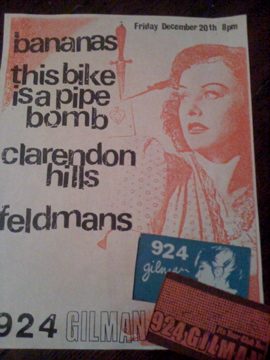
Show flier, and about 100 old Gilman cards. #scenecred
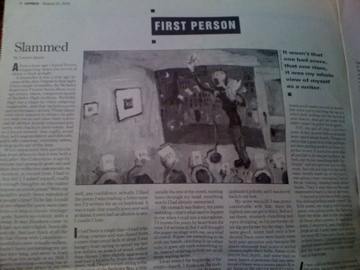
Second print piece I ever published, in August 2000.
New Kids On The Block newsletter I self-published back in the 2nd grade. Note the rub-on letters. #scenecred
45-page novella I wrote in the 4th grade, about little girls who had a secret club.
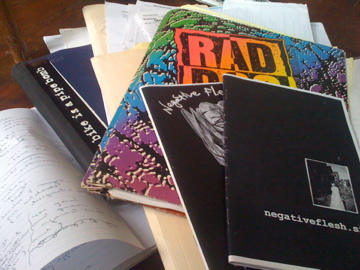
Mountain o' notebooks, zines, poems, etc.
And I think if you looked at it, without knowing me, you’d think, “Holy shit, this girl loves to write.” Cause that’s what I thought—surprised by it, startled like an animal in the lights of it, the reams of evidence—which I guess goes to show you how little you can know yourself. Like I’d forgotten, you know, how much writing has always been with me: the poetry and the zines and the pseudo-chapter books and the stories I dictated to my dad before I even knew how to write, that he transcribed for me and I somehow saved, in a dusty old box all these years later.
It’s kind of astounding, the sheer volume, and that some of the lines strike me as good. Really good. As in, “Holy shit, I wrote that!” It’s been a curious experience, like viewing my life from the outside, and it’s caused me to ask myself: Why? Where does this all come from? And the truth is, I couldn’t tell you why I write, where this need in me comes from, anymore than I can tell you why I travel. I’ve read great essays on these topics, even tried to write a few myself, but in my most honest of moments, I have to admit that I have no idea why, except that there’s that thing in me “that will not be still.”
So I guess you could say that digging out all this crap has helped to remind me of who I am, the fact of who I am (which might be different from what I tell myself)—that I didn’t just make this up, that I really have always wanted to write. And more than that: I’ve always written. Funny, that I’d have needed all this evidence to remind me.
But then there’s reality, which is that you can’t hang on to everything, save all these Xeroxs and yellow legal pads and notebooks that you really only ever go through when you move. It’s too much to possibly ever read, and besides, I’m trying to avoid the whole storage unit thing. So I set up two piles, the larger of which goes into the recycling bin, and I sift through and save the gems and take my own little stroll through Memory Lane.
Goodbye motorbikes droning and motorbikes honking.
Goodbye face masks and flesh-colored socks,
Goodbye pajama suits.
Goodbye dragon fruit, goodbye jack fruit,
green mango with chili salt from a push-cart.
Goodbye cane juice in a plastic bag.
Goodbye cows in road and chickens on the bus,
Goodbye water buffalo rising
from puddles in the rice paddies.
Goodbye orange robes and incense,
clusters of bananas
fanning open at the altar.
Goodbye karaoke
and pop music videos on the bus.
Goodbye wedding tents.
Goodbye mosquito nets.
Goodbye heat rash and swamp bra.
Goodbye hand-washed underpants hung to dry.
Goodbye cheap cigarettes and expensive muesli.
Goodbye “cheap cheap,” goodbye “same same,”
Goodbye mile-long mole hair,
Goodbye aerobic dancing at dusk,
Goodbye tissues under the table,
plastic stools and street stalls.
Goodbye haggling with fingers and haggling with calculators,
Goodbye maze of the market,
sleeping on top a pile of clothes—
Goodbye tubs of flopping fish and plucked limp birds
hanging from hooks.
Goodbye currency conversions and foreign transaction fees.
Goodbye photocopied US money
half-burnt on the sidewalk.
Goodbye no sidewalk,
walking in the street.
Goodbye bootleg guidebooks with cheap spines,
bootleg DVDs with blurry casings.
Goodbye thunderstorms,
Goodbye heat.
Goodbye widows with shaved heads,
Goodbye schoolgirls in sarongs.
Goodbye children begging and children waving,
children perched
between their parents on a motorbike
sleeping amid the fury.
It was really not the time to be thinking of Charles Bukowski.
I stood staring at a display of UXO casings at a Phonsavan tour company. I was thinking of the documentary I’d seen the night before (see previous post), which followed a group of impoverished Lao children as they harvested UXOs for scrap metal.
Something panged in me, and I thought of the poem.
It was the same something I’d felt at the War Remnants Museum in Saigon. I stood before pictures of children born with mutations from Agent Orange—small and crippled and bubble-skinned—children who’d been born after the war, hadn’t lived through the war, but who had it in them, possessed it in their DNA. If the images hadn’t been so brutal, I’d thought, they’d have been a metaphor for the intergenerational transmission of trauma.
I’d been surprised in Vietnam, to discover how much of the war I’d carried in me, without knowing it. I hadn’t realized how much a part of American culture the Vietnam War is—in our books, our films, our movies and our freeway exits, cardboard signs and thousand-yard stares. I’d remembered, suddenly, visiting the Vietnam War Memorial in Washington DC as a teenager—muggy-skied and sweating, watching the grown-ups trace hands along the reflective stone, place flowers and cry—not understanding it. I’d turned; my mom had been one of them, the name of her cousin under her fingers.
And I’d suddenly remembered the poem.
It’s more muddled in Cambodia and Laos, places were the American activity was “secret”—it’s less a part of your consciousness, more a part of something else that you can’t quite name.
“People from my province,” the Cambodian boy looked sheepish as he told me, “they still hate Americans. For the bombings.”
I nodded one, two, three times. “And you know what? America bombed Cambodia in secret. And most Americans still don’t know about those bombings.”
We sat beside each other waiting for our numbers to be called at the cell phone shop. Neither of us had been alive during the 70s.
I’d wondered, as I looked at bomb ponds beside pre-Angkorian temples in Cambodia, how one goes about being American in all this. “‘I wasn’t born yet,'” I wrote, “doesn’t seem good enough.”
And looking at the pile of UXOs in Phonsavan, I had the same thought rise. Because the kids out there harvesting these bombs, they weren’t born yet either. Neither of us asked for this, did this, witnessed this, lived through this. We were born into this, are left to figure out what to do with this, dig through the dirt of this.
And that’s when I thought of the poem again.
I’ve been composing some kind of essay in the back of my head about all this. I don’t know exactly what I have to say about it yet, or if there is anything to say about it. But in the meantime, I’m thinking of a poem that seems fitting. And, in the light of the recent string of natural and political disasters, doesn’t seem so dramatic or fanciful as it once did. It doesn’t feel so hopeless either—it just feels accurate.
Lauren Quinn is a writer and traveler currently living in Hanoi. Lonely Girl Travels was a blog of her sola travels and expat living from 2009 to 2012. She resides elsewhere on the internet now.






 Lonely Girl Travels
Recent Comments