Archive for the 'Punk' Category

Where Do Dirtbags Go for Valentine’s?

One of Aly's photos from the Burlington Hotel

It happened like this:

Making the rounds last Friday at the Art Murmur, I came across the photos of a friend of mine, Aly Su Borst. They were pretty bad-ass: a series of self-portraits set in some run-down opulence that got my spooky/awesome sensors spiked. I took some photos on my phone. At home the next day, I showed my roommate, “Hey, Luke, check out Aly’s photos.”

“Oh, rad, Port Costa.”

“Where’s that?”

That’s how I found out about the overnight destination all the local dirtbags have apparently been partying it up in for decades. And like most things, I’ve found out just in the nick of time: the reputedly haunted, ramshackle old bordello/hotel that serves as the heart of the 250-person town of Port Costa (that despite being 30 miles from my house, I’d never heard of) has plans to spiffy itself up, and recently received coverage by the San Francisco Chronicle. I knew no time could be wasted—I booked a room for this Saturday night. It’ll be a Valentine’s weekend overnight the way I like it: full of bats, bedbugs, dive bar denizens and rock n roll.

The Chronicle’s article made the Burlington Hotel sound like the very definition of “hidden gem”—not in the Tuscan villa sense of the word, but in the gritty, visceral sense—which is to say, the sense I dig the most. Whether it was in fact an old whorehouse, and whether it is indeed haunted by the ghosts of prostitutes and shipyard workers, one thing seems for sure: the Burlington Hotel is a relic of the Old West California, the one Jack Black captured in the book You Can’t Win—the one that’s all but gone amid the Botox and SUVs of Southern California, and the Blue Priuses and Tibetan prayer flags of Northern California. Which is why I want in.

It won’t be a relaxing, rejuvenating or romantic getaway. Its Yelp reviews reveal as much: “dirty,” “bad-ass,” “like a horror movie,” “whore-tel.” One person laments that it’s no longer the all-night rager spot it had been in previous years (frequented by the likes of none other than the East Bay Rats—nuff said). A raucous bar next door constitutes much of the clientele, including “bikers, transients, nazi crack addicts, and drifters. maybe tourists are in there somewhere, too.” (Really, there’s some effing gems on the Yelp page, read through that shit.)

Already pretty convinced, I came home from work the next night and found Liz and Melissa on the couch. “You guys ever heard of the Burlington Hotel?” They turned their heads slowly towards me. ”Oh. Dude.”

They swapped debaucherous stories from their hard-partying youth—Liz being haunted in Room K, Melissa’s heshen friends getting permanently 86-ed (which apparently is saying a whole lot). “Make sure,” Liz advised, “that you bring your own sheets. Bedbug city, yo.”

I called to make a reservation, which wasn’t quite as difficult as the Chronicle article made it out to be. After a long succession of rings, someone picked up; muffled and scratchy, he told me they weren’t quite open yet, but to call back in a half-hour, and they’d be ready to “rock n roll.” I did, and they were. Butt rock blared in the background. All the rooms I’d been advised were the best were, of course, full, but I did get in on the “special” (Valentine’s Day special? probably not): the room and 2 surf-and-turf dinners for $99 total. Now that’s my kind of overnight.

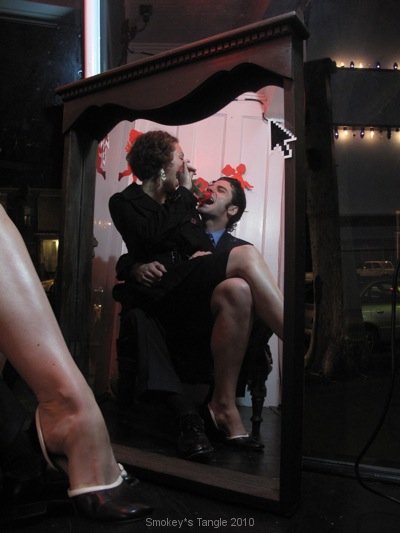
Ridiculous photo from the Smokey's Tangle V-Day Photo Booth, February's Art Murmur

So sadly, since the Chronicle recently did a piece on the hotel, I’m gonna have to dig a little deeper to a) out-do their article, and b) find the right publication for it. The good news is that my partner in crime is bringing along his fancy camera, so the photos, well, they’re going to kill. Hopefully not literally.

Forget the Guidebook, This is the VICE Guide to Travel

Dolores Park: "You would think VICE Magazine threw up there."---SF Comedian Ali Wong

At the risk of sounding like a gold-lame-wearing, ironic-mullet-sporting Dolores Park denizen, I’m gonna say it: I like VICE Magazine. And I fucking love the VICE Guide to Travel.

Quick run-down, in case you don’t know: VICE grew from a Montreal zine into global empire of youth counterculture, serving as a kind of hipster voice of a generation in what some could argue was the next CREEM magazine. By 1999, VICE had exploded on to the hip-slick-and-cool scene. A free, glossy magazine peppered with American Apparel ads, you’d find issues at trendy clothing stores and serving as coasters on your friends’ coffee tables, or stacked beside the toilet for inspirational reading material. Having reached new heights of hipness, VICE was nearly immediately deemed as have “been better” in previous years, in the perennial way that everything was better before it got big. But here’s a little secret about VICE: it’s got some killer articles. Some are better than others, for sure, and many breach a little too far into the snarky, too-cool-for-school realm. But I’d argue a good half of the magazine is usually filled with quality journalism, covering super interesting international cultural phenomena.

Which leads to the VICE Guide to Travel. It’s not Rick Steve’s, or even Lonely Planet. VICE goes to some of the most fucked locations on earth, “the kinds of places that nobody else wants to visit”; digs up shocking and bizarre stories; sends sweaty dudes in v-neck t-shirts to interview warlords/cannibals/other locals; films it all, and sets it to a soundtrack of doom, gloom and rock. It’s “edgy,” it’s “off-the-beaten-path” (to say the least), and it’s some of the most bad-ass travel journalism out there.

First, some clarifications on the meaning of “bad-ass.” Empty, self-serving sensationalism with no emotional depth or historical perspective is not bad-ass. And there’s plenty of that out there in the travel world.

A couple months ago, I complained about this kind of trying-to-be-bad-ass-edness in a post blog and subsequent Matador article. Later, I came across an article titled “5 Totally Bad-Ass Travel Experiences” that made me want to vomit. The article listed 5 “daring” travel experiences, two of which capitalized on some of the most heinous aspects of a country’s history. The perspective reeked of a privileged disconnect with the suffering caused by events like genocide and drug wars:

Home to one of the biggest genocides and mass killings in modern history, Cambodia is awash in guns and weaponry. It’s a pretty peaceful place these days but there are still opportunities to get a taste of the weapons of war.

Oh, well, bummer the murdering is over, but at least there’s still cool guns to shoot off. I wanted to reach through the computer and punch the writer. Granted, the article struck a personal nerve; I guess when you know people who escaped the Khmer Rouge, but who’s families all died in the killing fields, well, that takes the thrill out of shooting war weaponry in Cambodia.

What separates the VICE Guide to Travel from lame travel “journalism” like this is skill (they hire professionals)—but more importantly, approach. Traveling to some of the most depraved and damaged places in the world, VICE toes the line, certainly runs the risk of lapsing into one-dimensional exhibitionism and aren’t-I-cool pats on the back. Some in the series are stronger than others, but I’d argue that all stay true to the basic purpose of bringing obscure, untold stories from the gnarliest corners of the world to a Western audience. The liner notes of the original 2006 DVD explains:

The news is all bad. Sitting in our Western comfort, it’s easy to forget that most of the world is hell. War, disease, famine, genocide, and poverty dot the globe like big chunks of cancer. Basically, humans are fucked.

We thought we already knew something about current international events, but we didn’t really know shit until we set out and started doing some serious traveling. These aren’t vacations to Disney World, Paris or even some Outward Bound safari. These are trips to the places that you see once in a while on TV and think, ‘No way in hell am I ever going there.’

Well, we went so that you never, ever have to go for yourself as long as you live. We went, and we’re glad we did. Here are the stories to prove it…

What the VICE Guide to Travel offers is what some of my most difficult, but ultimately most illuminating, travels have: a new perspective on this crazy-ass world we live in. It’s tough to watch—the visit to the shell of a high school in the episode in Chernobyl made me tear up—but I think it’s some of the most interesting and important stuff out there in the travel world.

Which brings us to the new series, the VICE Guide to Liberia. The 8-part series is being released on their website; currently, the first 4 installments are up. Prepare yourself: this is some severely brutal material.

While I don’t think I’ll be going to Liberia any time soon, I’m glad that these guys did, and that the stories they found are getting told. In a world of SEO, Twittered trends and Top-10 lists, the VICE Guide to Travel gets down to the unmarketable, inconvenient bone of what travel (for me) is all about: seeing how other people live, and glimpsing into the strange stories that compose this world.

(Okay, so, it may or may not be a secret fantasy of mine to one day tag along on one of these installments. But for now, the website’ll due.)

Subtle Like T-Rex: My Obscure Top 10 Travel Songs

Just in case there’s someone who hasn’t got enough of the Top 10 list, get ready for another nail in coffin.

When it comes to songs about travel, there’s plenty looming giants that drown out the subtler stars. Now, I love “Route 66″ and “On the Road Again” as much as the next red-blooded American. And I’ve got a well-bred affection for “Graceland,” “Booby McGee” and “I’ve Been Everywhere.” But when it comes to the songs that really get my feet itching and fingers a’packing, it’s all about the lesser-known jams.

Call it the forever-to-the-contrary, anti-mainstream, cranky old punk in me, but I think these songs kill the more widely embraced classics (though, baby I was born to run too). I’ve listed them vaguely in order of ranking, but more in terms of a flow fit best for you’re listening pleasure.

In the spirit of old mix tape, my early Christmas present to you:

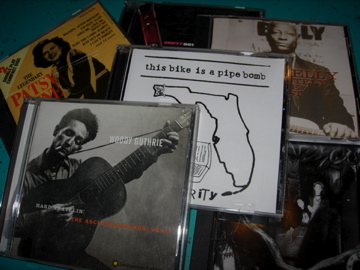
1. Hard Travelin’, Woody Guthrie

Whenever a bus is delayed or flight canceled, I wanna bust out a harmonica (that I don’t own and can’t play) and break into a freestyle rendition of “Hard Travelin’”. I may have been born three generations too late to live the train-hopping, vagabonding hobo dream, but Woody’s keeping it alive for me.

Best Line: “That mean old judge done said to me / It’s 90 days for vagrancy / And I’ve been hittin’ some hard travelin’, Lord”

2. Ramblin’ Man, Hank Williams III and Melvins

Not the Allman Brothers. With the heart, soul and twang of the original in his DNA, Hank Williams III buddied up with, that’s right, Melvins, and well, they killed it.

Best line: “I can settle down and be doin’ just fine / Till I hear those freights rollin’ down the line / Then I hurry straight home and pack / And if I didn’t go, I believe I’d blow stack” Amen.

3. Ready for More, Murder City Devils

AKA, the best show you went to in 2001 (really, no one lights their drums on fire anymore). The boys that made the trucker hat cool wrote this one about the exhaustion of hard-partying touring/traveling that only copious amounts of cocaine can fuel you through. I may have missed the boat (or tour bus) on that one, but I can get down with the angsty howlings of Spencer Moody any day.

Best line: “And I’m subtle, subtle like a T-Rex / And I haven’t even started yet / One week on the road / One week, and I’m already wrecked”

4. I’m Moving Along, Patsy Cline

With the guts and growl that can only belong to one woman, “I’m Moving Along” is an anthem for anyone that’s split town to heal a heartbreak. The way Patsy belts out that last line always make me wanna grab a suitcase and slam the door on whatever’s bumming me out at home.

Best line: “I’m moving along, I gotta be free”

5. Gone Till November, Wyclef Jean

He may be pretentious at times, but god damn, it’s a pretty song. If you’ve ever had to reconcile the traveling lifestyle with leaving loved ones at home, this is the jam for you.

Best line: “See you must understand, I can’t work a 9-5″

6. Sloop John B, Beach Boys

Not every trip is awesome. And even in the best of em, there comes that moment when, say, you’ve had diarrhea for two weeks and are really over the whole squat toilet thing. For moments like these, “Sloop John B” ’s refraining “I wanna go home, Let me go home” hits the swollen and tender spot.

Best Line: “This is the worst trip I’ve ever been on” (though, with Charles Manson running around the sandbox, we can’t be totally sure what kind of trip they mean…)

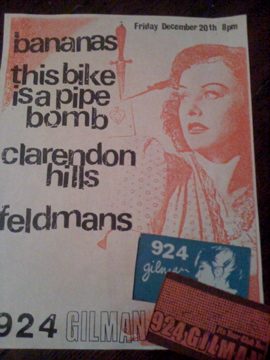
7. Board of Tourism, This Bike Is A Pipe Bomb

The touring-est band I’ve ever known wrote this cheeky tribute to the “attractions” their hometown Pensacola, Florida. It perfectly captures the two-bit claims-to-fame that small cities grasp at. And it’s adorable.

Best Line: Tie between the refrain, “We got a drive-thru funeral home” and “You know they even filmed a movie there one time / They had James Brown and gave away hot dogs”

8. Rock Island Line, Leadbelly

This song is the definition of bad-ass, by the guy that created the word cool. Nuff said.

Best Line: “If you wants to ride, you got to ride it like you find it”

9. Unknown Passage, Dead Moon

By another band that spent half their lives on the road, the hypnotic riffs of “Unknown Passage” hauntingly capture those road-tripping 3ams full of dark highways and strange landscapes. (And if you wanna know how to build a house, raise a family, travel the country six months a year, and rock and roll like it’s going out of style on less than $20,000 a year, check out the Dead Moon documentary by the same name.) Just don’t put this on if you’re trying to stay awake while driving.

Best Line: “There’s a red light on the hill / And a bridge out going down / There’s a city limits marker / Of an unfamiliar town”

10. So International, B-Legit Featuring Too $hort

Nothing like a little local love to round it out. Hometown boy Too $hort teams up with B-Legit and flows about, well, mostly having sex around the globe and flying first class. Can’t relate, but the hook is catchy as shit.

Best Line: “Yea, we fly first class, touch down like pimps / What’s the next event, tell me what town it’s in”

Sola: A Fetal Manifesto and Healing Tattoo

My swollen arm, looking more like my calf

Swollen and bruised and freshly tattooed, I’ve decided that there’s more to this “lonely girl” thing than a catchy title and purchasable domain name. It’s got to do with an approach towards travel, and maybe even an approach towards life, that’s developing inside me, embryonically. And at the center, the tiny heart between the budding limbs, is solitude, going at it sola.

There’s plenty of articles and blogs out there lauding the benefits of solo travel. Solo Friendly and Solo Traveler are devoted entirely to solo travel, with service-oriented tips and how-tos, while Women on the Road focuses exclusively on encouraging women to backpack. Independent-traveler sites BootsnAll and Matador have featured articles discussing pros and cons, and urging readers to take the solo plunge. The benefits promoted are fairly obvious—the freedom to do what you want when you want—as are the chief drawbacks discussed: safety and loneliness. Nearly every article and site on solo travel I’ve encountered has urged all travelers to go at it alone at least once.

I could write something similar, talk about how traveling solo forces me to be more social, to interact more with my surroundings; how it teaches me self-reliance and thus self-confidence; how I relish in the freedom of it; how none of my friends that can afford to travel are able to take the time off to accompany me anyway. But underneath and inside all those benefits is something harder to explain but ultimately more appealing, a kind of central gravity that all the other pluses of solo traveling orbit around: solitude.

It’s both positive and negative, both the exalted glory of Rilke and the insanity-inducing agony of solitary confinement. It’s a gnarled old wizard dude with a staff and a lantern, setting out into the craggy blue of the Hermit tarot card, now etched into the tender flesh on the inside of my arm, swollen amid the lymph nodes and brachial veins that hold me together.

On my last trip, I met many incredulous, widened eyes that asked, “You’re alone?” Then, declaratively, both impressed and horrified, “I could never do that”—in the way I’d respond to someone who’d climbed Mount Everest: good-for-you, thanks-but-no-thanks. People told me I was brave, fool-hardy, a feminist.

The truth is, I never really considered the fact that I was traveling alone; it rarely factors into my trip-planning, doesn’t strike me as odd or especially intrepid. It is what it is. Of course I’ll be alone. Who else am I gonna drag off around the planet?

But things like that, core characteristics and fundamental truths, rarely strike us as odd. Or even occur to us at all. They’re so central to who we are and how we live in the world that we aren’t aware of them. They strike us suddenly, in strange moments of lucidity—the porcelain-clutching “moment of clarity” in which one finally realizes she’s an alcoholic, or my mom’s recent epiphany that “we were the crazy white family in the neighborhood.” Or when someone else points it out to us, in the dingy back of dingy taxi, when you tell them you’re traveling alone.

For me, it goes back to my travel roots, which aren’t travel roots at all. It’s where I first learned to be alone in the world—the raggedy-ass East Bay buses. During my hour-and-a-half commute home from a far-away high school, I learned all the things international solo travel would later confirm and deepen—self-reliance, self-confidence, how to handle dicey situations and dodgy characters. It was especially important as a female. Honing my street smarts and learning how to carry myself and not take shit have been invaluable. And not something not every girl learns. The lessons taught on the hard plastic of AC Transit buses equipped me to travel sola everywhere from Colombia to Morocco.

But there’s something more inside that, something deeper and more fundamental than knowing how to watch your back and tell someone off with your eyes. More than even the confidence of knowing I’ll be able to figure out and make it through whatever crazy-ass situation I end up in. What is comes down to is a kind of comfort and security in who I am, and the way in which I never feel more like myself, the who-I-am underneath whatever’s happening in my life at the time, than when I’m alone, out in the world. It’s not the same sitting here in my bedroom typing; it’s gotta be out there, walking the streets and riding the buses of this world.

I think everyone should travel solo once in the same way I think everyone should be forced to wait tables once: it’d be nice, but not gonna happen. I don’t think solo travel is for everyone, but it’s become a defining part of how I experience the world, how I exist in it. I simultaneously delve deeper into myself (“the teacher within,” as they say in yoga) and my surroundings. I experience the world from a more intuitive, back-of-the-brain place, where I’m okay with it not making sense, where I find a way to somehow swim through the chaos and insanity and all-too-often heartbreaking cruelty of it, and tap, however lightly, on the beautiful something at the center of it all. I’m more able to trust that I’ve got a place somewhere amid it all.

During my four-hour detainment by the Venezuelan police a few years back, the female officer kept looking at my passport, me and back again, and asking, “Y estas sola?” She couldn’t believe I’d venture off in some other country by myself. However much of an evil, child-abusing American I might have been (it’s a long story), my being sola amazed her. And may have had something to do with me weaseling out of the situation.

I suppose it would have been more accurate to get a feminized Hermit card tattooed, but the beard was too Zeppelin-y to forfeit. And I feel cheesy having an uber-symbolic tattoo, to finally have some kind of answer for the middle-aged customers that look up over their reading glasses at me and ask what my tattoos mean. Most likely, I shrug and continue to say, “I just thought they looked cool.” At least until this approach, this fetal manifesto, is a little more gestated.

Life is Cheap But Living is Expensive: Hickey, the Dot-Com Death March and Why There’s No Good Bands in San Francisco Anymore

I love iTunes shuffle. On those long, bumpy bus rides through pebbly Moroccan deserts, when you’ve decided you’re sick of all 8,000 songs on your iPod, you set that baby to shuffle and bam—some blast from the past you’d totally forgotten comes blaring outta little white earpieces. And during my last trip, that blast was Hickey.

If you weren’t a Bay Area punk in the 90s, you probably haven’t heard of Hickey. A melodic punk band that came moaning, howling and screaming distortion straight from the strung-out heart of the Mission, Hickey may or may not have been the last great San Francisco band. But what’s for sure is that they captured the sound and sentiment of a time and place—one that’s bitten the dust amid the rising rents and impossible cost of living, now the nation’s second highest. And the setting for such incensed genius, the city that inspired so much of killer American music and art, isn’t recovering.

Hickey had all the makings of the legendary punk band: powerful songs that defied the typical versus-chorus-versus progression; a smattering of hard-to-attain 7″s; live antics that bordered on poetic insanity; a run-in with the Voodoo Glow Skulls over commercialization and a stolen trumpet; a tattooable logo; catchy melodies and apocalyptic lyrics—all enough to inspire a cult following. A naked cult following. The Naked Cult of Hickey was the self-given name for the ethos and devoted “movement” that sprung up around the band, capturing so much of the 90s Mission punk experience.

Despite the song title “Hickey is About Long Hair and Getting High,” the music, lyrics and passionate self-destruction the band epitomized was about more than just partying—it had the depth and pull of quicksand.

Hickey wasn’t about the type of apathetic disenfranchisement generally associated with Gen-X rock. Hickey’s brand was pure guts, the kind of heart and soul that can never really make it in this world, gain material successes or live past 30. Their lyrics and song titles read like some post-modern anthem of addiction (“The Prettiest Junkie in Town”), poverty (“Why buy what can be begged for, borrowed or stolen?”), snark (“Everything I Know About Sex I Learned From KISS”), co-optation of radical subcultures (“Revolution, $19.95″), and ominous fore-shadowing (“Make Sure There Aren’t Any Squares at My Funeral”). And all of it was delivered with a heart-breaking sensitivity that came shattering through the drug-addled haze, piercingly pure, like the face of the boy you love in a blackout. It’s the latter that ultimately hooked you in, grabbed down at something tender and swollen inside, with the hooting harmonies and lyrics of songs like “Hey Cutie Pie”: “hey cutie pie, it’ll be allright / i’ll be your frankenstein / you can dress me up any way you like / shoot me up with formaldehyde.”

On a rumbling black bus ride thousands of miles and lifetimes away, Hickey’s songs brought back the damp nights of the 90s Mission: alleyways and brown bags, bicycles and narrow Victorian hallways—kaleidoscopic images as jagged and cutting as glass, potent as any uncut rock. The sick-sweet sounds brought me back to a place, a pale and alcohol-swollen underbelly, that’s all but evaporated—been boarded up, kicked out and coffin-shut.

I arrived late to the party. I started going to shows when I was 15, a year after Hickey’s 97 breakup. But the Bay Area punk scene was still reverberating with Hickey’s influence. The 7″s played in friends’ basements; the comps floated amid the wrappers and busted CD cases of friends’ cars. Bassist Chubby did the cover art for the bootleg release of Dory Tourette and the Skirthead’s Rock Immortal, a cult-worthy, tragic legend in its own right. As Interpunk wrote: “They were only here for a little less than three years but the mark they left on the San Francisco bay area and DIY punk in general can still be felt.” Many SPAM Records bands played off Hickey and extended their aesthetic; it was only natural that the now-defunct label released the most definitive Hickey collection in 2002, “Various States of Disrepair.”

The album played in my Walkman for months. It seemed to scream so much of what I’d come in on the tailend of: the SF punk scene (also captured in Michelle Tea’s Valencia), but also a time when San Francisco had more grit and guts, and was a musical force to be reckoned with.

It just so happened that I was at a Mission Records show the day after Hickey lead guitarist and singer Matty Luv died. I’d only ever met him in passing, so I couldn’t share the tears and malt-liquor-fueled grief of his friends, wandering around in that particular flush-faced haze death inspires. But it felt that day, inside the smoke-stained walls of a threadbare backroom, like something bigger than just one person had died.

I was right. Mission Records, one of the last strongholds of the Mission punk scene, closed down shortly thereafter. Balazo Gallery endured a bit longer, before being absorbed into Sub-Mission art space—still on the DIY side, but lacking the spirit I remember.

The Mission punk scene fell victim to the same thing that strangled out the last vestiges of the famous San Francisco spirit, the same phenomenon that set artists, working families and low-income residents across the racial spectrum to the outlying cities of the greater Bay Area: the Dot-Com Boom. Gentrification with a URL. And despite the crash, San Francisco has been indelibly altered, homogenized by high rents, condos and redevelopment. Taken in context of what’s gone down, the Hickey lyric “life is cheap but living is expensive” takes on an added weight. The free-loving, easy-living San Francisco of Tales of City has been served an eviction notice.

But the Mission punk scene isn’t the first San Francisco party to end tragically. Decades before the Haight Ashbury high came crashing down as paranoid and hallucinatory as any bad comedown, the African-American cultural heart of the city, the “Harlem of the West,” was literally bulldozed through under the guise of “urban renewal”; 50 years later, blacks are only 6.5% of the population. As a child I bore witness to another SF party ending, as I watched my pretty young uncle grow thin, sarcoma-spotted, snatched by the dark hand that swept through the city’s bathhouses and bars, stealing so many lives. The death of the SF punk scene, and the larger gentrification that encompassed it, was just another dying in a long series of cultural deaths. It feels more personal because I was there to witness its asthmatic last gasps, convulsive as a fish out of water.

We don’t often think of San Francisco in such bleak terms. The city itself retains an almost innocent sweetness; its valleys and hills and gingerbread Victorians hardly seem the setting for something as sinister as cultural genocide. But when you’ve grown up here and watched the city been bled of its vibrancy by everything from AIDS to questionable city planning, you can’t help but feel a bittersweet alienation. It’s not the San Francisco that my uncle fell in love with in 70s, that my parents moved from Milwaukee to be near in the 80s, or that I partied in so desperately and whole-heartedly during the 90s.

It can be difficult to have as much sympathy for the Mission punk scene as, say, the Fillmore. To be fair, the Mission was gnarly, urine-drenched and windshield-splattered, and walking down the street as a skinny white girl in Converse was not fun. Much of the demise of the scene can also be chalked up to the good old sex-drugs-and-rock-n-roll lifestyle that snuffs out so many. And that’s without getting into the bigger and more impacting displacement of the Mission’s original Hispanic population (the neighborhood is the fabled birthplace of the burrito), of which the punks were the first discernible crest in the gentrification wave.

But what’s true is that the neighborhood, and San Francisco as a whole, had more room in the 90s. The space required for underground cultures and art to grow was narrowing, but still present. You could still, say, highjack the electricity from a MUNI line, roll out your amps and have a guerilla show at 16th Mission. A band like Hickey could never happen in the post-Dot-Com San Francisco. The Bay Area’s most vibrant art scenes and best bands are no longer based in the City By The Bay. San Francisco’s artsy image endures, with remaining collectives and spaces fighting hard to survive. But the city so many envision is now only in tacky guidebooks and tourist pamphlets.

On the Valencia side of the Mission’s Clarion Alley (run by one of the enduring community-based art collectives),  a tribute mural for Matty Luv remains: the Hickey logo, with the initials “ML” in place of the legendary “H.” If you weren’t around during the 90s, you wouldn’t have a clue as to the significance of that mural. You’d smile vaguely and trundle off to one of the innumerable trendy restaurants. You’d walk through the ghost-whispering fog, under the web of electric wires that sits atop the streets like a dreamcatcher and shoots sparks, images of lost friends and drunken nights. You’d be in the San Francisco of today, which only vaguely resembles the San Francisco you’d come to see. And the soundtrack, I’m sorry to say, would suck.

Thanks for Nothing / Everything

I celebrated this Thanksgiving at two long-standing Oakland events: Thanks for Nothing, the legendary potluck of punk debauchery, and my family’s annual Day-After-Thanksgiving party, legendary in its own right. Both events were a little less epic this year, with an intimacy that reminded me of what’s good about Thanksgiving and about family—as untraditional as they may come.

Anyone in the East Bay who’s ever donned liberty spikes and a studded anything has gone to Thanks for Nothing. And possibly passed out at it. Now in its 18th year, the Thanksgiving potluck is an Oakland punk tradition, a place for all the family-less kids in black to come together, at picnic tables under jimmied lights, and create their own family.

Of course, by “kids” I mean “punks” and not kids at all, anymore. These are the die-hards, wearing smile wrinkles and old band shirts—the folks that, once the scene-ness melts away, once all the other folks have grown out of what was just a phase, are still there, purely for the love of it. Punk may be mostly dead, but it’s not all-the-way dead; it just lives in the hearts of a small handful. And, on Thanksgiving, in an East Oakland backyard.

Thanks for Nothing has taken on a larger-than-life status; the woman that puts in on is convinced that even if she were out of town one year, people would still show up. They didn’t pump it too much this year—no flyers or MySpace posts, just word-of-mouth—and the result was a smaller, friendlier crowd, that was also a bit tamer. The event historically gets increasingly raucous as the evening progresses; as the steam from the turkey table cools and the toddlers konk out, staggering, slurring sing-alongs ensue (among other things). This year, the pot food table was nearly empty and the jar of homemade Bailey’s went fast, but the Jell-O shots were plentiful, tossed around in a haphazard game of catch that somehow didn’t end in neon goo being splattered across someone’s head.

Despite the uber-punk name, this year’s Thanks for Nothing felt more about community than anything else. Family, as most travelers know, isn’t really about blood lines; it’s got little to do with genes or ethnicity or even, as we learn on the road, nationality. Family’s about people that share similar values and perspectives coming together and sharing, growing together. (And at Thanks for Nothing, singing along to Cock Sparrer together.) It sounds more one-love than punk, more Berkeley than Oakland, but sometimes it takes unexpected manifestations to drive a point home.

But most of my “family” growing up wasn’t about blood lines—a lot of Californians’ aren’t. My parents moved my toddler brother and my infant self to California with only one blood relative within 2,000 miles. Once my uncle passed away, it was really just the four of us for holidays. Plus an ever-growing band of fellow Bay Area orphans. It seemed that my dad’s first couple of years in the fire department, he kept having to work Thanksgiving (turkey at the fire house!). So we started having all our family friends over the day after, when we’d sit back and talk and laugh and eat for hours. We invited everyone, and it became a kind of neighborhood affair. A tradition was born, and yesterday, carried into its 22nd year.

Like Thanks for Nothing, we don’t really need to invite people anymore; everyone just knows to show up. Charles deep-fries two turkeys in the driveway, Karen and Jamal make the marshmellow sweet potatoes, Nhu and Jacobo bring the bread pudding, my brother makes the famous firehouse Caesar (I used to make the vegan entree, but those days are long gone…). My parents’ small bungalow overflows; there’s an incessant wait for the one bathroom and a warm glow from the fireplace. It’s consistently one of my favorite days of the year.

The event was smaller this year, just under 60 people, and I had a couple bittersweet moments, missing people who used to come—people who’ve moved, who we’ve lost touch with, but mostly people who’ve passed away. But at the same time, there were folks there that I’ve grown up with, that I’ve known my whole life, that are the aunts and uncles and cousins I otherwise wouldn’t have really had, so many miles and states away.

Family is one of the most important things to me, as traditional or untraditional as mine may be regarded. Of course, much has been written about the “demise” of the American family, and holidays like Thanksgiving hold a particular weight for those from untraditional or un-intact families. But I’d argue that the American family isn’t crumbling, just reshaping; seeing as though this guy got a book deal out of the concept, I don’t think I’m alone. And as travelers know, the traditions of a family are some of the best glimpses you’ll get into a culture—whether it’s making stuffing with your play-cousin, or pounding Jell-O shots with punks. It may not be a Norman Rockwell painting, but it’s as close as some of us get.


I'm a featured blogger on Lonely Planet

Twitter It Up, Y’all

  • Pioneertown Motel closed indefinitely! So bummed. How am I gonna honky tonk w/o a Gene-Autry-themed room to crash in? 3 hours ago