Archive for the 'Bay Area' Category

Headcheese, Chicken Feet and “You Are What You Eat”: How Travel’s Beaten the Squeamish Eater Out of Me

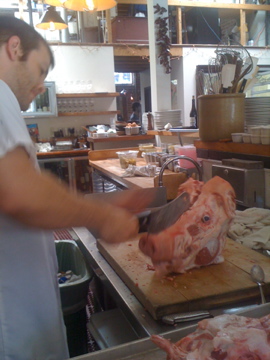
Jeffery was taking a machete to the disembodied pig’s head when I walked into work.

The other boys stood around watching. They looked up when they heard the door, grinned sheepishly at me. “Headcheese,” Colin said by way of explanation. “Sorry.”

I looked at the knives, the smeared aprons, the hunks of pig scattered about the wooden cutting board, and shrugged. “I think Southeast Asia has cured me of any squeamishness towards meat,” I laughed.

Food culture, it can be said, is a microcosm of culture. Traveling around, I’ve discovered that a society eats and its attitudes towards eating can be simultaneously one of the most telling and easily accessible aspects of a culture. In this way, eating in a foreign country is both a lofty, anthropological glimpse into the psyche of a culture, and a visceral adventure that often sends one dashing to the nearest squat toilet.

Case in point: there’s a certain semi-green queasy look Westerners wear when walking through a Southeast Asian street market. The plucked bodies hanging limply from hooks; the still-alive fish flopping out of their plastic tubs; the women waving fans at the flies that settle on heads, hooves, chunks of body; the smell of raw meat blooming in the humidity like irony mold—it’s all so utterly unlike the shrink-wrapped FDA-approved supermarket culture of the Western world.

And I’m not gonna lie: I was a bit unnerved at first. The literal rawness of market culture in Southeast Asia is jarring. Watching a teeny little woman crouch down in her pajama suit and hack off a chicken head seems brutal, surreal. Ordering a bowl of soup and seeing a chicken foot poke out of the translucent tangle of rice noodles is startling. And not at all appetizing.

Yes, I eat meat, your Westerness seems to say. But I don’t want to think about the fact that I eat meat. I don’t want to be confronted with the reality that I’m eating another living being.

When I was London a few years back, there was a big stir about Marcus the Lamb. It was being discussed on the talk radio station that played through my friend’s basement flat while we brewed morning coffee.

The story was this: as a lesson in the breeding and rearing of livestock, a primary school had adopted a lamb. The kids named the lamb Marcus, and did cute things like bottle feed him. Six months later, it was time for the lesson to culminate: Marcus was to be slaughtered. A shitstorm ensued.

Parents freaked, animal rights activists threatened, the headmistress was branded a murderer and some of the pupils were reported to develop stress-related insomnia. To their credit, the school officials remained firm: this was the point of the lesson—teaching urban children where their food comes from—and they weren’t going to cancel the lesson. A national debate raged, centering, it seemed, on the extent to which the urban, Western world has become disassociated from its food.

I considered this all as I chewed my toast in the gray London light. I’d been a non-vegan/vegetarian for a little over a year. During my 12 year run as a non-meat-eater, I’d maintained that meat eaters should know and acknowledge the reality of meat consumption. I wasn’t one of those PETA people plastering horror-movie pictures of slaughterhouses around town, but I’d always thought—Fuck, you eat the shit; you should be able to handle a head or a hoof or something.

And I had to hold myself to that when I started eating meat again at age 25. If I was gonna do it, I reasoned, I was gonna do all of it. I wasn’t going to hide from the fact of it, and I wasn’t going to be wasteful. Living in the Bay Area and working in the restaurant industry, it’s easy to make mindful, informed decisions about where one’s food is from, to nestle in the cozy, bedtime-story feeling a Cruelty Free label provides.

Way of advertising a butcher in Morocco. Flickr photo.

But then there’s the Southeast Asian food market. Or the goat head stew in a Moroccan medina. Or cabeza tacos in Mexico (or the Fruitvale, whatever). And by being confronted with heads and eyeballs and recognizable anatomy that doesn’t seem so different from our own, you’re also confronted with your Americanness, your Westerness.

But people are amazingly adaptable, and after a couple weeks you normalize your surroundings. You don’t look twice at the rows of raw meat, and you even acknowledge that while eating a fertilized duck egg is a mind-fuck—a bit like eating an abortion—it is goddamn delicious.

And then you come home and wonder what the fuck everyone is riled up about. Yeah, it’s headcheese, made from head meat, you think, What’s the big deal? Or you wait on a dude who sends back the whole shrimp on his plate cause the little head and eyeballs “Just ain’t cool.” And you think, Really, buddy? You’re a grown man; that’s just a lil ole head. But you laugh and shrug and say, “No problem,” cause you know that that’s just the culture he’s coming from. And it’s your job to make him happy, not to judge what kind of food he’s comfortable eating.

To say that Westerners, especially Americans, have become disassociated from our food is an understatement. (“Where does ketchup come from?” a friend asked her inner-city students once. “The store!”) You think of the old adage “You are what you eat,” and you wonder what the hell that means for us. It can’t, you reason, be anything good.

If you can tell a lot about a person by how they eat, what does a society’s food culture say about them? They say, for instance, that girls from alcoholic homes are exponentially more likely to develop eating disorders. If you extend that on a societal level, it’s a fascinating if unsettling picture of a national psyche. The ability of Americans, for instance, to feed themselves nourishing food in a way that’s free of drama and control and fad diets seems to have shattered, gotten lost somewhere; I think that the sanitized, shrink-wrapped, mass-produced foods we eat are a part of that.

We in the West, and especially the States, don’t know what the fuck we’re eating—or are so far removed from it we flip out at the potential of exposing our children to the age-old reality of meat eating. (For the record, it was the students themselves that voted to slaughter Marcus the Lamb. But one has to ask: would such a lesson ever even happen in the US? Assuming, of course, a school even had to funding for such a lesson…)

Growing up, my mom was convinced that the demise of the family dinner was inextricably linked to the break-down of the American family. She thus insisted that we all sit down, no matter how much homework we had, for a nightly family meal. This was, as you can imagine, infuriating for a moody teenager; I’d scowl at my plate until eventually someone would say something funny and we’d all sit and laugh and linger for an hour.

I’m grateful for that now, in the same way I’m grateful to have traveled to five different continents and gotten the squeamishness beaten out of me. There are some things I still won’t eat—shark fin soup, which is just plain wasteful; or that monkey-brain stew they make in China by pouring boiling water into a live monkey’s recently cracked skull—that’s just plain cruel. I don’t think I’m a particularly enlightened eater, nor do I think I’m gonna change the world by shopping at farmers markets.

I just think that I’ve gotten a bit more realistic, had a bit of my own barriers broken down. At least to the point that walking in on the making of headcheese doesn’t cause me to look twice.

Okay, so maybe I played with the eyeballs...

The Ghosts of Footsteps

Crisp blue and puffing chest, the glare of sunlight off the smooth flat of the Bay. My first run since a week-long flu, down along the Bay Trail, with its breezes and San Francisco views, pretty despite being directly beside a freeway.

I passed a little woodsy alcove. It’s mostly rocks and open space down there, but every now and then, beside a freeway exit, an overgrown patch of cluttered trees and shrubs is tucked alongside the trail.

I caught a glimpse between the leaves: a little stream, heavy from the rains; a long piece of wood placed over, a makeshift bridge; the dead remains of footsteps, the ghosts of footsteps, a path going in. Something was hiding in there.

I thought about the books I’d read as a kid—-Bridge To Terabithia—how kids in the country or in the suburbs, or in any event, not inside the city, would always have these places to hide. A creek or the woods, some undeveloped patch of something—a place they could escape to, along with their fantasies and maybe a stick to poke things with, to build empires in their minds where they were safe or powerful or in any event not in their own lives, some other place.

And I remembered how terribly jealous I’d be those kids—those kids in books, not real kids—because I lived in the city, and there weren’t any places like that. Or there were—under freeways, or the woods behind parks—but they were already filled up, claimed by junkies and derelicts with cardboard palaces, people retreated to their own fantasies, their own escapes, their own Not Heres.

There was a thin strip of dense trees behind the jungle gym at Children’s Playground, in Golden Gate Park. I’d wanted to go in there, to climb around, explore, find my own something magical. It was shady in there, I couldn’t see in, and I wanted to know what all mysteries lay in the damp earth and shadows.

“Don’t go in there,” my mother’d said.

“Why?”

“People live in there. There’s trash and needles and it smells.”

And I’d known, even then, that you could catch things with needles, things like death. I’d thought of sarcoma spots and sunken eyes, sick beds and the scatter of Chinese food containers, and I hadn’t wanted to go in there anymore, but I’d still wanted to go somewhere.

It was a good run. My shin splints didn’t hurt, although I did get a tightness in my chest, like a squeezing, that made me stop and walk for awhile. I stared into the open and soaked it in, and was ready to run again.

Sink, Alameda, Sink

December 9, 2003

“It’s a special kind of anesthetic. So we won’t be putting you completely under—you’ll still be lucid—but you won’t remember anything.”

Paper gown and stirrups, they injected the needle and you didn’t flinch.

You took it as a challenge: remembering.

You stared out of the window—out of the white walls made antiseptically cheerful, away from the faces and charts and the gleaming tray of tools—looked at a pond outside, gray water against gray sky, the geese sitting and splashing and silently honking—no noise, just their beaks moving in the shape of a scream.

The room went away, and the sides became black, tight, squeezing in, like the end of an old-timey cartoon—tunneling, until the whole world became that pond and those geese, trapped there in a December afternoon and a pinhole of consciousness.

And it’s like you weren’t there. You couldn’t see them working, couldn’t feel them working (working on you). You couldn’t hear them—or at least, you couldn’t remember hearing them, maybe a sound floated in here and there, but it didn’t stick to anything, memory like fly paper or that sticky tape the rats get stuck to and sometimes chew their own legs off trying to escape. So in that way, they were right.

You focused on the pond, out the window, struggled against the squeezing black. You fought for that pond, those geese (which now seemed like plastic geese) and you wondered if it was real or man-made—the pond, that is—whether the office park was built up around a marsh, filled in and cemented and paved clean, and the pond had been left there as a charming relic; or if it was added later, an empty lot dredged, a sliver of pastoral idyll amidst the row of generic 60s architecture.

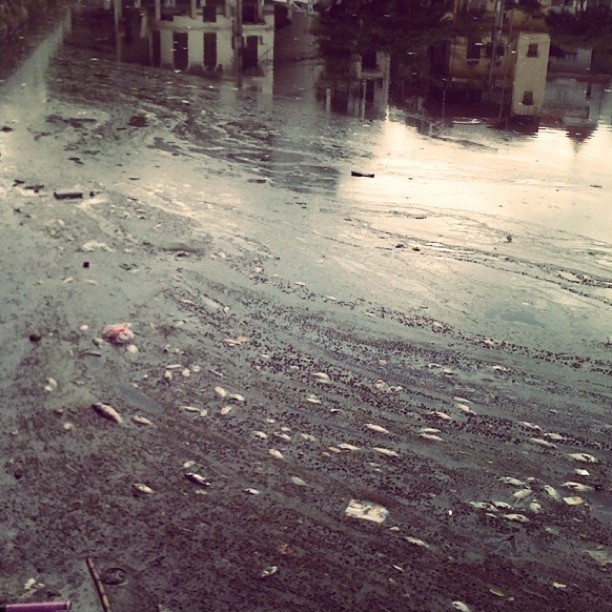
It was man-made, you decided, because this was Alameda and everything was man-made, an entire island of fabrication: unearthly flat, because it wasn’t earth; flat like the Bay, because it was the Bay. Because the Bay moved under the flimsy layers of landfill, murmuring, like a waterbed.

And they’d always said that if a big enough earthquake hit, the whole goddamn island would sink—crack and crumble and get swallowed into the water, because there was nothing solid underneath, just landfill, which you’d always assumed meant trash, like a trash patty, a whole city built on garbage.

And you imagined a big enough earthquake making the water reach up, tear apart all the little everyday cracks—in sidewalks and in the walls of old buildings—reswallowing the place: the office, the pond, the whole island. And you imagined those plastic geese rising up, flying off in a V shaped like an arrowhead, their beaks moving (open, close) in silent honking, which might have been prayers, or might have been screaming.

Because they didn’t need anything solid to exist, or anything unsolid either, but you did, or at least you thought you did—though whether it was the solid earth or the murmuring black underneath, you weren’t sure.

It was pretty fun, you told your mom later—a pretty good drug, all in all. Not one you’d do recreationally, there wasn’t enough of a high, but not bad at blacking out what needed to be blacked out, and keeping in some strange sliver of what didn’t matter, what meant nothing to nothing: the geese and the gray light of the gray afternoon. Which was, after all, all it was meant for.

Living With Vampires

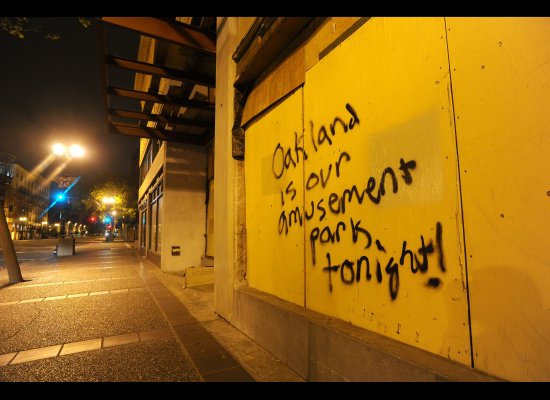
It’s vampire season in Oakland.

We sit at the bar, piles of cash and cigarettes and half-drunk bottles of wine—another end to another shift. It’s past midnight, and we’re all tired, itching to get home. “Just another ten minutes, I swear!” JL calls from the loft.

We sit there—all four of us—off the clock and waiting. Because we can’t leave someone to walk out alone.

I used to wonder as a little kid which would be worse: to live with werewolves or vampires? Werewolves could pulverize through anything, but you only had to deal with them one night a month. Vampires, on the other hand, were tricky, the color of shadows, and out there every single night. As soon as the sun went down, the streets would become a different thing, sinister, a free-for-all, an anything-goes zone where at any moment a pale, hungry creature could leap out and attack. And you could harbor illusions about fighting them off, but really, what were the chances you could actually drive a stake through their heart? You’d be defenseless, and all they’d see would be your virgin neck and throbbing vein and they’d want a drink—a drink of blood that was now theirs.

I imagined the constant stress, the constant level of awareness, the little ways that living with such creatures would reshape your life (“I left something in my car. Oh well, I’ll have to get it in the morning; not worth risking it.”), and in the end, I’d always decide that vampires were worse.

And it’s a similar feeling in Oakland right now—that when the sun goes down, the shadows come alive, and go on the hunt. There’s been a rash of robberies and violent assaults among the circles I frequent, enough that I can’t discount it as the usual fifth-most-dangerous-city-in-the-country shenanigans. No one can.

I forget how much it’s there, this constant consideration in the back of my head. I won’t take the train into the city if it means I’ll be coming home after dark; I don’t want to risk the walk back to my car from the station. I don’t go jogging at night—or at least, I drive up into Piedmont to do it. I suck it up and pay for parking in order to park right outside the restaurant I work at, so I again don’t have to risk walking farther than I have to.

But it’s gone a step further this year. After two guys I worked with got robbed at gunpoint leaving the restaurant, we stopped walking out even in pairs—we all leave work together now. After a girl from another restaurant got abducted, robbed and tortured, we won’t even let our manager stay late, even if her car is literally 50 feet from the door. She rearranges her schedule so that she comes in early, gets her office work done, and can leave with everyone else.

It’s like being a prisoner in a way. There’s no comfort in the fact that the fear applies equally to men and women, or that it’s not even fear that drive you all, but rather a statistical likelihood. When a third guy you work with got his nose broken last week, the reaction was largely anger—at him. “What the fuck was he doing thinking he could walk three blocks by himself?”

I keep thinking about Tirana, about my first late night at a bar, when everyone I’d come with had left.

“Where can I catch a cab?”

“A cab? You can walk, you know, it’s only 15 minutes.”

“Yeah, I know, but it’s late, and I’m alone…”

“Oh, but it’s totally safe.”

“I’d rather not risk it.”

A laugh. “Listen. In five years at the hostel, we’ve never heard of anyone ever having a problem.”

And it felt strange, walking through the two am streets, a foreign girl by herself. I couldn’t stop checking my back, walking briskly, staring down the few strangers I passed.

But eventually, I got used to it. And I almost felt giddy, elated by this strange sense of freedom—a sudden lightness and ease. Sometimes you don’t know what you’re missing until you get a taste of something better.

Just after one of the guys at work who got robbed, he posted a really telling Facebook status: “I knew it was bound to happen, living in Oakland caught up with me.” And it kind of broke my heart, because at times I feel the same way—like I’m just waiting for my number to be drawn. That I can be as careful and cautious as I’d like, but eventually, one day, I’ll let my guard down or take a risk, and it’ll be me, my turn, my time to get bitten.

When we finally walk out, it’s after one am. “That,” I sigh, “was not 10 minutes.”

“Nope.”

“But it’s not like we coulda left her there.”

“Nope.”

And we get in our cars and drive own separate homes, where we’ll circle to find the closest spot, walk briskly to the gate and slam it shut, tightly behind us.

If No Man Is An Island…

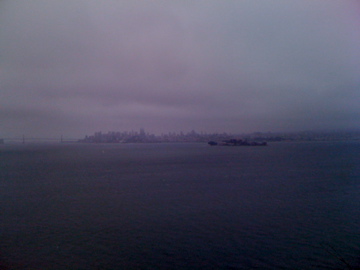
Alcatraz Night Tour—wandering around the haunted empty of an old institution, relighted and relabeled, black signs with white letters. All hard lines and sparse materials—cement and steel—littered with the footsteps of tourists, the little echoes we carry in our shoes and our voices and, in some of us, our hearts.

Because you live here, you’d never done it—because there was always some other chance, some other day, any day, it turned into no day, never. So when Nick said he was going to Alcatraz, fuck it, you said you were going too.

So you roved, like everyone else roved, wearing your headset and listening to the gravely voiced narrator of the audio tour, a well-cast choice by any measure. Former prison guards and inmates read their recollections, giving the tour more weight, more significance than it would have otherwise had.

You stopped in front of the steel doors to the solitary confinement cell, and listened to the weathered voices recall what they’d done to wait out the time in the blackness:

But if you would close your eyes—like right now, close your eyes, seal your eyes off with your hand—with a little concentration, you can see a light. And pretty soon that light will get brighter. And you’ve gotta concentrate on it—not a short while; it takes time and practice—but pretty soon you can almost put your own TV there, and you can see things and you can go on trips—and that’s what I did.

And it was an echo, the sound of a memory reverberating from some place inside. It was a night you’d stored away: summer, warm, the window open, the leaves cutting the streetlight into a thousand broken, dancing pieces. He laid on his side, held you under his arm, and you said you couldn’t sleep.

“Let me show you a trick.” And he said it softly—strangely soft, you’d thought, the way we’d whispered as kids in our hiding places, the places only children can fit.

“I used to do this when I was little, when I couldn’t sleep.” He rolled onto his back. “You put your thumbs against your eyes—you’ve got them there?—and you push. Not hard, but not light either. And keep pushing; don’t stop.”

You didn’t. You didn’t stop pushing.

“And eventually you see it.”

“See what?”

“Lights. Shapes. Anything. You go on a trip.”

And he got real quiet, and you listened—listened to the horrible silence and waited for your own show, your own little light parade. You saw only faint traces, dim colors, a couple gray buzzing lights.

He rolled back on his side, towards you. “Where did you go?”

You looked down, ashamed, though you weren’t sure why. “I don’t know. I don’t think I went anywhere.”

And he didn’t say anything, just traced your belly with the tips of his fingers—the fullest part of your belly, the part you hate and pinch and suck in in front of the mirror—and you felt so fucking lonely you thought you might die, that some part of you might die.

And it was the same feeling, standing there, alone with your headset in a silent group of wanderers. Like being a tourist in someone else’s loneliness—or rather, the ruins of someone else’s loneliness, what was left after the guards had gone and the light—now strange and harsh—had returned. Listening to their tricks, the little games they played (Your dad telling you, “Sometimes I’d bite the inside of my cheek, slowly, until it’d start bleeding and I’d play with it.”)—the ways they’d learn to escape, if only for a moment, into some place so deep inside that some piece, it seemed, never came back.

You blinked. You pushed the rewind button and the voice stuttered, restarted, and you listened again. And it was his voice, inside this other voice, and you remembered how you’d put it in a poem—or, you’d tried to put it in a poem, but it’d never amounted to anything, never quite fit, a parenthetical metaphor you weren’t quite sure related, or how it related, until right now, here, under the institutional glare of a tourist attraction, Alcatraz.

You half-smiled—what else was there to do?—and continued on with the tour, walked through the door in the steel bars into another emptied room.

Boiler Room, Angel Island

Abandoned by time but not escaped from it. Rust and debris, peeling paint and the pages of old magazines, broken glass so old its become smooth. Like some dim chamber of our hearts, we climbed into the boiler room.

Angel Island is full of abandoned buildings, the crumbling concrete and sagging frames of old military structures. A big mound in the middle of the Bay, smack in from the Golden Gate, the island is more than brown grasses and hiking trails. It was a detention center/”immigration station” during the Chinese Exclusionary Act, then an Army Post during World War II, later a missile center. Now it’s a state park, filled with picnicking families, kids on field trips, tourists on Segways.

Summer in San Francisco...

It’s nice to spend a day roaming around, out in the middle of the Bay—packing a sandwich and riding the expensive ferry and taking the long, gentle walk around the perimeter. But what I love most about Angel Island are the abandoned buildings.

Some are open to the public, stairways smashed out so there’s no chance of climbing up into the desolate upper stories. You wander around the ground level, the empty gutted rooms, staring up past the chicken scratch graffiti, wishing you could poke around the dusty remains above, crunch your sneakers through the silence.

Other buildings are fenced off, doors bolted and windows shuttered, large signs warning of the repercussions of trespassing. The grass grows up around these buildings, consuming them; sometimes you catch shadows in the broken windows and they look like your own.

We circumvented a large, fenced-off building, found a spot relatively hidden from the main path. It’d been a long time since I’d hopped a fence, wedged my toes between chainlink and landed ankle-sharp with a laugh.

We tiptoed towards the building.

The boiler room. Heavy, huffing machinery now silent, steamless, bellies swollen with the memory of a howl. Old basins and the criss-cross of empty pipes, useless and buckled. Nameless parts of an old operation. A map on the wall of where tools once hung.

We crunched around, slats of wood and indistinguishable debris, the flattened beer cans of some lost era. There’s something about crumbling places that make you whisper, a kind of reverence—not just for what has passed, but what has remained, aged and weathered and somehow still standing.

It reminds you of your own ragged heart, those places you’ve closed off, chained off, boarded up and shut. But they’re still there—forgotten, maybe, but not empty, bloodless pipes waiting, dreaming of steam.

And sometimes, something goes traipsing on in there, flicking lighters and echoing voices and leaving new footprints, in a place you swore no new footprints could go. A place you swore was sealed shut and secretly dying.

We trespassed into the abandoned boiler room, then stepped back out into the dim squint of a fog-heavy noon—our lives.

Sunday Morning on International

Sunday morning on International Blvd. A sidewalk laced in fog, car exhaust, the sick-sweet smell seeping from panderias. Little girls in patent-leather shoes, dudes crouched and smoking and speaking in Vietnamese outside the street shop: “Good tattoo ain’t cheap, cheap tattoo ain’t good.” The rattle of shopping cart wheels, the bark of fenced-in dogs.

I’m running late. I’m going to the 11am meeting at the In Between, a beat-up converted barroom now filled with folding chairs and faded banners, where we sit and curse and laugh, talk about God and booze, “hmm-mm”ing and “uh-huh”ing and drinking cheap coffee that stains our teeth. I love that place, its dusty corners and dying plants, the sag of the window frames.

I pass the bright blue letters of Iglesia de Buen Sabor, a storefront church with white bars over its frosted windows. The tambourine rattle and exalted voices of its congregation pours out the open door, from a faceless place—always black inside, when looking in from the street.

I make eye contact with a man standing in front of the doorway. He has a look of well-groomed desperation: cheap suit, overly combed hair, shoes shining like little black teeth. He’s got one crippled arm, bent and with a tangle of underdeveloped fingers; he cradles it next to his body as though he were holding an infant, or a small injured bird. I give him the half-smile and nod of a hello in passing.

He steps towards me. “Hello,” he says. “My name is Juan Carlos…” he continues on with a couple more names, surnames and second middle names. He leans his small hand towards me.

I pause mid-stride, take his small hand. “Right on, man, good to meet you.” It feels limp and strange in my momentary grasp, and I try to amend my handshake, make it softer, let it fit the contours of his curled-in fingers. “I’m running late, though—” I start to step away.

“You have a lot of joy in your heart.”

I stop, look at him with a slightly cocked head. “Thanks.”

He nods, smiles, then steps back into the black swallow and tambourine roll of his doorway.

I cross the street and squeak my own door open.

Southbound

Fog so heavy

it wept

the dust from my windshield

/

what I’d carried with me,

wore on me,

up and over

a road soggy with night—

always becoming, becoming

just up ahead.

/

So this is driving

across the Golden Gate—

yellow halos,

the swallow of white,

pillars into nothing,

and beyond

the railings—black, black,

the hiss of black

underneath the stereo speakers,

whispering, “this is the end

of the continent”

/

and you can’t even see it.

Travel Tip: Get Inventive

What to bring and how to pack—it’s always a hot topic. But no matter how well you prepare—no matter how many water purification tablets and rehydration pills you stuff into your waterproof, weather-resistant backpack—you can’t anticipate every twist and turn you’ll encounter on the road.

At some point, you’ll need to get inventive.

Let’s say you do something as innocent and seemingly unadventurous as going on a day hike. Now, some people tromp off with walking sticks, CamelBaks, and a fanny pack full of First Aid supplies. But those’re also the same folks that wear their jungle-proof hiking boots in the middle of the city. (In your preparedness, you must also consider fashion.)

Let’s say it’s a hot day at one of your top 3 travel secret spots. Let’s say that Bass Lake is sparkling cool, and filled with the intertubes and joyous clamor of hikers. You paddle out with a friend and see carefree bodies flying through the air, limbs ecstatically free for one airborne moment before splashing ceremoniously into the murky dark.

Let’s say you forget that both you and your friend are total effing city kids and have never once been on a rope swing. Let’s say that you don’t stop to consider the physics of the situation, the centrifugal force and the fact that some technique might be involved. Let’s say that all that’s going through your mind is—”Fuck yeah, rope swing!”

And let’s say that both you and your friend completely gnarl your hands and are left treading water with a mess of twisted and bloodied fingers.

It’s time to get creative.

First off, remember your First Aid training: reduce swelling (and bleeding) by raising the effected body part(s) above heart-level. This means treading water hands-up for 500+ feet back to shore. You can also call on your long-forgotten lifeguard training.

Next, you’ll want to get a second opinion. You’ll probably try to tell yourself that your wound “isn’t that bad, right?” You’ll attempt to move the effected body part in a perkily healthful manner to convince everyone—but mostly yourself—that no serious injury has occurred. At this stage, it helps to have friends with a firm grasp on reality.

When it’s determined that you are indeed effed up, you’ll need to provide some sort of make-shift care for yourself. You won’t always have gauze and splints and medical tape handy. You’ll have to make do with what you have right in front of you. Dig through your purse and discover that a Bic pen is about the length of your finger. Now how could you secure it to your effected digits to both provide support and restrict swelling? You think, look around…

Using your traveler ingenuity, you’ll end up with a perfectly workable—and dare I say, fashionable—solution: Bic-pen/shoelace splints:

Stop hiking? No way! You’re totally good to go.

Bonus tip: Don’t waste money on needless medical care. If you happen to be American, you’re already well-practiced in the delicate art of determining when medical attention is and is not absolutely necessary. Unless your shit is sideways and needs to be reset, a doctor isn’t going to do much for a broken finger. So save the pennies in your travel jar, go to Walgreens, and buy a splint and some medical tape. Total cost: $7.

Painting the Town: Street Artists Bomb the Bay

One of the nice things about living in the Bay Area is that people come here. Just, you know, to visit. We’re coming up on the high season, when the streets swell with tourists, clicking their cameras and speaking their different languages, hanging limbs off cable cars and sharing undoubtedly brilliant commentary in the halls of museums. We don’t complain so much about tourists in the Bay Area—aside from the fact that they spend a shitton of money (and have hopefully read the part in their guidebooks about tipping), it makes us feel good: we live somewhere people want to come to.

It makes us feel especially good when those people are street artists who leave us little gifts.

The Bay Area has been freaking out over the past few days about 6 Banksy pieces that have surfaced in San Francisco. We’re a medium-sized city, so it makes us feel special that an artist that big would come out and leave his mark. I, for one, had to take advantage of a sunny spring day and go on a taco-fueled, MUNI-powered mission across the city (cause, you know, why not?) to see as many as I could. But here on the quieter, slower side of the Bay, a couple other street artists/collectives have made visits. They may not be as big as Banksy (who is?), but spotting their work made me feel, I’m not gonna lie, a little warm and cozy about my hometown.

The blogosphere has been abuzz over Banksy lately. With the release of Exit Through the Gift Shop, everyone’s favorite British recluse has been hitting up spots where the film’s debuted. (His recent work in LA caused quite the stir when it was physically removed to be sold in a shady art gallery.) The San Francisco debut of the film went down recently, and we were all waiting, holding our collectively aerosol-stained breath, to see if any Bay Area pieces would surface.

They did. Warholian broke the news, spread the word and even got himself on TV:

I had to wait a few days, for a full day off (new waitressing gig = mucho trabajo) to embark on the mission. Luckily, Warholian posted exact locations on his Flickr stream (along with far better photos than I took). Oh, the digital age…

What was funnest about missioning around to find the pieces wasn’t really the art; it was seeing all the people come out. Folks were really excited to see the work, like a treasure hunt where the reward wasn’t some crappy Easter egg but sick-ass stencils that spawned social commentary—and a nice dose of civic pride. One guy I met was super stoked that a piece ended up abutting his soon-to-open bar (“It’s like free publicity!”). A group of European kids posed for photos by the Native American stencil while a hip dude explained in Spanish to a passer-by what all the fuss was about. On Haight Street, I met an old dude with a serious camera—miles of lenses and clicky gadgets—who told me, “I’ve never been that into this whole street art thing. Always looked like a bunch of scribble to me. But I read about this in the paper and thought, well, that’s pretty cool. So I wanted to come out and document it.”

Doubt this one will be winding up in a gallery

Yeah, my camera sucks. You should really just Google this shit.

Say what you will about Banksy—publicity stunt conspiracy theories and cries of being too mainstream—but that Bristol boy got San Francisco juiced, taking pictures and making missions and actually chatting with each other (usually a more Oakland phenomenon). And at least one cool old dude seeing street art as something other than vandalism.

But I’ve been noticing more cool pieces around lately, on my own side of the Bay. One of my favorite street art blogs alerted me to that fact that Feral was in town, and I spotted one of his pieces (now gone) by the MacArthur BART station.

Abandoned furniture and trash-feasting pigeons: that's my town!

And up on Telegraph, the epicenter of gutter punks and flip-flop-wearing bros, I spotted one of TrustoCorp‘s guerilla street signs. These have been making me giggle for months, and I was stoked to see some stuff locally.

I’m not sure who did this piece, but I liked the placement of it—a busy intersection across from a Whole Foods—and its stark insistence on being noticed.

I’m continuing to think a lot about street art and what exactly it is that draws me to it—what exactly it is that seems so undeniably related to travel. It’s got something to do with place, with the insistence of place, the immediacy and intimacy of interacting with a place on such a visceral, physical level (the subject of one of my first ever blog posts). The words are forming, the drooling gibberish shaping itself into discernible sounds under my wet pink tongue (“mama,” “dada”).

In the meantime, I’m thinking a trip to Italy for Fame Festival might answer some questions and cure some wanderlust. Just in case the Bay doesn’t receive any visitors for awhile…

Next Page »


Lauren Quinn is a writer and traveler currently living in Phnom Penh. Lonely Girl Travels is a blog of her sola travels and expat living.

Tweet this Sh%t

  • Feel like I just escaped the Cambodian version of Shutter Island. 21 hours ago

Categories


Follow

Get every new post delivered to your Inbox.

Join 3,000 other followers