Archive for the 'California' Category


Sunday Morning on International

Sunday morning on International Blvd. A sidewalk laced in fog, car exhaust, the sick-sweet smell seeping from panderias. Little girls in patent-leather shoes, dudes crouched and smoking and speaking in Vietnamese outside the street shop: “Good tattoo ain’t cheap, cheap tattoo ain’t good.” The rattle of shopping cart wheels, the bark of fenced-in dogs.

I’m running late. I’m going to the 11am meeting at the In Between, a beat-up converted barroom now filled with folding chairs and faded banners, where we sit and curse and laugh, talk about God and booze, “hmm-mm”ing and “uh-huh”ing and drinking cheap coffee that stains our teeth. I love that place, its dusty corners and dying plants, the sag of the window frames.

I pass the bright blue letters of Iglesia de Buen Sabor, a storefront church with white bars over its frosted windows. The tambourine rattle and exalted voices of its congregation pours out the open door, from a faceless place—always black inside, when looking in from the street.

I make eye contact with a man standing in front of the doorway. He has a look of well-groomed desperation: cheap suit, overly combed hair, shoes shining like little black teeth. He’s got one crippled arm, bent and with a tangle of underdeveloped fingers; he cradles it next to his body as though he were holding an infant, or a small injured bird. I give him the half-smile and nod of a hello in passing.

He steps towards me. “Hello,” he says. “My name is Juan Carlos…” he continues on with a couple more names, surnames and second middle names. He leans his small hand towards me.

I pause mid-stride, take his small hand. “Right on, man, good to meet you.” It feels limp and strange in my momentary grasp, and I try to amend my handshake, make it softer, let it fit the contours of his curled-in fingers. “I’m running late, though—” I start to step away.

“You have a lot of joy in your heart.”

I stop, look at him with a slightly cocked head. “Thanks.”

He nods, smiles, then steps back into the black swallow and tambourine roll of his doorway.

I cross the street and squeak my own door open.

Southbound

Fog so heavy

it wept

the dust from my windshield

/

what I’d carried with me,

wore on me,

up and over

a road soggy with night—

always becoming, becoming

just up ahead.

/

So this is driving

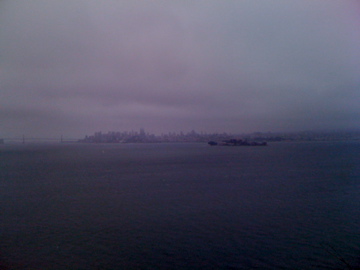
across the Golden Gate—

yellow halos,

the swallow of white,

pillars into nothing,

and beyond

the railings—black, black,

the hiss of black

underneath the stereo speakers,

whispering, “this is the end

of the continent”

/

and you can’t even see it.

Travel Tip: Get Inventive

What to bring and how to pack—it’s always a hot topic. But no matter how well you prepare—no matter how many water purification tablets and rehydration pills you stuff into your waterproof, weather-resistant backpack—you can’t anticipate every twist and turn you’ll encounter on the road.

At some point, you’ll need to get inventive.

Let’s say you do something as innocent and seemingly unadventurous as going on a day hike. Now, some people tromp off with walking sticks, CamelBaks, and a fanny pack full of First Aid supplies. But those’re also the same folks that wear their jungle-proof hiking boots in the middle of the city. (In your preparedness, you must also consider fashion.)

Let’s say it’s a hot day at one of your top 3 travel secret spots. Let’s say that Bass Lake is sparkling cool, and filled with the intertubes and joyous clamor of hikers. You paddle out with a friend and see carefree bodies flying through the air, limbs ecstatically free for one airborne moment before splashing ceremoniously into the murky dark.

Let’s say you forget that both you and your friend are total effing city kids and have never once been on a rope swing. Let’s say that you don’t stop to consider the physics of the situation, the centrifugal force and the fact that some technique might be involved. Let’s say that all that’s going through your mind is—”Fuck yeah, rope swing!”

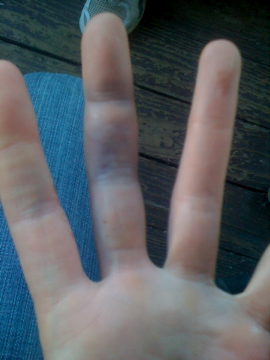
And let’s say that both you and your friend completely gnarl your hands and are left treading water with a mess of twisted and bloodied fingers.

It’s time to get creative.

First off, remember your First Aid training: reduce swelling (and bleeding) by raising the effected body part(s) above heart-level. This means treading water hands-up for 500+ feet back to shore. You can also call on your long-forgotten lifeguard training.

Next, you’ll want to get a second opinion. You’ll probably try to tell yourself that your wound “isn’t that bad, right?” You’ll attempt to move the effected body part in a perkily healthful manner to convince everyone—but mostly yourself—that no serious injury has occurred. At this stage, it helps to have friends with a firm grasp on reality.

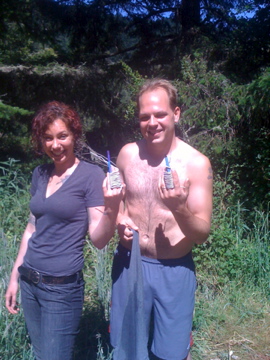
When it’s determined that you are indeed effed up, you’ll need to provide some sort of make-shift care for yourself. You won’t always have gauze and splints and medical tape handy. You’ll have to make do with what you have right in front of you. Dig through your purse and discover that a Bic pen is about the length of your finger. Now how could you secure it to your effected digits to both provide support and restrict swelling? You think, look around…

Using your traveler ingenuity, you’ll end up with a perfectly workable—and dare I say, fashionable—solution: Bic-pen/shoelace splints:

Stop hiking? No way! You’re totally good to go.

Bonus tip: Don’t waste money on needless medical care. If you happen to be American, you’re already well-practiced in the delicate art of determining when medical attention is and is not absolutely necessary. Unless your shit is sideways and needs to be reset, a doctor isn’t going to do much for a broken finger. So save the pennies in your travel jar, go to Walgreens, and buy a splint and some medical tape. Total cost: $7.

The Americanness of Garlic: Weekend Wedding Part III

We rode down the line, past the line, through it: the slice in the sky where the fog stops and the blue begins.

The California Coast and the Central Valley: there’s more than just a fog bank that separates the two. They’re culturally two different worlds. One is liberal, cultured, Priuses and windbreakers all year round. The other is hot, flat, migrant and dusty, rumbling trucks and fruit stands, too-neat rows of too-green produce lining the highway, whipping past your window in a monotonous flipbook, eye-numbing and strangely hypnotizing.

To us coastal folks, the Central Valley is a hazy strip of heat and pesticides, a nebulous region of towns we’ve heard of in passing, maybe driven through, but never really experienced past a gas station or two. Which is why Gabe and I had decided to stop in Gilroy, a typical agricultural Central Valley town, on our drive back to the Bay. That, and the garlic.

The Gilroy Garlic Festival is one of those things I’d heard about my whole life, but never been to. I wasn’t even really sure where Gilroy was. It’s one of those small-town events that put the place on the map, gives it some sort of name recognition to city folk. You get the feeling that the whole town lives for Garlic Festival weekend, that it’s their moment to shine—or more accurately, to waft.

We snaked along the single-file traffic leading to the parking lot. Everything was agriculture: produce stands, the Garlic Shoppe, a garlic restaurant, garlic paraphernalia. People with coolers stood on the roadside selling bottles of “ice-cold water, $1 here, $3 at the festival.” The town was amped.

We tromped across the dirt parking lot, past port-o-potties and shuttle bus lines, volunteers with bull horns, in towards the banners and balloons and cloud of cooking garlic.

It wasn’t cheap: $17 to get in. It didn’t matter. We were in it to win it.

At first, it was kind of disappointing—all the usual festival stuff: cheesy craft booths and “funky” bands, frozen lemonade (not garlic-infused). I was expecting some sort of kitschy throw-back vibe, a state fair kind of atmosphere. I was expecting uber-ridiculous, inventive garlic food, garlic everything.

But as we wandered more, went deeper into the booths and stands, the subtler ridiculousness revealed itself. And then we found this:

A flaming garlic effigy. How metal is that?

We went for it. We didn’t care that everything cost $5 and the lines were long and the sun was brutal. We wanted the full experience.

That’s right—garlic ice-cream. This is one of the festival’s great claims to fame that I’d heard about. And it’s ice-cream. So I had to have it. Oddly enough, they served it in a half cantaloupe. Not so sure about the culinary success of that, but I could appreciate the eco-friendliness.

Shit yeah!

Gabe was obsessed with finding deep-fried garlic. When he succeeded, we sat down on a hay bale and indulged in our treats (dipping deep-fried garlic into garlic ice-cream: amazing). One of the bands had broken into a cover of an obscure, early Johnny Cash song. As the families trundled by in the afternoon heat, there was something really sweet about the whole thing, something All-American in a way that I once scoffed at.

And then we found this dude:

Nothing like a man in drag resembling a human garlic nut sack to really get the party started.

While most of the booths were of the folk-art and rip-off variety ($20 for a flattened glass bottle window hanger), there were some hidden gems in the rows of awnings:

More vaguely scrotal goods

“The Originals”—thank god! None of these impostor custom toe rings.

This one goes out to all the vegetarians in the house...

“Gourmet Alley” was the closest thing to the state fair vibe I found. They seemed to serve all the same fare as the rest of the festival; the fonts on their banners were just of a more dignified variety. There was a cook-out section complete with demonstrations and seminars, where local hot shots flexed their garlic prowess. It was all proudly and unironically sponsored by Foster Farms (complete with chicken-shaped balloons bobbing overhead). We may have only been an hour and a half from the Bay Area, but the food culture was was a whole nuther world: purely All-American.

And in a way, beyond the deliciousness of garlic, that’s what I been looking for, hoping to find at the festival: America.

There’s a kind of beautiful part to participating in a culture, in mainstream culture. Growing up in a city, and especially in a place as distinct as the Bay Area, you don’t get a lot of chances to indulge in Americana—we’re all about film festivals and Critical Masses and dirty punk shows in dingy warehouses.

But there’s this American mythology, this agrarian life, a “simple life,” that’s always been there: a vague background noise, aired on old sitcoms, tucked into dusty paperbacks, into the heart of the big, wide country that I fly over and past, but never stop in. I’ve never experienced it, never lived it, observed it from a distance, as the Other.

I think us city people feel alienated from that culture. We judge it (“uneducated, small-minded, uber-Christian bigots”), and are afraid it was judge us (especially if we’re something other than straight, white, native-born). There’s a kind of deep distrust—”that isn’t me, can’t be me, not ever me.” There’s something lonely about existing in something other than the predominate culture.

It was nice, for an afternoon, to feel like in some small way, I can be a part of that too, that that’s in me as well: America. Never thought I’d say that.

And sweating garlic for the next day and a half was fun too.

Dancing in the Fog: Weekend Wedding Part II

Everything grey. Not the soft, floaty kind of grey, but heavy, brooding, impenetrable—like being underwater, like walking through a dream: the landscape all sand and crippled trees, windswept by something that came before you, something you can’t see, some kind of endless passing of which the fog is only a part, only a symptom of a larger sadness—the solitary transience of the Northern California coast.

Destination weddings are fun, because the party doesn’t stop, isn’t confined to six hours in impractical shoes and unforgiving fabrics. And you get to feel like you’ve gotten away, vacationed, traveled. So it’s a two-for. Guests complain about them because they’re more expensive, discreetly accusing hosts of choosing distant locales to limit the guest count. Which could all be well and true, but my first experience at a destination wedding pretty much ruled.

To qualify, it wasn’t much of a destination—a two-hour drive down the Monterey Peninsula to Asilomar, what could have easily been a day trip. But something about it gave me just a taste of travel, a hint, like passing someone smoking a cigarette on the street—not the real thing, but enough of a whiff to remind you of the real thing, evoke some sort of not-so-secret longing you try to muscle through, distract yourself from, most days. Something about the weekend was twinged with longing (for what?), some kind of sickly bittersweet lonely. Maybe it was the fog.

Asilomar is a state beach and rustic conference grounds billed as a “refuge by the sea.” It’s got some history, some charm, some Arts & Crafts style flair. But the conference grounds/hotel was unfortunately bought out by some large hospitality chain in recent months, and the service has gone from homey mom-and-pop to corporate nickel-and-dime-and-don’t-give-a-fuck-about-quality. Whatever. The scenery is still beautiful and the wedding was still awesome.

The weekend started with a Friday afternoon BBQ and wiffle ball tournament that got froze out by the cold. We retreated to the bridesmaid cottage (which was more like a suburban home than a cottage, beige carpeting and all) for epic hanging-outage.

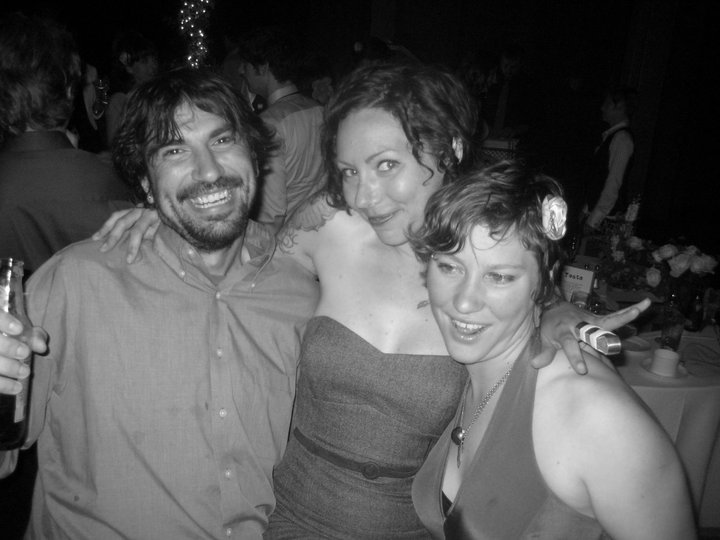
The cool thing about the whole weekend-long aspect of the wedding was that it really gave you a chance to meet people. Not just superficially, but, you know, to bro down. I suppose the destination wedding thing could be hell if you were trapped in some resort with someone’s insane family, but my friends Katie and Steven have pretty awesome friends. They’re scattered around the Bay, LA and NYC; the disparate groups had never really had a chance to meld, so the wedding served as the ultimate meeting (the whole reasoning behind having it be a destination affair). I’ve got a particular affinity for rad, smart, independent girls, and got to meet quite a few of them.

I also got to hang out with some super good old friends, the kind of people that have seen you grow, that you’ve seen grow—who you’ve walked through all sorts of brutal life shit with. The beautiful part is that we’ve managed to come out on the other side, all limbs in tact. (I’ve also got an affinity for survivors.) There’s not so many of us, you know, when it comes right down to it. And getting to hang out with a couple dope old friends that you’ve been through some shit with definitely serves to renew faith, lend some perspective, validate some small feeling inside you that everything might just be okay—almost like a small kind of prayer.

And then there was the dance party.

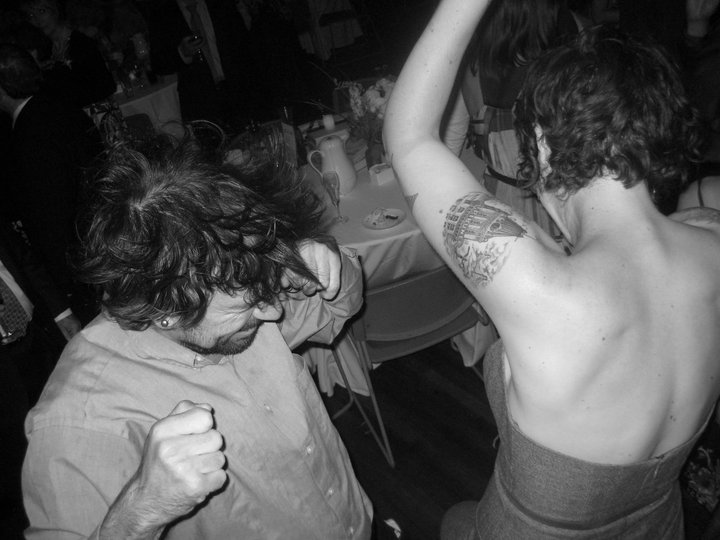
I like to get down; who doesn’t? But there was something different about this dance party. It wasn’t just the killer music (soul, 80s, old rock ‘n roll), and it wasn’t just the super cool folks. It was fueled by something within, some drive to… escape? That’s not exactly right, but close—a drive to push through a kind of pain, not just an immediate circumstantial sadness (checking the phone for text messages), but the deeper, desperate lonely beneath that (gone, gone, and left me here).

Whatever it was, I let loose like I rarely do, like I was trying to dance my way out of something. I thought of the kids that used to hang out the swimming pool I worked at as a teenager. It was North Oakland, an inner-city environment to say the least, filled with a bunch of little hood rats with nothing better to do than hang around the pool all day. Forget what they say about kids having no worries—a lot of these kids had pretty gnarly home lives. But I used to watch the way they’d play and find some sort of solace in it—the particularly child-like ability to shed all that shit and just play, find some small moment of release amidst the dysfunction and poverty and pain. Almost like a small kind of prayer.

Let’s just say at the end of the night, it was me, a dude who looked like Owen Wilson in Zoolander and danced like a gay stripper, and a ten year old girl who could break dance. Magical.

The next morning was all eggs and syrup and sleeping in. There’d been an after-party, then an after-after-party, and everyone was spent. We staggered around in the dream-like fog, hair half-curled and wearing sweatpants. People bundled up on the beach and ate the remainders of potato salad and cupcakes, wrapped in blankets and sleepiness and the grey, grey sky of California.

Garlic, Goodness and Fog: Weekend Wedding, Part I

Like a line, pencil-drawn, like someone had sliced the sky in half: where the blue stopped and the fog began. We drove beneath the division, up the curve of coastal mountains, and into the gray like a tunnel. The windows dimmed and the road darkened.

We’d entered our weekend: a summer wedding on the California coast.

Ain’t no sunshine. Hardly ever. The final wedding of my summer of love (other people’s love, that is—5 wedding invitations!) was a destination wedding at Asilomar, a state beach conference/retreat center near Monterey. Which meant that no matter what the rest of the state was cooking in, we were wrapped in an impenetrable blanket of fog all weekend.

The 101 had been hot, pink forearms and moaning wind. Gabe and I hadn’t had the chance to really catch up in a couple years, and there was a lot to talk about: dating and work, sickness and family, the little turns our lives had taken, as though our roads were getting clearer, more defined: yellower lines and harder asphalt. He played me his new band’s demo (“crust/doom metal from the woods of Northern California”) and we fell into that comfortable quiet of old friends.

Then I felt it stir in me.

Which was funny, because I was only driving 2 hours away for a wedding. But it was there, undeniably: the sleeping beast in me, rolling over in its nocturnal slumber—the traveler.

I don’t really know when it will strike in me—or rather, when something will strike it in me. My whole last trip, that sense of adventure and curiosity and freedom that I live for was never ignited. I never got to that mindset. But something about that highway, something about the light and the wind and the road arching up over the brown, brown hills, stirred up the traveler in me.

It’s like a meditation, traveling. I stop worrying, I stop planning, I stop thinking. I forget myself and I just experience. I get a place where I’m okay, deeply and wholly okay, and I can just sit and listen to the world humming, feel it reverberate in my own chest, like a bass line or a very small bird. I can’t do it, can’t get there, sitting crosslegged in my bedroom—the only way I’ve ever gotten to that place is traveling.

And something about that drive, something about sitting there with a dear old friend and thinking about the way our lives have taken shape, got me to that place, there—just for a moment, just for a breath. Which is all it ever really is, all you can ever hope for.

And then it smelled like garlic.

And I mean garlic. Weren’t no vampires in these parts. We were driving through Gilroy, an agricultural town filled with cherry stands and artichoke carts and tons of kitschy garlic-themed restaurants and shoppes. Every year they have a massive garlic festival; I’ve been hearing about it my whole life, and had never gone.

Gabe and I turned to each other and nodded. “On the way back?”

“Shit yeah.”

And then we entered the brooding gray of our weekend.

A Woman in the Sun

I sat in the sun, butt naked and heat dazed, my starving skin soaking up all the UV it’d been hungry for since my trip to LA. The sulfur smell of the hot springs had stopped burning my nose, and I was in that drool state of relaxation where everything floats in and out of your consciousness like a dream. The bits of conversation from down the deck came to me in whiffs, like BBQ or the burning of some far-off fire.

“You know, Mark called me on Friday. And he started up again. And I said, you know, like we’d practiced, ‘I am not going to participate in this conversation with you.’”

The words roused me a little. Not so much really the words, but the careful way in which they were recited—deliberate, practiced, the memorization of an actor who knows the scene but hasn’t quite figured out their character’s motivation.

The patter of bare feet and a sleek ripple of water. “Oh, Myra, I didn’t tell you,” the voiced repeated. “I got to use that tool we talked about, when I told Mark: ‘I am not going to participate in this conversation with you.’ It felt so good!”

Wilbur Hot Springs is a retreat place, and that’s what I’d come for. That’s what we’d all come for, driven the two-line highway through pastoral postcards, past cheese-commercial cows, down a bumping dirt road where the dust plumed and twisted behind us like everything we’d meant to leave behind.

Wilbur is the kind of place that makes you lapse into cheesy cliches (partly because your brain is too full of steam to think straight). A Victorian mansion “nestled” into the “rolling” California hills, it’s an uber-NorCal experience, an “oasis.” Everything is solar-powered. The natural hot springs are directed into four flumes clustered around a clothing-optional deck. There’s a communal kitchen where guests cook their own meals, and instruments for evening jam sessions. Everyone talks in low, soothing voices, and the place smells like well-oiled wood. Sustainability and spiritualism; regrouping, reconnecting, getting off the grid and soaking in 114 degree water—you know, the kind of hippie shit a punk rock kid like me used to scoff at. Until I went up on a gift certificate a couple years ago with a similarly suspicious friend.

We’ve been jonesing to get back ever since.

Retreat is what these chatting women on the deck had also come for, and like retreat, they were something, a certain kind of woman, a younger incarnation of me would have scoffed at: middle-aged, middle-class, white, all-American. Bad hair and worry lines. I’ve grown less judgmental in my old age, and in my hot-spring-infused sedation, observed them detachedly, from an almost anthropological distance.

They’d come on day passes. They weren’t entirely comfortable, held their robes and towels around them self-consciously, seemed self-conscious about being self-conscious—they averted eyes, glanced this way and that before letting go and slipping naked into the steaming water.

I’d pieced together their conversations, about ex-husbands and astrology, how to figure your aura energy by the kinds of animals you attracted (“You got lizards and butterflies; I got bit by a tick!”). This day trip to Wilbur appeared to be the culmination of a healing workshop. The leader of the group was some kind of psychic—not a predictive one, she assured, but one that dealt more in energies, a kind of cosmic therapist. They weren’t super New-Agey about it, talked in a kind of down-to-earth tone that made them seem less like people on board some kind of bullshit train, and more like people genuinely seeking, genuinely lost and hurt and looking for something, some kind of solidity.

“I am not going to participate in this conversation with you.” The statement rang in my ears, plucking me out of my sun-drenched stupor. The speaker’s voice held in it all the excitement of a pupil who’d just felt a switch flip—who’d practiced the arithmetic but wasn’t sure the equation would work for them, with their own dull and trembling pencil. But it wasn’t a young voice and a glance at the body from which it issued revealed a gravity, breasts heavy and hips wide, a child-bearing body.

My God, I thought, to have lived that long and only now have learned to say that.

The woman’s comment, the thrill with which she yielded it, struck me as tragic, in a particularly female kind of way—that a woman could go that long in her life without having learned to say no before.

Boundaries. Standing up for yourself. Not taking shit. They’re vital things for us girls to learn. You flat out won’t make it in this world without them, I’ve come to believe, and I don’t just mean with manipulative ex-husbands. You’ve got to learn where the world stops and you begin, what is and is not okay with you, and how to be firm and true to that. Cause you’re not going to make it—ride the buses or walk the streets or, shit, travel the world—you’re not going to survive the barrage of shit hurled at you without learning the word “no.”

And there, on that sun deck, a wave of gratitude swept over me, like the spring breeze on my pink and steaming body, for my mother. My tough-as-nails, take-no-shit mother.

My mother, my model: pretty and blond and trained in karate. She worked in factories, held her own in the male-dominated world of politics, worked in West Oakland during the worst of the crack years, dared a scab to follow through with their threat to punch her on the picket line (they punked out). It stems from that: my childhood love of Tina Turner and my vow that if, when I was older, I ever went on a date with a guy who tried to make me do something I didn’t want to, I’d “kick him in the nuts with my high heels”; my busted-Converse affection for Riot Grrls, Le Tigre, Anne Sexton and Sylvia Plath. And it stretches before that: my grandmothers, no-nonsense Midwest girls who endured Depression poverty and marched in Civil Rights protests.

I come from a long line of tough ladies. I can’t ever forget I stand upon the ground they forged for me. It’s a generational adventure, this learning of how to be a woman in the world, and what my mother and grandmothers fought for is in me, my blood. So much so that it still surprises me, blinking-eyed shocks me, when other women ask me how I have the “bravery” to travel alone. It simply never occurred to me to not have the bravery.

In that sun-drenched moment, any residual judgment melted away, just like the knots in my lower back unclenched in the hot, healing water. It may have seemed tragically late to learn how to make boundaries, she may have had to take a healing workshop with a psychic, but this woman had learned. And she sat now, naked and free, gently turning pink in the sunlight of it.

Painting the Town: Street Artists Bomb the Bay

One of the nice things about living in the Bay Area is that people come here. Just, you know, to visit. We’re coming up on the high season, when the streets swell with tourists, clicking their cameras and speaking their different languages, hanging limbs off cable cars and sharing undoubtedly brilliant commentary in the halls of museums. We don’t complain so much about tourists in the Bay Area—aside from the fact that they spend a shitton of money (and have hopefully read the part in their guidebooks about tipping), it makes us feel good: we live somewhere people want to come to.

It makes us feel especially good when those people are street artists who leave us little gifts.

The Bay Area has been freaking out over the past few days about 6 Banksy pieces that have surfaced in San Francisco. We’re a medium-sized city, so it makes us feel special that an artist that big would come out and leave his mark. I, for one, had to take advantage of a sunny spring day and go on a taco-fueled, MUNI-powered mission across the city (cause, you know, why not?) to see as many as I could. But here on the quieter, slower side of the Bay, a couple other street artists/collectives have made visits. They may not be as big as Banksy (who is?), but spotting their work made me feel, I’m not gonna lie, a little warm and cozy about my hometown.

The blogosphere has been abuzz over Banksy lately. With the release of Exit Through the Gift Shop, everyone’s favorite British recluse has been hitting up spots where the film’s debuted. (His recent work in LA caused quite the stir when it was physically removed to be sold in a shady art gallery.) The San Francisco debut of the film went down recently, and we were all waiting, holding our collectively aerosol-stained breath, to see if any Bay Area pieces would surface.

They did. Warholian broke the news, spread the word and even got himself on TV:

I had to wait a few days, for a full day off (new waitressing gig = mucho trabajo) to embark on the mission. Luckily, Warholian posted exact locations on his Flickr stream (along with far better photos than I took). Oh, the digital age…

What was funnest about missioning around to find the pieces wasn’t really the art; it was seeing all the people come out. Folks were really excited to see the work, like a treasure hunt where the reward wasn’t some crappy Easter egg but sick-ass stencils that spawned social commentary—and a nice dose of civic pride. One guy I met was super stoked that a piece ended up abutting his soon-to-open bar (“It’s like free publicity!”). A group of European kids posed for photos by the Native American stencil while a hip dude explained in Spanish to a passer-by what all the fuss was about. On Haight Street, I met an old dude with a serious camera—miles of lenses and clicky gadgets—who told me, “I’ve never been that into this whole street art thing. Always looked like a bunch of scribble to me. But I read about this in the paper and thought, well, that’s pretty cool. So I wanted to come out and document it.”

Doubt this one will be winding up in a gallery

Yeah, my camera sucks. You should really just Google this shit.

Say what you will about Banksy—publicity stunt conspiracy theories and cries of being too mainstream—but that Bristol boy got San Francisco juiced, taking pictures and making missions and actually chatting with each other (usually a more Oakland phenomenon). And at least one cool old dude seeing street art as something other than vandalism.

But I’ve been noticing more cool pieces around lately, on my own side of the Bay. One of my favorite street art blogs alerted me to that fact that Feral was in town, and I spotted one of his pieces (now gone) by the MacArthur BART station.

Abandoned furniture and trash-feasting pigeons: that's my town!

And up on Telegraph, the epicenter of gutter punks and flip-flop-wearing bros, I spotted one of TrustoCorp‘s guerilla street signs. These have been making me giggle for months, and I was stoked to see some stuff locally.

I’m not sure who did this piece, but I liked the placement of it—a busy intersection across from a Whole Foods—and its stark insistence on being noticed.

I’m continuing to think a lot about street art and what exactly it is that draws me to it—what exactly it is that seems so undeniably related to travel. It’s got something to do with place, with the insistence of place, the immediacy and intimacy of interacting with a place on such a visceral, physical level (the subject of one of my first ever blog posts). The words are forming, the drooling gibberish shaping itself into discernible sounds under my wet pink tongue (“mama,” “dada”).

In the meantime, I’m thinking a trip to Italy for Fame Festival might answer some questions and cure some wanderlust. Just in case the Bay doesn’t receive any visitors for awhile…

Smog City Street Art

Second and Traction. I wouldn’t have ended up there if three degrees of separation and a vaguely pointing finger hadn’t sent me, the intersection pulsing on my iMap like a gleam off buried treasure. Does every town have a warehouse district—posed delicately between decay and revitalization, a hushed breath that sends the trash dancing ecstatically down deserted streets. Abandoned buildings, chain-link fences, art collectives, lofts, hip cafes on whose terraces a gothic bartender I once knew squinted her eyes against the LA sun (she never did get sober). Dogs and day laborers and cute girls on bicycles—and a shitton on graffiti.

I’m thinking this little tract of Downtown LA is something like the hill (or dug-outs or BART tracts) where the cool kids in high school smoked weed. There were pieces from big names like So-Cal native Shepard Fairey and the UK’s D*Face (who recently made a stir with his Zombie Oscars installations), as well as wheatpastes and stencils and tags galore. I came across a friendly crew of dudes painting a legit mural on the side of an abandoned building that read “Still Kicking Ass.”

Damn straight.

Shepard Fairey

A lot of the work was heavily politicized—making poignant to satirical comments on the imperialism, immigration, consumerism, commodification and other fun subjects not typically conjured in my LA stereotypes. Just more proof that there’s more going on than teeth whitening and Botox injections.

Interesting comment on the commodification of political figures--especially considering the man responsible for the oh-so-famous Obama image had a piece up a block away.

Mad skills

Reminiscent of Banksy mice, no?

D*Face: Siiiick

Word.

Dudes painting mural

"Can I get a picture of your bird tattoos?" "Sure." "Aw, dude, show her your Booger tattoo."

At work

More pieces on the same building

http://www.youtube.com/watch?v=rV3tOdzyXTY

One of Nomade's Roman fellows

http://www.myspace.com/smogcity

Down on 9th and Mateo, another abandoned building was getting seriously hit up by some bad-ass murals, part of the LA Freewalls Project. Local boy Saber had just completed an impressive piece, as had D*Face.

Saber's mural

Detail: buffed graffiti

And, why not, a couple more gems from elsewhere in the city…

Sherpard Fairey & Saber alley, Silverlake (thanks for the correction, Daniel)

Note the can: Campbell's Soup. How Meta.

If all taggers and graffiti artists looked like this, they'd have a much easier time.

Health care reform passed while I was in LA. Was delighted to see the Monopoly fellow around.

Note the David Choe Die Antwoord posters. See also: http://www.thedirtfloor.com/2010/04/10/timell-tell-street-art-at-the-fairfax-district-in-los-angeles/

So what does it all tell you, these smears of paint and peeling papers, about Los Angeles? If street art and place really do have as much of a connection as I suspect they do, LA’s told me this: that even within the belly of mass culture and consumerism, pangs of outsider aches burn acidic. And they don’t sit quietly, politely, hands folded and waiting their turn. They’re illicit, guerilla and goddamn beautiful.

Take Me Back to Bunker Hill: Finding What I Came For in Downtown LA

“Well,” my Dad asked, “did you find what you were looking for?”

I sat travel-dazed and dirty-socked at the dining room table. I’d fought the coming home blues all 372 miles up the 101, driven straight to my parents’ house to eat dinner, tell stories and delay actually arriving home a couple more hours. My car rested in the driveway like a tired horse, bag-laden and dirt-covered. I couldn’t remember having ever wanted to come home less.

Of course, my dad meant Los Angeles, its gritty and unglossy underside—had I found it? I’d made quite the to-do over my mission to dig in, delve beneath and uncover buried, bloody gems of LA’s uncommercializable heart—the skeletons in its closets, its alleyways, the voices that came through tattered paperbacks and the shrieking distortion of old punk LPs. Had I gotten there, found there, held a bit of there in my hands like it could be mine?

Downtown mural

I stayed mostly in Downtown, LA’s most un-LA area. Modestly tall buildings jangled with the light dancing off of cheap jewelry stores; young girls beckoned you to enter their stores, calling out the names of goods in Spanish; a legless beggar with perfectly combed hair occupied the pavement outside Clifton’s Cafeteria; Santeria markets abutted Art Deco theater marquees, sitting above boarded-up entrances and watching the street like purgatoried angels. Hipsters took morning strolls with their well-groomed dogs, past shopping carts and transient twitching, the encampments of misery that compose Skid Row. There were no Valley Girls, OC bros or Pilates-perfect MILFs. There was even a cafe that served Ritual coffee.

It’s called “Historic” Downtown, complete with markers and murals, and I crossed several groups of confused tourists, consulting street maps and looking up bewildered at the carcasses of LA history as if it say, “Huh?” You learn to take the term “history” with a grain of salt in California, but it went beyond that—this was barely even a Downtown. There were no bustling businessmen, no Banana Republics, no dudes hawking maps of celebrities’ homes on the street corner, no tourist facilities, not really any non-neighborhood locals. Working-class, non-white, unglamorous—this was Downtown LA.

I hiked over to Bunker Hill, a doomed and fruitless mission, I knew. It was once a down-and-out neighborhood that held, in the shadows of its slanted incline, flophouses and brothels, dive bars and cheap hotels, derelicts and drunkards and two of the best damn writers to come out of that cursed city. John Fante curled up in the liquor-soaked sweetness of the slum, while Charles Bukowski broke furniture and chased alcoholic insanity in its tenements. A 1950s revitalization project razed the ramshackle Victorians, paved over the shattered remains of lives and dreams and addictions, suffocating the howling ghosts neatly beneath office parks, wide streets and sterilized, sparkling sidewalks.

There was nothing to discover. I tromped up a San-Francisco-steep hill, glanced at the historical markers, cruised past the newspaper village of bare feet and cigarette butts outside the Central Library. I stood on a corner that will next week be renamed John Fante Square, and not a damn thing remained. Not a shadow, not an echo, not a ghost of a passing fit of madness. There was, to use a tired and perfect quote, no there there.

But of course, there never really had been. None of it was true, not all the way true, at least. Us writers and alcoholics are tragically skilled at romanticizing even the most sordid, harrowing of places and experiences—and in all likelihood, the actual Bunker Hill bore more resemblance to the modern-day Downtown than it did the gloriously gritty harem of passion portrayed in the novels I’ve loved. It was, most likely, a sweet little lie those boys told themselves, in their more tender of moments, when they ached for something to hold them, rock them, hum the lullaby of a childhood none of us really had. I know I’ve been guilty of rose-painting, perfuming the past, my own life, and it takes a photograph, something tangible, to jar me out of it, to remind myself how much it hurt, it bled, it puked and moaned; I saw people die, burn out, “I saw the best minds of my generation destroyed by madness.”

So in that way, what I sought was all a mirage anyway. The narrow alleys and sagging Victorians of Bunker Hill may have been gone, but had the illusory soul of the place ever been more than that, a fevered dream? There was a current-day incarnation, just down the hill—laced with more sinister, soul-eating of drugs, for sure, with the rattle of shopping carts and broken lives—but it was probably a more accurate representation of Bunker Hill than those exalted odes to insanity, like the moment of pure genius and bliss before the trip goes back and the come-down shatters in.

But maybe it was all a mirage, Los Angeles—an oasis that keeps glimmering just a little further out in the sand. Katie told me about a girl she’d met in a penthouse one day (“typical LA story—went out for a coffee, met the Del Taco guy, went up to his apartment with his friends…”): perfectly thin and gorgeous, a 22-year-old model who’d run away from her Midwest home at 15, found herself stranded in California when the boyfriend ditched out, came to LA, rose in the ranks and behind the flashing of cameras, sat now on a leather sofa doing rails of cocaine off a glass coffee table. “She was the total LA person—came from somewhere else, chasing this glamourous illusion, the LA dream. She knew it was a dream, she was totally aware of it, but still too addicted to the dream to disconnect.”

Here’s what I learned: LA is a place for seekers. It seems it always has been, at least for the last 100 years or so. The City of Angeles, of a fleeting fulfillment you can almost, but never quite, grasp. There’s an LA dream, that’s not too unlike the American dream, that this too can be yours, that you too can find it, have it, hold it. It’s a flickering projection of images, like on the backs of eyelids or clean white screens, that’s so close to being real you could almost weep, almost believe it.

So did I find what I was looking for? Yes and no. It may have all been a dream to begin with, like the utopias of the almost-cults I visited. It had been bulldozed and redesigned with crisp corners and clean towers; it was living on in the ragged throats and stained clothes of Skid Row. It was a memory so old you don’t know whether it was a dream or not; it was a love song for the one you never really, but almost, had.

« Previous PageNext Page »


Lauren Quinn is a writer and traveler currently living in Phnom Penh. Lonely Girl Travels is a blog of her sola travels and expat living.

Tweet this Sh%t

  • Feel like I just escaped the Cambodian version of Shutter Island. 19 hours ago

Categories


Follow

Get every new post delivered to your Inbox.

Join 3,000 other followers