Archive for the 'USA' Category


If No Man Is An Island…

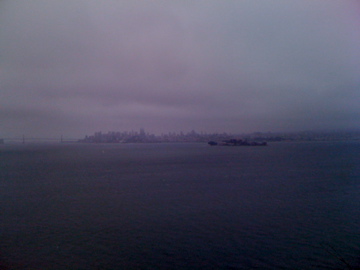
Alcatraz Night Tour—wandering around the haunted empty of an old institution, relighted and relabeled, black signs with white letters. All hard lines and sparse materials—cement and steel—littered with the footsteps of tourists, the little echoes we carry in our shoes and our voices and, in some of us, our hearts.

Because you live here, you’d never done it—because there was always some other chance, some other day, any day, it turned into no day, never. So when Nick said he was going to Alcatraz, fuck it, you said you were going too.

So you roved, like everyone else roved, wearing your headset and listening to the gravely voiced narrator of the audio tour, a well-cast choice by any measure. Former prison guards and inmates read their recollections, giving the tour more weight, more significance than it would have otherwise had.

You stopped in front of the steel doors to the solitary confinement cell, and listened to the weathered voices recall what they’d done to wait out the time in the blackness:

But if you would close your eyes—like right now, close your eyes, seal your eyes off with your hand—with a little concentration, you can see a light. And pretty soon that light will get brighter. And you’ve gotta concentrate on it—not a short while; it takes time and practice—but pretty soon you can almost put your own TV there, and you can see things and you can go on trips—and that’s what I did.

And it was an echo, the sound of a memory reverberating from some place inside. It was a night you’d stored away: summer, warm, the window open, the leaves cutting the streetlight into a thousand broken, dancing pieces. He laid on his side, held you under his arm, and you said you couldn’t sleep.

“Let me show you a trick.” And he said it softly—strangely soft, you’d thought, the way we’d whispered as kids in our hiding places, the places only children can fit.

“I used to do this when I was little, when I couldn’t sleep.” He rolled onto his back. “You put your thumbs against your eyes—you’ve got them there?—and you push. Not hard, but not light either. And keep pushing; don’t stop.”

You didn’t. You didn’t stop pushing.

“And eventually you see it.”

“See what?”

“Lights. Shapes. Anything. You go on a trip.”

And he got real quiet, and you listened—listened to the horrible silence and waited for your own show, your own little light parade. You saw only faint traces, dim colors, a couple gray buzzing lights.

He rolled back on his side, towards you. “Where did you go?”

You looked down, ashamed, though you weren’t sure why. “I don’t know. I don’t think I went anywhere.”

And he didn’t say anything, just traced your belly with the tips of his fingers—the fullest part of your belly, the part you hate and pinch and suck in in front of the mirror—and you felt so fucking lonely you thought you might die, that some part of you might die.

And it was the same feeling, standing there, alone with your headset in a silent group of wanderers. Like being a tourist in someone else’s loneliness—or rather, the ruins of someone else’s loneliness, what was left after the guards had gone and the light—now strange and harsh—had returned. Listening to their tricks, the little games they played (Your dad telling you, “Sometimes I’d bite the inside of my cheek, slowly, until it’d start bleeding and I’d play with it.”)—the ways they’d learn to escape, if only for a moment, into some place so deep inside that some piece, it seemed, never came back.

You blinked. You pushed the rewind button and the voice stuttered, restarted, and you listened again. And it was his voice, inside this other voice, and you remembered how you’d put it in a poem—or, you’d tried to put it in a poem, but it’d never amounted to anything, never quite fit, a parenthetical metaphor you weren’t quite sure related, or how it related, until right now, here, under the institutional glare of a tourist attraction, Alcatraz.

You half-smiled—what else was there to do?—and continued on with the tour, walked through the door in the steel bars into another emptied room.

Serendipity, Street Art and the Best Layover EVER

It’s a fantasy common enough to warrant TV commercials, (porno) movie plots and a voyeuristic story by Gabriel Garcia Marquez: you get seated next to an attractive person on an airplane. And you’re stuck beside each other, awkwardly negoitiating the small space for hours.

As most travelers will readily tell you, this is about as rare to air travel as getting bumped up to first class. No, rarer. The cast of characters usually beside you in the sardine can of coach include snorers, fidgeters, wiley children and consumers of mysterious day-old food. It really serves to drive home to actual percentage of datable people in the world’s population. I, for one, had given up on the fantasy and resigned myself to the mere hope of a recently showered individual that can fit in their own seat (which is also more or less when I’ve resigned myself in dating—and have been known to compromise on as well).

Well, holy shit if the travel gods didn’t smile down on me. And homeboy wasn’t just attractive—he was rad. As I discovered, not just during the flight, but on our 10-hour layover spent adventuring around Brooklyn together, spotting street art and searching for obscure vinyl.

I’d noticed him passing through security (as I was being pulled aside to have my purse dismembered in search on nonexistent weapons): hip without being pretentious, stubble beard, cowboy boots, a bulging bag of records. But I didn’t give it much thought until I was settling into my dismal seat in the back of the plane, next to the bathrooms. I watched him struggle to jam his record bag into the overhead compartment and smiled. When he looked down at his boarding pass, scanned the aisle numbers and ended up standing right beside me, we both smiled.

Sebastian had been traveling around the US for 5 weeks, and was on his way back to Zurich. He had a couple lines in his forhead, the well-traveled beginning of wrinkles. He had the worn-smooth hands of a cook, the black strand of a necklace peeking out from under his shirt. He had killer taste in music.

We chatted about life and travel and bands (“I saw some great shows in San Francisco.” “Like who?” “Ty Segall.” “On Wednesday? At the Rickshaw Stop? I was totally there!”). We talked about his trip and my trip (“I’ve got a 10 -hour layover.” “Me too. I was gonna go into the city, hang out. Better than being at the airport.” “That was my plan too.”) We fell into the fitful half-sleep of confined space and over air-conditioning; woke up stiff necked and lip smacking, ditched our bags at a luggage locker and rode the subway into Brooklyn.

It was a shuttered-up and bare-sidewalked Sunday morning on Bedford, ground zero of Brooklyn hipness. There was a record store Sebastian wanted to get back to, that wouldn’t be open for hours. We rubbed our aching eyes and looked for coffee.

I consulted my iPhone. “Oh shit, there’s a Blue Bottle?!” I exclaimed. “Yeah,” said a girl passing by, “it’s around the corner.”

We sat in the sun and drank our hand-dripped cups of black, watched the parade of dogs and toddlers and cool kids. We bombed around the neighborhood, going nowhere in particular, until the shops thinned and the wide walls of warehouses took over. And we began spotting some kick-ass street art.

All the pictures are on my phone, which for some reason my new (new to me, that is) netbook won’t download. So expect a post when I get home. But just to tease, I saw Roa, Faile, Space Invader, Gaia, and a whole bunch of folks I didn’t know but really wanted to.

We hit the record stores that had brought us there. Sebastian confessed to me that he was a music nerd with a record fetish. “There’s so many more records in the States,” he told me. He’d already shipped a crate back to Zurich. “It’s okay, though, it’s still cheaper than trying to buy it in Europe. If you can find it at all.”

We got back on the train, dazed and subdued with our long flights looming. We looked back through his pictures—he’d ended up going to Burning Man, on (another) serendipitous whim, and I leaned in over his shoulder to look at the small viewfinder, its story of dust and fire, the wind that moves through desolate places.

Our shoulders touched, just a little in the shudder of the train. I felt no desire to make a move, so to speak; it was enough to have a small flutter in my stomach. It was enough to have met someone awesome, totally serendipitously. It was enough to have wandered around sleep-dazed and discovering, to have sat on stoops smoking in the Brooklyn sun.

Sometimes you don’t need a big climax, don’t need to get all flirty and sleezy or anything at all. Sometimes it’s enough to feel liked, not just desired, and to genuinely like someone back. Not cause you want to make-out with them necessarily, but just because they’re rad.

We sat at the bar of a jokey airport restaurant, where Sebastian indulged in the last American hamburger of his trip. NFL games were flashing on the various television sets, the jarring loudspeaker announcements of boardings and departings echoing through the space.

“Sebastian,” I said, “you are by far the coolest person I’ve ever sat next to on an airplane.”

We hugged. “I had a great time,” he smiled. “Me too.”

And I walked away, through the terminal to my own adventure.

Boiler Room, Angel Island

Abandoned by time but not escaped from it. Rust and debris, peeling paint and the pages of old magazines, broken glass so old its become smooth. Like some dim chamber of our hearts, we climbed into the boiler room.

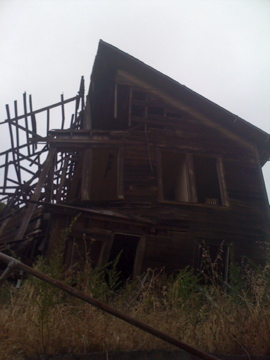
Angel Island is full of abandoned buildings, the crumbling concrete and sagging frames of old military structures. A big mound in the middle of the Bay, smack in from the Golden Gate, the island is more than brown grasses and hiking trails. It was a detention center/”immigration station” during the Chinese Exclusionary Act, then an Army Post during World War II, later a missile center. Now it’s a state park, filled with picnicking families, kids on field trips, tourists on Segways.

Summer in San Francisco...

It’s nice to spend a day roaming around, out in the middle of the Bay—packing a sandwich and riding the expensive ferry and taking the long, gentle walk around the perimeter. But what I love most about Angel Island are the abandoned buildings.

Some are open to the public, stairways smashed out so there’s no chance of climbing up into the desolate upper stories. You wander around the ground level, the empty gutted rooms, staring up past the chicken scratch graffiti, wishing you could poke around the dusty remains above, crunch your sneakers through the silence.

Other buildings are fenced off, doors bolted and windows shuttered, large signs warning of the repercussions of trespassing. The grass grows up around these buildings, consuming them; sometimes you catch shadows in the broken windows and they look like your own.

We circumvented a large, fenced-off building, found a spot relatively hidden from the main path. It’d been a long time since I’d hopped a fence, wedged my toes between chainlink and landed ankle-sharp with a laugh.

We tiptoed towards the building.

The boiler room. Heavy, huffing machinery now silent, steamless, bellies swollen with the memory of a howl. Old basins and the criss-cross of empty pipes, useless and buckled. Nameless parts of an old operation. A map on the wall of where tools once hung.

We crunched around, slats of wood and indistinguishable debris, the flattened beer cans of some lost era. There’s something about crumbling places that make you whisper, a kind of reverence—not just for what has passed, but what has remained, aged and weathered and somehow still standing.

It reminds you of your own ragged heart, those places you’ve closed off, chained off, boarded up and shut. But they’re still there—forgotten, maybe, but not empty, bloodless pipes waiting, dreaming of steam.

And sometimes, something goes traipsing on in there, flicking lighters and echoing voices and leaving new footprints, in a place you swore no new footprints could go. A place you swore was sealed shut and secretly dying.

We trespassed into the abandoned boiler room, then stepped back out into the dim squint of a fog-heavy noon—our lives.

Sunday Morning on International

Sunday morning on International Blvd. A sidewalk laced in fog, car exhaust, the sick-sweet smell seeping from panderias. Little girls in patent-leather shoes, dudes crouched and smoking and speaking in Vietnamese outside the street shop: “Good tattoo ain’t cheap, cheap tattoo ain’t good.” The rattle of shopping cart wheels, the bark of fenced-in dogs.

I’m running late. I’m going to the 11am meeting at the In Between, a beat-up converted barroom now filled with folding chairs and faded banners, where we sit and curse and laugh, talk about God and booze, “hmm-mm”ing and “uh-huh”ing and drinking cheap coffee that stains our teeth. I love that place, its dusty corners and dying plants, the sag of the window frames.

I pass the bright blue letters of Iglesia de Buen Sabor, a storefront church with white bars over its frosted windows. The tambourine rattle and exalted voices of its congregation pours out the open door, from a faceless place—always black inside, when looking in from the street.

I make eye contact with a man standing in front of the doorway. He has a look of well-groomed desperation: cheap suit, overly combed hair, shoes shining like little black teeth. He’s got one crippled arm, bent and with a tangle of underdeveloped fingers; he cradles it next to his body as though he were holding an infant, or a small injured bird. I give him the half-smile and nod of a hello in passing.

He steps towards me. “Hello,” he says. “My name is Juan Carlos…” he continues on with a couple more names, surnames and second middle names. He leans his small hand towards me.

I pause mid-stride, take his small hand. “Right on, man, good to meet you.” It feels limp and strange in my momentary grasp, and I try to amend my handshake, make it softer, let it fit the contours of his curled-in fingers. “I’m running late, though—” I start to step away.

“You have a lot of joy in your heart.”

I stop, look at him with a slightly cocked head. “Thanks.”

He nods, smiles, then steps back into the black swallow and tambourine roll of his doorway.

I cross the street and squeak my own door open.

Southbound

Fog so heavy

it wept

the dust from my windshield

/

what I’d carried with me,

wore on me,

up and over

a road soggy with night—

always becoming, becoming

just up ahead.

/

So this is driving

across the Golden Gate—

yellow halos,

the swallow of white,

pillars into nothing,

and beyond

the railings—black, black,

the hiss of black

underneath the stereo speakers,

whispering, “this is the end

of the continent”

/

and you can’t even see it.

Travel Tip: Get Inventive

What to bring and how to pack—it’s always a hot topic. But no matter how well you prepare—no matter how many water purification tablets and rehydration pills you stuff into your waterproof, weather-resistant backpack—you can’t anticipate every twist and turn you’ll encounter on the road.

At some point, you’ll need to get inventive.

Let’s say you do something as innocent and seemingly unadventurous as going on a day hike. Now, some people tromp off with walking sticks, CamelBaks, and a fanny pack full of First Aid supplies. But those’re also the same folks that wear their jungle-proof hiking boots in the middle of the city. (In your preparedness, you must also consider fashion.)

Let’s say it’s a hot day at one of your top 3 travel secret spots. Let’s say that Bass Lake is sparkling cool, and filled with the intertubes and joyous clamor of hikers. You paddle out with a friend and see carefree bodies flying through the air, limbs ecstatically free for one airborne moment before splashing ceremoniously into the murky dark.

Let’s say you forget that both you and your friend are total effing city kids and have never once been on a rope swing. Let’s say that you don’t stop to consider the physics of the situation, the centrifugal force and the fact that some technique might be involved. Let’s say that all that’s going through your mind is—”Fuck yeah, rope swing!”

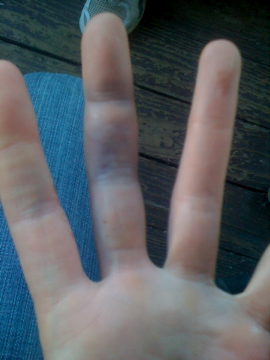
And let’s say that both you and your friend completely gnarl your hands and are left treading water with a mess of twisted and bloodied fingers.

It’s time to get creative.

First off, remember your First Aid training: reduce swelling (and bleeding) by raising the effected body part(s) above heart-level. This means treading water hands-up for 500+ feet back to shore. You can also call on your long-forgotten lifeguard training.

Next, you’ll want to get a second opinion. You’ll probably try to tell yourself that your wound “isn’t that bad, right?” You’ll attempt to move the effected body part in a perkily healthful manner to convince everyone—but mostly yourself—that no serious injury has occurred. At this stage, it helps to have friends with a firm grasp on reality.

When it’s determined that you are indeed effed up, you’ll need to provide some sort of make-shift care for yourself. You won’t always have gauze and splints and medical tape handy. You’ll have to make do with what you have right in front of you. Dig through your purse and discover that a Bic pen is about the length of your finger. Now how could you secure it to your effected digits to both provide support and restrict swelling? You think, look around…

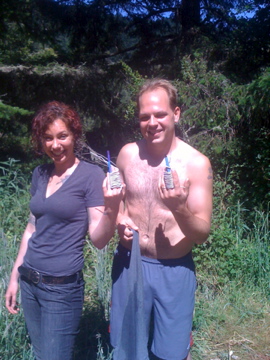
Using your traveler ingenuity, you’ll end up with a perfectly workable—and dare I say, fashionable—solution: Bic-pen/shoelace splints:

Stop hiking? No way! You’re totally good to go.

Bonus tip: Don’t waste money on needless medical care. If you happen to be American, you’re already well-practiced in the delicate art of determining when medical attention is and is not absolutely necessary. Unless your shit is sideways and needs to be reset, a doctor isn’t going to do much for a broken finger. So save the pennies in your travel jar, go to Walgreens, and buy a splint and some medical tape. Total cost: $7.

The Americanness of Garlic: Weekend Wedding Part III

We rode down the line, past the line, through it: the slice in the sky where the fog stops and the blue begins.

The California Coast and the Central Valley: there’s more than just a fog bank that separates the two. They’re culturally two different worlds. One is liberal, cultured, Priuses and windbreakers all year round. The other is hot, flat, migrant and dusty, rumbling trucks and fruit stands, too-neat rows of too-green produce lining the highway, whipping past your window in a monotonous flipbook, eye-numbing and strangely hypnotizing.

To us coastal folks, the Central Valley is a hazy strip of heat and pesticides, a nebulous region of towns we’ve heard of in passing, maybe driven through, but never really experienced past a gas station or two. Which is why Gabe and I had decided to stop in Gilroy, a typical agricultural Central Valley town, on our drive back to the Bay. That, and the garlic.

The Gilroy Garlic Festival is one of those things I’d heard about my whole life, but never been to. I wasn’t even really sure where Gilroy was. It’s one of those small-town events that put the place on the map, gives it some sort of name recognition to city folk. You get the feeling that the whole town lives for Garlic Festival weekend, that it’s their moment to shine—or more accurately, to waft.

We snaked along the single-file traffic leading to the parking lot. Everything was agriculture: produce stands, the Garlic Shoppe, a garlic restaurant, garlic paraphernalia. People with coolers stood on the roadside selling bottles of “ice-cold water, $1 here, $3 at the festival.” The town was amped.

We tromped across the dirt parking lot, past port-o-potties and shuttle bus lines, volunteers with bull horns, in towards the banners and balloons and cloud of cooking garlic.

It wasn’t cheap: $17 to get in. It didn’t matter. We were in it to win it.

At first, it was kind of disappointing—all the usual festival stuff: cheesy craft booths and “funky” bands, frozen lemonade (not garlic-infused). I was expecting some sort of kitschy throw-back vibe, a state fair kind of atmosphere. I was expecting uber-ridiculous, inventive garlic food, garlic everything.

But as we wandered more, went deeper into the booths and stands, the subtler ridiculousness revealed itself. And then we found this:
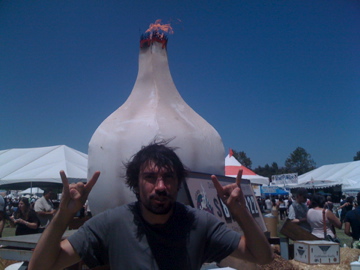
A flaming garlic effigy. How metal is that?

We went for it. We didn’t care that everything cost $5 and the lines were long and the sun was brutal. We wanted the full experience.

That’s right—garlic ice-cream. This is one of the festival’s great claims to fame that I’d heard about. And it’s ice-cream. So I had to have it. Oddly enough, they served it in a half cantaloupe. Not so sure about the culinary success of that, but I could appreciate the eco-friendliness.

Shit yeah!
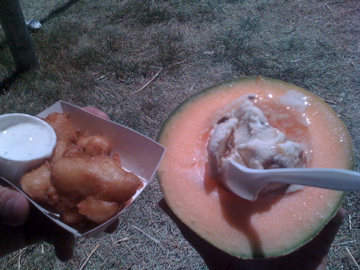
Gabe was obsessed with finding deep-fried garlic. When he succeeded, we sat down on a hay bale and indulged in our treats (dipping deep-fried garlic into garlic ice-cream: amazing). One of the bands had broken into a cover of an obscure, early Johnny Cash song. As the families trundled by in the afternoon heat, there was something really sweet about the whole thing, something All-American in a way that I once scoffed at.

And then we found this dude:

Nothing like a man in drag resembling a human garlic nut sack to really get the party started.

While most of the booths were of the folk-art and rip-off variety ($20 for a flattened glass bottle window hanger), there were some hidden gems in the rows of awnings:

More vaguely scrotal goods

“The Originals”—thank god! None of these impostor custom toe rings.

This one goes out to all the vegetarians in the house...

“Gourmet Alley” was the closest thing to the state fair vibe I found. They seemed to serve all the same fare as the rest of the festival; the fonts on their banners were just of a more dignified variety. There was a cook-out section complete with demonstrations and seminars, where local hot shots flexed their garlic prowess. It was all proudly and unironically sponsored by Foster Farms (complete with chicken-shaped balloons bobbing overhead). We may have only been an hour and a half from the Bay Area, but the food culture was was a whole nuther world: purely All-American.

And in a way, beyond the deliciousness of garlic, that’s what I been looking for, hoping to find at the festival: America.

There’s a kind of beautiful part to participating in a culture, in mainstream culture. Growing up in a city, and especially in a place as distinct as the Bay Area, you don’t get a lot of chances to indulge in Americana—we’re all about film festivals and Critical Masses and dirty punk shows in dingy warehouses.

But there’s this American mythology, this agrarian life, a “simple life,” that’s always been there: a vague background noise, aired on old sitcoms, tucked into dusty paperbacks, into the heart of the big, wide country that I fly over and past, but never stop in. I’ve never experienced it, never lived it, observed it from a distance, as the Other.

I think us city people feel alienated from that culture. We judge it (“uneducated, small-minded, uber-Christian bigots”), and are afraid it was judge us (especially if we’re something other than straight, white, native-born). There’s a kind of deep distrust—”that isn’t me, can’t be me, not ever me.” There’s something lonely about existing in something other than the predominate culture.

It was nice, for an afternoon, to feel like in some small way, I can be a part of that too, that that’s in me as well: America. Never thought I’d say that.

And sweating garlic for the next day and a half was fun too.

Dancing in the Fog: Weekend Wedding Part II

Everything grey. Not the soft, floaty kind of grey, but heavy, brooding, impenetrable—like being underwater, like walking through a dream: the landscape all sand and crippled trees, windswept by something that came before you, something you can’t see, some kind of endless passing of which the fog is only a part, only a symptom of a larger sadness—the solitary transience of the Northern California coast.

Destination weddings are fun, because the party doesn’t stop, isn’t confined to six hours in impractical shoes and unforgiving fabrics. And you get to feel like you’ve gotten away, vacationed, traveled. So it’s a two-for. Guests complain about them because they’re more expensive, discreetly accusing hosts of choosing distant locales to limit the guest count. Which could all be well and true, but my first experience at a destination wedding pretty much ruled.

To qualify, it wasn’t much of a destination—a two-hour drive down the Monterey Peninsula to Asilomar, what could have easily been a day trip. But something about it gave me just a taste of travel, a hint, like passing someone smoking a cigarette on the street—not the real thing, but enough of a whiff to remind you of the real thing, evoke some sort of not-so-secret longing you try to muscle through, distract yourself from, most days. Something about the weekend was twinged with longing (for what?), some kind of sickly bittersweet lonely. Maybe it was the fog.

Asilomar is a state beach and rustic conference grounds billed as a “refuge by the sea.” It’s got some history, some charm, some Arts & Crafts style flair. But the conference grounds/hotel was unfortunately bought out by some large hospitality chain in recent months, and the service has gone from homey mom-and-pop to corporate nickel-and-dime-and-don’t-give-a-fuck-about-quality. Whatever. The scenery is still beautiful and the wedding was still awesome.

The weekend started with a Friday afternoon BBQ and wiffle ball tournament that got froze out by the cold. We retreated to the bridesmaid cottage (which was more like a suburban home than a cottage, beige carpeting and all) for epic hanging-outage.

The cool thing about the whole weekend-long aspect of the wedding was that it really gave you a chance to meet people. Not just superficially, but, you know, to bro down. I suppose the destination wedding thing could be hell if you were trapped in some resort with someone’s insane family, but my friends Katie and Steven have pretty awesome friends. They’re scattered around the Bay, LA and NYC; the disparate groups had never really had a chance to meld, so the wedding served as the ultimate meeting (the whole reasoning behind having it be a destination affair). I’ve got a particular affinity for rad, smart, independent girls, and got to meet quite a few of them.

I also got to hang out with some super good old friends, the kind of people that have seen you grow, that you’ve seen grow—who you’ve walked through all sorts of brutal life shit with. The beautiful part is that we’ve managed to come out on the other side, all limbs in tact. (I’ve also got an affinity for survivors.) There’s not so many of us, you know, when it comes right down to it. And getting to hang out with a couple dope old friends that you’ve been through some shit with definitely serves to renew faith, lend some perspective, validate some small feeling inside you that everything might just be okay—almost like a small kind of prayer.

And then there was the dance party.

I like to get down; who doesn’t? But there was something different about this dance party. It wasn’t just the killer music (soul, 80s, old rock ‘n roll), and it wasn’t just the super cool folks. It was fueled by something within, some drive to… escape? That’s not exactly right, but close—a drive to push through a kind of pain, not just an immediate circumstantial sadness (checking the phone for text messages), but the deeper, desperate lonely beneath that (gone, gone, and left me here).

Whatever it was, I let loose like I rarely do, like I was trying to dance my way out of something. I thought of the kids that used to hang out the swimming pool I worked at as a teenager. It was North Oakland, an inner-city environment to say the least, filled with a bunch of little hood rats with nothing better to do than hang around the pool all day. Forget what they say about kids having no worries—a lot of these kids had pretty gnarly home lives. But I used to watch the way they’d play and find some sort of solace in it—the particularly child-like ability to shed all that shit and just play, find some small moment of release amidst the dysfunction and poverty and pain. Almost like a small kind of prayer.

Let’s just say at the end of the night, it was me, a dude who looked like Owen Wilson in Zoolander and danced like a gay stripper, and a ten year old girl who could break dance. Magical.

The next morning was all eggs and syrup and sleeping in. There’d been an after-party, then an after-after-party, and everyone was spent. We staggered around in the dream-like fog, hair half-curled and wearing sweatpants. People bundled up on the beach and ate the remainders of potato salad and cupcakes, wrapped in blankets and sleepiness and the grey, grey sky of California.

Garlic, Goodness and Fog: Weekend Wedding, Part I

Like a line, pencil-drawn, like someone had sliced the sky in half: where the blue stopped and the fog began. We drove beneath the division, up the curve of coastal mountains, and into the gray like a tunnel. The windows dimmed and the road darkened.

We’d entered our weekend: a summer wedding on the California coast.

Ain’t no sunshine. Hardly ever. The final wedding of my summer of love (other people’s love, that is—5 wedding invitations!) was a destination wedding at Asilomar, a state beach conference/retreat center near Monterey. Which meant that no matter what the rest of the state was cooking in, we were wrapped in an impenetrable blanket of fog all weekend.

The 101 had been hot, pink forearms and moaning wind. Gabe and I hadn’t had the chance to really catch up in a couple years, and there was a lot to talk about: dating and work, sickness and family, the little turns our lives had taken, as though our roads were getting clearer, more defined: yellower lines and harder asphalt. He played me his new band’s demo (“crust/doom metal from the woods of Northern California”) and we fell into that comfortable quiet of old friends.

Then I felt it stir in me.

Which was funny, because I was only driving 2 hours away for a wedding. But it was there, undeniably: the sleeping beast in me, rolling over in its nocturnal slumber—the traveler.

I don’t really know when it will strike in me—or rather, when something will strike it in me. My whole last trip, that sense of adventure and curiosity and freedom that I live for was never ignited. I never got to that mindset. But something about that highway, something about the light and the wind and the road arching up over the brown, brown hills, stirred up the traveler in me.

It’s like a meditation, traveling. I stop worrying, I stop planning, I stop thinking. I forget myself and I just experience. I get a place where I’m okay, deeply and wholly okay, and I can just sit and listen to the world humming, feel it reverberate in my own chest, like a bass line or a very small bird. I can’t do it, can’t get there, sitting crosslegged in my bedroom—the only way I’ve ever gotten to that place is traveling.

And something about that drive, something about sitting there with a dear old friend and thinking about the way our lives have taken shape, got me to that place, there—just for a moment, just for a breath. Which is all it ever really is, all you can ever hope for.

And then it smelled like garlic.

And I mean garlic. Weren’t no vampires in these parts. We were driving through Gilroy, an agricultural town filled with cherry stands and artichoke carts and tons of kitschy garlic-themed restaurants and shoppes. Every year they have a massive garlic festival; I’ve been hearing about it my whole life, and had never gone.

Gabe and I turned to each other and nodded. “On the way back?”

“Shit yeah.”

And then we entered the brooding gray of our weekend.

If You Can’t Beat Em, Wear a Plastic Lei and Film Em

A long gleaming corridor. Palm trees and piped-in music. Our shoes squeaked along too-shiny floors as we walked deeper, further down, following the faint beating of drums and the smell of roasting pig, down into the belly of the beast: the Hilton Waikoloa Village, Kona.

Nevermind how I ended up there. Nevermind the maze of hallways, the gift shops, the cocktail lounges and swimming pool complexes, the shuttle ferry that glided down the artificial waterway, disrupting the shadows of high-rises, floors and floors of cookie-cutter hotel rooms, windows all right angles and white curtains. Nevermind that I’d paid $90 to wind up at the kind of place an independent traveler has nightmares about: a psuedo-cultural event at a corporate hotel. Nevermind that I felt like a vegan at MacDonald’s.

I was there and, goddamnit, I was going to have a good time.

Going to a Hilton luau to experience Hawaiian culture is like going on It’s A Small World to learn about global diversity. Which actually isn’t that far off of a comparison, seeing as though the great minds at Disneyland were employed in the developing of the Hilton, Kona (which explains why we kept remarking how much like Disneyland it felt). Commodified, codified, packaged up and watered down as much as the “2 Drinks Included!”, the Hilton luau was about as authentic as, say, Polynesian tattoos applied by a sun-burnt white dude with a sharpie.

I’m all for cultural experiences. And truth be told, the package tourism experience is real and true in its own right—something in the center of modern-day Hawaii, its economy, its culture, its day-to-day reality. So, in a way, you can’t get much more authentic than the genuine inauthenticity of package tourism in Hawaii. When you look at it honestly, it’s not any prettier than the corrugated-tin shantytowns that surround big cities like Lima or Rio—but still a huge part of life, real life, that deserves to be looked at.

So, in the name of cultural anthropology (and of fuck-it-I-spent-the-money-so-I-may-as-well-enjoy-myself), I infiltrated the Other Side: threw on a plastic lei, ate 5 plates of mediocre buffet food, drank my sugared-to-shit blended virgin cocktails, watched the fire throwers and hula dancers and even danced along. Think Hunter S Thompson and the Hell’s Angels, only a lot less cool.

I did not pay the $30 to keep a copy of this photo. I went broke-style and took a picture of the picture with my phone.

During the opening participatory hula dance, all I could think of was that scene in Dirty Dancing:

Through the course of the show, there was much hulaing, conga shell blowing, relating of digestible chunks of Pacific Island history, and audience participation. As the night wore on, and the Lava Flows kept coming, some folks got a little more into the Hawaiian spirit.

A curious element of the whole affair to me was the Young Hunky Native Boy aspect. Young guys—some appearing to be Hawaiian, others just really tanned white guys—trotted around in loin cloths, flexing and shaking and posing like Chip and Dale dances to a chorus of female cheers. The best was the fire dancer, a methed-out-looking white dude with a sleeve of tribal tattoos who punctuated the band’s high notes with his own ear-piercing hillbilly yoodle, in what could only be assumed to be a white trash mating call, hidden under a psuedo-ethnic guise (we were hip to him).

It made me uncomfortable, the way some of the women in the audience were responding, as if on cue, to the unabashed display of sexualized exoticism. If it had been the other way around, if the cheers had been directed at the female hula dancers, it would have been disgusting, deplorable. I wondered what made it different, more acceptable, when it came from women. It seemed to me to come from the same place, the same heart-breakingly exploitative place: “a young dark thing for my personal pleasure.”

They say tourism is the imperialism of the 21st century. They say Hawaii has prostituted herself to the whims of the West, that she’s syphilis-stricken and soul-sickened under that thick hair and pretty skin. I’m not really here to talk about all that. I just know that us Americans gasp at the idea of Chinese ethnic minority theme parks—but, um, Hawaii doesn’t seem too far off. And certainly not a luau at the Hilton.

We had a nice waitress. As we were gathering our things, she came to wish us a good night. It had come out, sometime during the course of the night, down on the other end of the table, where we were staying. The waitress grabbed my sister-in-law’s hand, “Oh, enjoy P.” Then, a little quieter, “You know, it’s really a great thing, what G did.”

Against the backdrop of the Hilton, against the gleaming stage lights and up-lit palm trees, the crackle of the sound system and the bustle of bus boys, she was right.

« Previous PageNext Page »


Lauren Quinn is a writer and traveler currently living in Phnom Penh. Lonely Girl Travels is a blog of her sola travels and expat living.

Tweet this Sh%t

  • Feel like I just escaped the Cambodian version of Shutter Island. 19 hours ago

Categories


Follow

Get every new post delivered to your Inbox.

Join 3,000 other followers