Archive for the 'Transit' Category


Border Crossing: Searching the Landscape for Clues

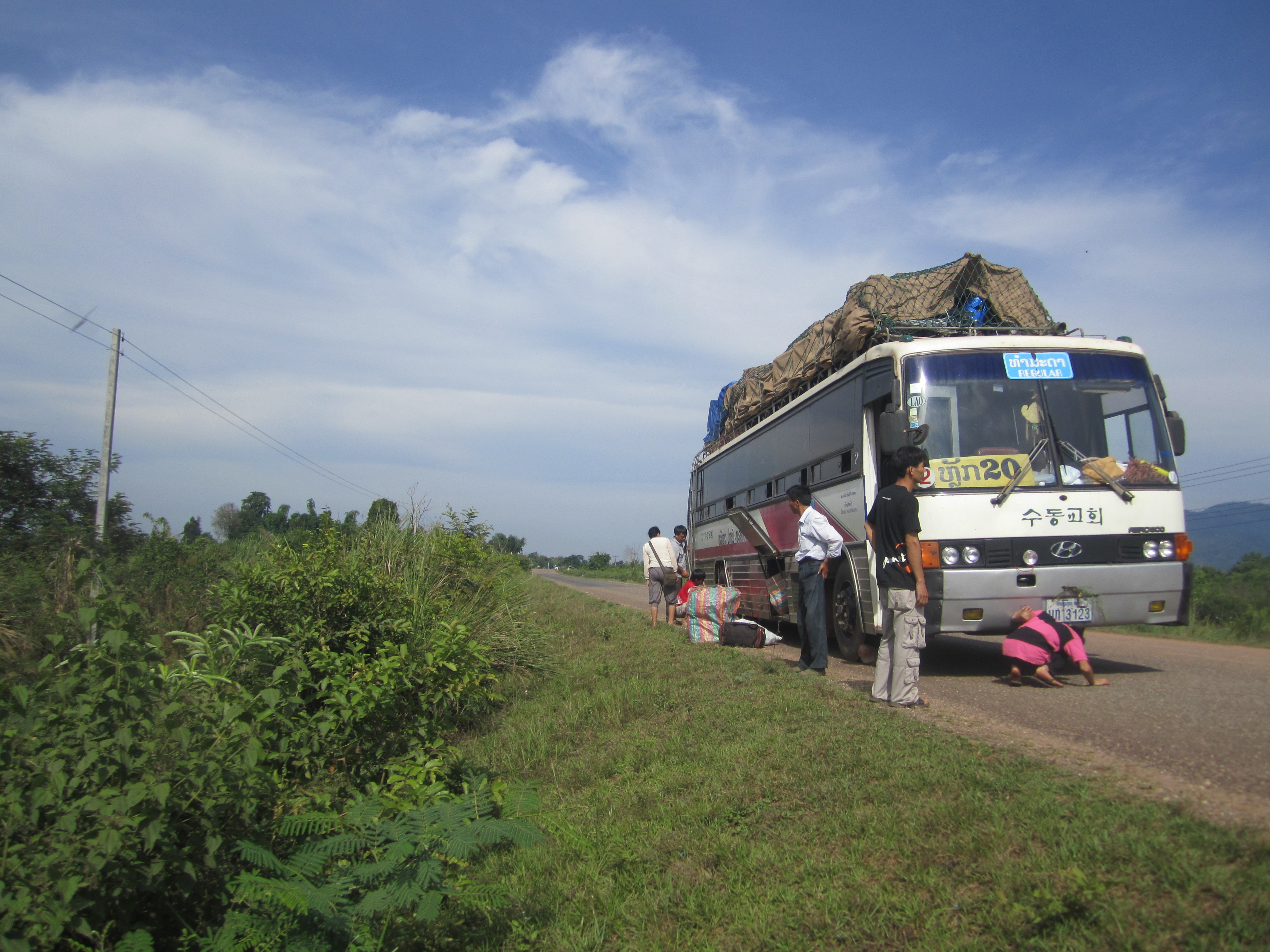
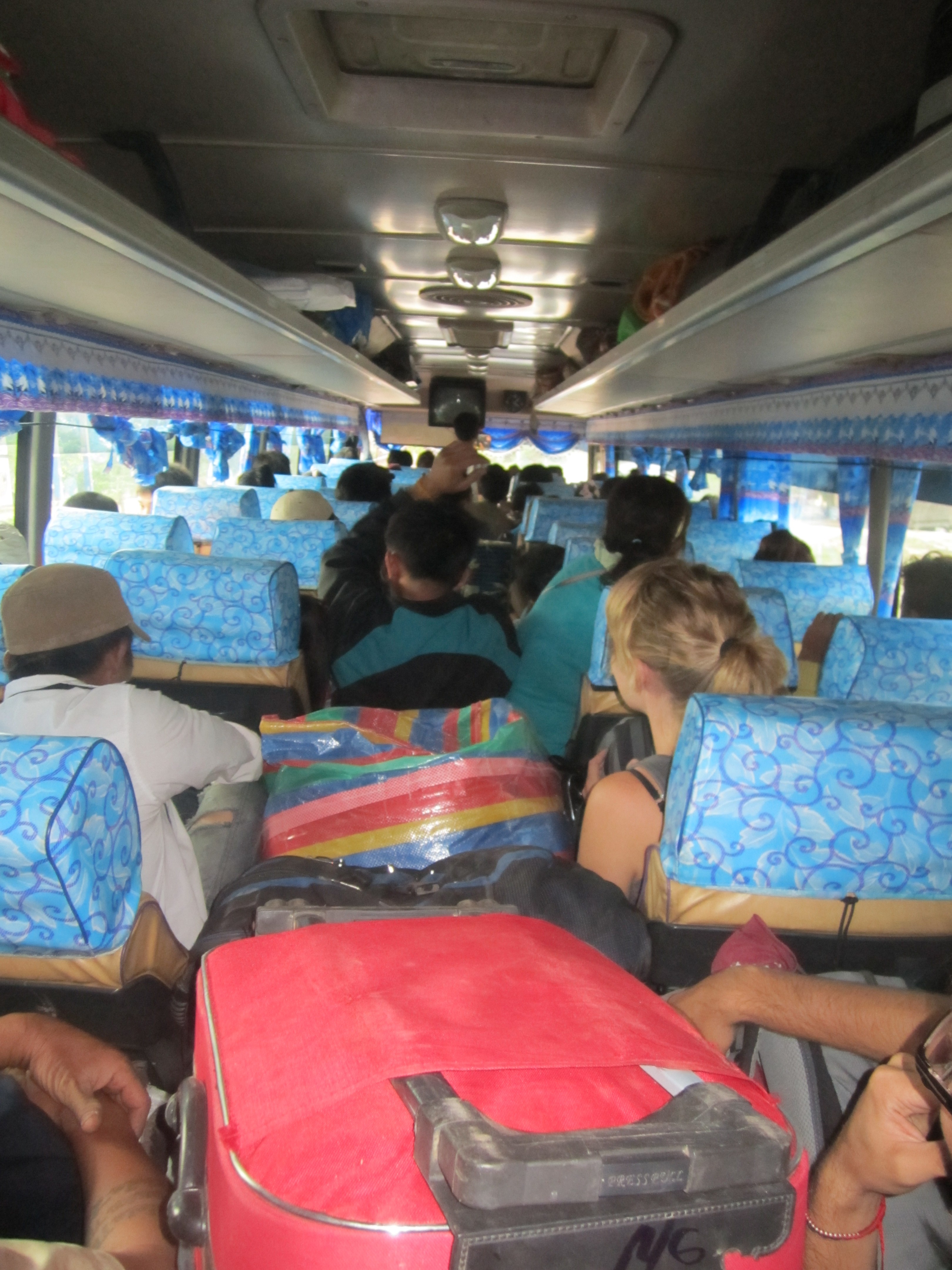
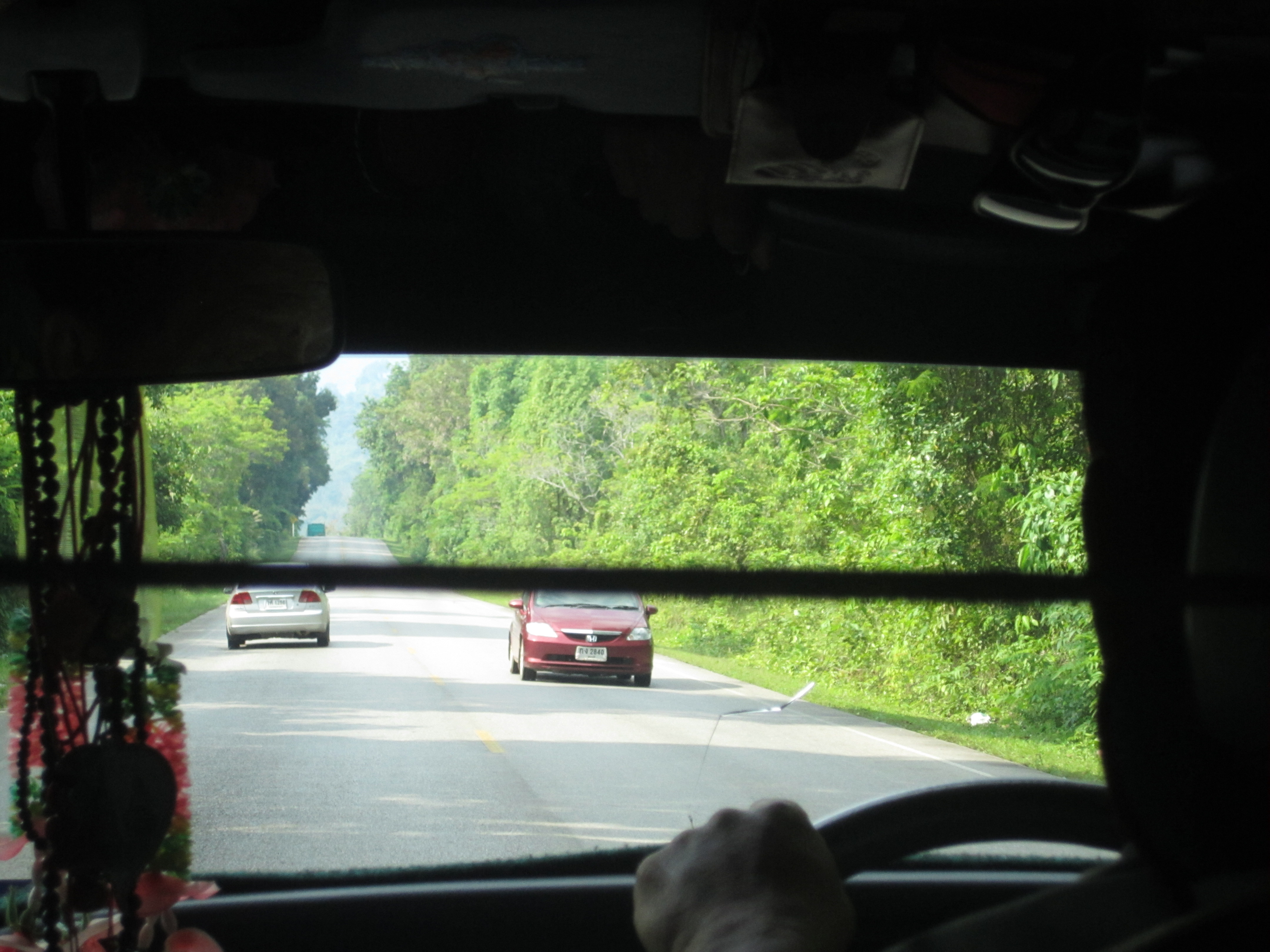
I’m staring through a bus window, scanning for clues.

A month in Phnom Penh and I’m finally leaving the city. I need a new visa, and I was planning to come to the Thai border anyway, to search for the remains of a refugee camp—as though the land could hold stories, or bits of stories; as though it could tell them and I’d be able to hear it.

I look out at the rumbly pavement, the lumbering trucks, the dusty shoulder and the green, green beyond. I don’t see any traces. I see thatched roofs and hammocks between the trees; I see bone-white cows laying in the dirt and houses perched on stilts like skinny legs. I see roadside petrol stands and carts of rubble with young boys sitting atop the heap, staring back through the window at me. I see palms reflected in still water.

Where did the people walk? Somewhere, once, there were paths, and this land saw it, was it. I’m along the Southeast of Cambodia, heading into the Thailand’s Trat Province. It wasn’t one of the main avenues for escape to Thailand—those were in the north—but enough people came this way for there to have been two refugee camps, from what I’ve been able to learn. And I see no traces of their journey.

How quickly, I think, the land swallows human traces. I think of the images of saw I Phnom Penh after the fall of the Khmer Rouge, a little less than four years after having been evacuated: it was rubble, crumble, weeds growing tall and stoplights swinging silent. It was surprising how quickly the earth could undo things.

I think of the accounts of refugees I’ve read. The danger was immense, especially for people already physically weakened by years of starvation and overwork. I think of Vietnamese soldiers, fake Khmer Rouge soldiers, Thai bandits, sleeping landmines—all that people risked to walk through this place that I’m gliding through, plexiglass and air-conditioning. And isn’t that the truth of it?—all I can know of it the warp in the window, the transparent reflection of my own face obscuring the landscape that once held answers, that maybe still does, maybe has its own recurrent dreams, of footsteps marching.

I think this as we climb through the Cardamom Mountains, bus heavy and wheezing. We arrive at the Thai border, our gaggle of Westerners clucking at the Immigration window. (Isn’t this the truth of it?) I buy a coffee; we pile into a different mini-bus and move away from Cambodia and deeper into Thailand.

And it’s different, very different, in a way that surprises me. Borders are usually blurry to me, cultures overlapping like a Venn Diagram. But this one, the contrasts seems stark.

It’s not just that everyone’s driving on the British side of the road, not just that the cars are all newer and shinier. The green is greener in Thailand, I think. There’s no trash on the sides of the road. The electrical wires extend in an orderly fashion, don’t tangle like dreadlocks. There’s more road signs, and they’re crisper, brighter, perkier.

After a month in Cambodia’s capital and five hours chugging through its countryside, Thailand strikes me as wealthy, lavishly wealthy—but something else too. Calm? Peaceful? Something emanates through the lushness, which seems unexplainably lusher than Cambodia. It reminds me of rich kid’s skin, how it seems to glow—how when I was young I learned to spot rich kids by their skin, and I remembering asking my Dad once, “Why do rich kids’ skin glow like that?” and he said, “Access to good health care.” And that made sense, logically, but still didn’t explain all of the glow, or why me and my friends didn’t have it.

And to me, Thailand glows in that way—gleams, even. I stare out at it, the ease and grace it permeates. I want to call it an innocence, but I don’t think it’s that. It’s a stability, I think, perhaps the result of having not been at war, wars. Is this the landscape of peace, of a place that’s managed to never be under the hold of imperialism, that’s maintained a precious degree (or illusion, depending on who you ask) of neutrality?

In comparison to Thailand, I begin to wonder if Cambodia’s landscape does bear wounds, bear a kind of witness—dulled and muted and hard to notice once your eyes have become adjusted to it, like a silhouette of mountains against the night’s sky. Will I be able to see it better when I cross back, the other direction?—what I have easily, automatically normalized.

I stare out the window, searching.

Lost in Navigational Translation: The Tuk-Tuk and Motorbike Drivers of Phnom Penh

“Tuk-tuk la-dee?” “La-dee, moto-bike!” “Where you go?” “La-dee, la-dee—you need moto-bike!”

This is the chorus you hear, endlessly, walking through central Phnom Penh. It’s like birds chattering, only more jarring, less song-like. It comes accompanied with a raised arm, two fingers extended—more of a summons than an offering of service.

By the touristy riverside, the touts can be pushy, but for the most part they’re just guys trying to make an honest(ish) buck. At first I tried to respond to all of them—Lisa ran a tuk-tuk company in Phnom Penh, given as part of her dowry, before the Khmer Rouge—so I feel a special responsibility to be respectful. I smiled politely and said “no” or “ot te.”

Eventually it got to be too much to respond to each other them, perched on their bikes at every street corner, crying out to you when you’re half-way down the block. I began to just shake my head, and soon stopped making eye contact. I started feeling like a bobble-head toy, my neck hurting from the constant swinging. Now I barely respond at all.

But I suppose that’s not so unusual, the constant barrage—being a Westerner in a city like Phnom Penh, where you stand out, gleaming of privilege and sweat and thin layer of sun screen. You take it in stride, a small price to pay for the relative welcoming warmness of the Cambodian people.

But here’s what is so unusual: most of these tuk-tuk and motorbike drivers have no idea how to navigate the city. A city, I should add, that’s laid out in a neat grid. And not just a grid, a numbered grid, where even numbered streets intersect the odd.

It is perhaps the easiest city I’ve ever learned. And I don’t make my living by driving its streets. So what, what, what is going on here?

It took me a few days to clue into it. I did a lot of walking at first, and when I did finally take a motorbike, chalked the confusion up to language barriers and my hotel’s offbeat location.

On Friday night, I was headed from a party back to my hotel. “Street 141 at 232,” I told the driver. The glassy gleam of incomprehension stared back at me, followed by a vague nod. This did not produce a feeling of confidence in me.

Must not know his English numbers yet, I thought and whipped out a piece of paper. I wrote the street numbers as largely and legibily as I could. I showed him. He nodded a little more vigoriously; we negotiated the price and I hopped on.

We slid down the wide Norodom Boulevard, nearly empty of its honking, and I felt the breeze of the night on my arms, my legs. I closed my eyes and let it kiss me.

I’d been in the city four days by that point—so I knew when we were making a wrong turn.

“Um, no,” I said and pointed back to Norodom. He shot me a confused glance. I pointed to the street sign. “This is only 156. We go to 232.” I waved my hand down the road.

A series of slow circlings and U-Turns ensued, me growing ever crankier on the back of the bike. It devolved to me leading the motorbike driver street-by-street back to the hotel.

He must be new at this, I thought as I finally hopped off.

But the phenomenon repeated itself: the glassy look, the vague nods, the wrong turns and aimless meandering. Another characteristic element to the typical un-joy-ride, I soon discovered, comes when you stop every couple blocks for the driver to discuss with other drivers the intended destination of the passenger, locked in some sort of secret code no one is able to decipher. Lots of pointing and shrugging ensues. This is apt to repeat two-to-four times before one finally arrives.

At first, I blamed it on my own inability to say Khmer numbers, and took to only writing locations, following it up with a big, you-get-it? grin.

The answer you always get is “okay, okay.” The ride you get is not always “okay, okay.”

I was utterly confused and out of ideas. Maybe they were guys from the countryside, who’d only just come to Phnom Penh. Maybe they didn’t know the city that well yet—but come on, how long does it take to learn a city? A numbered grid of a city at that?

No, no, there was something more going on here—some kind of deeper divide than just language or location familiarity. There was so kind of vast cultural chasm, a disconnect.

“Oh no, no, no,” Mathilde told me. “They don’t know street names, only landmarks. It’s better to say ‘near to Independence Monument,’ or ‘Royal Palace.’ These they know. But sometimes even then…”

I’ve worked that into my repertoire, a long, drawn-out process in which I use every means I can fathom to communicate my destination. “Sihanouk, near Independence Monument,” I told the driver yesterday.

We got closer this time, but just before the up-lit monument—positioned handsomely at the crossroads of two main thoroughfares and surrounded by the massive honking roundabout—we took a turn down a random sidestreet. I sighed. We U-Turned.

I reported my failure back to Mathilde. “They will always say ‘okay,’ even if they don’t know.”

“So, how do they work? How do they live and get around a city they don’t know at all?”

She shrugged, and I guess that’s all you can do. Because they must know it—there must be some way they know it, some entirely different way of interacting with a city and a landscape that doesn’t even occur to me, that I can’t even fathom—as foreign as another language, as mysterious as an alien scribble, written all over this city in a way I can’t read, can’t decipher—in a way that I can’t even see.

Perhaps I’ll figure out the mystery. But for now I’ll keep circling, keep ambling, keep pointing to a destination I can’t communicate, hidden somewhere in the gap between cultures—foreign, mystified and helmetless on the back of a Phnom Penh motorbike.

Learning to Ride On a Motorbike in Hanoi

Hanoi is a bipolar child with a strict bedtime.

Clinging hands behind me to the metal rack, I try to suppress the involuntary flinching—a circumstantial case of Tourette’s. It’s Saturday morning, and my first ride aback a motorbike through the frenetic traffic of Hanoi.

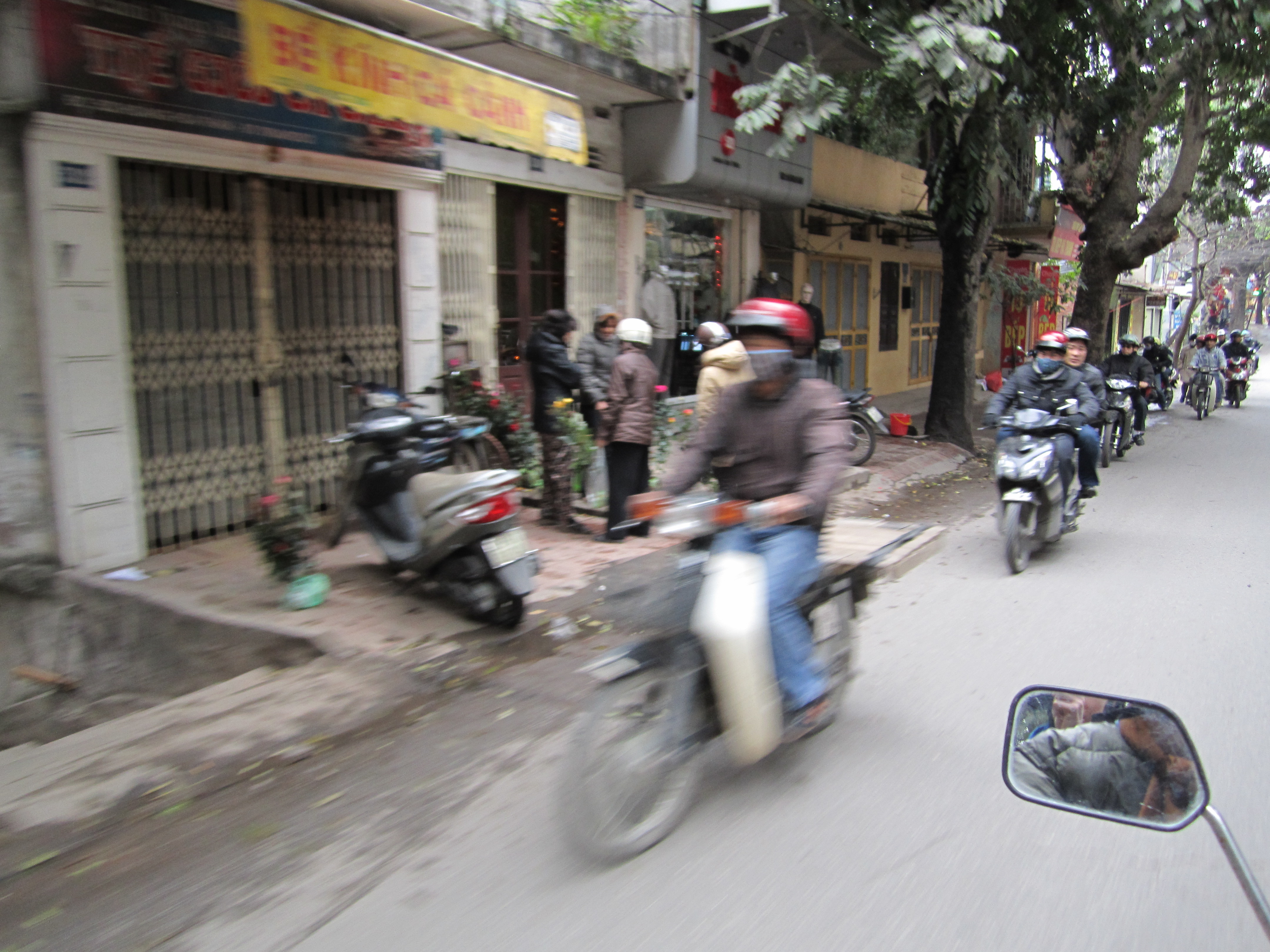
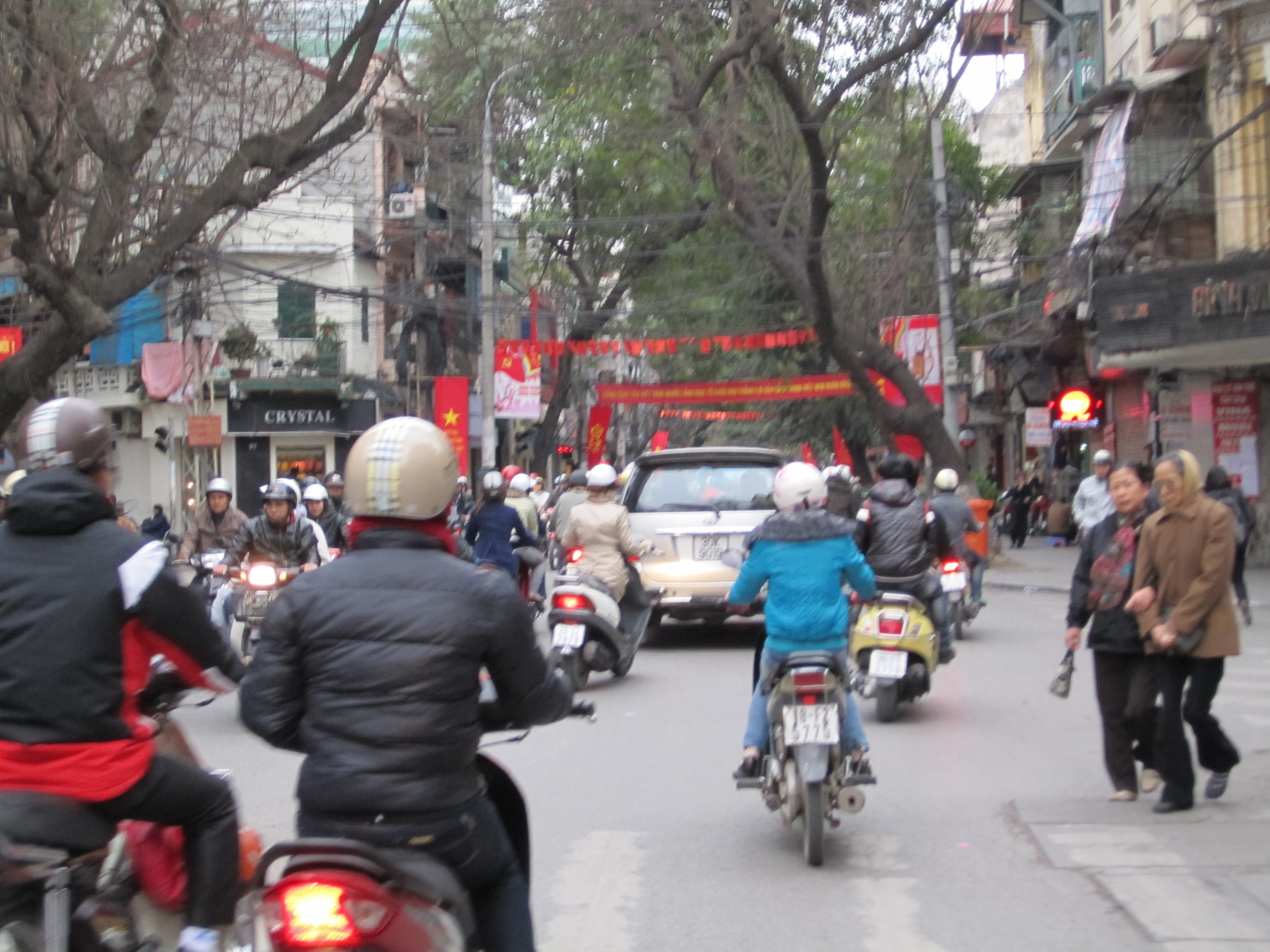
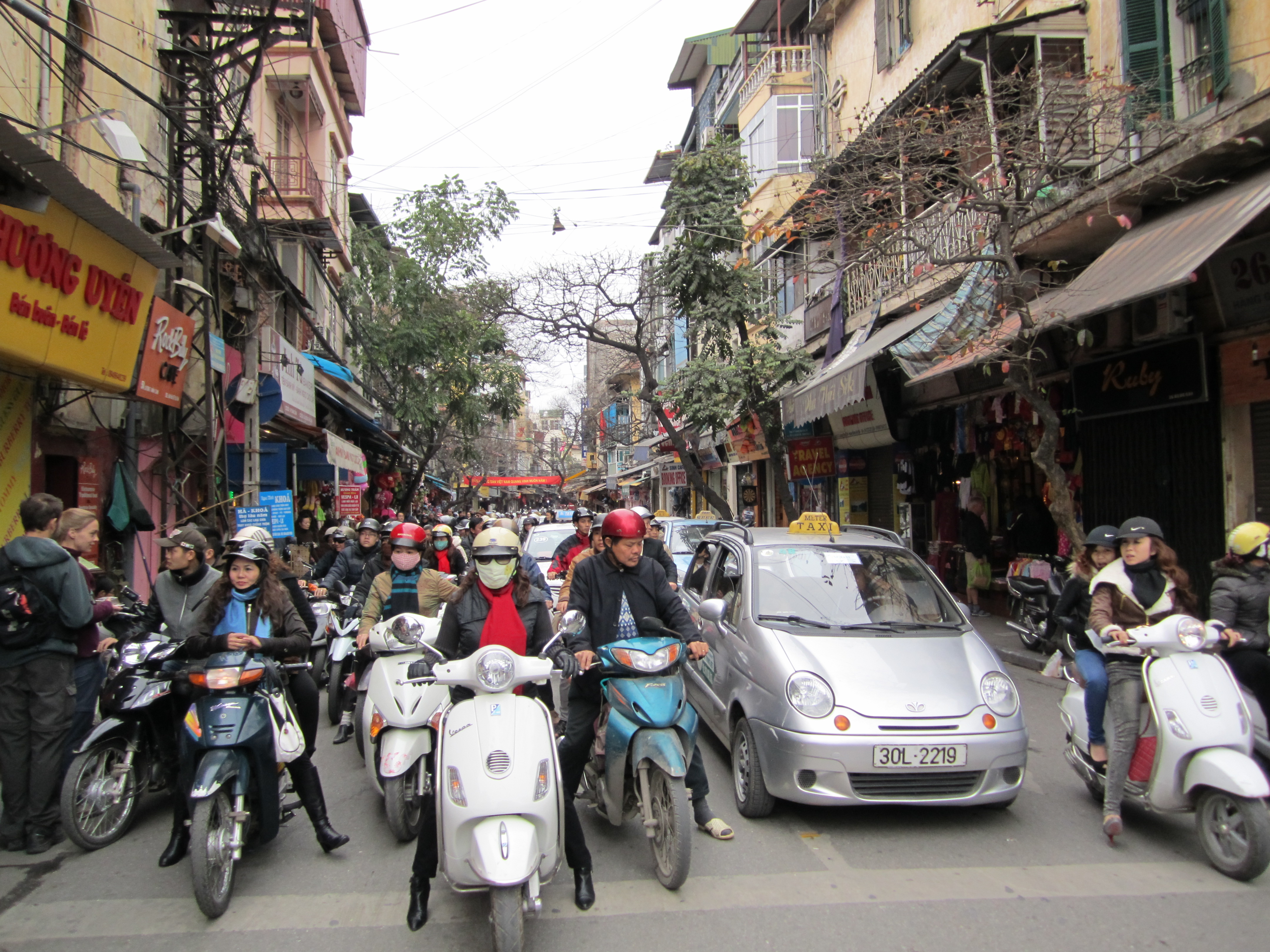
If you want to see the word “clusterfuck” defined, acted out in an exquisite charade, snap on a spare helmet, straddle the seat of your friend’s motorbike and take a ride through the streets of Hanoi. Feel the blanket of exhaust haze whip up around you; feel your legs naked to the risk of a thousand near collisions; feel the breeze of your own mortality and the queasy cocktail of sweetened coffee, cigarettes and exhaust churn in your stomach.

See towers of Tet trees and blossom branches balanced aback bikes; see jugs of water and housewares, bundles of mysterious somethings tied on in impossible precariousness. See families of four smooshed onto a single bike; see the eyes of children placidly blinking in the madness. See drivers texting, pulling out without looking, barely slowly, pedestrians stepping out into the chaos of it all—women walking with baskets balanced on a piece of wood across their shoulders, liked Lady Justice, except it’s their mouths that are masked; their eyes remain wide open.

Hear the horns beep and squawk like a million hungry birds—seven million, to be exact, and every damn one of em has a motorbike and is riding their motorbike, lanes just vague suggestions, right-of-way a nonexistent notion.

See this all this because you’re in this, suddenly a part of this: a passenger in the strange dance that feels more like a riot or a mosh pit—but no, no, must be a dance because you keep skirting disaster, skirting death, and you keep wanting to clamp your eyes shut but can’t, can’t.

Riding aback a motorbike through Hanoi isn’t exactly a near-death experience. It feels more like being on an airplane with really bad turbulence: you trust the pilot but not the skies. You know you’re not actually going to die, but you really can’t wait for the whole damn thing to be over. You get off feeling like you’ve just stepped off a rickety old rollercoaster that’s safety permits are supremely suspect.

“The sidewalks in Hanoi aren’t really for walking,” Jacob throws over his shoulder. “They’re more for commerce. If you want to walk, you’ve pretty much gotta do it in the street.”

It’s not a walking town, he says, and it’s true—at times I don’t see a single pedestrian, just a weaving, wheezing sea of traffic. How do you get to know a place without walking it? How do you get a feel for feel for a place without your feet on its streets?

It gets easier. I tell myself to trust, to put faith in the fact no one seems to be crashing. It begins to feel like we’re moving along this barely perceptible tightrope that weaves in and out of other people’s tightropes, maybe like telephone wires—like our own personal orbit, the miracle of chance that we don’t collide, such a miracle that it can’t be chance at all, but driven by some other force I can only suspect, can feel at times in the smoggy breeze, but can’t come close to naming.

Nighttime is different. It’s as though someone flips a giant switch. By 11, the streets have cleared, suddenly swept of everything but a faint whisper, the asthmatic glow of the headlight. The streets seem smaller in the dark, emptied of their madness—they don’t seem like the same streets at all, but an entirely different place, a different city. An incredible stillness settles over the buildings, the pavement, the wires stretching and branches drooping and the shapes of shadows in the dim drizzle—as if none of it were real, all the daylight mania just a waking dream, a reverse nightmare.

By Sunday I’m able to hang on with only one hand and snap photos with the other. I’m comfortable enough to carry on a conversation as we drive. Jacob points out landmarks and tell little stories; I tell him how my parents were revolutionaries when they were young, how the met in a Communist meeting. He quizzes me Vietnamese numbers, phrases; we laugh about the universal asshole-ness of SUV drivers. We weave through the manic chaos of daytime, and I tell him Hanoi feels like a bipolar city.

Rain comes that night, along with a cold wind; we move more slowly through the vacant streets. I blink against the lashings of wet and my hands turn frigid. Slowly, I loosen my grip on the metal grating, and place both my hands in my pockets.

I’ve learned how to trust the gods of traffic and chaos. I’ve learned how to ride a motorbike in Hanoi.

11 Dazed Hours in Hong Kong

If ever there was a place to wander around in a jet-lagged, head-cold haze with nothing more than a tourist bureau map, Hong Kong is it.

The 11-hour lay-over is actually what made me choose this flight to Hanoi (aside from the fact that it was the cheapest). I love long layovers; it’s like a two-for, a bonus. You get to extend the half-here-ness of transit onto a place—walk through its streets like it were a video game, or bumpy camcorder images from someone else’s vacation, or someone else’s dream, exuding a kind of impermenance that makes you impervious, imperceptible, a kind of illusion, a walking ghost in a half-here city.

Or it could just be the jet-lag talking.

Either way, Hong Kong is a trippy city to spend 11 hours sleepwalking through. Everything is clean, clear and predetermined: signs telling you where to go, signs reminding you to hold the handrailings, signs designating exactly where you should walk and where you should stand and which direction you should look for traffic and when you should be mindful of bicyclists.

It’s a subdued city, a city on Vicodin. Everyone talks in a low, pleasant voice; they smile slightly when they exchange words with you. Skyscrapers rise up to be swallowed in a white fog. Municipal workers sweep sidewalks, trim hedges, wear blue face masks and walk with their hands clasped behind their backs, or piously under their bellies. People walk with the self-possessed composure of business people on their lunch breaks. Shoes click, crosswalk signs hum, the gentle clatter of endless construction (what more could they be building?) echoes. Nothing is loud or jarring or overwhelming. Yes, it’s crowded, but there’s an order to everything—an organized insanity, a colonized chaos.

You could almost begin to suspect that you were in some George-Orwell-esque alternate reality, where everything seems real, resembles real, but really isn’t—just some placated approximation of a real place. Rolex, Prada, Couch, Ralph Lauren, Espirit, Starbucks, 711, Pret A Manger, Citibank, Geox—buildings that stack as neatly as Leggos and fish markets that don’t reek of fish, don’t reek of anything. The thinnest layer of soot covers the awnings, as if to remind you that it’s real—the slightest twinge of exhaust tickles your nose.

It doesn’t feel theme-parky or like a tourist charade, but rather like the city has in fact become this—a large, outdoor office park.

None of which is to say I didn’t enjoy my time wandering around Hong Kong—just that it felt more like one of the alternative realities from Inception than a real place. Which could have been the cocktail of jet lag and DayQuil and caffiene and bad airplane food swimming around inside me. It could have been the pork dumplings and Ramen noodles that tasted like childhood.

Serendipity, Street Art and the Best Layover EVER

It’s a fantasy common enough to warrant TV commercials, (porno) movie plots and a voyeuristic story by Gabriel Garcia Marquez: you get seated next to an attractive person on an airplane. And you’re stuck beside each other, awkwardly negoitiating the small space for hours.

As most travelers will readily tell you, this is about as rare to air travel as getting bumped up to first class. No, rarer. The cast of characters usually beside you in the sardine can of coach include snorers, fidgeters, wiley children and consumers of mysterious day-old food. It really serves to drive home to actual percentage of datable people in the world’s population. I, for one, had given up on the fantasy and resigned myself to the mere hope of a recently showered individual that can fit in their own seat (which is also more or less when I’ve resigned myself in dating—and have been known to compromise on as well).

Well, holy shit if the travel gods didn’t smile down on me. And homeboy wasn’t just attractive—he was rad. As I discovered, not just during the flight, but on our 10-hour layover spent adventuring around Brooklyn together, spotting street art and searching for obscure vinyl.

I’d noticed him passing through security (as I was being pulled aside to have my purse dismembered in search on nonexistent weapons): hip without being pretentious, stubble beard, cowboy boots, a bulging bag of records. But I didn’t give it much thought until I was settling into my dismal seat in the back of the plane, next to the bathrooms. I watched him struggle to jam his record bag into the overhead compartment and smiled. When he looked down at his boarding pass, scanned the aisle numbers and ended up standing right beside me, we both smiled.

Sebastian had been traveling around the US for 5 weeks, and was on his way back to Zurich. He had a couple lines in his forhead, the well-traveled beginning of wrinkles. He had the worn-smooth hands of a cook, the black strand of a necklace peeking out from under his shirt. He had killer taste in music.

We chatted about life and travel and bands (“I saw some great shows in San Francisco.” “Like who?” “Ty Segall.” “On Wednesday? At the Rickshaw Stop? I was totally there!”). We talked about his trip and my trip (“I’ve got a 10 -hour layover.” “Me too. I was gonna go into the city, hang out. Better than being at the airport.” “That was my plan too.”) We fell into the fitful half-sleep of confined space and over air-conditioning; woke up stiff necked and lip smacking, ditched our bags at a luggage locker and rode the subway into Brooklyn.

It was a shuttered-up and bare-sidewalked Sunday morning on Bedford, ground zero of Brooklyn hipness. There was a record store Sebastian wanted to get back to, that wouldn’t be open for hours. We rubbed our aching eyes and looked for coffee.

I consulted my iPhone. “Oh shit, there’s a Blue Bottle?!” I exclaimed. “Yeah,” said a girl passing by, “it’s around the corner.”

We sat in the sun and drank our hand-dripped cups of black, watched the parade of dogs and toddlers and cool kids. We bombed around the neighborhood, going nowhere in particular, until the shops thinned and the wide walls of warehouses took over. And we began spotting some kick-ass street art.

All the pictures are on my phone, which for some reason my new (new to me, that is) netbook won’t download. So expect a post when I get home. But just to tease, I saw Roa, Faile, Space Invader, Gaia, and a whole bunch of folks I didn’t know but really wanted to.

We hit the record stores that had brought us there. Sebastian confessed to me that he was a music nerd with a record fetish. “There’s so many more records in the States,” he told me. He’d already shipped a crate back to Zurich. “It’s okay, though, it’s still cheaper than trying to buy it in Europe. If you can find it at all.”

We got back on the train, dazed and subdued with our long flights looming. We looked back through his pictures—he’d ended up going to Burning Man, on (another) serendipitous whim, and I leaned in over his shoulder to look at the small viewfinder, its story of dust and fire, the wind that moves through desolate places.

Our shoulders touched, just a little in the shudder of the train. I felt no desire to make a move, so to speak; it was enough to have a small flutter in my stomach. It was enough to have met someone awesome, totally serendipitously. It was enough to have wandered around sleep-dazed and discovering, to have sat on stoops smoking in the Brooklyn sun.

Sometimes you don’t need a big climax, don’t need to get all flirty and sleezy or anything at all. Sometimes it’s enough to feel liked, not just desired, and to genuinely like someone back. Not cause you want to make-out with them necessarily, but just because they’re rad.

We sat at the bar of a jokey airport restaurant, where Sebastian indulged in the last American hamburger of his trip. NFL games were flashing on the various television sets, the jarring loudspeaker announcements of boardings and departings echoing through the space.

“Sebastian,” I said, “you are by far the coolest person I’ve ever sat next to on an airplane.”

We hugged. “I had a great time,” he smiled. “Me too.”

And I walked away, through the terminal to my own adventure.

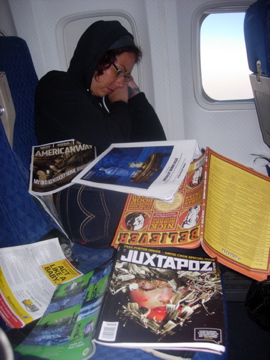
Travel Tip: Magazine Blanket (AKA: Stickin It to the Man)

Oh yeah, American Airlines? You wanna play dirty?

You’ve already taken away my peanuts and charged me for a checked bag—think you’re gonna bleed me a little more by cranking the air conditioning to Venezuelan-overnight-bus levels and charging $8 for one of those shitty blue blankets?

Well, I’m not skerd. I’ll make a hobo blanket out of magazines.

You’ve obviously underestimated my industrious frugality and lack of shame. Maybe next I’ll bring a can of beans and a hot plate, and make my own in-flight meal.

Through the Green and Into the Dust

Blogging to you LIVE from the Wigwam Motel in Rialto—my own yellow, cigarette-stenched circle of heaven in the epicenter of strip malls, tract housing and Morrissey fans, the San Bernardino Valley. It’s the perfect place to end the drive down to SoCal, and to begin the journey into the dusty heart of whatever weirdness remains.

I started out on my roadtrip yesterday, sniffling and sore and in a DayQuil daze. I decided to press on with my plans, despite succumbing to a nasty cold that’s been going around, and if it hadn’t been so goddamn beautiful, it might have been painful. Spring arrived a couple days ago, with that certain lightness that makes everything seem young and hopeful and achingly pure. The coast was lit green by months of El Nino storms, a verdancy that’s rare in California. I twisted and turned on the skinny roads, blasting my stereo over the roar of wind through the rattlingly cracked windows.

I stopped in Big Sur, where I hadn’t been since I was a kid. I’d remembered it being so far away from home, which I suppose it is, but only if you measure in culture, not in miles. It was just as massively impressive as I’d remembered, with broad trees and heartbreaking cliffs and not too many tourists, being early in the year. I’d been too groggy to stop for a sandwich on the way out of town, so I pulled into Nepenthe, purported to be one of the better of Big Sur’s overpriced coastal cafes. Glorified Wonderbread, browned and soggy lettuce, and $20 later, I decided that eating a $7 sandwich from home of the hood of my car at some pretty vista point would have been a far preferable experience. Whatever—it’s Big Sur. You can’t stay disappointed that long.

Feeling a little pepped up, I tried to do a quick hike, but discovered that a lot of the trails are currently closed due to the pummeling storms this year. So I tromped down a little coastal path, with bickering families and friendly Germans, aptly named Overlook Trail. It overlooks this:

and I felt pretty satisfied.

Back on the road, the coast got twistier, the pavement rougher, as I made my way down to San Luis Obispo. It’s a pretty typical California college town, with one major draw—one of the region’s few youth hostels. I grabbed a cheap bunk at Hostel Obispo, a cute old Victorian house, and took a leisurely stroll down to “Downtown,” which is really more of a high-end outdoor mall.

meeeeeat!

Traveling within the US is a novelty for me, and it comes with a couple major benefits, one of which is the use of my iPhone (far too expensive to use abroad). While the Cheap Gas and Public Restroom Finder apps have proven utterly disappointing, my old favorites are definitely coming through: Google maps and Yelp. I wanted to eat somewhere popular, that would give me a good feel for the town, and ended up at the Firestone Grill. It’s a BBQ joint heavy on portions and easy on the pocketbook, which makes sense in a college town. It was alright, about twice as good and half as much as my lunch—but 419 reviews? Then I passed the newly opened Chipotle, with a line literally out the door, and realized maybe, you know, I had had some of the best food in town.

I strolled around the town some more, filled with dudes in flip flops and girls in work-out clothes and pony-tails. It felt wholesome and relaxed—even the local riffraff felt quaint, in their barefoot belligerence. Everything felt cheerful and hopeful, like springtime and college students. I topped off the night with a much-needed soak in a hot tub at Sycamore Mineral Springs, a 12 minute drive from San Luis Obispo. My achy bones and sinus congestion thanked me.

This morning I backtracked to Montana de Oro State Park, for a little fresh air and strolling. Curving down a two-lane road, I went past coastal hills covered in purple and yellow wildflowers, orange explosions of poppies against the green green of the hills. The road took me into a tangle of eucalyptus trees; I pulled over where a bunch of cars were parked and scurried down a dirt path into a grove of trees.

The light cut through the leaves and branches and ocean mist in this dream-like haze, and all I could hear where birds and surf crashing. Over a hill and through a miniature valley (where a pelican glided past just as I rounded the corner), and I found myself at a surfer spot. I hung around a bit, sitting on the rocks and watching the waves and wet suits.

I headed back, this time inland on the 101, where flowers and green continued to line my journey. At home, I’m an impatient and cranky driver—I hate traffic, parking, street sweeping. Always an impediment to where I’m trying to go, what I’m trying to do. But driving down the coast, with my music playing and my broken skeleton doll dangling from the rearview mirror, I could let go and just go with the rhythms of the road. There was little traffic, just fresh air and beauty and my own wordless thoughts. The road was the place I was trying to go.

The roadside kitsch of Pea Soup Anderson’s was too much to pass up, so I made another stop—plus the soup felt good on my sore throat. Then I went to do a little un-urban exploring, swishing through thigh-high grass to poke around an abandoned diner I’d spotted from the highway. I peered through the windows at the stacked chairs, the silent booths, feeling a strange kind of nostalgia for a place I’d never been.

Things were starting to get cool.

As luck (or unluck) would have it, my iPod died just as I was cruising past Santa Barbara, so I pulled off to find a cafe. It’s hard not to feel alienated in a town like Santa Barbara, wealthy and white and homogenized and nice. Very very  nice. It’s the kind of place that feeds all your Southern California stereotypes, both the good ones—sun and long, tan legs—and the bad ones—everything else.

I got back on the highway just in time for rush hour. The green gave way to brown and billboards, the ocean mist to heat and just a thin layer of smog, the free flowing to break lights and miles of congestion. My 2 hour drive took 3 1/2. I climbed over the spine of LA, snuck around the backside, through one valley and into another. And finally pulled into the Wigwam Motel. It’s not as run-down as they say, the area not as “rough” as some reviews claimed. It’s a working class “ethnic” suburb and, hey, I’ll take that over a wealthy brofest any day. Even if it is damn hard to find a salad.

Blurry, but it does say "Get Your Kicks on Route 66." A better photo by daylight tomorrow.

So I’ve made it, my little car and me, crawling down the lip of the continent, down through the legendary beauty of coastal California, made more ridiculous by the green and tender spring. I’ve gotten reminded of what I already know of Southern California—bros and traffic—and am poised to head into the desert tomorrow. Found art, a rock n roll pilgrimage (and human cremation) site, and a honky tonk await. And that’s just tomorrow.

Ass Whoopin on the AC Transit: Epic Beard Man, and Why I Don’t Ride the Bus Anymore

Celebrity sighting on the 53

The voice was barely discernible, muffled by whizzing traffic and excitement. “I just rode the bus with Epic Beard Man! He was giving out candy bars and autographs, and I got a photo with him!”

My friend’s Friday evening commute home had been spiced up by a sighting of Oakland’s latest internet phenomenon. As the number 53 heaved down Fruitvale Avenue, passengers posed for pictures and chanted “Epic Beard Man,” as the grizzlied old dude distributed candy from his backpack and basked in the adoration of the bus riders.

Regardless of your take on Oakland’s latest internet sensation—racist, vigilante or mentally ill bad-ass—one thing is for sure: Epic Beard Man has reached celebrity status. And while a heated, racialized debate rages in chat rooms and on blogs, the actual riders of AC Transit appear to have risen Epic Beard Man to the revered status of folk hero.

Quick low-down, in case you’re out of the loop: earlier this week, a YouTube video of an AC Transit (Alameda County Transit) altercation between a middle-aged black man and an elderly white man (now dubbed Epic Beard Man) made quite a stir—over a million page views in its first day, and countless comments and ensuing discussions over issues of race and safety in Oakland. The story was picked up by local blogs, news outlets, even the Huffington PostKnow Your Meme offers the most complete run-down of the controversy, featuring video responses that capture some telling Oakland sentiments.

You can go to YouTube and dig through all the remixes, follow-ups and tributes, but here’s the original video. Yes, it’s graphic:

It’s no surprise that the video is so popular. It’s another opportunity for people to glimpse into the dysfunctional “urban” reality of Oakland, and people outside of Oakland never seem to tire of that. Several years ago, the city’s other big internet phenomenon fascinated outsiders with its oh-so Oakland cultural collisions and colorful characters (I was living in East Oakland at the time, and the screeching sound of whistle tips really did echo through the streets at all hours).

While responses to the latest video vary, they largely fall into two camps: Epic Beard Man is a racist, or a hero. He’s either an old redneck who asks a black man to shine his shoes, then beats him, or he’s a tough dude who stands up to a punk-ass thug who’s instigating and harassing him. In general, the first camp seems to be populated by guilty white people and advocates of all things ghetto, while the second camp is composed of kids, bus riders and enthusiasts of drama and smack-downs.

My own response lies somewhere between the two. Both men are unstable, not the kind of people you want to sit next to and exactly the kind of people you meet on East Bay buses. Epic Beard Man is obviously not well, further evidenced by follow-up interviews; turns out he was also the star of another YouTube phenomenon, a video where he gets tased at an A’s game for unruly behavior. He’s a deranged old Vet with a tenuous grasp on reality, prone to violent outbursts. Not someone who should be milling around the streets, trying to take care of themselves, but hey, that’s America (thank you, Ronald Reagan). The other dude should have left it alone, realized Epic Beard Man was not all there and not worth the trouble—but in his bravado, he got pumped full of ego and shit-talking and, well, he got served.

What’s most interesting to me is how the people most closely related to the issues raised in the video reacted—that is, AC Transit riders and people with exhaustive experience dealing with both the tiringly whacked-out and tediously ghetto. Most of the folks I’ve talked to feel that while, yeah, Epic Beard Man is totally deranged, dude got what he deserved.

It reminds me of an issue several years ago when an Oakland resident was both vilified and exalted for standing up to the thug kids that plagued his block, in what became a violent incident. While both parties in this instance were African-American, so the race issue wasn’t raised, responses were similar: he was either a vigilante hero, or a villainous attacker of innocent youth. Throughout the controversy, the man insisted that all he wanted was a safe neighborhood in which to raise his kids—what I’d argue the majority of people in Oakland are looking for. In the end, he did what most of the families I grew up with did—unable to afford a nicer neighborhood in Oakland, he moved to one of the outlying working-class suburbs.

Responses to that issue, as well as this one, tap into some very central Oakland issues. While the man from a few years back was a much more sympathetic (and sane) character, and didn’t want to be a hero, many people regarded him as such. I think it speaks to the extent to which people are sick of all the bullshit. People are tired of dealing with puffed up a-holes who think they can say/do whatever to whoever and get away with it, tired of shit-talkers, instigators and intimidators. So much so that they’re willing to revere violent behavior.

The riders on the 53 last night, majority non-white, were literally cheering for Epic Beard Man. Yes, some of it was surely star-struckedness and a glorification of school-yard theatrics, but I think there was something deeper going on there, something almost beyond race. Most of the video responses I’ve encountered are, in fact, from people of color. Epic Beard Man may be nuts, but the other guy was an ass. There’s no video glorifying him—and I don’t think it’s just cause he was the loser in the altercation. It’s a strange thing: an incident so racialized, that at its core, to the people who deal with this stuff day in and day out, has more to do with harassment and basic respect than race.

That the incident took place on a bus is no coincidence. A San Francisco Chronicle blogger (and fellow gym goer) centered his coverage of the issue on the ridiculousness of AC Transit—for him, it was all evidence for why he doesn’t ride the buses in Oakland.

Word. I grew up riding AC Transit, and it served as a serious education in the world. The first post on this blog was a reflection of how riding the East Bay buses prepared me for world travel, while the very first piece I published, as a teenager in The East Bay Express, was a narrative about my fucked-up experiences on AC Transit (I used a line from the piece as the title for this post). While shit like this doesn’t go down on the vast majority of bus rides, it’s not some sort of exceptional incident—it just happened to be captured on tape. I’m grateful for the schooling AC Transit administered; as a result of vital life skills learned on those blue plastic seats, people generally don’t fuck with me. But I’m even more grateful to have a car now.

The Epic Beard Man hype will surely die down—like everything these days, it’ll be discussed and linked to and tweeted wildly, then fade into the buzzing gray, the next craze taking its place (in the digital age, it seems everyone’s 15 minutes of fame are whittled down to 15 seconds). But for the rest of us, the issues the video captures will continue on: race, safety, the crazies that fill AC Transit. They’ll continue to roam around, screaming and bleeding all over our commutes, and I will carry on with my self-centered, polluting aversion to East Bay mass transit.

But I will say—being on that 53 with my friend last night would have been an experience. If for nothing else than the photo ops.

Relatives and Revelations: What My Brother’s Wedding Taught Me about Travel

Photo booth fun

“What can I say? When you’re children get married, it’s one of the happiest days of your life.”

That was my dad, toasting at my brother’s wedding two weeks ago. Simple, but true: celebrating my brother’s marriage to a rad lady will definitely go down as one of my happiest days. Aside from the awesomeness of why we were all there, it was a gorgeous event at the Julia Morgan Ballroom in Downtown San Francisco, complete with caviar and a five-tier chocolate fondue fountain (that’s right, you heard me). I was surrounded with life-long friends and far-away family, flown in from the Midwest and East Coast.

Of course, as a travel person, my antennaes were perked by all the out-of-towners. Watching them all come in—arrive at the hotel, rent cars, hang wrapped dress clothes in closets—I realized I only travel a very specific way, and it’s lent a very limited perspective.

I’d argue that most Americans travel the way my family did two weeks ago: domestically, in hotels, either shelling out for a rental car or attempting to traverse poorly funded mass transit systems. It’s pretty far-off from the international ramblings I do on second-class buses and cheap pensions/hostels/couchsurfing. The weekend resulted a series of travel revelations—“light bulb moments,” as I’d once heard them described on Oprah.

Before the guests arrived

What shocked me most was the sheer expense of it all. Even at an off-season rate, further discounted for the wedding party, staying in Downtown San Francisco is not cheap. Renting a car is not cheap. Eating at the restaurants and cafes Downtown is also not cheap. No wonder people ask me “But how can you afford to travel so much?” I used to feel that travel within the US was kinda a rip-off. I don’t take it that far now, but I will say you get a lot more bang for your buck elsewhere. (That being said, I have done New York City on $40 a day, so maybe I’m just a cheapskate.)

The night of the wedding, my parents decided to not add battling the Bay Bridge to the day’s ledger, and booked a room, which I piggy-backed on. Which brings me to the next travel revelation I had: looking good on the road is a major hassle.

As far as hassles go, mine were pretty minimal: the morning of the wedding, I dropped my shoes, dress and fancy jacket off at my parents’ house in Oakland before taking BART out to the city to get my hair and make-up done. I toted with me my overnight bag, in which I carried more make-up and hair products, as well as jewelry, nail polish, etc. My parents brought my dress clothes; I met them at the hotel and changed. The next day they took my dress clothes back to the East Bay while I hung out with my cousins. Not bad at all, considering I didn’t even have to negotiate riding the train with a hanger of dress clothes.

Classy as shit

But considering the way I normally travel, this jaunt across the Bay was complicated exponentially by the need to wear something other than jeans and sneakers. When I travel, all bets are off: I bring my most utilitarian clothes, no makeup, a dabble of hair gel and loads of sunscreen. I look like a total ragamuffin—handy, since it tends to decrease the amount I’m hit on. Wanting to look not just presentable, but my drop-dead best, is tricky enough; doing it out of a bag was even harder. I garnered a new appreciation for business travelers, beauty pageant contestants and all other non-backpacker/dirtbags travelers.

Here’s another thing I learned: logistics are tough. Organizing big groups of people, getting them here and there when they don’t know where they are, is really hard. No wonder tour companies charter buses. And no wonder people trundle on them happily.

I’m the kind of traveler that loves transit. I grew up riding buses and trains, and I get a kick out of figuring out new metro systems: where train lines connect, what lines run where, the fastest and easiest way to get from Point A to Point B. There’s a skill to transit, and I’ve honed a kind of sixth sense for the rhythm and order of it. So when my dad started to fret over how we’d get everyone from the Downtown hotel to a Sunday night pizza dinner at my brother’s house on 27th and Dolores, I responded, “We’ll have them take the J-Church.” Easy, right?

Well, it was easier than shuttling loads of people back and forth in the couple of rental cars, but not as easy as you’d suspect. I played transit tour guide, leading everyone to the Montgomery Station, through the turnstiles, down to the platform, on to the train (luckily, we all got seats). I alerted everyone to our stop, got us all out of the back doors (although almost lost my grandfather in the process), and down the two blocks to my brother’s house.

There’s not a lot of hand-holding or coddling on MUNI, and I like it that way. MUNI’s not most intuitive system—you can only pay station turnstiles in coins, have to retain a transfer ticket, and all lines eventually come aboveground, where stops are unmarked. But it’s still cheaper and more comprehensive than BART, long-distance commuter trains that double as mass transit for the Greater Bay Area, with a pathetic number of inner-city stations and a whopping $7 round trip fare from my neighborhood in Oakland to Downtown SF. In my mind, this makes BART infinitely inferior to MUNI. Who needs plush seats and timetables anyway? I’ll take hard plastic and a vague urine smell over a $7 fare any day.

iPhones have no flash, but you can still kinda make out five tiers of fondue.

But riding the train with my relatives, I realized that transit can be damn stressful. If you’re not already in the groove of it, or don’t share my nerdy obsession with maps and routes, it’s really just a pain in the ass. The potential to get lost is huge: you could get on the wrong train, get off at the wrong stop, end up god-only-knows-where. It’s confusing, station agents are exasperated, locals impatient. My relatives that rented cars were hit with overnight parking fees and having to traverse a maze of one-way streets, but when they got lost, they were warm and dry, and could easily turn back around. I realized why, despite the costs, so many travelers opt to rent cars over riding transit. Guiding everyone through the process, I also realized why tour guides carry those little colored umbrellas.

In the end, everyone got to and fro and everywhere inbetween safely. We gussied up, boogied down and had a killer time. And that’s what weddings are all about, right?

Yankee in a Che Shirt: How To Travel to Cuba Independently and Illegally as an American

Americans you're likely to encounter in Cuba

Si, se puede!

Three years ago, I traveled to Cuba. I didn’t get a visa, didn’t book a tour, didn’t go with a dance troupe or salsa band (though that would have been killer). I did it the way I do everything, independently.

Fear mongers, nay sayers and foreign travel agencies would lead you to believe that independent travel to Cuba is dangerous and impossible. They’re the same people that make full and complete stops at every stop sign, and are too scared to ride the subway in NYC. Or else they’re trying to sell you something—the hustling taxi driver outside of the airport. They clamor cowardly behind the embargo.

Here’s the legality deal: as an American, you’re technically not banned from traveling to Cuba; you’re prohibited from spending money there. Whatever. If you didn’t obey your parents’ curfew as a teenager, are you really gonna start heeding authority now?

The fun thing about traveling to Cuba as an American is that it requires more effort, more digging. You can’t buy your plane tickets online; most worthwhile advice won’t come from guidebooks but fellow travelers, via forums like Thorn Tree. Basically, you have to work a little harder. But the reward is getting to go to one of the most un-Americanized countries in the world—remarkably only 90 miles from Florida.

I’m pretty sure it’s technically illegal to give Cuban travel advice to Americans. But eff that too. Here’s how I did it, how it worked and the gems of wisdom I smuggled back (along with the cigars):

Before You Go: Money and Packing

Your most important pre-travel preparation as an American is money. Your ATM and credit cards won’t work in Cuba, meaning you’ve pretty much got to bring everything you plan on spending with you. Travelers checks are a pain in the ass and have a hefty commission tacked on—which means you’ll be bringing cash. Lots and lots of cash.

If you’re like me, you’re not too thrilled at the idea of walking around with $1300 on your person. But keep in mind Cuba’s remarkably low crime rate, the absence of desperate drug addicts and your own street sense—you’re gonna be fine.

Another consideration is which type of currency to bring in. The greenback gets an extra 10% penalty fee on top of the standard 8% exchange commission, so most travelers opt to bring in Canadian dollars or Euros. It pays to do the math on conversions and figure out how much you’ll be hit by commissions and fees for dual exchange (changing from dollars into Euros into CUCs).

Another pre-trip consideration is what to bring, and what not to bring. This is for everyone, not just Americans. Charitable donations like medical supplies and clothes are greatly needed and appreciated, but check out regulations on what and how much to bring. Cuban Customs has some unusual regulations regarding the import of electronics and pornography, and is super strict about narcotics. Of particular concern to Americans is the prohibition of anti-revolutionary literature—make sure you don’t have any crazy right-wing, Miami ex-pat ramblings with you. Not that you would anyway.

Getting In: Booking a Flight

The easiest, most popular and often cheapest way for an American to get into Cuba is through Mexico, namely Cancun. Of course, Cancun is the #1 most suspicious transfer point, and word around the chat rooms is that you’re singled out by US Customs most often when arriving from Cancun. But it’s also an insanely popular destination, and I think the Mexican- to Cuban-vacationer ratio still works in your favor.

American travel agencies and airlines are prohibited from booking flights or giving any kind of assistance to Cuban travelers. But foreign airlines and agencies aren’t. So instead of shelling out big bucks to some Canadian company that’ll orchestrate the whole thing (for a mere 300% mark-up), do what I did: call a foreign airline at one of their international offices. I called Mexicana in Mexico City (52 55 2881 0000), requested to speak to an agent that spoke English (not a bad idea when purchasing something as expensive as plane tickets), and bought tickets from Mexico to Havana. Not as easy as Orbitz, but pretty damn close.

The way the flight times worked out, we ended up bookending our Cuban travels with overnight stays in Mexico. I thought I’d be smart and fly through Merida, whose Sunday night dance parties sounded infinitely preferable to Cancun’s binge-drinking co-eds. Turns out that you can’t fly directly from Merida to Havana, so we had to transfer in Cancun anyway. Ah well, better than a spending a night in Cancun.

Arriving: Surviving Customs

Passing through Cuban Customs is the most intimidating border crossing I’ve ever done. But, as I reminded my then-boyfriend and travel companion, Cuba wants to let you in. They need tourists’ money. They just wanna make sure you’re not there on an anti-revolution espionage mission. Fair enough.

Expect to stand in an impossibly long line. You’ll be instructed to approach the Customs booth by yourself. They’ll scowl at you, tell you to take off your glasses and look into the camera. They’ll photograph you, record you, enter every last bit of info on your passport into their computer. They’ll then stamp your tourist card, your golden ticket. Cuba doesn’t stamp passports, but $20 purchased tourist cards. Mexicana provided mine, but it’s a good idea to check your airline or prepurchase your card at a Cuban Embassy, as getting ahold of one at the airport sucks. And hang on to that baby—losing it is an expensive, bureaucratic hassle.

Once your passport is handed back to you, you’ll get directed through the floor-to-ceiling solid door that the travelers before you disappeared behind. It may seem like you’re being funneled into an interrogation room, but most likely, you’ll be headed off for a quick frisking and x-raying of your baggage. Drug sniffing dogs will accompany female agents in ridiculously short skin-tight mini-skirts—the most amusing part of your Customs experience.

While You’re There

Really? Couldn't have left the Confederate swim trunks at home?

Once you’re in Cuba, there’s not a lot in your day-to-day travels that’ll set you apart as American. You’ll have to deal with the money issue, but the good news is that everyone will guess you’re from somewhere other than the US. It’s a nice change of pace from the Frenchman breaking into sudden English with, “And where in the States are you from?”

Getting Out: Playing Dumb and Looking Innocent

The trickiest and most anxiety-inducing part of any American’s trip to Cuba is coming home. I’ve heard of Americans getting hassled by Cuban customs agents, but it’s pretty rare. The folks you have to worry about are the good ole’ boys (and girls) back home.

But first you have to worry about a double-entry stamp back in Mexico. This means that you’ll have a stamp for arriving in Mexico, no stamps for Cuba, but then another entry stamp for your return to Mexico; there’s a void in there, signaling nefarious activity.

You can handle this one of two ways: bribing the Mexican Customs agent to not stamp your passport (trickier at Cancun, where they’re more vigilant, but still possible), or by hoping for the best with a doubly stamped passport. We opted to bribe the Mexican Customs agent. We tucked a sizable peso note into our passports and softly asked not to be stamped. The agent grunted and handed us back our passports, unstamped. If you’ve got a heavily stamped passport to begin with, it might be worth saving the money and relying on the slim odds that the US Customs agent will bother to inspect your passport closely. I’ve never had an agent more than glance at my stamps.

Aside from the extensive, albeit poorly edited, advice by eco-hippies International Bike Fund (I mean that in a good way), any American who’s ever traveled to Cuba will be eager to give you plenty of tips and first-hand accounts on how to elude US Customs—whether you want to hear it or not. So here’s my two centavos:

Revolution anniversary poster I stole and smuggled back home

Reports vary, but up to 100,000 Americans are claimed to have visited Cuba last year. Most of them breeze through US Customs without a problem. There’s nothing that should single you out as particularly suspicious. Be respectful; don’t roll up to the counter smoking a cigar and wearing a Che hat. But don’t sweat it too much. Customs agents are doing their job, and you’re doing yours. They really don’t want to write out lengthy reports anyway. I truly regarded my traveling to Cuba as not too dissimilar from jay-walking—not supposed to really do it, but no big deal. Folks’ll tell you not to bring anything incriminating and obviously Cuban back with you, but eff that—I brought cigars and stolen street posters.

We arrived at SFO disheveled and tired with a horde of sunburnt vacationers. I of course did not write on my Immigration Card that I’d traveled to Cuba, nor did I list the goods I was smuggling back (why you gonna rat yourself out?). I smiled nicely at the agent, told her yes, I’d had a great time in Mexico, picked up my bags, passed em through the x-ray machine without incident, and headed home.

But enough out of me. Any Americans out there wanna share their Cuban travel experiences?

« Previous PageNext Page »


Lauren Quinn is a writer and traveler currently living in Phnom Penh. Lonely Girl Travels is a blog of her sola travels and expat living.

Tweet this Sh%t

  • Feel like I just escaped the Cambodian version of Shutter Island. 20 hours ago

Categories


Follow

Get every new post delivered to your Inbox.

Join 3,000 other followers