Archive for the 'Culture Shock' Category


They’re Not Rat Turds, They’re Gecko Turds!

So, I’d been finding these on my terrace every morning:

Turds. Little fucking turds, a sprinkling of them. Festive, really, and one of the many reasons that sweeping one’s apartment is an activity that should occur on a daily basis (it doesn’t).

But I was willing to roll with it as long as the feces-confetti was contained to outer premises. I mean, there’s not a lot you can do about creatures crawling up on your balcony. The inside was where I drew the line.

But then finally, one morning, I walked into the kitchen, lit on the burner on my little camper stove, reached for some coffee and… they were there. Two little turds, right there on the counter.

I didn’t freak out, per se, but I was severely bummed. There’s a lot of “wildlife” that makes it into my life here, even in the city: ants and mosquitoes and insects and these fucking flying beetles that dive-bomb your face at night like miniature fighter jets. It’s why you get an apartment with screens on every single window (which I failed to do). It’s why I drew anti-ant chalk lines around every corner of every room, and why I finally forwent my eco-consciousness and purchased a can of Raid, which I now spray with zeal and frequency usually reserved for air freshenesr. Whatever, I’m adjusting—I’m from the Bay Area, and we don’t have this kind of shit there.

But we do have rodents: mice and rats. I’ve lived in houses and apartments with them, and they are no fucking fun. (An old boyfriend, living in one of Oakland’s more notorious punk houses, would sit up in the middle of the night and hiss like a cat when the rats in his room got too loud.) Putting out traps, removing the splattered bodies from the traps, opting for sticky paper, removing the little feet the desperate rats have tried to gnaw off in an attempt to escape—there’s no fun way to deal with them. And that morning, presented with two pristine specimens, I felt like I was looking upon two tiny calls to arms.

I scoured my kitchen, but couldn’t find any other evidence of them: no nibbled remains, no entry points. All my food was either in the fridge or in tightly sealed glass jars, and there were no holes in the walls or floors—the little fuckers would have had to crawl through window. It seemed rather dexterous, but possible.

After stalking around, eating my cereal, watering my plants and sweeping up the outside turds, I went down to the market to buy produce. There’s a soup stall I like, where massive metal bowls of different concoctions sit on cement blocks, above smoldering coals. I like the pumpkin fish soup, and it’s only 25 cents for serving, so I’m there all the time.

I was waiting amid the motorbikes and waving limbs of the other customers when I saw a friend walk by. We stood in the street, squinting and using our hands as sun visors, and chatted. I told her my story of woe.

She grinned. “I’ve got good news for you.”

I gave her a suspicious look.

“No, really. Was there a little white tip on the turds?”

“Yeah.”

She nodded. “They’re not rat turds. They’re gecko turds.”

“Thank God!” I exclaimed. Geckos are totally clean, they eat bugs, they make cute little squeaky noises (or big bellowing noises, if they’re larger) and they look damn cool, posted on the walls like those sticky toys we used to get from the quarter-prize machines.

I bought my soup, thanked my friend for yet another valuable insight, and trundled home to my apartment—NOT infested with rodents.

A small victory, but a victory nonetheless. Would rather, you know, they didn’t shit all over my counters and floors, but I’ll take what I can get.

A Christmas Miracle: Cambodian Yankee Doo Rag and Why Giving Is Better Than Receiving

So, remember that photo in the last post of the baby in a doo rag? Well, thanks to technology, a keen sense of irony and a friend willing to tote a shopping bag of presents back to the States of me, this was able to happen:

This is my youngest nephew Ethan, back in San Francisco, sporting the latest in Cambodian infant fashion. The photo appeared in my Inbox this morning. It was a nice Christmas treat, seeing as though the previous day’s attempt the Skype into Christmas Eve was foiled by a faulty wifi connection.

But how, you may wonder, did this fine piece of headwear reach young Ethan? The more savvy among you will know that Cambodia has a woeful postal system—as in, there basically isn’t one. There’s no mailmen; I’ve been told all the city’s PO Boxes are currently full; even so, you frequently receive other people’s letters in your PO Box, and vice versa; and, fun tidbit, private postal companies will only track packages until they reach Cambodia—at which point parcels enter a literal black hole and arrive 2 months later, at a rate of 50/50. While sending packages tends to be more successful than receiving them, you’ve still gotta go through a private company like DHL or UPS, whose rates for letters begin at $50.

So much finagling was done to bring Ethan this small slice of patriotism. Let’s retrace the journey together:

1. Meet up with a friend earlier this month at a “Christmas Village Craft Sale”—because it sounds like a hoot and what else are you up to on a Sunday afternoon? Pursue the array of shiny shit glittering under the pulse of epileptic lighting and mention, somewhat wistfully, how easy it’d be to buy presents for your nieces in a country where the pervading cultural aesthetic is akin to a 6-year-old girl’s brain on amphetamines. Your friend, who’s traveling to the States to spend Christmas with her boyfriend’s family, spontaneously offers to take a load of gifts with her and ship them from Seattle. Accept before she can change her mind.

2. Run around town finding small, light-weight gifts for people. For grown-ups, get boring, tasteful grown-up stuff, such as a krama scarf and a selection of Kampot peppers. For the kids, embrace the tacky: an Angry Birds t-shirt, glittery headbands, pink poofy hair clips. For the older kids—being your sister, and 18-year-old nephew—get ironic shit: t-shirts with nonsensical English words and an Apple logo, a cassette tape of Khmer pop, a bling kit (fake cellphone and gold chains used as offerings at altars). Chuckle to yourself, and consider the fact that you might be having more fun buying these presents than anyone could possibly have receiving them.

3. Wrapping: What’s cooler than gifts wrapped in newspaper? Gifts wrapped in Khmer newspaper. Khmer looks really cool, all squiggly and swirly; buy a stack of old papers at the market for 12 cents. Remember, once you get home and start wrapping, how much Cambodian newspapers like to publish pictures of dead bodies—motorbike accidents and murder victims. While perhaps the 18-year-old would find this culturally interesting, you figure this is not what a 2- or 6-year-old wants to see on Christmas morning. Carefully cut these photos out.

4. Hand off presents to Bel. Thank her profusely.

5. KEEP IT A SECRET! Holiday surprises are fun, and what’s more of a surprise than getting gifts from your daughter/sister/aunt from the anti-postal nethers of Southeast Asia? Well, a lot of things, but it’s still pretty cool. So do not mention any of this during your weekly Skype date with your parents.

6. Get up Christmas morning, which is Christmas Eve in California, and hurriedly make coffee and get on the computer and wait to connect to your family. The video will be out again, which is a major bummer, and you’ll spend 20 minutes trying to connect through FB video chat and iChat and AIM, but none of it will go through. Realize how much you were looking forward to seeing everyone. Cry.

But before you get off, your mom will tell you how a mysterious package arrived that morning. It had no return address, but they could see from the stamps that it was from Washington. They don’t know anyone in Washington. So they opened the package to try and figure out who it was supposed to go to—maybe it was sent to their address by accident—and they saw a bunch of little gifts, and they saw a card, and they thought—“Well, we’d better open the card to see who these are for.”

“And then we read the card, and it was from you!”

Smile. Your mom will say it was highlight of her day.

Then the connection will cut out.

So when you wake up the next morning, after a Christmas spent nursing another stomach flu, and see a pic of little smiley Ethan in his Cambodian Yankee chic, it’ll be pretty fucking sweet. It’ll be the highlight of your Christmas, and you’ll cry a little again—not because you feel far from home, like last time, but because you feel a little closer.

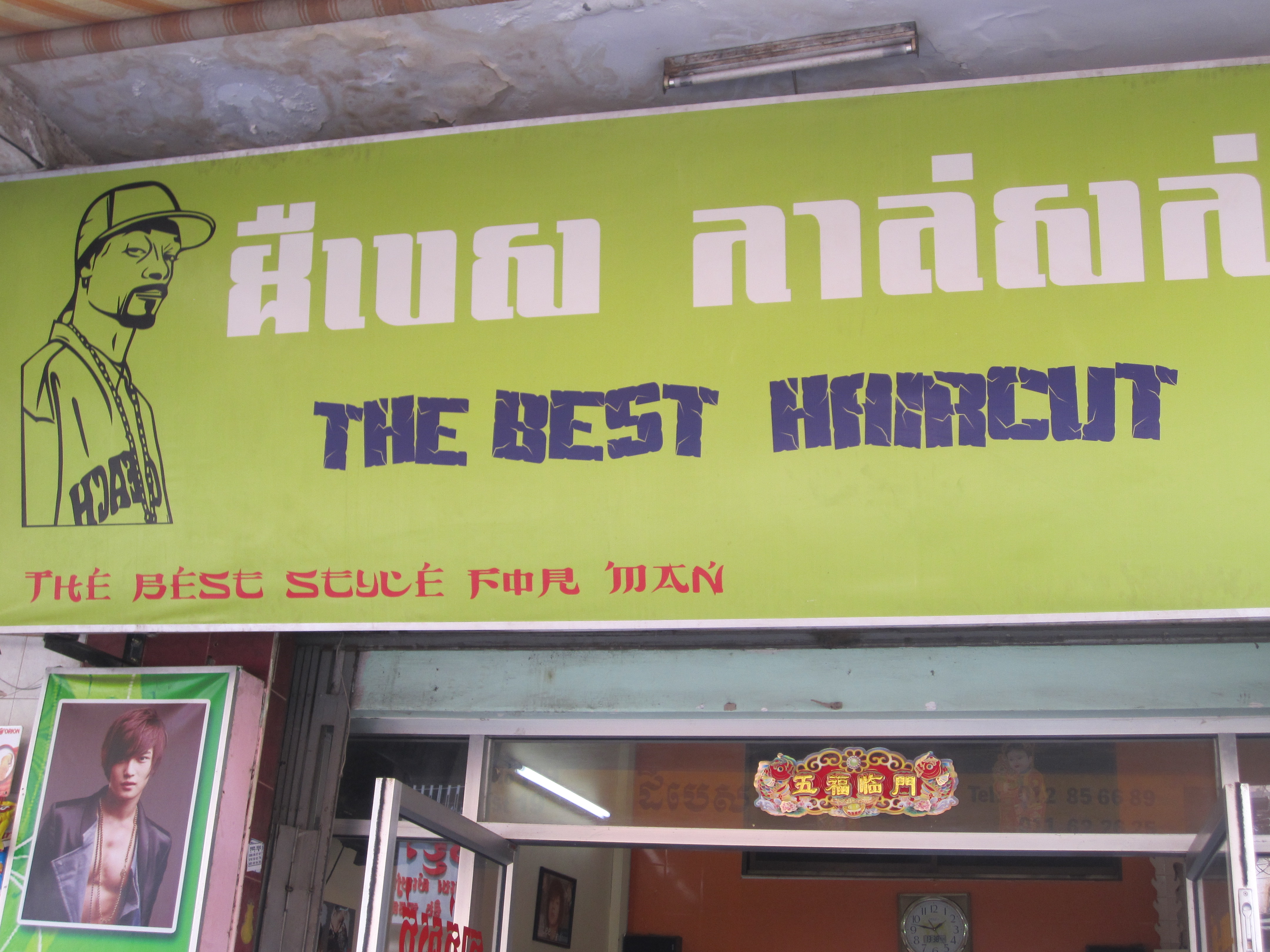
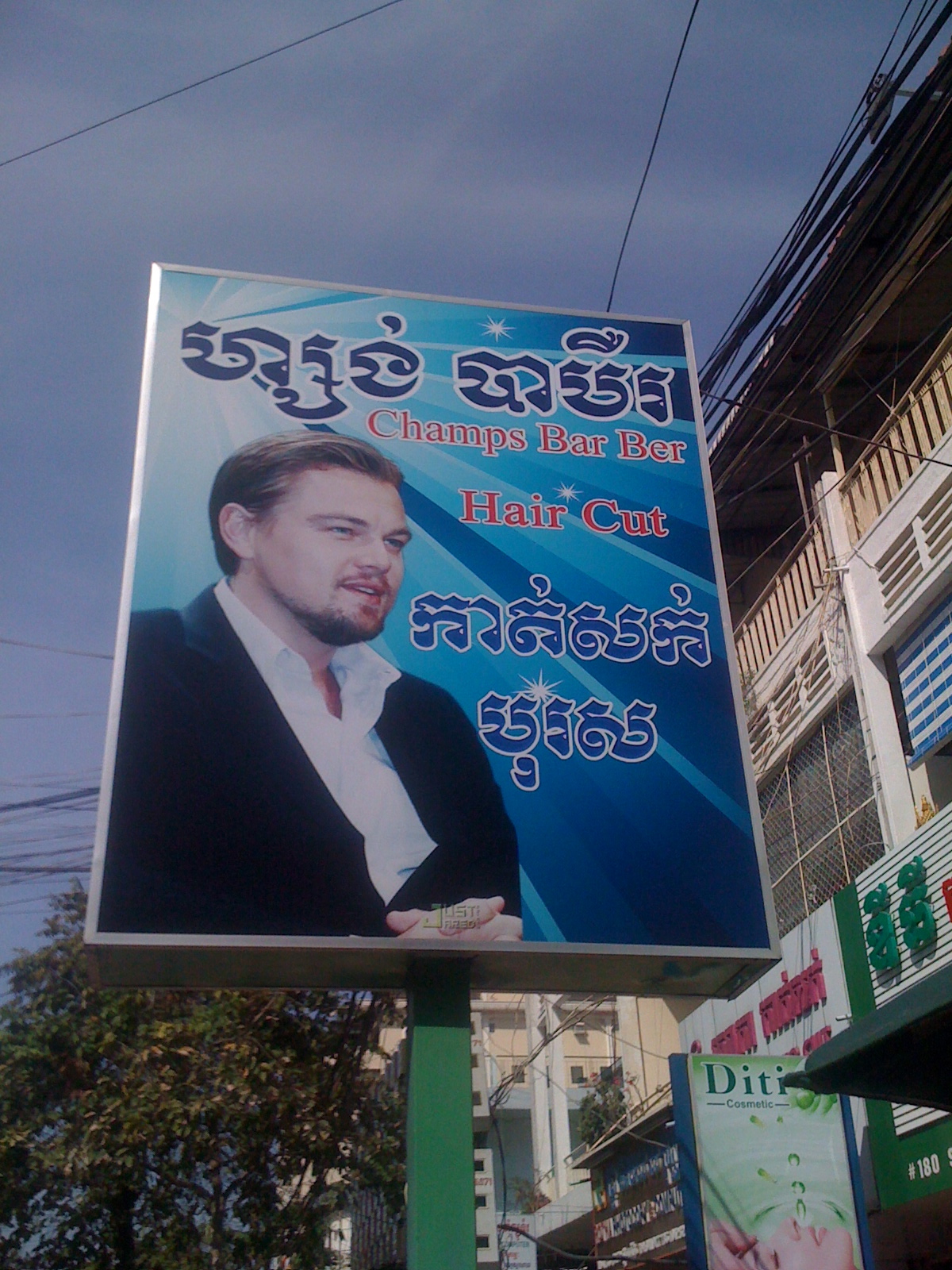
New China Paris Texas Snoop Leo Hair Cut: International Cambodian Man Style

Naysayers be damned. While Cambodians may not be able to travel as freely as other nationalities, there’s a lot of international influence here in Phnom Penh. Take style. Men’s hair styles, to be specific. You’ve got, of course, the regionally ubiquitous K-Pop hair, but it doesn’t stop there.

Behold: international stylings for men.

China in the front, Paris in the back. Or something.

Doo rag. Start em young, start em right.

Despite the advertising, you sadly cannot get cornrows at this salon.

Bieber Fever hasn’t quite hit here. We’re still on the Leo/1997 kick.

If anyone needs me, I’ll be getting my hair did.

Thirteen Ways of Looking at Phnom Penh

Note: The literary nerds among you will recognize this as a rip-off play on Wallace Steven’s “Thirteen Ways of Looking at a Blackbird.”

1. Lisa, American, 1.5 years:
“You get a lot of big egos,
people who think
they’re hot shit.
But you have to remember:
we’re all here cause
we can’t hack it out there”—
points outside,
beyond the street,
to the West—
“in the real world.”

2. Tommy, British, 6 years off-and-on
“Where else could I”—
hand tattoos and a missing eye—
“get a job teachin?”

3. Steven, American, 4 years
“This city’s a dangerous place
to have money
and a drinking problem.”

4. Kate, Australian, 7 months
“People do
what they can get away with:
drinking all day, sleeping
with prostitutes,
saying racist shit.”
Stirs margarita.
“This city reduces you
to what you really are.”

5. Sasha, American, 1 month
“I’ve never been anywhere
where I’ve felt so manic.”

6. Hank, American, 4 years
“In the time I’ve been here,
I’ve quit my job, no shit,
5 times. And each time,
whatever I’d lined up next
fell through. So”—
shrugs—“at a certain point, I just decided:
I’m gonna stay here
until I learn whatever lessons
I’m supposed to.”

7. Clare, American, 3 years
“It’s not that easy,
just picking up and leaving.
I have 19 employees, women
who depend on me
for their livelihoods.
But at the same time”—
looks out the tuk-tuk
at the street—
“I know I need to leave soon.
I can’t get stuck.”

8. Lisa (again)
“The thing about it is,
it all becomes normal.
You realize,
the guys sleeping with prostitutes—
they’re not all creepy and weird,
like you’d expect.
Most of them are totally normal.”
Surveys the bar
in one sweeping glance.
“I guess that’s the strangest thing:
how normal it all is.”

9. Boy in cafe, American accent, time unknown
“I can’t tell you
how many times it’s happened—
I go for an interview;
they ask me
to do a draft of a project;
they never call me back, but
they steal my ideas.”
Tosses pen across the table.
“They’re lazy
and sneaky
and can’t think for themselves.”

10. Martin, American, 6 years
“Whenever I get into that place,
you know,
when all of Cambodia
has got it wrong—
when no one knows how to drive
and every police officer is trying to get a bribe outta me—
that’s when I know I’ve got to sit down
and take a good long look
at me.”

11. Michelle, Australian, 3 years
“I tried.
Of course I tried.
But it’s hard to have Khmer friends
when you can’t tell them
you live with your boyfriend,
and they have be home
by 8 every night.”

12. Lisa (again)
“You totally just blew that guy off.
You do realize
that’s the last time
a white guy’s gonna hit on you
for a loooong time.”

13. Billy, British, 5 months
“There’s a lot of people like you,
moving here
cause it’s cheap
and they can do their art.
It’s not so different
from people moving to different cities
within a country
cause it’s cheaper and easier.”
Grins.
“I think it’s exciting.
Like Paris in the 20s.
Or something.”

A Not Entirely Atypical Tuk-Tuk Ride Home

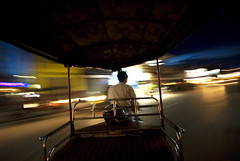
9pm so I give him a good stare down, check the eyes for red and glaze and drunkenness. I watch the way he walks to the tuk-tuk, parked a few feet away from where we’ve haggled the fare. He walks straight enough to drive straight, so I sigh and start to climb in.

“Ok,” he says, sitting down on the bike, “7000.”

I pause, my foot on step. “No, 6000,” repeating the fare we agreed to.

A grin. “Ok, ok, 6000.”

I sit and he sits. He throws a look back at me.

“You want to smoke weed?”

“No.”

“Why?”

“I don’t want to.”

“You no smoke weed?”

I smile and play it coy, “No, I’m a good girl.”

“Oh. I thought you were mafia.”

“Oh, really?”

“I see your tattoo, I thought you mafia.”

“No,” shake my head, “not mafia.”

He throws his helmet on. He doesn’t clip the chin strap.

We take off and turn the corner and it’s the usual questions: where did I make my tattoos? (USA) Is that where I’m from? (Yes) How many? (I don’t know) How much it cost? (A lot. But it should, it lasts forever.) Do I like them? (which is not a usual question and I smile: Yes.)

“But you no smoke weed?”

“No.”

“You no want to be happy?”

“I’m already happy.”

“But you be more happy.”

“Not if I smoke weed.”

“Oh, you smoke weed before?”

“Long time ago. When I was young. But I’m old now.” (Coy again, and I think how, broken language aside, it’s not so different from conversations I have with backpackers or college kids or, fuck it, my own peers, in bars or at shows—not entirely atypical.)

He speaks pretty good English and he’s driving straight enough and even knows where we’re going, so all things said, he’s a damn good tuk-tuk driver. We move through the pitted streets, slowly settling from their daily buzz—meat smoke thinning, piles of trash waiting for pick-up.

More questions, his eyes in the side mirrors more than on the road: How long will I be in Cambodia? (One year) What do I do for work? (smile: I’m a writer) I live in a guesthouse or apartment? (bigger smile: Guesthouse tonight, but tomorrow I move to an apartment) You live with roommate or alone? (another smile: Alone) Why alone? (I want to) I come live with you? (No) Why? (I want to live alone)

We approach the Orussey Market: lights and umbrellas and neon plastic stools and buses parked and smoke, still plenty of smoke billowing and twisting and rising into the night. I tell him the name of my guesthouse.

“Oh, you stay there alone?”

“Yes.”

“I come stay with you?”

“No.”

“Why?”

“I don’t want you to.”

“You no like boys?”

“I didn’t say that.”

“You like girls?”

“I didn’t say that either.”

We pull up in front, parked motorbikes in the glow of the reception desk, long shadows of security guards sitting listless in plastic chairs. I pull out the bills and step out of the tuk-tuk, hand them to him.

He takes off his helmet. “Goodnight, madam.”

“Goodnight sir.”

“Sleep good.”

“You too.”

An Anti-Social Trip to the Pyramids (In 5 Senses)

Dusty

Feel: Dusty wind on my cheeks, rustling through my hair—a bad place for contact lenses. A watery ouch, blinking madly.

Arms poking at me, fingers tapping—shove a postcard book in my face and flap it around.

Smell: Camel shit, horse shit—a stink, yes, but it’s a healthy, robust stink, blooming in the heat. Think of my dad, leaving the bathroom in the morning: “Ah, that smelled fertile—like it would make shit grow.”

Taste: Dry, thirsty crackle in my throat but too stubborn to buy overpriced bottled water. Linger of packaged jam from breakfast. The mint of my chapstick.

Sound: “Camel ride,” “Postcard, madam,” “Welcome to Egypt!” “Where you from?” “Camel ride, hello!”—haggle-hassle town, a chorus of cries, hungry touts with cracked feet and chipped teeth, sharp limbs and sharper eyes.

I understand the dynamic—I know my place in the global socioeconomic ladder, that I’m a Have, the 1%—or 10%, or whatever—but basically, not a Have Not. I understand that this is the price you pay, along with the admission, and that neither are very much.

But it’s aggravating as hell, which is kinda the point, the technique, if you will—and the best I can do right now is to ignore it, not engage or react, not look or respond. I bust a move from my old teenager bus riding days: wear headphones without the sound on, so I can still hear everything (in case it goes beyond annoying to threatening), but can pretend I don’t.

So I walk like that, then decide—Well, shit, may as well drown this shit out. So I turn to what was playing last—new Ty Segall, which is bad-ass but doesn’t fit the mood, the scene, the monumental, crumbling, cracked-lip ambiance. Stop and do a scroll through. Wait, wait…

Theeeeeere we go.

So I’ve got the drone-moan doom metal in my dome, and I’m mad-dogging it through the place. Touts and hustlers like flies to a light bulb—knock, knock, knock and you can’t get in.

Sight: Well, it’s the Pyramids, the effing Pyramids, and you know what that looks like. And you’ve probably heard that it’s plop in the middle of suburban sprawl, that there’s a shitshow of tour buses and taxis, that there’s a KFC across from the Sphinx, that there’s people everywhere, everywhere—climbing on the stones the signs tell you not to, posing for photos and I see, in a flash, 1000 framed photos on mantles and walls; I see a cacophony of Facebook profile shots and a clutter of newsfeeds; I see cards sent out at various holidays, see digital scrapbooks suffered through by captive relatives.

More Egyptian families than anything else, but the groups of teenage boys are second. They climb up the stone and flash smiles and hand gestures and gather around the viewfinder and nod in approval. They shout shit at me as I pass, but I’m like, “I can’t hear yyyyyyou”—even though secretly I can and (less secretly) they know I can.

But it’s the charade of the day, the game we play. I turn my headphones up louder.

Sight: Figure approaching, black clothes against the yellow dust. Alone, wearing headphones.

Feel: That I’m looking at some parallel version of myself, the Egyptian dude version. I can tell by his new clothes that he isn’t gonna try to sell me anything; can tell by his straight walk and forward gaze that he isn’t gonna hassle me, that he can’t be bothered to hassle a random Western girl.

Sound: “Funeralopooooooolis / Planet of the dead”

Smell: Dust in my nose.

Taste: Dust in my teeth.

Feel us approach each other like tangential lines, tangential lives, intersecting for one moment, then diverging into the big blank desert.

I give him the “yoyo, what’s up” nod.

He returns it without a smile.

Feel him walk away, disappear behind me and out of my sight.

He was cute, I realize. Goddammit—the one cute dude I’d want to talk to in this place.

I blink the dust from my contacts and keep walking

Notes on a Visit to Occupy Wall Street

Here’s something really New York for you: the people most excited about Occupy Wall Street aren’t in New York.

Again and again, the conversation went like this:

“Yo, you been down to that Wall Street shit?” (I don’t really talk like that, I’m just pretending.)

“No. I’ve been meaning to.” Or: “I went past once.” Or even: “Aw, I heard about that. What’s it all about?”

It seems like the rest of the country is stoked, excited, curious, enlivened—reposting photos and quips and words of encouragement, a newsfeed cluttered with that shit. But here in New York, it seems to have fallen into the static of the city—one more thing to negotiate, maneuver around, one more cultural phenomenon in a city of never-ending, never-sleeping cultural phenomena.

But I’m not a New Yorker, so I had to go down there. Check it out, see it for myself.

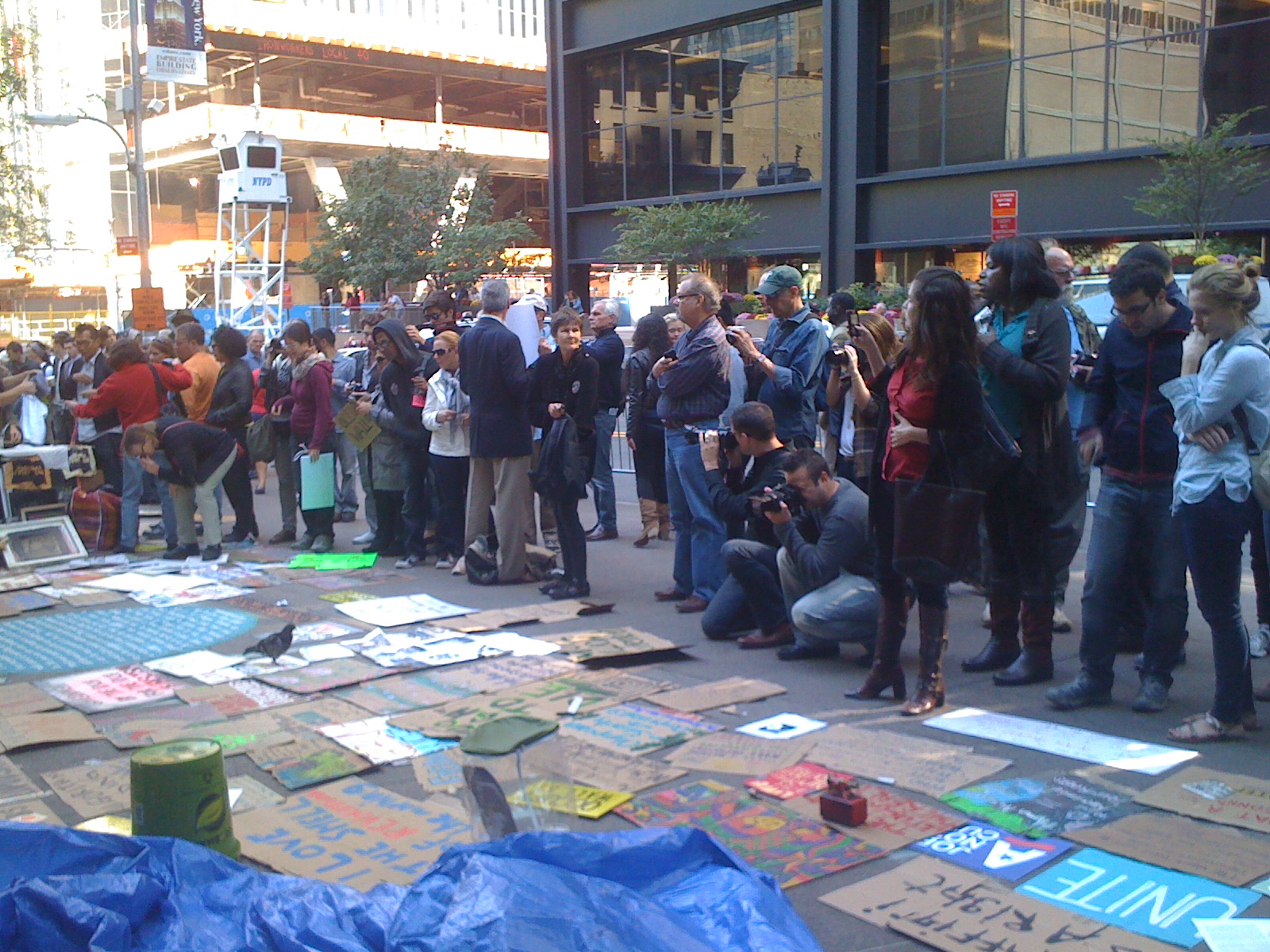
It was busy and crowded and loud at Zuccotti Park, in the shadow of the new World Trade Center—but not that much more than a normal street, at least not for how much virtual buzz I’d been hearing.

The park was surrounded by people stoically holding signs, standing still for the passerbys and the cameras and the statement it all made. It was a pretty even split between the protesters and passerbys—a mix of locals and tourists, curious expressions and viewfinders, everyone stopping to read signs and snap photos. I even saw a few Asian tourists posing for photos with the protesters.

I moved around the periphery, then headed into the center of the square. The encampments had been cut with makeshift streets, pathways where people buzzed around. An internet station and a free kitchen had been set up (dispensing, of course, pizza). Tables with leaflets and fliers stood before volunteers who answered questions and otherwise engaged with folks passing by.

Amidst the revolutionary fervor, there was also a distinct, well, Telegraph Avenue vibe. For those not from the Bay, this basically means young gutterpunky white kids with backdreads, bandanas, and a herd of mangy sniffing dogs, most often seen clumped together with sleeping bags, spare-changing. I think these were the kids critics were referring to when they critiqued the movement as being all unemployed, dirty hippie kids.

Or that they were entitled middle-class kids. To be fair, there was a decent mix of people. (“I haven’t been arrested for civil disobedience in 35 years!” I heard one man gleefully exclaim.) But the majority of the protesters appeared to fall into that category, at least to me. Which makes sense. I mean, who was it that started the Vietnam War protests? Who was it that was out there marching for women’s suffrage? Educated, middle-class young people with the leisure time to protest are usually the group with which change starts.

And yes—there yoga mats and Tibetan prayer flags and a band that included a bango and a stand-up bass. So there was a lot one could get snarky about. And I did decide that it was no coincidence that Occupy Wall Street cropped up a week or so after Burning Man.

But, really, that stuff aside, it struck me as really cool that people were out there, actually talking. Apathy is the poison of the MTV generation, my generation, so even if there isn’t a totally clear agenda or consensus on why they’re even there, it’s a start, and I guess that’s the most important part.

But more than the protesters themselves, it was cool to see the passerbys. People lingered, read signs, made comments, engaged. Which is so incredibly rare to see in this country. Occupy Wall Street was inspired by the events of Tahrir Square, but I also couldn’t help but think about recent protests in Chile or Israel (didn’t hear much about those, did you?). Somewhere along the line, we Americans have learned not to protest, and when we do, the backlash is incredible. Just look at the media reaction to the protests.

So the fact that there were people out there, who wandered down just to check it out, was really exciting. Sure there were frustratingly ill-informed debates going on, but shit, at least people were talking—as if every person that came by would take a little piece of something with them, a thought or impression or just the idea that we could try to do something a little different.

Because that’s the thing about New York—even if the majority of the city doesn’t make it down to Occupy Wall Street, even if it gets lost in the frenetic buzz of life there, of sidewalks and subway cars and trying to keep your fucking head above water—even if it’s just a small percentage that comes by, that small percentage ends up still being a pretty decent size. And it’s still there, and it’s still doing something, changing something, if only the way we think. And it’s a start.

This dude: most definitely not an entitled college student

Going Native: The Anti-Irony of Khmer Glamour Photos

I sat once in a cafe in Tangier, Morocco. Some famous man-filled cafe where Western writers used to pen masterpieces, or cruise for ass, or trip out on then-exotic drugs, or most likely some combination of the three. It was popular with tourists—in the way that that Hemingway bar in Havana is popular—and with well-heeled locals. I was the only female, Western or otherwise, in the joint.

I watched as a man strode in—large, burly, brusque. He may or may not have had a white beard—I remember something about white hair, though his head was most definitely adorned with some scarf. He had that expat look of permanent sunburn and wizened self-satisfaction; he wore a long, flowing robe of ethnic print and carried a thick wooden staff. Two younger men, one with a notebook, another with a video camera and a microphone, followed as he walked purposefully over to what I assumed to be his regular table.

He leaned back in a posture of pontification, began what I imagined to be a long soliloquy, in French, on Moroccan culture and the changes therein over the last decades, as observed by his keen eye. The guy with the notebook nodded and scribbled. I watched the camera man look around at all the Moroccans in the cafe, wearing t-shirts and jeans, then back over at the burly old dude before his camera, his attire some approximation of those sepia-hued photographs old explorers and anthropologists took, that are now sold as postcards.

Our eyes met briefly. I smiled; the camera man looked embarrassed. I chuckled, imagined we were having the same thought:

My God—he’s gone native.

There are few things funnier to me than people taking themselves too seriously. Travelers/expats who over-identify with their adoptive countries provide endless amusement while on the road. So when I saw the pointed fingers and fake-gold-gleam of Khmer glamour photos, I knew it had to do it—my own chance to Go Native, as it were.

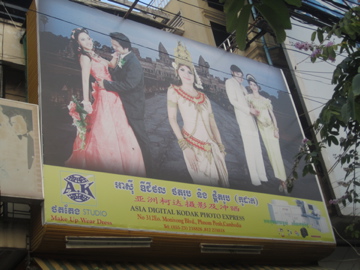
To clarify, this isn’t some chintzy gimmick produced for tourists; this is a Cambodian—nay, Southeast Asian—phenomenon. People dress up, get a pound of foundation and fake eyelashes slapped on, squeeze into gaudy garb and let themselves be molded into ridiculous poses, to be later Photoshopped several skin tones lighter and superimposed in front of illustrious sights like Angkor Wat, or the parlor of a well-to-do person’s house (a fireplace and Persian carpet are key). People do it for their wedding, for their coming-of-age, as family photos—it’s not uncommon to see a large framed print hanging in someone’s home.

It is, in short, the Khmer version of cheesy K-Mart photos. It’s is legit, authentic inauthenticity.

I hadn’t noticed the photography studios sprinkled around town until someone pointed them out. The sun-bleached signs of smiling couples, the window displays of sequined gowns—they’d faded into the visual static of Phnom Penh storefronts. Until I decided to get my own.

Khmer glamour photos are something of a rite of passage for Phnom Penh expats, especially the females. So I rounded up a posse, walked into the first decent-looking studio we passed on Monivong, and made an appointment to be turned into an Apsara princess.

At two o’clock on a sweltering Sunday, five of us clamored up the back stairs of a photography studio to the dressing room. It looked like the backstage of an Asian cabaret, make-up and sequins and traditional costumes stacked to the rafters.

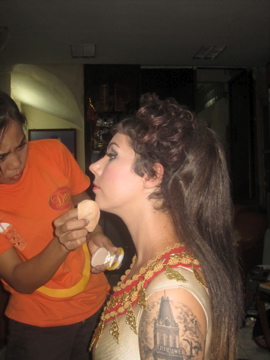
There was only one girl doing hair and make-up; at about thirty minutes each, we ended up being there for a loooong time. My friends chose the $10, more modestly ridiculous options; I opted for the $15 Apsara extraordinaire, which included more fanciful skirt folds, extra fake-gold bangles, even a wig. Behold the transformation:

I'd never worn fake eyelashes before.

Looking sufficiently like a drag queen.

Through the mirror

Fancy folds

I went to Cambodia and all I got was this mullet

Lock and load.

A couple days later, I went back to the studio to pick up my prints—three prints were included in the $15 price. I thought of the dude I’d seen, years ago, in the cafe in Tangier. The difference, I decided, was humor. And self-awareness: I was doing it as a joke, a statement on the ridiculousness of myself in the Khmer cultural context and how I, at 5’10” and a riddling of tattoos, will never, ever blend in with or a be a part of that culture. The photos were tangible evidence of the chasm between worlds.

I smiled and laughed out loud and thanked the ladies again.

I went to meet a few other friends for dinner at the Chinese Noodle Restaurant. I took out my prints and they laughed—it was ridiculous, right?

I noticed the waitress peering over our shoulders. I felt suddenly self-conscious—would she be offended? Would the joke translate?

To my relief, the waitress smiled, a chipped tooth and deep lines. Then she reached over and took one of the photos in her hand, examined it more closely. “Very beautiful,” and she looked up at me with a kind of sincerity that made me blush.

This was not the reaction I’d expected. I felt somehow more embarrassed.

The waitress proceeded to pass my prints along to the other tables in the restaurant, all the women smiling and nodding and murmuring their approval. The women’s eyes glanced over at me and it was a kind of warmth I felt, maternal and accepting and utterly devoid of the snarky irony with which I’d walked into the photography studio with.

They didn’t think it was funny, and they weren’t offended. They thought it was beautiful.

I hung my head. “I’m an asshole,” I announced. Then, looking up and grinning, “But at least I’m a beautiful asshole.”

Headcheese, Chicken Feet and “You Are What You Eat”: How Travel’s Beaten the Squeamish Eater Out of Me

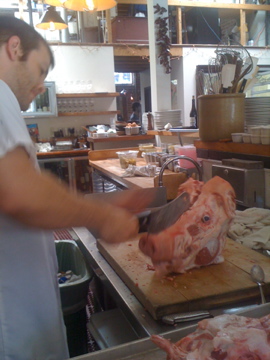
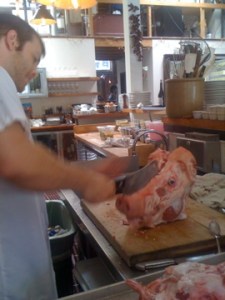
Jeffery was taking a machete to the disembodied pig’s head when I walked into work.

The other boys stood around watching. They looked up when they heard the door, grinned sheepishly at me. “Headcheese,” Colin said by way of explanation. “Sorry.”

I looked at the knives, the smeared aprons, the hunks of pig scattered about the wooden cutting board, and shrugged. “I think Southeast Asia has cured me of any squeamishness towards meat,” I laughed.

Food culture, it can be said, is a microcosm of culture. Traveling around, I’ve discovered that a society eats and its attitudes towards eating can be simultaneously one of the most telling and easily accessible aspects of a culture. In this way, eating in a foreign country is both a lofty, anthropological glimpse into the psyche of a culture, and a visceral adventure that often sends one dashing to the nearest squat toilet.

Case in point: there’s a certain semi-green queasy look Westerners wear when walking through a Southeast Asian street market. The plucked bodies hanging limply from hooks; the still-alive fish flopping out of their plastic tubs; the women waving fans at the flies that settle on heads, hooves, chunks of body; the smell of raw meat blooming in the humidity like irony mold—it’s all so utterly unlike the shrink-wrapped FDA-approved supermarket culture of the Western world.

And I’m not gonna lie: I was a bit unnerved at first. The literal rawness of market culture in Southeast Asia is jarring. Watching a teeny little woman crouch down in her pajama suit and hack off a chicken head seems brutal, surreal. Ordering a bowl of soup and seeing a chicken foot poke out of the translucent tangle of rice noodles is startling. And not at all appetizing.

Yes, I eat meat, your Westerness seems to say. But I don’t want to think about the fact that I eat meat. I don’t want to be confronted with the reality that I’m eating another living being.

When I was London a few years back, there was a big stir about Marcus the Lamb. It was being discussed on the talk radio station that played through my friend’s basement flat while we brewed morning coffee.

The story was this: as a lesson in the breeding and rearing of livestock, a primary school had adopted a lamb. The kids named the lamb Marcus, and did cute things like bottle feed him. Six months later, it was time for the lesson to culminate: Marcus was to be slaughtered. A shitstorm ensued.

Parents freaked, animal rights activists threatened, the headmistress was branded a murderer and some of the pupils were reported to develop stress-related insomnia. To their credit, the school officials remained firm: this was the point of the lesson—teaching urban children where their food comes from—and they weren’t going to cancel the lesson. A national debate raged, centering, it seemed, on the extent to which the urban, Western world has become disassociated from its food.

I considered this all as I chewed my toast in the gray London light. I’d been a non-vegan/vegetarian for a little over a year. During my 12 year run as a non-meat-eater, I’d maintained that meat eaters should know and acknowledge the reality of meat consumption. I wasn’t one of those PETA people plastering horror-movie pictures of slaughterhouses around town, but I’d always thought—Fuck, you eat the shit; you should be able to handle a head or a hoof or something.

And I had to hold myself to that when I started eating meat again at age 25. If I was gonna do it, I reasoned, I was gonna do all of it. I wasn’t going to hide from the fact of it, and I wasn’t going to be wasteful. Living in the Bay Area and working in the restaurant industry, it’s easy to make mindful, informed decisions about where one’s food is from, to nestle in the cozy, bedtime-story feeling a Cruelty Free label provides.

Way of advertising a butcher in Morocco. Flickr photo.

But then there’s the Southeast Asian food market. Or the goat head stew in a Moroccan medina. Or cabeza tacos in Mexico (or the Fruitvale, whatever). And by being confronted with heads and eyeballs and recognizable anatomy that doesn’t seem so different from our own, you’re also confronted with your Americanness, your Westerness.

But people are amazingly adaptable, and after a couple weeks you normalize your surroundings. You don’t look twice at the rows of raw meat, and you even acknowledge that while eating a fertilized duck egg is a mind-fuck—a bit like eating an abortion—it is goddamn delicious.

And then you come home and wonder what the fuck everyone is riled up about. Yeah, it’s headcheese, made from head meat, you think, What’s the big deal? Or you wait on a dude who sends back the whole shrimp on his plate cause the little head and eyeballs “Just ain’t cool.” And you think, Really, buddy? You’re a grown man; that’s just a lil ole head. But you laugh and shrug and say, “No problem,” cause you know that that’s just the culture he’s coming from. And it’s your job to make him happy, not to judge what kind of food he’s comfortable eating.

To say that Westerners, especially Americans, have become disassociated from our food is an understatement. (“Where does ketchup come from?” a friend asked her inner-city students once. “The store!”) You think of the old adage “You are what you eat,” and you wonder what the hell that means for us. It can’t, you reason, be anything good.

If you can tell a lot about a person by how they eat, what does a society’s food culture say about them? They say, for instance, that girls from alcoholic homes are exponentially more likely to develop eating disorders. If you extend that on a societal level, it’s a fascinating if unsettling picture of a national psyche. The ability of Americans, for instance, to feed themselves nourishing food in a way that’s free of drama and control and fad diets seems to have shattered, gotten lost somewhere; I think that the sanitized, shrink-wrapped, mass-produced foods we eat are a part of that.

We in the West, and especially the States, don’t know what the fuck we’re eating—or are so far removed from it we flip out at the potential of exposing our children to the age-old reality of meat eating. (For the record, it was the students themselves that voted to slaughter Marcus the Lamb. But one has to ask: would such a lesson ever even happen in the US? Assuming, of course, a school even had to funding for such a lesson…)

Growing up, my mom was convinced that the demise of the family dinner was inextricably linked to the break-down of the American family. She thus insisted that we all sit down, no matter how much homework we had, for a nightly family meal. This was, as you can imagine, infuriating for a moody teenager; I’d scowl at my plate until eventually someone would say something funny and we’d all sit and laugh and linger for an hour.

I’m grateful for that now, in the same way I’m grateful to have traveled to five different continents and gotten the squeamishness beaten out of me. There are some things I still won’t eat—shark fin soup, which is just plain wasteful; or that monkey-brain stew they make in China by pouring boiling water into a live monkey’s recently cracked skull—that’s just plain cruel. I don’t think I’m a particularly enlightened eater, nor do I think I’m gonna change the world by shopping at farmers markets.

I just think that I’ve gotten a bit more realistic, had a bit of my own barriers broken down. At least to the point that walking in on the making of headcheese doesn’t cause me to look twice.

Okay, so maybe I played with the eyeballs...

Privilege and Property Rights at the Phnom Penh Sofitel

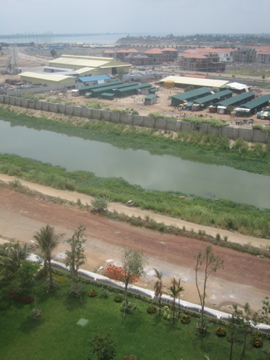
View from my balcony: construction workers' quarters beside construction lot for new, luxury villas

So, one of the most fascinating things I got the opportunity to do in Phnom Penh was to peek into the “other side.”

By “other side” I mean the foreign business men, the developers, the movers-and-shakers, the ambassadors and embassy folk—the people that are literally reshaping the city. By “other side,” I mean the people that are removed from the street, that live behind gated properties with bored-looking security guards, that ride around the city in chauffeured SUVs. I mean that I got to stay at a Sofitel.

I’ve never been one with an eye for perks. I always kinda rolled my eyes at the travel writers that billed themselves as luxury writers, assuming they were really more interested in getting free massages and Pina Coladas than actually being writers. Which they may be. But none of the glitz ever attracted me—I was always more into the grit. And perhaps being able to make a living as a writer. But really, just the grit.

Which is why it was so ridiculous that I ended up, frayed Toms and an H&M cardigan, in the lemongrass-scented lobby of a five-star hotel, on assignment from an equally ridiculous source: Matador, an independent travel website. And why it ended up being so goddamn fascinating.

The piece I wrote on the experience went up last week on the Matador site (link here). But 900 words is short, and there’s a lot I didn’t get the chance to say.

Construction cranes behind the Sofitel pool

The Sofitel sits handsomely amid vacant lots and construction cranes, in what the young manager with beautiful hands told me would soon be the new city center. He moved his hands through the air when he said it, like he were gathering something and drawing it closer to him. His nails were better filed than my own.

A poor, Eastern city rapidly modernizing by foreign hands: that’s not an entirely new story. But this was Cambodia, so it was more complex and fucked-up than it appeared on the surface.

Land rights are a huge issue in Cambodia. And like so many of the country’s problems, it comes out of the war: after the Khmer Rouge fell, no one had property deeds—you just moved into any available space you found. It was a clusterfuck of a situation. Ten years ago, the government began an official campaign to get people proper titles to the land they’d been living in since the KR. But it was a muddled, mismanaged process in which poor folks largely lost out. As a result, a lot of the country’s residents still don’t have official claim to the land they’ve been living on.

It’s the perfect situation for exploitation.

The case I got to witness first-hand was the ongoing issue over the lakeside evictions. You can read more here, but in a nutshell, a foreign company bought a lake and its surrounding region in Phnom Penh, to drain and develop. People were already living around the lake, but since most had no official claim to that land, they could legally be evicted. They’ve been protesting, losing, subjected to violence—it’s basically fucked.

None of which is to implicate the Sofitel into that. (In fact, a tuk-tuk driver told me that the Sofitel property used to house a Thai-owned luxury hotel that was torched during anti-Thai riots some years back.) But if you place the hotel’s presence in the larger context of the changing city, it says a lot. There didn’t used to be a market for a business-oriented luxury Western hotel. And there’s not really, yet—the Sofitel was largely empty when I stayed there, just like the villas being constructed across the Bassac River were. But the point was, it’s coming.

And if you draw the line in the sand—between old and new, redevelopment and who it benefits—the Sofitel is like glimpsing into the future, glimpsing over the line.

Which of course brings one to oneself. Because I was, after all, staying there. Yes, I was on assignment and thus not footing the bill. Yes, I was walking the half-mile of scorching-hot driveway to catch a tuk-tuk streetside, instead of paying the 300% surcharge from the hotel. And yes, I was using my $5/month wireless modem instead of paying for the hotel’s wifi (how you market yourself as a business-centric hotel and not have free wifi is beyond me…). But, if you drew the line in the sand—which you still can do, in the parts of the city without sidewalks—I was closer to all those business men than the people getting evicted by the lakeside.

Sometimes you can fool yourself about your own privilege. You wait tables; you work two jobs through college; you squint through old contact lenses because you can’t afford the eye doctor. Or you rent an apartment from a woman you can’t communicate with, save for the green mango she gives you once a week, and you drink shitty coffee at street stalls and buy produce at the local markets and tell yourself you’re experiencing a place “at ground level”—a phrase that in and of itself oozes an underlying sense of privilege, the idea that it’s a choice.

Turn-down service

But in a place like Phnom Penh, I really can’t fool myself. Putting on a bathrobe and shuffling around my hotel suite eating the macaroons from turn-down service, BBC images flashing sharply on the flat-screen TV—and getting to do it because I’ll use the skills I learned in university to write an article for a website, in a language I was born into speaking—I can’t kid myself about which side I’m on. I could get a well-paying job any time I want. At the drop of a hat, if I were in serious trouble, I could have someone wire me more money than your average Cambodian makes in a year. That’s just the fact of it.

I had this moment, taking a tuk-tuk from just outside the Sofitel’s gates, when I sat back and watched the street: a row of barber chairs set up, scuffed mirrors nailed to a corrugated fence, men waiting for clients. It felt like I were looking at it through glass, through the thickness of some impenetrable distance, and it all struck me as quaint. As in, the simple quaint life of a the noble local.

Could where you stay really make that much of a difference in how you experience a place? I wondered. Could surrounding myself in the piped-in fragrance of lemongrass, taking a hot bath and wearing a pair of slippers each night really ensconce me, alter how I enter a city so much? Or did it just serve to heighten what was already there, hiding from me?

I didn’t find answers to that. But I did have a lovely stay.


Lauren Quinn is a writer and traveler currently living in Hanoi. Lonely Girl Travels was a blog of her sola travels and expat living from 2009 to 2012. She resides elsewhere on the internet now.

Join 490 other subscribers

Buy This Sh#t

Categories