Archive for the 'Culture Shock' Category


Lost in Navigational Translation: The Tuk-Tuk and Motorbike Drivers of Phnom Penh

“Tuk-tuk la-dee?” “La-dee, moto-bike!” “Where you go?” “La-dee, la-dee—you need moto-bike!”

This is the chorus you hear, endlessly, walking through central Phnom Penh. It’s like birds chattering, only more jarring, less song-like. It comes accompanied with a raised arm, two fingers extended—more of a summons than an offering of service.

By the touristy riverside, the touts can be pushy, but for the most part they’re just guys trying to make an honest(ish) buck. At first I tried to respond to all of them—Lisa ran a tuk-tuk company in Phnom Penh, given as part of her dowry, before the Khmer Rouge—so I feel a special responsibility to be respectful. I smiled politely and said “no” or “ot te.”

Eventually it got to be too much to respond to each other them, perched on their bikes at every street corner, crying out to you when you’re half-way down the block. I began to just shake my head, and soon stopped making eye contact. I started feeling like a bobble-head toy, my neck hurting from the constant swinging. Now I barely respond at all.

But I suppose that’s not so unusual, the constant barrage—being a Westerner in a city like Phnom Penh, where you stand out, gleaming of privilege and sweat and thin layer of sun screen. You take it in stride, a small price to pay for the relative welcoming warmness of the Cambodian people.

But here’s what is so unusual: most of these tuk-tuk and motorbike drivers have no idea how to navigate the city. A city, I should add, that’s laid out in a neat grid. And not just a grid, a numbered grid, where even numbered streets intersect the odd.

It is perhaps the easiest city I’ve ever learned. And I don’t make my living by driving its streets. So what, what, what is going on here?

It took me a few days to clue into it. I did a lot of walking at first, and when I did finally take a motorbike, chalked the confusion up to language barriers and my hotel’s offbeat location.

On Friday night, I was headed from a party back to my hotel. “Street 141 at 232,” I told the driver. The glassy gleam of incomprehension stared back at me, followed by a vague nod. This did not produce a feeling of confidence in me.

Must not know his English numbers yet, I thought and whipped out a piece of paper. I wrote the street numbers as largely and legibily as I could. I showed him. He nodded a little more vigoriously; we negotiated the price and I hopped on.

We slid down the wide Norodom Boulevard, nearly empty of its honking, and I felt the breeze of the night on my arms, my legs. I closed my eyes and let it kiss me.

I’d been in the city four days by that point—so I knew when we were making a wrong turn.

“Um, no,” I said and pointed back to Norodom. He shot me a confused glance. I pointed to the street sign. “This is only 156. We go to 232.” I waved my hand down the road.

A series of slow circlings and U-Turns ensued, me growing ever crankier on the back of the bike. It devolved to me leading the motorbike driver street-by-street back to the hotel.

He must be new at this, I thought as I finally hopped off.

But the phenomenon repeated itself: the glassy look, the vague nods, the wrong turns and aimless meandering. Another characteristic element to the typical un-joy-ride, I soon discovered, comes when you stop every couple blocks for the driver to discuss with other drivers the intended destination of the passenger, locked in some sort of secret code no one is able to decipher. Lots of pointing and shrugging ensues. This is apt to repeat two-to-four times before one finally arrives.

At first, I blamed it on my own inability to say Khmer numbers, and took to only writing locations, following it up with a big, you-get-it? grin.

The answer you always get is “okay, okay.” The ride you get is not always “okay, okay.”

I was utterly confused and out of ideas. Maybe they were guys from the countryside, who’d only just come to Phnom Penh. Maybe they didn’t know the city that well yet—but come on, how long does it take to learn a city? A numbered grid of a city at that?

No, no, there was something more going on here—some kind of deeper divide than just language or location familiarity. There was so kind of vast cultural chasm, a disconnect.

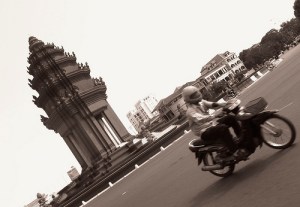
“Oh no, no, no,” Mathilde told me. “They don’t know street names, only landmarks. It’s better to say ‘near to Independence Monument,’ or ‘Royal Palace.’ These they know. But sometimes even then…”

I’ve worked that into my repertoire, a long, drawn-out process in which I use every means I can fathom to communicate my destination. “Sihanouk, near Independence Monument,” I told the driver yesterday.

We got closer this time, but just before the up-lit monument—positioned handsomely at the crossroads of two main thoroughfares and surrounded by the massive honking roundabout—we took a turn down a random sidestreet. I sighed. We U-Turned.

I reported my failure back to Mathilde. “They will always say ‘okay,’ even if they don’t know.”

“So, how do they work? How do they live and get around a city they don’t know at all?”

She shrugged, and I guess that’s all you can do. Because they must know it—there must be some way they know it, some entirely different way of interacting with a city and a landscape that doesn’t even occur to me, that I can’t even fathom—as foreign as another language, as mysterious as an alien scribble, written all over this city in a way I can’t read, can’t decipher—in a way that I can’t even see.

Perhaps I’ll figure out the mystery. But for now I’ll keep circling, keep ambling, keep pointing to a destination I can’t communicate, hidden somewhere in the gap between cultures—foreign, mystified and helmetless on the back of a Phnom Penh motorbike.
Saturday Night Fevered

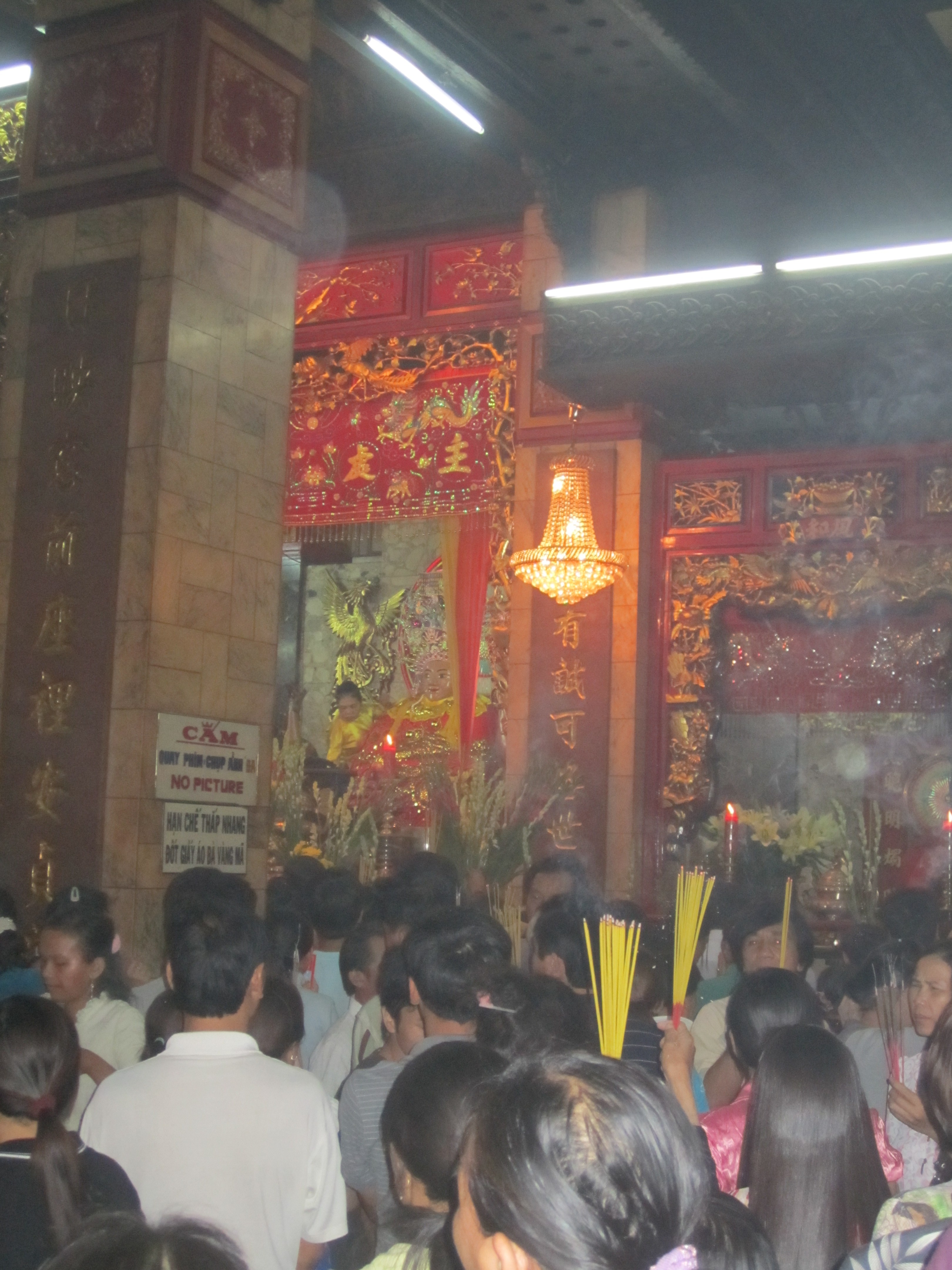
Long stalks of flowers and twisted plumes of incense burning. Nodding, bowing, chanting with their eyes closed. Trays of food—peeled fruit, shrink-wrapped cookie packages, an entire plucked chicken—held atop people’s heads as they murmur. Candles and coconuts, red glowing altars (to what, to what?).

Children and hunched-up old people, a constant bumping, bustling, brushing against—the Asian conception of personal space, or lack thereof, exemplified. Announcements on a loudspeaker (what, what?).

Smoking a cigarette while he prays. Sweeping rubbish out from under the feet of the worshippers—playing cards with footprints on the floor.

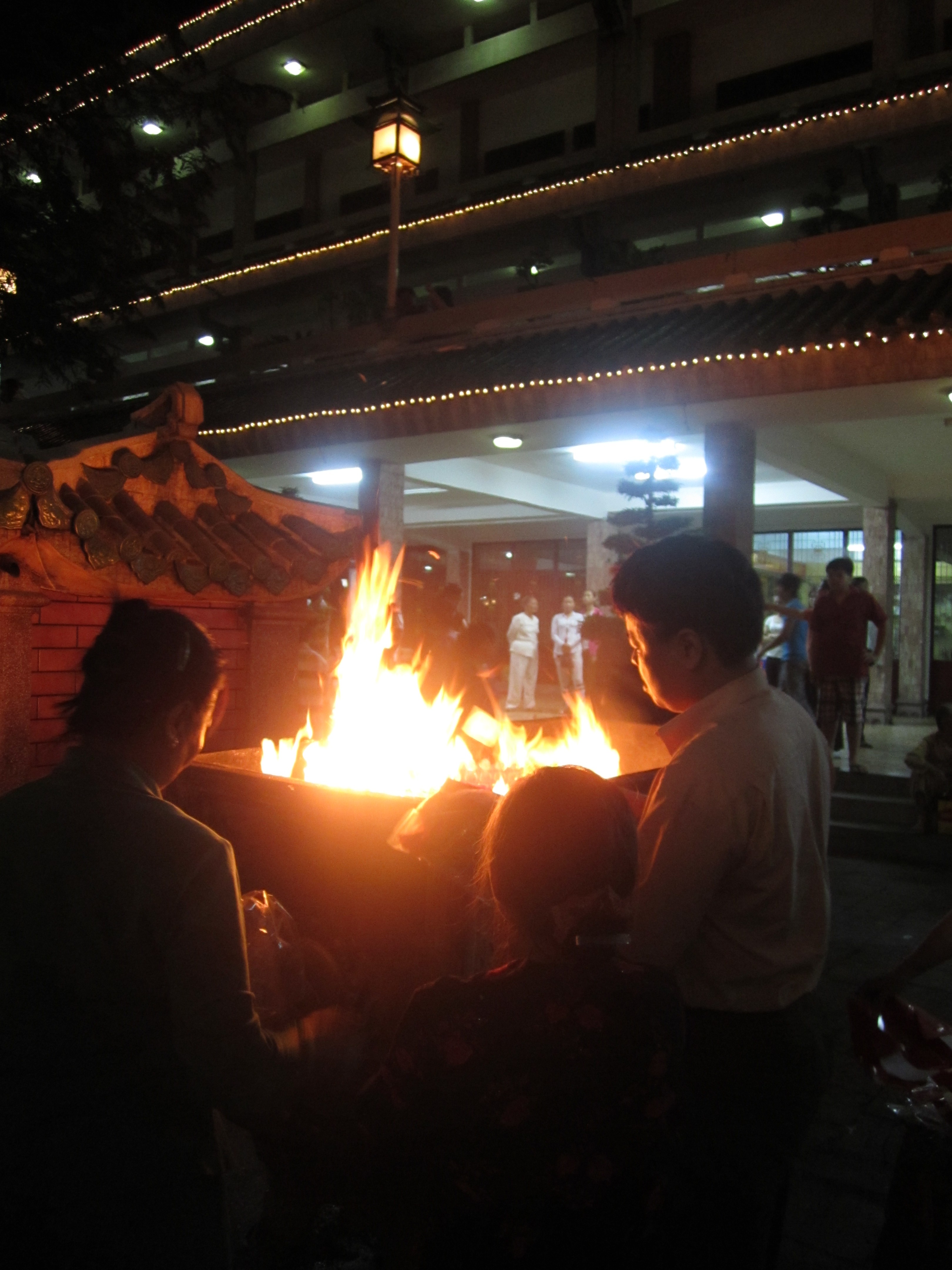
Photocopied money in buckets being carried, to be burned—tossed into a pit outside that shoots scraps of burnt paper all over, raining ash in the night wind. Smoke rising (to where, to where?). Calling to children—“Em oi! Em oi!” Some kind of urgency, some kind of plead—nothing Christian about this piety. Nothing solemn; everything sacred.

Security guard siddles up to me, glances at the furious scribbling in my notebook (for what, for what?).

A Buddha-looking diety looking down on it all—a halo of neon, flashing in technicolor.

——–

This was perhaps one of the biggest What The Fuck moments of my travels. I had no idea where I was, what was going on, what any of it was for—just that I was suddenly immersed in it, plunged into a cloud of incense smoke and chanting and riotous fervor. These were the notes I made in the middle of the madness.

The motorbike driver didn’t speak any English. We were coming back from another site outside of Chau Doc, a town along the Cambodian border in the Mekong Delta. The roads became cluttered, lined with food stalls and carts and bodies, bodies. They filled like a clogged pipe until they choked and he had to pedal the bike through the crowd.

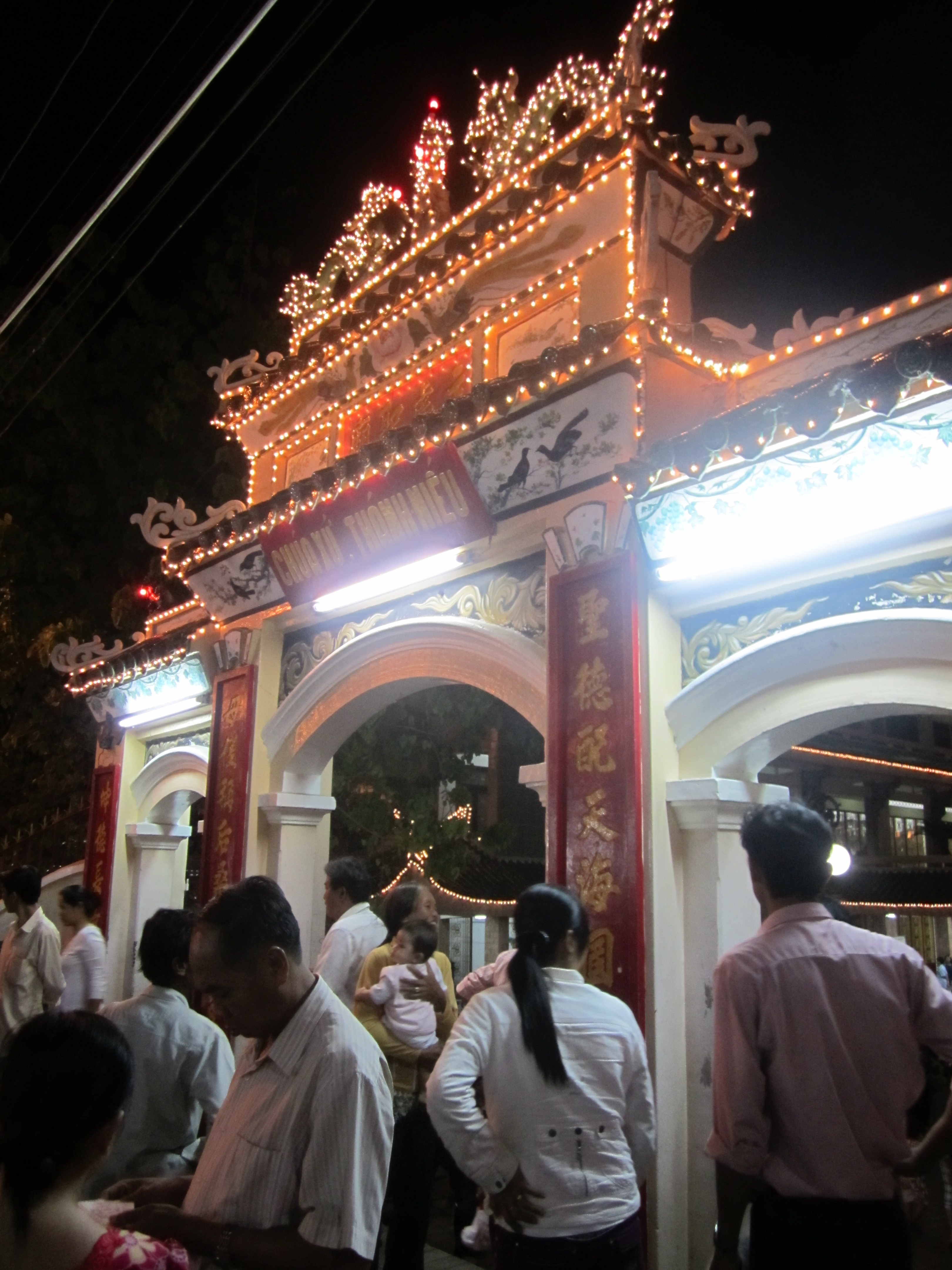
He stopped in front of a temple adorned with blinking Christmas lights. He pointed. I went in.

It was a funny thing, to be wrapped up in the zeal and fervor of it all without having the slightest clue what any of it was—an entirely sensory experience, a ritual out of context, a girl out of context, cultured-shocked.

When I got back to the hotel, I asked the English-speaking desk clerk, “I just went to some temple, up the road and—”

“You saw thousands of people,” she finished me, nodding.

“Yeah! What was that?”

She told me that they’re city-folk; they come to Lady Temple after the new year to ask for good luck. On weekends in February, March, even up through April, the otherwise sleepy town of Chau Doc swells with these Vietnamese travelers.

“Pilgrims, pilgrims,” the other clerk told me the next day. He’s younger than the girl, I thought, but he only seems it—he later told me that he’s almost 40. I wondered where the years went, behind his boyish smile.

“Other times, not so many people in Chau Doc. It very good for the business.” He looked out the glass lobby windows onto the town’s main market, overflowing into the street with tourists—not so many of them Western.

Snapped a couple of jostled photos before I saw the "No Camera" signs...

The Foreigner at the Party

Tirana and Rome don’t have much in common—except that it’s absurdly easy to stand out as a tourist.

They come at it from different angles—Rome because there’s so many goddamn tourists (really, do Americans realize that there’s other countries in the world?), and Tirana because there’s so few goddamn tourists (really, do people realize how amazing it is?). But the effect is the same either way: you aren’t ever, ever going to blend in.

Some travelers get bummed out by this, and do everything within their power to fool themselves (and themselves only), acquiring affected accents and scarves for the local football team. But I say fuck it—no one’s gonna buy it anyway. So you may as well just dance.

Friday night felt like a riot in Tirana: chanting crowds, police sirens, streets shut off, smoke billowing and fireworks flashing. It wasn’t a riot, just the Albania-Bosnia football match. The insane energy of it all is a little anxiety-provoking for an American—if it were Oakland, someone would have gotten shot.

Our little clan from the hostel walked through the raucous roads; some had picked up Albanian flags along the way, but it wasn’t any use. We were varied races and ethnicities, all speaking English, and the stares we ellicted became almost laughable, necks craning and feet stopping cold.

“Hello, hello,” shouted a voice from a drunken crowd, as though to point out that we were different and didn’t belong.

Everyone got quiet and a little uncomfortable. I gave a stupidly exaggerated wave. “Howdy!” I exclaimed in a Southern accent. “How y’all doin’?”

And we all had a laugh.

We didn’t end up getting into the stadium. It’s my absolute fate with football—I’ve never managed to actually see a match. So we marched across town to a bar to watch it on TV, amusing everyone with our mispronounciation of “Shqipëri,” the Albanian name for Albania. One of the waiters was so amused he bought everyone at our table—fourteen of us—a round of drinks. Sometimes it pays to stand out.

After the match we went to another bar, an underground spot near the Opera House, walls covered in the photos of the artists that used to hang out there (as well as a healthy layer of cigarette smoke). A DJ was playing drum and bass from his glowing white laptop and everyone was dancing, arms raising to graze the low ceiling.

Again, we were the only foreigners. But the good news is, the language of dance is universal.

So universal, in fact, that everyone was shacking up, disappearing from the dark room in hand-holding couples. At one am, it was just me and the gay Dutch dude left. “We’re dropping like flies!” I screamed over the music.

He kissed me on the cheek.

Saturday took me back to Rome, throat sore and heart heavy, sad and actually a little ill to be leaving. I met up with my couchsurfing host in the evening; we got in the car and drove. And drove and drove, into the damp-smelling dark, street lights thinning and stars appearing. A friend of his was having a birthday party at his parents’ country home.

My first clue that I was somewhere I seriously didn’t belong should have been “country home.” Or the red-candle-lit driveway, that rambled on for half a block. It was dark, so I couldn’t see the house I walking into, but I could sense its presence—something large and sturdy and stately.

We walked into a huge living room, exposed wooden beams and tasteful vases. The crowd was art-opening-hip, wine glasses and expensive haircuts. There was a DJ. There was actual porchetta—a whole pig—being sliced by a little old lady in an apron.

I was in Toms and (again) a Talk Is Poison shirt. I still stank from Tirana’s cigarette smoke, dirty hair stuffed under a beanie. Even in the States, I’d stand out in a party like this.

But I didn’t get any snotty vibes from anyone, so I shrugged and grabbed a plate. I couldn’t really talk to anyone, but I smiled a lot, and people smiled back. No one seemed to mind me too much. It was one of those isn’t-it-funny-where-travel-takes-you moments: if you’d ever asked me, “Hey, do you think you’ll ever end up at a super posh party in a villa outside of Rome?”, I’d have answered, “no.”

After the pig was picked apart, the lights went down and the dance songs started cranking. Good time stuff: “Surfin USA,” “Girl’s Just Wanna Have Fun,” some old rock n roll hits and a couple Italian songs to round it out.

And I danced again. It didn’t matter that I was dirty and foreign and didn’t belong. There was a good time to be had, and sometimes, in the midst of a really good party, the only thing the really “belongs,” so to speak, is fun—the boom of the bass and the way your shoulder dips to the beat.

Sveti Stefan, Forbidden Island

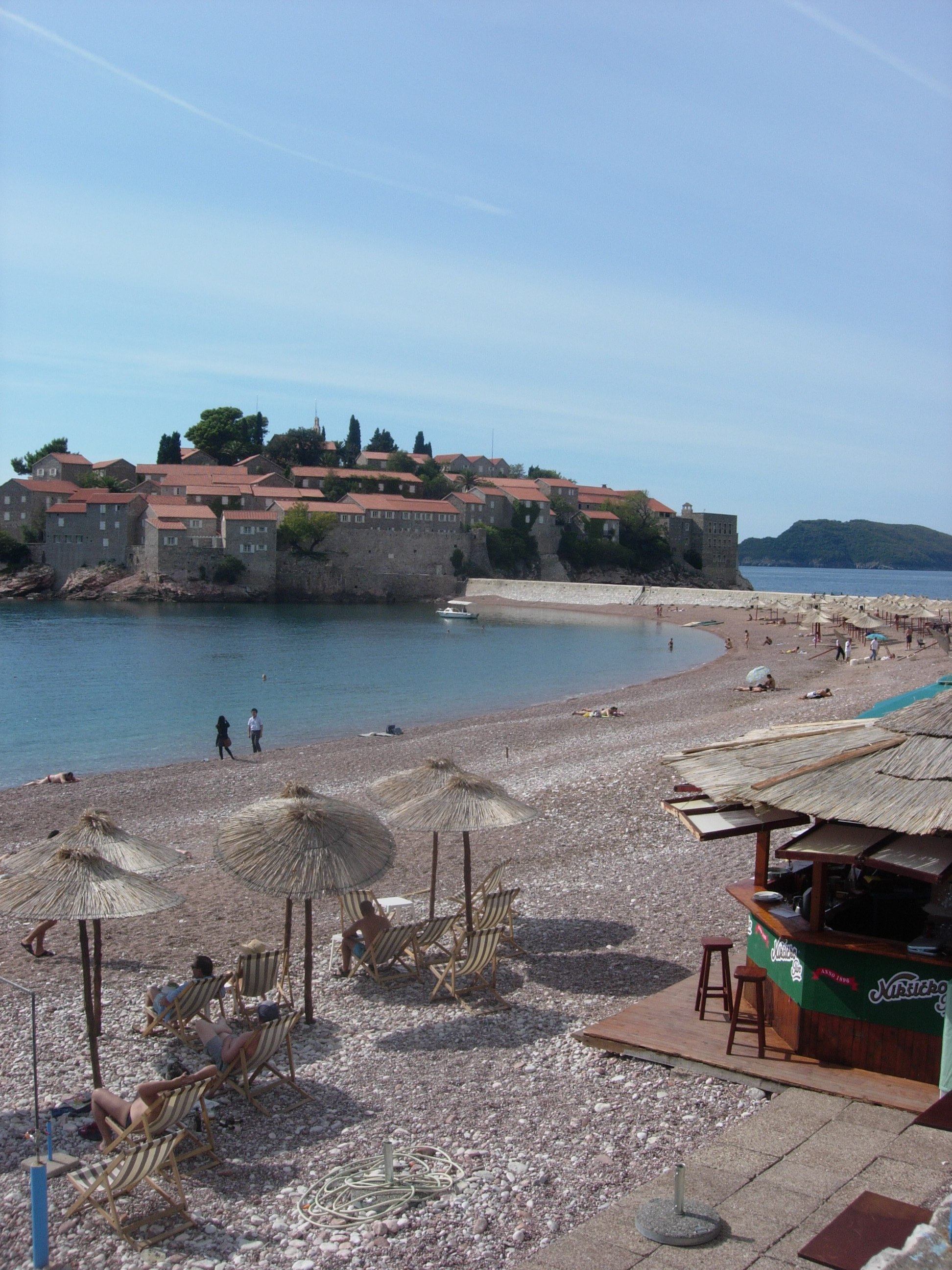
In a little cove on the Montenegro coast, cleaved between staggers of rock and water clear as glass, I’ve discovered what is simultaneously the most beautiful and depressing place I’ve never been: Sveti Stefan.

A little jumble of terracotta roofs, grey stone buildings that look like they were carved right out the rock, a couple trees poking through, all sitting plump and pretty and perfect in that glittering, glittering water: what could be more picturesque?

So you take pictures. Lots of them. You see the other vacationers—Eastern Europeans and a handful of Italians—doing the same. You’ll go over, have a stroll, feel the old cobbled stones through your soles, soak in the Old World ambiance before you work on that sunburn you’ve been itching for.

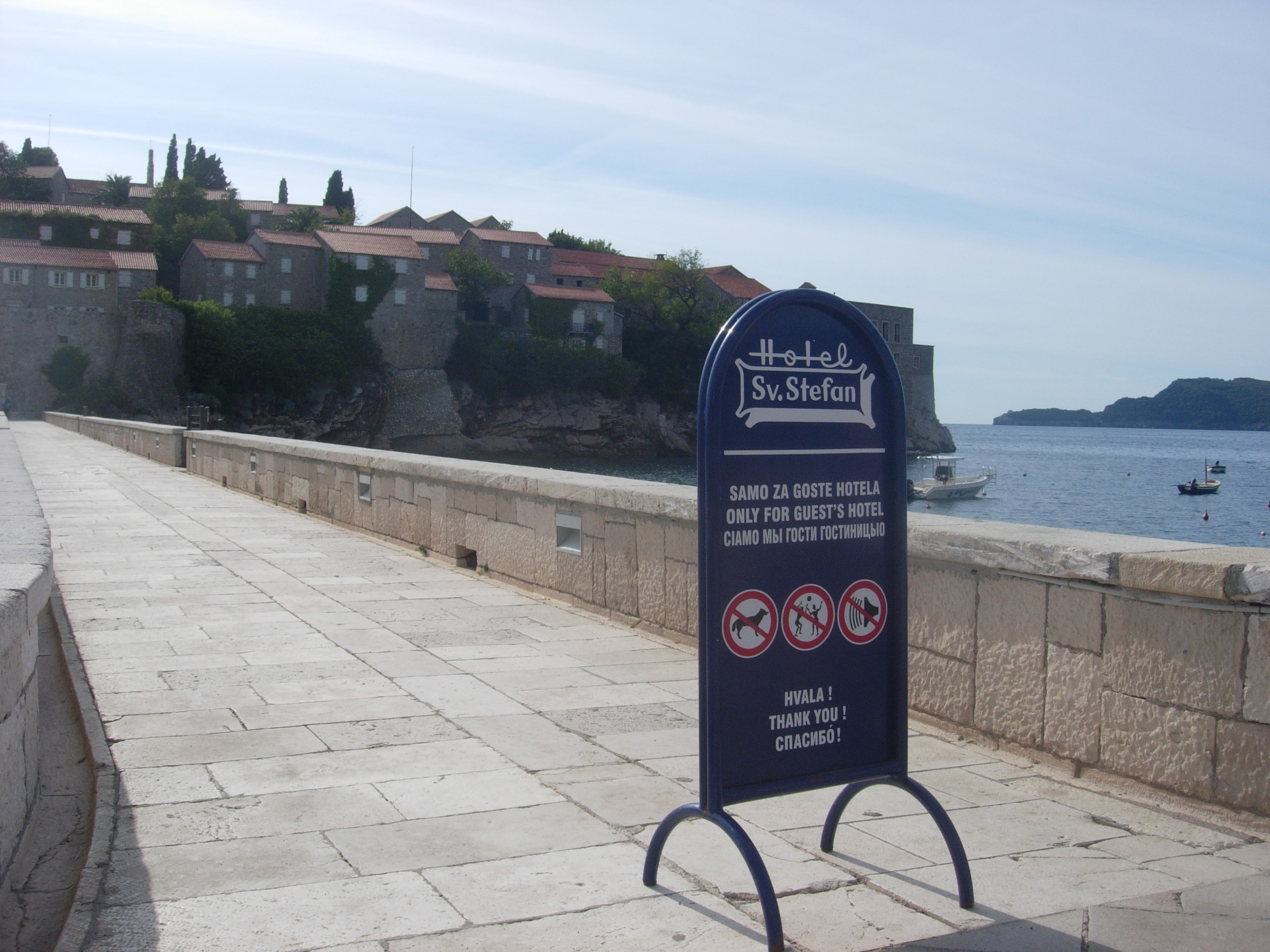
Only you can’t. You can’t actually go in Sveti Stefan. On the narrow isthmus leading up to the island—made of sand and reinforced with a stone-wall walkway—there’s a sign telling you you can’t. And a security guard, to remind you. And another one at the end of the isthmus (you can see him down there, pacing dutifully).

This is because the entire town is a resort. The entire town.

I hadn’t actually grasped that part in the guidebook: “an old fishing village that was nationalized in the 1950s and turned into a resort…” The resort was closed, but scheduled to reopen; in the meantime, a township had sprung up onshore, keeping the beaches alive with the gentle buzz of non-corporate tourism. All of which promised to change the moment the resort reopened—so go while you can, I read between the lines.

I envisioned a monstrous, skeletal structure with workcrews hanging from cranes, somewhere off to the side of an idyllic pebble beach—an eyesore, but something you could turn your back to. I did not picture the entire island, the remains of a 15th-century village, privatized and closed off to the public.

It’s like a modern-day version of a Forbidden Island. But instead of pirates burying the booty, it’s luxury travel mongols.

Awkward photo Boris insisted on taking

Sitting in the sand, under one of the umbrellas Boris the hotel worker graciously has let you set up camp beneath (hey, it’s October, officially low-season), you feel a little like a grubby kid with their nose pressed up to the glass of some fancy restaurant. It’s a pathetic feeling of alienation—you mean I can’t even walk in there?—that surprises you.

You watch a small boatload of people disembark. The gentle breeze carries their posh British accents over your way; you watch them climb the steps in a wave of white scarves and sun hats. They’re greeted by some resort offical and whisked off down the isthmus, a bagpipe player gloriously leading the way. You pick some pebbles off your leg and feel more dejected.

There’s a story there, and you know it. You imagine some 60 years ago, a traditional, working-class town filled with fishermen and their families. You imagine the boats going out in the morning, the nets coming back full in the afternoon; you picture the women in aprons calling from the windows at their children, running down narrow lanes. You picture them all forcibly removed from their homes, uprooted and unearthed after 500 years, and not able to return home. Because wealthy people wanted to work on their sunburns.

Such displacement happens in the world, yes, but usually in the name of war, religion, apartheid. But tourism?

You wander over to the shady terrace of a fancy cafe for an overpriced espresso. It’s killing you—the story, the story hiding in there, that you can see but can’t get into—so you ask the guy serving you your coffee. He gives you the Disney version. Afterall, he works for the resort.

The town’s population had been dwindling, and, in the 50s, the government bought out the last remaining families—15 or 16, who were given “nice pieces of land” in exchange. The town was then turned into a resort—“the only town resort in the world,” he says with a puff of pride—and saw the likes of Hollywood celebrities and European royalty. Then, “alas,” during the wars of the 90s, the resort fell into disrepair.

But “thankfully,” a German company interveened and purchased the resort. They made a series of exhaustive, tasteful renovations that manage to “retain the Mediterranean charm.” (“It’s really very excellent.”) The resort will officially reopen and accept guests sometime within a year—the British people I saw were probably on a promotional tour.

“Are there ever any other kind of tours? Like for the public?”

“No, no. It is closed. It’s not so nice—you pay to come to a place and have tourists outside your window all day.”

I nod slowly, thinking of a comment I heard once about why private schools should have tuition: “otherwise all the poor people would come rushing in.”

“But, maybe, I don’t know,” the espresso server continues, “you are here for awhile,” shrugs, “maybe I can work some magic, get you a tour.” He sneaks a sidelong glance.

The writer in me wants to press. The feminist in me wants to puke.

I sit there, instead, and watch the island, the steeple from the old church peeking up above the roofs and the green of its remaining trees. I watch the water nod in white glimmers and think, “Yes, yes, there’s a story there.” If I could just get in, if I could just walk among its buildings, sit on its stones, I might be able to get it, a hint of it—hear what is left, the melancholy echoes that have remained.

For a moment I wonder what is worse: that it be preserved, turned into a storybook land that’s accessible to only the fabulously wealthy, where they can indulge their sun-strewn fantasies of a simple life in a long-gone simple world. Or that it turn into a theme-park, another Venice—a soulless caricature of itself. Because, let’s be honest: in this day and age, there’s no way a place as pretty as this would escape the clutches of tourism.

But then I come to my senses. An entire island privitized. You’ve got to be kidding me.

I lick the last bit of froth from my espresso and watch my pretty, pretty island, sitting forbidden in its lonely paradise. And I think: if I could afford it, would I stay there?

Probably.

Dubrovnik, I Don’t Hate You

Amid the souvenoir shops, currency exchange offices and endless umbrellas of the tourist restaurants of Dubrovnik’s Old Town, I realized that something in me had changed.

It wasn’t a sudden, burning-bush kind of change, but slower, more subtle. It’s something that’s been changing in me, I suspect, for some time, without me noticing it—a transformation, unfolding gently, quietly, while I wasn’t looking. And it took Dubrovnik to make me aware of it: I no longer hate tourists.

And more than that, I no longer despise hard-partying backpackers, 20-year-olds that sleep all day and drink/cruise for girls all night on mom and dad’s bill. In short, my disapproval of how other people travel, when it isn’t my way of traveling, has dissipated.

I endured the torturous, fluorescent, overly air-conditioned ferry ride from Bari, Italy, in search of sunnier—and cheaper—shores. Well, um, Croatia ain’t it, I’ve discovered. And especially not Dubrovnik.

Yes, really.

My guidebook gushed about the splendor of the city. After I slept off the sleepless ferry ride, I curled up next to my $4 americano and watched the scene parade by: tour groups led by umbrella thrusting guides; middle-aged folks clutching their Rick Steves’; lots and lots of English. Later, at my hostel, I listened to the play-by-play recounting of the previous night’s drunken antics, and who’d made out with the hottest girl (it was Mark, the kid with the Justin Bieber hair).

And the remarkable thing was, I was okay with it all.

Now it could be that I’m getting older. It could be that I’m more well-traveled, and settling into myself. But I think it’s got more to do with something else, with this personal journey I’ve been on lately, entirely unrelated to travel. It’s got to do with taking care of yourself, with stopping using other people as a way of not looking at your own shit; it’s got to do with lovingly detatching from sick people. It’s potent shit, and it’s changing everything. Including, apparently, the way I travel.

No one likes to think of themself as a judgy a-hole, but hey, we all got our faults. In previous years, Dubrovnik would have evoked all my self-righteous better-than-thou-ness: too expensive, too touristy, too too. And it’s true that I’m not really into the scene here; I definitely dig the more obscure, the more offbeat and bizarre.

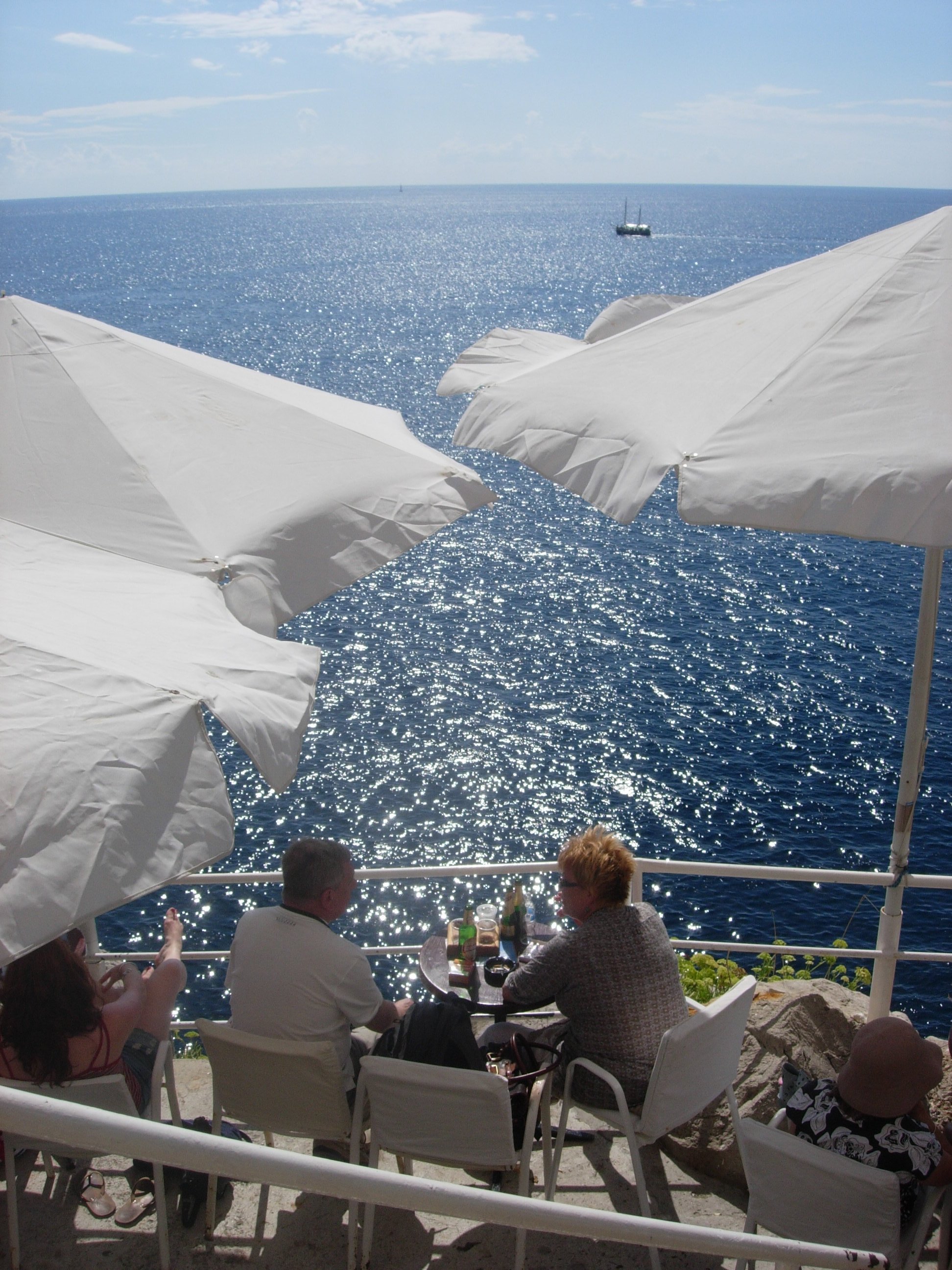
But it isn’t awful—it’s not theme-park-ish and you don’t get that resentment vibe from the locals. And it is beautiful: smooth stone streets gleaming white; sheets of ancient walls; passageways that lead to startling, sparkling vistas of aqua-clear water that really does live up to the hype.

And I’m letting myself enjoy that without judging it.

As I’ve learned to focus more on accepting myself, I’ve discovered a curious by-product: I’m better able to accept others, better able to let them be themselves, whatever that entails. And this doesn’t just come, apparently, with emotionally unavailable active alcoholics; it apparently also comes with accepting other travelers.

When you’re constantly measuring yourself against other people, when you’re constantly using other people to determine your worth and what exactly it is you are, there isn’t a lot of room left to just be okay, to just sit with yourself and be okay. And I’m learning to do that. I’m learning to go swim off the deck of a jokey tourist bar with a couple dudes I don’t have much in common with, learning to lay out in the Adriatic sun of a destination I’m not nuts about, and let that be okay.

I don’t think I’ll ever be into the big huge tourists destinations. I’ll probably always love the less obvious, the little-off; I’ll probably always love digging around, getting the dirt of a destination under my nails. That’s just what I’m into. It’s not any better or any worse than what anyone else is into. (Including getting black-out drunk and hooking up with random girls.)

Even now, with the chatter from the hostel’s common room filtering up the stairs, through the cracks under the door, over to my glowing light on this rickety bunk, even now it’s okay. Tomorrow I’ll take off for Montenegro, in search of something a little more me.

But Dubrovnik, I gotta say, it was a pretty good day. And I don’t hate you.

See Naples, And Then…

Die, the saying goes. They’re not fucking around.

I’d really wanted to go to Naples when I was last in Italy. But my then-boyfriend read the LP description—chaotic, dirty, somewhat dangerous—and nixed the idea. He liked Copenhagen, Scandindavia—clean, calm, safe cities filled with bicycles and crisp air, low unemployment and Nordic blondes with pale beautiful skin.

He can have it. Give me Naples.

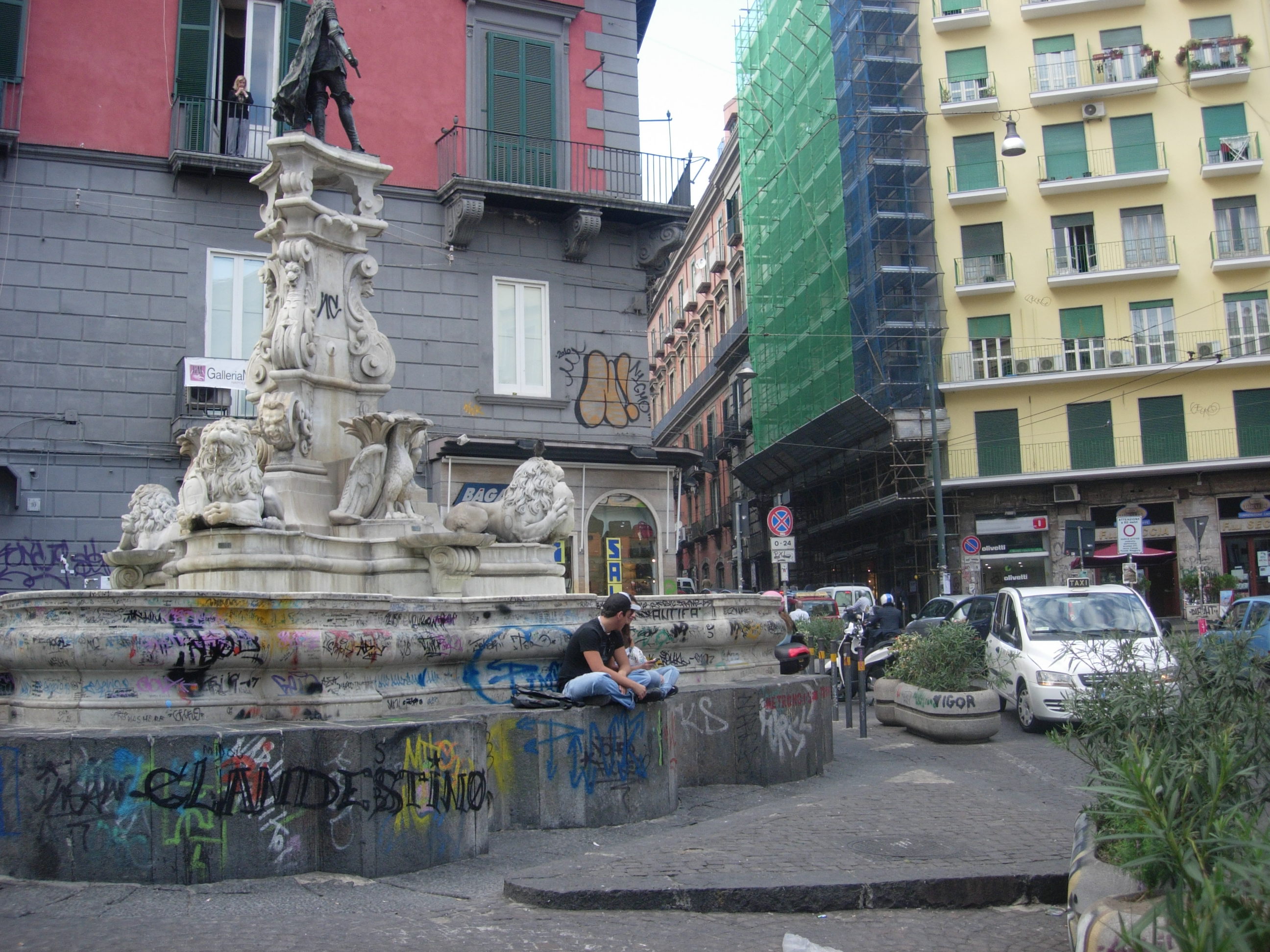
I got out of the Metro stop and walked the five blocks to my hostel. It took about that long to totally fall in love with the honking, swarming, spinning mess of it all, wedged with sharp shadows and bright sun between stories of faded facades that seem too tight, haphazard, overgrown. There seems no law or order to the flow of life on the street—cars and motorinos and pedestrians—but rather a kind of rhythm. Not a heartbeat, even and steady, but a wild palpitation, erratic and oxygen-deprived, that somehow keeps beating, keeps from careening.

It only seems like chaos. There’s something actually there, holding it all together.

I want it.

Give me traffic and noise. Give me trash piles and laundry lines. Give me jackhammers and roaring motorbikes. Give me a honk of warning but don’t slow down.

Give me scaffolding and shadows that swallow whole streets. Give me littered ruins surrounded by sidewalk. Give me a small dead bird flattened against the black stone of the street. Give me the smell of fish in open-air markets.

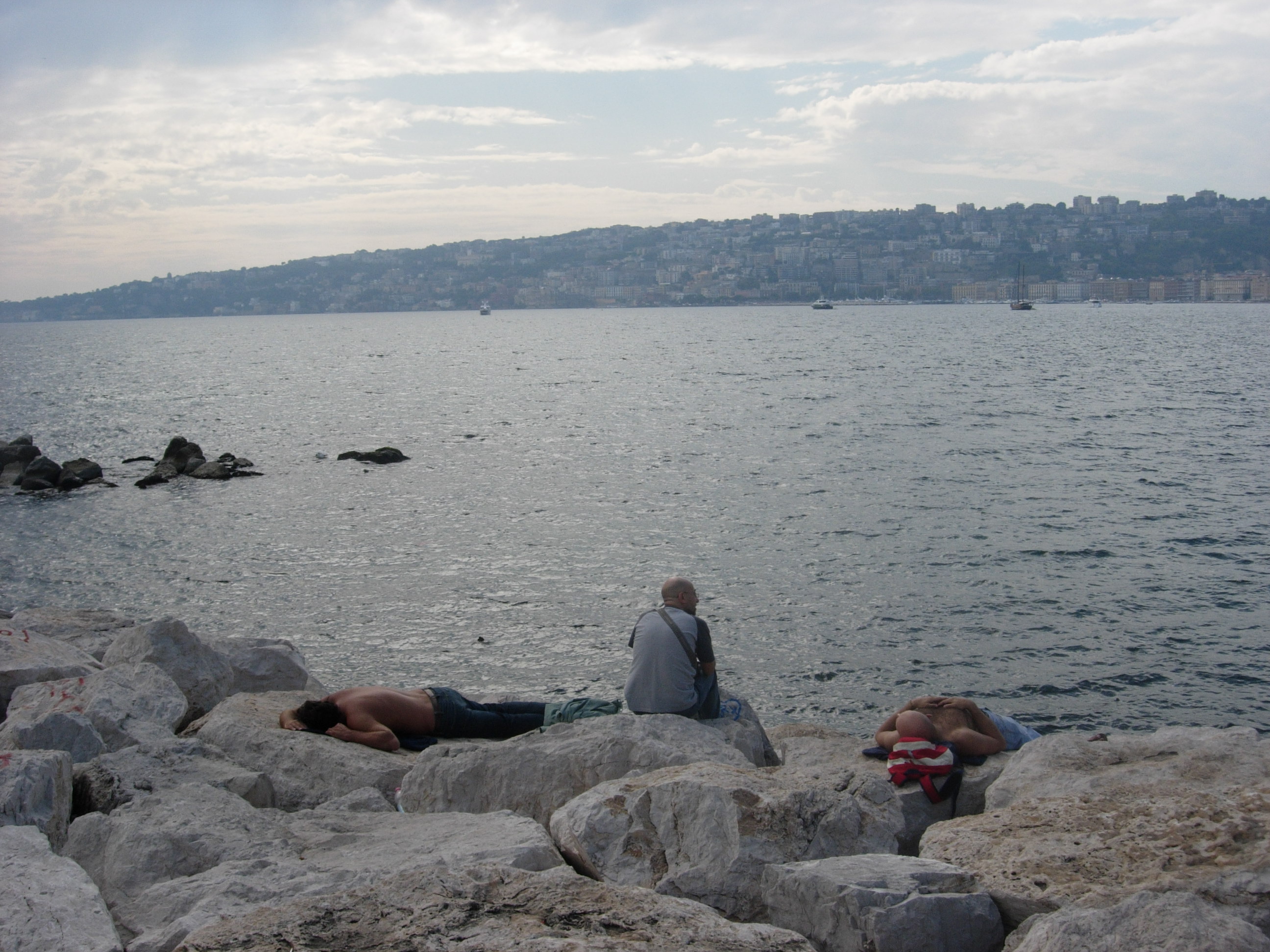
Give me gypsy beggars and business men; give me round bellies on white rocks, tanning in the sun. Give me a woman bathing in a baroque fountain. Give me stray dogs sleeping. Give me 1000 cigarette butts and worn skin on beautiful women. Give me immigrants selling purses; give me hustlers pawning cans of salt.

Give me graffiti. Lots and lots of graffiti.

Give me Naples—give me this city and its swarm, give me something inside my own soul.

Not Watching the World Cup

Watching the finals, four years ago in Merida

Four years ago. Cement and humidity. Rattling bus ride, stomach-sick and backpack-heavy, up and over, along the coast and back in again. Everything laced in car exhaust and heat, the smoke off cooking meat, the horn blows of “Hips Don’t Lie”—and the crackle of television sets, shoulders hunched around the static glow.

I’ll admit that I didn’t really know what the World Cup was before the last one. Cause I’m American and we’re generally not aware of things outside our own culture (as captured by this Simpsons episode). But four years ago, I got a crash course: I was traveling during the entire duration of the World Cup. I didn’t know shit about the game, and kindly fellow travelers tried repeatedly to educate me, but it was pretty much a loss. What got to me, though, was the way the World Cup consumed the places I was in, and completely took over daily life.

It started slowly. During the first rounds, just a couple dudes holed up in the kitchen of the youth hostel on drizzly Bogota afternoons. They made a list of all participating countries, along with offensive, politically incorrect nicknames they invented with their apparent oddles of free time (the only one I can remember is “Portugal: Little Brazil”).

As I snaked through the murderous mountains, bus break downs and military checkpoints, the intensity of the World Cup gathered speed. By the time I got to the sweltering, smoggy Caribbean coast, it was in full swing: TVs pulled out onto the Santa Marta street corners, men on folding cars, kids crosslegged, staring transfixed. Colombia wasn’t even in the games. It didn’t seem to matter.

I’ve heard reasons for why soccer isn’t big in the US, and why football (American football) is—basically, that football is tailor-made for commercial breaks and thus commercialization, while soccer’s lengthy sets make it untelevisable, in the American sense. It seemed like a plausible explanation. “I must say, it’s rather nice,” the British girl told me, leaning in and soft-voiced, “to have this one huge thing that America isn’t really a part of.”

I was in Merida, Venezuela for the final game. It was like Super Bowl Sunday times ten—you couldn’t really do anything else but watch the game. So I hung out at my hostel and pretended to follow along.

We went out for a walk after the end of the game, to survey the goings on. The city was transformed into a Venezuelan sideshow: a choke of traffic, horns and revving engines, kids hanging entire torsos out of the windows of moving vehicles, everyone chanting: “Italia! Italia!” I could only imagine what it must have been like in Italy.

The energy of it, the global ecstatic energy, felt like an addictive, consuming and altogether foreign thing. Was this what was going on while Americans were busy tailgating and spending $6 for a Budweiser? The raw emotion of it reminded me of a Sherman Alexie poem I’d read years ago:

On TV, more soccer riots in Europe.
There would be riots in American stadiums
during our particular games
if the people who had reason to riot
could pay the price for admission.

Like anything, like any time you travel and are surrounded by some awesome and immersive cultural force, you want to feel a part of it. But there’s always that little twinge, that hint, a prickle in the back of your neck, that you’re separate, somehow apart from—that you don’t really understand, not deeply enough, and that you’ll always be a little on the outside.

Do you ever play that game with yourself?—“the next time this happens, I wonder where I’ll be.” Four years older, but not where I supposed: still in the US, still waiting tables, still scraping money together here and there for little trips. Not the life I expected, or the one I even wanted, but the one I’ve ended up in: arrived in, disoriented and unsure, a noisy bus station on the smog-choked side of town.

So I didn’t join in the fuss this time around. I didn’t watch the games or pretend to follow along, didn’t ride the train out to Civic Center on Sunday to sit on the grass and squint at a big projection screen. I didn’t tweet my predictions or try to seem more international than I was really was by feigning interest (ahem, covered quite nicely here).

I let it pass quietly, peripherally—like a party going on in the apartment downstairs, when you look around the dim light of your bedroom and sigh. You put in some ear plugs and let the noise fade, feeling the foam expand as you fall asleep. In the morning, life returns to normal, and you try not to think about where you’ll be for the next one, in another four years.

If You Can’t Beat Em, Wear a Plastic Lei and Film Em

A long gleaming corridor. Palm trees and piped-in music. Our shoes squeaked along too-shiny floors as we walked deeper, further down, following the faint beating of drums and the smell of roasting pig, down into the belly of the beast: the Hilton Waikoloa Village, Kona.

Nevermind how I ended up there. Nevermind the maze of hallways, the gift shops, the cocktail lounges and swimming pool complexes, the shuttle ferry that glided down the artificial waterway, disrupting the shadows of high-rises, floors and floors of cookie-cutter hotel rooms, windows all right angles and white curtains. Nevermind that I’d paid $90 to wind up at the kind of place an independent traveler has nightmares about: a psuedo-cultural event at a corporate hotel. Nevermind that I felt like a vegan at MacDonald’s.

I was there and, goddamnit, I was going to have a good time.

Going to a Hilton luau to experience Hawaiian culture is like going on It’s A Small World to learn about global diversity. Which actually isn’t that far off of a comparison, seeing as though the great minds at Disneyland were employed in the developing of the Hilton, Kona (which explains why we kept remarking how much like Disneyland it felt). Commodified, codified, packaged up and watered down as much as the “2 Drinks Included!”, the Hilton luau was about as authentic as, say, Polynesian tattoos applied by a sun-burnt white dude with a sharpie.

I’m all for cultural experiences. And truth be told, the package tourism experience is real and true in its own right—something in the center of modern-day Hawaii, its economy, its culture, its day-to-day reality. So, in a way, you can’t get much more authentic than the genuine inauthenticity of package tourism in Hawaii. When you look at it honestly, it’s not any prettier than the corrugated-tin shantytowns that surround big cities like Lima or Rio—but still a huge part of life, real life, that deserves to be looked at.

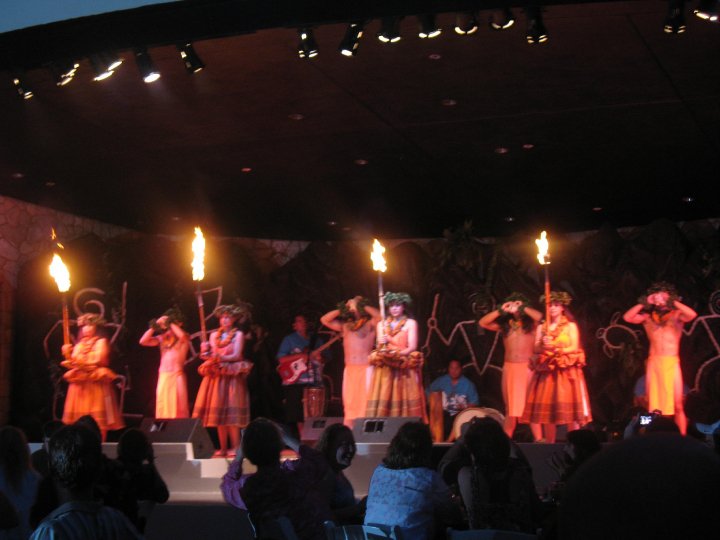
So, in the name of cultural anthropology (and of fuck-it-I-spent-the-money-so-I-may-as-well-enjoy-myself), I infiltrated the Other Side: threw on a plastic lei, ate 5 plates of mediocre buffet food, drank my sugared-to-shit blended virgin cocktails, watched the fire throwers and hula dancers and even danced along. Think Hunter S Thompson and the Hell’s Angels, only a lot less cool.

I did not pay the $30 to keep a copy of this photo. I went broke-style and took a picture of the picture with my phone.

During the opening participatory hula dance, all I could think of was that scene in Dirty Dancing:

Through the course of the show, there was much hulaing, conga shell blowing, relating of digestible chunks of Pacific Island history, and audience participation. As the night wore on, and the Lava Flows kept coming, some folks got a little more into the Hawaiian spirit.

A curious element of the whole affair to me was the Young Hunky Native Boy aspect. Young guys—some appearing to be Hawaiian, others just really tanned white guys—trotted around in loin cloths, flexing and shaking and posing like Chip and Dale dances to a chorus of female cheers. The best was the fire dancer, a methed-out-looking white dude with a sleeve of tribal tattoos who punctuated the band’s high notes with his own ear-piercing hillbilly yoodle, in what could only be assumed to be a white trash mating call, hidden under a psuedo-ethnic guise (we were hip to him).

It made me uncomfortable, the way some of the women in the audience were responding, as if on cue, to the unabashed display of sexualized exoticism. If it had been the other way around, if the cheers had been directed at the female hula dancers, it would have been disgusting, deplorable. I wondered what made it different, more acceptable, when it came from women. It seemed to me to come from the same place, the same heart-breakingly exploitative place: “a young dark thing for my personal pleasure.”

They say tourism is the imperialism of the 21st century. They say Hawaii has prostituted herself to the whims of the West, that she’s syphilis-stricken and soul-sickened under that thick hair and pretty skin. I’m not really here to talk about all that. I just know that us Americans gasp at the idea of Chinese ethnic minority theme parks—but, um, Hawaii doesn’t seem too far off. And certainly not a luau at the Hilton.

We had a nice waitress. As we were gathering our things, she came to wish us a good night. It had come out, sometime during the course of the night, down on the other end of the table, where we were staying. The waitress grabbed my sister-in-law’s hand, “Oh, enjoy P.” Then, a little quieter, “You know, it’s really a great thing, what G did.”

Against the backdrop of the Hilton, against the gleaming stage lights and up-lit palm trees, the crackle of the sound system and the bustle of bus boys, she was right.

Bootleg Blues: Thoughts on the Illegal Alcohol Trade Around the World

It was not a subject I expected to get so drawn into. But there I was, hunched over the pale glow of my laptop, clicking links and watching videos and reading random blogs, that damn color pinwheel spinning from the stress of too many open tabs—like going down a virtual rabbit hole into a murky, liquor-soaked world of shadows and motorbikes and sick yellow skin.

Modern-day bootlegging. Prompted by a New York Times piece about alcohol in tribal Pakistan, NileGuide assigned me an article on the illegal trade of alcohol around the world. It was to be a straight-forward round-up, carefully presenting the information without judgment, condemnation or alarmist cries of “this shit is crazy!” But it kind of is crazy, is the thing, and got me thinking a lot about the prohibition/restriction of substances in a society, and about my own experience traveling in Morocco.

As you’d probably guess, all of the places I discovered with a bootlegging industry either outlaw or strictly regulate alcohol sales and consumption. The how and why of it was fascinating. There were religious reasons, of course, in places like Pakistan and United Arab Emirates, but more interesting to me were Sweden, Russia and these remote rural towns in Alaska. All of these places enacted regulations in response to severe alcoholism within the culture. In the Alaskan towns, the temperance calls came from the community rather than the government—largely composed of a Native American population, folks in these towns were sick of the ravages of alcoholism and wanted to just do away with the whole existence of the glimmering, vile elixir. Can you really blame them?

The problem, as any good alcoholic knows, is that people will find a way to drink anyway. (Shit, I never took a legal drink in my life.) Regulations lead to a bootleg industry rife with gangs, violence and product made with piss-poor ingredients that can sicken and kill those who consume it. It’s not too unlike the drug trade in that regard—which got me thinking, on this uber-stoner holiday, about places I’ve been that have suffered immeasurably due to the drug trade: Mexico and Colombia. As always, the suffering seems to break down along class lines: the people who really get fucked are the poor folks in these cultures.

In Morocco, I had the chance to hang with some sober people. What these people—three expats and one Moroccan woman—told me about the actuality of alcohol consumption in the country kind of blew my mind. “Of course people drink,” the retired American sisters told me. “You’re just not supposed to drink, so no one talks about it. People just kind of turn a blind eye.”

As we pulled into the beach resort of Agadir, they sneered slightly. “They’ve been building the town up,” they told me. “It’s becoming something of a playground for Saudi men, where they can drink and have their call girls without anyone knowing.” They later told me about medina bums that drink cologne—not too unlike old-school stories I’ve heard about how folks, during the Depression, would strain shaving cream and drink the liquid to get drunk. (One report of an Alaskan town claimed mouthwash and air fresheners have to kept behind the counter at grocery stores because people use them to make alcohol.) The gaping, aching disparity between how the rich and the poor consume alcohol astounded me.

In the Gujarat state in India, only the wealthy could afford the imported and smuggled bottles of whiskey, while in Russia, only high rollers could fork over what was a three-fold increase in alcohol tax. Poor folks in these places were left to consume shady moonshine, made from medical disinfectants, that led to sicknesses like toxic hepatitis and “yellow death.” Recent outbreaks had killed over 100 people in both places and sickened over 1000. In Gujarat, people rioted during last summer’s outbreak of poisoned alcohol deaths, accusing the police of abetting bootleggers and clamoring for the repeal of Prohibition laws: “Blanket prohibition has never worked in this free world.” The government responded instead with harsher laws: the death penalty for anyone caught bootlegging.

Then, on top of all that, you toss in the lucrative business of bootlegging, complete with gangs, bribed government officials and violent skirmishes, and you gotta ask yourself: how dissimilar is all this from the drug trade?

It’s too simplistic to just advocate for legalization—there are huge cultural and religious forces to negotiate. But it seems, at least in the cases of Alaska and Russia, that putting tight restrictions on alcohol hasn’t done a whole lot the curb alcoholism. It’s a fast, tangible, measurable action, but seems to have caused a hell of a lot more suffering. The slower, more expensive and difficult answer would be to increase social services, preventive education and not-for-profit recovery centers.

At the very least, legalization means regulation, both of the substance and the criminal underbelly that controls its distribution when a government doesn’t. I’ve never drank moonshine, but I don’t even want to think about all the dumb and dangerous shit I did to get alcohol, all the yellow rocks cut with Ritalin and rat poison that I consumed, about the fourteen-year-old kid “in the scene” whose heart exploded when he took a bunch of bad acid. The safety of banned substances, along with crime, led the US the repeal Prohibition, and I can’t help but wonder if a more feasible answer to combatting the drug trade problems in Colombia and Mexico would be at least a partial legalization.

The sober Moroccan woman I met painted a fascinating picture of alcohol in her country. She was upper-class, from an important family, had been to European boarding schools and spoke seven languages. According to her, everyone in her class drank. It was considered cultured and European to drink—though, since alcohol wasn’t an established part of the culture, it didn’t take the form of a nice Cote de Rhone with dinner; people binge drank. People did it, but didn’t talk about it, a sort of deeply steeped denial. You can only imagine how difficult it would be for someone to admit they have a problem with alcohol, in a culture where you’re not even supposed to be drinking. Toss in being a woman on top of that and, well, you’ve gotta be one tough chick.

Let me tell you—she is.

Knuckle Bumps and Stomach Punches: VICE Under Fire

“Negligent.” “Contemptuous.” “Appalling substandard.” “Morally bankrupt.” “A modern version of a colonial diary.”

Ouch. It’s some harsh criticism that isn’t undeserved. The VICE Guide to Liberia, which I did a post about a few weeks ago, has ignited a cauldron of contempt on the blogosphere. Big-time media attention from CNN and the Huffington Post led to impassioned and eloquent arguments against the documentary, and some frighteningly truck-rally-esque endorsements. It’s got me thinking a lot about the travel series I’d formerly enjoyed and endorsed, despite its arrogance, and wondering: did VICE go too far?

Well, the answer is yes. Clearly. As I dug into the dozen or so blog posts, and the scores of ensuing comments, I learned more about the current situation in Liberia. VICE didn’t portray it fairly, or even close to fairly, and fell woefully short of providing the kind of context one would need to draw any kind of informed conclusions about the country. But I don’t think the series was entirely without merit, entirely evil and shallow. And buried beneath smirks and bro language (“heavy vibe” is used a lot), there’s still an emotional depth to the documentary that keeps it, for me, from being too simple of a case: black and white, Western and African, exploiter and exploited.

Most of the voices crying out against VICE are from people personally invested in the country—they’ve lived there, traveled there, done development work there. If I were emotionally linked to the country, I’d be pretty pissed too. Penelope MC’s post post relates stories and experiences of positive progress in Liberia, while Kate Thomas’ post shares some of the tourist-friendly spots. On The Faster Times, Adam Karlin delivers the most seething and meticulous critique of VICE I came across, picking apart the faulty journalistic practices employed. On the other end of the spectrum are the positive comments that fill the VBS website, which basically amount to a Beavis & Butthead “Whoa.” I found only one blog from someone with experience in Liberia that lauded the series, and the rationale there was a little odd. Christine Scott Cheng offered a more nuanced review, as does Ethan Zuckerman, arriving at the point that the series, however flawed, deserves to be watched. I agree.

A different view

The VICE Guide to Liberia paints a bleak picture—so much so that I was surprised, only a week after its release, to come across a New York Times article about the country’s burgeoning surf scene. I began to suspect VICE hadn’t captured the entirety of the situation in Liberia.

Indeed, one of the main qualms people have with the series is that it only shows the most fucked-up parts of Liberia, largely within the capital Monrovia. While it’s true that “this is just what VICE does,” I think that reasoning is a cop out. VICE hypes the situation: the first episode makes it seem like the war is still going on (though I’d argued subsequent episodes firmly depict the war as over), and the UN is claimed to be leaving the country, an incendiary claim that isn’t exactly true.

I don’t have any experience in Liberia, so I did what I always do in this situation: related it to Oakland. Someone could certainly go in to the worst neighborhoods of Oakland and do a series that made the whole city look like a dangerous, drug-riddled hellhole. And that would have pissed me off, for the exact same reason it did people invested in Liberia—the 80s are past, crime is down in Oakland, and a lot of people and organizations are working hard to enrich their communities. That being said, I don’t think going into those places, documenting and interviewing and excavating stories, would be entirely without value. They are hard, painful stories to hear, images to see, but they are true and deserve to be heard. More context certainly should have been provided—something like: “we went to the worst slums and interviewed former warlords”—so that the series didn’t appear to be a blanket of this-is-what-Liberia-is-like. But just because the stories featured weren’t representative of the whole doesn’t mean they shouldn’t be heard.

Ambassador setting up a Girls Empowerment Center

Other arguments against the series include sensationalism, stereotype indulgence and bad-assedness. People argue that host Shane Smith is exaggerating the situation so that he can look tough, and the series more daring, and that in the process he dehumanizes his subjects, treating them like animals in a zoo. There’s a lot of validity to these arguments. The war is over-hyped, and less discerning viewers could certainly draw erroneous conclusions. Shane Smith, to me, looks scared and freaked out in most of the footage; rather than a bad-ass, as many of the site’s commenters lauded him as, he seems wholly untough to me. Not saying that I’d react any better, just that the series didn’t make him seem cool to me.

But the argument I’ve been grappling the most with is the stereotyping and dehumanizing one. Africa is again portrayed as a hellhole, Africans as savage cannibals. I can agree with this statement, but my experience with the series was completely different.

Granted, I’m coming from a pretty left-wing perspective, but to me, the series didn’t evoke an Us Vs. Them reaction. To me, it served as an exploration of how generations of war, poverty and exploitation create dire situations not easily remedied. It’s not an African issue, but a human one. What happens to former warlords and child soldiers? Do they try to reform and make amends for their actions, like Joshua Blahyi, or stay whacked and ready for combat, like former General Rambo? What about the kids growing up in all that, the women and all those folks just trying to live life as they best they can?

The most interesting part of the series to me wasn’t the shocking wartime footage or discussions of cannibalism—it was the visits to the boys school of former soldiers, to the brothels and heroin dens. Not because it was shocking, because it wasn’t, but because of the eyes of the people shown, the pain-beyond-pain. For me, it was incredible humanizing, touched on that part of me that makes me feel like we’re all connected, together in this often fucked-up world. I can see how that wouldn’t evoke the same reaction in a lot of viewers, and maybe the emotional depth wasn’t in the coverage at all, but in my own reaction to it.

At the end of his review, Adam Karlin touched on what the real shortcoming of the VICE series is, to me: “Bad travel is about going somewhere and reconfirming everything you thought you knew before you left, and this is exactly what Vice does in Liberia.” I don’t feel like anything was learned by the people making the documentary—they were shocked, sure, but their ideas and opinions about what was going on appear to have remained unchanged. I’ve never been on a trip like that, where something in my understanding didn’t change. And I hope that I can retain enough open-mindedness and humility not to ever.

Whatever the conclusions, one thing’s for sure: the VICE Guide to Liberia garnered a lot of attention for the country. And for VICE. It got people talking, even if they didn’t want to, and got people like me, who had a hazy understanding of the present-day situation, spending hours online to dig deeper and learn more. It won’t be easily written off, which means there’s more to it than mere caricature and hip packaging. And it might mean that VICE does a more thorough, honest job next time. Cause God knows they certainly have the resources to.


Lauren Quinn is a writer and traveler currently living in Hanoi. Lonely Girl Travels was a blog of her sola travels and expat living from 2009 to 2012. She resides elsewhere on the internet now.

Join 490 other subscribers

Buy This Sh#t

Categories