Archive for the 'Dirty Tricks' Category


Top Three Travel Secrets: A Chain Letter for Travel Bloggers

It reads as ominously as a middle school chain letter. Except, in the end, failure to perpetuate the chain isn’t sworn to result in untimely death or spinsterhood (which are more or less the same thing when you’re 12). Rather, in this chain, compliance results in access to a treasure trove of travelers’ secrets. And probably some new friends.

I was hit by two writers in the TripBase Blog Tag, spreading through the travel blogosphere like hot gossip around a lunch table. Or a dirty note during Math class, light-up sneakers in a mean game of duck-duck-goose. (The analogies could go on forever.) The idea is you write a post about your top three travel secrets: out-of-the-way towns, little-known restaurants, unheard-of hotels—“hidden gems” that lay glittering in the dimness of obscurity. Until now, that is.

Aside from amassing an ass-kicking list of previously unknown spots around the world, the other objective of the TripBase Blog Tag is to be build community and get folks involved. I can get down with that. In addition to the awesome ladies that tagged me—Stephanie from Twenty-Something Travel and Abbie from Miles of Abbie—I’ve already discovered some new writers on the TripBase list of bloggers tagged so far. (Best blog names? Dirtbag Writer and Snarky Tofu. Fuck yeah.) My hunch: the final list won’t just expose travel secrets, but also some bad-ass writers I hadn’t encountered yet.

They say you’re only as sick as your secrets. Here’s to travel health:

End of the hike: waterfall into the Pacific

#1 Palomarin Hike, Marin County, California

My work friend had been telling me about “the secret hike” for months. Huddled over our staff meals in the cramped bus station, she made rope-swinging into the clear lake, and the coastal waterfall at the trail’s end, sound like a dream. Or at least a damn good fantasy.

We finally coordinated a day off together in August and headed up to Marin to the Palomarin Hike. We grabbed sandwiches and drove up past Stinson Beach to tackle the 11-mile hike. And I gotta say, it was just as killer as she’d described.

The hike starts through rather typical dusty California coastal terrain, taking you past sweeping Pacific vistas us locals have grown accustomed to. After about 45 minutes, the foliage and trees thicken, and you eventually get to Bass Lake, a frigid-water lake that’s biggest draw is an old-school rope swing. You could while away hours here, but, seeing as though it was August in the Bay Area and foggy as hell, we were too cold to partake. We continued on, and ended up at the trail’s end, where a waterfall tumbles into an isolated coastal cove.

The good news: the hike, although long, is gentle and not too strenuous. Which means just about anyone could do it—including my smoke-a-pack-a-day friend and me, who was then recovering from swine flu (yes, really).

The bad news: the Palomarin Hike is a total word-of-mouth Bay Area secret. As is the way with Marinites, locals don’t want outsiders to know about their secrets or have access to them (see also: why BART doesn’t run to Marin). Locals take down street signs and signposts, meaning that you’ve pretty much gotta go with someone who’s been there. So if you’re headed to the Bay soon, just hit me up; I’ll take you.

Ahhh...

#2 Legzira Plage, Atlantic Coast, Morocco

Okay, if you’ve been following this blog for a bit, you’ve already heard me gush about the most deserted and beautiful beach I’ve ever been to: Legzira Plage, Morocco.

Talk about tucked-away: from Tiznit, take an hour bus ride, hop off at the faded roadside sign, and hike down 20 minutes. It’ll really just be you, a couple stray tourists, some fisherman and their donkeys—and the sandstone arches that dive red earth into blue water.

Among the handful of pink building that cascade down the cliff into the main beach, there’s two hotels that offer relatively cheap rooms. I went high-class and got one with my own shower, squat toilet (doin’ big things), and a window that opened onto the ocean view—for under $20.

Another bonus is the Moroccan street harassment factor, and the fact that Legzira Plage doesn’t have one. After a couple weeks of solo backpacking, sweating in long sleeves and fending off the barrage of “bonjour”s, it felt pretty damn sweet to strip down to my bikini and wave-hop in peace.

Kids on their way to school

#3 El Congo, Venezuela

The story goes that, when Europeans first arrived in what is now Venezuela, they came to the Lake Maracaibo villages, perched on stilts amid the marshes and water. Watching the village folks traverse the “streets” in handmade rafts reminded the Europeans of Venice—and they dubbed the place Venezuela.

El Congo, Venezuela is the most other-worldly places I’ve ever been. It’s only reachable by boat, a 30-minute ride through the hazy flat expanse of water, and you’ve gotta book a tour to get there. But surprisingly, the town isn’t the main draw of the tour. The Catatumbo Lightning phenomenon is what draws most people—mysterious, thunderless lightning that occurs almost nightly in the skies over Lake Maracaibo.

The road to Los Llanos was flooded when I was in Merida, so I opted to take the Catatumbo tour in its place. I hadn’t heard of El Congo, but it ended up being the highlight of the tour (the lightning didn’t really happen that night). The town had everything—a school, a fire station, a convenience store, even a Plaza Bolivar—all erected on stilts. Rumor had it there were a couple old folks still living in the town who’d only ever stepped foot for dry land to bury relatives.

It wasn’t an untouched Eden: El Congo was extremely isolated, making inbreeding a huge problem, and the town was quite poor. Sanitation was a major issue, with most refuse and human waste going directly into the water. Owning an actual boat was a sign of privilege. The less well-to-do had to construct their own floatation devices—this girl tied a piece of wood to some leftover styrofoam, dug a stick down into the mushy lakebed, and propelled herself along that way.

The thing that really bummed me out were the poor yapping dogs chained to the “front porch” of some of the houses. So much for getting a walk, little buddy. But hands down, El Congo was the most unusual place I’ve ever traveled to—and so far off the beaten path, there wasn’t a path at all.

So that’s my top three, scrawled not-so-jaggedly into the margins of a wrinkled note. Now to fold it up and shove it into another sweaty, unsuspecting palm. This could get good…

Hipsters Vs. Homeys: Oakland YouTube Travel Guides

“Oh hell no,” the text read. “Hipster douches filming Oakland travel video outside the shop.”

This was my best friend, writing from her post behind the counter of Tattoo 13. For years, she and the fellas have maintained a comical running commentary on the goings on of the now-trendy Temescal neighborhood, knowing every event, incident and wily character within a 10-block radius. Of course, she’d be the first person I’d hear about such shenanigans from.

It actually turned out pretty good, with the bit filmed in front of the shop capturing hipster sentiment with striking accuracy. Amid the recent annoyance over the woefully narrow Cool Hunting’s Oakland Word-of-Mouth Guide, I was inspired to dig the “hipster douche” video back up, and discovered some other YouTube gems along the way. And I hate to say it, I think the douches did it best. Or at least the most forthrightly.

Cool Hunting promotes independent art and design, featuring video guides on artists, cultural events, how-tos and destinations. The most recent installment visits independent businesses and local artists in Oakland, interviewing “the people who call it home.” They hit some great, popular local spots, but there’s a problem—the video only visits a very narrow section of the population, and the city. Businesses featured are almost exclusively in the North Oakland/Temescal and Downtown/Uptown areas, and, um, all the people interviewed are white. There’s a lot more white people in Oakland these days, but not that many.

Perhaps in an attempt to be inclusive, the video includes a couple shots of non-white, non-artist folks. They exist as passing, silent figures, riding bikes and making sandwiches—almost as though on another plane. I think it’s rather telling; I’m sure there’s people who’ve moved to Oakland that interact solely with the arts/”yuppie” communities, who experience the rest of the city only in tangent, realities that intersect on sidewalks and in cheap cafes, but no where else. I’m stoked to see my city getting recognition, but sad to see the guide left out so much of the city, what makes Oakland Oakland.

On the complete other side of spectrum, I stumbled across Thizz Nation’s neighborhood guides during my YouTube quest for the “hipster douche” video. Amid Mac Dre’s ever-generous contributions to Bay Area culture (I’m not really being sarcastic here), his Thizz Nation & On Point Productions created Treal TV Series, video guides that feature notorious Bay Area neighborhoods that birthed prominent figures in the rap community. (If you’re wondering what “thizz” is, check out old high school buddy Rachel Swan’s East Bay Express article from a few years back.) Installments include North, West and East Oakland.

I’m convinced these will someday be used as important specimens in some cultural anthropological study of Oakland. These guides do a little more to reveal the history and culture of certain neighborhoods, as rugged as they may be. But of course, they are also terribly narrow, and could leave one with the impression that Oakland is filled with nothing but 20-something, hard-as-shit black guys. Murder Dubs was one of the better ones:

A stab at a more balanced portrayal is made in the endearing “Oakland B Mine” video. A trailer for a short film that will be showing on a 30-foot screen at the Oakland Airport’s baggage claim, “Oakland B Mine” is pretty damn sweet. I never thought of my city being the backdrop for an artsy dialogue-less love story, but hey, I can roll with that. The trailer features some shots of everyone’s favorite farmers market (okay, my favorite farmers market), and the bad-ass old folks that do Tai Chi by the Lake Merritt BART station in the morning. While definitely more balanced and definitely the most well-done, one could still walk away from this one with the idea that Oakland is filled with nothing but good-looking, casually well-dressed hiply ethnic types. Which is fairly accurate, but still incomplete.

Which leaves the douches. While still narrow and incomplete, their video does something the others all don’t: makes fun of itself. It doesn’t just make fun of hipsters and gentrifying yuppies, it makes fun of cheesy travel guides and the abhorrent “staycation” phenomenon. But most importantly, the video gets at some of the very real issues inherent to living in Oakland, the preposterous dysfunction that manifests in sideshows, prostitution and, yes, the smells emanating from the Lake. And while the underlying message is that Oakland is “crappy,” the video captures the kind of delusional exoticism so many fall spell to.

Leave it to the hipsters…

The French Won’t Save You: Recklessness, Fear and Safety Abroad

Military chillin in central Bogota

Military, chillin in central Bogota

We’d taken refuge from the soggy Bogota afternoon in the hostel’s dank kitchen, sat drinking coffee and swapping tales. Only my third trip out of the country, I sat quietly, listening to the boys one-up each other. No one could beat the Swede in zip-off pants.

He sat smugly, like a guru, doling out morsels of his tales in titillating tidbits. He’d dyed his hair brown, donned dark contacts, and backpacked through Iran, Iraq, Pakistan. He’d ridden buses rarely, walked mostly, and had almost been killed (purportedly) by an anti-American lynch mob. Sparks of awe and admiration flew from the enthralled eyes of other travelers.

One of the boys in his rapt audience turned to me, suddenly aware of my presence. He quizzed me on my basics: where was I from, how long was I traveling, did I speak Spanish. “What’s your itinerary?” was his final question. I bit my lip as he looked me over, sizing me up for what I was: an early-twenties American girl, not terribly well-traveled, with a mediocre accent and a minimal vocabulary. I recited my basic plan: Bogota, Medellin, Cartegena, Santa Marta and La Ciudad Perdida.

“Hmph,” he snorted. “Typical.” And with that, he turned his attention back to the blond god before him.

Fast forward several years and a couple thousand miles to this afternoon, as I rattled down the uneven pavement of Interstate 880, windows down and blasting NPR (yo, turn it up so it bumps). I’d just caught the beginning of a story on France’s proposal to charge tourists for rescues from risky spots while abroad. The hotly debated bill came about several months ago, prompted by a much-publicized rescue of French citizens who were captured by Somali pirates while pleasure-yachting around the Indian Ocean. Reportedly, public outrage at the travelers’ perceived irresponsibility was intense enough to inspire a bill that would require tourists rescued from dangerous situations abroad to repay rescue costs (aid workers and journalists excluded). A coordinating author from Lonely Planet was on hand to discuss the proposal and its implications, a discussion that centered around issues of travel safety, and real versus perceived dangers abroad.

Here’s something most independent travelers, including myself, rarely check before going abroad: the Department of State’s Current Travel Warnings. When you grow up amid a culture of fear mongering, it’s easy to get desensitized. Yeah, yeah, yeah, you think, the world’s sooo dangerous and I’ll get kidnapped and killed the moment I leave the US. Fear is one of three reasons discussed in Nomadic Matt’s article, Why American Don’t Travel Overseas. Once certain travelers step outside the country and see the rest of the world isn’t the depraved war zone it’s often portrayed to be, they get cocky. And brazen. And sometimes stupid.

Take that to the extreme: extreme tourism. I haven’t heard this term in awhile, but it was tossed around the hostel table in Bogota that afternoon. It refers to a type of off-the-beaten-path thrill-seeking travel that prides itself in brushes with danger. Real danger. As in, I’m-gonna-walk-through-Baghdad-just-to-prove-I-can danger. Implicit in this type of travel, I would argue, are entitlement and bragging rights.

Fresh stencil in Bogota

Fresh stencil in Bogota

Which begs the question: should risk-taking travelers enjoy the luxury of being rescued, at the expense of their countrymen? The French don’t seem to think so. Nor do the Germans. The United States—well, we don’t really need to worry about it, since so few of us travel to begin with. Reportedly vague and insufficient, the French bill also opens the door to a lot of loaded issues—namely, who decides what countries and regions are dangerous, and whether travelers are behaving recklessly?

I’ve been to three gasp-evoking places often deemed too dangerous for travelers (let alone a solo white girl): Caracas, Mexico City, the entire country of Colombia. I didn’t go to any of these places because they were considered dangerous, but despite them being considered dangerous. One I ended up in circumstantially, but the other two I sought out—I’d heard too many good things from other travelers. I did my research. Street sense and good luck got me through unscathed. But there’s certainly people who would have regarded my traveling in these places as reckless, stupid and asking for trouble.

I remember thinking Colombia was a lot like Oakland. Which isn’t true: armed military don’t roll through city streets, and you can’t smoke cigarettes inside shopping malls (not even Eastmont). But both places have a sort of infamy to them, a danger that either lures or deters. As in Oakland, many parts of Colombia feel totally safe; as in Oakland, other parts of Colombia continue to feed the unsafe reputation. To stay safe in Colombia, I did everything I already do in Oakland: don’t go out at night alone, stick to main streets in safe neighborhoods, don’t ride buses at night, check my back like a motherfuck.

The Swedish guy in the Colombian hostel reminded of suburban kids that move into Oakland warehouses (snark alert). They proudly tell you they live in the Lower Bottoms, Murder Dubs, Dirty 30s, Ghost Town. “The thugs aren’t that bad, really,” they tell you. Then, knowingly, as though they’re imparting some great gem of karmic street ethics upon you—“If you don’t bother them, they don’t bother you.” Then they mugged/assaulted/held at gunpoint, and they leave, go back to their suburbs bruised and bitter and hating the town they so recklessly glamorized.

There’s a certain romance with violence and danger that people who have no real experience with violence and danger have. It’s exciting, enlivening, visceral and real. It’s the wild-eyed rapture of Futurists (which for all of their sexism, fascism and idiocy still created some good art). It’s as easy to write off as the uninformed fear that keeps some folks away from Oakland, away from traveling, and comfortably cocooned in familiarity.

But neither side is right, neither view complete. They’re just two sides of the same coin—exoticizing someone else’s world, treating it as the Other, instead of attempting (however falteringly) to meet it, understand it and experience it as it is. Can I claim to have traveled so honorably? Not really. But I can claim to have tried.

DSCN1202_2_2

Good times with the Colombian military

Which could all be an elaborate rationalization for why the rules don’t apply to me—why I haven’t gotten into any real trouble while traveling, and why I would surely be rescued in the event of any dire incidents. And not expected to pay for it. (Because, after all, I’m not French.) But I suspect the truth lays somewhere muddled between all this, between embassies and travelers, the frightened and the intrepid, the streets of East Oakland, the seas of Somalia and hostel kitchen tables around the world.

Trudging the Road to Travel Writer-dom: Struggles, Successes and a Couple Happy Dances

DSCN3924

The ole ball and chain

It’s been an exciting, exhausting week in my journey (bad pun alert) to become a travel writer.

It’s pretty counterintuitive when you think about it—trying to become a travel writer. As Tim Cahill said, travel writing is a forgiving genre, “because as soon as you step out the front door it’s travel writing.” By the same token, the moment your fingers start scribbling or typing, you’re writing. So, bingo-bango—I’m a travel writer.

But when it comes to the more pressing business of business, of embarking upon building a profession around overlapping passions, in an industry so tumultuous seasoned experts are scrabbling to make due—well, that’s another story. I’d like to say I’m writing that story, but I suspect that this is a story that’s writing me.

First with the successes. They say bad things come in threes, but I’m convinced good things do too. The travel-writing stork delivered three little bundles of joy to my laptop this week.

My run of good luck started on Tuesday, when a StumbleUpon link to my blog generated 346 pages views, making the day’s total 494. My previous record had been 97, so, yeah, I was a little stoked. I knew it would only be downhill after that (indeed, the downward slope in the line graph is a little sad), and the busted link-back kept the original Stumbler a shadow-shrouded enigma. But I was tickled nonetheless. There may or may not have been a happy dance involved.

Wednesday I discovered that a local TV station’s website had published an excerpt from my Dia de los Muertos post, along with a link to my blog. This is the closest I’ve come to being on TV. (Happy dance #2)

Thursday, the editor from the new female-oriented travel site Girl’s Getaway contacted me to see if I’d be interested in writing for them. Um, yes. While I brainstorm ideas of girlie stuff to do around the Bay, my post on getting hassled and humiliated in Marrakesh will be appear on their site (guess my grand entrance will be on the bummer-ish side). I’m now listed on their writers page, which evoked more of a happy giggle than a dance. My feet hurt—it’d been a long night at work.

Which brings me to the “struggles” side of things. I don’t mind the long hours at the computer, and taking my laptop over to the cafe and eating cake while I work may or may not be the highlight of my day. But that’s also indicative of the adventure level of my life right now. Which, even if you don’t want to be a travel writer, is pretty lame.

Here’s the scenario: this week, I wrote the post on Dia de los Muertos; worked on a sizable, ongoing freelance project from NileGuide (fun with regional descriptions); continued reading the Pico Iyer book I’m deep into; spent hours online reading and commenting other people’s blogs; wrote an article on Caracas—and worked full-time. This means that pretty much every minute I wasn’t at my actual job (the one where I make enough to support myself), I was at the computer, doing what I love. Now, I love writing, but this scenario doesn’t leave a lot of time for friends, for going out, for doing the kinds of things that generate compelling writing in the first place. If great writing is the end product of great living, this ain’t cutting it.

Something’s gotta give, and I don’t think it’s gonna be the writing. I’ve been grappling with financial insecurity this week, on working up the nerve to release my grip and leap into the unknown.

I face, of course, the American Dilemma. No, not Gunnar Myrdal’s—I mean health insurance. If I cut my hours at work, I lose my health insurance. I can stay on the company’s plan and pay out of pocket for up to 18 months, but the last time I did that, it cost me nearly as much as my rent. But wait—if I cut my hours at work, how will I afford another monthly bill? Ah well, who needs thyroid medication anyway? Oh wait—me.

So I’m working (in addition to working) on letting go of my comforts, and getting comfortable with the idea of less security. Or no security. Careers that offer security don’t appeal to me—thus the debauched grant writing stint. Sometimes, a lot of times, I wish they did. But we don’t get to pick what we love, now do we?

I read an excellent interview with writer and fresh lady (and perhaps role model) Daisann McLane, in which she talks about how scary a life without security can be, the life of a travel writer. But, she says, “when you travel to so many different places, and you see how people live outside of your little bubble, you realize how ridiculous the very idea of security is, from a global perspective” (Lonely Planet’s Guide to Travel Writing, p. 140).

Well, amen, sister. But now I’ve got some margaritas to sell… do you take salt?

Top 5 Things That Make Me American

3622369311_8989a991b2_m

That is totally mine.

“The more I travel, the more I realize how American I really am.”

This was Matt, leaning on a pole in a Madrid metro car, observing the raucous teenagers and stylishly dressed adults of an average Spanish evening. I nodded in sad agreement.

I’d like to say that traveling has made me more cultured, sophisticated and worldly. Maybe it has. But it’s also made me acutely aware of my incurable Americanness.

I didn’t really know what it meant to be an American before I started traveling; it’s hard to know if you have nothing to compare it to. I’ve now caught on to plenty of red-flag characteristics that will immediately identify one as hopelessly American. I’m guilty of many of them: holding my fork like a shovel, having obscenely straight teeth, living on my own before marriage, maintaining a staunch belief in the importance of a hearty breakfast. There’s also some attributes I don’t share with my countrymen: I don’t own a TV, I’m not overweight, and I can find Australia on a map. And I travel.

Being as though I travel, and have had the luxury to mingle with other cultures, I’ve been made aware of my grosser American offenses. Here’s the top 5 off my American rap sheet:

2639402501_5924ef8801_m

From the human race, I'd like to extend my apologies, little fellow.

5. I walk fast.

I didn’t know this was an American characteristic until someone pointed it out to me. It makes perfect sense. We don’t stroll in America. Walking is not a leisure activity; it’s the lowliest form of transportation. We do it briskly to conceal our shame. Or else we construe it as exercise (as in, office workers powerwalking their lunch breaks away).

Our avoidance of walking manifests in everything from drive-thrus to elevators to Segways. Remember when MacDonald’s had step counters as a meal prize? Exactly.

4. I shake hands.

Now, this isn’t exclusively American; many cultures shake hands. But Americans place special importance on the handshake, measure relative grip and firmness to construct deep insights into another’s character and psyche. “I like that young man; he’s got a good handshake.” And I was just in Europe, where nothing announces your Americanness like jabbing someone in the chest with your outstretched hand as they lean in for a check kiss. (Sorry, Pierre, hope that doesn’t bruise.)

3. I call myself American.

America isn’t a country, it’s a continent. Two continents, actually. Filled with many, many countries. In our utterly naive narcissism, we seem to forget this (read: title of this post). Numerous travels through Latin America have taught me to say that I’m from “Estados Unidos,” not “America.” But I still have trouble pronouncing “Estadounidense,” which basically means United-States-ian. Doesn’t flow off the tongue as easily, but it is more correct.

2. I don’t speak another language.

I mean, really. It’s just ridiculous at this point.

441228274_30567e38cb_m

And the rockets red glare...

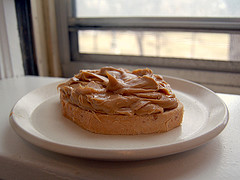
1. I have a deep and abiding love of peanut butter.

Protein, healthy fat, delicious taste: the American love affair with the peanut culminates when we grind it, jar it and spread it on stuff. Or eat it by the spoonful.

Trying to find peanut butter outside of the United States is a depressing, frustrating and often futile effort. If you can find a jar, on a lonesome dusty shelf hidden behind the Nutella and marmalades, it’s bound to be sugared to hell, rife with hydrogenated oils and staggeringly expensive. I’m not sure why the rest of the world is sleeping on the PB tip; with great taste, nutritional value and versatility, they’re really missing out.

There’s plenty of things I could change about myself to become more international, a “citizen of the world” as the obnoxious call it. Sure, I could learn 7 languages, use military time and metrics, and school myself in the finer points of kissing cheeks. I could disregard my reverence for the orderliness of lines, become a football fan (not American football, silly), even slow my roll to a smooth swagger. But I will never give up my passionate fervor for peanut butter.

Flyin’ with Ryan: What to Expect and How to Survive

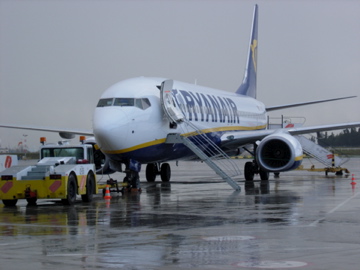
DSCN3843I have seen the future of air travel. And it’s covered in Telecom ads.
If you haven’t been broke and in Europe in recent years, you may not be familiar with Ryanair. Among the no-frills airlines specializing in short distances and absurdly low prices, Ryanair is the most vile, audacious and offensive. And usually the cheapest.

The idea of an under-$50 flight gets most Americans all hot and bothered. It’s just another way those Europeans have it better than us—universal health care, social welfare systems that work, less violent crime, tougher environmental laws. And cheap flights. I’m talking 5 Euros cheap. I’m not sure why Europe gets to add this to their ever-expanding repertoire of ass-kicking, but my guess would be that the airlines have to compete with competent, efficient train service. Take Amtrak, or God forbid, Greyhound across the country? Down to LA? I think I’ll pay the $125.

When I was figuring out the general itinerary for my last trip, I checked out flight costs for my longest distances on FlyCheapo. I came across Ryanair, and thought there was something wrong. A one-hour flight from Marrakesh to Seville for 5 Euros? Porto to Madrid also for 5? Are you kidding me?

Well, yes and no. The thing with Ryanair is that there’s catches. Enough to warrant a mitt—or the ability to read fine print, follow rules to a tee, and tune out advertising assaults. And you’ll need a pinch of luck. I took 2 flights with Ryanair; here’s some survival tips on what to expect from Europe’s most infamous airline:

The first trick to surviving a Ryanair flight is to read every rule and instruction, and treat it like the gospel. It is. Any attempts to bend the rules promptly results in a hailstorm of fees. Size and weight requirements for both checked and carry-on luggage, for instance, aren’t approximations. Carry-on baggage over 10kg? That’ll be 20 Euros. Forget to print your boarding pass at home? That’ll be 40 Euros. Traveling with an infant, surf board or guitar? Another 20-40 Euros. You’ve gotta pay to check a bag, but if it exceeds 15 kg, there’s an additional per kilo charge. If you’re a non-EU citizen, you have to have your passport checked by immigration control; forget that, and, yes, it’s another 20 Euros.

In preparation for your Ryanair flight, don’t even think about fudging on the details. Check-in closes exactly 40 minutes before the flight departs; arrive even 3 minutes late and you’re SOL. Have your printed boarding pass in hand, and get your passport checked.

Get to the gate early. Don’t sit in the hard plastic chairs—stand as close to the gate as possible. Ryanair doesn’t assign seating, which at first seems counterintuitive—it takes longer for people to board when they’re elbowing and jostling and trying to find their own seats. But, as always, there’s a catch: you can pay 4 Euros for priority boarding. Most of the folks doing this are traveling with small children, or those infants they paid an extra 20 Euros to hold on their laps.

As boarding time approaches, expect to see a steely-faced attendant walking up and down the line of anxious passengers, examining each carry-on item. It must be under 10 kg, and it must be only one bag. That means purses, laptops, water bottles, plastic bags carrying your wilted sandwich from earlier that day—it all counts. This is where they really rake in the extra fees. I only saw one man successfully evade the attendant, putting a jacket on over his fanny pack and untucking his shirt so you couldn’t see the waist strap. Smooth.

When it comes time to board, don’t expect anything fancy like gates or protected corridors. You’ll be scurrying across the tarmac and scampering up stairs (front or back, they open both up for maximized efficiency). Hustle on to the plane while perky young attendants bark at you like PE teachers: keep moving! find a seat! don’t block the isle! move quickly! go!

You’ll discover a couple of unusual things about your Ryanair aircraft. One, there are no tray tables. That safety card with a creepy characters acting out worst-case scenarios will not be a folded card in a pocket, but pasted onto the seat back in front of you. The overhead bins will be covered in Telecom ads, like a bus or metro car.

Once you’ve buckled your seatbelt, you’ve successfully completed the first stage in surviving a Ryanair flight: you’ve negotiated the rules and fees. Now it’s time to sit back and… be marketed at.

It’s ingenious, really, and I’m not sure why other airlines haven’t thought of it yet. Maybe they have, and Ryanair’s just the only one ballsy enough to go through with it. They’ve got a captive audience on an airplane, and Ryanair makes use of this ideal situation. In a 55 minute flight, I counted 4 opportunities to buy things. Jonesing for a cigarette? Buy our Smokeless Cigarettes for only 6 Euros. Make use of Ryanair’s exclusive inflight mobile phone service, and text and chat your heart away for only 2 Euros a minute. Buy Nescafe coffee for only 3 Euros. Get your gambling fix by buying a scratch card for only 3 Euros—and don’t feel guilty because some undisclosed amount of the proceeds goes to charity (here the flight attendant actually walked the aisle saying, “Win 10,000 Euros, save the children”). And let’s not forget duty-free shopping.

All this means that the attendants are basically talking at you the entire flight. Part of the reason is that announcements and sales pitches need to be made in multiple languages, but still. I recommend headphones. A smiley “no thank you” is as effective as a mean scowl, so pick whichever one fits your mood. No charge.

Now, when you’re descending into your destination, you may think the battle’s almost over, but here’s where the luck comes into play. I was fortunate on my 2 flights, because I landed in the airports and cities I thought I’d be landing in. Not so for all Ryanair passengers. I’ve heard horror stories about people landing on some lonesome runway 20 kms from the city they’d booked for. Notice that on your Ryanair itinerary, specific airport names aren’t given, just the names of cities. This allows them to land in the regional area of whatever destination, but not necessarily the main (and more expensive) airport. So, if you’re among the unfortunate, how do you get to where you thought you were going? Ryanair is nice enough to arrange for a bus. Which you can ride for 20 Euros.

Seeing as though I landed where I was supposed to, only had one flight time changed and neurotically followed every rule, my Ryanair travel experience wasn’t so bad. I actually don’t mind being inundated with ads and paying checked bag fees if it means I’m flying for a total of 25 Euros. And judging from the number of filled seats, I’m guessing I’m not alone.

Ryanair certainly hasn’t won any friends with its wily antics (this guy is pissed), and there’s an art to surviving their flights. But until they start charging to use the bathroom (they lost on that one), I’ll still grab a cheap flight with them whenever I’m in Europe. And my guess is that US-based airlines will begin moving more in this direction—hey, they’re already charging for checked bags. Only their flights ain’t no 5 Euros. (Oh, Europe, there you go again…)

Livin´ La Vida Português

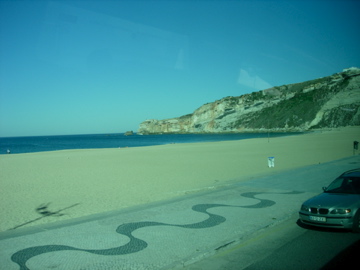
Beach from a bus window: NOT the way to be enjoyed

Beach from a bus window: NOT the way to be enjoyed

Nearly a week into my Portuguese travels, I am convinced of two things. One, Portugal is a country best enjoyed by car. Two, Portugal is best a country enjoyed.

On my second day in Lisbon, my Couchsurfing hosts and I chased the sunset along the granite coast, driving through increasingly posh, and beautiful, suburbs where tan bodies gleamed in beach coves, green parks and umbrellaed cafes. My hosts, recently relocated Hungarians, had spent a month driving around the country, stopping in at whatever little village or beach enticed them. As we curved down the coastline, in pursuit of their favorite sunset spot, they told that Portugal was best explored by car. Infrequent and/or nonexistant bus service cuts you off from a lot of the country, they told me; cars mean the usual freedom from timetables, but also a better glimpse into Portugal. I stared out the window, at the pinkening sky and grey sheets of cliff, and nodded—I certainly wouldn´t be feasting on that sight if it weren´t for my hosts´car. Of course, traveling solo, renting a car was far out of my budget, but I lamented my inability to see more of the country, to get off the beaten path and into the dying villages the speckle the green countryside.

But as we climbed out of the car and scurried along the rocks just in time to snap photos and sigh at the insane beauty of it all, another thing occured to me: the Portuguese know how to enjoy life. They don´t initially bowl you over with siestas and late-night partying like their neighbor; coming from a night in Seville, Lisbon actually felt a little tame. While the Spanish are a bit more flamboyant in their lust from life, the Portuguese have a subtler, but equally infectious, approach to living it up: they´ve got the beaches. And the pastelerias. And futbol and fado and seafood and port. And all of it´s twinged with this hint of melancholy that really gets under your skin.

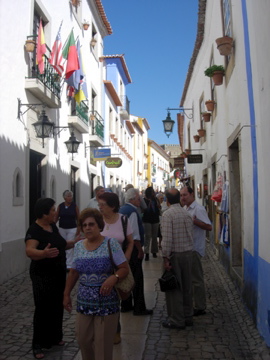
Old folks in Obidos

Old folks in Obidos

The theories converged and cemented today, as I treked off to Obios. The medieval village wasn´t initally on my itinerary, but two Portuguese guys and my hosts assured me it was the most beautiful town in Portugal, that I had to go there. An expensive touristy place to sleep, I booked a hostel in a nearby beachtown, filled with shirtless, sunbleached Austrialian surferboys. As they tossed their towels over their shoulders and headed out a day in the waves, I walked to the bus station. And waited.

The bus ran every two hours and, when it came, made a winding route through narrow streets, stopping at what felt like every crossroad. I got to Obios and, well, was a little underwhelmed. It was pretty, had a castle and cobbled streets and lots of stores selling lace and ginja, cherry liqeuor. I wandered amid the elderly tourists and billowing bougainvillea, half-heartedly snapping photos of the lush rambling countryside and gold-dripping cathedrals. Meh.

I´d been thinking about trying to make it over to another village, only about 30 km away. It sounded even more boring, but was home to a medieval monastery with a gruesome history—gruesome in the way Quentin Tarantino meant when he wrote the line, “I´m gonna get medieval on your ass.” Murals depicted scenes of the monastery´s founder ripping out and eating the hearts of the people who murdered his forbidden beloved, while making memebers of the court kiss her decomposing hand—metal enough to put Lords of Chaos to shame.

But, alas, the bus to Alcobaça only ran once every three hours, and would put me in town only an hour before the monastery closed. I debated: wait around in pretty-but-dull Obios for the bus and try to squeeze in one more sight, or head back to my hostel and do like the Portuguese: hit the beach. I´ll let you guess what won out.

Freshly shaved and bikini-clad, I took my crappy travel towel and joined the fat old men and tattered fishing boats along the gentle coast. The water was cold at first, but soon I was breast-stroking and wave-hopping with the best of em. I´ve been told the Portuguese love their beaches and escape to them at every available opportunity—and now I can see why. Rockless and clear enough that I could see my feet, it felt pretty heavenly. I stretched out in the sand, soaked up some sun, and stopped for an ice-cream cone on my way back.

I may not be making it out to the remote hilltop villages, and I may be spending hours twittling my thumbs at bus stations, but I´m starting to get the hang of this Portuguese living thing. And you know, it´s not so bad.

Marrakesh, You Broke Me Down

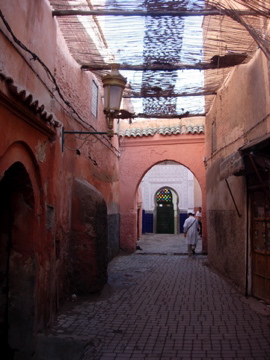
DSCN3558It was a long, hard, hot last day in Morocco, in Marrakesh, the pounding heart of the country´s tourism industry.
As I was venturing down the Atlantic Coast, south of Agadir and thoroughly ¨off the beaten path,¨ I was giving some serious thought to ditching out on my flight back into Europe, and spending the rest of my two weeks in Morocco. There was certainly enough to keep me occupied—I didn´t even make it to the Sahara!—and I felt like I´d hit my groove with Morocco. I was getting skilled at traversing the streets, haggling for taxis; I was in love with fresh-squeezed orange juice and mint tea; even my French was improving. We were vibing, Morocco and I, and it seemed a shame to cut out so soon.

But the prospect of Portugal, Western Europe´s ¨forgotten¨ country,  combined with a pre-purchased flight and a chance to wash my blue jeans and ditch that filthy blue scarf won out. I arrived in Marrakesh with just one day to soak in the crowning jewel of Morocco´s imperial cities, and its exotic lure.

I´d heard horror stories—travelers and Moroccans alike warned me that Marrakesh´s touts were the toughest, the street harassment the ugliest. I got off the bus from Tiznit suited up in my thickest armor, ready to do battle with a mean look and a linguistic sword of two words: la shokran, no thank you.

The problem with Marrakesh, or my problem with it, is that people like to touch. I don´t. As my grandma said, I´m ¨a real touch-me-not.¨ The men in Marrakesh really see no problem with poking you, grabbing your arm, pressing their bodies against yours, literally tugging you this way and that. I think it´s largely a cultural difference; Moroccans touch a lot, are extremely affectionate with one another, and I don´t think they view touching as the same kind of violation as Americans do. As in, get-your-fucking-hands-off-me, or touch-me-one-more-time-and-I-swear-to-God-I´ll-drop-your-ass-don´t-even-think-I´m-playing.

Not that I ever said either of those. But I thought it. And I suspect the wild-eyed, shocked look I gave the dudes who put their hands on me communicated well my very visceral reaction to unwanted contact. They, in turn, almost seemed offended that I was offended, got really defensive. It was one of those tough cultural clashes, and I refuse to admit I was in the wrong. Maybe just the different.

But there was, I have to admit, a kind of magic to the city. I always feel lame saying that about a place that´s really hyped up (as in, yes, Paris is all that). I was intermittently in awe of the city, and frustrated beyond belief.

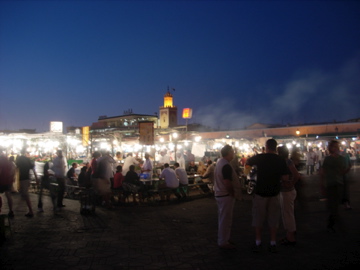
I stayed right near Djemaa el Fna, the open-air market of insanity that really was everything it was cracked up to be. Imagine a county fair. Now add throbbing drums and shrill pipes; snake charmers and witch doctors; wrapped women hunched on plastic stools, ready to ready fortunes and paint henna. Picture billows of meat smoke, the glare of a thousand gas lamps on a thousand white tarps;  see gleaming date stands and pyramided orange juice carts; beggars hands and child shoe-shiners. Hear the zoom and honk of motorbikes; feel the buzz of bodies weaving around one another. Wrap it all in a breeze that comes eastward and touches everything, envelops it in one big ball of electric humanity, shakes it up furiously, like a snow globe—and you´re somewhere close.

I meant to treat myself to a fancy last dinner, but when I got to the white-linen restaurant, it felt sterile. I headed down to Djemaa el Fna, stopping to slurp  snails at a food stall along the way. I dined on a wooden bench under the white tarps of one of the skewer stalls, watching the multi-lingual touts and hustlers do their business, sometimes rudely, but mostly with a charming penache that was hard to refuse. The breeze blew, and I felt in love with the night, the place, the country.

I thought I´d seal the deal with some chocolate ice-cream. I made my way across the square, nimbly traversing the crowds, not responding to the barrage of ¨bonjours,¨eyes on the prize.

I heard a loud voice rumble, ¨Hey sweetie!¨ Though the crowd was thick, I had that prickly back-of-the-neck feeling that the call was directed at me. I didn´t look up, kept walking. ¨Hey sweetcakes!¨ it yelled again. Still, I kept moving. ¨It´s okay,¨ the voice hollered, ¨I like small boobies.¨

I whipped my head around and saw a reddened face laughing, jowls shaking in a grotesque mask of amusement. Other faces were turned to look at me and my shawl-covered chest (I mean, come on, a B-cup is not that small). My cheeks flushed; I muttered ¨piece of shit¨and stormed away, trying to lose myself in the throngs.

The face hadn´t been a teenager´s, but a grown man´s, which angered me more. It had seemed quite pleased that it had humiliated me, that other people had noticed and looked. I felt the blood in my body burning with frustration.

A well-dressed man sidled up next to me, holding a clip-board and a perky straw hat. I looked forward, didn´t acknowledge him.

¨That man,¨ he said to me, ¨you can´t get angry. You have to just accept and—¨ out of the corner of my eye, I saw him make a brushing-off gesture.

I sighed, not entirely sure of this man´s intentions, and not in the mood to risk it. ¨I know,¨ I respond. ¨But sometimes I get tired of accepting, of always being the one to have to accept.¨ I could feel hot tears in the corners of my eyes.

¨Where are you from?¨ the man asked.

I eyed him cautiously, as the question was usually a prelude to some kind of hustle. ¨The US.¨

¨Ah, welcome,¨ he nodded thoughtfully. He leaned forward, said softly, ¨Of all the things you remember, of all the things you take home, don´t take that.¨ He nodded again. ¨I´m sorry.¨ He paused, let the words and the sentiment linger there in the charged air for a moment, turned and was gone, swallowed into the crowd.

It was all a little too much for me, the intensity of extremes—the degradation, the laughing face, the twisted soul-sickness that makes someone humiliate another person—and now, such thoughtful tenderness. All of it from strangers, all of it strange, somehow finding me in the immensity of the crowd. The whole day had felt like that, a tugging between two places, between two sentiments, of both loving and hating a place.

DSCN3551I was exhausted. I decided not to fight it, not to try to be tough anymore. I went back to my hotel room and sobbed, for the overwhelming kindness and cruelness of it all. For being a woman, for being a person, in a place, a world, that is simultaneously horrifying and beautiful.
Let’s Get Ready to Pray

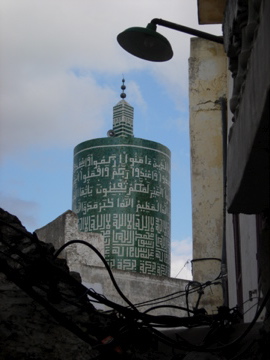
DSCN3343Adhans: you can’t escape them. They’re the echoing voice of omnipresence that follow you, haunt you, thoroughout your Moroccan travels. It doesn’t matter where you go, how far you wander—what town you’re in or how tightly you shut your windows at night; they find you. They punctuate your days of sweaty rambling, your dawns and dusks and inbetweens.
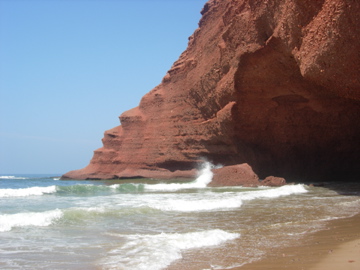
The adhan, the Muslim call to prayer, occurs five times a day, blared from the loudspeakers of every mosque’s minaret. The voice of the muezzin, the guy calling the prayer, is usually a little distorted; I imagine sweaty lips held too close to a scratchy old microphone, behind it all cool darkness and bare feet. If you’re in a big city with lots of mosques, the muezzins’ voices ricochet off the buildings and crumbly streets, off one another like a cat playing with its shadow, making it seem all the more enveloping. You have no idea what’s being said—at least I don’t—but the meaning needs no translation.

It happens like this: the voice erupts with a little squeak and feedback from the sound system. It begins slowly, softly at first, the first few syllables careful and clean; it swiftly gathers speed. The voice rises, grows stronger, accumulates decibels and conviction and heat, like an engine reving, smoke billowing from its spinning wheels. It reaches its final fevered pitch, a wail of passion and fury and God that makes you stop, pause in the street, roll over and groan in the first grey light of day.

The voice holds there, wavering in pitch and power, until at last, exhausted by the all-consuming energy of Allah, it shuts out and is gone. All this occurs in the span of about a minute. It happens at daybreak, noonish, mid-afternoon, sunset and early evening.

It’s a little creepy, to be honest—the omnipotence and disembodiment of it. But I can’t help but feel, whenever I hear it, that it sounds a little too like “Let’s Get Ready to Ruuuumble!” Only, you know, “Let’s Get Ready to Praaaaay!” It kinda gets me going, gets me all reved up and inspired; I kinda wanna kick my shoes off and grab a little carpet and kneel and mutter and bow like the dudes in the shops and alleyways I espy. Not knowing what I was saying or what it meant, just yeilding to the power of it all—lowering my head and kissing at something holy and unseen and buried deep in the fabric, the hand-woven and gently frayed thread of things.

Only, I’m not Muslim. Or any religion. And, coming from a (relatively) secular country, it still strikes me as strange to have religion pumped through the streets, sneaking through open doors and cracks in windows, filling the air and getting all over. But, hey, at least they do it with style.

Legzira Love

DSCN3456I think I may have just found the most beautiful beach in the world.
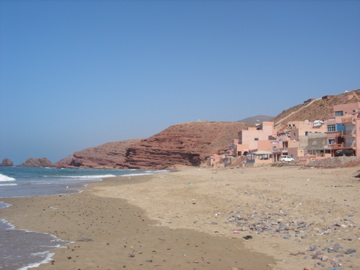
Yes, it’s a sweeping statement, and no, I’m not a beach afficionado. But if red cliffs diving into pebbled sand coves count for anything; if lazy waves crashing against sandstone arches score points; if a tourist to local fishman/swooping seagull/stray dog/donkey (hey, it’s still Morocco) ratio of 1:5 means much—if these are the elements that create that “paradise” thing all the guidebooks talk about, well then, I just spent the night there. And slept with the windows open to the ocean. Cause why not, you know?

Legzira Plage is pretty incognito—it warrants not more than a paragraph in my guidebook and a weathered-beaten, graffitied roadside sign along the pretty two-lane highway connecting Tiznit, Mirleft and Sidi Ifni. Down Morocco’s Atlantic coastline, just before the Western Sahara and a disputed border, the area as a whole doesn’t attract the hordes that the country’s other wonders do—which is why it attracted me. A near-deserted beach away from any big city or pushy tout? I’m in.

I took the local bus from Mirleft, got off at the faded cement block sign at the access road, and took the 20 minute walk down to the beach, a lazy slope washed in ocean breezes. The scenery revealed itself like a striptease: a sweeping hill view, a peak of ocean, the sound of waves, the pink edge of a pink building. I turned into a small dirt parking lot, and almost started laughing—it was so beautiful, it was almost obscene.

DSCN3464There were half-a-dozen pink buildings cascading down the cliff to the beach. Sweaty and shoulders aching, I set my backpack down in a cheap but cheerful hotel room with windows that flung open to the ocean. (Now thoroughly “off the beaten path,” the room costed only a little more than my smelly toilet- and shower-less hole in Essaouira.) I kicked off my shoes, grabbed my camera, and went for a walk.
I’m not much of a shutterbug, but I exhausted both my camera battery and memory card. I walked for over an hour; each cove was more secluded and empty than the last. On the first few beaches, I passed a small group of teenagers playing soccer, a fisherman, and a handful of sun-bathing tourists, many of them Moroccan (tell-tale sign: the lady’s swimming fully clothed). We “bonjour”ed politely. I rounded a gently jutting set of red rocks, and was alone. I closed my eyes, and let out a long exhale.

I’ve really been liking Morocco, but I can’t tell you how good it felt to be alone, away from any non-human sound—just me and the seagulls, you know? Later, I stripped down to my swim suit, and wave-hopped and sun-bathed without concern for modesty. I soaked up much-needed sun, vitamin D sparking wildly through my body. I didn’t worry about, well, anything.

I had a simple dinner of grilled fish (yes, caught that afternoon) and pommes frites, washed down by that killer mint tea. The hotel’s patio was sparsely populated with about a dozen dining guests. If there were any less people, I realized, it would have felt creepy. Like The Shining or something.

The hotel only ran electricity for prime hours during the evening, so I read by candlelight for awhile before crashing out. It was warm enough, so I left the windows open and slept to sound of the waves, to the smell of salt.

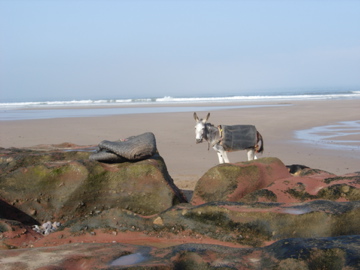
Donkey on the beach!

Donkey on the beach!

In the morning, the fog outside the window was thick. The tide was so far out that a previously offshore crag of rocks connected to the beach. I sipped my freshly squeezed orange juice and nibbled on my still-warm bread breakfast, and watched the fishmen trod out for the day, the sifters search out clams and mussels (I think) in the tide pools. A waiting donkey with two empty sacks on its side bickered with a yapping stray dog with a wobbly magazine of stretched-out nipples. The fog thinned, turned to a fine mist, and slowly, so faintly I could hardly notice, was gone.

I don’t know why Legzira Plage is so under-visited, under-promoted and unknown. But I’m not complaining. My camera battery may have konked out, but my personal battery is fully recharged. Just in time for Marrakech.


Lauren Quinn is a writer and traveler currently living in Hanoi. Lonely Girl Travels was a blog of her sola travels and expat living from 2009 to 2012. She resides elsewhere on the internet now.

Join 486 other subscribers

Buy This Sh#t

Categories