Archive for the 'Dirty Tricks' Category


Too Legit: The Insanely Easy Process of Getting My One-Year Visa in Cambodia

So, yesterday I got this:

I walked back down to the travel agency, one of the 800 that line the riverside, where I’d dropped my passport off two days earlier. I handed the man the $288 fee, grinning like a jackass. “That was so easy!” I exclaimed.

He gave me a wonky eye.

“I don’t know of any other country where it’s so easy to get a visa.”

“Really?” he smiled that bashful Cambodian smile.

“Totally. Cambodia—very very easy.”

I got my change and left the office still grinning. (I think the man thought I was a little off.)

But it’s true: I’m no expert on immigration, visa and residency laws, but I don’t personally know of another country where you can show up, get a 30-day visa upon arrival and then extend that visa for a year, with no applications or procedures.

It’s one of the reasons I decided to make the move out here. I’d fantasized about living abroad for years. The EU/Schengen Zone was entirely out of the question. And even in relatively easy countries like Argentina and Thailand, you’ve got to make a visa run every 90 days; procuring a work permit is another whole hassle. Cambodia?—as far as everyone I’ve talked to can tell, work permits don’t exist in this country.

“Word’s getting out,” “Lisa,” my go-to lady on all things expat-related, told me. “There’s been a huge influx of expats in the last six months. They do this Thanksgiving dinner every year at this pub. This year, they sold out by 4pm. You should have heard the dudes on Khmer 440!”

“It won’t stay this way of long,” a US Immigration lawyer based here told me. “But for now, yes—it’s one of the easiest countries for foreigners to live and work in.”

It’s tempting to write an article, a how-to-get-a-Cambodian-visa guide. It’d involve very little research, since the process is so fucking easy. But, in my inflated sense of self-importance, I’m not entirely sure I want to help “the word get out.” You know how Seoul just announced that they’re kicking out all foreign English teachers by 2014? Exactly.

So I’ll share what I did: Upon arrival at the Phnom Penh airport, I got an “ordinary” visa. It costs $25, as opposed to the $20 tourist visa. Getting an ordinary visa instead of a tourist visa is literally as easy as checking a box on a form. Both visas are valid for 30 days; a tourist visa can only be extended once, however, for an additional 30-day period, while an ordinary visa can be extended for up to a year. So, a little before my ordinary visa was to expire, I popped into one of the travel agencies on the riverside and gave them my passport, along with a passport photo (they really love those extra passport photos in SE Asia). I came back two days later, paid dude, perhaps made a grinning ass out of myself, and that was that.

Just like that, I’m legit. Dare I say, too legit…

http://www.youtube.com/watch?v=Cdk1gwWH-Cg

Thirteen Ways of Looking at Phnom Penh

Note: The literary nerds among you will recognize this as a rip-off play on Wallace Steven’s “Thirteen Ways of Looking at a Blackbird.”

1. Lisa, American, 1.5 years:
“You get a lot of big egos,
people who think
they’re hot shit.
But you have to remember:
we’re all here cause
we can’t hack it out there”—
points outside,
beyond the street,
to the West—
“in the real world.”

2. Tommy, British, 6 years off-and-on
“Where else could I”—
hand tattoos and a missing eye—
“get a job teachin?”

3. Steven, American, 4 years
“This city’s a dangerous place
to have money
and a drinking problem.”

4. Kate, Australian, 7 months
“People do
what they can get away with:
drinking all day, sleeping
with prostitutes,
saying racist shit.”
Stirs margarita.
“This city reduces you
to what you really are.”

5. Sasha, American, 1 month
“I’ve never been anywhere
where I’ve felt so manic.”

6. Hank, American, 4 years
“In the time I’ve been here,
I’ve quit my job, no shit,
5 times. And each time,
whatever I’d lined up next
fell through. So”—
shrugs—“at a certain point, I just decided:
I’m gonna stay here
until I learn whatever lessons
I’m supposed to.”

7. Clare, American, 3 years
“It’s not that easy,
just picking up and leaving.
I have 19 employees, women
who depend on me
for their livelihoods.
But at the same time”—
looks out the tuk-tuk
at the street—
“I know I need to leave soon.
I can’t get stuck.”

8. Lisa (again)
“The thing about it is,
it all becomes normal.
You realize,
the guys sleeping with prostitutes—
they’re not all creepy and weird,
like you’d expect.
Most of them are totally normal.”
Surveys the bar
in one sweeping glance.
“I guess that’s the strangest thing:
how normal it all is.”

9. Boy in cafe, American accent, time unknown
“I can’t tell you
how many times it’s happened—
I go for an interview;
they ask me
to do a draft of a project;
they never call me back, but
they steal my ideas.”
Tosses pen across the table.
“They’re lazy
and sneaky
and can’t think for themselves.”

10. Martin, American, 6 years
“Whenever I get into that place,
you know,
when all of Cambodia
has got it wrong—
when no one knows how to drive
and every police officer is trying to get a bribe outta me—
that’s when I know I’ve got to sit down
and take a good long look
at me.”

11. Michelle, Australian, 3 years
“I tried.
Of course I tried.
But it’s hard to have Khmer friends
when you can’t tell them
you live with your boyfriend,
and they have be home
by 8 every night.”

12. Lisa (again)
“You totally just blew that guy off.
You do realize
that’s the last time
a white guy’s gonna hit on you
for a loooong time.”

13. Billy, British, 5 months
“There’s a lot of people like you,
moving here
cause it’s cheap
and they can do their art.
It’s not so different
from people moving to different cities
within a country
cause it’s cheaper and easier.”
Grins.
“I think it’s exciting.
Like Paris in the 20s.
Or something.”

A Not Entirely Atypical Tuk-Tuk Ride Home

9pm so I give him a good stare down, check the eyes for red and glaze and drunkenness. I watch the way he walks to the tuk-tuk, parked a few feet away from where we’ve haggled the fare. He walks straight enough to drive straight, so I sigh and start to climb in.

“Ok,” he says, sitting down on the bike, “7000.”

I pause, my foot on step. “No, 6000,” repeating the fare we agreed to.

A grin. “Ok, ok, 6000.”

I sit and he sits. He throws a look back at me.

“You want to smoke weed?”

“No.”

“Why?”

“I don’t want to.”

“You no smoke weed?”

I smile and play it coy, “No, I’m a good girl.”

“Oh. I thought you were mafia.”

“Oh, really?”

“I see your tattoo, I thought you mafia.”

“No,” shake my head, “not mafia.”

He throws his helmet on. He doesn’t clip the chin strap.

We take off and turn the corner and it’s the usual questions: where did I make my tattoos? (USA) Is that where I’m from? (Yes) How many? (I don’t know) How much it cost? (A lot. But it should, it lasts forever.) Do I like them? (which is not a usual question and I smile: Yes.)

“But you no smoke weed?”

“No.”

“You no want to be happy?”

“I’m already happy.”

“But you be more happy.”

“Not if I smoke weed.”

“Oh, you smoke weed before?”

“Long time ago. When I was young. But I’m old now.” (Coy again, and I think how, broken language aside, it’s not so different from conversations I have with backpackers or college kids or, fuck it, my own peers, in bars or at shows—not entirely atypical.)

He speaks pretty good English and he’s driving straight enough and even knows where we’re going, so all things said, he’s a damn good tuk-tuk driver. We move through the pitted streets, slowly settling from their daily buzz—meat smoke thinning, piles of trash waiting for pick-up.

More questions, his eyes in the side mirrors more than on the road: How long will I be in Cambodia? (One year) What do I do for work? (smile: I’m a writer) I live in a guesthouse or apartment? (bigger smile: Guesthouse tonight, but tomorrow I move to an apartment) You live with roommate or alone? (another smile: Alone) Why alone? (I want to) I come live with you? (No) Why? (I want to live alone)

We approach the Orussey Market: lights and umbrellas and neon plastic stools and buses parked and smoke, still plenty of smoke billowing and twisting and rising into the night. I tell him the name of my guesthouse.

“Oh, you stay there alone?”

“Yes.”

“I come stay with you?”

“No.”

“Why?”

“I don’t want you to.”

“You no like boys?”

“I didn’t say that.”

“You like girls?”

“I didn’t say that either.”

We pull up in front, parked motorbikes in the glow of the reception desk, long shadows of security guards sitting listless in plastic chairs. I pull out the bills and step out of the tuk-tuk, hand them to him.

He takes off his helmet. “Goodnight, madam.”

“Goodnight sir.”

“Sleep good.”

“You too.”

An Anti-Social Trip to the Pyramids (In 5 Senses)

Dusty

Feel: Dusty wind on my cheeks, rustling through my hair—a bad place for contact lenses. A watery ouch, blinking madly.

Arms poking at me, fingers tapping—shove a postcard book in my face and flap it around.

Smell: Camel shit, horse shit—a stink, yes, but it’s a healthy, robust stink, blooming in the heat. Think of my dad, leaving the bathroom in the morning: “Ah, that smelled fertile—like it would make shit grow.”

Taste: Dry, thirsty crackle in my throat but too stubborn to buy overpriced bottled water. Linger of packaged jam from breakfast. The mint of my chapstick.

Sound: “Camel ride,” “Postcard, madam,” “Welcome to Egypt!” “Where you from?” “Camel ride, hello!”—haggle-hassle town, a chorus of cries, hungry touts with cracked feet and chipped teeth, sharp limbs and sharper eyes.

I understand the dynamic—I know my place in the global socioeconomic ladder, that I’m a Have, the 1%—or 10%, or whatever—but basically, not a Have Not. I understand that this is the price you pay, along with the admission, and that neither are very much.

But it’s aggravating as hell, which is kinda the point, the technique, if you will—and the best I can do right now is to ignore it, not engage or react, not look or respond. I bust a move from my old teenager bus riding days: wear headphones without the sound on, so I can still hear everything (in case it goes beyond annoying to threatening), but can pretend I don’t.

So I walk like that, then decide—Well, shit, may as well drown this shit out. So I turn to what was playing last—new Ty Segall, which is bad-ass but doesn’t fit the mood, the scene, the monumental, crumbling, cracked-lip ambiance. Stop and do a scroll through. Wait, wait…

Theeeeeere we go.

So I’ve got the drone-moan doom metal in my dome, and I’m mad-dogging it through the place. Touts and hustlers like flies to a light bulb—knock, knock, knock and you can’t get in.

Sight: Well, it’s the Pyramids, the effing Pyramids, and you know what that looks like. And you’ve probably heard that it’s plop in the middle of suburban sprawl, that there’s a shitshow of tour buses and taxis, that there’s a KFC across from the Sphinx, that there’s people everywhere, everywhere—climbing on the stones the signs tell you not to, posing for photos and I see, in a flash, 1000 framed photos on mantles and walls; I see a cacophony of Facebook profile shots and a clutter of newsfeeds; I see cards sent out at various holidays, see digital scrapbooks suffered through by captive relatives.

More Egyptian families than anything else, but the groups of teenage boys are second. They climb up the stone and flash smiles and hand gestures and gather around the viewfinder and nod in approval. They shout shit at me as I pass, but I’m like, “I can’t hear yyyyyyou”—even though secretly I can and (less secretly) they know I can.

But it’s the charade of the day, the game we play. I turn my headphones up louder.

Sight: Figure approaching, black clothes against the yellow dust. Alone, wearing headphones.

Feel: That I’m looking at some parallel version of myself, the Egyptian dude version. I can tell by his new clothes that he isn’t gonna try to sell me anything; can tell by his straight walk and forward gaze that he isn’t gonna hassle me, that he can’t be bothered to hassle a random Western girl.

Sound: “Funeralopooooooolis / Planet of the dead”

Smell: Dust in my nose.

Taste: Dust in my teeth.

Feel us approach each other like tangential lines, tangential lives, intersecting for one moment, then diverging into the big blank desert.

I give him the “yoyo, what’s up” nod.

He returns it without a smile.

Feel him walk away, disappear behind me and out of my sight.

He was cute, I realize. Goddammit—the one cute dude I’d want to talk to in this place.

I blink the dust from my contacts and keep walking

A Surf Board, A Cigarette and An Invitation to South Africa: Another Strange Exchange With Italian Men

Someone else's surf board, packed up...

Only 2 hours left to kill at the Fiumicino airport, where I’ve been sitting since 10am, waiting for my flight to Cairo—expensive Wifi day pass and four shots of espresso, getting my panini fix on.

They say you can’t tell anything about a place by its airport, but I say fuck that—two weeks in Albania, and the Rome airport feels exciting! diverse! worldly! Overweight American tourists! The Moldovan soccer team! A family of African royalty! I realize I haven’t seen any black people in two weeks, and only 1.5 Asians. I’ve barely seen any real denim or leather for that matter, and all the luxurious curly manes and hip lil mohawks make me giggle.

So I walk around making my mental list of goodbyes to the Western world: goodbye hipsters, goodbye tailored suits, goodbye potable tap water, goodbye cute boy across the cafe I keep making eyes at but am too chicken-shit realistic chicken-shit to talk to.

Heave my way through check-in, 18 kilos lighter and I step outside for a bit of fresh air cigarette. Dude’s standing there, big ole bag and a surfboard. Taking a picture with his iPhone. Smile and make the universal hand gesture for—“You want me to take a picture of you?”

He smiles back. “No, no, I just take a picture for my friend.” Smiles again. “Where you are from?”

California, which he approves of, because of the good waves, big waves. Yes, but cold, I say. Cold in Italy too. Where am I going? Cairo for a few days. And then? South Africa?

“No, close.” I smile, laugh. “Well, not close at all. Cambodia.”

“Cambodia?”

“Near Thailand.”

Blank look and a quick geography lesson, and the light flashes in his eyes. “Ah, Cambogia!” Scrutinizing squint: “But you are alone?” I nod. “No family, no boyfriend—“there, he said it—“Why?”

I shrug, laugh: “Who’s gonna come to Cambodia with me?”

“Me!”

And I laugh harder. “Oh yeah?”

“Yes, but first, South Africa.” He goes there twice a year, can’t stand the cold of an Italian winter—he’ll go for a month, come back for Christmas, head down there again. He’ll surf and live on the beach and I’m sure, I can tell by the lines in his face, not wear sunscreen.

“You like, you can come,” he suggests. I laugh again. I think he likes it.

Where have I been in Italy? Did I like it? Why didn’t I go to the Amalfi Coast—that’s where he’s from, he could have shown me around.

“I didn’t know you,” I smile, reminding him of the obvious.

He nods at the gray day, misting and cool. He hates the cold. I nod at the surfboard, “I can tell.”

Sleep-deprivation hunger blur gives a kick and I need one more espresso—just one more espresso—before the flight. That and he’s right—it’s cold, and what at first felt good now just feels… cold.

So I nod, say some kind of noncommittal goodbye, go to turn away. “Wait!” he calls out.

He opens his wallet, pulls out a card. “I am Lucio,” points to the name on the card, “That’s me. Next time you come to Italy, we go to Amalfi Coast, I show you my town, you meet my family.”

I smile, nod, put the card in my back pocket. “All right Lucio. I’ll be seeing you.”

Cause we all can dream, right?

Notes on Flying Into Albania

At the Bergamo airport outside Milan, and I’m in Albania before I’m in Albania.

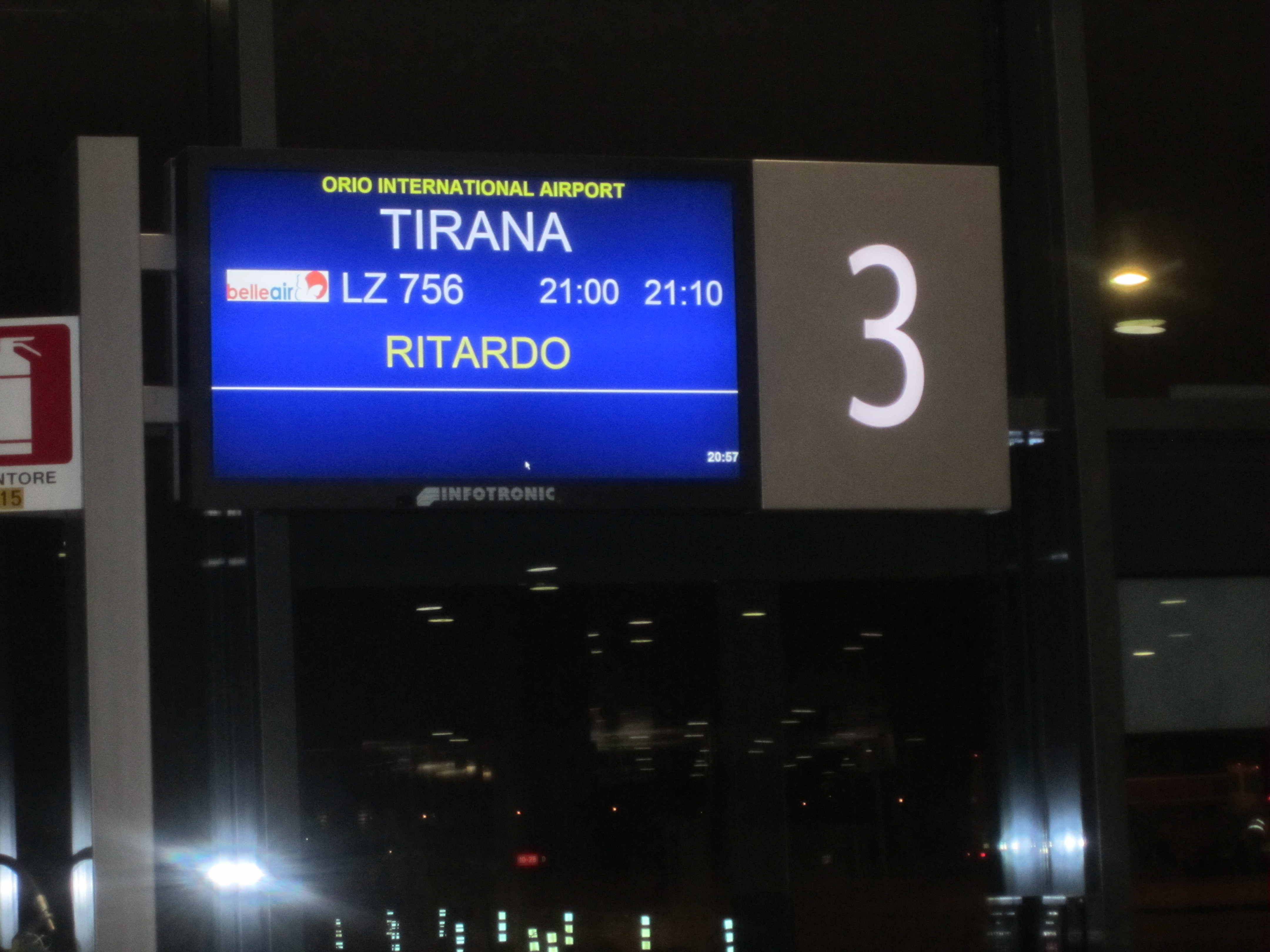
Waiting at the gate, last flight of the night and it’s delayed—“ritardo,” which sounds like “retarded” and I laugh and take a picture, and get those sideways glances—“Girl, you’re not from here.”

And I’m not—one of the only people at the gate that isn’t Albanian, clutching a red passport and the clothing suddenly different, so un-Milan, where even the dogs are better groomed that me. At Gate 3, it’s faded loose blazers instead of crisp fitted ones; it’s cheap haircuts and scarves tied over the heads of old women. It’s scuffed low heels and calf-length skirts, thin linen—it’s hard faces, jaws and brows more pronounced, and skin chiseled too, even in the children—chiseled, as though the expressions were carved out of some kind of different living, different reality, and you could never quite assimilate, could you? I think—No.

I’m wrecked tired, stayed up till 5am with the Le Fooding kids, slept maybe 4 broken hours, and I’ve got a bottle of Pelegrino and my headphones cranked up, tapping my foot through a caffeine haze just to stay awake. Glances snag on me—not Italian, not Albanian, what the fuck?

An hour after we’re supposed to leave, and a shuttle bus pulls up to the gate. People push and jostle; a man tears our boarding passes, which look like they were created in MS Word, printed on Xerox paper, glossy-thin. The bus smells like wet and feet, and it lets us off at the stairs to the plane, which bears no markers, no logos, a surface so lumpy it looks like paper-mache. We scurry in through the cool Italian night, breath clouds and blinking lights.

They’ve got the first ten rows blocked off—I remember this from my last Belle Air flight—and I can’t really discern why. People push and prod, they yell instructions to each other over, motion over the heads, and I can’t discern that either. There’s an old woman in my seat, and the seat next to her, and I show her my ticket and she shakes her scarved head as if to say, “No.”

I shrug and the stewardess—dolled up like a retro Pan Am attendant, hair pinned and orange hat tucked jauntily to the side—she shrugs and motions me up to the front of the plane, to the unassigned rows, and I grab an extra seat.

A staticy safety announcement rushed through in 3 languages—sounds like the voice in a fast-food drive-thru—and it’s too quiet for me to hear anyway over the mechanical groans of the plane. There’s nothing identifiably “Belle Air” about the plane, save the cloths on the head rests, and I decide it must be some kind of generic rent-a-plane, which doesn’t make me feel terribly confident, but I close my eyes and wait for take-off—though really, in a lot of ways, all these ways, I’ve already taken off.

We take off, and I watch the lights of Milan dissipate, fade—goodbye Western world. We’re cruising at news-helicopter altitude, it seems, and I feel like I could reach out and touch the little lights, the clouds that snag on the wings and eventually swallow everything, everything.

The cabin lights keep dimming and brightening, like a kid playing with a switch. Outside, the sky crackles a yellow flash, illuminating the shapes of those clouds, and I imagine the static clinging to us like clothes from a dryer, or when a silent electricity is in the air and you don’t know it until you touch something and get that little shock—in the black above the Adriatic, but we’re already in Albania, a rattly, groany little generic bullet of Albania, carrying Albania through the sky.

Lights appear and we start to sink. The scarved woman in my seat stands up—she opens the overhead bin literally as we’re landing, the first bump and rumble, and others follow suit as we taxi, and the stewardesses stare ahead, bored-looking and don’t bother to point out the seat-belt sign or tell us to sit.

Another flight of stairs, another stinky shuttle bus, and a mad rush to the immigration desk. It’s a quarter-size line at the “Foreigner” counter, though I could have sworn I was the only non-Albanian, and a man elbows me to get there first, waves his wife over, and it seems like a monumental rush for nothing, so I just let out a half-laugh and watch.

A faded dim stamp I can barely read, slammed on top of another stamp, and I wonder what the point of it is. Three luggage carousels that all read flights from earlier that day. My backpack finally appears, on its side amid the luggage mummified in neon shrink-wrap.

No buses at midnight, so I grab a taxi, and he drives between the lanes, over the lanes, flashing his high beams like lightning or static or the cabin lights that could never sit still. We cruise into Tirana, and I see familiar sights—the crepe stand I liked, the gaudy shopping mall, the dug-up square beside the national museum, the statue that sits amid the construction like a warrior in a dead battlefield, the broad empty road where the futbol crowds shot off smoke bombs.

It’s like a boy I’d met once, thought I’d really liked and kept on thinking about, retelling the story to myself so that eventually I didn’t know if it were true or not anymore, if I’d made it up or not—but I’m back and it’s still all there and it’s real and I can’t help but smile at that—Tirana, Tirana, sleeping and dark but still as I left it.

The taxi stops at the gate to the hostel and the driver helps me with my bags and I pay him and then he pauses and looks at me, nods and smiles, reaches out to shake my hand—maybe because I’m American and he knows that’s what we do, I’m not sure why. But he shakes my hand and I shake his and he pats me on the back and I ring the bell and now I’m in Albania, really in Albania—I’ve arrived.

Pizza and Love in Milan: Le Grand Fooding Milano 2011

The way to a man’s Italian’s French hipster’s anyone’s heart is through food. Especially pizza.

This is the main lesson I came away with from a weekend spent at Le Grand Fooding Milano. The others included: Italians don’t know what aioli is; there’s really no such thing as “Italian” food, and Northern Italians are shocked and somewhat scandalized by white pizza; Nespresso isn’t bad; there is perhaps no one more effortlessly chic and hip and fucking nice as a French foodie; as such, I will never be a Le Fooding girl; and it’s pretty easy to crash a food festival (and sneak into a Sheraton) as long as you work hard and smile a lot. And know the right people.

I spent the last weekend in Milan, at a three-day food event put on by the French culinary guide/movement/cultural phenomenon Le Fooding. While not terribly well-known in the States, they’ve been around 10 years in France, stirring shit up and throwing parties and breaking rules and basically being the anti-Michelin Guide.

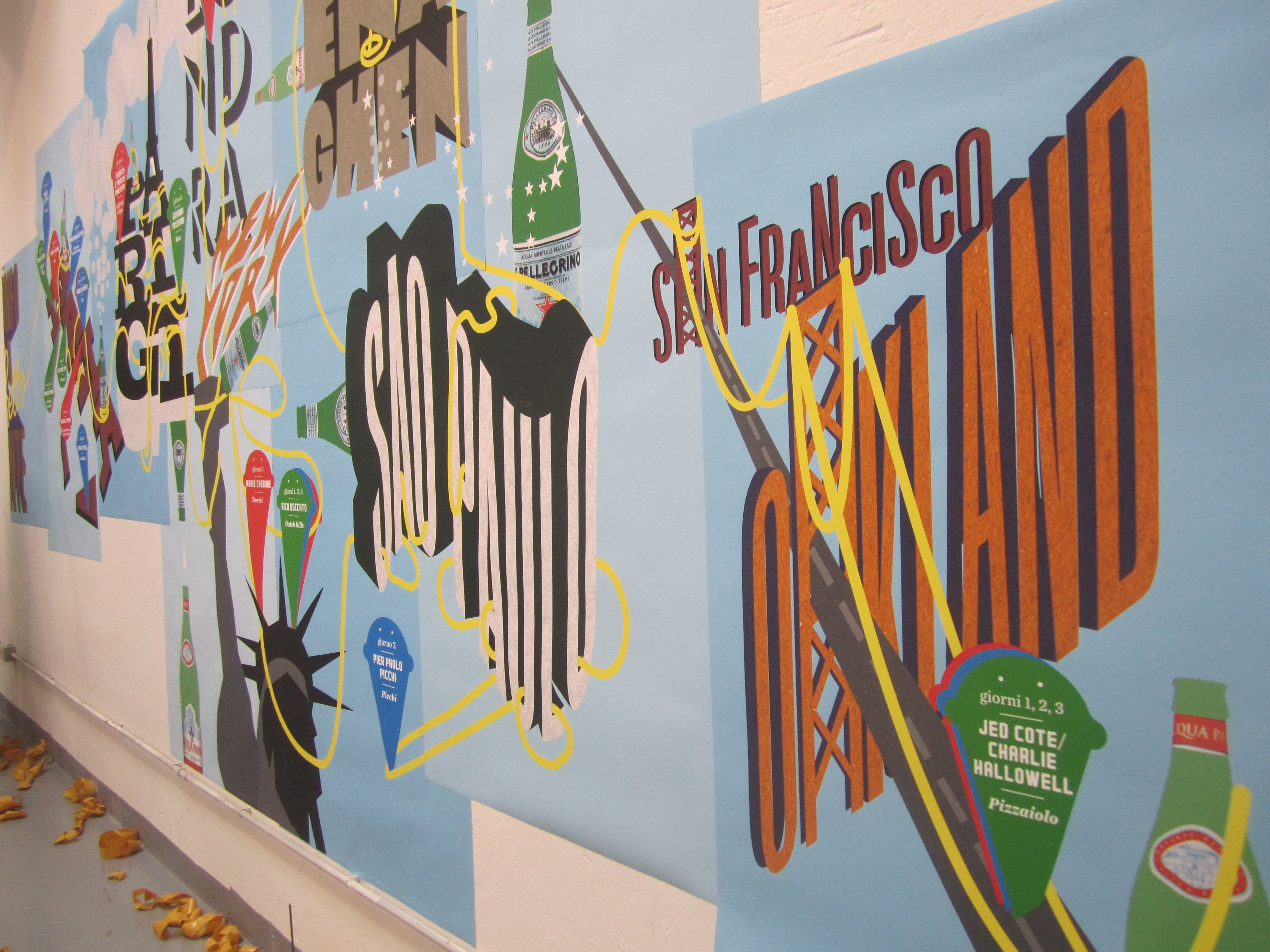
The theme of Milan’s festival was international chefs cooking Italian food versus Italian chefs cooking Italian food, and, being one of the better-known Neapolitan-style pizza restaurants in the US, Pizzaiolo (where I waited tables for the past year and a half) was invited to attend. My co-workers/chefs Jed Cote and Jason Loeb were flown across the globe, put up in a Sheraton, given a pizza oven and prep kitchen and about 100kg of squid, and sent to represent us.

And, since I was in Italy, I decided, you know, what the fuck—I’m going too.

So I showed up with my backpack and messenger bag and hoodie and crashed the party.

Represent!

Well, it wasn’t crashing exactly. We just figured that if I showed up to the San Pelegrino prep kitchen with Jason and Jed in the morning, hung out and sliced tomatoes and picked herbs and shit, and if I rolled with them to the event, just acted like I was supposed to be there, you know, that it’d all work out.

And it did, and it’s a good thing it did, cause it turned out to be one of those races to the finish, getting the pizza dough right, and cutting the squid, and plating and serving all the slices at the party. More than just a freeloader, I ended up being really useful. And having a rocking good time.

In all its glory

We were there making one of our signature pies (and one of my favorites)—a squid, cherry tomato and aioli pizza. Simple, makes the most of our Northern Cali goodness—abundant, sustainable squid supplies, bomb cherry tomatoes in the summer. We were contracted to pump out 50 pizzas, enough to feed the 300 guests each night, in the hour and a half before they went into the dining room for the seated dinner featuring four dishes from four different chefs.

Hella squid

We spent the mornings prepping, and one of the things I wasn’t expecting was how different the ingredients and facilities would be. Of course, the very premise of the event brings up issues of authenticity, of what happens to a cuisine when you take it from its home and drag it across the planet like… a spaghetti noodle (thus the name). But I didn’t anticipate how the location change would affect our own pizza. Jed and Jason brought their own yeast and used the same OO flour we use at the restaurant, but the squid was larger in Milan, and the tomatoes were more like small Romas instead of Sungolds and Sweet 100s, and less acidic and sweet. We also had a smaller mixer that required 4 batches to make our usual one; we also transported the dough to the event in a trash bag (classy). The pie didn’t end up tasting exactly how it does at home, and I guess that’s part of the point—that locality is crucial, defining, and that when foods travel, they change.

Trash bag dough!

At the event space, which took “industrial chic” to new levels, I hung out while the boys got the fire cranking and set up. It was some truly awesome people-watching. All the Le Fooding people were young and impossibly chic in that particularly Parisian way, cardigans and scarves (the boys) and little boots and tights and drape-y tops (girls), and a look we dubbed “the urban equestrian.” In my younger, less settled incarnations, I would have spent the time comparing myself to them and ultimately feeling shitty about myself. But now it was just comical—“Do we even grow girls like that in North America?” I asked my friends, and they shook their heads so fact I thought they might fall off.

Le Fooding girls

It was kinda like the squid and the tomatoes.

There were also tons of Italian crew setting up, working on the lights and such—they were less chic, more working class, in their cargo pants. Then there were the security guards and the phalanx of confused-looking 18-year-old assistant cooks/mignonnes, and the caterers—and everyone chain-smoking, chain-smoking, like it was their job. (One of the girls at the arancini stand was smoking while she set up the deep fryer…)

The people attending the event were a different breed—mostly middle-class, middle-aged Italians, with a sprinkling of hip folks and a whole slew of media. While the boys cooked, I plated slices, and talked to folks.

“Pizza di Oakland,” I heard people mutter.

“Pizza di Aukland?”

“No, America. Near to San Francisco.”

“Ah, pizza di Oakland! This is how you do pizza in California?”

“Well, this is how we do pizza.” And a wink and smile.

But the real test was the reception, which we seemed to win. People were only supposed to get one slice, but, as per our stuff-everyone philosophy, we’d prepped enough for 20 or so extra pies. So I got the catch people’s eyes as they tentatively looked over, tried not to hover, and I got to smile and motion for them to eat another. And another. Kill em with kindness, but also with food.

At 8:30, the Le Fooding kids ran a little bell and herded everyone into the dining room. Which is when the real fun started. Technically, we were done. But while the important chefs scurried around with their mignonnes, plating 300 dishes, and a crew of young caterers lined up, wearing all black with fucking headlamps on, like it were a Vegas show—we got to do what we love best, which is love on people.

It’s part of the whole Pizzaiolo philosophy (and the reason I loved working their so much)—to love the shit out of people, through food. So we started cranking out the pies. First some of our neighbors: the arancini girls and the Mumm champagne kids, and the guys at the next pizza oven, from Pizza East in London. Then a couple for the security guards and the people working the front door. How about the two gender-ambiguous Filipino cleaners? Of course! The endlessly hungry-eyed mignonnes—sure! Hey you, founder and director of this big-deal culinary movement—you get enough squid? How bout you, firefighter? You cold, Pelegrino girl?—come huddle by the pizza oven for a few minutes.

Cause that’s what it’s really all about, right? That’s why we call it breaking bread, why we mark important events by gathering for meals, why every fucking culture in the world comes together for food. It’s about love and building relationships and making friends, not cause it’s gonna get you something or somewhere or even a reciprocal drink/dish/whatever, but because that’s what we do—that’s what cooks get into the business to do, and what I, it turns out, love most about the industry: the simple act of feeding people.

And that’s what I think, after three days, that Le Fooding is all about to. I’d scoured the internet for English-language articles about them, and the main thing I’d read from the big American food critics is that they didn’t understand what Le Fooding wanted, or what they were trying to do (reminds you of Occupy Wall Street a bit, huh?). But after the weekend, after seeing how intensely we broed down and how food enabled all that, became a kind of edible language, when real language failed—it’s not that hard for me to understand what they want. They want that: love.

By the third day, we knew everyone—everyone stopping by to say hello or waving as they passed—and we partied late into the night on Saturday, dancing and smoking and exchanging hugs and email addresses. And it came out, you know, that I wasn’t a chef and that I’d just kinda showed up, but there was so much love no one gave a shit—they gave me those French double cheek kisses and wished me well in Cambodia.

And it’s a shame to be leaving the restaurant industry after such a weekend. But, as Jed said, “Way to go out on top.”

And with a lot of fucking love. And a belly full of pizza, which I’ll miss almost as much as the love.

Loved these two!

Rome, Like a Cannon Shot (Bella, You Must Be New At This)

I come into Rome like something shot out of a cannon—hair blown and thirsty, sweating in the thick denim and long layers I had to wear cause they wouldn’t fit in my backpack.

It started with the fact that my flight was 2 hours delayed. Which really started with the fact that I’d gotten about 7 hours of sleep in the 2 days prior; that I’d stood on a rush-hour E train all the way to the airport, all 60 fucking pounds of luggage draped around me so that my right fingers went numb holding on to the metal railing; with the fact that I actually nodded out a little bit at the terminal, all the eager/antsy middle-aged tourists in their neck pillows and compress socks buzzing around in anticipation of when the plane would actually arrive.

Couldn’t really sleep on the red-eye, which is rare for me—it was more freezing-cold than usual and since I’ve decided to bring half my closet with me, I didn’t have room for an extra blanket, which you really only need on flights and trains and buses anyway. But when you need it, fuck, you need it.

So I land with, what now?, 12 hours of sleep in a 3 day period? Doesn’t really matter anymore. Part of the trick of not ever really getting jetlag is that flying makes me so wonky, I’m out of it anyway, so I can rally and stay up for hours, or I can crash immediately. Or I can blaze bleary-eyed through a gleaming-stone ancient city and make all those novice traveler mistakes I like to think I’ve outgrown.

Get waved through immigration with barely a glance at my passport. This happens to me sometimes, when entering the EU, which is supposed to be all tripped out on the xenophobia tip, but I guess that only applies if you’re not white American. There isn’t even a long line—homeboy just glances at my picture (which doesn’t even look like me anymore, people tell me), his fingers barely grazing it, before pushing it back through the window, flicking his wrist and dismissing me. So, okay, that means I can stay forever, right?

But I’ve done this trek from Fiumicino to Termini enough times that I could kinda switch into automatic mode: the escalator down and the escalator up; the kiosk you don’t buy the train ticket at; the kiosk you do; the counter you get espresso at (not cause you need it, just to kill the time and get your heart racing more than it already is); the place where you validate your ticket; the number of machines you have to try before you find one that actually validates the ticket (usually 3); waiting waaaaay down the platform so that you’re away from the herd and can actually get a seat; how when you get to Termini you have to walk for like a mile down this loooong platform, how the station looks like a mirage in a desert down there, how when you finally reach it it isn’t an oasis at all but swarmed with rolling luggage and hustlers and pay phones that don’t work. Welcome to Rome, motherfucker.

I’m looking for the Laziali Tram—my fourth time in Rome and I’ve finally decided to fuck hostels near Termini, not even worth it. I did some research and found an affordable B&B outside of center, near Pigneto, which is where I want to stay anyway. So I walk down to the streetcars, which all look vintage and chic and rattly, like an old train model—I see the 5 and 14, which I suddenly remember are the trams that take you to Pigneto—where the hell that knowledge lay tucked in the bleary recesses of my brain, I don’t know.

But neither of them say “Laziali,” so shit, gotta keep looking. So I ask the dude sitting on the bench next to me, so I ask the tram driver, so I decide fuck it and try to go find a payphone to call dude at the B&B and ask him for better directions than the ones I scribbled for myself while waiting at the airport terminal. Phone steals 3 Euros and yells a series of tones in my ear—no luck. A cab maybe? They all look dicey.

Which is when I note to myself that I feel lighter, less encumbered. Which is when I notice that one of my bags is not with me—the one with my new laptop and my thyroid medication and fuck you, my makeup and cheap jewelry—important shit.

Ugh—that sudden razor of fear that cuts through your gut, laser of panic and you feel it radiate, shock you into focus. Dash back to the payphones—not there. Remember, as I lumber across the street as fast as I can, that I haven’t bought travel insurance yet—why?

But miracles of fucking miracles, my stuffed messenger bag is still sitting on the tram stop bench. The dude I asked for directions smiles sadly and shakes his head, as if to say: “Bella, you must be new at this.”

I gush a million thank yous, he tells me how lucky I am, especially in Rome, and I say, “Hell, in anywhere,” and I feel like a tired dog that’s gotten kicked in the ribs, like an old TV, shocked out of my static—I feel alive again.

“I watch your bag for you,” a squat man with an Indian/British accents tells me. “I ask everyone, ‘Is this your bag?'” Shakes his head. I gush a few more thank yous in his direction.

He asks me where I’m going, and he shakes his head again and points over to a bus parked across the street. “I’m going there too, come with me,” and shit, it’s not like I’m not gonna go with him—he coulda swiped all my stuff and he didn’t, so he can’t be half bad.

He walks with his chest kind of puffed out, has a sweater draped around his shoulders, sleeves tied sloppily or jauntily, I can’t decide—maybe both. He like to play the big shot, I can tell, I’m the man that knows this place, and it strikes me as a kind of pauper’s authority—but he’s obviously got a good heart beneath it.

He seems pleased that I know how to validate my ticket when I get on the bus (cause actually, I’m not new at this, I’m just a wreck). He asks me what country I’m from, tells me about his brother in Boston, how he wants to go to Boston—the usual immigrant conversation. He asks me if it’s my first time in Rome and I sigh and shake my head, “No, but you’d think so, wouldn’t you?”

I leave myself at his mercy, cause why not? My brain is bleary as fuck and I haven’t eaten and I’ve barely slept and he seems to take a kind of pleasure in leading me, in asking every Indian street peddler when we get off the bus where Via Capua is (even though I kinda know where it is), and I wait until the sign is right in front of us to point and say, “Look!”

And he walks me to the door of the B&B, which is locked because I’m about 3 hours later than I thought I’d be, and dude offers to wait with me, but I tell him “No, it’s cool.” And I thank him again and shake his hand and he wants to write me if he ever goes to the US, and I tell him I’m not going back for a long time. And he nods and gives me a different look—maybe he’s decided that I’m not new at this, I don’t know—and then he waves and walks back down the street, that puffed up chest leading the way.

Notes on a Visit to Occupy Wall Street

Here’s something really New York for you: the people most excited about Occupy Wall Street aren’t in New York.

Again and again, the conversation went like this:

“Yo, you been down to that Wall Street shit?” (I don’t really talk like that, I’m just pretending.)

“No. I’ve been meaning to.” Or: “I went past once.” Or even: “Aw, I heard about that. What’s it all about?”

It seems like the rest of the country is stoked, excited, curious, enlivened—reposting photos and quips and words of encouragement, a newsfeed cluttered with that shit. But here in New York, it seems to have fallen into the static of the city—one more thing to negotiate, maneuver around, one more cultural phenomenon in a city of never-ending, never-sleeping cultural phenomena.

But I’m not a New Yorker, so I had to go down there. Check it out, see it for myself.

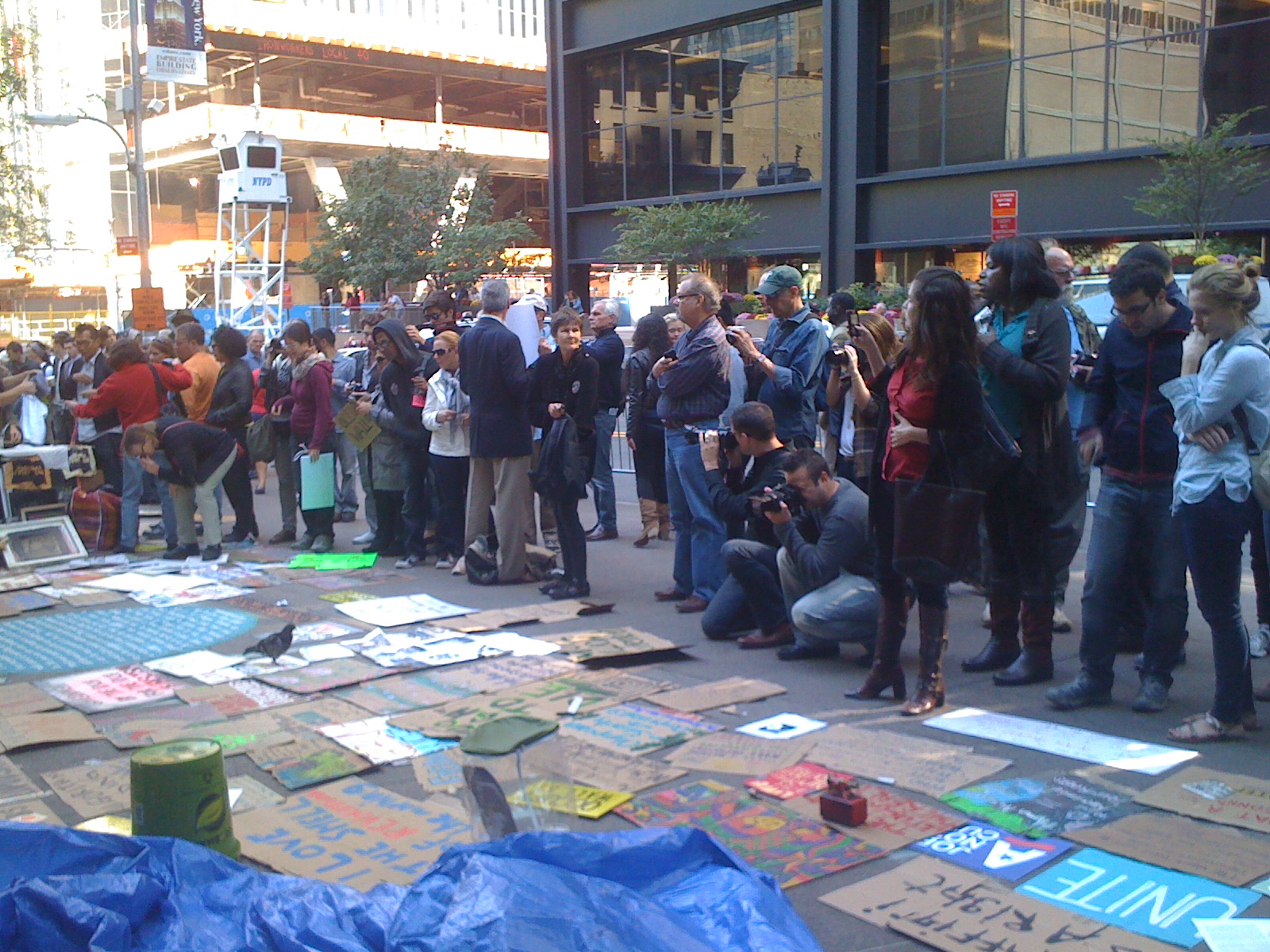
It was busy and crowded and loud at Zuccotti Park, in the shadow of the new World Trade Center—but not that much more than a normal street, at least not for how much virtual buzz I’d been hearing.

The park was surrounded by people stoically holding signs, standing still for the passerbys and the cameras and the statement it all made. It was a pretty even split between the protesters and passerbys—a mix of locals and tourists, curious expressions and viewfinders, everyone stopping to read signs and snap photos. I even saw a few Asian tourists posing for photos with the protesters.

I moved around the periphery, then headed into the center of the square. The encampments had been cut with makeshift streets, pathways where people buzzed around. An internet station and a free kitchen had been set up (dispensing, of course, pizza). Tables with leaflets and fliers stood before volunteers who answered questions and otherwise engaged with folks passing by.

Amidst the revolutionary fervor, there was also a distinct, well, Telegraph Avenue vibe. For those not from the Bay, this basically means young gutterpunky white kids with backdreads, bandanas, and a herd of mangy sniffing dogs, most often seen clumped together with sleeping bags, spare-changing. I think these were the kids critics were referring to when they critiqued the movement as being all unemployed, dirty hippie kids.

Or that they were entitled middle-class kids. To be fair, there was a decent mix of people. (“I haven’t been arrested for civil disobedience in 35 years!” I heard one man gleefully exclaim.) But the majority of the protesters appeared to fall into that category, at least to me. Which makes sense. I mean, who was it that started the Vietnam War protests? Who was it that was out there marching for women’s suffrage? Educated, middle-class young people with the leisure time to protest are usually the group with which change starts.

And yes—there yoga mats and Tibetan prayer flags and a band that included a bango and a stand-up bass. So there was a lot one could get snarky about. And I did decide that it was no coincidence that Occupy Wall Street cropped up a week or so after Burning Man.

But, really, that stuff aside, it struck me as really cool that people were out there, actually talking. Apathy is the poison of the MTV generation, my generation, so even if there isn’t a totally clear agenda or consensus on why they’re even there, it’s a start, and I guess that’s the most important part.

But more than the protesters themselves, it was cool to see the passerbys. People lingered, read signs, made comments, engaged. Which is so incredibly rare to see in this country. Occupy Wall Street was inspired by the events of Tahrir Square, but I also couldn’t help but think about recent protests in Chile or Israel (didn’t hear much about those, did you?). Somewhere along the line, we Americans have learned not to protest, and when we do, the backlash is incredible. Just look at the media reaction to the protests.

So the fact that there were people out there, who wandered down just to check it out, was really exciting. Sure there were frustratingly ill-informed debates going on, but shit, at least people were talking—as if every person that came by would take a little piece of something with them, a thought or impression or just the idea that we could try to do something a little different.

Because that’s the thing about New York—even if the majority of the city doesn’t make it down to Occupy Wall Street, even if it gets lost in the frenetic buzz of life there, of sidewalks and subway cars and trying to keep your fucking head above water—even if it’s just a small percentage that comes by, that small percentage ends up still being a pretty decent size. And it’s still there, and it’s still doing something, changing something, if only the way we think. And it’s a start.

This dude: most definitely not an entitled college student

Train

Struck me as though
we were all just trying
to hold it together—
our whole lives
accumulated
into pinched expressions,
hands on the knees,
the bit of hair
dented from sleep.

Fumbling for the phone
as it buzzes
in pockets
we can’t reach,
the bowels of purse
we carry like a cave
under ourselves—
“I don’t know what half this shit is anymore”
we’ll say with a half-laugh

as the semis circle
and the train bullets on.


Lauren Quinn is a writer and traveler currently living in Hanoi. Lonely Girl Travels was a blog of her sola travels and expat living from 2009 to 2012. She resides elsewhere on the internet now.

Join 490 other subscribers

Buy This Sh#t

Categories