Archive for the 'Dirty Tricks' Category


One-Night Travel Stands and The End of Next Trip-itis

Evidence

People have been asking me.

You know someone long enough, you know their patterns. And people who know me—for example, my dad, this morning, leaning back in a chair and giving me that long-view, that what-are-you-doing-with-your-life look—will ask me, “So, where’s the next trip?”

And god-damn if I don’t shock us both by shrugging my shoulders and replying, “I don’t know.”

For the past six years, I’ve been constantly planning The Next Trip. I’ve heard other chronic travelers say that they’ve caught themselves planning their next trip while on a trip. I’m afraid I’m one step worse: I plan trips before I even take the next trip: the Next Next Trip, and the one after that. My brain is like a Netflix cue of destinations: a constant adding, shuffling and reordering of an insurmountable list one will never actually make it through, but will happily spend their lives trying to.

But since returning home from my last trip, I haven’t been experiencing the same hamster-wheeling of obsessive planning/flight-price checking/guidebook-browsing/logistic-izing. The thought of another trip is, admittedly, exhausting. I’d have to get shifts covered at work. I’d have to scrimp and save. Sure, I’d get those exhilarating moments of wonder and awe and newness, the head-rush of travel addicts, and I love that, will always love that, I think.

But somewhere underneath that, it feels like it’d be more of the same, the travel equivalent of a one-night stand. Sure, it’d have its exciting moments, but in the end it’d be just another go-round: see some shit, learn some new phrases, reaffirm how bizarre and beautiful the world is and how little I can ever really know of it. And come home. Broke.

I’ve realized: I want something deeper.

It’s startling, something like a die-hard bachelor suddenly discovering that he wants a relationship. Where the hell is this coming from? I ask. Am I getting soft in my old age? And more importantly, more deeply unsettling: Why isn’t this thing that I always chased, that I based my life around chasing, suddenly so much less appealing?—as though the things that fulfill us are static, never change, don’t evolve the way we do.

I don’t have answers to these questions. Just to the one, the “where’s next?”, and my answer is “I don’t know.”

I suppose it’s symptomatic of the whole late-20s, Saturn-return thing (don’t laugh, that shit is no joke): the end of one phase, the beginning of another, the looking for What’s Next. But it’s shaken my whole idea of myself, the identity I’ve constructed over the last few years. Who would I be if I wasn’t The Traveler? What would I do with my brain if I wasn’t constantly chewing on the Next Trip?

Sometimes I meditate. (Don’t laugh, that shit is no joke.) I’m crummy at it: I set my timer for 10 minutes and try to listen to my breath, but mostly I just chase the chatter of my thoughts; I’m lucky if I get 20 solid seconds of thoughtlessness.

Mostly I ask for guidance (from what?), then try to just listen (to what?). They say the answers come. They say that if we feel an urgency to act, it’s our will, and that if we feel a calm certainty, it’s our Higher Power’s (fine, laugh).

I don’t have answers to any questions. Just a big giant “I don’t know.”

Going Native: The Anti-Irony of Khmer Glamour Photos

I sat once in a cafe in Tangier, Morocco. Some famous man-filled cafe where Western writers used to pen masterpieces, or cruise for ass, or trip out on then-exotic drugs, or most likely some combination of the three. It was popular with tourists—in the way that that Hemingway bar in Havana is popular—and with well-heeled locals. I was the only female, Western or otherwise, in the joint.

I watched as a man strode in—large, burly, brusque. He may or may not have had a white beard—I remember something about white hair, though his head was most definitely adorned with some scarf. He had that expat look of permanent sunburn and wizened self-satisfaction; he wore a long, flowing robe of ethnic print and carried a thick wooden staff. Two younger men, one with a notebook, another with a video camera and a microphone, followed as he walked purposefully over to what I assumed to be his regular table.

He leaned back in a posture of pontification, began what I imagined to be a long soliloquy, in French, on Moroccan culture and the changes therein over the last decades, as observed by his keen eye. The guy with the notebook nodded and scribbled. I watched the camera man look around at all the Moroccans in the cafe, wearing t-shirts and jeans, then back over at the burly old dude before his camera, his attire some approximation of those sepia-hued photographs old explorers and anthropologists took, that are now sold as postcards.

Our eyes met briefly. I smiled; the camera man looked embarrassed. I chuckled, imagined we were having the same thought:

My God—he’s gone native.

There are few things funnier to me than people taking themselves too seriously. Travelers/expats who over-identify with their adoptive countries provide endless amusement while on the road. So when I saw the pointed fingers and fake-gold-gleam of Khmer glamour photos, I knew it had to do it—my own chance to Go Native, as it were.

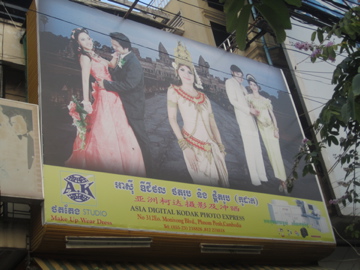
To clarify, this isn’t some chintzy gimmick produced for tourists; this is a Cambodian—nay, Southeast Asian—phenomenon. People dress up, get a pound of foundation and fake eyelashes slapped on, squeeze into gaudy garb and let themselves be molded into ridiculous poses, to be later Photoshopped several skin tones lighter and superimposed in front of illustrious sights like Angkor Wat, or the parlor of a well-to-do person’s house (a fireplace and Persian carpet are key). People do it for their wedding, for their coming-of-age, as family photos—it’s not uncommon to see a large framed print hanging in someone’s home.

It is, in short, the Khmer version of cheesy K-Mart photos. It’s is legit, authentic inauthenticity.

I hadn’t noticed the photography studios sprinkled around town until someone pointed them out. The sun-bleached signs of smiling couples, the window displays of sequined gowns—they’d faded into the visual static of Phnom Penh storefronts. Until I decided to get my own.

Khmer glamour photos are something of a rite of passage for Phnom Penh expats, especially the females. So I rounded up a posse, walked into the first decent-looking studio we passed on Monivong, and made an appointment to be turned into an Apsara princess.

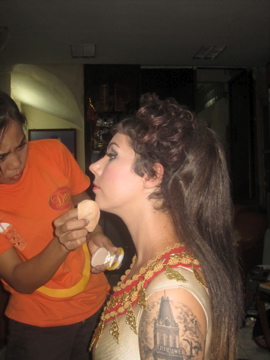
At two o’clock on a sweltering Sunday, five of us clamored up the back stairs of a photography studio to the dressing room. It looked like the backstage of an Asian cabaret, make-up and sequins and traditional costumes stacked to the rafters.

There was only one girl doing hair and make-up; at about thirty minutes each, we ended up being there for a loooong time. My friends chose the $10, more modestly ridiculous options; I opted for the $15 Apsara extraordinaire, which included more fanciful skirt folds, extra fake-gold bangles, even a wig. Behold the transformation:

I'd never worn fake eyelashes before.

Looking sufficiently like a drag queen.

Through the mirror

Fancy folds

I went to Cambodia and all I got was this mullet

Lock and load.

A couple days later, I went back to the studio to pick up my prints—three prints were included in the $15 price. I thought of the dude I’d seen, years ago, in the cafe in Tangier. The difference, I decided, was humor. And self-awareness: I was doing it as a joke, a statement on the ridiculousness of myself in the Khmer cultural context and how I, at 5’10” and a riddling of tattoos, will never, ever blend in with or a be a part of that culture. The photos were tangible evidence of the chasm between worlds.

I smiled and laughed out loud and thanked the ladies again.

I went to meet a few other friends for dinner at the Chinese Noodle Restaurant. I took out my prints and they laughed—it was ridiculous, right?

I noticed the waitress peering over our shoulders. I felt suddenly self-conscious—would she be offended? Would the joke translate?

To my relief, the waitress smiled, a chipped tooth and deep lines. Then she reached over and took one of the photos in her hand, examined it more closely. “Very beautiful,” and she looked up at me with a kind of sincerity that made me blush.

This was not the reaction I’d expected. I felt somehow more embarrassed.

The waitress proceeded to pass my prints along to the other tables in the restaurant, all the women smiling and nodding and murmuring their approval. The women’s eyes glanced over at me and it was a kind of warmth I felt, maternal and accepting and utterly devoid of the snarky irony with which I’d walked into the photography studio with.

They didn’t think it was funny, and they weren’t offended. They thought it was beautiful.

I hung my head. “I’m an asshole,” I announced. Then, looking up and grinning, “But at least I’m a beautiful asshole.”

Headcheese, Chicken Feet and “You Are What You Eat”: How Travel’s Beaten the Squeamish Eater Out of Me

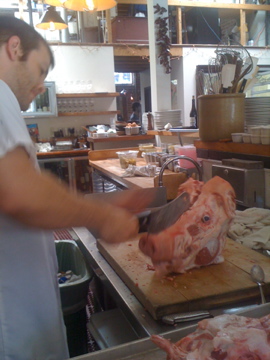
Jeffery was taking a machete to the disembodied pig’s head when I walked into work.

The other boys stood around watching. They looked up when they heard the door, grinned sheepishly at me. “Headcheese,” Colin said by way of explanation. “Sorry.”

I looked at the knives, the smeared aprons, the hunks of pig scattered about the wooden cutting board, and shrugged. “I think Southeast Asia has cured me of any squeamishness towards meat,” I laughed.

Food culture, it can be said, is a microcosm of culture. Traveling around, I’ve discovered that a society eats and its attitudes towards eating can be simultaneously one of the most telling and easily accessible aspects of a culture. In this way, eating in a foreign country is both a lofty, anthropological glimpse into the psyche of a culture, and a visceral adventure that often sends one dashing to the nearest squat toilet.

Case in point: there’s a certain semi-green queasy look Westerners wear when walking through a Southeast Asian street market. The plucked bodies hanging limply from hooks; the still-alive fish flopping out of their plastic tubs; the women waving fans at the flies that settle on heads, hooves, chunks of body; the smell of raw meat blooming in the humidity like irony mold—it’s all so utterly unlike the shrink-wrapped FDA-approved supermarket culture of the Western world.

And I’m not gonna lie: I was a bit unnerved at first. The literal rawness of market culture in Southeast Asia is jarring. Watching a teeny little woman crouch down in her pajama suit and hack off a chicken head seems brutal, surreal. Ordering a bowl of soup and seeing a chicken foot poke out of the translucent tangle of rice noodles is startling. And not at all appetizing.

Yes, I eat meat, your Westerness seems to say. But I don’t want to think about the fact that I eat meat. I don’t want to be confronted with the reality that I’m eating another living being.

When I was London a few years back, there was a big stir about Marcus the Lamb. It was being discussed on the talk radio station that played through my friend’s basement flat while we brewed morning coffee.

The story was this: as a lesson in the breeding and rearing of livestock, a primary school had adopted a lamb. The kids named the lamb Marcus, and did cute things like bottle feed him. Six months later, it was time for the lesson to culminate: Marcus was to be slaughtered. A shitstorm ensued.

Parents freaked, animal rights activists threatened, the headmistress was branded a murderer and some of the pupils were reported to develop stress-related insomnia. To their credit, the school officials remained firm: this was the point of the lesson—teaching urban children where their food comes from—and they weren’t going to cancel the lesson. A national debate raged, centering, it seemed, on the extent to which the urban, Western world has become disassociated from its food.

I considered this all as I chewed my toast in the gray London light. I’d been a non-vegan/vegetarian for a little over a year. During my 12 year run as a non-meat-eater, I’d maintained that meat eaters should know and acknowledge the reality of meat consumption. I wasn’t one of those PETA people plastering horror-movie pictures of slaughterhouses around town, but I’d always thought—Fuck, you eat the shit; you should be able to handle a head or a hoof or something.

And I had to hold myself to that when I started eating meat again at age 25. If I was gonna do it, I reasoned, I was gonna do all of it. I wasn’t going to hide from the fact of it, and I wasn’t going to be wasteful. Living in the Bay Area and working in the restaurant industry, it’s easy to make mindful, informed decisions about where one’s food is from, to nestle in the cozy, bedtime-story feeling a Cruelty Free label provides.

Way of advertising a butcher in Morocco. Flickr photo.

But then there’s the Southeast Asian food market. Or the goat head stew in a Moroccan medina. Or cabeza tacos in Mexico (or the Fruitvale, whatever). And by being confronted with heads and eyeballs and recognizable anatomy that doesn’t seem so different from our own, you’re also confronted with your Americanness, your Westerness.

But people are amazingly adaptable, and after a couple weeks you normalize your surroundings. You don’t look twice at the rows of raw meat, and you even acknowledge that while eating a fertilized duck egg is a mind-fuck—a bit like eating an abortion—it is goddamn delicious.

And then you come home and wonder what the fuck everyone is riled up about. Yeah, it’s headcheese, made from head meat, you think, What’s the big deal? Or you wait on a dude who sends back the whole shrimp on his plate cause the little head and eyeballs “Just ain’t cool.” And you think, Really, buddy? You’re a grown man; that’s just a lil ole head. But you laugh and shrug and say, “No problem,” cause you know that that’s just the culture he’s coming from. And it’s your job to make him happy, not to judge what kind of food he’s comfortable eating.

To say that Westerners, especially Americans, have become disassociated from our food is an understatement. (“Where does ketchup come from?” a friend asked her inner-city students once. “The store!”) You think of the old adage “You are what you eat,” and you wonder what the hell that means for us. It can’t, you reason, be anything good.

If you can tell a lot about a person by how they eat, what does a society’s food culture say about them? They say, for instance, that girls from alcoholic homes are exponentially more likely to develop eating disorders. If you extend that on a societal level, it’s a fascinating if unsettling picture of a national psyche. The ability of Americans, for instance, to feed themselves nourishing food in a way that’s free of drama and control and fad diets seems to have shattered, gotten lost somewhere; I think that the sanitized, shrink-wrapped, mass-produced foods we eat are a part of that.

We in the West, and especially the States, don’t know what the fuck we’re eating—or are so far removed from it we flip out at the potential of exposing our children to the age-old reality of meat eating. (For the record, it was the students themselves that voted to slaughter Marcus the Lamb. But one has to ask: would such a lesson ever even happen in the US? Assuming, of course, a school even had to funding for such a lesson…)

Growing up, my mom was convinced that the demise of the family dinner was inextricably linked to the break-down of the American family. She thus insisted that we all sit down, no matter how much homework we had, for a nightly family meal. This was, as you can imagine, infuriating for a moody teenager; I’d scowl at my plate until eventually someone would say something funny and we’d all sit and laugh and linger for an hour.

I’m grateful for that now, in the same way I’m grateful to have traveled to five different continents and gotten the squeamishness beaten out of me. There are some things I still won’t eat—shark fin soup, which is just plain wasteful; or that monkey-brain stew they make in China by pouring boiling water into a live monkey’s recently cracked skull—that’s just plain cruel. I don’t think I’m a particularly enlightened eater, nor do I think I’m gonna change the world by shopping at farmers markets.

I just think that I’ve gotten a bit more realistic, had a bit of my own barriers broken down. At least to the point that walking in on the making of headcheese doesn’t cause me to look twice.

Okay, so maybe I played with the eyeballs...

Privilege and Property Rights at the Phnom Penh Sofitel

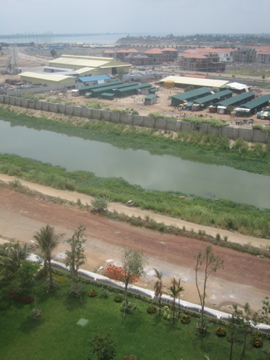
View from my balcony: construction workers' quarters beside construction lot for new, luxury villas

So, one of the most fascinating things I got the opportunity to do in Phnom Penh was to peek into the “other side.”

By “other side” I mean the foreign business men, the developers, the movers-and-shakers, the ambassadors and embassy folk—the people that are literally reshaping the city. By “other side,” I mean the people that are removed from the street, that live behind gated properties with bored-looking security guards, that ride around the city in chauffeured SUVs. I mean that I got to stay at a Sofitel.

I’ve never been one with an eye for perks. I always kinda rolled my eyes at the travel writers that billed themselves as luxury writers, assuming they were really more interested in getting free massages and Pina Coladas than actually being writers. Which they may be. But none of the glitz ever attracted me—I was always more into the grit. And perhaps being able to make a living as a writer. But really, just the grit.

Which is why it was so ridiculous that I ended up, frayed Toms and an H&M cardigan, in the lemongrass-scented lobby of a five-star hotel, on assignment from an equally ridiculous source: Matador, an independent travel website. And why it ended up being so goddamn fascinating.

The piece I wrote on the experience went up last week on the Matador site (link here). But 900 words is short, and there’s a lot I didn’t get the chance to say.

Construction cranes behind the Sofitel pool

The Sofitel sits handsomely amid vacant lots and construction cranes, in what the young manager with beautiful hands told me would soon be the new city center. He moved his hands through the air when he said it, like he were gathering something and drawing it closer to him. His nails were better filed than my own.

A poor, Eastern city rapidly modernizing by foreign hands: that’s not an entirely new story. But this was Cambodia, so it was more complex and fucked-up than it appeared on the surface.

Land rights are a huge issue in Cambodia. And like so many of the country’s problems, it comes out of the war: after the Khmer Rouge fell, no one had property deeds—you just moved into any available space you found. It was a clusterfuck of a situation. Ten years ago, the government began an official campaign to get people proper titles to the land they’d been living in since the KR. But it was a muddled, mismanaged process in which poor folks largely lost out. As a result, a lot of the country’s residents still don’t have official claim to the land they’ve been living on.

It’s the perfect situation for exploitation.

The case I got to witness first-hand was the ongoing issue over the lakeside evictions. You can read more here, but in a nutshell, a foreign company bought a lake and its surrounding region in Phnom Penh, to drain and develop. People were already living around the lake, but since most had no official claim to that land, they could legally be evicted. They’ve been protesting, losing, subjected to violence—it’s basically fucked.

None of which is to implicate the Sofitel into that. (In fact, a tuk-tuk driver told me that the Sofitel property used to house a Thai-owned luxury hotel that was torched during anti-Thai riots some years back.) But if you place the hotel’s presence in the larger context of the changing city, it says a lot. There didn’t used to be a market for a business-oriented luxury Western hotel. And there’s not really, yet—the Sofitel was largely empty when I stayed there, just like the villas being constructed across the Bassac River were. But the point was, it’s coming.

And if you draw the line in the sand—between old and new, redevelopment and who it benefits—the Sofitel is like glimpsing into the future, glimpsing over the line.

Which of course brings one to oneself. Because I was, after all, staying there. Yes, I was on assignment and thus not footing the bill. Yes, I was walking the half-mile of scorching-hot driveway to catch a tuk-tuk streetside, instead of paying the 300% surcharge from the hotel. And yes, I was using my $5/month wireless modem instead of paying for the hotel’s wifi (how you market yourself as a business-centric hotel and not have free wifi is beyond me…). But, if you drew the line in the sand—which you still can do, in the parts of the city without sidewalks—I was closer to all those business men than the people getting evicted by the lakeside.

Sometimes you can fool yourself about your own privilege. You wait tables; you work two jobs through college; you squint through old contact lenses because you can’t afford the eye doctor. Or you rent an apartment from a woman you can’t communicate with, save for the green mango she gives you once a week, and you drink shitty coffee at street stalls and buy produce at the local markets and tell yourself you’re experiencing a place “at ground level”—a phrase that in and of itself oozes an underlying sense of privilege, the idea that it’s a choice.

Turn-down service

But in a place like Phnom Penh, I really can’t fool myself. Putting on a bathrobe and shuffling around my hotel suite eating the macaroons from turn-down service, BBC images flashing sharply on the flat-screen TV—and getting to do it because I’ll use the skills I learned in university to write an article for a website, in a language I was born into speaking—I can’t kid myself about which side I’m on. I could get a well-paying job any time I want. At the drop of a hat, if I were in serious trouble, I could have someone wire me more money than your average Cambodian makes in a year. That’s just the fact of it.

I had this moment, taking a tuk-tuk from just outside the Sofitel’s gates, when I sat back and watched the street: a row of barber chairs set up, scuffed mirrors nailed to a corrugated fence, men waiting for clients. It felt like I were looking at it through glass, through the thickness of some impenetrable distance, and it all struck me as quaint. As in, the simple quaint life of a the noble local.

Could where you stay really make that much of a difference in how you experience a place? I wondered. Could surrounding myself in the piped-in fragrance of lemongrass, taking a hot bath and wearing a pair of slippers each night really ensconce me, alter how I enter a city so much? Or did it just serve to heighten what was already there, hiding from me?

I didn’t find answers to that. But I did have a lovely stay.

The Young Leading The Blind: Phnom Penh Image

This is the image I haven’t been able to get out of my head:

There’s an instrument called tro. It’s kind of like a violin. It’s a traditional Khmer instrument and you hold it low, down by its belly, and you work the strings with your other hand, across your chest or near your neck, like you’re sawing something.

There’s a whole history to it—it being destroyed during the Khmer Rouge time, famous musicians being killed, one surviving, unearthing the one he’d buried in the field before he’d been evacuated, it being one of the only tros to survive, the musician later founding a non-profit to teach the next generation, pass on what was nearly gone and almost died.

There’s a lot of stories like that in Cambodia; you hear so many you start to confuse them, get the facts mixed up and the characters wrong, until it becomes one big story that no one, it seems, can keep straight. But somehow blind men were involved in this one—were they blinded during the KR or later by landmines? Or were they born that way? I never figured that part out. But there were blind men that played the tro, that much I know, and you’d see them in the streets of Phnom Penh, and that’s the image I can’t get out of my head.

The tro players would always be older, battered-looking—the old generation, the 40+ers that had lived through the KR. They’d be walking as they played, being led around through the chaos of the motorbikes and tuk-tuks and vendors on the sidewalk and the busted-up places that were supposed to be sidewalks but were really just rubble—being led by a child, 10 or 11 or so, what was called “the new generation.” The kid would have their palm open, upturned, begging for the musician whose hands were occupied, seeing for eyes that were clouded by a perpetual mist.

But that wasn’t the weird part, the part that has lodged itself in my mind and keeps reappearing. The thing I keep thinking about is the string. There’d be a string tied around the tro player’s waist, and the kid would be holding the string, leading the blind old man like a pet through the streets—though you didn’t know who was whose pet, and how much of it was for show, for pity, for dollars.

The young leading the blind: it would have been a metaphor anywhere else. But this was Cambodia, Phnom Penh, so it was reality, just another scene on the street.

Gabriel Garcia Marquez hated the term “magical realism.” It was, to him, inaccurate, a term applied by outsiders, that dripped with misunderstanding and European paternalism. To him, what he wrote was realism, plain and simple—the so-called “magical” part was just a part of reality for Latin Americans, or Colombians at least.

Why do I think of this now? Why can’t I get the image of a lassoed blind man playing a near-extinct instrument out of my mind? Why did the image only begin recurring once I’d left, was in Laos, and why did I keep thinking of it and thinking of it, once I was back in the States?

Why didn’t it strike me as so bizarre in the moment?—not necessarily normal, in the sense of normal that I know, but as just another happening on the sidewalk, another sight to block out, filter out, shake my head to and keep my eyes straight and mutter “ot tey” to.

I’ve been trying to explain Cambodia and Phnom Penh to people. They ask me how my trip was, how my time there was, and my immediate answer—and the one that seems the truest—is, “Bizarre.” But I can’t really explain why it was bizarre, make any insightful statements or overarching cultural observations. All I can do is present a handful of images, anecdotes, the way they were presented to me—at random, shoved in my face so that all I could do was block them out, file them away to think about later and still not understand: children huffing from plastic bags, and monkeys running across the telephone wires, and the cross and uncross of the karaoke girls’ legs. The tro players and their milky eyes, the children and their upturned palms—but most of all the string.

Didn't take a picture of the tro players. Cause it seemed wrong. But here's another thing that didn't seem so weird at the time: typical sign outside a nightclub.

10 Thoughts on Being Back in the US

1. Riding in my dad’s truck, MLK:
“So what does it feel like to be back?”
Look out the window, lines of lanes and sidewalk. “Everything feels really sterile. And clean.”
“Sterile and clean? Not usually words associated with Oakland.”
Laugh. “Yeah, I guess not.”

Empty

2. Running around the lake, joggers in sweat clothes:
Everyone looks really healthy here—big and robust, cheeks flushed.

3. Whole Foods, walk around for an hour, confused—pick up food, put it back down:
How do you shop in a grocery store? Everything looks plastic.

4. Winter-like storm, long pants and a jacket:
Everyone else may be annoyed, but I’m tickled to death.

5. Waiting to make left turn, watching the cars:
The US feels like a video game, some kind of old-school Atari: little boxes moving through space. The object of the game is to stay between the lines, stay in the lanes, walk on the sidewalk, put trash in the bin…

6. Rapture billboards:
Why?

7. Waiting to meet Nhu and Jacobo outside Bette’s Cafe, watching family:
“But I’m huuuun-greee.”
“Well, we have to wait.”
“But I don’t wa-nnnna.”
American children are allowed to be really obnoxious.

8. Wine meeting for work, varietal characteristics and spit buckets:
This is my job. This is silly.

9. Drive to meeting, park; drive to yoga, park; drive to cafe, park:
My life feels like a video game. I’m not sure what the object is.

10. Waiting at stoplight. Car beside me: bass bumping, boy leaning out of the open window, shirt half-off, arms raised, dancing:
There is nothing, nothing in the world like African-American culture.

Adventures in Vietnamese Bureaucracy: Dong Hoi Visa Shenanigans

I didn't take many pictures amid all this. So here's a boat.

Blond and sun-crisp, with a Marlon Brandon mouth and board shorts, Ben was the first Westerner I’d seen in Dong Hoi.

He lit a cigarette and sighed as his driver secured my backpack to the roof of the SUV. “Where are you from in the States?”

“California.”

“Ah, well,” he exhaled an agitated puff, “this is like the Alabama of Vietnam.”

I’d only spent 20 hours in Dong Hoi, so I wasn’t exactly in the position to agree or disagree. But I could verify that during those hours, I hadn’t seen any other foreigners. I hadn’t been able to communicate with anyone, hadn’t seen any English or any Western food, and I certainly hadn’t seen the travel agency I so desperately needed.

My first clue that I was officially off the beaten path was when the minivan from Dong Ha had more or less slid the door open and pushed me out onto the main strip of Dong Hoi, the tout smiling and yelling back at me, “Dong Hoi.”

I’d been lured to this part of the country by the Phong Nha Farmstay, an independent, family-run homestay that was also one of the few outfitters to run tours to the newly opened Paradise Cave.

But what I needed first was a travel agency—the kind I’d see all over the other places I’d been in the country, English-language signs advertising tourism services. I needed a visa extension: my 3-month, multiple-entry one was due to expire just 4 days before I fly out. While in Laos, I’d spent a good hour researching extensions, grace periods, whether I should just apply for a new visa or try to extend the one I have. I’d come up with zero in the way of solid, conclusive information. You could, it was rumored, overstay by 48 hours with no penalty. After that? Both Google and the Vietnamese Immigration website were wholly unhelpful. My plan was: get to Vietnam, find a travel agency in Dong Hoi, drop my passport there while I went to the farmstay for four days, pick up my passport when I returned to Dong Hoi for my bus to Hanoi. It wasn’t air-tight, but it was the best I could devise.

But after circling a dusky Dong Hoi a few times, I determined that there were no travel agencies. Because there were no Western tourists. I picked up a SIM card and called Ben, from the Phong Nha Farmstay.

“Listen,” Ben told me after I explained my situation, “I’ve got a guy in Dong Hoi.” He gave me the info of a man named Hung. After an ensuing half-dozen phone calls triangulating between Ben, Hung and myself, I ended up at Hung’s office the next morning, 2km down the main highway, a small room crammed with computers and tourism posters—in Vietnamese.

“Why didn’t you just get another visa?” Hung drilled me.

“Because I didn’t know I needed to.”

“Why did you wait so long to apply for an extension?”

“Because I couldn’t find any information on whether I had to extend it or not.”

Hung sighed. “This will be a problem.” He lectured me on much easier it would have been to just get a new visa while I was in Laos. I nodded, not bothering to explain the obscurity of Vietnamese bureaucracy.

He made a phone call; I sipped a glass on tea. He wheeled back over to me, giving a grave-faced and round-about explanation for why I couldn’t apply for a normal extension, why I had to have a rush, one-day extension. Which cost $100.

At which point Ben called me. “How’s it going with the visa there?”

I explained the situation. He sighed. “Let me talk to Hung.” The phone passed back and forth a few times. “Okay, listen,” Ben told me, “what Hung’s telling me is that you can’t leave your passport in Dong Hoi, because if the extension gets denied, we could possibly get fined for having someone illegal at the farmstay.” I chuckled at the idea of myself being illegal. “So it looks like you’ve got to do the rush, sorry bout that.”

After the initial wave of nausea, I succumbed to the idea that I’d have to part with $100. Live and learn—and blog about it so that other poor saps can learn too. Hung told me he’d call when it was done, around 3 or 4 o’clock.

I commenced to wander around the sweltering town of Dong Hoi, the faded colonial streets, the floating restaurants and wooden fishing boats, waving at the boys on bicycles that called out “hello” at me. I’d retreated to the lobby of my hotel—where I’d been the only guest—when Hung called. “There’s a problem with your visa. You didn’t tell me you have a business visa.”

I let out a laugh. “Well, I didn’t know I had one. I applied for a tourist visa.”

“The Immigration office says they need a health check and a letter from your employer to extend your visa.”

“But I don’t have an employer. I don’t actually work in Vietnam. It’s a mistake.”

“Then you’ll have to go to Hanoi. Immigration here can’t do it.”

That was about the time Ben showed up, an SUV packed with family and supplies he’d picked up in Hue. “Well shit,” he said, “let’s drive over to Hung’s.”

There aren’t hardly any Westerners in this province, Ben explained, so they aren’t used to dealing with tourists. The Phong Nha Cave might be the biggest tourist attraction in Vietnam, but that was only for Vietnamese. Westerners are rare, and everything having to do with Westerners exceedingly difficult.

On the sidewalk in front of Hung’s office, Hung shook his head and handed my money back to me. We stood around and ate ice-cream from the corner store, brain-storming.

“I mean, fuck,” Ben said, “you could just overstay.”

His Vietnamese wife Vik shook her head. “No. Better to do it the legal way.”

We discussed options. I could take a bus to Hanoi that night, and get it sorted out there. I could take a bus to Hue, hoping I could sort it out there, then take a bus back to the farmstay. Or I could say fuck it.

“I mean, what’s the worst that’ll happen?” I asked. “Will they arrest me or detain me?”

“No, no. I think officially, they charge you $25 a day. But a mate of mine overstayed and they just waved him through. Worst, I say, is they put something in your passport saying you can’t come back for three years.”

I shrugged. “I can live with that.”

I had something less than a chuckle when I imagined myself actually being an illegal in Vietnam. But after all the day’s shenanigans, I really could live with it..

Adventures in Lao Transit: Ban Natane to Savannakhet

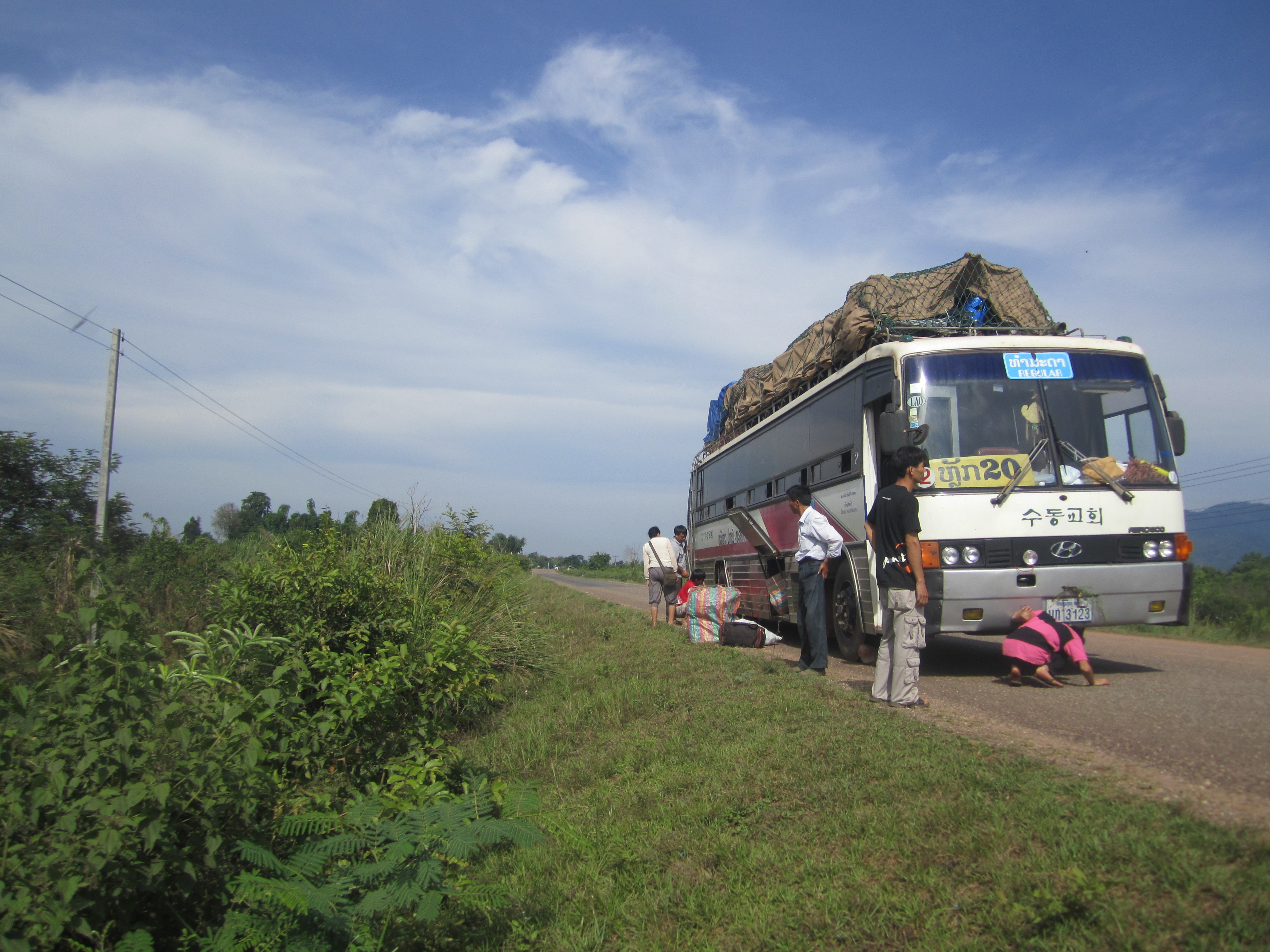
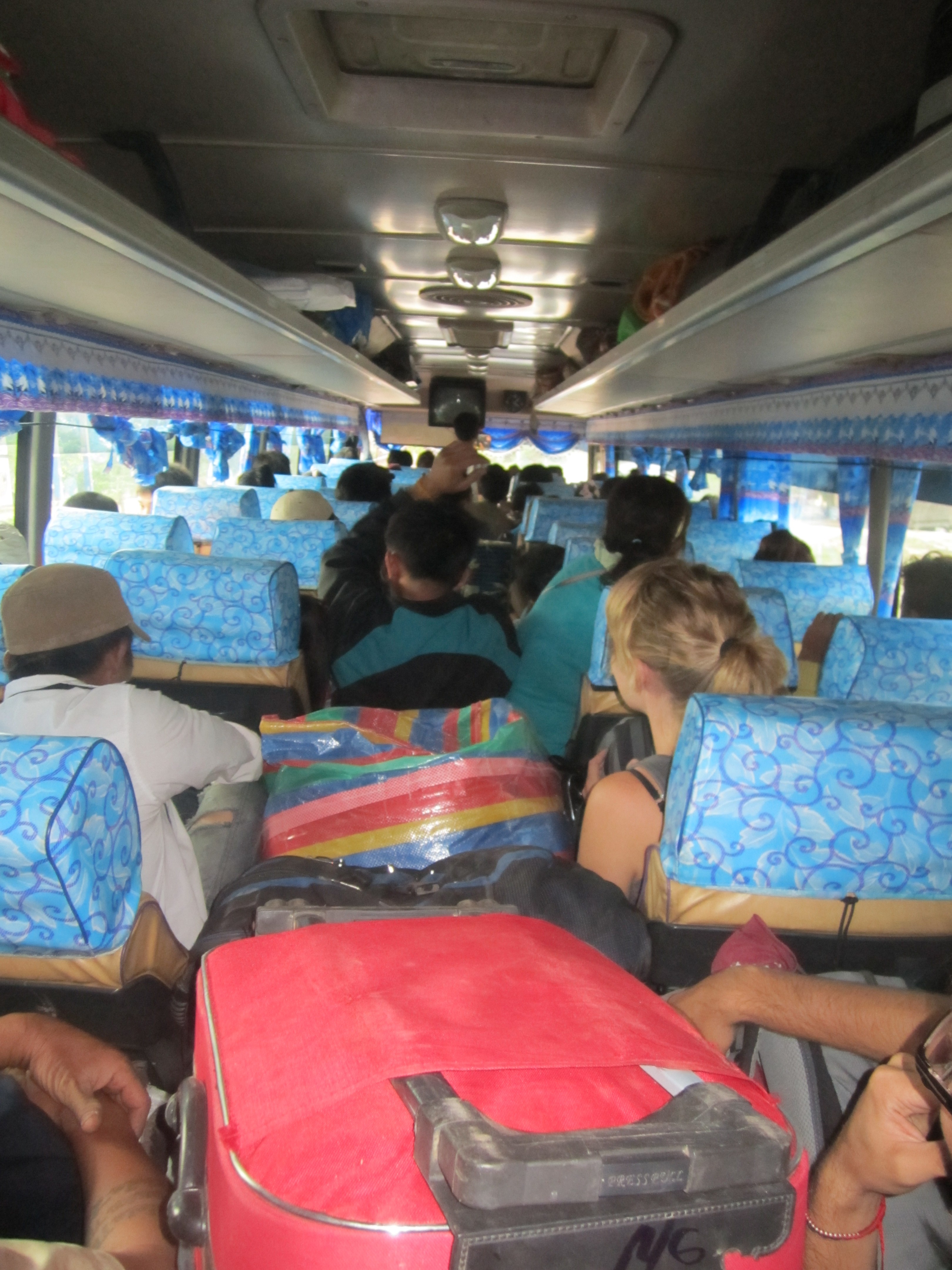
One hand tractor, a boat, two sawng thaew and a local bus so packed I had to crouch in the stairwell amid the rice sacks for 87km—I’ve had my Lao transit experience.

Tell other travelers you’re headed to Laos, and you’ll hear two things: “The people are so friendly, so nice!” and “Ugh, I was on this 12-hour chicken bus…”

Picturesque breakdown

Lao transit is infamous for being some of the ricketiest, breaking-down-ist in the SE Asia, maybe the world. Travelers hang weary heads over bottles of Beer Lao, swap war stories: the number of people standing in the aisle, the amount of livestock on board, the various strange cargo, number of break-downs and length of time to go 370km (12 hours is actually purty good). Instead of garnering scene cred, it seems more like commiserating, deriving solace from a shared trauma.

Given that context, my mission from remote Ban Natane to bustling metropolis Savannakhet was smooth, seamless, enjoyable even. An at a cool 10 hours, it could be said that I lucked the fuck out.

I awoke in Batane to a breakfast of fish soup, sticky rice and Nescafe. One of the men from the Baci ceremony a few nights prior came up the wooden ladder, chatted with Pauline’s supervisor. They nodded, glanced over at me. “Okay,” the supervisor said, “you go with him.”

With my transport clearly mapped out for me, I gathered my bags, said my good-byes. I left Ban Natane in a spray of brown water, thrown up from the wheels of another hand tractor. I’d gotten a little better at riding, crouched down, clutched the railing, teeth chattering with every dip and tree root. It’s a little like the squat toilet—it takes time, practice, to hone your particular method.

A half hour later, we arrived at the “dock”—a dirt slope where wooden boats lay half-submerged in the still river water. A small local group of men gathered, ranging from middle-aged to elderly, all with the lean muscles and chiseled features of people who’ve done hard labor their whole lives.

They commenced to scooping out water from one of the boats with a halved gasoline canister, assembling the engine and oars. Now, if you take the tourist boat, they allow a maximum of three passengers with two boatmen. But this was not the boat of life vests and Tevas (which would have been useful); this was the local boat, whose main purpose wasn’t to transport people but goods.

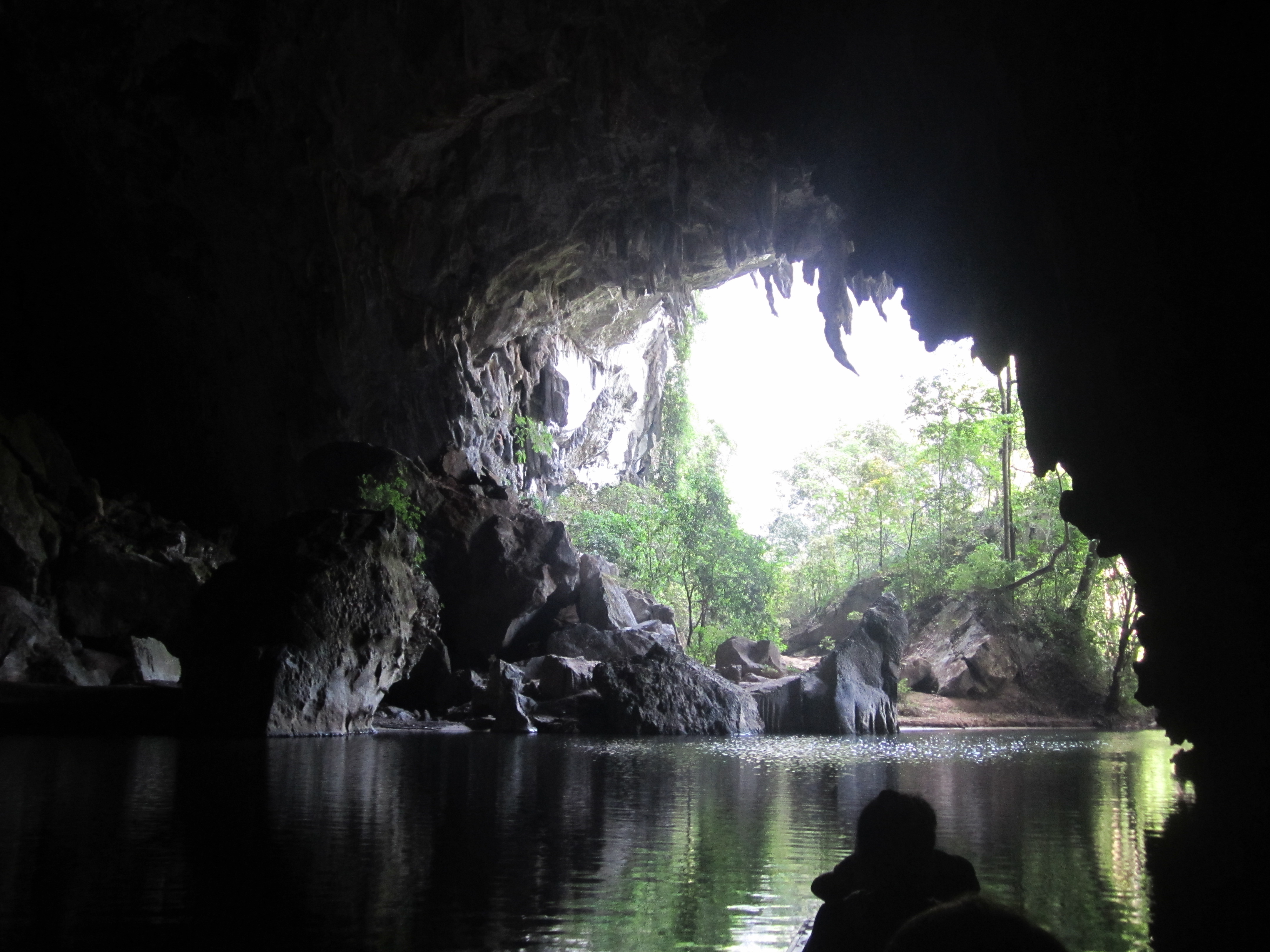
We piled six people, about a dozen parcels and one motorbike on that baby and cruised into the cave.

This is how we roll/paddle

Suffice to say, we bottomed out a half dozen times. Hopping out, pushing the boat, scooping water out, the crunching sound of rock—through a particular patch of rocks, the men had to unload the boat entirely, then reload it. They wouldn’t let me help. I stood in the damp cool and watched a sixty-some year-old man carry my backpack.

As they stood ankles in the water and moved boxes, one of the men lit a cigarette. In the light of his headlamp, I thought the dance of the smoke was about the most beautiful thing I’d ever seen. It was all still magical, majestic to me—the cave, the village, the way of life. But this was these men’s reality. They moved with efficiency, knowing the cave like I know the rhythm of the stoplights and crosswalks and trains. They seemed neither annoyed nor frustrated with the archaic and cumbersome method of transport. They had the expression of commuters. Except they smoked and laughed more.

On the other side of the cave, I bowed and said my thank-yous. I rode two largely uneventful sawng thaew—one back to Ban Na Hin, another to the Highway 13 crossroads. The sky thundered and the plastic bags of produce whipped and whistled in the wind.

It began to rain as I climbed off, hoisted my bag over my shoulder and dashed for an awning. I’d been told that buses to Savannakhet pass through the junction “all the time”—though what that meant in rural Lao speak, I wasn’t sure. I stood in a place that seemed like it wanted to be a bus stop, amid the fruit and sticky rice vendors, crouched down against the rain.

An old Korean bus rattled by, slowed to a stop. The tout leaned out the doorway, waved his arm at me as I jogged through the puddles. “Savannakhet?” I asked. “Yes, yes,” he nodded and ushered me in before I could think twice.

I took one step into the stairwell and stopped.

For the last 100km, managed to score a seat in the back. Catch: I had to climb over the piles of luggage to get there.

That’s because I couldn’t move any further. The crowd of people, luggage, cardboard boxes and rice sacks was so thick I had to wedge myself into the corner the bus door vacated when it closed, the leaky seal splashing a refreshing mist of Lao rain on my face.

Two grim-faced Westerners stood out in the crowd: a boy sitting on a blue plastic cooler, a girl standing behind him, trying to clutch anything she could. When a lumbering cow in the road made the driver screech and swerve, the girl lurched forward, toppling into several people and inspiring a chorus of “ooh”s.

“Twelve hours of this shit,” the boy told me later at a side-of-the-road piss stop (which I actually prefer to the squalid squat toilets you have to pay to us). “They told us when we got on in Vientiane that there’d be seats open at the next stop.”

They had twelve more hours to go, and were thoroughly spent on the authentic local experience.

We shared a what-the-hell-are-you-gonna-do laugh and crammed back on, men pulled zippers and stubbing out cigarettes. When the door closed, I wedged myself back into my corner, where I had just enough room to shift my weight from time to time. And sometimes, that’s all you can ask for.

Blessing of String and Sticky Rice: Day One in Ban Natane

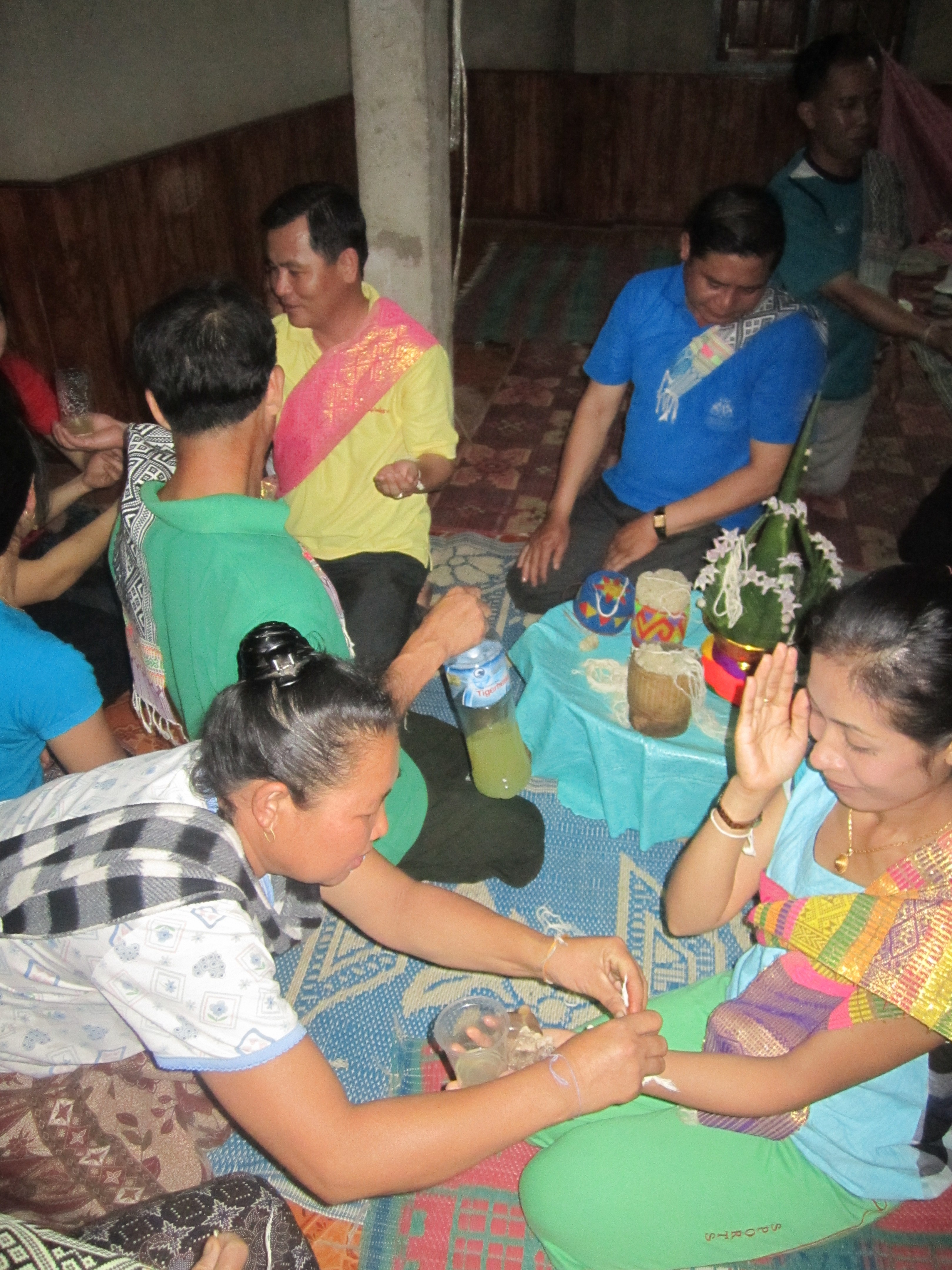
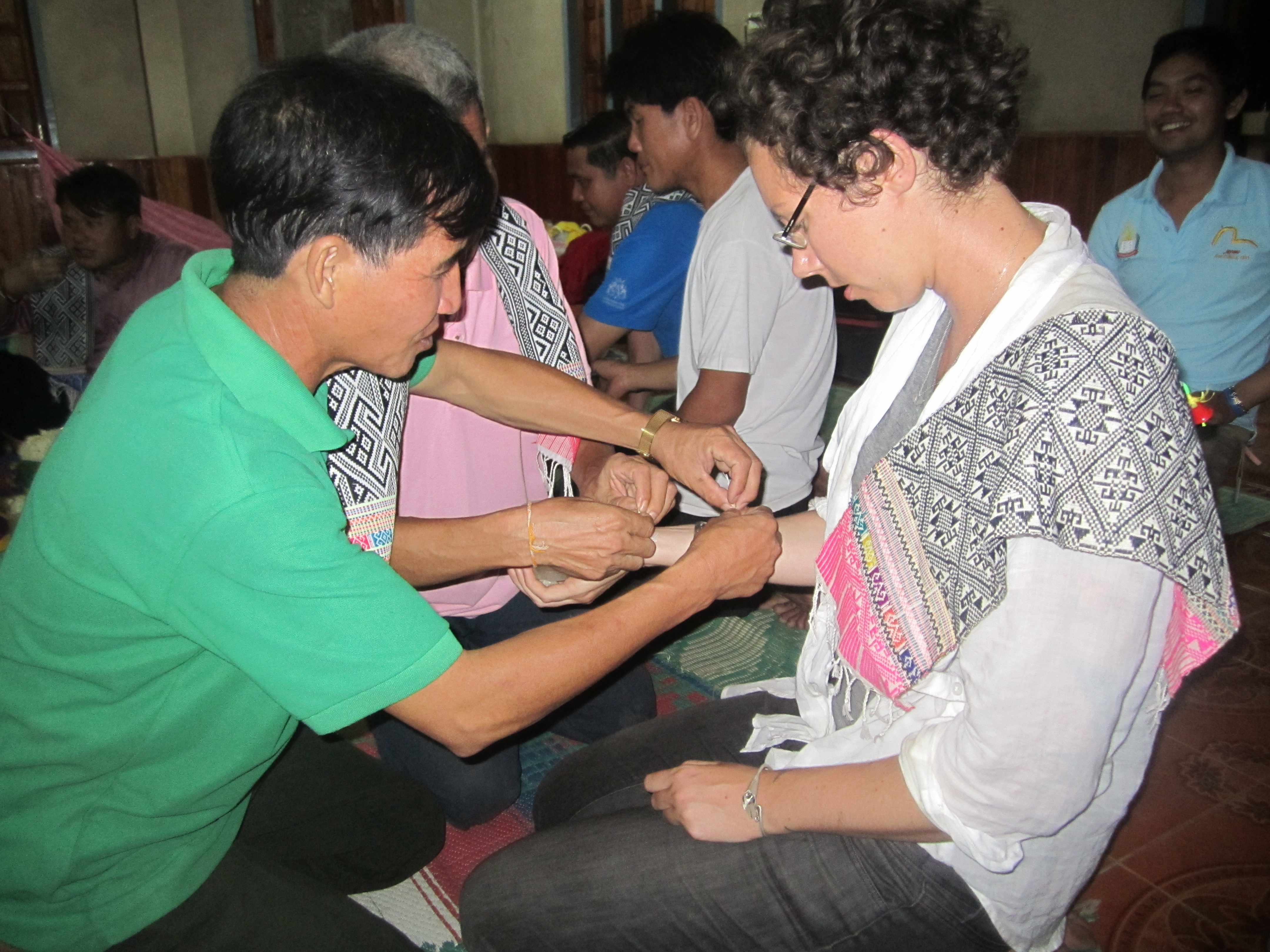
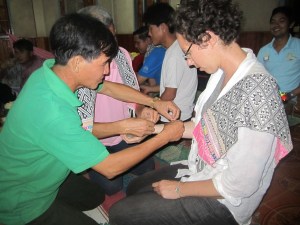
The man held my open palm in his. In it, he placed a small clump of sticky rice and pork. He raised his right hand to his face, murmured blessings in a language I didn’t understand. He waved a piece of string, then tied it around my wrist.

“He wishes you good health, good luck,” Pauline translated.

I smiled, bowed. Outside the open-air room, lightning stuttered the night sky white.

Sometimes you end up some weird-ass places traveling. Not that they’re weird, so much as it’s weird that you’re there, that you ended up there—that the gods of circumstance conspired, whispering in their thunderous perch above grey rock, to bring you there. And it was like that in Ban Natane.

To say Ban Natane is off the beaten path is an understatement. Cut off from the rest of world by impassable roads, the only way to reach it and its neighboring four villages is through the Kong Lo Cave. Which is how I got there.

I met Pauline trolling the town of Ban Na Hin for travel companions. The boat ride through the cave costs 100,000 kip, so I was on the lookout for people to split the ride with. Pauline sat on the computer in front of her guesthouse. As it turned out, she was a French anthropology student doing her Masters research on Ban Natane and its neighbors; she was meeting her local supervisor and translator the next day and headed back to the village for another 10-day stay. “If you’d like to come with us,” she made that characteristic French popping noise, “it’s no problem.”

On the sawng thaew ride to the cave’s entrance, she filled me in the details. A French NGO was sponsoring the development of eco-tourism in the Ban Natane area. To date, all homestays and eco-tourism in the area have focused on the Ban Kong Lo side of the cave—you take a boat ride through, come back and sleep on the more developed side of the cave.

“No one stays on this side,” she told me, “because tourists don’t know the villages are there.” Since the only viable way to reach the villages is through the cave, Ban Natane and its neighbors have remained quite isolated, not reaping the rewards/wealth of tourism. “In all of last year,” Pauline told me, “only 20 tourists came to Ban Natane.”

The eco-tourism project was focused on developing facilities for homestays and training locals to act as guides into the caves and waterfalls that surround the region. Pauline’s project focused on documenting the traditional agricultural way of life, interviewing locals about the history and their feelings about tourism, and then studying the impact.

Emerging

So the Kon Lo cave became, not my destination, but the passageway into another world. Which actually what it felt like—a limestone cavern like a mouth, dripping with stalagmites, the squeal and swoop of bats, where mist floated off the cool water like thin ghosts. It felt like moving through some deeply internal part of the earth, through its innards or petrified organs.

We emerged on the other side. Where most people turn around, we began walking down a dirt road. My cheap flip flops had finally busted, so I walked the 2km barefoot. In the distance, the sky grumbled. We arrived in Ban Natane just as the afternoon storm erupted.

My homestay was with one of the wealthier families in town. They owned the town’s only shop (and thus had packets of Nescafe in abundance), goods that had all been transported on skinny wooden boats through the cave, as they had been for generations. Even the TV. “TV only arrived here three months ago,” Pauline told me. “So the children,” she gestured towards the little ones gathered rapt around the glowing screen, “they are like this.”

The storm cleared and she showed me around the village. Everything enthralled me—I am, as previously admitted, a total city kid, so the presence alone of ducks, pigs, chickens and goats was thrilling, let alone the sarongs and hoes and looms beneath the stilted houses.

We shared dinner with the family that night, as we would for all our meals during my 2-day stay. As isolated as it is, the food was all local, not by trend as it is in the Bay Area, but by necessity—foraged snails, fish, frogs. “Frog season has just started,” Pauline translated from her Lao supervisor, “so we will eat a lot of frog.” (Sure enough, I had it 4 meals in a row.)

Walking that night, we three were called over to a large house. I could tell it was a wealthy person’s home because it had a ground floor, constructed of brick—like the TVs, this was new, Pauline told me, as traditional homes were all stilted and wooden. “It means you need more space, and have the money to build it.” She paused. “So modernity is already coming.”

Men sat on the floor around a type of altar, banana-leaf adorned in white flowers. It wasn’t a mystical vibe—they sat in polo shirts and slacks, chatting casually. A large silver bowl of pig parts, a leg and half a head, lay beside baskets of sticky rice.

We were motioned to sit, a village-made scarf thrown over our left shoulders. The man in charge began talking—“a blessing,” Pauline whispered. He held another man’s open palm, put a clump of food and a plastic cup of lao lao in it, chanted, tied the string. Then everyone commenced to bless each other.

“It’s a ceremony called baci,” Pauline translated. “They’re having it for special visitors—the district chief came today.” People took photos with digital cameras; I assumed those to be the wealthy and important visitors.

We were soon called into the mix. I wound up with a bangle of string around my right wrist and an even fuller tummy. The storms continued in the sky outside. Old men smiled as they blessed me, as they blessed each other.

And I had one of those moments when your life feels like a dream, some foreign place you don’t quite understand how you ended up in. Yes, I rode an old wooden boat through a cave and walked down a dirt road—but how I really got to Ban Natane or that ceremony, I suspected, had little to do with that. It didn’t make sense, to my Western mind, why I’d be so welcomed, so embraced here.

And so blessed.
***

Travel Tips: Getting to Ban Natane

It’s actually pretty simple, even if you don’t have an anthropologist as your guide. Take your day bag, sturdy plastic sandals, a good flashlight and some snacks with you on your boat ride. It’ll still cost 100,000 kip, even if you only take it one way. So it goes.

Get off at the snack stands. Only buy the snacks if you’re desperate; since they have to be transported through the cave, they’re fuck-all expensive. Anyway, there’ll be a blue sign that haphazardly explains the homestays:

From the snack stands, there’s two dirt roads. Facing the sign, Ban Natane is down the road to your left. Straight ahead, across the bridge, is another closer village, though from what I understand, there’s less facilities for homestays. If you arrive in Ban Natane and say “homestay,” you’ll get hooked up. Or just show up and look like a Westerner, and they’ll know what to do with you.

Bringing a Lao phrasebook would be goddamn useful. There may be some people floating around who speak a few scraps of English; there’s rumored to be an English teacher at the school in the village, though she was out of town when I was there. If you can manage to communicate, there’s bikes you can rent or a couple good treks to go on, if it’s the dry season. Next month, an NGO will be holding a tour guide training course for locals, so I imagine there will be much more in the way of communication and tour options shortly.
Bananas and Plastic Bows: Sawng Thaew to Kong Lo Cave

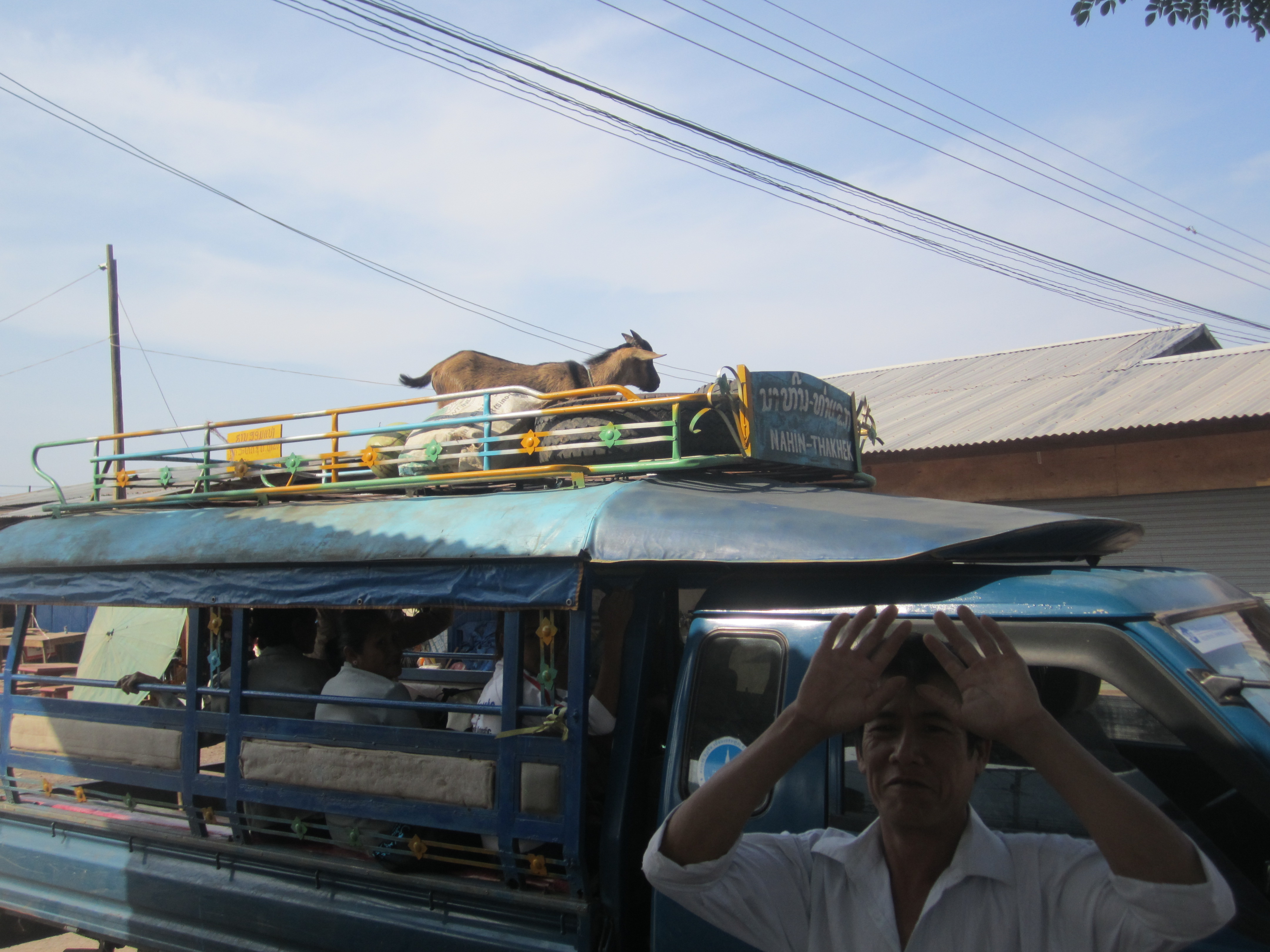
Goat on the roof. Friendly driver.

Salt-and-pepper hair beneath a worn military cap, high cheekbones and pursed lips. He squeezes the bananas I’m clutching through their plastic bag, says something in Lao.

I smile, shake my head. He repeats; I repeat. He nods.

I can’t tell if he approves of the bananas or not.

When I climbed on the sawng thaew in Ban Na Hin, the old man slid over, made room for me between the empty gasoline barrels and bags of cabbage. We rumbled around the market. Old women climbed on with pink bags, still-alive fish flopping inside, while the driver kept climbing on the roof, adding to the goods secured atop: sacks of rice, a goat and my dusty red backpack.

The old man nudged me. “Kong Lo?” I nodded. He nodded. But where else would I have been going?

We headed out down the two-lane highway, lined with construction lots and signs for a Ford Motors Center. The main industry in Ban Na Hin isn’t tourism—as evidenced by the single-room tourism office surrounded by grass-chewing cows—but the nearby hydro-electric plant. The handful of guesthouses that run the length of the town’s main road are an afterthought, and the English spoken is minimal.

Despite this, Ban Na Hin is still the closest town to the Kon Lo Cave, a 7.5km limestone tunnel that’s purported to be creepy as shit and mildly reminiscent of the Greek underworld. But, 40-some winding kilometers from a main highway and serviced only by local buses and sawng thaew (pick-up trucks with two benches in the truckbed), what would be a top tourist attraction in any other country remains fairly off-the-beaten-path in Laos. Which, as much as the cave itself, is what lured me out here—after Vientiane and Luang Prabang, I was tourism-weary and in the mood for adventure.

So I don’t mind as it takes two hours to go the 45km to Kon Lo. Past rock that jutted from the earth like jagged teeth, past slash-and-burn fields were the land looked as though it were gasping—we stop at every village, delivering groceries, dropping off canisters of gasoline. I watch the landscape, the farms, the clouds that ito the rock like scraps of cloth that had been ripped off. And I people-watch.

And now, slyly, I study the old man beside me. He has soft yellow skin the texture of crushed silk. I notice on his sleeve, he has small plastic bows haphazardly safety-pinned on. Beside his army-green cap, I imagine them as military decorations, badges from a make-believe army. I imagine them as gifts from grandchildren, secured to his shirt and forgotten about.

I pull out my notebook, to jot down the image between the bumps that stutter my handwriting across the page. He leans over, looks at the notebook, watches me write. He nods as though he understands.

I can’t tell if he approves or not.

I smile, point to the plastic bow on his sleeve. He laughs. I give a thumbs-up.

He tugs his sleeve, begins to unfasten one of the pins. He takes my sleeve, pins the bow. I touch it, smile. He laughs. I laugh.

(A little later on the ride, I discover what the bows are: a bunch of teenagers lining the road come up to the sawng thaew and, through the poles, pin bows to our shirts. They smile and sing, holding out a collection for something.)

The sawng thaew thins of its passengers and produce as we rumble along. A tank of a woman with a soft, laughing face pushes her way out, waves at me. We stretch our legs in the luxurious space.

The old man waves his arm at the driver, stands to a hunch beneath the truck bed’s dome. I tap him as he begins to shuffle off.

I open my plastic bag and hand him a banana.

He smiles. I laugh, he laughs.

I think he approves.

He steps off the back of the truck, place his hands together and bows his head. I repeat.

***

Travel Tips: Getting to Kong Lo Cave

While researching Kong Lo Cave, the number one concern I encountered was over transport. The LP doesn’t have much info and it seems as though the lack of direct buses deters a lot of people from visiting.

Here’s the deal: Kong Lo and the nearby Ban Na Hin (nearest town, with guesthouses and an ATM) lie along Highway 8, which moves east from Highway 13. All buses between Vientiane/Paksan and Tha Khaek/Savanaket run down Highway 13, so the route you will often read recommended is to take one of these buses running along the 13, ask to get off at the junction, then take a sawng thaew to Ban Na Hin, where you can then take another sawng thaew to Kon Lo Cave or the nearby town, Ban Kong Lo, where it’s possible to homestay.

Another friendly fellow

I think it’s the transfers that deter people. It;s actually a lot less dodgy than it sounds. There’s enough of a trickle of backpackers that the bus drivers know where you’re headed—there’s not much else out here for tourists. Sawng thaew run from the junction to Ban Na Hin every 30-or-so minutes during the daytime, and there are supposedly a few direct sawng thaew to Ban Kong Lo every day, though it probably wouldn’t be worth waiting for those.

From Vientiane, there’s only one VIP bus to Tha Khaek a day at an inconvenient 1pm—journey takes about 6-7 hours, so you’d potentially be looking at doing the transfer after dark. Local buses, though, run every half hour beginning at 6am. They cost 60,000 kip, regardless of whether you get off at the junction or the final destination.

There’s also local buses to Lak Soa, the biggest town along Highway 8. The advantage of this bus is that you negate the feared transfer at the junction. These buses leave Vientiane every 2 hours, beginning also at 6am, and cost 75,000. This is the bus I took, and I recommend it: it was early enough in the day that the lack of AC was bearable, and even with a break-down, I still arrive in Ban Na Hin at 1pm.

I’ve also been told that there’s one daily bus directly from Vientiane to Ban Kong Lo that leaves between 9-10am. However, if there’s not enough people, the bus will be canceled, so it’s probably best not to risk it.

From Ban Na Hin, though, there’s only three official sawng thaew per day to Kong Lo—more evidence of the undeveloped tourist facilities. The first leaves the town bus station at 10-ish, the others at 1 and 3-ish. But in reality, they seem to leave more often than that. Otherwise, you’re looking at arranging private transport, about 100,000 kip versus the 25,000 for the bus.

Coming from the South, it appears as though your best bets would be to take a sawng thaew from Tha Khaek, which is well-connected to Savannakhet and Pakse, or one of the buses coming up the 13 and doing the transfer. I did meet some grumpy Brits who had gotten on the wrong bus and had the journey take a day and a half—”All this for a bloody cave.”

Which brings me to my biggest recommendation: treat the whole thing as journey-is-the-destination adventure. Don’t focus on just Getting To The Cave—everyone I met who did this seemed fairly annoyed, or at least had to qualify it with “worth the trek.” I was armed with snacks and in the mindset of “well, let’s see where this leads,” and I had a grand ole’ time.


Lauren Quinn is a writer and traveler currently living in Hanoi. Lonely Girl Travels was a blog of her sola travels and expat living from 2009 to 2012. She resides elsewhere on the internet now.

Join 490 other subscribers

Buy This Sh#t

Categories