It was really not the time to be thinking of Charles Bukowski.
I stood staring at a display of UXO casings at a Phonsavan tour company. I was thinking of the documentary I’d seen the night before (see previous post), which followed a group of impoverished Lao children as they harvested UXOs for scrap metal.
Something panged in me, and I thought of the poem.
It was the same something I’d felt at the War Remnants Museum in Saigon. I stood before pictures of children born with mutations from Agent Orange—small and crippled and bubble-skinned—children who’d been born after the war, hadn’t lived through the war, but who had it in them, possessed it in their DNA. If the images hadn’t been so brutal, I’d thought, they’d have been a metaphor for the intergenerational transmission of trauma.
I’d been surprised in Vietnam, to discover how much of the war I’d carried in me, without knowing it. I hadn’t realized how much a part of American culture the Vietnam War is—in our books, our films, our movies and our freeway exits, cardboard signs and thousand-yard stares. I’d remembered, suddenly, visiting the Vietnam War Memorial in Washington DC as a teenager—muggy-skied and sweating, watching the grown-ups trace hands along the reflective stone, place flowers and cry—not understanding it. I’d turned; my mom had been one of them, the name of her cousin under her fingers.
And I’d suddenly remembered the poem.
It’s more muddled in Cambodia and Laos, places were the American activity was “secret”—it’s less a part of your consciousness, more a part of something else that you can’t quite name.
“People from my province,” the Cambodian boy looked sheepish as he told me, “they still hate Americans. For the bombings.”
I nodded one, two, three times. “And you know what? America bombed Cambodia in secret. And most Americans still don’t know about those bombings.”
We sat beside each other waiting for our numbers to be called at the cell phone shop. Neither of us had been alive during the 70s.
I’d wondered, as I looked at bomb ponds beside pre-Angkorian temples in Cambodia, how one goes about being American in all this. “‘I wasn’t born yet,'” I wrote, “doesn’t seem good enough.”
And looking at the pile of UXOs in Phonsavan, I had the same thought rise. Because the kids out there harvesting these bombs, they weren’t born yet either. Neither of us asked for this, did this, witnessed this, lived through this. We were born into this, are left to figure out what to do with this, dig through the dirt of this.
And that’s when I thought of the poem again.
I’ve been composing some kind of essay in the back of my head about all this. I don’t know exactly what I have to say about it yet, or if there is anything to say about it. But in the meantime, I’m thinking of a poem that seems fitting. And, in the light of the recent string of natural and political disasters, doesn’t seem so dramatic or fanciful as it once did. It doesn’t feel so hopeless either—it just feels accurate.
The rainy season may have arrived early in Laos this year. But think that means you’ve got to tromp around in ugly boots and plastic tarps?
I say nay. I say accessorize.
I once heard on Oprah that the difference between people and animals is our ability to accessorize. I couldn’t agree more. Enough of these chimpanzees in zip-off pants and Tevas. A proper display of one’s humanity obviously includes a few well-chosen statement pieces that take you from Backpacker Bum to Hobo Chic.
Take the belt. It is perhaps the most crucial travel fashion accessory—it is both practical and stylish. Kate Middleton recently made heads turn when she left the Buckingham Palace for a post-wedding getaway in a belted blue dress. There’s no reason one can’t have the same effect at tourist attractions in Laos.
The $2 plastic poncho purchased at the town market may not scream “Style Icon.” It may not be the most form-flattering and may make you feel like you’re wearing a sweaty trash bag with a too-small head hole. But don’t let that get you down.
Throw on that handy belt you’ve packed, and you suddenly have both a waistline and a powerful statement to make: “I will not be held back by weather conditions, budgetary restrictions nor poor local fashion standards.”
Yes, you can hold your head high, your pants up and your waistline in, all with one well-chosen and easily packable accessory. Oprah would be proud.
“It’s crazy,” Alicia leaned over and whispered, a precipitous landscape of green huffing past the bus window, “how much healthier people look here.”
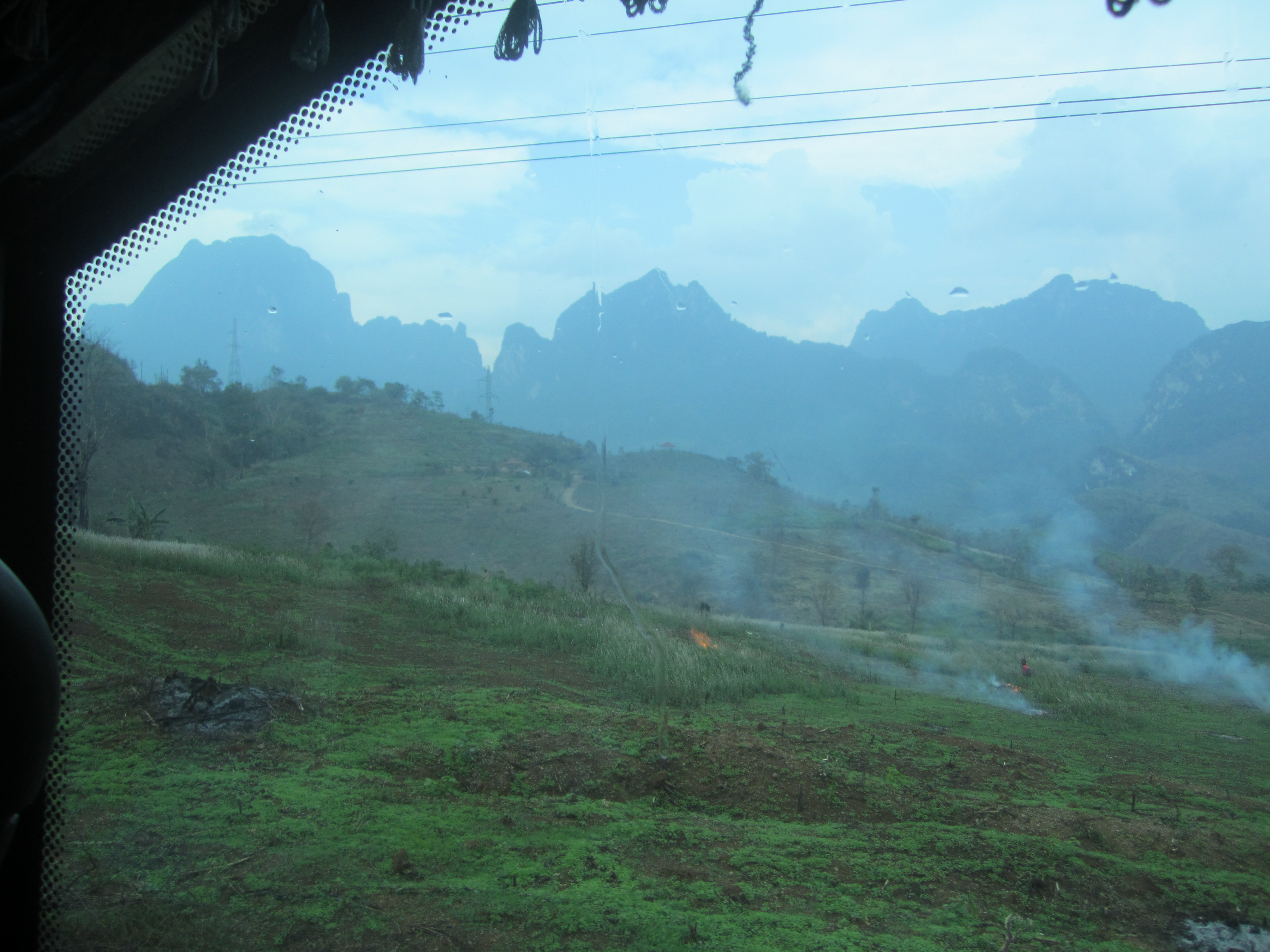
We sat in the cramped seats of a leaky-window bus, an 11-hour ride from Vientiane up to Luang Prabang. We passed mountains of limestone that rose up like the Angkor towers, dense forest and slash-and-burn fields of black, where smoke spindled like skinny incense. Punctuating the wild were villages of thatched-roofs and rusty satellite dishes, women swatting plastic bags at the flies that hovered over their roadside produce stalls, dirt-faced children who looked up, startled from inside doorways, then smiled and waved.
It was our fourth day in Laos.
I nodded; Alicia was right. There were the racial differences—lighter skin, sharper eyes—but also a kind of impoverished solidity to the people: lean but sturdy, skin firmer, less taut than that of their Cambodian neighbors.
Laos ranks among the world’s poorest 20 countries, and it endured its own US-fueled war and rounds of secret, incessant bombing. But there’s a difference between Laos and Cambodia, a lack of trauma that feels palatable.
We arrived that night in Luang Prabang, the country’s biggest tourist attraction—a Unesco-site of colonial chill. Vientiane was pretty mellow itself, but it’s hard to get a feel for a country by one city, especially its capital, often bound to be wealthier than the rest of the place.
It’s been a week now, and little differences between Laos and Cambodia have continued to reveal themselves to me. Like there aren’t private security guards sitting in plastic chairs outside every restaurant and guesthouse. There aren’t girls, bare arms folded and legs crossed in short skirts, sitting in similar plastic chairs outside of karaokes. I haven’t seen twelve-year-olds on the sidewalk, hunched over and breathing deeply into plastic bags that fill and deflate, fill and deflate, with the rhythm of addiction.
The foreigners are different too. There’s more backpackers, nearly exclusively backpackers, it feels, all wearing a uniform of flip-flops, shorts, Beer Laos tank tops and hungover sunburns. I’ve only seen a few Western white men with local women, and in most of those instances, they’ve had mixed-race children in tow. I haven’t seen any older burn-out travelers, with missing teeth and weathered skin and the particular wiriness that decades of addiction bring (think Iggy Pop in sandals).
I’ve read the newspaper a few times; it hasn’t been filled with stories about child rapes and murders and bizarre happenings (ie: a monk being disrobed for getting caught having sex with a married woman). Signs in my guesthouses haven’t advised me against having sex with children. I don’t finish all my food at a street stall, go to pack it up and take with me, then realize there aren’t street kids to give it to. There’s sidewalks, and the electrical wires stretch down the streets in smooth, discernible lines.
I hadn’t expected these differences. They’d existed in Thailand, but Thailand is wealthier, didn’t survive a war just a few short decades ago. I’ve been experiencing them as a series of little moments, realizations, that have started to add up in me, assemble in a line, make some sort of shape—a constellation of tragedy, a map of the way tragedies continue to exist in us, reverberating like sound waves or the rings inside trees when you cut them down and turn them sideways.
Cambodia, I’d thought, didn’t seem like a place that a genocide had occurred in. Phnom Penh, when I’d first arrived and walked its blossom-lined streets, didn’t seem like a city that had been evacuated, abandoned, left to crumble and rot for four years.
But the longer I’d stayed, the more I’d become aware of these strange things, little fucked-up moments that sparked and burned like dying stars. They felt like glimpses in to something too terrifying to look at squarely. So I suppose I didn’t look, didn’t think about them more deeply than a passing pang. This is how you deal with suffering, the same way I step over junkies in the Tenderloin: you build a wall around yourself, and you need this wall—if you let it all in, you might snap, go over into that dark side you’ve glimpsed and not ever come back. It happens; it sounds dramatic but you’ve seen it happen, like the kid in middle school who takes too much acid one night and is never the same. It could be you.
What I mean to say is that I normalized all the trauma in Cambodia, in the way people normalize everything—begging children and tuk-tuk drivers that couldn’t read maps, karma-scarves faces atop pick-up trucks, eyes that blazed black in the dust.
Sometimes it takes leaving a place to really know it—the way I’ve come to know the US much better by having traveled outside it. And now that I’m in Laos, somewhere chiller and possessed by a less horrible history, I’ve suddenly become aware of all these observations that were collecting quietly in me. It’s made me reconsider Cambodia, redefine it by a comparison country. And oddly, it’s made me miss it, crave it, the way we love things we can’t save.
“I was glad I went,” Suki said as we strolled the night market tonight. “There were some cool moments and it was really educational, but man,” she paused, shook her head slightly and her earrings followed her, glimmering, “I was ready to leave. It was heavy there.”
“How do you mean?” the writer in me asked, wanting details, specifics, scenes to cite.
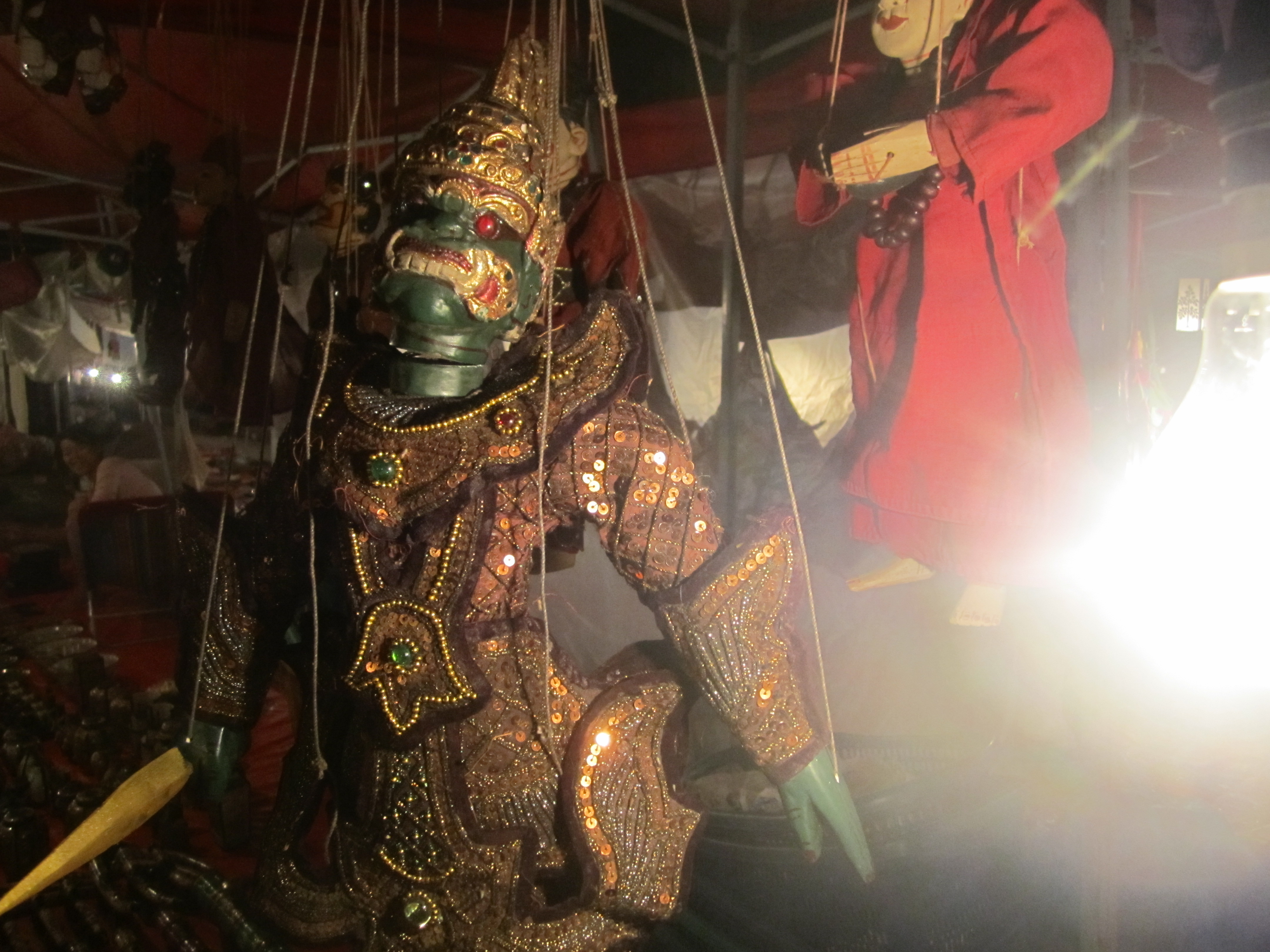
Spooky dolls at the market
“I don’t know, it was just this heaviness in the people.”
I looked around at the gentle bustle and glowing lights of the market, and nodded. “I think I know what you mean.”
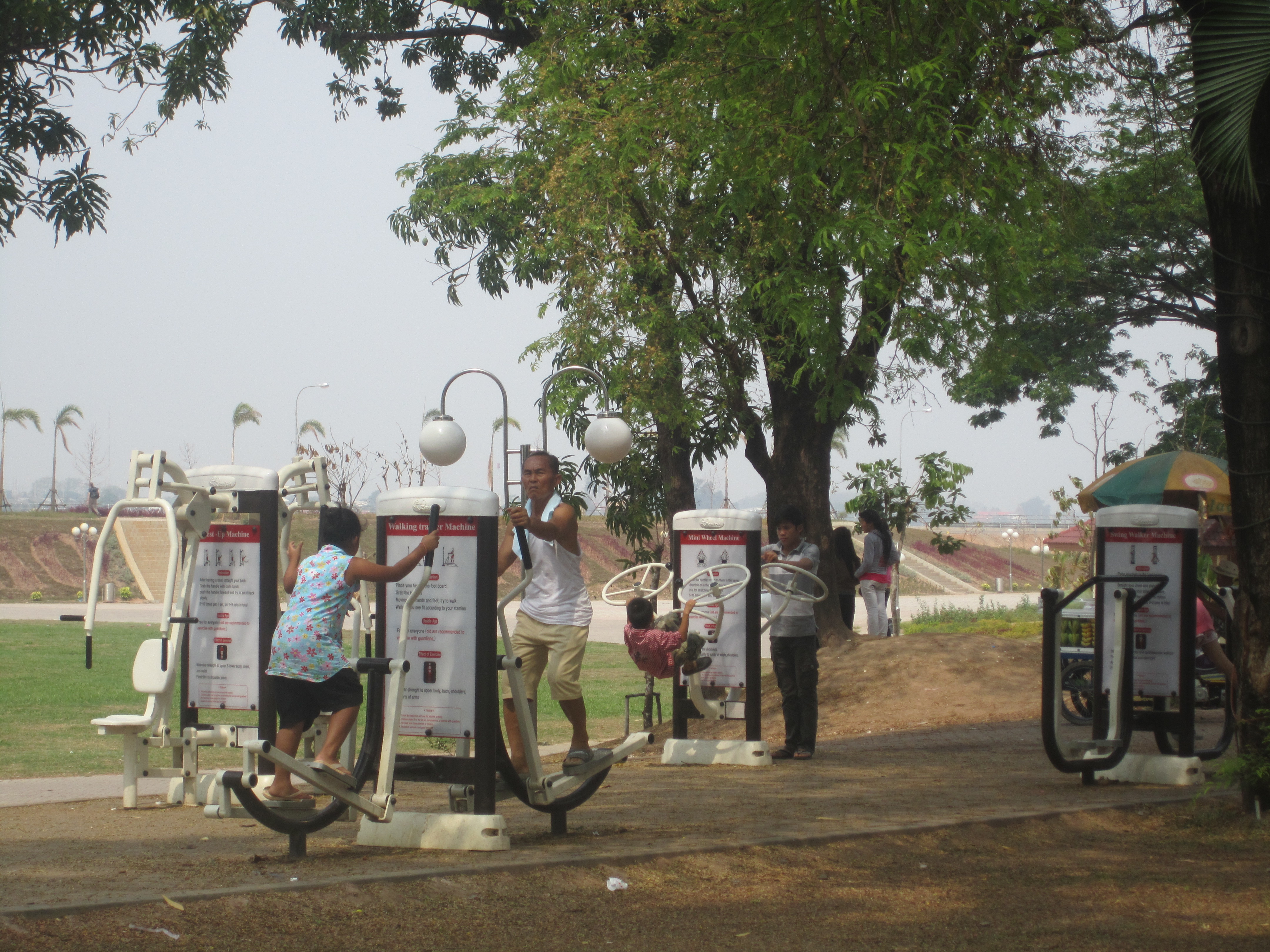
Didn't take many picture in Vientiane. So here's one of people on the exercise equipment along the riverside.
Vientiane, April 25th: it was one of those perfect days. Until I found the money missing.
April 25th is my sobriety birthday, the day I get to think to myself—“This is the number of years my life has been getting better.” This year was eleven. Eleven years of slowly, sometimes painfully, learning to live in the world and in my own body without killing myself. It’s a pretty good thing to celebrate, not in a balloons-and-cake kind of way, but in a way that’s stiller, sweeter.
The theme of the day, I’d decided, was self-cafe. Which didn’t seem like it would be hard to achieve in Vientiane. We’d arrived the previous morning, slept off our 24-hour-bus-ride aches and spent the afternoon strolling around the town, eating at the local night market, reveling in all the differences from Cambodia (“Sidewalks!”).
The air was lighter, softer in Vientiane. We were farther north, and it was cooler, an oppressive edge eased. The streets were free of rubbish, and the traffic was mellow, orderly even—girls in sarongs riding side-saddle, holding frilly sun umbrellas. With its shady streets and fountain square, its cafes and riverside promenade, the city felt—I hate to say it—European.
Everyone had talked about how insanely mellow Laos is, how when you cross the border you exhale this breath you hadn’t know you’d been holding. And it was like that for me. So I decided to mellow out with it. April 25, there’d be no hard-core traveler shit, just doing things that felt good for me.
So I spent a couple hours writing in the morning, then went for fruit shakes and Western salads. We took a tuk-tuk out to a fitness center recommended by the guidebook; I ran sprints on the treadmill, swam in the pool, read in the sun, drank fancy coffee, got an hour-long massage. We went back into town and my friends treated me to Indian food. Cool air blew off the river, and I felt healthy, serene, filled with a simple kind of gratitude you don’t need words for.
“This has been a fucking great day,” I told my friends as we walked back to the guesthouse. “Really, guys—thanks for sharing it with me.”
I needed to stop off at our room to grab some more cash. I’d changed a bunch of US dollars the day before, and I never like to walk around with too much money on me—a lesson learned, I suppose, growing up in Oakland. I know you’re not supposed to leave anything of value in hotel rooms, but it always seemed a toss up to me. And in six years of traveling, I’d never had a problem.
Housekeeping had come, we noticed: fresh towels and soap packets. I reached into my bag, a pocket that I’d left, admittedly, half-zipped. I pulled out the book I’d tucked my cash into—as it happened, my favorite recovery daily reader (yeah, that’s right). I flipped to the page I’d stuck my money in—as it happened, that day, April 25.
And it wasn’t there.
“God. Damn. It.” I closed my eyes, dropped my arms to my side. “My money is gone.”
I commenced what I knew was a fruitless effort, digging through all my shit. Alicia and Suki joined in. “Did you put it here maybe?” opening another pocket, lifting up another pile of dirty laundry.
It was gone. $150, about 5 days worth of travel. And I knew there was nothing I could do. Every hotel room I’d ever stayed in, this one included, has had signs telling you they weren’t responsible for missing property. I had travel insurance, but how do you prove you had cash stolen?
And it was partially my fault. I hadn’t been careless, per se, but I hadn’t been as vigilant as I should have. I’d broken one of the cardinal rules of traveling, right along with leaving your bags unattended or keeping money in your back pocket.
I went down to reception, even though I knew, just like searching through the room, that talking to the manager would be fruitless.
I told him about the missing money. “I know there’s nothing you can do, but I just thought you should know.” He went through the motions of calling staff (“They said no one cleaned your room today.”), searching through the video recorder of the hallway (“I didn’t see anyone enter the room.”).
He told me they’d never had a problem before; a couple minutes later, he suggested I’d lost the money. “Maybe because you are three,” he offered. “Once we had three people staying, and they also lost something. They called the police; it was a big problem for us.”
I sighed a long, pained sigh. “I thought you said you’d never had a problem before.”
He shook his head, dismissing my observation. “I trust my staff.”
“Well, that’s good. But someone stole money from me, so I don’t.”
I sat down in the gaudily carved bench in the foyer, defeated. My brain ran through a list of should-have’s, why-didn’t-I’s. I pictured all the end-of-trip indulgences I wouldn’t be able to allow myself. I felt nauseous. I got, I’ll admit it, teary.
I went back upstairs, flopped down on the crisply folded sheets. I smirked at the irony of getting money stolen from a recovery text, on my sobriety birthday, a day that had been so healthful and serene.
What do you have control of in this situation? I asked myself. I couldn’t get the money back, couldn’t file a claim with my travel insurance, couldn’t prove that it was stolen in the first place. All I could come up with was my attitude.
I sighed again. Not a pained sigh, but a long exhale, the kind they say you do in Laos. So someone took my money. Was I going to let them take my serenity too?
It’s been a few days. And while I still feel the sting, while I have to be extra careful about what I spend money on, the main thing I remember from April 25, 2011 isn’t getting ripped off. It’s of taking care of myself, giving myself what I needed—a day of fitness and relaxing and good food—and sharing it with friends.
[For what it’s worth, the hotel I stayed at was the Riverside Hotel. And they’re breakfast was pretty awful to boot.]
Fifteen minutes from the happy pizza restaurants and nibbling-fish pedicure tanks of Siem Reap’s Old Market area is the War Museum. It’s not much of a museum, per se—it’s a grassy field filled with mango trees and the skeletal carcasses of tanks, missiles and planes used during the Cambodian civil war (the 1960s Lon Nol era through the fighting of the mid-90s). The “exhibits” sit exhausted and silent in the heat of the field. They’ve been striped for parts, all that’s left of them slowly turning brown, the same brown as the the earth.
“The memorials in Cambodia are so raw,” Anna’d remarked. “At Auschwitz, everything is behind glass or protected. You felt more separated. But in Cambodia, at the Killing Fields or S-21, there’s less between you and the stuff you’re seeing.”
I thought of Anna’s comment as I walked into the War Museum, past the massive helicopters that slept like corpses in the entrance. I’ve never been to Auschwitz or any similar genocide memorials, so I don’t have anything to compare the ones in Cambodia to. But there’s definitely a rawness. And it’s a rawness you feel in the whole country, not just at the memorials, but that the memorials seem to capture, to be the pure essence of, in a way that reminds me of whiskey distillation—too pure, the uncut soul of the thing, that if’s not diluted could kill you.
A guide approached us, a young man in a fake Lacoste shirt, frayed stitching and tell-tale grin on the alligator’s face. He was missing an arm; a nub extended beneath the sleeve, a little past his shoulder, and you could see it move around in there as he walked.
A sign announced that guides were free, so we went along with him, assuming a small tip would be expected. He spoke English well and was knowledgeable about the artifacts, mute metal that sat, refusing to decompose. Small wooden signs had explanations penned in a haphazard English.
“What is your nationality?”
“USA,” I replied. A pause. “We’re American.”
“Ah. America is rich country. Cambodia is poor. So if a pilot not fight well, if a soldier not hit target, he get killed—it a waste of ammunition. The pilot, they cannot eject from the plane, they trapped. The soldier get locked inside the tank, and if he don’t fight good, he stay in and die. We find still the bodies in many of these tanks.”
We stared at the machines; they reminded me of dinosaur bones or the great cranes at the Port of Oakland—metal with so much power, sitting still.
As we walked, he told us the story of how he lost his arm: when he was 14, his dad brought home a landmine. He was trying to dismantle it; we couldn’t make sense of why. The bomb exploded, killing his parents and two siblings, and leaving him with a belly full of shrapnel and one less arm.
“I’m lucky I’m okay,” he told us. “But I am very lonely, I have no family.” He went on to explain the difficulties of life as an amputee in Cambodia, with discrimination and lack of healthcare. He paused, looked at us. “You are very lucky, you have family.”
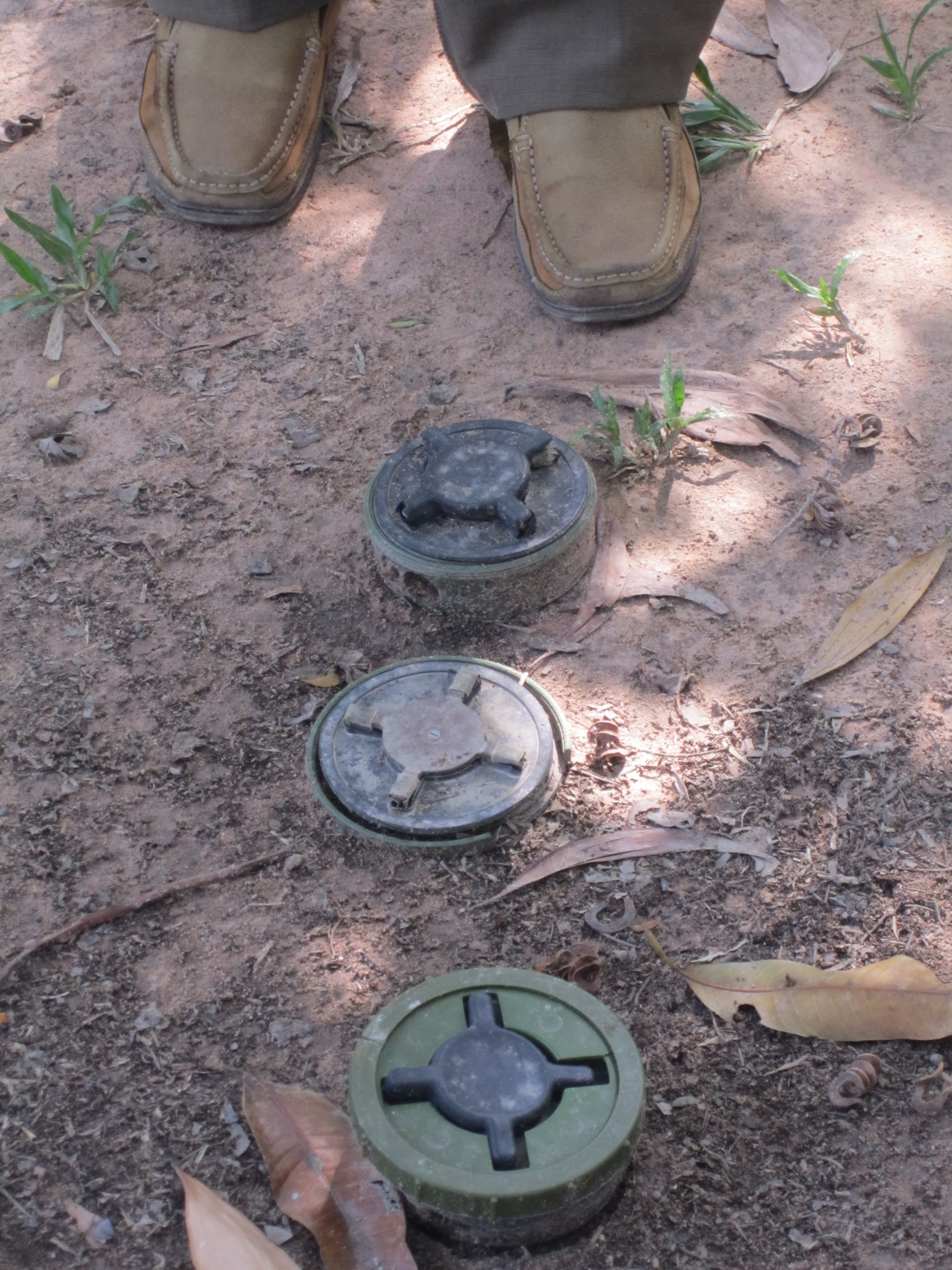
Types of landmines
We kept moving. He pointed out common types of landmines, explaining which countries they’d been made in: Russia, Bulgaria, the US. He told us 1-2 people a day in Cambodia are still injured by unexploded ordinances. “You are very lucky, your country no have landmines.”
As he stood talking, I slid a modest note into the “Donations for Landmine Victims” box. He watched me. When he finished explaining the table of empty shells, he pointed to the box. “This money go to the government first, then the people. The government take a lot.” I squinted my eyes, nodding slowly. It’s true—there’s a lot of corruption in Cambodia. But I could also sense where this was going. “It better you give to the people.”
I cocked my head as he lead us away. Everything I’ve read in every country I’ve been to—including the sign at the guesthouse I’d just left (that among other things encouraged me to not have sex with children)—tells you not to give directly to people but to worthy, legitimate organizations. It was unsubtle foreshadowing.
He kept us moving at a steady pace. I thought of my guide at the pre-Angkorian temples a week earlier—also missing an arm but older, darker, a man who only spoke Khmer. I thought of the way he’d clasped his phantom hands behind his back, and the way it made something in me pound, then sink.
This guide didn’t clasp his hands. He was wearing short sleeves.
We paused under the hot breath of the sun. “How many sibling you have?” he asked each of us and we each responded.
“That good. You lucky. I have no brother or sister now.”
We came to a row of wooden shacks, displays of exploded bombs. They looked like peeled fruit, like some modern-art interpretation of peeled fruit that you’d see in some chic lounge, that was trying to make some sort of terribly deep and obvious statement. But this wasn’t art and it wasn’t a lounge—it was a shack and twisted metal.
They’d sawed the blown bits of his arm off with a wire. Because he was young and still growing, he had to go back every four years, to have the bone re-sawed. He couldn’t afford to get the shrapnel from his belly removed; at $100-200 a pop, he said he’d had to leave it to float around in there.
“In America I hear they make a machine arm.” He looked around at all the dead, rusted machines. “Maybe soon they make it in China. It will be cheaper there, and if I work enough, one day I can get. This is my dream: you come back and I can give you a hug with my robot arms.”
We got to the end of the tour. “It is good if you give a tip,” he told us flatly, “so I can pay for my surgery. Many people give $20-30 each person.”
Suki and Alicia looked at me. They’d each been in the country less than 24 hours. I considered the fact that a construction worker makes $3 a day, your average tuk-tuk driver $5. I considered the fact that my daily budget was $30.
He stood a few steps back, staring at us, waiting. “Can you give us just two minutes?” Suki asked.
We whispered, gathered bills. We gave him a fair tip, said thank you.
Then he walked back to our tuk-tuk, heavy with sweat, our ankles covered in dirt the color of rust.
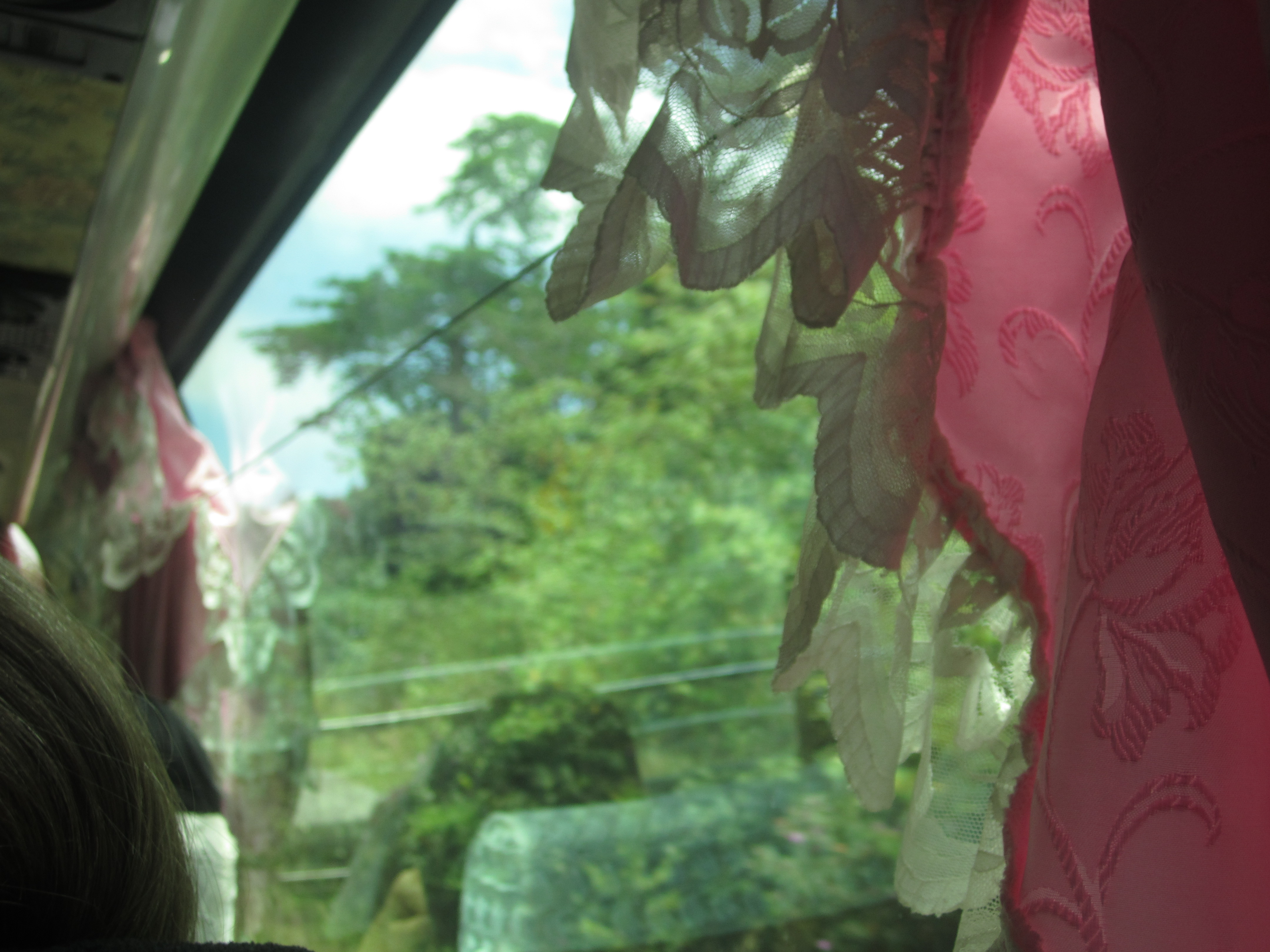
I’m staring through a bus window, scanning for clues.
A month in Phnom Penh and I’m finally leaving the city. I need a new visa, and I was planning to come to the Thai border anyway, to search for the remains of a refugee camp—as though the land could hold stories, or bits of stories; as though it could tell them and I’d be able to hear it.
I look out at the rumbly pavement, the lumbering trucks, the dusty shoulder and the green, green beyond. I don’t see any traces. I see thatched roofs and hammocks between the trees; I see bone-white cows laying in the dirt and houses perched on stilts like skinny legs. I see roadside petrol stands and carts of rubble with young boys sitting atop the heap, staring back through the window at me. I see palms reflected in still water.
Where did the people walk? Somewhere, once, there were paths, and this land saw it, was it. I’m along the Southeast of Cambodia, heading into the Thailand’s Trat Province. It wasn’t one of the main avenues for escape to Thailand—those were in the north—but enough people came this way for there to have been two refugee camps, from what I’ve been able to learn. And I see no traces of their journey.
How quickly, I think, the land swallows human traces. I think of the images of saw I Phnom Penh after the fall of the Khmer Rouge, a little less than four years after having been evacuated: it was rubble, crumble, weeds growing tall and stoplights swinging silent. It was surprising how quickly the earth could undo things.
I think of the accounts of refugees I’ve read. The danger was immense, especially for people already physically weakened by years of starvation and overwork. I think of Vietnamese soldiers, fake Khmer Rouge soldiers, Thai bandits, sleeping landmines—all that people risked to walk through this place that I’m gliding through, plexiglass and air-conditioning. And isn’t that the truth of it?—all I can know of it the warp in the window, the transparent reflection of my own face obscuring the landscape that once held answers, that maybe still does, maybe has its own recurrent dreams, of footsteps marching.
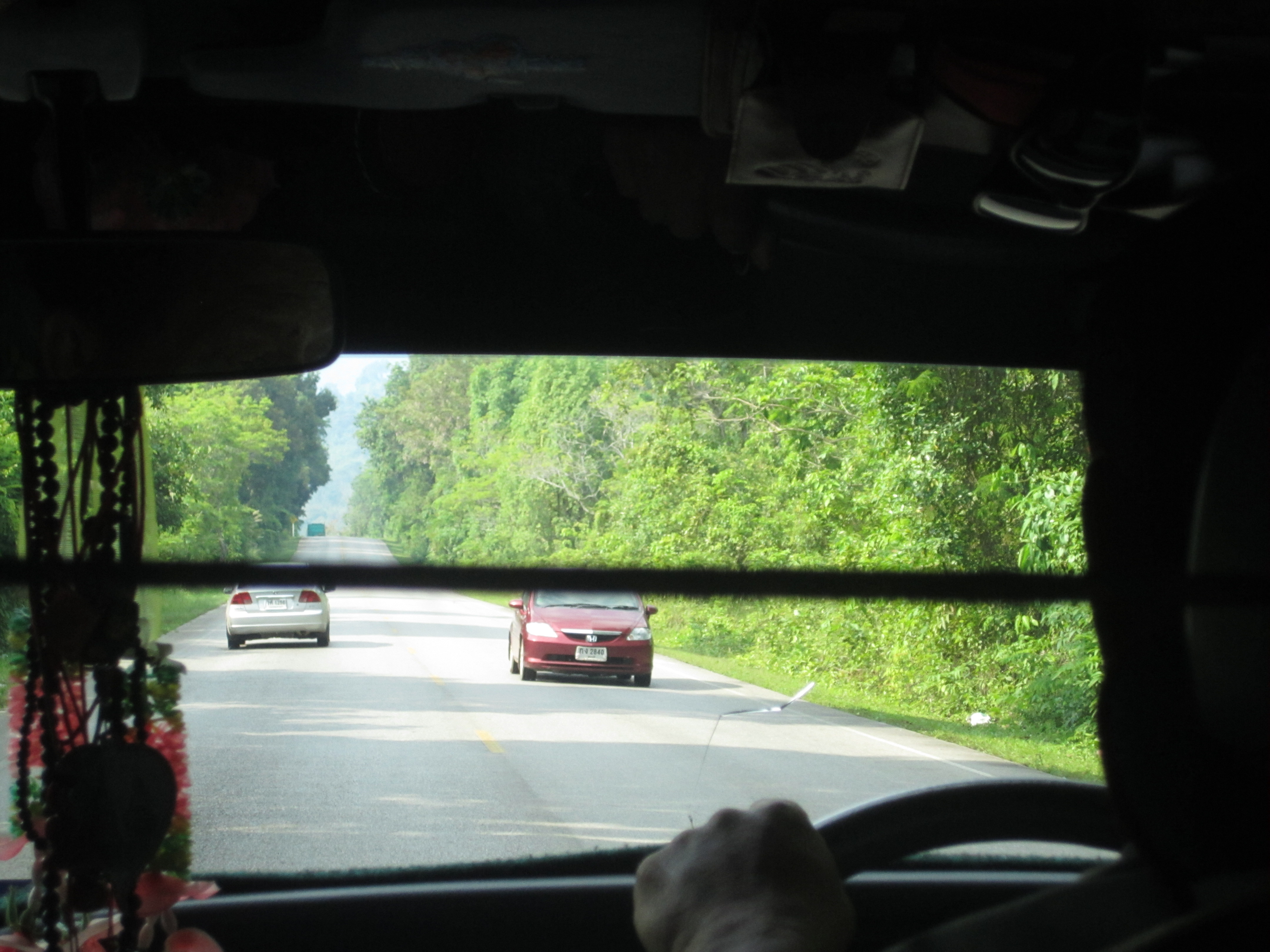
I think this as we climb through the Cardamom Mountains, bus heavy and wheezing. We arrive at the Thai border, our gaggle of Westerners clucking at the Immigration window. (Isn’t this the truth of it?) I buy a coffee; we pile into a different mini-bus and move away from Cambodia and deeper into Thailand.
And it’s different, very different, in a way that surprises me. Borders are usually blurry to me, cultures overlapping like a Venn Diagram. But this one, the contrasts seems stark.
It’s not just that everyone’s driving on the British side of the road, not just that the cars are all newer and shinier. The green is greener in Thailand, I think. There’s no trash on the sides of the road. The electrical wires extend in an orderly fashion, don’t tangle like dreadlocks. There’s more road signs, and they’re crisper, brighter, perkier.
After a month in Cambodia’s capital and five hours chugging through its countryside, Thailand strikes me as wealthy, lavishly wealthy—but something else too. Calm? Peaceful? Something emanates through the lushness, which seems unexplainably lusher than Cambodia. It reminds me of rich kid’s skin, how it seems to glow—how when I was young I learned to spot rich kids by their skin, and I remembering asking my Dad once, “Why do rich kids’ skin glow like that?” and he said, “Access to good health care.” And that made sense, logically, but still didn’t explain all of the glow, or why me and my friends didn’t have it.
And to me, Thailand glows in that way—gleams, even. I stare out at it, the ease and grace it permeates. I want to call it an innocence, but I don’t think it’s that. It’s a stability, I think, perhaps the result of having not been at war, wars. Is this the landscape of peace, of a place that’s managed to never be under the hold of imperialism, that’s maintained a precious degree (or illusion, depending on who you ask) of neutrality?
In comparison to Thailand, I begin to wonder if Cambodia’s landscape does bear wounds, bear a kind of witness—dulled and muted and hard to notice once your eyes have become adjusted to it, like a silhouette of mountains against the night’s sky. Will I be able to see it better when I cross back, the other direction?—what I have easily, automatically normalized.
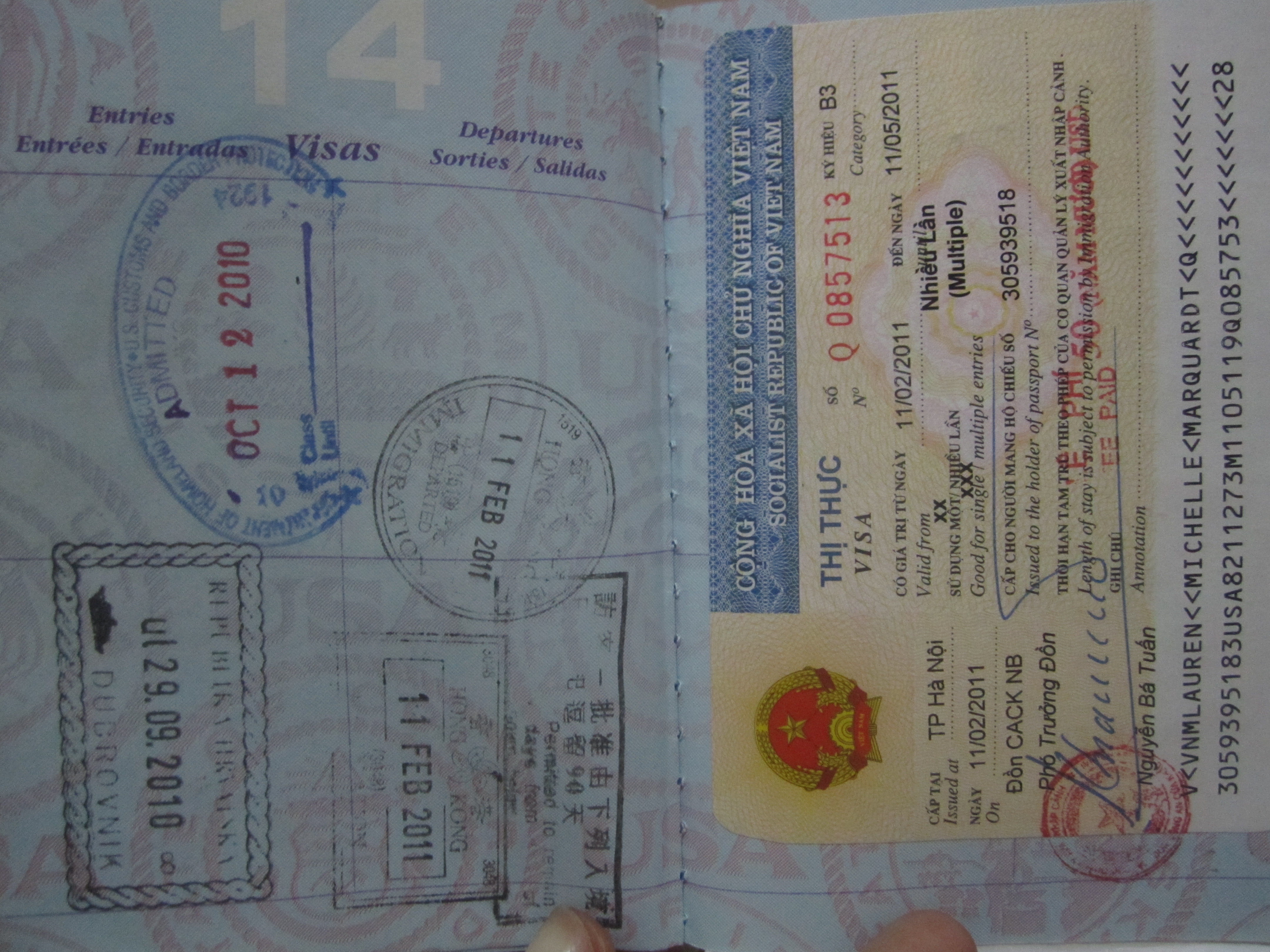
When I started traveling, I loved getting passport stamps. They were like tattoos—when you first starting getting tattooed, all you want is more, more, and you stare at the ones you have, and you look at the remaining blankness and fantasize about the ones you’ll get. Western Europe, I thought, was a real bummer—you got only one (extremely boring) stamp for entry into any of the Schengen Zone countries. Lame.
Enter SE Asia—the land of senseless beauracracy and full-page visas. They hungrily consume your passport, taking up space that could easily fit five to six entry stamps to more modest, reasonable countries. Two of these, and I realized I was quickly running out of room in my passport.
It was time for a trip to my Embassy.
Here I should interject—for the non-Americans and the non-traveling Americans, which is most Americans—that filling up my passport does not make me a world traveler of epic proportions. It simply means that the US issues the skimpiest passports you’ve ever seen.
“Look at this thing!” I exclaimed, holding my passport up sideways, showing Anna its anorexic profile.
“Aw, that’s the cutest little passport I’ve ever seen.”
“And guess how long it’s good for?” I paused, preparing her for the indignity. “Ten years! Ten fucking years! What am I supposed to do with this—go to Canada once a year?” And I flung it on the cafe table like the mildly offensive thing it is.
American passports have improved; they now come with 24 pages. But when mine was issued, they still came with a measly 14 pages. Which is annoying, but serves as yet more evidence that Americans don’t travel like the rest of their Western counterparts.
But we recently hit a record high: a whopping 30% of Americans hold passports. (Tell this to a person of any other Western nationality and they laugh heartily.) And, I’d soon find out, there’s evidence of that too.
So it was off to the US Embassy. I’ve never had a reason to visit an Embassy before, and it felt a little like a field trip. I was mildly excited. I queued up under a shady awning at 1pm, eager to be one of the first in line for the two daily hours allotted for walk-in services.
The door opened at 1pm exactly (ah, American punctuality) and a grim-faced guard waved me in. I passed through a metal detector, was told I need to check my bag. I left that room, walking through a manicured courtyard (ah, the American affection for well-groomed lawns) and into another room, where another man examined my passport, wrote down my info, handed me a visitors badge and waved to enter the next room.
It was like a little air-conditioned slice of America. Posters on the wall: “From Sea to Shining Sea,” portraying different landscape shots; pictures of smiling, racially diverse faces; a sign suggesting that I like the US Embassy on Facebook (now, why on earth…). There was a drinking fountain—not a water cooler, but a drinking fountain—and I took a sip just for the novelty of it. A picture of Uncle Sam pointed down at me, and I smiled.
I lined up at a service window, fenced off with red partitions. I’d heard that they’d recently started charging for additional passport pages. I’d assumed that, now flooded with an influx of traveling Americans, this would be some sort of modest administrative fee; I had $30 in my wallet. I got to the window and told the clerk I needed more passport pages, and asked how much it would be.
She handed me a form. “It’s $82.”
I blinked. “$82?” I repeated. Maybe I heard her wrong.
She nodded. “$82.”
I briefly considered quoting the old Chris Rock skit from I’m Gonna Get You Sucka: “$82? Good lord, that’s a lotta money. How much for one page? How bout I photocopy a page and staple it in myself?”
Apparently the original skit doesn’t have the tag line. But you know what I mean…
Something told me this would not be an effective bargaining technique. Besides, this was the little slice of America, and in America, we don’t bargain.
“Um, okay,” I said slowly. “Well, I didn’t think it would be that much. Do you take credit cards?”
“No,” she smiled. “Cash only.” So it wasn’t totally a slice of America.
I asked the clerk’s opinion on whether I’d actually need more pages. I showed what I had left—two unstamped pages, plus the back amendment pages. I told her the countries I’d be going to. Did she think the customs agents will be able to squeeze the stamps in? (If it were Mexico or Italy, it’d be no problem; those fools will stamp right over of other stamps.)
“I think it’ll be okay for this trip. But it’s the same price here as in the States. So if you think you’ll need more pages anyway, you may as well get them while you’re here.”
Ah, American customer service: she was right. I don’t even know where the Consulate is in San Francisco. Right now I’m living a 5 minute walk from the US Embassy; in Phnom Penh, the task would only chew up an hour or so, as opposed to a whole day.
I nodded. “Okay, thank you. I’ll be back.”
And so I went back yesterday, went through the whole process again. And I must say that there’s something vaguely comforting about the whole thing—even though I don’t feel myself missing the States at all, there’s something sweet and reassuring about being surrounded by the Americana images, the American accents.
The funny thing about the Embassy here—and I’ve been told this is particular to this Embassy—is that services for Americans and services for Cambodians are done in one room. You sit in little chairs and wait for your number to be called, which sounds boring (and it is) but you’re provided with some pretty keen people-watching. Conversations between clerks and customers are done through a glass window, over a small speaker, and that provides for some pretty keen eaves-dropping.
A Cambodian man was trying to secure visas for his family to come to the States. He’d failed to follow the correct procedures and was stumbling to answer questions. He didn’t seem to understand the concept of needing to provide DNA-test results for his kids. I felt embarrassed for him.
I also saw the most Mexican Khmer man in, well, perhaps anywhere: cowboy boots, cowboy hat, big belt buckle and blue jeans, one of those air-brushed Cholo shirts with a picture of a foxy lady on the back, saying something “Por Vida.” I was ravenously curious to find out his story, but he left before I had a chance to sit down next to him and get nosy. Sometimes Khmer people with especially round faces look vaguely Mayan, and in my mind I imagined him having resettled in Texas or California and one day deciding: “Fuck it, if everyone thinks I’m Mexican, I’m rolling with it—por vida.”
A man next to me struck up conversation. He was Cambodian; having lived in the US for 10 years, he’d recently returned and was hoping to get a job at the Embassy. He asked why I was there, and we shared a laugh about how ghastly expensive my simple task was.
“I think it’s because more Americans have passports now—they’re milking it.” I leaned in, lowered my voice, “They found a new way to rip us off, you know?”
He nodded. “Maybe the pages be made of gold.”
I chuckled. “We can only hope.”
I got my passport back and the new pages were not, in fact, made of gold. They were made of paper. Very smartly decorated paper, with fanciful American images—totem poles and majestic eagles and buffalo so darkly colored I don’t know how a stamp is supposed to be readable over it. There are quotes from famous Americans about democracy and freedom and something from Ronald Reagan about living in a world “lit by lightning” that I’ve been unable to make sense of.
The new pages are insultingly over-priced, audaciously gaudy and not entirely practical—in short, very very American. And what can I do but shake my head, both annoyed and amused, with the vague affection one feels for their native land, their home country, their home.
“I like how cheesy it is, you know?” Mathilde said this morning, ashing her anorexic cigarette and looking across the street, at the teenagers hanging out at the Best Friend Cafe. Fake acid-wash skinny jeans, emo sideswiped hair-dos, bedazzled trucker hats positioned atop boys’ heads in a perch reminiscent of Abe Lincoln—the styles donned so earnestly by Cambodian youth would be only be seen on the most ironic of Western hipsters. And even then…
“It’s not so serious as in Europe,” she continued. “We would think this was so cheesy, but why not? If they like it, if they think it looks good, why not?”
One of the things I love most about Cambodian fashion—and it isn’t the stripper shoes or cutesy pajama prints or polka-dot pants—is the utter sincerity with which ridiculous clothing is worn. Ridiculous to Western eyes, I should say. And tonight this was exemplified by the t-shirts for sale at Phnom Penh’s Night Market.
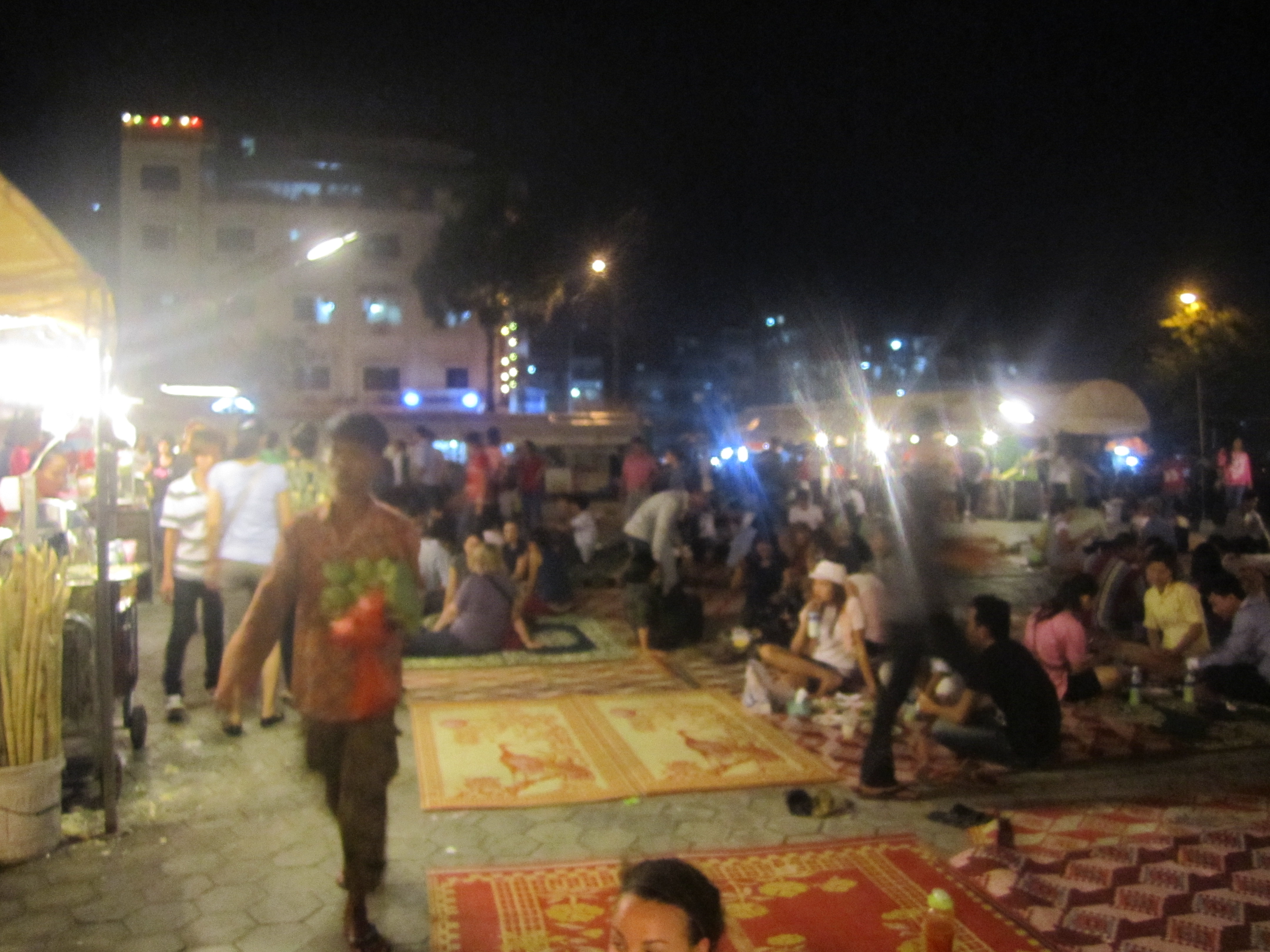
On Friday, Saturday and Sunday nights, along the riverside, tents are erected and a fair-style stage put up; vendors set up booths, teenagers with mediocre voices and sleep-walk-y dance moves perform on stage, mobile phone companies set up opposing stands with megaphones blasting promotions at one another, food stalls sell skewers of myserious deep-fried meat products, and diners take off their shoes and sit on straw mats, eating off thin wooden sticks. It’s nice. It’s a good mix of foreigners and Khmers, the riverside breeze is sweet, and until the mosquitoes drive you away, it’s pretty fucking luxurious to sit out and enjoy the night.
So we’ve been making a habit of grabbing some food and sitting out under the stars—or what would be the stars, might be the stars, behind the haze of city lights and smog. You can’t really be sure anymore. You don’t really go there to buy things—some tourist trinkets, fake floral arrangements (okay, I bought one of those for my apartment), and clothing. Clothing for local teenagers, I should say.
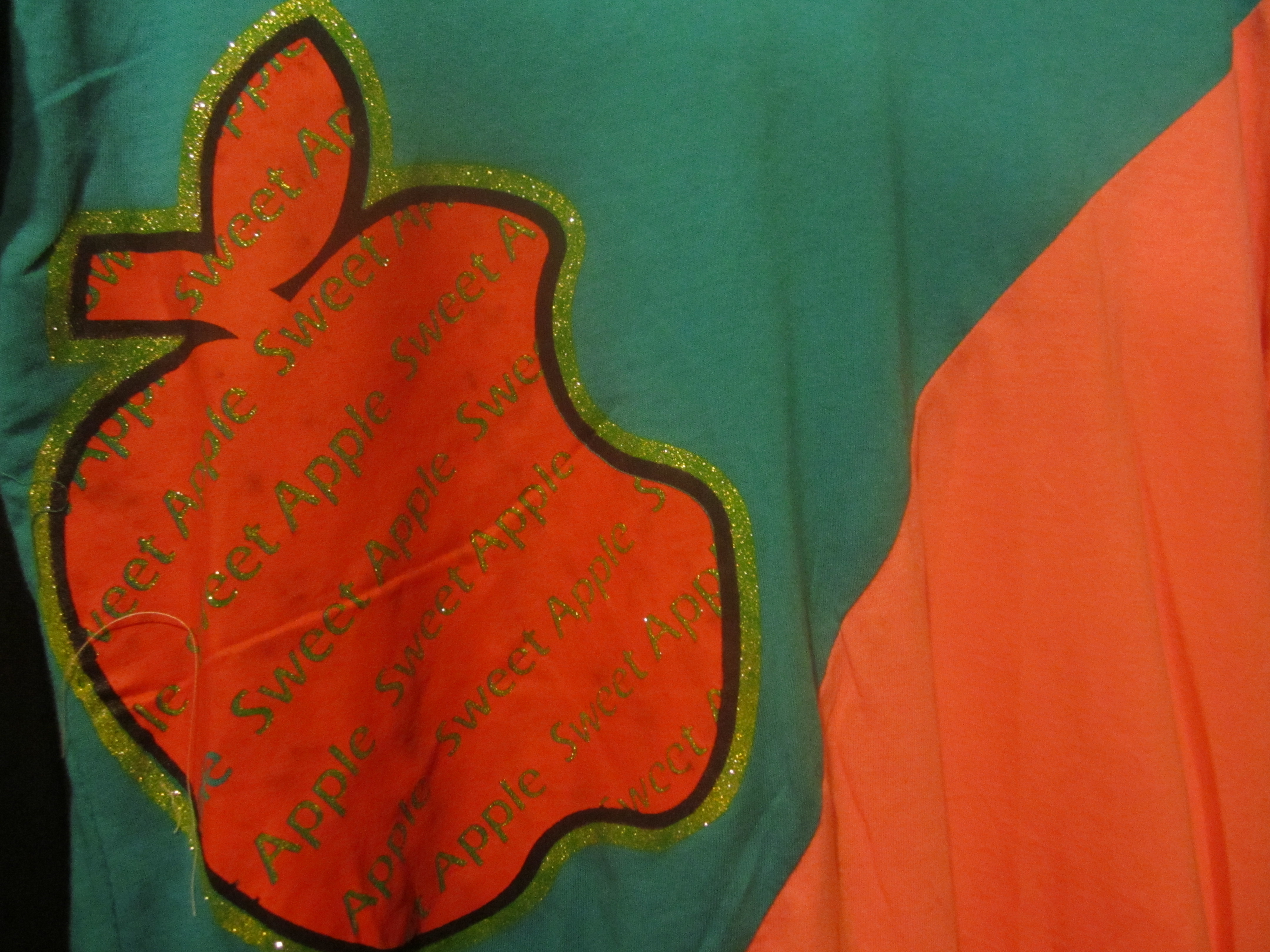
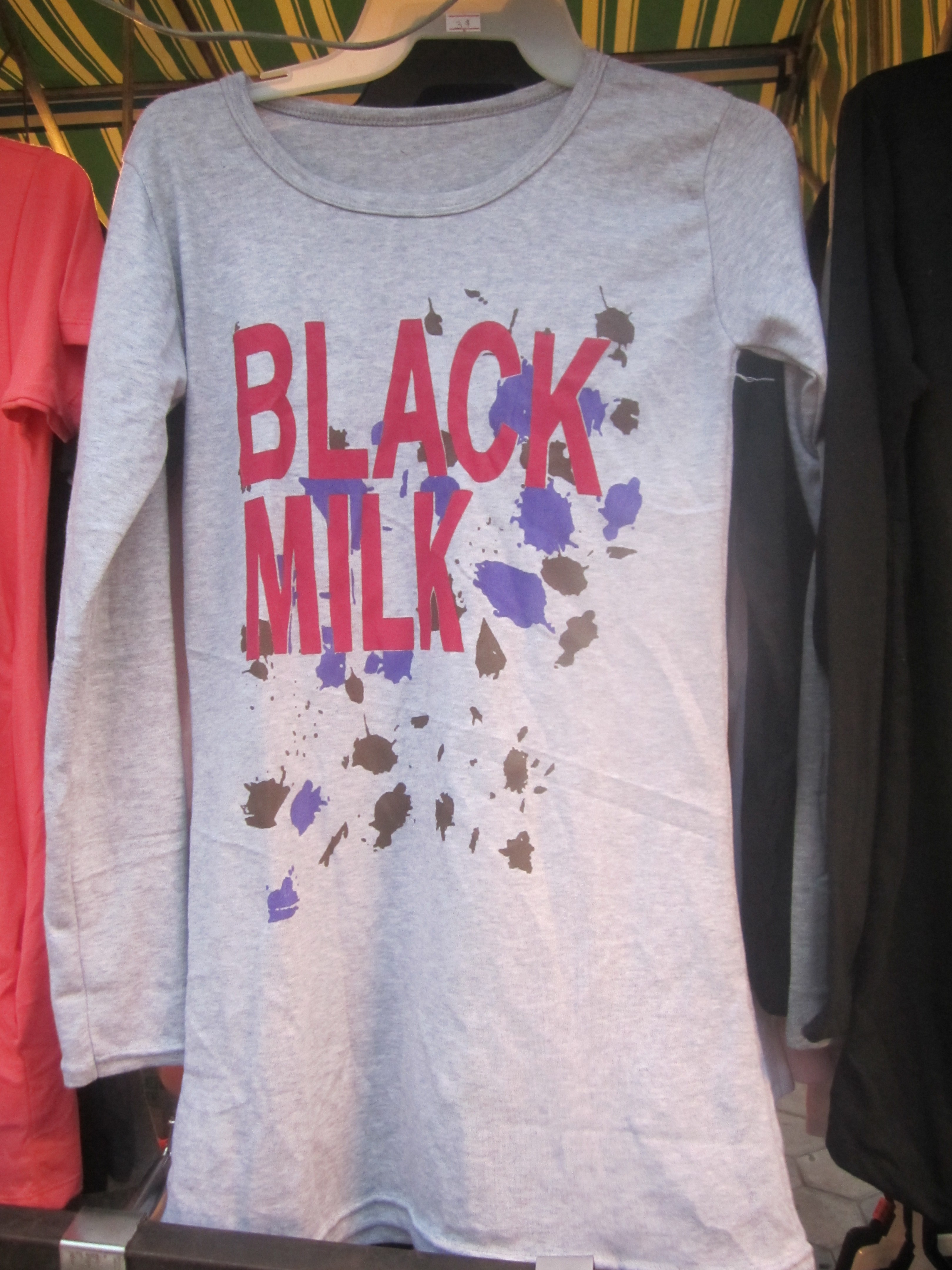
Tonight I took to photographing some of the t-shirts I felt best exemplified the Cambodian fashion spirit within the particular sub-category of Putting English Words On A Shirt Immediately Makes It Cool.
Rule #1: It doesn’t really matter if what’s on a shirt makes sense or not—as long as there are English letters, you’re half-way there.
Rule #2: It really doesn’t matter.
Rule #3: Product placement is a key component of English-language t-shirt fashion. It doesn’t matter if it’s the actual logo of a product, as long as it refers a Western, and preferably American, product.
Hey Apple marketing masterminds: you should really think about doing a Cambodian edition of those PC vs Apple guys ads. Do you see any PC t-shirts out here? I don’t think so…
Rule (?) #4: It also doesn’t seem to matter if the senseless phrases evoke repulsive imagery of, say, spoiled food products.
“Punk Rock Tonight Love Me”: I almost bought this one. It was too small.
“Power Over Pimples”: Fuck yeah! As someone who endured 12 years of acne, I wanted to high-five this t-shirt and jump joyously in the air like… the people on this t-shirt. The text was also English, singing the praises of an acne-fighting cleansing solution.
So, um, in a country where a shitton of kids get strung out on glue sniffing and paint huffing, I didn’t know what to make of this. Was it supposed to be funny? One thing’s for sure: I don’t think the affected demographic is perusing for new shirts at the Night Market though…
Rule #5: Content Over Accuracy
“Joy, Look For It Evert Day”: This shirt says it all. There’s a certain sweetness to it all, what would be convenient to call an innocence, but I think it’s something other than that, less simple or more simple or in any case different.
“Cambodia’s not a post-modern culture,” someone was explaining to me. “So there’s not a lot of irony. There’s a playfulness for sure—but more of a sincerity to the work.”
She was talking about contemporary art, but I thought about her comment looking at the shirts tonight. And I think it’s true for the fashion as well. And I agree with Mathilde—I like it. Coming from a world of ironic everything—ironic moustaches, ironic wolf-howling-at-the-moon shirts, ironic gangsta rap listening and ghetto blasting, ironic malt liquor drinking and crack smoking (yes, really)—it’s pretty fucking refreshing to enter a world of sweetness and anti-irony. It’s not any less self-conscious, it’s just self-conscious in a different way. It makes you feel like we’ve missed something in the Western world, that we’ve lost something, gotten away from something, something I can’t quite name but that makes me horribly sad, in the smallest way, heavy like a pebble.
But I’m Western. And I can’t switch worlds, switch roles, ease myself into a different way of thinking. The t-shirts are, to me, ironic.
So about once a day here in Phnom Penh I have a massive WTF moment. I’ve been catalouging them: a boy stabbing birds, Western beggars, my guesthouse posting a sign about not offering “the sex services,” and pretty much any occasion I open the Phnom Penh Post. Strange things, bizarre things that my Western brain can’t compartmentalize—where all there is to do is shrug, shake your head and say “What the fuck…”
Today’s WTF moment came as I was walking home. It was a mellow day, filled with writing and street food, and I was retiring early, walking down a dusty road lined with corrugated metal fences, behind which the humming of machinery had ceased for the day. Men still wearing their hardhats bicycled past; teenagers in school uniforms clustered at the street corners, eating grilled meats from street stalls.
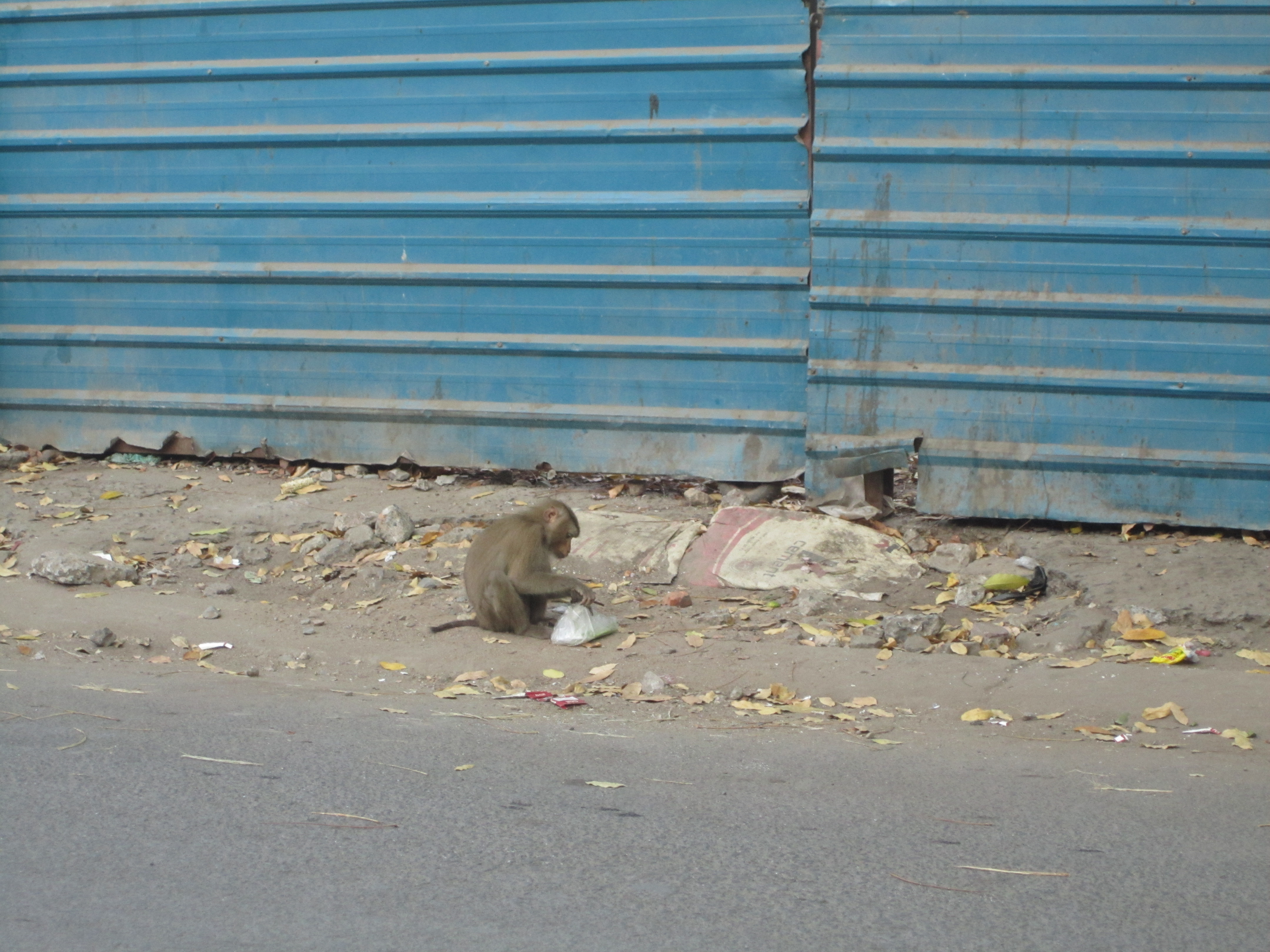
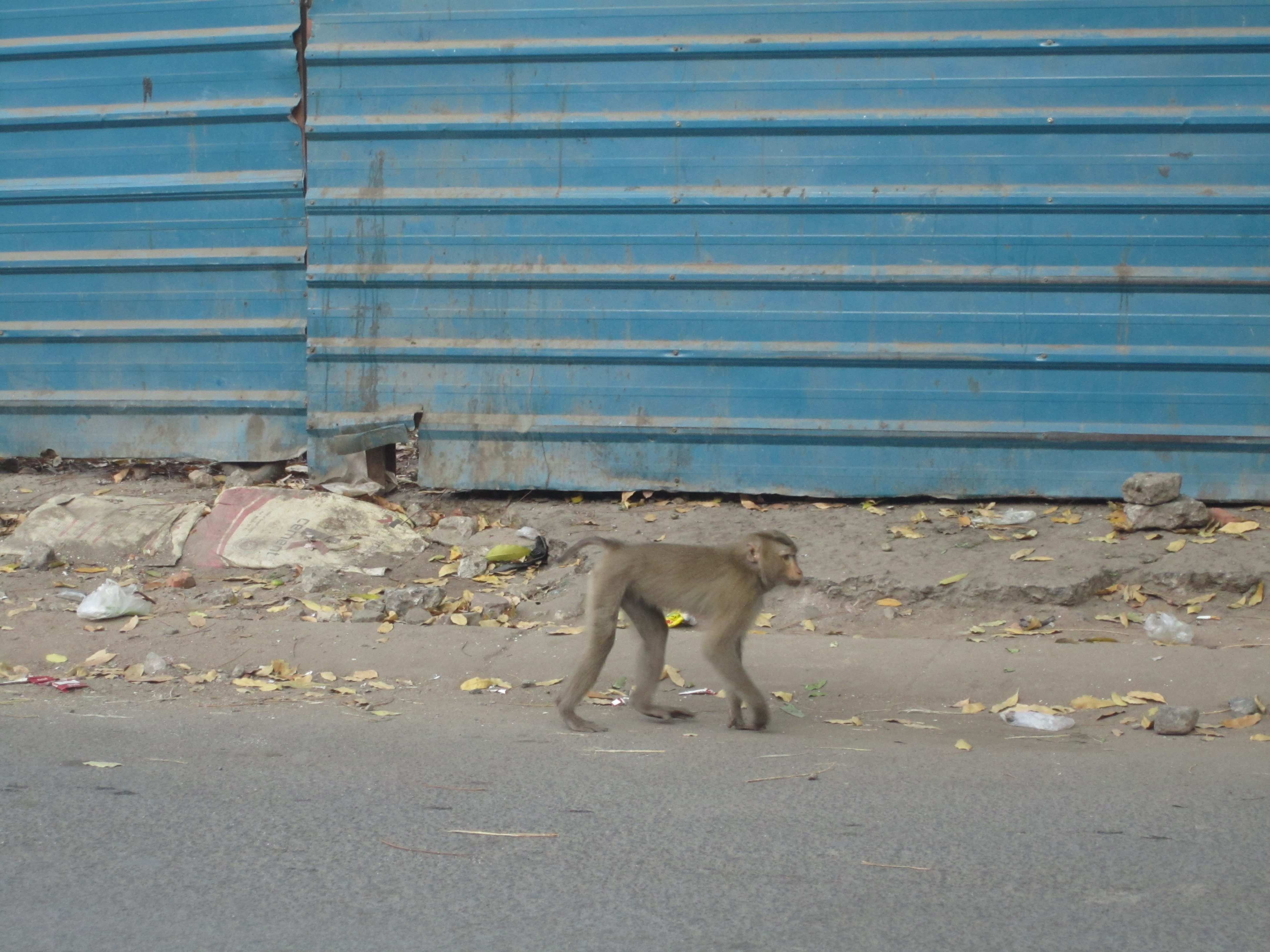
Then I saw this fellow:
Now, I’m familiar with street dogs and street cats and rats and mice and raccoons and squirrels—but WTF?! A street monkey? Phnom Penh isn’t the fucking jungle; it’s a city.
Where did the little guy comes from? Why wasn’t he in a zoo? Why was he just chilling there, riffling through a bag, trying to fish out a little food, sticking his red ass in the air as he repositioned? Why was no one doing anything? Why were they all going about their business like it was no big deal, perfectly normal for a hairy primate cousin to be out and about on a humid late afternoon?
I stood and watched him. I took a picture. A security guard down the road looked at me curiously—What’s this crazy white girl taking a picture of a monkey for?
The monkey tired of the plastic bag, threw it aside. He stretched his limbs and turned, looking into the traffic. He began to cross the street slowly, the same way I do, sensing out the rhythm of the road. He knew what he was doing. He was better at crossing the street than most tourists. The motobikes and tuk-tuks and cars slowed and swerved seamlessly around him—just another monkey cruising across the street.
Then he spotted me.
I still had my camera in my hands; maybe he was offended that I was taking pictures, objectifying him like an animal in a zoo. He gave me a real menacing look, bared his teeth slightly. He walked towards me.
Here I should clarify that I am 100% a city kid. I used to be afraid to swim in water I couldn’t see the bottom of. I’m easily impressed by the appearance of any stars whatsoever. Wildlife freaks me out about as much as uber urbanity freaks other people out. And everything is wildlife: from the geckos on the wall to the squeaks of bats. If it’s not a cat or dog, it’s probably got rabies and wants to eat you.
I thought of Greg, who I met bicycling breathlessly down a dirt road in Southern Italy. Greg was straight outta Queens, his speech peppered with more “yo”s than my own “hella”s. He’d just run into a herd of sheep in the road. He’d freaked—what were they doing? (“Probably grazing,” I offered.) Wildlife, fuck that. He hadn’t wasted any time in pedaling the other direction, and I immediately understood his panic.
And so the gangsta street monkey swaggered towards me. I moved slowly (“keep it cool, don’t ask scared, he can smell your fear”), stepping carefully, one foot at a time, in the opposite direction. When he disappeared between two parked cars, I walked briskly away, shaking my head and thinking, “What the fuck, what the fuck, what the fuck.”
You’re apt to hear this from other Westerners as you travel throughout Southeast Asia; you arrive in Phnom Penh and you’re apt to agree. A friendly, welcoming, almost shy demeanor, so vastly different from the brashness of their Vietnamese neighbors—it’s entracing, in a way, and a part of you falls in love with it, with the endlessly smiling faces, the hands pressed together and the small bow, say, when you pay your tab at a restaurant.
“How could they have possibly killed each other?” you hear people ask. “It’s amazing to think the Khmer Rouge could have occurred in a place like this, where the people are just so nice.” And as you graze the surface—stroll along the riverside, say, or stop for a coffee at a shady little street stall—it’s easy to wonder the same thing.
But you stay here a little while and you begin to see things—shadows that move like stray dogs, so that you think they’re stray dogs, until you look closer and realize: no, no, that’s something else. And it’s like there’s two Cambodias—the one you see on the surface, during daylight hours, and the other, some strange Other, of darkness and violence and short skirts sitting outside neon nightclubs, and weird, weird shit you couldn’t possibly ever understand.
“It’s out there,” Rachel said, nodding. “And all you need to do is scratch the surface—” she flicked her finger in the air “—and you see it.”
Flipping through the two English-language newspapers, you catch glimpses, between the black newsprint that smudges onto your fingertips in the heat. Western pedafiles, human traffikers, drug busts. You read a story about a local military captain being punished for using his gun “anarchically”, shooting it recklessly into a crowd of people. Because no one died, he doesn’t face any criminal charges. Instead, his head is shaved and he’s forced to go a military detention center, what sounds like a work camp, where he scrubs toilets and collects rubbish. He’ll be forced to work until “his attitude changes, then he’ll be set free.”
You read another article, about the murder/rape of a 25-year-old girl in a village in the Cham province. She’d been scratched, maimed, her vagina set ablaze. And yet it’s what the article mentions in passing, without further explaination, as though it were a given, that you find most disturbing. “Even in a time when every week brings fresh news of a horrific assault on a woman or child, the brutality of Lim Kim’s death stands out.” It’s determined that the attacker must be married, because otherwise he would have just married the victim after raping her and wouldn’t have had to kill her. “Something made him unable to be responsible for his actions,” the local police had determined. The reporter had gone on to interview villagers; they reported being “scared of the ghost of the body, but most of all the attacker”—as though it were perfectly normal to be scared of the murderer girl’s ghost, but not of an attacker.
Tim’s telling you the lead-in to some story, some hapless night. It took place at the first Western nightclub in Phnom Penh, where prostitution isn’t the worst of the city’s nightclubs, but certainly still present. “It’s called Heart of Darkness—”
“Wait,” you stop him. “Are you fucking serious? The first Western nightclub in the city is called ‘Heart of Darkness’?”
He nods and you laugh, because what is there else to do in the face of such a blatant metaphor—if you wrote in a book, you say, it’d be over-the-top symbolism. But here it is, in real life, staring you in the face, and there’s nothing to do but shake your head and laugh.
“You should always take a taxi at night,” Patricia tells you at the club, giving you the number of a taxi service. “The police clock off at 9. So sometimes, the moto or tuk-tuk driver will call a friend, and there’ll be someone waiting at your apartment with a gun to rob you. The taxi costs more, but it’s better.”
You program the taxi number into your phone.
You’re having dinner with Susan and she mentions in passing that the number of mob killings are down. “Mob killings?” you ask. “Oh, yes,” and she tells you about the phenomenon of mobs of people spontaneously beating and stoning accused theives to death. “It was really bad seven or so years ago, several a month. They came under pressure from the UN to get a handle on it. It’s pretty rare in Phnom Penh now, but it still happens in the provinces.”
“A girl was double raped earlier this week,” Tom tells you, “and her attackers only had to pay a $125 restitution. The case didn’t even go to court.”
“We’ve secured scholarships for several kids to go back to school,” Romi tells you when you visit Tiny Toones.
“Are the school fees very high?” you ask.
“No,” she sighs, “it’s the bribes that really add up.”
“Bribes?”
“Yes, the teacher bribes. They don’t always call it that, but it’s like this: the teacher photocopies a lesson. They say, ‘I paid for this photocopy, so you must pay me.’ If you don’t, you don’t get the lesson, you can’t take the test, you can’t pass the class. So it’s like this. But,” she shurgs and looks out at the shaded lot of squealing children, “this is Cambodia, and this is how it is.”
You nod. You’ve given up trying to wrap your head around it, trying to fit it into some compartment of Western understanding.
But it doesn’t feel bipolar; it doesn’t feel like a contradiction, or like it’s at odds with itself. You feel, on an intuitive, unnameable level, that it’s two sides of the same coin—that it’s born from the same place, the beauty and grace and warmth, and the violence and corruption and darkness—born from the same mystery down there at the center, and not so far from the surface.
You think of Elliott Smith. Which is embarrassing and ridiculous, but you think of him anyway—of the beautiful ballads, the immense tenderness, the way you cried across the Atlantic when his song came on your iPod and the news of the death was fresh, an another lifetime that’s not so long ago sometimes, not as far as you’d like to think. And you think of people asking, “Man, how could he write such beautiful songs and fucking stab himself in the chest?”
And you’d always thought, “That’s how.” And you think of it now, though you’re not sure why, though it’s not at all the same thing—though you laugh at your silly, silly gut for telling you it is.
Lauren Quinn is a writer and traveler currently living in Hanoi. Lonely Girl Travels was a blog of her sola travels and expat living from 2009 to 2012. She resides elsewhere on the internet now.
 I stood staring at a display of UXO casings at a Phonsavan tour company. I was thinking of the documentary I’d seen the night before (see previous post), which followed a group of impoverished Lao children as they harvested UXOs for scrap metal.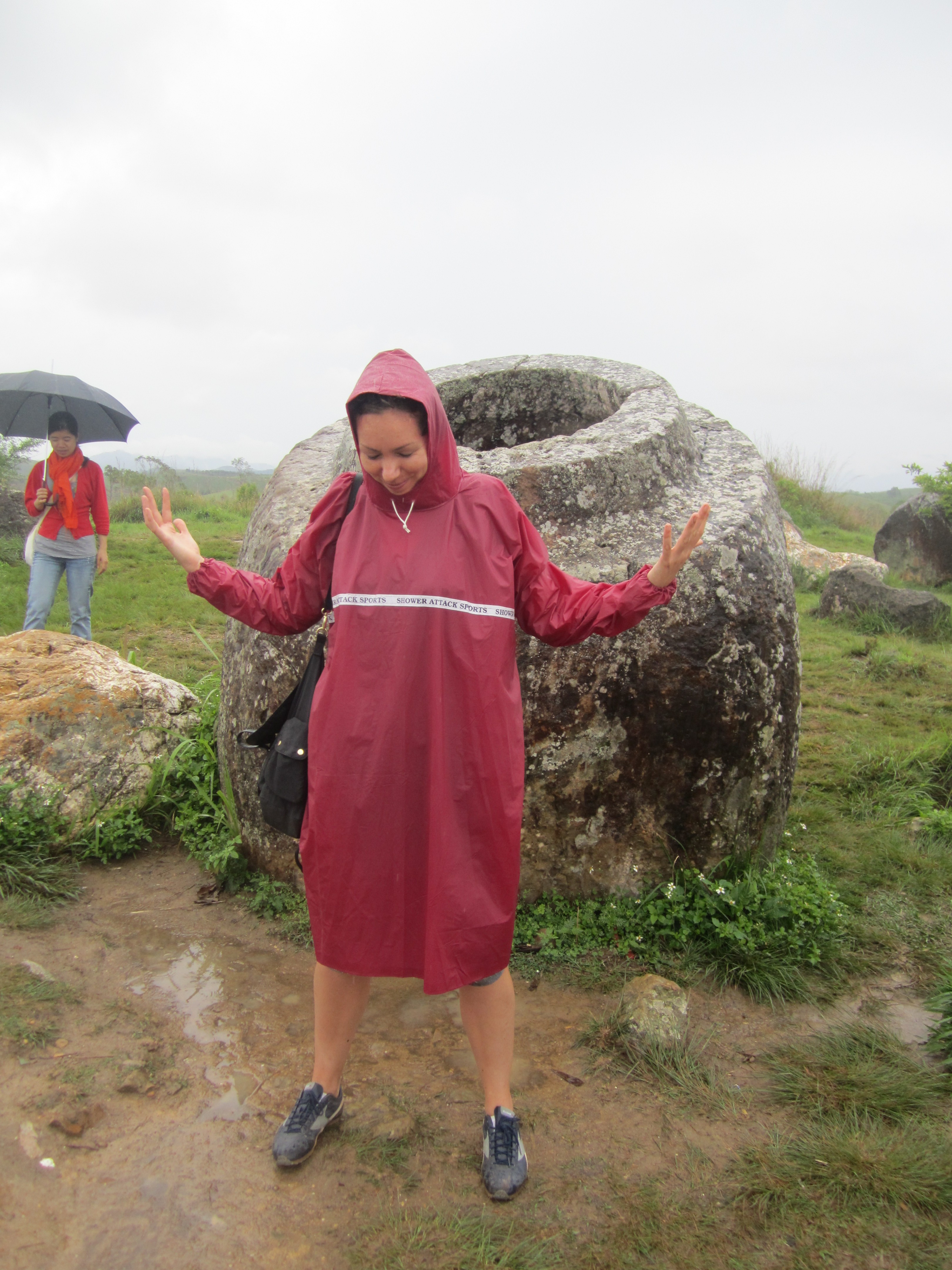















 Lonely Girl Travels
Recent Comments