Archive for the 'Dirty Tricks' Category


Living With Vampires

It’s vampire season in Oakland.

We sit at the bar, piles of cash and cigarettes and half-drunk bottles of wine—another end to another shift. It’s past midnight, and we’re all tired, itching to get home. “Just another ten minutes, I swear!” JL calls from the loft.

We sit there—all four of us—off the clock and waiting. Because we can’t leave someone to walk out alone.

I used to wonder as a little kid which would be worse: to live with werewolves or vampires? Werewolves could pulverize through anything, but you only had to deal with them one night a month. Vampires, on the other hand, were tricky, the color of shadows, and out there every single night. As soon as the sun went down, the streets would become a different thing, sinister, a free-for-all, an anything-goes zone where at any moment a pale, hungry creature could leap out and attack. And you could harbor illusions about fighting them off, but really, what were the chances you could actually drive a stake through their heart? You’d be defenseless, and all they’d see would be your virgin neck and throbbing vein and they’d want a drink—a drink of blood that was now theirs.

I imagined the constant stress, the constant level of awareness, the little ways that living with such creatures would reshape your life (“I left something in my car. Oh well, I’ll have to get it in the morning; not worth risking it.”), and in the end, I’d always decide that vampires were worse.

And it’s a similar feeling in Oakland right now—that when the sun goes down, the shadows come alive, and go on the hunt. There’s been a rash of robberies and violent assaults among the circles I frequent, enough that I can’t discount it as the usual fifth-most-dangerous-city-in-the-country shenanigans. No one can.

I forget how much it’s there, this constant consideration in the back of my head. I won’t take the train into the city if it means I’ll be coming home after dark; I don’t want to risk the walk back to my car from the station. I don’t go jogging at night—or at least, I drive up into Piedmont to do it. I suck it up and pay for parking in order to park right outside the restaurant I work at, so I again don’t have to risk walking farther than I have to.

But it’s gone a step further this year. After two guys I worked with got robbed at gunpoint leaving the restaurant, we stopped walking out even in pairs—we all leave work together now. After a girl from another restaurant got abducted, robbed and tortured, we won’t even let our manager stay late, even if her car is literally 50 feet from the door. She rearranges her schedule so that she comes in early, gets her office work done, and can leave with everyone else.

It’s like being a prisoner in a way. There’s no comfort in the fact that the fear applies equally to men and women, or that it’s not even fear that drive you all, but rather a statistical likelihood. When a third guy you work with got his nose broken last week, the reaction was largely anger—at him. “What the fuck was he doing thinking he could walk three blocks by himself?”

I keep thinking about Tirana, about my first late night at a bar, when everyone I’d come with had left.

“Where can I catch a cab?”

“A cab? You can walk, you know, it’s only 15 minutes.”

“Yeah, I know, but it’s late, and I’m alone…”

“Oh, but it’s totally safe.”

“I’d rather not risk it.”

A laugh. “Listen. In five years at the hostel, we’ve never heard of anyone ever having a problem.”

And it felt strange, walking through the two am streets, a foreign girl by herself. I couldn’t stop checking my back, walking briskly, staring down the few strangers I passed.

But eventually, I got used to it. And I almost felt giddy, elated by this strange sense of freedom—a sudden lightness and ease. Sometimes you don’t know what you’re missing until you get a taste of something better.

Just after one of the guys at work who got robbed, he posted a really telling Facebook status: “I knew it was bound to happen, living in Oakland caught up with me.” And it kind of broke my heart, because at times I feel the same way—like I’m just waiting for my number to be drawn. That I can be as careful and cautious as I’d like, but eventually, one day, I’ll let my guard down or take a risk, and it’ll be me, my turn, my time to get bitten.

When we finally walk out, it’s after one am. “That,” I sigh, “was not 10 minutes.”

“Nope.”

“But it’s not like we coulda left her there.”

“Nope.”

And we get in our cars and drive own separate homes, where we’ll circle to find the closest spot, walk briskly to the gate and slam it shut, tightly behind us.

Americanness on the Road, Part II: It Ain’t All Bad

Yes, really: George W Bush Street, in Tirana

“America is the best country for a person with a disability to visit.”

This was Rob, sitting cross-legged on the roof terrace of the Tirana hostel. He continued, “For deaf people, it’s like a dream. It’s like going to Disneyland. Actually,” he ashed his cigarette, “Disneyland is great for people with disabilities too. Wheelchair accessibility and all.”

Chad looked confused. You could see the information smacking up against the wall of prejudice, his brow wincing from the pressure.

Chad didn’t like the US, and Chad was American.

Rob continued on, citing the revolutionary wonders of Civil Rights legislation and the Americans with Disabilities Act (ADA) in his English accent. Rob was in Tirana doing NGO work in the deaf community; Zhujeta, Rob’s girlfriend who helped run the hostel, also did work with the same NGO. Rob rattled off the comprehensive services available to deaf people in the US—from resources in public schools to telephone interpreters—vastly different from any other country in the world, including his native England.

Chad nodded, soaking it all in. “Wow,” he said thoughtfully. “I guess that’s one thing we didn’t fuck up.”

It’s easy for Americans to be jaded about our own country. There’s a lot of fucked-up shit going on in it, and we’ve caused a lot of suffering, both abroad and at home. It’s easy to fall into a sort of naive cynicism: our country is completely fucked. As young travelers, little ambassadors on hostel terraces, we feel it our duty to decry our country and lament its shortcomings, its sins, its unforgivable and deplorable acts. And there’s a lot to decry.

But it’s something like the Guilty White Person syndrome, the Bleeding Heart Liberal. This perspective—and God knows I fell prey to it for several years in my early traveling—lacks complexity, nuance. The US isn’t the evil empire, as easy and convenient as it’d be to think that. Just when you want to write it off, there’s something like the ADA to remind you of the revolutionary notion of equality written into the fabric, the very law of the land, that you can’t get away from—that, no matter how far we sway into the other side, keeps showing up and shaking things down.

It was funny to watch that information try to sort itself in the mind of someone who thought they’d neatly washed their hands of the issue: US = bad. Because the fact is, we only have ADA legislation as a product of Civil Rights legislation, and we only have that because of that little blip written into our constitution that declared all the men equal. Sure, it’s not what a bunch of rich white dudes in powdered wigs meant at the time, but too bad. And this is what, in my mind, makes our country such a complex, contradictory and ultimately fascinating place: this space for change, this tension built into it. That, and the incredible cultural cocktail that keep colliding, exploding, bubbling over and making something new.

It was even funnier to watch Chad struggle with the information that Bush Senior was the man who signed the ADA into effect.

Because things as big as people or countries are never that simple, never all one thing (“Do I contradict myself? Very well then, I contradict myself. I am large, I contain multitudes”—when in doubt, always quote Walt Whitman). It reminded me of a Middle Eastern friend of mine, an ethnic minority from Iraq, who told me her mother still thinks of Saddam Hussein as a great man, because he didn’t persecute Assyrians.

And there’s more than the ADA on the list of “things we didn’t fuck up.” But it wasn’t my job to teach or explain that to Chad; he’d have to figure it out for himself. I just sat back and watched the lightbulb turn on, a small flicker of awareness.

Later on, we sat playing music from someone’s iPod. “Welcome to the Jungle” came on, and I indulged in a moment of cheesiness. “To me,” I said, absently, not really thinking about it, “this is the epitome of America. This is what the US sounds like.”

Chad looked slightly taken aback. “What do you mean?”

“Well, it’s rock, good ole’ 80s hard rock. Which came out of rock n roll, which came out of the blues, which is about as fucking American as it gets. It comes from the core, you know, the soul of the country. And I fucking love it,” I added. “American music is my favorite music. In all its permutations—folk, country, soul, hip hop, grunge…”

“I guess I never thought of it that way,” Chad said. “I think of American music as, you know, the corporate Britney Spears shit.”

“Well, yeah, it’s that too. But that’s only a small bit of it.” I lowered my voice and leaned in. “No one can deny it: our music is pretty bad-ass.”

Americanness on the Road, Part I: Letting His Issues Be His Issues

“I hate your country’s politics.”

This was K, and this was the first thing he said to me.

We sat on the dark patio of a Tirana bar, table of ashtrays and beer bottles, the headlights and footsteps of surrounding streets obscured by a criss-cross fence. I’d arrived in the city only hours earlier, and had already found myself chasing fun with the group of people I’d hang with for the next five days.

K had just come in from Kosovo, in town for a gig where important record executives would be. He sang, or he played the guitar, or did both—it wasn’t clear. He had a red Adidas track jacket and the straw Fedora of male insecurity: a little too self-consciously cool.

He sat down at the table, said his hellos to old friends, was introduced to me. He asked where I was from, then crossed his arms, leaned back, eyes narrowed to a challenge, as if to say, “Come on, step to this, I dare you.” He announced his personal aversion to my country’s politics with smug satisfaction.

It was like K was trying to hand me a big bag of his bullshit. And I, in turn, got to firmly but without malice reply, “Actually, this is yours. And I’m just gonna let you hang on it.”

There was a time when I would have had to jump up and down to prove to K that I wasn’t one of those Americans. I would have cited my city of residence, my family’s long history in activism, personal lifestyle choices that reflect my commitment to anti-corporate, anti-imperialist values. I would have lamented the pervasive culture of ignorance and fear that paved the way for predatory politics, and when the bitch/blame-session reached its crescendo of discontent, I’d have thrown my hands up and announced my ultimate goal to marry someone with an EU passport and flee the whole mess.

I would have, in short, run laps to prove who I was to K, to win his validation and approval, this person I had just met, in some sort of attempt to resolve my own insecurity about my nationality.

Instead I shrugged, sighed, “Yeah, join the club, buddy.”

The rest of the tabled groaned at K. “What is that?” Robo asked, shoulders hunched and flicking ash, seeming a little uncomfortable at K’s underhanded assault on me. “That’s the first thing you say to someone?”

“Well, I do hate the US’s politics,” K defended himself.

“Yeah, but as the first thing to say?” Zhujeta cooed in her gentle, loving way. “Not even, ‘Nice to meet you.'” She titled her head in the same way as when she spoke to the begging gypsy kids that cruised past the table, “It’s rude, K.”

“Okay, okay,” K waved his hands as though they were little white flags. “Sorry, nice to meet you.”

I shrugged again. Whatever issue it was—whatever insecurity in K made him want to challenge someone, get them to prove themselves to him—I wasn’t going to get involved. That was between K and himself, not me. Or my Americanness.

Boys, Boys, Boys: A Solo Female Traveler’s Experience With the Men of Southern Italy, Montenegro and Albania

You know the picture...

“Southern Italy, eh?” He gave me the raised eyebrow of caution. “Watch out for the men.”

This was Alex, his voice lifting above the roar of hair dryers and hip music at the salon, two days before I left on my trip.

A lady friend of his, he continued, had recently spent several weeks in the Mediterranean land of machismo. “Apparently, they all use the same line: ‘I have a girlfriend. But tonight, for you, no girlfriend.’ She said it got really old.”

I laughed. To be honest, it hadn’t crossed my mind yet. Dealing with the men of a country as a solo female traveler is usually one of the first things people ask me about when they hear I travel alone—right after the “is it safe” question. But the truth is, I’ve been doing this sola thing for awhile now, and whether or not the men somewhere will hound me to death doesn’t really factor into my travel considerations. Plus, I’ve done the majority of my traveling in Latin America, where sidewalks can at times feel like catwalks of degradation. As long as the men aren’t physically attacking me, I pretty much feel like I can handle it.

But Alex’s comment did give me pause. When it comes to safety (and drinking tap water), I throw caution to the wind in Europe. It’s the civilized, more highly evolved land of social safety nets and low crime. Hell, the vast majority of Europe is safer than my hometown. My hairdresser’s comment reminded me that, oh yeah, right, I’d be venturing off sola in a scant 48 hours and that maybe I’d ought to mentally prepare.

You stand out as a female solo traveler, and in a way, get to experience a culture more deeply, if no other reason than the fact that its men are talking to you more. My last trip took me to Southern Italy, Montenegro and the capital of Albania (and Croatia, but I only stayed for a day, so I’m not counting it). The men in each these countries treated me totally differently—and, I think, reveal a little something about the culture.

Italy

Oh, Italian men. They have quite the reputation. American women swoon for their accents, their sense of style, their motorinos and chest hair. And they’re known for hitting on pretty much anything that moves, serenading you with sweet odes of professed passion.

I don’t get it. And Italian men, apparently, don’t get me.

During my venture Rome-and-southwards, I was largely ignored by Italian men. Which suited me just fine. Again, having traveled heftily through Latin America and once through Morocco, I’m stoked on anything that isn’t street harassment. I’ll take being ignored over obscene insults any day.

But it did cause me wonder… Who the hell are all these American women who are getting hit on Italian men all the time? I’m a cute enough girl, but do you want to know why I wasn’t getting any attention from the dudes? Because they’re surrounded by Italian women—who are impossibly gorgeous and stylish, with their cascade of curly hair and their moody black eyeliner. I wouldn’t hit on me either.

Traveling through Southern Italy was like an adventure in mutual disinterest—as though every guy I passed on the street exchanged a brief little dialog with me: “Thanks but no thanks.” Italy is a pretty culturally conservative place, and I’m a pretty not culturally conservation person, in appearance or attitude. So it makes sense to me that the Italian men and I didn’t vibe. In person, that is.

While I was in Naples my Couchsurfing inbox got flooded with messages from shirtless dudes in sunglasses asking me if I needed a place to stay. (“Um, no.”) But this was the extent of the Italian sleaze I experienced—an indirect, easily ignored, half-assed attempt.

Maybe that was the secret to the purported flirtations of Italian men: that it’s largely impersonal, having less to do with you and whether or not there’s any real potential for something to happen, and more to do with, I dunno, not having anything else better to do? Hitting on someone just for the sake of hitting on someone?…

Montenegro

If ever a girl was thinking of a place to take advantage of men, Montenegro would be the place to do it. I had more offers for rides, tour guides, free drinks, places to stay, etc than anywhere else I’ve been.

But the curious thing was a) all the attention was from middle-aged men, no guys my own age, and b) they somehow managed to stay just on the right side of appropriate and respectful. I never felt violated or threatened by any of the Montenegrin men; it all just came across as really, really nice.

I was of course only getting the attention because I’m a pretty young(ish) American girl traveling alone. Montenegro is really trying to woo Western tourists, and I think I was something of an anomaly; there weren’t many Americans, weren’t many backpackers, weren’t many women alone. I think I was on the one hand intriguing for this reason; I think Montenegrins in general also really want tourists to feel welcome, want to take care of them. I must have sparked all the paternal instincts of the middle-aged men there. But somehow not in a demeaning way. Most curious.

Albania

At a certain point one night, it got ridiculous. I had to put on my sweater and get the hell off the dance floor.

It was like moths to a lightbulb. I have never received more male attention from males I actually wanted attention from than in Tirana. It was dangerous.

Albanians my age, it seems, really want to be Western. They’ve lived most of their lives in post-Communist Albania, but still relatively isolated from the rest of Europe. They’re ready, it seems, to be a part of the rest of the world.

For most kids, this striving seems to take the form of mainstream culture, the Top-40 kind. Stylistically, Tirana is filled with tons of extremely beautiful nouveau riche girls, who could, at first glance, blend in on Parisian sidewalks. You look a little closer and you realize that they don’t quite have it right yet; they wear a little too much make-up, their clothes not quite expensive enough.

But the point is, they’re trying really really hard. They have the posture, the poise, the carefully cultivated look of class in the arch of their fingers as they lean back and drag their cigarettes. They also don’t seem like a whole lot of fun—a little snobby, to be honest.

So I stood out, and not just for being foreign. There weren’t any other girls in Tirana like me, in sneakers and a band shirt, with short hair and tattoos. I’m a dime-a-dozen in the Bay Area, but in Tirana, I was the only act in town. And every single rock n roll dude, it seemed, was eying me. Or talking to me. Or offering me drinks or asking me out or wanting to dance with me.

Big-fish-in-a-little-pond syndrome. I’d never experienced it. After the initial rush of validation, though, it felt funny. It didn’t seem real and, in a way, it wasn’t.

It was like Genti’s indie rock band. An Albanian turned Brighton boy, Genti was just another dude in a band in England. But in Albania, he was becoming a big deal, selling a ton of albums and appearing on Albanian TV. It would have been easy, he told me, to really make it there. “But, I dunno,” he yelled over the barroom clatter, “do I really want to be the guy who was ‘really big in Albania’?”

I paused, and asked myself the same question. I was pretty damn sure that if all these rocker dudes were suddenly delivered into the Bay Area, they wouldn’t be tripping off me so much. I wanted to tell them, to put my hand gently on their shoulders and let them know, “Honey, there’s a big world out there, and it’s filled with a fuckton of cuter girls with more tattoos than me.”

But they’d have had to take my word for it. Cause it’s so damn hard for an Albanian to get a tourist visa, or to afford to travel anywhere where rock n roll girls live, places steeped in privilege.

So I did all I could do, which was to shake my head and laugh.

Albanian Death Flu, and The End to a Charmed Trip

Dog is my co-pilot?

It had been the best trip I’d ever been on. And, you know, I’ve been on a few trips.

But at last it happened: the perfect constellation that had hung above my trip cracked, shattered, rained down in a million filaments on to my cigarette-stained clothes until the smell writhed back out of rank layers. Not that I could smell it.

On my best trips—well, no, even on my worst trips—I don’t really feel in charge. That’s one of the things I love about traveling: it shatters any illusions of being in control, of running the show, so to speak. Serendipity drives the car; you just ride shotgun.

And I’d been really quite pleased with Serendipity’s navigational prowess on my latest trip, taking me to random small towns, big crazy cities, introducing me to rad people, giving endless writing material, keeping me in good spirits. I approved. “Job well done.”

But on my way back to Rome, something snagged, tripped, pulled the plug. It was my attitude. And my health. Things were no longer going my way. And so I ended my trip slumped over in a plastic airport chair, achy-boned, runny-nosed, sleep-deprived and pissed as fuck.

I didn’t want to leave Tirana. The only date I locked myself into on my itinerary-less travel was my flight from Tirana back to Rome, mostly to avoid another sleepless, freezing cold ferry ride. It was a cheap ticket, the kind you can’t change—so when I had to pass on the opportunity to drive up to Shkoder to get tattooed in an abandoned bunker and instead fly back to expensive-ass, whacked-ass Rome, I was slightly bummed. To say the least.

On the flight, I began to feel a tickle in my throat. I coughed. I assumed it was the result of the pack of cigarettes I’d smoked in the previous 48 hours, or the succession of late nights, or the guzzling of tap water that I wasn’t really supposed to be drinking. And it probably was those things. It was also the beginnings of what I’ve dubbed Albanian Death Flu (incidentally, also the name of my new metal band).

It started slow and steady as a rumbling drum beat—the amplified echo of my own heartbeat in congested ears. It’s okay, I could power through. I had a few different friends that also happened to be in Rome at the time that I wanted to meet up with, some events I wanted to check out; I’d fill the time.

It was like a see-saw: the more things unraveled, the shittier I felt. Or the other way around. Whatever. I never got in touch with any of my friends. The events either fell through or were kinda lame. After blissfully cheap, tourist-free Tirana, Rome was an expensive, American-swarmed jolt to my sick system. And I wasn’t helping myself any. I was cranky, torturing myself with the shoulda’s and why-didn’t-I’s. Serendipity may have been driving the car, but I was being a pretty big backseat driver.

It all came to a fevered pitch at the airport. I didn’t sleep at all the night before, six hours of tossing and turning and coughing and groaning. The overpriced train ride to the airport had robbed me of my last few Euros, so, with no cash for breakfast, the post-nasal drip stirred in my stomach in an unsettling stew. And I had no patience for my fellow travelers.

Rome is a most beloved destination of Americans, right up there with Paris and Disneyland. But it’s a pretty culturally conservative place—not a lot of contemporary arts or music going on—so it doesn’t tend to attract our most dynamic demographic, what I call our A-Team. It’s most popular with the Joe-and-Marge-from-Iowa demographic. Not that I have anything wrong with Joe and Marge; it can be, actually, just as culturally fascinating and foreign to observe them as Romans.

It’s just that Joe and Marge don’t travel much. They get stressed out easily, and they bicker with each other. They aren’t as adept to rolling with cultural differences, and feel it necessary to (loudly) point out contrasts and the discomfort those contrasts provide. They get lost easily. They aren’t urban people, and they get confused by public transportation, crowded spaces, the Italian irreverence for lines at espresso counters.

All this I’m more or less willing to take in stride. Except when I’m sick, nauseous, sleep-deprived, and generally fighting the gods of circumstance. Then I sit in a plastic airport chair with steam seeping out of my ears and one eyeball slowly twitching.

I gave up. I couldn’t fight it anymore. My body—and Serendipity—were trying to tell me something: the party was over. It was time to slow down, sit still and accept what came my way.

I went to a pharmacy and bought some mystery Italian cold medicine on my credit card. I changed a little cash back into Euros and bought a stale, overpriced panini. I moved over to an empty gate and slowly munched my bread in relative peace. Then I boarded my plane and promptly passed out in puddle of drool and sneezes (yeah, I was that person).

Even great trips have bad moments, and every trip, even the best, has to end. I suppose the trick is letting that happen gracefully. Still working on that one.

The Foreigner at the Party

Tirana and Rome don’t have much in common—except that it’s absurdly easy to stand out as a tourist.

They come at it from different angles—Rome because there’s so many goddamn tourists (really, do Americans realize that there’s other countries in the world?), and Tirana because there’s so few goddamn tourists (really, do people realize how amazing it is?). But the effect is the same either way: you aren’t ever, ever going to blend in.

Some travelers get bummed out by this, and do everything within their power to fool themselves (and themselves only), acquiring affected accents and scarves for the local football team. But I say fuck it—no one’s gonna buy it anyway. So you may as well just dance.

Friday night felt like a riot in Tirana: chanting crowds, police sirens, streets shut off, smoke billowing and fireworks flashing. It wasn’t a riot, just the Albania-Bosnia football match. The insane energy of it all is a little anxiety-provoking for an American—if it were Oakland, someone would have gotten shot.

Our little clan from the hostel walked through the raucous roads; some had picked up Albanian flags along the way, but it wasn’t any use. We were varied races and ethnicities, all speaking English, and the stares we ellicted became almost laughable, necks craning and feet stopping cold.

“Hello, hello,” shouted a voice from a drunken crowd, as though to point out that we were different and didn’t belong.

Everyone got quiet and a little uncomfortable. I gave a stupidly exaggerated wave. “Howdy!” I exclaimed in a Southern accent. “How y’all doin’?”

And we all had a laugh.

We didn’t end up getting into the stadium. It’s my absolute fate with football—I’ve never managed to actually see a match. So we marched across town to a bar to watch it on TV, amusing everyone with our mispronounciation of “Shqipëri,” the Albanian name for Albania. One of the waiters was so amused he bought everyone at our table—fourteen of us—a round of drinks. Sometimes it pays to stand out.

After the match we went to another bar, an underground spot near the Opera House, walls covered in the photos of the artists that used to hang out there (as well as a healthy layer of cigarette smoke). A DJ was playing drum and bass from his glowing white laptop and everyone was dancing, arms raising to graze the low ceiling.

Again, we were the only foreigners. But the good news is, the language of dance is universal.

So universal, in fact, that everyone was shacking up, disappearing from the dark room in hand-holding couples. At one am, it was just me and the gay Dutch dude left. “We’re dropping like flies!” I screamed over the music.

He kissed me on the cheek.

Saturday took me back to Rome, throat sore and heart heavy, sad and actually a little ill to be leaving. I met up with my couchsurfing host in the evening; we got in the car and drove. And drove and drove, into the damp-smelling dark, street lights thinning and stars appearing. A friend of his was having a birthday party at his parents’ country home.

My first clue that I was somewhere I seriously didn’t belong should have been “country home.” Or the red-candle-lit driveway, that rambled on for half a block. It was dark, so I couldn’t see the house I walking into, but I could sense its presence—something large and sturdy and stately.

We walked into a huge living room, exposed wooden beams and tasteful vases. The crowd was art-opening-hip, wine glasses and expensive haircuts. There was a DJ. There was actual porchetta—a whole pig—being sliced by a little old lady in an apron.

I was in Toms and (again) a Talk Is Poison shirt. I still stank from Tirana’s cigarette smoke, dirty hair stuffed under a beanie. Even in the States, I’d stand out in a party like this.

But I didn’t get any snotty vibes from anyone, so I shrugged and grabbed a plate. I couldn’t really talk to anyone, but I smiled a lot, and people smiled back. No one seemed to mind me too much. It was one of those isn’t-it-funny-where-travel-takes-you moments: if you’d ever asked me, “Hey, do you think you’ll ever end up at a super posh party in a villa outside of Rome?”, I’d have answered, “no.”

After the pig was picked apart, the lights went down and the dance songs started cranking. Good time stuff: “Surfin USA,” “Girl’s Just Wanna Have Fun,” some old rock n roll hits and a couple Italian songs to round it out.

And I danced again. It didn’t matter that I was dirty and foreign and didn’t belong. There was a good time to be had, and sometimes, in the midst of a really good party, the only thing the really “belongs,” so to speak, is fun—the boom of the bass and the way your shoulder dips to the beat.

Sveti Stefan, Forbidden Island

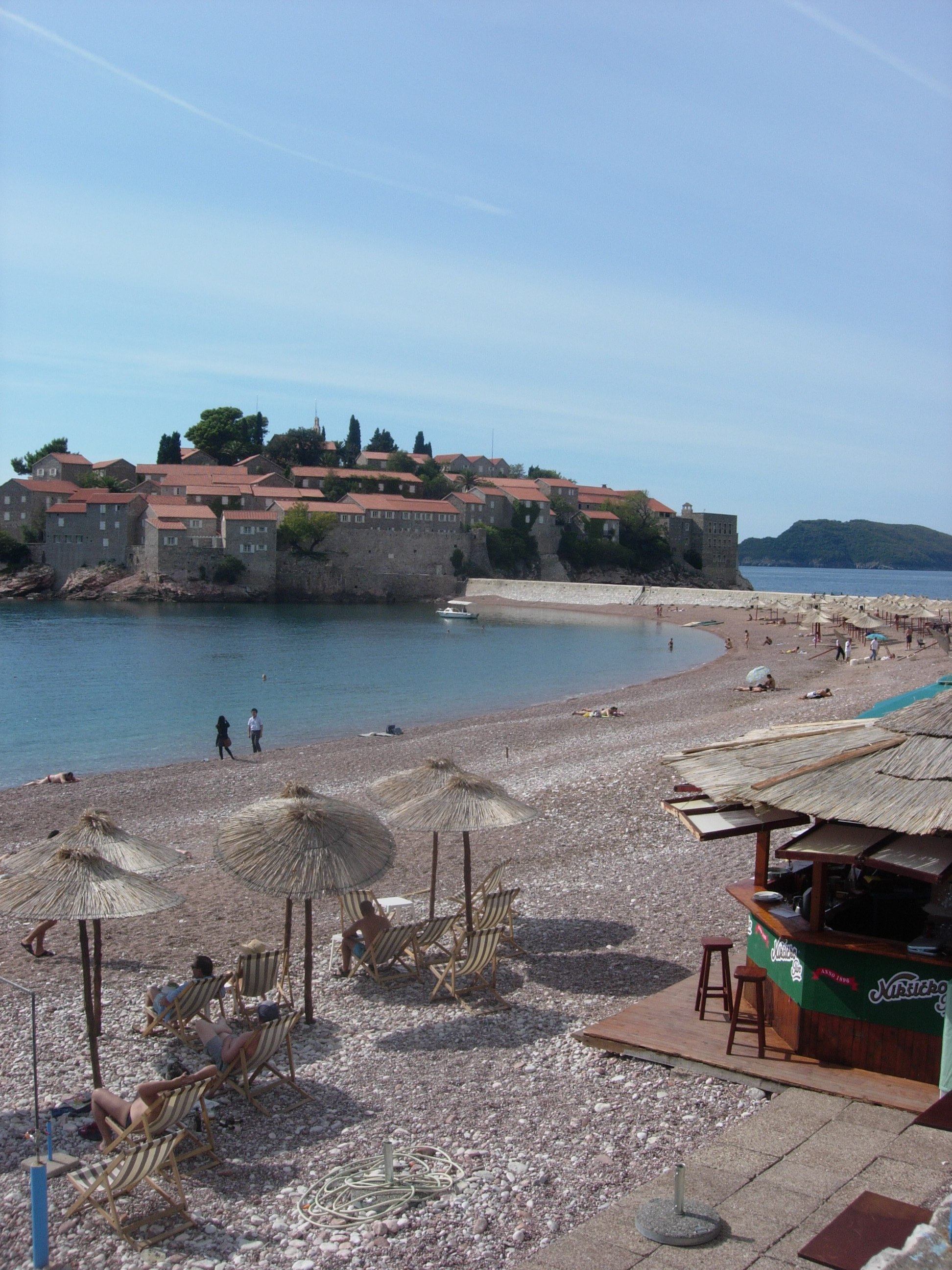
In a little cove on the Montenegro coast, cleaved between staggers of rock and water clear as glass, I’ve discovered what is simultaneously the most beautiful and depressing place I’ve never been: Sveti Stefan.

A little jumble of terracotta roofs, grey stone buildings that look like they were carved right out the rock, a couple trees poking through, all sitting plump and pretty and perfect in that glittering, glittering water: what could be more picturesque?

So you take pictures. Lots of them. You see the other vacationers—Eastern Europeans and a handful of Italians—doing the same. You’ll go over, have a stroll, feel the old cobbled stones through your soles, soak in the Old World ambiance before you work on that sunburn you’ve been itching for.

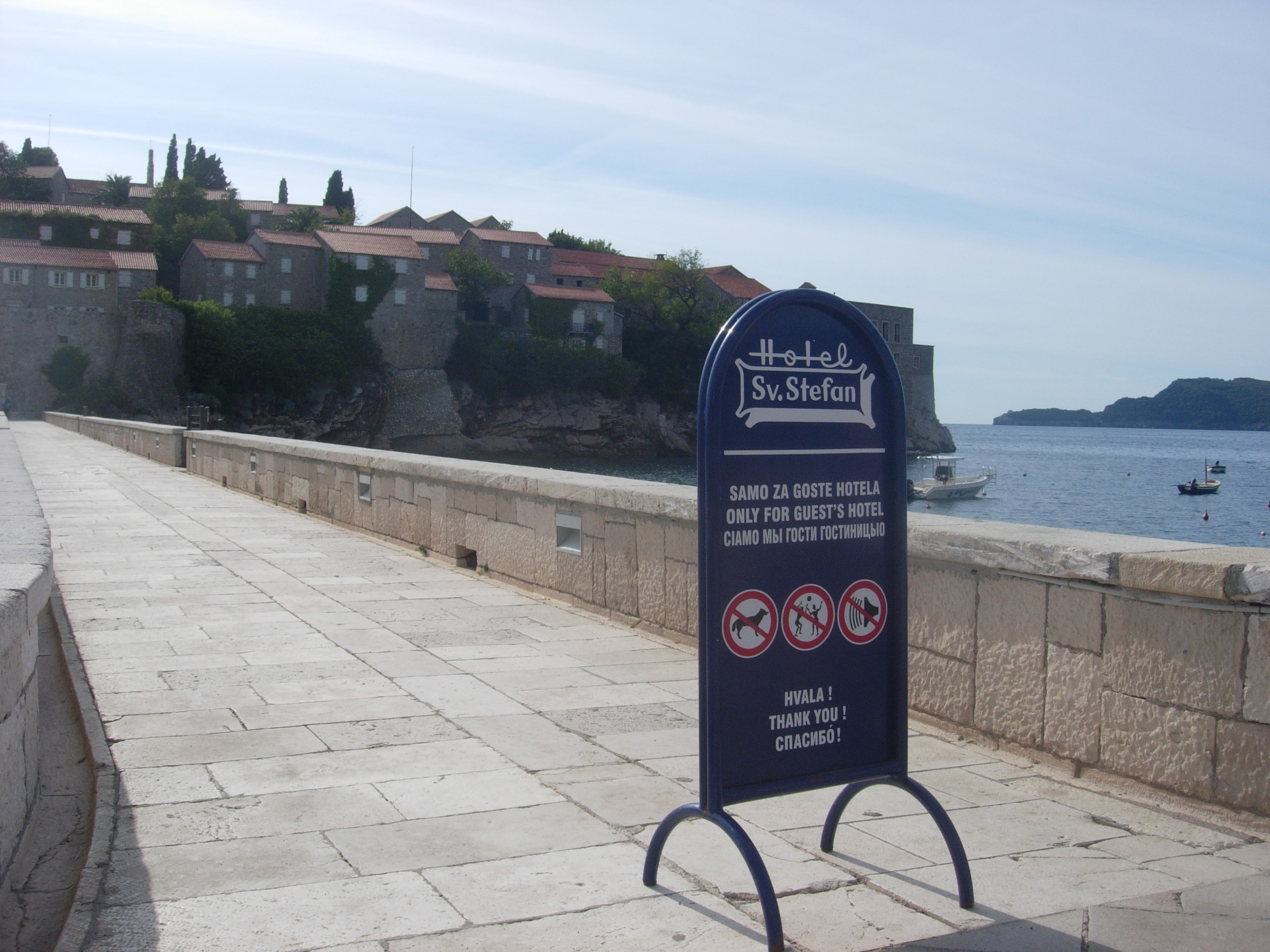
Only you can’t. You can’t actually go in Sveti Stefan. On the narrow isthmus leading up to the island—made of sand and reinforced with a stone-wall walkway—there’s a sign telling you you can’t. And a security guard, to remind you. And another one at the end of the isthmus (you can see him down there, pacing dutifully).

This is because the entire town is a resort. The entire town.

I hadn’t actually grasped that part in the guidebook: “an old fishing village that was nationalized in the 1950s and turned into a resort…” The resort was closed, but scheduled to reopen; in the meantime, a township had sprung up onshore, keeping the beaches alive with the gentle buzz of non-corporate tourism. All of which promised to change the moment the resort reopened—so go while you can, I read between the lines.

I envisioned a monstrous, skeletal structure with workcrews hanging from cranes, somewhere off to the side of an idyllic pebble beach—an eyesore, but something you could turn your back to. I did not picture the entire island, the remains of a 15th-century village, privatized and closed off to the public.

It’s like a modern-day version of a Forbidden Island. But instead of pirates burying the booty, it’s luxury travel mongols.

Awkward photo Boris insisted on taking

Sitting in the sand, under one of the umbrellas Boris the hotel worker graciously has let you set up camp beneath (hey, it’s October, officially low-season), you feel a little like a grubby kid with their nose pressed up to the glass of some fancy restaurant. It’s a pathetic feeling of alienation—you mean I can’t even walk in there?—that surprises you.

You watch a small boatload of people disembark. The gentle breeze carries their posh British accents over your way; you watch them climb the steps in a wave of white scarves and sun hats. They’re greeted by some resort offical and whisked off down the isthmus, a bagpipe player gloriously leading the way. You pick some pebbles off your leg and feel more dejected.

There’s a story there, and you know it. You imagine some 60 years ago, a traditional, working-class town filled with fishermen and their families. You imagine the boats going out in the morning, the nets coming back full in the afternoon; you picture the women in aprons calling from the windows at their children, running down narrow lanes. You picture them all forcibly removed from their homes, uprooted and unearthed after 500 years, and not able to return home. Because wealthy people wanted to work on their sunburns.

Such displacement happens in the world, yes, but usually in the name of war, religion, apartheid. But tourism?

You wander over to the shady terrace of a fancy cafe for an overpriced espresso. It’s killing you—the story, the story hiding in there, that you can see but can’t get into—so you ask the guy serving you your coffee. He gives you the Disney version. Afterall, he works for the resort.

The town’s population had been dwindling, and, in the 50s, the government bought out the last remaining families—15 or 16, who were given “nice pieces of land” in exchange. The town was then turned into a resort—“the only town resort in the world,” he says with a puff of pride—and saw the likes of Hollywood celebrities and European royalty. Then, “alas,” during the wars of the 90s, the resort fell into disrepair.

But “thankfully,” a German company interveened and purchased the resort. They made a series of exhaustive, tasteful renovations that manage to “retain the Mediterranean charm.” (“It’s really very excellent.”) The resort will officially reopen and accept guests sometime within a year—the British people I saw were probably on a promotional tour.

“Are there ever any other kind of tours? Like for the public?”

“No, no. It is closed. It’s not so nice—you pay to come to a place and have tourists outside your window all day.”

I nod slowly, thinking of a comment I heard once about why private schools should have tuition: “otherwise all the poor people would come rushing in.”

“But, maybe, I don’t know,” the espresso server continues, “you are here for awhile,” shrugs, “maybe I can work some magic, get you a tour.” He sneaks a sidelong glance.

The writer in me wants to press. The feminist in me wants to puke.

I sit there, instead, and watch the island, the steeple from the old church peeking up above the roofs and the green of its remaining trees. I watch the water nod in white glimmers and think, “Yes, yes, there’s a story there.” If I could just get in, if I could just walk among its buildings, sit on its stones, I might be able to get it, a hint of it—hear what is left, the melancholy echoes that have remained.

For a moment I wonder what is worse: that it be preserved, turned into a storybook land that’s accessible to only the fabulously wealthy, where they can indulge their sun-strewn fantasies of a simple life in a long-gone simple world. Or that it turn into a theme-park, another Venice—a soulless caricature of itself. Because, let’s be honest: in this day and age, there’s no way a place as pretty as this would escape the clutches of tourism.

But then I come to my senses. An entire island privitized. You’ve got to be kidding me.

I lick the last bit of froth from my espresso and watch my pretty, pretty island, sitting forbidden in its lonely paradise. And I think: if I could afford it, would I stay there?

Probably.

Dubrovnik, I Don’t Hate You

Amid the souvenoir shops, currency exchange offices and endless umbrellas of the tourist restaurants of Dubrovnik’s Old Town, I realized that something in me had changed.

It wasn’t a sudden, burning-bush kind of change, but slower, more subtle. It’s something that’s been changing in me, I suspect, for some time, without me noticing it—a transformation, unfolding gently, quietly, while I wasn’t looking. And it took Dubrovnik to make me aware of it: I no longer hate tourists.

And more than that, I no longer despise hard-partying backpackers, 20-year-olds that sleep all day and drink/cruise for girls all night on mom and dad’s bill. In short, my disapproval of how other people travel, when it isn’t my way of traveling, has dissipated.

I endured the torturous, fluorescent, overly air-conditioned ferry ride from Bari, Italy, in search of sunnier—and cheaper—shores. Well, um, Croatia ain’t it, I’ve discovered. And especially not Dubrovnik.

Yes, really.

My guidebook gushed about the splendor of the city. After I slept off the sleepless ferry ride, I curled up next to my $4 americano and watched the scene parade by: tour groups led by umbrella thrusting guides; middle-aged folks clutching their Rick Steves’; lots and lots of English. Later, at my hostel, I listened to the play-by-play recounting of the previous night’s drunken antics, and who’d made out with the hottest girl (it was Mark, the kid with the Justin Bieber hair).

And the remarkable thing was, I was okay with it all.

Now it could be that I’m getting older. It could be that I’m more well-traveled, and settling into myself. But I think it’s got more to do with something else, with this personal journey I’ve been on lately, entirely unrelated to travel. It’s got to do with taking care of yourself, with stopping using other people as a way of not looking at your own shit; it’s got to do with lovingly detatching from sick people. It’s potent shit, and it’s changing everything. Including, apparently, the way I travel.

No one likes to think of themself as a judgy a-hole, but hey, we all got our faults. In previous years, Dubrovnik would have evoked all my self-righteous better-than-thou-ness: too expensive, too touristy, too too. And it’s true that I’m not really into the scene here; I definitely dig the more obscure, the more offbeat and bizarre.

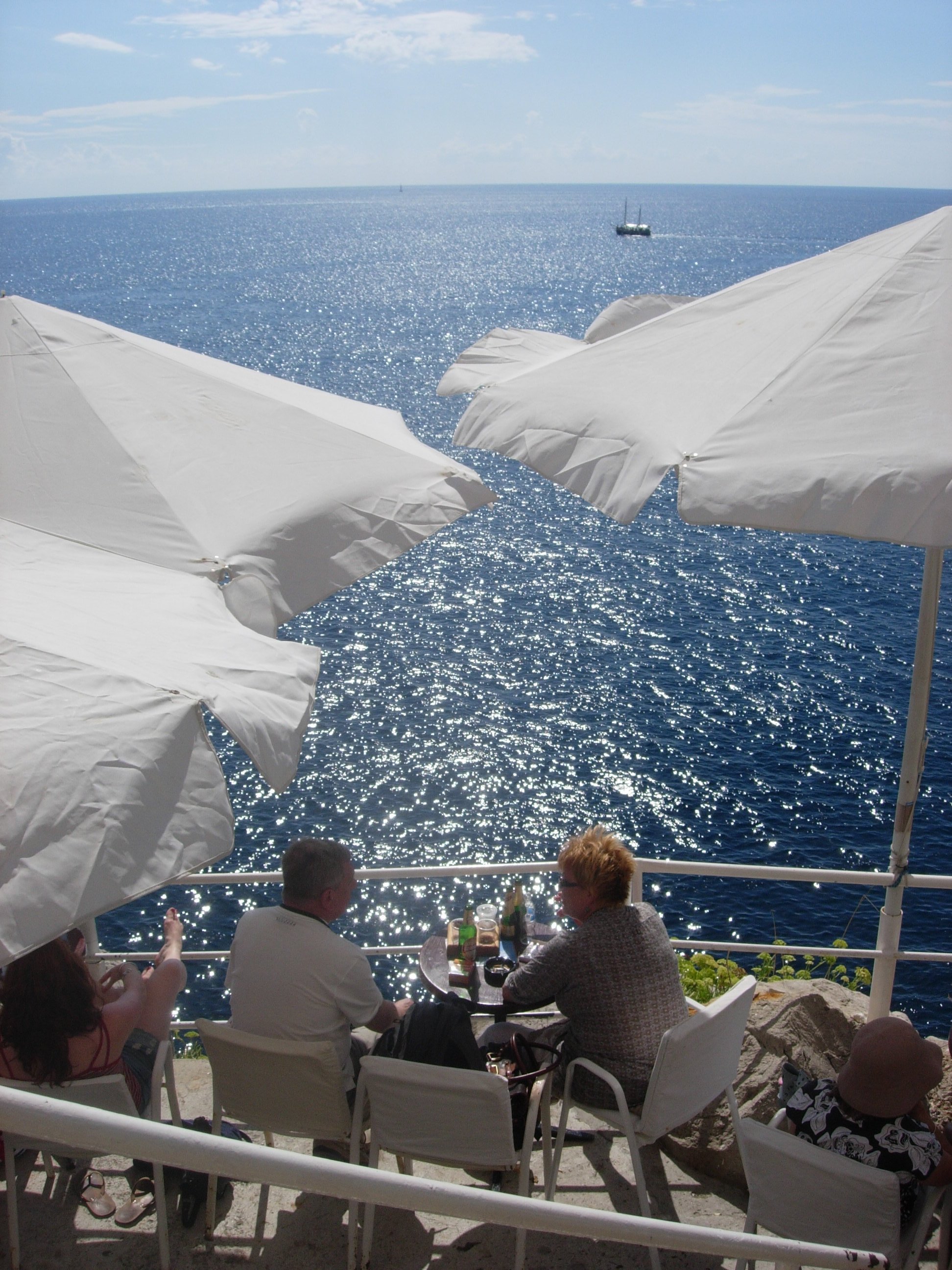
But it isn’t awful—it’s not theme-park-ish and you don’t get that resentment vibe from the locals. And it is beautiful: smooth stone streets gleaming white; sheets of ancient walls; passageways that lead to startling, sparkling vistas of aqua-clear water that really does live up to the hype.

And I’m letting myself enjoy that without judging it.

As I’ve learned to focus more on accepting myself, I’ve discovered a curious by-product: I’m better able to accept others, better able to let them be themselves, whatever that entails. And this doesn’t just come, apparently, with emotionally unavailable active alcoholics; it apparently also comes with accepting other travelers.

When you’re constantly measuring yourself against other people, when you’re constantly using other people to determine your worth and what exactly it is you are, there isn’t a lot of room left to just be okay, to just sit with yourself and be okay. And I’m learning to do that. I’m learning to go swim off the deck of a jokey tourist bar with a couple dudes I don’t have much in common with, learning to lay out in the Adriatic sun of a destination I’m not nuts about, and let that be okay.

I don’t think I’ll ever be into the big huge tourists destinations. I’ll probably always love the less obvious, the little-off; I’ll probably always love digging around, getting the dirt of a destination under my nails. That’s just what I’m into. It’s not any better or any worse than what anyone else is into. (Including getting black-out drunk and hooking up with random girls.)

Even now, with the chatter from the hostel’s common room filtering up the stairs, through the cracks under the door, over to my glowing light on this rickety bunk, even now it’s okay. Tomorrow I’ll take off for Montenegro, in search of something a little more me.

But Dubrovnik, I gotta say, it was a pretty good day. And I don’t hate you.

See Naples, And Then…

Die, the saying goes. They’re not fucking around.

I’d really wanted to go to Naples when I was last in Italy. But my then-boyfriend read the LP description—chaotic, dirty, somewhat dangerous—and nixed the idea. He liked Copenhagen, Scandindavia—clean, calm, safe cities filled with bicycles and crisp air, low unemployment and Nordic blondes with pale beautiful skin.

He can have it. Give me Naples.

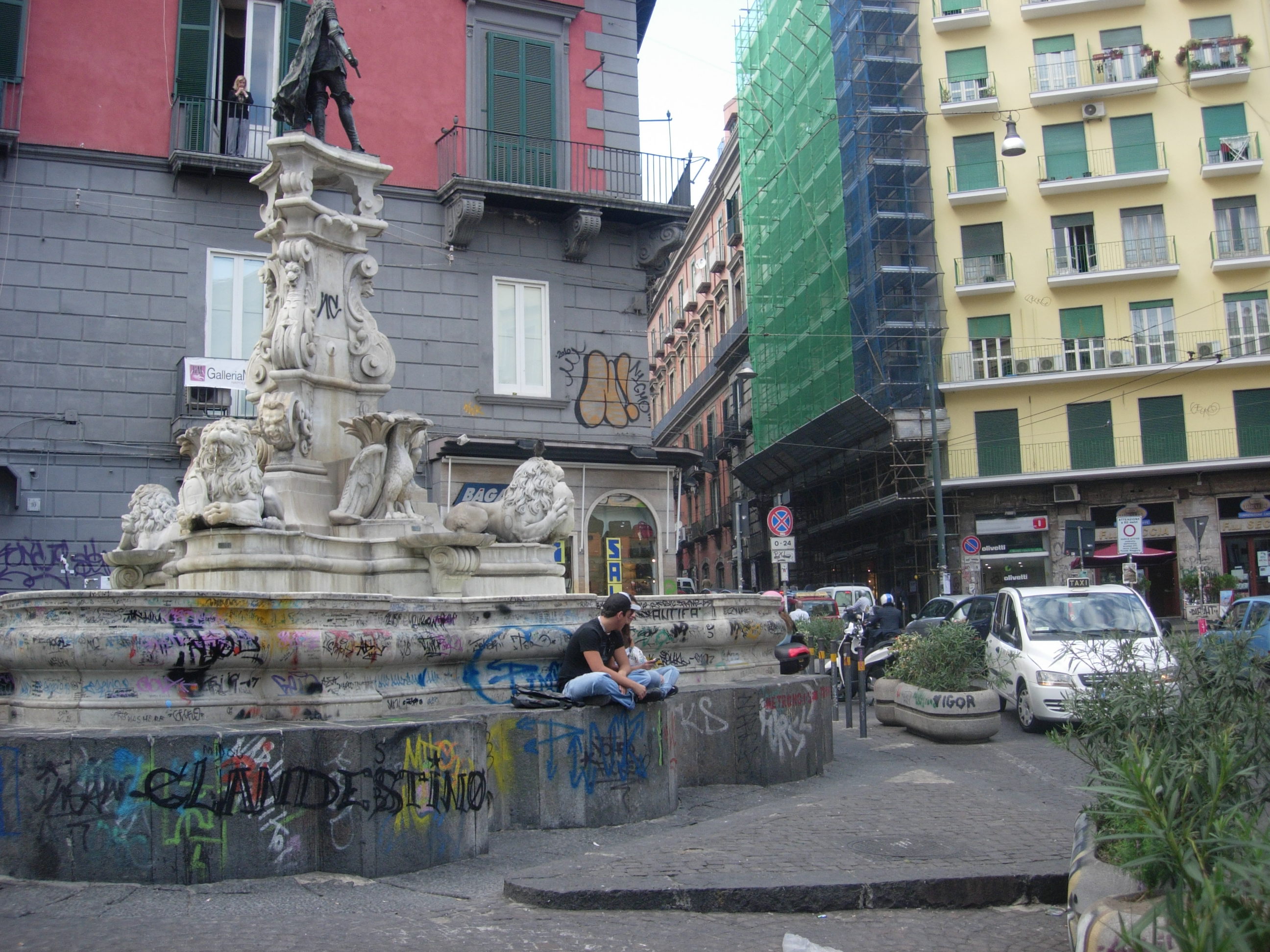
I got out of the Metro stop and walked the five blocks to my hostel. It took about that long to totally fall in love with the honking, swarming, spinning mess of it all, wedged with sharp shadows and bright sun between stories of faded facades that seem too tight, haphazard, overgrown. There seems no law or order to the flow of life on the street—cars and motorinos and pedestrians—but rather a kind of rhythm. Not a heartbeat, even and steady, but a wild palpitation, erratic and oxygen-deprived, that somehow keeps beating, keeps from careening.

It only seems like chaos. There’s something actually there, holding it all together.

I want it.

Give me traffic and noise. Give me trash piles and laundry lines. Give me jackhammers and roaring motorbikes. Give me a honk of warning but don’t slow down.

Give me scaffolding and shadows that swallow whole streets. Give me littered ruins surrounded by sidewalk. Give me a small dead bird flattened against the black stone of the street. Give me the smell of fish in open-air markets.

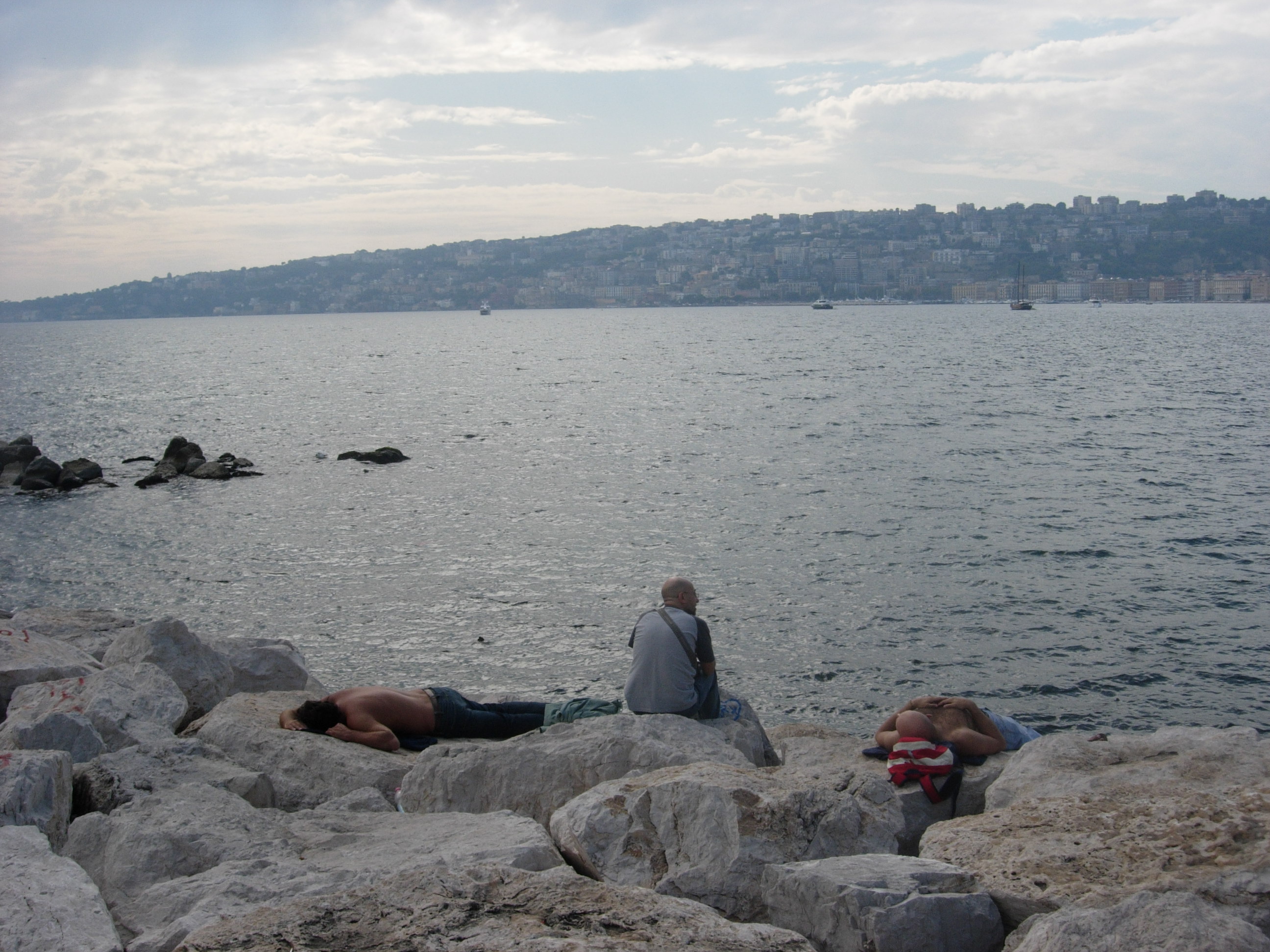
Give me gypsy beggars and business men; give me round bellies on white rocks, tanning in the sun. Give me a woman bathing in a baroque fountain. Give me stray dogs sleeping. Give me 1000 cigarette butts and worn skin on beautiful women. Give me immigrants selling purses; give me hustlers pawning cans of salt.

Give me graffiti. Lots and lots of graffiti.

Give me Naples—give me this city and its swarm, give me something inside my own soul.

Serendipity, Street Art and the Best Layover EVER

It’s a fantasy common enough to warrant TV commercials, (porno) movie plots and a voyeuristic story by Gabriel Garcia Marquez: you get seated next to an attractive person on an airplane. And you’re stuck beside each other, awkwardly negoitiating the small space for hours.

As most travelers will readily tell you, this is about as rare to air travel as getting bumped up to first class. No, rarer. The cast of characters usually beside you in the sardine can of coach include snorers, fidgeters, wiley children and consumers of mysterious day-old food. It really serves to drive home to actual percentage of datable people in the world’s population. I, for one, had given up on the fantasy and resigned myself to the mere hope of a recently showered individual that can fit in their own seat (which is also more or less when I’ve resigned myself in dating—and have been known to compromise on as well).

Well, holy shit if the travel gods didn’t smile down on me. And homeboy wasn’t just attractive—he was rad. As I discovered, not just during the flight, but on our 10-hour layover spent adventuring around Brooklyn together, spotting street art and searching for obscure vinyl.

I’d noticed him passing through security (as I was being pulled aside to have my purse dismembered in search on nonexistent weapons): hip without being pretentious, stubble beard, cowboy boots, a bulging bag of records. But I didn’t give it much thought until I was settling into my dismal seat in the back of the plane, next to the bathrooms. I watched him struggle to jam his record bag into the overhead compartment and smiled. When he looked down at his boarding pass, scanned the aisle numbers and ended up standing right beside me, we both smiled.

Sebastian had been traveling around the US for 5 weeks, and was on his way back to Zurich. He had a couple lines in his forhead, the well-traveled beginning of wrinkles. He had the worn-smooth hands of a cook, the black strand of a necklace peeking out from under his shirt. He had killer taste in music.

We chatted about life and travel and bands (“I saw some great shows in San Francisco.” “Like who?” “Ty Segall.” “On Wednesday? At the Rickshaw Stop? I was totally there!”). We talked about his trip and my trip (“I’ve got a 10 -hour layover.” “Me too. I was gonna go into the city, hang out. Better than being at the airport.” “That was my plan too.”) We fell into the fitful half-sleep of confined space and over air-conditioning; woke up stiff necked and lip smacking, ditched our bags at a luggage locker and rode the subway into Brooklyn.

It was a shuttered-up and bare-sidewalked Sunday morning on Bedford, ground zero of Brooklyn hipness. There was a record store Sebastian wanted to get back to, that wouldn’t be open for hours. We rubbed our aching eyes and looked for coffee.

I consulted my iPhone. “Oh shit, there’s a Blue Bottle?!” I exclaimed. “Yeah,” said a girl passing by, “it’s around the corner.”

We sat in the sun and drank our hand-dripped cups of black, watched the parade of dogs and toddlers and cool kids. We bombed around the neighborhood, going nowhere in particular, until the shops thinned and the wide walls of warehouses took over. And we began spotting some kick-ass street art.

All the pictures are on my phone, which for some reason my new (new to me, that is) netbook won’t download. So expect a post when I get home. But just to tease, I saw Roa, Faile, Space Invader, Gaia, and a whole bunch of folks I didn’t know but really wanted to.

We hit the record stores that had brought us there. Sebastian confessed to me that he was a music nerd with a record fetish. “There’s so many more records in the States,” he told me. He’d already shipped a crate back to Zurich. “It’s okay, though, it’s still cheaper than trying to buy it in Europe. If you can find it at all.”

We got back on the train, dazed and subdued with our long flights looming. We looked back through his pictures—he’d ended up going to Burning Man, on (another) serendipitous whim, and I leaned in over his shoulder to look at the small viewfinder, its story of dust and fire, the wind that moves through desolate places.

Our shoulders touched, just a little in the shudder of the train. I felt no desire to make a move, so to speak; it was enough to have a small flutter in my stomach. It was enough to have met someone awesome, totally serendipitously. It was enough to have wandered around sleep-dazed and discovering, to have sat on stoops smoking in the Brooklyn sun.

Sometimes you don’t need a big climax, don’t need to get all flirty and sleezy or anything at all. Sometimes it’s enough to feel liked, not just desired, and to genuinely like someone back. Not cause you want to make-out with them necessarily, but just because they’re rad.

We sat at the bar of a jokey airport restaurant, where Sebastian indulged in the last American hamburger of his trip. NFL games were flashing on the various television sets, the jarring loudspeaker announcements of boardings and departings echoing through the space.

“Sebastian,” I said, “you are by far the coolest person I’ve ever sat next to on an airplane.”

We hugged. “I had a great time,” he smiled. “Me too.”

And I walked away, through the terminal to my own adventure.


Lauren Quinn is a writer and traveler currently living in Hanoi. Lonely Girl Travels was a blog of her sola travels and expat living from 2009 to 2012. She resides elsewhere on the internet now.

Join 490 other subscribers

Buy This Sh#t

Categories