Archive for the 'Dirty Tricks' Category


Travel Tip: Get Inventive

What to bring and how to pack—it’s always a hot topic. But no matter how well you prepare—no matter how many water purification tablets and rehydration pills you stuff into your waterproof, weather-resistant backpack—you can’t anticipate every twist and turn you’ll encounter on the road.

At some point, you’ll need to get inventive.

Let’s say you do something as innocent and seemingly unadventurous as going on a day hike. Now, some people tromp off with walking sticks, CamelBaks, and a fanny pack full of First Aid supplies. But those’re also the same folks that wear their jungle-proof hiking boots in the middle of the city. (In your preparedness, you must also consider fashion.)

Let’s say it’s a hot day at one of your top 3 travel secret spots. Let’s say that Bass Lake is sparkling cool, and filled with the intertubes and joyous clamor of hikers. You paddle out with a friend and see carefree bodies flying through the air, limbs ecstatically free for one airborne moment before splashing ceremoniously into the murky dark.

Let’s say you forget that both you and your friend are total effing city kids and have never once been on a rope swing. Let’s say that you don’t stop to consider the physics of the situation, the centrifugal force and the fact that some technique might be involved. Let’s say that all that’s going through your mind is—“Fuck yeah, rope swing!”

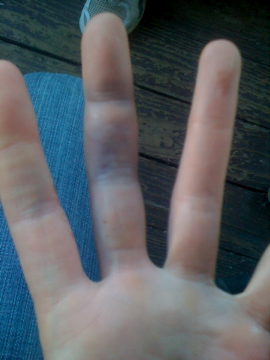
And let’s say that both you and your friend completely gnarl your hands and are left treading water with a mess of twisted and bloodied fingers.

It’s time to get creative.

First off, remember your First Aid training: reduce swelling (and bleeding) by raising the effected body part(s) above heart-level. This means treading water hands-up for 500+ feet back to shore. You can also call on your long-forgotten lifeguard training.

Next, you’ll want to get a second opinion. You’ll probably try to tell yourself that your wound “isn’t that bad, right?” You’ll attempt to move the effected body part in a perkily healthful manner to convince everyone—but mostly yourself—that no serious injury has occurred. At this stage, it helps to have friends with a firm grasp on reality.

When it’s determined that you are indeed effed up, you’ll need to provide some sort of make-shift care for yourself. You won’t always have gauze and splints and medical tape handy. You’ll have to make do with what you have right in front of you. Dig through your purse and discover that a Bic pen is about the length of your finger. Now how could you secure it to your effected digits to both provide support and restrict swelling? You think, look around…

Using your traveler ingenuity, you’ll end up with a perfectly workable—and dare I say, fashionable—solution: Bic-pen/shoelace splints:

Stop hiking? No way! You’re totally good to go.

Bonus tip: Don’t waste money on needless medical care. If you happen to be American, you’re already well-practiced in the delicate art of determining when medical attention is and is not absolutely necessary. Unless your shit is sideways and needs to be reset, a doctor isn’t going to do much for a broken finger. So save the pennies in your travel jar, go to Walgreens, and buy a splint and some medical tape. Total cost: $7.

Not Watching the World Cup

Watching the finals, four years ago in Merida

Four years ago. Cement and humidity. Rattling bus ride, stomach-sick and backpack-heavy, up and over, along the coast and back in again. Everything laced in car exhaust and heat, the smoke off cooking meat, the horn blows of “Hips Don’t Lie”—and the crackle of television sets, shoulders hunched around the static glow.

I’ll admit that I didn’t really know what the World Cup was before the last one. Cause I’m American and we’re generally not aware of things outside our own culture (as captured by this Simpsons episode). But four years ago, I got a crash course: I was traveling during the entire duration of the World Cup. I didn’t know shit about the game, and kindly fellow travelers tried repeatedly to educate me, but it was pretty much a loss. What got to me, though, was the way the World Cup consumed the places I was in, and completely took over daily life.

It started slowly. During the first rounds, just a couple dudes holed up in the kitchen of the youth hostel on drizzly Bogota afternoons. They made a list of all participating countries, along with offensive, politically incorrect nicknames they invented with their apparent oddles of free time (the only one I can remember is “Portugal: Little Brazil”).

As I snaked through the murderous mountains, bus break downs and military checkpoints, the intensity of the World Cup gathered speed. By the time I got to the sweltering, smoggy Caribbean coast, it was in full swing: TVs pulled out onto the Santa Marta street corners, men on folding cars, kids crosslegged, staring transfixed. Colombia wasn’t even in the games. It didn’t seem to matter.

I’ve heard reasons for why soccer isn’t big in the US, and why football (American football) is—basically, that football is tailor-made for commercial breaks and thus commercialization, while soccer’s lengthy sets make it untelevisable, in the American sense. It seemed like a plausible explanation. “I must say, it’s rather nice,” the British girl told me, leaning in and soft-voiced, “to have this one huge thing that America isn’t really a part of.”

I was in Merida, Venezuela for the final game. It was like Super Bowl Sunday times ten—you couldn’t really do anything else but watch the game. So I hung out at my hostel and pretended to follow along.

We went out for a walk after the end of the game, to survey the goings on. The city was transformed into a Venezuelan sideshow: a choke of traffic, horns and revving engines, kids hanging entire torsos out of the windows of moving vehicles, everyone chanting: “Italia! Italia!” I could only imagine what it must have been like in Italy.

The energy of it, the global ecstatic energy, felt like an addictive, consuming and altogether foreign thing. Was this what was going on while Americans were busy tailgating and spending $6 for a Budweiser? The raw emotion of it reminded me of a Sherman Alexie poem I’d read years ago:

On TV, more soccer riots in Europe.
There would be riots in American stadiums
during our particular games
if the people who had reason to riot
could pay the price for admission.

Like anything, like any time you travel and are surrounded by some awesome and immersive cultural force, you want to feel a part of it. But there’s always that little twinge, that hint, a prickle in the back of your neck, that you’re separate, somehow apart from—that you don’t really understand, not deeply enough, and that you’ll always be a little on the outside.

Do you ever play that game with yourself?—“the next time this happens, I wonder where I’ll be.” Four years older, but not where I supposed: still in the US, still waiting tables, still scraping money together here and there for little trips. Not the life I expected, or the one I even wanted, but the one I’ve ended up in: arrived in, disoriented and unsure, a noisy bus station on the smog-choked side of town.

So I didn’t join in the fuss this time around. I didn’t watch the games or pretend to follow along, didn’t ride the train out to Civic Center on Sunday to sit on the grass and squint at a big projection screen. I didn’t tweet my predictions or try to seem more international than I was really was by feigning interest (ahem, covered quite nicely here).

I let it pass quietly, peripherally—like a party going on in the apartment downstairs, when you look around the dim light of your bedroom and sigh. You put in some ear plugs and let the noise fade, feeling the foam expand as you fall asleep. In the morning, life returns to normal, and you try not to think about where you’ll be for the next one, in another four years.

Travel Tip: Tattoo Party

Nothing so helps you remember a trip like a permanent souvenir etched into your flesh.

We largely have the British Navy to thanks for the tradition of travelers getting tattooed, little relics of ink and miles, swallows instead of passport stamps. Though in the present-day we may be tortured with Sailor Jerry paraphernalia and hepatitis-factory street shops in beach towns like Puerto Vallarta, the basic idea of getting a tattoo to commemorate one’s travels remains a solidly good one.

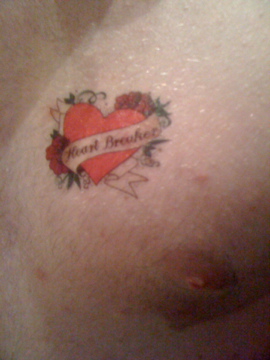
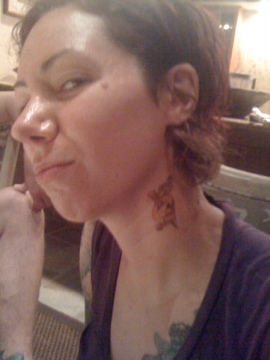
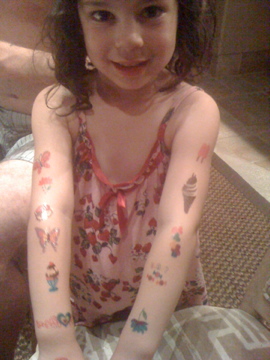
Even better is to have a DIY tattoo party with your travel companions. During my last trip in Hawaii, we did just that. It was a fabulous after-dinner family bonding experience.

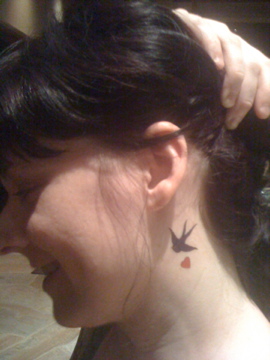
Zaia gives me a neck tattoo.

Hella cupcake-core—what you got to say?

Alicia goes under the gun/wet washcloth.

Nothing says “I’ve learned about spirituality through my travels” like a yin-yang.

Ankle tattoos are sexy and subtle.

Tribute tattoos, especially to significant others, are always a strong move.

Get chicks with a mean rose-and-thorn arm band.

But of course, you’ll want to let all those young backpacker girls know that you’re not looking for anything serious…

The beauty of the neck tattoo is that, even with long sleeves on, you’ll look like have a shitton of tattoos. Everyone will know how cool you are, whether you’re on the beach or hiking in the Alps.

And contrary to popular perception, no one is too young to join in the tattoo craze:

Let those cute boys down the hall know just how ready to party you are with a traditional tramp stamp.

At the end of it all, you’ll end up looking both tough and well-traveled…

… and have the coolest souvenir of em all.

If You Can’t Beat Em, Wear a Plastic Lei and Film Em

A long gleaming corridor. Palm trees and piped-in music. Our shoes squeaked along too-shiny floors as we walked deeper, further down, following the faint beating of drums and the smell of roasting pig, down into the belly of the beast: the Hilton Waikoloa Village, Kona.

Nevermind how I ended up there. Nevermind the maze of hallways, the gift shops, the cocktail lounges and swimming pool complexes, the shuttle ferry that glided down the artificial waterway, disrupting the shadows of high-rises, floors and floors of cookie-cutter hotel rooms, windows all right angles and white curtains. Nevermind that I’d paid $90 to wind up at the kind of place an independent traveler has nightmares about: a psuedo-cultural event at a corporate hotel. Nevermind that I felt like a vegan at MacDonald’s.

I was there and, goddamnit, I was going to have a good time.

Going to a Hilton luau to experience Hawaiian culture is like going on It’s A Small World to learn about global diversity. Which actually isn’t that far off of a comparison, seeing as though the great minds at Disneyland were employed in the developing of the Hilton, Kona (which explains why we kept remarking how much like Disneyland it felt). Commodified, codified, packaged up and watered down as much as the “2 Drinks Included!”, the Hilton luau was about as authentic as, say, Polynesian tattoos applied by a sun-burnt white dude with a sharpie.

I’m all for cultural experiences. And truth be told, the package tourism experience is real and true in its own right—something in the center of modern-day Hawaii, its economy, its culture, its day-to-day reality. So, in a way, you can’t get much more authentic than the genuine inauthenticity of package tourism in Hawaii. When you look at it honestly, it’s not any prettier than the corrugated-tin shantytowns that surround big cities like Lima or Rio—but still a huge part of life, real life, that deserves to be looked at.

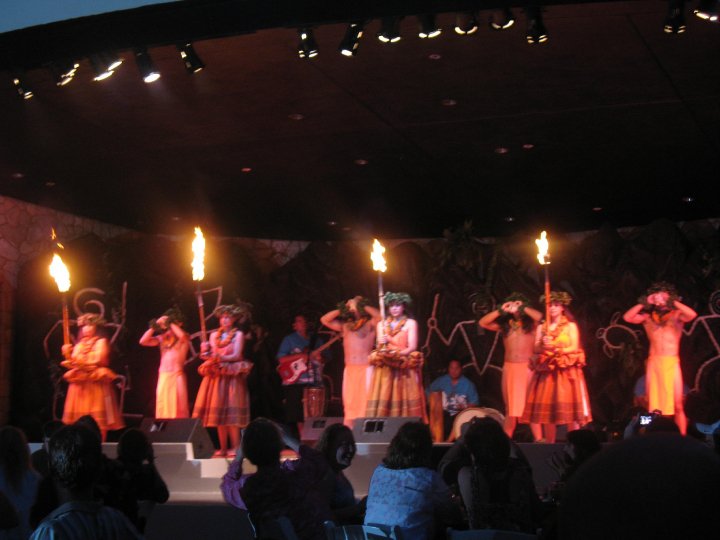
So, in the name of cultural anthropology (and of fuck-it-I-spent-the-money-so-I-may-as-well-enjoy-myself), I infiltrated the Other Side: threw on a plastic lei, ate 5 plates of mediocre buffet food, drank my sugared-to-shit blended virgin cocktails, watched the fire throwers and hula dancers and even danced along. Think Hunter S Thompson and the Hell’s Angels, only a lot less cool.

I did not pay the $30 to keep a copy of this photo. I went broke-style and took a picture of the picture with my phone.

During the opening participatory hula dance, all I could think of was that scene in Dirty Dancing:

Through the course of the show, there was much hulaing, conga shell blowing, relating of digestible chunks of Pacific Island history, and audience participation. As the night wore on, and the Lava Flows kept coming, some folks got a little more into the Hawaiian spirit.

A curious element of the whole affair to me was the Young Hunky Native Boy aspect. Young guys—some appearing to be Hawaiian, others just really tanned white guys—trotted around in loin cloths, flexing and shaking and posing like Chip and Dale dances to a chorus of female cheers. The best was the fire dancer, a methed-out-looking white dude with a sleeve of tribal tattoos who punctuated the band’s high notes with his own ear-piercing hillbilly yoodle, in what could only be assumed to be a white trash mating call, hidden under a psuedo-ethnic guise (we were hip to him).

It made me uncomfortable, the way some of the women in the audience were responding, as if on cue, to the unabashed display of sexualized exoticism. If it had been the other way around, if the cheers had been directed at the female hula dancers, it would have been disgusting, deplorable. I wondered what made it different, more acceptable, when it came from women. It seemed to me to come from the same place, the same heart-breakingly exploitative place: “a young dark thing for my personal pleasure.”

They say tourism is the imperialism of the 21st century. They say Hawaii has prostituted herself to the whims of the West, that she’s syphilis-stricken and soul-sickened under that thick hair and pretty skin. I’m not really here to talk about all that. I just know that us Americans gasp at the idea of Chinese ethnic minority theme parks—but, um, Hawaii doesn’t seem too far off. And certainly not a luau at the Hilton.

We had a nice waitress. As we were gathering our things, she came to wish us a good night. It had come out, sometime during the course of the night, down on the other end of the table, where we were staying. The waitress grabbed my sister-in-law’s hand, “Oh, enjoy P.” Then, a little quieter, “You know, it’s really a great thing, what G did.”

Against the backdrop of the Hilton, against the gleaming stage lights and up-lit palm trees, the crackle of the sound system and the bustle of bus boys, she was right.

Travel Tip: Wear a Fanny Pack

Much has been written about the fanny pack. Most of it is bad.

What began as a utilitarian fashion craze of the early 90s (shut up, you know you had one) has now been strictly relegated to the arena of unabashed tourist. Worse than Tevas, worse than zip-off pants, worse than wielding a guidebook or clutching a map or asking for directions loudly in English, the fanny pack is the ultimate signifier of clueless tourist. Just ask the people who write this blog.

But on my last trip in Austin, my good friend and travel buddy Liz presented a most compelling argument in favor of the fanny pack:

I guess it’s all in how you wear it.

Having trouble finding support in your fashion-forward revival of the fanny pack? Use your free hands to take solace at The Real Fanny Pack.

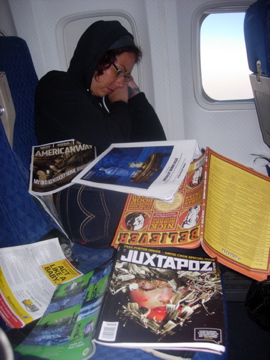
Travel Tip: Magazine Blanket (AKA: Stickin It to the Man)

Oh yeah, American Airlines? You wanna play dirty?

You’ve already taken away my peanuts and charged me for a checked bag—think you’re gonna bleed me a little more by cranking the air conditioning to Venezuelan-overnight-bus levels and charging $8 for one of those shitty blue blankets?

Well, I’m not skerd. I’ll make a hobo blanket out of magazines.

You’ve obviously underestimated my industrious frugality and lack of shame. Maybe next I’ll bring a can of beans and a hot plate, and make my own in-flight meal.

Domestic Travel for the 25% Club

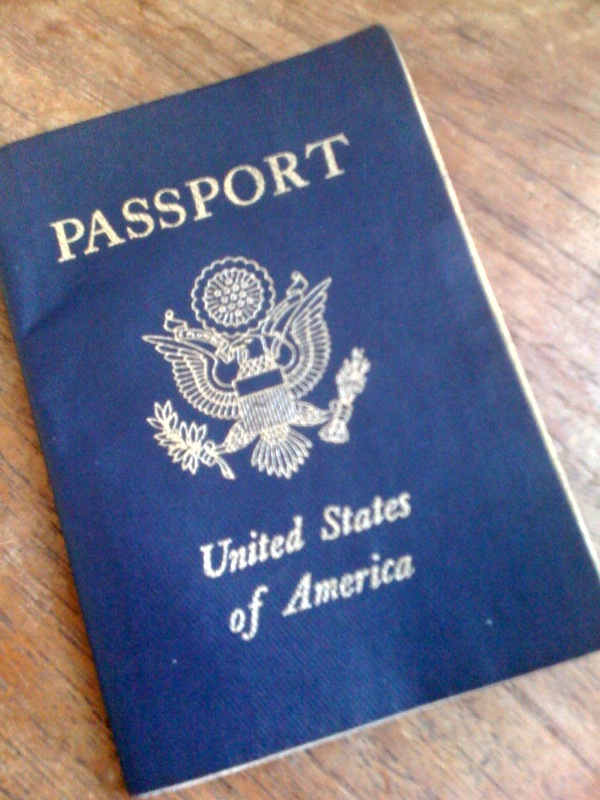
It’s a tired, tongue-worn statistic that staggers gasping into travel discussions across the internet: only 25% of Americans hold passports.

Usually meant as a sad accounting for the geographic and cultural ignorance of Americans, it has the opposite effect on those of us in that illustrious quarter percent. We are the daring, the open-minded, the shrewd and worldly elder all the glowing faces at the campfire are huddled around. We have seen the world, and we have stories to tell. (Whether you not you really want to listen.) The only real travel is international travel—all else (minus the notable exception of New York City) is a petty bourgeois venture in the money-sucking heart of homogeneity.

“Is domestic travel really travel?”—it’s the kind of inane question that you unwittingly discover yourself debating (with yourself) over a slice of open road and steaming cup of gas station coffee. Travel within one’s own country is never an exotic thing—a kind of half-traveling, going through the motions, faking the orgasm of discovery. But when you’re American, and that country is a sprawling continent composed mostly of people who never leave it, domestic travel can sometimes seem like the antithesis of travel: giving up, giving in and coping out. And paying entirely too much for hotel rooms.

I got to thinking a lot about domestic travel on my very unglamorous, utterly unworldly last trip: driving through Southern California. It was so different from the type of travel I’d been doing the last few years: I had my car, I spoke the language, could use my cell phone and credit cards. There was no hassle, no “other”—but it most definitely was still travel. And now, as I’m getting ready to dash off to one equally unexotic locale (Texas) and the ultimate “paradise without a passport” destination (Hawaii), I’m thinking even more about what domestic travel means as an American.

I didn’t grow up traveling. International travel was one of those unfathomable luxuries of the wealthy. So when I left the US for the first time, it was literally like the world opened up to me. This occurred during a very dark time—namely, Bush’s presidency. The prevailing image of America, and Americans, was pretty much everything I was against. I wouldn’t go so far as to say I was Canadian when abroad, but I didn’t want to be associated with anything American: capitalists, Christians, blond suburban girls. I was also broke, so traveling in places where rooms cost $7 a night was pretty much the only way to go. Thus, I left the country more than I left the immediate Bay Area and my ignorance went inverse: I knew the geography of Latin America better than the Midwest.

It’s true that the political tide has shifted, but it’s more than that. There’s so much to be against in the US—imperialism, corportatization, people who don’t believe in evolution—that it’s easy to forget all the good things. Our art is amazing; from hip-hop to punk rock to graffiti, pretty much everything I love was spawned out of the raging, pulsing cultural cocktail that is the United States.

And when I travel here, at home, I’m more able to dig in to those things that interest me—poke and scratch beneath the surface and get closer to what it means to be this, from this, born out of this. It goes beyond using the Yelp app in my phone to find a good coffee shop (which is goddamn useful). It goes beyond even just speaking the language, or doing so without an accent. Because I know the culture, am the culture, I know how to approach people, how get right in there and smile and make friends and discover cool shit I wouldn’t otherwise be able to.

The number one benefit of traveling within my own country is that I’m more able to dig in to what really fascinates me: people, how they live, the weird art/shit they make and the stories it tells. Domestic travel is a totally different beast from international, and I gotta admit that you don’t get the same knock-you-over-the-head rush. Rather than exploring the “other,” you’re exploring the known, and in that way, exploring yourself.

What does it really mean to be American? I used to think it had mostly to do with narrow-mindedness and consumerism. Maybe I’m just a cheeseball, maybe the Obama campaign really did give me some kind of hope, but I think it’s something much deeper than all that. I’m not sure what all it is, this being American, but I’m certain that somewhere down near the core of it is travel. There’s something very central about travel to the American psyche, a kind of open road that flows through the veins of the place, a Manifest Destiny born into us, to set wheels over earth. Stagecoaches, trains, automobiles, a country based upon more, upon Going West and Getting Yours. It’s not the jet-set , passport-stamping kind of travel. It’s visceral, grounded, rooted down into the earth, the dusty, craggy, bayoued and fertile earth.

Perhaps I’m settling into myself. Perhaps I’m just becoming accustomed to being a traveler and building a life around travel; being a member of that elite 25% isn’t so much a novelty anymore, it’s my life. I’m not the anxious teenager with a self-conscious mohawk; I’m the cranky old punk who doesn’t give a shit about dental-floss-sewn patches and would rather go to bed than party/do blow backstage (an actual anecdote from my weekend). And while my heart is in international travel, it doesn’t mean travel within the US is a waste of time and money (what I honestly used to think). It’s just a whole different experience, uses a whole different side of the brain.

Besides, what other country has Chaos in Tejas? (I’ll see you in the pit.)

Bootleg Blues: Thoughts on the Illegal Alcohol Trade Around the World

It was not a subject I expected to get so drawn into. But there I was, hunched over the pale glow of my laptop, clicking links and watching videos and reading random blogs, that damn color pinwheel spinning from the stress of too many open tabs—like going down a virtual rabbit hole into a murky, liquor-soaked world of shadows and motorbikes and sick yellow skin.

Modern-day bootlegging. Prompted by a New York Times piece about alcohol in tribal Pakistan, NileGuide assigned me an article on the illegal trade of alcohol around the world. It was to be a straight-forward round-up, carefully presenting the information without judgment, condemnation or alarmist cries of “this shit is crazy!” But it kind of is crazy, is the thing, and got me thinking a lot about the prohibition/restriction of substances in a society, and about my own experience traveling in Morocco.

As you’d probably guess, all of the places I discovered with a bootlegging industry either outlaw or strictly regulate alcohol sales and consumption. The how and why of it was fascinating. There were religious reasons, of course, in places like Pakistan and United Arab Emirates, but more interesting to me were Sweden, Russia and these remote rural towns in Alaska. All of these places enacted regulations in response to severe alcoholism within the culture. In the Alaskan towns, the temperance calls came from the community rather than the government—largely composed of a Native American population, folks in these towns were sick of the ravages of alcoholism and wanted to just do away with the whole existence of the glimmering, vile elixir. Can you really blame them?

The problem, as any good alcoholic knows, is that people will find a way to drink anyway. (Shit, I never took a legal drink in my life.) Regulations lead to a bootleg industry rife with gangs, violence and product made with piss-poor ingredients that can sicken and kill those who consume it. It’s not too unlike the drug trade in that regard—which got me thinking, on this uber-stoner holiday, about places I’ve been that have suffered immeasurably due to the drug trade: Mexico and Colombia. As always, the suffering seems to break down along class lines: the people who really get fucked are the poor folks in these cultures.

In Morocco, I had the chance to hang with some sober people. What these people—three expats and one Moroccan woman—told me about the actuality of alcohol consumption in the country kind of blew my mind. “Of course people drink,” the retired American sisters told me. “You’re just not supposed to drink, so no one talks about it. People just kind of turn a blind eye.”

As we pulled into the beach resort of Agadir, they sneered slightly. “They’ve been building the town up,” they told me. “It’s becoming something of a playground for Saudi men, where they can drink and have their call girls without anyone knowing.” They later told me about medina bums that drink cologne—not too unlike old-school stories I’ve heard about how folks, during the Depression, would strain shaving cream and drink the liquid to get drunk. (One report of an Alaskan town claimed mouthwash and air fresheners have to kept behind the counter at grocery stores because people use them to make alcohol.) The gaping, aching disparity between how the rich and the poor consume alcohol astounded me.

In the Gujarat state in India, only the wealthy could afford the imported and smuggled bottles of whiskey, while in Russia, only high rollers could fork over what was a three-fold increase in alcohol tax. Poor folks in these places were left to consume shady moonshine, made from medical disinfectants, that led to sicknesses like toxic hepatitis and “yellow death.” Recent outbreaks had killed over 100 people in both places and sickened over 1000. In Gujarat, people rioted during last summer’s outbreak of poisoned alcohol deaths, accusing the police of abetting bootleggers and clamoring for the repeal of Prohibition laws: “Blanket prohibition has never worked in this free world.” The government responded instead with harsher laws: the death penalty for anyone caught bootlegging.

Then, on top of all that, you toss in the lucrative business of bootlegging, complete with gangs, bribed government officials and violent skirmishes, and you gotta ask yourself: how dissimilar is all this from the drug trade?

It’s too simplistic to just advocate for legalization—there are huge cultural and religious forces to negotiate. But it seems, at least in the cases of Alaska and Russia, that putting tight restrictions on alcohol hasn’t done a whole lot the curb alcoholism. It’s a fast, tangible, measurable action, but seems to have caused a hell of a lot more suffering. The slower, more expensive and difficult answer would be to increase social services, preventive education and not-for-profit recovery centers.

At the very least, legalization means regulation, both of the substance and the criminal underbelly that controls its distribution when a government doesn’t. I’ve never drank moonshine, but I don’t even want to think about all the dumb and dangerous shit I did to get alcohol, all the yellow rocks cut with Ritalin and rat poison that I consumed, about the fourteen-year-old kid “in the scene” whose heart exploded when he took a bunch of bad acid. The safety of banned substances, along with crime, led the US the repeal Prohibition, and I can’t help but wonder if a more feasible answer to combatting the drug trade problems in Colombia and Mexico would be at least a partial legalization.

The sober Moroccan woman I met painted a fascinating picture of alcohol in her country. She was upper-class, from an important family, had been to European boarding schools and spoke seven languages. According to her, everyone in her class drank. It was considered cultured and European to drink—though, since alcohol wasn’t an established part of the culture, it didn’t take the form of a nice Cote de Rhone with dinner; people binge drank. People did it, but didn’t talk about it, a sort of deeply steeped denial. You can only imagine how difficult it would be for someone to admit they have a problem with alcohol, in a culture where you’re not even supposed to be drinking. Toss in being a woman on top of that and, well, you’ve gotta be one tough chick.

Let me tell you—she is.

Take Me Back to Bunker Hill: Finding What I Came For in Downtown LA

“Well,” my Dad asked, “did you find what you were looking for?”

I sat travel-dazed and dirty-socked at the dining room table. I’d fought the coming home blues all 372 miles up the 101, driven straight to my parents’ house to eat dinner, tell stories and delay actually arriving home a couple more hours. My car rested in the driveway like a tired horse, bag-laden and dirt-covered. I couldn’t remember having ever wanted to come home less.

Of course, my dad meant Los Angeles, its gritty and unglossy underside—had I found it? I’d made quite the to-do over my mission to dig in, delve beneath and uncover buried, bloody gems of LA’s uncommercializable heart—the skeletons in its closets, its alleyways, the voices that came through tattered paperbacks and the shrieking distortion of old punk LPs. Had I gotten there, found there, held a bit of there in my hands like it could be mine?

Downtown mural

I stayed mostly in Downtown, LA’s most un-LA area. Modestly tall buildings jangled with the light dancing off of cheap jewelry stores; young girls beckoned you to enter their stores, calling out the names of goods in Spanish; a legless beggar with perfectly combed hair occupied the pavement outside Clifton’s Cafeteria; Santeria markets abutted Art Deco theater marquees, sitting above boarded-up entrances and watching the street like purgatoried angels. Hipsters took morning strolls with their well-groomed dogs, past shopping carts and transient twitching, the encampments of misery that compose Skid Row. There were no Valley Girls, OC bros or Pilates-perfect MILFs. There was even a cafe that served Ritual coffee.

It’s called “Historic” Downtown, complete with markers and murals, and I crossed several groups of confused tourists, consulting street maps and looking up bewildered at the carcasses of LA history as if it say, “Huh?” You learn to take the term “history” with a grain of salt in California, but it went beyond that—this was barely even a Downtown. There were no bustling businessmen, no Banana Republics, no dudes hawking maps of celebrities’ homes on the street corner, no tourist facilities, not really any non-neighborhood locals. Working-class, non-white, unglamorous—this was Downtown LA.

I hiked over to Bunker Hill, a doomed and fruitless mission, I knew. It was once a down-and-out neighborhood that held, in the shadows of its slanted incline, flophouses and brothels, dive bars and cheap hotels, derelicts and drunkards and two of the best damn writers to come out of that cursed city. John Fante curled up in the liquor-soaked sweetness of the slum, while Charles Bukowski broke furniture and chased alcoholic insanity in its tenements. A 1950s revitalization project razed the ramshackle Victorians, paved over the shattered remains of lives and dreams and addictions, suffocating the howling ghosts neatly beneath office parks, wide streets and sterilized, sparkling sidewalks.

There was nothing to discover. I tromped up a San-Francisco-steep hill, glanced at the historical markers, cruised past the newspaper village of bare feet and cigarette butts outside the Central Library. I stood on a corner that will next week be renamed John Fante Square, and not a damn thing remained. Not a shadow, not an echo, not a ghost of a passing fit of madness. There was, to use a tired and perfect quote, no there there.
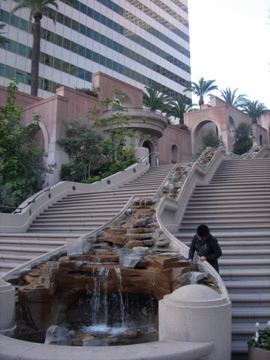
But of course, there never really had been. None of it was true, not all the way true, at least. Us writers and alcoholics are tragically skilled at romanticizing even the most sordid, harrowing of places and experiences—and in all likelihood, the actual Bunker Hill bore more resemblance to the modern-day Downtown than it did the gloriously gritty harem of passion portrayed in the novels I’ve loved. It was, most likely, a sweet little lie those boys told themselves, in their more tender of moments, when they ached for something to hold them, rock them, hum the lullaby of a childhood none of us really had. I know I’ve been guilty of rose-painting, perfuming the past, my own life, and it takes a photograph, something tangible, to jar me out of it, to remind myself how much it hurt, it bled, it puked and moaned; I saw people die, burn out, “I saw the best minds of my generation destroyed by madness.”

So in that way, what I sought was all a mirage anyway. The narrow alleys and sagging Victorians of Bunker Hill may have been gone, but had the illusory soul of the place ever been more than that, a fevered dream? There was a current-day incarnation, just down the hill—laced with more sinister, soul-eating of drugs, for sure, with the rattle of shopping carts and broken lives—but it was probably a more accurate representation of Bunker Hill than those exalted odes to insanity, like the moment of pure genius and bliss before the trip goes back and the come-down shatters in.

But maybe it was all a mirage, Los Angeles—an oasis that keeps glimmering just a little further out in the sand. Katie told me about a girl she’d met in a penthouse one day (“typical LA story—went out for a coffee, met the Del Taco guy, went up to his apartment with his friends…”): perfectly thin and gorgeous, a 22-year-old model who’d run away from her Midwest home at 15, found herself stranded in California when the boyfriend ditched out, came to LA, rose in the ranks and behind the flashing of cameras, sat now on a leather sofa doing rails of cocaine off a glass coffee table. “She was the total LA person—came from somewhere else, chasing this glamourous illusion, the LA dream. She knew it was a dream, she was totally aware of it, but still too addicted to the dream to disconnect.”

Here’s what I learned: LA is a place for seekers. It seems it always has been, at least for the last 100 years or so. The City of Angeles, of a fleeting fulfillment you can almost, but never quite, grasp. There’s an LA dream, that’s not too unlike the American dream, that this too can be yours, that you too can find it, have it, hold it. It’s a flickering projection of images, like on the backs of eyelids or clean white screens, that’s so close to being real you could almost weep, almost believe it.

So did I find what I was looking for? Yes and no. It may have all been a dream to begin with, like the utopias of the almost-cults I visited. It had been bulldozed and redesigned with crisp corners and clean towers; it was living on in the ragged throats and stained clothes of Skid Row. It was a memory so old you don’t know whether it was a dream or not; it was a love song for the one you never really, but almost, had.

Through the Green and Into the Dust

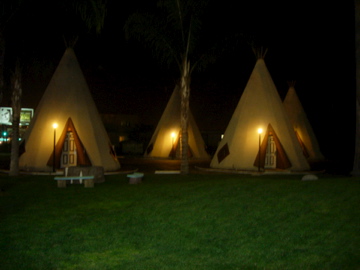
Blogging to you LIVE from the Wigwam Motel in Rialto—my own yellow, cigarette-stenched circle of heaven in the epicenter of strip malls, tract housing and Morrissey fans, the San Bernardino Valley. It’s the perfect place to end the drive down to SoCal, and to begin the journey into the dusty heart of whatever weirdness remains.

I started out on my roadtrip yesterday, sniffling and sore and in a DayQuil daze. I decided to press on with my plans, despite succumbing to a nasty cold that’s been going around, and if it hadn’t been so goddamn beautiful, it might have been painful. Spring arrived a couple days ago, with that certain lightness that makes everything seem young and hopeful and achingly pure. The coast was lit green by months of El Nino storms, a verdancy that’s rare in California. I twisted and turned on the skinny roads, blasting my stereo over the roar of wind through the rattlingly cracked windows.

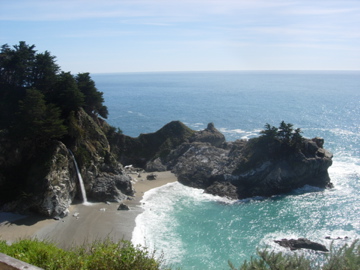
I stopped in Big Sur, where I hadn’t been since I was a kid. I’d remembered it being so far away from home, which I suppose it is, but only if you measure in culture, not in miles. It was just as massively impressive as I’d remembered, with broad trees and heartbreaking cliffs and not too many tourists, being early in the year. I’d been too groggy to stop for a sandwich on the way out of town, so I pulled into Nepenthe, purported to be one of the better of Big Sur’s overpriced coastal cafes. Glorified Wonderbread, browned and soggy lettuce, and $20 later, I decided that eating a $7 sandwich from home of the hood of my car at some pretty vista point would have been a far preferable experience. Whatever—it’s Big Sur. You can’t stay disappointed that long.

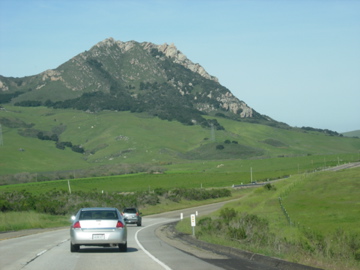
Feeling a little pepped up, I tried to do a quick hike, but discovered that a lot of the trails are currently closed due to the pummeling storms this year. So I tromped down a little coastal path, with bickering families and friendly Germans, aptly named Overlook Trail. It overlooks this:

and I felt pretty satisfied.

Back on the road, the coast got twistier, the pavement rougher, as I made my way down to San Luis Obispo. It’s a pretty typical California college town, with one major draw—one of the region’s few youth hostels. I grabbed a cheap bunk at Hostel Obispo, a cute old Victorian house, and took a leisurely stroll down to “Downtown,” which is really more of a high-end outdoor mall.

meeeeeat!

Traveling within the US is a novelty for me, and it comes with a couple major benefits, one of which is the use of my iPhone (far too expensive to use abroad). While the Cheap Gas and Public Restroom Finder apps have proven utterly disappointing, my old favorites are definitely coming through: Google maps and Yelp. I wanted to eat somewhere popular, that would give me a good feel for the town, and ended up at the Firestone Grill. It’s a BBQ joint heavy on portions and easy on the pocketbook, which makes sense in a college town. It was alright, about twice as good and half as much as my lunch—but 419 reviews? Then I passed the newly opened Chipotle, with a line literally out the door, and realized maybe, you know, I had had some of the best food in town.

I strolled around the town some more, filled with dudes in flip flops and girls in work-out clothes and pony-tails. It felt wholesome and relaxed—even the local riffraff felt quaint, in their barefoot belligerence. Everything felt cheerful and hopeful, like springtime and college students. I topped off the night with a much-needed soak in a hot tub at Sycamore Mineral Springs, a 12 minute drive from San Luis Obispo. My achy bones and sinus congestion thanked me.

This morning I backtracked to Montana de Oro State Park, for a little fresh air and strolling. Curving down a two-lane road, I went past coastal hills covered in purple and yellow wildflowers, orange explosions of poppies against the green green of the hills. The road took me into a tangle of eucalyptus trees; I pulled over where a bunch of cars were parked and scurried down a dirt path into a grove of trees.

The light cut through the leaves and branches and ocean mist in this dream-like haze, and all I could hear where birds and surf crashing. Over a hill and through a miniature valley (where a pelican glided past just as I rounded the corner), and I found myself at a surfer spot. I hung around a bit, sitting on the rocks and watching the waves and wet suits.

I headed back, this time inland on the 101, where flowers and green continued to line my journey. At home, I’m an impatient and cranky driver—I hate traffic, parking, street sweeping. Always an impediment to where I’m trying to go, what I’m trying to do. But driving down the coast, with my music playing and my broken skeleton doll dangling from the rearview mirror, I could let go and just go with the rhythms of the road. There was little traffic, just fresh air and beauty and my own wordless thoughts. The road was the place I was trying to go.

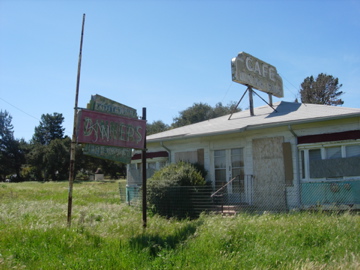
The roadside kitsch of Pea Soup Anderson’s was too much to pass up, so I made another stop—plus the soup felt good on my sore throat. Then I went to do a little un-urban exploring, swishing through thigh-high grass to poke around an abandoned diner I’d spotted from the highway. I peered through the windows at the stacked chairs, the silent booths, feeling a strange kind of nostalgia for a place I’d never been.

Things were starting to get cool.

As luck (or unluck) would have it, my iPod died just as I was cruising past Santa Barbara, so I pulled off to find a cafe. It’s hard not to feel alienated in a town like Santa Barbara, wealthy and white and homogenized and nice. Very very  nice. It’s the kind of place that feeds all your Southern California stereotypes, both the good ones—sun and long, tan legs—and the bad ones—everything else.

I got back on the highway just in time for rush hour. The green gave way to brown and billboards, the ocean mist to heat and just a thin layer of smog, the free flowing to break lights and miles of congestion. My 2 hour drive took 3 1/2. I climbed over the spine of LA, snuck around the backside, through one valley and into another. And finally pulled into the Wigwam Motel. It’s not as run-down as they say, the area not as “rough” as some reviews claimed. It’s a working class “ethnic” suburb and, hey, I’ll take that over a wealthy brofest any day. Even if it is damn hard to find a salad.

Blurry, but it does say "Get Your Kicks on Route 66." A better photo by daylight tomorrow.

So I’ve made it, my little car and me, crawling down the lip of the continent, down through the legendary beauty of coastal California, made more ridiculous by the green and tender spring. I’ve gotten reminded of what I already know of Southern California—bros and traffic—and am poised to head into the desert tomorrow. Found art, a rock n roll pilgrimage (and human cremation) site, and a honky tonk await. And that’s just tomorrow.


Lauren Quinn is a writer and traveler currently living in Hanoi. Lonely Girl Travels was a blog of her sola travels and expat living from 2009 to 2012. She resides elsewhere on the internet now.

Join 490 other subscribers

Buy This Sh#t

Categories