Archive for the 'Lonely Girl Loves' Category


Travel Tip: Tattoo Party

Nothing so helps you remember a trip like a permanent souvenir etched into your flesh.

We largely have the British Navy to thanks for the tradition of travelers getting tattooed, little relics of ink and miles, swallows instead of passport stamps. Though in the present-day we may be tortured with Sailor Jerry paraphernalia and hepatitis-factory street shops in beach towns like Puerto Vallarta, the basic idea of getting a tattoo to commemorate one’s travels remains a solidly good one.

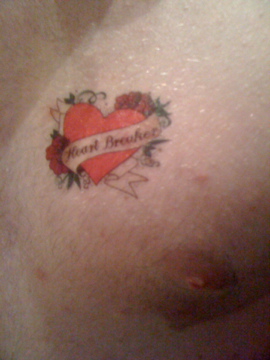
Even better is to have a DIY tattoo party with your travel companions. During my last trip in Hawaii, we did just that. It was a fabulous after-dinner family bonding experience.

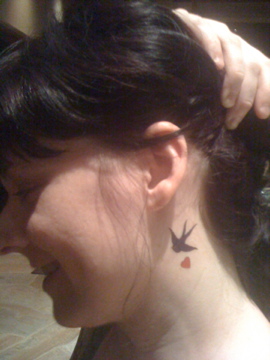
Zaia gives me a neck tattoo.

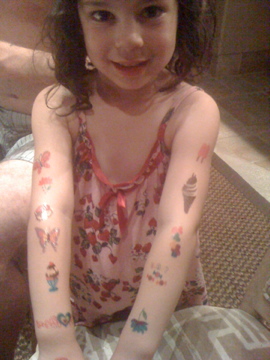
Hella cupcake-core—what you got to say?

Alicia goes under the gun/wet washcloth.

Nothing says “I’ve learned about spirituality through my travels” like a yin-yang.

Ankle tattoos are sexy and subtle.

Tribute tattoos, especially to significant others, are always a strong move.

Get chicks with a mean rose-and-thorn arm band.

But of course, you’ll want to let all those young backpacker girls know that you’re not looking for anything serious…

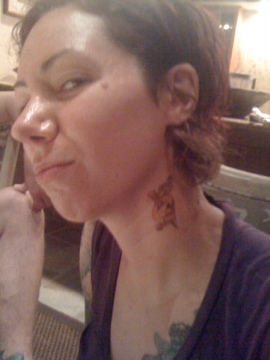
The beauty of the neck tattoo is that, even with long sleeves on, you’ll look like have a shitton of tattoos. Everyone will know how cool you are, whether you’re on the beach or hiking in the Alps.

And contrary to popular perception, no one is too young to join in the tattoo craze:

Let those cute boys down the hall know just how ready to party you are with a traditional tramp stamp.

At the end of it all, you’ll end up looking both tough and well-traveled…

… and have the coolest souvenir of em all.

A Circle of Stones

“I believe that the land has memory—that the earth remembers the things it has seen.”

Lucille Clifton said that at a reading I went to as a teenager, in introduction to her poem “Auction Street,” about how it felt to stand at former slave auctioning blocks in Memphis. I hadn’t traveled yet, hadn’t experienced much outside of the Bay Area, but something in me knew she was right: that rocks and trees and dirt have memories, maybe even dreams—that they hold little pieces of their histories in them, stored emotions, tender and swollen as our own knotted muscles.

I kept thinking about that line, said in passing in some beaming wooden room years ago, on my last trip. Walking amid the wordless rocky ruins of an abandoned village with a heat in my chest and a trouble in my mind, nothing seemed truer. Because, after all, Hawaii is a tragic place.

I stayed along the Kona Coast, a barren, burned-out mound of volcanic rock where the resorts stand out like green sores: lush, overly landscaped swaths of palm and grass against the expansive silence of lunar black.

P. was supposed to be one of them. Not a resort, but a tract of vacation homes: 7 acres divided into 10 lots, like much else along the winding 3-mile road that led from the highway to the coast. The land had belonged to a Hawaiian family who, amid the 80s mad-dash of development, could no longer afford the property tax and was forced to sell the land to a shady enterprise. A wealthy philanthropist came into contact with the family, bought P. from the enterprise, and built a personal vacation home there. My brother married the daughter of a the philanthropist’s good friend—which is how I came to find myself vacationing in a private, ocean-side villa earlier this month.

Sure, there was a gym and a media room and a billiards room and WiFi and groundskeepers and a gated entrance. But it wasn’t like a private resort. Not really. Because something had been retained, kept, preserved—not bulldozed and landscaped over (just landscaped around). The place quivered with a peculiar spiritual energy that made me hippie-out on heavy vibage. (And feel like I was on Vicodin.)

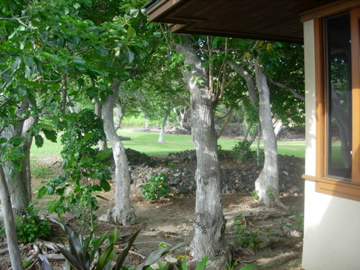
P. had once been a small Hawaiian village, abandoned for unknown reasons around the time Westerns arrived. Through a kind of cheat-the-locals-out-of-their-land swindle, a family came into possession of the land in the 1930s when they swapped their more lucrative property on a lusher side of the island for the rocky tangle of coast. As they bush-whacked into the overgrowth, the family discovered the rock-mound remains of the old buildings, as well as a burial site for what was later determined by archeologists to be a chief. The family was old-school, and believed in respecting the ruins; they didn’t move a stone, but left it in homage to their ancestors.

When the philanthropist came into possession of P., he respected the original family’s wishes and built his home around the ruins. He hired the son of the family, T., to be the property manager, an effort to maintain the sacred integrity of the place and undo some of the bad mojo that had cheated the family from their land.

That was as much of the story I knew as I walked the property the first day. Barefoot, the thick grass felt like carpet, and the air was soft and heavy and feeling of paradise. The path of grass snaked between the ruins, dotted by dense tangles of native trees. Neon birds flitted past, and the weasels darted like small, hungry ghosts.

I approached a perfectly circular mound to the immediate right of the house. Shaded by trees and covered in the round shells of their nuts, it seemed like a particularly potent spot.

As I got closer, I felt a warmth in my chest, rising into the base of my throat—not entirely unlike how I remember that first sip of alcohol: the healing heat, how something from the outside got inside, and suddenly made me feel more whole, less empty and aching. It was a curious, jarring feeling, at once intensely comforting and, well, disturbing in its unapologetic power.

I steered clear of the spot for the next few days. Frankly, I was freaked out. There was plenty else to do: I floated around the pool in an inner tube, did yoga on the deck, lounged in a hammock and read my self-help book on love addicition and co-dependancy. I’d glance sideways at the mound, avoid it, like it were a person watching me with too-blue eyes: it had seen through me and sat waiting.

T. came over to attend to some maintenance issues one day, and we got to talking. He filled in more of the history of P.—how he’d spent his summers there as a kid, how his grandmother had always told him about the spiritual power of the place and how he’d always felt it, even during his wild party days. He talked about respecting the land, saying thanks and being in tune. He told a story about an owl that lived on the property, that may or may not have been the spirit of his deceased grandmother, that had once come out in the middle of the day to watch him repair some of the stones the archeologists had moved.

If it were a movie, T. would have been wearing a lion cloth and the lights would have dimmed when he spoke, the sound of far-off drumming accompanying his tales. As it was, he wore flip-flops and a t-shirt, wrap-around sunglasses and an American moustache.

“P. has always been a healing place,” he told me simply. “I’m just glad that G. bought it, and it was able to stay the place it had always been.” He looked around the stately furniture in the vaulted-ceilinged living room, the hint of a wistful smile in the lines around his eyes. It was a far cry from the rustic shacks of his childhood, but I knew what he meant: it turned out as best it could, for the situation.

“That mound over by the house,” I pointed. “What was that?”

“Heavy, huh?” T. smiled. “We don’t really know. The archeologists thought it might have been a women’s house. Either way, it’s got some of the most powerful energy here.”

Later, I went over to the mound. Thinking of what T. had said, I bowed my head a little and asked permission before I entered into the center. I sat down cross-legged and breathed.

I felt the heat come—not a burning, but a warmth. I tried not to fight it. (He left.) It reached down, to some very tiny place inside, a very old and glowing wound. (A black kitchen and a birthday cake.) I looked at the trees, imagined their roots reaching down, back, on in at something (purple sores, swallowed by black)—like the pulsing red roots of teeth, the throbbing behind the bones of things. (He was sick, I loved him, he left.) The wind was gentle but urgent, speaking in a language of leaves (if I could have loved them more), like a mournful ballad sung in a language you don’t understand. (And left me here: gone.) The stones scratched and the shells dug in.

I heard a hoot. My eyes shot open and my spine twitched.

I heard it again, a belly sound, a calling. I thought of T.’s story: his grandmother owl in the middle of the day, watching over him.

It could have been a dove, cooing at the wind. But in the center of that circle, the ancient black of rocks, it sounded like the voice of P., the voice of the past—whatever it was, still was, had been and was still being, despite the house and the sprinklers and walking of foreign feet: a place of healing. A place that could somehow get down, down into the tightly clutched hurt of things, and coo.

Does the earth remember what it was? Does it carry its past in special little pockets, like a wound we hardly remember, but keep reliving, searching to heal? Well, fucked if I know. All I know is that, with all its resorts and rental cars, Hawaii feels like a beautiful young girl who’s been forced to marry a man she doesn’t love—and P. feels like the place where she goes, not to weep, but to pretend, to dream, to whisper her fantasies to herself, in the voice of the wind.

Travel Tip: Wear a Fanny Pack

Much has been written about the fanny pack. Most of it is bad.

What began as a utilitarian fashion craze of the early 90s (shut up, you know you had one) has now been strictly relegated to the arena of unabashed tourist. Worse than Tevas, worse than zip-off pants, worse than wielding a guidebook or clutching a map or asking for directions loudly in English, the fanny pack is the ultimate signifier of clueless tourist. Just ask the people who write this blog.

But on my last trip in Austin, my good friend and travel buddy Liz presented a most compelling argument in favor of the fanny pack:

I guess it’s all in how you wear it.

Having trouble finding support in your fashion-forward revival of the fanny pack? Use your free hands to take solace at The Real Fanny Pack.

Confession: I Have Been a Bad Travel Writer

And it’s not just that my computer’s been stressing out and spinning that color pinwheel in endless stuttering frustration.

It wasn’t that I traveled with friends or that I didn’t leave the US. It wasn’t that I went to a crusty music festival, or that I lounged in a private Hawaiian villa, or even that I slept till noon and stayed out till 4am chasing boys in a leopard print miniskirt (successful method, btw).

It was that I never made the switch, flipped my brain over into traveler mode. I didn’t push myself to explore, to dig in, to muck around and get dirty in the soul of a destination (no, getting covered in other people’s beer and sweat didn’t count).

It wasn’t that I was a “tourist instead of a traveler”—I was worse. I was a vacationer.

If tourists are the people following around umbrella-wielding tour guides, clicking shutters and buying cheesy trinkets and (sin of all sins) wearing fanny packs, vacationers are their drooling, sedated counterparts. We could really care less about whether a tour is culturally authentic or not; we don’t have the energy to get off our asses and go in the first place. We go to the same cafe over and over, buy the same sandwich, because it’s good and why bother finding another spot? We spend an hour staring into space. It there were a Sitting and Staring Olympics instead of a half-Ironman while I was in Hawaii, I would have won. (I have photographs that document my decent, but I’m currently not even able to upload anything onto my computer.)

I haven’t vacationed in years, maybe not ever, really—guiltlessly wasting days away. No notes taken, no itineraries feverishly followed, no long rambles down alien streets. So it wasn’t just that I barely wrote any posts while I was gone—it was that I wasn’t even traveling.

I had fun, and I certainly still have stories to tell. And while I “got away from it all” (really, people are on to something with this whole vacationing thing), I didn’t get away from myself. I talked a couple months ago about how I like who I am better when I travel, how I become what feels like a better version of myself, freer and happier and more at peace, enthralled with my surroundings instead of the hamster wheel of self-will. And while I was certainly a more relaxed version of myself these last 11 days, I was still Home Me, not Traveler Me.

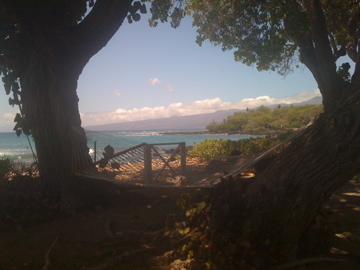
So that’s what my brain will be chewing on while my laptop’s in the shop—or rather, what my brain won’t be chewing on. Not articles or blog posts and pitches—just the image of what I stared at along the Kona coast, what’s burned into my retina, like the pink is onto my skin: a hammock, a horizon and a pile of black rocks. I’ll take my computer crashing as a sign, a circumstantial nudging that I need to take a step back and keep on being a bad travel writer.

Monetization Madness: Horn Players, Slam Poets and Why I Turned Down an Opportunity to Make Money on My Blog

From Flickr, not my stats

Yesterday I turned down an opportunity to make money on my blog.

Ridiculous, right? Isn’t that what every travel blogger wants? Isn’t it the dream that keeps us clicking fingers over keyboards and battling faulty WiFi connections around the planet: to fund our travels through a well-trafficked and heavily monetized blog? Click-throughs, AdSense, commissions. SEO and analytics and Top 100 badges. “Travel Blog Success,” “Monetize Your Blog,” “8 Steps to Building a Profitable Blog that Funds Your Travels.” Purchase an eBook, book a hostel, buy a flight. “Get advertisers contacting YOU.”

Well, I did. Without trying. And I shot them down.

It all happened, as most things do, via Twitter. A travel service that I actually have used and like contacted me wondering if I’d like to be a part of their “exciting new campaign.” “I’m hoping that we can create a relationship in which I email over exciting news, offers and competitions that (nameless company) has over the year so that you have some new content for your blog.” So, um, do you want to place ads or have me write posts related to your promotions on my personal blog? “The latter.”

It would have been easy and relatively painless. And also goddamn boring, both to write and to read. And if I wouldn’t want to read it, why would I want to put it up on my own blog? To improve traffic and make a little cash? I do contract work writing what is essentially marketing content for a trip-planning site. I pour hours into crafting pitches for sellable articles. I fucking wait tables. Why am I gonna compromise on the one place, the one thing, that’s really mine?

It sounds snarky, but that’s really just a defense mechanism for feeling unsure of my direction and a little jealous. Why jealous? Because if your goal is a have a successful and profitable travel blog, the trajectory is much more clear, much more linear: write on these topics, have a couple give-aways and contests, become an expert in something, brand yourself—get in where you fit in and get paid. There’s nothing wrong with that; being self-supporting through a blog is actually pretty bad-ass. It’s just that, when I browse through the most trafficked travel blogs, I realize that they’re (for the most part) not doing what I want to be doing. Which, I’m beginning to suspect, is write first-person narrative inspired by travel.

Trip-planning has its place. When I’m getting ready to go on a trip, I want to know what to pack and what buses to take and Top 10 tips and Top 10 undiscovered gems and Top 10 Top 10s. But that’s not what I want to write, not where my heart is. The travel blogs that I love and read regularly aren’t the most popular ones; they’re narrative-driven, thought-provoking and literary.

My blog is still young, in utero, 9 months old and dreaming fetal dreams of personage. “What kind of readers do you want to attract?” a friend of mine who’s helping me redesign my site asked months ago. “What are people coming to your blog for?” I’m starting to figure it out. And ads and stats don’t have much to do with it.

When I was in high school, I spent a lot of time doing Poetry Slams. The spoken word scene was popping off, Bay Area underground hip-hop was at its height, and every kid who could string a rhyme was taking to the stage. I took after-school workshops with an excellent literary non-profit and performed what felt like once a week. But I wasn’t a Slam poet. I couldn’t beat box, couldn’t freestyle (unless I was seriously faded), wasn’t a performance artist. I read Sylvia Plath and Charles Bukowski; instead of quoting Mos Def in my pieces, I quoted William Burroughs.

I learned, early on in that, to be okay with what I was. And that the kids that got all the applause and won all the competitions weren’t producing work that was necessarily any better or worse than mine—just different. A lot of it was bullshit, and a lot of it was really good. I met kids that weren’t into the scene of it all, but loved writing—kids I still keep in touch with and whose work I still respect. I’m immensely grateful to have been a part of that community, even if my own addiction-drenched lyrical poetry didn’t ever fit in, prompted more raised eyebrows and dead silences than standing ovations.

I’m finding myself again in the same situation. There’s a lot of great travel blogs out there, and I’ve “met” a lot of great writers. There’s really this awesome, supportive community out there, and I’m glad to be a part of it, however tangentially. But again, as usual and as always, what I’m doing and my vision of where I want to go doesn’t align with the dominant trend—isn’t raking in perfects 10s and bringing down the house. And again, I’m learning to be okay with that, and to stay true to myself.

When I was a teenager, amidst all the Slam Poetry woo-hah, I saw a documentary about Wynton Marsalis. He was talking about being a childhood prodigy, how he’d learned some fancy trick that horn players are hip to but audience go nuts for. He did it at a show and the crowd lost their mind and he basked in the thunder of their adoration.

After the show, on his way home, his dad was real quiet. Finally, he said, “Son, if you play for applause, that’s all you’ll ever get.”

I’ve kept that one with me all these years. And I’m still not performing for applause—or writing for advertisers.

A Woman in the Sun

I sat in the sun, butt naked and heat dazed, my starving skin soaking up all the UV it’d been hungry for since my trip to LA. The sulfur smell of the hot springs had stopped burning my nose, and I was in that drool state of relaxation where everything floats in and out of your consciousness like a dream. The bits of conversation from down the deck came to me in whiffs, like BBQ or the burning of some far-off fire.

“You know, Mark called me on Friday. And he started up again. And I said, you know, like we’d practiced, ‘I am not going to participate in this conversation with you.'”

The words roused me a little. Not so much really the words, but the careful way in which they were recited—deliberate, practiced, the memorization of an actor who knows the scene but hasn’t quite figured out their character’s motivation.

The patter of bare feet and a sleek ripple of water. “Oh, Myra, I didn’t tell you,” the voiced repeated. “I got to use that tool we talked about, when I told Mark: ‘I am not going to participate in this conversation with you.’ It felt so good!”

Wilbur Hot Springs is a retreat place, and that’s what I’d come for. That’s what we’d all come for, driven the two-line highway through pastoral postcards, past cheese-commercial cows, down a bumping dirt road where the dust plumed and twisted behind us like everything we’d meant to leave behind.

Wilbur is the kind of place that makes you lapse into cheesy cliches (partly because your brain is too full of steam to think straight). A Victorian mansion “nestled” into the “rolling” California hills, it’s an uber-NorCal experience, an “oasis.” Everything is solar-powered. The natural hot springs are directed into four flumes clustered around a clothing-optional deck. There’s a communal kitchen where guests cook their own meals, and instruments for evening jam sessions. Everyone talks in low, soothing voices, and the place smells like well-oiled wood. Sustainability and spiritualism; regrouping, reconnecting, getting off the grid and soaking in 114 degree water—you know, the kind of hippie shit a punk rock kid like me used to scoff at. Until I went up on a gift certificate a couple years ago with a similarly suspicious friend.

We’ve been jonesing to get back ever since.

Retreat is what these chatting women on the deck had also come for, and like retreat, they were something, a certain kind of woman, a younger incarnation of me would have scoffed at: middle-aged, middle-class, white, all-American. Bad hair and worry lines. I’ve grown less judgmental in my old age, and in my hot-spring-infused sedation, observed them detachedly, from an almost anthropological distance.

They’d come on day passes. They weren’t entirely comfortable, held their robes and towels around them self-consciously, seemed self-conscious about being self-conscious—they averted eyes, glanced this way and that before letting go and slipping naked into the steaming water.

I’d pieced together their conversations, about ex-husbands and astrology, how to figure your aura energy by the kinds of animals you attracted (“You got lizards and butterflies; I got bit by a tick!”). This day trip to Wilbur appeared to be the culmination of a healing workshop. The leader of the group was some kind of psychic—not a predictive one, she assured, but one that dealt more in energies, a kind of cosmic therapist. They weren’t super New-Agey about it, talked in a kind of down-to-earth tone that made them seem less like people on board some kind of bullshit train, and more like people genuinely seeking, genuinely lost and hurt and looking for something, some kind of solidity.

“I am not going to participate in this conversation with you.” The statement rang in my ears, plucking me out of my sun-drenched stupor. The speaker’s voice held in it all the excitement of a pupil who’d just felt a switch flip—who’d practiced the arithmetic but wasn’t sure the equation would work for them, with their own dull and trembling pencil. But it wasn’t a young voice and a glance at the body from which it issued revealed a gravity, breasts heavy and hips wide, a child-bearing body.

My God, I thought, to have lived that long and only now have learned to say that.

The woman’s comment, the thrill with which she yielded it, struck me as tragic, in a particularly female kind of way—that a woman could go that long in her life without having learned to say no before.

Boundaries. Standing up for yourself. Not taking shit. They’re vital things for us girls to learn. You flat out won’t make it in this world without them, I’ve come to believe, and I don’t just mean with manipulative ex-husbands. You’ve got to learn where the world stops and you begin, what is and is not okay with you, and how to be firm and true to that. Cause you’re not going to make it—ride the buses or walk the streets or, shit, travel the world—you’re not going to survive the barrage of shit hurled at you without learning the word “no.”

And there, on that sun deck, a wave of gratitude swept over me, like the spring breeze on my pink and steaming body, for my mother. My tough-as-nails, take-no-shit mother.

My mother, my model: pretty and blond and trained in karate. She worked in factories, held her own in the male-dominated world of politics, worked in West Oakland during the worst of the crack years, dared a scab to follow through with their threat to punch her on the picket line (they punked out). It stems from that: my childhood love of Tina Turner and my vow that if, when I was older, I ever went on a date with a guy who tried to make me do something I didn’t want to, I’d “kick him in the nuts with my high heels”; my busted-Converse affection for Riot Grrls, Le Tigre, Anne Sexton and Sylvia Plath. And it stretches before that: my grandmothers, no-nonsense Midwest girls who endured Depression poverty and marched in Civil Rights protests.

I come from a long line of tough ladies. I can’t ever forget I stand upon the ground they forged for me. It’s a generational adventure, this learning of how to be a woman in the world, and what my mother and grandmothers fought for is in me, my blood. So much so that it still surprises me, blinking-eyed shocks me, when other women ask me how I have the “bravery” to travel alone. It simply never occurred to me to not have the bravery.

In that sun-drenched moment, any residual judgment melted away, just like the knots in my lower back unclenched in the hot, healing water. It may have seemed tragically late to learn how to make boundaries, she may have had to take a healing workshop with a psychic, but this woman had learned. And she sat now, naked and free, gently turning pink in the sunlight of it.

This is Not About Travel

Ten years ago today was the worst day of my life.

This is not about travel.

Have you ever been broke down, beat up, tore back—I mean wiped out, swinging from a greasy rope, “with no knot in it”? Have you ever had to admit total defeat?

This is not about travel.

Have you been 17 and scared? Have you been running, running from an unnameable blackness inside you? Have you ever found the thing that would save you, keep you, sing to you sweetly in the jagged alleys of adolescence, a song of calloused fingertips and swollen livers that lullabyed you into a half-consciousness that made everything more manageable? Have you ever fallen in love with a sickness?

No, no, this is not about travel.

Have you woken up, bloody-elbowed and wobbly-toothed? Have you walked through the house with kitchen knives in both hands, watched the walls bleed and the shadows twitch, recoiled from your own hungry pupils in the mirror?

And has life ever stepped like a steel toe on your chest? Have you ever laid choking and gasping on the bottom bunk, the weight pressing down, pressing, pressure (that’s how diamonds are made).

Have you ever realized that the thing you thought would save you was gonna kill you faster than what you were running from?

This is not about travel in the traditional sense—not the route between physical places. This is about a different kind of journey, a spiritual journey, but one where there’s no arriving, no achieving. Where, no matter how far down the path you get, you’re always the same distance from the ditch.

My last drink was like this: Sunday afternoon, the parking lot of a West Berkeley warehouse, “backpack beer”—the warm remains of yesterday’s 12-pack. It was a place we’d go to drink during shows at Gilman; it wasn’t my part of town, and I didn’t know where else to go. We’d taken the bus an hour, to buy a half ounce from the kids above the pet shop, walked a couple blocks west to chill out before the trek home.

But the spot looked different during the day, naked and stark, not shielded under a blanket of dark that obscured everything, made you less able to look at it, see it. We crouched beside a stairwell, I drank two beers, got the cuff of my jeans wet when I squatted and pissed.

We took the bus back to Oakland, through a spring afternoon I didn’t deserve. It was too soft, too aching, too bird-singingly pure. Spring break had come and went, and the fragmented remnants of the week-long blackout were still jangling in me, sharp as glass. School would be out soon, graduation was coming, and I’d wear a white cap, march single-file into a future that was only getting heavier, deeper, more liquor-soaked and desperate.

I’d go home and eat dinner. I’d sneak a glass or two of wine, to take off the edge that was already sneaking back. I’d bag up the half-ounce and smoke a little of what was left. Listen to some music, maybe write a little. I would not meet fate, would not break down sobbing in a wretched little ball as it all caved in, crashed down, crushed the very bones of me. I would not get sober that night.

Ten years ago today was the first day of my life.

Bootleg Blues: Thoughts on the Illegal Alcohol Trade Around the World

It was not a subject I expected to get so drawn into. But there I was, hunched over the pale glow of my laptop, clicking links and watching videos and reading random blogs, that damn color pinwheel spinning from the stress of too many open tabs—like going down a virtual rabbit hole into a murky, liquor-soaked world of shadows and motorbikes and sick yellow skin.

Modern-day bootlegging. Prompted by a New York Times piece about alcohol in tribal Pakistan, NileGuide assigned me an article on the illegal trade of alcohol around the world. It was to be a straight-forward round-up, carefully presenting the information without judgment, condemnation or alarmist cries of “this shit is crazy!” But it kind of is crazy, is the thing, and got me thinking a lot about the prohibition/restriction of substances in a society, and about my own experience traveling in Morocco.

As you’d probably guess, all of the places I discovered with a bootlegging industry either outlaw or strictly regulate alcohol sales and consumption. The how and why of it was fascinating. There were religious reasons, of course, in places like Pakistan and United Arab Emirates, but more interesting to me were Sweden, Russia and these remote rural towns in Alaska. All of these places enacted regulations in response to severe alcoholism within the culture. In the Alaskan towns, the temperance calls came from the community rather than the government—largely composed of a Native American population, folks in these towns were sick of the ravages of alcoholism and wanted to just do away with the whole existence of the glimmering, vile elixir. Can you really blame them?

The problem, as any good alcoholic knows, is that people will find a way to drink anyway. (Shit, I never took a legal drink in my life.) Regulations lead to a bootleg industry rife with gangs, violence and product made with piss-poor ingredients that can sicken and kill those who consume it. It’s not too unlike the drug trade in that regard—which got me thinking, on this uber-stoner holiday, about places I’ve been that have suffered immeasurably due to the drug trade: Mexico and Colombia. As always, the suffering seems to break down along class lines: the people who really get fucked are the poor folks in these cultures.

In Morocco, I had the chance to hang with some sober people. What these people—three expats and one Moroccan woman—told me about the actuality of alcohol consumption in the country kind of blew my mind. “Of course people drink,” the retired American sisters told me. “You’re just not supposed to drink, so no one talks about it. People just kind of turn a blind eye.”

As we pulled into the beach resort of Agadir, they sneered slightly. “They’ve been building the town up,” they told me. “It’s becoming something of a playground for Saudi men, where they can drink and have their call girls without anyone knowing.” They later told me about medina bums that drink cologne—not too unlike old-school stories I’ve heard about how folks, during the Depression, would strain shaving cream and drink the liquid to get drunk. (One report of an Alaskan town claimed mouthwash and air fresheners have to kept behind the counter at grocery stores because people use them to make alcohol.) The gaping, aching disparity between how the rich and the poor consume alcohol astounded me.

In the Gujarat state in India, only the wealthy could afford the imported and smuggled bottles of whiskey, while in Russia, only high rollers could fork over what was a three-fold increase in alcohol tax. Poor folks in these places were left to consume shady moonshine, made from medical disinfectants, that led to sicknesses like toxic hepatitis and “yellow death.” Recent outbreaks had killed over 100 people in both places and sickened over 1000. In Gujarat, people rioted during last summer’s outbreak of poisoned alcohol deaths, accusing the police of abetting bootleggers and clamoring for the repeal of Prohibition laws: “Blanket prohibition has never worked in this free world.” The government responded instead with harsher laws: the death penalty for anyone caught bootlegging.

Then, on top of all that, you toss in the lucrative business of bootlegging, complete with gangs, bribed government officials and violent skirmishes, and you gotta ask yourself: how dissimilar is all this from the drug trade?

It’s too simplistic to just advocate for legalization—there are huge cultural and religious forces to negotiate. But it seems, at least in the cases of Alaska and Russia, that putting tight restrictions on alcohol hasn’t done a whole lot the curb alcoholism. It’s a fast, tangible, measurable action, but seems to have caused a hell of a lot more suffering. The slower, more expensive and difficult answer would be to increase social services, preventive education and not-for-profit recovery centers.

At the very least, legalization means regulation, both of the substance and the criminal underbelly that controls its distribution when a government doesn’t. I’ve never drank moonshine, but I don’t even want to think about all the dumb and dangerous shit I did to get alcohol, all the yellow rocks cut with Ritalin and rat poison that I consumed, about the fourteen-year-old kid “in the scene” whose heart exploded when he took a bunch of bad acid. The safety of banned substances, along with crime, led the US the repeal Prohibition, and I can’t help but wonder if a more feasible answer to combatting the drug trade problems in Colombia and Mexico would be at least a partial legalization.

The sober Moroccan woman I met painted a fascinating picture of alcohol in her country. She was upper-class, from an important family, had been to European boarding schools and spoke seven languages. According to her, everyone in her class drank. It was considered cultured and European to drink—though, since alcohol wasn’t an established part of the culture, it didn’t take the form of a nice Cote de Rhone with dinner; people binge drank. People did it, but didn’t talk about it, a sort of deeply steeped denial. You can only imagine how difficult it would be for someone to admit they have a problem with alcohol, in a culture where you’re not even supposed to be drinking. Toss in being a woman on top of that and, well, you’ve gotta be one tough chick.

Let me tell you—she is.

Travel and the Lonely Girl

"When that open roads starts to callin me..."

I have been in a post-trip funk.

It’s embarrassing to admit, especially since the trip that propelled me into the sucking black of it wasn’t much of a trip: 10 days, in-country—shit, wholly within California. No form of public transportation was ridden, no bulky backpack bulged to the max: Traveling Lite, Reduced Hassle.

But it wasn’t just that trip that launched me soul-first into the aching void. It was the accumulation of trips, the momentum and gathering steam, wheels spinning and dust pluming. It was a short drive through my own backyard than confirmed what I knew was true, solid and sore as a cancer, sitting unmovable in my gut, in the way that things we suspect (but don’t want to admit) are true do: I like myself better when I’m traveling.

God damnit. I’ve been restless, irritable and discontent since I’ve come home, an itch in my veins, mounting, rising with the blood and coming out (this part is true) in a pink dry rash on my arms and legs. On one particular night last week, when I felt like I was going to crawl out of my own skin, it dawned on me: I’m far less lonely traveling, even solo, than I am at home.

What the fuck is up with that? It’s one of those logic-defying spiritual axioms. But it’s not just the loneliness, because I’ve always been lonely, not in a no-friends kind of way, but in an ache-in-the-center kind of way. (“She had a funny way of looking, too, that was like bird looked: you know, with the head turned, never dead at something, but kind of past it, past it like she could see something nobody else could see; and whatever it was she saw sometimes scared her like a ghost. ‘I’m lonely,’ she says.“) No, it’s more than even that central fact. It’s that I feel like I’m a better version of myself when I travel—as though being on the road irons out all the rough spots, calms all the kinks and hushes me with a lullaby of engine roars and brake squeals.

Sure, there’s the departure from reality aspect: no work, no bills, no floors to be swept and trash to be taken out. Free of mundane tasks and responsibilities, travel allows you to turn to loftier activities, reflecting on life and culture (and street art and soda pop). Traveling isn’t “real” life—or rather, it’s realer life, a sudden plunge back into the ice water of all that surrounds us, but we’re just too wrapped up, too nose-to-the-grindstone, to see at home. It’s either an escape or a return, a reverse kind of homecoming—I haven’t decided which yet.

But it’s something more than that too, I think. Somehow, when I travel, I feel more connected, even when I don’t speak the language, don’t look like anyone around, don’t know anyone for hundreds or thousands of miles. I’m more curious, less shy and inhibited, more apt to  engage (even wordlessly) with a stranger or go traipsing off on some impulsive adventure. I’m totally consumed with my surroundings, and all the shooting sparks and trembling brain waves usually spent hamster-wheeling around myself are redirected, sent to other, sleeping parts of the brain that yawn and stretch and come to life only when I travel.

It’s not that I don’t love my home or my life. It’s that I think about myself less when I travel. Freedom from the bondage of self is what it’s all about, right?—the closest I’ve ever gotten to feeling whole and content and, holy shit, not lonely.

Of course, there are spiritual practices that can achieve the same effect. (“When we retire at night, we constructively review our day… Were we thinking of ourselves most of the time? Or were we thinking of others, of what we could pack into the stream of life?”) But I want it now, I want it the fast and tangible way, the board-a-plane-and-stuff-a-bag-and-drain-my-bank-account way. I don’t want to sit crosslegged on a lotus leaf and wait for, not enlightenment, but something to ease the itch and fill the void, the little lonely I carry, that I sometimes think we all carry.

I’d planned to go back. I’d switched my shifts and made hasty arrangements, was going to go back to LA. I told myself it was attend the renaming ceremony of John Fante Square (as much for the ceremony itself as to witness whatever bizarre cross-section of humanity would come out for such a thing—myself included, of course). I told myself it was to take more pictures and get more material and possibly go to a print studio that sounded pretty killer. But really I just wanted to relive my last trip—to get back to that place, that elusive illusive place, where I’m not just happy, but something that resembles content. It’s not actually a place at all, an anti-place—or else it’s every place, the possibility and freedom of the open road that courses through the world and ourselves and that, goddamn, I wanna get back on, wind-rattling and dust-covered.

Meet the Reason

… I won’t be traveling for a couple months. (Well, not the only reason, but the biggest, which is actually the smallest and the sweetest reason…)

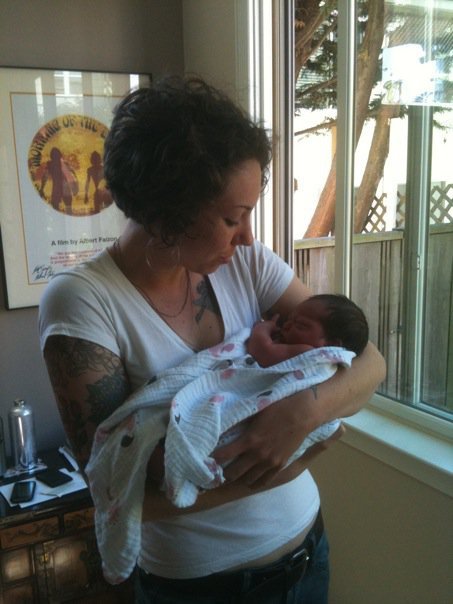
Baby Naomi, my brand spankin new little niece, born on Tuesday, April 6th. I’ve got other nieces and nephews, step- and half-, but none whose birth I’ve been around for. None I’ve gotten to hold when they’re pink and trembling and less than 24 hours old, blinking in the strangeness of light and the world—everything blank, yet-to-come, a suggestion of stars and planetary alignment, the etchings in a palm that’s too small to read yet, to gently uncurl or do anything but hold.

The world can wait. An impulsive trip to the renaming ceremony of John Fante Square in LA can be ditched. My inbox can fill like rising water and my page view stats can sink. There comes a time to sit still, when even the itchiest feet need to stay rooted.

This is definitely something I wanna be around for.


Lauren Quinn is a writer and traveler currently living in Hanoi. Lonely Girl Travels was a blog of her sola travels and expat living from 2009 to 2012. She resides elsewhere on the internet now.

Join 490 other subscribers

Buy This Sh#t

Categories