Archive for the 'Lonely Girl Loves' Category


Estudy of Estyle: Chilean Street Art and Figuring Out What the Hell It Is I Have to Say

There’s something I’ve been thinking a lot about, but struggling to find the words to explain: the connection between travel and street art. I’ve had fumbling conversations in which I attempt to articulate it, flapping my lips like hands gasping at butterflies, trying to gather vague supports for an unformed thesis. An idea has been forming in me, very far inside my brain, amid the murmuring currents of subconsciousness—like a toddler without the vocabulary to express herself, feeling emotions she doesn’t understand, but only knows are true.

And then a friend posts a video on Facebook that starts to explain everything I’ve been thinking and struggling to say. Thank God.

Chile Estyle has released the first documentary in what I’m hoping will be an ongoing exploration of the evolution of the burgeoning and blossoming Chilean spin on the global phenomenon of street art. And in its coverage of the specifically Chilean take on the art form, Chile Estyle touches on what I’d felt street art is doing all over the world: revealing (like a striptease) just a little more of the soul of a place.

I’ve been hearing a lot about Chilean street art, most recently in a photo essay by Oakland artist Obi Kaufmann (discussed in connection to his recent mural here). We stood around The Oakbook’s small gallery space, and I listened to Obi talk about the distinctions of Chilean street art: materials lending a unique aesthetic (due to the relative absence of aerosol spray paint in the country), and the culture of muralism leading to the acceptance, even support, of the community (you’re more likely to see street art on the sides of businesses and schools than abandoned warehouses). I can’t say I saw a lot of street art when I was in Santiago, nearly five years ago. Something has changed.

Judging from the picture presented by Chile Estyle, the explosion of street art in Chile has a lot to do with the country regaining confidence and reestablishing its identity. Artists in the video talk about seeing work from New York, Europe, Brazil, and taking pride in the fact that Chile can contribute works just as valuable and important. But, of course, it comes with their own distinct style, a product of their own history and culture.
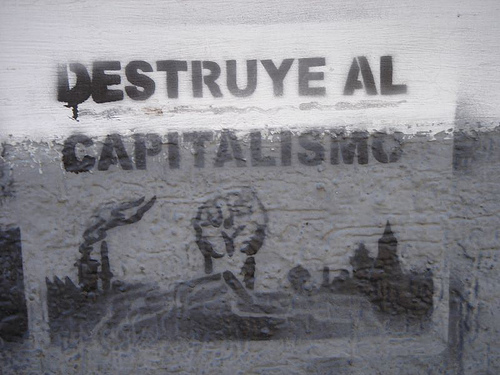
This one's for you, Mom

The video discusses “Chilean graffiti identity,” informed by the country’s tradition of political muralism. Uber populist and at its core revolutionary, graffiti and street art are seen as an extension of the self-expression that acted in rebuttal to (right-wing) major media outlets—“walls are taken much like a newspaper.” The tradition has lent a culture and community far more tolerant of street art than in most places of the world; it’s seen as “a gift for the people,” rather than vandalism. And, as Chilean street art has begun to garner international attention (like in a recent exhibition at LA’s Carmichael Gallery), it’s become a source of national pride.

How different this is from the culture of street art around the world. And more than just isolated vestiges of self-expression, one can take Chilean street art as a product of the country’s past and perhaps one of best reflections of its contemporary culture.

This is what I’ve been suspecting street art could do. In moments of blinding conviction, I’ve felt that street art, in its democratic and uncommercialized glory, can capture placeness just as well as food or architecture or music or any number of things people look to when they travel. In a continual cross-pollination of artists and influences, cities wear a bit more of their souls on their walls, as though the murals and stencils and wheatpastes were images from its dreams. It’s the way a city like Tel Aviv becomes a mecca for political street art, the way the aesthetic now known as Mission School bloomed in the alleyways of the 90’s SF Mission, whispering its stories in neon—and the way the tradition of political muralism paved the way and painted the walls for a purely Chilean approach to the art form.

And I still don’t have the words for it, the right or complete words to explain it all—because of course, virtually the same things could be said about all art forms, in how they inform and are informed by place. But something in me sparks when it comes to graffiti, in the same place of my brain that travel ignites. I guess the only thing to do is keep digging, poking, on the internet and down alleyways, until I stumble upon the thing it is I’m trying to say—painted on the walls in plain sight.

Candy, Travel and Love in Los Angeles

On a smog-sighing spring afternoon in Los Angeles, I met my soul mate. Possibly two soul mates.

Tuesday was a charmed day, my last full one before I hit the highway and headed back up the green spine of California. I ultimately failed in my scurrying attempt to cram in everything I hadn’t gotten to in the previous days—but I did encounter, sheerly by happenstance, two kindred spirits, cosmically bound in a coruscating tango set to the tune of my greatest loves: the unexpected beauty of travel, and sugar.

I got to Glaco’s Soda Pop Stop the round-about way. I learned about the Highland Park neighborhood (where Glaco’s has operated since 1897) through Trekking Los Angeles, a non-profit that aims to leverage cultural tourism to bring financial benefit to underserved communities. A pretty bad-ass ambition, and especially interesting given the recent spark in the ongoing debate about the cultural benefits/damages of tourism at World Hum and Matador. But how would it play out practically? I tried out one of their neighborhood guides.

The Highland Park guide focused mostly on art galleries and community spaces, which though interesting yielded a pretty incomplete neighborhood guide. I cruised past several of the galleries, finding only one open, and discovered the crowning Southwest Museum to be closed indefinitely due to earthquake damage.

What I ended up finding coolest was just wandering the streets. Far from trendy and slick, Highland Park is a diverse, working class community (not too different from Oakland) filled with raspado carts, 99 cent stores, auto shops, old women walking under the shade of umbrellas, panderias displaying Nescafe, Santeria markets, Food4Less, fast food chains, the lonely hiss of traffic. And art. Graffiti bloomed electric in the alleys, while murals covered the sides of buildings, highlighting local history, cheerfully advertising for businesses or bilingually encouraging you to recycle your motor oil. If it hadn’t been for Trekking Los Angeles, I’d never have ended up in Highland Park.

But Yelp led to me to the real gem of the neighborhood. Judging by the magazine articles taped to the front door, Glaco’s is far from undiscovered. Which is a good thing. Because under the fluorescence and atop the linoleum lies one of the most killer collection of sweets I’ve ever seen. I’d come to the holy land of sugar fiends. Cane sugar fiends.

I walked starry-eyed through the aisles, along displays of glass bottles and vintage candy. As I stocked up on candy cigarettes, Bubble Up and chocolate taffy, I perused some of the ingredients list. High fructose corn syrup was nowhere to be found. At the check-out line, I asked the grayed, smock-wearing clerk if the sweets sold were all in fact original recipes, free of all the chemicals and crap found in American candy today.

His eyes shone, a web of smile wrinkles appearing. “Our products only contain cane sugar.” My heart fluttered. My wallet opened.

Turns out the clerk was John, the owner of Glaco’s and the man responsible for turning it from an old-school deli to a cornucopia of candy. Being a fairly mellow Tuesday afternoon, John commenced to guide me around the store, explaining his philosophy and pointing out beloved brands.

John was all about the taste. He wasn’t a new-agey health nut (obviously)—to him, products made from natural ingredients like cane sugar just taste better. “The big companies are all about cutting costs,” he told me. “They don’t care about taste.” He told me how he remembered, as a kid, when 7Up switched from using lemon and lime oils to extracts. “It was terrible,” he lamented, with the touch of nostalgic heartbreak reserved for unhealed childhood wounds. “Now this,” he picked up a bottle with care, “is the good stuff. Original Dr. Pepper formula, with Imperial cane sugar.”

John and I proceeded to bro down about ingredients for about 20 minutes. Coming from the Bay Area dining scene, it’s all about quality, natural ingredients, even at the bar—squeeze your own fresh juices, make your own simple syrup, even your own small-batch Vermouth, increasingly. It’s a trend based on taste. But for John, it’s no trend. The vintage candy and soda thing isn’t a gimmick, isn’t hip. It’s just the way sweets were always meant to be. A square-shaped old man with smiling eyes and a die-hard passion for sugar, I almost asked if he had any single grandsons.

Thirty dollars and one mean sugar buzz later, I headed clean across town to Culver City, the undercover hotbed of hipness. Some of LA’s most prominent contemporary urban art galleries are housed in the unassuming tract of wide streets and windy sidewalks, including one often featured on one of my favorite street art blogs, unurth. I checked out the whimsical exhibition by Brazilian street artist Nina Pandolfo at Carmichael Gallery, and chatted up the friendly dude gallery sitting. He told me not to miss the current exhibition two doors down, at Roberts & Tilton. And oh man, am I glad I listened.

The white walls of the gallery’s main room were lined with a single ring of photographs, hung right at eye-level. The black-and-white images were haunting, gritty, unflinching, and ultimately beautiful. They were the work of Ed Templeton.

Ed Templeton is a kind of a Renaissance Man of contemporary cool—a pro skateboarder, photographer, artist, editor of a magazine, and, after reading the press release for his current show The Seconds Pass, a damn good writer, I’ve decided:

There is a scribble of asphalt and meandering ribbons of concrete tangled all over North America in a contiguous line of material that connects each of us to whomever else is also in contact. I sometimes marvel at this, walking from my front door and standing on the asphalt looking down at its grimy blackness, wishing I could rest my ear down on it and hear everything like the Indians in an old western film. The pavement I’m standing on is connected to other pavement, concrete, or steel to almost anywhere I can think of. Certainly everywhere you can drive to. Someone in Burnt Church, Tennessee is standing on gravel that is connected by touch to my street, just like someone is in Halifax, Nova Scotia. I can be in New York City in 3 days from my home in the suburban sprawl of Orange County, California without ever touching the earth.

All the photographs in the exhibition were taken from cars. On the road, in transit, the photos captured those fleeting moments, those “ephemeral winks” that slide past the glass like a poem of images, a slideshow of humanity and place. Walking, biking, waiting for the bus, staring out through the windshield—they were snapshots of those little moments, seemingly small and sometimes lonely, that are somehow connected, or connect us.

I’d been roadtripping for 9 days, riding the veins of America, the journey of it as much a destination as the places themselves. Dusty towns, gasping palm trees, billboards and cacti, strip malls and faces, faces—it was like a projection of something, a movie flickering on my windshield, disappearing in the side-view mirrors. And a thread of something laid underneath it all, tying it all together, like some obscure plot line I couldn’t quite grasp, but that kept nudging, whispering at me in its language of images, the roar of the wind. It was the road, the black asphalt itself—and god-damn, if I could take a decent picture, it’d look something like the ones lining the walls of that gallery.

It might have just been the cane sugar coursing through the blood, but things were beginning to make sense.

Searching for the Swallows in San Juan Capistrano

The air twitched with flies. Wild rabbits darted like phantoms from some hallucinogenic come-down; lizards crawled like insects out of the eyes of middle-school acid trips. Rocks and weeds tumbled down into a tight ravine; on the other side, trains rumbled past and the interstate roared like a wild thing. A weathered “No Trespassing” sign grew small behind me. I wasn’t concerned—this was bigger than trespassing. Down an abandoned road, amid the unkept overgrowth of a forgotten corner of Orange County, I was searching for what I’d come for—the swallows of San Juan Capistrano.

It started with the tattoo. I, like half of the tattooed population of the planet, have swallows. Not that I’m a sailor, bird enthusiast or have any particular affinity for traditional tattoos. But it means that every little old lady I meet asks me, “Have you been to San Juan Capistrano?” I found out that San Juan Capistrano was the town where swallows migrate back to every spring, after their trip down to Argentina. They arrive like clockwork every March 19, swooping around the old alcoves of the Mission there, building their bizarre nests and diving through the calm air and whispering history. I got tired of answering “no”—this year, I was going to the god-damn Mission and seeing some god-damn swallows.

I drove into the belly of the beast—Orange County. Motherland of every suburban California stereotype: sixteen lanes of chocked traffic, smog-smudged horizons, Del Taco and Starbucks, too-skinny arms and too-hard boobs. But somewhere amid all that was a kind of authenticity, a tradition, a natural phenomenon that hadn’t been strangled out by sprawl. I’d sat on the balcony of my cheap hotel in the Fez medina one dusk and watched the sky come alive with the swoop and screech of swallows: black, like shadows, fast, like phantoms, so that they almost seemed unreal. I wanted that rush again, that marvel and awe, in what seemed like a most unlikely place, this suburb of all suburbs.

The return of the swallows is San Juan Capistrano’s biggest event of the year. The Mission opens its doors to tons of visitors; I learned too late that the main event was the Swallows Day Parade on Saturday. But whatever. The main event for me were the birds themselves. I ditched my car about a mile from the Mission, hiked through the traffic and crowds of families and old ladies. I bought a couple $2 tacos, a pan dulce as big as my head, and entered the Mission.

Only the swallows weren’t there. Crowds milled around with their audio-tour headsets, their cameras and sun visors, through the neon flowers and crumbling edifices of the Mission, looking skyward at nothing but blue. “Ooh, there’s one,” an elderly man exclaimed. “No, dear,” his wife answered, “that’s a blackbird.”

What the hell? I sidled up to a ranger and asked, “So, um, where’s all the birds?”

“They don’t really come here anymore,” she answered in a hushed voice.

“Why not?”

“Well, we don’t really know. Some people think it’s climate change, but more likely it’s urbanization. The area was all rural when the Mission was built—lots of bugs and dirt for the birds. But now, you know—” she waved her hand at the hiss of traffic from beyond the Mission walls. “I’ve heard they’re mostly down by the creek.” She gave me directions to a creekbed just outside of town, where a small colony of swallows was rumored have nested, to be swooping through the skies. “Lots for them to eat out there,” the ranger told me with a smile.

I wandered around the Mission. It was beautiful in the way that Southern plantations are beautiful—peaceful and shady, but with something sinister inside the breezes and gardenia scents, a hint of haunting in the wild-blowing quietude, as though if you listened very closely, you could hear the echoes of crying, of cultural genocide and Christianization. I listened to my headset, watched the candles flicker in the chapel, observed the statue of missionary taming the savage, lion-cloth-wearing Native American.

“Are those swallows on your arms?” a woman wearing a swallow-studded t-shirt asked.

“They sure are.”

“Can I take a picture?”

I turned around and squeezed my elbows together, so that the birds on either sides of the arms were touching. The woman snapped her photo. “Those are the only ones I’ve seen today,” she told me wistfully.

I laughed. “Me too.”

Like everyone else, I kept looking up, searching the squinting blue sky for signs of the birds. Phantom swallow syndrome: kept thinking I saw the diving wings and forked tails of the elusive birds I’d come for. It seemed like a metaphor—like gentrification, like the more predatory forms of tourism, we’d descended en masse and through our seeking of something authentic and real, we’d driven out the very thing we sought. And I was, of course, one of them, in the way you never want to admit you’re really one of them (“I’m a traveler, not a tourist”)—with my digital camera, snapping photos at ghosts.

I’d find them, I decided. I got back into my desert-dust, dead-bug covered car and went creek-ward. I curved down a quiet road, spied the cleave in the green earth when the creek was, searched for somewhere to ditch my car that didn’t have an ominous “Tow Away” sign. I pulled up to a driveway and asked a little old man if he’d seen any swallows. He scratched his head, answered in a heavy accent, “No, but maybe down by the Church.”

The grounds of Rancho Capistrano weren’t very welcoming—sprinkled with “No Trespassing” and “No Parking” signs. I left my car between two parked big-rigs on the street outside and tromped in, down through shady grasses and soccer fields, alongside a 6-foot chainlink fence covered in forbidding signs. The grounds gave way to open space, wild grass and small, rustling animals. The natural creek was swallow-less, but as I approached the cement embankments, I saw the diving black figures I’d been searching for.

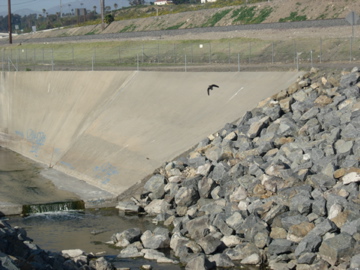
About a dozen swallows moved through the half-shadowed concrete, white bellies and black wings. I crouched down, snuck under the tall fence and crawled over big rocks to get closer to the birds’ strange dance. I tried to snap photos, but they were too fast, too elusive for my slow fingers and cranky old lens. I put down my camera and just watched, thinking of the balcony in Fez, the long journey of the small creatures, the city they’d shunned and where they’d ended up instead.

Los Angeles, Give Me Some of You!

“Los Angeles, give me some of you! Los Angeles come to me the way I came to you, my feet over your streets, you pretty town I loved you so much, you sad flower in the sand, you pretty town.”

John Fante, “Ask the Dust”

Us Northern Californians are prejudiced.

That’s right: prejudiced. We look down our noses, down the long craggy coastline, at Los Angeles as though it were the traffic-clogged  layer of Hell Dante forgot to mention. Tanned and Botoxed and full of silicone, Southern California steals our water, votes Republican, gave us the Governator. In its smog-laden haze of red carpets and reality shows, it skews our state’s reputation, bogs down our ethereal quest for Prius-driving utopia of gay marriage and legalized marijuana. It’s Sparta and we’re Athens, the “LA face and Oakland booty” that never quite make it onto the same person, never combine to create the ultimate bad-ass state, but instead go careening on their own individual, bickering paths of disapproval (NorCal) and complete unawareness/indifference (SoCal).

I once read an essay that whittled the whole Northern-Southern divide down to the difference between internal and external—Southern California was the glossy, teeth-whitened facade, Northern California the soulful, spiritually searching inside (you can guess which side of the debate the author fell on). It’s Bikram and we’re Hatha. And while Southern California remains too self-absorbed to even notice our despising of them, people write whole books on the cultural clashes of the US’s most populous state.

But I’ve long suspected that there’s more to Southern California than SUV-driving anorexics and flip-flop-wearing bros. It may have given us Kardashians and Speidi, but what about Charles Bukowski and John Fante, Camille Rose Garcia and The Date Farmers, The Germs and NWA? There must be, I’ve thought, a whole nuther Los Angeles, down beneath the glittering grotesque surface, that most people never see—hidden and raw, like an open wound or a small, beating heart.

I’m going to find it. I’m going, filling my beat-up car with gas and kicking the tires to check the air, going down the writhing road of Highway 1, past old Missions and crumbling cliffs, sleepy mansions and under-funded state parks. I’m headed into the desert, to psuedo-Old-West honky tonks and lawless squatter encampments. I’m watching swallows return from their long flight, to build strange nests and swoop their shadows through the dusk. And then I’m headed into the city itself, the city of Angeles and dreamers and dirtbags I’ve adored. I’ve got no traditional guidebook, no road map—just my phone and a smattering of tips divulged by friends and dug up on random websites.

Oh, and I’m taking you along for the ride.

Temporal Permanence: Ruins, Street Art and the Narrative Beneath

The speechless candlelight made the images more powerful. The way the sage billowed, the music groaned, the little light flickered—it made the images seem less like a mural and more like the hallucinogenic remnants of a dream, bloody and hand-smeared on the walls of a very dark cave, or on the inside of your skull—which may be the same thing. Dancing on the under side of your eyelids, before swollen and searching pupils, this was the stuff of mushrooms and all-nighters, of contemporary graffiti and ancient cities, of Latin American travels and my Friday night in Oakland.

The showing of Obi Kaufmann‘s mural The Feathered Serpent at The Oakbook was less like an art show than a ceremonious seance. Painted in the fever and fury of a single day and night (and mushroom trip), the mural was inspired by the artist’s recent travels through Latin America. The distinctive flavor of Santiago’s street art scene and the whispering ruins of Oaxaca’s ancient city Monte Alban swirled around in the artist’s subconscious until a dream pushed images out, from one side of the brain to the other, through his fingers and onto the wall of the gallery.

I am not an art critic, journalist, collector or student, so I won’t try to review or surmise. Instead, I’ll let the artist speak for himself. Here’s his photo essay of Santiago street art on Artopic, and his written essay about the genesis and symbolism of the piece on The Oakbook’s website.

After checking out the essays, I got pretty stoked to see the mural. The work being travel-inspired got my antennas twitching. I’d been to both Santiago and Monte Alban, I love crumbly old ruins, and I really love street art (as you’ve seen before)—often for the aesthetics but more because, as a traveler, I find it reveals so much about the beating heart of a place. I was curious to see how it all connected.

Indeed, what I found most compelling about the work (aside from the spooky images and skeletal figures) was the way it blended seemingly disparate influences. There doesn’t seem to be a lot of similarity between the streets of Santiago and the ruins of the Zapotec city Monte Alban: vibrant color versus crumbled stone; modern versus ancient; temporality versus remains—a continent, culture and two millennia apart, what commonality did these two places hold? For the artist, it was some kind of communalism, each place informing part of a narrative that was at once universal and personal, regionally distinct and part of a bigger story. Obi saw the world, human history, in the cavernous, torch-lit intersection of two places that don’t seem to intersect. And if that’s not some damn good traveling, than I don’t know what is.

The artist

Travel often brings up puzzling paradoxes (thus the tired line, “land of contrasts”). How does one hold, in the same hand, the transience of graffiti and the permanence of hard stone foundations? Or, to extend the metaphor, how does a traveler simultaneously love the spontaneity of the open road and the rootedness of home? I think the answer, if there is one, must lie somewhere down beneath all that, in the narrative thread that ties this big world together—in the collective unconscious, if you wanna get real heady. Or at least, you know, in the images and scrawlings and paint smears that have now been painted over—a wall blazing white and sealed-lipped about the stories it holds.

Would You Like Travel With That?: Why Being a Waitress is a Killer Job for a Traveler

As I’m planning my California road trip, buying plane tickets to Hawaii and Texas, and feverishly saving for a three-month galavant through Southeast Asia, I’m sometimes asked a question about work. Someone that doesn’t know me that well will wistfully gasp, “Your job lets you take that much time off?”

It’s at times like those that I realize how good I’ve got it. As a waitress.

That’s right—a waitress. It’s an inglorious job that people outside of the restaurant industry tend to look down on. It doesn’t exactly scream “motivation,” and at its worst, it screams “uneducated” or “Hooters girls.” Sigh. But the more I dig into the travel writing world, the more I’ve come to appreciate my “day” job. And despite the lack of benefits and security, it couldn’t be a better gig for me right now.

I didn’t plan it this way. But I majored in Creative Writing, and it’s not like there’s full-time gigs writing poetry. I hosted and served (and managed a local swimming pool) to get through college. I left the country for the first time after graduation, fell in love with traveling, and decided to stick around restaurants, if for nothing else than the time off (and getting to sleep in).

I’ve never worked a 9-5, never worked in an office, and never felt stifled or constrained by my job. I forget about the corporate trap of 40+ hour work weeks, because I’ve never lived it. I come across blogs with lengthy “About” descriptions detailing the karate-chop someone gave to the confines of corporate life (“I quit a job with XYZ company, sold everything and took to the road”), and I think, “Huh. That’s a life experience I totally can’t relate to.” I’ve certainly felt claustrophobic and stuck in my own life, but never because of my work.

There are trade-offs for the freedoms that come along with being a waitress—big ones. I work holidays and weekends, have never had a paid day off in my life, and the idea of a retirement plan or dental insurance is for me as exotic a fantasy as, say, traveling around the world is for some. But I swap all these securities for the one thing I can’t live, or travel, without: the ability to pick up and leave, yes, but also to not feel trapped.

And while I sometimes stress about the fact that it’s been nearly 10 years since I graduated high school and I’m “still a waitress,” I can’t help but feel I’m exactly where I’m supposed to be right now. Here’s why:

Time Off

Earlier in my “career,” I nervously asked my manager for an additional 4 days off during a month when I was already out of town for 2 weeks. He laughed. “Of course you can have the time off. That’s why you’re a server and not working for an insurance company.”

The number one plus of restaurant work for a traveler is the ability to take time off. It’s just a part of the culture—and why the cliche of a struggling artist or musician working as a server is so prevalent. The idea of being constricted to 2-3 weeks of vacation a year—paid or otherwise—scares the crap out of me. No wonder people quit their jobs to travel the world.

Flexibility

Allowing for time off is rooted in a deeper aspect of restaurant culture: flexibility. At most places it’s totally acceptable to switch shifts and in-times in order to accommodate whatever else is going on your life. Which is great for me now.

Short Hours

Shifts in most restaurants aren’t the grueling 8+ hour affairs they are in offices. My shifts currently average 5-6 hours, and are sometimes as short as 3 hours. This means that, even on days I work, I have time to write, and take care of all the tedious tasks/errands that come with being alive.

Internationalism

Because restaurant work is tough and doesn’t require traditional education, it’s chock full of immigrants. Mexicans and Central Americans fill the restaurants of California—which means you’re constantly immersed in Spanish. It’s impossible not to pick up a little Spanish in California restaurants. I’ve given myself pre-trip crash courses when I declare that no one should speak to me in English (this doesn’t really go as well as planned). As of late, I’ve been pretty lazy on the language tip; even still, I hear Spanish all the time and understand a fair amount (“Oh, Lorena, tienes un novio?”). I’m even picking up some random Mayan words (“pibil” means “baked”).

Being Active and Talking to People

Last year, I interned for several months at a rad travel website. Everyone was super nice and I enjoyed all the writing work I was doing, but the work environment felt totally alien: everyone sitting at desk, quietly clicking away on their keyboards. I was not used to the quiet, the immobility, the comfort and niceness of it all.

Restaurant work is visceral, and I like that. I tromp up and down stairs for hours, carrying trays of drinks and stacks of plates up my arms. I sweat. I spill salsas and half-eaten food down my apron. I sometimes have to pee for an hour, but am too busy to go. On a busy night, I’ll wait on over 100 people—interacting, reading them, talking and joking, making sure they have a good time. It’s intense and draining and I kind of love it.

But before you swap that comfy gig at the stifling job you say you hate, check out the other side of the scale: the restaurant work bummers.

When waitressing sucks your soul out...

No benefits

And I don’t just mean health benefits. These days, most restaurants in the Bay Area offer some kind of health insurance (albeit chintzy and hard to qualify for). What I mean are all the other “kushy” benefits (benefits that are automatics for all workers in some other countries—but that’s another post…).

I can take all the time I want off, but none of it is paid. That extends to paid holidays and sick days. If you’ve got the flu, tough. Maybe your landlord will accept a doctor’s note. Even those legally required 10 minute breaks are the stuff of waitress fantasy. Maybe someday we’ll unionize. Until then, we pop DayQuil and work sick.

No security

It’s not just the lack of unions; the lack of security in the restaurant world again goes down to the very nature of the job. When times are hard, as they are now, one of the first things people cut is eating out. Or worse, tipping. And there’s no safety net under the waitressing tightrope.

In most restaurants, you earn minimum wage (in some states, they can pay you under minimum wage; I knew a server in NYC who made $3.12 an hour!), which is usually just enough to cover taxes. So essentially all the money you’re making is from tips. If you have a slow night, get a string of 10% tippers, or, oh say, the economy totally falls into the shitter, you’re quickly screwed. There’s no guaranteed income to fall back on. By the same token, though, you can make insane amounts of money when times are good. But if you don’t know how to budget, it can devolve into a feast-or-famine lifestyle.

Hard on the body

The restaurant industry is great when you’re young and energetic and can’t stand the thought of sitting in a chair all day. But it’s not an industry to grow old in. Long hours on your feet, carrying trays and plates, seriously wears you down. By 23, I already had chronic lower back pain and an interstate roadmap of varicose veins criss-crossing my legs.

But these are the markings of someone who works for a living, like the calluses of my dad’s hands, the unwashable black under my brother’s nails: work you wear, that wears you. Whether I planned it this way or not, waitressing as become a part of me. And until I scramble my way to the top of travel writing heap (wink, wink), it’s not a bad way to earn my rent, fund my travels—and get the hell out of town.

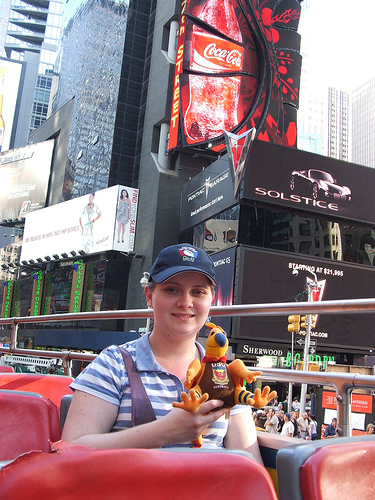
Lascivious Voyeurism, and The One Double-Decker Bus I’d Totally Ride

Flickr Tourist

To tour or not to tour? Or, better yet, to cruise.

Tours are almost not debatable. Independent travelers are supposed to be “too cool” for them. “Tour” is the very root (not just linguistically) of that dirty word, “tourist.” One of my favorite “knower of things” Mike Barish recently wrote a post on why it’s ok to take tours, referencing another article that also advocated for tours. Both articles received a fair amount of comments, in which readers debated the pros and cons of group tours.

While die-hard backpackers and shunners of all thing commercial loathe any type of tour, there’s one thing I’d venture to argue all independent travelers are averse to: the double-decker tour bus. Amplified, elevated symbols of all things cringably touristic, the most vile and offensive of guided tours, full of fanny packs and clicking shutters, whisking you here and there so you don’t have to actually interact with the place, and its full, living, breathing placeness. They’re bland, overpriced and utterly nerdy.

Unless you ended up in Manhattan in the 90s, with Timothy “Speed” Levitch as your guide—spouting facts and philosophies, possessed with passion, quoting everyone from Ira Gershwin to Thomas Paine to Henry Miller, monologuing, ad libing and waxing poetic about the city that stole his heart on a regular basis. Then it’s about as uncommercial as you can get.

Last night I watched the 1998 documentary, “The Cruise,” a profile of Manhattan double-decker tour bus guide Timothy “Speed” Levitch. To say he’s eccentric doesn’t begin to get at it; a reviewer on the DVD jacket calls him, “the guy Woody Allen can only dream of being.” The 76-minute movie is a peak into the mind of a madman/genius that turned tour guiding into an art. Now that’s an accomplishment.

[I couldn’t get the embedded url to work, but please follow this link to view “The Cruise” trailer.]

In a fevered frenzy of poetic genius, Levitch uses Willy Wonka and Virgil as his muses for tour guiding (um, bad-ass). For him, tour guiding—an extension of his life philosophy of “cruising”—is his chance to divulge riders of the glorious aliveness of New York City, and of life, in a loop of “lascivious voyeurism.” Clips from his tours are more like performance art, aching with a sensitivity and a passion that makes you want to cry—and laugh out loud at the absurd beauty of it.

Levitch is a tragic, intense, complex figure—in short, an artist. He goes off on the alienating confinement of grid-pattern urban planning, has a near orgasmic experience with architecture, relates to the stones of the Brooklyn Bridge like a living thing. It reminded me of the song “Under the Bridge,” in which Anthony Kiedis related to LA like a person, a comrade, a true friend. Levitch relates to New York City as a “living organism,” and has one of the most intense relationships with place that I’ve ever seen documented.

Of course, a person can’t be that insanely sensitive without being a little, well, off. This isn’t a kind world for people with such profound passion, who haven’t learned to filter things out, grow desensitized and most-of-the-time immune to the “frantic chaos of this limitless universe.” Levitch’s life philosophy of “cruising” (exploring/adventuring/seizing the moment and being completely free) versus “anti-cruising” (being confined and held back by societal norms and mediocracies) offers a fascinating glimpse into the psyche of someone that has sought to “transcend… air conditioning, comfortable couches… the magnitude of static that surrounds us.”

After the documentary came out in 98, Levitch enjoyed semi-celebrity, the object of a modest cult following. He relocated to the Bay Area for a time, where he led San Francisco tours and lived in—where else?—Oakland. Promos for his SF tours feel less inspired—by no means generic, but lacking the spark of genius. His band played in various Bay Area nightclubs from time to time, Levitch appearing grayed and reclusive. It seemed as though the light, the fire, had dimmed.

The documentary isn’t strictly a travel piece, becoming more of a tender glimpse into the heart and soul of a true eccentric, but I couldn’t help but wonder what must have been going through the minds of the people on those double-deckers. Unsuspecting, herding onto the bus, thinking they’d learn a little history and snap a few good photos—and then delivered a fantastic, fanatic monologue that captured not just a love for a city, but for life. That included little gems like: “Down the street, commuters, running towards their destinations—and from themselves.”

If a double-decker tour can be turned into a work of art, well, traveler scene cred be damned. Sign me up.

It Itches!: Feeling the Burn of Wanderlust

Itchy itchy...

“I’ve been home for nearly 4 months. My feet are so itchy, it feels like I got athlete’s foot.”

Okay, it was a bad joke. But that’s what Twitter’s for, right?

It’s not that I’m counting the days (not really). It’s not that I’m unhappy in my life at home or looking for escape. It’s just that I have this “incurable wanderlust” (what @cultoftravel speculated was worse than swine flu), and the more I read about travel, write about travel, tweet about travel, and am generally immersed in a virtual sea of travel, the worse it gets. I don’t have any problem going to a bar and not drinking, but reading travel blogs and knowing I won’t be doing any serious adventuring for a few more months—well, that’s tough. Ever since my first trip, I’ve gotten antsy when I’ve stayed at home too long. This whole travel writing business is adding a little more heat to the ring of fire.

I may be chomping at the bit, but it’s all good stuff that’s keeping me home. I have a niece on the way, my dad is retiring, and I have four friends getting married in the early half of the summer. All totally happy, exciting things that I’m grateful to be a part of. Plus it gives me a chance to save up for my next long trip, a three-monther around Southeast Asia.

In the mean time, I’m plotting a little solo California roadtrip for next month. Partly to visit an old friend, partly to see the swallows of San Juan Capistrano. Partly because I haven’t driven down Highway 1 since I was a kid, and partly because I’m curious what kind of conversations you get into with yourself after days of driving solo. Partly to debunk my own stereotypes of Southern California as a cultural wasteland of SUVs, strip malls and Kardashians, and partly to practice toting my laptop on the road with me. But, honestly, the trip is largely a keep-me-sane tide-me-over until the funds and circumstances—aka The Travel Gods—see fit to unleash me on the world again.

So as my feet are itching, my fingers twitching and my plans to high-tail it down the highway taking shape, I uncovered an old poem about restlessness, impulsivity and the physical road that hit the spot.

MacArthur Maze

Let’s drive this thing

into the blood burning sky.

/

Let’s take this road

potholed and hissing

past the pitched roofs

and pigeon wings,

past electrical wires

and blown-out streetlamps,

brown hills

where the grass cackles

and waits

to be lit.

/

Let’s curve

into the black, under

the overpass, past

the vacated bodies,

curled in and sighing—

/

Let’s take this thing

where it leads,

if it leads,

or stampedes

/

us into a sunburnt sky

the color of our own

sunburnt skin.

Now get me on the road!

I Heard That Lonesome Whistle Blow: Port Costa and the Past

In the hallway

It wasn’t the squeaking of the bats that kept me up all night. It wasn’t the way my shoulders dug in to the thin mattress that kept me rolling over, not the low-voiced howl of the passing freight trains that rattled me out of my half-dreams.

It was that I had to pee. And I was too scared of ghosts get up.

Not that I’m 7, and not that I actually saw or heard any ghosts. Just that, you know, I’m a wuss. The bathroom was only a couple doors down the hall. But I’d heard stories, of ghostly laughs and the clicking of century-old high heels, and I figured—why risk it? I waited until the gray light of dawn sank its fingers through the curtains, brushed the walls and illuminated the shadows. I relieved myself with incident.

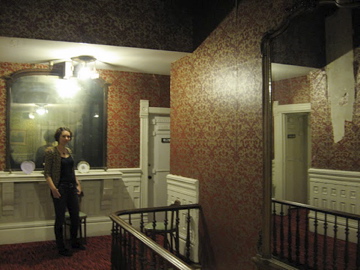
The whole overnight to Port Costa, actually, went without incident, the kind that had been hyped and fore-warned: red necks, ghosts, bed bugs, cocaine-fueled partiers—I didn’t see any. What I did see: peeling velvet wallpaper, a spooky porcelain doll, fishermen tromping over gravel and train tracks, a stuffed polar bear, a dude playing a banjo and a whole lot of motorcycles.

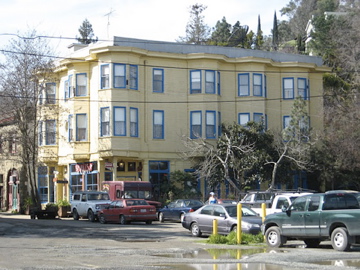
We arrived after dark, weaving our way through the shadowed coastal hills of a regional park. The pavement gave way to gravel as we delved into a little valley, dim houses and an old chapel lining the one road of Port Costa. The road dead-ended into a wide parking lot, gravel, train tracks, the misty water of the Carquinez Strait. On one side of us was a three-story, dirt-colored old warehouse, on the other, the bay windows of the Burlington Hotel. That was it.

Inside The Warehouse

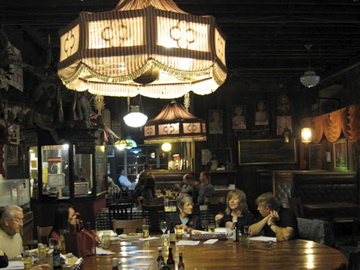
We turned the locked knob to the hotel’s door a couple times, until the banjo-playing dude on the corner told us we had to go across the street to the bar to check in. We entered The Warehouse, the main occupant of the 19th-century grain storage-house.  We stared stupidly for a couple moments, taking in the mish-mash of burlesque lampshades, checkered plastic tablecloths, mounted animal heads and vintage signs. We must have stood out—a man in the corner waved at us.

Turned out he was Howie, accompanied by Barbie, proprietors of the Burlington Hotel. They greeted us in what we’d discover was a typical Port Costa way: genuinely friendly and down-to-earth. It wasn’t the affected over-sweetness of a typical tourist town, nor the you-ain’t-from-round-here skepticism of an isolated small town. The vibe was unpretentious and warm, but not overly warm. It was the Goldilocks of small towns—just right.

Everything was just right about Port Costa: just enough overnighters that I didn’t feel too out of place, just enough decrepitude to make the hotel really really cool, just enough vestiges of history to make the town special—not undiscovered, but not blown up or theme-parky.

On the mantel in front of our room.

We wandered around the Burlington Hotel with our jaws dropped—it was the antique/vintage/ creaky dollhouse of cool we’d hoped for. But it wasn’t the stinky filth-pot Yelp reviewers and the Chronicle had made it out to be. Sure, it was faded and had the musty smell of an attic, but I had to wonder—had the people who’d called it dirty ever stayed in a cheap third-world hotel? Or a flea-bag American one, for that matter? It was no Courtyard Inn, but definitely one of the nicer hotels I’ve stayed in the US (not saying much, granted).

Maybe they’ve already started to spiffy up and straighten out, as the Chronicle article claimed. Aside from the lack of bed bugs and grime, there wasn’t a lot of raucous activity either. The other guests definitely looked like they were there for a good time, but the most debauchery we experienced at the Burlington Hotel was some middle-aged folks having a Hank Williams sing-along (I wanted in), followed by some late-night bed creaking (I did not want in). Pretty mild, really.

Ate all that!

As part of the Valentine’s Special, a $99 dinner-room combo, we headed back to The Warehouse for some good ole American eating. I’m usually a free-range, organic kinda girl, but I figured, meh, when in Port Costa. We grubbed on a whole lobster, one pound of prime rib, and unlimited salad/chili/chowder bar, washed down with soda served in a glass jar. My pants felt quite a bit snugger. A post-dinner stroll was definitely in order.

We tip-toed across the puddle-ridden parking lot, through an opening in the chain-link fence, and across the dark of gravel and train tracks. The nighttime mist made everything feel dream-like and removed, like we were somewhere much further away, like those weren’t the lights of a suburb blinking and sighing across the water. The way the Amtrack and freight trains’ horns would wail, the way their lights gleamed like animal eyes, how the heaved and rattled past—it made it feel like we were in some little pocket of the world, not quite forgotten by time, but where time just kind of rumbled past, without really stopping, leaving only a puff of exhaust and the echo of its cry.

Sitting on the rocks, I looked out across the water, and had a strange, back-of-the-head tingle. The lights of a far-off refinery winked in the billows of steam pouring out its towers, glittering like some kind of industrial Oz. Jagged fragments of memory came cutting back. “Fuck,” I said. “I’ve been here.”

High school. Malt liquor and weed and pills. We’d piled into B’s truck, drove around El Sob and Crockett looking for drugs and trouble, finding none of one and only a little of the other. We’d pulled into a parking lot, staggered across gravel. Refineries twinkling. Feet numb, and sides closing in, black. Cigarette smoke in my hair. Wanting to sleep.

My little kaleidoscope of fucked-up broken memories came out of some forgotten fold of my brain, stinging and still alcohol-damp. So I’d partied in Port Costa after all. Who knew.

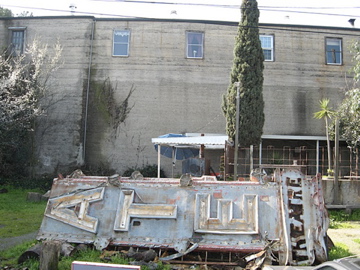
The next morning, the town was mist-shrouded and dewey-eyed. I was dazed; all night I’d listened to the trains, thinking of all the other people who’d laid in that room before me, in the gray and shadows, listening to that same rumble and sigh. We drank teeth-burning from styrofoam cups and took another tromp around town, then further down the train tracks. Lots of killer photos ensued (currently, only the digital ones are ready; pro film shots will take plenty longer). Coolest find: on some rusty old rails, someone with a similar nerdy affinity for trains and travel left their mark:

The mild afternoon melted past, time a far away thing. The trains continued to pass, rumbling and horn blowing at a couple of kids poking around the rocks and rails of a once-great railway hub, filled with miners and shipyard workers and whores and ferry horns—and now, just the ghostly groan of the trains, passing, passing, but never stopping, no, not anymore.

Photos by Theo Konrad Auer. More on the way…

Lady Love: Digging In to the Blogroll

Thank you, Flickr, for another gem

I’ve got a long Blogroll. What can I say?—I gotta lotta love.

Recently, I’ve seen some fellow bloggers do posts breaking down their favorite blogs. I was honored to be included in both Abbie Mood and Nancy Harder‘s lists, along with some really great writers I often read.

These posts got me thinking: I should really call out some of my own favorites. Many of my go-to blogs aren’t as widely read as I think they should be, and this’ll serve as a chance for me to give an extra shout out to some deserving, ass-kicking writers.

So I’ll start with the ladies. Five of my absolute favorite lady travel bloggers are…

Click Clack Gorilla

I’m not sure how I discovered Nicolette’s blog, but I’m stoked I did. This girl is old school, a DIY, dumpster-diving punk currently living in a house without heat in Mainz, Germany. She writes killer prose about digging around abandoned buildings, au pairing, living on the cheap and trying to keep warm through the winter. What I love about this blog is that it’s something different—utterly non-corporate and unapologetically  its own. It reminds me of the kind of writing the filled zines I’d find at the old Lookout Records. Thanks for keeping it real, lady.

Girl, Unstoppable

I’ve been following Ekua’s blog for awhile, so I was excited to see her get some big-time props from the folks over at Matador recently. The blog’s title says it all: Ekua is an adventurous lady who writes from a Bay Area perspective about her travels around places like Ghana and Bolivia, as well as her life here in San Francisco. One of my favorite features of her blog is travel quotes, especially this one, from a kid she works with—priceless! Despite living just across the Bay, and talking about it for months, Ekua and I haven’t been able to get it together to hang out yet. One day…

Kanitha Heng

Kanitha’s self-titled blog is a well-kept secret that shouldn’t be. Her stuff is seriously off the hook. She’s an engaging, provocative American writer currently chronicling her travels through her parents’ homeland, Cambodia. Her prose is both unafraid and tender, exploring cultural chasms and haunting histories. Kanitha’s writing consistently blows me away. Get on this shit, y’all.

Posa Tigres

Okay, so technically it’s a joint blog between Sarah, who does the writing, and Jorge, who does the photography. It’s quite the dynamic duo, and Sarah’s writing is some of my favorite out there. She doesn’t water shit down, or shy away from tough subjects—case in point, one of my favorites of hers, about the cultural implications of taking a Dia de los Muertos tour. She writes about living in Oaxaca with her boyfriend—beautiful prose that’s not nuggetized or easily digestible. Get ready to think.

The Mija Chronciles

I started reading Lesley’s blog a few months ago, enraptured by the photos, recipes and, most of all, her sumptuous descriptions of regional Mexican food. She’s currently living in Mexico City with her husband, and writes not just about food, but Mexican culture and the expat life. She’s a solid writer with journalistic credentials, and her tweets about what she’s cooking constantly get me salivating. She once casually invited me to come down to Mexico City for a foodie tour. What she doesn’t know is that I totally plan on taking her up on it one of these days…


Lauren Quinn is a writer and traveler currently living in Hanoi. Lonely Girl Travels was a blog of her sola travels and expat living from 2009 to 2012. She resides elsewhere on the internet now.

Join 490 other subscribers

Buy This Sh#t

Categories