Archive for the 'Lonely Girl Loves' Category


Honolulu, Black and White and Back in Time

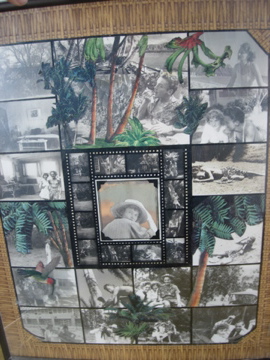
Faces stare out from a two-dimensional black and white. They are laughing, posing, cast in shadows and cut-and-pasted beside lush palm trees, neon hummingbirds, tan thatching and pinkened skies. Sometimes they smile; other times they gaze off, someplace beyond the camera, looking out from thin layer of time and plastic. And I am completely obsessed.

It’s my weirdest and raddest score from the Bay Area’s rummage event of year. The annual Oakland Museum’s White Elephant Sale is a cult event local collectors, scavengers, cheapskates and lovers of vintage live for. The Oakland Museum benefit is held out in a Jingletown warehouse, and hosted by the spunky white-haired ladies of the Women’s Board. Donations are collected throughout the year, culminating in the kitschy bonanza of bargains. The event takes over the neighborhood, complete with taco trucks and a free shuttle to the BART station.

While the main event is a two-day affair held on the first weekend in March, this last Sunday was the special preview—when the die-hards shell out $10-15 months in advance to get first pickings. A friend finagled us onto the guest list; we traipsed down across the train tracks, through the sour estuary smell and into the warehouse bustling with bodies digging for treasure.
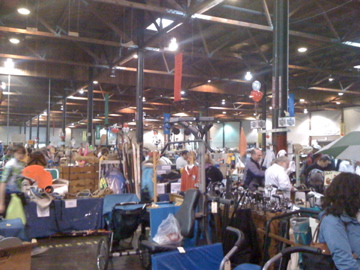
Inside the warehouse

There was a little of everything: antique furniture, vintage suits, old Polaroid cameras, $1 LPs, 80s action figures that brought me back to my childhood—even a box of expired condoms. The prices put any flea market to shame, and everyone was in a good mood. The staff was sweet and grandparently. An old dude with a vest full of buttons from previous years’ sales stood by a Thomas Edison record player, explaining to whoever passed how it worked and the history behind it. Some staff dressed up—I saw a Napoleon look-alike—which added to the festive atmosphere and reconfirmed my aspiration to be a cool old volunteer/docent person when I retire (like I’ll ever be able to…). A truly awesome moment came when, rifling through old records, a tween boy with shoulder-length blond hair picked up a Van Halen LP and let out a long, “Yessssss.”

I scored a couple cool vintage-y household items, but by far the coolest thing I came across was a 20″ x 16″ photo collage. It’s cheaply framed, cost $1 and is full of the kind of mystery that gets my wheels turning, my imagination shooting sparks.

The artfully executed collage of photos is from a group of young people’s vacation to Honolulu. The handwritten note on the cardboard back guesses the year to either be 1939, or 1940-43, World War II. Beneath that, four names appear: Virginia Matthiesen, Cole McFarland, Bud Matthiesen and “Sailor Friend.” Those are the only tangibles I have to cling to, the only ones I want. In the grey photos of shorelines and hotel rooms, a garden and a roadside, I have all the fodder for fantasy I need.

The group is young, mid-20s I’d guess. They have the eyes and expressions of old-school rebels, a kind of pre-Beatnik vibe, something carefree and a little wild in their smiles and poses. One has a Neal Cassady look; a girl has sharp cheekbones and piercing eyes; another stares off from above bare shoulders and a shell necklace. In a different photo, Neal Cassady is wearing the shell necklace, leaning in towards the girl as she looks away. The light has caught her blouse, making it blaze with a whiteness that obscures her face.
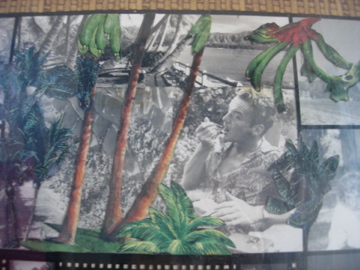
There’s an impossible number of stories inside the collage, silent and lost like a dream you can’t remember. Whoever made it set it in a border of tiki-style thatch print, then pasted a couple cut-outs of palm trees, to add color and a tropical vibe. It’s visually cool and kitschy enough to be hip. But really, it’s the faces that make me love the collage.

Of course, I’m projecting all of this—maybe they’re not artsy rebels at all. But that’s the fun of it, imagining a trip like that, then: how long it must have taken to get to Hawaii, how rustic and undeveloped it looked, how more pointed and romantic everything looks in black and white. And the timelessness of getting into adventures on the road. I haven’t found the perfect place for it yet; one of my roommates loves it, the other thinks it’s creepy. For now, it’s leaning against my bedroom wall, where I can stare and dream.

At the center of the collage, pasted on a pastel sunset, is a solo shot of the sharp-cheeked woman. She’s looking back, over her shoulder, holding a straw hat down against what might be wind, what might be the passage of time. I like to think she’s looking back at me, out from a moment that’s long passed, a place that isn’t the same, a youth that is gone. Probably, she was looking back at one of the boys in the collage. But a girl can dream, can’t she?

Relatives and Revelations: What My Brother’s Wedding Taught Me about Travel

Photo booth fun

“What can I say? When you’re children get married, it’s one of the happiest days of your life.”

That was my dad, toasting at my brother’s wedding two weeks ago. Simple, but true: celebrating my brother’s marriage to a rad lady will definitely go down as one of my happiest days. Aside from the awesomeness of why we were all there, it was a gorgeous event at the Julia Morgan Ballroom in Downtown San Francisco, complete with caviar and a five-tier chocolate fondue fountain (that’s right, you heard me). I was surrounded with life-long friends and far-away family, flown in from the Midwest and East Coast.

Of course, as a travel person, my antennaes were perked by all the out-of-towners. Watching them all come in—arrive at the hotel, rent cars, hang wrapped dress clothes in closets—I realized I only travel a very specific way, and it’s lent a very limited perspective.

I’d argue that most Americans travel the way my family did two weeks ago: domestically, in hotels, either shelling out for a rental car or attempting to traverse poorly funded mass transit systems. It’s pretty far-off from the international ramblings I do on second-class buses and cheap pensions/hostels/couchsurfing. The weekend resulted a series of travel revelations—“light bulb moments,” as I’d once heard them described on Oprah.

Before the guests arrived

What shocked me most was the sheer expense of it all. Even at an off-season rate, further discounted for the wedding party, staying in Downtown San Francisco is not cheap. Renting a car is not cheap. Eating at the restaurants and cafes Downtown is also not cheap. No wonder people ask me “But how can you afford to travel so much?” I used to feel that travel within the US was kinda a rip-off. I don’t take it that far now, but I will say you get a lot more bang for your buck elsewhere. (That being said, I have done New York City on $40 a day, so maybe I’m just a cheapskate.)

The night of the wedding, my parents decided to not add battling the Bay Bridge to the day’s ledger, and booked a room, which I piggy-backed on. Which brings me to the next travel revelation I had: looking good on the road is a major hassle.

As far as hassles go, mine were pretty minimal: the morning of the wedding, I dropped my shoes, dress and fancy jacket off at my parents’ house in Oakland before taking BART out to the city to get my hair and make-up done. I toted with me my overnight bag, in which I carried more make-up and hair products, as well as jewelry, nail polish, etc. My parents brought my dress clothes; I met them at the hotel and changed. The next day they took my dress clothes back to the East Bay while I hung out with my cousins. Not bad at all, considering I didn’t even have to negotiate riding the train with a hanger of dress clothes.

Classy as shit

But considering the way I normally travel, this jaunt across the Bay was complicated exponentially by the need to wear something other than jeans and sneakers. When I travel, all bets are off: I bring my most utilitarian clothes, no makeup, a dabble of hair gel and loads of sunscreen. I look like a total ragamuffin—handy, since it tends to decrease the amount I’m hit on. Wanting to look not just presentable, but my drop-dead best, is tricky enough; doing it out of a bag was even harder. I garnered a new appreciation for business travelers, beauty pageant contestants and all other non-backpacker/dirtbags travelers.

Here’s another thing I learned: logistics are tough. Organizing big groups of people, getting them here and there when they don’t know where they are, is really hard. No wonder tour companies charter buses. And no wonder people trundle on them happily.

I’m the kind of traveler that loves transit. I grew up riding buses and trains, and I get a kick out of figuring out new metro systems: where train lines connect, what lines run where, the fastest and easiest way to get from Point A to Point B. There’s a skill to transit, and I’ve honed a kind of sixth sense for the rhythm and order of it. So when my dad started to fret over how we’d get everyone from the Downtown hotel to a Sunday night pizza dinner at my brother’s house on 27th and Dolores, I responded, “We’ll have them take the J-Church.” Easy, right?

Well, it was easier than shuttling loads of people back and forth in the couple of rental cars, but not as easy as you’d suspect. I played transit tour guide, leading everyone to the Montgomery Station, through the turnstiles, down to the platform, on to the train (luckily, we all got seats). I alerted everyone to our stop, got us all out of the back doors (although almost lost my grandfather in the process), and down the two blocks to my brother’s house.

There’s not a lot of hand-holding or coddling on MUNI, and I like it that way. MUNI’s not most intuitive system—you can only pay station turnstiles in coins, have to retain a transfer ticket, and all lines eventually come aboveground, where stops are unmarked. But it’s still cheaper and more comprehensive than BART, long-distance commuter trains that double as mass transit for the Greater Bay Area, with a pathetic number of inner-city stations and a whopping $7 round trip fare from my neighborhood in Oakland to Downtown SF. In my mind, this makes BART infinitely inferior to MUNI. Who needs plush seats and timetables anyway? I’ll take hard plastic and a vague urine smell over a $7 fare any day.

iPhones have no flash, but you can still kinda make out five tiers of fondue.

But riding the train with my relatives, I realized that transit can be damn stressful. If you’re not already in the groove of it, or don’t share my nerdy obsession with maps and routes, it’s really just a pain in the ass. The potential to get lost is huge: you could get on the wrong train, get off at the wrong stop, end up god-only-knows-where. It’s confusing, station agents are exasperated, locals impatient. My relatives that rented cars were hit with overnight parking fees and having to traverse a maze of one-way streets, but when they got lost, they were warm and dry, and could easily turn back around. I realized why, despite the costs, so many travelers opt to rent cars over riding transit. Guiding everyone through the process, I also realized why tour guides carry those little colored umbrellas.

In the end, everyone got to and fro and everywhere inbetween safely. We gussied up, boogied down and had a killer time. And that’s what weddings are all about, right?

Elephant Seals, Artichoke Bread and a Lighthouse: Cheap Kicks on the California Coast

The wind had something to say. Howling, moaning, rattling through the fog-swelled rafters, it talked to us all night. The next morning, it fingered our hair, pinkened our noses, and carried the cries of birth and battles, sea gulls and elephant seals…

I think I’ll start the article something like that, depending on how highfalutin I wanna get. It’s not as ridiculous as it sounds; the drama of the California coast during a winter storm evokes that kind of mulling, moody language. The main character, if you will, of my mini-trip down the San Francisco peninsula was the wind, urgent and unrelenting. But the supporting cast was pretty rad too.

I’m trying not to get too claustrophobic in my own life, and trying to keep the travel writing material a’coming. So despite a heavy-duty week-long storm, my friend Liz and I hopped into my beat-up little car and headed out for a little Northern California overnighting action in Pescadero.

Aside from being super accessible from the inner Bay Area, a trip down to Pescadero is also one of cheapest getaways around. We hiked around redwoods, espied an elephant seal colony, ate “world famous” artichoke bread and local goat milk cheese, and lazed in a cliffside hot tub—all for under $90 each.

Pescadero is an old-school fishing town down the peninsula between San Francisco and Santa Cruz. Aside from some seriously killer breads from Arcangeli Grocery, its main claims to fame are its surroundings: the Pigeon Point Lighthouse Hostel, and Ano Nuevo State Park. Pigeon Point is a pretty basic hostel—except for its dramatic perch literally on the edge of the continent, its historic lighthouse, and its cliffside hot tub (yes, really). Ano Nuevo is a sandy stretch of shoreline best known as the winter home of migrating elephant seals, where they birth and wean and fuss and fight.

"Look, nature!"

The drive from Oakland was about an hour long, Highway 92 delving us down the spine of the peninsula into Half Moon Bay, a quintessentially quirky Northern California beach town. Then we headed down the 1, California’s most famously beautiful highway. It winds you past pastoral fields, green hills, a sprinkling of cove beaches and family farms, and a crashing, crumbling coastline. Everything was grey and heavy and wet. It was perfect Lucero-listening weather.

Huddled on a cliff next to an run-down, chained-off old lighthouse, Pigeon Point Lighthouse Hostel smells like salt, and the ocean winds rattle the humble buildings endlessly. The hostel is divided into three houses, each with its own kitchen and common room. There was only one other couple in the house, fellow overnighters from the East Bay. It was $25 for a dorm bunk; we had a whole room to ourselves.

Pigeon Point Lighthouse

The main draw of the Pigeon Point Lighthouse Hostel isn’t the ocean views or its precipitous perch; it’s the hot tub. I don’t know how a youth hostel came to have a feature like a hot tub, but it’s about the raddest thing you can imagine. A trip to the hot tub cost $7 per person; you sign up for a half-hour slot when you check-in.

We stumbled in the dark to the hot tub, shuffling in our sneakers and shivering in our towels. We kicked it in the hot tub, listening to the sound of wind and waves. It was a dark, cloudy night; there were no stars, just the white froth of water on rocks, and the lonesome beam of the lighthouse.

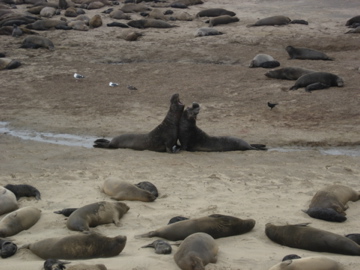
The next morning, we drove 10 minutes down to Ano Nuevo. Celebrities may have Miami; elephant seals winter in Ano Nuevo. They arrive from Alaska in mid-December; moms birth pups, wean them, and they hang around confused and blubberous until about late March. Mid-January is the best time to check out the seals; on our tour, we saw a birth, a fight, plenty of sulking and lots of squealing.

Hella seals

The seal tour is pretty popular, especially as a field trip for Bay Area schools. You have to take a guided tour, and it’s best to book ahead, but here’s the good news: the tour is an hour and a half long, and only $7. (Parking in the lot, though, costs a $10; there’s not any other viable parking around.)

Our naturalist docent guide was a cool old dude that solidified my opinion that being a park volunteer after you retire is about the most bad-ass thing you can do with your time. Our group of 13 people, mostly all Californians on day trips, headed out into the sand dunes, a mile traipse from the parking lot.

First we passed “Losers’ Alley,” where male seals that have lost the fight for prestige pout and sulk in solitude for the remainder of the season. We got pretty close to one; he arched his back up, his nose/trunk hanging like an absurd, uncircumcised phallus. A guttural, grunting nose erupted, bursting out of his mouth in a gust of white breath; it sounded like a stopped-up toilet. It was his get-the-hell-back cry, and we obliged.

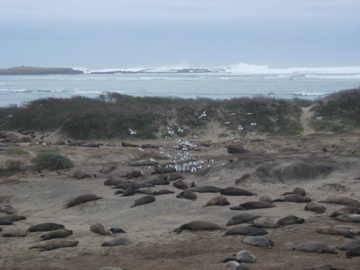
We climbed up a dune that overlooked the colony, and spent about an hour watching them flop around in the sand, squealing and moaning and rumbling their enormous selves around. The pups were adorable, too fat to do much of anything but wiggle their fins around and cry for milk. The moms flipped sand over their backs, rolled over to let pups nurse, and grumbled. The men did what men do: fight.

Bashing chests...

We caught a pretty good fight, full of plenty of screaming, biting and butting. It broke out amid the crowd, dominoed its way through the colony, pups wiggling to get out of the way; it rumbled all the way down to the shore, where the loser got 86ed. “It’s just like a bar fight,” Liz surmised.

Going mad for the placenta

We also got to see a birth. Well, not really. It was too far away to see, but we were alerted by the swooping, squawking riot of sea gulls. Sea gulls, apparently, love to eat placenta, so you can always tell when a birth is going down when the gulls start going crazy, a frenzy of white wings and diving beaks.

Muddy and wind-tossed, we tramped back to the car, cranked up the heat, and headed home. It was invigorating to get out of town, even if it was just for a night. Aside from gathering info for an article (not yet sold, if there’s any takers out there), I needed to clear my mind. It’s so easy to get tunnel-vision, to get caught up in the everydayness of my own life. It’s a good life, but there should be more to it than errands and work and my computer. I really am happiest when I’m traveling, and my mini-trip confirmed that. And reminded me how much killer stuff there is within an hour of where I live. And that it doesn’t need to cost any more than a new pair of pants.

Forget the Guidebook, This is the VICE Guide to Travel

Dolores Park: "You would think VICE Magazine threw up there."---SF Comedian Ali Wong

At the risk of sounding like a gold-lame-wearing, ironic-mullet-sporting Dolores Park denizen, I’m gonna say it: I like VICE Magazine. And I fucking love the VICE Guide to Travel.

Quick run-down, in case you don’t know: VICE grew from a Montreal zine into global empire of youth counterculture, serving as a kind of hipster voice of a generation in what some could argue was the next CREEM magazine. By 1999, VICE had exploded on to the hip-slick-and-cool scene. A free, glossy magazine peppered with American Apparel ads, you’d find issues at trendy clothing stores and serving as coasters on your friends’ coffee tables, or stacked beside the toilet for inspirational reading material. Having reached new heights of hipness, VICE was nearly immediately deemed as have “been better” in previous years, in the perennial way that everything was better before it got big. But here’s a little secret about VICE: it’s got some killer articles. Some are better than others, for sure, and many breach a little too far into the snarky, too-cool-for-school realm. But I’d argue a good half of the magazine is usually filled with quality journalism, covering super interesting international cultural phenomena.

Which leads to the VICE Guide to Travel. It’s not Rick Steve’s, or even Lonely Planet. VICE goes to some of the most fucked locations on earth, “the kinds of places that nobody else wants to visit”; digs up shocking and bizarre stories; sends sweaty dudes in v-neck t-shirts to interview warlords/cannibals/other locals; films it all, and sets it to a soundtrack of doom, gloom and rock. It’s “edgy,” it’s “off-the-beaten-path” (to say the least), and it’s some of the most bad-ass travel journalism out there.

First, some clarifications on the meaning of “bad-ass.” Empty, self-serving sensationalism with no emotional depth or historical perspective is not bad-ass. And there’s plenty of that out there in the travel world.

A couple months ago, I complained about this kind of trying-to-be-bad-ass-edness in a post blog and subsequent Matador article. Later, I came across an article titled “5 Totally Bad-Ass Travel Experiences” that made me want to vomit. The article listed 5 “daring” travel experiences, two of which capitalized on some of the most heinous aspects of a country’s history. The perspective reeked of a privileged disconnect with the suffering caused by events like genocide and drug wars:

Home to one of the biggest genocides and mass killings in modern history, Cambodia is awash in guns and weaponry. It’s a pretty peaceful place these days but there are still opportunities to get a taste of the weapons of war.

Oh, well, bummer the murdering is over, but at least there’s still cool guns to shoot off. I wanted to reach through the computer and punch the writer. Granted, the article struck a personal nerve; I guess when you know people who escaped the Khmer Rouge, but who’s families all died in the killing fields, well, that takes the thrill out of shooting war weaponry in Cambodia.

What separates the VICE Guide to Travel from lame travel “journalism” like this is skill (they hire professionals)—but more importantly, approach. Traveling to some of the most depraved and damaged places in the world, VICE toes the line, certainly runs the risk of lapsing into one-dimensional exhibitionism and aren’t-I-cool pats on the back. Some in the series are stronger than others, but I’d argue that all stay true to the basic purpose of bringing obscure, untold stories from the gnarliest corners of the world to a Western audience. The liner notes of the original 2006 DVD explains:

The news is all bad. Sitting in our Western comfort, it’s easy to forget that most of the world is hell. War, disease, famine, genocide, and poverty dot the globe like big chunks of cancer. Basically, humans are fucked.

We thought we already knew something about current international events, but we didn’t really know shit until we set out and started doing some serious traveling. These aren’t vacations to Disney World, Paris or even some Outward Bound safari. These are trips to the places that you see once in a while on TV and think, ‘No way in hell am I ever going there.’

Well, we went so that you never, ever have to go for yourself as long as you live. We went, and we’re glad we did. Here are the stories to prove it…

What the VICE Guide to Travel offers is what some of my most difficult, but ultimately most illuminating, travels have: a new perspective on this crazy-ass world we live in. It’s tough to watch—the visit to the shell of a high school in the episode in Chernobyl made me tear up—but I think it’s some of the most interesting and important stuff out there in the travel world.

Which brings us to the new series, the VICE Guide to Liberia. The 8-part series is being released on their website; currently, the first 4 installments are up. Prepare yourself: this is some severely brutal material.

While I don’t think I’ll be going to Liberia any time soon, I’m glad that these guys did, and that the stories they found are getting told. In a world of SEO, Twittered trends and Top-10 lists, the VICE Guide to Travel gets down to the unmarketable, inconvenient bone of what travel (for me) is all about: seeing how other people live, and glimpsing into the strange stories that compose this world.

(Okay, so, it may or may not be a secret fantasy of mine to one day tag along on one of these installments. But for now, the website’ll due.)

Havana in Pictures

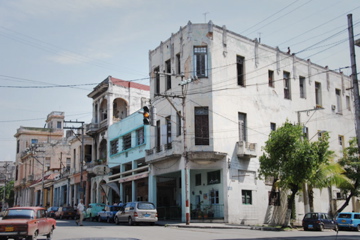
To end my series of Cuba posts, I’m bringing you photos from my brother’s trip to the forbidden island. Aside from being a far better photographer than me, my brother traveled with a Cuban-American friend and his family, so he had even cooler adventures (cooler than wrecking plumbing? I know, it’s hard for me to believe too). All photos are from Havana. Enjoy, and  thanks for all the comments and feedback throughout the series.

Che Marti-ni: The Cuban Cocktail of National Heroes

Oh, the sweet taste of revolution. And martyr worship.

There’s no escaping Cuba’s two biggest icons. Revered, quoted and placed on pedestals/t-shirts, these tragical heroes loom large in the national psyche. They give impassioned words and a photogenic face to the struggle for independence that has characterized the country for centuries. One, you’ve heard of; actually, you’ve had him shoved down your throat by starry-eyed ultra-lefties. The other lurks in the dusty corners of used bookstores, in the syllabi of Latin American Studies courses; you’ve heard his words, but never his name. Until you land in Havana.

Che stencil I saw around in Berlin. In case you can't tell, Che's wearing a Che shirt.

Okay, okay, I’ll tell you. One is Che Guevara, the Argentine renegade who’s become synonymous with Cuba, guerilla warfare and revolutionary politics. He’s arguably the country’s biggest cultural export, and a ubiquitous presence within Cuba (hey, an atheist country’s gotta worship something). This is relatively unsurprising as a visitor; what’s more surprising is this fetish they’ve got for Jose Marti. You could call him the OG—he advocated and fought for Cuban liberation from Spain, calling on the same ideas of Latin American unity and anti-imperialism that Che later did. But when you actually start to read his essays and poems, you wonder why in hell you haven’t been inundated with Marti your whole life too (one answer: he shoulda swapped the funny moustache for a guerilla beard—far more flattering). Even more intriguing is what lies at the intersection of these two figures, and what they reveal about the country that adores them.

Jose Marti and Che Guevara share more than just a saintly status in the heart of a nation. The die-hard revolutionaries were both privileged boys of good education, who gave voice and garnered fame for the struggles of Cuba. Both were seasoned travelers; both had a vision of a unified Latin America free of imperialism; both died fighting battle for their cause, the cause of “the people.” Both pumped out enough good quotes to rival Mao, and both are exalted in the streets of Cuba. And both were, at the risk of sounding ridiculous, guided by feelings of love.

"Viva Che." Etched into the sidewalk in Berkeley. Spotted this on my Marti hunt this morning.

Jose Marti was a 19th-century Cuban-born revolutionary, poet, writer, thinker and traveler. His writings about the Cuban struggle for independence captured the culture in a way no one previously had, and his words served as the voice of a people. So much so that the first lines from his famed poems “Versos Sencillos” were adapted as the lyrics of Cuba’s most famous song and de facto anthem, “Guantanamera.” But what’s most interesting about Marti is how his writing has endured, and the ways it’s remained relevant.

Already a national hero, Marti’s anti-colonial, pro-America (Latin America, that is) ethos was invoked during Castro’s revolution. Castro framed his revolution as an extension of the one Marti fought and died for, and depending on your politics, it’s pretty easy to agree. What fueled all Marti’s work was a fierce defense of justice inspired by a complex and tender understanding of human nature. I won’t play lecturer and drag you through tedious citations, as the Marti Wikiquote page serves as evidence enough. But the famous poem “I Grow A White Rose” captures the Marti sentiment pretty well:

I grow a white rose
In July just as in January
For the sincere friend
Who gives me his frank hand.
And for the cruel man who pulls out of me
the heart with which I live,
I grow neither nettles nor thorns:
I grow a white rose.

Che cigarettes, purchased in Peru. Each cigarette had a tiny Che on it.

And then there’s Che. Aside from being charismatic and hot as hell (yeah, I said it), Che’s enduring legacy, I’d argue, comes from his compassion. Not necessarily for his enemies, but for the people, the struggle. Sure, he had the bad-ass lines like, “I would rather die standing than live life on my knees,” but he also came out with quotes like, “One must harden without ever losing tenderness.” It’s not just rebel girls that swoon at lines like these; a whole nation does. And that says a lot about them, wouldn’t you say?

You definitely get beaten over the head with the two in Cuba, a combo that will flatten you faster than a Cube Libre (not really). Che’s legacy does retain a little more depth here than in the rest of the world, where the commodification of Che is more depressing than consumerist Hot Topic punk. And to be fair, the elevation and exaltation of national poets isn’t purely a Cuban phenomenon, but a Latin American trait; Gabriela Mistral is also pictured on the currency of her native country, Chile. (Imagine paying for groceries with a Walt Whitman note.) Call it the Latin flair for passion, but it’s enough to make a US Creative Writing major weep.

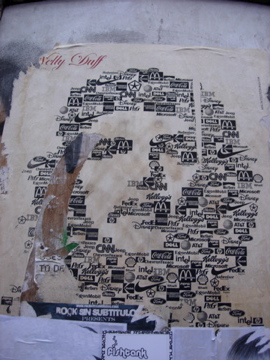
Wheatpaste in London. Che's image composed of corporate logos.

Together, Che and Marti conspire to create a revealing picture of the Cuban culture and psyche: revolutionary, lyrical, learned, passionate, martyred. Both figures have been reduced, their lives and work co-opted for the purposes of others, commercial or otherwise. And while the world is oversaturated in Che juices, Marti remains little-known, a recluse of national monuments and smelly old bookstores. But the true picture, I think, lies somewhere between the two—between national fame and international obscurity, the commodification and the worship, the intrigue of an outsider and the love of a people.

I’ll end with a Marti poem I worked hard to bring you. I once owned a Marti collection; who knows who I lent it to or what move it got lost in. I remembered a poem that captured the intricate relationship between colonizer and colonized, and decided to find it. Google gave me nothing, so today I missioned to 3 book stores and 1 library. In a dim, 4th-floor corner of an independent bookstore, I finally found the poem, in the lone Marti book stuffed amid the over-packed shelves. I slyly photographed the pages with my phone, and transcribed them. As far as I know, this is the only available translation of “Little Prince” on the web. Enjoy. And keep fighting.

Little Prince

This party is for

A little prince.

He has long hair,

Soft blond hair

That hangs over

His white shoulders.

His eyes appear

To be black stars

That move like the wind,

Shine, quiver and give off sparks.

He is my crown,

My pillow and my spur.

My hand, that bridles

Horses and hyenas,

Goes where e’er he takes it.

When he frowns, I tremble.

If he complains,

My face, like a woman’s,

Turns white as snow,

Then red, as blood

Pours through my veins.

His pleasure causes

My blood to ebb and flow.

This party is for

A little prince.

/

Come, my gentleman;

Come this way.

Come, my tyrant,

Into this cave.

When he appears

Within my sight,

It seems a pale star

Casts its opal

Brilliance o’er all

In a dark cavern.

/

When he goes by

The shade acquires textures

Like the sun,

That wounds the blackest clouds.

Behold me, at arms,

In the struggle.

The prince wants me to fight again.

He is my crown,

My pillow and my spur.

And, just as the sun,

Breaking up the black clouds,

Turns shadows

into bands of colors,

When he touches the thick wave,

He embroiders

My red and violet

Battle colors there.

So, my master wants

To return to life?

Come, my gentleman;

Come this way.

Come, my tyrant,

Into this cave.

Let me offer life

To him, to him.

This party is for

A little prince.

Subtle Like T-Rex: My Obscure Top 10 Travel Songs

Just in case there’s someone who hasn’t got enough of the Top 10 list, get ready for another nail in coffin.

When it comes to songs about travel, there’s plenty looming giants that drown out the subtler stars. Now, I love “Route 66” and “On the Road Again” as much as the next red-blooded American. And I’ve got a well-bred affection for “Graceland,” “Booby McGee” and “I’ve Been Everywhere.” But when it comes to the songs that really get my feet itching and fingers a’packing, it’s all about the lesser-known jams.

Call it the forever-to-the-contrary, anti-mainstream, cranky old punk in me, but I think these songs kill the more widely embraced classics (though, baby I was born to run too). I’ve listed them vaguely in order of ranking, but more in terms of a flow fit best for you’re listening pleasure.

In the spirit of old mix tape, my early Christmas present to you:

[clearspring_widget title=”Grooveshark Widget: Chameleon” wid=”48f3ef6c29317865″ pid=”4b3c0826d2cf749c” width=”400″ height=”300″ domain=”widgets.clearspring.com”]

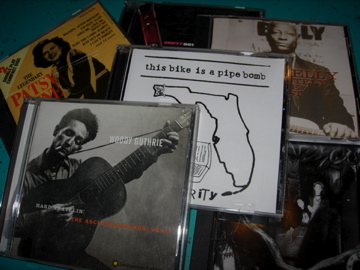
1. Hard Travelin’, Woody Guthrie

Whenever a bus is delayed or flight canceled, I wanna bust out a harmonica (that I don’t own and can’t play) and break into a freestyle rendition of “Hard Travelin'”. I may have been born three generations too late to live the train-hopping, vagabonding hobo dream, but Woody’s keeping it alive for me.

Best Line: “That mean old judge done said to me / It’s 90 days for vagrancy / And I’ve been hittin’ some hard travelin’, Lord”

2. Ramblin’ Man, Hank Williams III and Melvins

Not the Allman Brothers. With the heart, soul and twang of the original in his DNA, Hank Williams III buddied up with, that’s right, Melvins, and well, they killed it.

Best line: “I can settle down and be doin’ just fine / Till I hear those freights rollin’ down the line / Then I hurry straight home and pack / And if I didn’t go, I believe I’d blow stack” Amen.

3. Ready for More, Murder City Devils

AKA, the best show you went to in 2001 (really, no one lights their drums on fire anymore). The boys that made the trucker hat cool wrote this one about the exhaustion of hard-partying touring/traveling that only copious amounts of cocaine can fuel you through. I may have missed the boat (or tour bus) on that one, but I can get down with the angsty howlings of Spencer Moody any day.

Best line: “And I’m subtle, subtle like a T-Rex / And I haven’t even started yet / One week on the road / One week, and I’m already wrecked”

4. I’m Moving Along, Patsy Cline

With the guts and growl that can only belong to one woman, “I’m Moving Along” is an anthem for anyone that’s split town to heal a heartbreak. The way Patsy belts out that last line always make me wanna grab a suitcase and slam the door on whatever’s bumming me out at home.

Best line: “I’m moving along, I gotta be free”

5. Gone Till November, Wyclef Jean

He may be pretentious at times, but god damn, it’s a pretty song. If you’ve ever had to reconcile the traveling lifestyle with leaving loved ones at home, this is the jam for you.

Best line: “See you must understand, I can’t work a 9-5”

6. Sloop John B, Beach Boys

Not every trip is awesome. And even in the best of em, there comes that moment when, say, you’ve had diarrhea for two weeks and are really over the whole squat toilet thing. For moments like these, “Sloop John B” ‘s refraining “I wanna go home, Let me go home” hits the swollen and tender spot.

Best Line: “This is the worst trip I’ve ever been on” (though, with Charles Manson running around the sandbox, we can’t be totally sure what kind of trip they mean…)

7. Board of Tourism, This Bike Is A Pipe Bomb

The touring-est band I’ve ever known wrote this cheeky tribute to the “attractions” their hometown Pensacola, Florida. It perfectly captures the two-bit claims-to-fame that small cities grasp at. And it’s adorable.

Best Line: Tie between the refrain, “We got a drive-thru funeral home” and “You know they even filmed a movie there one time / They had James Brown and gave away hot dogs”

8. Rock Island Line, Leadbelly

This song is the definition of bad-ass, by the guy that created the word cool. Nuff said.

Best Line: “If you wants to ride, you got to ride it like you find it”

9. Unknown Passage, Dead Moon

By another band that spent half their lives on the road, the hypnotic riffs of “Unknown Passage” hauntingly capture those road-tripping 3ams full of dark highways and strange landscapes. (And if you wanna know how to build a house, raise a family, travel the country six months a year, and rock and roll like it’s going out of style on less than $20,000 a year, check out the Dead Moon documentary by the same name.) Just don’t put this on if you’re trying to stay awake while driving.

Best Line: “There’s a red light on the hill / And a bridge out going down / There’s a city limits marker / Of an unfamiliar town”

10. So International, B-Legit Featuring Too $hort

Nothing like a little local love to round it out. Hometown boy Too $hort teams up with B-Legit and flows about, well, mostly having sex around the globe and flying first class. Can’t relate, but the hook is catchy as shit.

Best Line: “Yea, we fly first class, touch down like pimps / What’s the next event, tell me what town it’s in”

Sola: A Fetal Manifesto and Healing Tattoo

My swollen arm, looking more like my calf

Swollen and bruised and freshly tattooed, I’ve decided that there’s more to this “lonely girl” thing than a catchy title and purchasable domain name. It’s got to do with an approach towards travel, and maybe even an approach towards life, that’s developing inside me, embryonically. And at the center, the tiny heart between the budding limbs, is solitude, going at it sola.

There’s plenty of articles and blogs out there lauding the benefits of solo travel. Solo Friendly and Solo Traveler are devoted entirely to solo travel, with service-oriented tips and how-tos, while Women on the Road focuses exclusively on encouraging women to backpack. Independent-traveler sites BootsnAll and Matador have featured articles discussing pros and cons, and urging readers to take the solo plunge. The benefits promoted are fairly obvious—the freedom to do what you want when you want—as are the chief drawbacks discussed: safety and loneliness. Nearly every article and site on solo travel I’ve encountered has urged all travelers to go at it alone at least once.

I could write something similar, talk about how traveling solo forces me to be more social, to interact more with my surroundings; how it teaches me self-reliance and thus self-confidence; how I relish in the freedom of it; how none of my friends that can afford to travel are able to take the time off to accompany me anyway. But underneath and inside all those benefits is something harder to explain but ultimately more appealing, a kind of central gravity that all the other pluses of solo traveling orbit around: solitude.

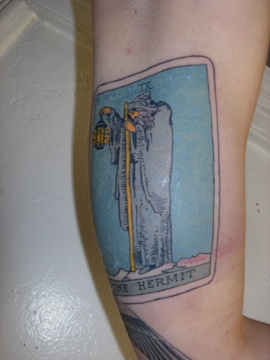
It’s both positive and negative, both the exalted glory of Rilke and the insanity-inducing agony of solitary confinement. It’s a gnarled old wizard dude with a staff and a lantern, setting out into the craggy blue of the Hermit tarot card, now etched into the tender flesh on the inside of my arm, swollen amid the lymph nodes and brachial veins that hold me together.

On my last trip, I met many incredulous, widened eyes that asked, “You’re alone?” Then, declaratively, both impressed and horrified, “I could never do that”—in the way I’d respond to someone who’d climbed Mount Everest: good-for-you, thanks-but-no-thanks. People told me I was brave, fool-hardy, a feminist.

The truth is, I never really considered the fact that I was traveling alone; it rarely factors into my trip-planning, doesn’t strike me as odd or especially intrepid. It is what it is. Of course I’ll be alone. Who else am I gonna drag off around the planet?

But things like that, core characteristics and fundamental truths, rarely strike us as odd. Or even occur to us at all. They’re so central to who we are and how we live in the world that we aren’t aware of them. They strike us suddenly, in strange moments of lucidity—the porcelain-clutching “moment of clarity” in which one finally realizes she’s an alcoholic, or my mom’s recent epiphany that “we were the crazy white family in the neighborhood.” Or when someone else points it out to us, in the dingy back of dingy taxi, when you tell them you’re traveling alone.

For me, it goes back to my travel roots, which aren’t travel roots at all. It’s where I first learned to be alone in the world—the raggedy-ass East Bay buses. During my hour-and-a-half commute home from a far-away high school, I learned all the things international solo travel would later confirm and deepen—self-reliance, self-confidence, how to handle dicey situations and dodgy characters. It was especially important as a female. Honing my street smarts and learning how to carry myself and not take shit have been invaluable. And not something not every girl learns. The lessons taught on the hard plastic of AC Transit buses equipped me to travel sola everywhere from Colombia to Morocco.

But there’s something more inside that, something deeper and more fundamental than knowing how to watch your back and tell someone off with your eyes. More than even the confidence of knowing I’ll be able to figure out and make it through whatever crazy-ass situation I end up in. What is comes down to is a kind of comfort and security in who I am, and the way in which I never feel more like myself, the who-I-am underneath whatever’s happening in my life at the time, than when I’m alone, out in the world. It’s not the same sitting here in my bedroom typing; it’s gotta be out there, walking the streets and riding the buses of this world.

I think everyone should travel solo once in the same way I think everyone should be forced to wait tables once: it’d be nice, but not gonna happen. I don’t think solo travel is for everyone, but it’s become a defining part of how I experience the world, how I exist in it. I simultaneously delve deeper into myself (“the teacher within,” as they say in yoga) and my surroundings. I experience the world from a more intuitive, back-of-the-brain place, where I’m okay with it not making sense, where I find a way to somehow swim through the chaos and insanity and all-too-often heartbreaking cruelty of it, and tap, however lightly, on the beautiful something at the center of it all. I’m more able to trust that I’ve got a place somewhere amid it all.

During my four-hour detainment by the Venezuelan police a few years back, the female officer kept looking at my passport, me and back again, and asking, “Y estas sola?” She couldn’t believe I’d venture off in some other country by myself. However much of an evil, child-abusing American I might have been (it’s a long story), my being sola amazed her. And may have had something to do with me weaseling out of the situation.

I suppose it would have been more accurate to get a feminized Hermit card tattooed, but the beard was too Zeppelin-y to forfeit. And I feel cheesy having an uber-symbolic tattoo, to finally have some kind of answer for the middle-aged customers that look up over their reading glasses at me and ask what my tattoos mean. Most likely, I shrug and continue to say, “I just thought they looked cool.” At least until this approach, this fetal manifesto, is a little more gestated.

Top Three Travel Secrets: A Chain Letter for Travel Bloggers

It reads as ominously as a middle school chain letter. Except, in the end, failure to perpetuate the chain isn’t sworn to result in untimely death or spinsterhood (which are more or less the same thing when you’re 12). Rather, in this chain, compliance results in access to a treasure trove of travelers’ secrets. And probably some new friends.

I was hit by two writers in the TripBase Blog Tag, spreading through the travel blogosphere like hot gossip around a lunch table. Or a dirty note during Math class, light-up sneakers in a mean game of duck-duck-goose. (The analogies could go on forever.) The idea is you write a post about your top three travel secrets: out-of-the-way towns, little-known restaurants, unheard-of hotels—“hidden gems” that lay glittering in the dimness of obscurity. Until now, that is.

Aside from amassing an ass-kicking list of previously unknown spots around the world, the other objective of the TripBase Blog Tag is to be build community and get folks involved. I can get down with that. In addition to the awesome ladies that tagged me—Stephanie from Twenty-Something Travel and Abbie from Miles of Abbie—I’ve already discovered some new writers on the TripBase list of bloggers tagged so far. (Best blog names? Dirtbag Writer and Snarky Tofu. Fuck yeah.) My hunch: the final list won’t just expose travel secrets, but also some bad-ass writers I hadn’t encountered yet.

They say you’re only as sick as your secrets. Here’s to travel health:

End of the hike: waterfall into the Pacific

#1 Palomarin Hike, Marin County, California

My work friend had been telling me about “the secret hike” for months. Huddled over our staff meals in the cramped bus station, she made rope-swinging into the clear lake, and the coastal waterfall at the trail’s end, sound like a dream. Or at least a damn good fantasy.

We finally coordinated a day off together in August and headed up to Marin to the Palomarin Hike. We grabbed sandwiches and drove up past Stinson Beach to tackle the 11-mile hike. And I gotta say, it was just as killer as she’d described.

The hike starts through rather typical dusty California coastal terrain, taking you past sweeping Pacific vistas us locals have grown accustomed to. After about 45 minutes, the foliage and trees thicken, and you eventually get to Bass Lake, a frigid-water lake that’s biggest draw is an old-school rope swing. You could while away hours here, but, seeing as though it was August in the Bay Area and foggy as hell, we were too cold to partake. We continued on, and ended up at the trail’s end, where a waterfall tumbles into an isolated coastal cove.

The good news: the hike, although long, is gentle and not too strenuous. Which means just about anyone could do it—including my smoke-a-pack-a-day friend and me, who was then recovering from swine flu (yes, really).

The bad news: the Palomarin Hike is a total word-of-mouth Bay Area secret. As is the way with Marinites, locals don’t want outsiders to know about their secrets or have access to them (see also: why BART doesn’t run to Marin). Locals take down street signs and signposts, meaning that you’ve pretty much gotta go with someone who’s been there. So if you’re headed to the Bay soon, just hit me up; I’ll take you.

Ahhh...

#2 Legzira Plage, Atlantic Coast, Morocco

Okay, if you’ve been following this blog for a bit, you’ve already heard me gush about the most deserted and beautiful beach I’ve ever been to: Legzira Plage, Morocco.

Talk about tucked-away: from Tiznit, take an hour bus ride, hop off at the faded roadside sign, and hike down 20 minutes. It’ll really just be you, a couple stray tourists, some fisherman and their donkeys—and the sandstone arches that dive red earth into blue water.

Among the handful of pink building that cascade down the cliff into the main beach, there’s two hotels that offer relatively cheap rooms. I went high-class and got one with my own shower, squat toilet (doin’ big things), and a window that opened onto the ocean view—for under $20.

Another bonus is the Moroccan street harassment factor, and the fact that Legzira Plage doesn’t have one. After a couple weeks of solo backpacking, sweating in long sleeves and fending off the barrage of “bonjour”s, it felt pretty damn sweet to strip down to my bikini and wave-hop in peace.

Kids on their way to school

#3 El Congo, Venezuela

The story goes that, when Europeans first arrived in what is now Venezuela, they came to the Lake Maracaibo villages, perched on stilts amid the marshes and water. Watching the village folks traverse the “streets” in handmade rafts reminded the Europeans of Venice—and they dubbed the place Venezuela.

El Congo, Venezuela is the most other-worldly places I’ve ever been. It’s only reachable by boat, a 30-minute ride through the hazy flat expanse of water, and you’ve gotta book a tour to get there. But surprisingly, the town isn’t the main draw of the tour. The Catatumbo Lightning phenomenon is what draws most people—mysterious, thunderless lightning that occurs almost nightly in the skies over Lake Maracaibo.

The road to Los Llanos was flooded when I was in Merida, so I opted to take the Catatumbo tour in its place. I hadn’t heard of El Congo, but it ended up being the highlight of the tour (the lightning didn’t really happen that night). The town had everything—a school, a fire station, a convenience store, even a Plaza Bolivar—all erected on stilts. Rumor had it there were a couple old folks still living in the town who’d only ever stepped foot for dry land to bury relatives.

It wasn’t an untouched Eden: El Congo was extremely isolated, making inbreeding a huge problem, and the town was quite poor. Sanitation was a major issue, with most refuse and human waste going directly into the water. Owning an actual boat was a sign of privilege. The less well-to-do had to construct their own floatation devices—this girl tied a piece of wood to some leftover styrofoam, dug a stick down into the mushy lakebed, and propelled herself along that way.

The thing that really bummed me out were the poor yapping dogs chained to the “front porch” of some of the houses. So much for getting a walk, little buddy. But hands down, El Congo was the most unusual place I’ve ever traveled to—and so far off the beaten path, there wasn’t a path at all.

So that’s my top three, scrawled not-so-jaggedly into the margins of a wrinkled note. Now to fold it up and shove it into another sweaty, unsuspecting palm. This could get good…

Thanks for Nothing / Everything

I celebrated this Thanksgiving at two long-standing Oakland events: Thanks for Nothing, the legendary potluck of punk debauchery, and my family’s annual Day-After-Thanksgiving party, legendary in its own right. Both events were a little less epic this year, with an intimacy that reminded me of what’s good about Thanksgiving and about family—as untraditional as they may come.

Anyone in the East Bay who’s ever donned liberty spikes and a studded anything has gone to Thanks for Nothing. And possibly passed out at it. Now in its 18th year, the Thanksgiving potluck is an Oakland punk tradition, a place for all the family-less kids in black to come together, at picnic tables under jimmied lights, and create their own family.

Of course, by “kids” I mean “punks” and not kids at all, anymore. These are the die-hards, wearing smile wrinkles and old band shirts—the folks that, once the scene-ness melts away, once all the other folks have grown out of what was just a phase, are still there, purely for the love of it. Punk may be mostly dead, but it’s not all-the-way dead; it just lives in the hearts of a small handful. And, on Thanksgiving, in an East Oakland backyard.

Thanks for Nothing has taken on a larger-than-life status; the woman that puts in on is convinced that even if she were out of town one year, people would still show up. They didn’t pump it too much this year—no flyers or MySpace posts, just word-of-mouth—and the result was a smaller, friendlier crowd, that was also a bit tamer. The event historically gets increasingly raucous as the evening progresses; as the steam from the turkey table cools and the toddlers konk out, staggering, slurring sing-alongs ensue (among other things). This year, the pot food table was nearly empty and the jar of homemade Bailey’s went fast, but the Jell-O shots were plentiful, tossed around in a haphazard game of catch that somehow didn’t end in neon goo being splattered across someone’s head.

Despite the uber-punk name, this year’s Thanks for Nothing felt more about community than anything else. Family, as most travelers know, isn’t really about blood lines; it’s got little to do with genes or ethnicity or even, as we learn on the road, nationality. Family’s about people that share similar values and perspectives coming together and sharing, growing together. (And at Thanks for Nothing, singing along to Cock Sparrer together.) It sounds more one-love than punk, more Berkeley than Oakland, but sometimes it takes unexpected manifestations to drive a point home.

But most of my “family” growing up wasn’t about blood lines—a lot of Californians’ aren’t. My parents moved my toddler brother and my infant self to California with only one blood relative within 2,000 miles. Once my uncle passed away, it was really just the four of us for holidays. Plus an ever-growing band of fellow Bay Area orphans. It seemed that my dad’s first couple of years in the fire department, he kept having to work Thanksgiving (turkey at the fire house!). So we started having all our family friends over the day after, when we’d sit back and talk and laugh and eat for hours. We invited everyone, and it became a kind of neighborhood affair. A tradition was born, and yesterday, carried into its 22nd year.

Like Thanks for Nothing, we don’t really need to invite people anymore; everyone just knows to show up. Charles deep-fries two turkeys in the driveway, Karen and Jamal make the marshmellow sweet potatoes, Nhu and Jacobo bring the bread pudding, my brother makes the famous firehouse Caesar (I used to make the vegan entree, but those days are long gone…). My parents’ small bungalow overflows; there’s an incessant wait for the one bathroom and a warm glow from the fireplace. It’s consistently one of my favorite days of the year.

The event was smaller this year, just under 60 people, and I had a couple bittersweet moments, missing people who used to come—people who’ve moved, who we’ve lost touch with, but mostly people who’ve passed away. But at the same time, there were folks there that I’ve grown up with, that I’ve known my whole life, that are the aunts and uncles and cousins I otherwise wouldn’t have really had, so many miles and states away.

Family is one of the most important things to me, as traditional or untraditional as mine may be regarded. Of course, much has been written about the “demise” of the American family, and holidays like Thanksgiving hold a particular weight for those from untraditional or un-intact families. But I’d argue that the American family isn’t crumbling, just reshaping; seeing as though this guy got a book deal out of the concept, I don’t think I’m alone. And as travelers know, the traditions of a family are some of the best glimpses you’ll get into a culture—whether it’s making stuffing with your play-cousin, or pounding Jell-O shots with punks. It may not be a Norman Rockwell painting, but it’s as close as some of us get.


Lauren Quinn is a writer and traveler currently living in Hanoi. Lonely Girl Travels was a blog of her sola travels and expat living from 2009 to 2012. She resides elsewhere on the internet now.

Join 490 other subscribers

Buy This Sh#t

Categories