Archive for the 'Places' Category


Suicide-Proof

I dreamed your apartment was suicide-proof:
those little half-windows
that only open in slits,
like doped-up eyes,
how we blew the smoke
sideways and down
and it couldn’t really make it out,
just blew right back to us.

I asked if there were earthquakes here
and you said there weren’t,
but I didn’t believe it—
not that I didn’t believe you,
but I didn’t believe the earth—
that somewhere down
under all this something
was shaking,
ready to shake:
the smell of a seizure
before it erupts.

I got up and paddled
my bare feet across the floor,
my bad ankle snapping.
I realized I’d forgotten the kitchen window,
that slides open wide—
a ledge and a little metal railing
that wouldn’t be enough
to keep a body from crouching,
crawling out
to the 16 stories
of honking beneath.

Learning to Ride On a Motorbike in Hanoi

Hanoi is a bipolar child with a strict bedtime.

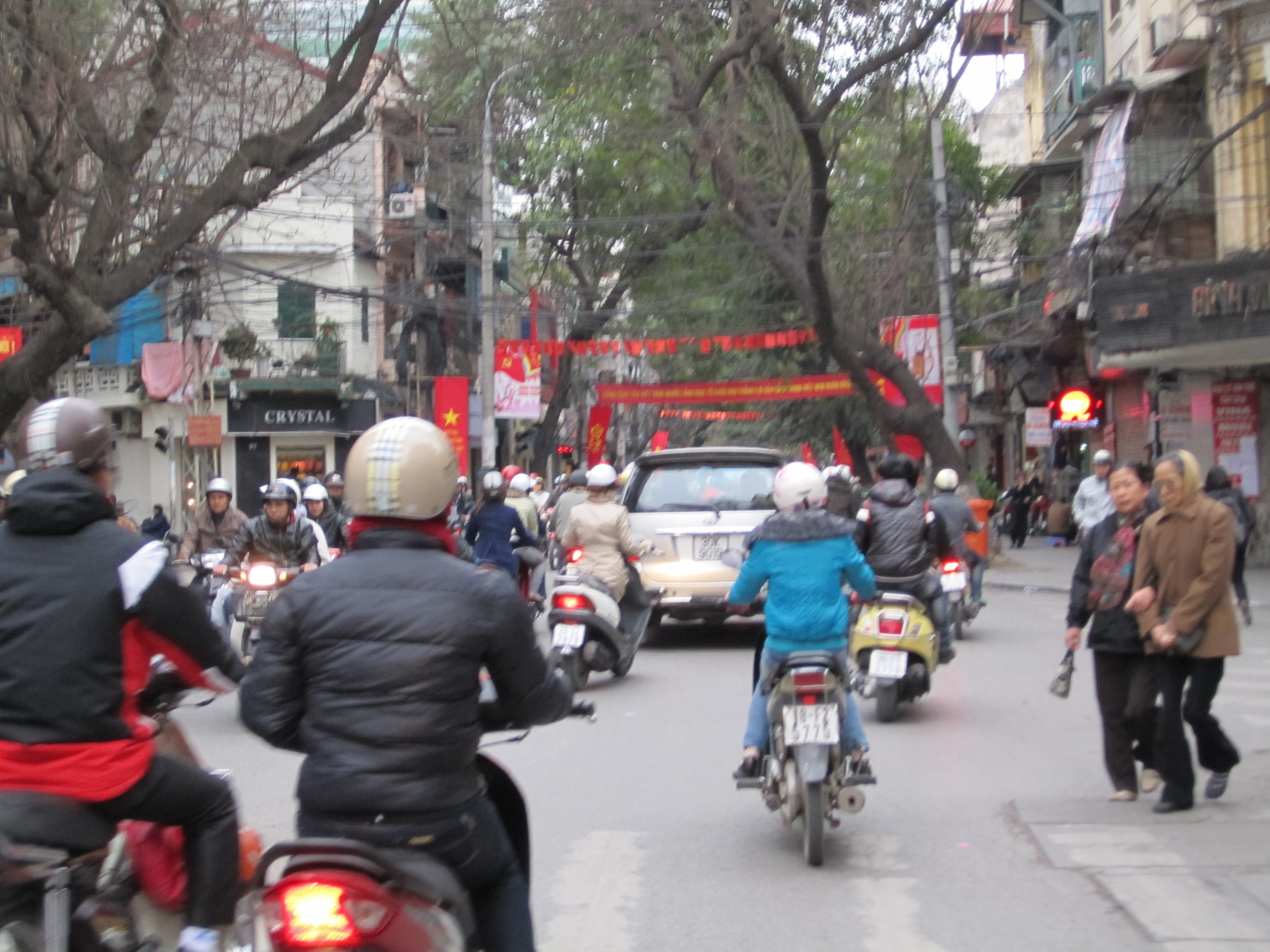
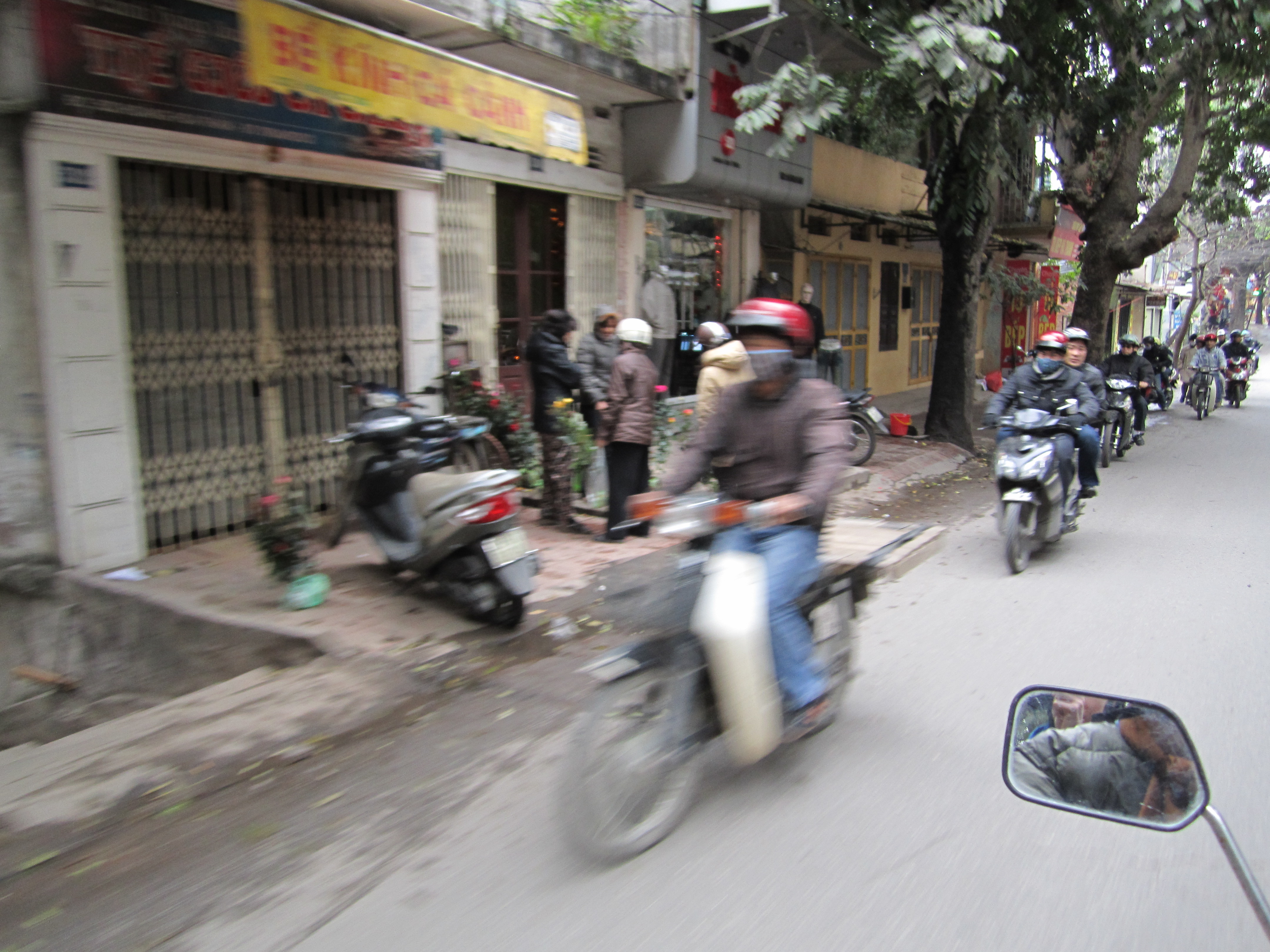
Clinging hands behind me to the metal rack, I try to suppress the involuntary flinching—a circumstantial case of Tourette’s. It’s Saturday morning, and my first ride aback a motorbike through the frenetic traffic of Hanoi.

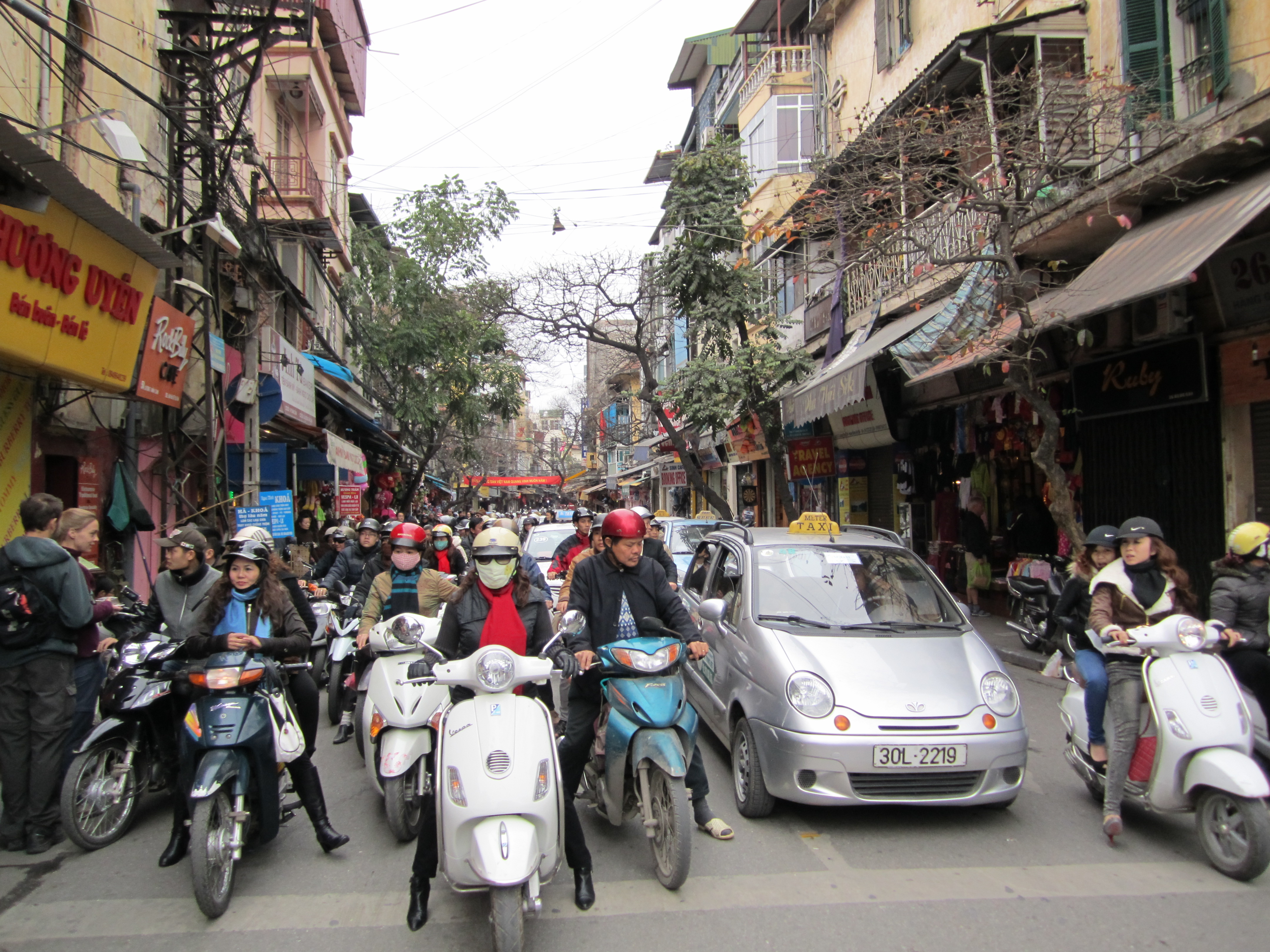
If you want to see the word “clusterfuck” defined, acted out in an exquisite charade, snap on a spare helmet, straddle the seat of your friend’s motorbike and take a ride through the streets of Hanoi. Feel the blanket of exhaust haze whip up around you; feel your legs naked to the risk of a thousand near collisions; feel the breeze of your own mortality and the queasy cocktail of sweetened coffee, cigarettes and exhaust churn in your stomach.

See towers of Tet trees and blossom branches balanced aback bikes; see jugs of water and housewares, bundles of mysterious somethings tied on in impossible precariousness. See families of four smooshed onto a single bike; see the eyes of children placidly blinking in the madness. See drivers texting, pulling out without looking, barely slowly, pedestrians stepping out into the chaos of it all—women walking with baskets balanced on a piece of wood across their shoulders, liked Lady Justice, except it’s their mouths that are masked; their eyes remain wide open.

Hear the horns beep and squawk like a million hungry birds—seven million, to be exact, and every damn one of em has a motorbike and is riding their motorbike, lanes just vague suggestions, right-of-way a nonexistent notion.

See this all this because you’re in this, suddenly a part of this: a passenger in the strange dance that feels more like a riot or a mosh pit—but no, no, must be a dance because you keep skirting disaster, skirting death, and you keep wanting to clamp your eyes shut but can’t, can’t.

Riding aback a motorbike through Hanoi isn’t exactly a near-death experience. It feels more like being on an airplane with really bad turbulence: you trust the pilot but not the skies. You know you’re not actually going to die, but you really can’t wait for the whole damn thing to be over. You get off feeling like you’ve just stepped off a rickety old rollercoaster that’s safety permits are supremely suspect.

“The sidewalks in Hanoi aren’t really for walking,” Jacob throws over his shoulder. “They’re more for commerce. If you want to walk, you’ve pretty much gotta do it in the street.”

It’s not a walking town, he says, and it’s true—at times I don’t see a single pedestrian, just a weaving, wheezing sea of traffic. How do you get to know a place without walking it? How do you get a feel for feel for a place without your feet on its streets?

It gets easier. I tell myself to trust, to put faith in the fact no one seems to be crashing. It begins to feel like we’re moving along this barely perceptible tightrope that weaves in and out of other people’s tightropes, maybe like telephone wires—like our own personal orbit, the miracle of chance that we don’t collide, such a miracle that it can’t be chance at all, but driven by some other force I can only suspect, can feel at times in the smoggy breeze, but can’t come close to naming.

Nighttime is different. It’s as though someone flips a giant switch. By 11, the streets have cleared, suddenly swept of everything but a faint whisper, the asthmatic glow of the headlight. The streets seem smaller in the dark, emptied of their madness—they don’t seem like the same streets at all, but an entirely different place, a different city. An incredible stillness settles over the buildings, the pavement, the wires stretching and branches drooping and the shapes of shadows in the dim drizzle—as if none of it were real, all the daylight mania just a waking dream, a reverse nightmare.

By Sunday I’m able to hang on with only one hand and snap photos with the other. I’m comfortable enough to carry on a conversation as we drive. Jacob points out landmarks and tell little stories; I tell him how my parents were revolutionaries when they were young, how the met in a Communist meeting. He quizzes me Vietnamese numbers, phrases; we laugh about the universal asshole-ness of SUV drivers. We weave through the manic chaos of daytime, and I tell him Hanoi feels like a bipolar city.

Rain comes that night, along with a cold wind; we move more slowly through the vacant streets. I blink against the lashings of wet and my hands turn frigid. Slowly, I loosen my grip on the metal grating, and place both my hands in my pockets.

I’ve learned how to trust the gods of traffic and chaos. I’ve learned how to ride a motorbike in Hanoi.

Vietnam, Look For Me Cause Here I Come: How to Get A Visa

Yes, travel is exotic and life-altering and profoundly moving. Yes, you encounter new environments, new people, new customs, and in that way, also encounter some new piece of yourself. Yes, you become more cultured, more able to pepper cocktail conversations with ledes like, “Well, when I was learning tango in Buenos Aires…,” and “There’s really no comparison to actual Italian gelato…”

But there’s also the nitty-gritty, the laborious and unglamorous, the tedium of trip planning. It’s not fun, there’s no scene cred, and no one likes to talk about it.

So, with twelve days left until my departure to Southeast Asia, I’m taking a pause in the string of earth-shattering lyrical narratives to discuss the oh-so boring details necessary to Vietnam travel: visas.

The first step to any obligatory activity, whether it’s commuting or house cleaning, is to get yourself a killer soundtrack to lessen the annoyance. For this, I suggest listening to Abner Jay on repeat.

Having to obtain a visa before visiting a country is a strange and confusing process to those of us native to countries of privilege. As an American, you’re more or less used to waltzing up to a customs window, flashing a smile that gleams of tourist dollars, and getting your stamp. Some countries, like Chile and Brazil, charge you of reciprocal entry fee, a kind of fuck-you I can appreciate. But needing to arrange a visa prior to arrival? What kind of criminal do you think I am?

Once you get over the indignity that the majority of the world’s other citizens are subjected to, you’ll need to actually procure the said visa. Here’s what I learned, thanks to research and Thorn Tree, one of my all-time favorite travel resources.

There are no “visas on arrival” for Vietnam.

Other countries in Southeast Asia, yes. Vietnam, no. It’s pretty simple.

There are different types of visas.

For your basic Vietnam tourist visa, there’s a few options. You can go for a one- or three-month visa; you can also opt for single- or multiple-entry. There are no longer six-month tourist or business visas. This means that, if like me, you’re planning on cruising in and out of Vietnam for a period longer than three months, you’ll need to get a visa extension while you’re there. That’s a beast I’ll tackle when the time comes…

Visa costs aren’t fixed.

Figuring out exactly how much a Vietnam visa will cost is an adventure in obscurity. The Embassy and Consulate websites conveniently don’t tell you how much visas cost. Through poking around, I discovered that if you go directly through official channels—that is, the Embassy or Consulate—you can expect to pay anything from $70 for a one-month single-entry, to $150 for a three-month multiple-entry.

There are several companies (like this one) that facilitate visas, and their prices are far from fixed. Discounts apply for groups; the larger the group, the deeper the discount. Prices for these service range from a $20-$50 discount from official prices.

Going through the Embassy or Consulate is expensive, time-consuming and worrisome.

In most situations like this, I’m skeptical of companies with cheesy websites that offer deeply discounted prices on official services. So I’d decided to stick with getting a visa from the Consulate. But this meant handing over my passport. I’d either have to mail my passport to the Embassy and wait for it to be returned (hello anxiety), or get up early one morning and head out to the Vietnam Consulate in San Francisco. Here, I was told I’d need to give them my passport for processing, which would take around 5 days, and then come pick it up again. It sounded like a pain, but preferable to mailing my most sacred of travel possessions.

The night before I was to roust myself and cram onto the train with all the suit-and-ties, I discovered that…

There’s a way around all this. Kind of.

So, you can actually negate the visa process, in a way. You can get what’s called a Visa Approval Letter, an official document that allows you to get what is essentially a visa on arrival. The pluses are that it’s much cheaper, your passport doesn’t have to leave your possession, and you can do it from your computer. The two big catches are that you need to be arriving into one of the international airports (Hanoi, Da Nang, and Ho Chi Minh), and you need to be ready to pay a $25-$50 “stamping” fee.

I used Vietnam Visa Pro, and while the actual entry into Vietnam remains to be experienced, I’m so far super happy with them. I paid $30 for an approval letter for a three-month multiple-entry. I paid via Paypal, which I liked since I’ve heard horror stories about stolen credit card numbers from shady foreign websites (incidentally, just had my credit card number stolen, but that’s another story). I heard back from the company promptly, and had my approval letter emailed to me in 2 business days. Printed it out, made copies of my passport photo, and am ready to roll!

Now all I’ve got to focus on is amassing some more exotic-sounding stories.

Tirana Took Some Piece of Me, Under Seige And Too Far Away

The Pyramid, where protests took place

Sometimes when you travel, a place will steal a piece of you. And sometimes you’ll leave a little piece of yourself in a place—which might be the same thing—some piece of you you hadn’t really known was there, that took the foreign air (smoking chestnuts and car exhaust) to be awakened or realized. And you’re sure you can only ever know that piece or be that piece there—which probably isn’t true but is nonetheless how it feels. Because all it can do is feel, not quite be articulated or explained or rationalized. Which is part of the magic of traveling.

Tirana is one of these places for me—not perfect, far from paradise, but a place I just slid into, like a peg in one of them little holes. I think about my Albanian homies often, and we keep in touch (like everyone else) via Facebook. So I knew when it was snowing there last month, saw pictures of familiar rooftops hazed in a dingy white. I saw pictures from New Year’s, from parties that looked like the ghosts of parties I’d gone to—or rather, parties that had never stopped, kept going, where some piece of me might still be dancing amid the smoke.

And so I knew this morning that shit had gone down. Before I looked at the New York Times or Reuters or listened to NPR, I saw via Facebook. Which made it impossible to detach from, which made it all the more real.

Vincent had been a fellow traveler when I’d been in Tirana, but the lure of the city had inspired him to move there (and helped me to acknowledge that it wasn’t just me being crazy, that the city really does have a kind of special something). He’s been the most vocal of my Tirana friends, though I did get word that everyone I know is okay.

Vincent posted this first-hand account, far more compelling than any news story I read:

I was surprised how well cars can burn, they make hissing and exploding sounds as they slowly die, and usually after two or three minutes, their horns and lights switch on until the circuits are burned through, its like their dying lament.

It’s a funny feeling, I can’t explain it, but I want to be there. For what? To protest? It’s not my fight. To watch shit burn, to run the streets and raise my fist and feel the sting of tear gas? No, that’s not it. To be curled up in someone’s apartment, watching newscasts and hearing the echoes of sirens and shouts and maybe gunfire? Perhaps. To feel that that piece of me I left there, that was so so alive there, is safe?—and that all those people that saw that piece, that shared that piece and maybe even a small piece of themselves, that they’re all safe too?

Because nothing is really safe, and no one is really safe, least of all the parts of you you don’t know, that you’ve littered all over this planet like loose change, like strands of hair, like earring backs and lines from old forgotten poems someone else remembered and reminded you of, when you least expected it, on Twitter of all fucking places—and it sounded like an echo of an ancient sadness and you don’t know what the fuck all this is or means, but just that it doesn’t feel safe, or doesn’t feel like you can save it—which is not at all the same thing, but is all too easy to confuse. And you’ve been confusing it your whole damn life without knowing it.

All of which is to say that you can never predict how this shit will make you feel, what it will bring up. Which is my own way of saying I hope all my Albanian friends—that I love without really knowing, the way I love a part of myself without really knowing it—are safe.

The Ghosts of Footsteps

Crisp blue and puffing chest, the glare of sunlight off the smooth flat of the Bay. My first run since a week-long flu, down along the Bay Trail, with its breezes and San Francisco views, pretty despite being directly beside a freeway.

I passed a little woodsy alcove. It’s mostly rocks and open space down there, but every now and then, beside a freeway exit, an overgrown patch of cluttered trees and shrubs is tucked alongside the trail.

I caught a glimpse between the leaves: a little stream, heavy from the rains; a long piece of wood placed over, a makeshift bridge; the dead remains of footsteps, the ghosts of footsteps, a path going in. Something was hiding in there.

I thought about the books I’d read as a kid—-Bridge To Terabithia—how kids in the country or in the suburbs, or in any event, not inside the city, would always have these places to hide. A creek or the woods, some undeveloped patch of something—a place they could escape to, along with their fantasies and maybe a stick to poke things with, to build empires in their minds where they were safe or powerful or in any event not in their own lives, some other place.

And I remembered how terribly jealous I’d be those kids—those kids in books, not real kids—because I lived in the city, and there weren’t any places like that. Or there were—under freeways, or the woods behind parks—but they were already filled up, claimed by junkies and derelicts with cardboard palaces, people retreated to their own fantasies, their own escapes, their own Not Heres.

There was a thin strip of dense trees behind the jungle gym at Children’s Playground, in Golden Gate Park. I’d wanted to go in there, to climb around, explore, find my own something magical. It was shady in there, I couldn’t see in, and I wanted to know what all mysteries lay in the damp earth and shadows.

“Don’t go in there,” my mother’d said.

“Why?”

“People live in there. There’s trash and needles and it smells.”

And I’d known, even then, that you could catch things with needles, things like death. I’d thought of sarcoma spots and sunken eyes, sick beds and the scatter of Chinese food containers, and I hadn’t wanted to go in there anymore, but I’d still wanted to go somewhere.

It was a good run. My shin splints didn’t hurt, although I did get a tightness in my chest, like a squeezing, that made me stop and walk for awhile. I stared into the open and soaked it in, and was ready to run again.

Sink, Alameda, Sink

December 9, 2003

“It’s a special kind of anesthetic. So we won’t be putting you completely under—you’ll still be lucid—but you won’t remember anything.”

Paper gown and stirrups, they injected the needle and you didn’t flinch.

You took it as a challenge: remembering.

You stared out of the window—out of the white walls made antiseptically cheerful, away from the faces and charts and the gleaming tray of tools—looked at a pond outside, gray water against gray sky, the geese sitting and splashing and silently honking—no noise, just their beaks moving in the shape of a scream.

The room went away, and the sides became black, tight, squeezing in, like the end of an old-timey cartoon—tunneling, until the whole world became that pond and those geese, trapped there in a December afternoon and a pinhole of consciousness.

And it’s like you weren’t there. You couldn’t see them working, couldn’t feel them working (working on you). You couldn’t hear them—or at least, you couldn’t remember hearing them, maybe a sound floated in here and there, but it didn’t stick to anything, memory like fly paper or that sticky tape the rats get stuck to and sometimes chew their own legs off trying to escape. So in that way, they were right.

You focused on the pond, out the window, struggled against the squeezing black. You fought for that pond, those geese (which now seemed like plastic geese) and you wondered if it was real or man-made—the pond, that is—whether the office park was built up around a marsh, filled in and cemented and paved clean, and the pond had been left there as a charming relic; or if it was added later, an empty lot dredged, a sliver of pastoral idyll amidst the row of generic 60s architecture.

It was man-made, you decided, because this was Alameda and everything was man-made, an entire island of fabrication: unearthly flat, because it wasn’t earth; flat like the Bay, because it was the Bay. Because the Bay moved under the flimsy layers of landfill, murmuring, like a waterbed.

And they’d always said that if a big enough earthquake hit, the whole goddamn island would sink—crack and crumble and get swallowed into the water, because there was nothing solid underneath, just landfill, which you’d always assumed meant trash, like a trash patty, a whole city built on garbage.

And you imagined a big enough earthquake making the water reach up, tear apart all the little everyday cracks—in sidewalks and in the walls of old buildings—reswallowing the place: the office, the pond, the whole island. And you imagined those plastic geese rising up, flying off in a V shaped like an arrowhead, their beaks moving (open, close) in silent honking, which might have been prayers, or might have been screaming.

Because they didn’t need anything solid to exist, or anything unsolid either, but you did, or at least you thought you did—though whether it was the solid earth or the murmuring black underneath, you weren’t sure.

It was pretty fun, you told your mom later—a pretty good drug, all in all. Not one you’d do recreationally, there wasn’t enough of a high, but not bad at blacking out what needed to be blacked out, and keeping in some strange sliver of what didn’t matter, what meant nothing to nothing: the geese and the gray light of the gray afternoon. Which was, after all, all it was meant for.

Living With Vampires

It’s vampire season in Oakland.

We sit at the bar, piles of cash and cigarettes and half-drunk bottles of wine—another end to another shift. It’s past midnight, and we’re all tired, itching to get home. “Just another ten minutes, I swear!” JL calls from the loft.

We sit there—all four of us—off the clock and waiting. Because we can’t leave someone to walk out alone.

I used to wonder as a little kid which would be worse: to live with werewolves or vampires? Werewolves could pulverize through anything, but you only had to deal with them one night a month. Vampires, on the other hand, were tricky, the color of shadows, and out there every single night. As soon as the sun went down, the streets would become a different thing, sinister, a free-for-all, an anything-goes zone where at any moment a pale, hungry creature could leap out and attack. And you could harbor illusions about fighting them off, but really, what were the chances you could actually drive a stake through their heart? You’d be defenseless, and all they’d see would be your virgin neck and throbbing vein and they’d want a drink—a drink of blood that was now theirs.

I imagined the constant stress, the constant level of awareness, the little ways that living with such creatures would reshape your life (“I left something in my car. Oh well, I’ll have to get it in the morning; not worth risking it.”), and in the end, I’d always decide that vampires were worse.

And it’s a similar feeling in Oakland right now—that when the sun goes down, the shadows come alive, and go on the hunt. There’s been a rash of robberies and violent assaults among the circles I frequent, enough that I can’t discount it as the usual fifth-most-dangerous-city-in-the-country shenanigans. No one can.

I forget how much it’s there, this constant consideration in the back of my head. I won’t take the train into the city if it means I’ll be coming home after dark; I don’t want to risk the walk back to my car from the station. I don’t go jogging at night—or at least, I drive up into Piedmont to do it. I suck it up and pay for parking in order to park right outside the restaurant I work at, so I again don’t have to risk walking farther than I have to.

But it’s gone a step further this year. After two guys I worked with got robbed at gunpoint leaving the restaurant, we stopped walking out even in pairs—we all leave work together now. After a girl from another restaurant got abducted, robbed and tortured, we won’t even let our manager stay late, even if her car is literally 50 feet from the door. She rearranges her schedule so that she comes in early, gets her office work done, and can leave with everyone else.

It’s like being a prisoner in a way. There’s no comfort in the fact that the fear applies equally to men and women, or that it’s not even fear that drive you all, but rather a statistical likelihood. When a third guy you work with got his nose broken last week, the reaction was largely anger—at him. “What the fuck was he doing thinking he could walk three blocks by himself?”

I keep thinking about Tirana, about my first late night at a bar, when everyone I’d come with had left.

“Where can I catch a cab?”

“A cab? You can walk, you know, it’s only 15 minutes.”

“Yeah, I know, but it’s late, and I’m alone…”

“Oh, but it’s totally safe.”

“I’d rather not risk it.”

A laugh. “Listen. In five years at the hostel, we’ve never heard of anyone ever having a problem.”

And it felt strange, walking through the two am streets, a foreign girl by herself. I couldn’t stop checking my back, walking briskly, staring down the few strangers I passed.

But eventually, I got used to it. And I almost felt giddy, elated by this strange sense of freedom—a sudden lightness and ease. Sometimes you don’t know what you’re missing until you get a taste of something better.

Just after one of the guys at work who got robbed, he posted a really telling Facebook status: “I knew it was bound to happen, living in Oakland caught up with me.” And it kind of broke my heart, because at times I feel the same way—like I’m just waiting for my number to be drawn. That I can be as careful and cautious as I’d like, but eventually, one day, I’ll let my guard down or take a risk, and it’ll be me, my turn, my time to get bitten.

When we finally walk out, it’s after one am. “That,” I sigh, “was not 10 minutes.”

“Nope.”

“But it’s not like we coulda left her there.”

“Nope.”

And we get in our cars and drive own separate homes, where we’ll circle to find the closest spot, walk briskly to the gate and slam it shut, tightly behind us.

If No Man Is An Island…

Alcatraz Night Tour—wandering around the haunted empty of an old institution, relighted and relabeled, black signs with white letters. All hard lines and sparse materials—cement and steel—littered with the footsteps of tourists, the little echoes we carry in our shoes and our voices and, in some of us, our hearts.

Because you live here, you’d never done it—because there was always some other chance, some other day, any day, it turned into no day, never. So when Nick said he was going to Alcatraz, fuck it, you said you were going too.

So you roved, like everyone else roved, wearing your headset and listening to the gravely voiced narrator of the audio tour, a well-cast choice by any measure. Former prison guards and inmates read their recollections, giving the tour more weight, more significance than it would have otherwise had.

You stopped in front of the steel doors to the solitary confinement cell, and listened to the weathered voices recall what they’d done to wait out the time in the blackness:

But if you would close your eyes—like right now, close your eyes, seal your eyes off with your hand—with a little concentration, you can see a light. And pretty soon that light will get brighter. And you’ve gotta concentrate on it—not a short while; it takes time and practice—but pretty soon you can almost put your own TV there, and you can see things and you can go on trips—and that’s what I did.

And it was an echo, the sound of a memory reverberating from some place inside. It was a night you’d stored away: summer, warm, the window open, the leaves cutting the streetlight into a thousand broken, dancing pieces. He laid on his side, held you under his arm, and you said you couldn’t sleep.

“Let me show you a trick.” And he said it softly—strangely soft, you’d thought, the way we’d whispered as kids in our hiding places, the places only children can fit.

“I used to do this when I was little, when I couldn’t sleep.” He rolled onto his back. “You put your thumbs against your eyes—you’ve got them there?—and you push. Not hard, but not light either. And keep pushing; don’t stop.”

You didn’t. You didn’t stop pushing.

“And eventually you see it.”

“See what?”

“Lights. Shapes. Anything. You go on a trip.”

And he got real quiet, and you listened—listened to the horrible silence and waited for your own show, your own little light parade. You saw only faint traces, dim colors, a couple gray buzzing lights.

He rolled back on his side, towards you. “Where did you go?”

You looked down, ashamed, though you weren’t sure why. “I don’t know. I don’t think I went anywhere.”

And he didn’t say anything, just traced your belly with the tips of his fingers—the fullest part of your belly, the part you hate and pinch and suck in in front of the mirror—and you felt so fucking lonely you thought you might die, that some part of you might die.

And it was the same feeling, standing there, alone with your headset in a silent group of wanderers. Like being a tourist in someone else’s loneliness—or rather, the ruins of someone else’s loneliness, what was left after the guards had gone and the light—now strange and harsh—had returned. Listening to their tricks, the little games they played (Your dad telling you, “Sometimes I’d bite the inside of my cheek, slowly, until it’d start bleeding and I’d play with it.”)—the ways they’d learn to escape, if only for a moment, into some place so deep inside that some piece, it seemed, never came back.

You blinked. You pushed the rewind button and the voice stuttered, restarted, and you listened again. And it was his voice, inside this other voice, and you remembered how you’d put it in a poem—or, you’d tried to put it in a poem, but it’d never amounted to anything, never quite fit, a parenthetical metaphor you weren’t quite sure related, or how it related, until right now, here, under the institutional glare of a tourist attraction, Alcatraz.

You half-smiled—what else was there to do?—and continued on with the tour, walked through the door in the steel bars into another emptied room.

Americanness on the Road, Part II: It Ain’t All Bad

Yes, really: George W Bush Street, in Tirana

“America is the best country for a person with a disability to visit.”

This was Rob, sitting cross-legged on the roof terrace of the Tirana hostel. He continued, “For deaf people, it’s like a dream. It’s like going to Disneyland. Actually,” he ashed his cigarette, “Disneyland is great for people with disabilities too. Wheelchair accessibility and all.”

Chad looked confused. You could see the information smacking up against the wall of prejudice, his brow wincing from the pressure.

Chad didn’t like the US, and Chad was American.

Rob continued on, citing the revolutionary wonders of Civil Rights legislation and the Americans with Disabilities Act (ADA) in his English accent. Rob was in Tirana doing NGO work in the deaf community; Zhujeta, Rob’s girlfriend who helped run the hostel, also did work with the same NGO. Rob rattled off the comprehensive services available to deaf people in the US—from resources in public schools to telephone interpreters—vastly different from any other country in the world, including his native England.

Chad nodded, soaking it all in. “Wow,” he said thoughtfully. “I guess that’s one thing we didn’t fuck up.”

It’s easy for Americans to be jaded about our own country. There’s a lot of fucked-up shit going on in it, and we’ve caused a lot of suffering, both abroad and at home. It’s easy to fall into a sort of naive cynicism: our country is completely fucked. As young travelers, little ambassadors on hostel terraces, we feel it our duty to decry our country and lament its shortcomings, its sins, its unforgivable and deplorable acts. And there’s a lot to decry.

But it’s something like the Guilty White Person syndrome, the Bleeding Heart Liberal. This perspective—and God knows I fell prey to it for several years in my early traveling—lacks complexity, nuance. The US isn’t the evil empire, as easy and convenient as it’d be to think that. Just when you want to write it off, there’s something like the ADA to remind you of the revolutionary notion of equality written into the fabric, the very law of the land, that you can’t get away from—that, no matter how far we sway into the other side, keeps showing up and shaking things down.

It was funny to watch that information try to sort itself in the mind of someone who thought they’d neatly washed their hands of the issue: US = bad. Because the fact is, we only have ADA legislation as a product of Civil Rights legislation, and we only have that because of that little blip written into our constitution that declared all the men equal. Sure, it’s not what a bunch of rich white dudes in powdered wigs meant at the time, but too bad. And this is what, in my mind, makes our country such a complex, contradictory and ultimately fascinating place: this space for change, this tension built into it. That, and the incredible cultural cocktail that keep colliding, exploding, bubbling over and making something new.

It was even funnier to watch Chad struggle with the information that Bush Senior was the man who signed the ADA into effect.

Because things as big as people or countries are never that simple, never all one thing (“Do I contradict myself? Very well then, I contradict myself. I am large, I contain multitudes”—when in doubt, always quote Walt Whitman). It reminded me of a Middle Eastern friend of mine, an ethnic minority from Iraq, who told me her mother still thinks of Saddam Hussein as a great man, because he didn’t persecute Assyrians.

And there’s more than the ADA on the list of “things we didn’t fuck up.” But it wasn’t my job to teach or explain that to Chad; he’d have to figure it out for himself. I just sat back and watched the lightbulb turn on, a small flicker of awareness.

Later on, we sat playing music from someone’s iPod. “Welcome to the Jungle” came on, and I indulged in a moment of cheesiness. “To me,” I said, absently, not really thinking about it, “this is the epitome of America. This is what the US sounds like.”

Chad looked slightly taken aback. “What do you mean?”

“Well, it’s rock, good ole’ 80s hard rock. Which came out of rock n roll, which came out of the blues, which is about as fucking American as it gets. It comes from the core, you know, the soul of the country. And I fucking love it,” I added. “American music is my favorite music. In all its permutations—folk, country, soul, hip hop, grunge…”

“I guess I never thought of it that way,” Chad said. “I think of American music as, you know, the corporate Britney Spears shit.”

“Well, yeah, it’s that too. But that’s only a small bit of it.” I lowered my voice and leaned in. “No one can deny it: our music is pretty bad-ass.”

Americanness on the Road, Part I: Letting His Issues Be His Issues

“I hate your country’s politics.”

This was K, and this was the first thing he said to me.

We sat on the dark patio of a Tirana bar, table of ashtrays and beer bottles, the headlights and footsteps of surrounding streets obscured by a criss-cross fence. I’d arrived in the city only hours earlier, and had already found myself chasing fun with the group of people I’d hang with for the next five days.

K had just come in from Kosovo, in town for a gig where important record executives would be. He sang, or he played the guitar, or did both—it wasn’t clear. He had a red Adidas track jacket and the straw Fedora of male insecurity: a little too self-consciously cool.

He sat down at the table, said his hellos to old friends, was introduced to me. He asked where I was from, then crossed his arms, leaned back, eyes narrowed to a challenge, as if to say, “Come on, step to this, I dare you.” He announced his personal aversion to my country’s politics with smug satisfaction.

It was like K was trying to hand me a big bag of his bullshit. And I, in turn, got to firmly but without malice reply, “Actually, this is yours. And I’m just gonna let you hang on it.”

There was a time when I would have had to jump up and down to prove to K that I wasn’t one of those Americans. I would have cited my city of residence, my family’s long history in activism, personal lifestyle choices that reflect my commitment to anti-corporate, anti-imperialist values. I would have lamented the pervasive culture of ignorance and fear that paved the way for predatory politics, and when the bitch/blame-session reached its crescendo of discontent, I’d have thrown my hands up and announced my ultimate goal to marry someone with an EU passport and flee the whole mess.

I would have, in short, run laps to prove who I was to K, to win his validation and approval, this person I had just met, in some sort of attempt to resolve my own insecurity about my nationality.

Instead I shrugged, sighed, “Yeah, join the club, buddy.”

The rest of the tabled groaned at K. “What is that?” Robo asked, shoulders hunched and flicking ash, seeming a little uncomfortable at K’s underhanded assault on me. “That’s the first thing you say to someone?”

“Well, I do hate the US’s politics,” K defended himself.

“Yeah, but as the first thing to say?” Zhujeta cooed in her gentle, loving way. “Not even, ‘Nice to meet you.'” She titled her head in the same way as when she spoke to the begging gypsy kids that cruised past the table, “It’s rude, K.”

“Okay, okay,” K waved his hands as though they were little white flags. “Sorry, nice to meet you.”

I shrugged again. Whatever issue it was—whatever insecurity in K made him want to challenge someone, get them to prove themselves to him—I wasn’t going to get involved. That was between K and himself, not me. Or my Americanness.


Lauren Quinn is a writer and traveler currently living in Hanoi. Lonely Girl Travels was a blog of her sola travels and expat living from 2009 to 2012. She resides elsewhere on the internet now.

Join 490 other subscribers

Buy This Sh#t

Categories