Archive for the 'Places' Category


We Wish You a Merry Solstice, and a Non-Denominational New Year: A Muir Woods Solstice

Into the darkness...

Nature lover, pagan, hippie, cheapskate—call me what you will, but the Muir Woods Solstice Event ruled. And not just in a Wicker Man kind of way.

The free, annual event honoring the longest night of the year is uber North-Bay: wholesome, granola-y, non-denominational family fun, set amid old-growth redwoods and adorned with weedy handmade garlands. Luminaria-lit paths fill with white-breathed revelers, whose flashlights make the falling rain look like snow, or that scene from Edward Scissorheads. Puppet shows, antler-clashing Germanic dances and de-Christianized caroling ensue in an event that makes even a cynical 20-something (me) smile.

The promise of free entry and free hot cider lured me out on a moody Monday afternoon, to brave the bridges and highways of a Bay Area rush hour. On a slow Saturday, I’d gotten to chatting with some regulars at work, who gushed to me about the event. Traipsing around the damp dark of one of the Bay Area’s most impressive natural attractions had sounded like a damn good way to spend the longest night of the year. I grabbed a crappy flashlight and a hooded puff coat, roped a friend into riding shotgun and playing DJ, and we set out, sliding along the green curves of Marin, through afternoon sun that shone through the clouds like light into a church.
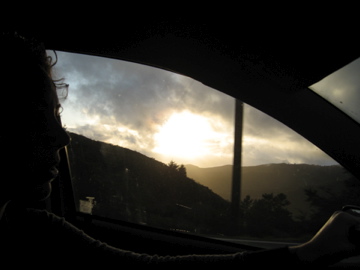
A ranger with plastic encasing her hat ushered us past the forever-full parking lot; we joined the assembly of cars lined up along the soft shoulder. We walked a muddy, pleasant 15 minutes to the park entrance. Slicker-clod kids tromped puddles as their parents juggled umbrellas and thermoses.

We arrived just as the crowd was thickening. A bearded ranger that looked like a nervous cross between a bluegrass singer and a surfer handed us a booklet of Solsticized/Muirized Christmas carols, complete with lines and titles such as “Deck the woods with luminaria,” “I’m Dreaming of a Green Solstice,” “O Redwood Tree,” and “Come All Ye People.” My personal favorite was “On the first day of Solstice / A Ranger showed to me / A spotted owl in a redwood tree.” The adapted songs captured the progressive eco-politics and non-religious spirituality of Marin better than an Anne Lamott novel. You know that stir a couple years back when right-wing Christians got their knickers in a twist over “Happy Holidays” replacing “Merry Christmas”? Well, these were the folks they were pissed at.
It was, as you might guess, a mellow crowd of nature-y families and local weirdos (a simplification that I suppose puts me into the latter category). We grabbed some cups of cider and strolled around in the intermittent rain, soggy sneakers and cold noses. The creek was full from the recent storm, the stumps mossy; everything felt wet and alive.

We joined the huddle of firepits and hunched shoulders encircling a small, makeshift stage. It was time for some wholesome, non-offensive entertainment. The crowd sang a couple carols, and was then held rapt by a story-telling performance featuring exuberantly portrayed animal characters that I’m sure have inspired several voice-over school rejections. We agreed that the confused shadow puppet show was most definitely the improved result of a flash of marijuana-fueled brilliance. We took it as our cue to stroll the now-dark trails.

Candles in white paper bags lined the trails, making it feel almost like we were walking through an altar. Raindrops held heavy on the tree branches as little kids ran past in a bobble of flashlight beams. Other than that, it was all sound. It reminded me of an interview I’d read with a travel writer (Don George?) who’d wanted to write about something other than the cathedral-ish quality of light in Muir Woods. He’d blindfolded himself and walked around, experiencing the famous woods with mostly just his sense of sound, and written the article from that perspective. It was true that it was a totally different Muir Woods without the light and the sight of redwoods—all rambling water and the solid, rooted presence of those trees, the way you feel a stranger in a dark room.

We got back to the caroling crowd just in time to catch the most bad-ass and spooky performance of the night, a Germanic Solstice dance by the Christmas Rebels (which sounds kind of punk rock). Composed of members of the German fraternal society California Rebels, the group did a slow, hypnotic folk dance that included antler-clashing and creepy flute playing. A bearded dude with a crazy eye hushedly explained the pre-Christian roots of the dance, which got back to the potent mix of fear and worship that fuels most religions, not just Paganism. Under the illuminated, snow-like mist, the clanks of the antlers and the wet clomp of the determined feet felt like a ritual not from long ago, but rather some deranged allegorical movie. Which is to say it was rad.

Toes numb and bellies hungry, we trekked back to the car under the dim halo of my flashlight. A half-grin of moon cut through the heavy clouds, and the earth rustled, sighed, pulled a blanket of darkness up to its chin and settled in for the longest sleep of the year. And Marin celebrated, the way Marin knows how: amid the trees.

Top Three Travel Secrets: A Chain Letter for Travel Bloggers

It reads as ominously as a middle school chain letter. Except, in the end, failure to perpetuate the chain isn’t sworn to result in untimely death or spinsterhood (which are more or less the same thing when you’re 12). Rather, in this chain, compliance results in access to a treasure trove of travelers’ secrets. And probably some new friends.

I was hit by two writers in the TripBase Blog Tag, spreading through the travel blogosphere like hot gossip around a lunch table. Or a dirty note during Math class, light-up sneakers in a mean game of duck-duck-goose. (The analogies could go on forever.) The idea is you write a post about your top three travel secrets: out-of-the-way towns, little-known restaurants, unheard-of hotels—“hidden gems” that lay glittering in the dimness of obscurity. Until now, that is.

Aside from amassing an ass-kicking list of previously unknown spots around the world, the other objective of the TripBase Blog Tag is to be build community and get folks involved. I can get down with that. In addition to the awesome ladies that tagged me—Stephanie from Twenty-Something Travel and Abbie from Miles of Abbie—I’ve already discovered some new writers on the TripBase list of bloggers tagged so far. (Best blog names? Dirtbag Writer and Snarky Tofu. Fuck yeah.) My hunch: the final list won’t just expose travel secrets, but also some bad-ass writers I hadn’t encountered yet.

They say you’re only as sick as your secrets. Here’s to travel health:

End of the hike: waterfall into the Pacific

#1 Palomarin Hike, Marin County, California

My work friend had been telling me about “the secret hike” for months. Huddled over our staff meals in the cramped bus station, she made rope-swinging into the clear lake, and the coastal waterfall at the trail’s end, sound like a dream. Or at least a damn good fantasy.

We finally coordinated a day off together in August and headed up to Marin to the Palomarin Hike. We grabbed sandwiches and drove up past Stinson Beach to tackle the 11-mile hike. And I gotta say, it was just as killer as she’d described.

The hike starts through rather typical dusty California coastal terrain, taking you past sweeping Pacific vistas us locals have grown accustomed to. After about 45 minutes, the foliage and trees thicken, and you eventually get to Bass Lake, a frigid-water lake that’s biggest draw is an old-school rope swing. You could while away hours here, but, seeing as though it was August in the Bay Area and foggy as hell, we were too cold to partake. We continued on, and ended up at the trail’s end, where a waterfall tumbles into an isolated coastal cove.

The good news: the hike, although long, is gentle and not too strenuous. Which means just about anyone could do it—including my smoke-a-pack-a-day friend and me, who was then recovering from swine flu (yes, really).

The bad news: the Palomarin Hike is a total word-of-mouth Bay Area secret. As is the way with Marinites, locals don’t want outsiders to know about their secrets or have access to them (see also: why BART doesn’t run to Marin). Locals take down street signs and signposts, meaning that you’ve pretty much gotta go with someone who’s been there. So if you’re headed to the Bay soon, just hit me up; I’ll take you.

Ahhh...

#2 Legzira Plage, Atlantic Coast, Morocco

Okay, if you’ve been following this blog for a bit, you’ve already heard me gush about the most deserted and beautiful beach I’ve ever been to: Legzira Plage, Morocco.

Talk about tucked-away: from Tiznit, take an hour bus ride, hop off at the faded roadside sign, and hike down 20 minutes. It’ll really just be you, a couple stray tourists, some fisherman and their donkeys—and the sandstone arches that dive red earth into blue water.

Among the handful of pink building that cascade down the cliff into the main beach, there’s two hotels that offer relatively cheap rooms. I went high-class and got one with my own shower, squat toilet (doin’ big things), and a window that opened onto the ocean view—for under $20.

Another bonus is the Moroccan street harassment factor, and the fact that Legzira Plage doesn’t have one. After a couple weeks of solo backpacking, sweating in long sleeves and fending off the barrage of “bonjour”s, it felt pretty damn sweet to strip down to my bikini and wave-hop in peace.

Kids on their way to school

#3 El Congo, Venezuela

The story goes that, when Europeans first arrived in what is now Venezuela, they came to the Lake Maracaibo villages, perched on stilts amid the marshes and water. Watching the village folks traverse the “streets” in handmade rafts reminded the Europeans of Venice—and they dubbed the place Venezuela.

El Congo, Venezuela is the most other-worldly places I’ve ever been. It’s only reachable by boat, a 30-minute ride through the hazy flat expanse of water, and you’ve gotta book a tour to get there. But surprisingly, the town isn’t the main draw of the tour. The Catatumbo Lightning phenomenon is what draws most people—mysterious, thunderless lightning that occurs almost nightly in the skies over Lake Maracaibo.

The road to Los Llanos was flooded when I was in Merida, so I opted to take the Catatumbo tour in its place. I hadn’t heard of El Congo, but it ended up being the highlight of the tour (the lightning didn’t really happen that night). The town had everything—a school, a fire station, a convenience store, even a Plaza Bolivar—all erected on stilts. Rumor had it there were a couple old folks still living in the town who’d only ever stepped foot for dry land to bury relatives.

It wasn’t an untouched Eden: El Congo was extremely isolated, making inbreeding a huge problem, and the town was quite poor. Sanitation was a major issue, with most refuse and human waste going directly into the water. Owning an actual boat was a sign of privilege. The less well-to-do had to construct their own floatation devices—this girl tied a piece of wood to some leftover styrofoam, dug a stick down into the mushy lakebed, and propelled herself along that way.

The thing that really bummed me out were the poor yapping dogs chained to the “front porch” of some of the houses. So much for getting a walk, little buddy. But hands down, El Congo was the most unusual place I’ve ever traveled to—and so far off the beaten path, there wasn’t a path at all.

So that’s my top three, scrawled not-so-jaggedly into the margins of a wrinkled note. Now to fold it up and shove it into another sweaty, unsuspecting palm. This could get good…

Hipsters Vs. Homeys: Oakland YouTube Travel Guides

“Oh hell no,” the text read. “Hipster douches filming Oakland travel video outside the shop.”

This was my best friend, writing from her post behind the counter of Tattoo 13. For years, she and the fellas have maintained a comical running commentary on the goings on of the now-trendy Temescal neighborhood, knowing every event, incident and wily character within a 10-block radius. Of course, she’d be the first person I’d hear about such shenanigans from.

It actually turned out pretty good, with the bit filmed in front of the shop capturing hipster sentiment with striking accuracy. Amid the recent annoyance over the woefully narrow Cool Hunting’s Oakland Word-of-Mouth Guide, I was inspired to dig the “hipster douche” video back up, and discovered some other YouTube gems along the way. And I hate to say it, I think the douches did it best. Or at least the most forthrightly.

Cool Hunting promotes independent art and design, featuring video guides on artists, cultural events, how-tos and destinations. The most recent installment visits independent businesses and local artists in Oakland, interviewing “the people who call it home.” They hit some great, popular local spots, but there’s a problem—the video only visits a very narrow section of the population, and the city. Businesses featured are almost exclusively in the North Oakland/Temescal and Downtown/Uptown areas, and, um, all the people interviewed are white. There’s a lot more white people in Oakland these days, but not that many.

Perhaps in an attempt to be inclusive, the video includes a couple shots of non-white, non-artist folks. They exist as passing, silent figures, riding bikes and making sandwiches—almost as though on another plane. I think it’s rather telling; I’m sure there’s people who’ve moved to Oakland that interact solely with the arts/”yuppie” communities, who experience the rest of the city only in tangent, realities that intersect on sidewalks and in cheap cafes, but no where else. I’m stoked to see my city getting recognition, but sad to see the guide left out so much of the city, what makes Oakland Oakland.

On the complete other side of spectrum, I stumbled across Thizz Nation’s neighborhood guides during my YouTube quest for the “hipster douche” video. Amid Mac Dre’s ever-generous contributions to Bay Area culture (I’m not really being sarcastic here), his Thizz Nation & On Point Productions created Treal TV Series, video guides that feature notorious Bay Area neighborhoods that birthed prominent figures in the rap community. (If you’re wondering what “thizz” is, check out old high school buddy Rachel Swan’s East Bay Express article from a few years back.) Installments include North, West and East Oakland.

I’m convinced these will someday be used as important specimens in some cultural anthropological study of Oakland. These guides do a little more to reveal the history and culture of certain neighborhoods, as rugged as they may be. But of course, they are also terribly narrow, and could leave one with the impression that Oakland is filled with nothing but 20-something, hard-as-shit black guys. Murder Dubs was one of the better ones:

A stab at a more balanced portrayal is made in the endearing “Oakland B Mine” video. A trailer for a short film that will be showing on a 30-foot screen at the Oakland Airport’s baggage claim, “Oakland B Mine” is pretty damn sweet. I never thought of my city being the backdrop for an artsy dialogue-less love story, but hey, I can roll with that. The trailer features some shots of everyone’s favorite farmers market (okay, my favorite farmers market), and the bad-ass old folks that do Tai Chi by the Lake Merritt BART station in the morning. While definitely more balanced and definitely the most well-done, one could still walk away from this one with the idea that Oakland is filled with nothing but good-looking, casually well-dressed hiply ethnic types. Which is fairly accurate, but still incomplete.

Which leaves the douches. While still narrow and incomplete, their video does something the others all don’t: makes fun of itself. It doesn’t just make fun of hipsters and gentrifying yuppies, it makes fun of cheesy travel guides and the abhorrent “staycation” phenomenon. But most importantly, the video gets at some of the very real issues inherent to living in Oakland, the preposterous dysfunction that manifests in sideshows, prostitution and, yes, the smells emanating from the Lake. And while the underlying message is that Oakland is “crappy,” the video captures the kind of delusional exoticism so many fall spell to.

Leave it to the hipsters…

Thanks for Nothing / Everything

I celebrated this Thanksgiving at two long-standing Oakland events: Thanks for Nothing, the legendary potluck of punk debauchery, and my family’s annual Day-After-Thanksgiving party, legendary in its own right. Both events were a little less epic this year, with an intimacy that reminded me of what’s good about Thanksgiving and about family—as untraditional as they may come.

Anyone in the East Bay who’s ever donned liberty spikes and a studded anything has gone to Thanks for Nothing. And possibly passed out at it. Now in its 18th year, the Thanksgiving potluck is an Oakland punk tradition, a place for all the family-less kids in black to come together, at picnic tables under jimmied lights, and create their own family.

Of course, by “kids” I mean “punks” and not kids at all, anymore. These are the die-hards, wearing smile wrinkles and old band shirts—the folks that, once the scene-ness melts away, once all the other folks have grown out of what was just a phase, are still there, purely for the love of it. Punk may be mostly dead, but it’s not all-the-way dead; it just lives in the hearts of a small handful. And, on Thanksgiving, in an East Oakland backyard.

Thanks for Nothing has taken on a larger-than-life status; the woman that puts in on is convinced that even if she were out of town one year, people would still show up. They didn’t pump it too much this year—no flyers or MySpace posts, just word-of-mouth—and the result was a smaller, friendlier crowd, that was also a bit tamer. The event historically gets increasingly raucous as the evening progresses; as the steam from the turkey table cools and the toddlers konk out, staggering, slurring sing-alongs ensue (among other things). This year, the pot food table was nearly empty and the jar of homemade Bailey’s went fast, but the Jell-O shots were plentiful, tossed around in a haphazard game of catch that somehow didn’t end in neon goo being splattered across someone’s head.

Despite the uber-punk name, this year’s Thanks for Nothing felt more about community than anything else. Family, as most travelers know, isn’t really about blood lines; it’s got little to do with genes or ethnicity or even, as we learn on the road, nationality. Family’s about people that share similar values and perspectives coming together and sharing, growing together. (And at Thanks for Nothing, singing along to Cock Sparrer together.) It sounds more one-love than punk, more Berkeley than Oakland, but sometimes it takes unexpected manifestations to drive a point home.

But most of my “family” growing up wasn’t about blood lines—a lot of Californians’ aren’t. My parents moved my toddler brother and my infant self to California with only one blood relative within 2,000 miles. Once my uncle passed away, it was really just the four of us for holidays. Plus an ever-growing band of fellow Bay Area orphans. It seemed that my dad’s first couple of years in the fire department, he kept having to work Thanksgiving (turkey at the fire house!). So we started having all our family friends over the day after, when we’d sit back and talk and laugh and eat for hours. We invited everyone, and it became a kind of neighborhood affair. A tradition was born, and yesterday, carried into its 22nd year.

Like Thanks for Nothing, we don’t really need to invite people anymore; everyone just knows to show up. Charles deep-fries two turkeys in the driveway, Karen and Jamal make the marshmellow sweet potatoes, Nhu and Jacobo bring the bread pudding, my brother makes the famous firehouse Caesar (I used to make the vegan entree, but those days are long gone…). My parents’ small bungalow overflows; there’s an incessant wait for the one bathroom and a warm glow from the fireplace. It’s consistently one of my favorite days of the year.

The event was smaller this year, just under 60 people, and I had a couple bittersweet moments, missing people who used to come—people who’ve moved, who we’ve lost touch with, but mostly people who’ve passed away. But at the same time, there were folks there that I’ve grown up with, that I’ve known my whole life, that are the aunts and uncles and cousins I otherwise wouldn’t have really had, so many miles and states away.

Family is one of the most important things to me, as traditional or untraditional as mine may be regarded. Of course, much has been written about the “demise” of the American family, and holidays like Thanksgiving hold a particular weight for those from untraditional or un-intact families. But I’d argue that the American family isn’t crumbling, just reshaping; seeing as though this guy got a book deal out of the concept, I don’t think I’m alone. And as travelers know, the traditions of a family are some of the best glimpses you’ll get into a culture—whether it’s making stuffing with your play-cousin, or pounding Jell-O shots with punks. It may not be a Norman Rockwell painting, but it’s as close as some of us get.

Street Art Pictures: London, Spain, Morocco and Portugal

First, a disclaimer: I don’t profess to be any kind of expert in street art. Or even a novice, really. I just know that, when I spot a fresh stencil or spy some sick piece, it makes me smile—and, if I happen to have a camera with me, snap some photos.

I guess the thing about street art is the sense of place it evokes—which one naturally notices more when one is traveling, seeing a city with fresh eyes. As the world gets smaller, regionalism can be hard to find; this is especially true in the Westernized world. Traveling in Western Europe, you constantly see the same chainstores, the same brands, the same fashions—girls are wearing whatever’s hip at H&M everywhere from Malmo to Madison (and I’d like to say myself excluded, but that would be a lie). Street art, whether it’s good or not, shatters through that; its viscerality marks a place, claims it, and if you’re traveling, can often reveal a lot more about where you are than reconstructed period buildings and restaurants with picture menus (really, paella all kinda looks the same).

I hung around some East Bay graf kids for a time, and still smile when I see their tags around town. A repeated stencil, a tag, a distinctive style—they’re like recurring images from a dream, someone else’s dream, and you catch little glimpses, train your eyes to look down alleys and up at overpasses, and you feel like you’re in on something. It grounds you in a very tangible way, connects you with the phantoms that sneak around at 3am with backpacks full of clanging illegality, with their finger-staining passions and illicit dreams. Of course, I was never one of them; a certain romance remains when it’s not you getting arrested or jumped in some strange turf battle. But I will say you interact with a city—its architecture and landscape, its thingness—differently when you’re even vaguely in tune with its street art. And when you’re traveling, it can often be your only contact with the night-crawling kids that in large part create the pulse of a place.

My first stop on my trip was London, where I of course went on an all-day goose chase for Banksy (chronicled here). The hunt also took me past several of these digitized little fellows by Invader..

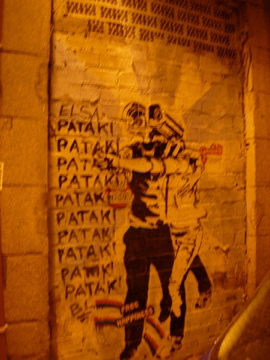
Super poor picture quality, but what can you expect from a 2am street lamp and a mediocre camera? This I spotted in Madrid, near Plaza Sol. If you can't tell, it's two tangoing figures with security cameras for heads.

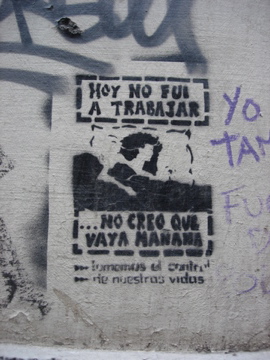
Granada generally had some piss-poor graffiti and stencils, but this one made me laugh. Totally fitting for a college town.

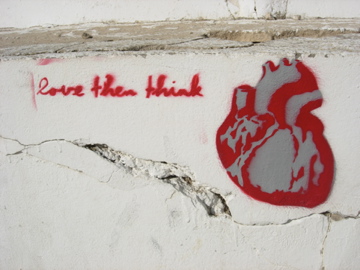
I spotted this one several times around the beach breakers in Tarifa. The sentiment jived well with the surf-town vibe, and the fact that it was in English spoke to the internationalism of the unassuming little place-between-places.

As you might guess, there wasn't a whole lot of street art going on in Morocco, or at least in the places I went. What one does see a lot of is stenciled Muslim calendars, on the side of buildings, with icons depicting certain holidays and dates. My favorite was the rose. I of course have no idea what it denoted or what the Arabic says, and retained none of the heavily accented, half-French explanations.

But of course, the best stencil piece I saw was in one of my favorite dirt-road beach towns, Mirleft. Popular with vacationing Marrakeshis, artists, dreadlocked travelers and, well, me, Mirleft seemed a perfect place to find this, peeling away on a side street.

Back in Europe, much of Lisbon's street art had a distinctive Brazilian flavor, which makes sense considering the city's large Afro-Brazilian population, and the fact that São Paulo and Rio are some of the biggest and baddest producers of street art in the world. I saw this stencil around the center, around uber-hip Barrio Alto.

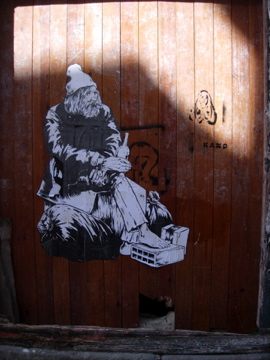
And this was a simply incredible wheatpasted portrait over near the Alfama district.

Another college town, Coimbra had a fair amount of politicized stencils. This one was especially interesting given the prevalence of domestic violence in Portugal, and the pervading stigma against seeking help: "Every 2 weeks, a Portuguese victim of domestic violence dies." The number is a little more somber when you consider the small country's population of 10 million.

On the flip side, this was just awesome.

And I quite liked this one as well.

But the place that really took the cake was Porto. Good ole unsuspecting Porto, forever in the shiny, smiley shadow of Lisbon. These were all taken near hip-slick-and-cool Rue Miguel Bombara.

The paper cranes were part of the 1000 Tsuri Project. They acted like punctuation, all over the walls of the street, serving as both a kind of visual break and space filler between the other pieces.

Part of a larger project by artist Costah; check more out here: http://www.costah.net/the-icons.html

This little girl is up a few places; each time, she's touching something different. From what I could tell, this was the logo of a nearby art gallery/collective.

One my favorites. Simple but expressive, and totally took me aback when I spotted it down an alley.

I don’t know if these reveal any more about the places I was in, but to me they do. And if nothing else, they’re better than cell phone ads.

The French Won’t Save You: Recklessness, Fear and Safety Abroad

Military chillin in central Bogota

Military, chillin in central Bogota

We’d taken refuge from the soggy Bogota afternoon in the hostel’s dank kitchen, sat drinking coffee and swapping tales. Only my third trip out of the country, I sat quietly, listening to the boys one-up each other. No one could beat the Swede in zip-off pants.

He sat smugly, like a guru, doling out morsels of his tales in titillating tidbits. He’d dyed his hair brown, donned dark contacts, and backpacked through Iran, Iraq, Pakistan. He’d ridden buses rarely, walked mostly, and had almost been killed (purportedly) by an anti-American lynch mob. Sparks of awe and admiration flew from the enthralled eyes of other travelers.

One of the boys in his rapt audience turned to me, suddenly aware of my presence. He quizzed me on my basics: where was I from, how long was I traveling, did I speak Spanish. “What’s your itinerary?” was his final question. I bit my lip as he looked me over, sizing me up for what I was: an early-twenties American girl, not terribly well-traveled, with a mediocre accent and a minimal vocabulary. I recited my basic plan: Bogota, Medellin, Cartegena, Santa Marta and La Ciudad Perdida.

“Hmph,” he snorted. “Typical.” And with that, he turned his attention back to the blond god before him.

Fast forward several years and a couple thousand miles to this afternoon, as I rattled down the uneven pavement of Interstate 880, windows down and blasting NPR (yo, turn it up so it bumps). I’d just caught the beginning of a story on France’s proposal to charge tourists for rescues from risky spots while abroad. The hotly debated bill came about several months ago, prompted by a much-publicized rescue of French citizens who were captured by Somali pirates while pleasure-yachting around the Indian Ocean. Reportedly, public outrage at the travelers’ perceived irresponsibility was intense enough to inspire a bill that would require tourists rescued from dangerous situations abroad to repay rescue costs (aid workers and journalists excluded). A coordinating author from Lonely Planet was on hand to discuss the proposal and its implications, a discussion that centered around issues of travel safety, and real versus perceived dangers abroad.

Here’s something most independent travelers, including myself, rarely check before going abroad: the Department of State’s Current Travel Warnings. When you grow up amid a culture of fear mongering, it’s easy to get desensitized. Yeah, yeah, yeah, you think, the world’s sooo dangerous and I’ll get kidnapped and killed the moment I leave the US. Fear is one of three reasons discussed in Nomadic Matt’s article, Why American Don’t Travel Overseas. Once certain travelers step outside the country and see the rest of the world isn’t the depraved war zone it’s often portrayed to be, they get cocky. And brazen. And sometimes stupid.

Take that to the extreme: extreme tourism. I haven’t heard this term in awhile, but it was tossed around the hostel table in Bogota that afternoon. It refers to a type of off-the-beaten-path thrill-seeking travel that prides itself in brushes with danger. Real danger. As in, I’m-gonna-walk-through-Baghdad-just-to-prove-I-can danger. Implicit in this type of travel, I would argue, are entitlement and bragging rights.

Fresh stencil in Bogota

Fresh stencil in Bogota

Which begs the question: should risk-taking travelers enjoy the luxury of being rescued, at the expense of their countrymen? The French don’t seem to think so. Nor do the Germans. The United States—well, we don’t really need to worry about it, since so few of us travel to begin with. Reportedly vague and insufficient, the French bill also opens the door to a lot of loaded issues—namely, who decides what countries and regions are dangerous, and whether travelers are behaving recklessly?

I’ve been to three gasp-evoking places often deemed too dangerous for travelers (let alone a solo white girl): Caracas, Mexico City, the entire country of Colombia. I didn’t go to any of these places because they were considered dangerous, but despite them being considered dangerous. One I ended up in circumstantially, but the other two I sought out—I’d heard too many good things from other travelers. I did my research. Street sense and good luck got me through unscathed. But there’s certainly people who would have regarded my traveling in these places as reckless, stupid and asking for trouble.

I remember thinking Colombia was a lot like Oakland. Which isn’t true: armed military don’t roll through city streets, and you can’t smoke cigarettes inside shopping malls (not even Eastmont). But both places have a sort of infamy to them, a danger that either lures or deters. As in Oakland, many parts of Colombia feel totally safe; as in Oakland, other parts of Colombia continue to feed the unsafe reputation. To stay safe in Colombia, I did everything I already do in Oakland: don’t go out at night alone, stick to main streets in safe neighborhoods, don’t ride buses at night, check my back like a motherfuck.

The Swedish guy in the Colombian hostel reminded of suburban kids that move into Oakland warehouses (snark alert). They proudly tell you they live in the Lower Bottoms, Murder Dubs, Dirty 30s, Ghost Town. “The thugs aren’t that bad, really,” they tell you. Then, knowingly, as though they’re imparting some great gem of karmic street ethics upon you—“If you don’t bother them, they don’t bother you.” Then they mugged/assaulted/held at gunpoint, and they leave, go back to their suburbs bruised and bitter and hating the town they so recklessly glamorized.

There’s a certain romance with violence and danger that people who have no real experience with violence and danger have. It’s exciting, enlivening, visceral and real. It’s the wild-eyed rapture of Futurists (which for all of their sexism, fascism and idiocy still created some good art). It’s as easy to write off as the uninformed fear that keeps some folks away from Oakland, away from traveling, and comfortably cocooned in familiarity.

But neither side is right, neither view complete. They’re just two sides of the same coin—exoticizing someone else’s world, treating it as the Other, instead of attempting (however falteringly) to meet it, understand it and experience it as it is. Can I claim to have traveled so honorably? Not really. But I can claim to have tried.

DSCN1202_2_2

Good times with the Colombian military

Which could all be an elaborate rationalization for why the rules don’t apply to me—why I haven’t gotten into any real trouble while traveling, and why I would surely be rescued in the event of any dire incidents. And not expected to pay for it. (Because, after all, I’m not French.) But I suspect the truth lays somewhere muddled between all this, between embassies and travelers, the frightened and the intrepid, the streets of East Oakland, the seas of Somalia and hostel kitchen tables around the world.

Dos Dias de los Muertos: Oakland Vs. SF Celebrations

DSCN3892It’s not Mexican Halloween. Or Northern Californian Halloween. It’s Dia de los Muertos, and it’s everyone’s holiday now.
You can’t escape Dia de los Muertos in the Bay Area. That’s a good thing. It’s a pretty bad-ass holiday, based in the Aztec belief of death not as a definitive end, but merely a continuation in a parallel form. Aided by elaborate graveside altars, souls of the departed return for one night (traditionally two) to kick it with the living. The celebratory approach towards death comes complete with a comically macabre aesthetic derived largely from a good ole’ revolutionary, Jose Guadalupe Posada (see: my first tattoo).

What makes the holiday fascinating to me is its endurance and evolution. Dia de los Muertos is the little holiday that could: millennia-old, it’s survived colonialism, Catholicism, and more recently, the United States. But while all these outside elements have altered the holiday, the fundamental spirit has managed to survive. Observances vary wildly, both within and outside Mexico, and serve to say a lot about their respective communities (see: my latest Matador article). Case in point? Oakland versus San Francisco celebrations.

The Bay Area’s enormous Hispanic population has two established homebases: East Oakland’s increasingly cleaned-up Fruitvale district, and San Francisco’s contentiously gentrified Mission District (claimed to be birthplace of the burrito). Both host huge Dia de los Muertos celebrations that shut down city blocks and draw thousands with marigold-adorned, incense-laced festivities. Neither celebration is traditional, in the Patzcuaro sense of the term, but neither are the same. They contrast as starkly as an SF hipster’s ironic mullet and an Oakland hyphy  kid’s synthetic dreads.

DSCN3846

International Blvd during the Dia de los Muertos

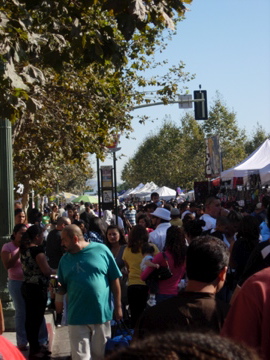
Oakland celebrates with a family-oriented daytime street fair on the Sunday preceding the holiday, this year November 1. While drawing a healthy cross-section of the city’s ever-diverse population, the event is mostly representative of contemporary Mexican and Latin culture in the Bay Area. Powerhouse Spanish radio stations, La Raza and La Preciosa, set up stages on opposite ends of the festival and vie for on-lookers. Local taquerias set up stands that pump out carne asada smoke, while DIY vendors push helado carts and set up raspado stands. Women hawkers cry, “Churros, Churros, Churros!” while others wrap still-steaming elotes in foil. Local businesses abut booths with corporate superpowers like Safeway, while non-profits erect altars next to those of neighborhood school kids. Dancers decked out in Aztec garb (the feather- and skull-adorned headdresses are bad-ass) break into spontaneous drum-infused performances, and there’s more men in cowboy hats and little girls in mini-skirts than you can count.

DSC_0381On November 2, San Francisco holds an evening procession that a jaded friend of mine has dubbed “Gringos Gone Wild.” True, the participants are largely not of Hispanic decent and, boy, do they get down. People dress up in calavera face paint and elaborate Tim-Burton-esque costumes that I suspect derive from Victorian Catrina dolls. A modest group of Aztec dancers leads the procession, which then follows with revelers of the purely San Franciscan variety: costumed people with politicized signs, curious interpretive dancers, bicycle-powered floats, and a whole lotta candle-clutching white folks. The procession ends at a public park filled with some seriously artistic altars—this year, an anatomical heart suspended by red nerves, a papier-mache carniceria, a parlor scene that looked like the inside of Edward Gorey’s head.
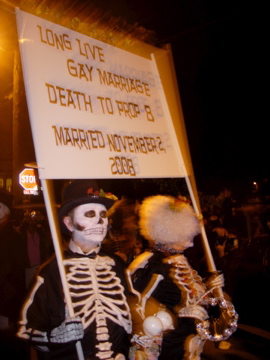
I can see how people get down on San Francisco’s Dia de Los Muertos celebration for not being authentico; I understand why others deem Oakland’s as boring and not creative enough. But isn’t that just an extension of the Oakland-SF rivalry, the cities’ differences demonstrated through the observance of another culture’s holiday?

I’m an Oakland girl, so I’m partial to an event where I run into about a dozen people I know. And if nothing else, the Fruitvale festival is thrilling for the mere fact that Oakland manages to hold a peaceful public festival (I remember seeing stray post-Festival-At-The-Lake rioters pass by the bottom of my block as a kid—that was the end of that neighborhood event). Events like the Dia de los Muertos celebration remind me why I love my hometown—though I never really forget.

DSCN3907At the same time, the Mission procession captures so much of San Francisco’s cultural landscape. Just when you get disheartened, want to write the whole place off as over-priced and gentrified, the city comes through with something insanely creative or beautiful. Despite the changing demographics, beneath the paling population and depressing socioeconomics, San Francisco’s still a city with soul.

And at the center of both of these celebrations is the fact that they don’t derive from, well, here. They aren’t American, have been brought over by immigrants and subsequently Americanized. Some shout cultural appropriation, and, sure, these festivities are a far cry from the all-night graveside vigils I attended last year in Tzintzuntzan. But, at the core of these modern interpretations, both stay true to the fundamentally celebratory Aztec approach of the holiday. And if that’s not survival, I don’t know what is.

Flyin’ with Ryan: What to Expect and How to Survive

DSCN3843I have seen the future of air travel. And it’s covered in Telecom ads.

If you haven’t been broke and in Europe in recent years, you may not be familiar with Ryanair. Among the no-frills airlines specializing in short distances and absurdly low prices, Ryanair is the most vile, audacious and offensive. And usually the cheapest.

The idea of an under-$50 flight gets most Americans all hot and bothered. It’s just another way those Europeans have it better than us—universal health care, social welfare systems that work, less violent crime, tougher environmental laws. And cheap flights. I’m talking 5 Euros cheap. I’m not sure why Europe gets to add this to their ever-expanding repertoire of ass-kicking, but my guess would be that the airlines have to compete with competent, efficient train service. Take Amtrak, or God forbid, Greyhound across the country? Down to LA? I think I’ll pay the $125.

When I was figuring out the general itinerary for my last trip, I checked out flight costs for my longest distances on FlyCheapo. I came across Ryanair, and thought there was something wrong. A one-hour flight from Marrakesh to Seville for 5 Euros? Porto to Madrid also for 5? Are you kidding me?

Well, yes and no. The thing with Ryanair is that there’s catches. Enough to warrant a mitt—or the ability to read fine print, follow rules to a tee, and tune out advertising assaults. And you’ll need a pinch of luck. I took 2 flights with Ryanair; here’s some survival tips on what to expect from Europe’s most infamous airline:

The first trick to surviving a Ryanair flight is to read every rule and instruction, and treat it like the gospel. It is. Any attempts to bend the rules promptly results in a hailstorm of fees. Size and weight requirements for both checked and carry-on luggage, for instance, aren’t approximations. Carry-on baggage over 10kg? That’ll be 20 Euros. Forget to print your boarding pass at home? That’ll be 40 Euros. Traveling with an infant, surf board or guitar? Another 20-40 Euros. You’ve gotta pay to check a bag, but if it exceeds 15 kg, there’s an additional per kilo charge. If you’re a non-EU citizen, you have to have your passport checked by immigration control; forget that, and, yes, it’s another 20 Euros.

In preparation for your Ryanair flight, don’t even think about fudging on the details. Check-in closes exactly 40 minutes before the flight departs; arrive even 3 minutes late and you’re SOL. Have your printed boarding pass in hand, and get your passport checked.

Get to the gate early. Don’t sit in the hard plastic chairs—stand as close to the gate as possible. Ryanair doesn’t assign seating, which at first seems counterintuitive—it takes longer for people to board when they’re elbowing and jostling and trying to find their own seats. But, as always, there’s a catch: you can pay 4 Euros for priority boarding. Most of the folks doing this are traveling with small children, or those infants they paid an extra 20 Euros to hold on their laps.

As boarding time approaches, expect to see a steely-faced attendant walking up and down the line of anxious passengers, examining each carry-on item. It must be under 10 kg, and it must be only one bag. That means purses, laptops, water bottles, plastic bags carrying your wilted sandwich from earlier that day—it all counts. This is where they really rake in the extra fees. I only saw one man successfully evade the attendant, putting a jacket on over his fanny pack and untucking his shirt so you couldn’t see the waist strap. Smooth.

When it comes time to board, don’t expect anything fancy like gates or protected corridors. You’ll be scurrying across the tarmac and scampering up stairs (front or back, they open both up for maximized efficiency). Hustle on to the plane while perky young attendants bark at you like PE teachers: keep moving! find a seat! don’t block the isle! move quickly! go!

You’ll discover a couple of unusual things about your Ryanair aircraft. One, there are no tray tables. That safety card with a creepy characters acting out worst-case scenarios will not be a folded card in a pocket, but pasted onto the seat back in front of you. The overhead bins will be covered in Telecom ads, like a bus or metro car.

Once you’ve buckled your seatbelt, you’ve successfully completed the first stage in surviving a Ryanair flight: you’ve negotiated the rules and fees. Now it’s time to sit back and… be marketed at.

It’s ingenious, really, and I’m not sure why other airlines haven’t thought of it yet. Maybe they have, and Ryanair’s just the only one ballsy enough to go through with it. They’ve got a captive audience on an airplane, and Ryanair makes use of this ideal situation. In a 55 minute flight, I counted 4 opportunities to buy things. Jonesing for a cigarette? Buy our Smokeless Cigarettes for only 6 Euros. Make use of Ryanair’s exclusive inflight mobile phone service, and text and chat your heart away for only 2 Euros a minute. Buy Nescafe coffee for only 3 Euros. Get your gambling fix by buying a scratch card for only 3 Euros—and don’t feel guilty because some undisclosed amount of the proceeds goes to charity (here the flight attendant actually walked the aisle saying, “Win 10,000 Euros, save the children”). And let’s not forget duty-free shopping.

All this means that the attendants are basically talking at you the entire flight. Part of the reason is that announcements and sales pitches need to be made in multiple languages, but still. I recommend headphones. A smiley “no thank you” is as effective as a mean scowl, so pick whichever one fits your mood. No charge.

Now, when you’re descending into your destination, you may think the battle’s almost over, but here’s where the luck comes into play. I was fortunate on my 2 flights, because I landed in the airports and cities I thought I’d be landing in. Not so for all Ryanair passengers. I’ve heard horror stories about people landing on some lonesome runway 20 kms from the city they’d booked for. Notice that on your Ryanair itinerary, specific airport names aren’t given, just the names of cities. This allows them to land in the regional area of whatever destination, but not necessarily the main (and more expensive) airport. So, if you’re among the unfortunate, how do you get to where you thought you were going? Ryanair is nice enough to arrange for a bus. Which you can ride for 20 Euros.

Seeing as though I landed where I was supposed to, only had one flight time changed and neurotically followed every rule, my Ryanair travel experience wasn’t so bad. I actually don’t mind being inundated with ads and paying checked bag fees if it means I’m flying for a total of 25 Euros. And judging from the number of filled seats, I’m guessing I’m not alone.

Ryanair certainly hasn’t won any friends with its wily antics (this guy is pissed), and there’s an art to surviving their flights. But until they start charging to use the bathroom (they lost on that one), I’ll still grab a cheap flight with them whenever I’m in Europe. And my guess is that US-based airlines will begin moving more in this direction—hey, they’re already charging for checked bags. Only their flights ain’t no 5 Euros. (Oh, Europe, there you go again…)

There’s No Place like Oakland

3318186624_396e94a2c4_mI’m falling in love with my hometown. Again.
I’ve just come home from six weeks in Iberocco (Spain, Portugal, Morocco). And more than any other homecoming from any other trip, I’ve been struck with a swooning sense of smittendom—for Oakland.

Coming home is always bittersweet. I love so much the headspace of traveling and who I am when I’m on the road—more open and willing to roll with punches, the literal potholes and uneven pavement of shoulderless highways. I love the feeling of constantly learning, constantly adjusting, figuring out buses and city streets and how to say “thank you” in whatever language (“gracias,” “obrigada” and “shokran,” in case you’re wondering). It’s always a serious bummer to board a plane and know that that will soon slip away as I settle back into the familiar, a chrysalis of complacency.

But as the jumbo jet tilted and spun and made its descent into SFO on Wednesday, I had another usual feeling encountered when coming home: awe. Even in my dehydrated, swollen-legged state of sleep deprivation, I was floored by the raw beauty of the Bay Area, its bridges and mountains and tumble of cities. You’d think I’d have gotten used to it by now, desensitized to the rugged coast and smooth blanket of ocean. But no. It still gets me. And, surrounded by eager British tourists, I had a sense of pride—yeah, this is where I’m from.

My dad picked me up, and we chatted about exciting family developments on the drive across the bridge. My brother’s gotten engaged, wedding preparations are in full effect, baby’s on the way. It was one of those perfect Indian summer days in the Bay, and the skyscrapers and billboards of Downtown San Francisco sparkled in the lazy afternoon sun. If you’ve gotta come home to anyway in the US, I’ve always thought, this is about the best place.

And then came Oakland.

We pulled off the freeway, stopped at a light next to a woman singing along to the bass-rattling radio, hyphy dancing in her gleaming-rims car. My dad looked over at me. “Good to be home?”

“You have no idea.”

I love my hometown in a fierce, unexplainable way that transcends the normal no-place-like-home adage. There’s really no where quite like Oakland—at once diverse and vibrant, crime-ridden and corrupt, filled with the tension of violence and drugs, and with a kind of kick-back coolness that gets under people’s skin, infects them with this cursed passion for the place that won’t let them leave.

There’s a reason San Francisco is called The City, and Oakland’s called The Town: it’s a city of neighborhoods, where people say hello and chat with each other. I can’t blame the encroaching tide of gentrifiers for snatching up bungalows, sipping coffee on their porches and talking about how much they love their neighborhoods, their new city, their adopted hometown. Even for the newly arrived, Oakland just feels like home.

And seeing as though I’ve never lived anywhere but Oakland, it’s truly the only place where I feel comfortable, feel like I don’t stand out like the 5’10, tattooed, throbbing sore thumb I am everywhere else. (Even in New York City, I’m constantly being stopped on the subway, the streets, in Jewish delis, and asked where I get my work done—so much for New Yorkers being unfriendly.) Somewhere amid the dreadlocks and full sleeves, the mulleted vaqueros and the clashing-prints Asian immigrants, between the Crod-clad yuppies and the Southern-accented old men, somewhere in the seams of all that, I find this funny feeling of home.

Oakland’s not an easy city to love. My first Matador article was about that, and, judging from the comments, I’m not alone in either my love for Oakland or heartbreaking frustration with it. And, while I really can’t get enough of traveling, of seeing the world and experiencing different cultures, I’m fairly certain that, fuck, Oakland’s got a grip on my heart. I’m a lifer.

Hanging On: Porto and My Final Days

Porto, being hella beautiful

Porto, being hella beautiful

I´m nearing the end of my trip, fighting the blues and impending sense of finality not at all discouraged by the dark and brooding city of Porto.

Every place I go in Portugal seems to the up the ante. College-town Coimbra was a steep jumble of old streets and sudden squares with startlingly beautiful sights tucked inside every twist and fold. It was as pretty as a girl without make-up on, a girl who doesn´t know how pretty she is—clutching her parks and praças (plazas) and fountains to her chest like a Valentine. I wandered around the small city, sighing and thinking, This might be my favorite place in Portugal.

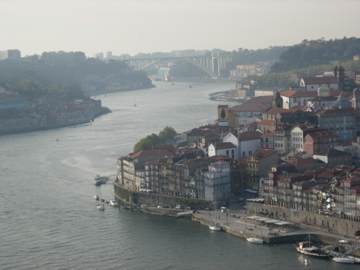
Then came Porto, sharply cleaved by the Douro River in a precipitous dive of rock and stone, bridges and dancing light. It´s the dark-haired, fiery-eyed counterpart forever in the Northern shadow of its shiny, more popular younger sibling, Lisbon. The two cities have a huge rivalry (most overtly expressed via football); I feel like an aunt that loves them both, for their different personalities, but that can vibe a little more with the darker side. At least, right now I can.

I spent the bus ride in yesterday not reading or writing or listening to my ipod, but staring out the window and wishing I would never arrive. Just keep riding, keep traveling, keep going. It was the last bus ride of my trip and I was savoring those precious moments of just sitting, thinking, living in that inbetween state—like when I used to ride the bus as a teenager. Having the time just to sit and stare is a huge luxury for me these days, and I´m going to miss it.

But more than even that, I wanted to hang on to the feeling of traveling, the mindset. When I´m on the road, everything seems possible; I´m more open to chance, more aware, more able to live life on life´s terms. When I´m at home, nothing seems possible; everything seems difficult and riddled with tedious and insurmountable obstacles. Of course, neither view is entirely accurate, but I enjoy the former much more than the nose-to-the-grindstone latter.

Two days ago, on the bus ride from Peniche to Coimbra, I began plotting and planning—sketching out timetables and earning versus saving projections (yes, really), trying to figure out when my next trip would be. I was seized by panic, stressed by the dismal prospect of not being able to travel anytime soon. Basically, I was future-tripping, trying to manage and arrange life before I even got home.

But I´m not alone in that. During my trip, I´ve slowly been reading Peter Matthiessen´s The Snow Leopard, a classic travelouge and meditation on the state of living. As timing would have it, Peter´s about to head back down the mountain, towards home, just as I´m about to hop on a flight and sleep in an airport and hop another two flights. In the passage I read today, he´s also losing the Zen of travel and stressing about home, “forever getting-ready-for-life instead of living it each day” (p. 244). He suggests that perhaps the greatest spiritual challenge is to live in the present, to “pay attention even at unextraordinary times, to be of the present, nothing-but-the-present, to bear this mindfulness of now into each event of ordinary life” (p. 245).

So I rambled around the shuttered shops and lonesome graffiti of Porto this afternoon, the uneven stones in the street like a repeating mantra against my worn soles: be present, be present, be present. I wandered past baroque building facades adorned with trumpet-blazing statues, up gasping stairways, into gold-dripping cathedrals, past the darkly oxidized rock (“the awful and irrefutable rock-ness”) that jutted from the earth, bold and undeniable. I felt the murmur of Roman ruins beneath the surface, beneath my sneakers, and tried to hang on to this fleeting feeling of present.


Lauren Quinn is a writer and traveler currently living in Hanoi. Lonely Girl Travels was a blog of her sola travels and expat living from 2009 to 2012. She resides elsewhere on the internet now.

Join 490 other subscribers

Buy This Sh#t

Categories