Archive for the 'Places' Category


No Port in Porto

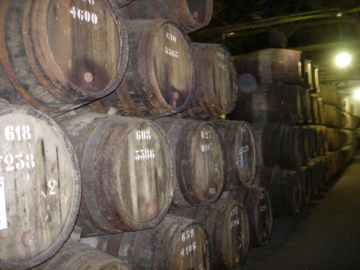
DSCN3759I ended up at port tasting in Porto today. If you know anyone who´s been to Porto (yes, the homeland of port), this probably topped their itinerary, sent them scampering up the city´s steep hillside for a free tour and tasting of the  carefully aged, exquisitely sweet wine that is as Portuguese as codfish. If you know me, you´re bound to be uttering a “wtf?”

The thing is, I don´t drink. Not even wine; not even to taste. It´s been over 9 years since I´ve had a drink, so I don´t think of this as a very big deal anymore and don´t think to announce it on my Couchsurfing profile. So when my host picked me up from the bus station, drove me around town on a personalized sight-seeing tour (this is the life), and thought, you know, it´d be fun to stop off for a port tasting—far be it from me to not tag along.

It was mildly interesting, to wander amid the massive barrels and cool stones, listening to the heavily accented spiel (I serve ports at work, which I´ll be returning to in exactly one week, so it was good to have a little refresher course). I observed everyone else´s excitement, especially for the free tasting portion, and I have to say, it was a little awkward when I was the only one not politely pushing to the counter and grabbing a glass.

I´ve been thinking a lot about drinking and traveling, since I read Matador article discussing the pros and cons of alcohol consumption on the road. The article asked whether we needed alcohol to connect on the road. The 21-and-counting comments ran the gamut, and revealed a lot about the people the wrote them. On his personal blog, Matador editor Carlo Alcos offered his ruminations on the subject. “Okay,” I thought, “I can totally write a post on this.” I saved the links and let the subject swim around in the back of my head. And, I´m surprised to say, I actually have very little to say.

So, of course, I´ll say something about that. I found the responses to the article fascinating, little boxed glimpses into the psyches of the thumbnail photos that accompanied them. The fervor and conviction with which so many people wrote intrigued me, especially when they went so far as to make blanket statements or preachy proclaimations. I observed it all with a strange sort of detachment, as though I were looking in on something that had nothing to do with me, like watching a documentary on the culture of people in a terribly far-away land. And, in a way, I was.

I´ve never drank while traveling. I got sober at 17 and never looked back. At home and on the road, people who don´t know this will offer me drinks—I casually decline, and that´s the end of it. Sometimes they notice my repeated refusal and ask why, and I tell them the truth: I´m far more charming company sober.

Drinking for me was never about the kind of camaraderie and conviviality the Matador article talks about—it was about self-destruction and oblivion.  I didn´t win many friends by cussing people out, pissing in doorways or sobbing in corners. Nor would I expect to while traveling. And while I don´t hit the pubs or search out the coke bars when I´m in another city, I do go out. To parties, yes, sometimes to clubs and bars. Sometimes to port tastings. And I dance and laugh and conversate (I´ve stopped fighting, it´s a word now) and do all the stuff everyone else does. I just remember it the next day.

Or, at least that´s the position I´ve always maintained. But in my Portugal travels, I´ve had this lurking feeling that I´m missing out on something. Wine is a huge part of life in Portugal, a cultural characteristic that culminates in the precipitous cleave of Porto and the surrounding green valleys of the Douro. And in the same way that you get a better, ahem, taste of a culture via their traditional foods, I think I´d be getting a better feel for the soul of Portugal if I were swishing a tawny port around my teeth and pontificating on notes of walnut and honey.

But even this feeling, this knowledge, I observe with a distance. It´s all so far away, drinking and the culture behind it, and I find myself regarding it with complete indifference. That is to say, regarding other people´s drinking with complete indifference. I guess what I realized with the Matador article and the responses it provoked was that I really don´t want to be the arbiter of anyone else´s drinking. I´m probably the least qualified person in the world to do that anyway. I just want to keep living my little sober, happy life—even if I end up wandering into a port cellar or two.
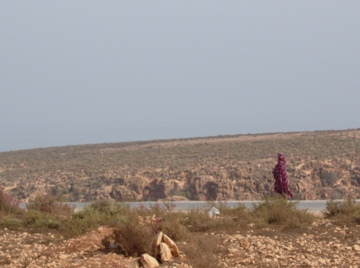
Well, Isn´t This Handy? Moroccan Photos by Someone Else!

Here it is: my best Moroccan photo. Now go look at the other ones...

Here it is: my best Moroccan photo. Now go look at the other ones...

I have a confession to make: I am a terrible photographer.

Not that you´d know, seeing as though I left my camera cord at home and all my posts from the road have been woefully without visual accompaniment. But despite the fact you can´t see any what fills my memory card, I have been making a concerted effort to take more photos on this trip. Photos enhance articles, and most publications dole out additional sums for good pictures. The only problem is, I suck.

It´s not just that I lack the technical ability to address lighting and angles and perspective. I´m a timid photographer, not intrepid enough to shove my camera lens in at the moments that would create good photos. I´ve come home from previous multiple-month sojourns with less than 200 pictures. But I actually love photography, and see plenty of good pictures all around me—it´s just that, by the time I´ve dug my camera out of my bag, turned it on and focused, the moment has passed. And I find I´ve wasted the moment not enjoying it, sucking it in, but instead trying to photograph it.

I´ve decided that, since I´m a much better writer than I am photographer, I´m going to take pictures with words. When I see an insanely beautiful or mesmorizing or unusual image, I study it, memorize it, savor it—then scribble as fast as my fingers will let me, trying to get it all down. It works—when I flip through my notebook, the scraps of phrases bring back everything my haphazard and poorly focused photos don´t.

But a good pictures is still a good picture, and I wistfully reflect on all the excellent moments in time that are only captured in my mind. So you can imagine my delight when one of my favorite travel forces, Matador, published a photo essay on Morocco today.

The photographer, Paul Sullivan, has a killer eye and enough credentials to make you cry. Most of the photos are from Marrakesh, where I spent my ill-fated last day; I think photo 10 of Djemaa El Fna totally captures the spirit of the food stalls.

I like this system, someone doing my dirty work for me without even knowing it. I fantasize about one day setting out on a trip with a photographer, tag-teaming some destination with a dynamic duo of artistic ability. Until I get a grant or find a glossy magazine still willing to send people out on stories old-school style, this will have to do.

(PS—If you´re licking your chops for more kick-ass travel photography, check out my homeboy Peter´s photo blog, stolen goods.)

Livin´ La Vida Português

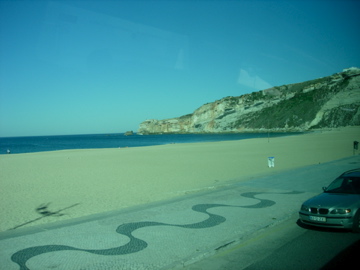
Beach from a bus window: NOT the way to be enjoyed

Beach from a bus window: NOT the way to be enjoyed

Nearly a week into my Portuguese travels, I am convinced of two things. One, Portugal is a country best enjoyed by car. Two, Portugal is best a country enjoyed.

On my second day in Lisbon, my Couchsurfing hosts and I chased the sunset along the granite coast, driving through increasingly posh, and beautiful, suburbs where tan bodies gleamed in beach coves, green parks and umbrellaed cafes. My hosts, recently relocated Hungarians, had spent a month driving around the country, stopping in at whatever little village or beach enticed them. As we curved down the coastline, in pursuit of their favorite sunset spot, they told that Portugal was best explored by car. Infrequent and/or nonexistant bus service cuts you off from a lot of the country, they told me; cars mean the usual freedom from timetables, but also a better glimpse into Portugal. I stared out the window, at the pinkening sky and grey sheets of cliff, and nodded—I certainly wouldn´t be feasting on that sight if it weren´t for my hosts´car. Of course, traveling solo, renting a car was far out of my budget, but I lamented my inability to see more of the country, to get off the beaten path and into the dying villages the speckle the green countryside.

But as we climbed out of the car and scurried along the rocks just in time to snap photos and sigh at the insane beauty of it all, another thing occured to me: the Portuguese know how to enjoy life. They don´t initially bowl you over with siestas and late-night partying like their neighbor; coming from a night in Seville, Lisbon actually felt a little tame. While the Spanish are a bit more flamboyant in their lust from life, the Portuguese have a subtler, but equally infectious, approach to living it up: they´ve got the beaches. And the pastelerias. And futbol and fado and seafood and port. And all of it´s twinged with this hint of melancholy that really gets under your skin.

Old folks in Obidos

Old folks in Obidos

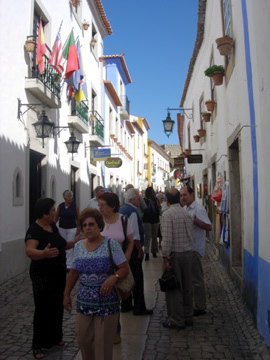
The theories converged and cemented today, as I treked off to Obios. The medieval village wasn´t initally on my itinerary, but two Portuguese guys and my hosts assured me it was the most beautiful town in Portugal, that I had to go there. An expensive touristy place to sleep, I booked a hostel in a nearby beachtown, filled with shirtless, sunbleached Austrialian surferboys. As they tossed their towels over their shoulders and headed out a day in the waves, I walked to the bus station. And waited.

The bus ran every two hours and, when it came, made a winding route through narrow streets, stopping at what felt like every crossroad. I got to Obios and, well, was a little underwhelmed. It was pretty, had a castle and cobbled streets and lots of stores selling lace and ginja, cherry liqeuor. I wandered amid the elderly tourists and billowing bougainvillea, half-heartedly snapping photos of the lush rambling countryside and gold-dripping cathedrals. Meh.

I´d been thinking about trying to make it over to another village, only about 30 km away. It sounded even more boring, but was home to a medieval monastery with a gruesome history—gruesome in the way Quentin Tarantino meant when he wrote the line, “I´m gonna get medieval on your ass.” Murals depicted scenes of the monastery´s founder ripping out and eating the hearts of the people who murdered his forbidden beloved, while making memebers of the court kiss her decomposing hand—metal enough to put Lords of Chaos to shame.

But, alas, the bus to Alcobaça only ran once every three hours, and would put me in town only an hour before the monastery closed. I debated: wait around in pretty-but-dull Obios for the bus and try to squeeze in one more sight, or head back to my hostel and do like the Portuguese: hit the beach. I´ll let you guess what won out.

Freshly shaved and bikini-clad, I took my crappy travel towel and joined the fat old men and tattered fishing boats along the gentle coast. The water was cold at first, but soon I was breast-stroking and wave-hopping with the best of em. I´ve been told the Portuguese love their beaches and escape to them at every available opportunity—and now I can see why. Rockless and clear enough that I could see my feet, it felt pretty heavenly. I stretched out in the sand, soaked up some sun, and stopped for an ice-cream cone on my way back.

I may not be making it out to the remote hilltop villages, and I may be spending hours twittling my thumbs at bus stations, but I´m starting to get the hang of this Portuguese living thing. And you know, it´s not so bad.

The Trials of Trying

DSCN3637I´m learning to become a travel writer—which has a lot more to do with learning to travel, and travel differently, than it does learning to write.
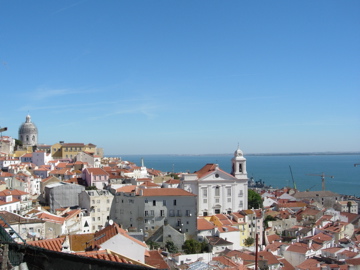
Sure, it´s its own genre, a new craft to negotiate. And, yes, it involves hours hunched over a notebook or a computer, weaving images and experience and attempting to capture the whiffs of a place, the strange sentiments it evokes—those vague stirrings that Viriginia Woolf lamented go “fluttering through the nets” of even the best writers.

But, for me, the tricky part has been the first half of the phrase, the “travel” part of “travel writing.” It means traveling in a different way, pushing myself more beyond my comfort zone and inherent shyness in order to experience more—more interactions and more adventures mean more to write about. It means forcing myself to follow those little nudgings, those whispers to, say, delve into that shadowed medina alleyway or say yes to going out on the town when I´d really rather sleep. Fuller travels equal richer content; everyone wins.

I knew on the on-set of this trip that it´d be different for me—my first long trip since getting serious about travel writing. And I set out blazing—tromping around, joyfully holding hands with serendipity, taking feverish notes and spending long hours at cheap internet cafes, searching for punctuation marks on foreign keyboards. I was feeling positive, productive, learning more each day to let go and follow my hunches, the random doors that open.

Then came Lisbon.

I loved Lisbon. Maybe that was the problem. Maybe its bittersweet melancholy sunk in a little too deeply. It´s hard to say. But I spent my last morning woefully walking its steep streets, ruing in a mosaic of regrets not too dissimilar from the sidewalk stone designs.

Vibing well with my hosts, I´d stayed a day longer than intended, and still felt like I´d wasted my time, hadn´t used it well enough—missed out on a chance to go to my first football game, didn´t make the trek to a huge experimental design expo, didn´t go inside a cool-looking vintage toy store that probably would have made a killer (and sellable) story. I´d dropped so many balls, as my friend Katie would say, you´d think I was trying to dribble.

I´m not sure why I fell off so steeply, as precipitous as the seven hills of the city (at least I´m making some anaolgies out of it). It´s possible I´m just being hard on myself. I´m a person that always feels like I should be doing more, working harder, being better. I´m excellent at rallying, at pushing myself—working six days a week for months, saving money to travel. I told myself that for every place I visited on this trip, I´d come out with at least one story. This didn´t happen in Lisbon, and I think there´s a lesson somewhere in there.

I arrived in Lisbon tired. Exhausted, and it wasn´t just the six hours of broken sleep on an overnight bus. I´d been power-traveling for over a month, never sleeping in the same place for more than three nights. My clothes were filthy, my chest blossoming in a recurring stress-related rash. I´d had on-and-off-again diarrhoea for almost two weeks, but hadn´t had a period in over six. My last day in Marrakesh was emotionally draining, and I was ready to relax. To hang out with fun people, to eat pasteries in a shady park and watch trashy American movies. Which is what I did. Rejuvenating? Yes. Fodder for great travel writing? No.

There´s no use in wallowing in regret; all I can do now is try to learn something from it. And while I need to continue to push myself to take risks while traveling—to push open those cracked doors, to go into that toy shop—I also need to go easier on myself. Working as hard as I could got me sick for a month with summer (with swine flu, a whole ´nother story); similarily, traveling as hard as I can will burn me out. It´s tough, cause my time is so limited and my resources are so meager, but I need to move a little slower. Schedule in down time. Take moments to breathe.

Of course, it´s a spiritual challenge as well as a travel writing challenge, a lesson I´ve had to have beaten into me repeatedly. Maybe this time, I´ll finally learn.

Lisa, the Beautiful

DSCN3627Tiles and terraces and tired-ass legs: it´s my third day in Lisbon/Lisboa/Lisa, and she´s working her charm on me.
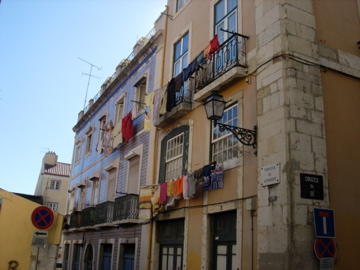
Portugal´s an intriguing country: it feels overlooked, almost forgotten to me, hanging on to the edge of Iberia, of Europe, like fluttering laundry. I never hear much about it, tucked away down there, in the shadow of both Spain and its dominating former colony. (Prior to my arrival, my only two words of Portuguese were Brazilian: “caçhaca” and “caipirinha.”) A small country, it´s hemorrhaged emigrants for decades, leaving the country a little empty and a little lonely. It´s bittersweet, and so far, I love it.

I´ve spent my days in Lisbon rather lazily, sleeping late, hanging out with my Couchsurfing hosts, lunching and napping and strolling slowly. It feels like a city to be taken in slowly, to be savored, and I´m doing my best to oblige.

My hosts tell me that Lisbon is the most underrated city in Europe; they´ve seen more than I have, but I´m going to venture to agree. They live in a comfortable flat with smooth hardwood floors and modern appliances, in the heart of the city—“In no other city in Europe,” my host told me thoughtfully, “would this be possible.” Rents are cheap, and abandoned buildings with boarded-up windows and cracked tiles line streets that in Paris or Barcelona would be bustling, booming, and demanding rents at least twice as high.

Lisbon is a humble city. Though complete with all the usual big-city stuff—busy metro stations and graffiti and honking snares of traffic—there´s a certain quiet underneath it all, a kind of yearning in the gleaming stone streets, the zig-zag of rust-colored tiled roofs. She´s filled with a brave nostalgia, this Lisa, with the rattle of yellow street cars that young boys cling to the sides of, hooting and yelling, sharp limbs hanging in a bravado that feels old, a relic from another time. Her seven hills rise and fall sharply, like breath; steps are carved into the sidewalk. The hills don´t slope gradually but seem too reach, almost hungrily, for the water, too bright and sparkling for blue eyes to bear.

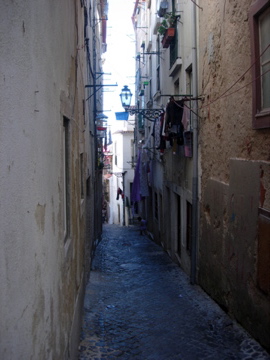
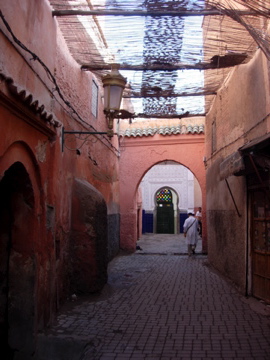
DSCN3639Today I wandered around Alfama, the old Moorish neighborhood, a European version of a medina—tight alleys that twist and angle and dead-end into the sides of terracotta buildings dripping with flowers and bushes and colorful plastic streamers. The streets are so narrow that old women can lean their full arms against the wrought-iron railings and gossip between the buildings, between the lines of laundry, laughing and shouting in their flower-patterned aprons. In little squares, trees jumble the black and tan stones that have been worn smooth—by Romans and Moors and Crusaders, by my thin-soled Toms that make me slip from time to time, lose myself amid it all.
It sounds sentimental, and it kind of is. It´s a city like that—with soul. And tonight, I´ll go to hear the sound of its melancholy mourning, its bittersweet longing, its Fado. I think Lisa´s prepared me well.

Marrakesh, You Broke Me Down

DSCN3558It was a long, hard, hot last day in Morocco, in Marrakesh, the pounding heart of the country´s tourism industry.
As I was venturing down the Atlantic Coast, south of Agadir and thoroughly ¨off the beaten path,¨ I was giving some serious thought to ditching out on my flight back into Europe, and spending the rest of my two weeks in Morocco. There was certainly enough to keep me occupied—I didn´t even make it to the Sahara!—and I felt like I´d hit my groove with Morocco. I was getting skilled at traversing the streets, haggling for taxis; I was in love with fresh-squeezed orange juice and mint tea; even my French was improving. We were vibing, Morocco and I, and it seemed a shame to cut out so soon.

But the prospect of Portugal, Western Europe´s ¨forgotten¨ country,  combined with a pre-purchased flight and a chance to wash my blue jeans and ditch that filthy blue scarf won out. I arrived in Marrakesh with just one day to soak in the crowning jewel of Morocco´s imperial cities, and its exotic lure.

I´d heard horror stories—travelers and Moroccans alike warned me that Marrakesh´s touts were the toughest, the street harassment the ugliest. I got off the bus from Tiznit suited up in my thickest armor, ready to do battle with a mean look and a linguistic sword of two words: la shokran, no thank you.

The problem with Marrakesh, or my problem with it, is that people like to touch. I don´t. As my grandma said, I´m ¨a real touch-me-not.¨ The men in Marrakesh really see no problem with poking you, grabbing your arm, pressing their bodies against yours, literally tugging you this way and that. I think it´s largely a cultural difference; Moroccans touch a lot, are extremely affectionate with one another, and I don´t think they view touching as the same kind of violation as Americans do. As in, get-your-fucking-hands-off-me, or touch-me-one-more-time-and-I-swear-to-God-I´ll-drop-your-ass-don´t-even-think-I´m-playing.

Not that I ever said either of those. But I thought it. And I suspect the wild-eyed, shocked look I gave the dudes who put their hands on me communicated well my very visceral reaction to unwanted contact. They, in turn, almost seemed offended that I was offended, got really defensive. It was one of those tough cultural clashes, and I refuse to admit I was in the wrong. Maybe just the different.

But there was, I have to admit, a kind of magic to the city. I always feel lame saying that about a place that´s really hyped up (as in, yes, Paris is all that). I was intermittently in awe of the city, and frustrated beyond belief.

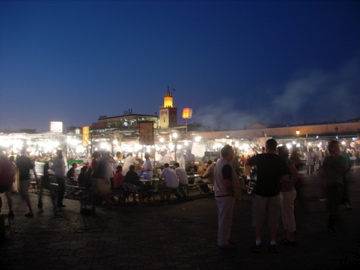
I stayed right near Djemaa el Fna, the open-air market of insanity that really was everything it was cracked up to be. Imagine a county fair. Now add throbbing drums and shrill pipes; snake charmers and witch doctors; wrapped women hunched on plastic stools, ready to ready fortunes and paint henna. Picture billows of meat smoke, the glare of a thousand gas lamps on a thousand white tarps;  see gleaming date stands and pyramided orange juice carts; beggars hands and child shoe-shiners. Hear the zoom and honk of motorbikes; feel the buzz of bodies weaving around one another. Wrap it all in a breeze that comes eastward and touches everything, envelops it in one big ball of electric humanity, shakes it up furiously, like a snow globe—and you´re somewhere close.

I meant to treat myself to a fancy last dinner, but when I got to the white-linen restaurant, it felt sterile. I headed down to Djemaa el Fna, stopping to slurp  snails at a food stall along the way. I dined on a wooden bench under the white tarps of one of the skewer stalls, watching the multi-lingual touts and hustlers do their business, sometimes rudely, but mostly with a charming penache that was hard to refuse. The breeze blew, and I felt in love with the night, the place, the country.

I thought I´d seal the deal with some chocolate ice-cream. I made my way across the square, nimbly traversing the crowds, not responding to the barrage of ¨bonjours,¨eyes on the prize.

I heard a loud voice rumble, ¨Hey sweetie!¨ Though the crowd was thick, I had that prickly back-of-the-neck feeling that the call was directed at me. I didn´t look up, kept walking. ¨Hey sweetcakes!¨ it yelled again. Still, I kept moving. ¨It´s okay,¨ the voice hollered, ¨I like small boobies.¨

I whipped my head around and saw a reddened face laughing, jowls shaking in a grotesque mask of amusement. Other faces were turned to look at me and my shawl-covered chest (I mean, come on, a B-cup is not that small). My cheeks flushed; I muttered ¨piece of shit¨and stormed away, trying to lose myself in the throngs.

The face hadn´t been a teenager´s, but a grown man´s, which angered me more. It had seemed quite pleased that it had humiliated me, that other people had noticed and looked. I felt the blood in my body burning with frustration.

A well-dressed man sidled up next to me, holding a clip-board and a perky straw hat. I looked forward, didn´t acknowledge him.

¨That man,¨ he said to me, ¨you can´t get angry. You have to just accept and—¨ out of the corner of my eye, I saw him make a brushing-off gesture.

I sighed, not entirely sure of this man´s intentions, and not in the mood to risk it. ¨I know,¨ I respond. ¨But sometimes I get tired of accepting, of always being the one to have to accept.¨ I could feel hot tears in the corners of my eyes.

¨Where are you from?¨ the man asked.

I eyed him cautiously, as the question was usually a prelude to some kind of hustle. ¨The US.¨

¨Ah, welcome,¨ he nodded thoughtfully. He leaned forward, said softly, ¨Of all the things you remember, of all the things you take home, don´t take that.¨ He nodded again. ¨I´m sorry.¨ He paused, let the words and the sentiment linger there in the charged air for a moment, turned and was gone, swallowed into the crowd.

It was all a little too much for me, the intensity of extremes—the degradation, the laughing face, the twisted soul-sickness that makes someone humiliate another person—and now, such thoughtful tenderness. All of it from strangers, all of it strange, somehow finding me in the immensity of the crowd. The whole day had felt like that, a tugging between two places, between two sentiments, of both loving and hating a place.

DSCN3551I was exhausted. I decided not to fight it, not to try to be tough anymore. I went back to my hotel room and sobbed, for the overwhelming kindness and cruelness of it all. For being a woman, for being a person, in a place, a world, that is simultaneously horrifying and beautiful.
Let’s Get Ready to Pray

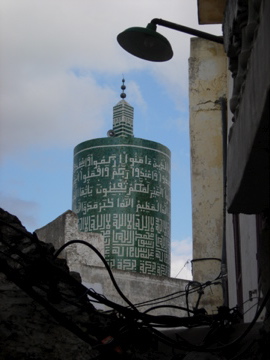
DSCN3343Adhans: you can’t escape them. They’re the echoing voice of omnipresence that follow you, haunt you, thoroughout your Moroccan travels. It doesn’t matter where you go, how far you wander—what town you’re in or how tightly you shut your windows at night; they find you. They punctuate your days of sweaty rambling, your dawns and dusks and inbetweens.
The adhan, the Muslim call to prayer, occurs five times a day, blared from the loudspeakers of every mosque’s minaret. The voice of the muezzin, the guy calling the prayer, is usually a little distorted; I imagine sweaty lips held too close to a scratchy old microphone, behind it all cool darkness and bare feet. If you’re in a big city with lots of mosques, the muezzins’ voices ricochet off the buildings and crumbly streets, off one another like a cat playing with its shadow, making it seem all the more enveloping. You have no idea what’s being said—at least I don’t—but the meaning needs no translation.

It happens like this: the voice erupts with a little squeak and feedback from the sound system. It begins slowly, softly at first, the first few syllables careful and clean; it swiftly gathers speed. The voice rises, grows stronger, accumulates decibels and conviction and heat, like an engine reving, smoke billowing from its spinning wheels. It reaches its final fevered pitch, a wail of passion and fury and God that makes you stop, pause in the street, roll over and groan in the first grey light of day.

The voice holds there, wavering in pitch and power, until at last, exhausted by the all-consuming energy of Allah, it shuts out and is gone. All this occurs in the span of about a minute. It happens at daybreak, noonish, mid-afternoon, sunset and early evening.

It’s a little creepy, to be honest—the omnipotence and disembodiment of it. But I can’t help but feel, whenever I hear it, that it sounds a little too like “Let’s Get Ready to Ruuuumble!” Only, you know, “Let’s Get Ready to Praaaaay!” It kinda gets me going, gets me all reved up and inspired; I kinda wanna kick my shoes off and grab a little carpet and kneel and mutter and bow like the dudes in the shops and alleyways I espy. Not knowing what I was saying or what it meant, just yeilding to the power of it all—lowering my head and kissing at something holy and unseen and buried deep in the fabric, the hand-woven and gently frayed thread of things.

Only, I’m not Muslim. Or any religion. And, coming from a (relatively) secular country, it still strikes me as strange to have religion pumped through the streets, sneaking through open doors and cracks in windows, filling the air and getting all over. But, hey, at least they do it with style.

Legzira Love

DSCN3456I think I may have just found the most beautiful beach in the world.
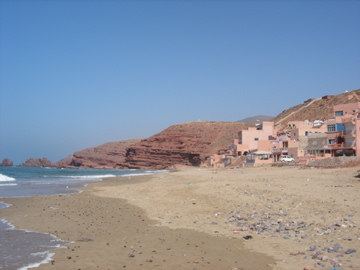
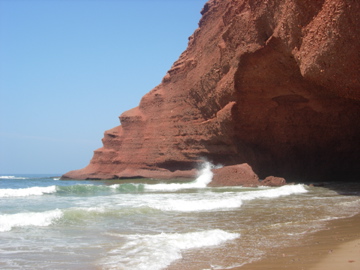
Yes, it’s a sweeping statement, and no, I’m not a beach afficionado. But if red cliffs diving into pebbled sand coves count for anything; if lazy waves crashing against sandstone arches score points; if a tourist to local fishman/swooping seagull/stray dog/donkey (hey, it’s still Morocco) ratio of 1:5 means much—if these are the elements that create that “paradise” thing all the guidebooks talk about, well then, I just spent the night there. And slept with the windows open to the ocean. Cause why not, you know?

Legzira Plage is pretty incognito—it warrants not more than a paragraph in my guidebook and a weathered-beaten, graffitied roadside sign along the pretty two-lane highway connecting Tiznit, Mirleft and Sidi Ifni. Down Morocco’s Atlantic coastline, just before the Western Sahara and a disputed border, the area as a whole doesn’t attract the hordes that the country’s other wonders do—which is why it attracted me. A near-deserted beach away from any big city or pushy tout? I’m in.

I took the local bus from Mirleft, got off at the faded cement block sign at the access road, and took the 20 minute walk down to the beach, a lazy slope washed in ocean breezes. The scenery revealed itself like a striptease: a sweeping hill view, a peak of ocean, the sound of waves, the pink edge of a pink building. I turned into a small dirt parking lot, and almost started laughing—it was so beautiful, it was almost obscene.

DSCN3464There were half-a-dozen pink buildings cascading down the cliff to the beach. Sweaty and shoulders aching, I set my backpack down in a cheap but cheerful hotel room with windows that flung open to the ocean. (Now thoroughly “off the beaten path,” the room costed only a little more than my smelly toilet- and shower-less hole in Essaouira.) I kicked off my shoes, grabbed my camera, and went for a walk.
I’m not much of a shutterbug, but I exhausted both my camera battery and memory card. I walked for over an hour; each cove was more secluded and empty than the last. On the first few beaches, I passed a small group of teenagers playing soccer, a fisherman, and a handful of sun-bathing tourists, many of them Moroccan (tell-tale sign: the lady’s swimming fully clothed). We “bonjour”ed politely. I rounded a gently jutting set of red rocks, and was alone. I closed my eyes, and let out a long exhale.

I’ve really been liking Morocco, but I can’t tell you how good it felt to be alone, away from any non-human sound—just me and the seagulls, you know? Later, I stripped down to my swim suit, and wave-hopped and sun-bathed without concern for modesty. I soaked up much-needed sun, vitamin D sparking wildly through my body. I didn’t worry about, well, anything.

I had a simple dinner of grilled fish (yes, caught that afternoon) and pommes frites, washed down by that killer mint tea. The hotel’s patio was sparsely populated with about a dozen dining guests. If there were any less people, I realized, it would have felt creepy. Like The Shining or something.

The hotel only ran electricity for prime hours during the evening, so I read by candlelight for awhile before crashing out. It was warm enough, so I left the windows open and slept to sound of the waves, to the smell of salt.

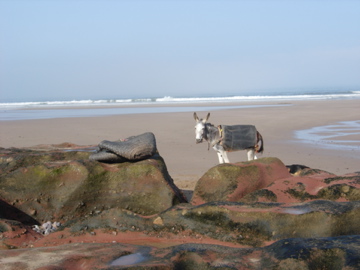
Donkey on the beach!

Donkey on the beach!

In the morning, the fog outside the window was thick. The tide was so far out that a previously offshore crag of rocks connected to the beach. I sipped my freshly squeezed orange juice and nibbled on my still-warm bread breakfast, and watched the fishmen trod out for the day, the sifters search out clams and mussels (I think) in the tide pools. A waiting donkey with two empty sacks on its side bickered with a yapping stray dog with a wobbly magazine of stretched-out nipples. The fog thinned, turned to a fine mist, and slowly, so faintly I could hardly notice, was gone.

I don’t know why Legzira Plage is so under-visited, under-promoted and unknown. But I’m not complaining. My camera battery may have konked out, but my personal battery is fully recharged. Just in time for Marrakech.

The Best Tour Guides in Mirleft

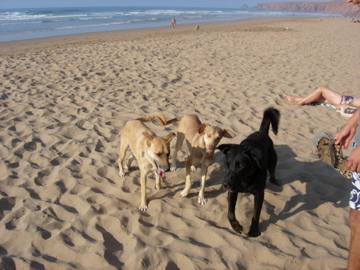
DSCN3389Yesterday I found the best 3 tour guides in town. No, they weren’t the touts that surrounded me shouting in 3 different languages and tugging me in 12 different directions the second I stepped out of the grand taxi from Tiznit. They were a rag-tag group of stray dogs that led me around the Berber beach town of Mirleft for over 2 hours.
We met outside my hotel, Hotel Atlas, the cleanest, cutest and most well equipped of my trip thus far (hot water, flushing toilets AND toilet paper—hot damn!). The leader, a German Sheppard looking female with a mangled hind leg and a black patch of furless scar tissue, greeted me as joyously as an old friend. I politely explained that I didn’t have any food, but she didn’t seem to mind. I’m not as worn out by the street dogs as everyone else in town is; I didn’t shoo them away, just kind of smiled and kept walking down the dirt main road toward the beach.

The dog immediately took the role of loyal and ardent defender, barking and growling at every scooter and donkey that passed, as well as a couple old men and frightened schoolgirls. I smiled and shrugged at them; we exchanged chuckles.

Along our pebbled-path way, we picked up a couple other boney-ribbed dogs who displayed proper supplication to the leader. I didn’t know where I was going other than coastward; Mirleft is too small to warrant a map in my guidebook. So the dogs would trot off ahead of me, sniffing through refuse and gnawing on plastic bottles. When we’d reach a crossroads, they’d pause and wait for me to catch up before continuing waggingily along whatever way they thought was best. Who was I not to follow? They knew the town better than me, and I was grateful for the speechless company.

DSCN3394They led me down a steep flight of cliffside stairs into a cove of jagged rocks and gleaming sand. Shirtless local boys were playing afternoon soccer and a couple tourists sat out on blankets. My guides dashed off to leap in the waves; I rolled up my jeans and waded behind them.
I wanted to tip them—I certainly would be expected to if they were people—but thought they’d be terribly uninterested in my pocket full of coins. I rustled some stale crackers out of my bag, and they chewed them gratefully. I sat in the sand and watched them trot off, skinny and mangled and more-or-less happy.

Vomit Ride Through the Heat-Land: Part II

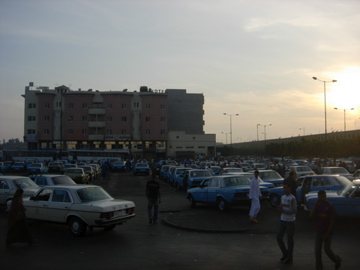
Grand taxis outside the bus station

Grand taxis outside the bus station

We groaned our way along the highway, rocking and swaying with every dip in the road. The air-conditioning had completely given out; I was grateful to be sitting by one of the few curtains, blocking out the mid-day sun. I shifted around the cheap shawl I had covering my bare arms and realized I was sweating so badly the blue dye was wearing off on my sticky arms.

I devolved into lamaze breathing. Well, no, not really—but I did employ the breathing technique I learned in yoga class to release heat: exhaling with a “hah,” like you’re fogging up a mirror (or a steaming bus window). Burning it up in a power lunge or cramped to hell on a sweat-bomb bus, it really does help. It also took my focus of my increasing nausea, not at all abetted by the chorus of gagging and spitting surrounding me. Despite having passed all those littered landscapes, I felt immensely grateful for plastic bags.

Others around me weren’t so lucky. The poor boy left crouching in the stairwell—some kind soul had supplied him with some newspaper to sit on—had been puking more or less constantly the whole ride, now approaching 3 hours. He’d been provided with an arsenal of plastic bags, a supply he apparently exhausted. That’s right—I saw his desperate face, checks full and eyes searching, then heard the sound of splattering on the stairs. A chorus of shouts erupted; the tout appeared with a fist full of newspaper and women waved robed arms in an effort to fan away the smell. It didn’t help much—in the heat, the vomit pile festered, wafting odiferously through the bus carriage in rank waves.

Any minute now, I told myself, we’ll get to Agadir. It wasn’t my destination, only a little more than half-way along, but a big transfer point. Hopefully the stop would be long enough for someone to hose down the floor.

We careened past a cliffside, a gorgeous view that I could almost enjoy through the misery. We passed construction cranes and cinderblocks outside Agadir, a package holiday town more akin to Miami than Morocco. Traversing a tangle of traffic, we pulled into the bus station. Doors sighed open and people pushed towards the front stairs to disembark.

Most of the passengers weren’t staying on for the rest of the ride, so I took advantage of the time before the next batch of grim faces boarded and got myself a primo seat: closer to the front, on the unsunny side, under the blowingest vent I could find. I smiled to myself, privately pleased that I had endured the trip without vomitting. You’re tougher than you think, I congratulated myself. I felt validated,  rewarded by the best seat on the bus.

We sat for awhile. This didn’t surprise me; most non-first-class buses don’t maintain timetables, just wait until the bus is full—or overly full—before departing. A new round of unsmiling people trickled on, along with the usual tissue, jewelery and snack sellers that enter through the front doors, shout the names of their goods as though you couldn’t see what they were, then exit through the back doors. Additionally, a sullen woman with a dirty scowl distributed those Xeroxed scraps of paper, telling her story of hardship, to each passenger; as per usual, she made her way back down the aisle, recollecting the papers and giving an even dirtier look to anyone who didn’t give her a couple coins. Though the paper was hand-written in jagged Arabic and I could have feigned ignorance, her bullying expression inspired me to give her some change.

No one, I noted, was coming to clean up the back stairs. I sighed, taking solace in my good seat and that fact that the worst heat of the day had passed.

The tout poked his head through the open door and pointed accusingly at me. “Tiznit?” he bellowed. I felt all eyes on me. “Tiznit,” I echoed with a nod, confirming my final destination. He gave one hard nod and disappeared.

He came back a couple minutes later, placed his hand surprisingly softly on my shoulder and launched into a choppy French explaination I couldn’t begin to understand as he ushered me off the bus. “Tiznit?” I asked feebly, pointing at my well-earned seat, fading as I stepped down the bus stairs. “Oui, oui, Tiznit,” he replied as he dug my dirty backpack out of the luggage compartment, hoisted over his shoulder, and walked me over to another, scrawnier bus. He tossed my bag into its luggage compartment, patting his hand firmly against the dented side of the bus. “Tiznit!” he assured me, and then was gone into the scurry of bodies and glint of steel that filled the station lot.

I stepped disheartened onto my new bus. The seats were scattered with a couple forlorn looking faces. They looked like they’d been there awhile; from the number of empty seats, I didn’t anticipate leaving any time soon. I flopped into a sun-baked vinyl seat and scowled. Through the window, I watched my sense of victory lumber away on the previous bus.

It was an hour before we left the station. Night fell pinkly and hazily between the palm trees and pebbles outside the window. Exhausted, I surrendered to a neck-jerking broken sleep; I woke just as a row of lights was growing closer.

Instead of a bus station, I was deposited on the side of a half-deserted road. Some teenagers hooted at me as I hoisted on my backpack; I gave them the finger and crossed the street to the Teleboutique. I had to call my hosts—at last, I had arrived.


Lauren Quinn is a writer and traveler currently living in Hanoi. Lonely Girl Travels was a blog of her sola travels and expat living from 2009 to 2012. She resides elsewhere on the internet now.

Join 490 other subscribers

Buy This Sh#t

Categories