Archive for the 'Places' Category


Take Me Home, On a Malaysian Highway

This is what this song with forever be: the Malaysian countryside, flat and scrappy through the window of a bus. Me crying.

Sometimes songs get wedged in you; sometimes you know it when it’s happening, have that vague feeling of a future memory forming. Like hearing “Pumped Up Kicks” on the fire escape of a Soho loft, the first week I left home—afterparty of an art opening and 800 sleazy Italian guys offering me cigarettes, that sweet kid from Manchester in his first 2 weeks in the States, too shy to admit he was lonely. Which wasn’t the first time I’d heard the song—it was being shoved down my throat on a daily basis—but I don’t know, I just had this feeling then, that the air, the night, the lights from the apartment across the alley—that it was all being stored up somewhere and that whenever I’d hear the song from now on, this moment would come crashing back with a nostalgia for something I couldn’t quite put my finger on.

Well, I heard “Pumped Up Kicks” in one of those malls in KL and turns out I was right—standing in the gleaming florescence of consumerism, I felt a kind of homesickness for that moment. In a city that wasn’t mine, talking to some kid I didn’t know, watching the dim figures move through the next building over. It doesn’t make sense, but I know you know what I’m talking about.

One of the ironic benefits of living abroad, I was telling a friend recently, is that I have so much more time to read music blogs and download music that, while I can’t actually go to any real shows, I’m way more in the loop than I was in the States. So a string of 4+ hour bus rides, chasing across the east coast of Malaysia, what ended up kind of characterizing my trip—it gave me lots of time to catch up on all the new albums I’d cluttered my phone with.

So, “Take Me Home.” It’ll be this: an overly air-conditioned bus, roadside restaurants passing through the tinted window—“restorans,” metal tins of food, men smoking and women’s scarves flapping. Smooth highway and pocked skin—the poor part of a rich country. Swinging curtain that won’t snap shut brushing my shoulder, bag of banana chips and that constant feeling of having to pee that I have on long bus rides. Two seats to myself so I can curl my knees and pretend that no one can see me when I start to tear up—when he hits the keys on that warbly keyboard and it sounds like something from a well come rise up—“I’ll be so still for you.”

I swear it’s not just that I’m about to get my period, that I’m not just tired—I straight start crying on my bus and I’m surprised by it, you know? Like—Really? This is happening right now? Yeah, yeah, it is.

It’s the night before maybe; the song stirs something in it. Wooden porch of a beach chalet, ramshackle sea-shell clatter, cat at my feet, bug spray and cigarettes and brandy in his cup. He offers me some; I say no. He has wrinkles in his forehead that makes him cuter. He has strings tied around his wrist and bad taste in music but it isn’t that that stops me. It’s something else, I’m not sure what, but I just can’t do it. I smile and say I’m tired and go back to my room before it can happen, before anything can happen, and something about that makes me wanna cry then, in that moment. But I don’t. I play (and lose) a couple games of Sudoku on my phone and snap out the light.

So maybe I’m making up for it now. But it’s not that even really that scene I think about now, not the moment of it at least, but more the feeling. The “goddammit.” The “this again.” The “damaged goods.” “Like a shadow of a shadow of a shadow.”

I’ve been joking about it, that I’m writing “How Not To Get Laid Across The Fucking Planet.” Since I don’t know what the hell else I’m writing. I’m doing research; I’m in character; I’m method acting. Hahaha, it’s all so fucking funny. I’m dragging myself across the planet like something caught beneath the tailpipe; I’m dragging myself down this Malaysian highway and I don’t know where I’m going—I’ve got no guidebook or maps—and I’m turning the music up so I can’t hear any of it, trailing behind me, scraping against the pavement and possibly screaming but probably just whimpering—behind me and I can’t hear it, except for now, in the pitch of a high note—“Like a foooooool.”

“What’s the dating scene in Phnom Penh like?” Josh asked me a couple days later. I spit out a sour psssh—“Fucking dismal,” I replied.

But I knew that, I knew that going in, and you wanna know the fucking truth? I sought that shit out. Like a kind of relief, like a cop out, like “I won’t have to deal with that at all.” So it was weird, you know—as weird as the shopping malls and overpasses and Starbucks—to be hit on in Malaysia. I should have been stoked right? I should have been giddily shouting a “fuck yeah” the way I was the first day in KL, right?

Well, I wasn’t. I was alone in a mold-smelling chalet; I was crying on a fucking bus; I was listening to sensitive bummer music some older version of me would have laughed at and closing my eyes and rocking my head like a goddamn blind person, feeling god-knows-what welling up inside me and pushing the backtrack button over and over and over, so I must have listened to that song like 12 times in a row—knowing that it was getting seared into me, that some future version of me was sitting somewhere, smiling in nostalgia hearing this song again. Why are we always nostalgic for the most painful shit? For the shit we never really had to begin with? Or is that just me?

The Malaysian highway passed. Eventually, I got where I was going.

Glitter and Consumerism in KL


Let’s just say that my mind is blown.

Back in November, when I landed in Phnom Penh, there was a sale on Air Asia. I looked into my crystal ball and determined that come April—Cambodia’s hottest month and when the biggest holiday of the year shuts down virtually everything for a week—I’d be ready for a vacation to the developed world. So I booked tickets to Kuala Lumpur.

I really can’t remember the last time I was so excited for a trip. Riding the tuk-tuk to the airport, I was literally vibrating (I’d also had a ton of coffee). The idea of a city with sidewalks, a Metro and Western fucking shopping malls was as exotic to me as… well, Cambodia is to some people.

One of the incredible things about living in a developed country for me is how quickly things become normal, how quickly you adapt to your surroundings. I really don’t feel like Phnom Penh is that ramshackle; when I return from a trip the provinces, in fact, Phnom Penh feels like the glittery big city.

Are we starting to see where this is going? Are we starting to see how wildly impressed one would be any Monorials and overpasses, by international chains and consumerism, by diversity and hipsters, air-conditioned walkways and traffic lights people actually obey?

I am not in any way ashamed to admit that I spent my first day in Kuala Lumpur completely inside shopping malls. I didn’t sweat all day, and it was glorious. I rode glass elevators and ate Krispy Kreme donuts and reconfirmed that I really just don’t like Starbucks coffee. I heard “Pumped Up Kids” inside a Forever 21; I heard Edward Sharpe and the Magnetic Zeros in a Topshop. I passed women in burkas and women in booty shorts, both clutching Coach bags. I ate in a motherfucking food court: I had sushi and Turkish coffee and some kinda weird Taiwanese shaved ice that was really not that awesome. I tried on pants that fit me and bras that fit me, that weren’t three-inches thick with padding.

I bought some nice-ass work clothes and paid for them on a credit card and signed my name and got one of those itemized receipts with the credit card digits blocked out with little stars.

I was dazzled, and utterly unashamed by how dazzled I was.

There was a time when I would have been mega critical of the malls of KL. I would have deemed them inauthentic, not real cultural experiences. Well, they aren’t—everything is imported, corporate, packaged, temperature controlled. And that’s what’s so amazing—how inauthentic they are.

Cause you know what I’ve realized? In Cambodia, my most “authentic” “local” “cultural” experiences have been really uncomfortable. I’ve been hot and confused and unable to communicate and unsure of how to bathe myself and mildly-to-extremely sick to my stomach. Which isn’t to say that they haven’t been important, valuable experiences, just that they haven’t been easy. Not like, say, a corporate shopping mall.

We’re obsessed in the West with authenticity. Travelers are always looking to get off the beaten path, away from the tourist circuit. We scour Yelp to find the best local restaurants. And remember that Lana del Rey thing? People were so pissed off because she tricked us—we thought for a minute, you know, with a shitty youtube video, that she might be “real” and not some music executive’s wet dream of indie.

Maybe those are anecdotal, but I kinda don’t think so. Living the last 5 months in a developing country, the majority of what I buy and what I do is non-corporate—I buy produce at the market, top-up cards at roadside stalls, bottles of water from mini-markets set up in a family’s living room. I guess that’s pretty authentic, when you think about it.

But still. I was so fucking excited to be in a shopping mall I couldn’t take it.

Cause it’s in you, you know? Consumerism such a deeply rooted part of American culture, such a deeply rooted part of myself, that I’m often not aware it’s there. You’re constantly interacting with it—even if you shop at local mom-and-pops and go out of your way to support small businesses, you’re still interacting in opposition to it. You’ve been marketed towards since you were a toddler; you’re a unit of consumption and you consume. In one way or another.

Until you move to Cambodia. And you can’t. Because, aside from KFC and a Mango, there’s just not the option. And you don’t miss it. Or you don’t think you miss it. Until you land in KL and you wander through the pristine malls, floors glittering and piped-in music playing, with stars in your fucking eyes cause it’s so goddamn impressive.

But, now the third day, something else has happened—I’ve begun to get sick to my stomach. That’s probably because I’ve been stuffing my face with every thing I pass that catches my eye, because who knows when I’ll get another chance. It’s like a sleeping beast has been unleashed—the problem being that I’m now indigestive and constipated and gross-feeling.

Which is metaphor of course for consumerism. Not that I’ve even been buying much stuff, other than some work clothes, but just that I’ve been around it, been in it, so startling and dazzling. And so soulless. All the manufactured identities you’re supposed to buy in to; all air-brushed models; all the feelings of not having, of not being good/thin/rich/beautiful/cool enough; all the subtle alienation—the inoffensive, comfortable, sparkling clean wanting-more-ness.

All the bras that fit me.

All my favorite make-up.

All the brands I like.

Which I guess is just to say—man, you don’t realize how complex and conflicted a relationship you have with consumerism until you’re out of it and then you’re plunged back into it. And you don’t really know a place until you leave. Cambodia was becoming so normal to me; I was forgetting what made it special, different, fuck-up and amazing and and exactly where I’m supposed to be right now.

The World’s Most Amazing T-Shirt!

About a year ago I blogged about the utterly unironic English language t-shirts in Cambodia—nonsensical phrases, constant-clutterfuck non-words, uncouth slang beside hearts and smiley faces.

Well down at the Russian Market recently, I found the shirt to end all shirts:

First off, you’ve got the letters: glittery gold. You’ve got the allusion to gangsta rap (at least I always think of NWA), which is literally and culturally on the other side of the fucking planet from Cambodia. Then you’ve got the fact that a sizable number of the people who’d actually buy and wear this shirt would have no clue what the words even meant, let alone the potent cultural references.

But that’s not all. The brilliance of this shirt, what elevates it from just another joke shirt to The World’s Most Amazing Shirt, is its juxtapositions. It works on so many levels! It’s multi-fucking-dimensional!

Let’s take a closer look:

Okay, so we’ve got a Philadelphia police emblem—cool, at least we’re in the right country.

Wait… Is that… Sting?

Why yes it is.

Oh, but why should we stop there? Gangsta rap versus new wave, UK versus USA, anarchistic anti-authority versus just not liking a band—what do the words “Fuck The Police” really mean? Can any one group claim ownership to the phrase? What does the phrase mean in different contexts?

There are no easy answers. Like any great work of art, the shirt merely raises the questions, leaving the audience to determine their own answers, revelations, resolutions. If in fact there are any. Perhaps the shirt is actually a statement on cultural relativity. Or maybe on the unifying, equalizing distaste for the police so many of us share.

You can’t be sure. So is the world we live in.

But is it possible, is it conceivable, that inside the glittery block letters, wedged between the emblems clustered around the words, there’s yet another meaning? A third and possibly more sinister layer of context?

Let’s get Crass involved:

Well now I’m really at a loss.

As you can see, we no longer have any fucking clue as to where we are or what any of this means. We’ve got an English-language t-shirt making references to three English-language bands that were all trailblazers in their given genres and decades. But that’s the only cohesive thread I can find (other than the snazzy black stitching along the shoulders). Do we hate Sting or are we trying to stir up revolt? Are we making references to racialized police brutality or a more class-driven variety? What fucking continent are we even on? What decade—scratch that, what century? Why is this shirt in Phnom Penh, at the fucking Russian Market, a sweat-bomb of stalls overflowing with bootleg H&M clothes, sacks of rice and touristy trinkets? Why is it $6? Why am I buying it? And wearing it around town?

And why do I not know if I’m wearing the shirt ironically or unironically?

Well, so is my life these days. An Oakland girl living in Phnom Penh—why should any of it make sense? Why should I even try to make sense of it? Better to just pay the $6 (“Really? $6? Why so expensive? I pay $4? $5? Ok.”)—better to put on the shirt, enjoy the glitter and the juxtapositions and relax in the fact that I’m not ever gonna figure any of it out.

But I can still look fly in the meantime.

Being An Asshole Abroad

I am one.

Not all the time. Not most of the time or even some of the time. But on ever so rare occasions (at least I like to think), I have been known to snap. I’d like to water it down, cushion the blow to the ego, but that doesn’t do anyone any good—I can be a big flaming asshole, and that’s just the truth of it.

That’s what my latest piece on World Hum “The Particular Anger of Powerlessness” was about. You guys might remember the piece—an earlier draft appeared on this blog around a year ago. It was a gamble publishing it for a couple reasons. One, it incriminates my parents for traveling illegally to Cuba. But the good news about having supportive parents is that they’re so stoked to see their kid get published, they’re willing to risk their own hides.

But the main gamble is that I was opening myself up to attack. It’s like going in for a knee in Muay Thai—better keep your hands by your face cause someone can clock you good at that proximity. Basically, I reveal myself to be an asshole in the piece. Or rather, I reveal myself at one of my asshole moments—one where I’m not the picture of cultural sensitivity or a deep, abiding sense of my own privilege. Instead, I’m the picture of An Ugly Westerner.

I knew I was doing it—leaving myself open. In fact, I knew I was doing it in the moment, when I acted that way, and it was mighty uncomfortable. It’s like I was watching myself do it and some other part of me was shaking my head—I knew how it looked. But I couldn’t help myself.

Why?

That’s the question I try to delve into in the piece. We all act like dicks sometimes, right? We’ve all flicked people off while driving; we’ve all snapped at grocery clerks; we’ve all been snippy at waitresses—whatever your version is, there’s been a moment when you’ve thought, “Fuck, did I really just do that?” There’s a certain vision one has of oneself and there’s moments that prove that vision, and there’s moments that contradict it. It’s easier to just push them aside and not think about them. It’s less easy to force yourself to go back and make amends. And it’s even less easy to delve into it, to look at it squarely—“This is not how I’d like to act, so why did I do it?”

My fifteen minutes on the Lao-Cambodian border last year was one of those moments. And the answer I came up with, after looking real hard at the situation, was powerlessness.

This may or may not be the right answer. But the point, at least I like to think, is that I wanted to look it. Cause travel pushes you beyond yourself, right? It pushes you out of your comfort zone; it exposes you to new things, some of which are exhilarating, some of which leave you fuming/confused/rushing for the bathroom. But the idea is that travel expands you, that you’re not the same after a trip, that you learn something—both about the world and yourself.

I knew some people would take up issue with it. And when the comments started to come in—“I thought we independent travelers were supposed to be culturally sensitive”; “Way to go, rubbing the guy’s poverty in his face, you definitely came out ahead there”—they didn’t really bother me. I mean, that was the shit I was saying to myself, in my own head. (I realize in retrospect that I should have worked that angle more explicitly in the piece, instead of leaving it hanging around in the subtext…)

The thing is, they’ve got a lot of valid points. The whole speaking-on-other-people’s-behalf thing makes me a wee uncomfortable, chimes itself of a kind of imperialist attitude—but yeah, you know, I get where they’re coming from. You do carry a certain amount of responsibility as an outsider in a someone else’s country, and there’s a certain level of respect one ought to conduct oneself with.

Which is a whole nuther rant for a whole nuther day. But what happens when you fall short of that? Or when you watch other people fall short of that?

It’s something I have ample opportunity to muse over, living here in the shitshow of Phnom Penh. I mean, fucking Cambodia—it’s Westerners Behaving Badly all over this MF. A lot of folks come here for the sole purpose of acting in ways they can’t get away with at home—sleeping with prostitutes, drinking all day, etc.

And believe me, I was way the fuck judgy at first. I remember standing in line at Lucky Supermarket, watching this guy in front of me totally berate the clerk for not wanting to accept a wrinkled $20. It was ugly. Being Cambodian, the clerk didn’t get back in the guy’s face, but instead apologized and groveled and looked real ashamed/embarrassed. Then I felt ashamed/embarrassed. I shot the guy dart-eyes and, after he left, apologized to the clerk on his behalf.

But you know what I’ve realized? Well, one, that apologizing for someone else’s behavior is not my job, regardless if we’re both Americans in another country. But more importantly, that milder versions of the same thing have happened to me. That—holy shit!—I’ve been on the other side of it. Maybe not that bad, but still. That afternoon on the Lao border was one of those times.

It’s humbling indeed to discover you have that in you. (As one friend says, “Cambodia reduces you to what you really are.”) I hate to say it, but I’ve snapped at tuk-tuk drivers, gotten mad at slow service, yelled at people in English when they’ve nearly run me over on the street. I’ve seen poor dudes from the countryside pissing on the sidewalk and blowing snot rockets and thought, “Ugh, poor people.” And I’ve been fucking horrified at myself.

I’ve talked to a lot of expats here about this and there’s always this cringy way we admit it. At least some of us admit it—that sometimes we snap and act like assholes. Maybe it’s the difference of living somewhere versus passing through on holiday—all the shit you could brush off in the moment becomes your life.

Whatever the reason, I realized I had to look at it. I mean, I’m here, this shit is happening, it’s not how I want to act, so I need to at least pretend to be a grown-up and deal with it.

There are some things I just don’t get. I mean, they can be explained to me and I can conceptualize some sort of understanding, but at it’s core it just seems wrong. Bribery and corruption are one of them. It’s a cultural difference, but guess what?—I’m culturally different. You will never convince me that bribery is okay, on any level, no matter how much it’s rationalized. (The same with pissing on the street. It just fucking smells.)

But here I am, in their country (which I can do, being privileged, and they by-and-large cannot)—so what do I do? Well, one is that I accept it bothers me. I don’t play the tape of oh-you-should-be-more-culturally-sensitive. Nope, I just accept that it doesn’t fucking seem right to me. The second is that I notice that it only reeeeally bothers me when my tolerance is down—when I’m stressed/tired/hungry/lonely/hot/dehydrated/whatever. So, in the interest of not being a raving asshole all the time, I do my best to not get stressed/tired/hungry/lonely/hot/dehydrated/whatever. When I’m taking care of myself, when I’m rested and full and happy, it’s a helluv a lot easier to shrug and say, “Well, that’s not how I roll, but so be it.”

It’s what I’d do now if I encountered the border situation today. I’ve grown a lot more comfortable with bribery—I don’t think it’s right, but I’m not gonna fucking fight it every day. And when I see dudes like the one at Lucky that day? Well, I don’t apologize for them but I also don’t really judge them anymore. Most times I honestly think, “Fuck, he must be having a real hard time, to be spreading that kind of negativity around.” It’s the kind of compassion I’d like for someone to look at me with, if they saw me acting like an asshole.

I get lots of great examples, living in this fine city, of how I don’t want to act. And the cool thing is, I’ve learned how to take them as just that: examples and nothing else. And then I try to be my own example of how I do wanna act.

All of which is to say, I’m a lot less bothered by other Westerners’ behavior. It’s kind of not my business. Of course, if you publish a piece about it, then you’re making it everyone’s business. But I did it cause I thought it was a productive thing to do, to come right out and say it. Like I said in my response, I’d love to see a piece by someone who really lost their shit—cussed out an old woman or some shit. Not for the shock value, but because I think looking at those uncomfortable parts of ourselves is really fucking important. Cause we all have them, right?

Or maybe it’s just me. Maybe the folks that left those comments really have never had their moment of entitled asshole total-melt-down-ness. Maybe they’re uber-PC and culturally sensitive every minute of the every day, every trip they’ve taken, every waitress they’ve encountered, every shit driver that’s been in the fast lane in front of them. If they have, though, I don’t really want to know them—I don’t trust them.

Maybe I’ve just grown a really thick skin from all these years of writing. Maybe it’s one in the same—people are gonna say what they’re gonna say and do what they’re gonna do and god bless em for it.

And if I do see people who piss me off? Well, I’ve got a jam for that:

Because Love Letters and Get Up From the War: Cambodian Teenagers Report on Gender Inequality

“Gender disparity”

I wrote the phrase in blue felt pen on the dingy white wipe board.

“What does this mean?” I asked, underlining the phrase for emphasis. Because it felt teacherly.

I looked out on a chorus of blank eyes.

Which is not actually what I looked out on, but what I’d like to think I did. Really, it was a chorus of chatter, back-of-the-classroom text messaging, shuffling, soda drinking, and probably only a half dozen eyes actually looking at me, the teacher, in the front of the class in my button-down shirt and skinny pants that haven’t been cleaned since Oakland.

This is teaching in Cambodia.

I haven’t written about it much, since I plan to write (and sell) funny disheartening funny pieces about the whole fiasco that is applying for, interviewing for and teaching in Cambodian schools. It’s a complete and total farce. Given that neighboring countries pay double, you really get the dregs of Western society over here. Reminders at the all-staff meeting for the university where I teach evening classes for high school students included: 1) come to class on time, 2) don’t tell your students dirty jokes, and 3) don’t come smelling like alcohol.

Note: Not “don’t come to school drunk.”

“Don’t come smelling like alcohol.”

Are we beginning to get the picture?

So I teach in this rundown ramshackle-ass classroom with trash in the corners and a door that won’t close all the way, that some industrious student wedges a plastic straw in the doorframe to keep it shut. The majority of class arrive late, play on their phones and cheat on tests—all of which I’d been warned of and told was best not to fight against—it’s a losing battle.

But I can’t get myself to totally not give a shit. Especially cause there’s those five kids that sit up near the front and actually appear to somewhat give a fuck. You know, the kind of kids whose eyes light up a bit, whose voices raise timidly after the dead silence of my glaringly obvious reading comp questions.

And as it turns out, they like to write. Well, they don’t actually like to write, they bitch and moan about it, but the class goes real quiet when I make them write paragraphs and when I read them, they’re grammatical bloodbaths but at least they’re original, ie not copied.

And, as a bonus for me, I make them write about shit in Cambodia, so that I can learn a thing or two. The first assignment was to write about how Cambodians celebrate Chinese New Year (cause they do). One kid wrote: “We burn the ghost money.” And if that’s not a goddamn beautiful line, I don’t know what is.

So tomorrow’s International Women’s Day. It’s a public holiday over in these parts, which baffled the shit out of me last year when I was here. Really? In a country with a fucking 80% domestic violence rate, endemic prostitution, fainting garment-factory employees and expatriated domestic help who live like slaves in neighboring countries?

There’s not a lot of irony going on in this country, so yes, really. But, you know, okay—at least we get a day off, right?

I’m supposed to do these listening exercises with them—I read aloud and check their comprehension. If you think reading comprehension is painful in this country, try listening comprehension. It’s painful stuff, and just to make it more painful (for me), I pick stuff not in their boring-ass American textbook that they can’t relate to (ie: the lesson on the NYC subway, to which I opened by asking, “Who’s been on a train before?” No hands raised. Now how the fuck do you teach that??). Noooo, there I go giving a shit again, and I bring in one of the English-language newspapers and read that shit aloud, stopping every few words to explain terms like “gender disparity.”

The gist of the article is that Cambodia ranks lower than any other country in the Southeast Asian region when it comes to gender equality, as measured by literacy, economic participation and empowerment. Of course, the government is disputing this, because disputing stone-cold facts is something they do.

Which I’m not dumb enough to begin a debate around. It’s in my contract that I can’t teach “controversial” material, which given the aforementioned propensity to deny inconvenient facts pretty much includes anything you’d read in the English-language newspapers. So I’m already pushing the envelope. I mean, this article’s got a quote from the (female) opposition party leader. (Should I be writing this on my blog?) That, and it took fifteen minutes to drag the above summary out of them.

So we focus on access to education, since “the Kingdom’s low ranking could largely be explained by social pressures that push women out of the education system.”

“What’s a ‘social pressure’?” I ask. I write the phrase on the boar beneath “gender disparity.”

More blank looks.

We hash it out, and come up with a good little list. A lot of the expected “a woman’s place is in the home” kind of stuff, but I’m surprised by “girls can’t study at the pagoda.” Boys can become monks and study for free; girls can’t become monks. That hadn’t occurred to me.

But I’m most surprised by how quickly some of them say “because the war.”

I just leave it there, on the board beside a bullet point: “war.”

I know better than to ask.

I point to our list. I inhale, “Now, what you’re going to do—” They groan. They know what’s coming. “—is write a paragraph telling me about why you think girls don’t go to school as much as boys in Cambodia. For those of you that have been listening,” I stare not at the kids who’ve been listening but at the ones in the back, “it’ll be easy.

“Oh, and this is how I’m going to take roll today. So you’d all better write something.”

They shuffle around and pass each other sheets of paper, and pretty soon they’re writing, scribbling, and it’s not quiet in the room, but as quiet as it gets—which is kind of like a jungle-quiet, with a constant buzz of insects and the occasional strange what-the-fuck animal call. (It’s usually a ringtone.)

I should say here that these are patently not the population the article is referring to. These girls are the privileged—they have iPhones and bedazzled purses and platform wedge sandals that remind me of Boogie Nights. They’re pursuing higher education, and their families have the means to send them to what is sadly considered one of the better schools in the city.

But still.

The “social pressure.”

“Pressure’s like a hand pushing on you,” I told them, demonstrating on my arm. “It’s what you feel whens something’s pushing on you.”

After fifteen minutes I collect the papers. We review some vocab and I let them go early, their eyes are so glazed.

I read the papers later, over dinner. Some gems:

“Because Khmer old culture they thought that women can’t go to school because if the women get high education they can write love letter to men and it not good for Khmer culture.”

“They think if the girls go to study, girls can go outside and have boyfriends, that is not the culture in Cambodia.”

“I think Cambodia is the small country that get up from war in 1993 and it’s stay from colonial a lot too. Long time Cambodia have one culture that unfair for girl is the boy can go to study but the girl cannot.”

“Some women in countryside [read: poor people] have low knowledge because the parents didn’t bring them to school. And the schools are far from the house. Some students in Phnom Penh didn’t study because they are allowed the foreiner [sic] tradition.”

“They think if women get high education or not is not important because they will become a housewife and only work in chicken and look after the child.”

“They’re think that if they agree the girl go to study, the girl can meet a lot of boy can write letter love and don’t listen parents advice.”

“Because the girl is 15 year old – 18 year old they alway get marries.” [We’ve reviewed “always” like 800 times, so this especially broke my heart.]

Those were from my more stellar students, most of whom are sit-at-fronters and girls to boot. As you can see, I’ve got my work cut out for me, when it comes to correcting and editing this stuff. Guess that’s what you get for giving a shit and trying to go all Dangerous Minds on these kids.

But strangely, it was the half-assed papers that got to me the most—the ones from the boys in the back of the room, who spent the whole class dicking off and then furiously scribbled shotty sentences, or even bulleted lists (NOT sentences, minus points!).

There’s an almost haiku-like starkness to them:

“We don’t have enough schools for students.
A lot of families are poor.
We just finish the war in 1979.”

“Because:
– don’t have money for them.
– Family don’t have enough money.
– Tranditional.
– War along time in the country
– Girl can help housework.”

“Because parents don’t have money to study. Some women is the countryside have low knowledge because the parents didn’t bring them to school. Cambodia have war.”

Or this one, the worst one, in terms of effort, information and sentence structure:

“Because Cambodia just get up from the war.”

Oh, there’s a sentimental old poet still knocking around inside me.

Screw it, I’ll give him the points for it.

Naked Like That (Kep Bungalow)

Tonight I miss America
at night.

Tonight I miss tambourines and harmonicas.
I miss the low whistle
of a train through the dark.
I miss fog-soggy sidewalks
and boys with stubbly beards
smoking cigarettes,
windshield shards
glittering beneath their sneakers
like that:
stars.

I miss driving home—
Bay Bridge jaundice,
hungry tunnel howling,
ears ringing
and headlights
like a lonesome pair of eyes.

I missed cracked windows
and cup holders,
the arch of 580
to 24,
the moment before
the highways touch

And I miss that city
laid out beneath me
and glittering

For one still moment

Like that
Like how I miss that—
Something I could almost touch
At night.

Tonight I’ve got the jungle.
Tonight I’ve got
Cambodia’s muggy black
of birds crying and geckos belching,
the low drone of insects
trying to get in.
Tonight I’ve got the world
behind a mosquito net
and the sea somewhere—
I can hear it.

I’ve got sheets and the shape
of some still body;
I’ve got a lonesome pair of eyes
probing in the dark
and all the goddamn stars in the world,
glittering like that

Naked like that

Like how I’ve always been—
Splayed and waiting

And breathing in the dark.

Surviving Sunset, And My First Motorbike Accident

So, so much for that New Year’s Resolution.

To be fair, I was on my friend’s motorbike, so I was still acting in accordance with the half-assed guidelines I’d set for myself. But that’s not really the point, now is it? The point of not riding a motorbike was to avoid accidents, to avoid getting injured and thus avoid medical treatment and having to deal with open wounds in a swampy climate in which I am unaccustomed to dealing with open wounds.

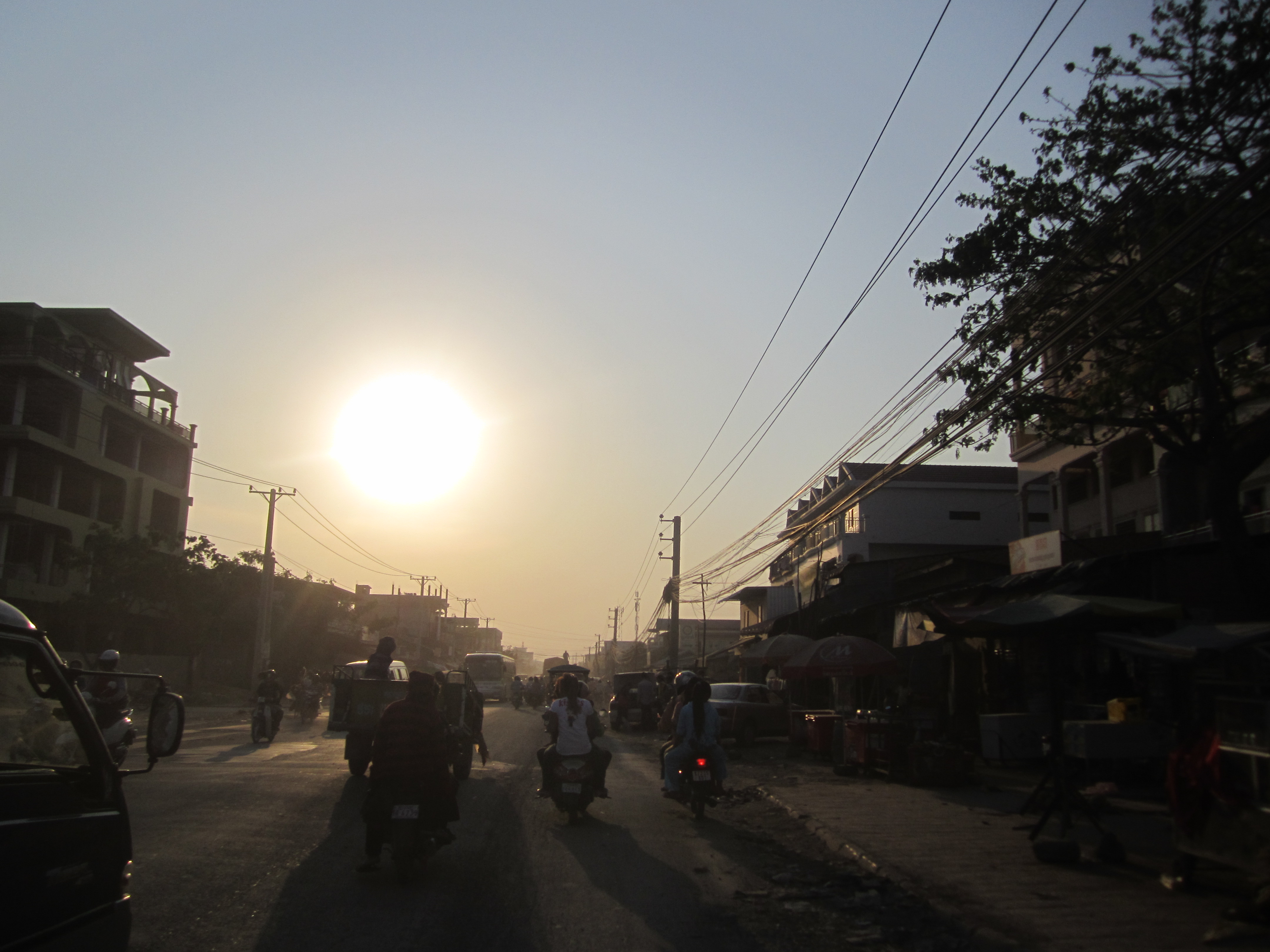
As far as accidents go, it was pretty uneventful. We were on a dusty highway outside of town—though “highway” isn’t quite the right word. It’s a big road with a gravel-and-dirt shoulder, filled with wheezing trucks and swerving motorbikes and minivans full of black-eyed workers heading home, the unlucky of whom were relegated to sitting on the roof. It’s one of the big roads outside of town, lined with garment factories and gas stations and bakeries and endless rows of roadside markets selling t-shirts and produce and weird smoldering meats, from beneath endless rows of beach umbrellas displaying names of cell phone companies.

It’s one of those roads that make you realize how big this city actually is, how little of it you actually know, living in the expat bubble of the inner-city. Which is why we’d headed out there—my friend’s company put him up in a housing division out there and he’d kept telling me I had to see it: “It’s totally different out there. Makes the riverside look fancy.”

That and we were chasing the dusk—wanted photos of smoldering sunsets, red as a wound behind a horizon of dust and exhaust, this particular breed of humanity all cast in silhouette. Everything’s more beautiful as a silhouette; anything can be beautiful as a silhouette.

So we were weaving and rolling through the bottlenecks and break-necks, me on the back snapping photos and trying not to slide in too close to the driver, but knowing that each time we narrowly missed another bike, I’d reflexively squeeze my legs. You’re never sure if that’s the kind of message you want to send, or if you want to send a message at all. Sometime you do.

So I was only half paying attention when an old man wobbled slowly on a motorbike in front of us. He moved out from the shoulder suddenly, and we couldn’t slow down in time. We probably wouldn’t have fallen over if it hadn’t been for all the dust—the same dust that was making the sunset so damn pretty.

We fell, I skidded and it was over before I realized it happened. It didn’t hurt, because most things don’t hurt till later, unless they’re really bad. We stood up, shook off the dust and I laughed as the blood blossomed from my knee.

People from the storefronts and markets came out, stood along the dirt that passed as a sidewalk, and stared. “White girl bleeding on the side of the highway,” I thought and laughed. I waved.

They smiled and waved back.

Blurry, but still...

We cruised back towards my friend’s apartment, stopped at a pharmacy that was really just a medicine cabinet in the front of a family’s living room. The woman tsked at me in a motherly way, stroked my shoulder and disappeared; a smiley guy I took to be her husband tenderly cleaned me up.

The wound foamed under the hydrogen peroxide, and the Betadine was drippy and the color of old blood, rusty blood, and it stung but in a clean way. The smiley guy cut up gauze and taped my wound shut as my friend looked sheepishly on and apologized.

“Don’t apologize, it’s not your fault,” I said. Then, with a smile, “But if I’d been driving, I’d probably be apologizing too.”

Smiley charged us $2 and my friend insisted on paying, which I didn’t argue about. Then we headed back into the city center, everything blacker than night behind my sunglasses, which I still wore to keep the dirt out of my contacts. But he was right—the city center seemed fancy after that, developed and paved and rich.

So now I’ve got this knee to attend to. Three days and thrice-daily cleanings, and it’s still raw in spots. I’m waiting for the scab to form, cringing each time I look at it, wincing each time I rinse it in disinfectants. I always hate tending to wounds. It’s the same with getting tattooed—it’s not the thing itself that bothers me, it’s the healing, the dealing with it. Which is a metaphor, of course.

But before I’d gotten back on the bike—while I stood on that dusty roadside dripping fresh blood down my leg and feeling the stares on my body like sticky insects—I’d looked out and noticed the sunset.

It was goddamn beautiful.

So I hobbled over and snapped a photo.

Because everything is beautiful at sunset.

The Only Omar I’ve Ever Known

So one of the great things about being an expat in Phnom Penh is all the extra time I have. It’s kind of unreal. Despite the fact I now have two jobs, a volunteer gig, a possible contract position in the works and try to freelance my ass off, I’ve still got buttloads of free time. Why did I never have any in the States? I dunno, but here I fill it with all sorts of productive activities, from sweeping my apartment every morning to kick boxing to spending entirely too much time on Facebook.

Then there’s the bootleg DVDs.

They’re everywhere, and they’re mad cheap. Usually $1.50 a pop.

It’s a dangerous combo.

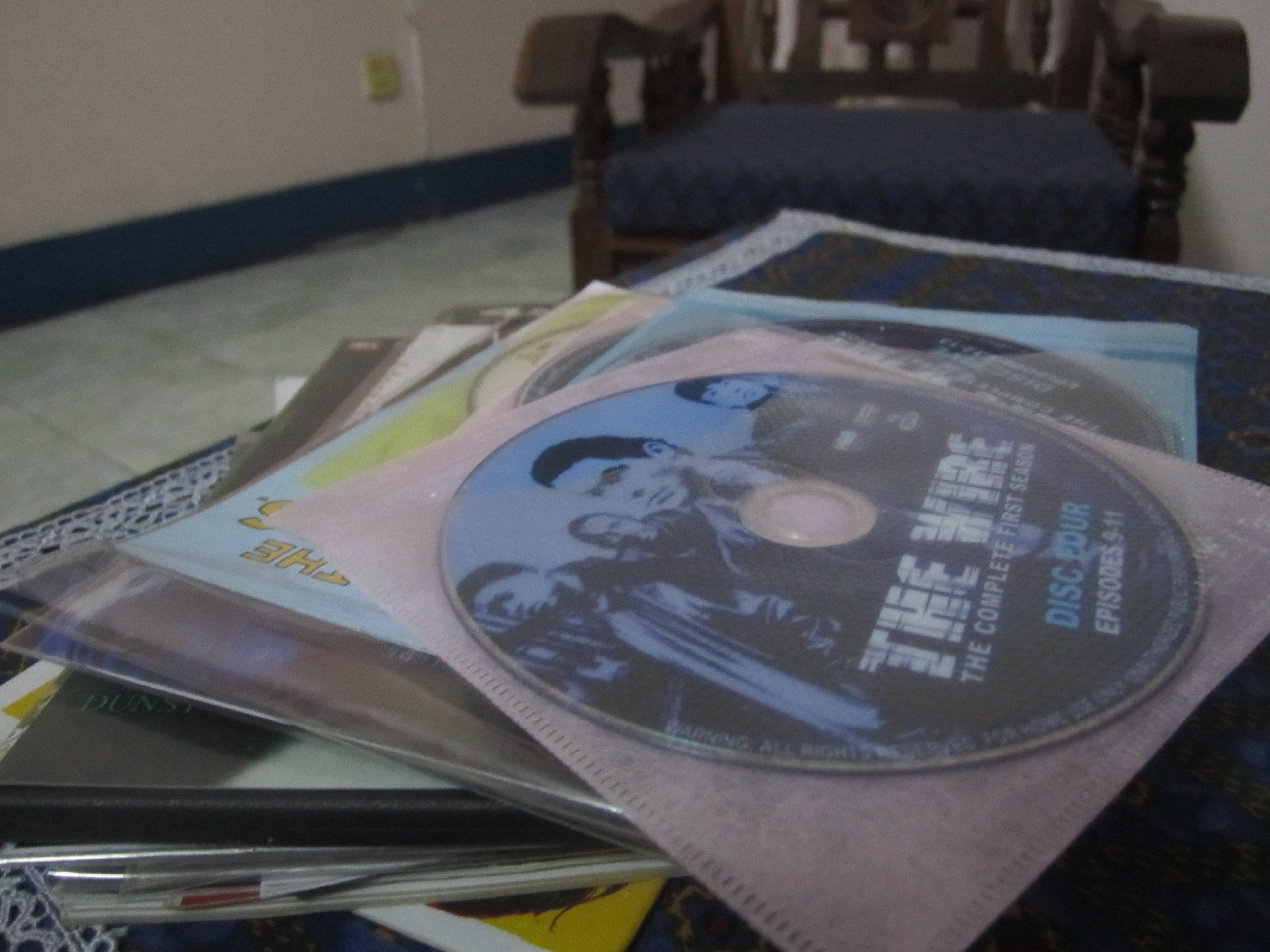
Add to this the fact that I’ve got a friend who has a killer collection and is about to leave town. I’m urgently trying to convince him that customs agents will freak out if he tries to enter any Western country with a 300+ stash of plastic cases with fuzzy, Xeroxed liners, and that the best solution to this is to leave his collection in my safekeeping. Don’t know if it’ll work, but in the meantime, I’ve been sampling his goods.

And I’ve gotten into The Wire.

I was afraid of The Wire. I was afraid for the same reason I’m afraid of Words With Friends—do I really need another addictive timesuck?

Why, yes, yes I do.

So I’m working my way through Season One, curled up on my less-than-comfortable wooden bench in my kimono each night, eyes glued to the laptop screen adjusted juuuust so.

The world doesn’t need another commentary on the series, so I’ll just keep it to what’s relevant, which isn’t really relevant at all, just feels relevant tonight: my favorite character is Omar. For obvious reasons. But for less obvious reasons, it got me thinking tonight. As I had my nightly cigarette on the terrace (sorry Mom) and watched the stray motorbikes whiz by three stories below, listened to the neighbor’s dog barking, felt one of those rare cool breezes dancing around the edges of my kimono—it got to thinking about the only Omar I’ve ever known.

Omar James. I’ll use his real name, cause why the fuck not?—weird things happen online and I might even find him. We went to grade school together. He was in my class, all the way through, but I remember him most from sixth grade.

Omar was American, which sounds obvious, but half of my grade school was immigrant kids, so it actually kinda narrows it down. He wasn’t a Bad Kid, but he wasn’t a good kid either—that strange kind of inbetween place people float in as kids, before puberty, when all hell breaks loose—that time when everyone’s lives hangs before them, unformed and waiting, like one of those planetary birth charts I’ve never understood or been able to read.

I remember the DARE counselor, a dude named Officer Lee, saying on the first day: “There’s three kinds of kids. There’s the kids that’ll for sure get into drugs and the kids that for sure won’t. Then there’s the kids in the middle.” He’d paused here, for effect. “Those are the ones we’re trying to reach.”

I knew positively I was one of the kids who wouldn’t.

So I’ve been known to be wrong in my life.

But I remember thinking Omar was one of the kids in the middle. He had a real raspy, low voice, so the teachers always caught him when he was talking (“Your voice is like a red race car,” one teacher had told him. “People are always gonna notice it.”) I remember one term we were seated in the same group, warped old wooden desks facing each other, and I’d tried to whisper something to him out of turn—my version of taking a risk—and he’d gotten frustrated, making a pssshhh noise and said, “Man, I can’t hear you.”

I probably turned real red.

Irish blood makes you do that.

No one else in that class had Irish blood.

Omar had real dark skin and a burn from a flat-iron on his forearm. Lots of the black kids had them, and I remember wondering why—in the same way other kids asked if all little white girls were born with parts in their hair.

He had rough hands too; I remember that. They had little scars on them, callouses and patches of grayed skin, and they’d seemed to me like grown-up hands, man hands. I remember watching them, holding a pencil during tests. I remember watching that shiny burn too, the way the light seemed to gleam off it someway special.

He also had these little gray hairs all over his head. They curled around the rest of his hair, in a way that made them seem curlier, though probably they weren’t. He said he’d always had them, and I’d remember that, since second grade, he had. He said his grandpa had them too, and that that was who he’d gotten it from.

Omar also had a Starter jacket. That was a big deal back in the day. Cause they were expensive and fly. Kids in Oakland fought over Starter jackets, the way kids also fought over Air Jordans, and the kids who had them had a reputation for, you know, the kinds of things kids with fancy shit in poor cities have a reputation for. The Oakland School Board got frustrated and decided to ban the jackets at all schools. This was before the days of semi-mandatory uniforms in public schools, so the ban was also big deal. The school board meeting where it was discussed made the nightly news, and I remember thinking, “Not all kids with Starter jackets are thugs—Omar’s got one.”

No one, I should say, ever tried to fight Omar for his.

Which is maybe why The Wire Omar made me think of him.

But I really don’t know why the fuck I should remember any of this. Maybe it was the hair, the little gray hairs, and how they made me have a picture of his grandpa—some old dude as a little boy once, somewhere, hella long ago, with the same little gray hairs. And picturing that had made me picture Omar as an old man, the same way his rough hands did.

Neither one of us would be old now.

But still.

Then I left that school—we all left, graduated—and I went to a nicer public school up in the hills, followed by a string of other schools—the typical hustle for a decent education in Oakland—and I lost touch with most of those kids. I’ve found some through Facebook—Alekist, who went to Brown and works for a biotech company; Dartanyan, who used to do backflips off the stairs and has a record label now. (Okay, so, I found two kids.) But even before The Wire, even before Phnom Penh and expathood and this weird ass new life of mine that has made me nostalgic for random shit I can’t explain, I’d looked for Omar a few times—plugged his name into the search bar and got nothing.

Cause some people stick like that. Some images stick like that.

Like a race car in the red.

Going To The Bathroom Abroad: The Butt Hose Edition

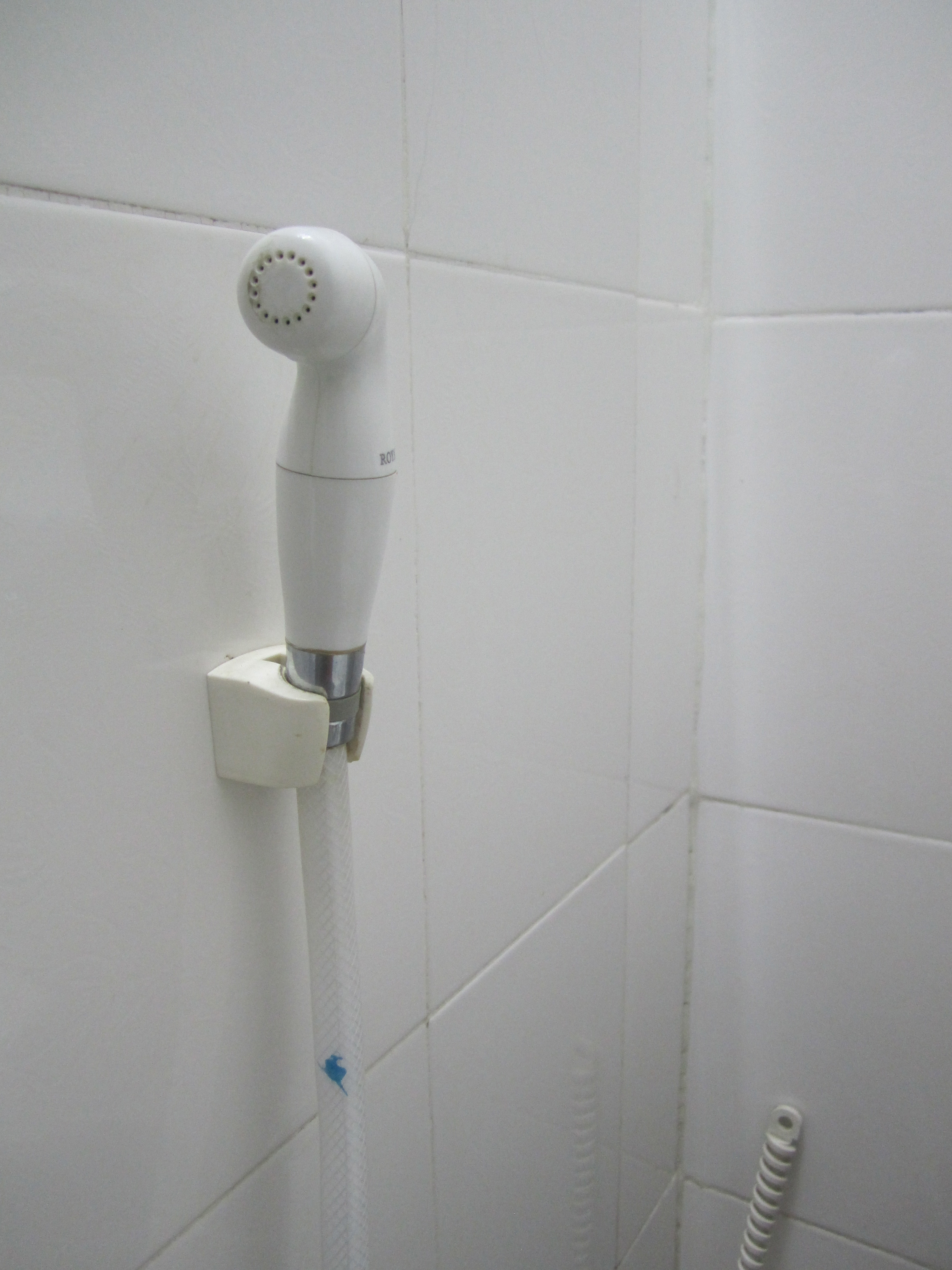
This is my bathroom. As you can see, it’s nothing special (aside from how clean it is). It’s actually nicer than my last bathroom back in the States, with its black mold and peeling linoleum. Because contrary to what some folks back home have envisioned, I’m actually not living in a straw hut. Nor am I not taking dumps crouched down over a squat toilet. Using the bathroom is a totally Western affair.

Except.

Look closer—what’s that thing snaking out from the wall and resting perkily in its holster?

Why, it’s a butt hose.

I don’t know if that’s what it’s actually called, but that’s what I call it. Maybe I haven’t been looking closely, but I haven’t seen butt hoses outside of Asia.

At first they confounded me. What the fuck were you supposed to do with that thing? I thought it might be for cleaning and admittedly used it as such once—got a real good angle on those hard-to-reach tiles behind the toilet. But that couldn’t really explain why I’d see the butt hoses around town, in fairly squalid bathrooms where toilets were either missing seats or were of the squat variety, and where toilet paper was a laughably far-fetched wish.

You know those little old ladies that sit outside bus station bathrooms in Latin America and charge you to enter? You know how they give you one painstaking square of toilet paper? I was thinking that Southeast Asia could really stand to learn from that jam. I mean, the pay-to-stand-on-a-scale hustle appears to be worldwide, so why not the charge-for-toilet-paper hustle?

Haha---these signs are reeeeal funny, until you go into a bathroom with muddy foot prints on the toilet seat

Cause they don’t use it.

Word?

Word.

Well, not everyone doesn’t use it. But from what I hear, the butt hose is the Southeast Asian answer to toilet paper. When you think about it, it makes a lot of sense: instead of smearing a dry piece of paper around there, you give the area a refreshing little spritz. It’s kind of genius, and far less intrusive and intimidating than a bidet, with its cranks and levers that strike fear and worries of cultural inadequacy into the hearts of Americans.

The butt hose takes up a lot less space too—just sits there innocuously against the wall, as if to say, “Use me if you’d like, madame.” It doesn’t stare at you from beside the toilet, in that way that makes you comfortable and unable to look away while you’re dropping one, wondering if you’re a less evolved human being because you can never figure out how to spell, much less use, that European contraption of ass-refinement. It’s a metaphor, really, when you think about it.

I’ve become a big fucking fan of the butt hose. Once it was explained to me, I began to work it in to my shit-taking repertoire—cautiously at first, perfecting my preferred angle and pressure. Now I’m a convert. A missionary, actually, since I felt the need to carry the good news to a friend over lunch yesterday:

“Dude, have you gotten into the butt hose?”

“The what?”

“You know, that hose you see in all the bathrooms?”

“Yeah, what’s up with that?”

[Insert semi-graphic demo and staring eyes from the neighboring tables.]

It’s really taken my dump-taking to a new level. But, because I’m so fucking international and can’t be confined to any one culture, I’ve taken to doubling up—using both the butt hose, then toilet paper to dry. It’s like a mini-shower for my nethers. And considering how much you sweat here, any extra freshening is a welcome affair.

So hello there, new friend. You’re looking fresh today. What’s that you say? Well, don’t mind if I do…

A Poem Walked Past My Balcony Last Night

Teenagers

walk down the median,
streetlamp light
laughing.

Boy pauses
reaches
to a branch.

He pulls it down
picks
one, two

mangoes off the tree.
Hands one
to each of the girls.

They keep walking
and disappear.


Lauren Quinn is a writer and traveler currently living in Hanoi. Lonely Girl Travels was a blog of her sola travels and expat living from 2009 to 2012. She resides elsewhere on the internet now.

Join 490 other subscribers

Buy This Sh#t

Categories