Archive for the 'Places' Category


Thirteen Ways of Looking at Phnom Penh

Note: The literary nerds among you will recognize this as a rip-off play on Wallace Steven’s “Thirteen Ways of Looking at a Blackbird.”

1. Lisa, American, 1.5 years:
“You get a lot of big egos,
people who think
they’re hot shit.
But you have to remember:
we’re all here cause
we can’t hack it out there”—
points outside,
beyond the street,
to the West—
“in the real world.”

2. Tommy, British, 6 years off-and-on
“Where else could I”—
hand tattoos and a missing eye—
“get a job teachin?”

3. Steven, American, 4 years
“This city’s a dangerous place
to have money
and a drinking problem.”

4. Kate, Australian, 7 months
“People do
what they can get away with:
drinking all day, sleeping
with prostitutes,
saying racist shit.”
Stirs margarita.
“This city reduces you
to what you really are.”

5. Sasha, American, 1 month
“I’ve never been anywhere
where I’ve felt so manic.”

6. Hank, American, 4 years
“In the time I’ve been here,
I’ve quit my job, no shit,
5 times. And each time,
whatever I’d lined up next
fell through. So”—
shrugs—“at a certain point, I just decided:
I’m gonna stay here
until I learn whatever lessons
I’m supposed to.”

7. Clare, American, 3 years
“It’s not that easy,
just picking up and leaving.
I have 19 employees, women
who depend on me
for their livelihoods.
But at the same time”—
looks out the tuk-tuk
at the street—
“I know I need to leave soon.
I can’t get stuck.”

8. Lisa (again)
“The thing about it is,
it all becomes normal.
You realize,
the guys sleeping with prostitutes—
they’re not all creepy and weird,
like you’d expect.
Most of them are totally normal.”
Surveys the bar
in one sweeping glance.
“I guess that’s the strangest thing:
how normal it all is.”

9. Boy in cafe, American accent, time unknown
“I can’t tell you
how many times it’s happened—
I go for an interview;
they ask me
to do a draft of a project;
they never call me back, but
they steal my ideas.”
Tosses pen across the table.
“They’re lazy
and sneaky
and can’t think for themselves.”

10. Martin, American, 6 years
“Whenever I get into that place,
you know,
when all of Cambodia
has got it wrong—
when no one knows how to drive
and every police officer is trying to get a bribe outta me—
that’s when I know I’ve got to sit down
and take a good long look
at me.”

11. Michelle, Australian, 3 years
“I tried.
Of course I tried.
But it’s hard to have Khmer friends
when you can’t tell them
you live with your boyfriend,
and they have be home
by 8 every night.”

12. Lisa (again)
“You totally just blew that guy off.
You do realize
that’s the last time
a white guy’s gonna hit on you
for a loooong time.”

13. Billy, British, 5 months
“There’s a lot of people like you,
moving here
cause it’s cheap
and they can do their art.
It’s not so different
from people moving to different cities
within a country
cause it’s cheaper and easier.”
Grins.
“I think it’s exciting.
Like Paris in the 20s.
Or something.”

Jogging Where Tanks Once Rolled

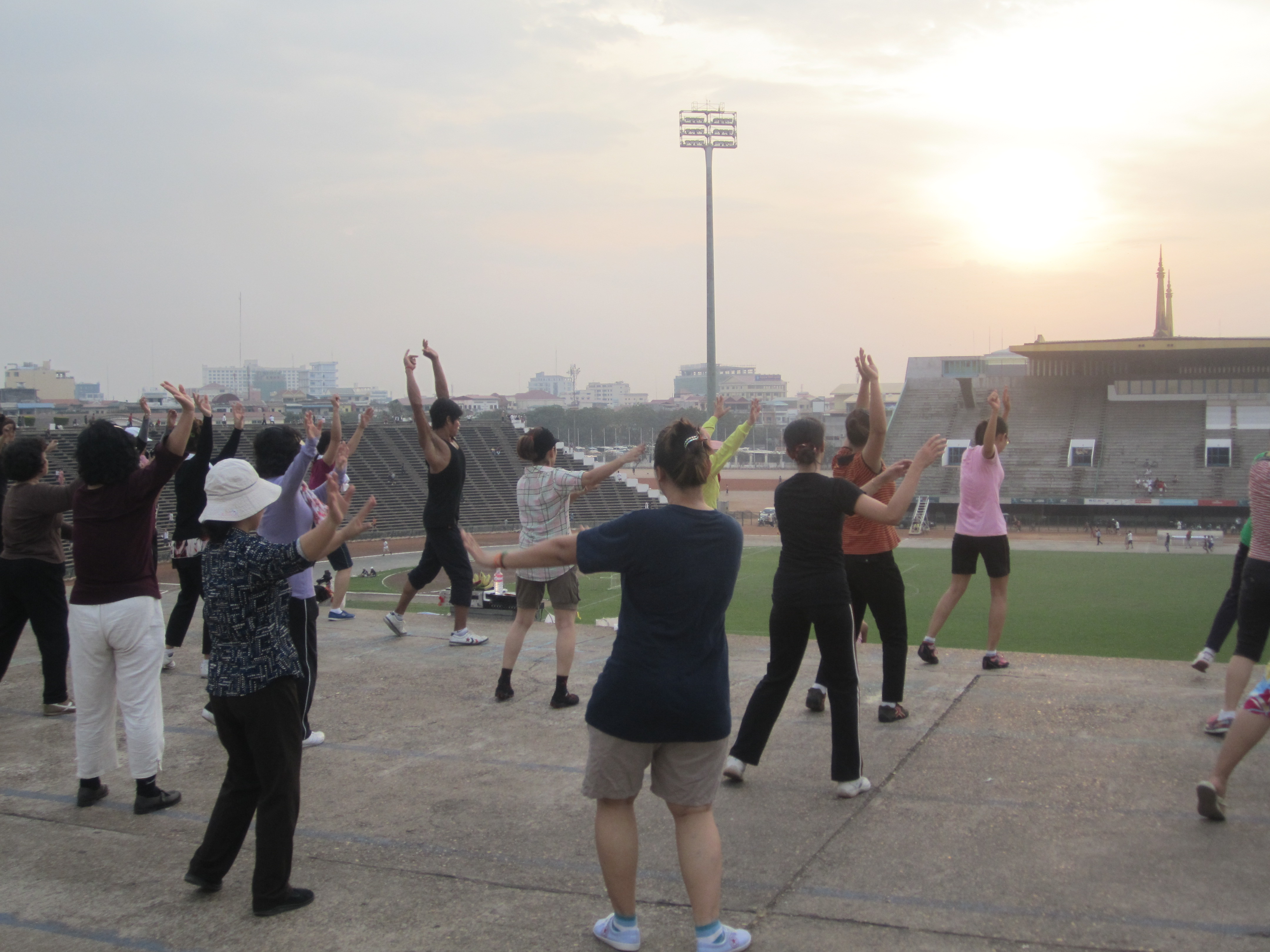
Aerobic dancing at Olympic Stadium

3pm, barefoot in the dim room, whirling fans and headphones on, staring at the screen. It’s my first trip back to the Bophana Audiovisual Resource Center, where I spent hours last spring, trolling through their archives of documentaries and newsreels and scanned photographs of the old Phnom Penh, before the war—which, it seems to me today, doesn’t look so different from the Phnom Penh outside the open-air terrace, just minus the new cars and sidewalks. Sometimes.

I’m back to refresh myself. I’m working on editing my second Glimpse piece. I wrote it over the summer and haven’t looked at it in months, so when I got Sarah’s comments, it all felt vague and faraway. I knew I needed something to kickstart me.

To be honest, I haven’t been thinking much about my project, or the Khmer Rouge, or any of it. Last time I’d arrived, it’d been on my mind constantly, a lens I saw everything through: everyone over 35 was a survivor. I couldn’t turn it off, and I’d hit the ground running, dove right in to the research and writing, the quest to understand.

And it’s not like I’ve forgotten all that—I can feel it, sitting there, off to the side and waiting, in the corner of the room when I can’t sleep at night—but my focus has been elsewhere. Getting an apartment. Buying all the crap I need—dishes and towels and non-neon-plastic chairs and Western bedsheets (really effing hard to find, btw). Reconnecting with the friends I’ve got left, and making new ones. Getting a phone and internet and finding a good laundry place and all that very unglamorous day-to-day stuff that’s part of life, part of living somewhere.

So I’ve pushed it all aside, knowing that it was waiting and that I’d come to it when I was ready (and, really, I’ve only been back two weeks). So it was with a little hesitation that I went to Bophana, took off my shoes and climbed the steps, climbed back in to The Reason I Came, and the thick-as-mud emotional difficulty of it all.

Most of the newsreels are in French, and I watch ones from the Thai refugee camps, 79-80; I watch the same newscaster in different suits, and fish out token words of French: “famine,” “guerre,” “mort.” Mostly I look at the faces, which are shell-shocked and gaunt.

I scroll down, down, down the list of archives, never-ending, thinking how long it would take someone to watch it all. I see “Rediscovered Propaganda Films” and click on it. There’s an English dubbed version, which is exciting. I watch and listen.

They show short films produced during the Khmer Rouge and narrate. They show staged shots from the camps, aerials of people like ants, carrying hoes and buckets, balanced on a stick over their shoulders, the way the soup ladies at the market do. They show close-ups of carefully selected workers smiling; they point out child workers and how to tell who was a New Person and who was an Old Person. They show clips of a poorly acted film Pol Pot directed, shortly before the regime fell—men reenact the defeat of Lon Nol’s army, twitching on the ground with arrows arranged around their bodies. The film was never made, and the shots I see now, in the dim viewing room, were assembled from found reels. I imagine them on a dirty floor somewhere, curled and brown.

The narrator points out inconsistencies: no one was supposed to have bourgeois personal items like watches or eyeglasses. But here’s Pol Pot, that smiling cult leader face, wearing a watch, and here’s Brother Number Three, wearing glasses, and here’s the regional leader Brother Number Two snubs, who’s later deemed a traitor and tortured and destroyed, along with his family. They freeze the frame on him, and he’s smiling, smiling.

This scene is at a party meeting; women with Soviet semi-automatic weapons march, and US artillery tanks roll past, left over from Lon Nol’s time. The setting looks vaguely familiar, and the narrator says: “The meeting took place in the otherwise empty Phnom Penh, at the Olympic Stadium.”

Holy shit, I think. Olympic Stadium is in the city center, near the guesthouse I stayed at when I arrived. Every dawn and dusk, they do aerobic dancing there, and people run and powerwalk and swing their limbs around; food vendors set up carts and plastic stools, and men play soccer in the dirt lot outside.

It’s my favorite place to go running in the city. In fact, I’m planning on going for a jog there tonight.

I squint at the screen and it’s all there: the steps I run, the contour of the stone tiers, the spires of the Royal Palace rising in the background. It’s newer and cleaner and nicer in the footage, but it’s the same place.

I don’t know what to do with that.

I walk back to my apartment with a funny little feeling in my stomach, like I’ve seen a ghost—like I’ve gotten up in the middle of night and everything familiar looks strange and different, and the thing that was sitting there waiting for me isn’t in the corner anymore but is moving across the room.

I put on my running shoes and spray some more mosquito repellent on, grab a water and go back downstairs, to the street to catch a motorbike over to the stadium.

It’s surreal when I get there. I walk past the rows of motorbikes and cars, the tuk-tuks covered in ads for the new Twilight movie. Teenage boys stare at me as I walk past their soccer game, say “Hello, hello!”

I walk beside the arena, which is locked and closed, my own face in the tinted windows. It was where the meeting had been, in the newsreel. I walk past where the shot of Pol Pot wearing a watch was, where Brother Number Two and Brother Number Three had trailed behind him, wearing eyeglasses and giving silent death sentences to smiling men.

A young boy carries a sack on his shoulder. He picks a plastic bottle out of the trash.

He walks closer to me, his eyes scouring the ground of recyclables.

I say hello, in Khmer, hand him my empty water bottle.

He smiles and puts it in his sack.

I say thank you, and walk towards the track, to jog where the tanks once rolled.

A Not Entirely Atypical Tuk-Tuk Ride Home

9pm so I give him a good stare down, check the eyes for red and glaze and drunkenness. I watch the way he walks to the tuk-tuk, parked a few feet away from where we’ve haggled the fare. He walks straight enough to drive straight, so I sigh and start to climb in.

“Ok,” he says, sitting down on the bike, “7000.”

I pause, my foot on step. “No, 6000,” repeating the fare we agreed to.

A grin. “Ok, ok, 6000.”

I sit and he sits. He throws a look back at me.

“You want to smoke weed?”

“No.”

“Why?”

“I don’t want to.”

“You no smoke weed?”

I smile and play it coy, “No, I’m a good girl.”

“Oh. I thought you were mafia.”

“Oh, really?”

“I see your tattoo, I thought you mafia.”

“No,” shake my head, “not mafia.”

He throws his helmet on. He doesn’t clip the chin strap.

We take off and turn the corner and it’s the usual questions: where did I make my tattoos? (USA) Is that where I’m from? (Yes) How many? (I don’t know) How much it cost? (A lot. But it should, it lasts forever.) Do I like them? (which is not a usual question and I smile: Yes.)

“But you no smoke weed?”

“No.”

“You no want to be happy?”

“I’m already happy.”

“But you be more happy.”

“Not if I smoke weed.”

“Oh, you smoke weed before?”

“Long time ago. When I was young. But I’m old now.” (Coy again, and I think how, broken language aside, it’s not so different from conversations I have with backpackers or college kids or, fuck it, my own peers, in bars or at shows—not entirely atypical.)

He speaks pretty good English and he’s driving straight enough and even knows where we’re going, so all things said, he’s a damn good tuk-tuk driver. We move through the pitted streets, slowly settling from their daily buzz—meat smoke thinning, piles of trash waiting for pick-up.

More questions, his eyes in the side mirrors more than on the road: How long will I be in Cambodia? (One year) What do I do for work? (smile: I’m a writer) I live in a guesthouse or apartment? (bigger smile: Guesthouse tonight, but tomorrow I move to an apartment) You live with roommate or alone? (another smile: Alone) Why alone? (I want to) I come live with you? (No) Why? (I want to live alone)

We approach the Orussey Market: lights and umbrellas and neon plastic stools and buses parked and smoke, still plenty of smoke billowing and twisting and rising into the night. I tell him the name of my guesthouse.

“Oh, you stay there alone?”

“Yes.”

“I come stay with you?”

“No.”

“Why?”

“I don’t want you to.”

“You no like boys?”

“I didn’t say that.”

“You like girls?”

“I didn’t say that either.”

We pull up in front, parked motorbikes in the glow of the reception desk, long shadows of security guards sitting listless in plastic chairs. I pull out the bills and step out of the tuk-tuk, hand them to him.

He takes off his helmet. “Goodnight, madam.”

“Goodnight sir.”

“Sleep good.”

“You too.”

Arriving Back in My New Home: Anti-Culture Shock and A Broken Necklace

In the shower this morning, rinsing the dried sweat of night chills from my dehydrated, gasping body, I noticed it: my necklace was gone.

When I came out of the bathroom, I saw it there, tangled and delicate, next to the pillow, the sheets that had stayed miraculously white during my 2-day readjustment sickness. It wasn’t my favorite necklace, an innocuous dangle of silver that clung close to the skin. At some point over the years, it’d become my traveling necklace—I’d put it on one of the first days of a trip, then just leave it, forget about until I’d noticed myself absently fingering the chain, digging the tip of the winged heart under my nails.

I picked it up. The chain had broken.

I smiled. If this were a novel, it’d be a metaphor.

I arrived in Phnom Penh nearly a week ago—flew in, which I hadn’t done before, but even at the airport, that familiar smell of mildew and cooking rice, overripe fruit and a faint whiff of urine underlying it all. I took a taxi (when’s the next time I’ll be in a car?), and we rumbled over pitted roads exploded with smoking meat, food stalls, cell phone shops, baskets of fruit, motorbikes and bodies, bodies everywhere. It didn’t seem insane or lawless or overwhelming—it just felt really good.

I dumped my bags at the guesthouse—the first one I’d gone to, back in February, which made it feel like I was coming full circle—and went out for an early evening stroll. My feet knew the way, my feet remembered how to traverse the traffic, how to cross the street (slow and steady and smooth), my feet took me to the pharmacy and a corner market and a street stall where I sat on a plastic stool and ate soup for $1. I went down the block to the sticky rice stall; I bought bananas for the next morning. I bought a giant fucking coconut, and the little lady hacked it open with a machete and stuck a straw in it and I took my first sip and, after 4+ months of $3 Vita Coco, a long sigh was unleashed in me.

Which is all basically to say I’ve been experiencing an extreme and bizarre lack of culture shock. I had more culture shock entering Albania from Italy, or any time I’ve reentered the US after traveling. What is about this place? How did it come to feel like home, after only a couple months last Spring?

I’ve spent the last few days hitting up my favorite cafes and street stalls and going to meetings and jogging at Olympic Stadium and trolling the town for For Rent signs (and getting one of those requisite, paralyzing stomach flus that gives you chills in 90 degree weather, that leave you sleek and lean and mean after, ready to take over the town). And all the while, I’ve kind of been looking over my shoulder, waiting for the other shoe to drop.

I’d expected my arrival back to be something like the final scene of The Graduate. All this effort and stress and energy and hullabaloo, goodbyes and good riddances, and then a month+ of traveling, cruising around the planet in the most unprepared and overpacked of fashions. I’d been kind of delaying it, you know, worried that I’d get back here and it’d be like that moment at the back of bus when Elaine looks over at Ben and he just stares forward and you see them both thinking—“Well now what the fuck?”

And I suppose there’s still time for that. Plenty of time, and I suppose there’ll be moments of that. But so far, all I’ve had is this feeling of being, not home, but somewhere close to home. I’d been doubting myself right up to the very end, right up till my Air Asia plane hit the tarmac. But more than ever, I keep having this feeling that I’ve made the right decision, that I’m in the right place.

I’m here. Really here. I’m not traveling anymore—just look at the necklace.

Cairo, Stencil City

I landed in Cairo like something shot out the bottom of a waterslide: a sharp gasp and splash of forward momentum, wedgie-style with a sting up the nose, blinking, shaking water from my ear for the four days. Completely unprepared, and didn’t know what to expect, except that I hadn’t even given it enough mental energy to expect anything.

Which isn’t entirely true—I expected it to be fairly modern, fairly developed. After two weeks in Albania, Cairo felt downright fancy, wealthy even. (There’s a Metro! When’s the next time I’m gonna get to ride a Metro?) I arrived during Eid, which is basically a four-day shitshow of fireworks, honking, running the streets—a Muslim teenage boy version of Girls Gone Wild.

But the daytimes are sleepy as fuck, Downtown dead, shuttered, traffic-less and breezy. I met up an old friend’s little sister, who I hadn’t seen since I was in high school (insert requisite “Oh my God, you’re a woman now!”). We ate koshari and drank Turkish coffee and wandered around, making our way over to Tahrir Square.

Where, if I’d stopped to think about it while I’d been crashing down that waterslide, I would have expected it: a shitton of political stencils.

Running around snapping photos, many of which Kate was able to translate and explain to me, turned out to be the dopest part of my four-day stay.

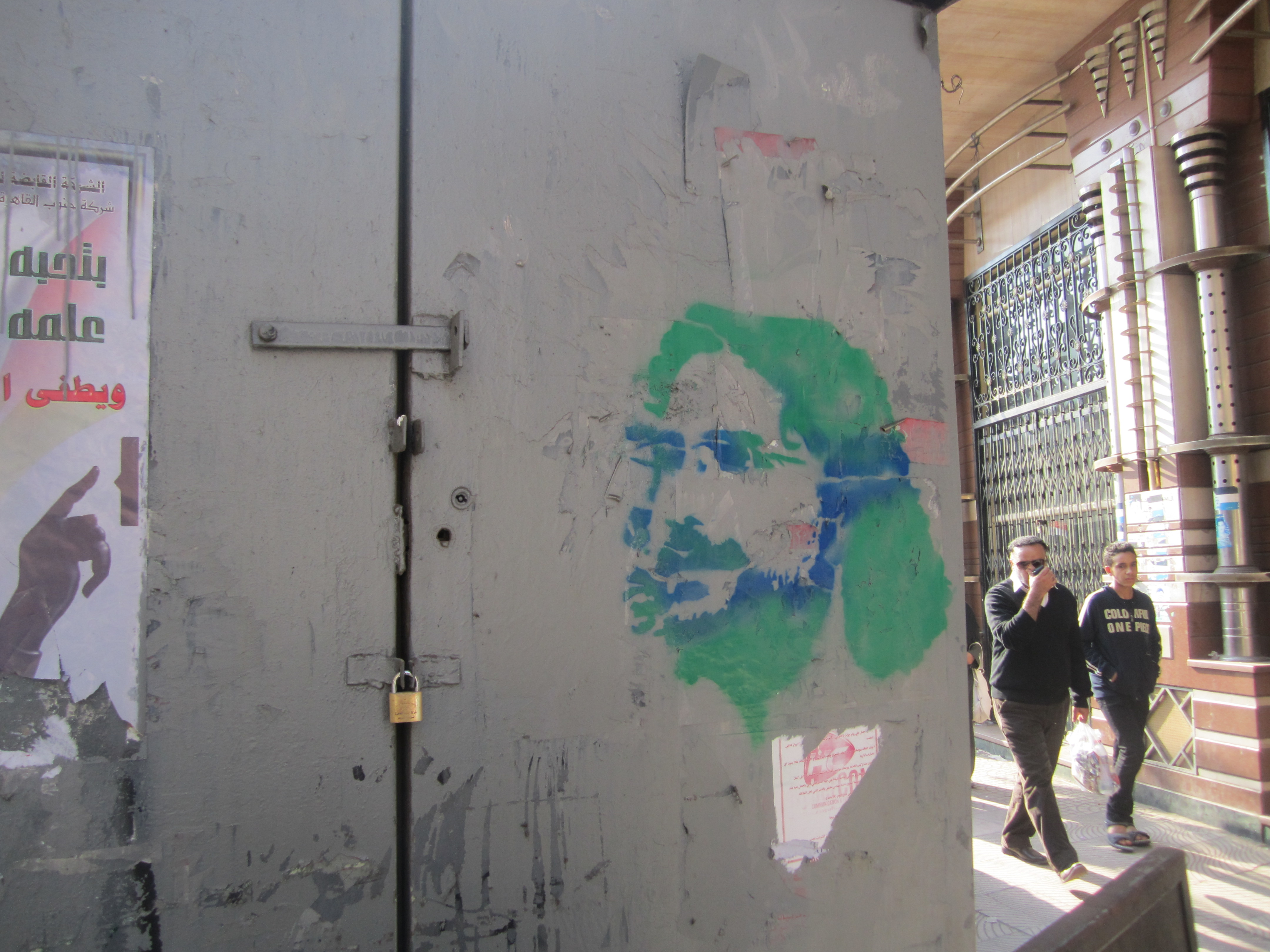
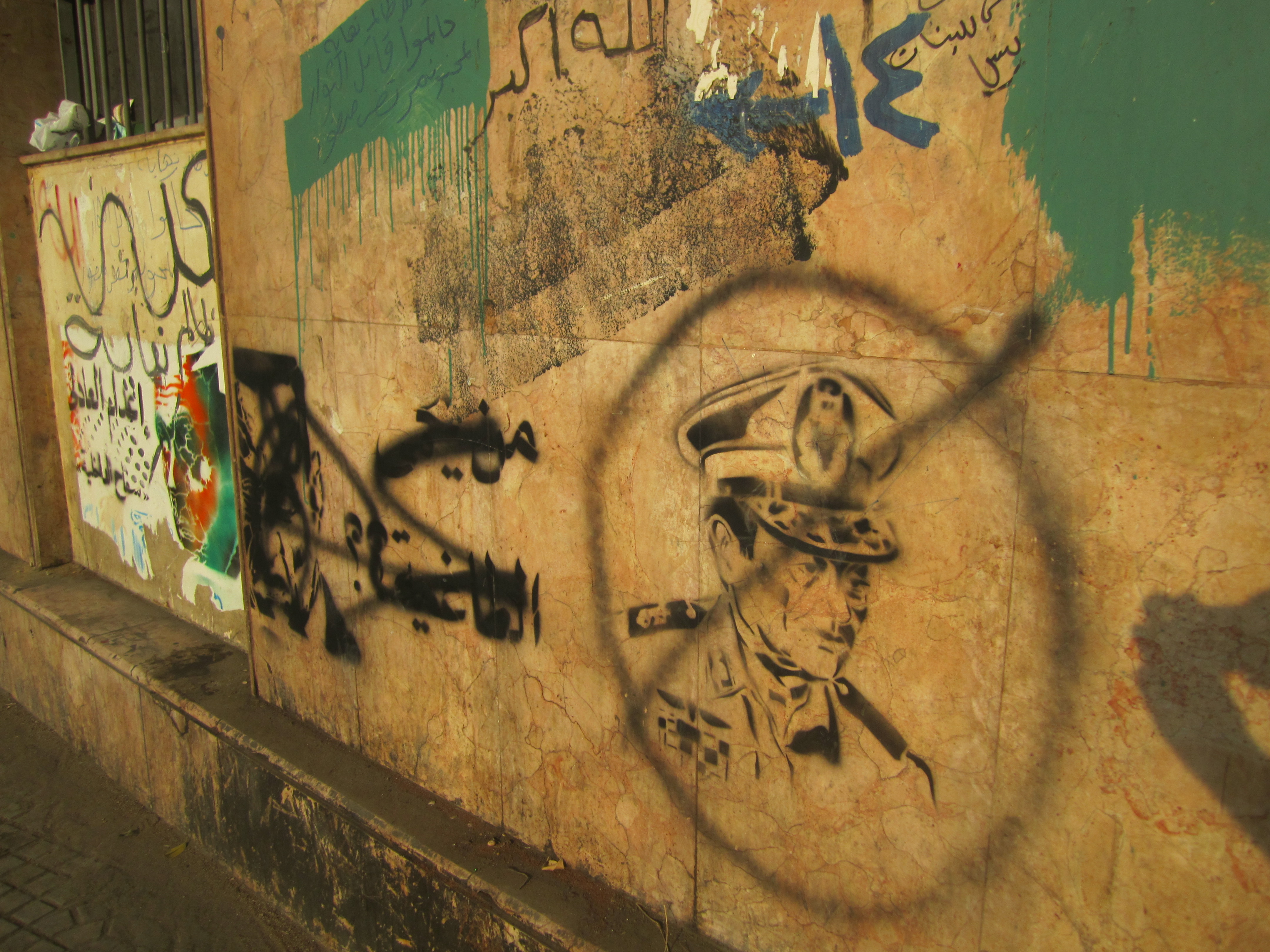
Leading up to the square, this is a pretty typical shot of what the walls are looking like down there. The half-face on the left is one of the more popular stencils, which I saw in various forms. It’s of Alexandrian blogger Khaled Said who was beaten and killed by the police, pre-Arab-Spring. Outcry and attention (speareheaded by FB group “We are all Khaled Said”) over his death are credited with fueling the flames that eventually led to the January 25th uprising.

Cool because I’d seen almost the exact same Anarchy head in Kosovo.

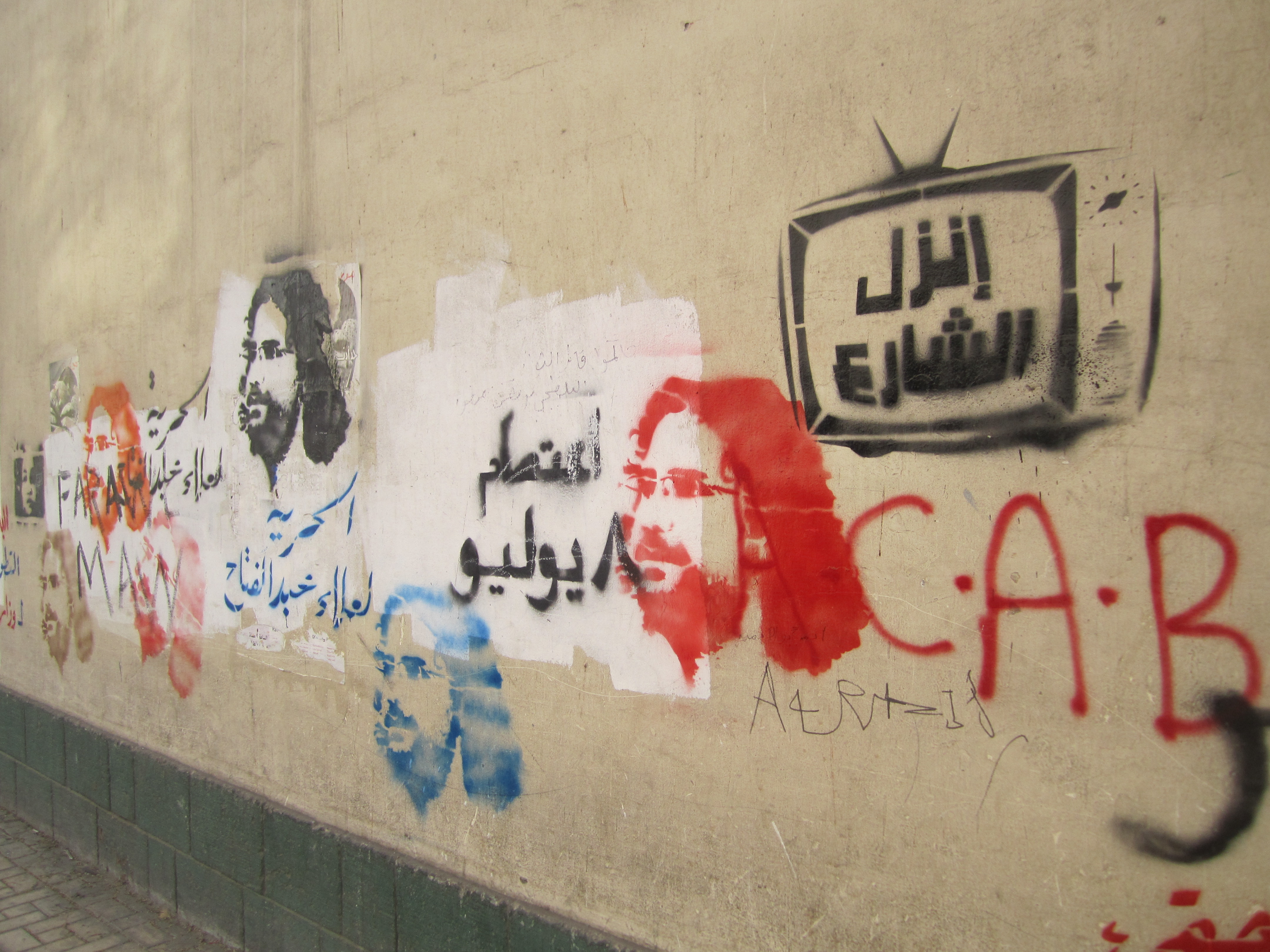
Another jailed blogger, Alaa Abdel Fattah.

Face on the left of the tree is of Mina Danial, another blogger who was killed.

The next batch are all on the wall by the American University.

“We are all the martyr Mina Danial.”

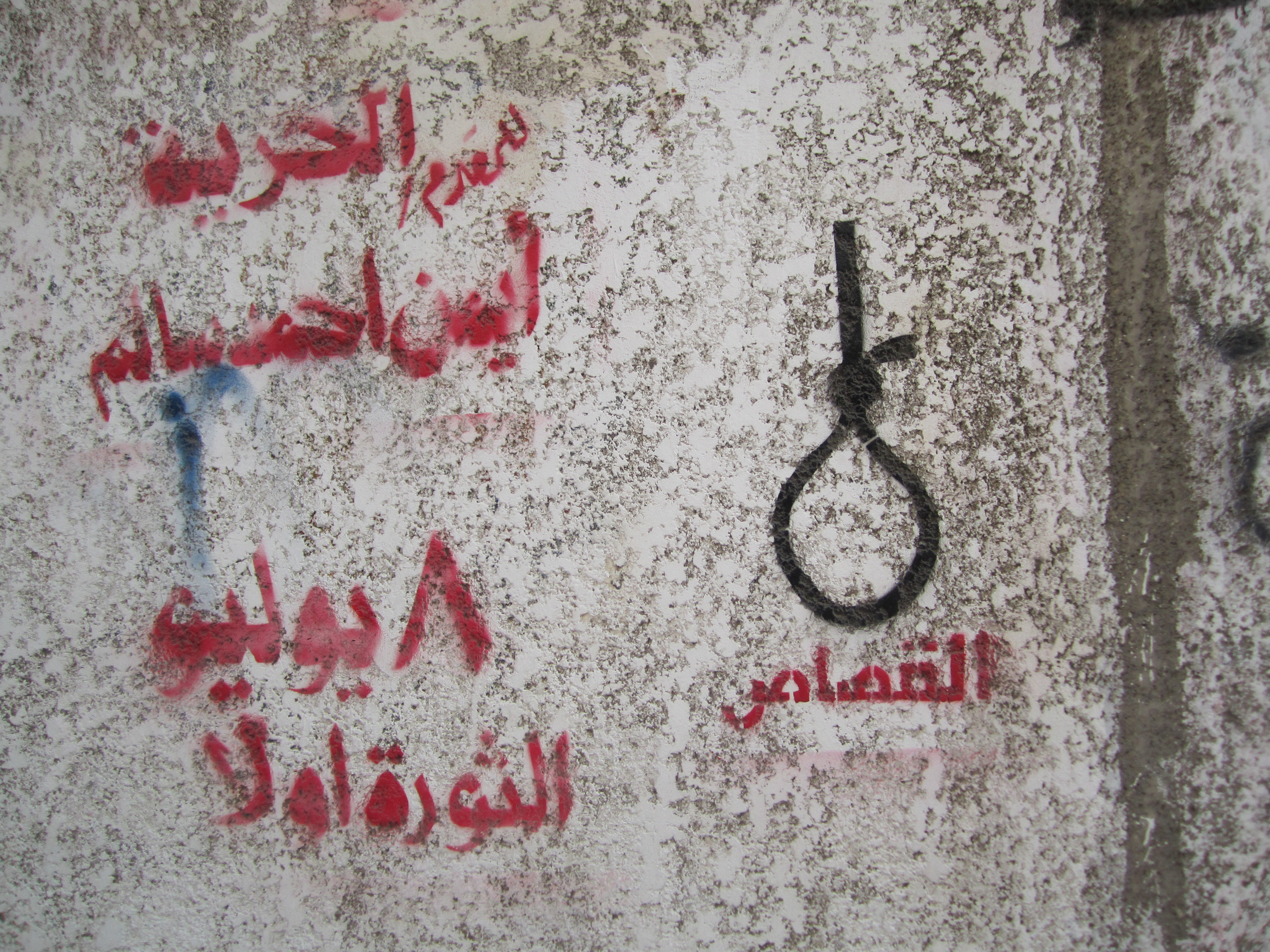
“Retribution for Mubarak.”

Date of a protest, alongside the star-and-fist logo of the revolutionary socialists. Stencils are apparently one of the primary ways protest dates get circulated.

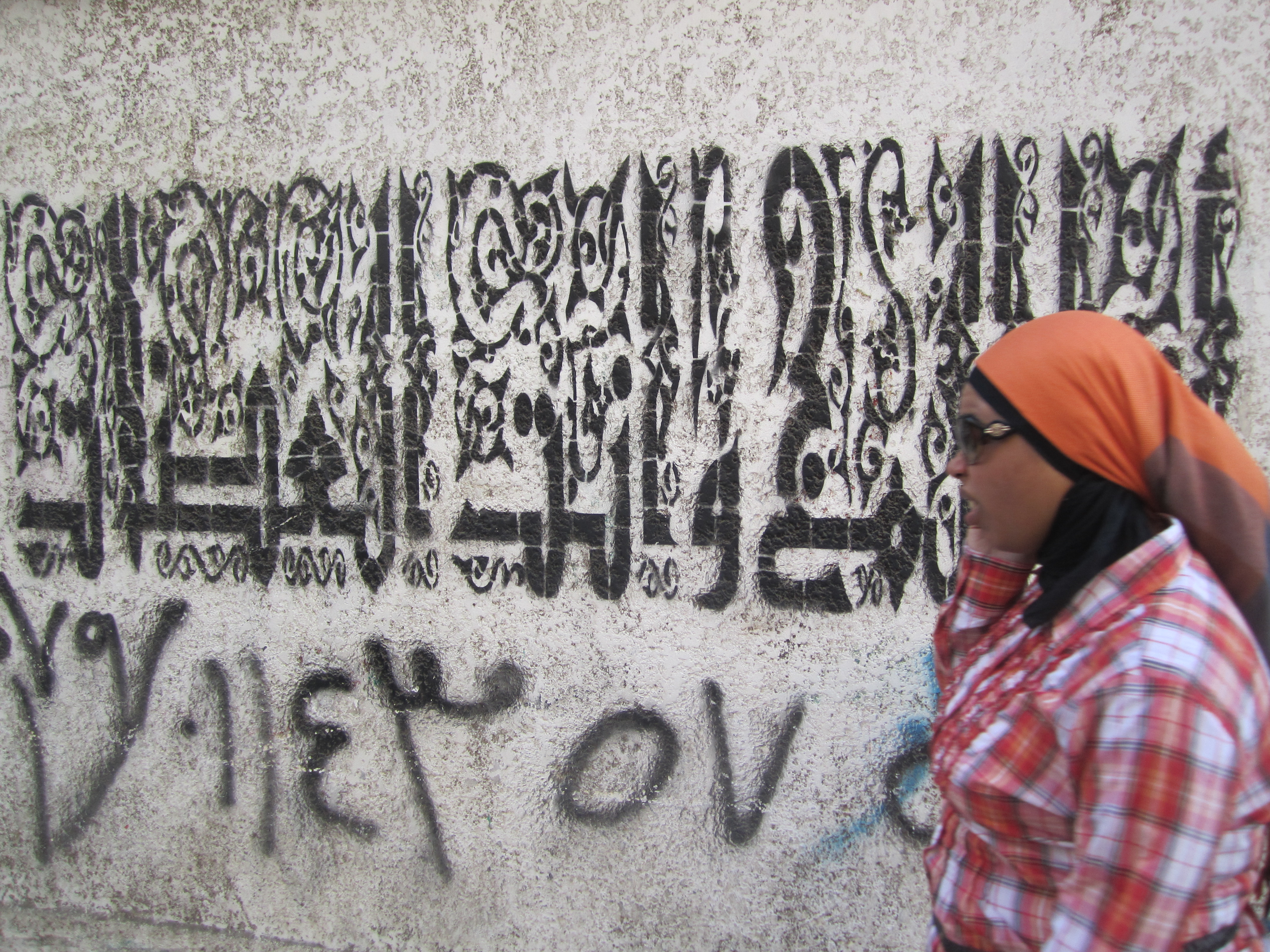
“I am the brain, you are the muscle.” Liked that this lady walked into the shot.

Face on the left is of a TV newscaster (missed his name) who canceled his show rather than be censored.

A classic. Writing beneath reads: “Long Live the People of my Country.”

Writing inside the TV reads: “Go down to the streets”—ie, don’t rely on the TV/media to tell you what’s going on.

Another of Khaled Said. Quite liked the placement beside the doorway.

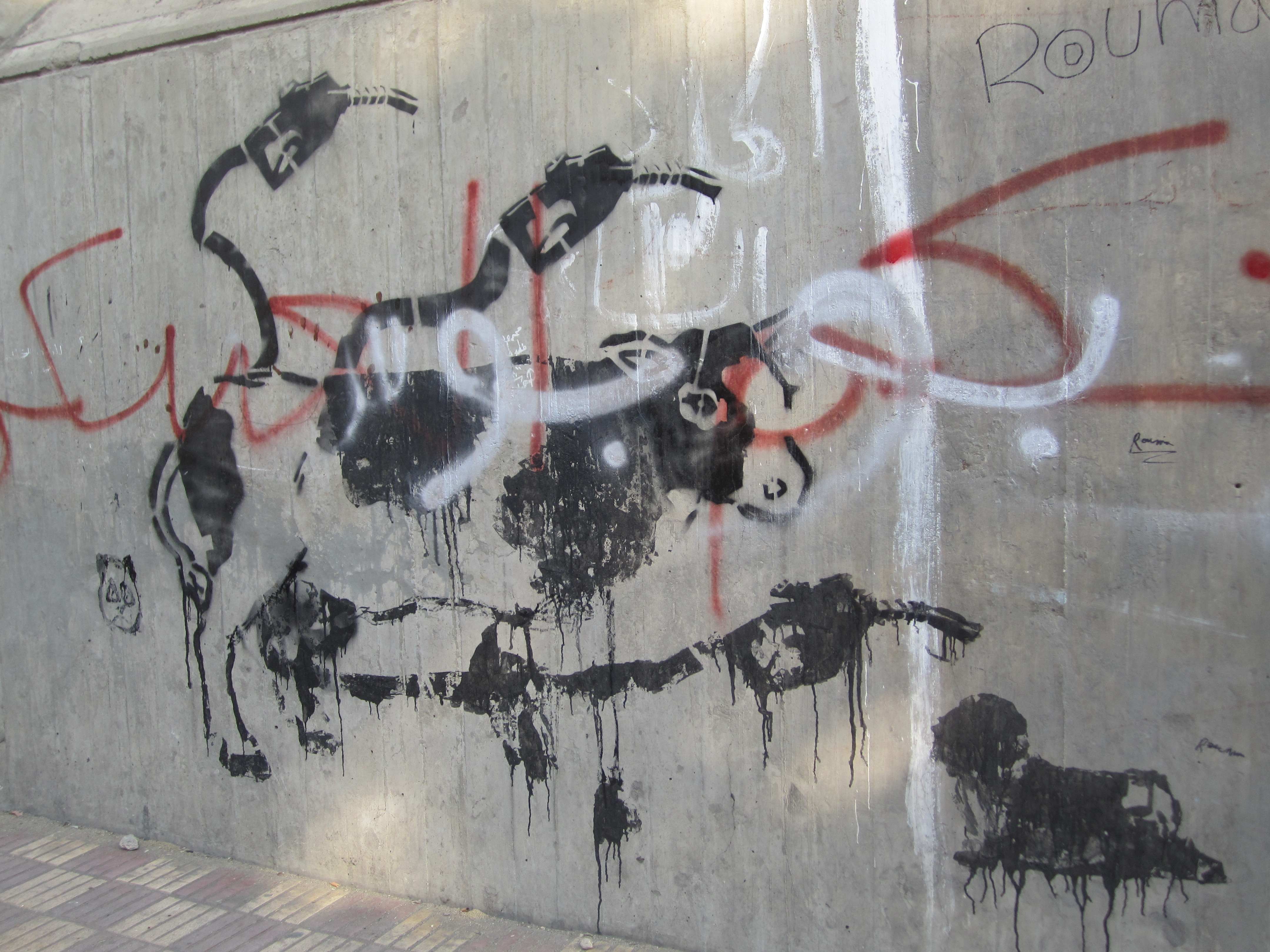
Never quite figured out what the cow meant, but there were a lot of them…

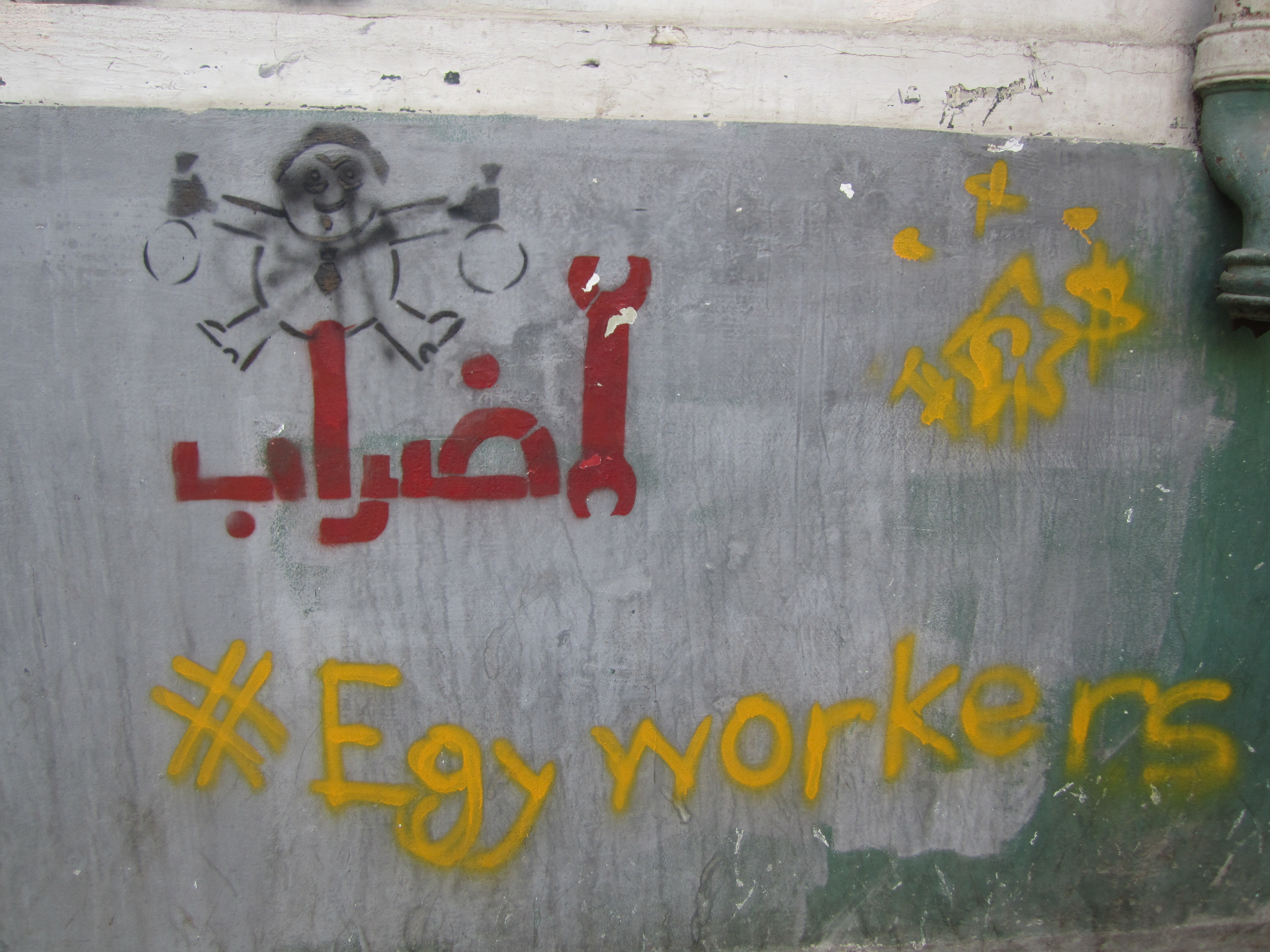
K, here’s one all the Occupiers can get down with: a banker being, um, poked, with a caption that reads: “Strike!”

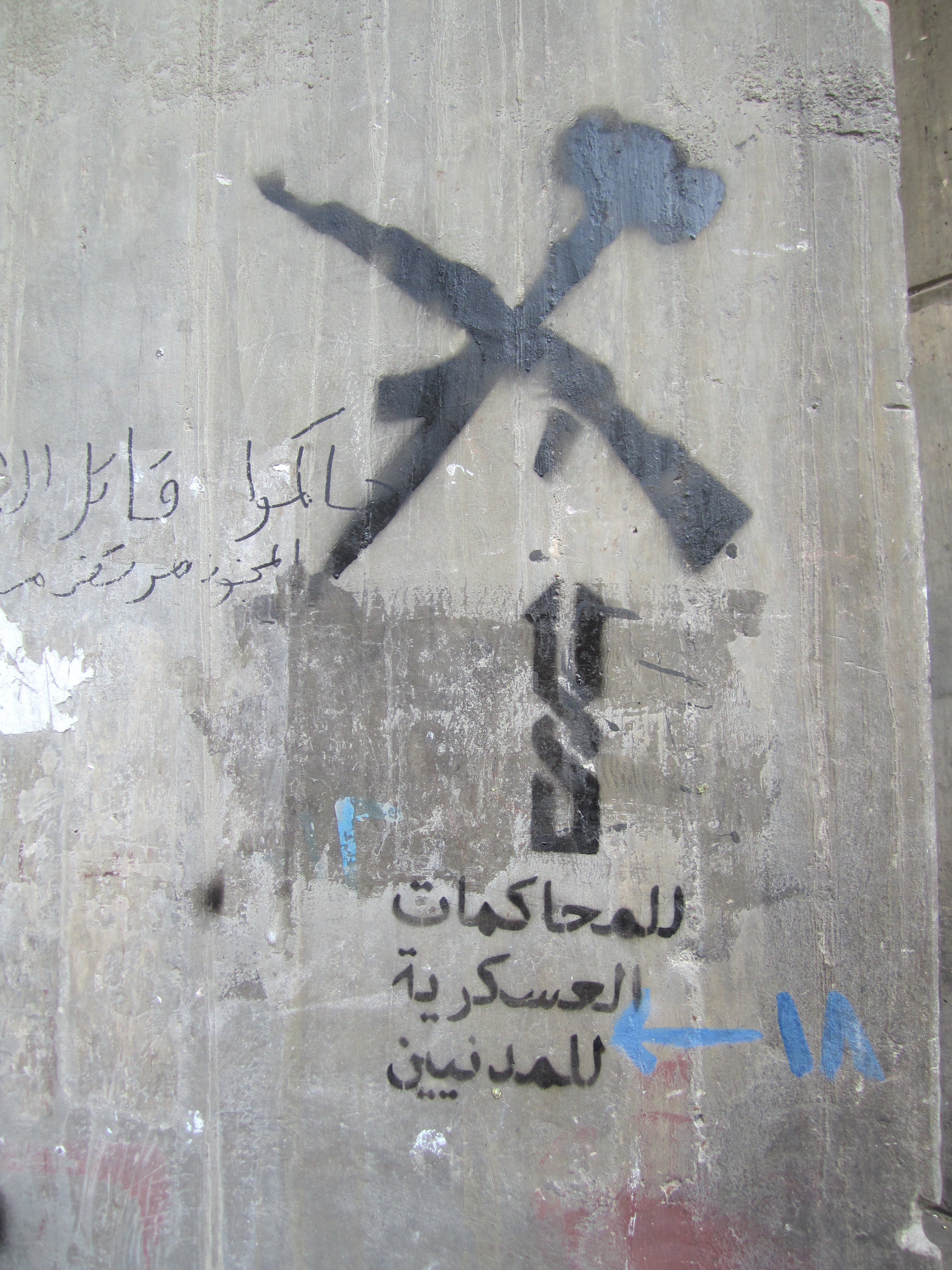
Perhaps not the most well-executed, but reminded me of the Sherpard Fairey guns and roses piece.

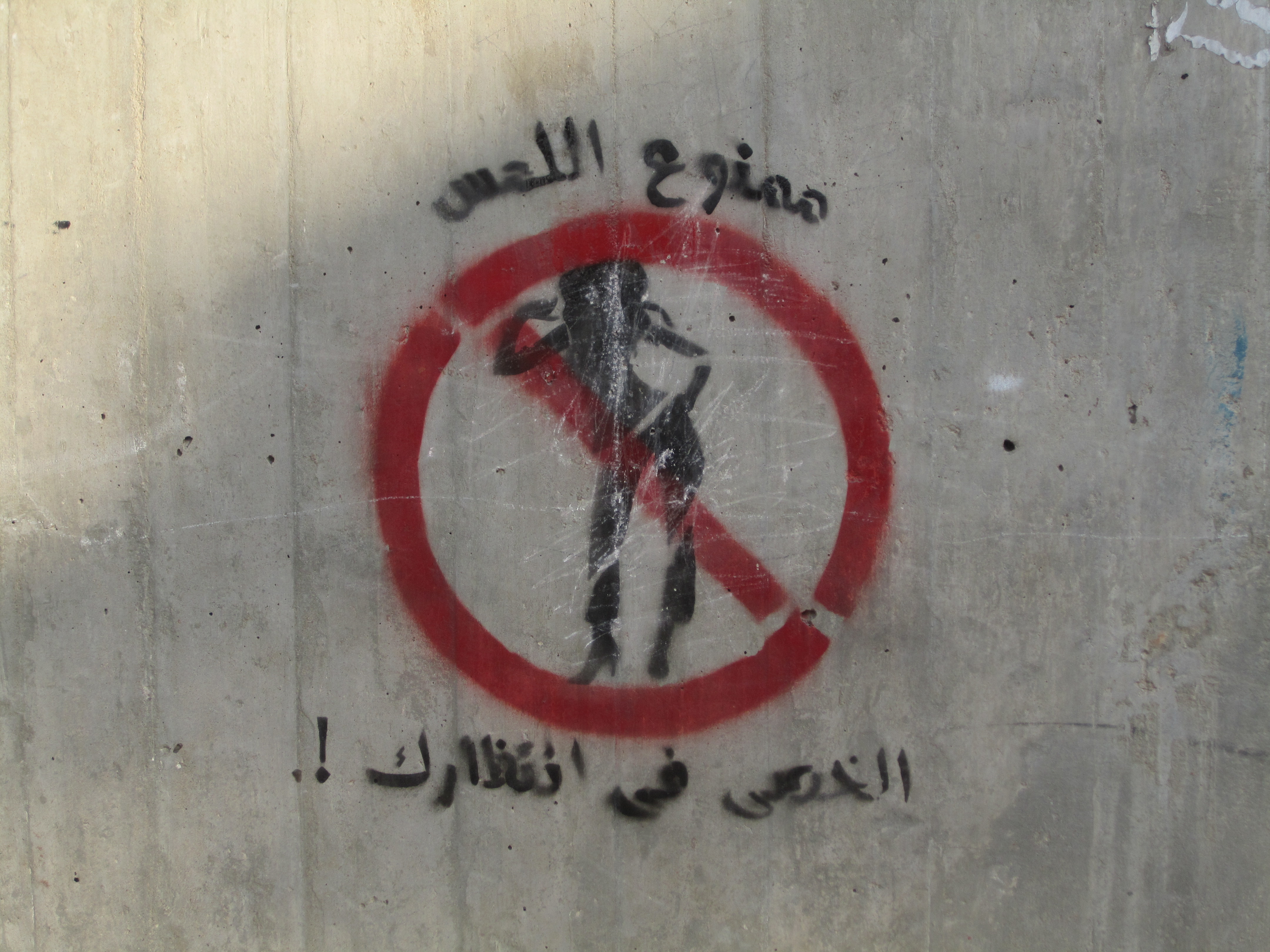
Personal favorite, for obvious reasons (though only got groped once): “No touching. Castration awaits you.” Shit yeah!

Don’t have captions/translations/context for the rest of these. If anyone’s got any insights or context to offer, holler…

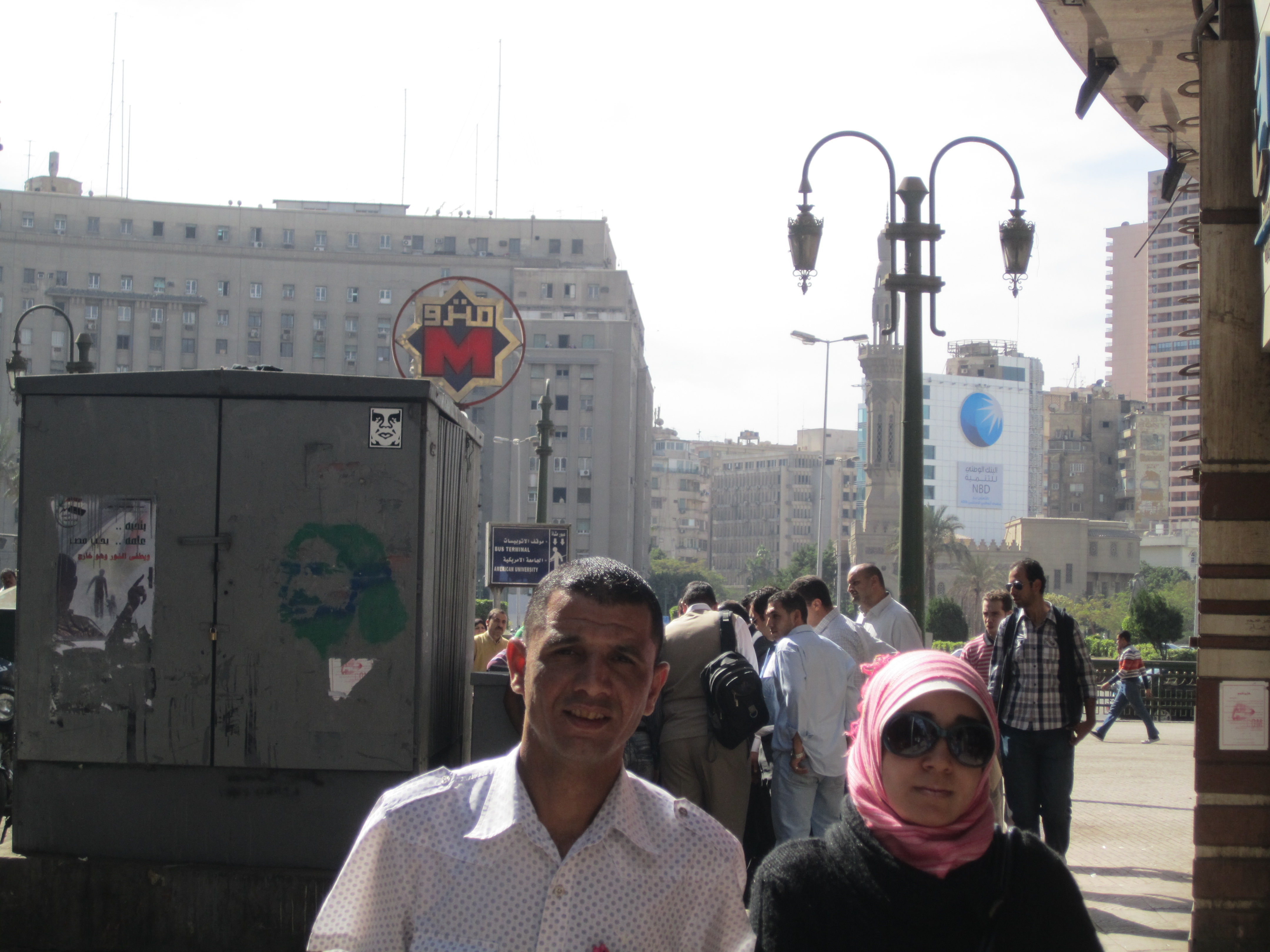
Metro stops.

…And, a typical street scene round the Square, with a lil hidden gem.

It was really cool and really fucking refreshing to see all these stencils up. You know, you come across a lot of jaded people—people who will tell you that street art is played out, has sold out, commercialized and commodified and done for. There’s an element of truth to what they say, sure, but I think that level of cynicism is dangerous.

So it was rad, all else aside, to see all this up, in this context. Street art is, in its origin and at its core, a political act. At least that’s how I see it. It may be all the other sceney bullshit too, but walking around Tahrir Sqaure, I was reminded of the crucial role it can still play, the dissent it can represent, and how it can be un-fucking-stoppable. And, in a place where there’s such intense repression and media censorship, street art plays a vital role.

It’s like social media—which can be be soul-sucking and superficial—if you let it. The same cynical voices will tell you that FB and Twitter are deteriorating authentic human interaction. Which very well may be true. But, if you look at the fuller picture—holy shit, look what it can do! Look how it can connect people. It’s not a coincidence that authorities, from Tahrir Square to BART, shut down cell phone reception in the face of protests. It’s not a coincidence that the majority of faces stenciled here are bloggers. Yeah, yeah, there’s a lot of BS that comes along with the territory, but that’s the world we live in, you know? And check out the crazy, amazing tools we have to make it a better place.

Street art is one.

An Anti-Social Trip to the Pyramids (In 5 Senses)

Dusty

Feel: Dusty wind on my cheeks, rustling through my hair—a bad place for contact lenses. A watery ouch, blinking madly.

Arms poking at me, fingers tapping—shove a postcard book in my face and flap it around.

Smell: Camel shit, horse shit—a stink, yes, but it’s a healthy, robust stink, blooming in the heat. Think of my dad, leaving the bathroom in the morning: “Ah, that smelled fertile—like it would make shit grow.”

Taste: Dry, thirsty crackle in my throat but too stubborn to buy overpriced bottled water. Linger of packaged jam from breakfast. The mint of my chapstick.

Sound: “Camel ride,” “Postcard, madam,” “Welcome to Egypt!” “Where you from?” “Camel ride, hello!”—haggle-hassle town, a chorus of cries, hungry touts with cracked feet and chipped teeth, sharp limbs and sharper eyes.

I understand the dynamic—I know my place in the global socioeconomic ladder, that I’m a Have, the 1%—or 10%, or whatever—but basically, not a Have Not. I understand that this is the price you pay, along with the admission, and that neither are very much.

But it’s aggravating as hell, which is kinda the point, the technique, if you will—and the best I can do right now is to ignore it, not engage or react, not look or respond. I bust a move from my old teenager bus riding days: wear headphones without the sound on, so I can still hear everything (in case it goes beyond annoying to threatening), but can pretend I don’t.

So I walk like that, then decide—Well, shit, may as well drown this shit out. So I turn to what was playing last—new Ty Segall, which is bad-ass but doesn’t fit the mood, the scene, the monumental, crumbling, cracked-lip ambiance. Stop and do a scroll through. Wait, wait…

Theeeeeere we go.

So I’ve got the drone-moan doom metal in my dome, and I’m mad-dogging it through the place. Touts and hustlers like flies to a light bulb—knock, knock, knock and you can’t get in.

Sight: Well, it’s the Pyramids, the effing Pyramids, and you know what that looks like. And you’ve probably heard that it’s plop in the middle of suburban sprawl, that there’s a shitshow of tour buses and taxis, that there’s a KFC across from the Sphinx, that there’s people everywhere, everywhere—climbing on the stones the signs tell you not to, posing for photos and I see, in a flash, 1000 framed photos on mantles and walls; I see a cacophony of Facebook profile shots and a clutter of newsfeeds; I see cards sent out at various holidays, see digital scrapbooks suffered through by captive relatives.

More Egyptian families than anything else, but the groups of teenage boys are second. They climb up the stone and flash smiles and hand gestures and gather around the viewfinder and nod in approval. They shout shit at me as I pass, but I’m like, “I can’t hear yyyyyyou”—even though secretly I can and (less secretly) they know I can.

But it’s the charade of the day, the game we play. I turn my headphones up louder.

Sight: Figure approaching, black clothes against the yellow dust. Alone, wearing headphones.

Feel: That I’m looking at some parallel version of myself, the Egyptian dude version. I can tell by his new clothes that he isn’t gonna try to sell me anything; can tell by his straight walk and forward gaze that he isn’t gonna hassle me, that he can’t be bothered to hassle a random Western girl.

Sound: “Funeralopooooooolis / Planet of the dead”

Smell: Dust in my nose.

Taste: Dust in my teeth.

Feel us approach each other like tangential lines, tangential lives, intersecting for one moment, then diverging into the big blank desert.

I give him the “yoyo, what’s up” nod.

He returns it without a smile.

Feel him walk away, disappear behind me and out of my sight.

He was cute, I realize. Goddammit—the one cute dude I’d want to talk to in this place.

I blink the dust from my contacts and keep walking

A Surf Board, A Cigarette and An Invitation to South Africa: Another Strange Exchange With Italian Men

Someone else's surf board, packed up...

Only 2 hours left to kill at the Fiumicino airport, where I’ve been sitting since 10am, waiting for my flight to Cairo—expensive Wifi day pass and four shots of espresso, getting my panini fix on.

They say you can’t tell anything about a place by its airport, but I say fuck that—two weeks in Albania, and the Rome airport feels exciting! diverse! worldly! Overweight American tourists! The Moldovan soccer team! A family of African royalty! I realize I haven’t seen any black people in two weeks, and only 1.5 Asians. I’ve barely seen any real denim or leather for that matter, and all the luxurious curly manes and hip lil mohawks make me giggle.

So I walk around making my mental list of goodbyes to the Western world: goodbye hipsters, goodbye tailored suits, goodbye potable tap water, goodbye cute boy across the cafe I keep making eyes at but am too chicken-shit realistic chicken-shit to talk to.

Heave my way through check-in, 18 kilos lighter and I step outside for a bit of fresh air cigarette. Dude’s standing there, big ole bag and a surfboard. Taking a picture with his iPhone. Smile and make the universal hand gesture for—“You want me to take a picture of you?”

He smiles back. “No, no, I just take a picture for my friend.” Smiles again. “Where you are from?”

California, which he approves of, because of the good waves, big waves. Yes, but cold, I say. Cold in Italy too. Where am I going? Cairo for a few days. And then? South Africa?

“No, close.” I smile, laugh. “Well, not close at all. Cambodia.”

“Cambodia?”

“Near Thailand.”

Blank look and a quick geography lesson, and the light flashes in his eyes. “Ah, Cambogia!” Scrutinizing squint: “But you are alone?” I nod. “No family, no boyfriend—“there, he said it—“Why?”

I shrug, laugh: “Who’s gonna come to Cambodia with me?”

“Me!”

And I laugh harder. “Oh yeah?”

“Yes, but first, South Africa.” He goes there twice a year, can’t stand the cold of an Italian winter—he’ll go for a month, come back for Christmas, head down there again. He’ll surf and live on the beach and I’m sure, I can tell by the lines in his face, not wear sunscreen.

“You like, you can come,” he suggests. I laugh again. I think he likes it.

Where have I been in Italy? Did I like it? Why didn’t I go to the Amalfi Coast—that’s where he’s from, he could have shown me around.

“I didn’t know you,” I smile, reminding him of the obvious.

He nods at the gray day, misting and cool. He hates the cold. I nod at the surfboard, “I can tell.”

Sleep-deprivation hunger blur gives a kick and I need one more espresso—just one more espresso—before the flight. That and he’s right—it’s cold, and what at first felt good now just feels… cold.

So I nod, say some kind of noncommittal goodbye, go to turn away. “Wait!” he calls out.

He opens his wallet, pulls out a card. “I am Lucio,” points to the name on the card, “That’s me. Next time you come to Italy, we go to Amalfi Coast, I show you my town, you meet my family.”

I smile, nod, put the card in my back pocket. “All right Lucio. I’ll be seeing you.”

Cause we all can dream, right?

Three Odd Interactions With The Men of Gjirokastra

1. Stone/dirt path scramble, muddy Converse and I’m chasing rubble: mad crumbled buildings in this town, falling like trash down the mountainside, and the urban explorer/trespasser in me can’t get enough.

Guy sitting on his stoop—track suit and cheap sunglasses, smoking what smells like weed. Give him a nod, which I can’t tell if he returns.

He watches me as I tromp past, up the hill and he whistles—makes a time-out signal with his hands, which I take to mean, “Don’t go traipsing on my fucking property, girl.” But he does it with a smile, so I smile back, and when I walk past again he says, “You speak Deutsch, American?”

“American.”

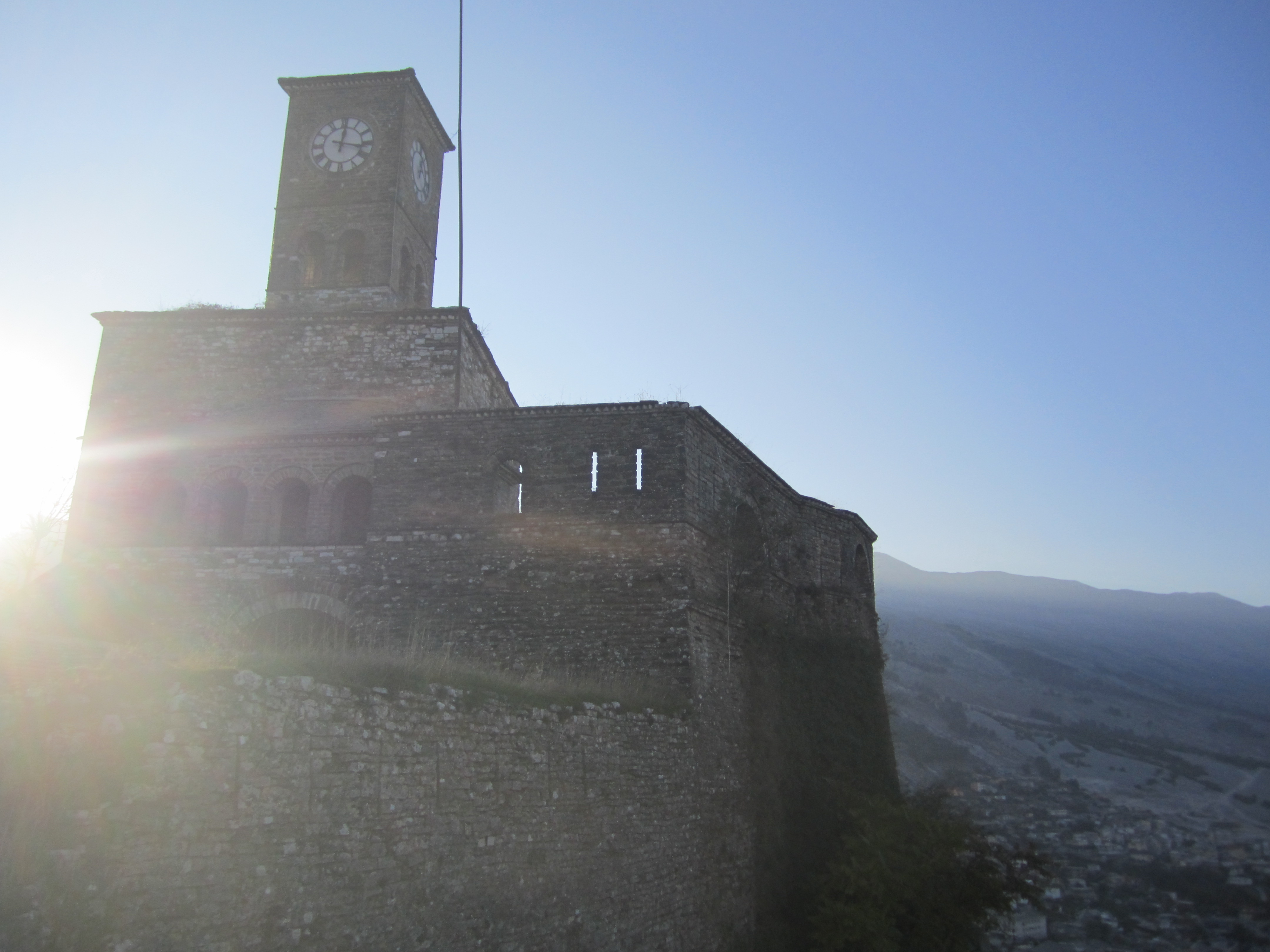
He nods. “Nice castle,” and juts his chin towards the stone mass in the distance.

“Very nice,” I reply.

He gestures whatever he’s smoking towards me. I shake my head no. “Have a good day.”

“Goodbye.”

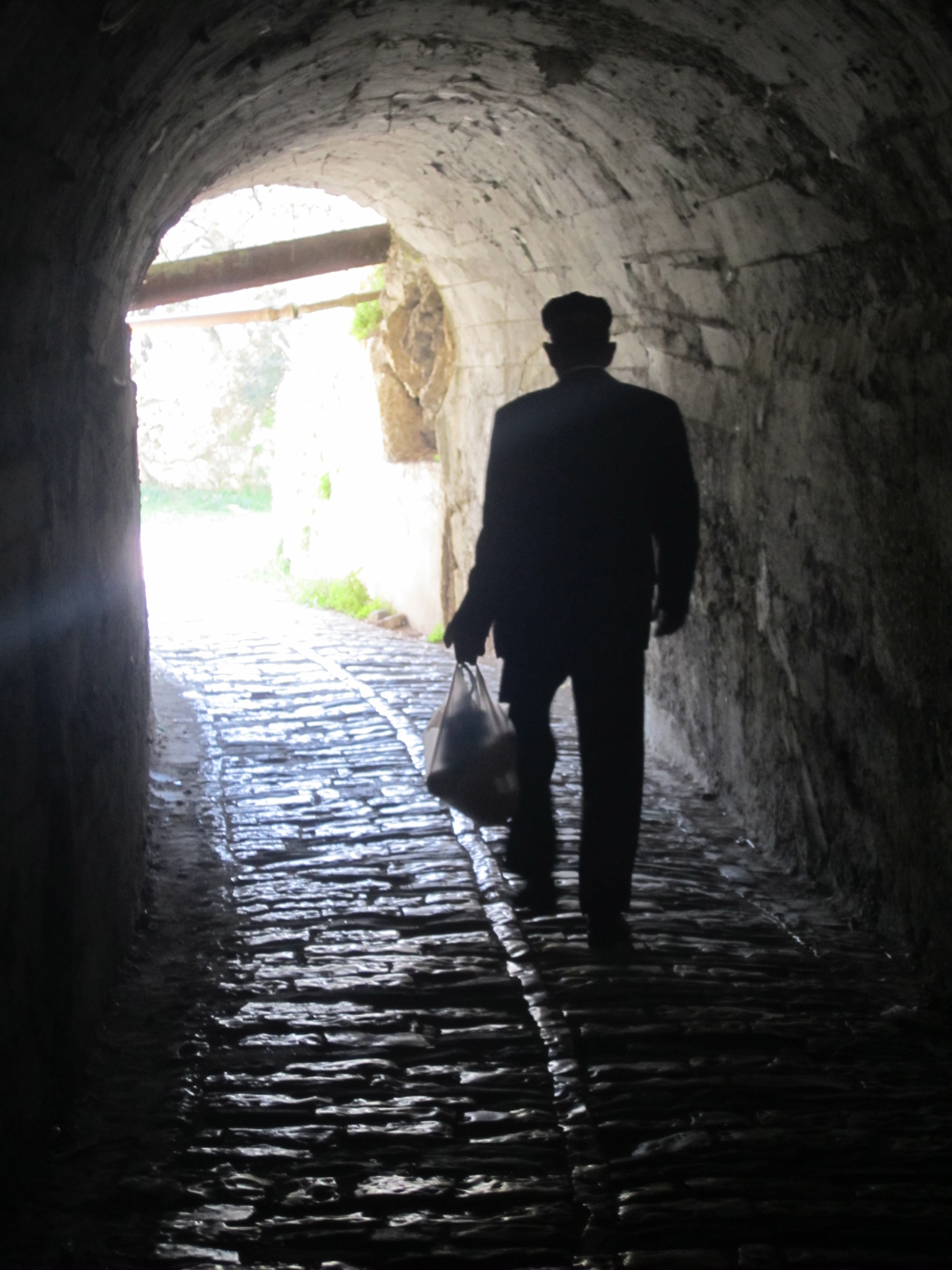
2. Cobbled road in the old town, forty-five degree angle and I’m taking it slow. Pass an old dude I saw down in the new town—has one of the most intense shoe-polish toupees I’ve ever seen, hanging over his forehead like a black awning. I recognize him and he recognizes me—our eyes meet and I smile, nod.

He smiles and asks me something in Albanian.

I shake my head.

He sighs. “Deutsch, Italiana…”

“Ah, ah,” I answer, understanding. “American.”

“Detroit?”

“San Francisco.”

He nods and throws a barrage of Albanian at me. I shake my head again.

He points to his ring finger, then me.

I laugh, wave my hands no.

A woman appears at the window of the meat market we’re standing in front of, her face obscured by the glare on the glass. Our eyes meet and I smile.

3. “Can I sit down?”

I’m scrounging the last sunlight of the day, before it slips behind that mountain and casts everything in a funny pink glow. I look up from my book and nod.

His name is George, he served me my espresso in the sinking light—he asks me where I’m from and if I have friends in Gjirokastra.

“No. But I’ve only been here one day.”

He asks me if I have a mother and father back in the States, brothers and sisters—he asks me if I have a job, and I say no, and he asks why, and I say I quit. I tell him I’m a writer. I don’t think he understands.

“Why you are alone?”

I give him the usual answer: that my friends either don’t have time or don’t have money, so I travel alone. I give this answer regardless of language barriers, because the real answer is harder to explain. Most of time, I don’t think I know the real answer.

We try to chat, but it’s awkward and fails, and then the light is gone. So I smile and nod at my empty espresso cup and ask how much. He shakes his head. “Nothing. Now,” big broken smile, “you have a friend in Gjirokastra,” and points his thumb to his chest.

Pillow Talk, Tirana (Well, Don’t Make Me Beg)

Tirana, I want to lay
my head on your naked chest,
one ear to the heartbeat, hear
the ragged breath,
1000 cars wheezing,
careening,
screaming—
a cough
like smoking meat.

Can we lay like that?—
in the morning,
between the mountains,
sun through no curtain,
this bedroom of a city
and everything that contains us—

You cut a river
through the middle,
build your bridges
likes slits across wrists—
Stare at the soggy trash
they’ve thrown there and say
“It’s a real river in the winter.”

Tell me how you’re better
at 4am,
when the wheezing unrattles itself
and the city falls silent,
each dog a lonesome bark
and we climb to the top
of that tattooed pyramid
and look at it all,
laid out there
blinking
naked
smoldering trash

and the police will chase us up
and cough at the top,
place their hands on their knees,
ask for our documents
and I’ll be too scared—you’ll laugh:
“You were scared, scared.”

Tirana, I want this:
your bone
against my ear,
hearing your organs groan,
black breath rattle
between those mountains,
your breastplate—

where you keep it,
you keep it.

How To Rock in Kosovo

Show flier

1. Get up at 5am. Ease open the lock on your cupboard and stuff your purse full of the only socks and scarves you own. Leave the key on the counter and walk through the black-morning streets. Think about how Genti said this city was best at 4am—a different place without the cars, all smooth and still; think about how you’re an hour off but how he’s right.

Meet Robo at the bus stop, which isn’t a bus stop but a street corner with two wheezing vehicles, bumpers touching like a kiss. Drink an espresso and still fall asleep before the bus leaves.

2. Wake up when your ears start popping, look out the window and see only mist—a kind of apocalyptic mist that’s mixed with pollution so you don’t know which is which—mist and trash and dogs sleeping in the median by the border control. Think of “The Road.” Hand the man your passport, remark how you thought you’d be the only navy one, have Robo reply, “The others are former Yugoslavia passports.”
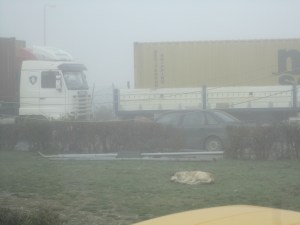
Hazy border median

It’s easy when the man comes back on the bus—he calls the names of everyone, groggy hands reclaiming documents—but for you, he just hands it over, doesn’t even look up.

3. Stop at the cafe, squat toilet and sensor towel dispenser. Eat a salad for a Euro, wrap the hunk of bread in napkins and tuck it in your purse. Robo goes across the road to the market, comes back with a bottle wrapped in newspaper and a plastic bag, “Like in America,” he says and laughs and drinks.

4. Fiddle-rock and Turkish pop, Kosovo countryside through the window: tire-less cars on the roof, pile of trash burning and man warms his hands, leans his ear into a cell phone. Dead dog in the ditch, blood-matted fur and lolling tongue. RC Cola ad. Hotel Luxory, Hotel Florida, Hotel OK—two points for honesty.

That's not a real beverage

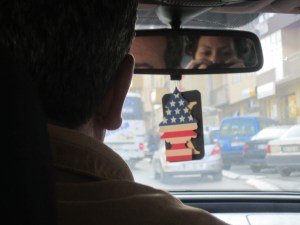
5. Arrive at the Pristina bus station. Jay-walk across the overpass and remark how cars actually stop for you. See a Bill Clinton statue, see Yankee flag and American knock-off products everywhere: American Hot Dog, American Doughnut, American Cola. Say: “They must be the last country left on Earth that likes us.”

6. Go to Tingle Tangle, a hipster coffee shop that could be in Brooklyn or SF, except everyone’s smoking, smoking, inside and out, and a 10-year-old walks by, box full of cigarettes and you shake your head no. Sit in the sun and order a cappuccino, which you find out is a mocha, and look at the macchiato Bledi orders and say, “That’s a cappuccino,” and he says, “No, it’s a macchiato.”

Word.

The kids are different here, in Kosovo, where you’ve come for a music festival called Cow Fest, or something like that. They speak Albanian, but a different type of Albanian, more slang, they tell you, looser and more wild. The kids look more European or American or something—hip in the way we like to be hip, sweaters and beards and slept-on hair—less like Tirana, where most of the kids are trying so hard to look Western they just fail—an approximation based on music videos and bad Hollywood movies, a hauty snootiness the girls assume, cheap shoes and too-much make-up, in the face of that failure. Say something about this, and they tell you, “Yes, yes”—how Kosovo’s been more connected to the Western world, how in Yugoslavia they could travel while Albania was on lock-down, how the music scene is better here but how the city’s smaller, less dynamic.

Nod and drink your fake cappuccino. See an “Occupy Pristina” sticker, and open your purse, your notebook, dig out one the Obey stickers Greg gave you, metal drawer full. Peel off the back and put it up. Wonder if anyone will know what it means. Take a picture.
7. Take a taxi to the one cheap guesthouse in town, share it with Gredy, who’s got a half-melted face and you don’t ask why—with Mardi and Marin, who you remember from last year and who remember you too. Reception smells like stale smoke in the underground, and the cupboard’s got tea cups and condoms, and the staticy TV has an “I ❤ English" sticker on it. Astro-turf-style carpet runner, crash for a disco nap—bleary limbs back awake for the walk down the hill.

8. Sound check at Oda, the theater where the festival will be: velvet wallpaper and cement floors. First espresso’s free. We leave Mardi there, cello and guitars—walk through a shopping mall where Marin stares through the window at hiking boots, “They’re all shit in Albania”—just finished another season tour guiding and wants to get out of the country fast (Pristina doesn’t count), wants to go to Rome or Berlin, wants to play the guitar, wants to meet a nice girl.

But first he wants a hamburger, so we go to Route 66, an American style diner with the requisite Monroe/Dean/Elvis pictures, and a Mexican section on the laminated menu. Shake your head and order the sorriest, soggiest salad you've seen all trip.

9. Walk the town, the cold hurts: back to Tingle Tangle, over to the opening of a photography exhibit where they play Son House and you laugh. Some other smokey bar, always a smokey bar, and, no, you still don’t want a drink. Clear liquid in short glasses, a kind of grappa, and you feel like you’re in the way. Walk again, and the cold still hurts.

10. Go back to Oda, wait for the first band. Proceeds from the festival go to purchase cows for local farmers in need, and you ask how much a cow costs—“500 Euros.” Figure out your entrance bought 1% of a cow. Try to figure out how many people there are, how many cows you’ve bought so far. “It was bigger last year.”

Marin’s bummed cause the DJ he wanted to see has canceled, and Robo stands in the back, and the first band sucks, a jazzy quartet with a hip-hop-style MC. Go for another walk, the cold colder—buy chestnuts and sit at a table in the mall, shedding shells and tell Robo your writing dilemma and ask for advice. It’s slurry now, but solid. Nod and know what you have to do.

11. There’s a fleet of teenagers back at Oda, and the floor is sticky and a punk band is playing and they’re decent, despite shotty vocal levels. Nod and watch the limbs of a mini-pit thrash, silhouette against the stage lights, not too unlike home. You’ll decide later it was the best band of the night.

The next band “is real shit”—girl with dreads pinned into a bun, scatting while the band jams, but no real set, no real songs—so you sit against the back wall with your knees to your chest, which reminds you of being a teenager. They’ve only raised a cow and a half so far, “Last year it was seven,” and they say how the show wasn’t promoted this year, how everyone was fighting, how another band canceled last minute—how still, the scene is better than in Tirana, where they’ve nearly stopped having shows, where it’s all cover bands—“We lost our best guitarist to Pristina!” Marin exclaims as he grabs Bledi’s cheeks.

Decide it’s still decent enough to rock to, and nod your head, even though you’re sitting in the back and you’re tired, which is how you rock anyway these days—“Granny style,” you tell Robo and laugh, as he takes another swig from his plastic-bag bottle, America-style.
Lauren Quinn is a writer and traveler currently living in Hanoi. Lonely Girl Travels was a blog of her sola travels and expat living from 2009 to 2012. She resides elsewhere on the internet now.

Join 490 other subscribers

Buy This Sh#t

Categories