Archive for the 'Places' Category


No Prayers in Shkoder

Exercise: 20 minutes of contemporaneous note-taking, cafe in Shkoder.

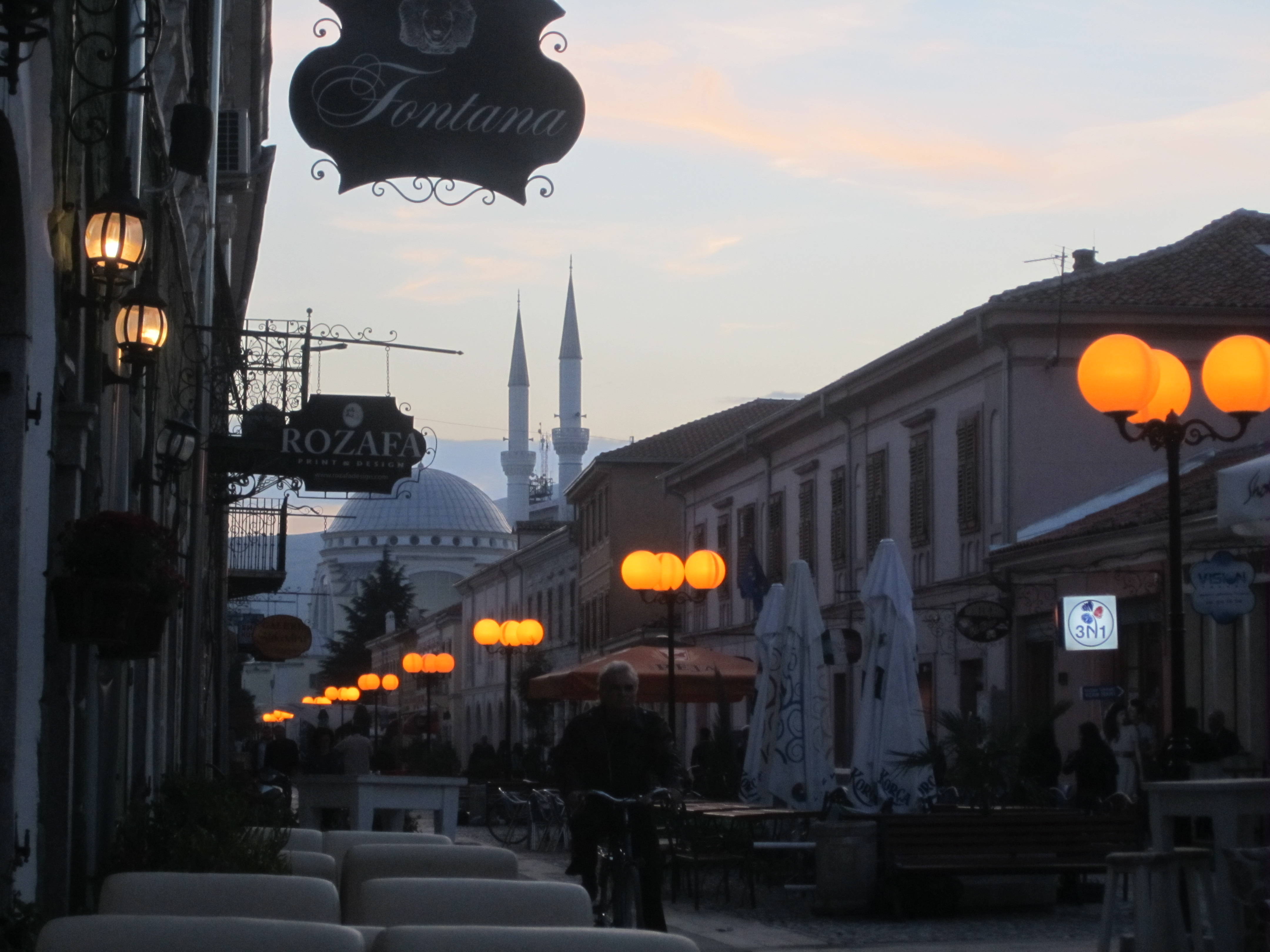
Click of heels on stones and bass of techno, bicycle chains and conversations. The lamps click on their orange glow, against the minarets and mountains. Two men in business suits behind me, speaking accented English and I have to turn and look, have to stop and snap a photo of the pedestrian walkway—Albanian for picturesque, which means that if you take a picture just of it then it could be Croatia or Montenegro—leave out the tin roofs and rubble, cats in the trash and the smell of something rotting, which you couldn’t photograph anyway. A chill and I check my phone for a text that hasn’t come.

“Runaway Train” comes on the cafe next door, and I think of the “10 year delay,” and wonder if it’s more like 20 years here—remember the dreads and the video, my parents’ living room, thick rug on bare feet and the feeling of being safe.

A dry claw in my throat but I keep smoking—rumble of a motorbike—young girl in a pink parka, sunken eyes—“Somehow neither here nor there.” Women sitting sidesaddle, cross of the ankles and stockings that bunch like that—wrinkles.

Iggy Pop and the lights on the minaret twink on. But it’s dusk and it’s silent and I wonder where the prayers have gone, my own book sitting closed in my purse, haven’t wanted God in any of this (a dry claw, I keep smoking)—listened to my own fable, “see the bright and hollow sky”—which part of my is still in New York?—track suits and tight jeans, spiky hair and lanky grins.

Evening stroll hour, though it’s not like Phnom Penh—the limbs don’t swing but sit tucked into pockets, in the crooks where elbows hinge, old couple, walking into this, through this. Two backpackers walk up, table where the business men have left, stubs still smoking—“Oh here”—hoist bags off and sit.

And the adhan begins to whine and echo, a ghost everyone ignores—but I’ve ignored my own prayers, not forgotten but avoided, God like a lighted tower between the buildings, and I wonder what it takes to become the man who sings out those prayers—what training? And then the Christian church bells chime, 6pm, and the man hits a higher note and holds it, “and I ride and I ride,” and the motorbike engine cuts on and the heels click and I’m still nowhere but here—Albania at dusk.

Notes on Flying Into Albania

At the Bergamo airport outside Milan, and I’m in Albania before I’m in Albania.

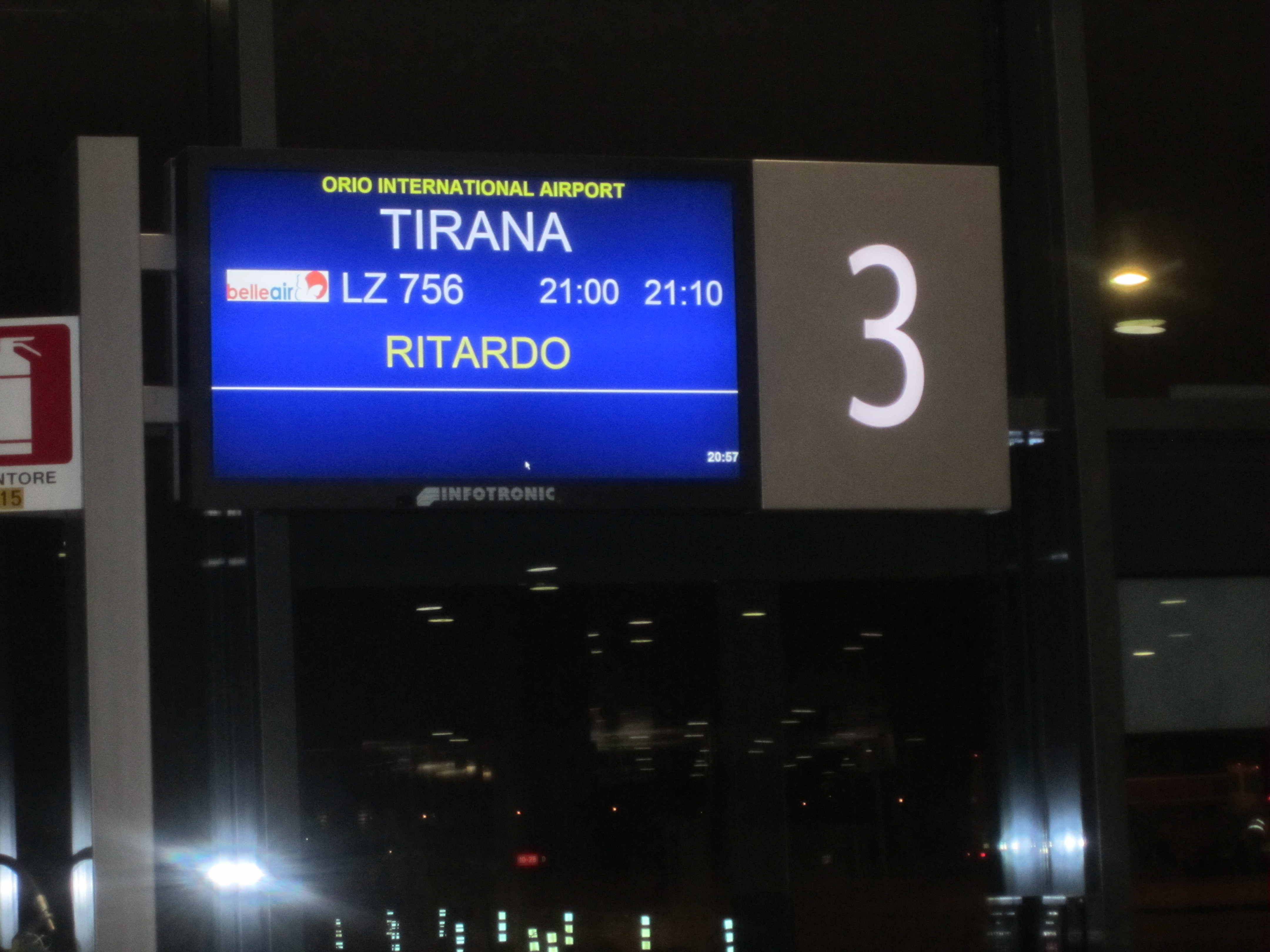
Waiting at the gate, last flight of the night and it’s delayed—“ritardo,” which sounds like “retarded” and I laugh and take a picture, and get those sideways glances—“Girl, you’re not from here.”

And I’m not—one of the only people at the gate that isn’t Albanian, clutching a red passport and the clothing suddenly different, so un-Milan, where even the dogs are better groomed that me. At Gate 3, it’s faded loose blazers instead of crisp fitted ones; it’s cheap haircuts and scarves tied over the heads of old women. It’s scuffed low heels and calf-length skirts, thin linen—it’s hard faces, jaws and brows more pronounced, and skin chiseled too, even in the children—chiseled, as though the expressions were carved out of some kind of different living, different reality, and you could never quite assimilate, could you? I think—No.

I’m wrecked tired, stayed up till 5am with the Le Fooding kids, slept maybe 4 broken hours, and I’ve got a bottle of Pelegrino and my headphones cranked up, tapping my foot through a caffeine haze just to stay awake. Glances snag on me—not Italian, not Albanian, what the fuck?

An hour after we’re supposed to leave, and a shuttle bus pulls up to the gate. People push and jostle; a man tears our boarding passes, which look like they were created in MS Word, printed on Xerox paper, glossy-thin. The bus smells like wet and feet, and it lets us off at the stairs to the plane, which bears no markers, no logos, a surface so lumpy it looks like paper-mache. We scurry in through the cool Italian night, breath clouds and blinking lights.

They’ve got the first ten rows blocked off—I remember this from my last Belle Air flight—and I can’t really discern why. People push and prod, they yell instructions to each other over, motion over the heads, and I can’t discern that either. There’s an old woman in my seat, and the seat next to her, and I show her my ticket and she shakes her scarved head as if to say, “No.”

I shrug and the stewardess—dolled up like a retro Pan Am attendant, hair pinned and orange hat tucked jauntily to the side—she shrugs and motions me up to the front of the plane, to the unassigned rows, and I grab an extra seat.

A staticy safety announcement rushed through in 3 languages—sounds like the voice in a fast-food drive-thru—and it’s too quiet for me to hear anyway over the mechanical groans of the plane. There’s nothing identifiably “Belle Air” about the plane, save the cloths on the head rests, and I decide it must be some kind of generic rent-a-plane, which doesn’t make me feel terribly confident, but I close my eyes and wait for take-off—though really, in a lot of ways, all these ways, I’ve already taken off.

We take off, and I watch the lights of Milan dissipate, fade—goodbye Western world. We’re cruising at news-helicopter altitude, it seems, and I feel like I could reach out and touch the little lights, the clouds that snag on the wings and eventually swallow everything, everything.

The cabin lights keep dimming and brightening, like a kid playing with a switch. Outside, the sky crackles a yellow flash, illuminating the shapes of those clouds, and I imagine the static clinging to us like clothes from a dryer, or when a silent electricity is in the air and you don’t know it until you touch something and get that little shock—in the black above the Adriatic, but we’re already in Albania, a rattly, groany little generic bullet of Albania, carrying Albania through the sky.

Lights appear and we start to sink. The scarved woman in my seat stands up—she opens the overhead bin literally as we’re landing, the first bump and rumble, and others follow suit as we taxi, and the stewardesses stare ahead, bored-looking and don’t bother to point out the seat-belt sign or tell us to sit.

Another flight of stairs, another stinky shuttle bus, and a mad rush to the immigration desk. It’s a quarter-size line at the “Foreigner” counter, though I could have sworn I was the only non-Albanian, and a man elbows me to get there first, waves his wife over, and it seems like a monumental rush for nothing, so I just let out a half-laugh and watch.

A faded dim stamp I can barely read, slammed on top of another stamp, and I wonder what the point of it is. Three luggage carousels that all read flights from earlier that day. My backpack finally appears, on its side amid the luggage mummified in neon shrink-wrap.

No buses at midnight, so I grab a taxi, and he drives between the lanes, over the lanes, flashing his high beams like lightning or static or the cabin lights that could never sit still. We cruise into Tirana, and I see familiar sights—the crepe stand I liked, the gaudy shopping mall, the dug-up square beside the national museum, the statue that sits amid the construction like a warrior in a dead battlefield, the broad empty road where the futbol crowds shot off smoke bombs.

It’s like a boy I’d met once, thought I’d really liked and kept on thinking about, retelling the story to myself so that eventually I didn’t know if it were true or not anymore, if I’d made it up or not—but I’m back and it’s still all there and it’s real and I can’t help but smile at that—Tirana, Tirana, sleeping and dark but still as I left it.

The taxi stops at the gate to the hostel and the driver helps me with my bags and I pay him and then he pauses and looks at me, nods and smiles, reaches out to shake my hand—maybe because I’m American and he knows that’s what we do, I’m not sure why. But he shakes my hand and I shake his and he pats me on the back and I ring the bell and now I’m in Albania, really in Albania—I’ve arrived.

Pizza and Love in Milan: Le Grand Fooding Milano 2011

The way to a man’s Italian’s French hipster’s anyone’s heart is through food. Especially pizza.

This is the main lesson I came away with from a weekend spent at Le Grand Fooding Milano. The others included: Italians don’t know what aioli is; there’s really no such thing as “Italian” food, and Northern Italians are shocked and somewhat scandalized by white pizza; Nespresso isn’t bad; there is perhaps no one more effortlessly chic and hip and fucking nice as a French foodie; as such, I will never be a Le Fooding girl; and it’s pretty easy to crash a food festival (and sneak into a Sheraton) as long as you work hard and smile a lot. And know the right people.

I spent the last weekend in Milan, at a three-day food event put on by the French culinary guide/movement/cultural phenomenon Le Fooding. While not terribly well-known in the States, they’ve been around 10 years in France, stirring shit up and throwing parties and breaking rules and basically being the anti-Michelin Guide.

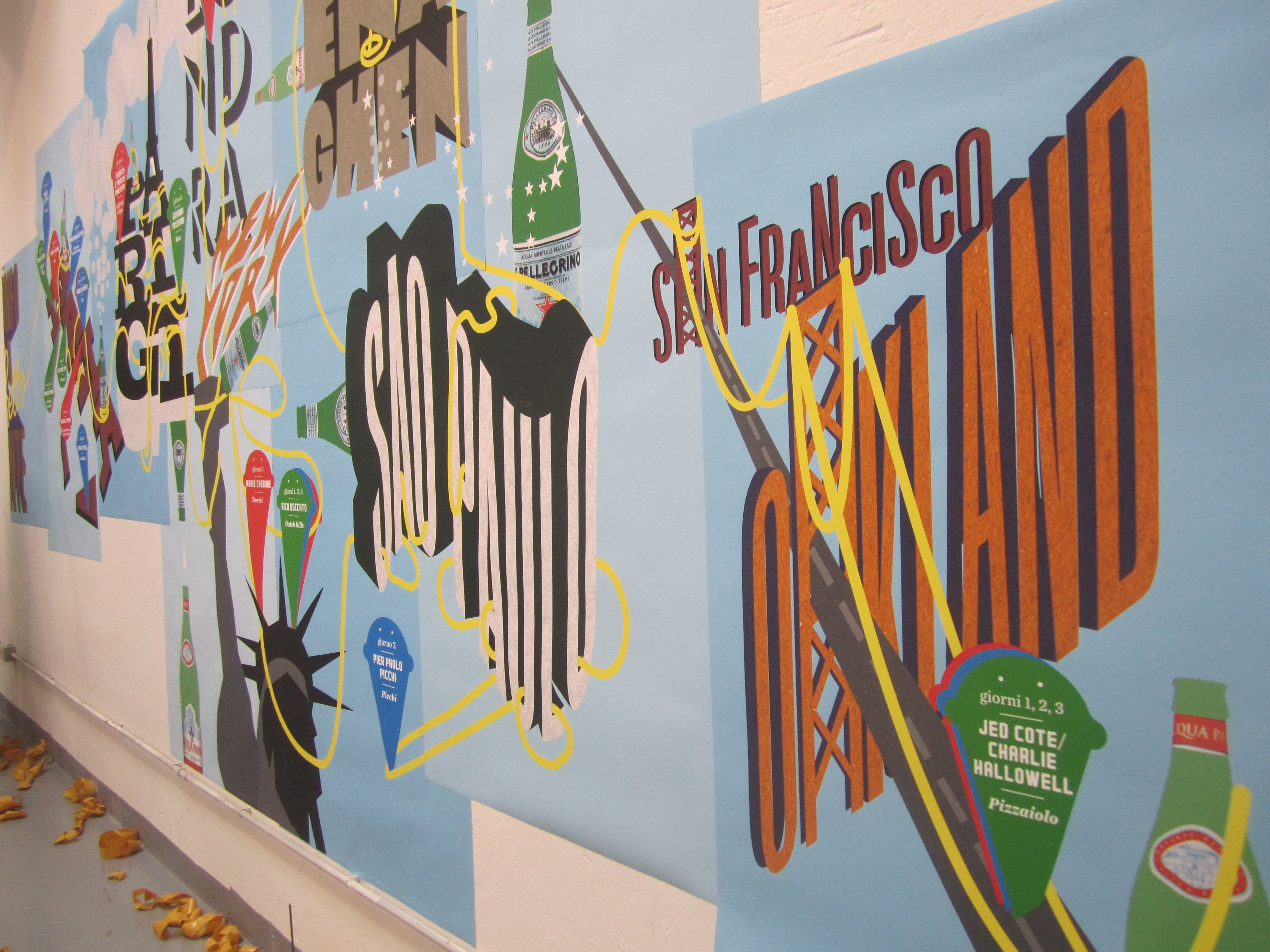
The theme of Milan’s festival was international chefs cooking Italian food versus Italian chefs cooking Italian food, and, being one of the better-known Neapolitan-style pizza restaurants in the US, Pizzaiolo (where I waited tables for the past year and a half) was invited to attend. My co-workers/chefs Jed Cote and Jason Loeb were flown across the globe, put up in a Sheraton, given a pizza oven and prep kitchen and about 100kg of squid, and sent to represent us.

And, since I was in Italy, I decided, you know, what the fuck—I’m going too.

So I showed up with my backpack and messenger bag and hoodie and crashed the party.

Represent!

Well, it wasn’t crashing exactly. We just figured that if I showed up to the San Pelegrino prep kitchen with Jason and Jed in the morning, hung out and sliced tomatoes and picked herbs and shit, and if I rolled with them to the event, just acted like I was supposed to be there, you know, that it’d all work out.

And it did, and it’s a good thing it did, cause it turned out to be one of those races to the finish, getting the pizza dough right, and cutting the squid, and plating and serving all the slices at the party. More than just a freeloader, I ended up being really useful. And having a rocking good time.

In all its glory

We were there making one of our signature pies (and one of my favorites)—a squid, cherry tomato and aioli pizza. Simple, makes the most of our Northern Cali goodness—abundant, sustainable squid supplies, bomb cherry tomatoes in the summer. We were contracted to pump out 50 pizzas, enough to feed the 300 guests each night, in the hour and a half before they went into the dining room for the seated dinner featuring four dishes from four different chefs.

Hella squid

We spent the mornings prepping, and one of the things I wasn’t expecting was how different the ingredients and facilities would be. Of course, the very premise of the event brings up issues of authenticity, of what happens to a cuisine when you take it from its home and drag it across the planet like… a spaghetti noodle (thus the name). But I didn’t anticipate how the location change would affect our own pizza. Jed and Jason brought their own yeast and used the same OO flour we use at the restaurant, but the squid was larger in Milan, and the tomatoes were more like small Romas instead of Sungolds and Sweet 100s, and less acidic and sweet. We also had a smaller mixer that required 4 batches to make our usual one; we also transported the dough to the event in a trash bag (classy). The pie didn’t end up tasting exactly how it does at home, and I guess that’s part of the point—that locality is crucial, defining, and that when foods travel, they change.

Trash bag dough!

At the event space, which took “industrial chic” to new levels, I hung out while the boys got the fire cranking and set up. It was some truly awesome people-watching. All the Le Fooding people were young and impossibly chic in that particularly Parisian way, cardigans and scarves (the boys) and little boots and tights and drape-y tops (girls), and a look we dubbed “the urban equestrian.” In my younger, less settled incarnations, I would have spent the time comparing myself to them and ultimately feeling shitty about myself. But now it was just comical—“Do we even grow girls like that in North America?” I asked my friends, and they shook their heads so fact I thought they might fall off.

Le Fooding girls

It was kinda like the squid and the tomatoes.

There were also tons of Italian crew setting up, working on the lights and such—they were less chic, more working class, in their cargo pants. Then there were the security guards and the phalanx of confused-looking 18-year-old assistant cooks/mignonnes, and the caterers—and everyone chain-smoking, chain-smoking, like it was their job. (One of the girls at the arancini stand was smoking while she set up the deep fryer…)

The people attending the event were a different breed—mostly middle-class, middle-aged Italians, with a sprinkling of hip folks and a whole slew of media. While the boys cooked, I plated slices, and talked to folks.

“Pizza di Oakland,” I heard people mutter.

“Pizza di Aukland?”

“No, America. Near to San Francisco.”

“Ah, pizza di Oakland! This is how you do pizza in California?”

“Well, this is how we do pizza.” And a wink and smile.

But the real test was the reception, which we seemed to win. People were only supposed to get one slice, but, as per our stuff-everyone philosophy, we’d prepped enough for 20 or so extra pies. So I got the catch people’s eyes as they tentatively looked over, tried not to hover, and I got to smile and motion for them to eat another. And another. Kill em with kindness, but also with food.

At 8:30, the Le Fooding kids ran a little bell and herded everyone into the dining room. Which is when the real fun started. Technically, we were done. But while the important chefs scurried around with their mignonnes, plating 300 dishes, and a crew of young caterers lined up, wearing all black with fucking headlamps on, like it were a Vegas show—we got to do what we love best, which is love on people.

It’s part of the whole Pizzaiolo philosophy (and the reason I loved working their so much)—to love the shit out of people, through food. So we started cranking out the pies. First some of our neighbors: the arancini girls and the Mumm champagne kids, and the guys at the next pizza oven, from Pizza East in London. Then a couple for the security guards and the people working the front door. How about the two gender-ambiguous Filipino cleaners? Of course! The endlessly hungry-eyed mignonnes—sure! Hey you, founder and director of this big-deal culinary movement—you get enough squid? How bout you, firefighter? You cold, Pelegrino girl?—come huddle by the pizza oven for a few minutes.

Cause that’s what it’s really all about, right? That’s why we call it breaking bread, why we mark important events by gathering for meals, why every fucking culture in the world comes together for food. It’s about love and building relationships and making friends, not cause it’s gonna get you something or somewhere or even a reciprocal drink/dish/whatever, but because that’s what we do—that’s what cooks get into the business to do, and what I, it turns out, love most about the industry: the simple act of feeding people.

And that’s what I think, after three days, that Le Fooding is all about to. I’d scoured the internet for English-language articles about them, and the main thing I’d read from the big American food critics is that they didn’t understand what Le Fooding wanted, or what they were trying to do (reminds you of Occupy Wall Street a bit, huh?). But after the weekend, after seeing how intensely we broed down and how food enabled all that, became a kind of edible language, when real language failed—it’s not that hard for me to understand what they want. They want that: love.

By the third day, we knew everyone—everyone stopping by to say hello or waving as they passed—and we partied late into the night on Saturday, dancing and smoking and exchanging hugs and email addresses. And it came out, you know, that I wasn’t a chef and that I’d just kinda showed up, but there was so much love no one gave a shit—they gave me those French double cheek kisses and wished me well in Cambodia.

And it’s a shame to be leaving the restaurant industry after such a weekend. But, as Jed said, “Way to go out on top.”

And with a lot of fucking love. And a belly full of pizza, which I’ll miss almost as much as the love.

Loved these two!
Gaeta, Inbetween-itis, and Why I Love a Beach Town in October

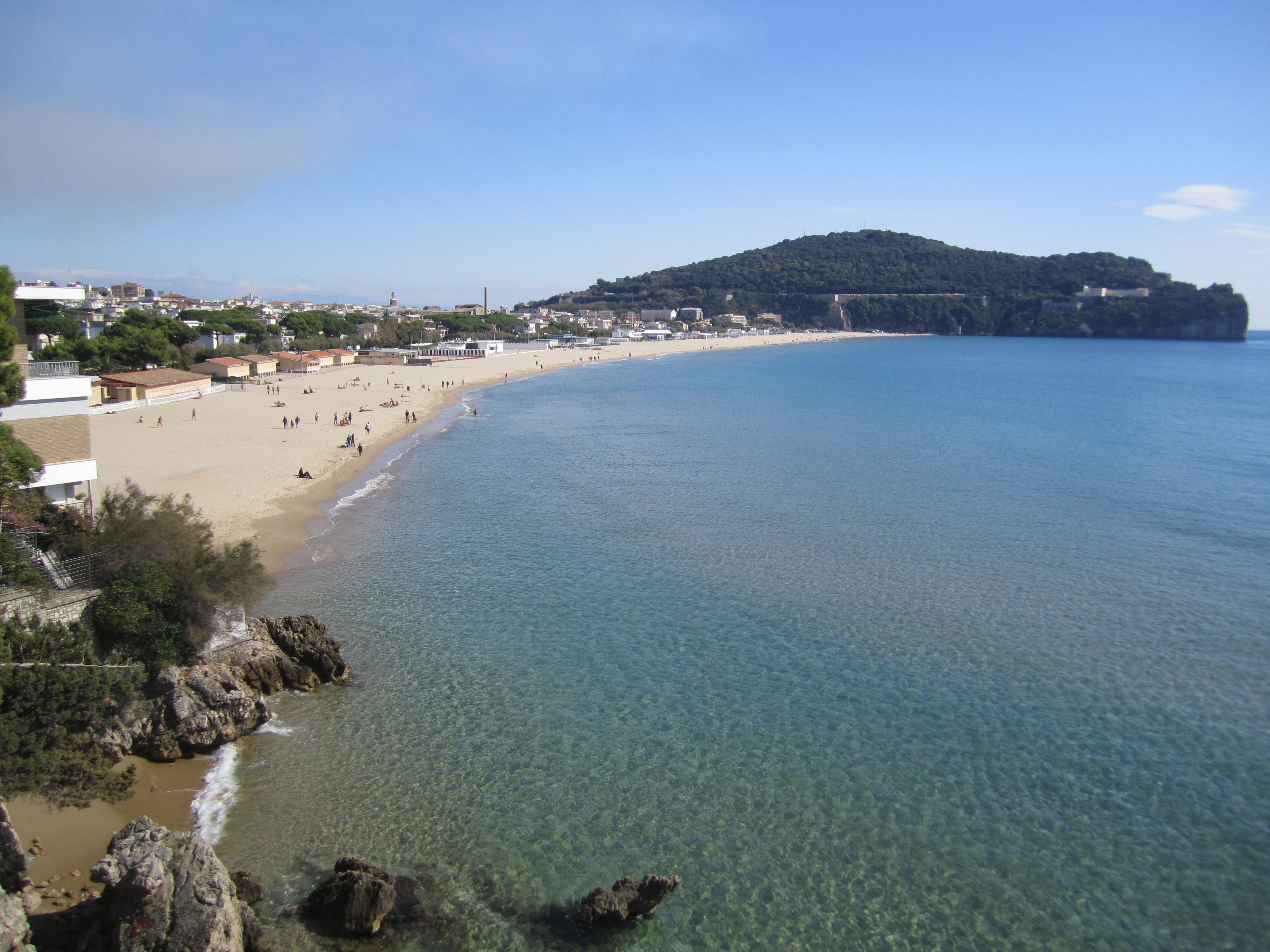
This is what I wanted: a chill, cheap beach town to hole up in and write for five days. This is what I got:

So, sometimes, success can be yours.

It starts because I have six days to kill in Italy, before meeting two chef friends at a French food hipster festival in Milan. This is what’s known as a luxury problem—a problem only because whiling away a near week in Italy means whiling it away in Euros, when I’m already short on funds. Plus there’s the hassle factor: I’m moving across the world, so I’ve got a lot of crap with me, and hauling it on this train and that bus and down some cobble-y old alleyway loses its charm real quick. All I wanted was to find somewhere mellow, about to shut down for the season, and park it. Catch up on writing and sleep, maybe do a couple yoga podcasts.

So I sent out a Twitter blast and emailed Liv over at I Eat My Pigeon, did a bit of Tripadvisor digging, and ended up in Gaeta. Cue the lights and music.

It’s kind of like having a really specific craving for, say, calamari, and stumbling upon some of the best damn squid you’ve ever eaten—same level of deep satisfaction. Which I don’t think many of the locals around here get, cause it’s the number one question I’ve been asked (after, you know, “Where are you from?”)—“Why Gaeta? Why now?”

A beach town in October is one of my all-time favorite things. Take last year’s Sveti Stephan, or the previous year’s Legzira Plage. There’s something about the end of the season, hot days and cool nights and everything twinged with nostalgia and pink. The businesses are all half-shuttered-up and the crowds have thinned and you’ve got the place, not to yourself, but to share with the locals and the last straggle of tourists, who you feel a sort of aren’t-we-oddballs comradery with.

And the room rates drop like mad.

So really, what more could a cheapskate blogger want?

I uncovered the B&B Un Letto A Gaeta on Tripadvisor, and decided that even if I couldn’t read the Italian reviews, it was still a good sign that there were four and five stars. It’s on a hill above an olive orchard, run by a dude with a killer record collection and good taste in art, and my private room is less than half what it cost 2 months ago, in the height of the tourist season.

I unpacked my bag five days ago, and let it become a little like home.

Proof I was there!

I got the chance to meet up with Liv, the International Woman of Mystery behind one of my favorite narrative travel blogs. We cruised around the region, known as the Ulysses Coast (cause apparently this is where it all went down)—we went to some of the neighboring towns and I got to glimpse into her life. She blogs mostly about the daily life of an expat, and it felt almost like walking into a novel you’ve read, and having it all be real, right in front of you—this character and that character, her friends and the cafe she writes at. (Someone was occupying her favorite table when we were there.)

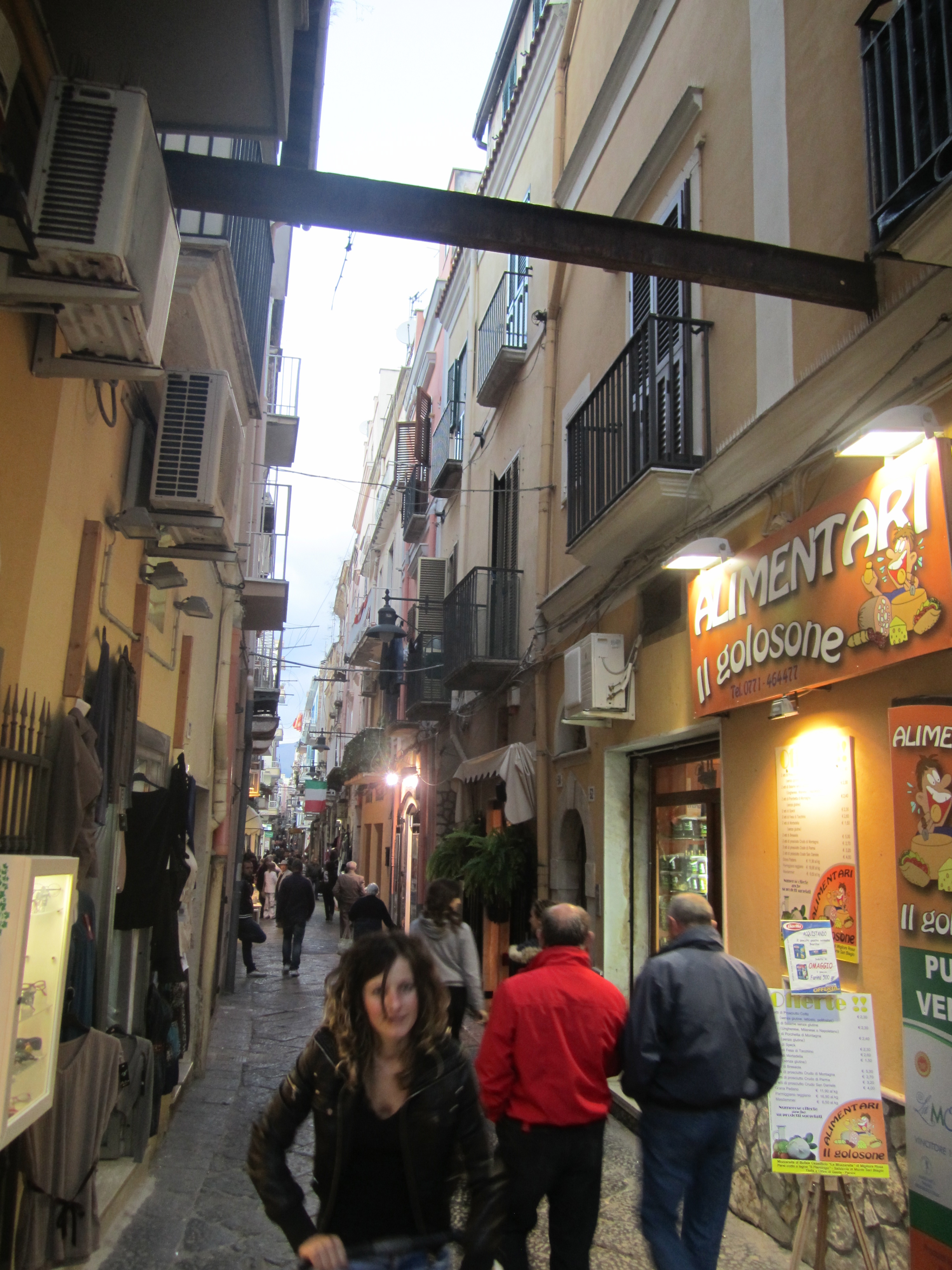
We strolled around the ancient quarters and paused in front of Roman ruins and talked about writing and the freelance hustle, about expat life and being solo females. It feels good, the more expats I talk to and the more writers I talk to—less like I’m making some sort of horribly rash and insane leap, and more like a logical step in my career. It makes it all feel achievable and, well, normal.

Of course, though, she told me her friends had all been curious: they wanted to know why Geata, and why now?

The only other person occupying a room at the B&B also wanted to know—a college kid from Torino who’s renting a room for a few months while he studies here. I gave him the stock answer: “I love a beach town in October.”

Which is true, but it’s really more about the funny inbetween state a beach town in October encompasses. It infects you, and you become inbetween too. Locals have their guards down a bit more, and they start to recognize you, as you jog around in the morning or buy paninis or drink espresso, and they wave and say hello (in English cause you can’t ever manage to learn any Italian). You’re a tourist, for sure, but not an all-the-way tourist; in October, you’re something else. A familiar stranger, maybe—something inbetween.

Cause I’m here but not really here. I’m on my way, moving across the world, and I feel like I don’t have a right answer for those “Where are you from?” and “What do you do?” questions. I’m not a “signora” and I’m not a “signorina.” I’m a traveler, in transit.

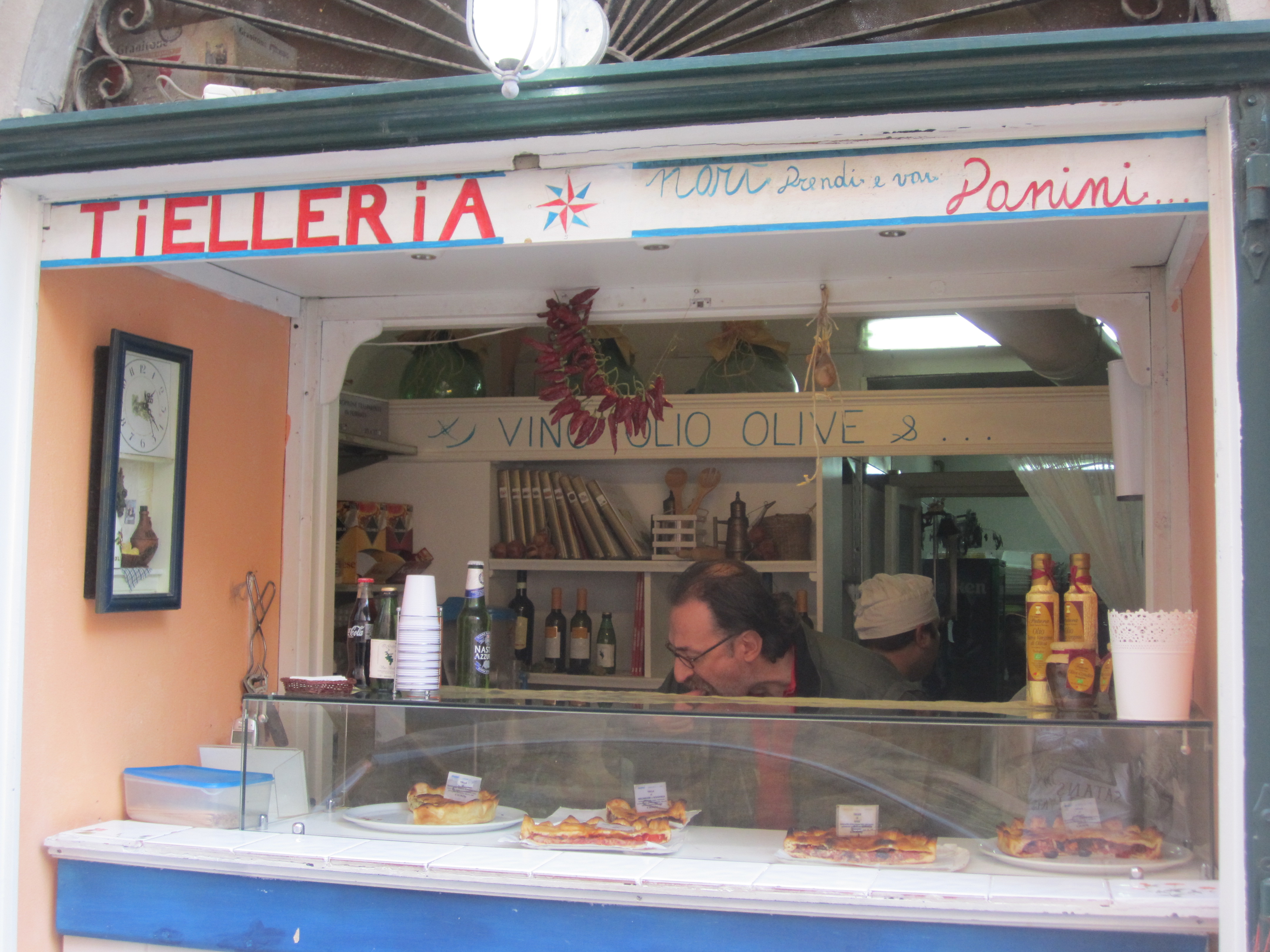
There’s a local specialty here, called tielle. It’s—get ready—like a savory pie stuffed with local calamari and olives and other good shit. It’s off the chains. I went with Liv for lunch to a super cute little spot in the medieval quarter of Gaeta; a few days later, after a rambling jog across town, I bellied up to their take-away window and ordered a slice.

The owner recognized me, said hello. “You are lonely today?”

I knew what he meant—I was alone, not with Liv. But the question, you know, in light of the name of this blog, struck me as funny. Cause I wasn’t lonely, cause he’d recognized me and so had a dude that had served me espresso the day before, who’d honked and waved as I’d panted up a hill, running—cause it was a beach town in October, one of my goddamn favorite things.

I smiled. “Yes, I’m alone today.”

Occupy Nazionale Street: Yes We Camp and Entering the Underbelly

The helicopters throbbed in the pink dusk above Rome. Police cars parked diagonally, blocking off the black-stone artery of Via Nazionale, usually clogged with cars and buses and motorbikes. You could hear the echo of chants, megaphones—see a crowd assembled, way down there, at the street’s end. The stone gleamed like water.

It was not a particularly Roman moment. Or maybe it was. At least, it wasn’t the Rome that the tourists thronging the sidewalk had come to see. But I suppose that’s the thing about Rome: it’s got all that history, but it’s been a continually inhabited city too. It’s not a museum; people still live there.

When I’m in Rome, I always think of that scene in Fellini’s Roma, when they’re trying to build a Metro stop and they find some ancient villa beneath the city. It’s a Catch-22: you can’t just bulldoze the shit, it’s got archaeological importance and is beautiful, beautiful—but fuck, it’d be nice to have a functional Metro system too.


“Entering the Underbelly”


“Frescoes”

In any event, I was taking an evening stroll, sat on a bench and noticed what we used to call a Ghetto Bird whomping around in the sky above the historical center. Hmmm, strange. Strolled more and reached Via Nazionale, which was largely shut off by police cars, men in uniforme standing around, waving traffic away. (You can only imagine the clusterfuck of Roman rush-hour traffic this created.)

Way down at the end of the street, towards the uplit splendor of the Palazzo delle Esposizoni, I could see a mass of people gathered, making a small ruckus. I moved down to check it out.

Around me, the sidewalks were swarmed with tourists. That’s the other thing about Rome: it is un-fucking-real to me how many Americans there are there. You know, they always talk about how Americans don’t travel, but you really wouldn’t know it from the looks of Rome. Or maybe it’s just that we only go to two places: Paris and Rome. I mean, Rome’s great, but it kinda makes me want to pull people aside, let them know, you know, it’s a big world out there. And with an American passport, you can go see a lot of it. But I suppose I understand the appeal—so much history, and for us, a country with so little, it’s mind-blowing.

Anyway, I spotted a guy with a big phat professional camera around his neck, watched him go out into the middle of the empty street and crouch down and get what I’m supposing were some phenomenal shots of the crowd. I wandered around and fiddled with the settings on my point-and-shoot and eventually gave up and walked through the crowd.

The steps of the Palazzo were littered with kids, 20-somethings, smoking and drinking and eating and talking and huddled up against a night that must have felt cold to them. Further down, near a makeshift mesh-fence of a police barricade, a couple hundred Roman young people milled around, toting signs and starting chants and calling into a megaphone and generally looking like they were waiting for something to happen.

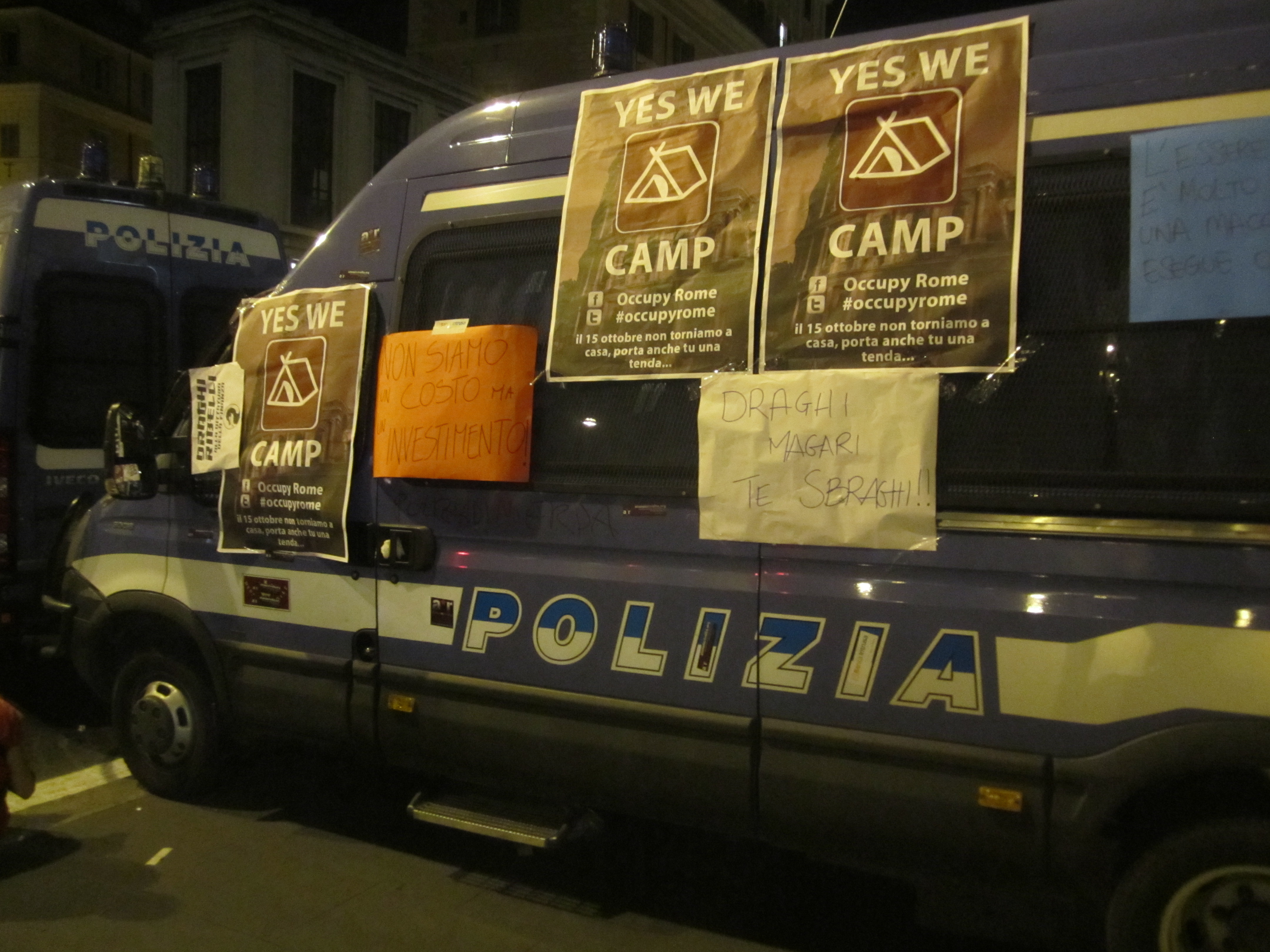
Nothing ever did. A couple of the police vans had signs taped to them: “Yes We Camp.” A sit-in/camp-in, a protest. I stay vaguely abreast of world politics enough to know that the economic situation in Italy is fucked—not as fucked as Greece, but not great. Unemployment is high, the economy’s in the shitter, and that day, October 12, it was announced that the Prime Minister would face a vote of no confidence.

So people have a lot to be riled up about, a lot to protest and fight against. But it felt sort of anti-climatic, to be honest—all that great width of Nazionale shut off, the helicopter and fleet of cop cars, and the protest felt modest in comparison. Protesters were pretty well-behaved and I lingered for a good half-hour, without anything really happening.

But here’s the thing: it was oddly reminiscent of the protest I’d passed by the previous week—you know, that Occupy Wall Street thing. Some of the signs protesters toted had references to it, and the spirit seemed largely the same: young middle-class people upset and in the street. Of course, the “Yes We Camp” referenced the Obama campaign and, further back from the crowd, someone had hitched a tent in the middle of Nazionale, anti-capitalist signs out front.

All I could think was: Shit’s spreading.

What that means, I dunno. No one knows yet. And that’s the exciting thing, the thing that I gleaned the most from my visit to Occupy Wall Street: it’s not so much about the thing itself (which one writer likened to “the grass seats of a Dave Matthew’s Band concert”), which can be frankly underwhelming—it’s about the conversations it’s starting, the sparks it’s creating, the reaction it’s evoking from the powers that be: threatened evictions and street closures and a Ghetto Bird in the sky above the tourist center of Rome.

Shit’s getting stirred up, people are getting engaged for the first time in what feels like forever, and you can’t contain that. Especially not now, in our era of social media. It’s cool as hell.

But this fight wasn’t mine, and besides, it was largely in Italian. So I trundled off to the English-speaking meeting I’d come to Via Nazionale for, and later went back to my B&B and Googled the hell out it. Turns out it was a preview of coming attractions: bigger protests are planned for October 15, today. And I’m out of Rome now, in a quiet seaside town about to shut up shop for the season—but I can still follow along on the internet.

And that’s the thing about this era, this fight, which is so strikingly similar to the fights popping up all over the globe right now: it’s a living thing (like Rome), and you can follow along anywhere, and you can live it too.

For more/better photos, follow this link.

Rome, Like a Cannon Shot (Bella, You Must Be New At This)

I come into Rome like something shot out of a cannon—hair blown and thirsty, sweating in the thick denim and long layers I had to wear cause they wouldn’t fit in my backpack.

It started with the fact that my flight was 2 hours delayed. Which really started with the fact that I’d gotten about 7 hours of sleep in the 2 days prior; that I’d stood on a rush-hour E train all the way to the airport, all 60 fucking pounds of luggage draped around me so that my right fingers went numb holding on to the metal railing; with the fact that I actually nodded out a little bit at the terminal, all the eager/antsy middle-aged tourists in their neck pillows and compress socks buzzing around in anticipation of when the plane would actually arrive.

Couldn’t really sleep on the red-eye, which is rare for me—it was more freezing-cold than usual and since I’ve decided to bring half my closet with me, I didn’t have room for an extra blanket, which you really only need on flights and trains and buses anyway. But when you need it, fuck, you need it.

So I land with, what now?, 12 hours of sleep in a 3 day period? Doesn’t really matter anymore. Part of the trick of not ever really getting jetlag is that flying makes me so wonky, I’m out of it anyway, so I can rally and stay up for hours, or I can crash immediately. Or I can blaze bleary-eyed through a gleaming-stone ancient city and make all those novice traveler mistakes I like to think I’ve outgrown.

Get waved through immigration with barely a glance at my passport. This happens to me sometimes, when entering the EU, which is supposed to be all tripped out on the xenophobia tip, but I guess that only applies if you’re not white American. There isn’t even a long line—homeboy just glances at my picture (which doesn’t even look like me anymore, people tell me), his fingers barely grazing it, before pushing it back through the window, flicking his wrist and dismissing me. So, okay, that means I can stay forever, right?

But I’ve done this trek from Fiumicino to Termini enough times that I could kinda switch into automatic mode: the escalator down and the escalator up; the kiosk you don’t buy the train ticket at; the kiosk you do; the counter you get espresso at (not cause you need it, just to kill the time and get your heart racing more than it already is); the place where you validate your ticket; the number of machines you have to try before you find one that actually validates the ticket (usually 3); waiting waaaaay down the platform so that you’re away from the herd and can actually get a seat; how when you get to Termini you have to walk for like a mile down this loooong platform, how the station looks like a mirage in a desert down there, how when you finally reach it it isn’t an oasis at all but swarmed with rolling luggage and hustlers and pay phones that don’t work. Welcome to Rome, motherfucker.

I’m looking for the Laziali Tram—my fourth time in Rome and I’ve finally decided to fuck hostels near Termini, not even worth it. I did some research and found an affordable B&B outside of center, near Pigneto, which is where I want to stay anyway. So I walk down to the streetcars, which all look vintage and chic and rattly, like an old train model—I see the 5 and 14, which I suddenly remember are the trams that take you to Pigneto—where the hell that knowledge lay tucked in the bleary recesses of my brain, I don’t know.

But neither of them say “Laziali,” so shit, gotta keep looking. So I ask the dude sitting on the bench next to me, so I ask the tram driver, so I decide fuck it and try to go find a payphone to call dude at the B&B and ask him for better directions than the ones I scribbled for myself while waiting at the airport terminal. Phone steals 3 Euros and yells a series of tones in my ear—no luck. A cab maybe? They all look dicey.

Which is when I note to myself that I feel lighter, less encumbered. Which is when I notice that one of my bags is not with me—the one with my new laptop and my thyroid medication and fuck you, my makeup and cheap jewelry—important shit.

Ugh—that sudden razor of fear that cuts through your gut, laser of panic and you feel it radiate, shock you into focus. Dash back to the payphones—not there. Remember, as I lumber across the street as fast as I can, that I haven’t bought travel insurance yet—why?

But miracles of fucking miracles, my stuffed messenger bag is still sitting on the tram stop bench. The dude I asked for directions smiles sadly and shakes his head, as if to say: “Bella, you must be new at this.”

I gush a million thank yous, he tells me how lucky I am, especially in Rome, and I say, “Hell, in anywhere,” and I feel like a tired dog that’s gotten kicked in the ribs, like an old TV, shocked out of my static—I feel alive again.

“I watch your bag for you,” a squat man with an Indian/British accents tells me. “I ask everyone, ‘Is this your bag?'” Shakes his head. I gush a few more thank yous in his direction.

He asks me where I’m going, and he shakes his head again and points over to a bus parked across the street. “I’m going there too, come with me,” and shit, it’s not like I’m not gonna go with him—he coulda swiped all my stuff and he didn’t, so he can’t be half bad.

He walks with his chest kind of puffed out, has a sweater draped around his shoulders, sleeves tied sloppily or jauntily, I can’t decide—maybe both. He like to play the big shot, I can tell, I’m the man that knows this place, and it strikes me as a kind of pauper’s authority—but he’s obviously got a good heart beneath it.

He seems pleased that I know how to validate my ticket when I get on the bus (cause actually, I’m not new at this, I’m just a wreck). He asks me what country I’m from, tells me about his brother in Boston, how he wants to go to Boston—the usual immigrant conversation. He asks me if it’s my first time in Rome and I sigh and shake my head, “No, but you’d think so, wouldn’t you?”

I leave myself at his mercy, cause why not? My brain is bleary as fuck and I haven’t eaten and I’ve barely slept and he seems to take a kind of pleasure in leading me, in asking every Indian street peddler when we get off the bus where Via Capua is (even though I kinda know where it is), and I wait until the sign is right in front of us to point and say, “Look!”

And he walks me to the door of the B&B, which is locked because I’m about 3 hours later than I thought I’d be, and dude offers to wait with me, but I tell him “No, it’s cool.” And I thank him again and shake his hand and he wants to write me if he ever goes to the US, and I tell him I’m not going back for a long time. And he nods and gives me a different look—maybe he’s decided that I’m not new at this, I don’t know—and then he waves and walks back down the street, that puffed up chest leading the way.

Cities Like Boys: Vela and the New York Edition

So I’m a little late on this, but am stoked to tell y’all about a brand new venture I’m a part of: Vela.

The brainchild of ever-the-bad-ass Sarah Menkedick, Vela is a website that features the travel-related writing of six women. The site is a venue for women to write like women, and to define whatever that means ourselves—not to have to write in opposition to or in the style of the male-dominated publishing industry, just to do our own thing. “Written by Women”—check out Sarah’s spot-on manifesto for further thoughts.

I was beyond honored to be asked to be a part of the project. I’ve followed Sarah’s work for awhile, and she was the editor for my Glimpse project, so I was down to ride along with whatever she was scheming up. But the other ladies involved are just as awesome. Makes me wish we could have a meet-up or something, an anti-Sex-In-The-City lady date (no cosmos).

So the plan is that we publish one piece a week. This week was my turn. In “Cities Like Boys” I further the theme I touched upon in a blog post I wrote a few months back—how more and more, I relate to cities like people. In this piece, I focused on four cities that I feel like I’ve had relationships with. I made them boys, cause it was more fun that way.

So, furthering the theme (you can really get on a roll with this exercise), here’s a little epilogue—the New York edition:

JR eyes

You know, they say two things about New York—that he’s dangerous and that he’s rude. I’ve never found either to be true.

He’s a bit brusk, for sure—not all nicey-nice, and busy, always moving, defenses and filters and solid glass gleaming, to keep all the crazy out. But New York’s always been friendly with me, always eyed me kinda curiously—“You’re a different breed than we got out here”—the 21-year-old working student who hadn’t taken a vacation in four years; the vegan traveling with her brother, bleeding money; the girlfriend sleeping on the floor in Brooklyn, an apartment that shook like an earthquake when the subway rolled by; the 26-year-old couchsurfing with her best friend, a couple tattooed freaks. Toss in 2 day-long lay-overs, and New York’s seen me grow up in a way other cities hasn’t—the evolution of a traveler.

This time I came without maps or a guidebook or an itinerary, just left myself to the mercy of New York, and what that says about me now, I’m not sure.

But we’ve always been cool. And he’s got a sort of charm, you know, in all that toughness—the accent and the slang and the shit-talking and the posture—almost a kind of character he plays: the New York Guy.

And I’ve always been kinda enamored with it—a type of working-class macho we just don’t do on the West Coast. But it wasn’t until this time, this trip—curled up in the dim, light-shaft, perpetual-dusk of New York’s heart, an air mattress and the cling of old weed smoke—that I feel like I finally understood it.

It’s like a kind of persona he assumes—not an act, per se, but a version of himself he likes to present. And he turns it, not off and on (because it’s never all the way gone), but up and down, like a light dimmer, and I watched New York do that—on the street, in the subway, when some drunk bridge-and-tunnel guy was being a dick at 4am in the East Village—almost a type of defense: the New York Guy.

And it’s charming as shit. And I can’t help but laugh, and the Duane Reade clerks say, “Keep her smiling,” and New York says, “Yo, that’s that Cali smile”—and if New York were any other city, he’d say it with a wink. But he doesn’t.

Hey, it's a crappy iPhone 3 photo, don't judge

But then there’s this other side, that in all the previous trips I guess I’d only glimpsed. We took the train out to Roosevelt Island one night, broke into an abandoned small pox hospital, tromped through the dirt and gravel of a sleeping construction site towards the water, Manhattan like a glittering snow globe—a layer of glass and you can never quite touch it. It was still, and neither me or New York said a word for a moment. And then New York said, “Yo, this is like the Mercedes of trespassing,” and you both laughed. Then we rode the cable car back—up, up, beneath the belly of the bridge, steel wires quivering, and I thought how glad I was New York doesn’t get earthquakes.

And on the last night I curled up beside New York—started talking about my move and my project and without really meaning to, told New York about that gnarly shit that came up in Phnom Penh, that I’ve been too busy to think about the last few months but that I’ve felt sitting, waiting, watching, on the periphery of me.

And New York got real quiet, and it was only like a half hour later that New York said, “Yeah, I’ve got my own shit. And I think about it all the time.” I didn’t ask what that was—just listened and watched that other side, the one beneath the persona, unfold and open up—it all quivering under the veneer of “New York” like cable wires. I felt a monumental tenderness welling up in me, but it was a sad tenderness, because New York is something I could never quite touch, not then or now—not in 1 night or 5 days or 5 trips or nothing.

Because New York will ravage you. You’ll run with New York and pretend like you’re 22. You’ll eat dollar pizza and falafel and bagels, and you’ll drink 100 cups of battery-acid deli coffee. You’ll stay up till 4am, and when you wake you won’t be able to tell what time it is in the perpetual dusk. You’ll smoke on 7th-story fire escapes, and sneak up to Soho rooftops, and you’ll crunch through sidewalks of drunken miniskirts and food trucks, and you’ll be exhausted when you’re done—because you’re not 22, and you can feel the first chill of age rushing through you, an October breeze, and you’ll know that, won’t be able to forget that, even in all the fun and charm and “Yo, word?” of it—you’ll keep thinking of that song you listened to all goddamn summer: “You wanna get young but you’re just getting older.” And even New York can’t make you forget that. Or maybe he makes you think of it more.

But you can pretend for 5 days. And on the last day, the morning you leave, you’ll put on yesterday’s clothes and walk for coffee. You and New York will stand amid the trees, in front of a university neither one of you could afford, and you’ll give New York the biggest fucking hug you can; you’ll say thank you and you’ll mean it, fuck you’ll mean it.

And then you’ll flash that Cali smile, say something noncommittal, and you’ll walk away without looking. Because when you leave New York, it’s always best not to look.

Notes on a Visit to Occupy Wall Street

Here’s something really New York for you: the people most excited about Occupy Wall Street aren’t in New York.

Again and again, the conversation went like this:

“Yo, you been down to that Wall Street shit?” (I don’t really talk like that, I’m just pretending.)

“No. I’ve been meaning to.” Or: “I went past once.” Or even: “Aw, I heard about that. What’s it all about?”

It seems like the rest of the country is stoked, excited, curious, enlivened—reposting photos and quips and words of encouragement, a newsfeed cluttered with that shit. But here in New York, it seems to have fallen into the static of the city—one more thing to negotiate, maneuver around, one more cultural phenomenon in a city of never-ending, never-sleeping cultural phenomena.

But I’m not a New Yorker, so I had to go down there. Check it out, see it for myself.

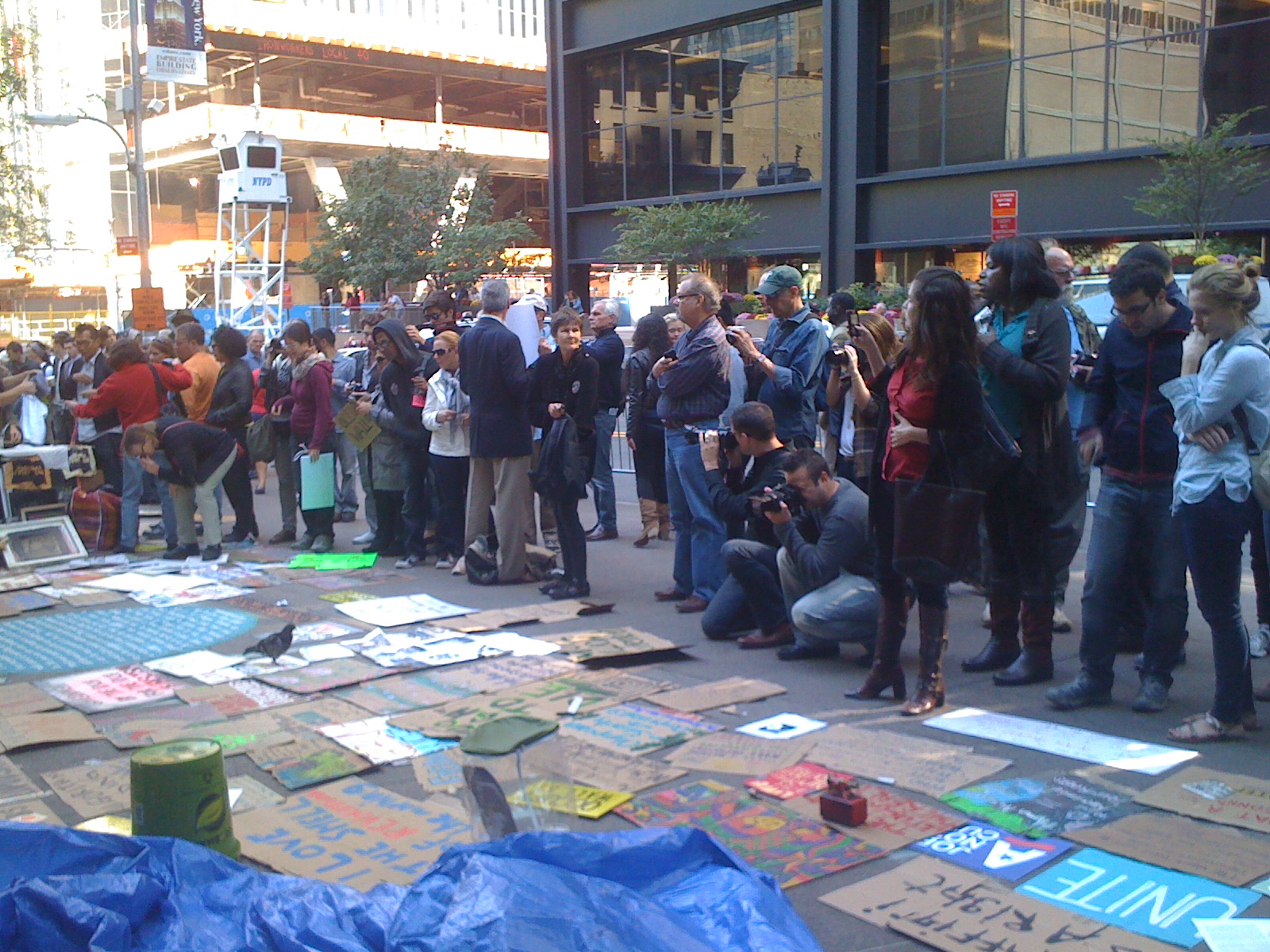
It was busy and crowded and loud at Zuccotti Park, in the shadow of the new World Trade Center—but not that much more than a normal street, at least not for how much virtual buzz I’d been hearing.

The park was surrounded by people stoically holding signs, standing still for the passerbys and the cameras and the statement it all made. It was a pretty even split between the protesters and passerbys—a mix of locals and tourists, curious expressions and viewfinders, everyone stopping to read signs and snap photos. I even saw a few Asian tourists posing for photos with the protesters.

I moved around the periphery, then headed into the center of the square. The encampments had been cut with makeshift streets, pathways where people buzzed around. An internet station and a free kitchen had been set up (dispensing, of course, pizza). Tables with leaflets and fliers stood before volunteers who answered questions and otherwise engaged with folks passing by.

Amidst the revolutionary fervor, there was also a distinct, well, Telegraph Avenue vibe. For those not from the Bay, this basically means young gutterpunky white kids with backdreads, bandanas, and a herd of mangy sniffing dogs, most often seen clumped together with sleeping bags, spare-changing. I think these were the kids critics were referring to when they critiqued the movement as being all unemployed, dirty hippie kids.

Or that they were entitled middle-class kids. To be fair, there was a decent mix of people. (“I haven’t been arrested for civil disobedience in 35 years!” I heard one man gleefully exclaim.) But the majority of the protesters appeared to fall into that category, at least to me. Which makes sense. I mean, who was it that started the Vietnam War protests? Who was it that was out there marching for women’s suffrage? Educated, middle-class young people with the leisure time to protest are usually the group with which change starts.

And yes—there yoga mats and Tibetan prayer flags and a band that included a bango and a stand-up bass. So there was a lot one could get snarky about. And I did decide that it was no coincidence that Occupy Wall Street cropped up a week or so after Burning Man.

But, really, that stuff aside, it struck me as really cool that people were out there, actually talking. Apathy is the poison of the MTV generation, my generation, so even if there isn’t a totally clear agenda or consensus on why they’re even there, it’s a start, and I guess that’s the most important part.

But more than the protesters themselves, it was cool to see the passerbys. People lingered, read signs, made comments, engaged. Which is so incredibly rare to see in this country. Occupy Wall Street was inspired by the events of Tahrir Square, but I also couldn’t help but think about recent protests in Chile or Israel (didn’t hear much about those, did you?). Somewhere along the line, we Americans have learned not to protest, and when we do, the backlash is incredible. Just look at the media reaction to the protests.

So the fact that there were people out there, who wandered down just to check it out, was really exciting. Sure there were frustratingly ill-informed debates going on, but shit, at least people were talking—as if every person that came by would take a little piece of something with them, a thought or impression or just the idea that we could try to do something a little different.

Because that’s the thing about New York—even if the majority of the city doesn’t make it down to Occupy Wall Street, even if it gets lost in the frenetic buzz of life there, of sidewalks and subway cars and trying to keep your fucking head above water—even if it’s just a small percentage that comes by, that small percentage ends up still being a pretty decent size. And it’s still there, and it’s still doing something, changing something, if only the way we think. And it’s a start.

This dude: most definitely not an entitled college student

Phnom Penh Timelapse

A Phnom Penh friend posted this video on Facebook. I’ve watched it a few times through; amidst the deluge of moving anxiety dreams and before-I-go to-do’s, it’s been a nice way to pause—a kind of moment of stillness, a stand-in for the meditation I’ve been entirely too busy to do.

So of course it’s a terribly idealized depiction of the city. (“What did they did with all the rubbish?” one person commented.) But I have to say that there were moments there that kind of felt like this—riding in a tuk-tuk at night, when the city was still, half-asleep with a cool breeze off the river, and it felt magical and precious and like home in a way you couldn’t quite explain.

It’s good to be reminded of that, even if the moments were fleeting and only one side of what it felt like to be there, live there—good because the move is getting close and I’m starting to stress.

I’ve been waking up unrested, unsettled from tangles of intense dreams, catastrophes that prohibit me moving: car accidents, robberies, deaths, pregnancy. In my waking mind, I don’t feel that worried, am still consumed with the day-to-day’s of a life that doesn’t feel like it’s ending. Except that I’ve started to stress about money. Money’s an easy thing to stress about—it’s measurable, tangible, far easier to stress about than the big blank horizon of unknowns.

“You’re still so young,” a friend told me over dinner. “Even if you go out there and it all falls through, and you have to come back and start over in a year, you still won’t be 30 yet.”

“I know,” I replied, nodding. I’d given myself the same rationalization.

“But,” she smiled, “I don’t think that’s gonna happen.”

I sighed. “Me neither. And that’s what really scares me.”

The Keeper, Yuba River Character Study

Didn't take a picture of The Keeper. Though he apparently doesn't mind. So here's a Flickr photo instead

He stood like a masthead on the wooden deck and yowled at the river.

His shirt flapped open in the breeze. The stomach was hard, muscles like little knots and skin tough as old leather. Cargo pants and sandals, not-quite-Birkenstocks. Eyes as spooky-clear and sharp as the river water, blazing from behind a scraggle of hair: shoulder-length gray and a light-socket beard that seemed reminiscent of those old miner photos, made you wonder if he wasn’t the descendant of some wayward band of them, a man born into the wrong era, or the last living vestige of an era that’s dying, been dying, might already be dead.

“He’s a dyin bread, for sure,” Alicia said as we tromped over the dirt path, stepping sideways so our worn old sneakers wouldn’t skid us into patches of poison oak. “Like a real-life troll gate keeper.”

Backpacks and coolers and limp plastic flotation devices—we were rolling 22-deep, a smattering of tattoos and a trail of cigarette smoke rode up from Oakland for an annual camping trip.

I could glimpse the river from the path: slick green between these flat, broad boulders, like a long line of really crooked molars. It was hot—Northern California hot, which isn’t really that hot—and each spot I saw along that Yuba River looked perfect, picturesque, a postcard of Sierra-Foothills pristine.

“The best spot is further down,” Chummy called back. “But we gotta to pay The Keeper.” And he smiled at the joke and people called out “Keeee-per” and we laughed.

“It’s the OG dude,” they’d explained, “that’s got one of the best swimming spots on the river on his property. There’s a fence and shit, a sign telling you you’re on private property, but you keep walking down and you get to this shack he built down there, where he lives and is always kinda hanging out. And you give him a couple beers or some weed or something, and listen to him talk for awhile, and he lets you pass.”

“I once took a photo of him,” Matt had said, “that I was gonna mail him, to some PO Box he’s got somewhere. I never did,” shrugged, “but he wrote the address down on one of those discharge papers they give you in jail—you know, we’re they’ve written down everything you have in your pockets and shit. It was all like: ‘$1.17 in change, a bus ticket, a pint of gin…’ Homeboy’d just gotten out of the drunk tank like the night before.”

“That guy is cool as shit,” Moe’d added, grinning. “The Keeper.”

And we tromped and skidded down, and sure enough: a wooden shack and the sharp glare off a tin roof and a gang of chickens clucking and a grizzlied old man standing in a semi-squat hollering at it all.

It seemed like a continuous stream of somewhat-intelligible drunk babble that we’d happened to walk in on—I could imagine him going on and on, with or without an audience, talking to himself and the chickens and the rocks and the river that didn’t ever stop flowing either.

“See that there,” pointed to a little fenced-in patch of green, “I call that My Feeble Attempt To Grow Something,” and yowled in laughter. A rooster yodeled back, as though in response. “Here you can hear the roosters crow all day long, yep. I been here, watching this tryin to grow—” pointed at the green again “—and haven’t left in damn near three weeks. Just had some people passin through to give me a few beers and some LSD from time to time and that’s all I need to live, you know what I’m sayin?”

Sadie opened her bag and handed him a few cold beers.

“Well alright, alright,” The Keeper said, nodding. “You are officially no longer tourists, you are guests, welcome. The only rules are that you bring back your cans and that you remember to come back, cause—” a pause here “—if you didn’t, it’d break my heart.”
“Yessir!”

“Keep coming back, it works!” The Keeper called out and laughed as we shuffled by. “And be careful on the rocks, watch your step—these are the most difficult steps you might take. Twelve steps, my own twelve steps,” and howled again in laughter, a not-quite-crazy kind of laughter that got swallowed by the rocks and the river and passing of the river, as we marched on to our swimming spot.


Lauren Quinn is a writer and traveler currently living in Hanoi. Lonely Girl Travels was a blog of her sola travels and expat living from 2009 to 2012. She resides elsewhere on the internet now.

Join 490 other subscribers

Buy This Sh#t

Categories