Archive for the 'Phnom Penh' Category


Jogging Where Tanks Once Rolled

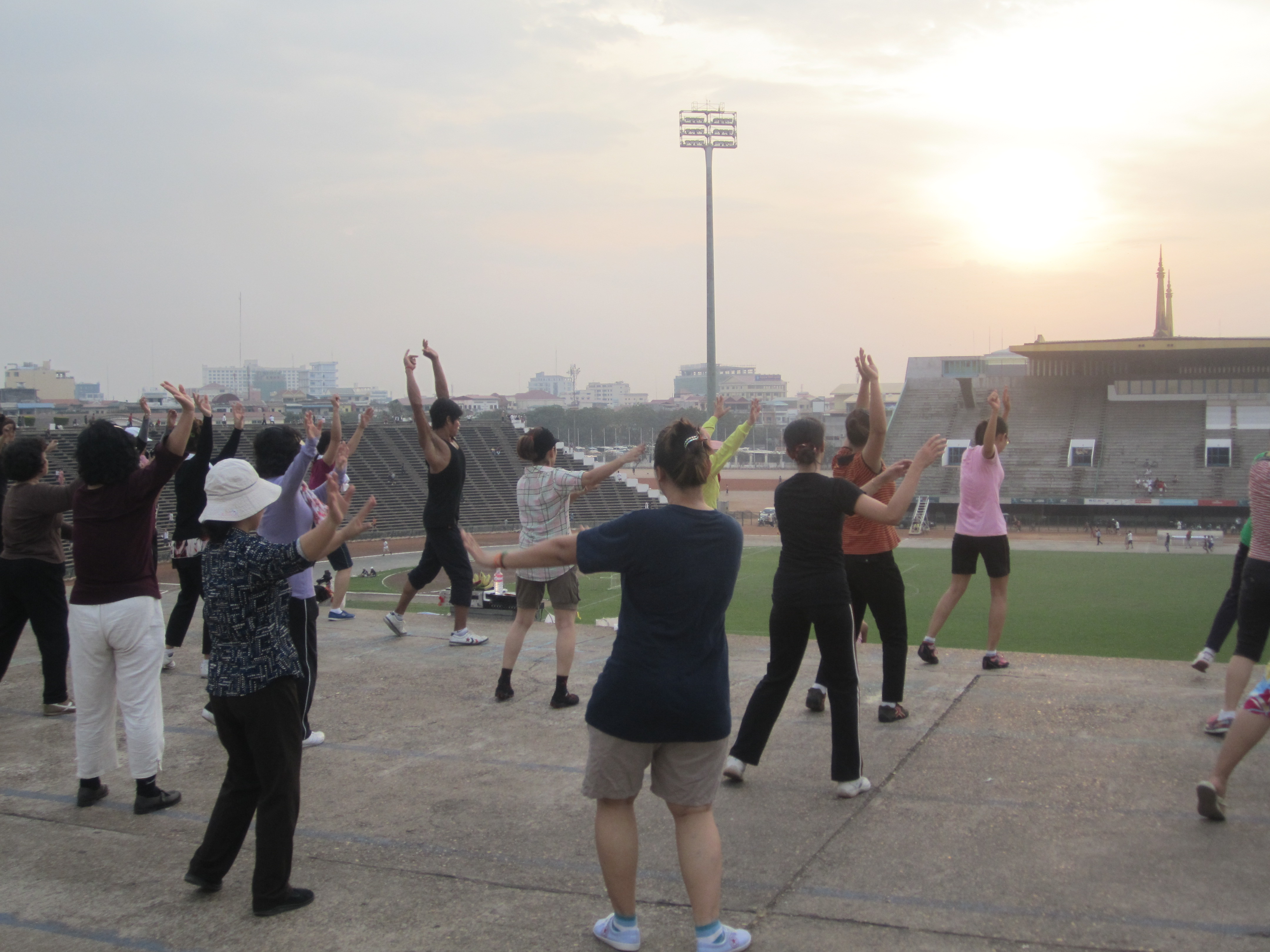
Aerobic dancing at Olympic Stadium

3pm, barefoot in the dim room, whirling fans and headphones on, staring at the screen. It’s my first trip back to the Bophana Audiovisual Resource Center, where I spent hours last spring, trolling through their archives of documentaries and newsreels and scanned photographs of the old Phnom Penh, before the war—which, it seems to me today, doesn’t look so different from the Phnom Penh outside the open-air terrace, just minus the new cars and sidewalks. Sometimes.

I’m back to refresh myself. I’m working on editing my second Glimpse piece. I wrote it over the summer and haven’t looked at it in months, so when I got Sarah’s comments, it all felt vague and faraway. I knew I needed something to kickstart me.

To be honest, I haven’t been thinking much about my project, or the Khmer Rouge, or any of it. Last time I’d arrived, it’d been on my mind constantly, a lens I saw everything through: everyone over 35 was a survivor. I couldn’t turn it off, and I’d hit the ground running, dove right in to the research and writing, the quest to understand.

And it’s not like I’ve forgotten all that—I can feel it, sitting there, off to the side and waiting, in the corner of the room when I can’t sleep at night—but my focus has been elsewhere. Getting an apartment. Buying all the crap I need—dishes and towels and non-neon-plastic chairs and Western bedsheets (really effing hard to find, btw). Reconnecting with the friends I’ve got left, and making new ones. Getting a phone and internet and finding a good laundry place and all that very unglamorous day-to-day stuff that’s part of life, part of living somewhere.

So I’ve pushed it all aside, knowing that it was waiting and that I’d come to it when I was ready (and, really, I’ve only been back two weeks). So it was with a little hesitation that I went to Bophana, took off my shoes and climbed the steps, climbed back in to The Reason I Came, and the thick-as-mud emotional difficulty of it all.

Most of the newsreels are in French, and I watch ones from the Thai refugee camps, 79-80; I watch the same newscaster in different suits, and fish out token words of French: “famine,” “guerre,” “mort.” Mostly I look at the faces, which are shell-shocked and gaunt.

I scroll down, down, down the list of archives, never-ending, thinking how long it would take someone to watch it all. I see “Rediscovered Propaganda Films” and click on it. There’s an English dubbed version, which is exciting. I watch and listen.

They show short films produced during the Khmer Rouge and narrate. They show staged shots from the camps, aerials of people like ants, carrying hoes and buckets, balanced on a stick over their shoulders, the way the soup ladies at the market do. They show close-ups of carefully selected workers smiling; they point out child workers and how to tell who was a New Person and who was an Old Person. They show clips of a poorly acted film Pol Pot directed, shortly before the regime fell—men reenact the defeat of Lon Nol’s army, twitching on the ground with arrows arranged around their bodies. The film was never made, and the shots I see now, in the dim viewing room, were assembled from found reels. I imagine them on a dirty floor somewhere, curled and brown.

The narrator points out inconsistencies: no one was supposed to have bourgeois personal items like watches or eyeglasses. But here’s Pol Pot, that smiling cult leader face, wearing a watch, and here’s Brother Number Three, wearing glasses, and here’s the regional leader Brother Number Two snubs, who’s later deemed a traitor and tortured and destroyed, along with his family. They freeze the frame on him, and he’s smiling, smiling.

This scene is at a party meeting; women with Soviet semi-automatic weapons march, and US artillery tanks roll past, left over from Lon Nol’s time. The setting looks vaguely familiar, and the narrator says: “The meeting took place in the otherwise empty Phnom Penh, at the Olympic Stadium.”

Holy shit, I think. Olympic Stadium is in the city center, near the guesthouse I stayed at when I arrived. Every dawn and dusk, they do aerobic dancing there, and people run and powerwalk and swing their limbs around; food vendors set up carts and plastic stools, and men play soccer in the dirt lot outside.

It’s my favorite place to go running in the city. In fact, I’m planning on going for a jog there tonight.

I squint at the screen and it’s all there: the steps I run, the contour of the stone tiers, the spires of the Royal Palace rising in the background. It’s newer and cleaner and nicer in the footage, but it’s the same place.

I don’t know what to do with that.

I walk back to my apartment with a funny little feeling in my stomach, like I’ve seen a ghost—like I’ve gotten up in the middle of night and everything familiar looks strange and different, and the thing that was sitting there waiting for me isn’t in the corner anymore but is moving across the room.

I put on my running shoes and spray some more mosquito repellent on, grab a water and go back downstairs, to the street to catch a motorbike over to the stadium.

It’s surreal when I get there. I walk past the rows of motorbikes and cars, the tuk-tuks covered in ads for the new Twilight movie. Teenage boys stare at me as I walk past their soccer game, say “Hello, hello!”

I walk beside the arena, which is locked and closed, my own face in the tinted windows. It was where the meeting had been, in the newsreel. I walk past where the shot of Pol Pot wearing a watch was, where Brother Number Two and Brother Number Three had trailed behind him, wearing eyeglasses and giving silent death sentences to smiling men.

A young boy carries a sack on his shoulder. He picks a plastic bottle out of the trash.

He walks closer to me, his eyes scouring the ground of recyclables.

I say hello, in Khmer, hand him my empty water bottle.

He smiles and puts it in his sack.

I say thank you, and walk towards the track, to jog where the tanks once rolled.
A Not Entirely Atypical Tuk-Tuk Ride Home

9pm so I give him a good stare down, check the eyes for red and glaze and drunkenness. I watch the way he walks to the tuk-tuk, parked a few feet away from where we’ve haggled the fare. He walks straight enough to drive straight, so I sigh and start to climb in.

“Ok,” he says, sitting down on the bike, “7000.”

I pause, my foot on step. “No, 6000,” repeating the fare we agreed to.

A grin. “Ok, ok, 6000.”

I sit and he sits. He throws a look back at me.

“You want to smoke weed?”

“No.”

“Why?”

“I don’t want to.”

“You no smoke weed?”

I smile and play it coy, “No, I’m a good girl.”

“Oh. I thought you were mafia.”

“Oh, really?”

“I see your tattoo, I thought you mafia.”

“No,” shake my head, “not mafia.”

He throws his helmet on. He doesn’t clip the chin strap.

We take off and turn the corner and it’s the usual questions: where did I make my tattoos? (USA) Is that where I’m from? (Yes) How many? (I don’t know) How much it cost? (A lot. But it should, it lasts forever.) Do I like them? (which is not a usual question and I smile: Yes.)

“But you no smoke weed?”

“No.”

“You no want to be happy?”

“I’m already happy.”

“But you be more happy.”

“Not if I smoke weed.”

“Oh, you smoke weed before?”

“Long time ago. When I was young. But I’m old now.” (Coy again, and I think how, broken language aside, it’s not so different from conversations I have with backpackers or college kids or, fuck it, my own peers, in bars or at shows—not entirely atypical.)

He speaks pretty good English and he’s driving straight enough and even knows where we’re going, so all things said, he’s a damn good tuk-tuk driver. We move through the pitted streets, slowly settling from their daily buzz—meat smoke thinning, piles of trash waiting for pick-up.

More questions, his eyes in the side mirrors more than on the road: How long will I be in Cambodia? (One year) What do I do for work? (smile: I’m a writer) I live in a guesthouse or apartment? (bigger smile: Guesthouse tonight, but tomorrow I move to an apartment) You live with roommate or alone? (another smile: Alone) Why alone? (I want to) I come live with you? (No) Why? (I want to live alone)

We approach the Orussey Market: lights and umbrellas and neon plastic stools and buses parked and smoke, still plenty of smoke billowing and twisting and rising into the night. I tell him the name of my guesthouse.

“Oh, you stay there alone?”

“Yes.”

“I come stay with you?”

“No.”

“Why?”

“I don’t want you to.”

“You no like boys?”

“I didn’t say that.”

“You like girls?”

“I didn’t say that either.”

We pull up in front, parked motorbikes in the glow of the reception desk, long shadows of security guards sitting listless in plastic chairs. I pull out the bills and step out of the tuk-tuk, hand them to him.

He takes off his helmet. “Goodnight, madam.”

“Goodnight sir.”

“Sleep good.”

“You too.”

Arriving Back in My New Home: Anti-Culture Shock and A Broken Necklace

In the shower this morning, rinsing the dried sweat of night chills from my dehydrated, gasping body, I noticed it: my necklace was gone.

When I came out of the bathroom, I saw it there, tangled and delicate, next to the pillow, the sheets that had stayed miraculously white during my 2-day readjustment sickness. It wasn’t my favorite necklace, an innocuous dangle of silver that clung close to the skin. At some point over the years, it’d become my traveling necklace—I’d put it on one of the first days of a trip, then just leave it, forget about until I’d noticed myself absently fingering the chain, digging the tip of the winged heart under my nails.

I picked it up. The chain had broken.

I smiled. If this were a novel, it’d be a metaphor.
I arrived in Phnom Penh nearly a week ago—flew in, which I hadn’t done before, but even at the airport, that familiar smell of mildew and cooking rice, overripe fruit and a faint whiff of urine underlying it all. I took a taxi (when’s the next time I’ll be in a car?), and we rumbled over pitted roads exploded with smoking meat, food stalls, cell phone shops, baskets of fruit, motorbikes and bodies, bodies everywhere. It didn’t seem insane or lawless or overwhelming—it just felt really good.

I dumped my bags at the guesthouse—the first one I’d gone to, back in February, which made it feel like I was coming full circle—and went out for an early evening stroll. My feet knew the way, my feet remembered how to traverse the traffic, how to cross the street (slow and steady and smooth), my feet took me to the pharmacy and a corner market and a street stall where I sat on a plastic stool and ate soup for $1. I went down the block to the sticky rice stall; I bought bananas for the next morning. I bought a giant fucking coconut, and the little lady hacked it open with a machete and stuck a straw in it and I took my first sip and, after 4+ months of $3 Vita Coco, a long sigh was unleashed in me.

Which is all basically to say I’ve been experiencing an extreme and bizarre lack of culture shock. I had more culture shock entering Albania from Italy, or any time I’ve reentered the US after traveling. What is about this place? How did it come to feel like home, after only a couple months last Spring?

I’ve spent the last few days hitting up my favorite cafes and street stalls and going to meetings and jogging at Olympic Stadium and trolling the town for For Rent signs (and getting one of those requisite, paralyzing stomach flus that gives you chills in 90 degree weather, that leave you sleek and lean and mean after, ready to take over the town). And all the while, I’ve kind of been looking over my shoulder, waiting for the other shoe to drop.

I’d expected my arrival back to be something like the final scene of The Graduate. All this effort and stress and energy and hullabaloo, goodbyes and good riddances, and then a month+ of traveling, cruising around the planet in the most unprepared and overpacked of fashions. I’d been kind of delaying it, you know, worried that I’d get back here and it’d be like that moment at the back of bus when Elaine looks over at Ben and he just stares forward and you see them both thinking—“Well now what the fuck?”

And I suppose there’s still time for that. Plenty of time, and I suppose there’ll be moments of that. But so far, all I’ve had is this feeling of being, not home, but somewhere close to home. I’d been doubting myself right up to the very end, right up till my Air Asia plane hit the tarmac. But more than ever, I keep having this feeling that I’ve made the right decision, that I’m in the right place.

I’m here. Really here. I’m not traveling anymore—just look at the necklace.

Phnom Penh Timelapse

A Phnom Penh friend posted this video on Facebook. I’ve watched it a few times through; amidst the deluge of moving anxiety dreams and before-I-go to-do’s, it’s been a nice way to pause—a kind of moment of stillness, a stand-in for the meditation I’ve been entirely too busy to do.

So of course it’s a terribly idealized depiction of the city. (“What did they did with all the rubbish?” one person commented.) But I have to say that there were moments there that kind of felt like this—riding in a tuk-tuk at night, when the city was still, half-asleep with a cool breeze off the river, and it felt magical and precious and like home in a way you couldn’t quite explain.

It’s good to be reminded of that, even if the moments were fleeting and only one side of what it felt like to be there, live there—good because the move is getting close and I’m starting to stress.

I’ve been waking up unrested, unsettled from tangles of intense dreams, catastrophes that prohibit me moving: car accidents, robberies, deaths, pregnancy. In my waking mind, I don’t feel that worried, am still consumed with the day-to-day’s of a life that doesn’t feel like it’s ending. Except that I’ve started to stress about money. Money’s an easy thing to stress about—it’s measurable, tangible, far easier to stress about than the big blank horizon of unknowns.

“You’re still so young,” a friend told me over dinner. “Even if you go out there and it all falls through, and you have to come back and start over in a year, you still won’t be 30 yet.”

“I know,” I replied, nodding. I’d given myself the same rationalization.

“But,” she smiled, “I don’t think that’s gonna happen.”

I sighed. “Me neither. And that’s what really scares me.”

Going Native: The Anti-Irony of Khmer Glamour Photos

I sat once in a cafe in Tangier, Morocco. Some famous man-filled cafe where Western writers used to pen masterpieces, or cruise for ass, or trip out on then-exotic drugs, or most likely some combination of the three. It was popular with tourists—in the way that that Hemingway bar in Havana is popular—and with well-heeled locals. I was the only female, Western or otherwise, in the joint.

I watched as a man strode in—large, burly, brusque. He may or may not have had a white beard—I remember something about white hair, though his head was most definitely adorned with some scarf. He had that expat look of permanent sunburn and wizened self-satisfaction; he wore a long, flowing robe of ethnic print and carried a thick wooden staff. Two younger men, one with a notebook, another with a video camera and a microphone, followed as he walked purposefully over to what I assumed to be his regular table.

He leaned back in a posture of pontification, began what I imagined to be a long soliloquy, in French, on Moroccan culture and the changes therein over the last decades, as observed by his keen eye. The guy with the notebook nodded and scribbled. I watched the camera man look around at all the Moroccans in the cafe, wearing t-shirts and jeans, then back over at the burly old dude before his camera, his attire some approximation of those sepia-hued photographs old explorers and anthropologists took, that are now sold as postcards.

Our eyes met briefly. I smiled; the camera man looked embarrassed. I chuckled, imagined we were having the same thought:

My God—he’s gone native.

There are few things funnier to me than people taking themselves too seriously. Travelers/expats who over-identify with their adoptive countries provide endless amusement while on the road. So when I saw the pointed fingers and fake-gold-gleam of Khmer glamour photos, I knew it had to do it—my own chance to Go Native, as it were.

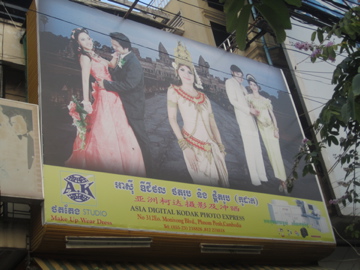
To clarify, this isn’t some chintzy gimmick produced for tourists; this is a Cambodian—nay, Southeast Asian—phenomenon. People dress up, get a pound of foundation and fake eyelashes slapped on, squeeze into gaudy garb and let themselves be molded into ridiculous poses, to be later Photoshopped several skin tones lighter and superimposed in front of illustrious sights like Angkor Wat, or the parlor of a well-to-do person’s house (a fireplace and Persian carpet are key). People do it for their wedding, for their coming-of-age, as family photos—it’s not uncommon to see a large framed print hanging in someone’s home.

It is, in short, the Khmer version of cheesy K-Mart photos. It’s is legit, authentic inauthenticity.

I hadn’t noticed the photography studios sprinkled around town until someone pointed them out. The sun-bleached signs of smiling couples, the window displays of sequined gowns—they’d faded into the visual static of Phnom Penh storefronts. Until I decided to get my own.

Khmer glamour photos are something of a rite of passage for Phnom Penh expats, especially the females. So I rounded up a posse, walked into the first decent-looking studio we passed on Monivong, and made an appointment to be turned into an Apsara princess.

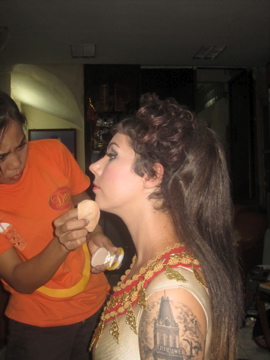
At two o’clock on a sweltering Sunday, five of us clamored up the back stairs of a photography studio to the dressing room. It looked like the backstage of an Asian cabaret, make-up and sequins and traditional costumes stacked to the rafters.

There was only one girl doing hair and make-up; at about thirty minutes each, we ended up being there for a loooong time. My friends chose the $10, more modestly ridiculous options; I opted for the $15 Apsara extraordinaire, which included more fanciful skirt folds, extra fake-gold bangles, even a wig. Behold the transformation:

I'd never worn fake eyelashes before.

Looking sufficiently like a drag queen.

Through the mirror

Fancy folds

I went to Cambodia and all I got was this mullet

Lock and load.

A couple days later, I went back to the studio to pick up my prints—three prints were included in the $15 price. I thought of the dude I’d seen, years ago, in the cafe in Tangier. The difference, I decided, was humor. And self-awareness: I was doing it as a joke, a statement on the ridiculousness of myself in the Khmer cultural context and how I, at 5’10” and a riddling of tattoos, will never, ever blend in with or a be a part of that culture. The photos were tangible evidence of the chasm between worlds.

I smiled and laughed out loud and thanked the ladies again.

I went to meet a few other friends for dinner at the Chinese Noodle Restaurant. I took out my prints and they laughed—it was ridiculous, right?

I noticed the waitress peering over our shoulders. I felt suddenly self-conscious—would she be offended? Would the joke translate?

To my relief, the waitress smiled, a chipped tooth and deep lines. Then she reached over and took one of the photos in her hand, examined it more closely. “Very beautiful,” and she looked up at me with a kind of sincerity that made me blush.

This was not the reaction I’d expected. I felt somehow more embarrassed.

The waitress proceeded to pass my prints along to the other tables in the restaurant, all the women smiling and nodding and murmuring their approval. The women’s eyes glanced over at me and it was a kind of warmth I felt, maternal and accepting and utterly devoid of the snarky irony with which I’d walked into the photography studio with.

They didn’t think it was funny, and they weren’t offended. They thought it was beautiful.

I hung my head. “I’m an asshole,” I announced. Then, looking up and grinning, “But at least I’m a beautiful asshole.”

Privilege and Property Rights at the Phnom Penh Sofitel

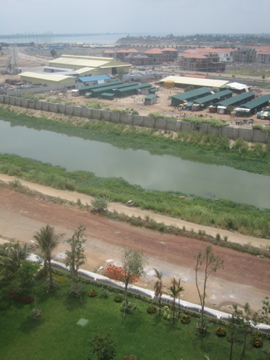
View from my balcony: construction workers' quarters beside construction lot for new, luxury villas

So, one of the most fascinating things I got the opportunity to do in Phnom Penh was to peek into the “other side.”

By “other side” I mean the foreign business men, the developers, the movers-and-shakers, the ambassadors and embassy folk—the people that are literally reshaping the city. By “other side,” I mean the people that are removed from the street, that live behind gated properties with bored-looking security guards, that ride around the city in chauffeured SUVs. I mean that I got to stay at a Sofitel.

I’ve never been one with an eye for perks. I always kinda rolled my eyes at the travel writers that billed themselves as luxury writers, assuming they were really more interested in getting free massages and Pina Coladas than actually being writers. Which they may be. But none of the glitz ever attracted me—I was always more into the grit. And perhaps being able to make a living as a writer. But really, just the grit.

Which is why it was so ridiculous that I ended up, frayed Toms and an H&M cardigan, in the lemongrass-scented lobby of a five-star hotel, on assignment from an equally ridiculous source: Matador, an independent travel website. And why it ended up being so goddamn fascinating.

The piece I wrote on the experience went up last week on the Matador site (link here). But 900 words is short, and there’s a lot I didn’t get the chance to say.

Construction cranes behind the Sofitel pool

The Sofitel sits handsomely amid vacant lots and construction cranes, in what the young manager with beautiful hands told me would soon be the new city center. He moved his hands through the air when he said it, like he were gathering something and drawing it closer to him. His nails were better filed than my own.

A poor, Eastern city rapidly modernizing by foreign hands: that’s not an entirely new story. But this was Cambodia, so it was more complex and fucked-up than it appeared on the surface.

Land rights are a huge issue in Cambodia. And like so many of the country’s problems, it comes out of the war: after the Khmer Rouge fell, no one had property deeds—you just moved into any available space you found. It was a clusterfuck of a situation. Ten years ago, the government began an official campaign to get people proper titles to the land they’d been living in since the KR. But it was a muddled, mismanaged process in which poor folks largely lost out. As a result, a lot of the country’s residents still don’t have official claim to the land they’ve been living on.

It’s the perfect situation for exploitation.

The case I got to witness first-hand was the ongoing issue over the lakeside evictions. You can read more here, but in a nutshell, a foreign company bought a lake and its surrounding region in Phnom Penh, to drain and develop. People were already living around the lake, but since most had no official claim to that land, they could legally be evicted. They’ve been protesting, losing, subjected to violence—it’s basically fucked.

None of which is to implicate the Sofitel into that. (In fact, a tuk-tuk driver told me that the Sofitel property used to house a Thai-owned luxury hotel that was torched during anti-Thai riots some years back.) But if you place the hotel’s presence in the larger context of the changing city, it says a lot. There didn’t used to be a market for a business-oriented luxury Western hotel. And there’s not really, yet—the Sofitel was largely empty when I stayed there, just like the villas being constructed across the Bassac River were. But the point was, it’s coming.

And if you draw the line in the sand—between old and new, redevelopment and who it benefits—the Sofitel is like glimpsing into the future, glimpsing over the line.

Which of course brings one to oneself. Because I was, after all, staying there. Yes, I was on assignment and thus not footing the bill. Yes, I was walking the half-mile of scorching-hot driveway to catch a tuk-tuk streetside, instead of paying the 300% surcharge from the hotel. And yes, I was using my $5/month wireless modem instead of paying for the hotel’s wifi (how you market yourself as a business-centric hotel and not have free wifi is beyond me…). But, if you drew the line in the sand—which you still can do, in the parts of the city without sidewalks—I was closer to all those business men than the people getting evicted by the lakeside.

Sometimes you can fool yourself about your own privilege. You wait tables; you work two jobs through college; you squint through old contact lenses because you can’t afford the eye doctor. Or you rent an apartment from a woman you can’t communicate with, save for the green mango she gives you once a week, and you drink shitty coffee at street stalls and buy produce at the local markets and tell yourself you’re experiencing a place “at ground level”—a phrase that in and of itself oozes an underlying sense of privilege, the idea that it’s a choice.

Turn-down service

But in a place like Phnom Penh, I really can’t fool myself. Putting on a bathrobe and shuffling around my hotel suite eating the macaroons from turn-down service, BBC images flashing sharply on the flat-screen TV—and getting to do it because I’ll use the skills I learned in university to write an article for a website, in a language I was born into speaking—I can’t kid myself about which side I’m on. I could get a well-paying job any time I want. At the drop of a hat, if I were in serious trouble, I could have someone wire me more money than your average Cambodian makes in a year. That’s just the fact of it.

I had this moment, taking a tuk-tuk from just outside the Sofitel’s gates, when I sat back and watched the street: a row of barber chairs set up, scuffed mirrors nailed to a corrugated fence, men waiting for clients. It felt like I were looking at it through glass, through the thickness of some impenetrable distance, and it all struck me as quaint. As in, the simple quaint life of a the noble local.

Could where you stay really make that much of a difference in how you experience a place? I wondered. Could surrounding myself in the piped-in fragrance of lemongrass, taking a hot bath and wearing a pair of slippers each night really ensconce me, alter how I enter a city so much? Or did it just serve to heighten what was already there, hiding from me?

I didn’t find answers to that. But I did have a lovely stay.

The Young Leading The Blind: Phnom Penh Image

This is the image I haven’t been able to get out of my head:

There’s an instrument called tro. It’s kind of like a violin. It’s a traditional Khmer instrument and you hold it low, down by its belly, and you work the strings with your other hand, across your chest or near your neck, like you’re sawing something.

There’s a whole history to it—it being destroyed during the Khmer Rouge time, famous musicians being killed, one surviving, unearthing the one he’d buried in the field before he’d been evacuated, it being one of the only tros to survive, the musician later founding a non-profit to teach the next generation, pass on what was nearly gone and almost died.

There’s a lot of stories like that in Cambodia; you hear so many you start to confuse them, get the facts mixed up and the characters wrong, until it becomes one big story that no one, it seems, can keep straight. But somehow blind men were involved in this one—were they blinded during the KR or later by landmines? Or were they born that way? I never figured that part out. But there were blind men that played the tro, that much I know, and you’d see them in the streets of Phnom Penh, and that’s the image I can’t get out of my head.

The tro players would always be older, battered-looking—the old generation, the 40+ers that had lived through the KR. They’d be walking as they played, being led around through the chaos of the motorbikes and tuk-tuks and vendors on the sidewalk and the busted-up places that were supposed to be sidewalks but were really just rubble—being led by a child, 10 or 11 or so, what was called “the new generation.” The kid would have their palm open, upturned, begging for the musician whose hands were occupied, seeing for eyes that were clouded by a perpetual mist.

But that wasn’t the weird part, the part that has lodged itself in my mind and keeps reappearing. The thing I keep thinking about is the string. There’d be a string tied around the tro player’s waist, and the kid would be holding the string, leading the blind old man like a pet through the streets—though you didn’t know who was whose pet, and how much of it was for show, for pity, for dollars.

The young leading the blind: it would have been a metaphor anywhere else. But this was Cambodia, Phnom Penh, so it was reality, just another scene on the street.

Gabriel Garcia Marquez hated the term “magical realism.” It was, to him, inaccurate, a term applied by outsiders, that dripped with misunderstanding and European paternalism. To him, what he wrote was realism, plain and simple—the so-called “magical” part was just a part of reality for Latin Americans, or Colombians at least.

Why do I think of this now? Why can’t I get the image of a lassoed blind man playing a near-extinct instrument out of my mind? Why did the image only begin recurring once I’d left, was in Laos, and why did I keep thinking of it and thinking of it, once I was back in the States?

Why didn’t it strike me as so bizarre in the moment?—not necessarily normal, in the sense of normal that I know, but as just another happening on the sidewalk, another sight to block out, filter out, shake my head to and keep my eyes straight and mutter “ot tey” to.

I’ve been trying to explain Cambodia and Phnom Penh to people. They ask me how my trip was, how my time there was, and my immediate answer—and the one that seems the truest—is, “Bizarre.” But I can’t really explain why it was bizarre, make any insightful statements or overarching cultural observations. All I can do is present a handful of images, anecdotes, the way they were presented to me—at random, shoved in my face so that all I could do was block them out, file them away to think about later and still not understand: children huffing from plastic bags, and monkeys running across the telephone wires, and the cross and uncross of the karaoke girls’ legs. The tro players and their milky eyes, the children and their upturned palms—but most of all the string.

Didn't take a picture of the tro players. Cause it seemed wrong. But here's another thing that didn't seem so weird at the time: typical sign outside a nightclub.

The Un-Bittersweet of Leaving Phnom Penh

It’s not as bittersweet as I’d expected.

It’s been six weeks in Phnom Penh. That’s the longest I’ve sat still anywhere—the longest I’ve spent consecutively in any city other than Oakland.

I’m embarrassed to admit that; I feel like I should have lived abroad, should have studied abroad, should have spent a summer somewhere, should have should have should have. But the truth is, I’m still a relative newcomer to the travel game, and for the first few years I was stuck in the going-going-going of it all: ticking off lists, counting countries and cramming in as many destinations as possible. It seemed like a waste of time to stay anywhere any longer than necessary.

Sure, I’d entertained elaborate fantasies about moving abroad. But really, if I couldn’t sit still in another city for more than 10 days, how could I really know if I could be happy, could have a life, abroad? Or, hell, even out of Oakland?

Part of the reason I got an apartment in Phnom Penh is that I wanted to feel like I lived there, that I wasn’t just passing through. I wanted a little glimpse into what that life would be like. I wanted keys; I wanted to shop for toilet paper; I wanted to “Sua s’dei” the neighbors and have a cafe where they knew my order. I wanted to feel little roots sprouting—the beginnings of being grounded, like the wind could blow and I wouldn’t fall over, be blown over with it.

When my bus arrived last week, bringing me back from my three-day visa run/refugee camp search, I hustled down the steps. I booked it past the cluster of tuk-tuk drivers, crossed the street without looking (the Cambodian way), dove between the tents of the night market, walked directly to my favorite food stall, kicked off my shoes and slurped down a Khmer soup under the night’s haze, the warm breeze from the river. I felt like I’d come home.

So I was expecting to be sad to leave. I was expecting to go around doing my silent rounds of “last times” with twinges of melancholy, that little lonely longing that you can almost fall in love with, more than the thing itself.

But it wasn’t as bittersweet as I’d expected.

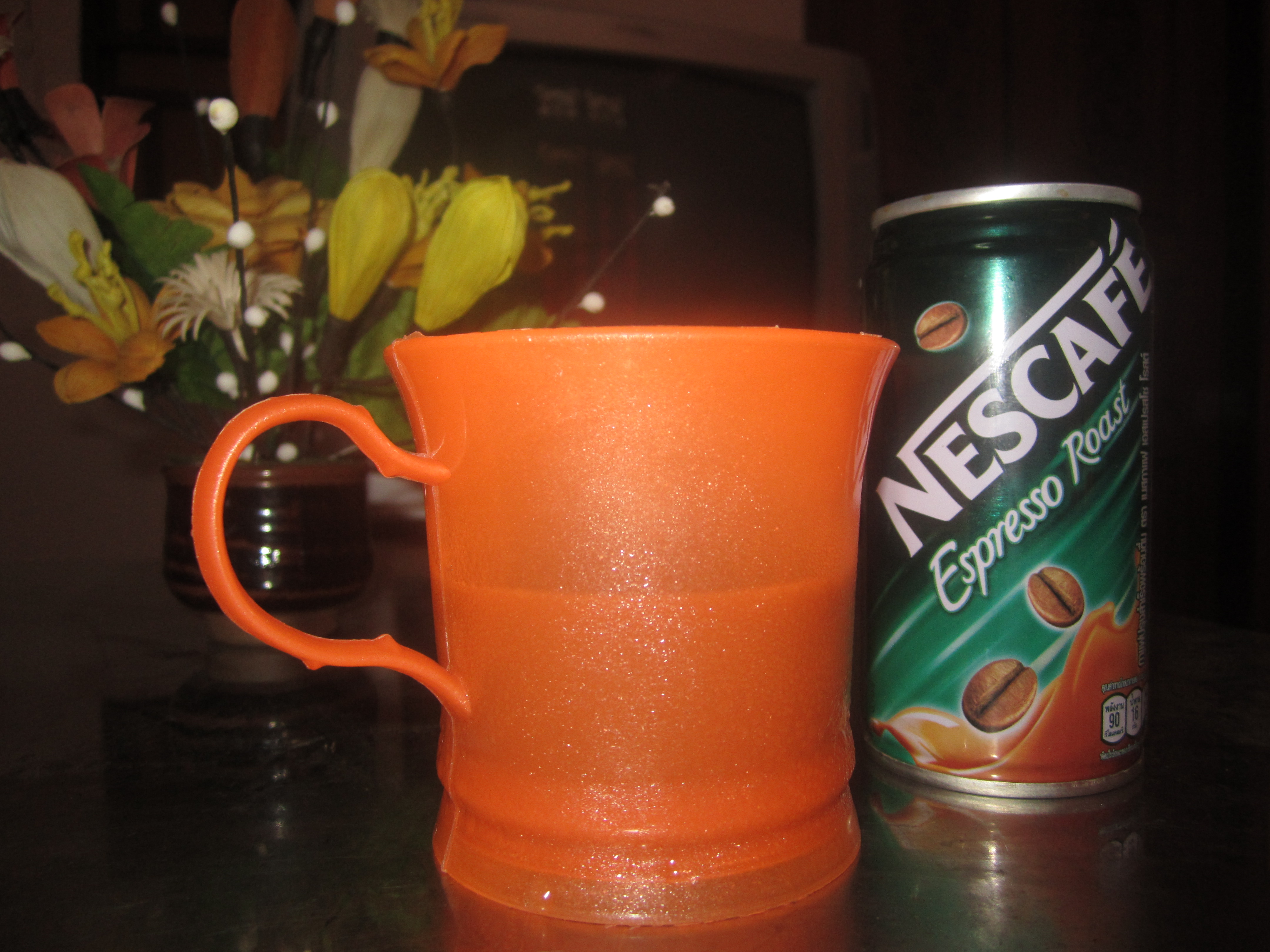
Sometimes it comes to this: Nescafe from a plastic mug. And plastic flowers. Classy as shit.

Saying good-bye to the people was sad. I’d made some rad friends, had gotten close to a few cool girls. People tend to be on a three- to six-month rotation in Phnom Penh, and in a few months, almost everyone I know here will have moved on. And it was definitely sad to leave my apartment, with its metal table and one chair, its thin mattress and fuzzy TV, the plastic kitchenware I’d purchased at the market down the street—where I’d go to eat soup and the women would squat down and stare at me, giggling. I’d giggle back, and I’ll miss that too.

But still, it wasn’t as bittersweet as I’d expected.

I’ve taken to comparing cities to people. Boys, to be specific. Because cities have personalities the same way people do, and you have relationships with cities the same way you (I) have relationships to boys with (well, no, they’re actually much healthier).

So Rome is a really sophisticated, well-groomed and worldly guy that I like to keep track of, that I like to get lunch with from time to time, and talk about art and culture and history, but who I could never actually be with—we’re just too different. Tirana is the fun one, the one I met one crazy night at a crazy dance party, who I connected with under the lights—the one I felt like was made for me, as though anyone could ever really be made for anyone else, as though you could ever really know anyone after a week, or a month or even a year, years.

Buenos Aires is the one who got away, the eyes exchanged between subway cars, or maybe the one whose number you got and lost and still catch yourself thinking of, years later, looking for some scribbled scrap of paper in old jeans pockets without even realizing it. San Francisco is the neighbor boy you grew up with, who you know is really attractive and cool and who you really get along with, but you just couldn’t ever date.

And Phnom Penh?

Phnom Penh’s not terribly handsome or debonair, not the stuff of little-girl dress-up fantasies. He’s not super cultured and he’s got some obvious flaws. He’s a little beat-up; he’s been through shit. And there are things about him that drive you nuts. If you were to write a list of the perfect mate, there’s a lot of things Phnom Penh wouldn’t have. But the big ones, the ones that are really important and that really fucking count, when you’re up against the wall and the wind is blowing and you need something firm, some kind of roots to hold you down—he’s got them.

He fits. He’s not perfect, and neither are you.

And so it wasn’t so bittersweet to leave him. The same as when you leave for a trip and you just know the person you’re leaving behind, that you’re coming back to eventually, isn’t going to cheat on you or be shady. You don’t even have to think about it, worry about it. It doesn’t occur to you to worry; you’ve just got that confidence, you know? That you’ve got them and they’ve got you, whether you like it or not—like you were picked for each other, matched to each other, though you’re not sure by who.

But does it matter?

Good Lord, That’s A Lotta Money: A Trip to the US Embassy

The culprit

Damn these full-page visas.

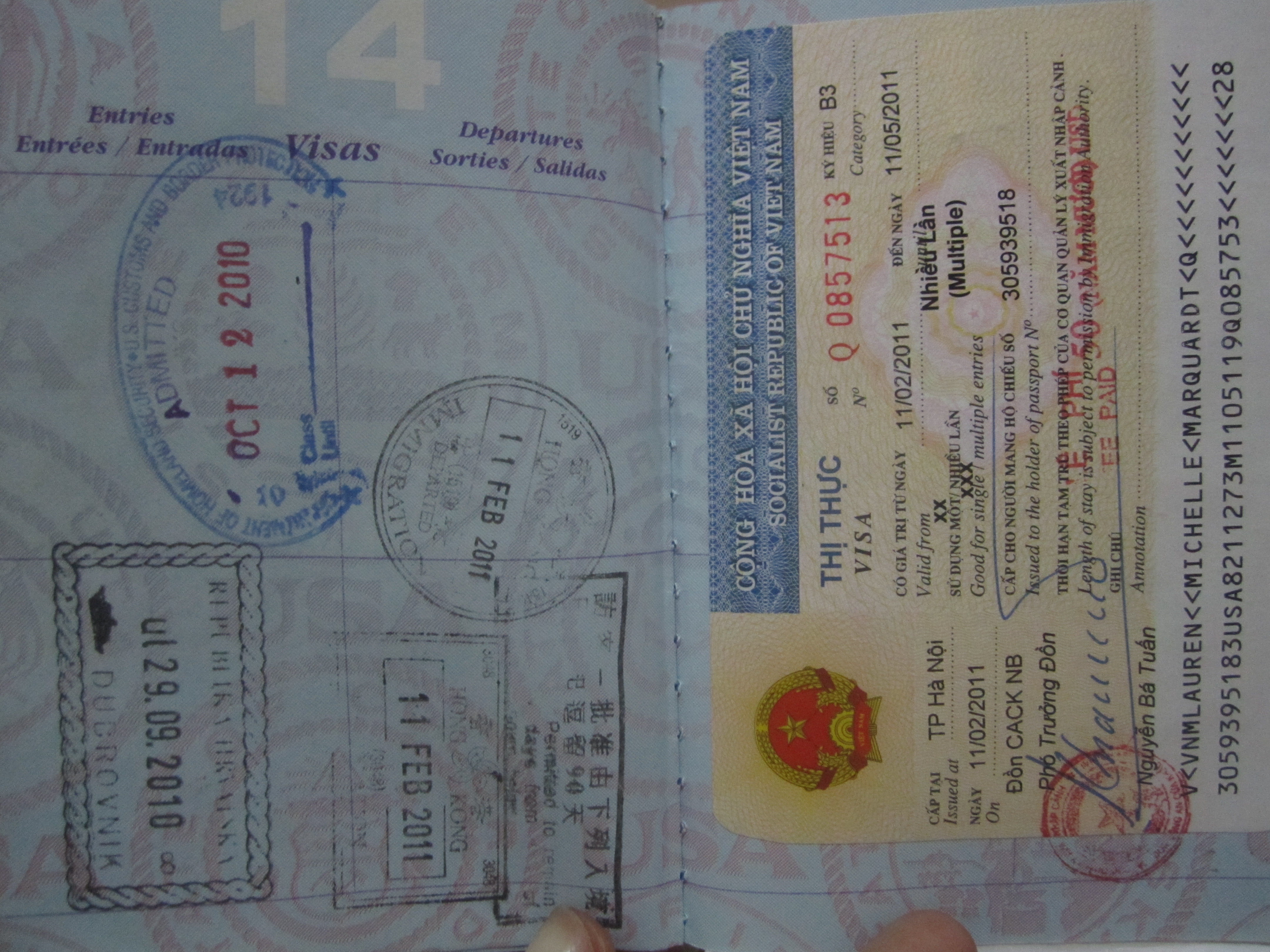
When I started traveling, I loved getting passport stamps. They were like tattoos—when you first starting getting tattooed, all you want is more, more, and you stare at the ones you have, and you look at the remaining blankness and fantasize about the ones you’ll get. Western Europe, I thought, was a real bummer—you got only one (extremely boring) stamp for entry into any of the Schengen Zone countries. Lame.

Enter SE Asia—the land of senseless beauracracy and full-page visas. They hungrily consume your passport, taking up space that could easily fit five to six entry stamps to more modest, reasonable countries. Two of these, and I realized I was quickly running out of room in my passport.

It was time for a trip to my Embassy.

Here I should interject—for the non-Americans and the non-traveling Americans, which is most Americans—that filling up my passport does not make me a world traveler of epic proportions. It simply means that the US issues the skimpiest passports you’ve ever seen.

“Look at this thing!” I exclaimed, holding my passport up sideways, showing Anna its anorexic profile.

“Aw, that’s the cutest little passport I’ve ever seen.”

“And guess how long it’s good for?” I paused, preparing her for the indignity. “Ten years! Ten fucking years! What am I supposed to do with this—go to Canada once a year?” And I flung it on the cafe table like the mildly offensive thing it is.

American passports have improved; they now come with 24 pages. But when mine was issued, they still came with a measly 14 pages. Which is annoying, but serves as yet more evidence that Americans don’t travel like the rest of their Western counterparts.

But we recently hit a record high: a whopping 30% of Americans hold passports. (Tell this to a person of any other Western nationality and they laugh heartily.) And, I’d soon find out, there’s evidence of that too.

So it was off to the US Embassy. I’ve never had a reason to visit an Embassy before, and it felt a little like a field trip. I was mildly excited. I queued up under a shady awning at 1pm, eager to be one of the first in line for the two daily hours allotted for walk-in services.

The door opened at 1pm exactly (ah, American punctuality) and a grim-faced guard waved me in. I passed through a metal detector, was told I need to check my bag. I left that room, walking through a manicured courtyard (ah, the American affection for well-groomed lawns) and into another room, where another man examined my passport, wrote down my info, handed me a visitors badge and waved to enter the next room.

It was like a little air-conditioned slice of America. Posters on the wall: “From Sea to Shining Sea,” portraying different landscape shots; pictures of smiling, racially diverse faces; a sign suggesting that I like the US Embassy on Facebook (now, why on earth…). There was a drinking fountain—not a water cooler, but a drinking fountain—and I took a sip just for the novelty of it. A picture of Uncle Sam pointed down at me, and I smiled.

I lined up at a service window, fenced off with red partitions. I’d heard that they’d recently started charging for additional passport pages. I’d assumed that, now flooded with an influx of traveling Americans, this would be some sort of modest administrative fee; I had $30 in my wallet. I got to the window and told the clerk I needed more passport pages, and asked how much it would be.

She handed me a form. “It’s $82.”

I blinked. “$82?” I repeated. Maybe I heard her wrong.

She nodded. “$82.”

I briefly considered quoting the old Chris Rock skit from I’m Gonna Get You Sucka: “$82? Good lord, that’s a lotta money. How much for one page? How bout I photocopy a page and staple it in myself?”

Apparently the original skit doesn’t have the tag line. But you know what I mean…

Something told me this would not be an effective bargaining technique. Besides, this was the little slice of America, and in America, we don’t bargain.

“Um, okay,” I said slowly. “Well, I didn’t think it would be that much. Do you take credit cards?”

“No,” she smiled. “Cash only.” So it wasn’t totally a slice of America.

I asked the clerk’s opinion on whether I’d actually need more pages. I showed what I had left—two unstamped pages, plus the back amendment pages. I told her the countries I’d be going to. Did she think the customs agents will be able to squeeze the stamps in? (If it were Mexico or Italy, it’d be no problem; those fools will stamp right over of other stamps.)

“I think it’ll be okay for this trip. But it’s the same price here as in the States. So if you think you’ll need more pages anyway, you may as well get them while you’re here.”

Ah, American customer service: she was right. I don’t even know where the Consulate is in San Francisco. Right now I’m living a 5 minute walk from the US Embassy; in Phnom Penh, the task would only chew up an hour or so, as opposed to a whole day.

I nodded. “Okay, thank you. I’ll be back.”

And so I went back yesterday, went through the whole process again. And I must say that there’s something vaguely comforting about the whole thing—even though I don’t feel myself missing the States at all, there’s something sweet and reassuring about being surrounded by the Americana images, the American accents.

The funny thing about the Embassy here—and I’ve been told this is particular to this Embassy—is that services for Americans and services for Cambodians are done in one room. You sit in little chairs and wait for your number to be called, which sounds boring (and it is) but you’re provided with some pretty keen people-watching. Conversations between clerks and customers are done through a glass window, over a small speaker, and that provides for some pretty keen eaves-dropping.

A Cambodian man was trying to secure visas for his family to come to the States. He’d failed to follow the correct procedures and was stumbling to answer questions. He didn’t seem to understand the concept of needing to provide DNA-test results for his kids. I felt embarrassed for him.

I also saw the most Mexican Khmer man in, well, perhaps anywhere: cowboy boots, cowboy hat, big belt buckle and blue jeans, one of those air-brushed Cholo shirts with a picture of a foxy lady on the back, saying something “Por Vida.” I was ravenously curious to find out his story, but he left before I had a chance to sit down next to him and get nosy. Sometimes Khmer people with especially round faces look vaguely Mayan, and in my mind I imagined him having resettled in Texas or California and one day deciding: “Fuck it, if everyone thinks I’m Mexican, I’m rolling with it—por vida.”

A man next to me struck up conversation. He was Cambodian; having lived in the US for 10 years, he’d recently returned and was hoping to get a job at the Embassy. He asked why I was there, and we shared a laugh about how ghastly expensive my simple task was.

“I think it’s because more Americans have passports now—they’re milking it.” I leaned in, lowered my voice, “They found a new way to rip us off, you know?”

He nodded. “Maybe the pages be made of gold.”

I chuckled. “We can only hope.”

I got my passport back and the new pages were not, in fact, made of gold. They were made of paper. Very smartly decorated paper, with fanciful American images—totem poles and majestic eagles and buffalo so darkly colored I don’t know how a stamp is supposed to be readable over it. There are quotes from famous Americans about democracy and freedom and something from Ronald Reagan about living in a world “lit by lightning” that I’ve been unable to make sense of.

The new pages are insultingly over-priced, audaciously gaudy and not entirely practical—in short, very very American. And what can I do but shake my head, both annoyed and amused, with the vague affection one feels for their native land, their home country, their home.

My new plump passport

The Anti-Irony of Cambodian Fashion: The English-Language T-Shirt Edition

“I like how cheesy it is, you know?” Mathilde said this morning, ashing her anorexic cigarette and looking across the street, at the teenagers hanging out at the Best Friend Cafe. Fake acid-wash skinny jeans, emo sideswiped hair-dos, bedazzled trucker hats positioned atop boys’ heads in a perch reminiscent of Abe Lincoln—the styles donned so earnestly by Cambodian youth would be only be seen on the most ironic of Western hipsters. And even then…

“It’s not so serious as in Europe,” she continued. “We would think this was so cheesy, but why not? If they like it, if they think it looks good, why not?”

One of the things I love most about Cambodian fashion—and it isn’t the stripper shoes or cutesy pajama prints or polka-dot pants—is the utter sincerity with which ridiculous clothing is worn. Ridiculous to Western eyes, I should say. And tonight this was exemplified by the t-shirts for sale at Phnom Penh’s Night Market.

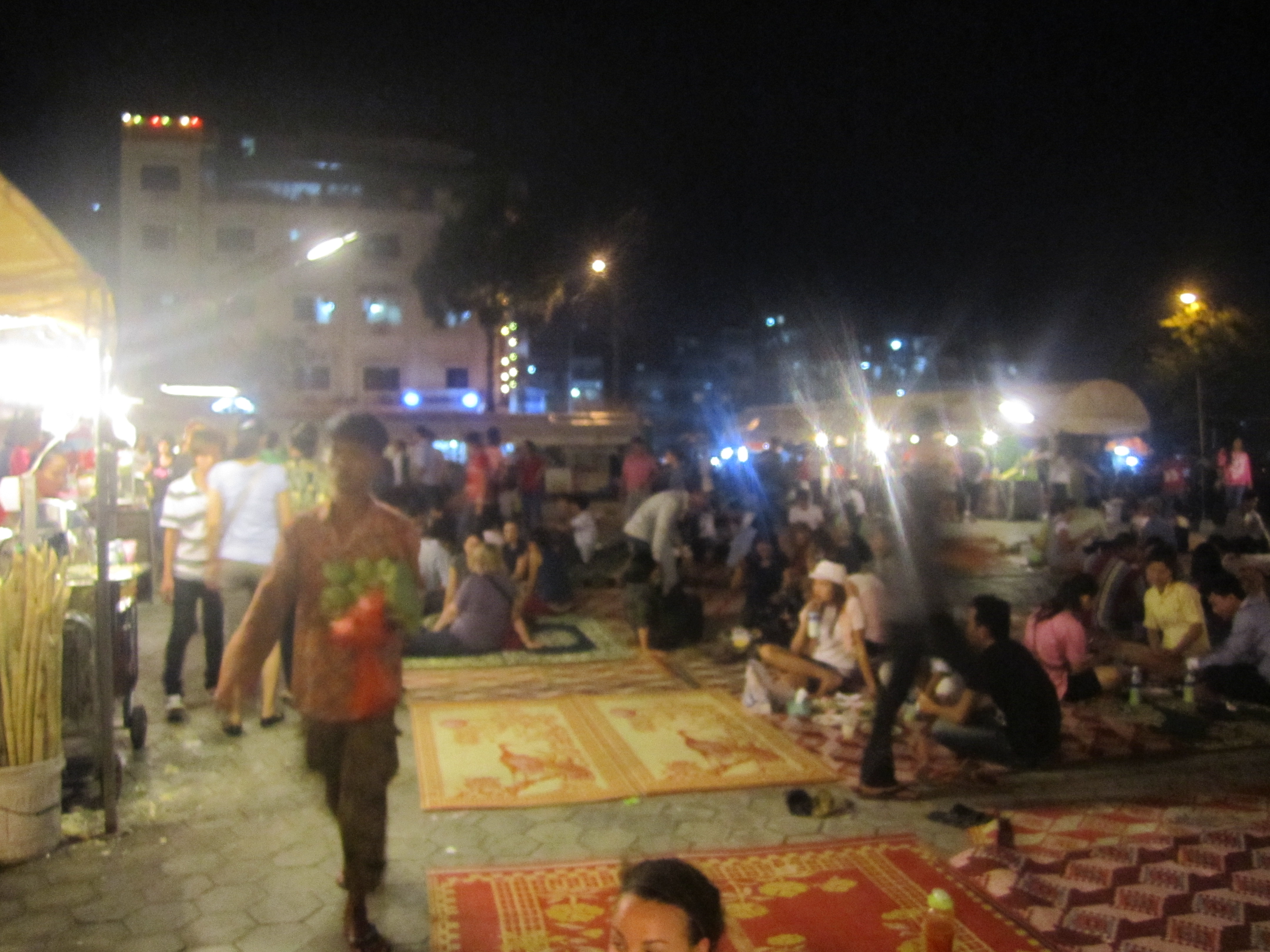
On Friday, Saturday and Sunday nights, along the riverside, tents are erected and a fair-style stage put up; vendors set up booths, teenagers with mediocre voices and sleep-walk-y dance moves perform on stage, mobile phone companies set up opposing stands with megaphones blasting promotions at one another, food stalls sell skewers of myserious deep-fried meat products, and diners take off their shoes and sit on straw mats, eating off thin wooden sticks. It’s nice. It’s a good mix of foreigners and Khmers, the riverside breeze is sweet, and until the mosquitoes drive you away, it’s pretty fucking luxurious to sit out and enjoy the night.

So we’ve been making a habit of grabbing some food and sitting out under the stars—or what would be the stars, might be the stars, behind the haze of city lights and smog. You can’t really be sure anymore. You don’t really go there to buy things—some tourist trinkets, fake floral arrangements (okay, I bought one of those for my apartment), and clothing. Clothing for local teenagers, I should say.

Tonight I took to photographing some of the t-shirts I felt best exemplified the Cambodian fashion spirit within the particular sub-category of Putting English Words On A Shirt Immediately Makes It Cool.

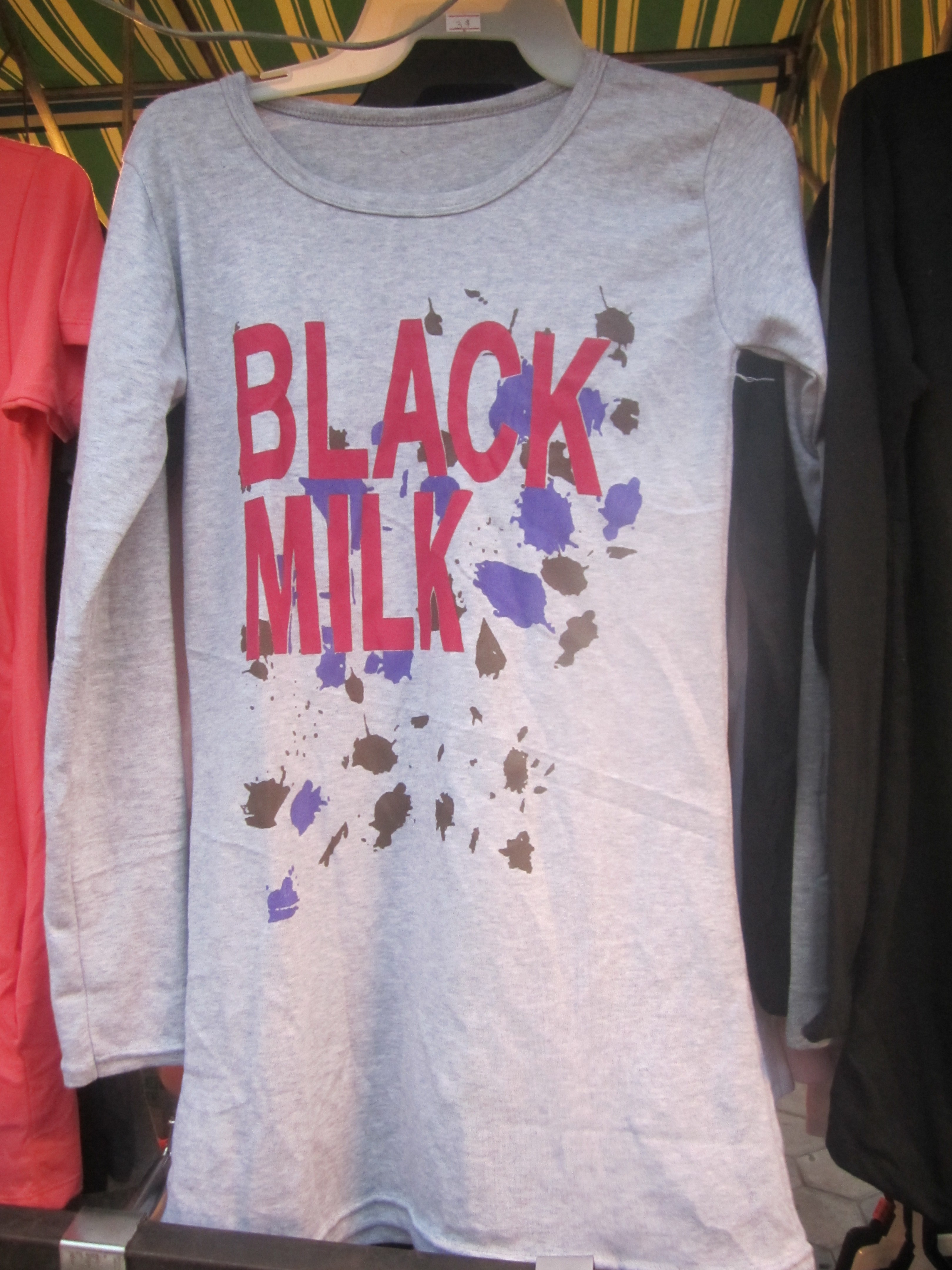
Rule #1: It doesn’t really matter if what’s on a shirt makes sense or not—as long as there are English letters, you’re half-way there.

Rule #2: It really doesn’t matter.

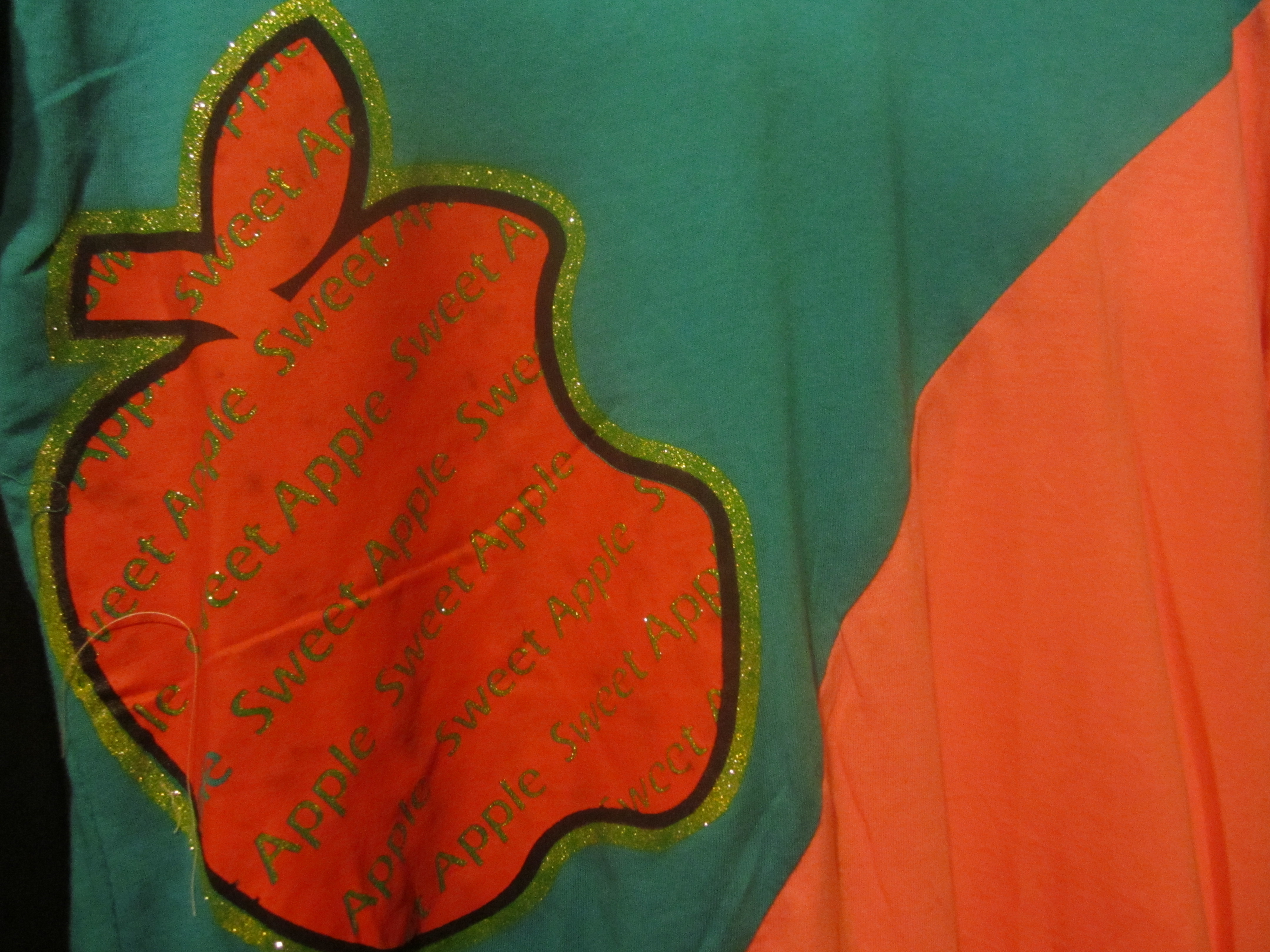
Rule #3: Product placement is a key component of English-language t-shirt fashion. It doesn’t matter if it’s the actual logo of a product, as long as it refers a Western, and preferably American, product.

Hey Apple marketing masterminds: you should really think about doing a Cambodian edition of those PC vs Apple guys ads. Do you see any PC t-shirts out here? I don’t think so…

Rule (?) #4: It also doesn’t seem to matter if the senseless phrases evoke repulsive imagery of, say, spoiled food products.

“Punk Rock Tonight Love Me”: I almost bought this one. It was too small.

“Power Over Pimples”: Fuck yeah! As someone who endured 12 years of acne, I wanted to high-five this t-shirt and jump joyously in the air like… the people on this t-shirt. The text was also English, singing the praises of an acne-fighting cleansing solution.

So, um, in a country where a shitton of kids get strung out on glue sniffing and paint huffing, I didn’t know what to make of this. Was it supposed to be funny? One thing’s for sure: I don’t think the affected demographic is perusing for new shirts at the Night Market though…

Rule #5: Content Over Accuracy

“Joy, Look For It Evert Day”: This shirt says it all. There’s a certain sweetness to it all, what would be convenient to call an innocence, but I think it’s something other than that, less simple or more simple or in any case different.

“Cambodia’s not a post-modern culture,” someone was explaining to me. “So there’s not a lot of irony. There’s a playfulness for sure—but more of a sincerity to the work.”

She was talking about contemporary art, but I thought about her comment looking at the shirts tonight. And I think it’s true for the fashion as well. And I agree with Mathilde—I like it. Coming from a world of ironic everything—ironic moustaches, ironic wolf-howling-at-the-moon shirts, ironic gangsta rap listening and ghetto blasting, ironic malt liquor drinking and crack smoking (yes, really)—it’s pretty fucking refreshing to enter a world of sweetness and anti-irony. It’s not any less self-conscious, it’s just self-conscious in a different way. It makes you feel like we’ve missed something in the Western world, that we’ve lost something, gotten away from something, something I can’t quite name but that makes me horribly sad, in the smallest way, heavy like a pebble.

But I’m Western. And I can’t switch worlds, switch roles, ease myself into a different way of thinking. The t-shirts are, to me, ironic.

Yawning teenager working the teddy bear stand


Lauren Quinn is a writer and traveler currently living in Hanoi. Lonely Girl Travels was a blog of her sola travels and expat living from 2009 to 2012. She resides elsewhere on the internet now.

Join 490 other subscribers

Buy This Sh#t

Categories