Archive for the 'Phnom Penh' Category


The Lone Black Dance: Tiny Toones Record Release

I knew, I knew, I knew there was something there.

You hear about an organization: Tiny Toones. Founded by a deported Khmer-American, it works to improve the lives and futures of Phnom Penh’s street kids—through, primarily, breakdance. You don’t breakdance. You’re not Cambodian and you don’t even really listen to hip-hop anymore. But there’s something about it, something about it…

I’ve recently figured this out about myself: that things I should, by all logic, experience as intense emotions, vivid memories and blazing-eyed convictions, I experience instead as far-away feelings, a vague awareness, a dim hunch in the sunlight of my consciousness (oh silhouette, oh silhouette). And so it was with Tiny Toones.

I went to their album release party last Saturday. In their four years of existence, Tiny Toones has grown to encompass additional programs: computer literacy, Khmer and English literacy, harm reduction and music. The release of their first full-length hip-hop album was the end result of that new program.

The event was held on the rooftop of the Meta House, the minimalist white German cultural center. Like the show I’d gone to two nights prior, the crowd was a healthy mix of ages and locals/expats. And like the previous show, the kids behind the mike and turnatables all looked totally hip-hop American. It reminded me of being at a Youth Speaks event.

And so there were speeches and raffles and auctions and performances. They also showed some videos, including a recording of the performace that had won the organization a recent TED Award. Participants had developed narrative breakdances that depicted defining elements of their life stories (oh undimness, oh spotlight).

A girl depicted being abused, two boys violent robbery. They’d be in black for these, at the end of each, they’d shed their black shirts, under which there were white shirts, and they’d join each other, a representation of Tiny Toones.

They do one for addiction. Boys crouched around a make-shift pipe (oh soda bottle, oh tin foil). The kids in white pass by, and every time they take another boy in black with them. Finally there is one boy, in one spotlight, alone on the stage.

He does a strange dance, beautiful dance. His shoulder arch up like he’s attached to strings (oh puppet child, oh puppet child)—he rises, chest first and lungs full—and then drops back down, as though whatever held those strings (oh God-like fingers, oh typewriter of fate) had dropped him suddenly—and he crashes to the floor, the bottom, or what appears to be the bottom—in real life there’s always further you can go, downer and downer and maybe even death isn’t the basement (oh elevator of addiction, oh wobble of the cablewires)—maybe the dance continues on after that, into that, souls arching and crashing endlessly, winglessly.

Anyway, he carries on like that—spotlight and a bare stage, rising and falling around the homemade pipe—and I think: Well, isn’t that just it? Isn’t that the dance of it?

And it surprises me how much I relate to it. Though it shouldn’t. Because even though it would outwardly appear that I have even less in common with this kid dancing, a Cambodian streetkid, than oh, say, Charlies Sheen—you strip away the details, the circumstances—you strip away the lights and setting and the props—and isn’t that all you’re ever left with? Isn’t that all we (oh puppet children, oh puppet children) ever really do?—a lone black dance on a barren stage?

I smiled and thought: Of course, of course, of course.

O body swayed to music, O brightening glance,
How can we know the dancer from the dance?

—William Butler Yeats

Dance, Dance, Evolution: Aerobic Dancing at the Olympic Stadium

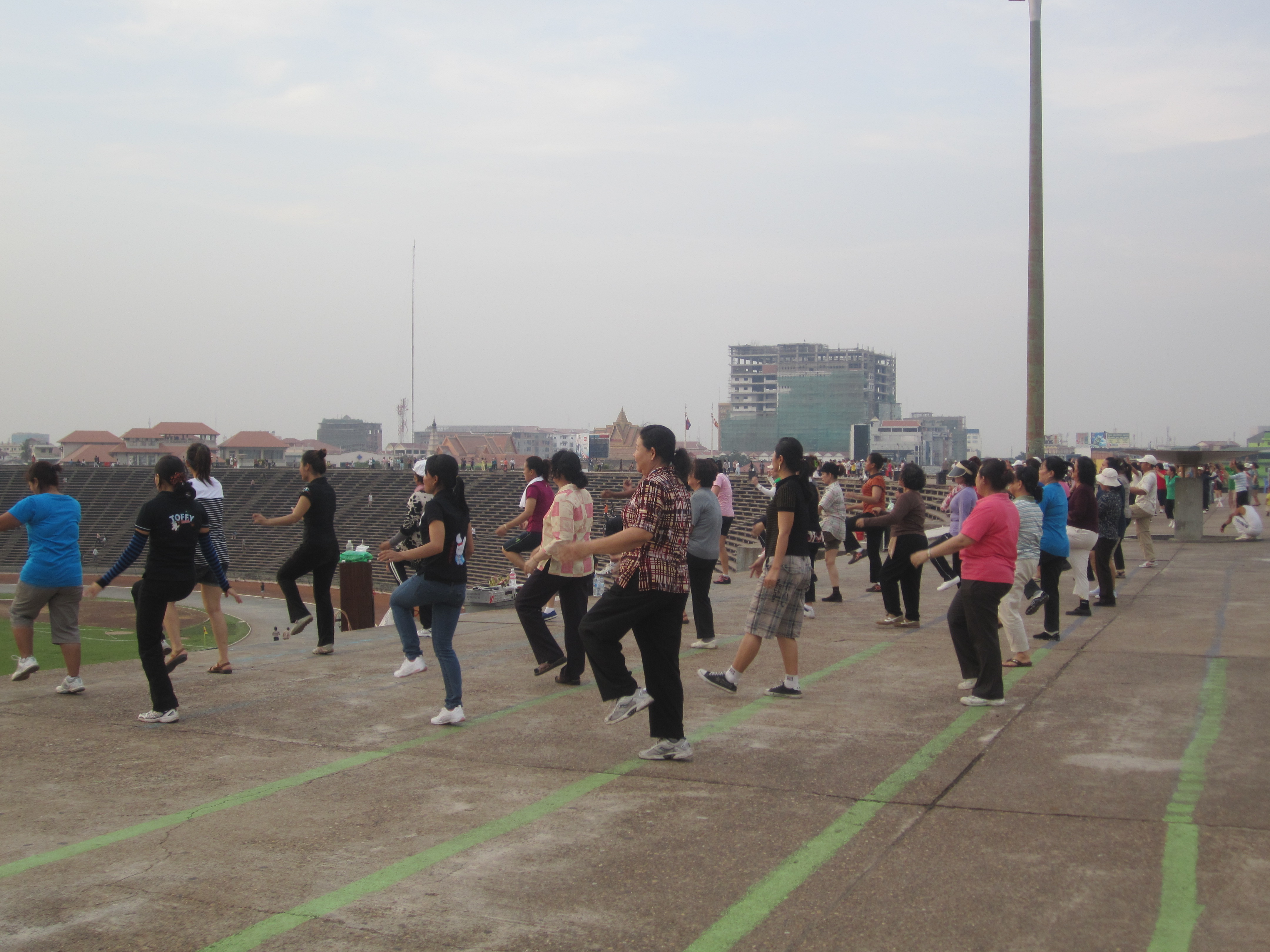
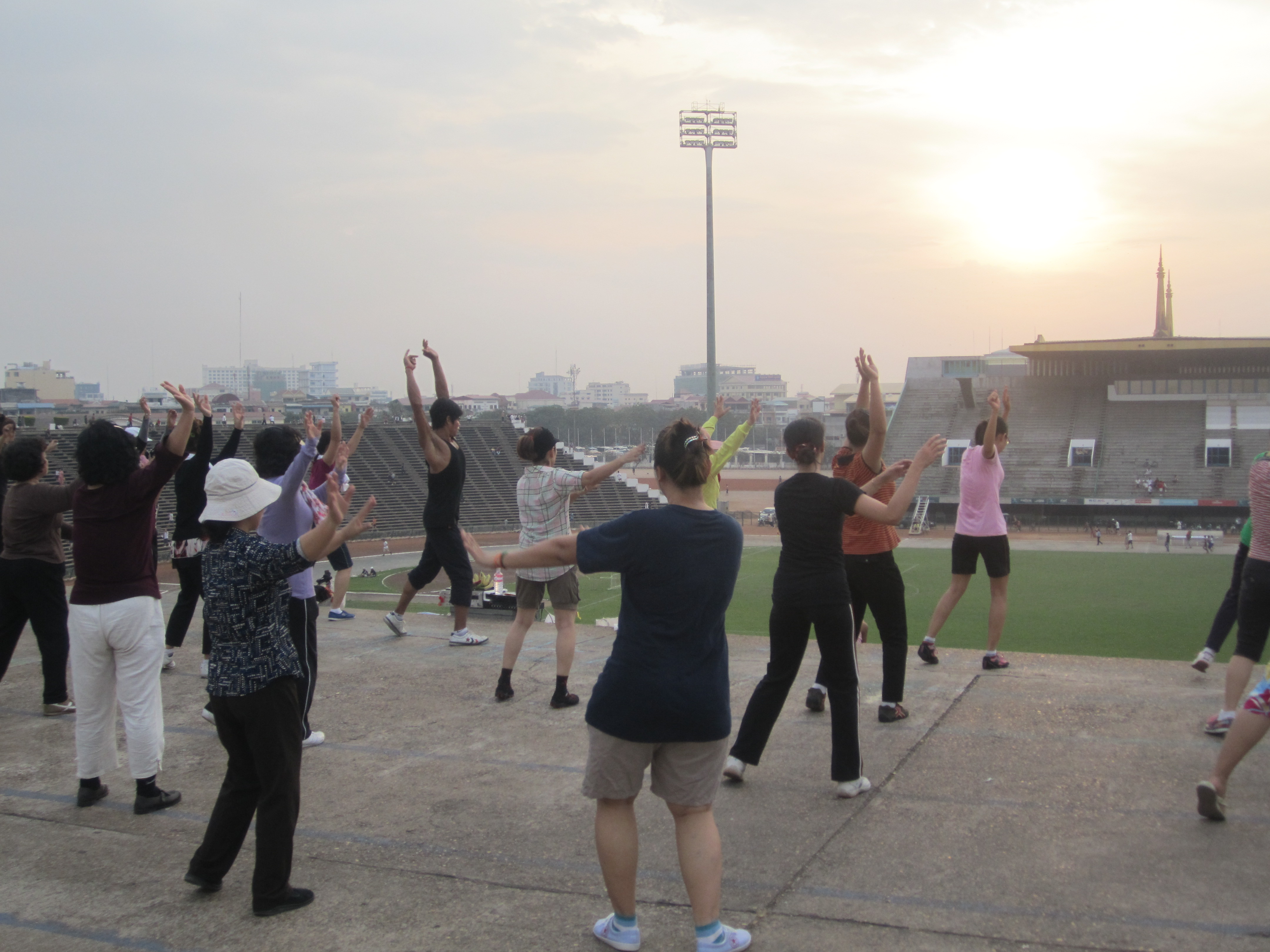
It’s dusk at the Olympic Stadium, and it feels like a festival. Vendors have set up stalls selling snack foods, beverages, trinkets. People in sweat clothes swarm. Cliche club dance music beats out of stereosystems and, lined up along the cement ring of the stadium’s top tier, little old ladies dance.

It’s called Aerobic Dancing, and it’s about the goddamn most endearing thing I’ve ever seen.

I saw it my first night in Phnom Penh, along the riverside. A few sets of stereospeakers had been set up, and young men were leading groups in dance moves. I thought it was something for tourists, some sort of street performance. I looked for baskets of money and didn’t see any. Then I scanned the expressions of the dancers’ faces, and they were all totally in earnest, concentrated of getting the moves right. Now this, I thought, is something different.

It was recommended to me later that I go to the city’s Olympic Stadium at dawn (um, no) or dusk (um, yes!) to see some real aerobic dancing. Well, you didn’t have to tell me twice.

It’s bustling leading up the steep slope of the stadium’s entrance. People swing their arms and legs, warming up. Children run around. I get to the top, and it’s a buzzing beehive of fitness. People run the stairs. Down at the bottom, a crew of joggers circle the dirt track. But the overwhelming majority of people at the stadium are late-middle-aged women. And they are there to dance.

Now, I’m quite familiar with old ladies doing Tai Chi in the parks at dawn. And I’m even used to random young Western dude who thanks to Ghost Dog has aspirations of becoming an urban samurai and practices along. But this is something entirely different.

About a dozen different stations are set up along the stadium’s ring, where a cool dusk breeze passes. Their music and moves are all slight variations of each other: twists and kicks and stretches and arm raises, a little fancy footwork from time to time. The people in the front rows sweat, focus intently. Most of the others vaguely step along, moving this way and that, sometimes getting the moves right, sometimes not. It doesn’t really seem to be about that.

The leaders of all of these groups are young men, teenagers in some cases. Hair swept across the face, pink shirts, dedazzled jean pockets: they are boys that by American standards would be categorically, 100% flaming gay. But they’re doing their thing here. And a crew of older ladies are doing it with them.

I sit and watch for awhile: the various sets of raised arms, the shakes and twists, the echoes of club music. Before the Khmer Rouge, dance was one of the most important art forms in the culture. Most of the country’s dancers, along with other artists, were killed.

Well, this might not be a revival of a lost traditional art form, but it might be an evolution of that. It might be a new manifestation of a cultural predisposition to dance. Or it could just be exercise, set to a melting sky and sweet as fucking hell.

Voices of the Khmer Rouge: The Exhibition and the Mystery

I never heard the term “Khmer Rouge” growing up. We didn’t learn about Cambodia in school, didn’t hear about it in TV or the movies. I must have been a teenager when I first heard those specific words, and I remember it sounding terribly exotic and glamorous: “Khmer,” smooth, black, still as glass; “Rouge,” like lipstick, like burlesque, Paris in the 20s. (Cambodia, Cambodia—where even the genocides have beautiful names.)

I did hear about Pol Pot. Not all the time—quite rarely, actually, and only in passing, but in a way that made in stand out in your mind, that made it tuck into some cramped little corner of your brain where nothing much else goes. How did you learn to make fire from two sticks? “I learn during Pol Pot.” Why were you running, pregnant, through waist-deep water in the middle of a monsoon? “To escape Pol Pot.” Who hung you upside down for days when you were caught stealing food? “Pol Pot.”

It was never the Khmer Rouge, but instead always this person, this invisible man, a dark silhouette that you could perhaps see passing, passing, passing through the house at night—like a ghost or a phantom or something even realer than that: Pol Pot.

So it was a type of linguistic division—responsibility placed not on a mass of people, a movement (ie: Nazis), but on a single person. Not a war, a genocide, but a man.

I kept thinking about that last night. I chanced upon—as I’ve been “chancing” upon everything in this project, so that you can’t really call it chance at all—the exhibition “Voices of the Khmer Rouge.” A massive audiovideo installation, “Voices of the Khmer Rouge” features 30 interviews with former low-ranking Khmer Rouge soliders, displayed with multi-lingual subtitles on some dozen computer monitors/headsets. It’s being shown at the Bophana Audiovisual Resource Center, an historical archive center with free, open access to the public. The exhibition opening happened to be last night. So I went.

It was sweltering hot in Bophana’s main floor, a space that was meant to have air-conditioning but didn’t. There were well-dressed Westerners and well-dressed Cambodians—lots of younger Cambodians, too: teens and twenties, what’s referred to as “the next generation,” all wearing the same type of short-leeve button-up top and slacks, conservative skirts. At a certain point, a herd of younger children filtered through, chattering softly; they were thin and dark and put on the headphones and stared.

The opening speeches were being translated into 3 languages—Khmer, English and French—and proceeded at a painstaking pace. I stood in the breeze of a fan and read the subtitles flashing on the screen.

All of the interviewees were poor villagers from a Northern province. Many of them had been young when they joined the Khmer Rouge—teenagers or even children. I’d read about that, accounts of that: the Khmer Rouge’s use of child soliders. Some had been arrested and forced to join, others felt they’d had no choice, and still others joined voluntarily, zealously.

So they’d mostly all been extremely vulnerable. They all spoke of experiencing hardship during Lon Nol’s regime and the American B-52 bombings: hunger, death, loss. They were angry, young, uneducated and desperate. These are dangerous conditions.

Their thoughts about the Khmer Rouge now ran the gamut. One man lauded Pol Pot as a hero who’d fought imperalism. He thought of him as a teacher and kept repeating that he couldn’t say Pol Pot is bad because, “If the student says the teacher is bad, then the student is bad too”—a logic steeped in the Cambodian brand of Buddhism.

There was a marked clarity when it came to the US’s involvement in the development of the war. One woman summed up: “Americans paid Khmers to fight other Khmer, and that’s what we were fighting: Khmer puppets.” Another man, with piercing eyes and deep wrinkles, spoke of how the power of the Khmer Rouge was set up by the “greater powers” of the world. He cited the US, China, Vietnam, Cuba, the Soviet Union—how they supplied money, guns, mines. “It was the greater powers that incited war. How could they have afforded it otherwise?”

He said that he was for the trying for former Khmer Rouge leaders, but that it wouldn’t be a proper trial if it was only trying them. “America must pay compensation too,” he said.

When I was at Tuol Sleng, my tour guide had said something about the Khmer Rouge that stood out to me. He said that they had “the trauma” just like the victims. Some of them killed, but they had to; if they didn’t, they’d be killed. “So they are victims too,” he said. “Indirect victims, but victims too.” That sense of division echoed in me: Pol Pot vs. the Khmer Rouge.

One woman, old and thin now, spoke of how she’d felt sorry for the people in the camps, but how there was nothing she could do. “That is war.” Mostly, she felt sorry for her Khmer Rouge comrades. She said how, when one would die, they would mourn them like a sibling. And I imagined an army of children in black pajamas, in the jungle with their semi-automatic weapons, stripped of their families, with nothing but each other.

Another man had been sent to be a solider as a child. During the fighting, he said, he’d lost his thumb, an eye, had a leg cut off; he didn’t even mention his missing front teeth. “I became a disabled person,” and he said it with a smile, a well-what’re-you-gonna-do smile—a battered little shell of a man.

Another man had a broad smile and smooth dark skin. He spoke of being afraid. “Maybe they will see this and come arrest me and execute me.” I thought of what my tour guide had said, how he’s still easily frightened, all these years later. “This would be very unfortunate for me,” said the man on the screen, and he smiled still, laughed. “It may sound like I’m joking, but I’m not.”

The project’s producers were on hand to discuss the work—two Danish dudes. They insisted that this was an art installation, because it wasn’t attempting to answer questions, only raise them. They refused to tell viewers what to think of the interviews; they wanted you to look at them and make your own conclusions.

“There are no conclusions,” I thought.

I waited around to speak with one of them. I was curious about a point he’d made—that he felt there were different levels of Khmer Rouge, the “really bad guys,” as it was convenient to phrase, and the other people, who existed in shades of grey—so many shades of grey, I’d thought, that you hadn’t knew existed before, like looking at one of those charts of the light spectrum in science class and realizing that all you’d ever seen was this small sliver of what was out there.

Another American girl had him cornered; I eavesdropped and they seemed to be talking about the same thing. She was debating that point fiercely, the kind guilty-by-compliance logic that had always made sense to me, before this. She was young, unwrinkled skin and braces, and kept shaking her head.

I finally got my chance to ask him. I told him my linguistic childhood ancedote. He spoke about the shades of grey, how he didn’t think it was as simple as just Pol Pot or all the Khmer Rouge. He again urged me to find my own answers.

“I think maybe there aren’t answers,” I said.

Which I think didn’t sound the way I’d intended. It wasn’t to say that the search was futile—because, after all, what the hell am I doing? (What the hell am I doing?)

No, I think the search is one of the most worthwhile things we can do. But I keep feeling like every layer I peel back, the further I look into it, the more complex it gets; it only opens the door to new questions. So we can look at it and we can tease it apart and try to know it, but I feel that at the center of it all is a great mystery, an un-understandability—the same mystery that’s at the center of everything, only maybe a little darker.

It’s a fact I feel I keep coming back to and keep coming back to, that all of seems to orbit around: the impenetrable mystery—smooth, black, still as glass.

Not Your Normal Expat Scene: Khmer Kids Coming Back to Cambodia

“This not your normal expat scene.”

That’s all I kept thinking last night, as I stood sweating and stomach-sore in the crowd. I’d dragged myself out to a show, what was described to me as an all-girl indie rock band that sang in Khmer. Killer. No traveler’s flu would make me miss this.

It was a funny mix—local men in dress shirts and slacks, women in those super foofy sparkly dresses; kids, some just in the crowd, others wearing matching shirts for some organization I couldn’t quite make out.

And there were your typical expats—Western, mostly white. Some of them were extremely well-groomed, reeking of cologne and hair spray and kissing their friends on both cheeks. Some of them wore that aren’t-I-so-cool-for-being-here look. Some tried to dance along or move to the beat, and it was sad and cute in the way it’s always sad and cute. And others just seemed to be there, watching, enjoying the show, because that’s what there was to do that night.

But the kids putting on the show—the kids on stage and holding the cameras and checking the sound—they were not your normal expats.

Your typical expat does not drop their “to be” verb (“She crazy”), doesn’t say “y’all” or “aight.” They don’t wear baggy jeans and puffy sneakers. They don’t start NGOs called Tiny Toones or hip-hop groups called Klap Ya Handz, written in Godfather font. They don’t breakdance or freestyle or bust—and they don’t do it in the language native to their new homes.

I’d heard about the show from Bel, a girl I’d found on Couchsurfing. We had plans to meet up for coffee and even though my stomach was already getting wonky, something told me not to flake.

She was a cool girl and we talked for awhile. Her boyfriend was a Khmer-American who’d moved back to Cambodia, with no intention of ever leaving again. “He’s the most patriotic Khmer you’ll ever meet,” she said, and later he showed me the tattoo of a famous Wat across his back.

“There’s a lot of foreign-born Khmers moving back,” Bel told me. “Lots of artists and young people. And they’re really motivated to do something here.”

I wanted to see this; I wanted to glimpse what this was. Sure, I knew of people going back to their parents’ countries for a visit, but to live? To give up everything they know to fight for something better in a country they hadn’t grown up in? This was something different.

And it was. The show place was buried deep inside the maze of a mall, shuttered shops and a blinking arcade, bowling alley and bumper cars. I got there earlyish, paid a $10 cover—normal for the US, but exorbitant for here.

On stage was a DJ, two turntables and a MacBook glowing. Two artists were on stage, doing ad hoc graffiti art on a make-shift wall. “Empire State of Mind” came on. It was like being at any hip-hop show at home—except a hell of a lot hotter.

The first act was a hip-hop group called Klap Ya Handz. They spoke in a working-class English, like kids that grow up in Oakland. But in the songs, they flowed in Khmer. For one song, they brought out traditional Khmer drummers that were, well, bad-ass. During another song, the lead girl did what she later called “Khmer hands,” a hip-hop take-off on the hand movements of traditional Khmer dancers.

Cambodia lost a whole generation of artists during the Khmer Rouge. Traditional dance was virtually erased and, after Pol Pot, there wasn’t anyone left to pass it on. I’d read accounts of the few survivors left trying to teach the next generation, and it being hard—they were more interested, as teenagers usually are, in contemporary things. Like hip-hop.

The headliner was Laura Mam and the Like Me’s. They’re a bluesy, all-girl rock band from San Jose, California (local love). They’re Khmer-American and sing in Khmer. The crowd obviously loved them, singing along and snapping photos and waving their arms. I was told that they came to play in Cambodia relatively often. Either way, they showed the same kind of passionate pride in their Khmer culture that the kids in Klap Ya Handz did.

They played a song called “Diaspora”: “for all the refugees living in diaspora around the world—and missing Cambodia.” The crowd went crazy.

No, this wasn’t your normal expat scene.

Your typical expat is someone of relative priviledge; they have, say, a university degree and the social mobility to pick up and move around the world. Maybe they studied abroad, or spent time backpacking around. In any event, it occurred to them to leave their home countries in the first place and they had the means, however meager, to do it. The ones I encounter are largely middle-class; the uber wealthy ones exist on another plane, and I only see them in passing—the immaculate girls on the streets of Hong Kong.

These kids were categorically Not That. They’re the kind of kids, in the kind of scene, that I miss when I leave the US; when I think about moving abroad, I think, “Man, there’s so much shit I’d be missing” and this is part of what I mean.

And they bring their Americanness—their very, very Americanness—back here. But they’re making something new with it; there’s that frenetic energy, that spark you feel when cultures collide and you see people that are so intensely passionate about what they’re doing, you can’t help but feel it too.

Of course, not all of them are coming back by choice. The US opted to deport foreign-born convicts, regardless of whether they’d served their time, and nearly 200 people who were, for all intents and purposes, American were sent “back” to Cambodia. They brought their culture, a street culture, and they brought their art. And they’re doing shit; they’re bringing this to the kids of Cambodia, the next generation (ie: Tiny Toones).

So basically, watch the fuck out for these kids.

There was a shirt I kept seeing in the crowd, tons of kids wearing it. Its design was a take-off on the Star Wars logo, and it read: “The Khmer Empire Strikes Back.”

This was my first glimpse into this, my looking-through-the-peep-hole into this. I fully intend on investigating this more during my time here. But last night, sickness was calling, and I had to head back to the hotel.

Holiday in Cambodia: “Ugly Foreigners” At The Tuol Sleng Genoicde Museum

Yeah, yeah, you knew it was coming:

A sun-pressed afternoon and I’m walking through the dim cool rooms of the Tuol Slen Genocide Museum. The crumbling cells, the tangled barbed wire, the blood stains on the floor—none of it seems real. A bird flitted through the room of brick cells during our tour; a child was giggling and running on the grass. Tourists snapped photos.

I didn’t feel anything I was supposed to, or thought I was supposed to. The rooms and rooms lined with photos on cheap display boards, gleaming plexi-glass—young faces, beautiful faces, virtually all with same expression. I can’t quite name it; it isn’t anger or fear or anything like that. Maybe it’s a lack of fear, a numbness, a well-isn’t-this-it, isn’t-this-the-end-of-it. I looked at them and they didn’t look dead, didn’t look like people tortured and starved and tossed off into a mass graves just a couple meters away. They looked real and their expressions, in the face of death, looked real too.

I’m waiting to catch my tour guide. He’d shared his own experiences during the tour—life in the camps, his family members that had died—and I want to ask him questions. How does he do it? How does he walk through here everyday and talk about it, tell his story to masses of Western tourists, panting and sleeveless?

“Everyone in my generation is traumatized,” he’d said, pointing to his head with both fingers, making a very small looping motion. “We all have the trauma.” How does he do it, how does he talk about it?

[“I don’t want to, I don’t want to take this job. But I needed to work,” he told me later, a bench in the shade. He’d gone to Germany last summer to study at a Holocaust museum. “That’s what this was, a second Holocaust,” and he showed me a page in the book he held, where amidst the Khmer lettering, more like art than language, a lone English word stood in parentheses: “Holocaust.”]

I’m waiting and rewalking through the first rooms, torture rooms. In each one is a ragged metal bed frame, rusted tools of torture, a photo on the wall of a body, bloody and dead and tied to the bed. There are blood stains on the floor and they look more like dirt, so that you could almost think that they were dirt and not someone’s blood, and again I don’t feel anything.

Three tourists—male, late 20s. Not American or European, some kind of Asian, I think. They’re laughing. There’s big signs that ask you not to laugh—a smiling man with a red slash across his face—and they’re laughing.

One of them picks up a torture tool. He swings it at the other in slow motion; he makes a comical grimace and their friend snaps a photo. They gather around the viewfinder and laugh.

I watch them, and it’s now that I feel something. It isn’t anger or rage, which would make more sense, I think—not even the how-dare-yous. It’s just a sadness—a deep, wordless sadness.

“That’s really fucked up and disrespectful,” I say. I don’t know if they speak English, but it doesn’t really matter.

And it’s at that point that I feel tears welling up—that I finally feel what I think I’m supposed to feel at a place like this. And I curse myself for having put on eye makeup that morning, and I curse myself for crying for something I don’t think I have a right to cry for, for crying here, in the middle of the museum. I curse myself for letting someone else’s ignorance bother me, and I curse myself for having said something when it’s not my job or my place—when it won’t change anything, not their disrespect and certainly not my sadness.

They stare at me. They have no expression, and maybe it’s their own kind of numbness. “That’s really hurtful,” I add, and walk away.

Phnom Penh: First Impressions, And An Open Letter

I want to tell you that there’s life here.

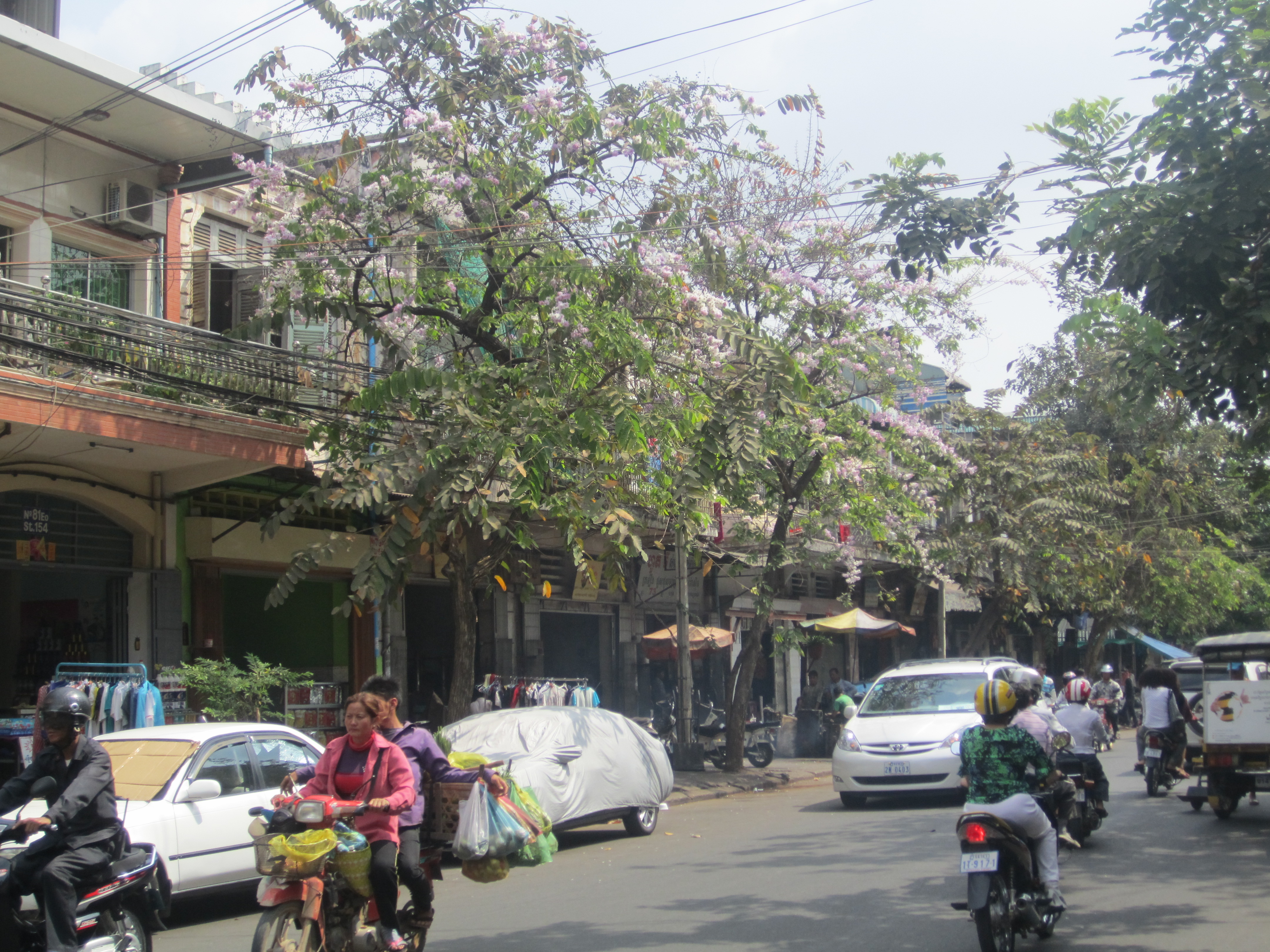
There are wide roads filled with motorbikes and tuk-tuks and more cars that I’d expected. There are smaller roads, lined with trees with soft pink flowers; there is laundry on the balconies. There are the umbrellas of the markets, the umbrellas of the monks—yellow above orange robes, a prayer in and of the themselves. There’s tourists and business men and beggars and children. There are a lot of children.

There wasn’t any of this when you left. There was smoke and emptiness; there was a camp of people on the medians. The buildings were shells, the lives were shells—bulleted carcases, metaphors of each other. A city punctured and bled.

But I want to tell you that there’s life here again. What you left devastated and destroyed; what you never came back to. It feels like a city, a normal city, and not as poor as I’d expected. There are billboards on the banks across the river, and construction cranes behind fences of corrugated metal. A smooth breeze comes off the river and the nights feel delicious on my skin.

This is the city that kept living—the way it grew in your dreams, I imagine, without you. This is the city you carried in you—its streets the same, some of the buildings too—but what fills them is all different, all changed, the architecture of absence. This is the city that kept living, when you did not.

After Vietnamese cities, Phnom Penh feels leisurely, luxurious, and it’s easy to feel enamored, to imagine none of it happened. But there are images, glimpses—dark things that I don’t understand, have nowhere to put, can only see.

Two boys standing beside the body of a man, limbs in an opiate sprawl along the sidewalk, next to a metal fence that ripples and warps. They frame him like boney columns—something vaguely Roman in the pose—and they each clutch a plastic bag. They raise it to their mouths and breathe, breathe.

Red-faced man with a bushy white beard, fat and eczematous, a Bad Santa—drinking a beer along the river, his arm around a thin, firm, dark body. A Bad Santa, bearing dark gifts and a cloud of soot.

Young girls, beautiful girls, white-skinned girls, legs and heels and tiny waists. Painted and primped and walking, neon-light shadow in the night, a click-click teeter. They’ve learned to balance, to walk on this, three and a half inches high.

Thin man, wiry man, sun-spotted and heat-blasted, something of a shell. He opens his mouth—a mess of rotted teeth, melted into one another. He speaks with an Australian accent. I don’t listen, or half-listen, instead watching his eyes, which shift ever so slightly—this way and that—like someone at the very beginning of sleep, when they still think the dream is real.

His story is practiced and performed: a stolen bag and a closed Embassy. Do I have money? Can I help him out?—-him, him, in this foreign land.

Children begging. In other countries they’d be gypsies, and some of them look like gypsies—but there’s something different to their posture. They don’t tug at your clothes, but approach with their palms up. Their whine is less pronounced, their words barely audible. There’s a restlessness, a shiftlessness, that they don’t have. Instead, there’s a permanence, an element of Here, to their movement that is, in a way, more lonesome.

A teenager walks the steep slope to the river, all black eyes and sharp bones—angular elbows and a collar bone shadow. He carries a long stick, and walks slowly along the cement embankment, where small black birds flit into nooks.

He walks up to a bird and swiftly stabs his stick at it—a flurry of wings. But he’s got it. He raises it to his face, slowly plucks the bird from its spear. He presses his thumb against its throat and pushes in slow, hard strokes. I can’t tell if it’s dead; I think I still see it moving.

He places the small black body in his pocket—a ragged strip of cloth—and continues walking, repeating, repeating. Is he killing them? Gathering them to sell? Are they food? Are they dead?

It isn’t so much the action of it that disturbs me—it’s the slowness with which he does it. It’s the calm of it all.

He continues off, along the steep slope, stabbing and gathering.

I don’t understand any of it. It’s life written in another language, a calligraphy dripping in mystery. It is beautiful and terrifying, and I don’t think for one minute that I’ll be able to understand.


Lauren Quinn is a writer and traveler currently living in Hanoi. Lonely Girl Travels was a blog of her sola travels and expat living from 2009 to 2012. She resides elsewhere on the internet now.

Join 490 other subscribers

Buy This Sh#t

Categories