Archive for the 'Southeast Asia' Category


Photo Essay: Kep’s Abandoned Mansions

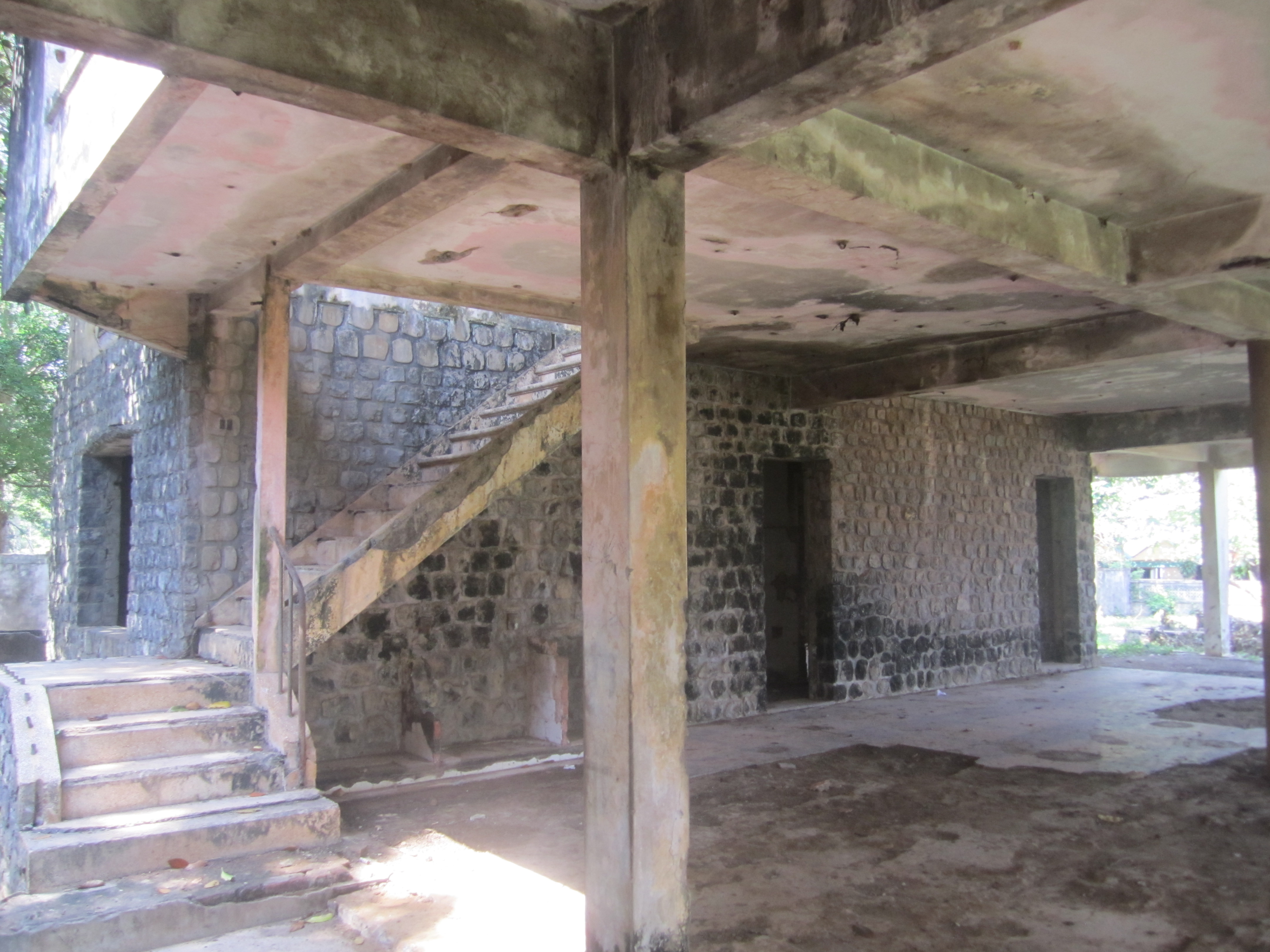
Before the war, beach-side Kep was a fashionable get-away for Phnom Penh’s well-heeled. Opulent homes were built into the cicada-buzzing green slopes, washed in the smell of salt and seafood. They were all abandoned, of course, in 1975; as the war reached on into the 90s, the facades crumbled and the green grew up in the cracks. It’s pretty much stayed that way since.

Kep is on track to regain its by-gone glory. For better or worse, bulldozers lumber across construction lots where crisp new buildings arch up behind shotty scaffolding. For now, Kep is a mellow mix of vacationing Cambodian families and independent Western travelers. Fishermen reel their nets, women season crab in fresh Kampot pepper and their adolescent children serve you at beach-side shack restaurants. You can hop on a boat and cruise out to Rabbit Island, where hammocks and coconuts and ramshackle bungalows will lure you away from any noble ambitions to trek to the top of the jungle-y island.

And of course, you can traipse through the remains of Kep’s past.

Makes my heart flutter

The squat toilet shall never die

The tile survives

View from the former second-story balcony

Peeking out: view from the street

Looking up

Looking out

Between the trees

Rising up

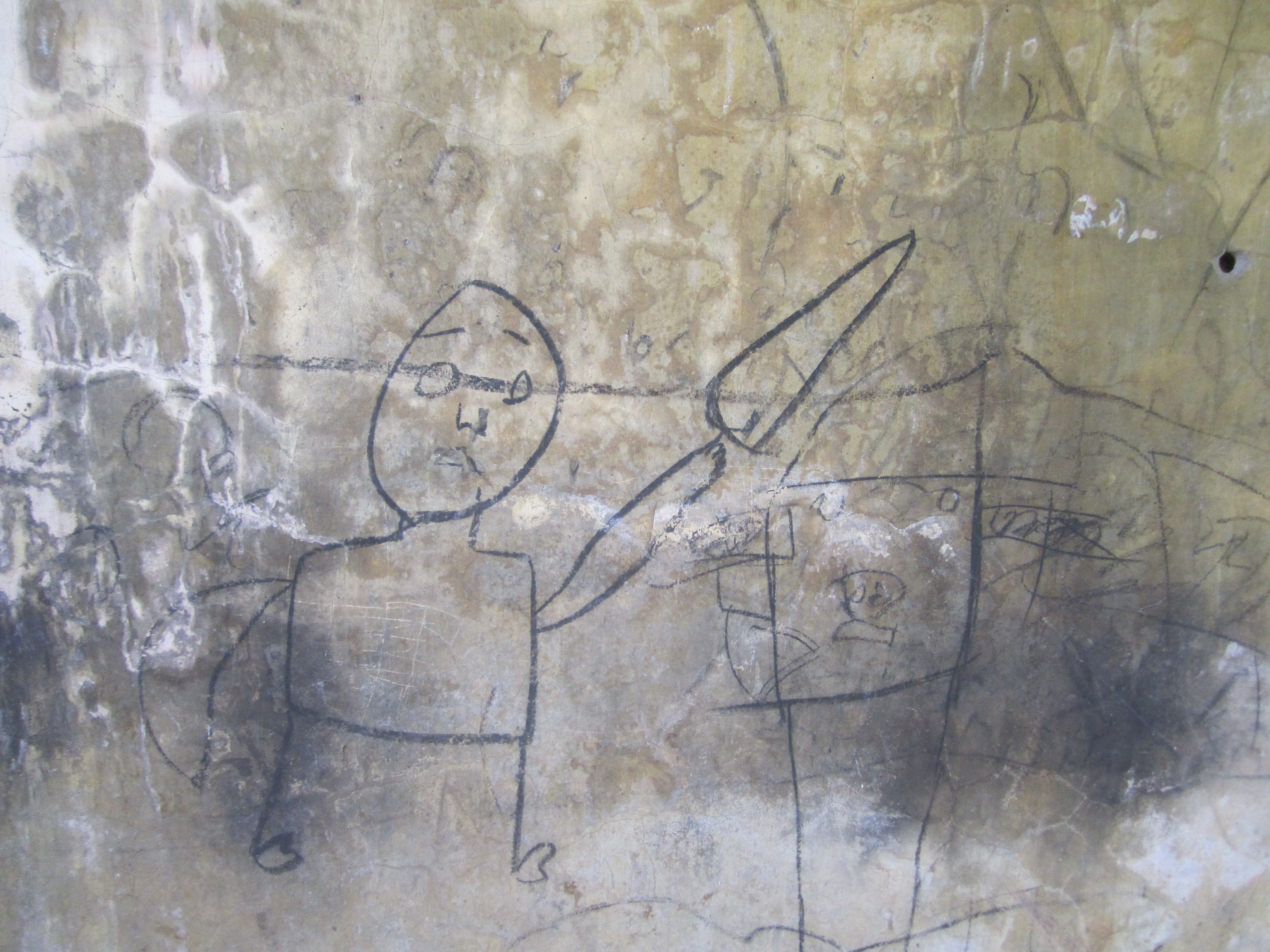
The walls of some of the buildings were covered, not in traditional graffiti, but children’s scribbles: faces, indiscernible Khmer, dirty drawings of women. It somehow made it sweeter, lent an innocence to the rubble that made you think of it, not as a relic of war and the country’s painstakingly slow march towards recovery, but instead as a child’s play place, a fantasy land, safe and hidden.

It’s hard to know what to say about Kep. The urban explorer in me was pretty stoked to traipse through abandoned building after abandoned building, surveying what was left and what was gone and what was growing up amid the crumble. But you couldn’t help but feel a sadness, adventuring around in this way you love, because you knew the reason for it was so heart-breaking.

It’s also hard to know what to say about the new development, the sure wave of resort tourism it will bring. It won’t be the same, that’s for sure, but will it actually go back to being something more similar to what it once was, before the war?

There’s no way to know right now. But I will say it’s a damn good place to hole of for a few days, eating crab and swimming in the ocean and climbing through ruins.

Battambang, Abandoned City

Battambang is a dingy balcony over a deserted street. Battambang is a tangle of electrical wires sagging in the heat, is a patch of sand between busted-up sidewalk, is discarded amusement-park bumper cars fading in the sun.

Cambodia’s fourth largest tourist attraction felt post-apocalyptic when we arrived, mid-afternoon during the biggest day of Khmer New Year. We wandered through nameless, signless streets, past shutters and padlocks and beach umbrellas with no one under them, looking for a guesthouse. We ventured out for coffee, through the wilted market, strewn stalks of sugar cane and vegetables rotting in the heat. The open lot across from the evening carnival, sleeping in the mid-day sun, reminded me of an old Freddy Kueger movie, dogs sniffing around the menacing clown smiles on the front of bumper cars.

While this impression isn’t entirely accurate—it would be like coming into any US city on Christmas Day—it did prove an apt opening to two days of wandering around the city and its surroundings. Battambang was, I’d learned, a major hub for people making the journey to Thailand in the post-Khmer-Rouge days, where they’d trade gold and hire shady guides to lead them through forests and mountains, landmines and bandits, that only some would survive. It’s probable that my friends’ parents passed through Battambang, and my friend, in a sense—in utero, sleeping inside the warmth of his mother.

It was hard with the holiday to get a sense for the city as it is today. And the coolest stuff we found wasn’t the temples, where monks chanted into megaphones, and it wasn’t the bamboo norry trains that have now turned into a shameless tourist trap—a police man with a crooked smile and a limp handshake, “$5 per person.” The coolest places in Battambang were the abandoned ones.

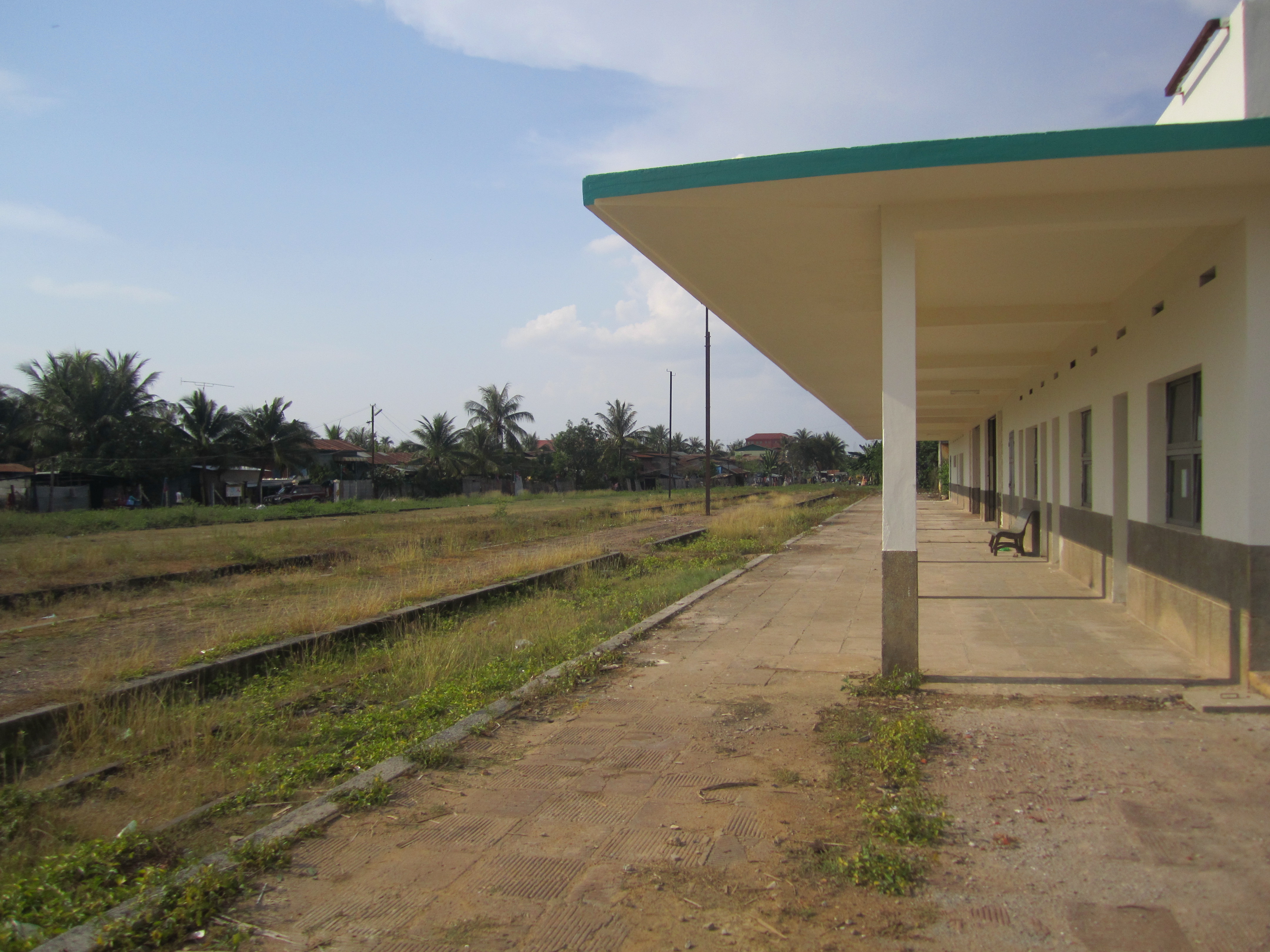
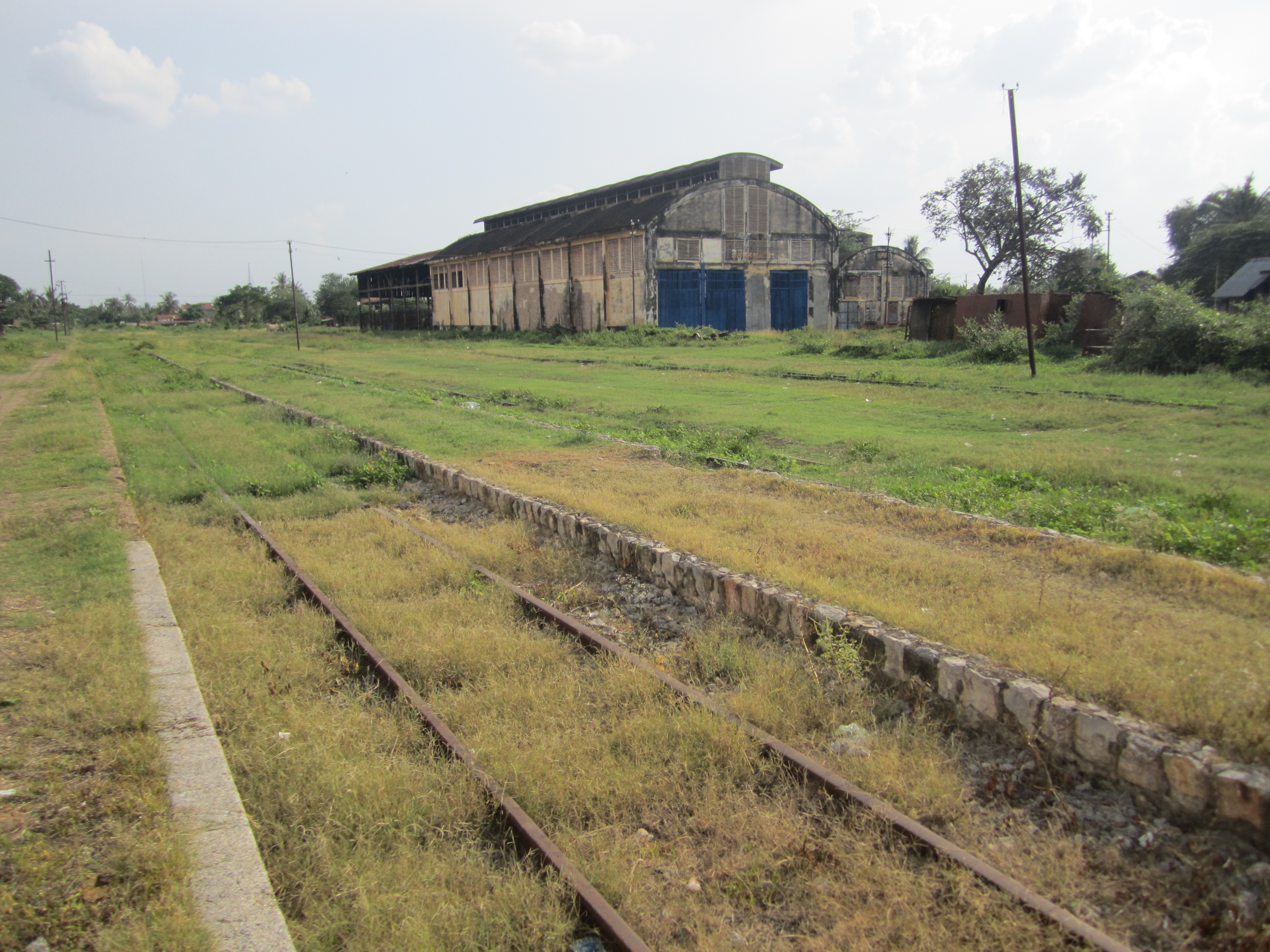
We walked down to the abandoned train station, a sweltering sidewalk lined with New Years decorations that look like tinsel pentagrams. During colonialism, the French built a train system in Cambodia, and it was still used through the 70s. I’ve read accounts of people who, early on in the Khmer Rouge reign, were transported to various work sites by train. At some point the system disintegrated, and the Battambang train station is proof of it, the clock out front permanently frozen at 8:02—a time that comes twice a day, like a train passing, but a year and date that remain silent, that will never pass by again.

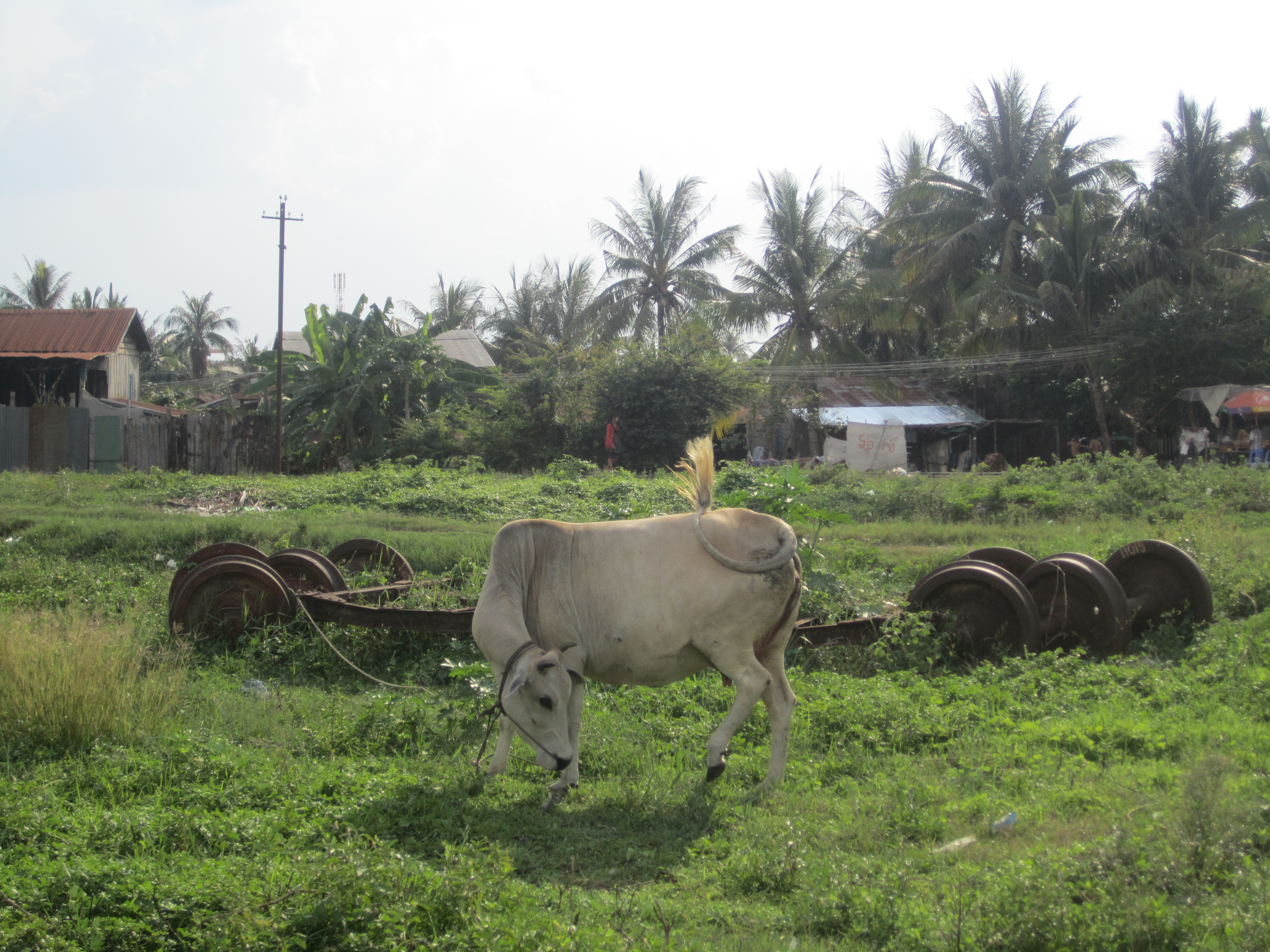
Like everything old in Cambodia, there’s nothing to stop you from poking around the lot of rusted engines, boxcar carcasses, tracks obscured by long grass and cow dung. People live there now, poor folks in thatched huts, where once the wind of the train might have blown them down, but now they only have to worry about the ghost trains passing—the wind, I suppose, doesn’t blow so hard from those. One man had set up a home in an old warehouse; I glimpsed him, through a crumble in the wall, bathing in his sarong.

You’d feel funny walking through a place like that in any other country. In the US, it’d be dripping with graffiti and crackheads. But in Cambodia it was people just living their lives, sitting on bamboo platforms with their families, small children exclaiming, “Hello!” and giggling joyiously when we responded. You couldn’t help but feel welcome, though you weren’t sure why you were welcome, why they all greeted you so goddamn graciously. Something in me felt I didn’t deserve it. I smiled anyway.

The next day I went out solo to explore the abandoned Pepsi factory. It’d been shut down, I read, when the Khmer Rouge came to power in 1975—frozen like that, like the clock at the train station. I grabbed a tuk-tuk, a man who insisted I pity him for having to work on New Years. We rattled out there, dirt roads lined with kids throwing small plastic bags of water, a New Year tradition. They smiled at me, waved, but none of them threw a bag at me. I wondered why.

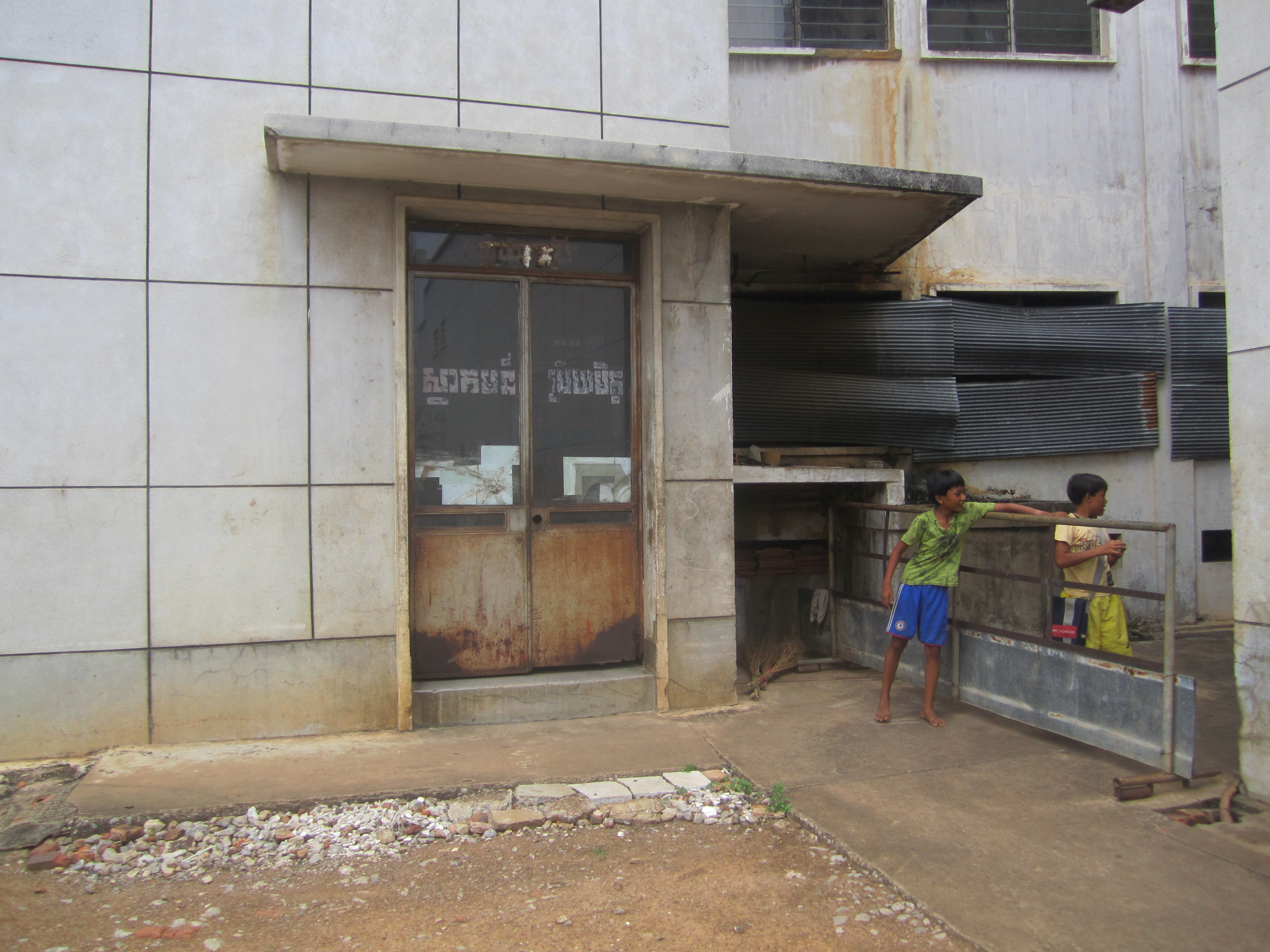
The Pepsi factory was a faded concrete building with a well-tended garden. It struck me as a curious juxtaposition—the crates of bottles I could spy through the windows, waiting for a delivery that never came; the burned-out remains of a warehouse further back, where a fire had once raged, fixtures hanging from holes in the ceiling; the barefoot children that wandered around, peeling back strips of corrugated tin and disappearing inside the blackness. All that, next to trimmed grass and perky flowers, a yard free of rubbish, where a couple of families picnicked in the shade of a tree.

My tuk-tuk driver wandered over to me, as I balanced up on a ledge, beside shorn hedges, trying to get a photo of the inside of the factory. “All the machines are gone,” he told me in surprisingly fluent English. “They went to Vietnam.”

The factory, he said, had sat empty during the Khmer Rouge regime. When the Vietnamese came in 79, they’d dismantled all the machines and took the parts back to Vietnam. Now it was just crates of empty bottles, a silent loudspeaker with its wires disconnected, exposed.

“Why is the garden so nice?” I asked him.

“Oh, it’s a man who lives here. He’s very old, 80, I think. He used to work at the factory before the war. After, he had no family, nowhere to go, so he came back. The government let him keep the grounds. He lives back there.” He waved his hand back towards the burned-out warehouse, where I’d seen laundry lines and pieces of cooked rice sitting in the sun.

“That’s him,” the tuk-tuk driver said casually, gesturing towards an old man who walked slowly with his hands clasped behind his back. He wore an Angkor Wat t-shirt and a krama scarf loosely over his shoulders. You could tell by the way he sucked his mouth that there weren’t hardly any teeth left. The lines in his face were a fine webbing, like wrinkled laundry.

I smiled and bowed for our awkward introduction. What do you say to a man like that?—a man who’d seen all those abandoned places alive, who’d lived it himself, who’d set up a home amid the ruin and spent his days tidying what was left, memories green as grass?

“The garden is beautiful.” The tuk-tuk driver translated and the old man smiled a sunken smile, no teeth to stretch it taut. I bowed again.

Battambang is a dirt road and a child waving, an old man nodding to himself as he walks away.

On Not Riding A Bike In Siem Reap

I have a deep dark secret: I don’t know how to ride a bicycle.

It’s what I like to think is the last relic of the child I was: hysterical, terrified, subject to daily sobbing break-downs until the age of 8, my parents called in for concerned conferences with teachers. I was afraid of everything, and that included learning to ride a bicycle. My parents couldn’t come up with a good enough reason to force me—or themselves to teach me.

So I never learned. The older I got, the more ridiculous it became. Every once in a while I’d try, boyfriends valiantly declaring they’d teach me. It always ended in me flush-faced, ashamed, the jack-o-lantern cackle of crackheads at the park we’d hang out it, laughing as I fearfully raised one foot, then the other, then wobbled and swerved. It always ended in tears, and I’d be embarrassed about that too.

So when my two friends wanted to rent bikes to cruise around Siem Reap, when they smiled so sweetly and suggested, “There’ll probably never be a better place to learn. Flat roads, old cruiser bikes—a lot better than a roadbike in Oakland.” I nodded at the logic. Yes, I thought, the time has come to finally learn.

I’d actually thought about it the day before, as we rattled in our tuk-tuk through the temple sites. We were trapped on a painful tour, which actually felt more like a school field trip—our guide a well-meaning fellow who insisted we take photos at all the popular spots (“Stand sideways here, so it looks like your nose is touching the statue’s”). A girl had passed us on a rented bicycle, sundress and a basket, steering with one hand as she ate a pineapple wedge with the other. She looked so leisurely, so relaxed, in her own world of solitude with the trees, the stones, the road.

I’d wanted to be on that bike more than anything.

“But I have to warn you guys,” I told my friends as we walked to the rental shop. “I turn into a five-year-old when I try to ride a bike.”

“It’s gonna be fine,” they reassured me. “You’ll pick it up no problem.”

I had a knot in my stomach as they tested the different bikes, adjusting seats and cruising slowly down the dirt road and back. I distracted myself with plans for a blog post, a tender and life-affirming meditation on overcoming fear, letting go of old identities, on the role of place—on how, I imagined, being in a different environment could help you to find yourself or lose yourself, parts of yourself you don’t like—or maybe discover a new version of yourself. Yes, something like that, I thought as my friends paid the rental fee.

We walked down to a shady street with only occasional traffic, bicycles and motorbikes passing every few minutes. I felt nervous but confident as my friends gave me pointers, suggestions, but most of all encouragement. “You’re totally gonna get this,” Suki assured me with her sunlight smile, as Alicia held on to the back of the seat like a father, explaining the science of forward momentum to reassure me.

I wobbled around, lifting feet to the pedals one at a time, then both for quick moments of breath-held balance. “Oh, your so close!” Suki exclaimed behind me. “Any minute you’re gonna take right off!”

A frustration started to mount. It came, it seemed, from some very deep place. As I went back and forth down the country road, the feeling grew. It began to turn into anger, a seething self-hatred I haven’t felt in years but know too well to mistake. A burning began behind my eyes.

“Goddamnit,” I kept muttering under my breath. I knew logically that I could get this—I’m an able-bodied person with full control of my limbs. But my forearms tightened as I gripped the handlebars, staring down at the dirt before me—I couldn’t bear to look up at the world. You’re defective, a voice said.

I know this voice. It’s a tape I like to think I’ve outgrown, that I like to think I’ve smashed the casing of, pulled out the shiny reel, spun it like a fat black spiderweb, like I’d do as a kid—then crumbled and thrown away. I like to think I don’t even own a cassette player anymore.

But it’s there, always there (“What we really have is a daily reprieve…”)—perhaps collecting dust but still waiting for something, feet on pedals, to push play. The more I tried to ride that goddamn bicycle, the louder and clearer the voice became.

The good news is that today, I know it’s just a tape. And I told myself that, sweating in the morning heat: These are just old beliefs. They aren’t true, and you can choose not to believe them.

A motorbike and a bicycle passed concurrently, raising a plume of dust. I glanced up. I saw five faces, turned back over their shoulders to look at me. The expression wasn’t of pity or amusement or superiority—it was of concern. They’d seen me, these strangers, glimpsed a very private and shame-filled and ultimately very true part of me, on a roadside in their city.

I put my feet down, stood up. “I can’t do anymore guys,” I said in a shaky voice. I grabbed my purse, not wanting to look my friends in the eye. “I’m going for a walk; have a good day.” I rushed away.

The tears came freely as I kept my head down, walking through the roads of outer Siem Reap. Tinsel New Years decorations hung from doorways as amplified voices of chanting monks filtered through the trees, along with the lethargic sunlight.

“Fuck, fuck fuck,” I chanted to myself. There I was, 28 years old in Cambodia, and still feeling like a little kid, like that girl I used to be and hated.

Can travel really change us? Can discovering new external landscapes help us to discover new landscapes inside ourselves? Does anyone really ever “find themselves” traveling? Is it all one massive distraction from the pain of it, the pain we’ve nestled away, the way they say we store memories in our knotted muscles? Can travel be a kind of accupressure? What are we hoping to find, and what are we hoping to get rid of?

I walked. I passed a group of half-clothed children playing with a ball. They smiled and waved, “Hello!” and giggled when I said hello back. I passed a cemetery, where a shirtless young monk hung his orange robe on a clothesline, then lit a cigarette and stared. A skinny-ribbed dog sniffed through a pile of rubble, a magazine of tired black nipples. She looked up at me with startled eyes, flinched at the sight of me, lowered her head and stepped backwards.

I wanted to take that dog, to sit down and let her lie her head in my lap. I wanted to sit like that, the two of us in the trash and smashed cement, a random road outside Siem Reap.

But I just kept walking.

A Vision at Sunrise, Angkor Wat

I had a vision.

Standing on the ancient stone of Angkor Wat, watching the red fist of a sun rise, reach up through the horizon’s haze to ignite the sky, to silhouette that crumble of bygone glory, to light the ponds in the earth red too, to make them become a mirror between the lily pads—there, I had a vision:

What would happen if everyone put their cameras down?

Few things get me out of bed before 7am, and watching the sun rise at Angkor Wat is one of them. Yes, it’s touristy. But it’s one of the wonders of the world (depending on what list you consult; on the List of Me, it’s there), and getting there before the tour bus hordes, when the day was still cool, early, innocent and young—that sounded worth it.

I didn’t expect it to be so goddamn beautiful. I didn’t expect the sun to blaze like that, be red and burning like that, to glare against the expanse of ruin and palms.

I glimpsed it as I came through the gates. I gave it a quick glance and a gasp. As I scurried along the stone wall, rushing past Apsara carvings and other tourists, I reached in my bag. I pointed the camera, saw the landscape through the viewfinder, clicked. I did this before I even looked at the image myself, gave myself time to soak it in, breathe it in—to simple see it.

We moved down towards a pool of water, “a very good place for photos” our well-meaning guide assured us. Through the politely jostling throngs, we could see that, yes, it was a good photo op. So good, in fact, it was the same image on the postcards that little girls in sweatshirts and messy ponytails clutched, tugged at you—“Lady, you buy, 10 postcards, $1”—a voice too low and raspy to belong to a child.

I watched us all there, taking turns and swapping camera, posing with smiles, embraces: “Look at me, I was here.” It seemed more important to get the photo, the proof, the documentation, than it did to bear witness to the immense and startling beauty of it—to just be there.

What would happen, I wondered, if we all put our cameras down, just for thirty seconds, and stood and watched?

I suspected a silence would fall. I suspected some of us might start crying. I suspected something huge would wash over us, come up from inside us, that kind of humbling you feel in the presence of the world’s greatness, that particular pang in your heart when you see something so beautiful it overwhelms you—a feeling you think is private but that really might be communal, like a great inkwell a monk tattoos from, writing our particular fates with shared blackness.

But that’s just a guess. Really, I wouldn’t be able to know, won’t ever know. We all kept clicking at the blaze of a red sun, in the shadow of Angkor Wat.

The Lucky Ones at the War Museum

Instruments of death don’t die. They rust.

Fifteen minutes from the happy pizza restaurants and nibbling-fish pedicure tanks of Siem Reap’s Old Market area is the War Museum. It’s not much of a museum, per se—it’s a grassy field filled with mango trees and the skeletal carcasses of tanks, missiles and planes used during the Cambodian civil war (the 1960s Lon Nol era through the fighting of the mid-90s). The “exhibits” sit exhausted and silent in the heat of the field. They’ve been striped for parts, all that’s left of them slowly turning brown, the same brown as the the earth.

“The memorials in Cambodia are so raw,” Anna’d remarked. “At Auschwitz, everything is behind glass or protected. You felt more separated. But in Cambodia, at the Killing Fields or S-21, there’s less between you and the stuff you’re seeing.”

I thought of Anna’s comment as I walked into the War Museum, past the massive helicopters that slept like corpses in the entrance. I’ve never been to Auschwitz or any similar genocide memorials, so I don’t have anything to compare the ones in Cambodia to. But there’s definitely a rawness. And it’s a rawness you feel in the whole country, not just at the memorials, but that the memorials seem to capture, to be the pure essence of, in a way that reminds me of whiskey distillation—too pure, the uncut soul of the thing, that if’s not diluted could kill you.

A guide approached us, a young man in a fake Lacoste shirt, frayed stitching and tell-tale grin on the alligator’s face. He was missing an arm; a nub extended beneath the sleeve, a little past his shoulder, and you could see it move around in there as he walked.

A sign announced that guides were free, so we went along with him, assuming a small tip would be expected. He spoke English well and was knowledgeable about the artifacts, mute metal that sat, refusing to decompose. Small wooden signs had explanations penned in a haphazard English.

“What is your nationality?”

“USA,” I replied. A pause. “We’re American.”

“Ah. America is rich country. Cambodia is poor. So if a pilot not fight well, if a soldier not hit target, he get killed—it a waste of ammunition. The pilot, they cannot eject from the plane, they trapped. The soldier get locked inside the tank, and if he don’t fight good, he stay in and die. We find still the bodies in many of these tanks.”

We stared at the machines; they reminded me of dinosaur bones or the great cranes at the Port of Oakland—metal with so much power, sitting still.

As we walked, he told us the story of how he lost his arm: when he was 14, his dad brought home a landmine. He was trying to dismantle it; we couldn’t make sense of why. The bomb exploded, killing his parents and two siblings, and leaving him with a belly full of shrapnel and one less arm.

“I’m lucky I’m okay,” he told us. “But I am very lonely, I have no family.” He went on to explain the difficulties of life as an amputee in Cambodia, with discrimination and lack of healthcare. He paused, looked at us. “You are very lucky, you have family.”

Types of landmines

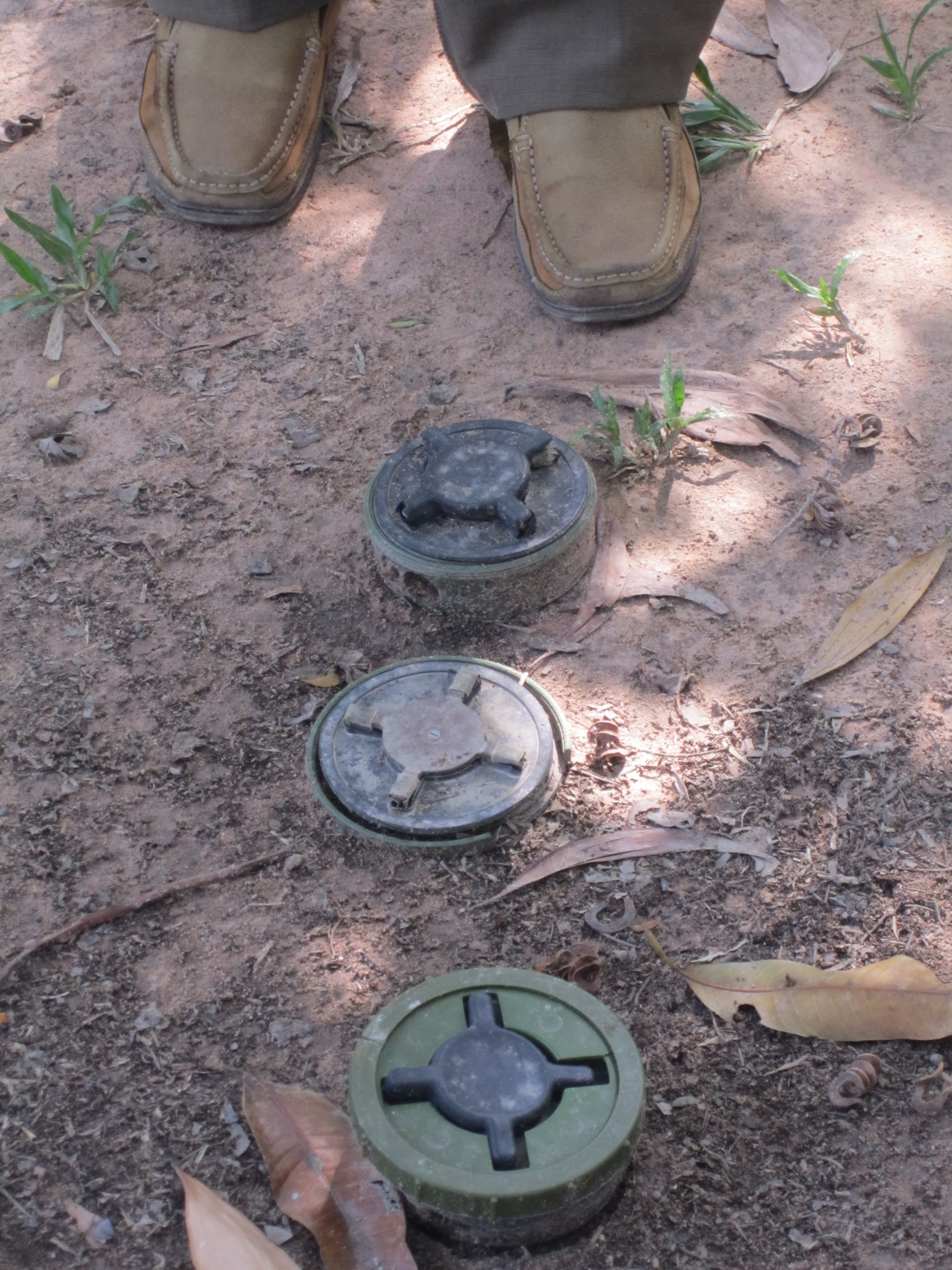
We kept moving. He pointed out common types of landmines, explaining which countries they’d been made in: Russia, Bulgaria, the US. He told us 1-2 people a day in Cambodia are still injured by unexploded ordinances. “You are very lucky, your country no have landmines.”

As he stood talking, I slid a modest note into the “Donations for Landmine Victims” box. He watched me. When he finished explaining the table of empty shells, he pointed to the box. “This money go to the government first, then the people. The government take a lot.” I squinted my eyes, nodding slowly. It’s true—there’s a lot of corruption in Cambodia. But I could also sense where this was going. “It better you give to the people.”

I cocked my head as he lead us away. Everything I’ve read in every country I’ve been to—including the sign at the guesthouse I’d just left (that among other things encouraged me to not have sex with children)—tells you not to give directly to people but to worthy, legitimate organizations. It was unsubtle foreshadowing.

He kept us moving at a steady pace. I thought of my guide at the pre-Angkorian temples a week earlier—also missing an arm but older, darker, a man who only spoke Khmer. I thought of the way he’d clasped his phantom hands behind his back, and the way it made something in me pound, then sink.

This guide didn’t clasp his hands. He was wearing short sleeves.

We paused under the hot breath of the sun. “How many sibling you have?” he asked each of us and we each responded.

“That good. You lucky. I have no brother or sister now.”

We came to a row of wooden shacks, displays of exploded bombs. They looked like peeled fruit, like some modern-art interpretation of peeled fruit that you’d see in some chic lounge, that was trying to make some sort of terribly deep and obvious statement. But this wasn’t art and it wasn’t a lounge—it was a shack and twisted metal.

They’d sawed the blown bits of his arm off with a wire. Because he was young and still growing, he had to go back every four years, to have the bone re-sawed. He couldn’t afford to get the shrapnel from his belly removed; at $100-200 a pop, he said he’d had to leave it to float around in there.

“In America I hear they make a machine arm.” He looked around at all the dead, rusted machines. “Maybe soon they make it in China. It will be cheaper there, and if I work enough, one day I can get. This is my dream: you come back and I can give you a hug with my robot arms.”

We got to the end of the tour. “It is good if you give a tip,” he told us flatly, “so I can pay for my surgery. Many people give $20-30 each person.”

Suki and Alicia looked at me. They’d each been in the country less than 24 hours. I considered the fact that a construction worker makes $3 a day, your average tuk-tuk driver $5. I considered the fact that my daily budget was $30.

He stood a few steps back, staring at us, waiting. “Can you give us just two minutes?” Suki asked.

We whispered, gathered bills. We gave him a fair tip, said thank you.

Then he walked back to our tuk-tuk, heavy with sweat, our ankles covered in dirt the color of rust.

The Un-Bittersweet of Leaving Phnom Penh

It’s not as bittersweet as I’d expected.

It’s been six weeks in Phnom Penh. That’s the longest I’ve sat still anywhere—the longest I’ve spent consecutively in any city other than Oakland.

I’m embarrassed to admit that; I feel like I should have lived abroad, should have studied abroad, should have spent a summer somewhere, should have should have should have. But the truth is, I’m still a relative newcomer to the travel game, and for the first few years I was stuck in the going-going-going of it all: ticking off lists, counting countries and cramming in as many destinations as possible. It seemed like a waste of time to stay anywhere any longer than necessary.

Sure, I’d entertained elaborate fantasies about moving abroad. But really, if I couldn’t sit still in another city for more than 10 days, how could I really know if I could be happy, could have a life, abroad? Or, hell, even out of Oakland?

Part of the reason I got an apartment in Phnom Penh is that I wanted to feel like I lived there, that I wasn’t just passing through. I wanted a little glimpse into what that life would be like. I wanted keys; I wanted to shop for toilet paper; I wanted to “Sua s’dei” the neighbors and have a cafe where they knew my order. I wanted to feel little roots sprouting—the beginnings of being grounded, like the wind could blow and I wouldn’t fall over, be blown over with it.

When my bus arrived last week, bringing me back from my three-day visa run/refugee camp search, I hustled down the steps. I booked it past the cluster of tuk-tuk drivers, crossed the street without looking (the Cambodian way), dove between the tents of the night market, walked directly to my favorite food stall, kicked off my shoes and slurped down a Khmer soup under the night’s haze, the warm breeze from the river. I felt like I’d come home.

So I was expecting to be sad to leave. I was expecting to go around doing my silent rounds of “last times” with twinges of melancholy, that little lonely longing that you can almost fall in love with, more than the thing itself.

But it wasn’t as bittersweet as I’d expected.

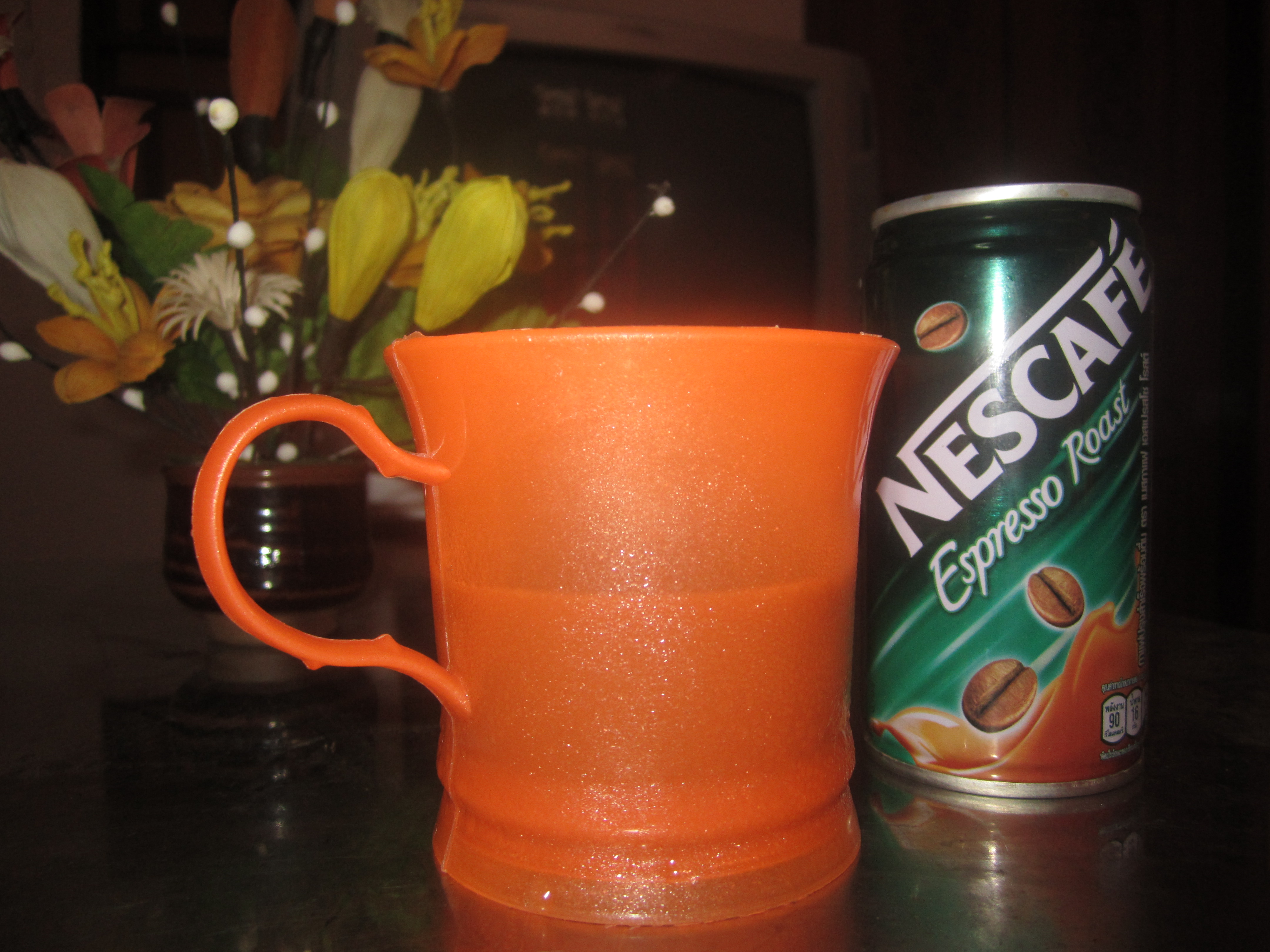
Sometimes it comes to this: Nescafe from a plastic mug. And plastic flowers. Classy as shit.

Saying good-bye to the people was sad. I’d made some rad friends, had gotten close to a few cool girls. People tend to be on a three- to six-month rotation in Phnom Penh, and in a few months, almost everyone I know here will have moved on. And it was definitely sad to leave my apartment, with its metal table and one chair, its thin mattress and fuzzy TV, the plastic kitchenware I’d purchased at the market down the street—where I’d go to eat soup and the women would squat down and stare at me, giggling. I’d giggle back, and I’ll miss that too.

But still, it wasn’t as bittersweet as I’d expected.

I’ve taken to comparing cities to people. Boys, to be specific. Because cities have personalities the same way people do, and you have relationships with cities the same way you (I) have relationships to boys with (well, no, they’re actually much healthier).

So Rome is a really sophisticated, well-groomed and worldly guy that I like to keep track of, that I like to get lunch with from time to time, and talk about art and culture and history, but who I could never actually be with—we’re just too different. Tirana is the fun one, the one I met one crazy night at a crazy dance party, who I connected with under the lights—the one I felt like was made for me, as though anyone could ever really be made for anyone else, as though you could ever really know anyone after a week, or a month or even a year, years.

Buenos Aires is the one who got away, the eyes exchanged between subway cars, or maybe the one whose number you got and lost and still catch yourself thinking of, years later, looking for some scribbled scrap of paper in old jeans pockets without even realizing it. San Francisco is the neighbor boy you grew up with, who you know is really attractive and cool and who you really get along with, but you just couldn’t ever date.

And Phnom Penh?

Phnom Penh’s not terribly handsome or debonair, not the stuff of little-girl dress-up fantasies. He’s not super cultured and he’s got some obvious flaws. He’s a little beat-up; he’s been through shit. And there are things about him that drive you nuts. If you were to write a list of the perfect mate, there’s a lot of things Phnom Penh wouldn’t have. But the big ones, the ones that are really important and that really fucking count, when you’re up against the wall and the wind is blowing and you need something firm, some kind of roots to hold you down—he’s got them.

He fits. He’s not perfect, and neither are you.

And so it wasn’t so bittersweet to leave him. The same as when you leave for a trip and you just know the person you’re leaving behind, that you’re coming back to eventually, isn’t going to cheat on you or be shady. You don’t even have to think about it, worry about it. It doesn’t occur to you to worry; you’ve just got that confidence, you know? That you’ve got them and they’ve got you, whether you like it or not—like you were picked for each other, matched to each other, though you’re not sure by who.

But does it matter?

A Walk Through The Ruins: Temples and Bomb Ponds

The three little girls followed us like flies. They circled as we walked through the dirt and dry grass, holding out scarves for us to buy.

We approached the rubble of temples, bricks strangled by a varicose of vines. Beside where we stood, busted stone sat in a pile. One of the girls pointed. “American. B-52.”

It was my first trip out to the provinces. That’s what expats call the rest of country, everything that’s not Phnom Penh, and it’s a fairly accurate distinction: it’s like there’s two Cambodias, not just the surface and the underbelly that I wrote about before, but the urban and rural.

The division goes a long way back. Before the Khmer Rouge, during the Lon Nol regime and the American bombings, the countryside suffered greatly—some million people are estimated to have died—while Phnom Penh remained a relative island of safety. When the Khmer Rouge took over, they targeted urbanites, the so-called “New People.” A mutual distrust between city- and country-dwellers lingers.

Still today, people in the countryside tend to be darker skin, pure Khmer, and largely uneducated, often living without electricity and running water. And while Phnom Penh is rapidly developing, construction cranes and billboards and the gleaming new riverside, the provinces remain fairly the same: dirt roads, thatch-roofed houses on stilts, naked children and water buffalo and chickens in the road. And a lot more of the scars of war.

We’d headed out to the Kompong Thom province, 170 km along the “highway” to Siem Reap. We were going to look at two things: the Sambor Prei Kuk pre-Angkorian temples, and bomb ponds. We found both, beside each other.

I’d contacted Rattana Vandy about his exhibit Bomb Ponds, wanting to learn more. Although he lives in Paris now, he just so happened to be back in Phnom Penh, and invited me to come along with his wife and friend on an adventure to the countryside.

The drive was long, filled with stops for cashews and pomelo and tarantulas (which are surprisingly delicious). Three hours on the road and we arrived at the temple site. It was nearly empty, aside from a straggle of locals and the few huts they’d set up, selling bottles of water and chips. The little girls were on us; even after it was obvious we weren’t going to buy anything, they followed us, poking and playing with each other. There probably wasn’t much else to do.

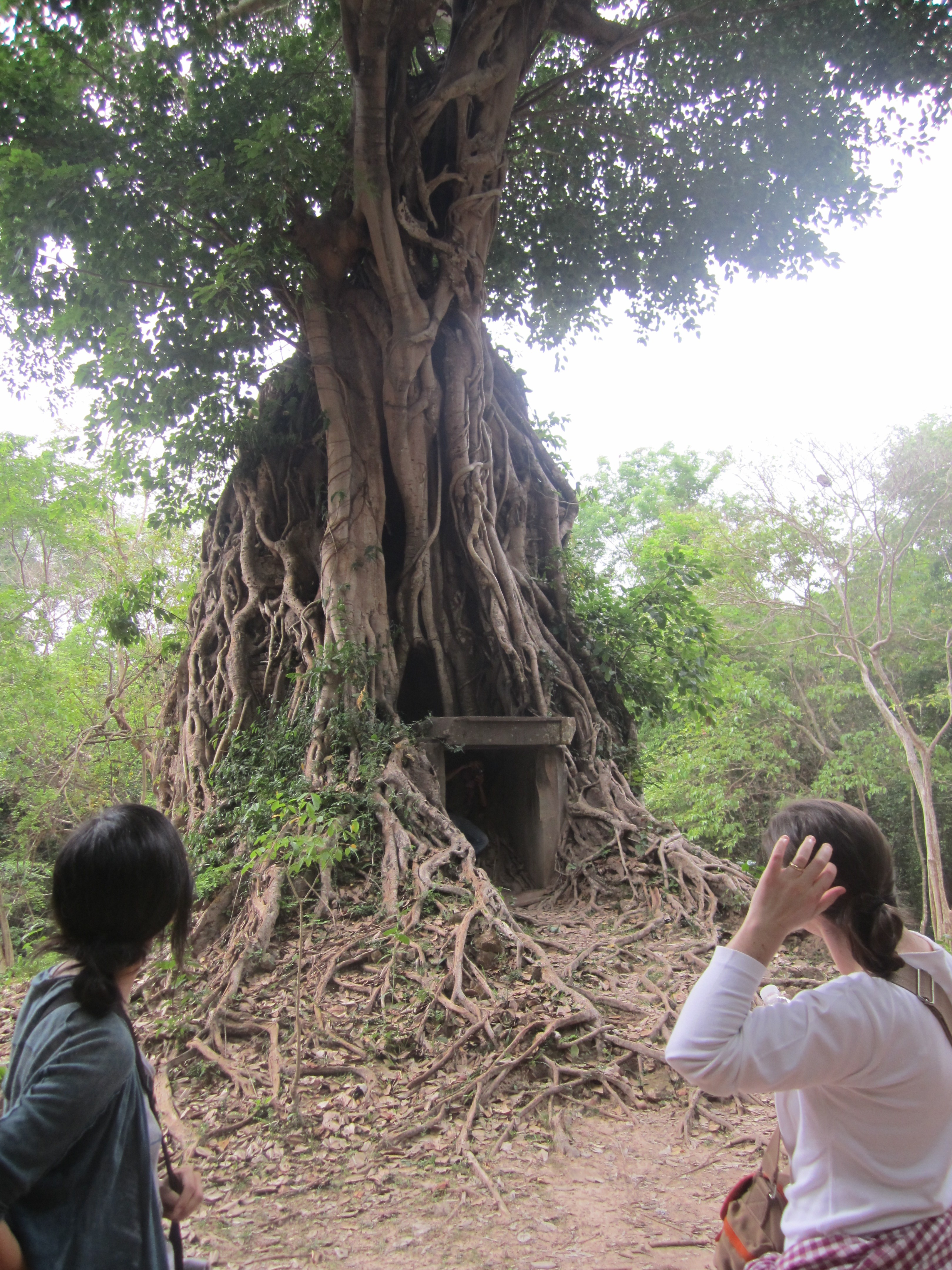
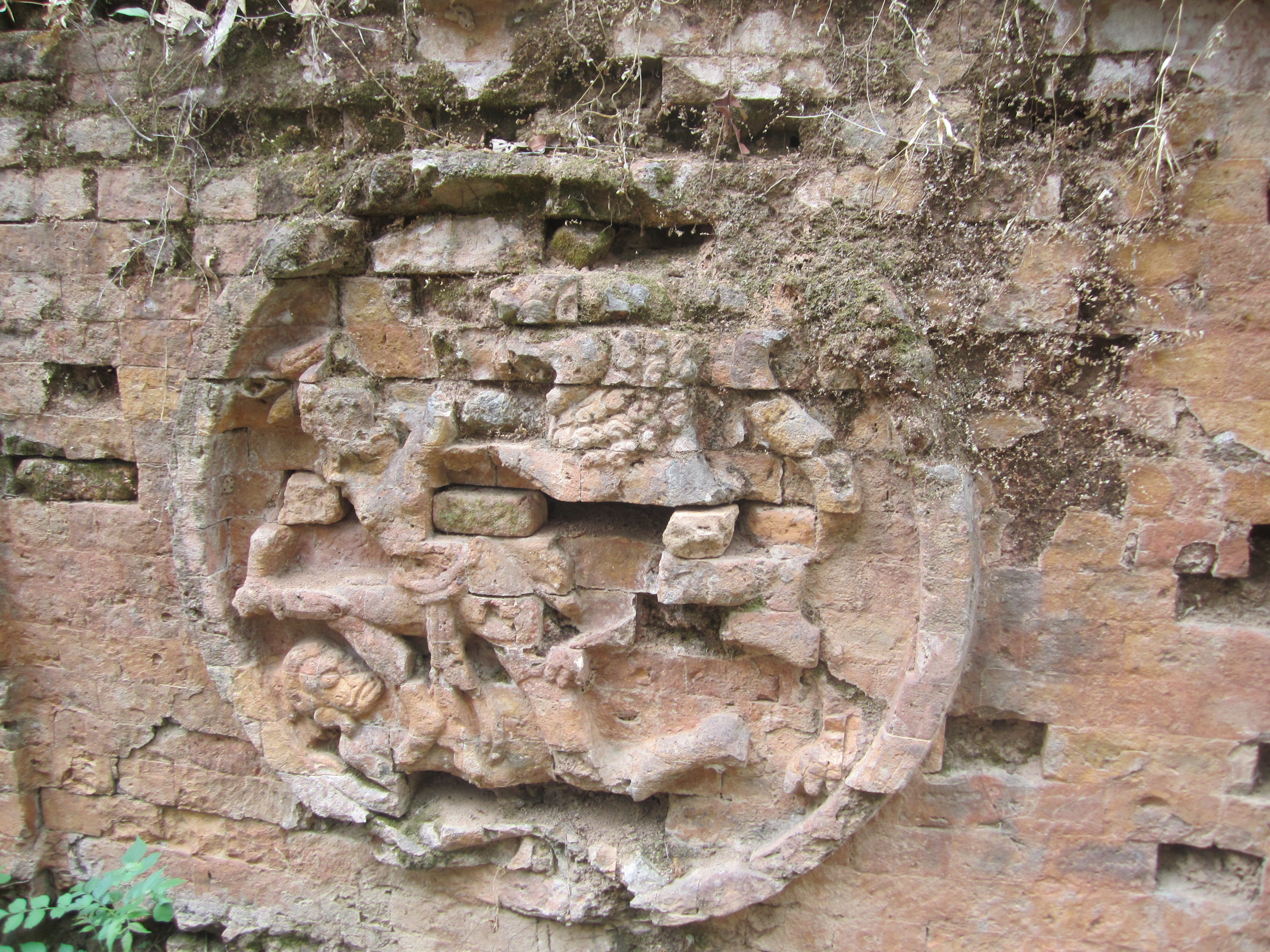
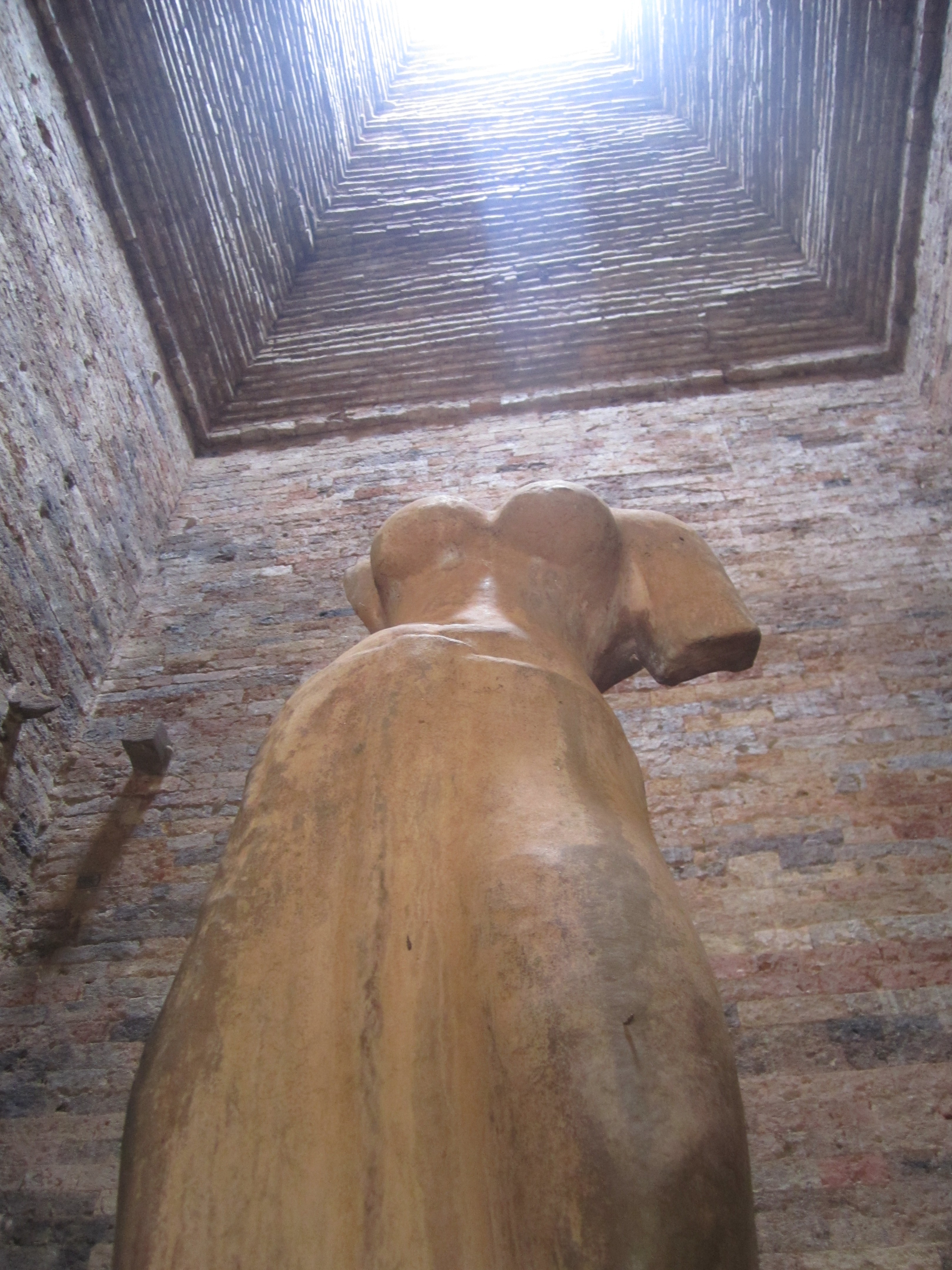
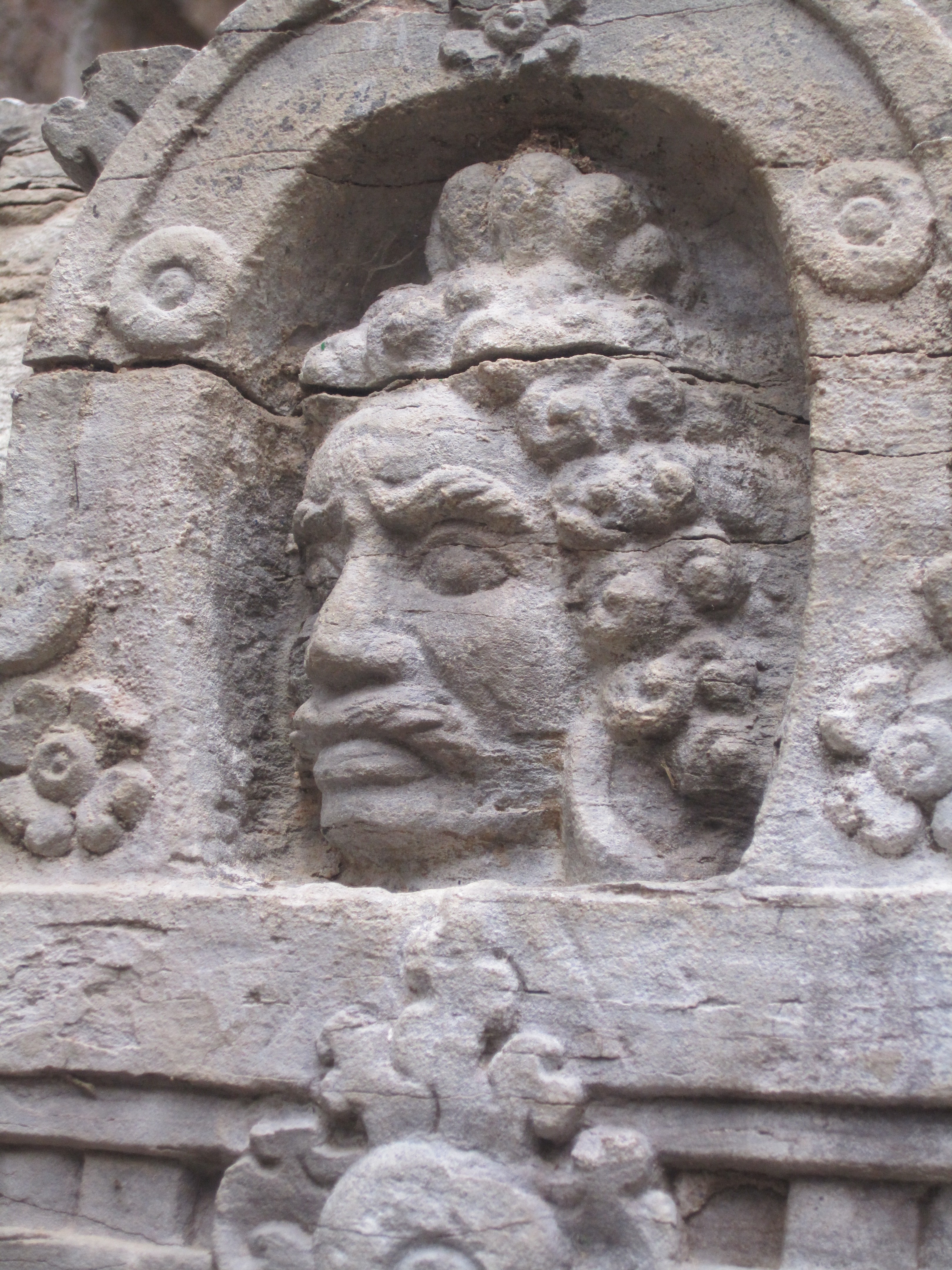
The temples were scattered around the shady dirt grounds. They’re pre-Angkorian, which means they were built between the 5th and 7th centuries, constructed of brick, with carvings in Sanskrit, odes to Hinduism rather than Buddhism. I hadn’t seen any temples yet, so I was easily impressed by the age, by the trees growing up and along them, like the vines were strangling the remains, trying to pull them back down into the earth.

There’d once been some 200 temples at the site; only 40ish remained. I thought of the incredible luck that any of them had survived: the years, the monsoons, the looting, the gold diggings—and the bombings.

Photographing a bomb pond/crater

Rattana had taught us how to spot bomb ponds. Unlike natural ditches, they’re perfectly circular. Because of the linear bomb-dropping pattern, they usually occur in a row, in certain intervals; you can count them out: “one, two, three…” The big ones are along the Vietnam border; the smaller ones, like these, were dropped from fighter jets and can be found all over the country. During the rainy season, they fill with water that even still, after 30+ years, has a lingering toxicity that makes it undrinkable. As it’s the end of the dry season, the bomb ponds now are just craters, sunken and waiting. They reminded me of pockmarks, the skin of a hard life—I thought back to Thailand, to its green, its rich-kid skin.

A local man lingered around us, like the little girls but with less exuberance. He began chatting with Rattana in Khmer, and wound up being our guide. He was knowledgeable, walked slowly, chiseled cheeks and a lean smile, salt-and-pepper hair swept into a comb-over, though he wasn’t balding. The lines around his eyes and mouth were thin, precise, deep and uncountable; they framed his mouth when he smiled, so that they seemed like smile lines.

He was missing an arm. There was a nub somewhere inside his worn shirt, and he tucked things under it: his cap, his cigarettes. Sometimes when he walked, a slow and pensive walk, he held onto the empty sleeve as though he were clasping his hands. There was a tenderness to the gesture so palpable you wondered if it was his phantom limb he was holding—a dead hand, ghost hand, from another life that he was still clinging to, intertwined with, in the moments when no one was looking.

He pointed out carvings and statues and explained their meaning, which then went through rounds of French and English translations. At one point, as we walked between temples, he pointed to a crater in the earth with his one arm. “American,” he said. “B-52.”

How do you be American in this? “I wasn’t born yet” doesn’t seem good enough. “My parents were against the war” doesn’t either. Because these may be ruins, but it’s still happening, in other places; it’s still happening in this place too, the echo of it. You know, intellectually, that this echo lasts a long time, but knowing it and seeing it are two different things: You can hear something a thousand times and not know it, yet if you see it with your eyes just once, you know. It’s a Khmer proverb, and it seems to be written for this place, the experience of being in this place.

I thought, briefly, of bombs falling from the sky like small black parcels; I tried to imagine the blast and the sound, the rumble and heat. I couldn’t, not really—just project what I’d seen on old newsreels, aerial footage of impersonal explosions, reverse fireworks against dense green. I thought of how much was lost—lives and limbs and ancient temples, vacant of their gods—and how much remained, that any of it remained, even as scars, on the earth and in the bodies. I thought of what still stood, what still walked, and wondered how to be American amidst all this.

On The Road to Nowhere: Finding an Anti-Place, Part 3

Mai Rut. Mai Rood. You couldn’t even be sure of the name, and you sure as hell couldn’t be sure of the history. But it existed, that was the important part, and I was going to find it.

I sat on the back of a motorbike and scanned the landscape. The town of Mai Rut was 5km from the main highway, and there’d actually been a motorbike driver, waiting on the platform in the shade for someone like me to set off a blue pick-up truck. Thailand was otherwise devoid of motorbike drivers; although a break from the constant barrage of “La-dee, moto-bike!” was refreshing, I kept finding myself needing a motorbike and finding none. But one appeared just when I needed it, and I suppose that’s how Thailand worked for me, how I’ll come to think of those three days spent along the border.

I’d seen footage of Mai Rut, at the Bophana Audiovisual Center, from an old French newsreel. I could piece together bits and pieces, stray words, but mostly it was a study in the visual, squinting at the screen and trying to memorize every little bit of earth. I knew I’d later try and find the place, what was left of the place, and this was the best clue I was going to get. (It was silly, but I kept scanning the faces too, as though I’d happen to see the two people I knew in the crowd, as though that would be a clue too.)

And now I was there, or whizzing through there, and there was nothing but trees and grass and the odd clearing. We moved too fast; I didn’t know how to tell the motorbike driver what I was looking for, or even to slow down, so I just let him drive, let us move through the landscape of lost stories.

He left me off at the end of the road, where earth gave way to water and boats bobbed and nets hung, flies buzzing over sheets of fish and the smell of fish, fish, drying in the sun. Houses stood on stilts and streets of cement had been made. This was the town, not the remains of the camp, which must have been somewhere outside of the town, fenced off by barbed wire the camera kept focusing on and off of, a beat-you-over-the-head kind of metaphor but a metaphor nonetheless, in a newsreel, which I could appreciate. This was not it, but it was the closest I was going to get.

Mai Rood was a quiet little fishing town with not a lot going on. People sat in doorways. Children ran naked, grinned and disappeared. Women sat cutting fish, and men reeled in the nets from painted wooden boats. Dogs sniffed at the sand, littered and muddy; a man picked at the wounds that covered his body, little scabs that spoke of disease and something else, a language I didn’t understand.

I looked at the faces—many of them were Khmer, obviously Khmer. There’s a brown to pure Khmer skin, while Thai has more of a yellow glow. I thought of what the man at the guesthouse in Trat had told me, how a lot of the Cambodian refugees had stayed once their camps had closed, resettled in Thailand.

Like him, there were stories trapped in these people—or rather, trapped in the incommunicable space between me and them. They held answers, and if I could have sat with them, listened to them, I could have pieced together an approximation of another story, trapped in a different incommunicable space, the one between live and death—the story I had come to understand.

In the picture my friends have from Mai Rut, there’s my friend, a newborn in his mother’s arms. His mother looks like the woman I knew, strong and sturdy and alive, and his father like the man I knew, small and frail and dark. Beside them were two little girls who looked nothing like my friends’ parents—different features, much too dark-skinned.

“Who are these girls?”

“Some girls that came over with us. They were orphans. Or their parents said they were orphans. so they could come to the US. Or maybe my parents said they were their kids too.”

“But they look nothing like you guys.”

He shrugged. “So what happened to them?” I ask.

Shrugged again. “They probably had family here already, and met up with them once we got here.”

“Have you ever tried to find them?”

“No,” he answered kind of far-away, as though the thought had never occurred to him.

And I thought of that picture and wondered if I had it, if I could show it to these people, even without a common language, and if anyone would have known or remembered. I wondered what the hell that would accomplish anyway, other than confirming that it had all actually happened. I wondered what the hell I was even doing there, what I was looking for, what any of it was, let alone what it meant.

I wandered.

Closest thing to a remnant I found: Red Cross symbol on a lamppost back along the main highway

On The Road to Nowhere: Finding an Anti-Place, Part 2

Our pick-up truck bounded down the smooth pavement, creating a muggy breeze. We moved down a strip of the coast, a highway and a shade of green I think I’ll forever associate with Thailand, and that’s the place the people came through. It was 30 years ago and there’s not a lot left—unless you know where to look.

I didn’t. I kept craning my neck through the grating of the covered truck bed, trying to catch a sign for Khao Lan. I was lucky, I discovered, in that a giggly group of five teenage girls with straw mats and beach towels were getting off at Khao Lan as well. They’d spend the entire 40-minute ride squealing and chatting and texting. When we glided to an easy stop, they pointed and exclaimed to me, “Khao Lan!”

We trundled off, stood on the swampy roadside of a military checkpoint. “Beach?” one of the girls asked me shyly.

“Museum,” I replied.

“Museum,” she repeated softly. The word caused a buzz among her friends. “Museum!” one of them exclaimed assuredly, and pointed to a white structure obscured by the green.

I thanked them with a small bow of my head—I hadn’t learned “thank you” in Thai—and watched them disappear down the road.

The museum was modern, diagonal columns and a glass skylight structure that didn’t at all seem to fit the landscape. The adjoining parking lot was empty and the museum gates locked.

The guard at the military checkpoint back on the road made an eating motion. He pointed to his watch, held up one finger. I nodded and wandered back down towards the museum grounds, thinking how strangely simple it was, how much you could communicate without words, without a common language, just signs and gestures and hints, a smile and a bow.

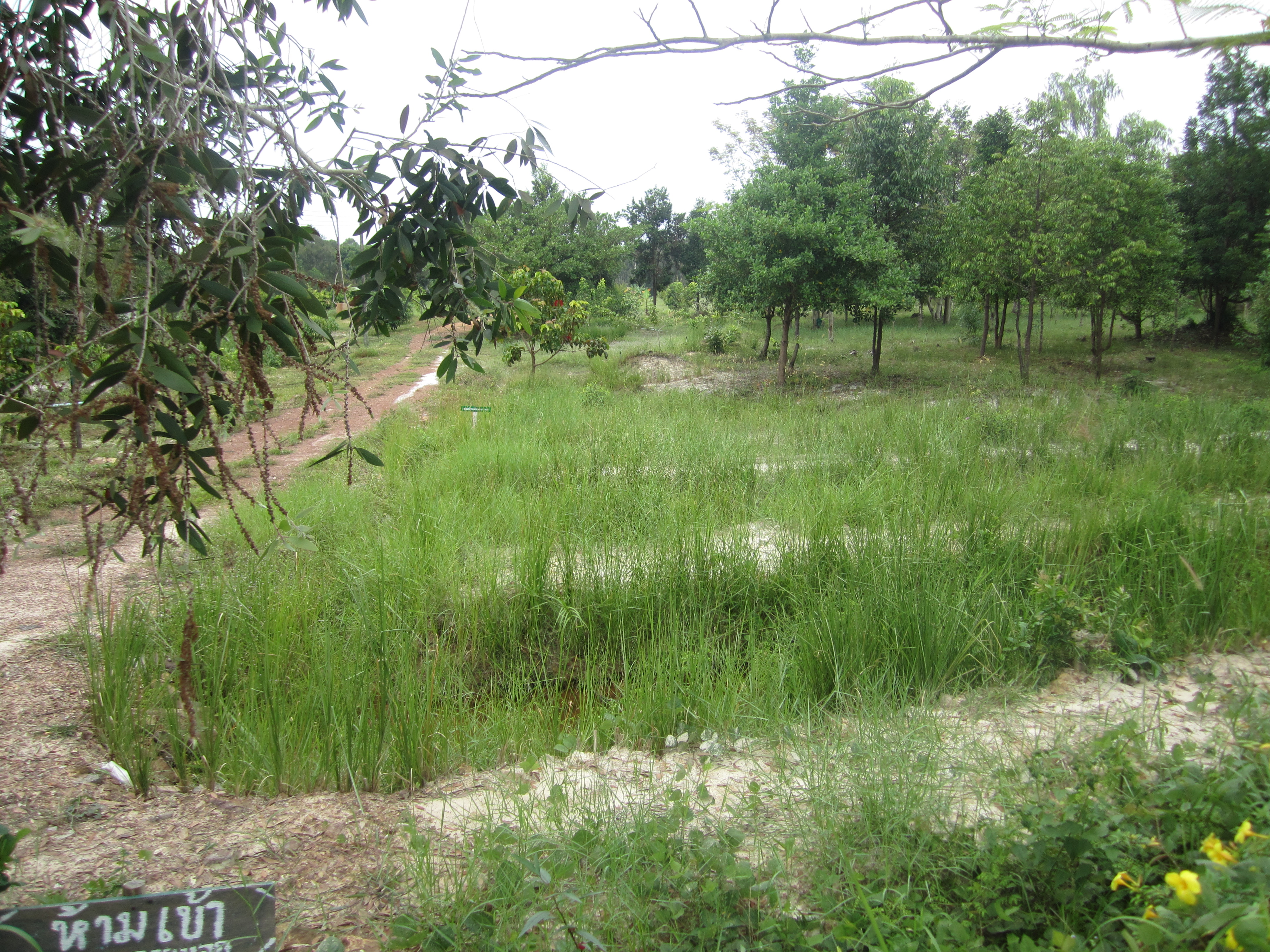
Green signs were stuck amid the grasses, and those communicated a lot less. Were they marking something related to the camp that had once stood there? I couldn’t be sure, but photographed them just in case.

I walked deeper into the grounds. A buzz grew from the trees like a living thing, like it weren’t the product of a living thing, a million unseen insects, but an animal in and of itself. It whined and hissed and followed me down the road.

There were beaten bits of earth, what had once been a road. Chunks of cement remained, with earth growing back up around it, like a scab before it peels. There were clearings in the grass, and I tried to figure out if they were remains or something used for farming, the stray huts I could spot off between the trees.

But I walked further and found translated markers—something, not in a common language, but my language, a scribble I could understand. I held my breath and tried to imagine tents and roads and some 90,000 people.

I couldn’t. It was just wind and rubble, stairs to nowhere and the earth growing back up around.

The museum was open by the time I got back, and I slid off my shoes and stepped inside. A lone female attendant smiled at me and went back to sweeping the floor.

The museum was strange. It was mostly a tribute to the Queen, a tribute to her goodwill as evidenced by her selfless saving of Cambodian refugees. Everything was framed in that context—photographs of a glamorous white-skinned woman walking through a city of tents in a white suit, a floppy sun hat and Jackie-O sunglasses. She crouched beside the thin and sick, bellies swollen and eyes dulled, a look of practiced concern. She sat before a group of children, an opened book in her hands: The children listened rapt, the words of the Queen forever imprinted in their minds.

Subtext: Thailand is the only country in SE Asia to have never officially fallen under imperalist control.

But still, she’d done a good thing, a damn good thing. The museum included three life-size scenes that reminded me of wildlife dioramas, the kind my best friend meticulously restores, repainting eyes and gluing on fake fur.

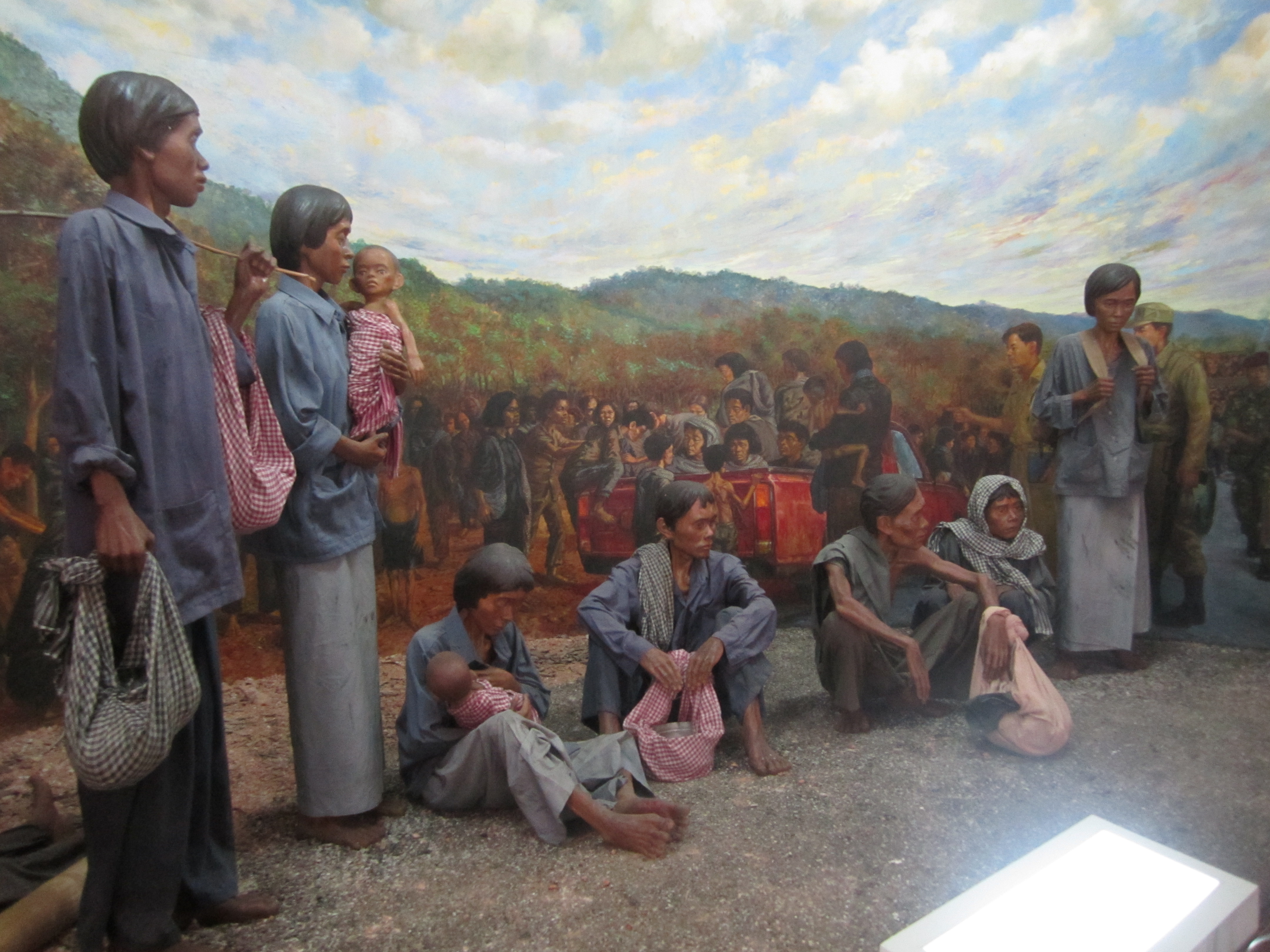
Wax Cambodian figures, their bodies worn and their faces contorted by grief, stood in varying poses of despair, before a painting of thick jungle, more faces and bodies coming through the trees. Other scenes depicted varying elements of camp life: cooking pots of rice, a white woman holding a stethoscope to the chest of a small wax infant. The dark Cambodian bodies grew plumper, more solid.

I wondered if that’s what it’d looked like—the emergence from the woods and the camp life. I thought of the newsreel footage of camps I’d seen, the faces in the camps, and decided it was worse.

(“You’ve seen The Killing Fields?” Lisa asked my mom once. My mom said yes. Lisa nodded. “It was much worse.”)

For its oddity and drama, I wondered, if there were any other museums like this, that documented this particular snippet, this part of journey, this freeze-frame from the film reel of a movie you’ve never managed to see all of, keep catching out of sequence or coming in half-way through.

I stood barefoot in an empty museum of transience, while the earth outside slowly swallowed the remains of what was left, which wasn’t much at all. I tucked some crumbled bills into the donation box, slid my shoes back on, and stepped out into the heat.

On The Road to Nowhere: Finding an Anti-Place,Part 1

"We're on the road to nowhere..."

I rode, blue pick-up truck bouncing, through the lush green and muggy grey of a Thai highway. I was squeezed between a bucket of paint, a woman’s groceries and the soft squirming limbs of two small children. Men stood on rice stacks on the back of the trailer, clutching the grating as the breeze moved through their hair.

I was on the local “taxi,” domed trucks with wooden benches in the back, and I was on something of a mission—an anti-mission to find an anti-place, a futile mission to find the What’s Left of a transient moment, blue tents and barbed wire, where babies were born and fates were written in the dusty earth.

So it was more than a visa run. I’d come to the Trat province to find the remains of Mai Rut, a Cambodian refugee camp where my friends’ parents had escaped to, where one of my friends was born. I knew it was a somewhat fruitless endeavor; refugee camps are purposefully made from temporal materials. Still, I wanted to see it, or as close as it I could come to. It was an inbetween point, a turning point, where lives were changed. There’d be little left to find, and that was, I supposed, part of the point.

I’d gotten into the town of Trat the night before, still startled by the disparity between Thailand and Cambodia. I found the backpacker area, got a cheap room in a cute guesthouse. I’d proceeded to wander around, asking every guesthouse keeper and travel agent about where I could hire a tour guide. They looked at me like I was crazy. It was the one time I was ready to throw down some money to hire someone who knew the area, and I was getting nowhere.

“Why you want to go there?” the man at Pop Guesthouse asked, eying me carefully.

“I’m working on a project. My friend was born there.”

He shook his head. “There’s nothing there. Nothing to see.” It was the same answer I’d gotten from everyone else, but it felt like he was holding back. I paused a moment, then shrugged, said thanks anyway, and continued on.

I rounded a corner, to the block behind. After walking a bit, the same man poked his head out of a doorway. “Oh, hello again,” I smiled, confused as to how he’d gotten there.

He waved me over. He spread a map out on a table, pointed. “This Mai Rood,” he pointed. It was spelled differently, but sounded the same. “But nothing to see there.” He paused. “But here, Khao Lan,” his finger moved up the green spindle of coast, “there is a museum for the refugee.”

“A museum?” I asked, amazed.

He nodded. “For the Queen. She make the refugee camp for Cambodians.” He explained how to get there, wrote the name in Thai for me in my notebook.

I sensed my moment of opportunity.

“Did you live here then?”

He nodded.

“You were a little boy?” I asked.

“No, I was 18!”

“No!” I exclaimed, smiling. (Flattery gets you everywhere.) I paused. “Do you remember it?”

He nodded again. “Yes, I work on the border then. In my uncle’s orchard.” He pointed to a place right along the black line.

“There? Did you see a lot of people coming in?”

“Yes. A lot of people come through the orchard.” He stopped there. I tried to imagine it, to hold some kind of image of what that must have looked, been like—the first foreign eyes to see these people straggle out of four years of unthinkable misery.

We stood there in silence. “Most of the camps were up here, right?” I pointed to the Northern border.

He nodded again. “Yes, but here, not so many landmines. So it’s better.” He paused again, another muggy silence. “The people here, they come from Battambang, this way,” he drags his finger across the dim yellow of Cambodia’s eastern edge along the map. I nodded.

“Mai Rood, it’s a fishing town. Big town.” I nodded, waiting. “Many Cambodians live there,” he added briefly.

“Really?”

“Yes. Here too,” he pointed at the ground. “Trat too.”

“People from the camps? They stayed?”

He nodded again. We stood another moment. “Maybe I have picture somewhere. Maybe you want to see it.”

My eyes widened. “Definitely!”

“I have map too. I go look and bring it to your guesthouse. You stay—” and he named my guesthouse.

“Yeah,” I responded, amazed. What was this guy, the hospitality ninja?

“I see you earlier.” He paused. “Okay,” he folded up his map and smiled. That was it; we were done talking.

Of course I wanted to know more. Of course he knew more, more he wasn’t saying. But who was I to ask, to push? I’d already gotten far more than I otherwise would have.
I thought about the time it would take to coax the whole story out. I wondered for a moment if he’d ever even told it. Why should he, now, there, with me, a Western girl wandered in from the street? It would take months, I decided—at least that, and I don’t have that now. But if I really want to do this project, and really want to do it right, that’s what it’s going to take.

But for now I had all I was going to get. And it was a helluva lot more than I’d come with.


Lauren Quinn is a writer and traveler currently living in Hanoi. Lonely Girl Travels was a blog of her sola travels and expat living from 2009 to 2012. She resides elsewhere on the internet now.

Join 490 other subscribers

Buy This Sh#t

Categories