
Military, chillin in central Bogota
We’d taken refuge from the soggy Bogota afternoon in the hostel’s dank kitchen, sat drinking coffee and swapping tales. Only my third trip out of the country, I sat quietly, listening to the boys one-up each other. No one could beat the Swede in zip-off pants.
He sat smugly, like a guru, doling out morsels of his tales in titillating tidbits. He’d dyed his hair brown, donned dark contacts, and backpacked through Iran, Iraq, Pakistan. He’d ridden buses rarely, walked mostly, and had almost been killed (purportedly) by an anti-American lynch mob. Sparks of awe and admiration flew from the enthralled eyes of other travelers.
One of the boys in his rapt audience turned to me, suddenly aware of my presence. He quizzed me on my basics: where was I from, how long was I traveling, did I speak Spanish. “What’s your itinerary?” was his final question. I bit my lip as he looked me over, sizing me up for what I was: an early-twenties American girl, not terribly well-traveled, with a mediocre accent and a minimal vocabulary. I recited my basic plan: Bogota, Medellin, Cartegena, Santa Marta and La Ciudad Perdida.
“Hmph,” he snorted. “Typical.” And with that, he turned his attention back to the blond god before him.
Fast forward several years and a couple thousand miles to this afternoon, as I rattled down the uneven pavement of Interstate 880, windows down and blasting NPR (yo, turn it up so it bumps). I’d just caught the beginning of a story on France’s proposal to charge tourists for rescues from risky spots while abroad. The hotly debated bill came about several months ago, prompted by a much-publicized rescue of French citizens who were captured by Somali pirates while pleasure-yachting around the Indian Ocean. Reportedly, public outrage at the travelers’ perceived irresponsibility was intense enough to inspire a bill that would require tourists rescued from dangerous situations abroad to repay rescue costs (aid workers and journalists excluded). A coordinating author from Lonely Planet was on hand to discuss the proposal and its implications, a discussion that centered around issues of travel safety, and real versus perceived dangers abroad.
Here’s something most independent travelers, including myself, rarely check before going abroad: the Department of State’s Current Travel Warnings. When you grow up amid a culture of fear mongering, it’s easy to get desensitized. Yeah, yeah, yeah, you think, the world’s sooo dangerous and I’ll get kidnapped and killed the moment I leave the US. Fear is one of three reasons discussed in Nomadic Matt’s article, Why American Don’t Travel Overseas. Once certain travelers step outside the country and see the rest of the world isn’t the depraved war zone it’s often portrayed to be, they get cocky. And brazen. And sometimes stupid.
Take that to the extreme: extreme tourism. I haven’t heard this term in awhile, but it was tossed around the hostel table in Bogota that afternoon. It refers to a type of off-the-beaten-path thrill-seeking travel that prides itself in brushes with danger. Real danger. As in, I’m-gonna-walk-through-Baghdad-just-to-prove-I-can danger. Implicit in this type of travel, I would argue, are entitlement and bragging rights.

Fresh stencil in Bogota
Which begs the question: should risk-taking travelers enjoy the luxury of being rescued, at the expense of their countrymen? The French don’t seem to think so. Nor do the Germans. The United States—well, we don’t really need to worry about it, since so few of us travel to begin with. Reportedly vague and insufficient, the French bill also opens the door to a lot of loaded issues—namely, who decides what countries and regions are dangerous, and whether travelers are behaving recklessly?
I’ve been to three gasp-evoking places often deemed too dangerous for travelers (let alone a solo white girl): Caracas, Mexico City, the entire country of Colombia. I didn’t go to any of these places because they were considered dangerous, but despite them being considered dangerous. One I ended up in circumstantially, but the other two I sought out—I’d heard too many good things from other travelers. I did my research. Street sense and good luck got me through unscathed. But there’s certainly people who would have regarded my traveling in these places as reckless, stupid and asking for trouble.
I remember thinking Colombia was a lot like Oakland. Which isn’t true: armed military don’t roll through city streets, and you can’t smoke cigarettes inside shopping malls (not even Eastmont). But both places have a sort of infamy to them, a danger that either lures or deters. As in Oakland, many parts of Colombia feel totally safe; as in Oakland, other parts of Colombia continue to feed the unsafe reputation. To stay safe in Colombia, I did everything I already do in Oakland: don’t go out at night alone, stick to main streets in safe neighborhoods, don’t ride buses at night, check my back like a motherfuck.
The Swedish guy in the Colombian hostel reminded of suburban kids that move into Oakland warehouses (snark alert). They proudly tell you they live in the Lower Bottoms, Murder Dubs, Dirty 30s, Ghost Town. “The thugs aren’t that bad, really,” they tell you. Then, knowingly, as though they’re imparting some great gem of karmic street ethics upon you—“If you don’t bother them, they don’t bother you.” Then they mugged/assaulted/held at gunpoint, and they leave, go back to their suburbs bruised and bitter and hating the town they so recklessly glamorized.
There’s a certain romance with violence and danger that people who have no real experience with violence and danger have. It’s exciting, enlivening, visceral and real. It’s the wild-eyed rapture of Futurists (which for all of their sexism, fascism and idiocy still created some good art). It’s as easy to write off as the uninformed fear that keeps some folks away from Oakland, away from traveling, and comfortably cocooned in familiarity.
But neither side is right, neither view complete. They’re just two sides of the same coin—exoticizing someone else’s world, treating it as the Other, instead of attempting (however falteringly) to meet it, understand it and experience it as it is. Can I claim to have traveled so honorably? Not really. But I can claim to have tried.

Good times with the Colombian military
Which could all be an elaborate rationalization for why the rules don’t apply to me—why I haven’t gotten into any real trouble while traveling, and why I would surely be rescued in the event of any dire incidents. And not expected to pay for it. (Because, after all, I’m not French.) But I suspect the truth lays somewhere muddled between all this, between embassies and travelers, the frightened and the intrepid, the streets of East Oakland, the seas of Somalia and hostel kitchen tables around the world.
 It’s not Mexican Halloween. Or Northern Californian Halloween. It’s Dia de los Muertos, and it’s everyone’s holiday now.
 On November 2, San Francisco holds an evening procession that a jaded friend of mine has dubbed “Gringos Gone Wild.” True, the participants are largely not of Hispanic decent and, boy, do they get down. People dress up in calavera face paint and elaborate Tim-Burton-esque costumes that I suspect derive from Victorian Catrina dolls. A modest group of Aztec dancers leads the procession, which then follows with revelers of the purely San Franciscan variety: costumed people with politicized signs, curious interpretive dancers, bicycle-powered floats, and a whole lotta candle-clutching white folks. The procession ends at a public park filled with some seriously artistic altars—this year, an anatomical heart suspended by red nerves, a papier-mache carniceria, a parlor scene that looked like the inside of Edward Gorey’s head.
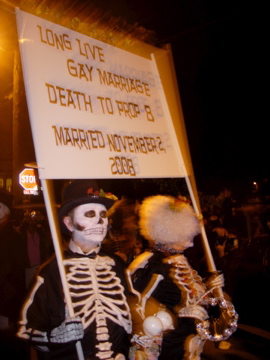 At the same time, the Mission procession captures so much of San Francisco’s cultural landscape. Just when you get disheartened, want to write the whole place off as over-priced and gentrified, the city comes through with something insanely creative or beautiful. Despite the changing demographics, beneath the paling population and depressing socioeconomics, San Francisco’s still a city with soul.
 I’m falling in love with my hometown. Again.

 Lonely Girl Travels
Recent Comments