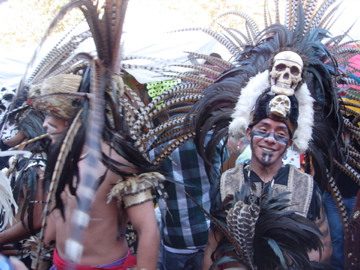
 It’s not Mexican Halloween. Or Northern Californian Halloween. It’s Dia de los Muertos, and it’s everyone’s holiday now.
You can’t escape Dia de los Muertos in the Bay Area. That’s a good thing. It’s a pretty bad-ass holiday, based in the Aztec belief of death not as a definitive end, but merely a continuation in a parallel form. Aided by elaborate graveside altars, souls of the departed return for one night (traditionally two) to kick it with the living. The celebratory approach towards death comes complete with a comically macabre aesthetic derived largely from a good ole’ revolutionary, Jose Guadalupe Posada (see: my first tattoo).
What makes the holiday fascinating to me is its endurance and evolution. Dia de los Muertos is the little holiday that could: millennia-old, it’s survived colonialism, Catholicism, and more recently, the United States. But while all these outside elements have altered the holiday, the fundamental spirit has managed to survive. Observances vary wildly, both within and outside Mexico, and serve to say a lot about their respective communities (see: my latest Matador article). Case in point? Oakland versus San Francisco celebrations.
The Bay Area’s enormous Hispanic population has two established homebases: East Oakland’s increasingly cleaned-up Fruitvale district, and San Francisco’s contentiously gentrified Mission District (claimed to be birthplace of the burrito). Both host huge Dia de los Muertos celebrations that shut down city blocks and draw thousands with marigold-adorned, incense-laced festivities. Neither celebration is traditional, in the Patzcuaro sense of the term, but neither are the same. They contrast as starkly as an SF hipster’s ironic mullet and an Oakland hyphy kid’s synthetic dreads.
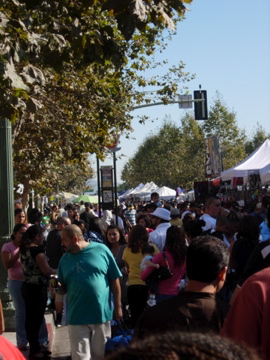
International Blvd during the Dia de los Muertos
Oakland celebrates with a family-oriented daytime street fair on the Sunday preceding the holiday, this year November 1. While drawing a healthy cross-section of the city’s ever-diverse population, the event is mostly representative of contemporary Mexican and Latin culture in the Bay Area. Powerhouse Spanish radio stations, La Raza and La Preciosa, set up stages on opposite ends of the festival and vie for on-lookers. Local taquerias set up stands that pump out carne asada smoke, while DIY vendors push helado carts and set up raspado stands. Women hawkers cry, “Churros, Churros, Churros!” while others wrap still-steaming elotes in foil. Local businesses abut booths with corporate superpowers like Safeway, while non-profits erect altars next to those of neighborhood school kids. Dancers decked out in Aztec garb (the feather- and skull-adorned headdresses are bad-ass) break into spontaneous drum-infused performances, and there’s more men in cowboy hats and little girls in mini-skirts than you can count.
 On November 2, San Francisco holds an evening procession that a jaded friend of mine has dubbed “Gringos Gone Wild.” True, the participants are largely not of Hispanic decent and, boy, do they get down. People dress up in calavera face paint and elaborate Tim-Burton-esque costumes that I suspect derive from Victorian Catrina dolls. A modest group of Aztec dancers leads the procession, which then follows with revelers of the purely San Franciscan variety: costumed people with politicized signs, curious interpretive dancers, bicycle-powered floats, and a whole lotta candle-clutching white folks. The procession ends at a public park filled with some seriously artistic altars—this year, an anatomical heart suspended by red nerves, a papier-mache carniceria, a parlor scene that looked like the inside of Edward Gorey’s head.
I can see how people get down on San Francisco’s Dia de Los Muertos celebration for not being authentico; I understand why others deem Oakland’s as boring and not creative enough. But isn’t that just an extension of the Oakland-SF rivalry, the cities’ differences demonstrated through the observance of another culture’s holiday?
I’m an Oakland girl, so I’m partial to an event where I run into about a dozen people I know. And if nothing else, the Fruitvale festival is thrilling for the mere fact that Oakland manages to hold a peaceful public festival (I remember seeing stray post-Festival-At-The-Lake rioters pass by the bottom of my block as a kid—that was the end of that neighborhood event). Events like the Dia de los Muertos celebration remind me why I love my hometown—though I never really forget.
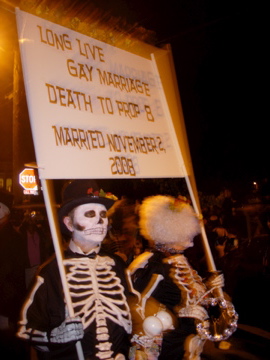 At the same time, the Mission procession captures so much of San Francisco’s cultural landscape. Just when you get disheartened, want to write the whole place off as over-priced and gentrified, the city comes through with something insanely creative or beautiful. Despite the changing demographics, beneath the paling population and depressing socioeconomics, San Francisco’s still a city with soul.
And at the center of both of these celebrations is the fact that they don’t derive from, well, here. They aren’t American, have been brought over by immigrants and subsequently Americanized. Some shout cultural appropriation, and, sure, these festivities are a far cry from the all-night graveside vigils I attended last year in Tzintzuntzan. But, at the core of these modern interpretations, both stay true to the fundamentally celebratory Aztec approach of the holiday. And if that’s not survival, I don’t know what is.
 I’m falling in love with my hometown. Again.




Recent Comments