Archive for the 'Independent' Category


On The Road to Nowhere: Finding an Anti-Place, Part 2

Our pick-up truck bounded down the smooth pavement, creating a muggy breeze. We moved down a strip of the coast, a highway and a shade of green I think I’ll forever associate with Thailand, and that’s the place the people came through. It was 30 years ago and there’s not a lot left—unless you know where to look.

I didn’t. I kept craning my neck through the grating of the covered truck bed, trying to catch a sign for Khao Lan. I was lucky, I discovered, in that a giggly group of five teenage girls with straw mats and beach towels were getting off at Khao Lan as well. They’d spend the entire 40-minute ride squealing and chatting and texting. When we glided to an easy stop, they pointed and exclaimed to me, “Khao Lan!”

We trundled off, stood on the swampy roadside of a military checkpoint. “Beach?” one of the girls asked me shyly.

“Museum,” I replied.

“Museum,” she repeated softly. The word caused a buzz among her friends. “Museum!” one of them exclaimed assuredly, and pointed to a white structure obscured by the green.

I thanked them with a small bow of my head—I hadn’t learned “thank you” in Thai—and watched them disappear down the road.

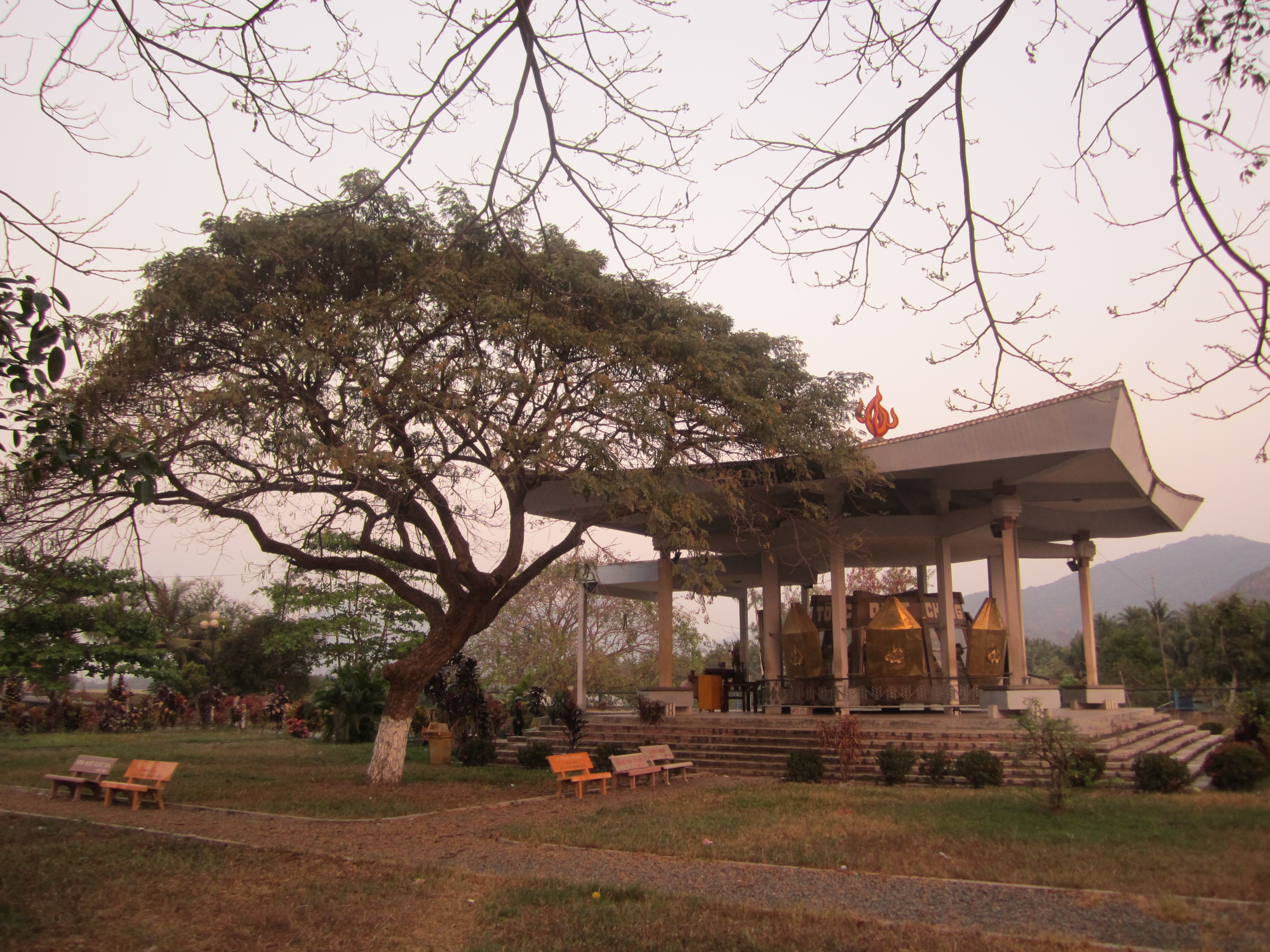
The museum was modern, diagonal columns and a glass skylight structure that didn’t at all seem to fit the landscape. The adjoining parking lot was empty and the museum gates locked.

The guard at the military checkpoint back on the road made an eating motion. He pointed to his watch, held up one finger. I nodded and wandered back down towards the museum grounds, thinking how strangely simple it was, how much you could communicate without words, without a common language, just signs and gestures and hints, a smile and a bow.

Green signs were stuck amid the grasses, and those communicated a lot less. Were they marking something related to the camp that had once stood there? I couldn’t be sure, but photographed them just in case.

I walked deeper into the grounds. A buzz grew from the trees like a living thing, like it weren’t the product of a living thing, a million unseen insects, but an animal in and of itself. It whined and hissed and followed me down the road.
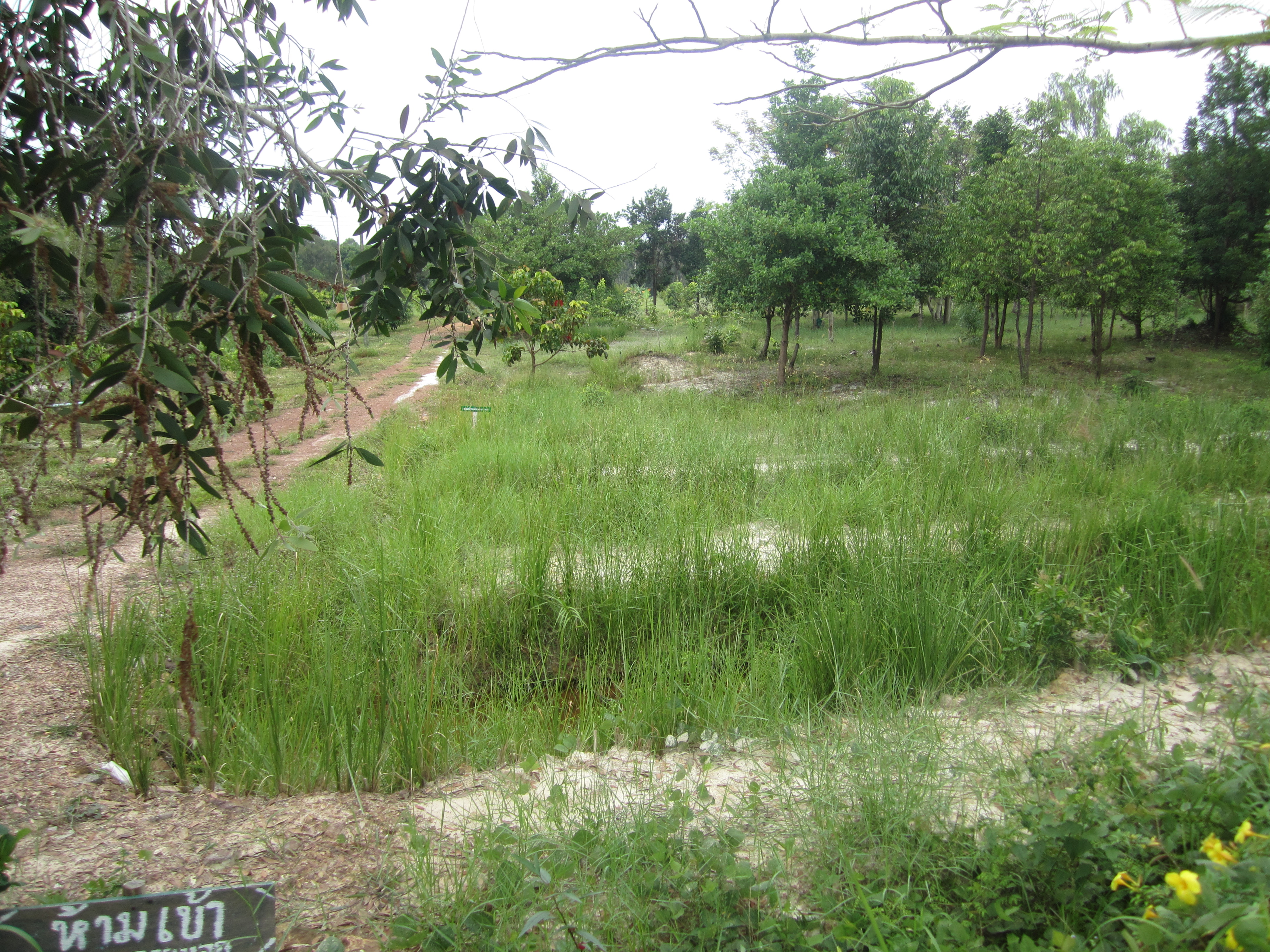
There were beaten bits of earth, what had once been a road. Chunks of cement remained, with earth growing back up around it, like a scab before it peels. There were clearings in the grass, and I tried to figure out if they were remains or something used for farming, the stray huts I could spot off between the trees.

But I walked further and found translated markers—something, not in a common language, but my language, a scribble I could understand. I held my breath and tried to imagine tents and roads and some 90,000 people.

I couldn’t. It was just wind and rubble, stairs to nowhere and the earth growing back up around.

The museum was open by the time I got back, and I slid off my shoes and stepped inside. A lone female attendant smiled at me and went back to sweeping the floor.

The museum was strange. It was mostly a tribute to the Queen, a tribute to her goodwill as evidenced by her selfless saving of Cambodian refugees. Everything was framed in that context—photographs of a glamorous white-skinned woman walking through a city of tents in a white suit, a floppy sun hat and Jackie-O sunglasses. She crouched beside the thin and sick, bellies swollen and eyes dulled, a look of practiced concern. She sat before a group of children, an opened book in her hands: The children listened rapt, the words of the Queen forever imprinted in their minds.

Subtext: Thailand is the only country in SE Asia to have never officially fallen under imperalist control.

But still, she’d done a good thing, a damn good thing. The museum included three life-size scenes that reminded me of wildlife dioramas, the kind my best friend meticulously restores, repainting eyes and gluing on fake fur.

Wax Cambodian figures, their bodies worn and their faces contorted by grief, stood in varying poses of despair, before a painting of thick jungle, more faces and bodies coming through the trees. Other scenes depicted varying elements of camp life: cooking pots of rice, a white woman holding a stethoscope to the chest of a small wax infant. The dark Cambodian bodies grew plumper, more solid.
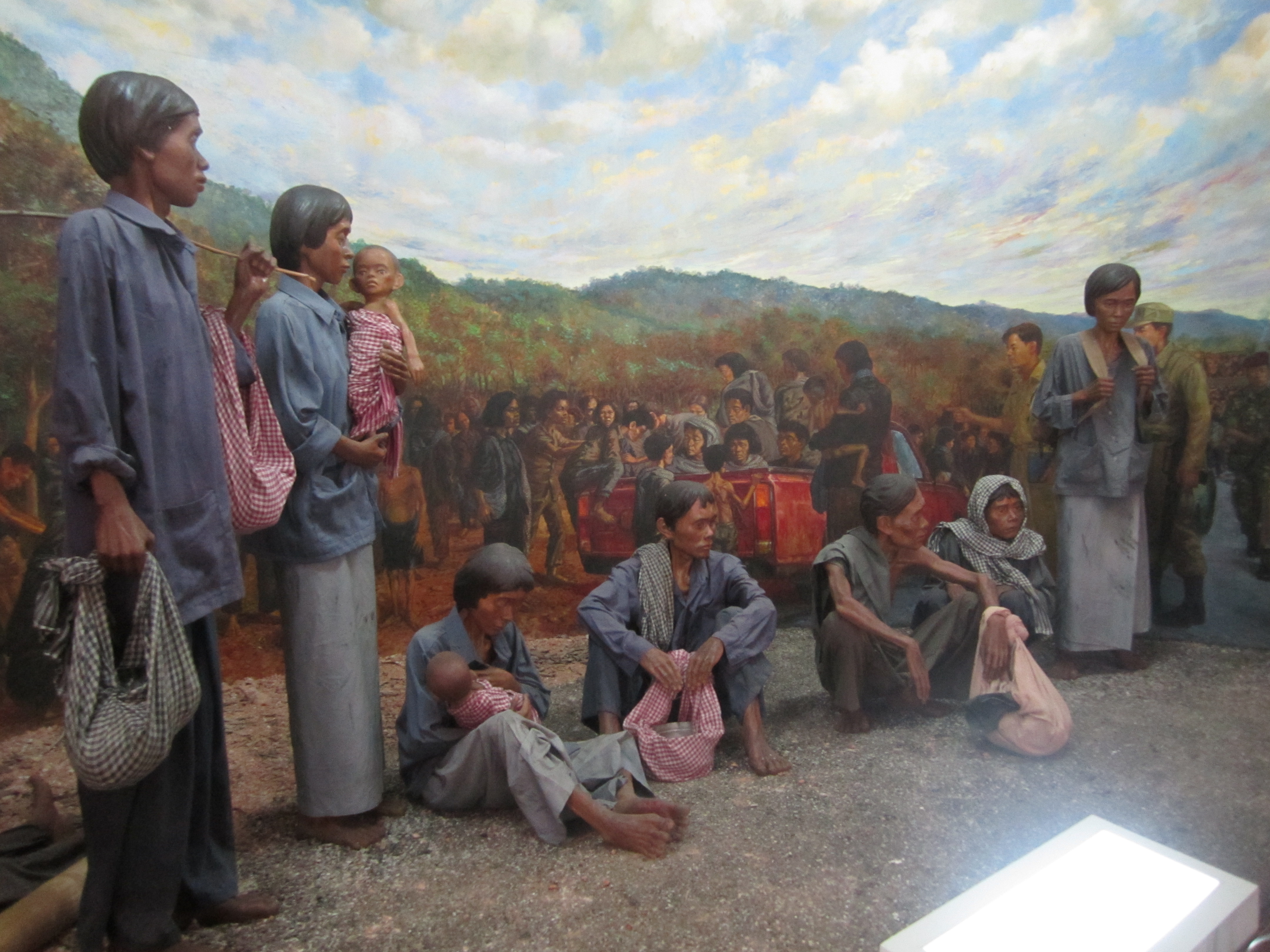
I wondered if that’s what it’d looked like—the emergence from the woods and the camp life. I thought of the newsreel footage of camps I’d seen, the faces in the camps, and decided it was worse.

(“You’ve seen The Killing Fields?” Lisa asked my mom once. My mom said yes. Lisa nodded. “It was much worse.”)

For its oddity and drama, I wondered, if there were any other museums like this, that documented this particular snippet, this part of journey, this freeze-frame from the film reel of a movie you’ve never managed to see all of, keep catching out of sequence or coming in half-way through.

I stood barefoot in an empty museum of transience, while the earth outside slowly swallowed the remains of what was left, which wasn’t much at all. I tucked some crumbled bills into the donation box, slid my shoes back on, and stepped out into the heat.

Vintage Sounds: The Revival of Cambodia’s Golden Era

The 1960s were a bad-ass time in Phnom Penh.

You might not have known that. I certainly didn’t, not until a work friend happened to put Cambodian Cassette Archives on my iPod. Even then, I didn’t know the extent of the dopeness, just that the psychodelic, garage sounds coming through the little white earpieces were unusual, different, haunting—an echo of another era, most of the songs flashing with an “Unknown/Unknown” track title and band name. What the hell was this, how did it survive, why was it so effing good?

http://www.youtube.com/watch?v=6gJqPOIfKa0&feature=related
My intro to Cambodian rock

Well, it’s nice to know I’m not alone. People have been digging in, excavating through the darkness, trying to revive the Golden Era of 60s Cambodian pop culture: rock, films, thick lines of black eyeliner and bouffants the color of ink. It’s an exercise in lost histories, untold stories, missing pieces, what-could-have-beens, what-shouldn’t-have-beens. It’s an exercise in facing just exactly how much was lost. And ultimately, it’s an exercise in love.

So when I saw the flyer for a vintage shop, simply named Vintage, opening in Phnom Penh’s Russian Market yesterday—um, yes, count me in.

We waded through the sweaty stalls of the market—Western clothes and traditional trinkets, vegetables and raw meat, housewares and fruit stands. Tucked beside the nucleus of food stalls, it was easy to spot Vintage: sleek, boutique design, a crowd of hob-nobbing Westerners, and insanely good music coming out of the speakers.

http://www.youtube.com/watch?v=J_fkNEuX-qw&feature=related
Bad-ass original

The shop was selling remastered CDs, tshirts of contemporary Khmer hip-hop groups, some refurbished 80s ghettoblasters (dubbed as such), a new vinyl record by the revivalist band Cambodian Space Project. It’s the first vinyl, the enthusiastic Frenchman wearing a killer pair of glasses told me, to be pressed in Cambodia since the war. (Composed of an eclectic group of Westerners and fronted by a working-class Cambodian woman, the band is actually out of town for SXSW, so I’ll have to wait til April to catch them. For a super interesting interview, check out this link.)

Cambodian Space Project’s cover

One of the most interesting things for sale at the shop—and what had attracted me to the flyer for the opening in the first place—were the “reprints” of Cambodian film posters from the 60s. All the originals of these posters had been destroyed, not to mention the films themselves. But Sithen Sum, from the Kon Khmer Koun Khmer (Khmer Film Khmer Generation) repainted versions of the lost posters. We chatted, I got his business card, yes, yes, there’ll be an interview.

I’m forming an image in my head. It’s of Phnom Penh in the 60s. It’s aided by photography books I’ve browsed at the posh English-language bookstore. It’s populated with the people I’ve seen on grainy black-and-white videos at the Bophana Audiovisual Resource Center, where I’ve spent hours clicking through the archives, where the people don’t look so different from how they do today, where the markets look the same and cyclos look the same and you could almost imagine none of it had ever happened.

The image has a sound. Behind the spotlights and sequins of it, it echoes of guitar riffs and mystery.

I’m sure this image is grossly inaccurate and veiled in layers of romanticized mystique, but right now I don’t really care. Sometimes you need a fantasy, a vision, a place in your head you can go to where everything is safe—just the glowing lights and the dancing limbs of some other time, that doesn’t seem so dead or so far away—that you let yourself pretend isn’t.

Not Your Normal Expat Scene: Khmer Kids Coming Back to Cambodia

“This not your normal expat scene.”

That’s all I kept thinking last night, as I stood sweating and stomach-sore in the crowd. I’d dragged myself out to a show, what was described to me as an all-girl indie rock band that sang in Khmer. Killer. No traveler’s flu would make me miss this.

It was a funny mix—local men in dress shirts and slacks, women in those super foofy sparkly dresses; kids, some just in the crowd, others wearing matching shirts for some organization I couldn’t quite make out.

And there were your typical expats—Western, mostly white. Some of them were extremely well-groomed, reeking of cologne and hair spray and kissing their friends on both cheeks. Some of them wore that aren’t-I-so-cool-for-being-here look. Some tried to dance along or move to the beat, and it was sad and cute in the way it’s always sad and cute. And others just seemed to be there, watching, enjoying the show, because that’s what there was to do that night.

But the kids putting on the show—the kids on stage and holding the cameras and checking the sound—they were not your normal expats.

Your typical expat does not drop their “to be” verb (“She crazy”), doesn’t say “y’all” or “aight.” They don’t wear baggy jeans and puffy sneakers. They don’t start NGOs called Tiny Toones or hip-hop groups called Klap Ya Handz, written in Godfather font. They don’t breakdance or freestyle or bust—and they don’t do it in the language native to their new homes.

I’d heard about the show from Bel, a girl I’d found on Couchsurfing. We had plans to meet up for coffee and even though my stomach was already getting wonky, something told me not to flake.

She was a cool girl and we talked for awhile. Her boyfriend was a Khmer-American who’d moved back to Cambodia, with no intention of ever leaving again. “He’s the most patriotic Khmer you’ll ever meet,” she said, and later he showed me the tattoo of a famous Wat across his back.

“There’s a lot of foreign-born Khmers moving back,” Bel told me. “Lots of artists and young people. And they’re really motivated to do something here.”

I wanted to see this; I wanted to glimpse what this was. Sure, I knew of people going back to their parents’ countries for a visit, but to live? To give up everything they know to fight for something better in a country they hadn’t grown up in? This was something different.

And it was. The show place was buried deep inside the maze of a mall, shuttered shops and a blinking arcade, bowling alley and bumper cars. I got there earlyish, paid a $10 cover—normal for the US, but exorbitant for here.

On stage was a DJ, two turntables and a MacBook glowing. Two artists were on stage, doing ad hoc graffiti art on a make-shift wall. “Empire State of Mind” came on. It was like being at any hip-hop show at home—except a hell of a lot hotter.

The first act was a hip-hop group called Klap Ya Handz. They spoke in a working-class English, like kids that grow up in Oakland. But in the songs, they flowed in Khmer. For one song, they brought out traditional Khmer drummers that were, well, bad-ass. During another song, the lead girl did what she later called “Khmer hands,” a hip-hop take-off on the hand movements of traditional Khmer dancers.

Cambodia lost a whole generation of artists during the Khmer Rouge. Traditional dance was virtually erased and, after Pol Pot, there wasn’t anyone left to pass it on. I’d read accounts of the few survivors left trying to teach the next generation, and it being hard—they were more interested, as teenagers usually are, in contemporary things. Like hip-hop.

The headliner was Laura Mam and the Like Me’s. They’re a bluesy, all-girl rock band from San Jose, California (local love). They’re Khmer-American and sing in Khmer. The crowd obviously loved them, singing along and snapping photos and waving their arms. I was told that they came to play in Cambodia relatively often. Either way, they showed the same kind of passionate pride in their Khmer culture that the kids in Klap Ya Handz did.

They played a song called “Diaspora”: “for all the refugees living in diaspora around the world—and missing Cambodia.” The crowd went crazy.

No, this wasn’t your normal expat scene.

Your typical expat is someone of relative priviledge; they have, say, a university degree and the social mobility to pick up and move around the world. Maybe they studied abroad, or spent time backpacking around. In any event, it occurred to them to leave their home countries in the first place and they had the means, however meager, to do it. The ones I encounter are largely middle-class; the uber wealthy ones exist on another plane, and I only see them in passing—the immaculate girls on the streets of Hong Kong.

These kids were categorically Not That. They’re the kind of kids, in the kind of scene, that I miss when I leave the US; when I think about moving abroad, I think, “Man, there’s so much shit I’d be missing” and this is part of what I mean.

And they bring their Americanness—their very, very Americanness—back here. But they’re making something new with it; there’s that frenetic energy, that spark you feel when cultures collide and you see people that are so intensely passionate about what they’re doing, you can’t help but feel it too.

Of course, not all of them are coming back by choice. The US opted to deport foreign-born convicts, regardless of whether they’d served their time, and nearly 200 people who were, for all intents and purposes, American were sent “back” to Cambodia. They brought their culture, a street culture, and they brought their art. And they’re doing shit; they’re bringing this to the kids of Cambodia, the next generation (ie: Tiny Toones).

So basically, watch the fuck out for these kids.

There was a shirt I kept seeing in the crowd, tons of kids wearing it. Its design was a take-off on the Star Wars logo, and it read: “The Khmer Empire Strikes Back.”

This was my first glimpse into this, my looking-through-the-peep-hole into this. I fully intend on investigating this more during my time here. But last night, sickness was calling, and I had to head back to the hotel.

A Tale of Two Tours: Part II, Khmer Village

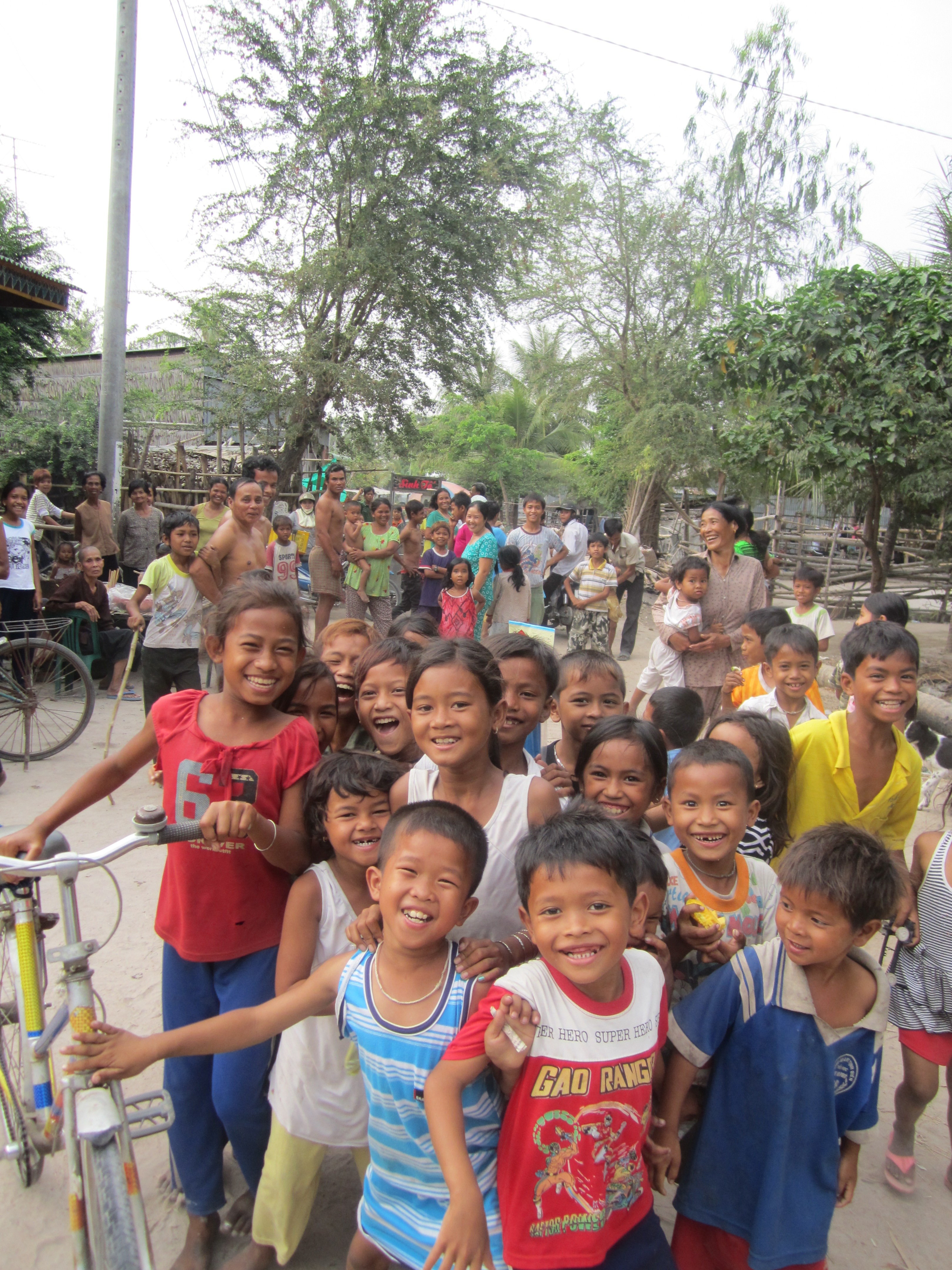
White girl comes to town. Crowd gathers.

Duc had a prison-style dragon tattoo and a speech impediment, and he gave me the best goddamn tour I went on in Vietnam.

I kept seeing him around town. My first morning, groggy-eyed drinking coffee at a corner cafe, I saw him sitting at a neighboring table. He was selling his tour services to another sola Westerner, and it appeared to be working. He was younger than the other motorbike drivers, wearing a sleeveless shirt, something beat-up, kind of tough about him. He’s working it, I’d thought.

He looked over at me and we exchanged brief nods.

I saw him again that afternoon atop Sam Mountain, two skimpily clad female backpackers hopping off the back of his motorbike. Yup, I thought. Woooorkin it.

He asked me about my tattoos, peeled his shirt back and showed me a jagged dragon across his chest. The lines of it were half-blown out.

“You tattoo? You use neddle?” he asked me. I shook my head, “No way, a gun, man!”

He grinned a soggy-toothed grin. “Me, no gun.” I could tell, though I didn’t say it.

And again outside my hotel that night. He talked up his tour services, an English at once clear and garbled, that snagged and stuttered on certain words. I’d already booked a Delta tour with my hotel; I politely refused.

The next day’s tour was my third one in Vietnam with barely-to-no English spoken. We motored the Delta’s brown waters, through a “village” of tattered boats—faded wood, clutters of laungry, children flying kites from somewhere on the decks—and to a Cham ethnic minority village on dryland. It was fascinating, beautiful, but I had no context for it, no way to learn, to understand what I was seeing. I wanted to know more, felt it building up in me, bottling up, nowhere to go—an asphyxiation of unasked questions.

I was over it. Over the seeing-and-not-knowing tours.

Which I guess is how Duc sold himself to me. I sat later drinking coffee on a plastic stool in the shade. He pedaled his motorbike up, said hello. He asked how my tour had gone. I told him not great.

“You go with someone who speak English, it better.”

“Yeah, you’re right about that.”

He must have sized me up pretty well. He told me about a Khmer village about 15km away, very remote and isolated, “no one else take you there.” He kept talking and talking, and I thought, It’d be nice to see something with someone who can explain it. I also thought, If his tour guide skills are anything like his sales skills, it’ll be pretty good. I’d already spent too much that day, but said fuck it.

“Okay, okay,” I smiled. Then added, “You’re a good salesman.”

We drove through the Delta, its murky beauty: corrugated tin shacks perched on bamboo stilts like skinny legs, a Dali painting; ladders to reedy docks, leading precipitously down the muddy banks, into the muddy water (love, love, love that dirty water). My brain was on fire with images; I kept trying to scribble them down. Writing poetry on the back of a motorbike, it turns out, is very hard.

Duc kept pulling over along the way, to show me things, rice and seeds, things laid out on tarps to dry in the sun. He didn’t have to do that. He explained how the rice patties were harvested, how the people worked long hours, “very hard work.” He didn’t have to do that either.

Every now and then a vagrant stutter would lurk through his speech. But he’d work through it—drag his speech and himself through the snare of it—and something about it struck me as sad and somehow tender, like a bird with a broken wing.

I pretended not to notice.

We made a few other stops, finally pulled off and bumped slowly down a dirt road. The landscape changed—more cows, bone white and skinny-ribbed, flowering trees I hadn’t seen elsewhere. The houses were suddenly different too—thatching for walls as well as roofs, so the structures looked furry, like animals.

We crawled out of a cloud of dust as the bike came to a stop.

We begin to walk the town’s road slowly. He explained: a town of about 400, ethnically Khmer. There were a few towns like that along this strip of the Delta, a ribbon of land that had once been part of Cambodia. They stayed pretty isolated, stayed to themselves; residents rarely left. So traditional ways, instead of blurring with those of the Vietnamese, stayed pretty intact. And I could feel it, could feel the immediate difference.

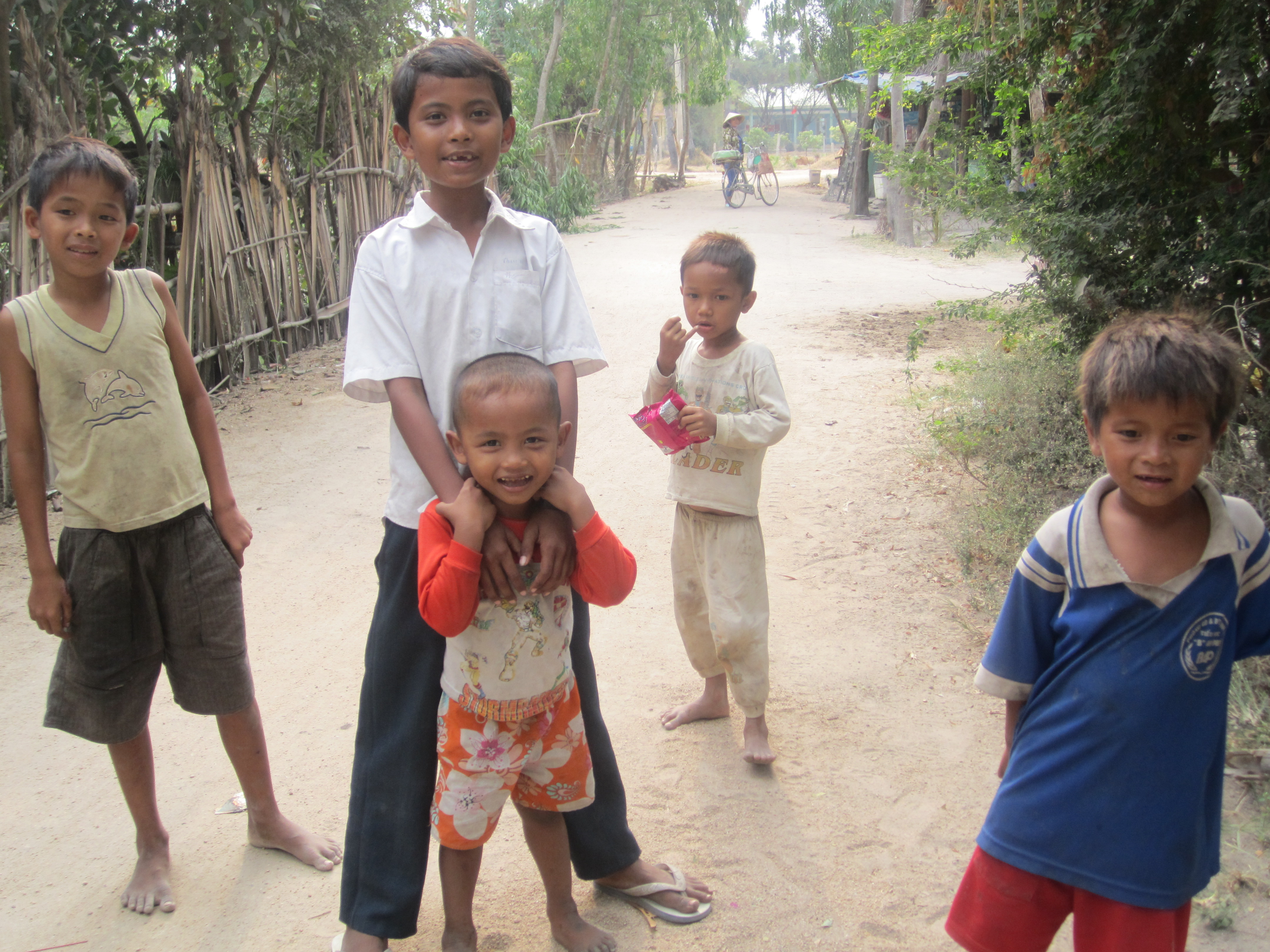
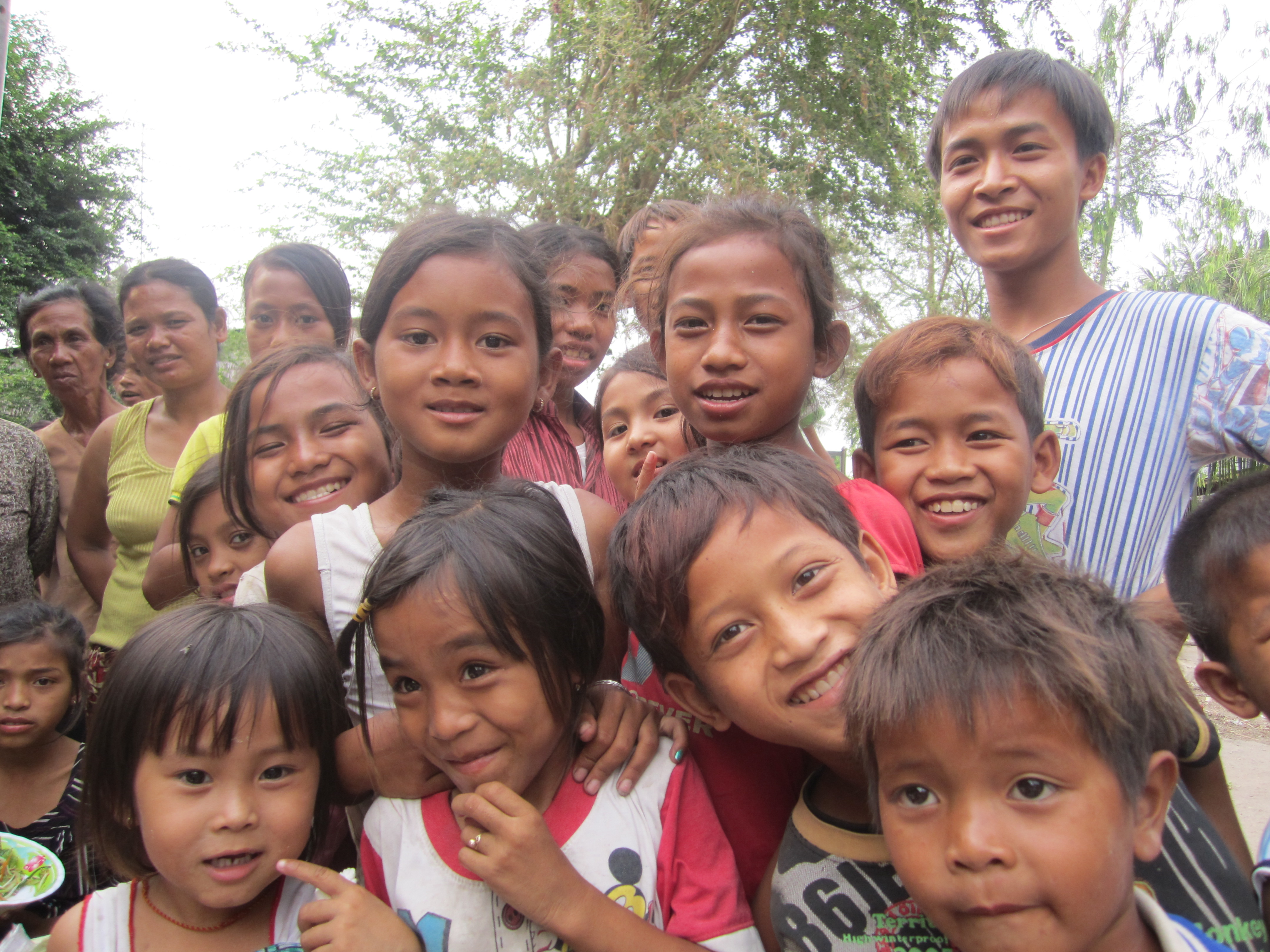
Curious brown faces began to appear. “Hello!” one of them shouted, then hid behind the back of another. “My name is—” then a chorus of giggling. I answered back hello, and they laughed more. We went on like that, as I kept walking.

Every face I passed seemed to smile. I was an outsider, an oddity, but they seemed pleased by me. I passed a baby in a hammock, being rocked by a rope that was tied to it, a mother tugging, tugging. She smiled too.

The crowd of children grew, big grins on small faces. Most were barefoot, their clothes thin and worn. They held their hands to their mouths, the girls chewed their hair, they smiled and smiled.

We passed a woman making these omelet/crepe things I’d had before, filled with sprouts and meat. I was hungry. I motioned for one and sat down.

This is when the real delight began to grow. And the crowd.

I’ve heard other travelers’ tales like these: being surrounded in some small village somewhere, stared at. But I’d never had to happen to me. I kept stopping eating, looking around—an entire circle of faces, just watching, watching, and smiling too.

I laughed—what else could I do? I searched for Duc’s face, hidden behind the crowd; his was smiling too.

A very small, very hunched and wrinkled old woman, tapped my shoulder. She handed me a short tin cup filled with water, and I thought I might cry. They were all so welcoming, so sincere; the children giggled and the adults watched and they all kept smiling. It struck me as about the sweetest thing I’d ever experienced.

Duc and I began to walk slowly back towards the motorbike, the village’s kids trailing behind us—a shadow of children. I turned around and waved. “Good-bye.” And a chorus of “good-byes” erupted and a flurry of waves, and we drove off, away: a precious little place I’d never be again.

And it struck me, there, on the back of that bike, that Ba Chuc must have been a lot like that town before the Khmer Rouge came. Only bigger.

We cruised back into town. I hopped off in front of my hotel, handed Duc $10 instead of the $9 we’d agreed on.

“Oh, you tip me? You happy?”

“Yes. I’m very, very happy.”

A Tale of Two Tours: Part 1, Ba Chuc

We were racing the sun. It was begining to glow orange, cut into pieces by the great green palm leaves. The Mekong Delta—the landscape of every Vietnam War movie I’d ever seen, where boat engines sounded like the echoes of helicopter blades.

We were trying to get to Ba Chuc before the sun went down. It was the site of a Khmer Rouge massacre; a pagoda with the bones of the deceased had been constructed. I’d planned on visiting it the next day, but when Sam Mountain turned out to be a bust—cages full of endangered birds for sale, and small boys peeing between make-shift altars—I’d decided to make a run for it.

We pulled into a dirt lot with the sun low, barely above the squat structures—corrugated tin walls and thatched roofs. The motorbike driver didn’t speak English; he pointed at the sign on a small, concrete building. “Ba Chuc.” I handed him my helmet, and he leaned back to wait.

Inside was empty, a lonely government building—fading paint and dusty floors. The walls were lined with photos depicting the massacre. Along this stretch of border, there were several Khmer villages; it had, at one time, been part of the Khmer kingdom. In 1978, the Khmer Rouge had come into the town of nearly 4,000; only one person survived the massacre.

I’d read this all in my guidebook. Here, all the signs were in Vietnamese. The brutal black-and-white images didn’t need translation. I walked slowly, alone with the freeze-frame horror.

A barefoot woman entered the room. She was withered and hunched. She tugged at my sleeve, pointed to the picture of a girl’s body impaled through the vagina. She made a thrusting motion, her eyes desperate. She motioned around.

She kept pointing, I kept nodding—what else do you do? She held incense out towards me, made a motion for bowing. I didn’t want to buy any incense. Not so much that I didn’t want to buy it, but that I didn’t want to burn it, to bow—to mime the motions of someone else’s religion, someone else’s sanctity, someone else’s tragedy. Not mine, not mine. (I hadn’t wanted to go to my uncle’s funeral as a little girl, and it was the same feeling—an old feeling, buried feeling, that I’d forgotten—something in me saying, “No, no, no.”)

I walked over to the pagoda. It was in a grassy lot, mostly deserted. A large tree grew next to it. It was pretty, rural, littered with trash. Two teenagers sat holding hands. Three small, dirty boys played on the steps leading up to it. They leapt up, walked over to me, palms open. I shook my head (no, no).

They followed me as I walked in a slow circle around the pagoda. Behind glass, skulls had been arranged according to age: 0-2, 17-25… It didn’t seem real.

I circled around once, twice. I didn’t feel anything I thought I should be feeling (“There’s no right or wrong way to grieve.”) I didn’t feel anything, really, but numbness, and a “no.”

I walked back down the few steps, back towards the motorbike, the driver, another distance to be traveled in silence. A rock hit the groumnd beside my sneakers. I looked back, and the boys giggled. Had they meant to hit me? Was it malicious, were they playing, who was I, what was I doing there?

I walked back to the motorbike through the dirt-lot dusk, feeling nothing but “no.”

Saturday Night Fevered

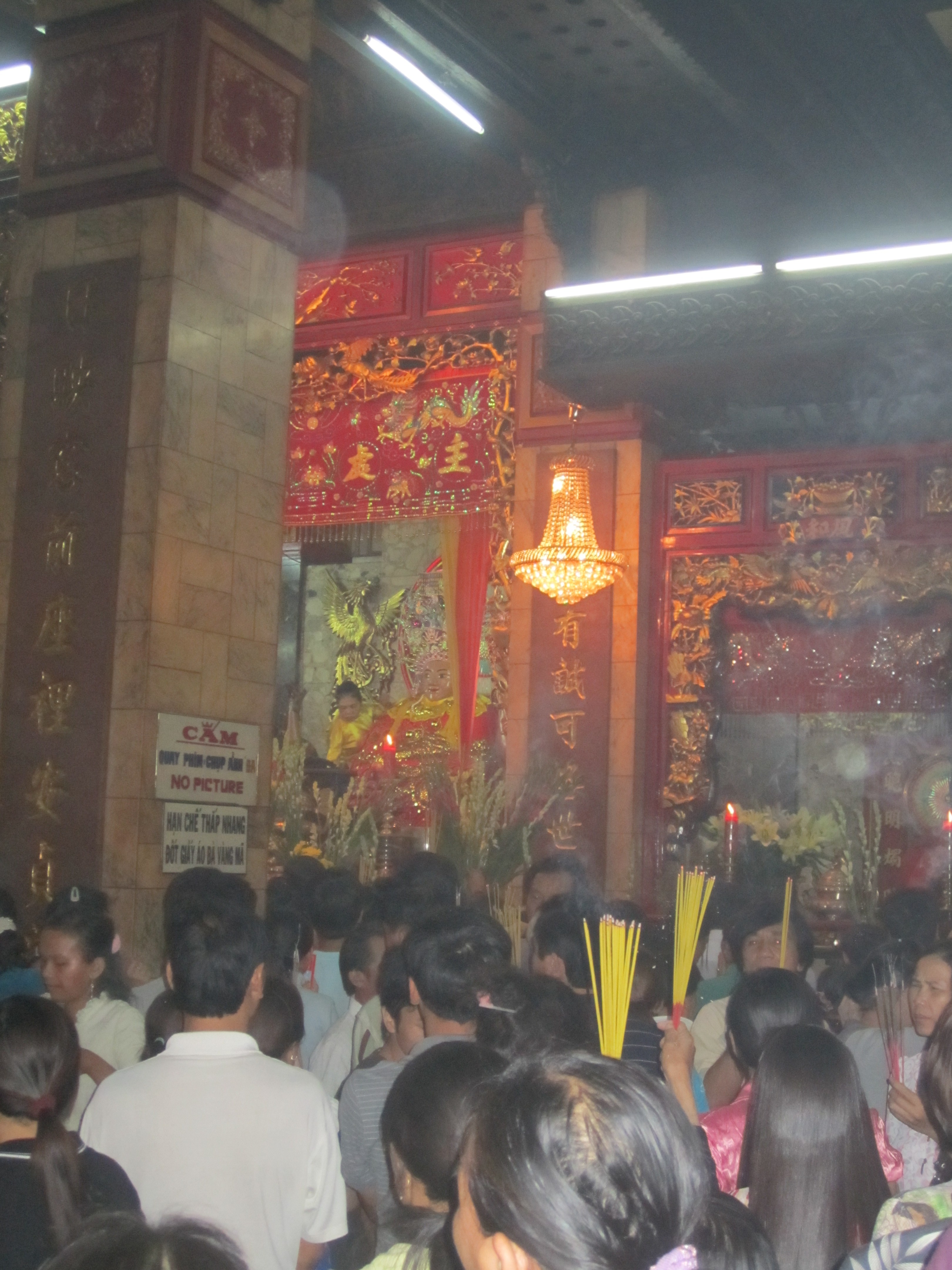
Long stalks of flowers and twisted plumes of incense burning. Nodding, bowing, chanting with their eyes closed. Trays of food—peeled fruit, shrink-wrapped cookie packages, an entire plucked chicken—held atop people’s heads as they murmur. Candles and coconuts, red glowing altars (to what, to what?).

Children and hunched-up old people, a constant bumping, bustling, brushing against—the Asian conception of personal space, or lack thereof, exemplified. Announcements on a loudspeaker (what, what?).

Smoking a cigarette while he prays. Sweeping rubbish out from under the feet of the worshippers—playing cards with footprints on the floor.

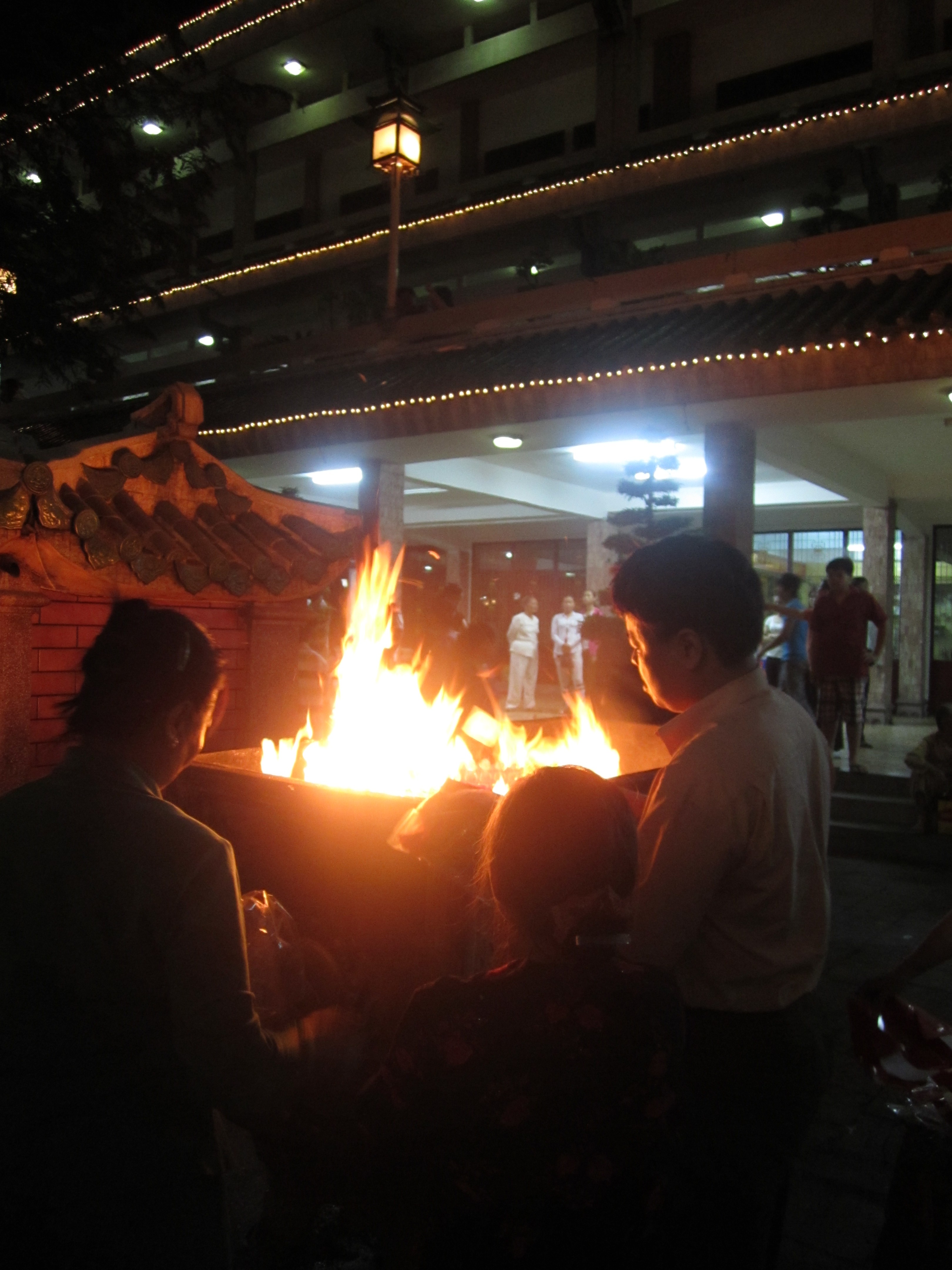
Photocopied money in buckets being carried, to be burned—tossed into a pit outside that shoots scraps of burnt paper all over, raining ash in the night wind. Smoke rising (to where, to where?). Calling to children—“Em oi! Em oi!” Some kind of urgency, some kind of plead—nothing Christian about this piety. Nothing solemn; everything sacred.

Security guard siddles up to me, glances at the furious scribbling in my notebook (for what, for what?).

A Buddha-looking diety looking down on it all—a halo of neon, flashing in technicolor.

——–

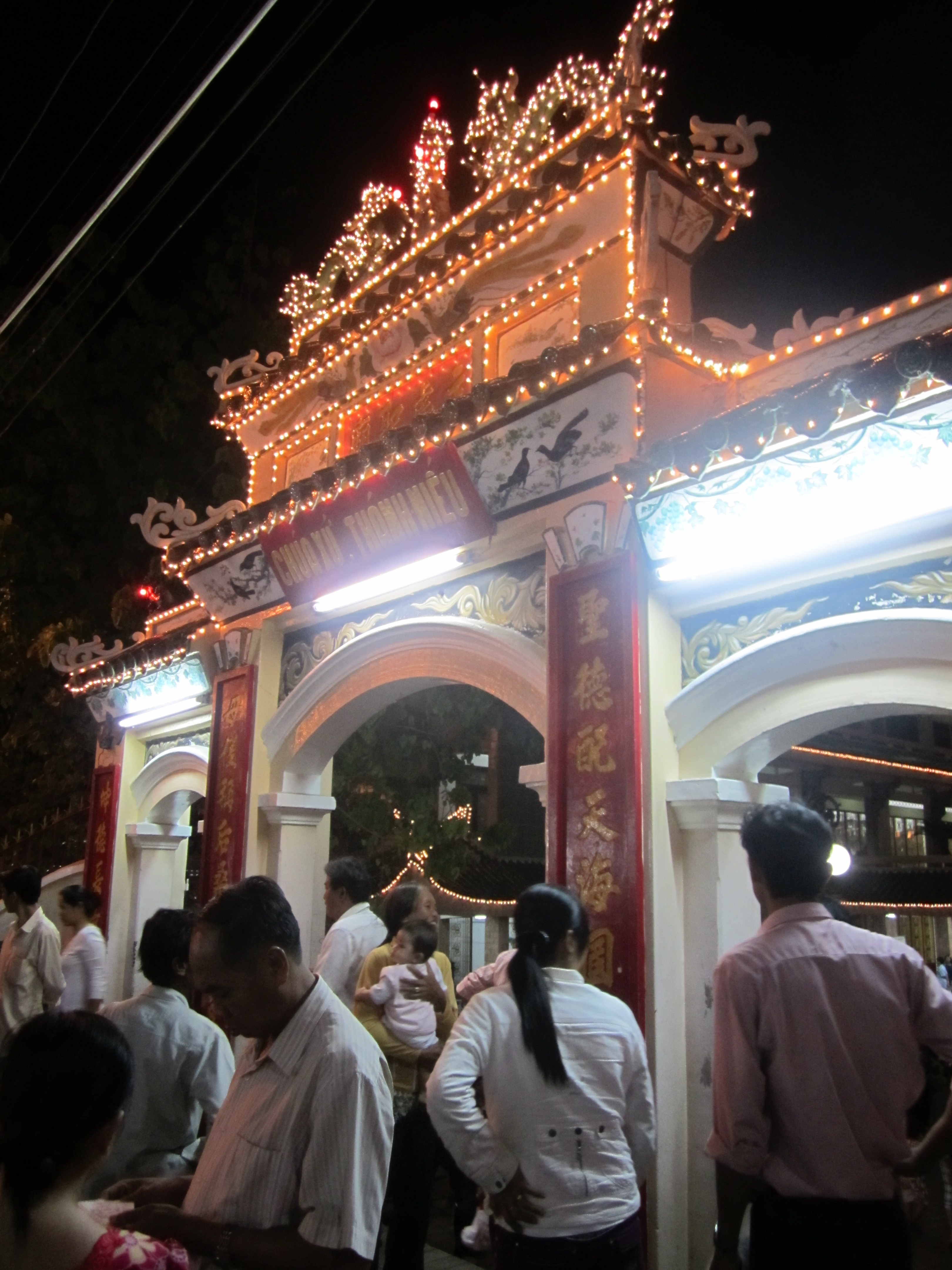
This was perhaps one of the biggest What The Fuck moments of my travels. I had no idea where I was, what was going on, what any of it was for—just that I was suddenly immersed in it, plunged into a cloud of incense smoke and chanting and riotous fervor. These were the notes I made in the middle of the madness.

The motorbike driver didn’t speak any English. We were coming back from another site outside of Chau Doc, a town along the Cambodian border in the Mekong Delta. The roads became cluttered, lined with food stalls and carts and bodies, bodies. They filled like a clogged pipe until they choked and he had to pedal the bike through the crowd.

He stopped in front of a temple adorned with blinking Christmas lights. He pointed. I went in.

It was a funny thing, to be wrapped up in the zeal and fervor of it all without having the slightest clue what any of it was—an entirely sensory experience, a ritual out of context, a girl out of context, cultured-shocked.

When I got back to the hotel, I asked the English-speaking desk clerk, “I just went to some temple, up the road and—”

“You saw thousands of people,” she finished me, nodding.

“Yeah! What was that?”

She told me that they’re city-folk; they come to Lady Temple after the new year to ask for good luck. On weekends in February, March, even up through April, the otherwise sleepy town of Chau Doc swells with these Vietnamese travelers.

“Pilgrims, pilgrims,” the other clerk told me the next day. He’s younger than the girl, I thought, but he only seems it—he later told me that he’s almost 40. I wondered where the years went, behind his boyish smile.

“Other times, not so many people in Chau Doc. It very good for the business.” He looked out the glass lobby windows onto the town’s main market, overflowing into the street with tourists—not so many of them Western.

Snapped a couple of jostled photos before I saw the "No Camera" signs...

Saigon’s Secret Cities

Zero points for subtlety

It seemed like LA to me: glitzy buildings, endless traffic, neon lights reflecting off the hoods of gleaming cars. After two weeks in Vietnam, Saigon’s wide roads and rows of Western shops, its construction cranes turning this way, that way, like slow skeletal animals—it all seemed terribly wealthy to me.

And even more than Hanoi, there seemed to be no break in Saigon, nowhere to rest or even catch your breath from the heat and exhaust and honking, the billboards and the building, always building—more, higher, newer: an unrelenting city, like hot breath on the back of your neck.

But if you looked, if someone showed you, you could find them—passageways, skinny portals to other places, other cities, secret cities just behind the surface.

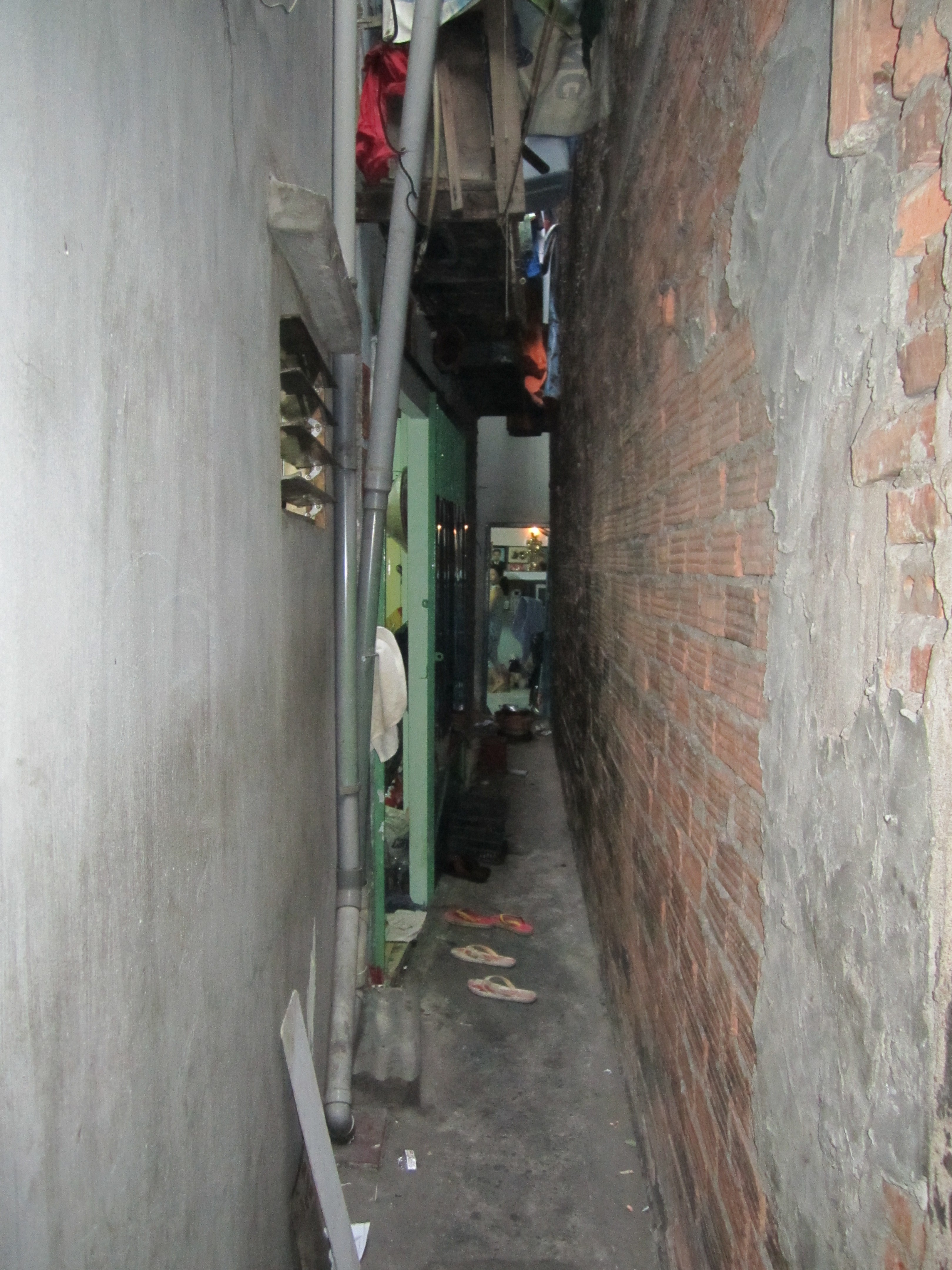
You don’t notice them at first—or you think they’re dead-end alleys, nothing gaps between buildings—no wider than a doorway, and you step through them, into them, into another world: alley streets that wind inside city blocks, where people sit in doorways and women crouch over grills of smoking meat and children run and laundry hangs and TVs flash beside flashing altars and telephone wires stretch in impossible tangles, like dreadlocks—in short, where everyday life is lived.

It’s cool and quiet inside—the buildings are high and the alley streets narrow. You pass a succession of doorways, more glimpses into the lives of the people inside, a flood of images: families huddled on the floor around a big cooker, eating rice; chickens clucking around; old men napping in hammocks; women lighting incense and raising it and waving it and tucking it in a crevice to smolder and smoke.

It feels like a Moroccan medina, those deep parts when you wander far enough—little shops set up in the front rooms of people’s homes, the random internet cafe, children running everywhere, squealing and toddling off into doorways. Only the smell is of fish instead of spices, and it’s motorbikes instead of donkeys you have to look out for.

But it’s the same sense of feeling strangely at home, even though it’s so far from your own home, anything you know of home. There’s something incredibly comforting about the living of everyday life. For those of us that have treaded onto the dark side—maybe for all of us—there’s something really precious about the doing of everyday tasks, a simple joy in being a part of the world, a simple part of it all—even if only as a passing shadow on the wall, a white girl snapping photos and peering in crevices and smiling and waving when the children exclaim “Hello! Hello!” in an English they barely know.

You wander and rove, twist and turn, and then suddenly you’re back out on the surface, the wide swarming streets, an assault of heat and honking. It feels addicitive—you want more, you want to go back, go back under. You find another small portal and dive into the cool dark shadows.

It starts to feel like water, like bobbing up and down, in and under the surface, submerging and coming up for air—only you’re not sure which is the breathing and which is holding, cheeks full and a quiet burn rising through the chest.

You move in a strange space through caverns, observing the private lives of organisms you feel you’re somehow distantly related to; you move through a still, dark world terribly foreign but also somehow familiar, somehow like home—at home, in the secret cities of Saigon.

Take Me To The Jungle, And Don’t Ever Take Me Back

Okay, so outdated pop culture references aside, hear me and hear me well: Jungle Beach is the stuff of backpacker folklore.

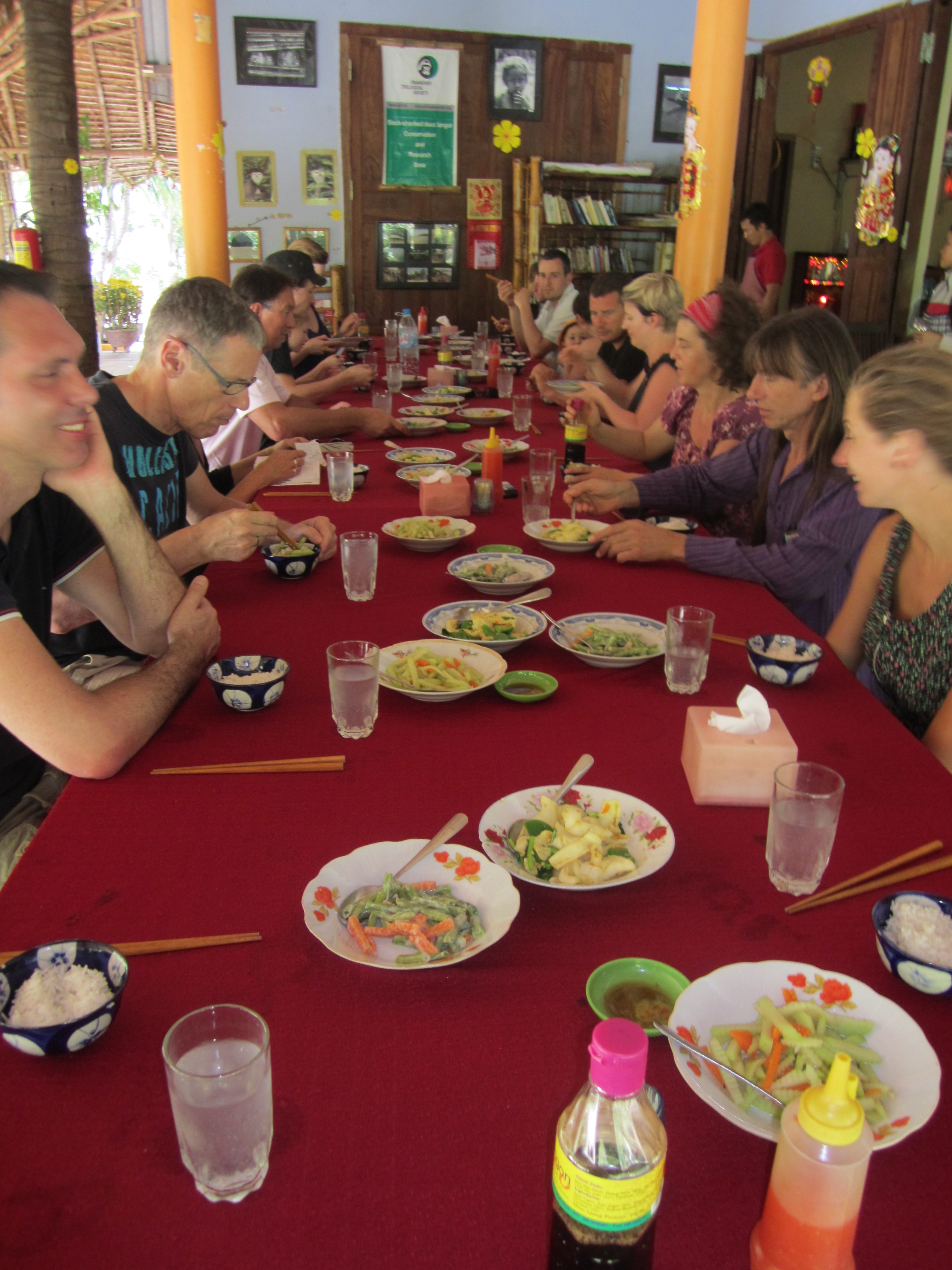
A rustic, simple homestay: a cluster of bamboo cabanas on a sandy lot, shaded by the whispering palms of trees; hammocks and hand-made lounge chairs; a communal dining room where guests gather twice a day for meals; thatched sun umbrellas stuck into the sand of a postcard beach.

Sometimes a place feels so special that you don’t really want to write about—as though writing about it would sully it, or giving it words—trying to give it words—would cheapen it, lessen it, and you want to keep it a private, precious thing.

I arrived at Jungle Beach a little heart-heavy (see previous post), a bit of melancholy sprung up, as though something tapped into a murmuring, gargling reserve of oil beneath the surface of me and wasn’t shooting out like a geyser, but rather seeping through, leaking out into the sunlight.

In any case, I crawled off the overnight bus a stop early, 40km outside Nha Trang—5:30 am on a dusty strip of highway that consituted the town Doc Let. I took a motorbike the next 20-some km, sleep-blurred and thirty-mouthed, to Jungle Beach. I arrived, and I didn’t ever want to leave.

It wasn’t the kind of place that immediately bowls you over. “This is nice,” I thought, as I curled up under a thin blanket, inside a soft blue mosquito net. But the place grew on me—or I grew into it.

Hours and days passed in some sort of other time zone. Wake up with the sun. Jog on the beach or do yoga on a mat in the shade. Eat breakfast. Do some writing, some reading. Lay on the beach. One of the workers comes out and says it’s lunchtime. Rise off my feet, sit at the communal table, pass bowls of meat and veggies and rice and sweet chili sauce. Have another coffee. Go back to the beach. Not even read, really, just lay there—lay there thinking, or not thinking, just watching the waves and feeling my own kind of waves inside, welling up, rising and receeding, as though I were standing on the banks of a monumental sadness, whose bounds I didn’t know, just the pull of its gravity. Cry sometimes, about nothing in particular.

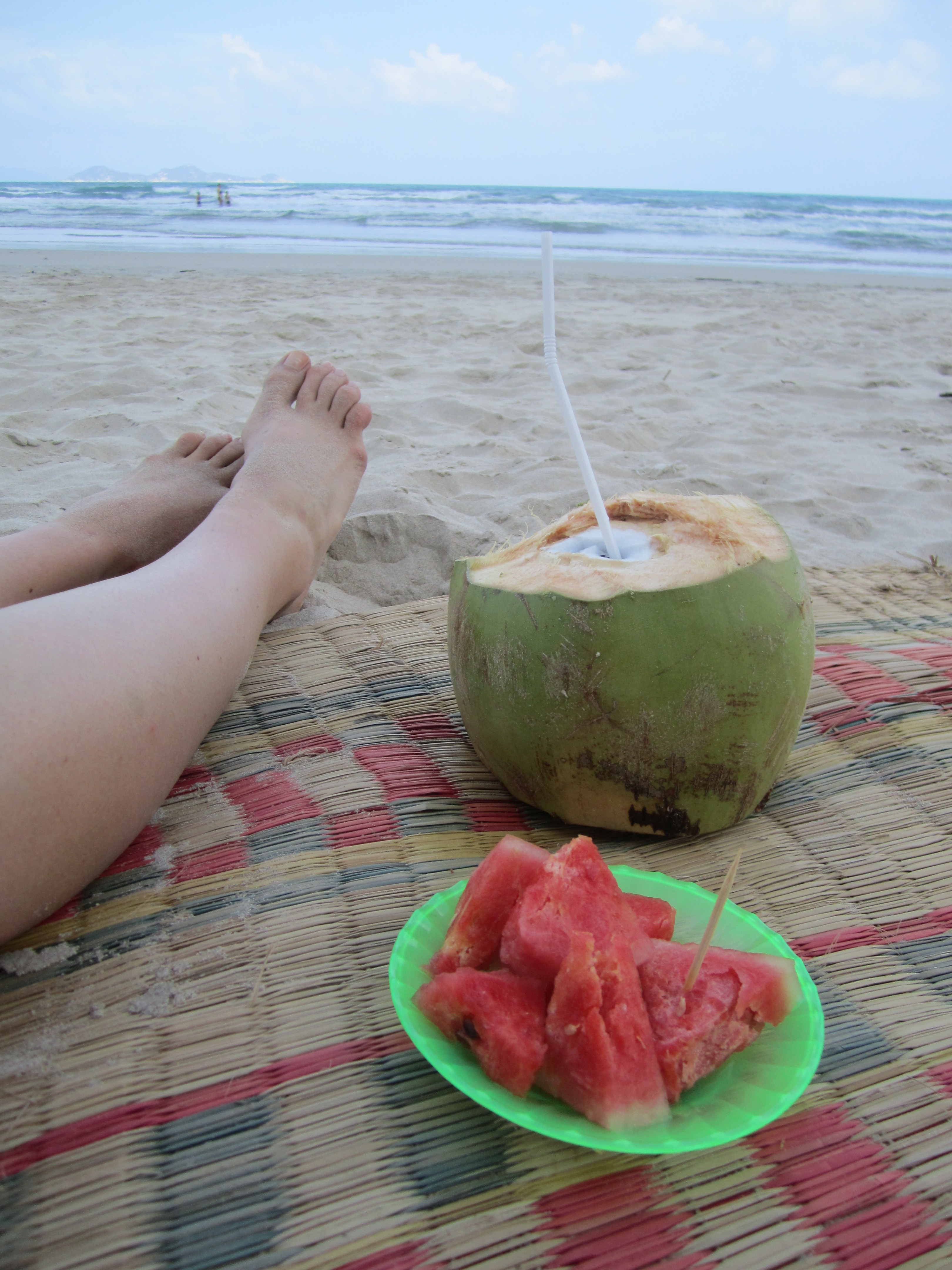
Three pm, and someone comes out with a little plastic plate of fruit, pineapple or pomello or watermelon. Eat it with a toothpick, get a coconut, drink it and scrape it clean with a spoon. Go wade in the water, hopping waves or letting them pummel me, or floating on my back and watching the great white clouds walk across the sky. Shower, check my email, write. Gather for dinner and spend hours afterwards chatting with the other travelers—mostly couples, mostly German for some reason, but really cool people, different ages but all open and friendly. Feel like it’s midnight when it’s only 9, say good night and curl up under a thin blanket, inside a soft blue mosquito net. Repeat as necessary.

The place was built by a dude named Sylvio, who walks around shirtless and smoking, a tough old guy (see character study in upcoming post). He bought the land nearly 10 years ago, and built the place slowly, each cabana by hand, and it’s become the stuff of backpacker folklore.

One of the most impressive parts of Jungle Beach is the staff. The staff to guest ratio was almost 1:1, a friendly, laid-back Vietnamese staff that didn’t pander to the guests and fawn over them, but was attentive—in short, that actually seemed to really care that we had a good time. Ten years of working in the service industry, and I’ve decided that that’s all people really want—to feel taken care of, to feel like you actually give a shit. It’s a rare thing, and it doesn’t necessarily come with heafy price tags and swanky surroundings. It comes, to be completely and utterly trite, from the heart.

I spent four days and three nights doing virtually nothing at Jungle Beach. And as my depature neared, I found myself desperately not wanting to leave. I discovered, without having known it, that I really needed that time—to decompress, to clear out some space, to get ready for the project I’m about to embark on. And yet I didn’t feel rejuvenated, in a sense; I felt simply like I didn’t want to leave.

But what would another day have done? What would another week or year done? Will I ever actually work through all this whatever-it-is I carry in me? Will I ever be done? No, no, it was time to go.

But I can’t ever remember feeling so sad to leave a place. I looked around—it all seemed so precious. I actually almost cried. What the hell is all this? Am I going crazy? Am I becoming soft in my old age?

I got in the taxi and we bumped off, leaving the buildings and the thatched roofs and the gate and the barking dogs in a billow of dust behind us.

No Hue: Hue Riders Knock-Off

Um, is this supposed to be something important?

Mr. Loc is over it.

He slows the motorbike, pulling over to the skinny shoulder of the highway that wraps seductively around the lush green mountain. He points. “Photo.” It’s more of a command than a suggestion. I snap of shot of the vista—pretty, with rice paddies and a cloak of fog. But I couldn’t tell you any more about it.

That’s because Mr. Loc isn’t having it. He’s shown us the goddamn vista, his posture seems to say, what more do we want?

Even the most skilled and adept of independent travelers (and I’m certainly far from one of them) falls for an imitator sometimes. It happens: we’re tired, we’re rushed, our guard is down, it seems like a good idea. We wind up paying top dollar for a half-assed adventure.

I’d heard about the Hue Riders one night in Hanoi. Instead of a boring old tour bus, they take you on motorbikes from Hue to Hoi An, an historic trail that stops at waterfalls and pagodas and old American bunkers. “It’s supposed to be brillant,” one of Jacob’s friends told me, hunched on our plastic stools over the billow of BBQ smoke.

Killer. Sign me up.

I asked my hotel in Hue if they’d heard of the Hue Riders and they nodded enthusiastically, leading me over to the dude posted at the cafe next door. He thumbed through his photo album—him with smiling white girls, him with white dudes giving the thumbs up sign. He showed me an entry in his customer comment notebook from a girl who was “from your country!”

I couldn’t tell if it was cause to be suspicious, or if he was just that certain kind of proud that third-world tourism workers sometimes are. He showed me his business card: “FIFTEEN YEARS Experienced, All’s for your satisfaction.” But hey, it said “Hue Riders” under his name.

It was only later, after I’d paid and signed up, that the real suspicion began to mount. I googled Hue Riders. And holy shit, there was an actual, legit website. For the real Hue Riders. Of which Mr. Loc was not one.

Oh well, I told myself. Chalk another up to experience. Sometimes the DIY, hustling tour guides can be just as good as the bona fide ones your LP recommends.

Which is true. But Mr. Loc, I’m discovering, isn’t one of them.

He isn’t terrible; he’s just monumentally not into it. Fifteen years of experience has translated to boredom.

Our first stop was a fishing village off the highway: a dirt road strewn with debris; a couple of kids playing soccer; a clutter of wooden boats, docked and sleeping; nets laid out like the vacated skins of snakes.

“Fishing village,” was the extent of explaination given.

Joe, the upbeat and friendly male half of an American couple who’d also gotten roped into the tour, attempted to ask some questions. “Do they go out in the morning?” We got a sort of unintelligble, one-word answer.

Now at a mountain pass—but was it the first or the second pass?—I attempt to eavesdrop on the tour guide next to us. Something important about these cables, this view, something about Americans? I try to ask Mr. Loc. “Was this something important during the war?”

“Yes, I think so.”

Tourists at a former bunker

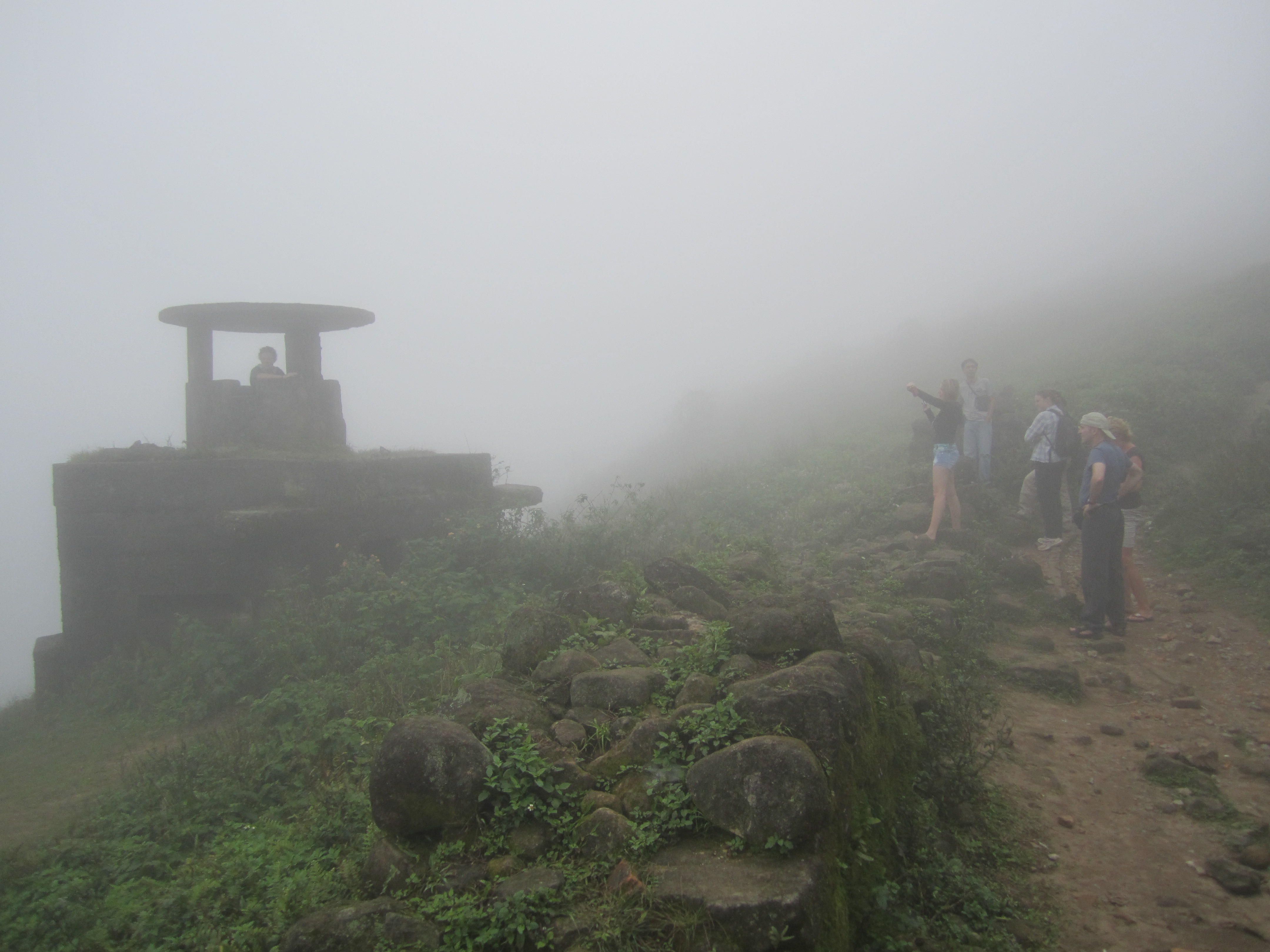
We move along. It’s a foggy, white-wrapped day, and all the sights we stop at are equally shrouded in hazy incomprehension. We stop by bunkers used during “the American War” (now a tourist trap—more on that in a later post). We stop off for overpriced coffee at a cheesy resort. We pull over at the roadside operation for a kind of cosmetic oil made from a local leaf. We stand around awkwardly as Mr. Loc tells us the prices of the different sized oils.

“Not much of an oil type myself,” Joe declares good-naturedly. He’s pathologically cheerful, in that particular American way, with his buzz cut and beaming cheeks. “When do we get to the waterfall?”

“No waterfall today,” Mr. Loc declares. “The weather,” he gestures around us, “road too slippery.” He makes a skid-and-crash motion with his hands. We nod solemnly, disappointed.

We stop at Marble Mountains, thrust from the flat earth near China Beach like a glittering rock of crystal. Pagodas and temples abound. Joe maintains his positivity, reading aloud from his Lonely Planet to make up for our lack of tour guide. I’m grateful for his unrelenting optimism.

Holy light

We wander into a cave that feels like a cathedral—a carved Buddha in the stone, incense like breath, sunlight filtering through the ceiling like the fingers of gods. There’s the hush of a holy place there; Joe reads that during the War, it was used as a VC hospital.

In a corner, a bat with a broken wing arches and flops. He squeaks intermittenly, and it sounds like a very small prayer, echoing against the rock.

We descend the mountain and find Mr. Loc waiting for us, leaned against the motorbike. “Okay, we go.”

I realize the thing about Mr. Loc isn’t that he’s rude or unknowledgable or even a shitty tour guide. It’s that he’s supremely Vietnamese. It’s this certain way, this certain attitude, that I’ve begun to understand, the same as in the nail shops at home—matter-of-fact, blunt, nothing sugar-coated or said sweetly. Here’s your tour. There’s a sight. Good? Okay.

“Vietnamese people aren’t very nice,” other travelers have told me. I understand where they’re coming from, but I don’t think it’s a simple matter of not being nice; I think it’s a profound cultural difference. (“You want pedicure? Okay, you pick a color.”) Brusk and brash—jarring as the chorus of honks from the motorbikes.

We arrive in Hoi An wind-blown and dirt-covered. My eyes well from the thousand particles of crap swimming around my contacts; my hair’s matted to my head from too many hours wearing a helmet.

Mr. Loc drops me at my hotel. “Happy?” It’s a business-like question.

I nod. Why not?

Hanoi’s Secret Cafe

I love rooftops, and I love rooftops in cities—sitting up on your bird’s perch and watching the strange dance of it all.

There’s no pigeons in Hanoi (except the ones you see plucked and pink at the food stalls), and there’s virtually no places to take respite.

Jacob told me about the secret cafe—not so much a secret, but a nameless, signless place you could never find without looking for it. On a road behind Turtle Lake, beside an especially terrifying roundabout, at the heart of the chaos—a nondescript storefront shop selling all the usual lanterns and bags and lacquered art. You walk past it, through it, down and back, what looks like the dim hallway to some squalid toilet.

It actually leads to a cafe, opening up into a courtyard that evokes the same “ah” sensation as stepping into a riad from the din of a Moroccan medina. A girl thrust a menu at me and told me I needed to order there, right there, before going any further. I pointed to the coffee with milk and egg white, as recommended, and the girl moved aside and let me pass.

I climbed up a flight of stairs, past a set of carved doors left ajar, revealing a glowing, smoldering altar within. Up another skinny staircase, and I was at a quiet little terrace that overlooked the lake, the skyline, the swarming street, the madness of the city.

It was my fourth day in Hanoi, and I was only then beginning to make sense of it. Its roads were a tangle of incomprehension, like lines in a palm whose fortune you couldn’t quite decipher—electrical wires and branches the gentle hatch marks that lay like a webbing, even less decipherable in what was certainly a story, certainly trying to say something.

But on the terrace it almost made sense, or at least begin to take shape. The other tables were sparsely inhabited by couples, leaning in and speaking low, by a few other foreigners smoking and reading. My egg white coffee came and it was goddamn delicious, thick and like a milkshake. I spooned it to myself like I were my own infant and sat there, just sat, thinking my nothing thoughts and watching.

It was refreshing, to be up there like a bird, in a city that doesn’t have any—to enjoy a moment of peace amid the frenzy. Which is a metaphor for life, in the way it’s all a metaphor for life—one great metaphor beneath the surface of everyday, at the center of everyday, everything just an arrow, pointing, leading, hinting us towards some soft secret (down a passageway, behind a trinket shop)—nudging us towards something we can’t possibly ever know or say, can only sense sometimes, in the still moments—can only approximate, speak about in abstractions, relationally. Which is why it’s a metaphor in the first place, and not The Real Thing—why we need metaphors and egg white foam in thick coffee and pretty little terraces to take a breather on.

Hanoi Secret Cafe: 11 Hang Gai


Lauren Quinn is a writer and traveler currently living in Hanoi. Lonely Girl Travels was a blog of her sola travels and expat living from 2009 to 2012. She resides elsewhere on the internet now.

Join 490 other subscribers

Buy This Sh#t

Categories