Archive for the 'Independent' Category


I Heard That Lonesome Whistle Blow: Port Costa and the Past

In the hallway

It wasn’t the squeaking of the bats that kept me up all night. It wasn’t the way my shoulders dug in to the thin mattress that kept me rolling over, not the low-voiced howl of the passing freight trains that rattled me out of my half-dreams.

It was that I had to pee. And I was too scared of ghosts get up.

Not that I’m 7, and not that I actually saw or heard any ghosts. Just that, you know, I’m a wuss. The bathroom was only a couple doors down the hall. But I’d heard stories, of ghostly laughs and the clicking of century-old high heels, and I figured—why risk it? I waited until the gray light of dawn sank its fingers through the curtains, brushed the walls and illuminated the shadows. I relieved myself with incident.

The whole overnight to Port Costa, actually, went without incident, the kind that had been hyped and fore-warned: red necks, ghosts, bed bugs, cocaine-fueled partiers—I didn’t see any. What I did see: peeling velvet wallpaper, a spooky porcelain doll, fishermen tromping over gravel and train tracks, a stuffed polar bear, a dude playing a banjo and a whole lot of motorcycles.

We arrived after dark, weaving our way through the shadowed coastal hills of a regional park. The pavement gave way to gravel as we delved into a little valley, dim houses and an old chapel lining the one road of Port Costa. The road dead-ended into a wide parking lot, gravel, train tracks, the misty water of the Carquinez Strait. On one side of us was a three-story, dirt-colored old warehouse, on the other, the bay windows of the Burlington Hotel. That was it.
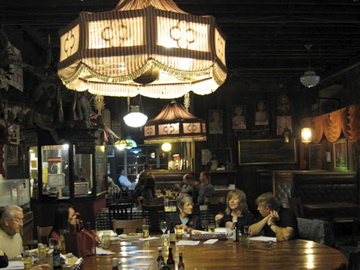
Inside The Warehouse

We turned the locked knob to the hotel’s door a couple times, until the banjo-playing dude on the corner told us we had to go across the street to the bar to check in. We entered The Warehouse, the main occupant of the 19th-century grain storage-house.  We stared stupidly for a couple moments, taking in the mish-mash of burlesque lampshades, checkered plastic tablecloths, mounted animal heads and vintage signs. We must have stood out—a man in the corner waved at us.

Turned out he was Howie, accompanied by Barbie, proprietors of the Burlington Hotel. They greeted us in what we’d discover was a typical Port Costa way: genuinely friendly and down-to-earth. It wasn’t the affected over-sweetness of a typical tourist town, nor the you-ain’t-from-round-here skepticism of an isolated small town. The vibe was unpretentious and warm, but not overly warm. It was the Goldilocks of small towns—just right.

Everything was just right about Port Costa: just enough overnighters that I didn’t feel too out of place, just enough decrepitude to make the hotel really really cool, just enough vestiges of history to make the town special—not undiscovered, but not blown up or theme-parky.

On the mantel in front of our room.

We wandered around the Burlington Hotel with our jaws dropped—it was the antique/vintage/ creaky dollhouse of cool we’d hoped for. But it wasn’t the stinky filth-pot Yelp reviewers and the Chronicle had made it out to be. Sure, it was faded and had the musty smell of an attic, but I had to wonder—had the people who’d called it dirty ever stayed in a cheap third-world hotel? Or a flea-bag American one, for that matter? It was no Courtyard Inn, but definitely one of the nicer hotels I’ve stayed in the US (not saying much, granted).

Maybe they’ve already started to spiffy up and straighten out, as the Chronicle article claimed. Aside from the lack of bed bugs and grime, there wasn’t a lot of raucous activity either. The other guests definitely looked like they were there for a good time, but the most debauchery we experienced at the Burlington Hotel was some middle-aged folks having a Hank Williams sing-along (I wanted in), followed by some late-night bed creaking (I did not want in). Pretty mild, really.

Ate all that!

As part of the Valentine’s Special, a $99 dinner-room combo, we headed back to The Warehouse for some good ole American eating. I’m usually a free-range, organic kinda girl, but I figured, meh, when in Port Costa. We grubbed on a whole lobster, one pound of prime rib, and unlimited salad/chili/chowder bar, washed down with soda served in a glass jar. My pants felt quite a bit snugger. A post-dinner stroll was definitely in order.

We tip-toed across the puddle-ridden parking lot, through an opening in the chain-link fence, and across the dark of gravel and train tracks. The nighttime mist made everything feel dream-like and removed, like we were somewhere much further away, like those weren’t the lights of a suburb blinking and sighing across the water. The way the Amtrack and freight trains’ horns would wail, the way their lights gleamed like animal eyes, how the heaved and rattled past—it made it feel like we were in some little pocket of the world, not quite forgotten by time, but where time just kind of rumbled past, without really stopping, leaving only a puff of exhaust and the echo of its cry.

Sitting on the rocks, I looked out across the water, and had a strange, back-of-the-head tingle. The lights of a far-off refinery winked in the billows of steam pouring out its towers, glittering like some kind of industrial Oz. Jagged fragments of memory came cutting back. “Fuck,” I said. “I’ve been here.”

High school. Malt liquor and weed and pills. We’d piled into B’s truck, drove around El Sob and Crockett looking for drugs and trouble, finding none of one and only a little of the other. We’d pulled into a parking lot, staggered across gravel. Refineries twinkling. Feet numb, and sides closing in, black. Cigarette smoke in my hair. Wanting to sleep.

My little kaleidoscope of fucked-up broken memories came out of some forgotten fold of my brain, stinging and still alcohol-damp. So I’d partied in Port Costa after all. Who knew.

The next morning, the town was mist-shrouded and dewey-eyed. I was dazed; all night I’d listened to the trains, thinking of all the other people who’d laid in that room before me, in the gray and shadows, listening to that same rumble and sigh. We drank teeth-burning from styrofoam cups and took another tromp around town, then further down the train tracks. Lots of killer photos ensued (currently, only the digital ones are ready; pro film shots will take plenty longer). Coolest find: on some rusty old rails, someone with a similar nerdy affinity for trains and travel left their mark:

The mild afternoon melted past, time a far away thing. The trains continued to pass, rumbling and horn blowing at a couple of kids poking around the rocks and rails of a once-great railway hub, filled with miners and shipyard workers and whores and ferry horns—and now, just the ghostly groan of the trains, passing, passing, but never stopping, no, not anymore.

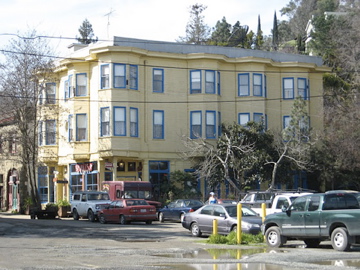
Photos by Theo Konrad Auer. More on the way…

Elephant Seals, Artichoke Bread and a Lighthouse: Cheap Kicks on the California Coast

The wind had something to say. Howling, moaning, rattling through the fog-swelled rafters, it talked to us all night. The next morning, it fingered our hair, pinkened our noses, and carried the cries of birth and battles, sea gulls and elephant seals…

I think I’ll start the article something like that, depending on how highfalutin I wanna get. It’s not as ridiculous as it sounds; the drama of the California coast during a winter storm evokes that kind of mulling, moody language. The main character, if you will, of my mini-trip down the San Francisco peninsula was the wind, urgent and unrelenting. But the supporting cast was pretty rad too.

I’m trying not to get too claustrophobic in my own life, and trying to keep the travel writing material a’coming. So despite a heavy-duty week-long storm, my friend Liz and I hopped into my beat-up little car and headed out for a little Northern California overnighting action in Pescadero.

Aside from being super accessible from the inner Bay Area, a trip down to Pescadero is also one of cheapest getaways around. We hiked around redwoods, espied an elephant seal colony, ate “world famous” artichoke bread and local goat milk cheese, and lazed in a cliffside hot tub—all for under $90 each.

Pescadero is an old-school fishing town down the peninsula between San Francisco and Santa Cruz. Aside from some seriously killer breads from Arcangeli Grocery, its main claims to fame are its surroundings: the Pigeon Point Lighthouse Hostel, and Ano Nuevo State Park. Pigeon Point is a pretty basic hostel—except for its dramatic perch literally on the edge of the continent, its historic lighthouse, and its cliffside hot tub (yes, really). Ano Nuevo is a sandy stretch of shoreline best known as the winter home of migrating elephant seals, where they birth and wean and fuss and fight.

"Look, nature!"

The drive from Oakland was about an hour long, Highway 92 delving us down the spine of the peninsula into Half Moon Bay, a quintessentially quirky Northern California beach town. Then we headed down the 1, California’s most famously beautiful highway. It winds you past pastoral fields, green hills, a sprinkling of cove beaches and family farms, and a crashing, crumbling coastline. Everything was grey and heavy and wet. It was perfect Lucero-listening weather.

Huddled on a cliff next to an run-down, chained-off old lighthouse, Pigeon Point Lighthouse Hostel smells like salt, and the ocean winds rattle the humble buildings endlessly. The hostel is divided into three houses, each with its own kitchen and common room. There was only one other couple in the house, fellow overnighters from the East Bay. It was $25 for a dorm bunk; we had a whole room to ourselves.

Pigeon Point Lighthouse

The main draw of the Pigeon Point Lighthouse Hostel isn’t the ocean views or its precipitous perch; it’s the hot tub. I don’t know how a youth hostel came to have a feature like a hot tub, but it’s about the raddest thing you can imagine. A trip to the hot tub cost $7 per person; you sign up for a half-hour slot when you check-in.

We stumbled in the dark to the hot tub, shuffling in our sneakers and shivering in our towels. We kicked it in the hot tub, listening to the sound of wind and waves. It was a dark, cloudy night; there were no stars, just the white froth of water on rocks, and the lonesome beam of the lighthouse.

The next morning, we drove 10 minutes down to Ano Nuevo. Celebrities may have Miami; elephant seals winter in Ano Nuevo. They arrive from Alaska in mid-December; moms birth pups, wean them, and they hang around confused and blubberous until about late March. Mid-January is the best time to check out the seals; on our tour, we saw a birth, a fight, plenty of sulking and lots of squealing.

Hella seals

The seal tour is pretty popular, especially as a field trip for Bay Area schools. You have to take a guided tour, and it’s best to book ahead, but here’s the good news: the tour is an hour and a half long, and only $7. (Parking in the lot, though, costs a $10; there’s not any other viable parking around.)

Our naturalist docent guide was a cool old dude that solidified my opinion that being a park volunteer after you retire is about the most bad-ass thing you can do with your time. Our group of 13 people, mostly all Californians on day trips, headed out into the sand dunes, a mile traipse from the parking lot.

First we passed “Losers’ Alley,” where male seals that have lost the fight for prestige pout and sulk in solitude for the remainder of the season. We got pretty close to one; he arched his back up, his nose/trunk hanging like an absurd, uncircumcised phallus. A guttural, grunting nose erupted, bursting out of his mouth in a gust of white breath; it sounded like a stopped-up toilet. It was his get-the-hell-back cry, and we obliged.

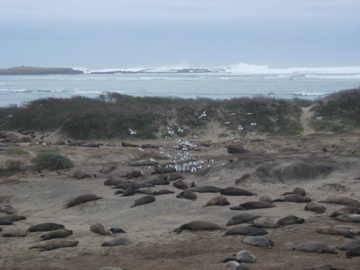
We climbed up a dune that overlooked the colony, and spent about an hour watching them flop around in the sand, squealing and moaning and rumbling their enormous selves around. The pups were adorable, too fat to do much of anything but wiggle their fins around and cry for milk. The moms flipped sand over their backs, rolled over to let pups nurse, and grumbled. The men did what men do: fight.

Bashing chests...

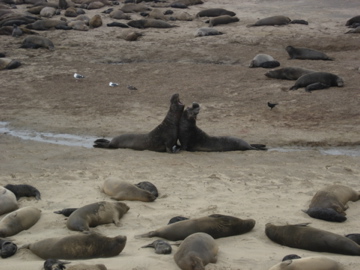
We caught a pretty good fight, full of plenty of screaming, biting and butting. It broke out amid the crowd, dominoed its way through the colony, pups wiggling to get out of the way; it rumbled all the way down to the shore, where the loser got 86ed. “It’s just like a bar fight,” Liz surmised.

Going mad for the placenta

We also got to see a birth. Well, not really. It was too far away to see, but we were alerted by the swooping, squawking riot of sea gulls. Sea gulls, apparently, love to eat placenta, so you can always tell when a birth is going down when the gulls start going crazy, a frenzy of white wings and diving beaks.

Muddy and wind-tossed, we tramped back to the car, cranked up the heat, and headed home. It was invigorating to get out of town, even if it was just for a night. Aside from gathering info for an article (not yet sold, if there’s any takers out there), I needed to clear my mind. It’s so easy to get tunnel-vision, to get caught up in the everydayness of my own life. It’s a good life, but there should be more to it than errands and work and my computer. I really am happiest when I’m traveling, and my mini-trip confirmed that. And reminded me how much killer stuff there is within an hour of where I live. And that it doesn’t need to cost any more than a new pair of pants.

Forget the Guidebook, This is the VICE Guide to Travel

Dolores Park: "You would think VICE Magazine threw up there."---SF Comedian Ali Wong

At the risk of sounding like a gold-lame-wearing, ironic-mullet-sporting Dolores Park denizen, I’m gonna say it: I like VICE Magazine. And I fucking love the VICE Guide to Travel.

Quick run-down, in case you don’t know: VICE grew from a Montreal zine into global empire of youth counterculture, serving as a kind of hipster voice of a generation in what some could argue was the next CREEM magazine. By 1999, VICE had exploded on to the hip-slick-and-cool scene. A free, glossy magazine peppered with American Apparel ads, you’d find issues at trendy clothing stores and serving as coasters on your friends’ coffee tables, or stacked beside the toilet for inspirational reading material. Having reached new heights of hipness, VICE was nearly immediately deemed as have “been better” in previous years, in the perennial way that everything was better before it got big. But here’s a little secret about VICE: it’s got some killer articles. Some are better than others, for sure, and many breach a little too far into the snarky, too-cool-for-school realm. But I’d argue a good half of the magazine is usually filled with quality journalism, covering super interesting international cultural phenomena.

Which leads to the VICE Guide to Travel. It’s not Rick Steve’s, or even Lonely Planet. VICE goes to some of the most fucked locations on earth, “the kinds of places that nobody else wants to visit”; digs up shocking and bizarre stories; sends sweaty dudes in v-neck t-shirts to interview warlords/cannibals/other locals; films it all, and sets it to a soundtrack of doom, gloom and rock. It’s “edgy,” it’s “off-the-beaten-path” (to say the least), and it’s some of the most bad-ass travel journalism out there.

First, some clarifications on the meaning of “bad-ass.” Empty, self-serving sensationalism with no emotional depth or historical perspective is not bad-ass. And there’s plenty of that out there in the travel world.

A couple months ago, I complained about this kind of trying-to-be-bad-ass-edness in a post blog and subsequent Matador article. Later, I came across an article titled “5 Totally Bad-Ass Travel Experiences” that made me want to vomit. The article listed 5 “daring” travel experiences, two of which capitalized on some of the most heinous aspects of a country’s history. The perspective reeked of a privileged disconnect with the suffering caused by events like genocide and drug wars:

Home to one of the biggest genocides and mass killings in modern history, Cambodia is awash in guns and weaponry. It’s a pretty peaceful place these days but there are still opportunities to get a taste of the weapons of war.

Oh, well, bummer the murdering is over, but at least there’s still cool guns to shoot off. I wanted to reach through the computer and punch the writer. Granted, the article struck a personal nerve; I guess when you know people who escaped the Khmer Rouge, but who’s families all died in the killing fields, well, that takes the thrill out of shooting war weaponry in Cambodia.

What separates the VICE Guide to Travel from lame travel “journalism” like this is skill (they hire professionals)—but more importantly, approach. Traveling to some of the most depraved and damaged places in the world, VICE toes the line, certainly runs the risk of lapsing into one-dimensional exhibitionism and aren’t-I-cool pats on the back. Some in the series are stronger than others, but I’d argue that all stay true to the basic purpose of bringing obscure, untold stories from the gnarliest corners of the world to a Western audience. The liner notes of the original 2006 DVD explains:

The news is all bad. Sitting in our Western comfort, it’s easy to forget that most of the world is hell. War, disease, famine, genocide, and poverty dot the globe like big chunks of cancer. Basically, humans are fucked.

We thought we already knew something about current international events, but we didn’t really know shit until we set out and started doing some serious traveling. These aren’t vacations to Disney World, Paris or even some Outward Bound safari. These are trips to the places that you see once in a while on TV and think, ‘No way in hell am I ever going there.’

Well, we went so that you never, ever have to go for yourself as long as you live. We went, and we’re glad we did. Here are the stories to prove it…

What the VICE Guide to Travel offers is what some of my most difficult, but ultimately most illuminating, travels have: a new perspective on this crazy-ass world we live in. It’s tough to watch—the visit to the shell of a high school in the episode in Chernobyl made me tear up—but I think it’s some of the most interesting and important stuff out there in the travel world.

Which brings us to the new series, the VICE Guide to Liberia. The 8-part series is being released on their website; currently, the first 4 installments are up. Prepare yourself: this is some severely brutal material.

While I don’t think I’ll be going to Liberia any time soon, I’m glad that these guys did, and that the stories they found are getting told. In a world of SEO, Twittered trends and Top-10 lists, the VICE Guide to Travel gets down to the unmarketable, inconvenient bone of what travel (for me) is all about: seeing how other people live, and glimpsing into the strange stories that compose this world.

(Okay, so, it may or may not be a secret fantasy of mine to one day tag along on one of these installments. But for now, the website’ll due.)

There’s No Crackheads in Cuba, and Other Things that Strike the American Traveler as Strange

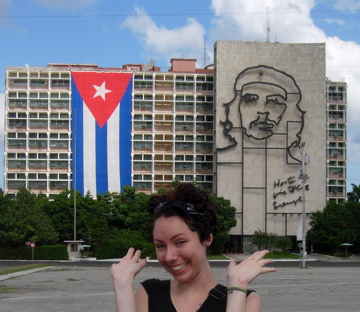
Havana Mural

Hands down, beyond a doubt, Cuba is the most different place I’ve ever traveled to.

Sure, I’ve been to non-Western countries; I’ve trekked through remote jungles studded with indigenous villages and spent a night in a water-world town-on-stilts where the night sky erupted with spontaneous flashes of thunderless lightning. But I’ve never been to another place where capitalism wasn’t a presence, and where the ensuing materialism and infiltration of American culture was so miniscule.

It’s impossible to talk about Cuba without getting into some kind of political discussion. Like everyone else, I’ve got my personal views—seeing as I was raised in a house that had 38 volumes of Lenin on the shelf, I’ll just let you guess what side of the spectrum I fall on.

But I’m not here to talk about that. Not really. What I want to talk about, and what’s of importance to the traveler to Cuba, are the ways in which Cuba is unlike any other country I’ve experienced. These reasons are inextricably linked to the country’s politics, to the revolution and the island’s legacy of struggle.

Yes, I realize I’m walking into a shitstorm. But we either dance delicately around these things, saying the same, tired, noncommittal niceties (Dante had a hell for that), or we get real—sit down, look it in the eye and say what we mean. (I’ll let you guess which option I think has more value.) Besides, I’m back home; I’ve got the toilet paper and functional plumbing to handle barrages of shit.

Oddity #1: Safety

One of the first things I read about Cuba was how safe it was. Touted in guidebooks to be paradise for solo female travelers, where any dark backalley can be delved into any time of day or night, I was willing to accept that Cuba was probably safer than Oakland. Most places are. I was still uneasy about rolling into the country with over a thousand dollars in cash on me, and neither my travel companion nor I could easily shed our well-grained habits of stone-facing strangers and checking our backs like motherfucks. But after a couple days, we loosened up. It was true: Cuba was mellow.

Break between innings

I suppose what strikes one as odd about the lack of violent crime in Cuba is that the country is so terribly poor. In the US, and most other countries in the world, poverty equals danger. From Rio’s famed favelas to Cairo’s ghettos of Sudanese refugees, to deep East Oakland, the relative safety of a neighborhood is most often directly proportionate to the level of wealth, or lack thereof. One look at the crumbling building facades and boys playing baseball with scrap pieces of plywood, and you start to understand just how poor Cuba is. And while, yes, there’s hustlers and pick-pockets, and yes, some laughing 12-year-olds tried to snatch my bag one night, the gravity of the threat of real violence isn’t there. (It would have sucked to have my bag stolen, but it sucks a lot worse to get a gun put under your chin.)

You can chalk Cuba’s safety up to a number of factors, depending on your politics and worldview: The police force is strong and no one wants to risk a lengthy stay in a Cuban prison. Protecting tourists is in the best interest of the island as a whole. Or you can think it’s got something to do with the fact that base needs like housing, education, medical care and some amount of food are all guaranteed by the Communist government, taking the edge of desperation out of the poverty equation.

Whatever the reason, walking around at night and realizing that you have no need to be weary is a strange feeling for an Oakland kid like me. Good thing we didn’t get used to it; less than 48 hours after getting home, my travel buddy was robbed at gunpoint. Welcome home.

Oddity #2: Lack of Homeless People and Drug Addicts

Cienfuegos

Beggars and bleary-eyed glue sniffers are par for the course in the cities of most poor countries. Even in one the wealthiest countries on earth (guess which one), pan-handlers, under-the-freeway encampments, and twitchy characters of all narcotic varieties are everyday fixtures on the streets, even in posh tourist attractions (San Francisco). After a couple of days wandering around Havana, I realized I hadn’t seen any cardboard alley homes and not a single crackhead. Weird.

During my time in Cuba, I got pan-handled maybe half a dozen times, and saw one toothless, staggering old lady that looked like the resident town wino. But when it came to hard-core addicts and homeless people, I didn’t see any.

The lack of homelessness is fairly obvious—the government provides housing. But Cuba is also really strict about the import of drugs. Not wanting to give the US any reason to invade, and perhaps still smarting from its soul-sucking era as a mafia paradise, the Cuban government put the ixnay on drugs, and today they’re really not a presence in Cuba. (Makes you wonder what would happen if the US made such a bold decision—oh wait, wasn’t that what the whole War on Drugs thing was about?)

The night we got home from Cuba, we went to see Neurosis play at the Great American Music Hall in San Francisco. The venue is smack in the middle of the Tenderloin, one of the highest concentrations of human misery on the West Coast. We walked through urine-soaked sidewalks, crunching windshield glass and dodging screaming, contorted derelicts, in a kind of dazed state of shock. After two weeks in Cuba, it seemed inhumane that suffering like that could be tolerated, allowed to exist in such a rich, rich nation. It was the worst culture shock I’ve ever experienced.

Oddity #3: Lack of Advertising and Lots of Government Propaganda

Okay, you’re gonna see a lot of government propaganda. Pro-revolutionary billboards, Vive Fidel banners, smiling pictures of Hugo Chavez: it’s all a little unnerving, I’m not gonna lie. But then you realize why it seems like there’s so damn much of it in Cuba (aside from the fact that there is): there’s no other advertising out there.

You forget how much energy you spend blocking out flashing signs, automated voices, beautifully anorexic, air-brushed girls selling perfume and cell phones and chewing gum. Until you don’t have to do it. I’ve heard really high-end resorts make you feel the same way, like you can let your mental filters down and just relax. Well, until I get a rich sponsor, Cuba’s gonna be the closest I come.

If it’s true that you can learn a lot about a culture through its advertising, then it’s also true you can learn a lot about a culture about its lack of advertising. Cubans are insanely open and friendly, and while there’s plenty of cultural factors contributing, couldn’t one of the reasons be that they’re not constantly fending off the barrage of catchy slogans and glossy images of psychologically invasive advertising? At the same time, the government is an inescapable presence on the island; one is constantly given visual reminders of the pro-government stance everyone’s supposed to take.

It’s a stretch, but maybe. All I know for sure is that my brain got a real vacation in Cuba.

Oddity #4: Havana Has a Chinatown (With Three Chinese People in It)

And it’s actually the oldest Chinatown in the Western Hemisphere.

A then-vegan, I had a mean hankering for some tofu when I was in Havana. I thought my best bet was Chinatown, the touristy relic of Cuba’s once-robust Chinese population, originally brought over in the mid 19th century to work in the sugar fields. I elbowed amid the throngs on foreigners and grabbed a seat under the red awning of a restaurant whose menu listed something I assumed was bean cakes. Ten minutes later, a steaming plate of bean sprouts, and nothing but bean sprouts, was placed before me. My then-boyfriend laughed.

Havana’s Chinatown stands as a reminder that the country has plenty of pre-Castro history, often overshadowed. Most of the Chinese laborers brought over intermarried, infusing the Cuban cocktail with Asian genes; thus, there aren’t a whole lot of fully Chinese looking people left in Chinatown. I saw a couple dudes smoking in the traditional squat, but it was honestly the most un-Chinese Chinatown I’ve ever been to. And the most devoid of tofu.


Oddity #5: The Resilience of Cuban People

It’s kind of a Cuban cliche: some cigar-smoking, deeply wrinkled dude fixing a 30-year-old bicycle with a piece of dental floss and an old Coke can (or something to that extent). Cuban people are renowned as the global experts in reusing everything, wasting nothing, helping each other out and not complaining (partially because of political repression, but still). Cubans are like the one friend you have that can fix anything, who relishes in helping you figure out why your car is making that funny noise and who repairs the holes in their sneakers instead of tossing them to hang over the telephone wires. Yes, part of it is a result of years of rationing and making do, but I think it gets down to a deeper cultural characteristic, one born of imperialism.

Another gem from the Havana mural

The best explanation I read of why Cubans are so resilient and continue to come together and make do is that, by and large, they want the Revolution to succeed. (I’m not talking Miami Cubans now. And this isn’t necessarily my perspective, but a well-informed argument that made a lot of sense.) However deeply flawed and difficult the Revolution is, it’s still the first time in 500 years that the island’s been run by Cubans. From Spanish colonialism to puppet governments to foreign-owned sugar plantations, outsiders had the ultimate power in pre-Castro Cuba. The country was endemically violent and deeply divided down lines of race, class and ethnic origin—divisions that don’t disappear in 50 years, but have improved. Castro’s Revolution is the longest enduring era of Cuban control since the Spanish arrived on the island. That’s a really powerful statement, one that can help you understand why Cubans endure so much and continue to struggle.

Of course, one could easily argue that all this is at risk. The impending end to the US embargo will mean an immediate influx of American culture and goods. And however much outsiders may want Cuba to remain a junkie-free, billboard-less Eden of free health care and high literacy, the end of the embargo will be a damn good thing for Cubans. But I’m glad I got to go pre-post-embargo, and experience some of the strangest things an Oakland girl can.

Livin on a CUC: Independent, Budget Travel in Cuba

Cheesin it up

Backpackers, lefties and dirty hippies beware: Cuba is not cheap. And despite any romantic revolutionary visions, it’s got tourist traps, just like everywhere else. They’re just filled with Che shirts instead of fanny packs.

Several factors might lead one to logically assume Cuba to be a budget-friendly, independent travelers’ paradise: it’s a dirt-poor Latin American country, enamored in the hearts of liberals, intellectuals and military-cap-wearing undergrads. So when you hear that your low-to-mid-range daily budget for Cuba should be around $100/day, it comes as a bit of a shock.

Here’s the deal: after the sugar industry collapsed in Cuba, there wasn’t much left to keep the island afloat. Keen eyes turned towards tourism. Not only does Cuba’s larger-than-life lore hold particular allure for the left-leaning, it’s got an undeniable romanticism—old cars, crumbling buildings, rum and Rumba. Couple that white people’s insatiable lust for balmy Caribbean getaways, and they had the perfect cocktail on their hands—muddled with Euros instead of mint sprigs. Tourism today is “the most dynamic sector of the Cuban economy.”

If you’ve traveled to other places where tourism is a mainstay of the economy, you’ll know what this means: high prices and potential hassle. From Moroccan medina touts to San Francisco’s 14% hotel tax, economies that rely on tourism milk it. In San Francisco, the hotel tax goes to fund all sorts of cool arts endeavors and social programming that other US cities don’t have; you could argue (depending on your politics) that Cuba’s dual currencies are an extension of that. And in Cuba you don’t really have to worry about hustlers and pick-pockets (though they do still exist); tour companies take care of that.

Let's play "Spot the Tourists"

You wouldn’t initially think it, but Cuba’s got a resort, package tourism industry up to snuff with any Caribbean destination. A Hungarian friend won a Cuban vacation as an incentive prize at work; all he saw of Cuba outside of his resort was through a tour bus window. Combine the package factor with the absence of youth hostels and backpacking networks, and the prospects can seem pretty dismal for DIY cheapstakes like me.

But independent, budget travel in Cuba can and does happen. There’s just some special tricks you have to be hip to. My travel companion and I managed to squeak by on $75/day, well under the Lonely Planet budget (but then again, we were both surviving at home on less than $2000/month, so cheap living wasn’t anything new). Here’s what we learned and how we did it.

Resources

My two biggest resources for independent, budget travel to Cuba were Lonely Planet’s Thorn Tree Forum, and Cuba Junky, a comprehensive, Cuban/Dutch-run website for travelers (with endearingly odd translations and misspellings). At these two sites, you can find info all sorts of great information, and on the forum you can trouble-shoot and get advice (and suffer through the occasional political debate).

Money

Cuba operates on two currencies: the Cuban peso (CUP), the money of the people, and the Cuban Convertible Peso (CUC), the money of tourists.

Why? As tourism grew, American dollars began to wiggle their way into the country—hotels and tourist restaurants charged foreigners in dollars, while charging locals in pesos. (Considering the average monthly salary for a Cuban doctor is about what I make in thirty minutes, it’s more fair than it seems.) In addition, “dollar-only” shops emerged, where scarce and coveted items like dental floss could be had for a a high price. The influx of money was good, but the presence of American dollars was kind of slap-in-the-face to the government, wouldn’t you say? The government thus created the CUC to keep US dollars out; they did, though, base the exchange rate on the US dollar. Tourists pay for things in CUCs, while locals pay in pesos.

Whenever you exchange money, you’ll be given CUCs, and the majority of places you spend money will accept only CUCs. Invariably, however, you’ll get your hands on some pesos. It’ll probably happen like this: you get seduced by the wafting smell of cooking meats, and buy some street food. You hand the guy your CUC note. He digs around his pockets, shouts over at some other vendors; no one has the proper CUC change. He shrugs and gives your change in pesos. You’ve now got a pocket full of notes and coins, and can pay for small items like coffee and ice-cream with pesos—dropping the price from a couple bucks to a couple cents (literally).

There are of course more nefarious ways to get your hands on pesos, but you wouldn’t do that, now would you? Tourists aren’t really supposed to use pesos, and I have to say, I felt pretty guilty paying the equivalent of 5 cents to someone who makes $10/month—even if I am just a waitress living in a run-down North Oakland Victorian. I don’t recommend trying to use pesos as a way of cutting corners and stretching your budget, but it’s something that will happen at some point.

Casa Particulares

The single biggest way to save money in Cuba is by staying in casa particulares. State-licensed rooms for rent in private homes, casa particulares will also be one of your best glimpses into Cuban life.

Huge-ass main course served at a casa particular

Here’s how it works: individuals apply for a license, which is expensive; they must pay a monthly tax whether or not they have guests. The government approves them, and they can rent rooms to foreigners.

Expect to pay 15-30 CUCs per night (as opposed to 50-100 Euros and upwards on a hotel). Plus, as everyone knows, homestays are a great way to experience the everyday life and culture of a country; we stayed with hosts in Vinales whose teenage son showed us plenty of hip Cuban dance moves (which we were incapable of replicating). Hosts will usually offer to cook you meals, for an additional 5-15 CUCs. This may not be cheaper than eating at a budget restaurant or food stall, but they’ll stuff you silly.

The Cuba Junky site has gotten much more spiffy since I went to Cuba, and you can now book a casa particular room via the website. I did it a semi-old-fashioned way: I got ahold of Potato’s email address on the Thorn Tree forum, sent him an email, and he booked a room for us. He gave us his address; once we landed in Havana, we went to his apartment, enjoyed a cup of tea and chatted (he’s a really cool dude), and he walked us a couple blocks over to a lovely elderly couple who we stayed with for four days (and whose toilet we later busted—more on that later).

I like to have my accommodation arranged for my first couple nights when I arrive somewhere new, but the rest of the casa particulares we stayed in on our trip we booked ourselves. Most people will display their license logo prominently, so you can just knock on their door and ask if they have room (really, Cubans are insanely friendly and won’t turn you away). If the one you go to is full, they’ll for sure have a dozen friends with licensed rooms, and will help you find one. It sounds like a hassle, more for them than us, but I swear it works: a cab driver drove us all around Vinales while neighbors tracked down an empty room.

Bring Every Last Toiletry You May Possibly Need

Basic medical supplies are both costly and in short supply, or nonexistent, in Cuba. Pack all the sunscreen, aspirin, contact lens solution and insect repellent you might need—or risk shelling out painful amounts of money in a poorly stocked dollar-store. Even an extra roll of toilet paper isn’t a bad idea—unless you like wiping your ass with day-old news.

Tours and Entertainment

Cuba has a fairly well-beaten path, and if you stick to the neighborhoods and activities tourists are routinely funneled into, you’ll bleed CUCs faster than you can say “revolucion.” But get a little intrepid and a little chatty, and you’ll stretch your budget big-time.

Everyone knows that Cubans party, and party well, so you can be pretty sure that any club charging a hefty entrance fee is geared towards tourists. And as cool as a Hemingway tour or trip to the Tropicana might sound right now, you’ll quickly realize that they’re the Fisherman’s Wharf of Havana. Get friendly and ask your casa hosts (or random folks on the street) for tips on where to go and what to do. Less tacky companies like San Cristobal Agencia de Viajes are a good bet for more offbeat tours.

Food, Transport, and the Likes

There’s no real trick here: just do what you do in other countries.

Dinners at tourist-geared restaurants will set you back much further than paladares (mom-and-pops) and street food stands. Snack foods can actually be pretty hard to come by, so bringing along some biscuits, nuts or, for the homesick Yankee, peanut butter isn’t a bad idea. You can skimp on transit, but be prepared to pay the price: low-cost buses break down and hitch-hiking isn’t fun anywhere (in my opinion). Walk and take local buses within big cities, as opposed to cabs, and of course, the less you move, the less you spend on bus tickets, trains, etc. Cut down on souvenirs (really, how any Che hats do you need?), and do free stuff like strolling and lazing on the beach.


So, as with the last post, any seasoned Cuban travelers or recent returnees wanna share their experiences? We’re all ears…

Yankee in a Che Shirt: How To Travel to Cuba Independently and Illegally as an American

Americans you're likely to encounter in Cuba

Si, se puede!

Three years ago, I traveled to Cuba. I didn’t get a visa, didn’t book a tour, didn’t go with a dance troupe or salsa band (though that would have been killer). I did it the way I do everything, independently.

Fear mongers, nay sayers and foreign travel agencies would lead you to believe that independent travel to Cuba is dangerous and impossible. They’re the same people that make full and complete stops at every stop sign, and are too scared to ride the subway in NYC. Or else they’re trying to sell you something—the hustling taxi driver outside of the airport. They clamor cowardly behind the embargo.

Here’s the legality deal: as an American, you’re technically not banned from traveling to Cuba; you’re prohibited from spending money there. Whatever. If you didn’t obey your parents’ curfew as a teenager, are you really gonna start heeding authority now?

The fun thing about traveling to Cuba as an American is that it requires more effort, more digging. You can’t buy your plane tickets online; most worthwhile advice won’t come from guidebooks but fellow travelers, via forums like Thorn Tree. Basically, you have to work a little harder. But the reward is getting to go to one of the most un-Americanized countries in the world—remarkably only 90 miles from Florida.

I’m pretty sure it’s technically illegal to give Cuban travel advice to Americans. But eff that too. Here’s how I did it, how it worked and the gems of wisdom I smuggled back (along with the cigars):

Before You Go: Money and Packing

Your most important pre-travel preparation as an American is money. Your ATM and credit cards won’t work in Cuba, meaning you’ve pretty much got to bring everything you plan on spending with you. Travelers checks are a pain in the ass and have a hefty commission tacked on—which means you’ll be bringing cash. Lots and lots of cash.

If you’re like me, you’re not too thrilled at the idea of walking around with $1300 on your person. But keep in mind Cuba’s remarkably low crime rate, the absence of desperate drug addicts and your own street sense—you’re gonna be fine.

Another consideration is which type of currency to bring in. The greenback gets an extra 10% penalty fee on top of the standard 8% exchange commission, so most travelers opt to bring in Canadian dollars or Euros. It pays to do the math on conversions and figure out how much you’ll be hit by commissions and fees for dual exchange (changing from dollars into Euros into CUCs).

Another pre-trip consideration is what to bring, and what not to bring. This is for everyone, not just Americans. Charitable donations like medical supplies and clothes are greatly needed and appreciated, but check out regulations on what and how much to bring. Cuban Customs has some unusual regulations regarding the import of electronics and pornography, and is super strict about narcotics. Of particular concern to Americans is the prohibition of anti-revolutionary literature—make sure you don’t have any crazy right-wing, Miami ex-pat ramblings with you. Not that you would anyway.

Getting In: Booking a Flight

The easiest, most popular and often cheapest way for an American to get into Cuba is through Mexico, namely Cancun. Of course, Cancun is the #1 most suspicious transfer point, and word around the chat rooms is that you’re singled out by US Customs most often when arriving from Cancun. But it’s also an insanely popular destination, and I think the Mexican- to Cuban-vacationer ratio still works in your favor.

American travel agencies and airlines are prohibited from booking flights or giving any kind of assistance to Cuban travelers. But foreign airlines and agencies aren’t. So instead of shelling out big bucks to some Canadian company that’ll orchestrate the whole thing (for a mere 300% mark-up), do what I did: call a foreign airline at one of their international offices. I called Mexicana in Mexico City (52 55 2881 0000), requested to speak to an agent that spoke English (not a bad idea when purchasing something as expensive as plane tickets), and bought tickets from Mexico to Havana. Not as easy as Orbitz, but pretty damn close.

The way the flight times worked out, we ended up bookending our Cuban travels with overnight stays in Mexico. I thought I’d be smart and fly through Merida, whose Sunday night dance parties sounded infinitely preferable to Cancun’s binge-drinking co-eds. Turns out that you can’t fly directly from Merida to Havana, so we had to transfer in Cancun anyway. Ah well, better than a spending a night in Cancun.

Arriving: Surviving Customs

Passing through Cuban Customs is the most intimidating border crossing I’ve ever done. But, as I reminded my then-boyfriend and travel companion, Cuba wants to let you in. They need tourists’ money. They just wanna make sure you’re not there on an anti-revolution espionage mission. Fair enough.

Expect to stand in an impossibly long line. You’ll be instructed to approach the Customs booth by yourself. They’ll scowl at you, tell you to take off your glasses and look into the camera. They’ll photograph you, record you, enter every last bit of info on your passport into their computer. They’ll then stamp your tourist card, your golden ticket. Cuba doesn’t stamp passports, but $20 purchased tourist cards. Mexicana provided mine, but it’s a good idea to check your airline or prepurchase your card at a Cuban Embassy, as getting ahold of one at the airport sucks. And hang on to that baby—losing it is an expensive, bureaucratic hassle.

Once your passport is handed back to you, you’ll get directed through the floor-to-ceiling solid door that the travelers before you disappeared behind. It may seem like you’re being funneled into an interrogation room, but most likely, you’ll be headed off for a quick frisking and x-raying of your baggage. Drug sniffing dogs will accompany female agents in ridiculously short skin-tight mini-skirts—the most amusing part of your Customs experience.

While You’re There

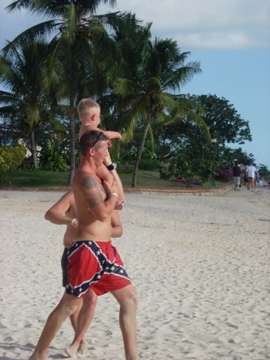
Really? Couldn't have left the Confederate swim trunks at home?

Once you’re in Cuba, there’s not a lot in your day-to-day travels that’ll set you apart as American. You’ll have to deal with the money issue, but the good news is that everyone will guess you’re from somewhere other than the US. It’s a nice change of pace from the Frenchman breaking into sudden English with, “And where in the States are you from?”

Getting Out: Playing Dumb and Looking Innocent

The trickiest and most anxiety-inducing part of any American’s trip to Cuba is coming home. I’ve heard of Americans getting hassled by Cuban customs agents, but it’s pretty rare. The folks you have to worry about are the good ole’ boys (and girls) back home.

But first you have to worry about a double-entry stamp back in Mexico. This means that you’ll have a stamp for arriving in Mexico, no stamps for Cuba, but then another entry stamp for your return to Mexico; there’s a void in there, signaling nefarious activity.

You can handle this one of two ways: bribing the Mexican Customs agent to not stamp your passport (trickier at Cancun, where they’re more vigilant, but still possible), or by hoping for the best with a doubly stamped passport. We opted to bribe the Mexican Customs agent. We tucked a sizable peso note into our passports and softly asked not to be stamped. The agent grunted and handed us back our passports, unstamped. If you’ve got a heavily stamped passport to begin with, it might be worth saving the money and relying on the slim odds that the US Customs agent will bother to inspect your passport closely. I’ve never had an agent more than glance at my stamps.

Aside from the extensive, albeit poorly edited, advice by eco-hippies International Bike Fund (I mean that in a good way), any American who’s ever traveled to Cuba will be eager to give you plenty of tips and first-hand accounts on how to elude US Customs—whether you want to hear it or not. So here’s my two centavos:

Revolution anniversary poster I stole and smuggled back home

Reports vary, but up to 100,000 Americans are claimed to have visited Cuba last year. Most of them breeze through US Customs without a problem. There’s nothing that should single you out as particularly suspicious. Be respectful; don’t roll up to the counter smoking a cigar and wearing a Che hat. But don’t sweat it too much. Customs agents are doing their job, and you’re doing yours. They really don’t want to write out lengthy reports anyway. I truly regarded my traveling to Cuba as not too dissimilar from jay-walking—not supposed to really do it, but no big deal. Folks’ll tell you not to bring anything incriminating and obviously Cuban back with you, but eff that—I brought cigars and stolen street posters.

We arrived at SFO disheveled and tired with a horde of sunburnt vacationers. I of course did not write on my Immigration Card that I’d traveled to Cuba, nor did I list the goods I was smuggling back (why you gonna rat yourself out?). I smiled nicely at the agent, told her yes, I’d had a great time in Mexico, picked up my bags, passed em through the x-ray machine without incident, and headed home.

But enough out of me. Any Americans out there wanna share their Cuban travel experiences?


Lauren Quinn is a writer and traveler currently living in Hanoi. Lonely Girl Travels was a blog of her sola travels and expat living from 2009 to 2012. She resides elsewhere on the internet now.

Join 490 other subscribers

Buy This Sh#t

Categories