Archive for the 'Sola' Category


Pigneto: The Rome For Outsiders, and Me

Here’s a little rule of thumb I learned yesterday: if a neighborhood has a shitton of street art, it’s probably the neighborhood I wanna be in.

It’s funny coming back to a place; I never really do it. I was interested to experience the difference. Three years ago, Rome was hands down my favorite European city—probably because it was the most vivaciously chaotic of the cities I’d visited in Europe. Life was different then; for one, I was traveling with my then-boyfriend, who I’d break up with a month after returning home. Nuff said.

Rome didn’t seem so intense and frenetic this time around; it felt much more manageable. I landed with 8 hours of scattered sleep within the previous 48 hour period, and decided to power through the day in order to acclimate myself to the time difference (it worked).

I wandered through the city in a haze of memory, surprised by how my legs took me to all the familiar spots—muscle memory of a city. There was the Colosseum, aching in its magnificent crumble; there was this piazza and that piazza; there was the terrible Chinese restaurant I dragged us to in a vegan moment of tofu craving. It’s funny when a place has only existed in your mind, at one very specific time, funny to see it still going on, living and breathing, like going back into a dream that had kept on dreaming without you.

I remember my dad saying that Rome made him feel his own mortality, and I can definitely say that’s still true for me. There’s something about the ancient greatness, the ruins and remains of glory, that really serve to check you. Just in case, you know, you got to thinking your shit really mattered, there’s Rome to remind you how inconsequential it all is—how small, how much of one shining moment you are. All your joy and heartbreak, your own impending ruin—it will all come and go, and Rome will still be there. You’ll be lucky if your bones last as long as Rome’s.

That being said, Rome isn’t really about anything I’m about. It’s one of the world’s great cities, and has been for thousands of years, and I love it for that, but everything that I get stoked on—diversity, punk rock, hip hop, street art, tattoos, counterculture—Rome doesm’t give a shit about. Why should it? It had Julius Caesar; Rome doesn’t have time for trends.

Walking around center, you get to feeling like an absolute slob—an(other) American slob. Everyone has so much style and grace in Rome; how do their clothes fit so well? How do they all look so effortlessly chic and beautiful, and what the hell is wrong with you in your Toms and Talk Is Poison shirt?

And then you take a rickety street car down, along desolate tracks and amid rows of block buildings, into the rundown side of town, and you realize: that’s because all the Romans in the center are rich. Rich people of any culture look good, and are inherently alientating (to me at least). You get amid a neighborhood a little more like your own, and you realize there’s more to Roman life than tailored suits and killer shoes.

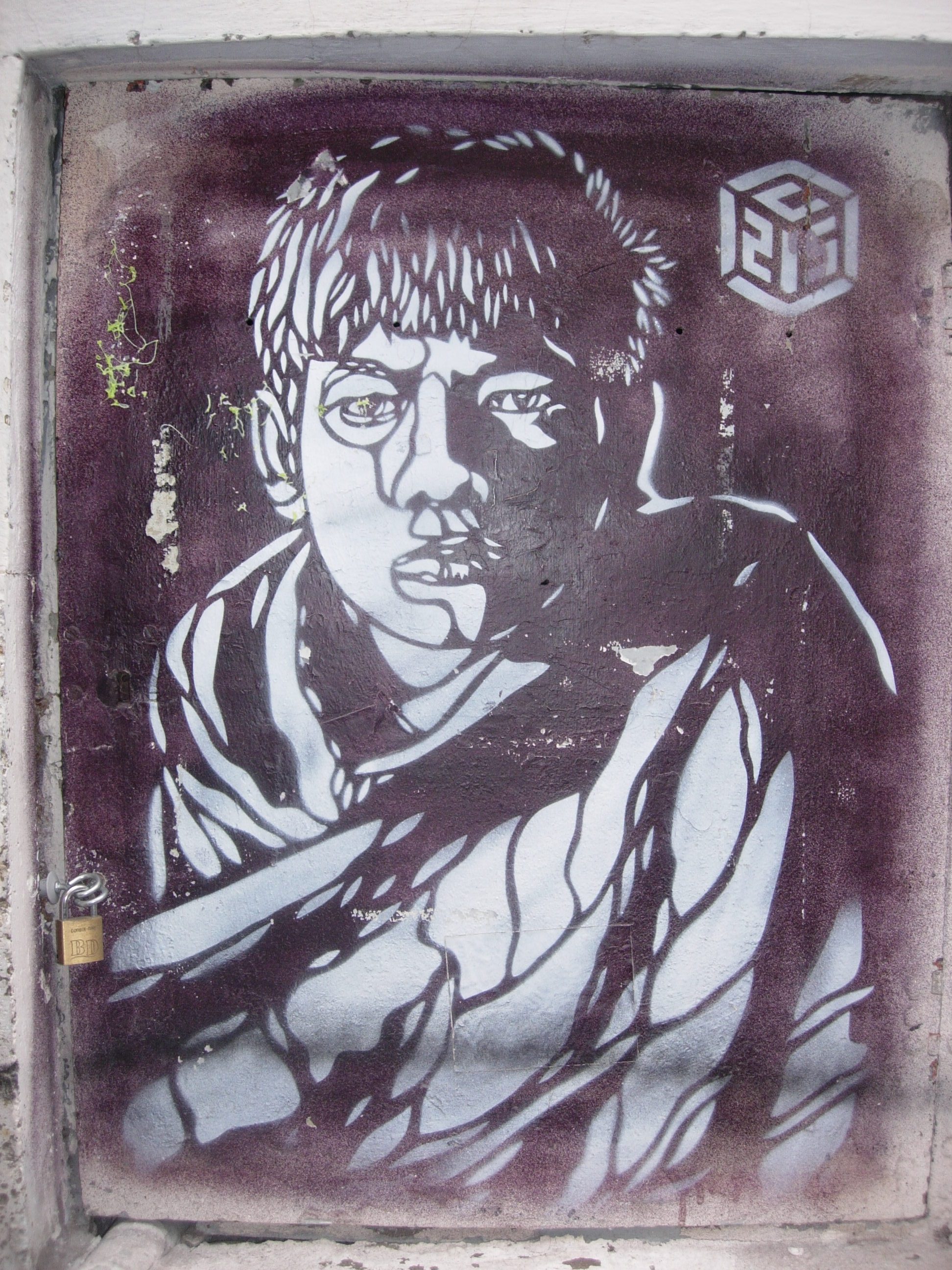
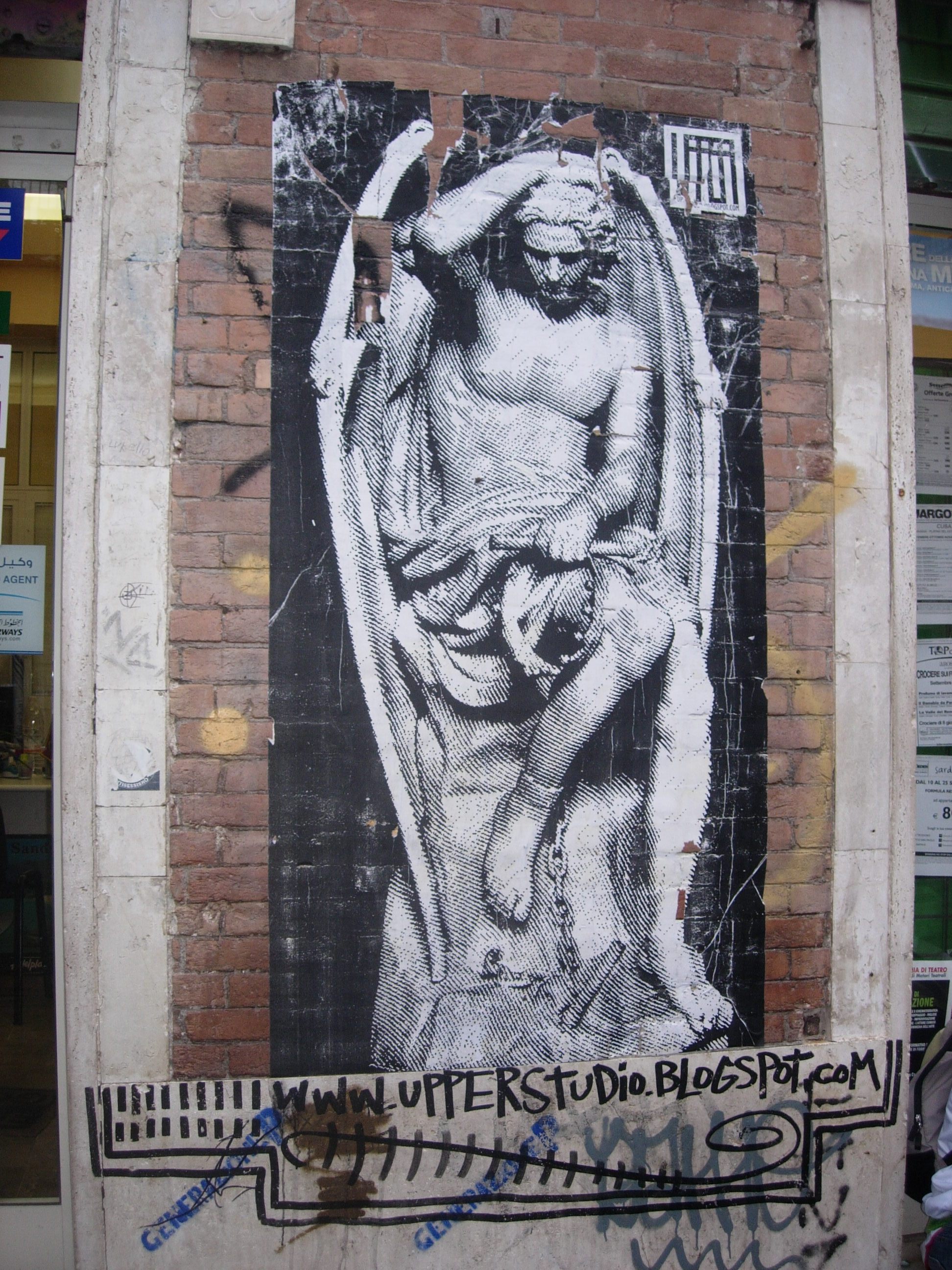
Pigneto is the Mission Dolores/Williamsburg of Rome—an old-school, traditional neighborhood first overtaken by immigrants, now overtaken by hipsters artist types otherwise entirely abscent from Rome. Along its shady streets, you see little old Italian men shuffling around; African, Chinese and Bangladeshi immigrants hanging out, free of their blankets of goods to sell; young Italian sitting in doorways smoking. I love dynamic cultural collisions like that; they’ve been known to bring much of the forementioned things I love. Including street art.

I’d headed out to Pigneto in the first place to meet up with Jessica Stewart, who runs the very kick-ass Rome Photo Blog, covering contemporary art, street art and other radom wonderful things around Rome. I had some time to kill before we met, so I roamed around and took photos.
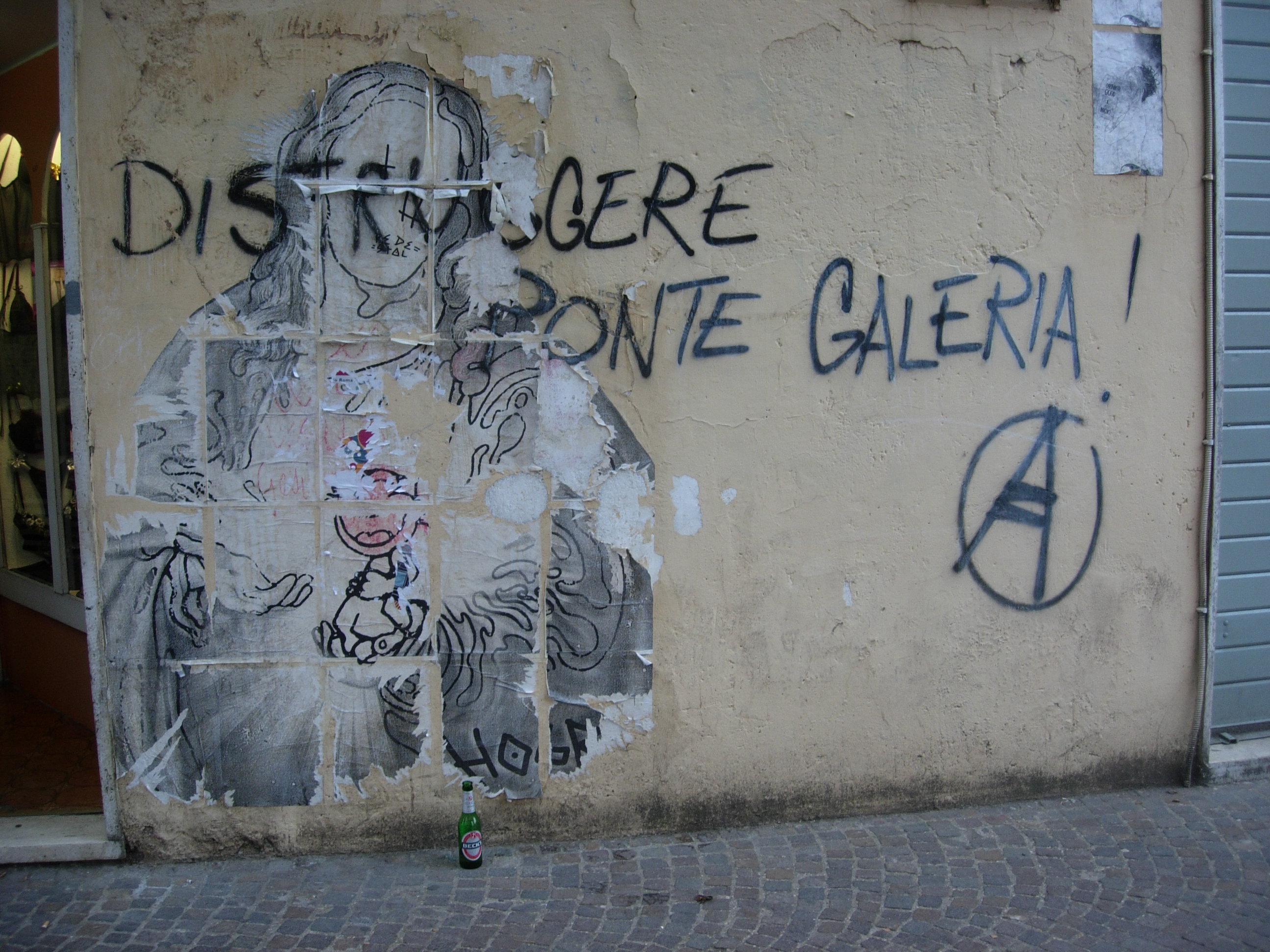
Swear I saw stuff from this person in Brooklyn...
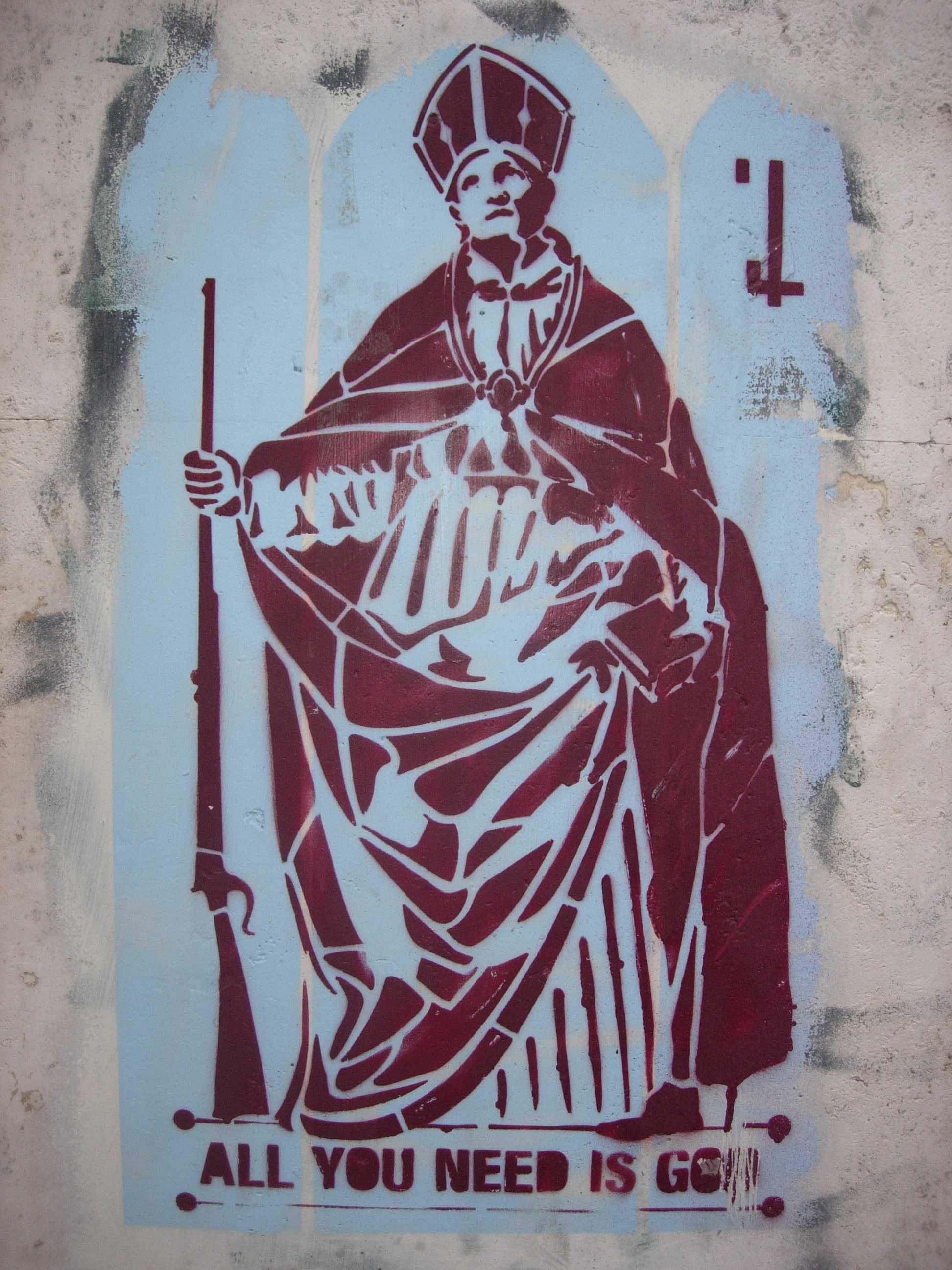
Loved this series

Well, lookey who...
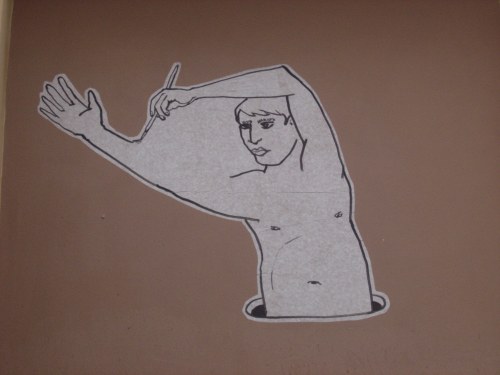
My favorite series

I met Jessica at Necci, a bar/restaurant that’s been around since the 1920s and was featured in an issue of Australian Gourmet Traveller last year. We sat at a table under a tree (which only kind of shielded us from the rain) and she told me about the neighborhood, about the art scene and ex-pat life in Rome.

“Rome is a very play-it-safe, stay-with-the-pack kind of city,” she told me. She spoke about the city’s slowness to accept street art in its galleries. “It’s a very traditional city. It’s hard to impress people in Rome—you know, when you’ve got the Colosseum right there, it’s hard to feel like you can do anything in comparison, or anything that matters.”

There were, she told me (and as she’s documented on her blog), a small handful of artists, living out in Pigneto and San Lorenzo, that were doing their own thing. And acceptance was growing, along with recognition.

“The one thing one of the artists said that was true,” she told me, our shoulders hunched under the branches and drizzle, faces half-lit from the barroom light, “is that, if you can make it in Rome, you can make it anywhere.”

It seemed true enough.

Serendipity, Street Art and the Best Layover EVER

It’s a fantasy common enough to warrant TV commercials, (porno) movie plots and a voyeuristic story by Gabriel Garcia Marquez: you get seated next to an attractive person on an airplane. And you’re stuck beside each other, awkwardly negoitiating the small space for hours.

As most travelers will readily tell you, this is about as rare to air travel as getting bumped up to first class. No, rarer. The cast of characters usually beside you in the sardine can of coach include snorers, fidgeters, wiley children and consumers of mysterious day-old food. It really serves to drive home to actual percentage of datable people in the world’s population. I, for one, had given up on the fantasy and resigned myself to the mere hope of a recently showered individual that can fit in their own seat (which is also more or less when I’ve resigned myself in dating—and have been known to compromise on as well).

Well, holy shit if the travel gods didn’t smile down on me. And homeboy wasn’t just attractive—he was rad. As I discovered, not just during the flight, but on our 10-hour layover spent adventuring around Brooklyn together, spotting street art and searching for obscure vinyl.

I’d noticed him passing through security (as I was being pulled aside to have my purse dismembered in search on nonexistent weapons): hip without being pretentious, stubble beard, cowboy boots, a bulging bag of records. But I didn’t give it much thought until I was settling into my dismal seat in the back of the plane, next to the bathrooms. I watched him struggle to jam his record bag into the overhead compartment and smiled. When he looked down at his boarding pass, scanned the aisle numbers and ended up standing right beside me, we both smiled.

Sebastian had been traveling around the US for 5 weeks, and was on his way back to Zurich. He had a couple lines in his forhead, the well-traveled beginning of wrinkles. He had the worn-smooth hands of a cook, the black strand of a necklace peeking out from under his shirt. He had killer taste in music.

We chatted about life and travel and bands (“I saw some great shows in San Francisco.” “Like who?” “Ty Segall.” “On Wednesday? At the Rickshaw Stop? I was totally there!”). We talked about his trip and my trip (“I’ve got a 10 -hour layover.” “Me too. I was gonna go into the city, hang out. Better than being at the airport.” “That was my plan too.”) We fell into the fitful half-sleep of confined space and over air-conditioning; woke up stiff necked and lip smacking, ditched our bags at a luggage locker and rode the subway into Brooklyn.

It was a shuttered-up and bare-sidewalked Sunday morning on Bedford, ground zero of Brooklyn hipness. There was a record store Sebastian wanted to get back to, that wouldn’t be open for hours. We rubbed our aching eyes and looked for coffee.

I consulted my iPhone. “Oh shit, there’s a Blue Bottle?!” I exclaimed. “Yeah,” said a girl passing by, “it’s around the corner.”

We sat in the sun and drank our hand-dripped cups of black, watched the parade of dogs and toddlers and cool kids. We bombed around the neighborhood, going nowhere in particular, until the shops thinned and the wide walls of warehouses took over. And we began spotting some kick-ass street art.

All the pictures are on my phone, which for some reason my new (new to me, that is) netbook won’t download. So expect a post when I get home. But just to tease, I saw Roa, Faile, Space Invader, Gaia, and a whole bunch of folks I didn’t know but really wanted to.

We hit the record stores that had brought us there. Sebastian confessed to me that he was a music nerd with a record fetish. “There’s so many more records in the States,” he told me. He’d already shipped a crate back to Zurich. “It’s okay, though, it’s still cheaper than trying to buy it in Europe. If you can find it at all.”

We got back on the train, dazed and subdued with our long flights looming. We looked back through his pictures—he’d ended up going to Burning Man, on (another) serendipitous whim, and I leaned in over his shoulder to look at the small viewfinder, its story of dust and fire, the wind that moves through desolate places.

Our shoulders touched, just a little in the shudder of the train. I felt no desire to make a move, so to speak; it was enough to have a small flutter in my stomach. It was enough to have met someone awesome, totally serendipitously. It was enough to have wandered around sleep-dazed and discovering, to have sat on stoops smoking in the Brooklyn sun.

Sometimes you don’t need a big climax, don’t need to get all flirty and sleezy or anything at all. Sometimes it’s enough to feel liked, not just desired, and to genuinely like someone back. Not cause you want to make-out with them necessarily, but just because they’re rad.

We sat at the bar of a jokey airport restaurant, where Sebastian indulged in the last American hamburger of his trip. NFL games were flashing on the various television sets, the jarring loudspeaker announcements of boardings and departings echoing through the space.

“Sebastian,” I said, “you are by far the coolest person I’ve ever sat next to on an airplane.”

We hugged. “I had a great time,” he smiled. “Me too.”

And I walked away, through the terminal to my own adventure.

In Transit, Transitory

Grey fluorescence and thin carpet, pacing and staring, the crackle of walkie talkies—the sanitized restlessness of waiting.

I don’t mind airports, waiting in airports. I almost look forward to it, to the ritual of it—buy a trashy magazine, a bottle of water, go to the bathroom, watch the faces, cross and uncross my legs: a small moment of imposed stillness amid the go! go! go! of traveling.

I like traveling. And not just the Getting To, Arriving In, the Being There.  I enjoy the process of traveling, the physicality of moving from one place to another, the inbetweenness, the great equalizing of bodies in motion.

I used to dream in trains. I say “in,” the way some people dream in color or in black-and-white or in impossible tangles of Freudian metaphor. I’d always be moving, always in route—changing carriages, transfering trains, walking down long dimly lit corridors, riding escalators deeper and deeper into the earth, underground, to grey platforms where something would howl and headlights would gleam like little pairs of eyes.

In these dreams, I’d never be still, never sitting. The stations and trains were always crowded; I’d never be alone. And I’d never, never arrive. I wouldn’t even know where I was going, what my destination was. I’d just be moving—in transit, transitory.

I’m not sure when the dreams stopped, maybe a few years ago. I still get them, from time to time, and it’ll be like an old familiar place—a dingy station somewhere in my mind.

I’m en route again, in my real life, my waking life (which may or may not be my real life, depending on how you look at it). I’m at the beginning of a journey, bags checked and tickets printed, legs crossed and waiting.

This isn’t the “wow” moment—there’s no story here, no picture to take or pearl of wisdom to unearth. Just the waiting, the stillness, the reflections on the glass.

Traveling Itinerary-less

I have a confession: I love planning.

I love itineraries, I love train schedules, I love booking reservations. I love figuring out exactly how much I can cram into a trip, how many overnight buses I can take, how much ground I can cover in how much time. I love scheduling in “cushion” days—two or three, no more—for rest, buffer days, and I love burning through them by packing in more shit to see. And I really love guidebooks.

This, I’ve been assured, excludes me from the illustrious elite of Real Travelers. “Ditch the itinerary!” “Slow Travel!” “Forget the Guidebook!” (words I’ve actually written for jokey articles I didn’t really believe in). You get this vision of Real Travelers: soulful types who tote around their ludicrously light backpacks, free of weathered books and long hours in internet cafes, guided by some impeccable instinct that brings them to the Right Place at the Right Time. Their buses depart whenever they happen to show up at the station; they meet kindly strangers who led them through dark streets; they happen upon “undiscovered gems” and spend weeks lazing with locals, learning their ways, nursing their orphaned children.

But most of all, I imagine these Real Travelers as open to the whims of the road. They don’t lock themselves down to itineraries, don’t construct little prisons of time constraints and force themselves to rush! rush! keep up! with some sort of idea they’ve forced upon themselves, an artificial timeframe not too dissimilar from the things we lock ourselves into at home. I imagine them listening—ears like stethoscopes to some pulse, some rhythm of the world that I can’t even feel, am only vaguely aware is even there—listening and hearing and heeding.

And I imagine, or rather I see, myself, scrambling and rushing and running myself ragged. And needing a vacation after my vacation.

I was revving up to do my upcoming trip in much the same fashion: after FAME Festival, I’d have two weeks. Two weeks! I’d cruise over to Croatia, work my way down through Montenegro and Albania, cut across Northern Greece, hightail it all the way to Istanbul, soak in the city in a furious two/three days before flying back into Rome. I was checking bus routes, maps and schedules; I was calculating days. I was getting exhausted.

I finally said fuck it. In five years of traveling, I’ve finally learned to say fuck it. True, I have no idea when I’ll be back in that part of the world, and true, there’s a lot I want to see. But when I tie myself down to self-constructed itineraries, I end up seeing everything and nothing. I’m tired. I get sick. “Oh, I’d really like to go to the Sahara, but I just don’t know if I’ll have time.” Time, time, always time.

I’m ditching the itinerary. Kind of. I’m going to Grottaglie, yes, but for the two weeks after that, I don’t know what I’m doing or where I’m going. I don’t know. I’ve been relishing in those words, smiling when I get to say them (“Where all are you going?”), feeling them warm me up, a hot sun on a languid beach.

Maybe I’ll end up “wasting” days doing nothing, swimming and eating and strolling around tangled old streets of torn-up cobblestone. (When you’ve got nowhere to be, you can’t be late.) Maybe I’ll just go to one other place, or maybe I won’t leave Italy at all; maybe I’ll go back to Rome and spend days wandering into dank old churches and eating too much gelato. Maybe I’ll listen really really hard and get some sort of answer, not in words, but in impulse—“go here, do this.” Or maybe I’ll just fucking relax and enjoy myself.

And you never know, maybe I’ll become a Real Traveler.

Alone With Everybody: My First Post on HuffPo

You know how I say on my “About” page that I’m not actually that lonely? Well, I lied. Or I half lied. What I should say is that I’m more or less, to one degree or another, constantly lonely. Except for when I travel—alone.

If that seems to make no sense to you, well, you’re in good company. For my first post as a blogger over at the Huffington Post, I muddled around with the quandary for few hundred words. Check it out here.

Travel Tip: Get Inventive

What to bring and how to pack—it’s always a hot topic. But no matter how well you prepare—no matter how many water purification tablets and rehydration pills you stuff into your waterproof, weather-resistant backpack—you can’t anticipate every twist and turn you’ll encounter on the road.

At some point, you’ll need to get inventive.

Let’s say you do something as innocent and seemingly unadventurous as going on a day hike. Now, some people tromp off with walking sticks, CamelBaks, and a fanny pack full of First Aid supplies. But those’re also the same folks that wear their jungle-proof hiking boots in the middle of the city. (In your preparedness, you must also consider fashion.)

Let’s say it’s a hot day at one of your top 3 travel secret spots. Let’s say that Bass Lake is sparkling cool, and filled with the intertubes and joyous clamor of hikers. You paddle out with a friend and see carefree bodies flying through the air, limbs ecstatically free for one airborne moment before splashing ceremoniously into the murky dark.

Let’s say you forget that both you and your friend are total effing city kids and have never once been on a rope swing. Let’s say that you don’t stop to consider the physics of the situation, the centrifugal force and the fact that some technique might be involved. Let’s say that all that’s going through your mind is—“Fuck yeah, rope swing!”

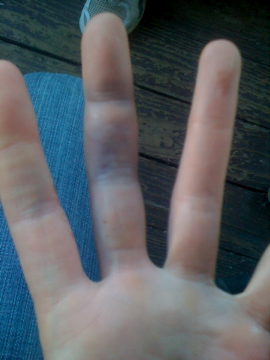
And let’s say that both you and your friend completely gnarl your hands and are left treading water with a mess of twisted and bloodied fingers.

It’s time to get creative.

First off, remember your First Aid training: reduce swelling (and bleeding) by raising the effected body part(s) above heart-level. This means treading water hands-up for 500+ feet back to shore. You can also call on your long-forgotten lifeguard training.

Next, you’ll want to get a second opinion. You’ll probably try to tell yourself that your wound “isn’t that bad, right?” You’ll attempt to move the effected body part in a perkily healthful manner to convince everyone—but mostly yourself—that no serious injury has occurred. At this stage, it helps to have friends with a firm grasp on reality.

When it’s determined that you are indeed effed up, you’ll need to provide some sort of make-shift care for yourself. You won’t always have gauze and splints and medical tape handy. You’ll have to make do with what you have right in front of you. Dig through your purse and discover that a Bic pen is about the length of your finger. Now how could you secure it to your effected digits to both provide support and restrict swelling? You think, look around…

Using your traveler ingenuity, you’ll end up with a perfectly workable—and dare I say, fashionable—solution: Bic-pen/shoelace splints:

Stop hiking? No way! You’re totally good to go.

Bonus tip: Don’t waste money on needless medical care. If you happen to be American, you’re already well-practiced in the delicate art of determining when medical attention is and is not absolutely necessary. Unless your shit is sideways and needs to be reset, a doctor isn’t going to do much for a broken finger. So save the pennies in your travel jar, go to Walgreens, and buy a splint and some medical tape. Total cost: $7.

A Circle of Stones

“I believe that the land has memory—that the earth remembers the things it has seen.”

Lucille Clifton said that at a reading I went to as a teenager, in introduction to her poem “Auction Street,” about how it felt to stand at former slave auctioning blocks in Memphis. I hadn’t traveled yet, hadn’t experienced much outside of the Bay Area, but something in me knew she was right: that rocks and trees and dirt have memories, maybe even dreams—that they hold little pieces of their histories in them, stored emotions, tender and swollen as our own knotted muscles.

I kept thinking about that line, said in passing in some beaming wooden room years ago, on my last trip. Walking amid the wordless rocky ruins of an abandoned village with a heat in my chest and a trouble in my mind, nothing seemed truer. Because, after all, Hawaii is a tragic place.

I stayed along the Kona Coast, a barren, burned-out mound of volcanic rock where the resorts stand out like green sores: lush, overly landscaped swaths of palm and grass against the expansive silence of lunar black.

P. was supposed to be one of them. Not a resort, but a tract of vacation homes: 7 acres divided into 10 lots, like much else along the winding 3-mile road that led from the highway to the coast. The land had belonged to a Hawaiian family who, amid the 80s mad-dash of development, could no longer afford the property tax and was forced to sell the land to a shady enterprise. A wealthy philanthropist came into contact with the family, bought P. from the enterprise, and built a personal vacation home there. My brother married the daughter of a the philanthropist’s good friend—which is how I came to find myself vacationing in a private, ocean-side villa earlier this month.

Sure, there was a gym and a media room and a billiards room and WiFi and groundskeepers and a gated entrance. But it wasn’t like a private resort. Not really. Because something had been retained, kept, preserved—not bulldozed and landscaped over (just landscaped around). The place quivered with a peculiar spiritual energy that made me hippie-out on heavy vibage. (And feel like I was on Vicodin.)

P. had once been a small Hawaiian village, abandoned for unknown reasons around the time Westerns arrived. Through a kind of cheat-the-locals-out-of-their-land swindle, a family came into possession of the land in the 1930s when they swapped their more lucrative property on a lusher side of the island for the rocky tangle of coast. As they bush-whacked into the overgrowth, the family discovered the rock-mound remains of the old buildings, as well as a burial site for what was later determined by archeologists to be a chief. The family was old-school, and believed in respecting the ruins; they didn’t move a stone, but left it in homage to their ancestors.

When the philanthropist came into possession of P., he respected the original family’s wishes and built his home around the ruins. He hired the son of the family, T., to be the property manager, an effort to maintain the sacred integrity of the place and undo some of the bad mojo that had cheated the family from their land.

That was as much of the story I knew as I walked the property the first day. Barefoot, the thick grass felt like carpet, and the air was soft and heavy and feeling of paradise. The path of grass snaked between the ruins, dotted by dense tangles of native trees. Neon birds flitted past, and the weasels darted like small, hungry ghosts.

I approached a perfectly circular mound to the immediate right of the house. Shaded by trees and covered in the round shells of their nuts, it seemed like a particularly potent spot.

As I got closer, I felt a warmth in my chest, rising into the base of my throat—not entirely unlike how I remember that first sip of alcohol: the healing heat, how something from the outside got inside, and suddenly made me feel more whole, less empty and aching. It was a curious, jarring feeling, at once intensely comforting and, well, disturbing in its unapologetic power.

I steered clear of the spot for the next few days. Frankly, I was freaked out. There was plenty else to do: I floated around the pool in an inner tube, did yoga on the deck, lounged in a hammock and read my self-help book on love addicition and co-dependancy. I’d glance sideways at the mound, avoid it, like it were a person watching me with too-blue eyes: it had seen through me and sat waiting.

T. came over to attend to some maintenance issues one day, and we got to talking. He filled in more of the history of P.—how he’d spent his summers there as a kid, how his grandmother had always told him about the spiritual power of the place and how he’d always felt it, even during his wild party days. He talked about respecting the land, saying thanks and being in tune. He told a story about an owl that lived on the property, that may or may not have been the spirit of his deceased grandmother, that had once come out in the middle of the day to watch him repair some of the stones the archeologists had moved.

If it were a movie, T. would have been wearing a lion cloth and the lights would have dimmed when he spoke, the sound of far-off drumming accompanying his tales. As it was, he wore flip-flops and a t-shirt, wrap-around sunglasses and an American moustache.

“P. has always been a healing place,” he told me simply. “I’m just glad that G. bought it, and it was able to stay the place it had always been.” He looked around the stately furniture in the vaulted-ceilinged living room, the hint of a wistful smile in the lines around his eyes. It was a far cry from the rustic shacks of his childhood, but I knew what he meant: it turned out as best it could, for the situation.

“That mound over by the house,” I pointed. “What was that?”

“Heavy, huh?” T. smiled. “We don’t really know. The archeologists thought it might have been a women’s house. Either way, it’s got some of the most powerful energy here.”

Later, I went over to the mound. Thinking of what T. had said, I bowed my head a little and asked permission before I entered into the center. I sat down cross-legged and breathed.

I felt the heat come—not a burning, but a warmth. I tried not to fight it. (He left.) It reached down, to some very tiny place inside, a very old and glowing wound. (A black kitchen and a birthday cake.) I looked at the trees, imagined their roots reaching down, back, on in at something (purple sores, swallowed by black)—like the pulsing red roots of teeth, the throbbing behind the bones of things. (He was sick, I loved him, he left.) The wind was gentle but urgent, speaking in a language of leaves (if I could have loved them more), like a mournful ballad sung in a language you don’t understand. (And left me here: gone.) The stones scratched and the shells dug in.

I heard a hoot. My eyes shot open and my spine twitched.

I heard it again, a belly sound, a calling. I thought of T.’s story: his grandmother owl in the middle of the day, watching over him.

It could have been a dove, cooing at the wind. But in the center of that circle, the ancient black of rocks, it sounded like the voice of P., the voice of the past—whatever it was, still was, had been and was still being, despite the house and the sprinklers and walking of foreign feet: a place of healing. A place that could somehow get down, down into the tightly clutched hurt of things, and coo.

Does the earth remember what it was? Does it carry its past in special little pockets, like a wound we hardly remember, but keep reliving, searching to heal? Well, fucked if I know. All I know is that, with all its resorts and rental cars, Hawaii feels like a beautiful young girl who’s been forced to marry a man she doesn’t love—and P. feels like the place where she goes, not to weep, but to pretend, to dream, to whisper her fantasies to herself, in the voice of the wind.

Beautiful: The Ridiculous Hair of Chaos in Tejas

Oh, kids these days…

Or actually, kids circa 1979. This year’s crowd at Chaos in Tejas was kind of like a time warp. I haven’t seen that many liberty spikes and back dreads since the hey day of the Telegraph Ave gutterpunk.

Now everyone loves a good Elmer’s glue mohawk with an anarchy symbol spray-painted on it. And who hasn’t shaved half their head before? It was like being a kid again…

By the end of it all, I wanted to wear a pink leotard and sparkly tights. To the dude who wore a tie-dyed t-shirt: rock on. You might have been the punkest of them all.

Travel Tip: Magazine Blanket (AKA: Stickin It to the Man)

Oh yeah, American Airlines? You wanna play dirty?

You’ve already taken away my peanuts and charged me for a checked bag—think you’re gonna bleed me a little more by cranking the air conditioning to Venezuelan-overnight-bus levels and charging $8 for one of those shitty blue blankets?

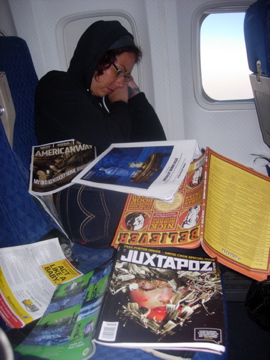
Well, I’m not skerd. I’ll make a hobo blanket out of magazines.

You’ve obviously underestimated my industrious frugality and lack of shame. Maybe next I’ll bring a can of beans and a hot plate, and make my own in-flight meal.

Chaos to Kona: This Will Be Epic

SFO –> AUS –> SJC –> LAX –> KOA –> LAX –> SFO: This will be epic.

It happened like this: my brother’s family was going to Hawaii. It’s an annual thing. My sister-in-law has a good family friend who is famously, fabulously wealthy, and owns a private villa along the Kona coast (“It’s like your own personal Four Seasons,” my parents told me). They go down and stay at the house every year, usually with a big group of people in January (when you can watch the migrating whales from the pool deck). The imminent arrival of my new baby niece pushed the party back till the end of May this year, which gave me enough time to scrape together airfare and justify taking a proper vacation (travelers don’t vacation, see below…). I roped my hard-working best friend into getting some time off from her fancy scientist job and come along with me.

Aside from the not-paying-for-a-place-to-stay bit, it’s kind of the classic American vacation: a relaxing one-week Hawaiian beach vacation. We’re renting a car (which I’ve never done while traveling), traveling with family, have nothing on the agenda other than morning yoga, noontime naps and all-day sunbathing. Which means, of course, it was nearly impossible to justify. I don’t relax when I travel; that’s not the point. If I need to relax, I’ll sleep till noon and go eat ice-cream cones in Dolores Park. I travel to see the world, dig in, explore, run myself ragged on third-class busses. When I travel, virtually no sacrifice is too big: I’ll bankrupt myself, take as much time off work as I can without getting fired. But when it came to taking 5 days off work and spending $436 to fly to Hawaii, I balked. It seemed like a lot to do nothing, learn nothing, gain nothing but a couple pounds from my brother’s bad-ass cooking.

I took it on as a sort of spiritual challenge: a traveler vacationing. In a lot of ways, it’s going to be my first vacation in 5 years. Unwinding, unplugging. But of course, I’ll have to write about that. And bring my laptop along. And then a friend gave me some tips on non-touristy places to go on the Big Island. An independent traveler tackling the most touristy place in the US? Sounds like a killer article…

Already, I was chipping away at the “vacation” element of my vacation. And then came Chaos.

It’s the dirtbaggiest, DIY-est music festival of the year. Organized by one dude with a blog and Xeroxed flyers, Chaos is Tejas brings out some of the biggest names in punk/crust/sludge/metal for four days of sheer debauchery in Austin, Texas. Friends had been road-tripping out since its inception 6 years ago. I finally went 2 years ago, and partied like I was 15 (minus the malt liquor and methamphetamines). I stayed with a tattooer/artist friend of mine, and ran around the streets till 4 in the morning, lighting off fireworks at after parties and making out in the back of a truck with some dude while his friends careened us around the city. And that was stone-cold sober.

I remembered the festival as being in early May. A tight squeeze, but I could fit it before Hawaii, right?

Turns out Chaos in Tejas (which has entered the digital age this year with a Facebook page) is Memorial Day weekend. And I was leaving for Hawaii on that Sunday. Some friends were planning to drive out. A hair-brained scheme began to hatch.

The road-tripping part had to get chopped out, but here’s how it’s ended up working out:

Wednesday: Fly to Austin with Liz and Melissa.

Thursday – Saturday: Rock our effing brains out. Killer bands from all over the world playing nearly 20 different shows. 3 single girls in a sea of crusty boys: think “Girls Gone Wild,” but with more tattoos.

Sunday: Fly from Austin to San Jose. Meet Alicia at the airport. Fly from San Jose to LA, where we’ll connect and fly to Kona. Grab our rental car and traverse the dark turns of some deserted highway, arriving at the gate to the mile-long driveway.

Monday-Saturday: Chill-ax.

Saturday night: Red-eye back to LA.

Sunday morning: Fly back to San Jose. Get a ride back to Oakland. Be at work by 2:30.

It’ll be one end of the spectrum to another: ridiculous partying to ridiculous relaxing. Punk rock shows to private properties, dirtbags to nieces, stinky clubs to island paradise. 11 days, 2 destinations, 7 flights, 1 rental car, 3 girls in 1 cheap hotel room, 15 people in 1 oceanside villa, 99 bands and 1 me to live (and write) it all.


Lauren Quinn is a writer and traveler currently living in Hanoi. Lonely Girl Travels was a blog of her sola travels and expat living from 2009 to 2012. She resides elsewhere on the internet now.

Join 490 other subscribers

Buy This Sh#t

Categories