Archive for the 'Subculture' Category


Thanks for Nothing / Everything

I celebrated this Thanksgiving at two long-standing Oakland events: Thanks for Nothing, the legendary potluck of punk debauchery, and my family’s annual Day-After-Thanksgiving party, legendary in its own right. Both events were a little less epic this year, with an intimacy that reminded me of what’s good about Thanksgiving and about family—as untraditional as they may come.

Anyone in the East Bay who’s ever donned liberty spikes and a studded anything has gone to Thanks for Nothing. And possibly passed out at it. Now in its 18th year, the Thanksgiving potluck is an Oakland punk tradition, a place for all the family-less kids in black to come together, at picnic tables under jimmied lights, and create their own family.

Of course, by “kids” I mean “punks” and not kids at all, anymore. These are the die-hards, wearing smile wrinkles and old band shirts—the folks that, once the scene-ness melts away, once all the other folks have grown out of what was just a phase, are still there, purely for the love of it. Punk may be mostly dead, but it’s not all-the-way dead; it just lives in the hearts of a small handful. And, on Thanksgiving, in an East Oakland backyard.

Thanks for Nothing has taken on a larger-than-life status; the woman that puts in on is convinced that even if she were out of town one year, people would still show up. They didn’t pump it too much this year—no flyers or MySpace posts, just word-of-mouth—and the result was a smaller, friendlier crowd, that was also a bit tamer. The event historically gets increasingly raucous as the evening progresses; as the steam from the turkey table cools and the toddlers konk out, staggering, slurring sing-alongs ensue (among other things). This year, the pot food table was nearly empty and the jar of homemade Bailey’s went fast, but the Jell-O shots were plentiful, tossed around in a haphazard game of catch that somehow didn’t end in neon goo being splattered across someone’s head.

Despite the uber-punk name, this year’s Thanks for Nothing felt more about community than anything else. Family, as most travelers know, isn’t really about blood lines; it’s got little to do with genes or ethnicity or even, as we learn on the road, nationality. Family’s about people that share similar values and perspectives coming together and sharing, growing together. (And at Thanks for Nothing, singing along to Cock Sparrer together.) It sounds more one-love than punk, more Berkeley than Oakland, but sometimes it takes unexpected manifestations to drive a point home.

But most of my “family” growing up wasn’t about blood lines—a lot of Californians’ aren’t. My parents moved my toddler brother and my infant self to California with only one blood relative within 2,000 miles. Once my uncle passed away, it was really just the four of us for holidays. Plus an ever-growing band of fellow Bay Area orphans. It seemed that my dad’s first couple of years in the fire department, he kept having to work Thanksgiving (turkey at the fire house!). So we started having all our family friends over the day after, when we’d sit back and talk and laugh and eat for hours. We invited everyone, and it became a kind of neighborhood affair. A tradition was born, and yesterday, carried into its 22nd year.

Like Thanks for Nothing, we don’t really need to invite people anymore; everyone just knows to show up. Charles deep-fries two turkeys in the driveway, Karen and Jamal make the marshmellow sweet potatoes, Nhu and Jacobo bring the bread pudding, my brother makes the famous firehouse Caesar (I used to make the vegan entree, but those days are long gone…). My parents’ small bungalow overflows; there’s an incessant wait for the one bathroom and a warm glow from the fireplace. It’s consistently one of my favorite days of the year.

The event was smaller this year, just under 60 people, and I had a couple bittersweet moments, missing people who used to come—people who’ve moved, who we’ve lost touch with, but mostly people who’ve passed away. But at the same time, there were folks there that I’ve grown up with, that I’ve known my whole life, that are the aunts and uncles and cousins I otherwise wouldn’t have really had, so many miles and states away.

Family is one of the most important things to me, as traditional or untraditional as mine may be regarded. Of course, much has been written about the “demise” of the American family, and holidays like Thanksgiving hold a particular weight for those from untraditional or un-intact families. But I’d argue that the American family isn’t crumbling, just reshaping; seeing as though this guy got a book deal out of the concept, I don’t think I’m alone. And as travelers know, the traditions of a family are some of the best glimpses you’ll get into a culture—whether it’s making stuffing with your play-cousin, or pounding Jell-O shots with punks. It may not be a Norman Rockwell painting, but it’s as close as some of us get.

Street Art Pictures: London, Spain, Morocco and Portugal

First, a disclaimer: I don’t profess to be any kind of expert in street art. Or even a novice, really. I just know that, when I spot a fresh stencil or spy some sick piece, it makes me smile—and, if I happen to have a camera with me, snap some photos.

I guess the thing about street art is the sense of place it evokes—which one naturally notices more when one is traveling, seeing a city with fresh eyes. As the world gets smaller, regionalism can be hard to find; this is especially true in the Westernized world. Traveling in Western Europe, you constantly see the same chainstores, the same brands, the same fashions—girls are wearing whatever’s hip at H&M everywhere from Malmo to Madison (and I’d like to say myself excluded, but that would be a lie). Street art, whether it’s good or not, shatters through that; its viscerality marks a place, claims it, and if you’re traveling, can often reveal a lot more about where you are than reconstructed period buildings and restaurants with picture menus (really, paella all kinda looks the same).

I hung around some East Bay graf kids for a time, and still smile when I see their tags around town. A repeated stencil, a tag, a distinctive style—they’re like recurring images from a dream, someone else’s dream, and you catch little glimpses, train your eyes to look down alleys and up at overpasses, and you feel like you’re in on something. It grounds you in a very tangible way, connects you with the phantoms that sneak around at 3am with backpacks full of clanging illegality, with their finger-staining passions and illicit dreams. Of course, I was never one of them; a certain romance remains when it’s not you getting arrested or jumped in some strange turf battle. But I will say you interact with a city—its architecture and landscape, its thingness—differently when you’re even vaguely in tune with its street art. And when you’re traveling, it can often be your only contact with the night-crawling kids that in large part create the pulse of a place.

My first stop on my trip was London, where I of course went on an all-day goose chase for Banksy (chronicled here). The hunt also took me past several of these digitized little fellows by Invader..

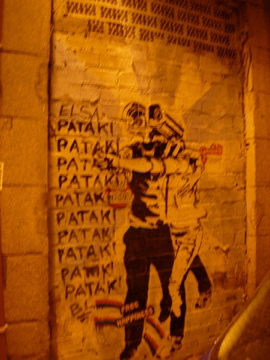
Super poor picture quality, but what can you expect from a 2am street lamp and a mediocre camera? This I spotted in Madrid, near Plaza Sol. If you can't tell, it's two tangoing figures with security cameras for heads.

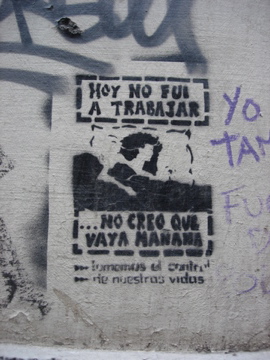
Granada generally had some piss-poor graffiti and stencils, but this one made me laugh. Totally fitting for a college town.

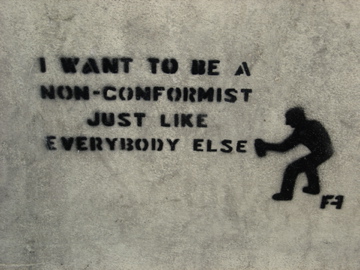
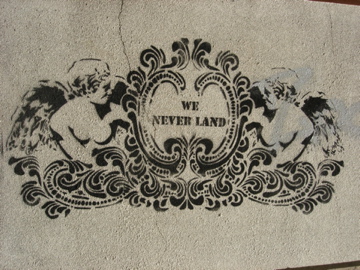
I spotted this one several times around the beach breakers in Tarifa. The sentiment jived well with the surf-town vibe, and the fact that it was in English spoke to the internationalism of the unassuming little place-between-places.

As you might guess, there wasn't a whole lot of street art going on in Morocco, or at least in the places I went. What one does see a lot of is stenciled Muslim calendars, on the side of buildings, with icons depicting certain holidays and dates. My favorite was the rose. I of course have no idea what it denoted or what the Arabic says, and retained none of the heavily accented, half-French explanations.

But of course, the best stencil piece I saw was in one of my favorite dirt-road beach towns, Mirleft. Popular with vacationing Marrakeshis, artists, dreadlocked travelers and, well, me, Mirleft seemed a perfect place to find this, peeling away on a side street.

Back in Europe, much of Lisbon's street art had a distinctive Brazilian flavor, which makes sense considering the city's large Afro-Brazilian population, and the fact that São Paulo and Rio are some of the biggest and baddest producers of street art in the world. I saw this stencil around the center, around uber-hip Barrio Alto.

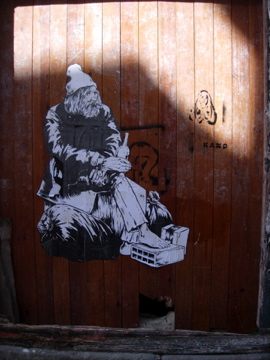
And this was a simply incredible wheatpasted portrait over near the Alfama district.

Another college town, Coimbra had a fair amount of politicized stencils. This one was especially interesting given the prevalence of domestic violence in Portugal, and the pervading stigma against seeking help: "Every 2 weeks, a Portuguese victim of domestic violence dies." The number is a little more somber when you consider the small country's population of 10 million.

On the flip side, this was just awesome.

And I quite liked this one as well.

But the place that really took the cake was Porto. Good ole unsuspecting Porto, forever in the shiny, smiley shadow of Lisbon. These were all taken near hip-slick-and-cool Rue Miguel Bombara.

The paper cranes were part of the 1000 Tsuri Project. They acted like punctuation, all over the walls of the street, serving as both a kind of visual break and space filler between the other pieces.

Part of a larger project by artist Costah; check more out here: http://www.costah.net/the-icons.html

This little girl is up a few places; each time, she's touching something different. From what I could tell, this was the logo of a nearby art gallery/collective.

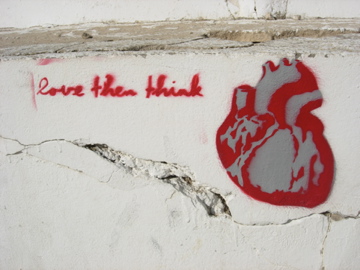
One my favorites. Simple but expressive, and totally took me aback when I spotted it down an alley.

I don’t know if these reveal any more about the places I was in, but to me they do. And if nothing else, they’re better than cell phone ads.

Notebook Digging

DSCN3935

Yep. Traveled with all 3 of these guys.

Recrafting prose or polishing turds?—you make the call.

I’ve put it off long enough. I’ve finally embarked on the task of digging through my last trip’s notebooks. I’ve set out on a spelunking mission through the email addresses, phone numbers and crudely drawn street maps that fill the stained pages, excavating hieroglyphic scrawling and jagged phrases in search of literary gems I just know are in there, buried amid the recesses of black ink/bat feces.

As per usual, these disembodied stanzas and half-poems don’t seem quite as brilliant as they did in the moment, but some aren’t so bad. I plan on bugging some writing friends of mine for feedback (that means you, Jacob), then packaging up what survives in a nice electronic bow and sending it to Literary Bohemian, a site I have a crush on. What’s left will be put on here.

Don’t think of it as a literary scrap heap, but rather that first post-Thanksgiving plate of leftovers—before you’ve gotten sick of turkey. At least that’s the spin I’m putting on it.

One of the great things about my last trip was how much I wrote. I was on fire. It’d been a long time since I’d felt that way, completely consumed, possessed. It’d been a lost couple of years, basically not writing at all; I could feel it all swimming around in there, very far beneath the conscious surface, but nothing would come out. Literary constipation. As uncomfortable as it sounds.

To my delight, I actually wrote a fair amount of poetry on my trip. Which feels more like writing to me than first-person narrative—I don’t know why. I love narrative, but it sometimes feels too easy. Just me mouthing off, you know. Of course, I find my witty insights endlessly amusing and fascinating, but I still love the rawness of writing poetry, the way an image will overpower you, how the best poems feel like they write themselves. It’s a tough place for me to tap into these days, and it sometimes feels like traveling is the only way to give my poetic prowess the necessary kick in the ass. Shock therapy via passport stamps.

In any event, here’s a fragment I wrote in Tangier about, well, writing and feeling like you’re in the pocket. And there’s plenty more where it came from…

I’m writing again

all the time

even when there’s not a pen in my hand,

always, in some back basement

of my brain, a hunched figure

banging typewriter keys,

smoke-shrouded

with only a street level window

silhouetting it

against the endless passing of feet.

I can’t keep up

with the furious clatter,

the singing of the keys,

their persistent tapping,

not for permission

but to be unleashed.

No Port in Porto

DSCN3759I ended up at port tasting in Porto today. If you know anyone who´s been to Porto (yes, the homeland of port), this probably topped their itinerary, sent them scampering up the city´s steep hillside for a free tour and tasting of the  carefully aged, exquisitely sweet wine that is as Portuguese as codfish. If you know me, you´re bound to be uttering a “wtf?”
The thing is, I don´t drink. Not even wine; not even to taste. It´s been over 9 years since I´ve had a drink, so I don´t think of this as a very big deal anymore and don´t think to announce it on my Couchsurfing profile. So when my host picked me up from the bus station, drove me around town on a personalized sight-seeing tour (this is the life), and thought, you know, it´d be fun to stop off for a port tasting—far be it from me to not tag along.

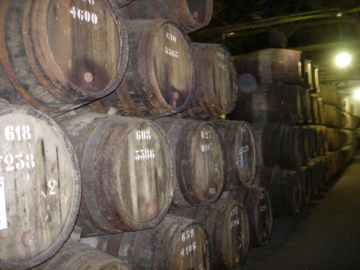
It was mildly interesting, to wander amid the massive barrels and cool stones, listening to the heavily accented spiel (I serve ports at work, which I´ll be returning to in exactly one week, so it was good to have a little refresher course). I observed everyone else´s excitement, especially for the free tasting portion, and I have to say, it was a little awkward when I was the only one not politely pushing to the counter and grabbing a glass.

I´ve been thinking a lot about drinking and traveling, since I read Matador article discussing the pros and cons of alcohol consumption on the road. The article asked whether we needed alcohol to connect on the road. The 21-and-counting comments ran the gamut, and revealed a lot about the people the wrote them. On his personal blog, Matador editor Carlo Alcos offered his ruminations on the subject. “Okay,” I thought, “I can totally write a post on this.” I saved the links and let the subject swim around in the back of my head. And, I´m surprised to say, I actually have very little to say.

So, of course, I´ll say something about that. I found the responses to the article fascinating, little boxed glimpses into the psyches of the thumbnail photos that accompanied them. The fervor and conviction with which so many people wrote intrigued me, especially when they went so far as to make blanket statements or preachy proclaimations. I observed it all with a strange sort of detachment, as though I were looking in on something that had nothing to do with me, like watching a documentary on the culture of people in a terribly far-away land. And, in a way, I was.

I´ve never drank while traveling. I got sober at 17 and never looked back. At home and on the road, people who don´t know this will offer me drinks—I casually decline, and that´s the end of it. Sometimes they notice my repeated refusal and ask why, and I tell them the truth: I´m far more charming company sober.

Drinking for me was never about the kind of camaraderie and conviviality the Matador article talks about—it was about self-destruction and oblivion.  I didn´t win many friends by cussing people out, pissing in doorways or sobbing in corners. Nor would I expect to while traveling. And while I don´t hit the pubs or search out the coke bars when I´m in another city, I do go out. To parties, yes, sometimes to clubs and bars. Sometimes to port tastings. And I dance and laugh and conversate (I´ve stopped fighting, it´s a word now) and do all the stuff everyone else does. I just remember it the next day.

Or, at least that´s the position I´ve always maintained. But in my Portugal travels, I´ve had this lurking feeling that I´m missing out on something. Wine is a huge part of life in Portugal, a cultural characteristic that culminates in the precipitous cleave of Porto and the surrounding green valleys of the Douro. And in the same way that you get a better, ahem, taste of a culture via their traditional foods, I think I´d be getting a better feel for the soul of Portugal if I were swishing a tawny port around my teeth and pontificating on notes of walnut and honey.

But even this feeling, this knowledge, I observe with a distance. It´s all so far away, drinking and the culture behind it, and I find myself regarding it with complete indifference. That is to say, regarding other people´s drinking with complete indifference. I guess what I realized with the Matador article and the responses it provoked was that I really don´t want to be the arbiter of anyone else´s drinking. I´m probably the least qualified person in the world to do that anyway. I just want to keep living my little sober, happy life—even if I end up wandering into a port cellar or two.

Well, Isn´t This Handy? Moroccan Photos by Someone Else!

Here it is: my best Moroccan photo. Now go look at the other ones...

Here it is: my best Moroccan photo. Now go look at the other ones...

I have a confession to make: I am a terrible photographer.

Not that you´d know, seeing as though I left my camera cord at home and all my posts from the road have been woefully without visual accompaniment. But despite the fact you can´t see any what fills my memory card, I have been making a concerted effort to take more photos on this trip. Photos enhance articles, and most publications dole out additional sums for good pictures. The only problem is, I suck.

It´s not just that I lack the technical ability to address lighting and angles and perspective. I´m a timid photographer, not intrepid enough to shove my camera lens in at the moments that would create good photos. I´ve come home from previous multiple-month sojourns with less than 200 pictures. But I actually love photography, and see plenty of good pictures all around me—it´s just that, by the time I´ve dug my camera out of my bag, turned it on and focused, the moment has passed. And I find I´ve wasted the moment not enjoying it, sucking it in, but instead trying to photograph it.

I´ve decided that, since I´m a much better writer than I am photographer, I´m going to take pictures with words. When I see an insanely beautiful or mesmorizing or unusual image, I study it, memorize it, savor it—then scribble as fast as my fingers will let me, trying to get it all down. It works—when I flip through my notebook, the scraps of phrases bring back everything my haphazard and poorly focused photos don´t.

But a good pictures is still a good picture, and I wistfully reflect on all the excellent moments in time that are only captured in my mind. So you can imagine my delight when one of my favorite travel forces, Matador, published a photo essay on Morocco today.

The photographer, Paul Sullivan, has a killer eye and enough credentials to make you cry. Most of the photos are from Marrakesh, where I spent my ill-fated last day; I think photo 10 of Djemaa El Fna totally captures the spirit of the food stalls.

I like this system, someone doing my dirty work for me without even knowing it. I fantasize about one day setting out on a trip with a photographer, tag-teaming some destination with a dynamic duo of artistic ability. Until I get a grant or find a glossy magazine still willing to send people out on stories old-school style, this will have to do.

(PS—If you´re licking your chops for more kick-ass travel photography, check out my homeboy Peter´s photo blog, stolen goods.)

Red-Door Flamenco

DSCN3201The drama and thunder of it—

trance-like

when the notes sing sadly,

seem to pluck themselves

from weeping fingers,

when the wails of passion

get inside the hips,

become the bend of wrists,

the fistful of ruffles—

how unapologetic

the stomps are,

the throbs

of a furious pulse,

the exactitude of hands

that don´t stop clapping

until the blood reaches

its final fevered pitch:

a pose of breathlessness,

a sculpture gasping

with life.

BYOB Debauchery: Spanish Botellónes

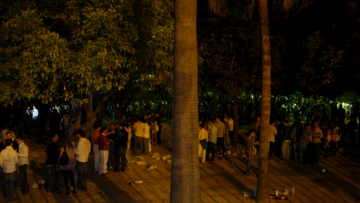
DSCN3177The roar of voices rose from between the trees, out of the darkness and dirt. Scooters swarmed, freshly broken glass glittered in the dim park lights. Young girls teetered in impossibly high heels and boys stumbled, leaned their faces against the sides of walls as they pissed. And every person clutched a plastic cup.
When Spanairds sigh in disapproving despondency about ¨kids today,¨ they´re talking about botellónes. In a culture of late-night fiestas,  these youth-ridden BYOB binges stand out as particularly debaucherous.

Bottelónes take place in public, on the streets and in the parks; teeangers and early 20-somethings gather to drink, flirt, cause trouble, and leave a mountain of trash in their wake. Increasingly the subject of public controversy, Seville´s bottelónes are known to be especially raucous.

We passed one as we trod through Parque Maria Luisa on Friday during a once-a-year festival of museum open houses and cultural performances. (How Spanish is this?: museums are free to the public from 10pm-3am, and completely full the whole time.) September is festival month in Seville, when residents have returned from August vacations and the oppression of the heat has subsided; it´s also the beginning of botellón season. My couchsurfing hosts and I were walking over to Museo Artes y Costumbres Populares, where we saw a killer flamenco show, and the adjacent Museo Arqueológico, where a classical guitarist´s exaggerated facial expressions were more dramatic than an old guitar-playing friend with Tourettes (RIP, friend).

We passed what I was told was a typically trashy Friday night bottelón. It was like a rave minus the pulsing lights and techno music, like a sideshow minus the cars and firearms. Hundreds of kids filled the open space at the park´s entrance. Teenage girls were dressed to the nines to attire revealing even by Spanish standards, while boys puffed their chests and tried to impress each other, even in curiously effeminate clothing. My hosts spoke of the trash, piss and vomit the parties left in their wake, the shards of glass and tell-tale crushed plastic cups that city workers scurry to clean up the mornings after. (The next day, I passed through the carnage of another botellón, down by the river, and had to say, it was pretty gnarly.)

I smiled to myself as we passed by. I couldn´t help but feel that, if you swapped the heels for combat boots, and blush and blow-drying for heavy eyeliner and multi-colored dreads, it wouldn´t have been too unlike the Rocky Horror Picture Show or Gilman Street of my adolescence. Instead of being out in the open, though, we were relegated to the sketchy corners of the city, to alleyways, public restrooms, the stairwells of parking garages. I wondered if having to hide it—the violent pursuit of oblivion—somehow served to make ours worse, more seedy and powder-laced, more self-destructive and apt to end in institutions and death.

From between the park gates, I spotted a girl hoisted up by two friends, her arms drapped over their shoulders. Her head hung at a sharp angel; her heeled feet scuttled, dragged in the dirt lifelessly. Whether it´s a plague to Spanish culture or kids just being kids, I felt mighty glad not to be a teenager anymore.

The Jugular of Granada´s Street Art

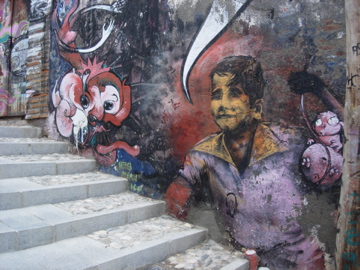
DSCN3131Down a deserted stairwell in a steep tangle of stone streets, I stumbled upon the best street art in Granada.

Literally, I stumbled. The precarious passageway of unleveled rocks made walking an ankle-twisting, sole-bending venture. The vacant lots, abandoned mattresses and wafting bits of urban debris didn´t make the footpath a particularly picturesque one either. But I didn´t care; it was what covered the cement walls and old stone wells that fascinated me. Color-swarmed, vibrant and thoroughly hidden, I´d discovered the best street art in Granada.

This isn´t a difficult feat. The ancient city of intricatly carved Islamic monuments, mammoth cathedrals and labyrinthic streets is, in its modern-day incarnation, also a college town. Chicken-scratch tags and idealistic political statments irreverently adorn any paintable surface; Granada writers have a particular penchant for anarchy symbols, replacing ¨a¨s with the symbol at every opportunity. A crayon box of every imaginable color, the city is swarmed in adolescent scribblings that somehow add to the o ld-world ambiance; they seem to fit.

I decided to take a morning walk through Albaicín to the city´s center. My couchsurfing host, a thin Spanish girl in a black raincoat, had a quiet apartment in the Sierra mountains, a simple tiled space that´s view from the balcony was like a prayer. The building was  just outside the old city wall, a half-crumbled mass that arched down the spine of the steep terrain. Just on the other side was the city´s old Muslim quarter, cascading down the hillside towards the city center. Crumbling buildings mixed in with modest modern architecture, lining the zig-zag of cobbled streets with walls tall enough to block the wind and let in only a bit of the morning sun.

The layout of the streets is utterly random and unintuitive, so I gave myself a couple hours to wander the mile downhill. Small plazas punctuated the skinny streets, most of which were closed off to anything by foot traffic. It was a functioning neighborhood that gave a gentle nod toward the map-clutching, steep-grade-panting tourists that trcikled through: a couple stores sold postcards in addition to fruits and food staples, an internet cafe´s doors were locked for Ramadan. People bustled about their business—old men smoked and the women gathered in an arm-crossed group at a plaza´s market—and us tourists smiled pleasantly at each other in passing.

I maplessly meandered my way to an impressive mirador directly across from the Alhambra, where people posed for photos and looked out over the vast  city view. A slight grumble in my stomach inspired me to move towards the city center. Directionless, I decided to just make my way downhill until I hit a promising-looking street.

DSCN3134The streets I wandered got starker, more litter-filled than people-filled. Abandoned buildings and dirt lots suggested that restoration efforts weren´t the trend in this forgotten corner, perched on a precipice between well-visible, touristed neighborhoods. A steep stone footpath lightning-bolted its way down the hillside; I followed it.

I passed one of the old, gated-up wells that fill the Albaicín neighborhood. This one was covered in slightly different bread of tags, filled with crude characters and comical creatures. Turning a sharp corner, a mural-filled walls of air-brushed portraits and abstract colors stretched out in front of me. A stencil of George Bush with a blood-red clown nose appeared next to a telling tag: Albaicín Crew.

I walked up and down a bit, taking pictures and smiling at the refreshingly creative vibrancy. In one litter-strewn, forgotten footpath, tucked into the secret flesh of the city, I´d found the jugular of Granada´s street art scene.

Granada Fragments

DSCN3127Granada got me all literary…

Bus ride: Sheets of rock like shoulder blades, knobby fingers  pointing skyward in an arthritic ache.

Granada: A town that still rolls its clattering shutters down for siesta, where people lean on bars at lunchtime, where crayon-colored graffiti makes the edifices seem all the older, and more opulent.

Outskirts: Tatiana lived on the outskirts, the broad chest of the Sierra, where  grey blocks of buildings stood stoicly, white-washed walls and flat stone streets filled with people coughing, crossing their arms as they walked to bus stops beneath rain-streaked towers, windows crying mascara tears.

Thursday: It was a moody day, a voluptuous pout of wind and clouds.

Balcony like a prayer: The rain thins, the clouds ascend, and the city sharpens like a reflection in an unfogging mirror—tiled roofs that arch along the spine of the mountain, the grey domes of grey cathedrals, the red crane of steel-boned construction. The birds chatter invisibly from the inside of trees, like children at recess, high voices rising above the thunder of the drainpipes.

Boy at the party: It was the way his shoulder moved beneath his tshirt, how his sneakered feet would pigeon inward, the way his veins vined around his forearms like twine, down, down, to the thick fingers that, unlike yours, were uncalloused and clean.

In Search of Banksy: 30 pounds and 48 hours in London

DSCN2994There´s nothing like a good ole map-less search for illegal art through the streets of a foreign city to get you off the tourist track.

Call it my guide to ¨spending less and seeing more¨: extend your flight connection from an hour and a half to 48, crash with a family friend in Brixton, and set out on a scavenger´s hunt through one of world´s most expensive cities for illusive works of a notorious street artist. Arm yourself with nothing more than a transit day pass (5.6 pounds), a scribbled scrap of notes from a Banksy locations website, no guidebook or map, and a long-time London resident down for the quest. You´ll trapse through the heart of the city, through 2 ethnic neighborhoods, 2 gentrified hipster havens and an unabashed tourist trap; take 4 tube rides, 3 buses and walk an estimated 5 miles; pop into 2 galleries and 1 museum; sip cappuccinos on a roof-top cafe (2 pounds), munch on Jamaican patties at an Afro-Carribean market (2.5 pounds), and down some killer dal at a Pakinstani restaurant (17 pounds, with hella leftovers). You´ll venture down abandoned tunnels and crumbling back alleys as you tour the city´s sweet, tender underbelly, swollen with bright colors and pealing wheatpaste. And all for less than the Lonely Planet shoestringer budget.

Bristol-native Banksy has become synonymous with street art, his satyrical, subversive large-scale stencils offering poignant and humorous statements on politics, culture, capitalism. While his pieces have popped up in cities around the world (an apparent traveler himself), London is one of the hotbeds. The ephemeral nature of street art makes finding his work a kind of wild goose chase.

DSCN2972New Zealand native, world-travler and 30-year London resident Dave served as my gracious host and personal guide extraordinaire. We began at the Waterloo tunnel, once a Eurostar passageway, once abandoned, now a designated graffiti area. None of Banksy´s work remains, but lots of other bright colors and politized stencils fill the surprisingly clean, un-urine-smelling underground area. We rambled along the brown, gurgling Thames to the Tate Modern, sister museum to the Tate Britain, one of the museums hit in Banksy´s guerilla art hanging. We checked out the excellent Futurism exhibit (which warrants its own post), making use of Dave´s free +1 entry.

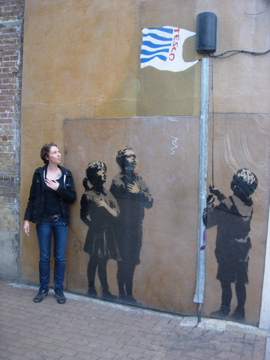
Our search took us through two once-funky, now-trendy gentrified neighborhoods, the Angel and Old Street areas. We passed a crosslegged girl working on a legit piece on the exterior of a hip nightclub, a one-time poppin gay bar that was ¨the perfect mix of seedy and interesting,¨ Dave sighed in bittersweet nostalgia. Amid the antique stores and vintage shops of Angel, we at last found a Banksy. Preserved under plate glass like the Mona Lisa, I posed next to the children pledging a Tesco shopping bag (of course, I forgot my camera cord at home, so you´ll have to wait for the proof).

DSCN3006We found another Banksy on a quiet sidestreet off of unabashed tourist trap/hipster hangout Brick Lane. The first half of the blocks we walked were wall-to-wall Indian restaurants, with pushy male touts outside jostling for patronage; I think they´d find more success if they employed the Latin American method and used smokin hot girls in skimpy clothing. The street morphed into uber-cool bar and pub land, and that´s where we found the most street art of our mission. My favorite was a collage of corporate logos composing the now-commodified famous image of Che. The Banksy we found was several blocks from the hubbub, a painter sitting next to a large yellow flower. The words ¨vandals found vandalising this vandalism will be prosecuted¨ appeared right beside the large spray of paint covering the stencil´s face.

One of my visit´s sub-missions was to find one of those Cockney ATMs; while that searched proved unfruitful, it did bring us to bomb-ass Tayab, a Pakistani restaurant doing a cafeteria-style smorgasborg for Ramadan. I wisely stocked up on minced meat pastries for my next day´s flight, as well as enough leftovers for a spicy breakfast.

DSCN3018Another culinary and culture highlight was our next morning´s stroll through the Brixton Market, the pulsing heart of the Afro-Carribean Brixton neighborhood. African flags and fabrics, produce-selling mom and pops, Bob Marley tapestries, Obama t-shirts, Rasta onesies and pot-leaf-adorned everythings filled with multi-block indoor/outdoor bazaar of bad-assedness. There wasn´t a single corporate logo in sight, and as I sipped on a Buffalo-milk cappuccino and watched passerbys, I couldn´t help but feel my 48-hour powertour had provided me with a pretty good glimpse of the London in which locals live, graffiti-adorned, cumin-scented and throbbing with life.

Lauren Quinn is a writer and traveler currently living in Hanoi. Lonely Girl Travels was a blog of her sola travels and expat living from 2009 to 2012. She resides elsewhere on the internet now.

Join 490 other subscribers

Buy This Sh#t

Categories