Archive for the 'Subculture' Category


On The Road to Nowhere: Finding an Anti-Place, Part 2

Our pick-up truck bounded down the smooth pavement, creating a muggy breeze. We moved down a strip of the coast, a highway and a shade of green I think I’ll forever associate with Thailand, and that’s the place the people came through. It was 30 years ago and there’s not a lot left—unless you know where to look.

I didn’t. I kept craning my neck through the grating of the covered truck bed, trying to catch a sign for Khao Lan. I was lucky, I discovered, in that a giggly group of five teenage girls with straw mats and beach towels were getting off at Khao Lan as well. They’d spend the entire 40-minute ride squealing and chatting and texting. When we glided to an easy stop, they pointed and exclaimed to me, “Khao Lan!”

We trundled off, stood on the swampy roadside of a military checkpoint. “Beach?” one of the girls asked me shyly.

“Museum,” I replied.

“Museum,” she repeated softly. The word caused a buzz among her friends. “Museum!” one of them exclaimed assuredly, and pointed to a white structure obscured by the green.

I thanked them with a small bow of my head—I hadn’t learned “thank you” in Thai—and watched them disappear down the road.

The museum was modern, diagonal columns and a glass skylight structure that didn’t at all seem to fit the landscape. The adjoining parking lot was empty and the museum gates locked.

The guard at the military checkpoint back on the road made an eating motion. He pointed to his watch, held up one finger. I nodded and wandered back down towards the museum grounds, thinking how strangely simple it was, how much you could communicate without words, without a common language, just signs and gestures and hints, a smile and a bow.

Green signs were stuck amid the grasses, and those communicated a lot less. Were they marking something related to the camp that had once stood there? I couldn’t be sure, but photographed them just in case.

I walked deeper into the grounds. A buzz grew from the trees like a living thing, like it weren’t the product of a living thing, a million unseen insects, but an animal in and of itself. It whined and hissed and followed me down the road.
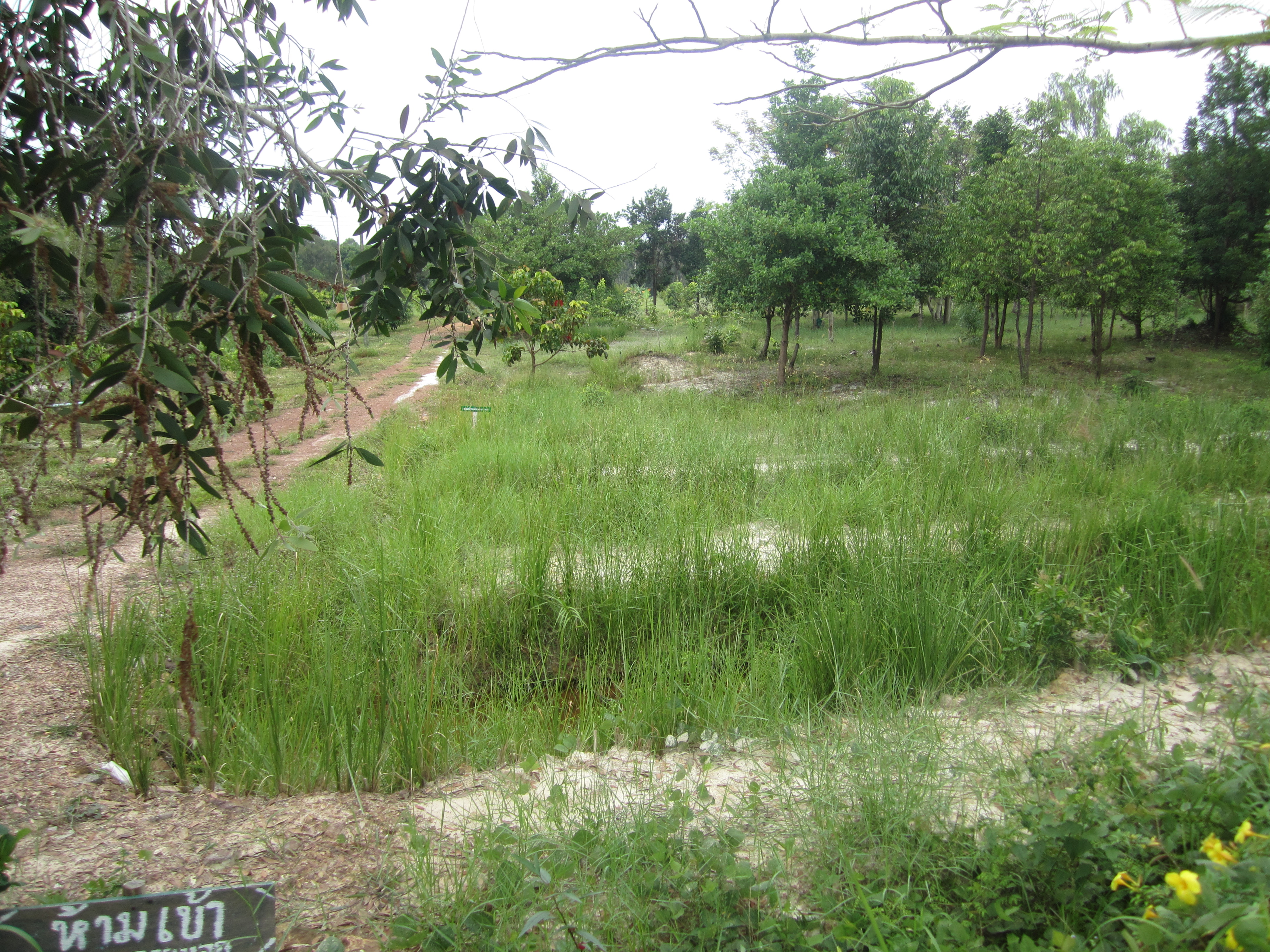
There were beaten bits of earth, what had once been a road. Chunks of cement remained, with earth growing back up around it, like a scab before it peels. There were clearings in the grass, and I tried to figure out if they were remains or something used for farming, the stray huts I could spot off between the trees.

But I walked further and found translated markers—something, not in a common language, but my language, a scribble I could understand. I held my breath and tried to imagine tents and roads and some 90,000 people.

I couldn’t. It was just wind and rubble, stairs to nowhere and the earth growing back up around.

The museum was open by the time I got back, and I slid off my shoes and stepped inside. A lone female attendant smiled at me and went back to sweeping the floor.

The museum was strange. It was mostly a tribute to the Queen, a tribute to her goodwill as evidenced by her selfless saving of Cambodian refugees. Everything was framed in that context—photographs of a glamorous white-skinned woman walking through a city of tents in a white suit, a floppy sun hat and Jackie-O sunglasses. She crouched beside the thin and sick, bellies swollen and eyes dulled, a look of practiced concern. She sat before a group of children, an opened book in her hands: The children listened rapt, the words of the Queen forever imprinted in their minds.

Subtext: Thailand is the only country in SE Asia to have never officially fallen under imperalist control.

But still, she’d done a good thing, a damn good thing. The museum included three life-size scenes that reminded me of wildlife dioramas, the kind my best friend meticulously restores, repainting eyes and gluing on fake fur.

Wax Cambodian figures, their bodies worn and their faces contorted by grief, stood in varying poses of despair, before a painting of thick jungle, more faces and bodies coming through the trees. Other scenes depicted varying elements of camp life: cooking pots of rice, a white woman holding a stethoscope to the chest of a small wax infant. The dark Cambodian bodies grew plumper, more solid.
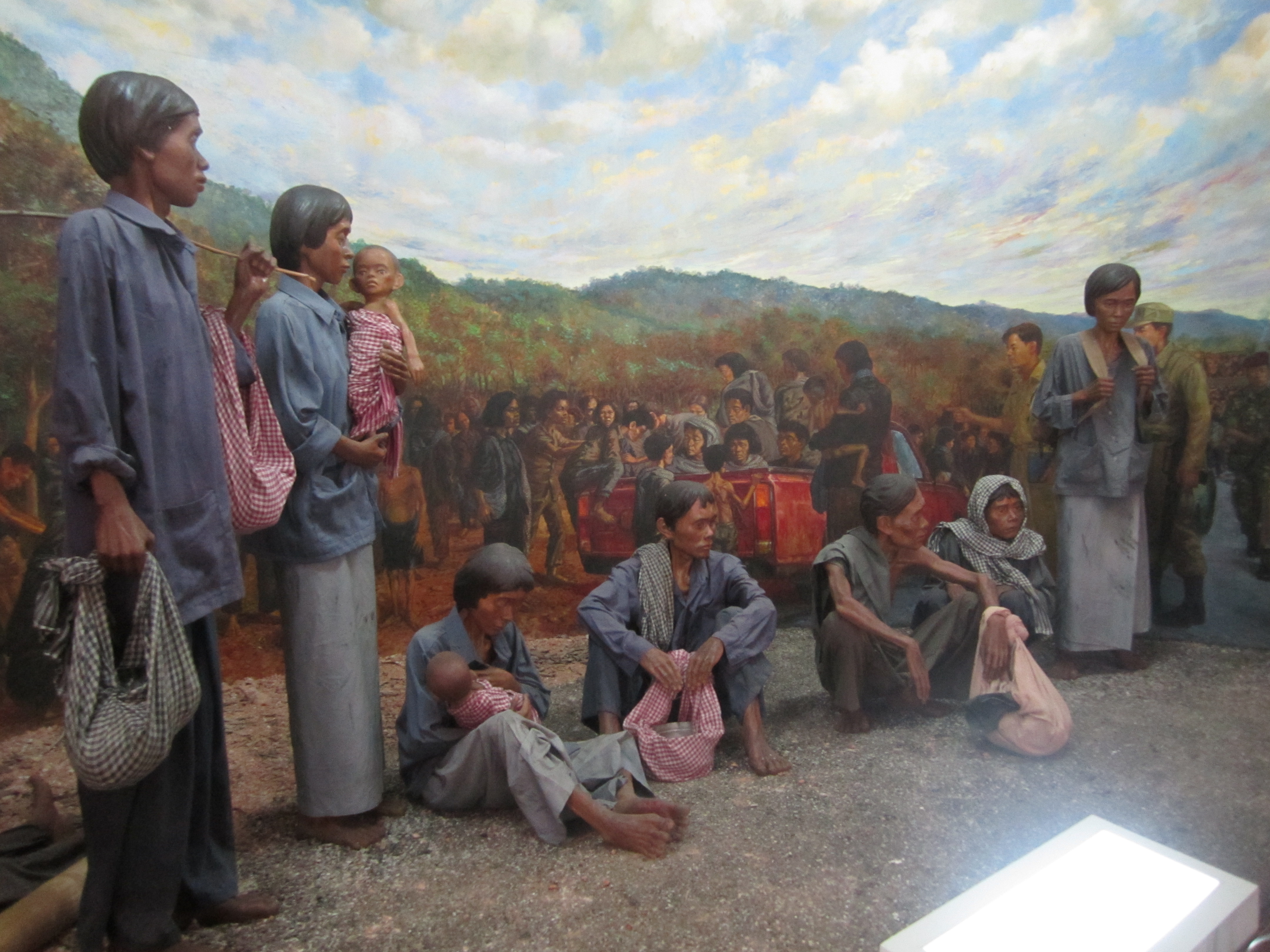
I wondered if that’s what it’d looked like—the emergence from the woods and the camp life. I thought of the newsreel footage of camps I’d seen, the faces in the camps, and decided it was worse.

(“You’ve seen The Killing Fields?” Lisa asked my mom once. My mom said yes. Lisa nodded. “It was much worse.”)

For its oddity and drama, I wondered, if there were any other museums like this, that documented this particular snippet, this part of journey, this freeze-frame from the film reel of a movie you’ve never managed to see all of, keep catching out of sequence or coming in half-way through.

I stood barefoot in an empty museum of transience, while the earth outside slowly swallowed the remains of what was left, which wasn’t much at all. I tucked some crumbled bills into the donation box, slid my shoes back on, and stepped out into the heat.

On The Road to Nowhere: Finding an Anti-Place,Part 1

"We're on the road to nowhere..."

I rode, blue pick-up truck bouncing, through the lush green and muggy grey of a Thai highway. I was squeezed between a bucket of paint, a woman’s groceries and the soft squirming limbs of two small children. Men stood on rice stacks on the back of the trailer, clutching the grating as the breeze moved through their hair.

I was on the local “taxi,” domed trucks with wooden benches in the back, and I was on something of a mission—an anti-mission to find an anti-place, a futile mission to find the What’s Left of a transient moment, blue tents and barbed wire, where babies were born and fates were written in the dusty earth.

So it was more than a visa run. I’d come to the Trat province to find the remains of Mai Rut, a Cambodian refugee camp where my friends’ parents had escaped to, where one of my friends was born. I knew it was a somewhat fruitless endeavor; refugee camps are purposefully made from temporal materials. Still, I wanted to see it, or as close as it I could come to. It was an inbetween point, a turning point, where lives were changed. There’d be little left to find, and that was, I supposed, part of the point.

I’d gotten into the town of Trat the night before, still startled by the disparity between Thailand and Cambodia. I found the backpacker area, got a cheap room in a cute guesthouse. I’d proceeded to wander around, asking every guesthouse keeper and travel agent about where I could hire a tour guide. They looked at me like I was crazy. It was the one time I was ready to throw down some money to hire someone who knew the area, and I was getting nowhere.

“Why you want to go there?” the man at Pop Guesthouse asked, eying me carefully.

“I’m working on a project. My friend was born there.”

He shook his head. “There’s nothing there. Nothing to see.” It was the same answer I’d gotten from everyone else, but it felt like he was holding back. I paused a moment, then shrugged, said thanks anyway, and continued on.

I rounded a corner, to the block behind. After walking a bit, the same man poked his head out of a doorway. “Oh, hello again,” I smiled, confused as to how he’d gotten there.

He waved me over. He spread a map out on a table, pointed. “This Mai Rood,” he pointed. It was spelled differently, but sounded the same. “But nothing to see there.” He paused. “But here, Khao Lan,” his finger moved up the green spindle of coast, “there is a museum for the refugee.”

“A museum?” I asked, amazed.

He nodded. “For the Queen. She make the refugee camp for Cambodians.” He explained how to get there, wrote the name in Thai for me in my notebook.

I sensed my moment of opportunity.

“Did you live here then?”

He nodded.

“You were a little boy?” I asked.

“No, I was 18!”

“No!” I exclaimed, smiling. (Flattery gets you everywhere.) I paused. “Do you remember it?”

He nodded again. “Yes, I work on the border then. In my uncle’s orchard.” He pointed to a place right along the black line.

“There? Did you see a lot of people coming in?”

“Yes. A lot of people come through the orchard.” He stopped there. I tried to imagine it, to hold some kind of image of what that must have looked, been like—the first foreign eyes to see these people straggle out of four years of unthinkable misery.

We stood there in silence. “Most of the camps were up here, right?” I pointed to the Northern border.

He nodded again. “Yes, but here, not so many landmines. So it’s better.” He paused again, another muggy silence. “The people here, they come from Battambang, this way,” he drags his finger across the dim yellow of Cambodia’s eastern edge along the map. I nodded.

“Mai Rood, it’s a fishing town. Big town.” I nodded, waiting. “Many Cambodians live there,” he added briefly.

“Really?”

“Yes. Here too,” he pointed at the ground. “Trat too.”

“People from the camps? They stayed?”

He nodded again. We stood another moment. “Maybe I have picture somewhere. Maybe you want to see it.”

My eyes widened. “Definitely!”

“I have map too. I go look and bring it to your guesthouse. You stay—” and he named my guesthouse.

“Yeah,” I responded, amazed. What was this guy, the hospitality ninja?

“I see you earlier.” He paused. “Okay,” he folded up his map and smiled. That was it; we were done talking.

Of course I wanted to know more. Of course he knew more, more he wasn’t saying. But who was I to ask, to push? I’d already gotten far more than I otherwise would have.

I thought about the time it would take to coax the whole story out. I wondered for a moment if he’d ever even told it. Why should he, now, there, with me, a Western girl wandered in from the street? It would take months, I decided—at least that, and I don’t have that now. But if I really want to do this project, and really want to do it right, that’s what it’s going to take.

But for now I had all I was going to get. And it was a helluva lot more than I’d come with.

A Silence Created By A Mighty Sound Is Still A Sound

Bomb Ponds, Sa Sa Bassac

This is it, I thought. I’ve hit the wall of my own silence.

When I started my trip, on through when I first got to Phnom Penh, I was on fire. I couldn’t stop writing. It came like a flood, from some damp corner of my brain, out my fingers; it came menstrually, ravenously. I couldn’t turn it off. I felt like, for every hour spent outside, I needed three hours to write everything I saw. I was exhausted, and I was in the zone.

And then, and then… Something in me closed the door.

Other doors have closed too. Or haven’t opened to begin with. I had a crap morning. I’d made an appointment to meet with the Acting Director of PADV, a leading domestic violence NGO. Domestic violence is central to the story I have to tell, though I haven’t wanted to look at it. Or rather, I’ve only been able to look at it sideways, head cocked askew, the way my brother watches TV. I’ve stolen a glance at its countenance, its cruel shadow, and I’ve quickly glanced away.

But I wrote the organization, and someone actually wrote me back and was willing to meet. And that’s pretty much what I’ve been doing here in Phnom Penh—standing in a hallway (a skinny dim hallway with a full-length mirror at the end, where I see myself and also something else, a shadow moving perhaps, though I don’t know of what), knocking on doors and waiting to see which ones open.

I woke up with a knot in my stomach and full of nervous energy. I was uptight about the meeting, self-conscious and stressed. I was dreading talking about what we were going to be talking about, something I haven’t been able to find much qualitative information on—the reality of domestic violence in Cambodia.

I never made it to the meeting.

In classic Phnom Penh fashion, I got lost. I tried to look up the address the night before, but Google Maps has proven useless for this city. I got a motobike 40 minutes before the appointment, a confused old man with deep wrinkles and busted plastic sandals.

We eventually found Street 271, but the building numbers didn’t make sense. They stuttered, jumped from 5 to 36 to 300, back to 60. Evens and odds hop-scotched across the sides of the road. Up and down the hot, dusty road, sweating in my tattoo-covering cardigan, scanning the storefronts for addresses, searching for some kind of sense, a logic, a meaning and order, finding none. Sometimes there isn’t one.

We finally found #269, but it was not an NGO. It was a dress shop. I showed the woman, sitting in her pajamas amidst the sequin-studded manequins, the name of the organization. She frowned, waved her hands in the air. I felt forlorn, a kind of panic rising up in me—but why? What for? I felt like I was going to cry.

I handed the motobike driver $2.5, far more than the ride was worth, and thanked him. I tried to call PADV; my phone died. I wove through the traffic to a call center; I got through to PADV, but then the line cut out. I used the internet, wrote them an email, idled while I waited for a reply.

I never heard back from them. I missed my appointment. I felt like I’d hit a wall, alone in the hall with only the echo of my knocking. It was an awful sound, a rhythm like a feeble heartbeat. There was a curious feeling welling up in me, a kind of black hysteria. What was this? I didn’t know; all I was sure of was that I needed to go back to my apartment.

Maybe this is it, I thought. Maybe I’ve gone as far as I can go with this project. Maybe I’m not ready, maybe it’s too much, maybe the doors are locked too tightly, maybe the silence too deafening, maybe it’s that way for a reason.

I went out later for food. I ended up wandering further than I’d meant to. I was close to the Royal Palace, decided to stop in an art gallery I’d been meaning to check out, the only independent art gallery in Cambodia, started up last year by a collective of “new generation” photographers.

The slim doorway led to a dusty stairwell. I squeezed up the narrow passage into Sa Sa Bassac‘s gallery space. The nine photographs on the wall constituted Vandy Rattana‘s The Bomb Ponds, photographic documentation of the craters left behind from American B-52 bombings.

(“In my province,” the downstairs neighbor, who translates conversations between my landlady and I, said, “many people still hate the Americans for the bombings.” He smiled sheepishly, boyishly and looked away.

“You know,” I told him, “most Americans didn’t know about the bombings then. It was kept a secret.” I paused. “And most Americans still don’t know about them.”)

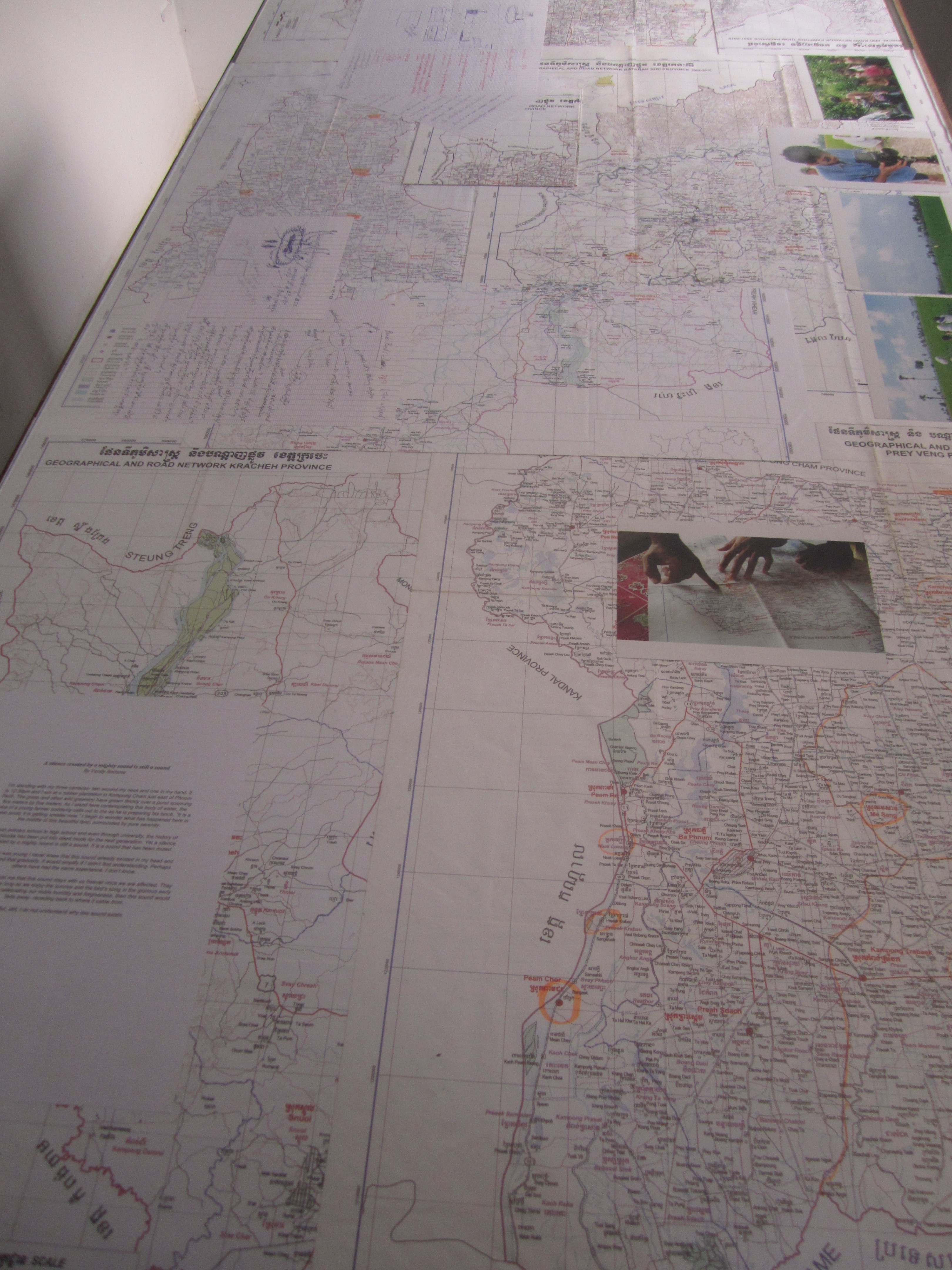
In a back room, sweaty and lit by sunlight, was a table laid out with maps from Rattana’s expeditions to the bomb ponds—black-and-white line drawings circled with highlighters, neon halos and Khmer scribblings. A single typed half-sheet of paper told a story, held a key, a small sound of knocking, knocking…

From primary school to high school and even through university, the history of Cambodia has been put into silent mode for the next generation. Yet a silence created by a mighty sound is still a sound. It is a sound that has been muted.

When I was young I never knew that this sound already existed in my head and body, that gradually it would amplify if I didn’t find understanding. Perhaps others have had the same experience. I don’t know.

My parents told me that this sound stays with us forever once we are affected. They told me as long as we enjoy the sunrise and the bird’s song in the glorious early morning whilst celebrating our noble humility and forgiveness, then this sound would fade away, receeding back to where it came from.

But still I do not understand why this sound exists.

I stood in the heat, in the echoes of street, and nodded. Thank you Vandy, I thought. Thank you.


Fuck you, I love this song. And orange turtlenecks.

Old Films, New Stories and Sifting For Clues

I got another clue the other day.

That’s what I feel like I’m doing: sifting around this city for clues. I’m working on my Glimpse project, which is really a personal project, a mammoth undertaking of which the writing is only the very end result, a small part of the process.

What I’m trying to do is reconstruct a story—a story of the past, that was only ever told in fragments, and now those scraps are all that’s left. I’m trying to string them together, make some sort of linear, coherent narrative, though I’m not sure why or what it’ll accomplish or change or relieve.

Because there’s not a linear, coherent narrative. There was once, perhaps, but it’s gone now; the chance to know it is gone too. And the silence and the blank spots, the unknowing—they tell a story too. They tell a story I know much better than the scraps themselves. It’s a story I’ve locked away, in my own kind of silence—a story as foreign to me as the dust and traffic of this city, the microbes in the water, floating in an unseeable dance.

And here’s the other thing I’ve been thinking: what the fuck for? Aside from the huge, glaring fact that it isn’t my story, or is only tangentially my story—my own story is still too dim to know, to touch or hold or let alone tell—aside from that, there’s the Why. Why do we seek out the past, feel a need to understand it, or at least know it—a past we didn’t even live? What does it accomplish or change or relieve?

I went to Bophana yesterday, sat on a straw mat in a corner of a dim room with no fan, and watched New Year Baby. It’s a documentary by a Khmer-American woman about her search to learn about her family’s history and war experience, what was always kept a secret from her. There seem to be more and more foreign-born Khmers doing this—traveling back to Cambodia, seeking out answers, trying to find the full story, the reel from which they’ve only ever seen clipped stills.

It was an excellent film. But the question that kept ringing through my head was Why? What’s this need in us, drive in us, all of us, to know where we come from? And what does it mean for the generations growing up in silence?

In any event, 500 words later, here’s the clue I got. I met with Sithen Sum, director of Kon Khmer Koun Khmer. It’s a collective of young Cambodian filmmakers—the “next generation,” as they’re called here. I’d met him at the opening of the Vintage shop, where repaintings of Cambodian Golden Era film posters intrigued me.

We met at a Western cafe. I was dry-mouthed and bleary-eyed from an all-night bout of traveler’s stomach, but I refused to miss our appointment. We sat in the air-conditioning and talked about the organization’s work: the short films they’d made, the way they’re all volunteer-run, doing all the projects in their off time from other jobs, full-time, money-earning jobs.

The organization grew out of a 2009 exhibition curated by French-Khmer film maker Davy Chou focused on reviving 60s and 70s Cambodian films and bringing them to the public.


Trailer for Chou’s upcoming documentary about Cambodian film revival

Chou led workshops and classes in film making, and inspired the formation of Kon Khmer Koun Khmer. The group has gone on to make a few of their own films, with another to be released in May.

“It started as a revival,” Sithen told me. “We see the old cinema as a bridge to make something new, to create something of our own.”


Trailer of Kon Khmer Koun Khmer’s first film, Twin Diamonds

It was so simple, so succinct: to make something new, they have to know what came before them. To know who you are, you have to know where you come from. Artistically, I’ve always known this is true—where would I be without the works of all those writers I’ve adored that came before me? You need to lineage to build on, whether its a family tree or a film reel.

This was the clue, staring me in the face, living inside me—that took someone else’s words to realize.

“We love the old films like realitives,” he said. “But we’re also critical of them.” They especially don’t like the universal practice of voice dubbing used in the old films. The group is more influenced by foreign methods, Sithen admits; they want to apply foregin knowledge to make new films. “We don’t want to go back to the past,” he told me. “We want to learn from both the successes and mistakes of the old films.”

They want to know where they come from.

Fragmentary Thoughts at the Killing Fields

Late afternoon sun through the trees, dusty lot and birds singing, the stillness of a temple. I slide off my shoes and the tiles are hot on my feet as I walk slowly around the pagoda, a tower of skulls.

And it isn’t the skulls that get me—sorted by age and gender, piles that are missing jaws and teeth, holes where the smashing happened, the jagged line were the cranium stitched itself together—lines that were hidden, kept under hair and skin, kept a secret from them, themselves for as long as they lived—and laid bare here now, with nothing to disguise it anymore: This is how you were sewn together, and this is where the wound occurred, and this is what is left.

But the skulls aren’t what gets me, because the skulls don’t seem real. It’s the piles of clothes on the bottom shelf. Shirts and shorts, dusty and tattered and vacant now, a limp pile—this is what is left.

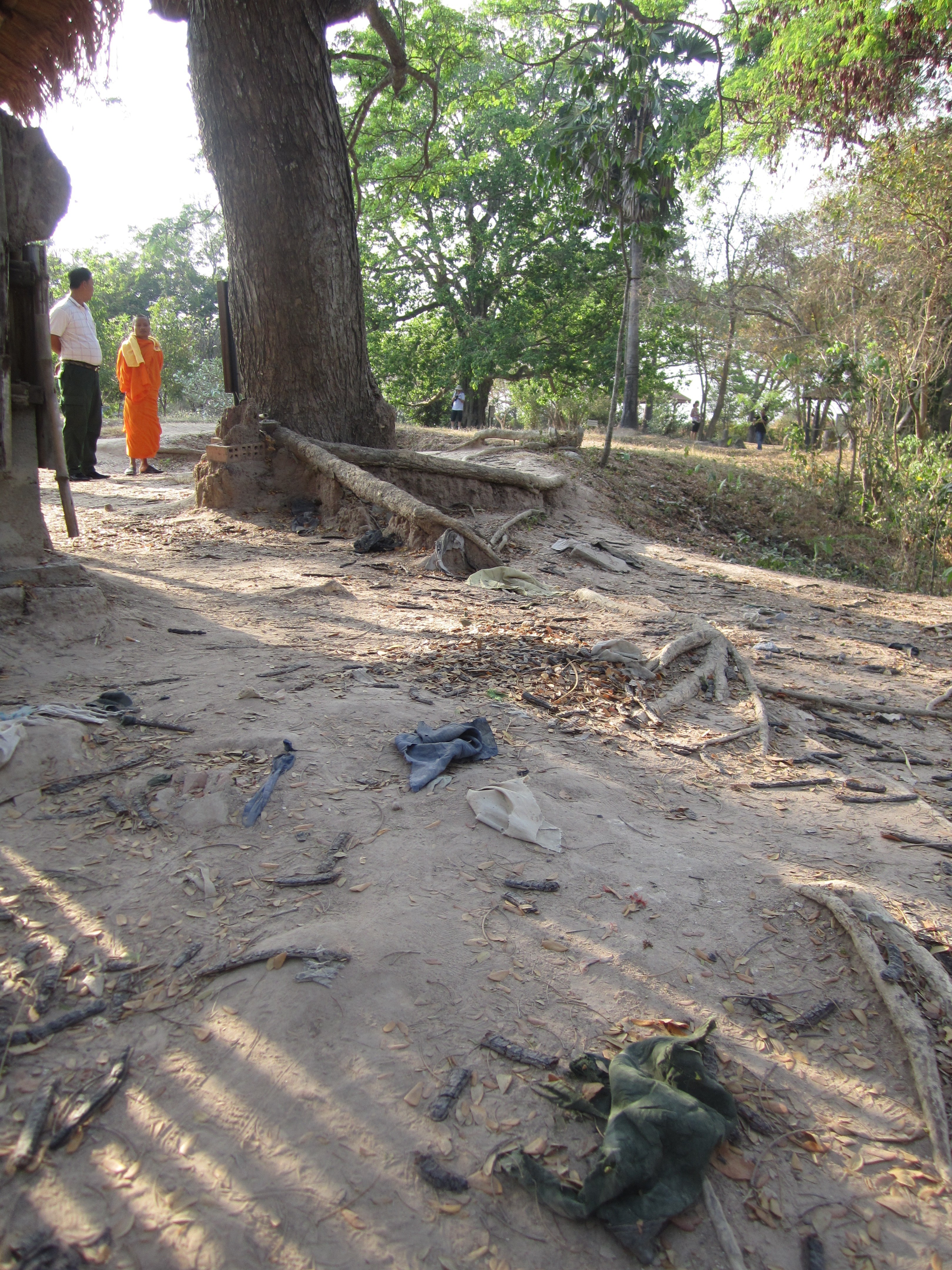
We walk through the field, where the earth dips down into ditches (it’s not rain or erosion that made these), trees that stand stoicly, silently by. We come to stand beside an exhumed grave (but “grave” is too good a word—there’s no word for what this was). A sign says that teeth and bits of bones and scraps of clothes continue to come up, out of the earth, after it rains or floods.

Sometimes the earth write the metaphors for you, I think. Sometimes the ground itself is a poem—this place a poem you couldn’t possibly ever write, no one could write, just walk through—the stillness; the birds; the smell of incense and smoke; someone burning off wild grasses somewhere, behind the fence; schoolkids singing somewhere in the wind. Two monks walking, orange robes, reading the signs with impassive faces, round faces, young young faces.

There’s scraps of clothes everywhere. “Are these…?” we begin to ask each other, but don’t finish the question. (There is no question for what this was.) Surely someone would have gathered these scraps, dusted them off, “deordorized” them as the sign said, added them to the pile of All That Is Left.

But we keep walking and I realize there’s too many, too much—scraps of clothes existing like ghosts, or souls that haven’t quite made it up out of the earth, out of what there aren’t words for, poems for—this.

The trees all saw this, I think. These same trees, noble and twisted and standing here still. Some were forced to take part, and I imagine something in them weeping, their trunks dulled and bloodied. These same trees, bearing witness, the same way they bear witness now—silent, petrified in their places, the way parts of our brains are, the way parts of our brains bear witness (secret stitching, secret from ourselves)—roots tangling and rising out of the earth, with the teeth and bones and scraps of clothing and all the things there aren’t metaphors for: a dusty field in the afternoon sun.

Vintage Sounds: The Revival of Cambodia’s Golden Era

The 1960s were a bad-ass time in Phnom Penh.

You might not have known that. I certainly didn’t, not until a work friend happened to put Cambodian Cassette Archives on my iPod. Even then, I didn’t know the extent of the dopeness, just that the psychodelic, garage sounds coming through the little white earpieces were unusual, different, haunting—an echo of another era, most of the songs flashing with an “Unknown/Unknown” track title and band name. What the hell was this, how did it survive, why was it so effing good?


My intro to Cambodian rock

Well, it’s nice to know I’m not alone. People have been digging in, excavating through the darkness, trying to revive the Golden Era of 60s Cambodian pop culture: rock, films, thick lines of black eyeliner and bouffants the color of ink. It’s an exercise in lost histories, untold stories, missing pieces, what-could-have-beens, what-shouldn’t-have-beens. It’s an exercise in facing just exactly how much was lost. And ultimately, it’s an exercise in love.

So when I saw the flyer for a vintage shop, simply named Vintage, opening in Phnom Penh’s Russian Market yesterday—um, yes, count me in.

We waded through the sweaty stalls of the market—Western clothes and traditional trinkets, vegetables and raw meat, housewares and fruit stands. Tucked beside the nucleus of food stalls, it was easy to spot Vintage: sleek, boutique design, a crowd of hob-nobbing Westerners, and insanely good music coming out of the speakers.


Bad-ass original

The shop was selling remastered CDs, tshirts of contemporary Khmer hip-hop groups, some refurbished 80s ghettoblasters (dubbed as such), a new vinyl record by the revivalist band Cambodian Space Project. It’s the first vinyl, the enthusiastic Frenchman wearing a killer pair of glasses told me, to be pressed in Cambodia since the war. (Composed of an eclectic group of Westerners and fronted by a working-class Cambodian woman, the band is actually out of town for SXSW, so I’ll have to wait til April to catch them. For a super interesting interview, check out this link.)


Cambodian Space Project’s cover

One of the most interesting things for sale at the shop—and what had attracted me to the flyer for the opening in the first place—were the “reprints” of Cambodian film posters from the 60s. All the originals of these posters had been destroyed, not to mention the films themselves. But Sithen Sum, from the Kon Khmer Koun Khmer (Khmer Film Khmer Generation) repainted versions of the lost posters. We chatted, I got his business card, yes, yes, there’ll be an interview.

I’m forming an image in my head. It’s of Phnom Penh in the 60s. It’s aided by photography books I’ve browsed at the posh English-language bookstore. It’s populated with the people I’ve seen on grainy black-and-white videos at the Bophana Audiovisual Resource Center, where I’ve spent hours clicking through the archives, where the people don’t look so different from how they do today, where the markets look the same and cyclos look the same and you could almost imagine none of it had ever happened.

The image has a sound. Behind the spotlights and sequins of it, it echoes of guitar riffs and mystery.

I’m sure this image is grossly inaccurate and veiled in layers of romanticized mystique, but right now I don’t really care. Sometimes you need a fantasy, a vision, a place in your head you can go to where everything is safe—just the glowing lights and the dancing limbs of some other time, that doesn’t seem so dead or so far away—that you let yourself pretend isn’t.

The Lone Black Dance: Tiny Toones Record Release

I knew, I knew, I knew there was something there.

You hear about an organization: Tiny Toones. Founded by a deported Khmer-American, it works to improve the lives and futures of Phnom Penh’s street kids—through, primarily, breakdance. You don’t breakdance. You’re not Cambodian and you don’t even really listen to hip-hop anymore. But there’s something about it, something about it…

I’ve recently figured this out about myself: that things I should, by all logic, experience as intense emotions, vivid memories and blazing-eyed convictions, I experience instead as far-away feelings, a vague awareness, a dim hunch in the sunlight of my consciousness (oh silhouette, oh silhouette). And so it was with Tiny Toones.

I went to their album release party last Saturday. In their four years of existence, Tiny Toones has grown to encompass additional programs: computer literacy, Khmer and English literacy, harm reduction and music. The release of their first full-length hip-hop album was the end result of that new program.

The event was held on the rooftop of the Meta House, the minimalist white German cultural center. Like the show I’d gone to two nights prior, the crowd was a healthy mix of ages and locals/expats. And like the previous show, the kids behind the mike and turnatables all looked totally hip-hop American. It reminded me of being at a Youth Speaks event.

And so there were speeches and raffles and auctions and performances. They also showed some videos, including a recording of the performace that had won the organization a recent TED Award. Participants had developed narrative breakdances that depicted defining elements of their life stories (oh undimness, oh spotlight).

A girl depicted being abused, two boys violent robbery. They’d be in black for these, at the end of each, they’d shed their black shirts, under which there were white shirts, and they’d join each other, a representation of Tiny Toones.

They do one for addiction. Boys crouched around a make-shift pipe (oh soda bottle, oh tin foil). The kids in white pass by, and every time they take another boy in black with them. Finally there is one boy, in one spotlight, alone on the stage.

He does a strange dance, beautiful dance. His shoulder arch up like he’s attached to strings (oh puppet child, oh puppet child)—he rises, chest first and lungs full—and then drops back down, as though whatever held those strings (oh God-like fingers, oh typewriter of fate) had dropped him suddenly—and he crashes to the floor, the bottom, or what appears to be the bottom—in real life there’s always further you can go, downer and downer and maybe even death isn’t the basement (oh elevator of addiction, oh wobble of the cablewires)—maybe the dance continues on after that, into that, souls arching and crashing endlessly, winglessly.

Anyway, he carries on like that—spotlight and a bare stage, rising and falling around the homemade pipe—and I think: Well, isn’t that just it? Isn’t that the dance of it?

And it surprises me how much I relate to it. Though it shouldn’t. Because even though it would outwardly appear that I have even less in common with this kid dancing, a Cambodian streetkid, than oh, say, Charlies Sheen—you strip away the details, the circumstances—you strip away the lights and setting and the props—and isn’t that all you’re ever left with? Isn’t that all we (oh puppet children, oh puppet children) ever really do?—a lone black dance on a barren stage?

I smiled and thought: Of course, of course, of course.

O body swayed to music, O brightening glance,
How can we know the dancer from the dance?

—William Butler Yeats

Dance, Dance, Evolution: Aerobic Dancing at the Olympic Stadium

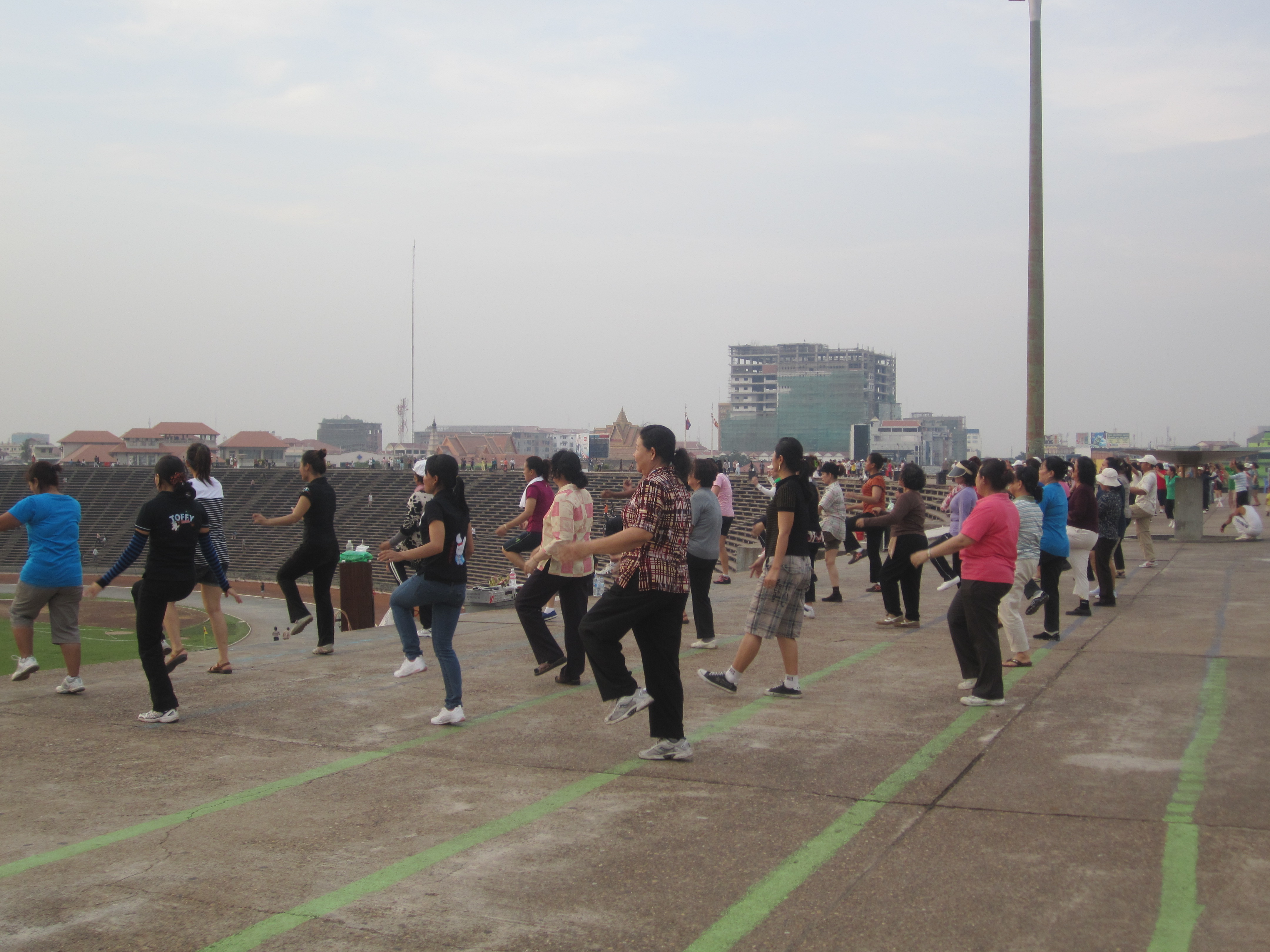
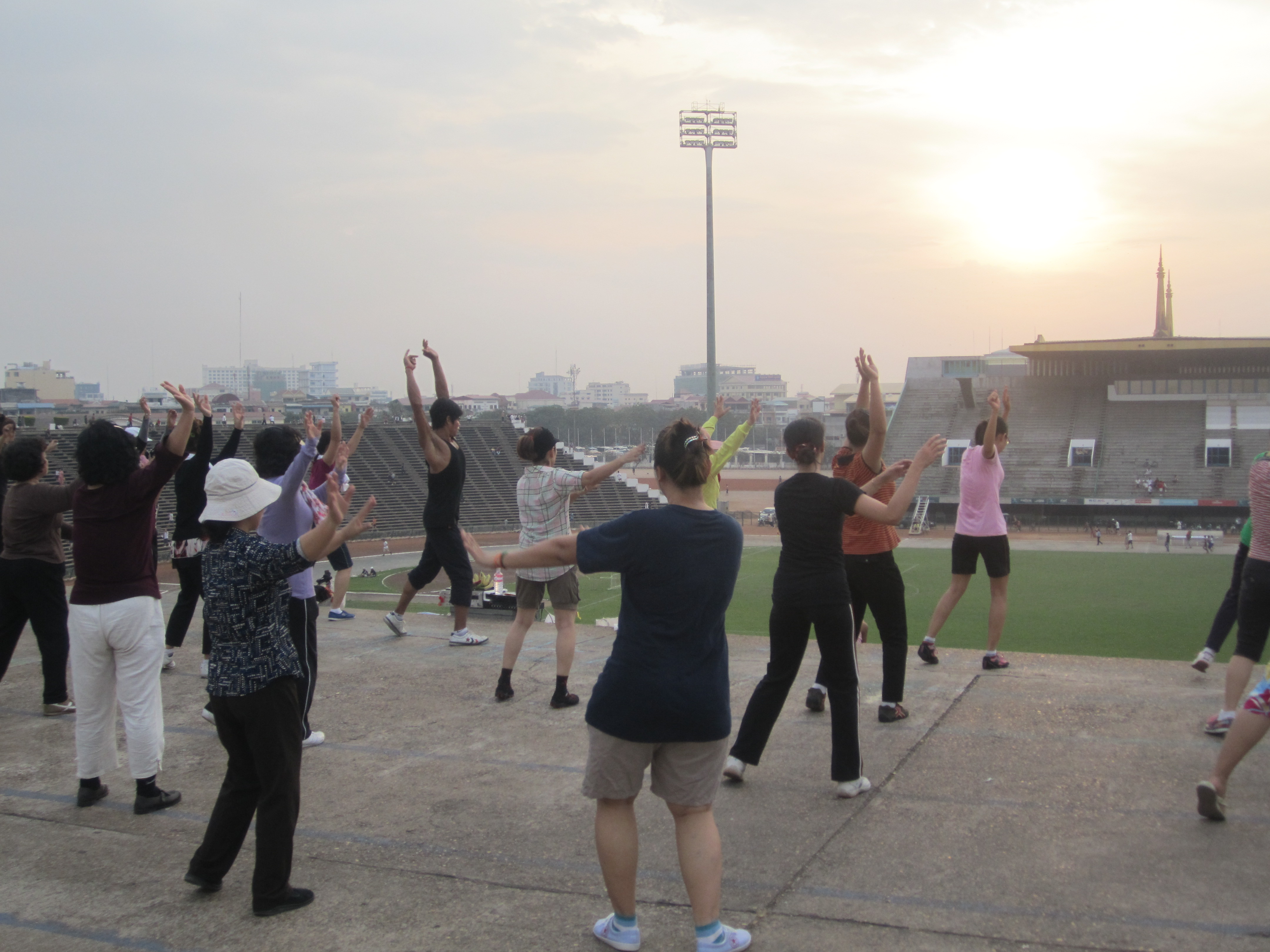
It’s dusk at the Olympic Stadium, and it feels like a festival. Vendors have set up stalls selling snack foods, beverages, trinkets. People in sweat clothes swarm. Cliche club dance music beats out of stereosystems and, lined up along the cement ring of the stadium’s top tier, little old ladies dance.

It’s called Aerobic Dancing, and it’s about the goddamn most endearing thing I’ve ever seen.

I saw it my first night in Phnom Penh, along the riverside. A few sets of stereospeakers had been set up, and young men were leading groups in dance moves. I thought it was something for tourists, some sort of street performance. I looked for baskets of money and didn’t see any. Then I scanned the expressions of the dancers’ faces, and they were all totally in earnest, concentrated of getting the moves right. Now this, I thought, is something different.

It was recommended to me later that I go to the city’s Olympic Stadium at dawn (um, no) or dusk (um, yes!) to see some real aerobic dancing. Well, you didn’t have to tell me twice.

It’s bustling leading up the steep slope of the stadium’s entrance. People swing their arms and legs, warming up. Children run around. I get to the top, and it’s a buzzing beehive of fitness. People run the stairs. Down at the bottom, a crew of joggers circle the dirt track. But the overwhelming majority of people at the stadium are late-middle-aged women. And they are there to dance.

Now, I’m quite familiar with old ladies doing Tai Chi in the parks at dawn. And I’m even used to random young Western dude who thanks to Ghost Dog has aspirations of becoming an urban samurai and practices along. But this is something entirely different.

About a dozen different stations are set up along the stadium’s ring, where a cool dusk breeze passes. Their music and moves are all slight variations of each other: twists and kicks and stretches and arm raises, a little fancy footwork from time to time. The people in the front rows sweat, focus intently. Most of the others vaguely step along, moving this way and that, sometimes getting the moves right, sometimes not. It doesn’t really seem to be about that.

The leaders of all of these groups are young men, teenagers in some cases. Hair swept across the face, pink shirts, dedazzled jean pockets: they are boys that by American standards would be categorically, 100% flaming gay. But they’re doing their thing here. And a crew of older ladies are doing it with them.

I sit and watch for awhile: the various sets of raised arms, the shakes and twists, the echoes of club music. Before the Khmer Rouge, dance was one of the most important art forms in the culture. Most of the country’s dancers, along with other artists, were killed.

Well, this might not be a revival of a lost traditional art form, but it might be an evolution of that. It might be a new manifestation of a cultural predisposition to dance. Or it could just be exercise, set to a melting sky and sweet as fucking hell.

Not Your Normal Expat Scene: Khmer Kids Coming Back to Cambodia

“This not your normal expat scene.”

That’s all I kept thinking last night, as I stood sweating and stomach-sore in the crowd. I’d dragged myself out to a show, what was described to me as an all-girl indie rock band that sang in Khmer. Killer. No traveler’s flu would make me miss this.

It was a funny mix—local men in dress shirts and slacks, women in those super foofy sparkly dresses; kids, some just in the crowd, others wearing matching shirts for some organization I couldn’t quite make out.

And there were your typical expats—Western, mostly white. Some of them were extremely well-groomed, reeking of cologne and hair spray and kissing their friends on both cheeks. Some of them wore that aren’t-I-so-cool-for-being-here look. Some tried to dance along or move to the beat, and it was sad and cute in the way it’s always sad and cute. And others just seemed to be there, watching, enjoying the show, because that’s what there was to do that night.

But the kids putting on the show—the kids on stage and holding the cameras and checking the sound—they were not your normal expats.

Your typical expat does not drop their “to be” verb (“She crazy”), doesn’t say “y’all” or “aight.” They don’t wear baggy jeans and puffy sneakers. They don’t start NGOs called Tiny Toones or hip-hop groups called Klap Ya Handz, written in Godfather font. They don’t breakdance or freestyle or bust—and they don’t do it in the language native to their new homes.

I’d heard about the show from Bel, a girl I’d found on Couchsurfing. We had plans to meet up for coffee and even though my stomach was already getting wonky, something told me not to flake.

She was a cool girl and we talked for awhile. Her boyfriend was a Khmer-American who’d moved back to Cambodia, with no intention of ever leaving again. “He’s the most patriotic Khmer you’ll ever meet,” she said, and later he showed me the tattoo of a famous Wat across his back.

“There’s a lot of foreign-born Khmers moving back,” Bel told me. “Lots of artists and young people. And they’re really motivated to do something here.”

I wanted to see this; I wanted to glimpse what this was. Sure, I knew of people going back to their parents’ countries for a visit, but to live? To give up everything they know to fight for something better in a country they hadn’t grown up in? This was something different.

And it was. The show place was buried deep inside the maze of a mall, shuttered shops and a blinking arcade, bowling alley and bumper cars. I got there earlyish, paid a $10 cover—normal for the US, but exorbitant for here.

On stage was a DJ, two turntables and a MacBook glowing. Two artists were on stage, doing ad hoc graffiti art on a make-shift wall. “Empire State of Mind” came on. It was like being at any hip-hop show at home—except a hell of a lot hotter.

The first act was a hip-hop group called Klap Ya Handz. They spoke in a working-class English, like kids that grow up in Oakland. But in the songs, they flowed in Khmer. For one song, they brought out traditional Khmer drummers that were, well, bad-ass. During another song, the lead girl did what she later called “Khmer hands,” a hip-hop take-off on the hand movements of traditional Khmer dancers.

Cambodia lost a whole generation of artists during the Khmer Rouge. Traditional dance was virtually erased and, after Pol Pot, there wasn’t anyone left to pass it on. I’d read accounts of the few survivors left trying to teach the next generation, and it being hard—they were more interested, as teenagers usually are, in contemporary things. Like hip-hop.

The headliner was Laura Mam and the Like Me’s. They’re a bluesy, all-girl rock band from San Jose, California (local love). They’re Khmer-American and sing in Khmer. The crowd obviously loved them, singing along and snapping photos and waving their arms. I was told that they came to play in Cambodia relatively often. Either way, they showed the same kind of passionate pride in their Khmer culture that the kids in Klap Ya Handz did.

They played a song called “Diaspora”: “for all the refugees living in diaspora around the world—and missing Cambodia.” The crowd went crazy.

No, this wasn’t your normal expat scene.

Your typical expat is someone of relative priviledge; they have, say, a university degree and the social mobility to pick up and move around the world. Maybe they studied abroad, or spent time backpacking around. In any event, it occurred to them to leave their home countries in the first place and they had the means, however meager, to do it. The ones I encounter are largely middle-class; the uber wealthy ones exist on another plane, and I only see them in passing—the immaculate girls on the streets of Hong Kong.

These kids were categorically Not That. They’re the kind of kids, in the kind of scene, that I miss when I leave the US; when I think about moving abroad, I think, “Man, there’s so much shit I’d be missing” and this is part of what I mean.

And they bring their Americanness—their very, very Americanness—back here. But they’re making something new with it; there’s that frenetic energy, that spark you feel when cultures collide and you see people that are so intensely passionate about what they’re doing, you can’t help but feel it too.

Of course, not all of them are coming back by choice. The US opted to deport foreign-born convicts, regardless of whether they’d served their time, and nearly 200 people who were, for all intents and purposes, American were sent “back” to Cambodia. They brought their culture, a street culture, and they brought their art. And they’re doing shit; they’re bringing this to the kids of Cambodia, the next generation (ie: Tiny Toones).

So basically, watch the fuck out for these kids.

There was a shirt I kept seeing in the crowd, tons of kids wearing it. Its design was a take-off on the Star Wars logo, and it read: “The Khmer Empire Strikes Back.”

This was my first glimpse into this, my looking-through-the-peep-hole into this. I fully intend on investigating this more during my time here. But last night, sickness was calling, and I had to head back to the hotel.

Suicide-Proof

I dreamed your apartment was suicide-proof:
those little half-windows
that only open in slits,
like doped-up eyes,
how we blew the smoke
sideways and down
and it couldn’t really make it out,
just blew right back to us.

I asked if there were earthquakes here
and you said there weren’t,
but I didn’t believe it—
not that I didn’t believe you,
but I didn’t believe the earth—
that somewhere down
under all this something
was shaking,
ready to shake:
the smell of a seizure
before it erupts.

I got up and paddled
my bare feet across the floor,
my bad ankle snapping.
I realized I’d forgotten the kitchen window,
that slides open wide—
a ledge and a little metal railing
that wouldn’t be enough
to keep a body from crouching,
crawling out
to the 16 stories
of honking beneath.


Lauren Quinn is a writer and traveler currently living in Hanoi. Lonely Girl Travels was a blog of her sola travels and expat living from 2009 to 2012. She resides elsewhere on the internet now.

Join 490 other subscribers

Buy This Sh#t

Categories