Archive Page 11

10 Thoughts on Being Back in the US

1. Riding in my dad’s truck, MLK:
“So what does it feel like to be back?”
Look out the window, lines of lanes and sidewalk. “Everything feels really sterile. And clean.”
“Sterile and clean? Not usually words associated with Oakland.”
Laugh. “Yeah, I guess not.”

Empty

2. Running around the lake, joggers in sweat clothes:
Everyone looks really healthy here—big and robust, cheeks flushed.

3. Whole Foods, walk around for an hour, confused—pick up food, put it back down:
How do you shop in a grocery store? Everything looks plastic.

4. Winter-like storm, long pants and a jacket:
Everyone else may be annoyed, but I’m tickled to death.

5. Waiting to make left turn, watching the cars:
The US feels like a video game, some kind of old-school Atari: little boxes moving through space. The object of the game is to stay between the lines, stay in the lanes, walk on the sidewalk, put trash in the bin…

6. Rapture billboards:
Why?

7. Waiting to meet Nhu and Jacobo outside Bette’s Cafe, watching family:
“But I’m huuuun-greee.”
“Well, we have to wait.”
“But I don’t wa-nnnna.”
American children are allowed to be really obnoxious.

8. Wine meeting for work, varietal characteristics and spit buckets:
This is my job. This is silly.

9. Drive to meeting, park; drive to yoga, park; drive to cafe, park:
My life feels like a video game. I’m not sure what the object is.

10. Waiting at stoplight. Car beside me: bass bumping, boy leaning out of the open window, shirt half-off, arms raised, dancing:
There is nothing, nothing in the world like African-American culture.

Hello Oakland

Hello taco trucks and Priuses,
Hello hyphy dreads and flannel shirts.

Hello berry season.
Hello farmers market.
Hello Blue Bottle, hello Strauss milk from a glass bottle.
Hello expensive cigarettes and cheap muesli.

Hello Muay Thai.
Hello jump rope, hello downward dog.
Hello pit bulls.

Hello Victorians and sky scrapers
of San Francisco in the distance.
Hello sound of trains at night.

Hello sound of kids playing
beneath my bedroom window.

Hello rock n roll shows and dance parties,
Hello art openings and literary magazines.

Hello back porch.
Hello leaves on the tree
and dead plants in the pots.
Hello Mick in pajama pants.

Hello vanity,
Hello bathrobe.
Hello stripped apron and wine notes.

Hello driving,
Hello seat belts,
Hello potholes on 880, arching
up the overpass past the railroad tracks—
Hello building
I’ve got tattooed on my arm.

Hello fog in the morning and fog at night,
Hello fog breaking
in the afternoon light.

And, why not: heading-home jam I can’t get out of my head…

Goodbye Southeast Asia

Goodbye motorbikes droning and motorbikes honking.
Goodbye face masks and flesh-colored socks,
Goodbye pajama suits.

Goodbye dragon fruit, goodbye jack fruit,
green mango with chili salt from a push-cart.
Goodbye cane juice in a plastic bag.

Goodbye cows in road and chickens on the bus,
Goodbye water buffalo rising
from puddles in the rice paddies.

Goodbye orange robes and incense,
clusters of bananas
fanning open at the altar.

Goodbye karaoke
and pop music videos on the bus.
Goodbye wedding tents.

Goodbye mosquito nets.
Goodbye heat rash and swamp bra.
Goodbye hand-washed underpants hung to dry.
Goodbye cheap cigarettes and expensive muesli.

Goodbye “cheap cheap,” goodbye “same same,”
Goodbye mile-long mole hair,
Goodbye aerobic dancing at dusk,
Goodbye tissues under the table,
plastic stools and street stalls.
Goodbye haggling with fingers and haggling with calculators,
Goodbye maze of the market,
sleeping on top a pile of clothes—
Goodbye tubs of flopping fish and plucked limp birds
hanging from hooks.

Goodbye currency conversions and foreign transaction fees.
Goodbye photocopied US money
half-burnt on the sidewalk.
Goodbye no sidewalk,
walking in the street.
Goodbye bootleg guidebooks with cheap spines,
bootleg DVDs with blurry casings.

Goodbye thunderstorms,
Goodbye heat.

Goodbye widows with shaved heads,
Goodbye schoolgirls in sarongs.
Goodbye children begging and children waving,
children perched
between their parents on a motorbike
sleeping amid the fury.

Phong Nha Farmstay, F*ck Yeah

I could tell by the way he slid the business card over to me, by the utter seriousness in his eyes, that he wasn’t fucking around. “Hands down, without a doubt,” he stabbed the card with his index finger, “the best thing I did in Vietnam.”

I put the Phong Nha Farmstay card in my wallet. It stayed there for nearly 3 months. I knew I’d be headed back through Vietnam for my flight home and, now, I knew where I’d be stopping along the way.

Central Vietnam’s caves have been making a lot of buzz lately. A few months ago, National Geographic ran a feature on the newly discovered Song Doong/World’s Biggest Cave. And Thien Duong/Paradise Cave, which had previously been thought to be the world’s biggest cave, officially opened for tourism. Not that I’m the biggest cave person in the world—just that I’ve traveled enough to know that the best recommendations often come, not from guidebooks and tourists offices, but from other travelers.

And so it went with Phong Nha Farmstay. Sure, I could have ventured out to the area independently. Or I could have done a day trip to Paradise Cave and been sufficiently blown away by the other-worldly spectacle of it: stalactites dripping and stalagmites rising, looking like sea kelp, so that I didn’t know where in the earth I was, so that I looked up at the cathedral of limestone and exclaimed, “Holy shit, I didn’t know the earth could do this.”

I could have stared out of a bus window at the Ke Bang National Park that contains the cave, as well as some 300 others, and I could have seen American bomb craters or perhaps even spotted the rare langur monkeys that we saw rattling around in the trees.

But I wouldn’t have ridden down Victory Highway. I wouldn’t have gotten to learn the local history so well. I wouldn’t have watched a former VN medic squat down beside a girl’s motorbike-accident wound and apply crushed penicillin to dry it out and keep the insects away. And I wouldn’t have had a pool to swim in or killer food to eat either.

Phong Nha Farmstay opened in December 2010, in the same month as Paradise Cave. While the nearby Phong Nha Cave was the second largest internal tourism site in Vietnam last year, the area is still largely unknown to Westerners—children still wave when you pass by, women touch your curly hair curiously and giggle, and you don’t see a single “Good Morning Vietnam” shirt for sale. But with the biodiversity and political history of Ke Bang National Park, and the never-ending quest of travelers to find the “real” fill-in-the-country’s-name, the region unlikely to stay that way.

Which is what Phong Nha Farmstay is banking on. Its 7 private rooms and 1 dorm room were never full during my 3 night stay, though this too is unlikely to stay that way. The place is run by Australian expat Ben and his Vietnamese wife Bich, who grew up in the Cu Nam village where the farmstay is located; milling around are also their infant son; Ben’s daughter; Bich’s mother (the medic), father and brother; and a slew of easy-going staff. They set the tone for a professional yet homey environment—solidifying my view that, more than uniforms and fawning, the best thing you can do in the service industry is really, truly give a shit about your product and your customers.

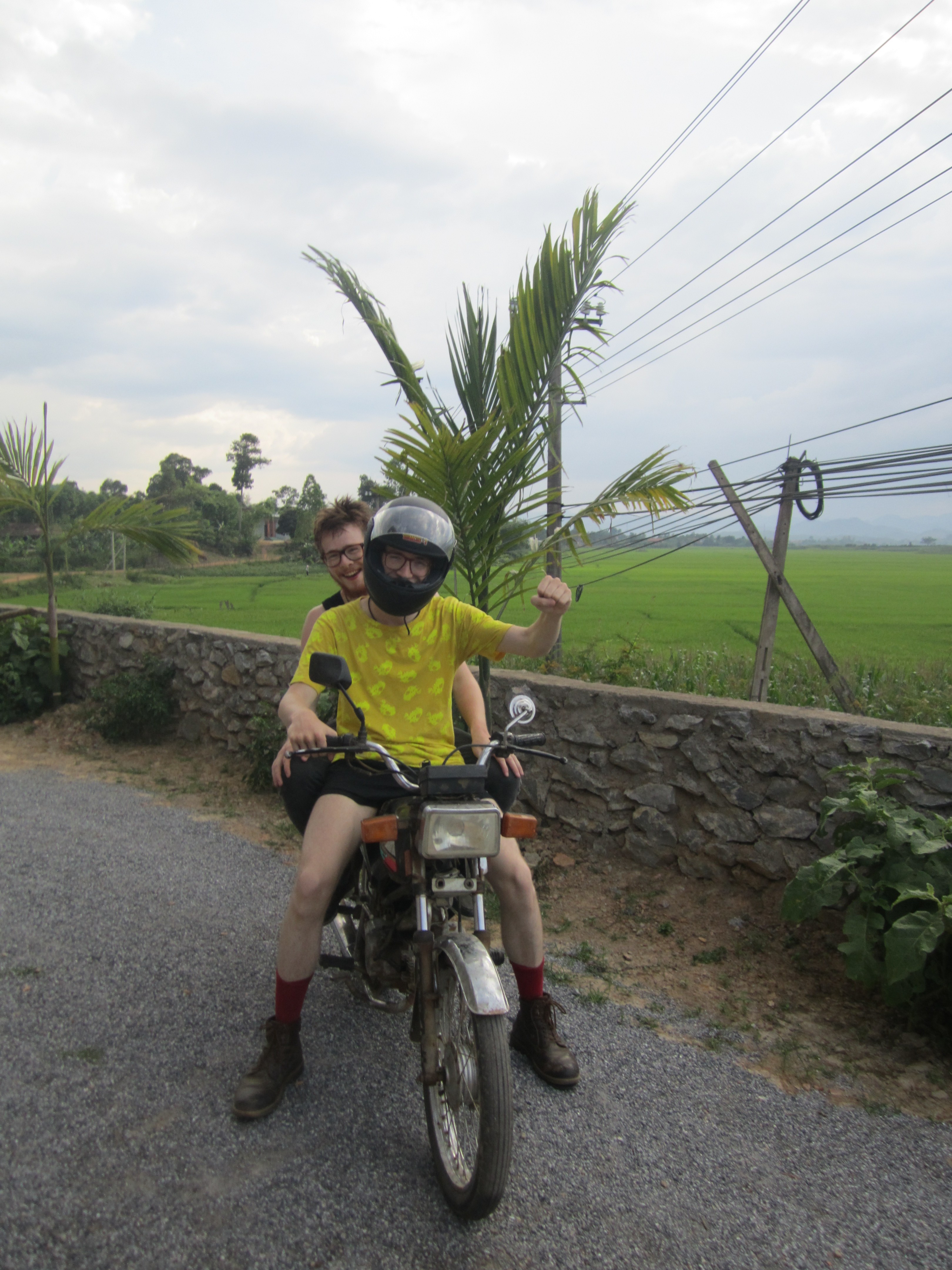
I took their 1-day tour of Ke Bang National Park and Paradise Cave. We rode on the back of motorbikes, down Victory Highway, which is officially closed to foreigners (Ben’s wrangled some kind of deal, I didn’t ask what), which was built to transport goods during the war. Riding down the near deserted highway, I couldn’t see any of the rare mammals or the thousands of species of plants or birds that the park contains—all I could see was dense green, the cliffs and peaks of mountains, the white flutter of butterflies along the roadside.

We made several stops along the way at sites important to the Vietnam/American War. North of the DMZ line, the Ho Chi Minh Trail runs through the park, which was heavily bombed during the war. A museum is currently being built. We stopped at the memorial 8 Ladies Cave, as well as a somewhat-obscured vista of a downed helicopter.

The tour was led by Ben and his buddy Dave, a white dude with deep smile wrinkles, a camouflage vest and a permanent cigarette dangling from his lips—the kind of semi-grizzled expat guys that off-road motorbikes and cold beer were made for. They were knowledgeable and funny and didn’t take themselves too seriously. Along for the ride was also their underling Tom, a recent transplant from Hanoi Backpackers Hostel, who had Iron Maiden board shorts and the greenest goddamn eyes I’ve ever seen.

Paradise Cave itself was a trip. It was designed by a private developer, and felt like a tasteful, eco-Disneyland. There was an automated turnstile and go-carts to transport the half-dozen tourists we saw. Unlike the nearby Phong Nha Cave, decked out in red, green and purple disco lights, Paradise Cave is lit with energy-efficient lighting. We wandered through the kilometer of deck open to the public, our voices the only ones echoing in the cavernous dark.

We then stopped by a mountain-stream river, where we stripped off our clothes and leaped from rocks and sunbathed and poked around the lagoons and sandy shores. We were lucky enough to spot some langur monkeys hopping around the trees on our way back to the farmstay, where we chilled and drank smoothies/beer.

And I have to agree with the random dude, whose name I forget, who handed me that business card all those months ago—Phong Nha Farmstay was the coolest thing I did in Vietnam. It gave me a fuller, more complete experience of the country—what it’s like outside of the cities and the tourist towns and even the beaches. I don’t think I’d be walking away, as I will in a few short days, with the same picture of Vietnam if I hadn’t gone there.

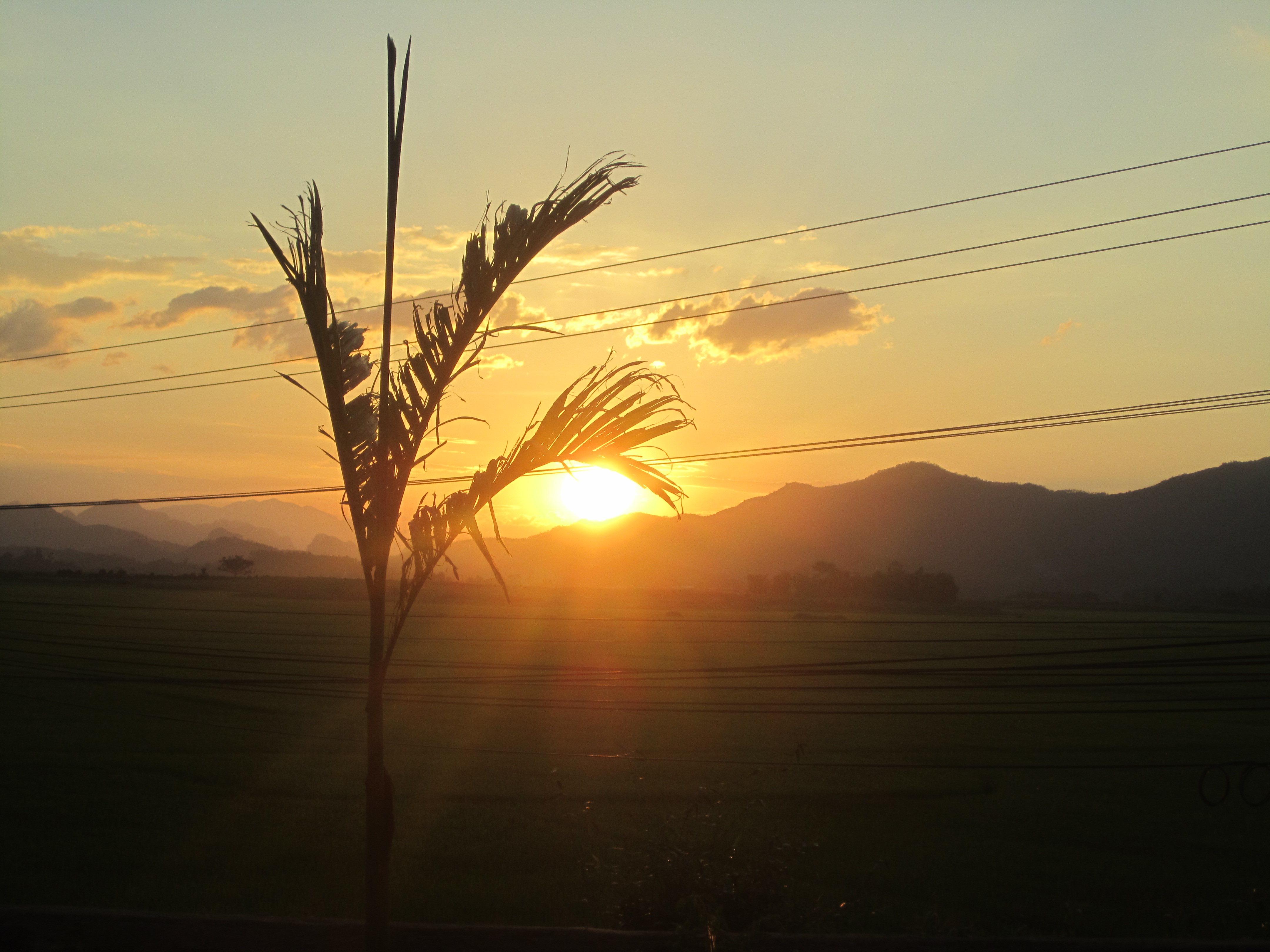
Sunset over the rice paddies

**

Travel Tips: Phong Nha Farmstay

Contact the farmstay, and they’ll make it easy to reach them—they’ll arrange a taxi from Dong Hoi, which costs about 370,000 dong. It’s best to come by plane or train; as there’s no official bus station that I could discern in Dong Hoi, it’ll be hard for the taxi to locate you otherwise. Dong Hoi is along the Reunification train line, and well-connected to other cities by bus.

The farmstay is a mid-range experience. Private rooms are $25-35 night, with air-con and hot water, and there’s a somewhat cramped 6-bed dorm room with beds for $8. Additional rooms are being built next door, at Bich’s brother’s house. Food is not cheap but delicious. It’s all at restaurant, not street food, prices, so you’ll be paying $2-6 per meal. It is, however, some of the best food I’ve eaten in Vietnam.

You can also expect to meet awesome fellow travelers. Like these Icelandic dudes. Bad asses all the way.

The 1-day tour of Ke Bang is $45, $50 with a driver, which is recommended. This is steep for a lot of backpackers, but like the food, definitely worth it. Besides, are you really gonna come all the way out there and not see the park/cave?

One of the goals of the farmstay is to train local folks in Western tourism. There’s a sweet note on the front page of the menu explaining that some staff have more experience than others, and that if mistakes are made, please communicate them. So when one guy was brought Coco Pops instead of Muesli, the situation was handled gracefully. You can tell a lot about a business by how they handle their mistakes, and in this regard, Phong Nha Farmstay proves itself as quality.

Adventures in Vietnamese Bureaucracy: Dong Hoi Visa Shenanigans

I didn't take many pictures amid all this. So here's a boat.

Blond and sun-crisp, with a Marlon Brandon mouth and board shorts, Ben was the first Westerner I’d seen in Dong Hoi.

He lit a cigarette and sighed as his driver secured my backpack to the roof of the SUV. “Where are you from in the States?”

“California.”

“Ah, well,” he exhaled an agitated puff, “this is like the Alabama of Vietnam.”

I’d only spent 20 hours in Dong Hoi, so I wasn’t exactly in the position to agree or disagree. But I could verify that during those hours, I hadn’t seen any other foreigners. I hadn’t been able to communicate with anyone, hadn’t seen any English or any Western food, and I certainly hadn’t seen the travel agency I so desperately needed.

My first clue that I was officially off the beaten path was when the minivan from Dong Ha had more or less slid the door open and pushed me out onto the main strip of Dong Hoi, the tout smiling and yelling back at me, “Dong Hoi.”

I’d been lured to this part of the country by the Phong Nha Farmstay, an independent, family-run homestay that was also one of the few outfitters to run tours to the newly opened Paradise Cave.

But what I needed first was a travel agency—the kind I’d see all over the other places I’d been in the country, English-language signs advertising tourism services. I needed a visa extension: my 3-month, multiple-entry one was due to expire just 4 days before I fly out. While in Laos, I’d spent a good hour researching extensions, grace periods, whether I should just apply for a new visa or try to extend the one I have. I’d come up with zero in the way of solid, conclusive information. You could, it was rumored, overstay by 48 hours with no penalty. After that? Both Google and the Vietnamese Immigration website were wholly unhelpful. My plan was: get to Vietnam, find a travel agency in Dong Hoi, drop my passport there while I went to the farmstay for four days, pick up my passport when I returned to Dong Hoi for my bus to Hanoi. It wasn’t air-tight, but it was the best I could devise.

But after circling a dusky Dong Hoi a few times, I determined that there were no travel agencies. Because there were no Western tourists. I picked up a SIM card and called Ben, from the Phong Nha Farmstay.

“Listen,” Ben told me after I explained my situation, “I’ve got a guy in Dong Hoi.” He gave me the info of a man named Hung. After an ensuing half-dozen phone calls triangulating between Ben, Hung and myself, I ended up at Hung’s office the next morning, 2km down the main highway, a small room crammed with computers and tourism posters—in Vietnamese.

“Why didn’t you just get another visa?” Hung drilled me.

“Because I didn’t know I needed to.”

“Why did you wait so long to apply for an extension?”

“Because I couldn’t find any information on whether I had to extend it or not.”

Hung sighed. “This will be a problem.” He lectured me on much easier it would have been to just get a new visa while I was in Laos. I nodded, not bothering to explain the obscurity of Vietnamese bureaucracy.

He made a phone call; I sipped a glass on tea. He wheeled back over to me, giving a grave-faced and round-about explanation for why I couldn’t apply for a normal extension, why I had to have a rush, one-day extension. Which cost $100.

At which point Ben called me. “How’s it going with the visa there?”

I explained the situation. He sighed. “Let me talk to Hung.” The phone passed back and forth a few times. “Okay, listen,” Ben told me, “what Hung’s telling me is that you can’t leave your passport in Dong Hoi, because if the extension gets denied, we could possibly get fined for having someone illegal at the farmstay.” I chuckled at the idea of myself being illegal. “So it looks like you’ve got to do the rush, sorry bout that.”

After the initial wave of nausea, I succumbed to the idea that I’d have to part with $100. Live and learn—and blog about it so that other poor saps can learn too. Hung told me he’d call when it was done, around 3 or 4 o’clock.

I commenced to wander around the sweltering town of Dong Hoi, the faded colonial streets, the floating restaurants and wooden fishing boats, waving at the boys on bicycles that called out “hello” at me. I’d retreated to the lobby of my hotel—where I’d been the only guest—when Hung called. “There’s a problem with your visa. You didn’t tell me you have a business visa.”

I let out a laugh. “Well, I didn’t know I had one. I applied for a tourist visa.”

“The Immigration office says they need a health check and a letter from your employer to extend your visa.”

“But I don’t have an employer. I don’t actually work in Vietnam. It’s a mistake.”

“Then you’ll have to go to Hanoi. Immigration here can’t do it.”

That was about the time Ben showed up, an SUV packed with family and supplies he’d picked up in Hue. “Well shit,” he said, “let’s drive over to Hung’s.”

There aren’t hardly any Westerners in this province, Ben explained, so they aren’t used to dealing with tourists. The Phong Nha Cave might be the biggest tourist attraction in Vietnam, but that was only for Vietnamese. Westerners are rare, and everything having to do with Westerners exceedingly difficult.

On the sidewalk in front of Hung’s office, Hung shook his head and handed my money back to me. We stood around and ate ice-cream from the corner store, brain-storming.

“I mean, fuck,” Ben said, “you could just overstay.”

His Vietnamese wife Vik shook her head. “No. Better to do it the legal way.”

We discussed options. I could take a bus to Hanoi that night, and get it sorted out there. I could take a bus to Hue, hoping I could sort it out there, then take a bus back to the farmstay. Or I could say fuck it.

“I mean, what’s the worst that’ll happen?” I asked. “Will they arrest me or detain me?”

“No, no. I think officially, they charge you $25 a day. But a mate of mine overstayed and they just waved him through. Worst, I say, is they put something in your passport saying you can’t come back for three years.”

I shrugged. “I can live with that.”

I had something less than a chuckle when I imagined myself actually being an illegal in Vietnam. But after all the day’s shenanigans, I really could live with it..

Adventures in Lao Transit: Ban Natane to Savannakhet

One hand tractor, a boat, two sawng thaew and a local bus so packed I had to crouch in the stairwell amid the rice sacks for 87km—I’ve had my Lao transit experience.

Tell other travelers you’re headed to Laos, and you’ll hear two things: “The people are so friendly, so nice!” and “Ugh, I was on this 12-hour chicken bus…”

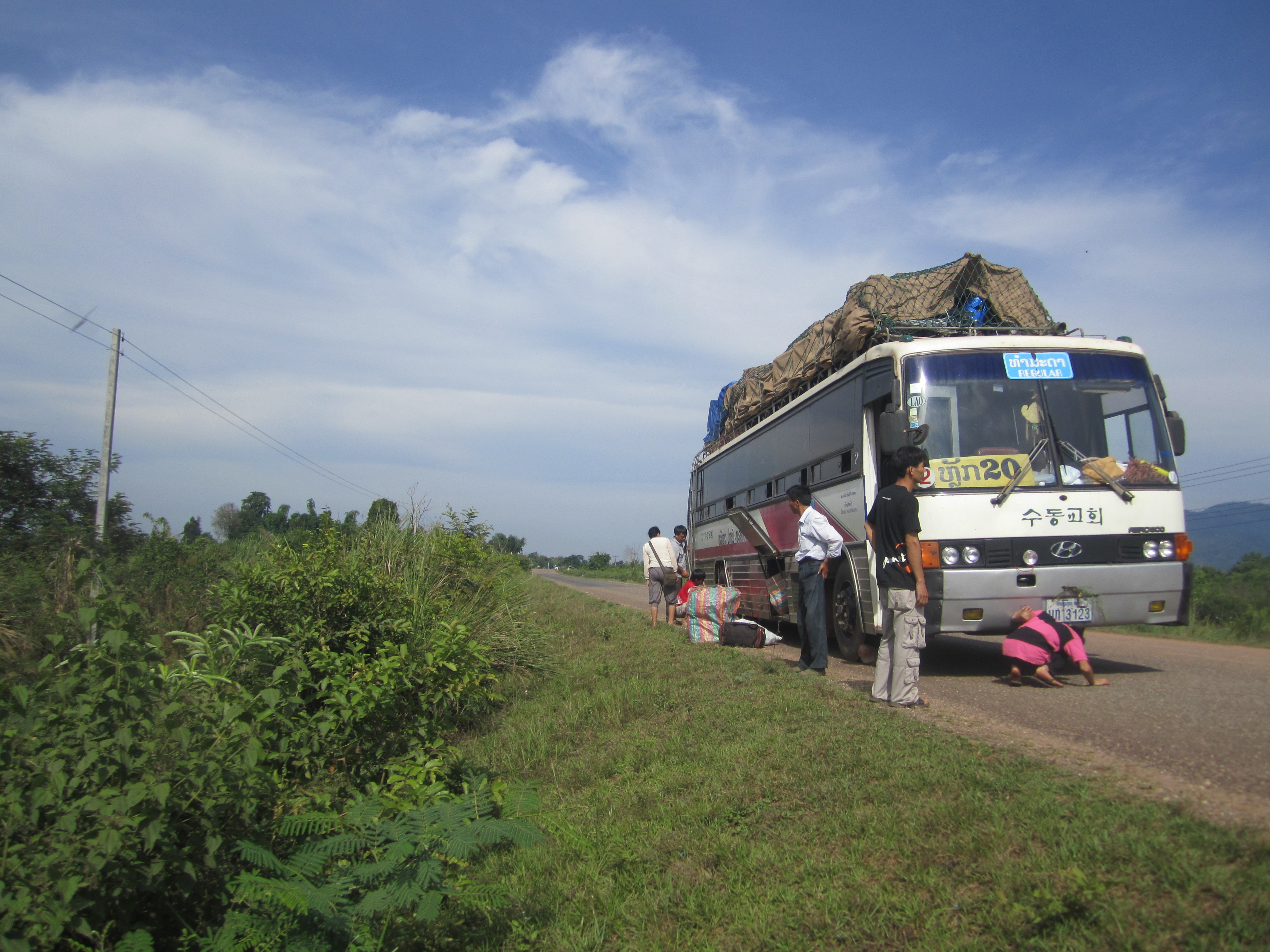
Picturesque breakdown

Lao transit is infamous for being some of the ricketiest, breaking-down-ist in the SE Asia, maybe the world. Travelers hang weary heads over bottles of Beer Lao, swap war stories: the number of people standing in the aisle, the amount of livestock on board, the various strange cargo, number of break-downs and length of time to go 370km (12 hours is actually purty good). Instead of garnering scene cred, it seems more like commiserating, deriving solace from a shared trauma.

Given that context, my mission from remote Ban Natane to bustling metropolis Savannakhet was smooth, seamless, enjoyable even. An at a cool 10 hours, it could be said that I lucked the fuck out.

I awoke in Batane to a breakfast of fish soup, sticky rice and Nescafe. One of the men from the Baci ceremony a few nights prior came up the wooden ladder, chatted with Pauline’s supervisor. They nodded, glanced over at me. “Okay,” the supervisor said, “you go with him.”

With my transport clearly mapped out for me, I gathered my bags, said my good-byes. I left Ban Natane in a spray of brown water, thrown up from the wheels of another hand tractor. I’d gotten a little better at riding, crouched down, clutched the railing, teeth chattering with every dip and tree root. It’s a little like the squat toilet—it takes time, practice, to hone your particular method.

A half hour later, we arrived at the “dock”—a dirt slope where wooden boats lay half-submerged in the still river water. A small local group of men gathered, ranging from middle-aged to elderly, all with the lean muscles and chiseled features of people who’ve done hard labor their whole lives.

They commenced to scooping out water from one of the boats with a halved gasoline canister, assembling the engine and oars. Now, if you take the tourist boat, they allow a maximum of three passengers with two boatmen. But this was not the boat of life vests and Tevas (which would have been useful); this was the local boat, whose main purpose wasn’t to transport people but goods.

We piled six people, about a dozen parcels and one motorbike on that baby and cruised into the cave.

This is how we roll/paddle

Suffice to say, we bottomed out a half dozen times. Hopping out, pushing the boat, scooping water out, the crunching sound of rock—through a particular patch of rocks, the men had to unload the boat entirely, then reload it. They wouldn’t let me help. I stood in the damp cool and watched a sixty-some year-old man carry my backpack.

As they stood ankles in the water and moved boxes, one of the men lit a cigarette. In the light of his headlamp, I thought the dance of the smoke was about the most beautiful thing I’d ever seen. It was all still magical, majestic to me—the cave, the village, the way of life. But this was these men’s reality. They moved with efficiency, knowing the cave like I know the rhythm of the stoplights and crosswalks and trains. They seemed neither annoyed nor frustrated with the archaic and cumbersome method of transport. They had the expression of commuters. Except they smoked and laughed more.

On the other side of the cave, I bowed and said my thank-yous. I rode two largely uneventful sawng thaew—one back to Ban Na Hin, another to the Highway 13 crossroads. The sky thundered and the plastic bags of produce whipped and whistled in the wind.

It began to rain as I climbed off, hoisted my bag over my shoulder and dashed for an awning. I’d been told that buses to Savannakhet pass through the junction “all the time”—though what that meant in rural Lao speak, I wasn’t sure. I stood in a place that seemed like it wanted to be a bus stop, amid the fruit and sticky rice vendors, crouched down against the rain.

An old Korean bus rattled by, slowed to a stop. The tout leaned out the doorway, waved his arm at me as I jogged through the puddles. “Savannakhet?” I asked. “Yes, yes,” he nodded and ushered me in before I could think twice.

I took one step into the stairwell and stopped.

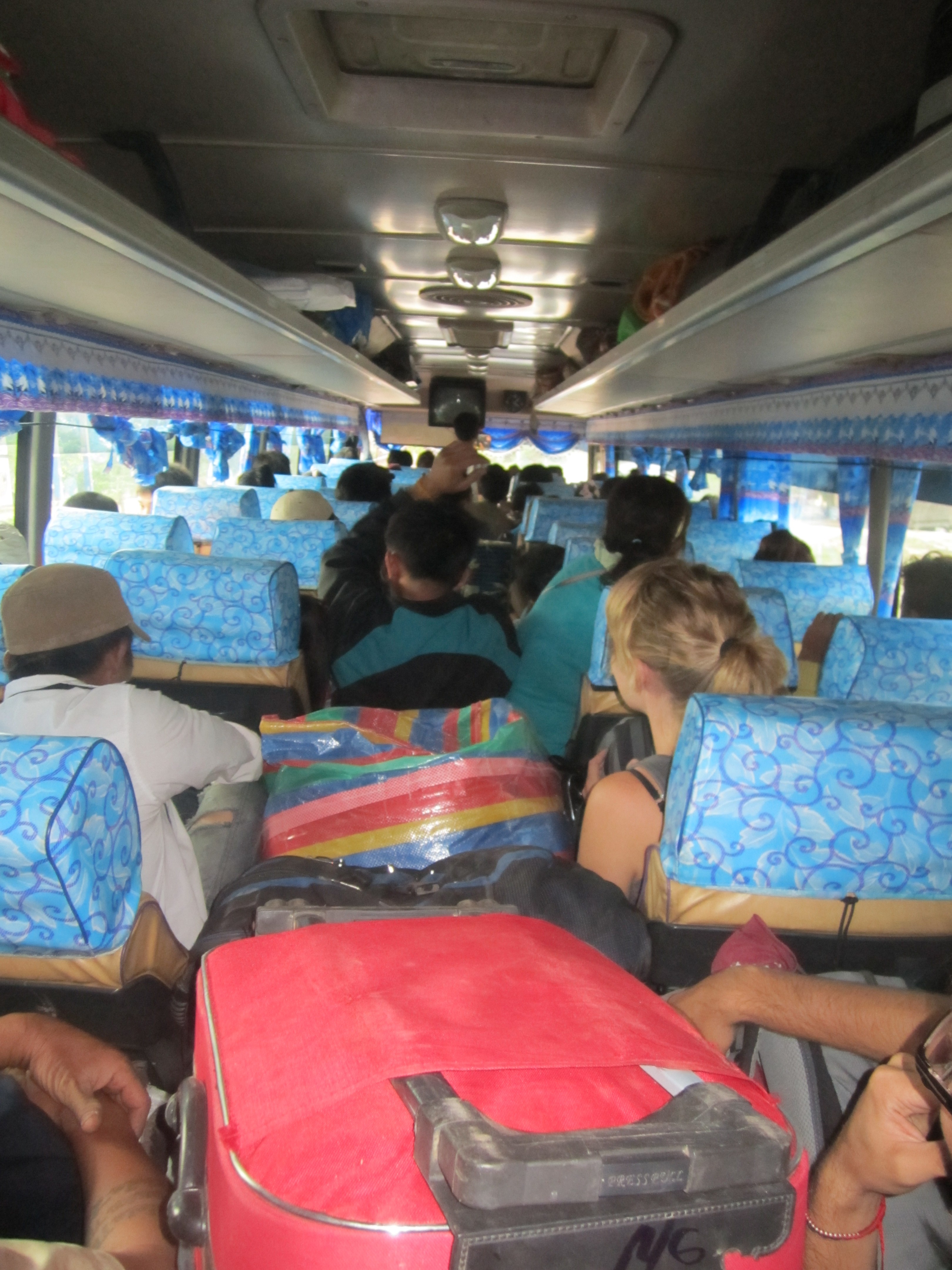
For the last 100km, managed to score a seat in the back. Catch: I had to climb over the piles of luggage to get there.

That’s because I couldn’t move any further. The crowd of people, luggage, cardboard boxes and rice sacks was so thick I had to wedge myself into the corner the bus door vacated when it closed, the leaky seal splashing a refreshing mist of Lao rain on my face.

Two grim-faced Westerners stood out in the crowd: a boy sitting on a blue plastic cooler, a girl standing behind him, trying to clutch anything she could. When a lumbering cow in the road made the driver screech and swerve, the girl lurched forward, toppling into several people and inspiring a chorus of “ooh”s.

“Twelve hours of this shit,” the boy told me later at a side-of-the-road piss stop (which I actually prefer to the squalid squat toilets you have to pay to us). “They told us when we got on in Vientiane that there’d be seats open at the next stop.”

They had twelve more hours to go, and were thoroughly spent on the authentic local experience.

We shared a what-the-hell-are-you-gonna-do laugh and crammed back on, men pulled zippers and stubbing out cigarettes. When the door closed, I wedged myself back into my corner, where I had just enough room to shift my weight from time to time. And sometimes, that’s all you can ask for.

Hand Tractors and Impending Tourism: Day Two in Ban Natane

My first morning in Ban Natane, I woke up with the sun and the roosters. It isn’t saying much—it could have happened somewhere in the States—but it was still a first for me.

The morning was misty and, as I sat up and peered through my mosquito net, I could see out the open-air common room into the dirt paths of the village, the common room of the next house over, where the TV already blared and the family sat on the floor around a metal table of steaming bowls. The day had begun.

I’d had to sleep with ear plugs. I’d become accustomed in SE Asia to geckos bellowing and incests buzzing, but I wasn’t used to the noise of the village: animals snorting, grunting, squawking, chirping, thunder booming and rain drumming. The houses are all open in the village—no windows or glass to enclose things—so you could also hear the neighbors talking. There were less filters, less divisions, more of a meshing of life, I thought as I crawled off my cot. I poured a cloudy glass of water that had been boiled and purified with local herbs, and swallowed my malaria pills.

I’d had plans to ride a hand tractor, then hike an hour out to a river, possibly visit some caves. “Too much rain,” Pauline’s supervisor—whose name I could never get straight—told me over our breakfast of sticky rice and more frog. It was determined, as we dipped clumps of rice into red chili paste, that I would instead ride a hand tractor around to the check out the neighboring villages.

This is romantic in theory. And it is pretty cool—the hand-crank wrench, the rumble, the foot pedals and gear shift, all the machinery exposed, retching and rumbling through brown puddles, water whooshing into waves beside you. Standing on a vehicle like that without falling over is another matter. I tried squatting, clutching the wooden railing, but the lurching started to make me nauseous. For some reason, I determined that sitting was my best option. (Three days later, I’m still paying for this decision with a bruised tailbone…)

Two guys from the Ban Natane took me around to three other villages. Which gave me more of a feel for life out there. It looks like this:

I suppose what struck me most was how much life there was, how much constant movement. It wasn’t exciting like a city, but there was this constant bustle, animals and people, babies of different species. It was intoxicating—I felt like I could sit for hours and just watch it pass.

Again, there seemed to be less divisions: the pig that snorted around today, for instance, could just as easily be dinner tomorrow. Even the land see more involved, more implicated, more imminently a part of life. We talk a lot about sustainable living in the West, but this was the real deal. It wasn’t ideal—there was plenty of trash strewn about, mostly wrappers for the products transported through the cave, and other trash, people still burned. But it was the closest I’d ever seen.

I met Pauline and her supervisor in one of the villages for lunch—another family’s house, another bare wooden room with modest Lao girly posters on the wall, an exposed shoulder, perhaps. On a cot on the floor lay an impossibly thin woman, skin loose on a coat hanger of an arm she raised to readjust her blanket. “She is sick,” Pauline told me, “with cancer.”

I tried not to watch as her family members brought a glass of the murky, purified water to her lips, as they rolled her over, readjusted her pillows. I stared at my frog lunch. These villages were traditional, isolated—and this was part of that too. It wasn’t just the agrarian ideal, the simple life; people here were also poor, didn’t have access to the arguably good aspects of modern life, like health care. It was all fascinating, intoxicating for me, glimpsing in for a few days—but this was these people’s lives. And this, too, was what it looked like.

Later that afternoon, I walked down to the stream by Ban Natane with Pauline. It was where locals bathe, wash clothes, where boys clutch bows and arrows shoot them into the water, actually managing to catch some fish. Pauline laid down on the shallow rocks—clothed, as they do in Laos—and let the water run over her.

“All the people I interview,” she told me, “they all want the tourism. They think it will be a good thing.” She looked over at the boys fishing. “But I’m not so sure. I think they will lose their way of life.” It had already happened, already begun, with the introduction of TV a few months earlier.

I thought of the sallow skin and boney elbow of the woman at lunch. “But who are we to say how their lives should be? If they support the tourism project—” I shrugged, made that French popping noise I’ve picked up— “maybe it will bring positive changes too.”

We talked for a long time about it—about the preservation and loss of culture, about isolation and poverty, about the role of outsiders and tourism, whether it ever does any good or not. I thought of a story I’d heard once, about some now-famous Greek statue that was discovered by Englishmen or Frenchmen, the locals unaware of how valuable and precious it was. They were going to smash it, until the explorers stopped them. I couldn’t remember the name of the statue, or where I heard the story or if it was even true or not. But I thought of broken-off noses and missing limbs in European museums, and wondered if the sanctity of some things might be seen better by outsiders, who have more of world to compare it to.

But again, I thought of the woman on the cot, barely moving. I thought of the earthy taste of the purified water, imagined that taste in her mouth as well as mine.

“There is not an easy answer, I think,” Pauline said, as the water ran over her clothed limbs.

I nodded.

Blessing of String and Sticky Rice: Day One in Ban Natane

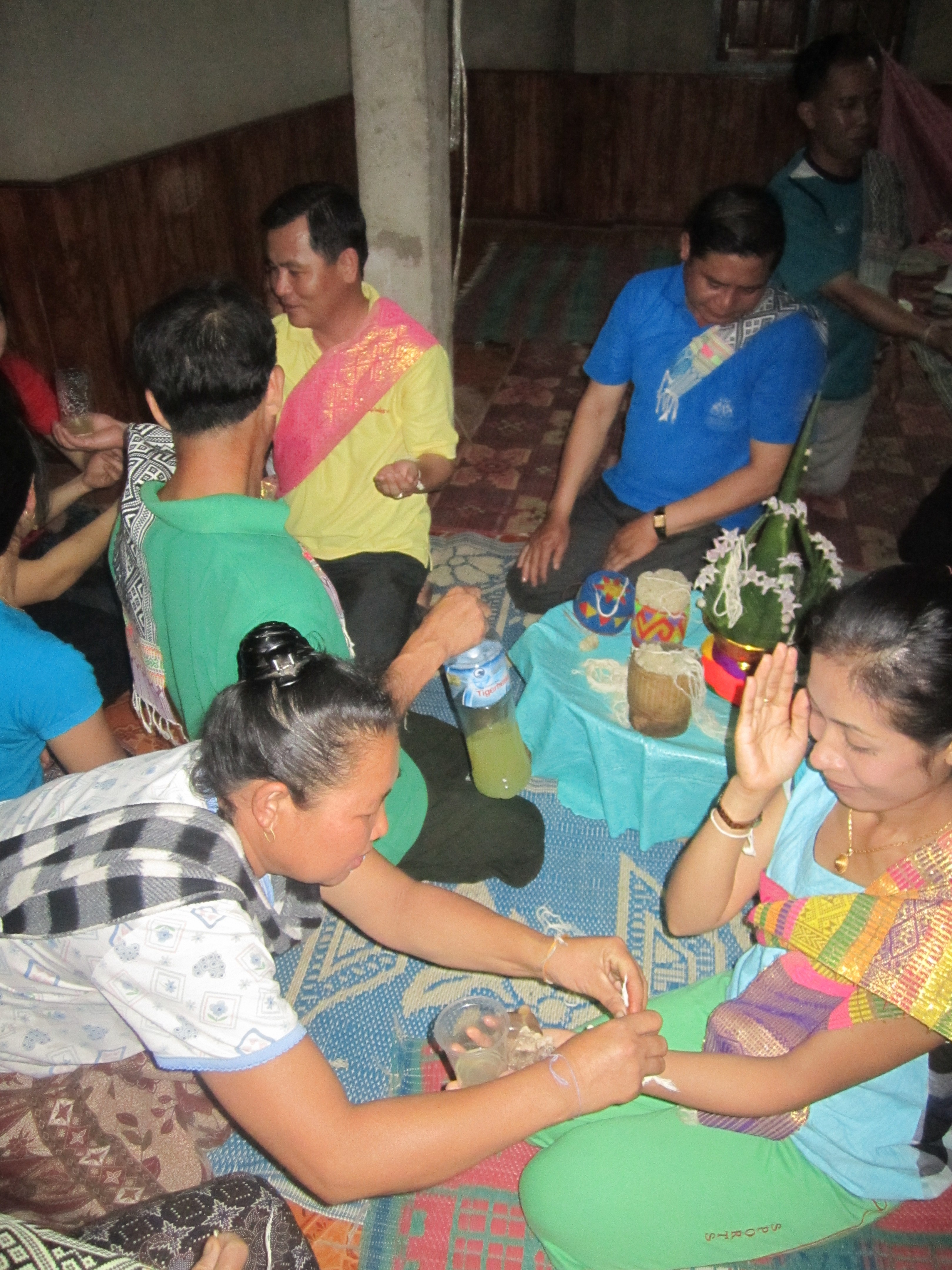
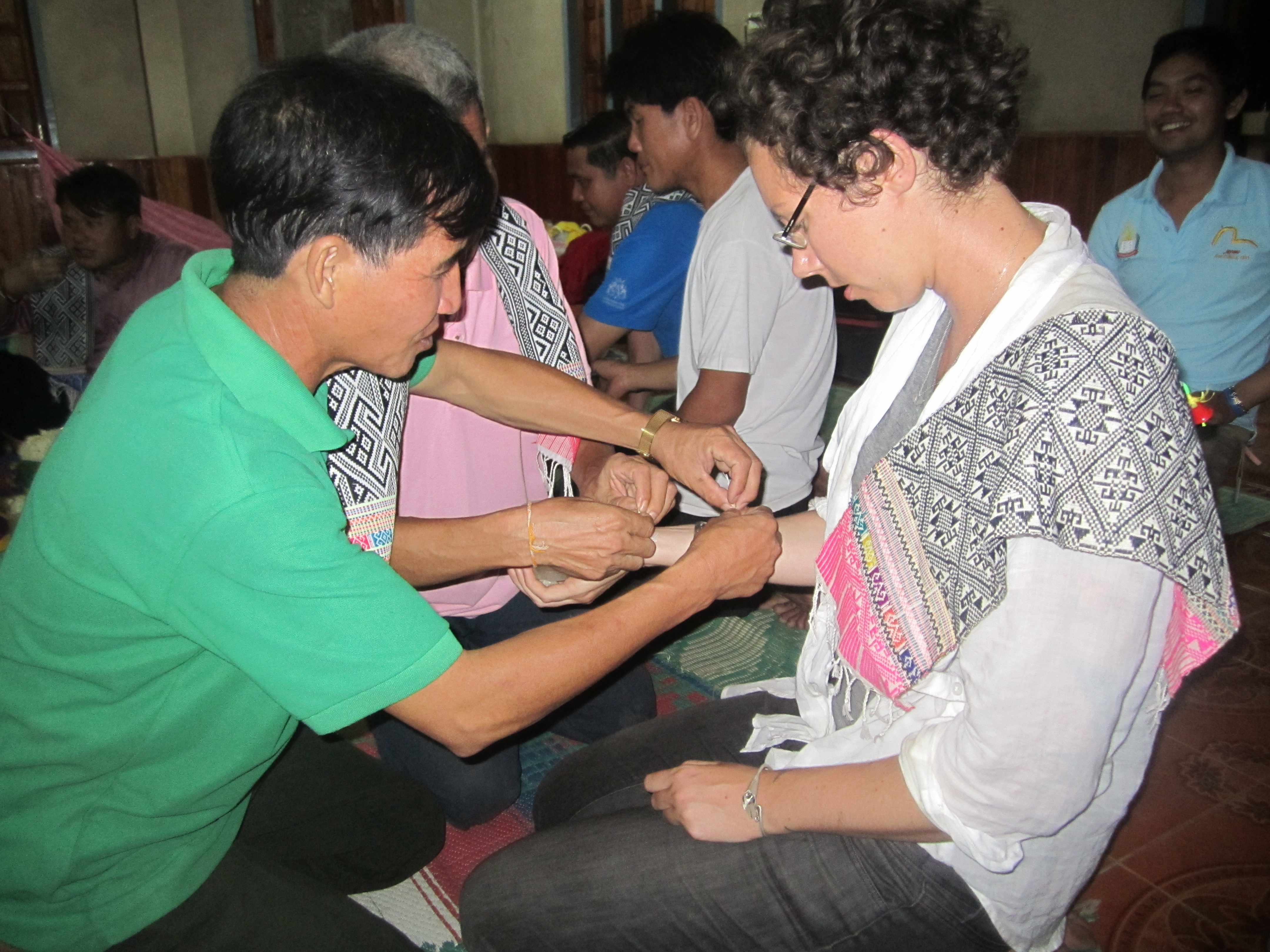
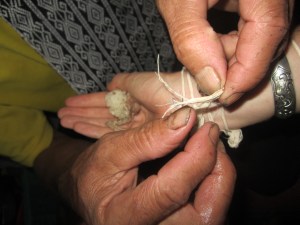
The man held my open palm in his. In it, he placed a small clump of sticky rice and pork. He raised his right hand to his face, murmured blessings in a language I didn’t understand. He waved a piece of string, then tied it around my wrist.

“He wishes you good health, good luck,” Pauline translated.

I smiled, bowed. Outside the open-air room, lightning stuttered the night sky white.

Sometimes you end up some weird-ass places traveling. Not that they’re weird, so much as it’s weird that you’re there, that you ended up there—that the gods of circumstance conspired, whispering in their thunderous perch above grey rock, to bring you there. And it was like that in Ban Natane.

To say Ban Natane is off the beaten path is an understatement. Cut off from the rest of world by impassable roads, the only way to reach it and its neighboring four villages is through the Kong Lo Cave. Which is how I got there.

I met Pauline trolling the town of Ban Na Hin for travel companions. The boat ride through the cave costs 100,000 kip, so I was on the lookout for people to split the ride with. Pauline sat on the computer in front of her guesthouse. As it turned out, she was a French anthropology student doing her Masters research on Ban Natane and its neighbors; she was meeting her local supervisor and translator the next day and headed back to the village for another 10-day stay. “If you’d like to come with us,” she made that characteristic French popping noise, “it’s no problem.”

On the sawng thaew ride to the cave’s entrance, she filled me in the details. A French NGO was sponsoring the development of eco-tourism in the Ban Natane area. To date, all homestays and eco-tourism in the area have focused on the Ban Kong Lo side of the cave—you take a boat ride through, come back and sleep on the more developed side of the cave.

“No one stays on this side,” she told me, “because tourists don’t know the villages are there.” Since the only viable way to reach the villages is through the cave, Ban Natane and its neighbors have remained quite isolated, not reaping the rewards/wealth of tourism. “In all of last year,” Pauline told me, “only 20 tourists came to Ban Natane.”

The eco-tourism project was focused on developing facilities for homestays and training locals to act as guides into the caves and waterfalls that surround the region. Pauline’s project focused on documenting the traditional agricultural way of life, interviewing locals about the history and their feelings about tourism, and then studying the impact.

Emerging

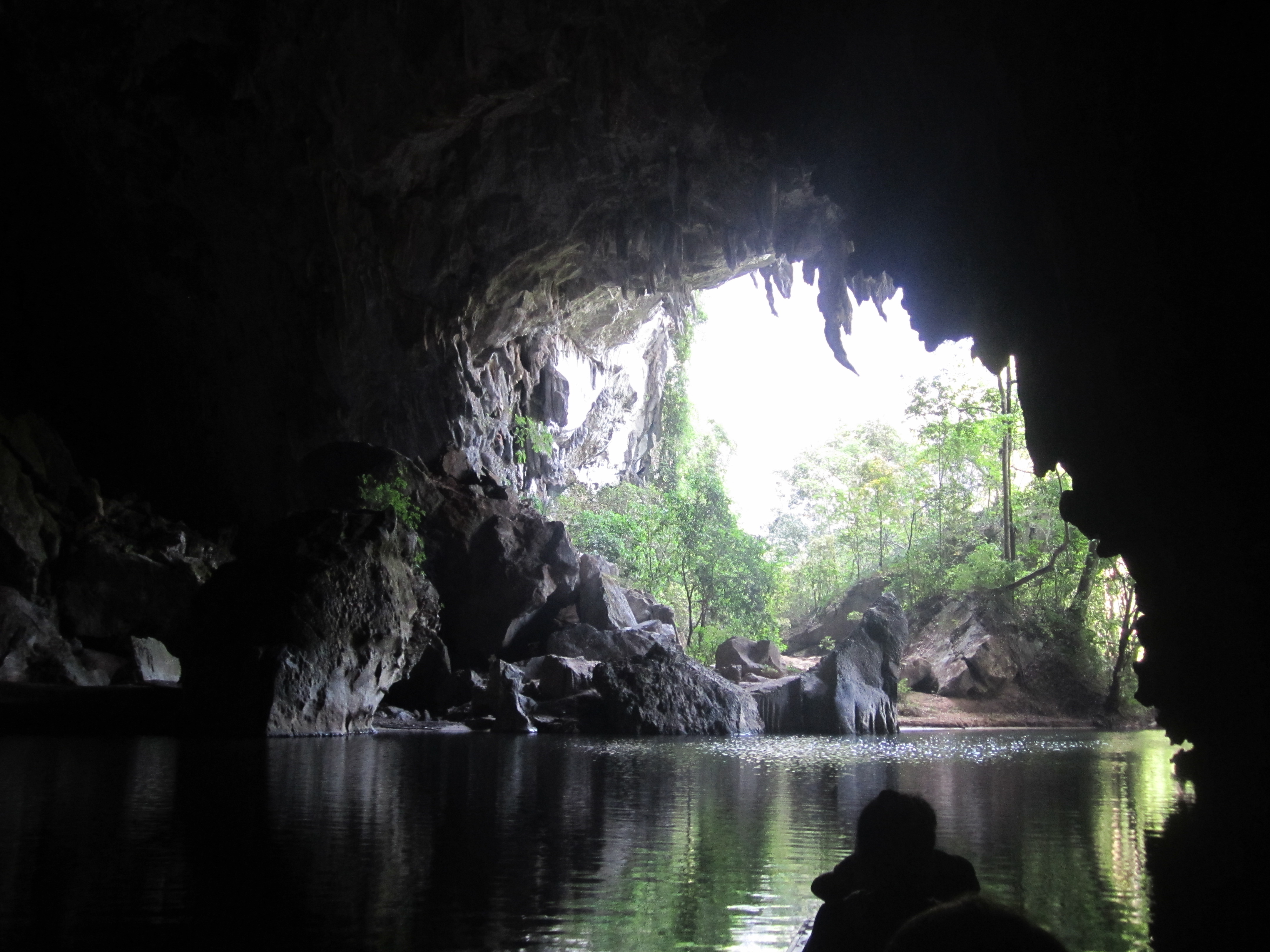
So the Kon Lo cave became, not my destination, but the passageway into another world. Which actually what it felt like—a limestone cavern like a mouth, dripping with stalagmites, the squeal and swoop of bats, where mist floated off the cool water like thin ghosts. It felt like moving through some deeply internal part of the earth, through its innards or petrified organs.

We emerged on the other side. Where most people turn around, we began walking down a dirt road. My cheap flip flops had finally busted, so I walked the 2km barefoot. In the distance, the sky grumbled. We arrived in Ban Natane just as the afternoon storm erupted.

My homestay was with one of the wealthier families in town. They owned the town’s only shop (and thus had packets of Nescafe in abundance), goods that had all been transported on skinny wooden boats through the cave, as they had been for generations. Even the TV. “TV only arrived here three months ago,” Pauline told me. “So the children,” she gestured towards the little ones gathered rapt around the glowing screen, “they are like this.”

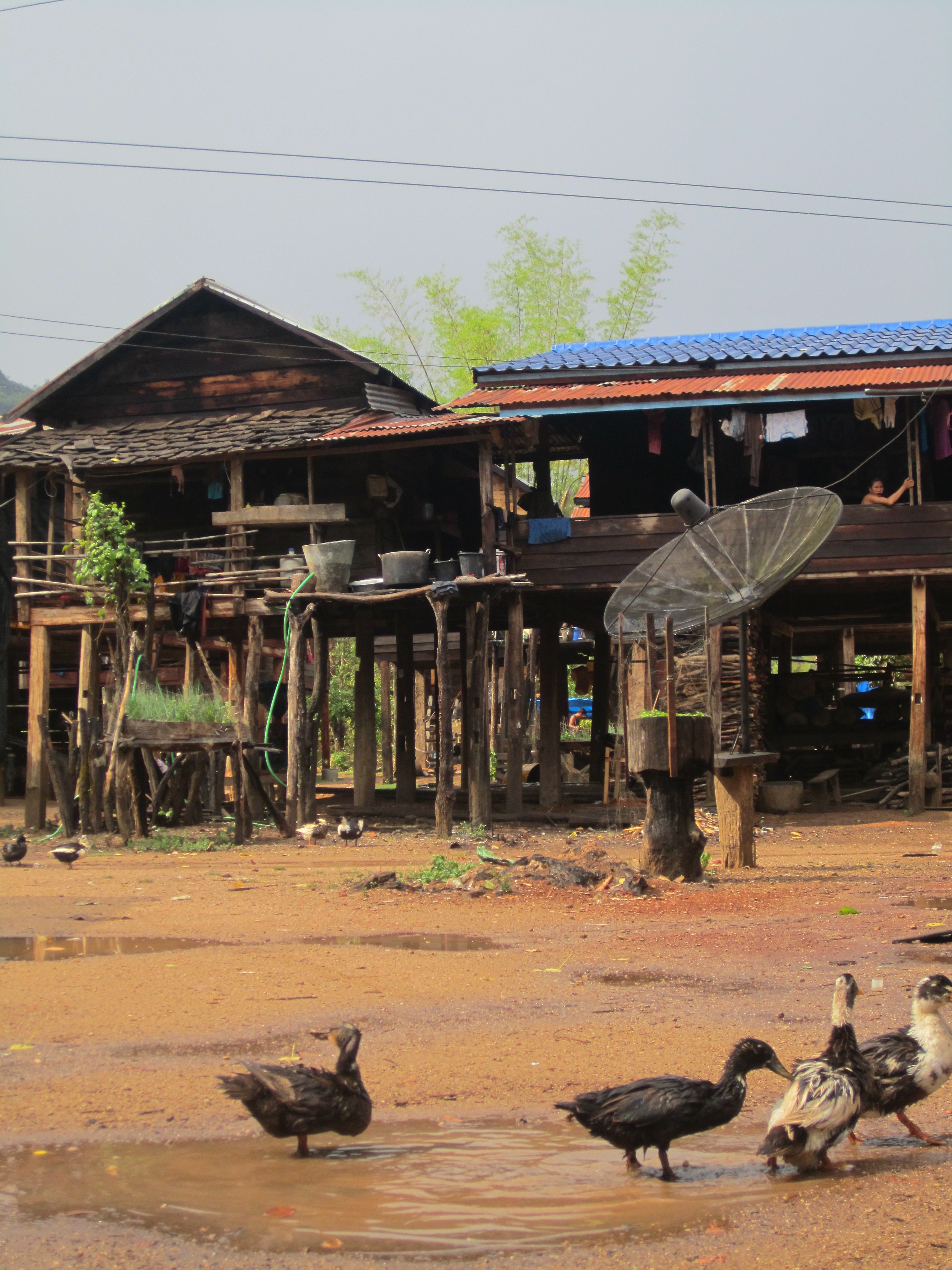
The storm cleared and she showed me around the village. Everything enthralled me—I am, as previously admitted, a total city kid, so the presence alone of ducks, pigs, chickens and goats was thrilling, let alone the sarongs and hoes and looms beneath the stilted houses.

We shared dinner with the family that night, as we would for all our meals during my 2-day stay. As isolated as it is, the food was all local, not by trend as it is in the Bay Area, but by necessity—foraged snails, fish, frogs. “Frog season has just started,” Pauline translated from her Lao supervisor, “so we will eat a lot of frog.” (Sure enough, I had it 4 meals in a row.)

Walking that night, we three were called over to a large house. I could tell it was a wealthy person’s home because it had a ground floor, constructed of brick—like the TVs, this was new, Pauline told me, as traditional homes were all stilted and wooden. “It means you need more space, and have the money to build it.” She paused. “So modernity is already coming.”

Men sat on the floor around a type of altar, banana-leaf adorned in white flowers. It wasn’t a mystical vibe—they sat in polo shirts and slacks, chatting casually. A large silver bowl of pig parts, a leg and half a head, lay beside baskets of sticky rice.

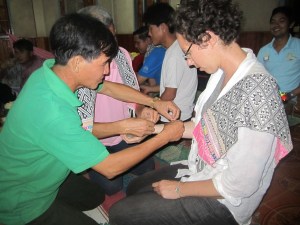
We were motioned to sit, a village-made scarf thrown over our left shoulders. The man in charge began talking—“a blessing,” Pauline whispered. He held another man’s open palm, put a clump of food and a plastic cup of lao lao in it, chanted, tied the string. Then everyone commenced to bless each other.

“It’s a ceremony called baci,” Pauline translated. “They’re having it for special visitors—the district chief came today.” People took photos with digital cameras; I assumed those to be the wealthy and important visitors.

We were soon called into the mix. I wound up with a bangle of string around my right wrist and an even fuller tummy. The storms continued in the sky outside. Old men smiled as they blessed me, as they blessed each other.

And I had one of those moments when your life feels like a dream, some foreign place you don’t quite understand how you ended up in. Yes, I rode an old wooden boat through a cave and walked down a dirt road—but how I really got to Ban Natane or that ceremony, I suspected, had little to do with that. It didn’t make sense, to my Western mind, why I’d be so welcomed, so embraced here.

And so blessed.
***

Travel Tips: Getting to Ban Natane

It’s actually pretty simple, even if you don’t have an anthropologist as your guide. Take your day bag, sturdy plastic sandals, a good flashlight and some snacks with you on your boat ride. It’ll still cost 100,000 kip, even if you only take it one way. So it goes.

Get off at the snack stands. Only buy the snacks if you’re desperate; since they have to be transported through the cave, they’re fuck-all expensive. Anyway, there’ll be a blue sign that haphazardly explains the homestays:

From the snack stands, there’s two dirt roads. Facing the sign, Ban Natane is down the road to your left. Straight ahead, across the bridge, is another closer village, though from what I understand, there’s less facilities for homestays. If you arrive in Ban Natane and say “homestay,” you’ll get hooked up. Or just show up and look like a Westerner, and they’ll know what to do with you.

Bringing a Lao phrasebook would be goddamn useful. There may be some people floating around who speak a few scraps of English; there’s rumored to be an English teacher at the school in the village, though she was out of town when I was there. If you can manage to communicate, there’s bikes you can rent or a couple good treks to go on, if it’s the dry season. Next month, an NGO will be holding a tour guide training course for locals, so I imagine there will be much more in the way of communication and tour options shortly.

Bananas and Plastic Bows: Sawng Thaew to Kong Lo Cave

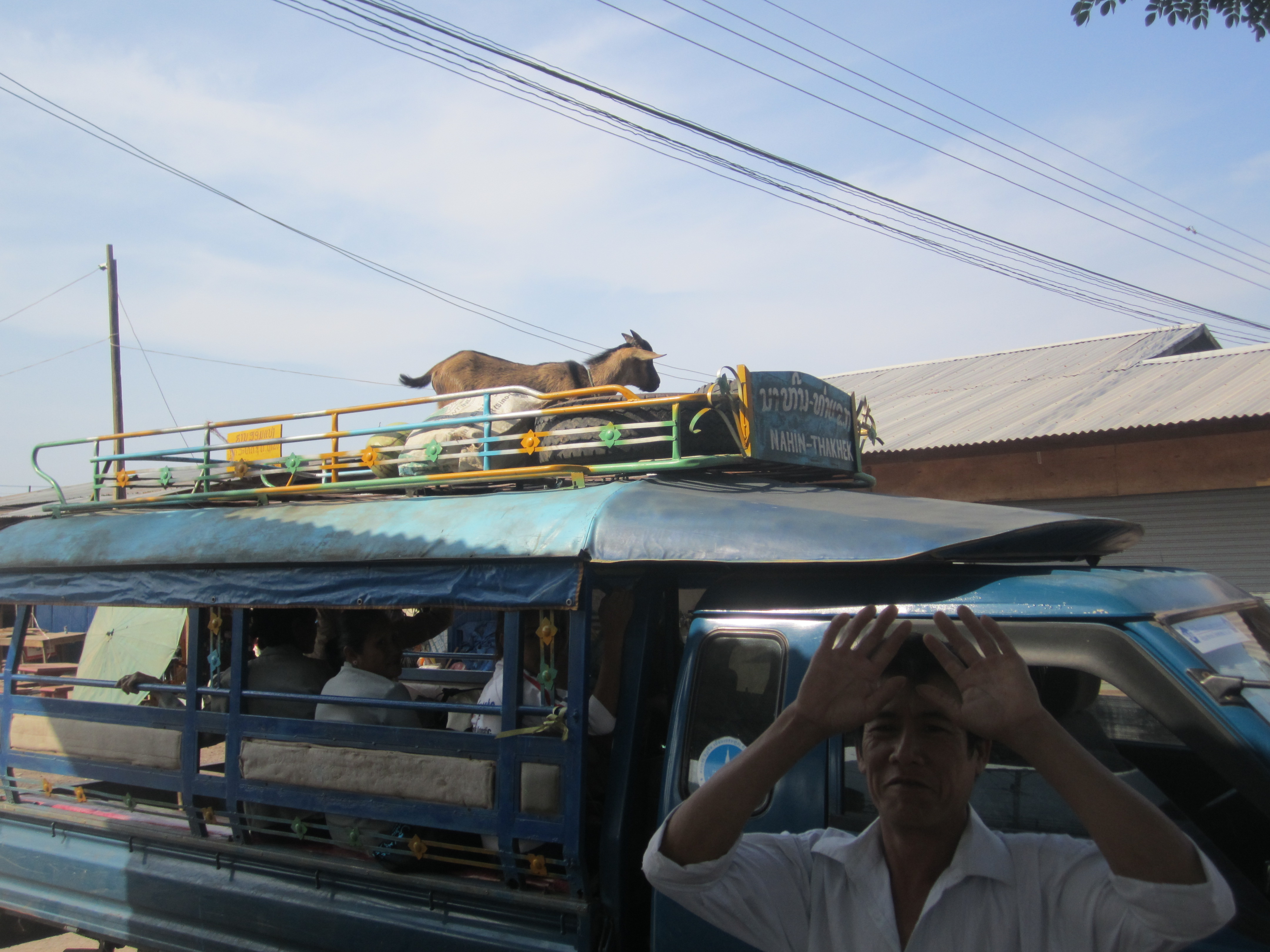
Goat on the roof. Friendly driver.

Salt-and-pepper hair beneath a worn military cap, high cheekbones and pursed lips. He squeezes the bananas I’m clutching through their plastic bag, says something in Lao.

I smile, shake my head. He repeats; I repeat. He nods.

I can’t tell if he approves of the bananas or not.

When I climbed on the sawng thaew in Ban Na Hin, the old man slid over, made room for me between the empty gasoline barrels and bags of cabbage. We rumbled around the market. Old women climbed on with pink bags, still-alive fish flopping inside, while the driver kept climbing on the roof, adding to the goods secured atop: sacks of rice, a goat and my dusty red backpack.

The old man nudged me. “Kong Lo?” I nodded. He nodded. But where else would I have been going?

We headed out down the two-lane highway, lined with construction lots and signs for a Ford Motors Center. The main industry in Ban Na Hin isn’t tourism—as evidenced by the single-room tourism office surrounded by grass-chewing cows—but the nearby hydro-electric plant. The handful of guesthouses that run the length of the town’s main road are an afterthought, and the English spoken is minimal.

Despite this, Ban Na Hin is still the closest town to the Kon Lo Cave, a 7.5km limestone tunnel that’s purported to be creepy as shit and mildly reminiscent of the Greek underworld. But, 40-some winding kilometers from a main highway and serviced only by local buses and sawng thaew (pick-up trucks with two benches in the truckbed), what would be a top tourist attraction in any other country remains fairly off-the-beaten-path in Laos. Which, as much as the cave itself, is what lured me out here—after Vientiane and Luang Prabang, I was tourism-weary and in the mood for adventure.

So I don’t mind as it takes two hours to go the 45km to Kon Lo. Past rock that jutted from the earth like jagged teeth, past slash-and-burn fields were the land looked as though it were gasping—we stop at every village, delivering groceries, dropping off canisters of gasoline. I watch the landscape, the farms, the clouds that ito the rock like scraps of cloth that had been ripped off. And I people-watch.

And now, slyly, I study the old man beside me. He has soft yellow skin the texture of crushed silk. I notice on his sleeve, he has small plastic bows haphazardly safety-pinned on. Beside his army-green cap, I imagine them as military decorations, badges from a make-believe army. I imagine them as gifts from grandchildren, secured to his shirt and forgotten about.

I pull out my notebook, to jot down the image between the bumps that stutter my handwriting across the page. He leans over, looks at the notebook, watches me write. He nods as though he understands.

I can’t tell if he approves or not.

I smile, point to the plastic bow on his sleeve. He laughs. I give a thumbs-up.

He tugs his sleeve, begins to unfasten one of the pins. He takes my sleeve, pins the bow. I touch it, smile. He laughs. I laugh.

(A little later on the ride, I discover what the bows are: a bunch of teenagers lining the road come up to the sawng thaew and, through the poles, pin bows to our shirts. They smile and sing, holding out a collection for something.)

The sawng thaew thins of its passengers and produce as we rumble along. A tank of a woman with a soft, laughing face pushes her way out, waves at me. We stretch our legs in the luxurious space.

The old man waves his arm at the driver, stands to a hunch beneath the truck bed’s dome. I tap him as he begins to shuffle off.

I open my plastic bag and hand him a banana.

He smiles. I laugh, he laughs.

I think he approves.

He steps off the back of the truck, place his hands together and bows his head. I repeat.

***

Travel Tips: Getting to Kong Lo Cave

While researching Kong Lo Cave, the number one concern I encountered was over transport. The LP doesn’t have much info and it seems as though the lack of direct buses deters a lot of people from visiting.

Here’s the deal: Kong Lo and the nearby Ban Na Hin (nearest town, with guesthouses and an ATM) lie along Highway 8, which moves east from Highway 13. All buses between Vientiane/Paksan and Tha Khaek/Savanaket run down Highway 13, so the route you will often read recommended is to take one of these buses running along the 13, ask to get off at the junction, then take a sawng thaew to Ban Na Hin, where you can then take another sawng thaew to Kon Lo Cave or the nearby town, Ban Kong Lo, where it’s possible to homestay.

Another friendly fellow

I think it’s the transfers that deter people. It;s actually a lot less dodgy than it sounds. There’s enough of a trickle of backpackers that the bus drivers know where you’re headed—there’s not much else out here for tourists. Sawng thaew run from the junction to Ban Na Hin every 30-or-so minutes during the daytime, and there are supposedly a few direct sawng thaew to Ban Kong Lo every day, though it probably wouldn’t be worth waiting for those.

From Vientiane, there’s only one VIP bus to Tha Khaek a day at an inconvenient 1pm—journey takes about 6-7 hours, so you’d potentially be looking at doing the transfer after dark. Local buses, though, run every half hour beginning at 6am. They cost 60,000 kip, regardless of whether you get off at the junction or the final destination.

There’s also local buses to Lak Soa, the biggest town along Highway 8. The advantage of this bus is that you negate the feared transfer at the junction. These buses leave Vientiane every 2 hours, beginning also at 6am, and cost 75,000. This is the bus I took, and I recommend it: it was early enough in the day that the lack of AC was bearable, and even with a break-down, I still arrive in Ban Na Hin at 1pm.

I’ve also been told that there’s one daily bus directly from Vientiane to Ban Kong Lo that leaves between 9-10am. However, if there’s not enough people, the bus will be canceled, so it’s probably best not to risk it.

From Ban Na Hin, though, there’s only three official sawng thaew per day to Kong Lo—more evidence of the undeveloped tourist facilities. The first leaves the town bus station at 10-ish, the others at 1 and 3-ish. But in reality, they seem to leave more often than that. Otherwise, you’re looking at arranging private transport, about 100,000 kip versus the 25,000 for the bus.

Coming from the South, it appears as though your best bets would be to take a sawng thaew from Tha Khaek, which is well-connected to Savannakhet and Pakse, or one of the buses coming up the 13 and doing the transfer. I did meet some grumpy Brits who had gotten on the wrong bus and had the journey take a day and a half—”All this for a bloody cave.”

Which brings me to my biggest recommendation: treat the whole thing as journey-is-the-destination adventure. Don’t focus on just Getting To The Cave—everyone I met who did this seemed fairly annoyed, or at least had to qualify it with “worth the trek.” I was armed with snacks and in the mindset of “well, let’s see where this leads,” and I had a grand ole’ time.

Born Into This: Inheriting War in SE Asia

It was really not the time to be thinking of Charles Bukowski.

I stood staring at a display of UXO casings at a Phonsavan tour company. I was thinking of the documentary I’d seen the night before (see previous post), which followed a group of impoverished Lao children as they harvested UXOs for scrap metal.

Something panged in me, and I thought of the poem.

It was the same something I’d felt at the War Remnants Museum in Saigon. I stood before pictures of children born with mutations from Agent Orange—small and crippled and bubble-skinned—children who’d been born after the war, hadn’t lived through the war, but who had it in them, possessed it in their DNA. If the images hadn’t been so brutal, I’d thought, they’d have been a metaphor for the intergenerational transmission of trauma.

I’d been surprised in Vietnam, to discover how much of the war I’d carried in me, without knowing it. I hadn’t realized how much a part of American culture the Vietnam War is—in our books, our films, our movies and our freeway exits, cardboard signs and thousand-yard stares. I’d remembered, suddenly, visiting the Vietnam War Memorial in Washington DC as a teenager—muggy-skied and sweating, watching the grown-ups trace hands along the reflective stone, place flowers and cry—not understanding it. I’d turned; my mom had been one of them, the name of her cousin under her fingers.

And I’d suddenly remembered the poem.

It’s more muddled in Cambodia and Laos, places were the American activity was “secret”—it’s less a part of your consciousness, more a part of something else that you can’t quite name.

“People from my province,” the Cambodian boy looked sheepish as he told me, “they still hate Americans. For the bombings.”

I nodded one, two, three times. “And you know what? America bombed Cambodia in secret. And most Americans still don’t know about those bombings.”

We sat beside each other waiting for our numbers to be called at the cell phone shop. Neither of us had been alive during the 70s.

I’d wondered, as I looked at bomb ponds beside pre-Angkorian temples in Cambodia, how one goes about being American in all this. “‘I wasn’t born yet,'” I wrote, “doesn’t seem good enough.”

And looking at the pile of UXOs in Phonsavan, I had the same thought rise. Because the kids out there harvesting these bombs, they weren’t born yet either. Neither of us asked for this, did this, witnessed this, lived through this. We were born into this, are left to figure out what to do with this, dig through the dirt of this.

And that’s when I thought of the poem again.

I’ve been composing some kind of essay in the back of my head about all this. I don’t know exactly what I have to say about it yet, or if there is anything to say about it. But in the meantime, I’m thinking of a poem that seems fitting. And, in the light of the recent string of natural and political disasters, doesn’t seem so dramatic or fanciful as it once did. It doesn’t feel so hopeless either—it just feels accurate.


Lauren Quinn is a writer and traveler currently living in Hanoi. Lonely Girl Travels was a blog of her sola travels and expat living from 2009 to 2012. She resides elsewhere on the internet now.

Join 490 other subscribers

Buy This Sh#t

Categories