Archive Page 13

The Un-Bittersweet of Leaving Phnom Penh

It’s not as bittersweet as I’d expected.

It’s been six weeks in Phnom Penh. That’s the longest I’ve sat still anywhere—the longest I’ve spent consecutively in any city other than Oakland.

I’m embarrassed to admit that; I feel like I should have lived abroad, should have studied abroad, should have spent a summer somewhere, should have should have should have. But the truth is, I’m still a relative newcomer to the travel game, and for the first few years I was stuck in the going-going-going of it all: ticking off lists, counting countries and cramming in as many destinations as possible. It seemed like a waste of time to stay anywhere any longer than necessary.

Sure, I’d entertained elaborate fantasies about moving abroad. But really, if I couldn’t sit still in another city for more than 10 days, how could I really know if I could be happy, could have a life, abroad? Or, hell, even out of Oakland?

Part of the reason I got an apartment in Phnom Penh is that I wanted to feel like I lived there, that I wasn’t just passing through. I wanted a little glimpse into what that life would be like. I wanted keys; I wanted to shop for toilet paper; I wanted to “Sua s’dei” the neighbors and have a cafe where they knew my order. I wanted to feel little roots sprouting—the beginnings of being grounded, like the wind could blow and I wouldn’t fall over, be blown over with it.

When my bus arrived last week, bringing me back from my three-day visa run/refugee camp search, I hustled down the steps. I booked it past the cluster of tuk-tuk drivers, crossed the street without looking (the Cambodian way), dove between the tents of the night market, walked directly to my favorite food stall, kicked off my shoes and slurped down a Khmer soup under the night’s haze, the warm breeze from the river. I felt like I’d come home.

So I was expecting to be sad to leave. I was expecting to go around doing my silent rounds of “last times” with twinges of melancholy, that little lonely longing that you can almost fall in love with, more than the thing itself.

But it wasn’t as bittersweet as I’d expected.
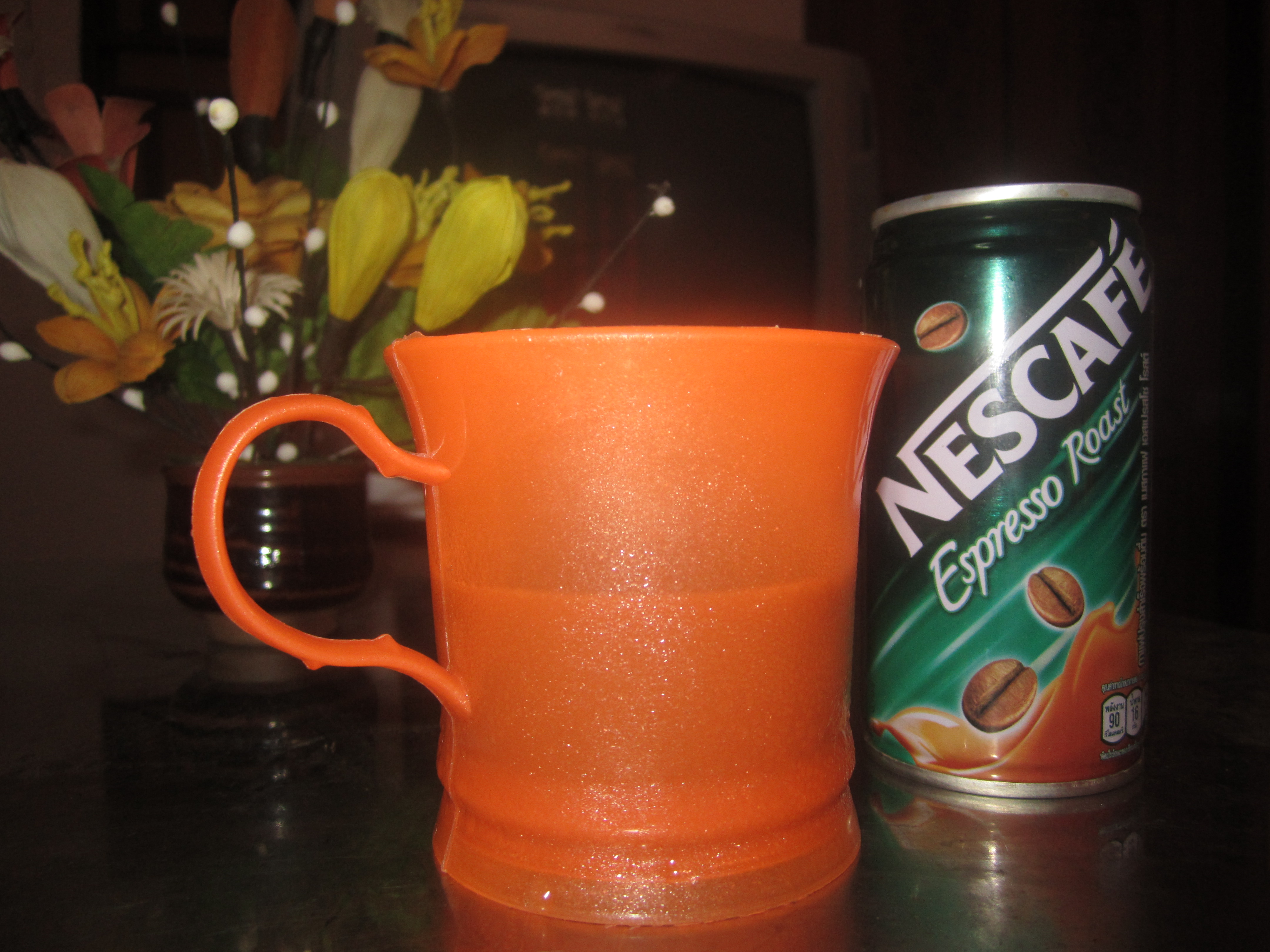
Sometimes it comes to this: Nescafe from a plastic mug. And plastic flowers. Classy as shit.

Saying good-bye to the people was sad. I’d made some rad friends, had gotten close to a few cool girls. People tend to be on a three- to six-month rotation in Phnom Penh, and in a few months, almost everyone I know here will have moved on. And it was definitely sad to leave my apartment, with its metal table and one chair, its thin mattress and fuzzy TV, the plastic kitchenware I’d purchased at the market down the street—where I’d go to eat soup and the women would squat down and stare at me, giggling. I’d giggle back, and I’ll miss that too.

But still, it wasn’t as bittersweet as I’d expected.

I’ve taken to comparing cities to people. Boys, to be specific. Because cities have personalities the same way people do, and you have relationships with cities the same way you (I) have relationships to boys with (well, no, they’re actually much healthier).

So Rome is a really sophisticated, well-groomed and worldly guy that I like to keep track of, that I like to get lunch with from time to time, and talk about art and culture and history, but who I could never actually be with—we’re just too different. Tirana is the fun one, the one I met one crazy night at a crazy dance party, who I connected with under the lights—the one I felt like was made for me, as though anyone could ever really be made for anyone else, as though you could ever really know anyone after a week, or a month or even a year, years.

Buenos Aires is the one who got away, the eyes exchanged between subway cars, or maybe the one whose number you got and lost and still catch yourself thinking of, years later, looking for some scribbled scrap of paper in old jeans pockets without even realizing it. San Francisco is the neighbor boy you grew up with, who you know is really attractive and cool and who you really get along with, but you just couldn’t ever date.

And Phnom Penh?

Phnom Penh’s not terribly handsome or debonair, not the stuff of little-girl dress-up fantasies. He’s not super cultured and he’s got some obvious flaws. He’s a little beat-up; he’s been through shit. And there are things about him that drive you nuts. If you were to write a list of the perfect mate, there’s a lot of things Phnom Penh wouldn’t have. But the big ones, the ones that are really important and that really fucking count, when you’re up against the wall and the wind is blowing and you need something firm, some kind of roots to hold you down—he’s got them.

He fits. He’s not perfect, and neither are you.

And so it wasn’t so bittersweet to leave him. The same as when you leave for a trip and you just know the person you’re leaving behind, that you’re coming back to eventually, isn’t going to cheat on you or be shady. You don’t even have to think about it, worry about it. It doesn’t occur to you to worry; you’ve just got that confidence, you know? That you’ve got them and they’ve got you, whether you like it or not—like you were picked for each other, matched to each other, though you’re not sure by who.

But does it matter?

A Walk Through The Ruins: Temples and Bomb Ponds

The three little girls followed us like flies. They circled as we walked through the dirt and dry grass, holding out scarves for us to buy.

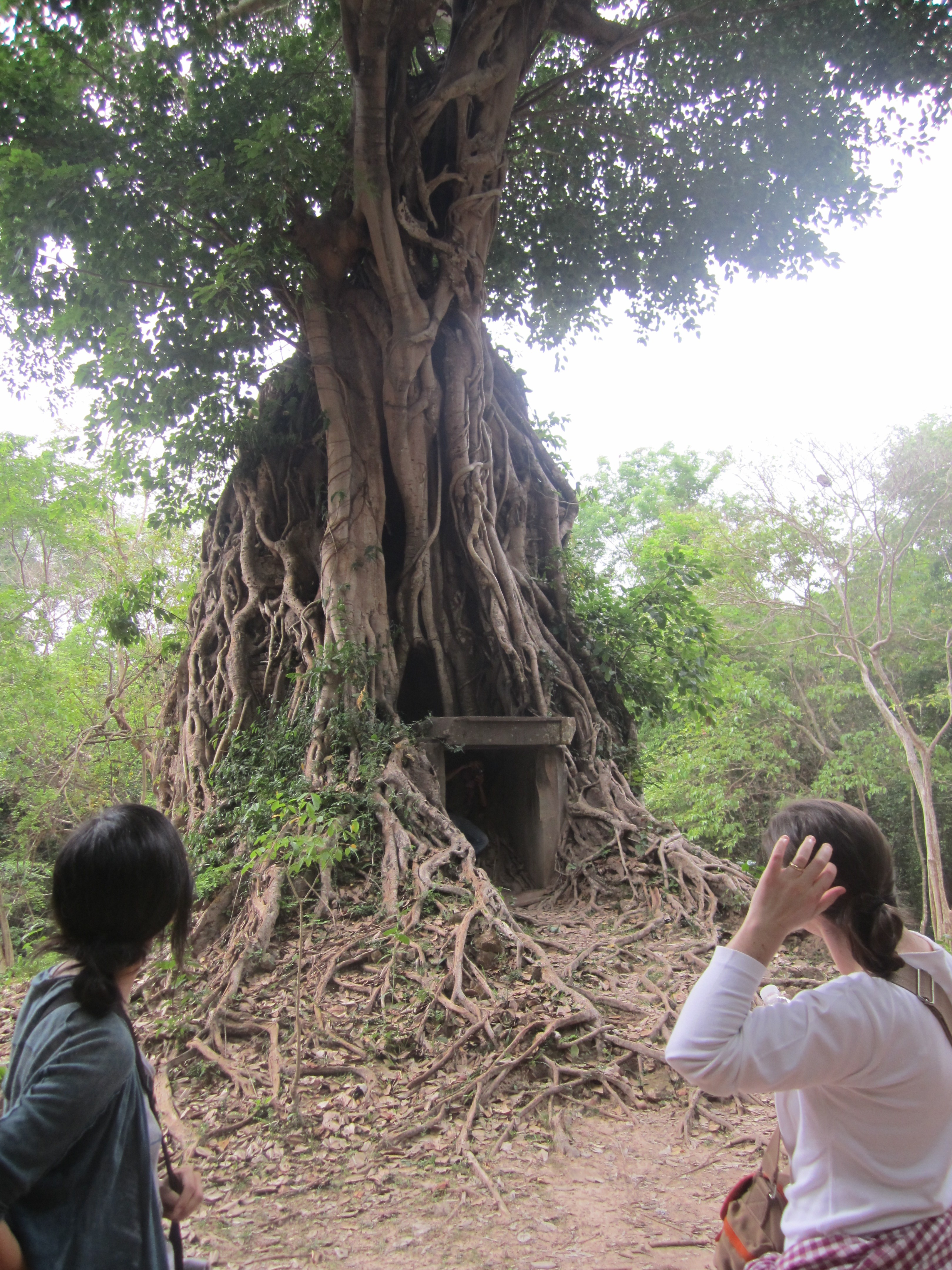
We approached the rubble of temples, bricks strangled by a varicose of vines. Beside where we stood, busted stone sat in a pile. One of the girls pointed. “American. B-52.”

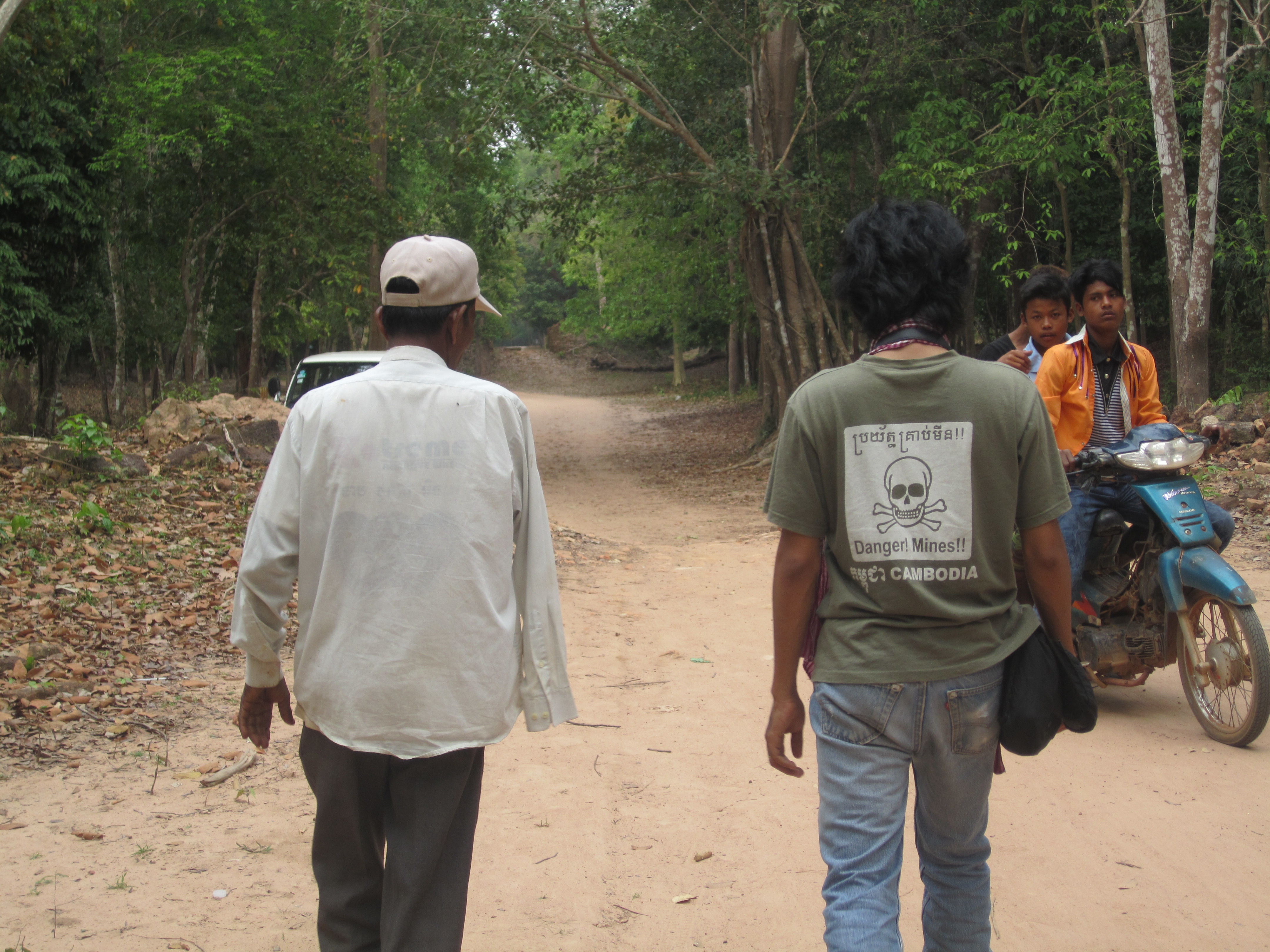
It was my first trip out to the provinces. That’s what expats call the rest of country, everything that’s not Phnom Penh, and it’s a fairly accurate distinction: it’s like there’s two Cambodias, not just the surface and the underbelly that I wrote about before, but the urban and rural.

The division goes a long way back. Before the Khmer Rouge, during the Lon Nol regime and the American bombings, the countryside suffered greatly—some million people are estimated to have died—while Phnom Penh remained a relative island of safety. When the Khmer Rouge took over, they targeted urbanites, the so-called “New People.” A mutual distrust between city- and country-dwellers lingers.

Still today, people in the countryside tend to be darker skin, pure Khmer, and largely uneducated, often living without electricity and running water. And while Phnom Penh is rapidly developing, construction cranes and billboards and the gleaming new riverside, the provinces remain fairly the same: dirt roads, thatch-roofed houses on stilts, naked children and water buffalo and chickens in the road. And a lot more of the scars of war.

We’d headed out to the Kompong Thom province, 170 km along the “highway” to Siem Reap. We were going to look at two things: the Sambor Prei Kuk pre-Angkorian temples, and bomb ponds. We found both, beside each other.

I’d contacted Rattana Vandy about his exhibit Bomb Ponds, wanting to learn more. Although he lives in Paris now, he just so happened to be back in Phnom Penh, and invited me to come along with his wife and friend on an adventure to the countryside.

The drive was long, filled with stops for cashews and pomelo and tarantulas (which are surprisingly delicious). Three hours on the road and we arrived at the temple site. It was nearly empty, aside from a straggle of locals and the few huts they’d set up, selling bottles of water and chips. The little girls were on us; even after it was obvious we weren’t going to buy anything, they followed us, poking and playing with each other. There probably wasn’t much else to do.

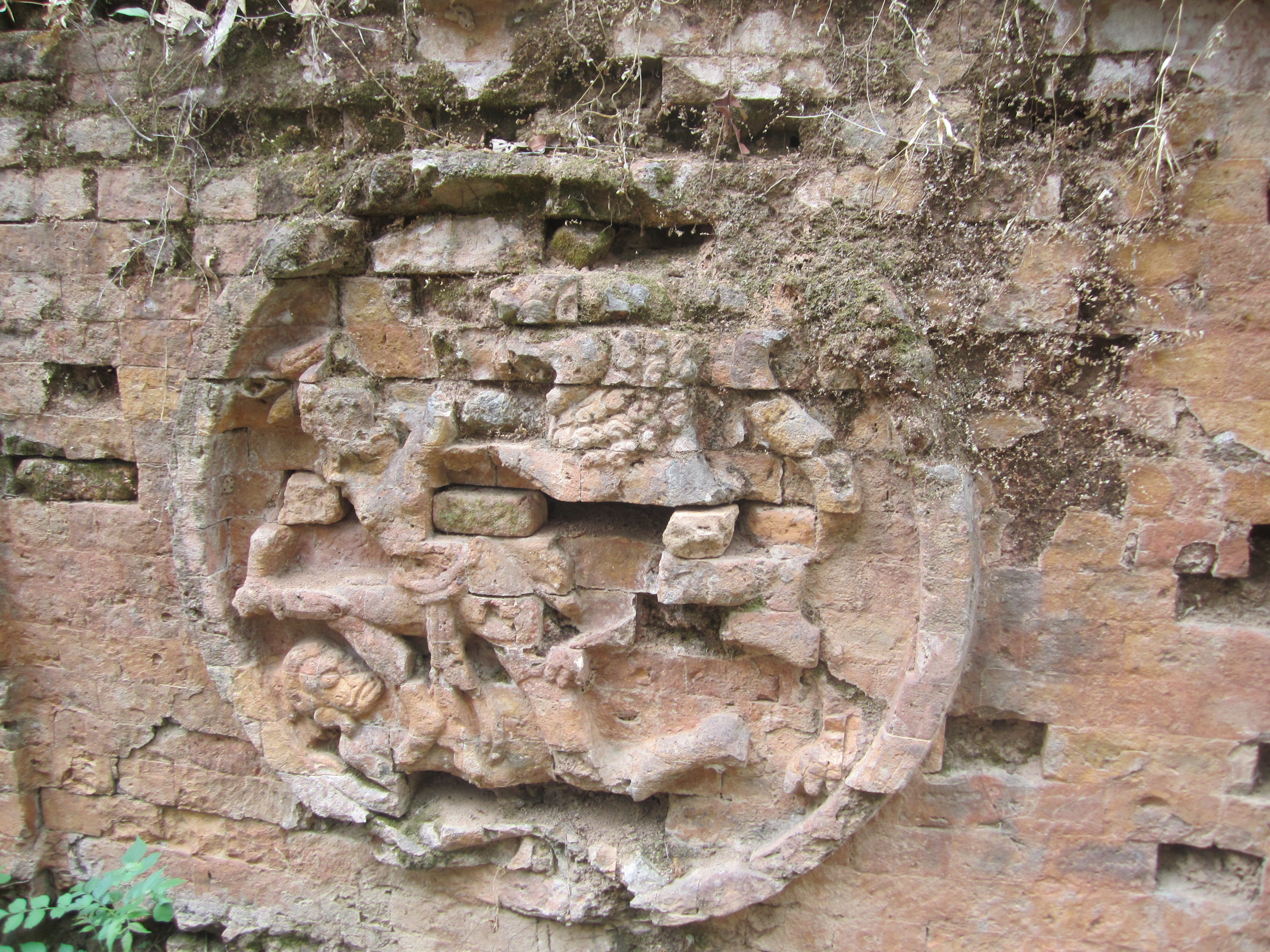
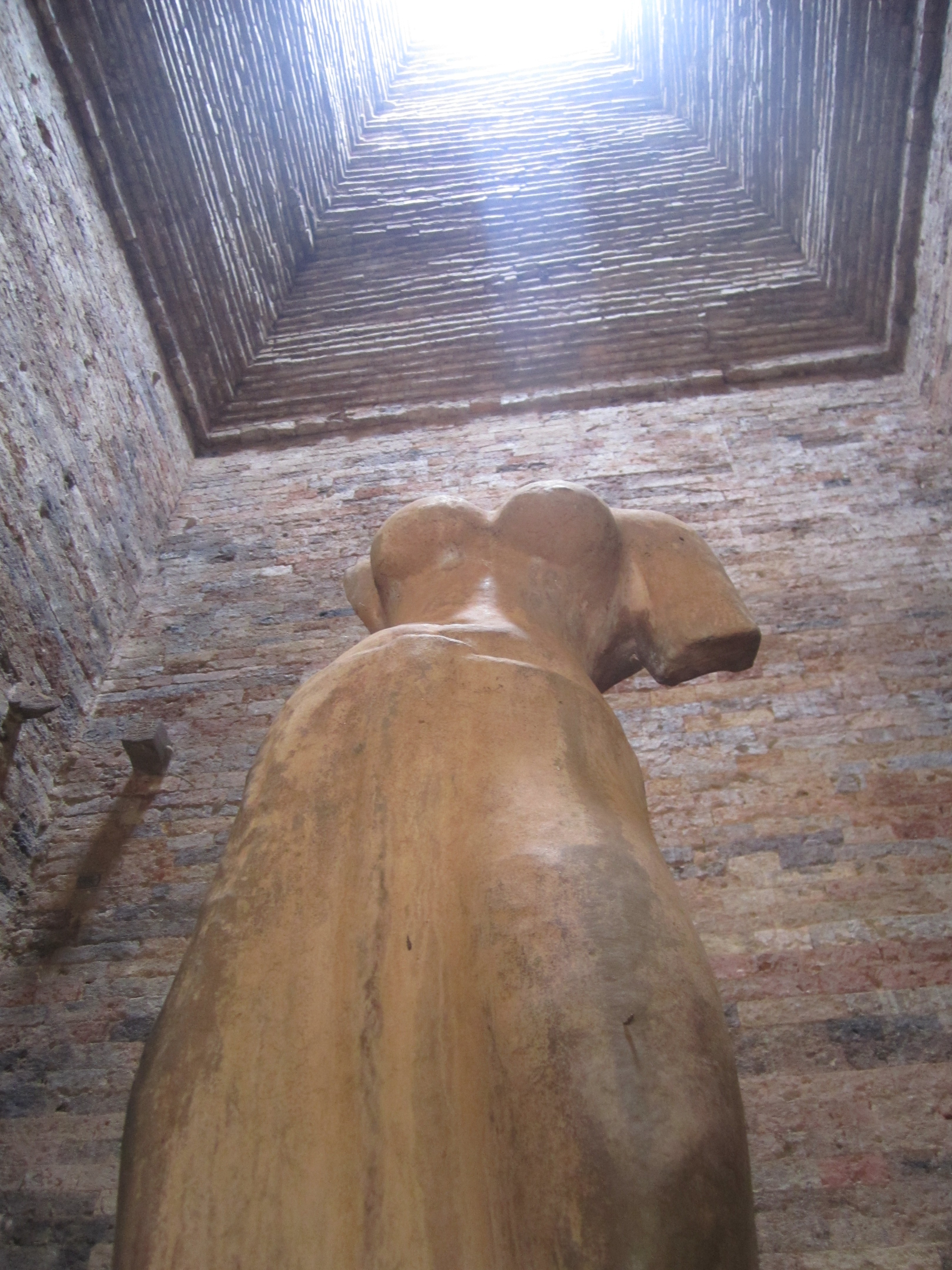
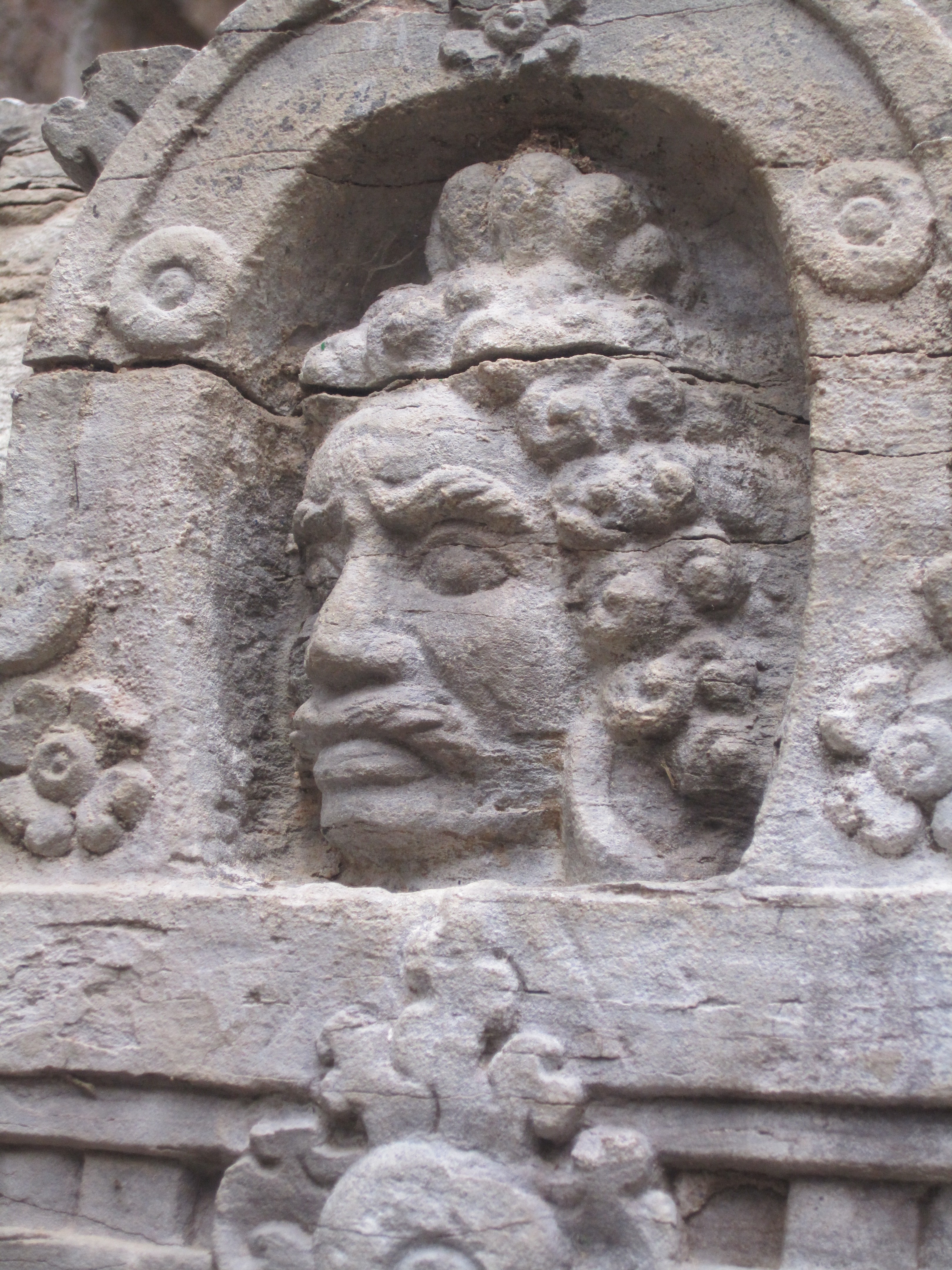
The temples were scattered around the shady dirt grounds. They’re pre-Angkorian, which means they were built between the 5th and 7th centuries, constructed of brick, with carvings in Sanskrit, odes to Hinduism rather than Buddhism. I hadn’t seen any temples yet, so I was easily impressed by the age, by the trees growing up and along them, like the vines were strangling the remains, trying to pull them back down into the earth.

There’d once been some 200 temples at the site; only 40ish remained. I thought of the incredible luck that any of them had survived: the years, the monsoons, the looting, the gold diggings—and the bombings.

Photographing a bomb pond/crater

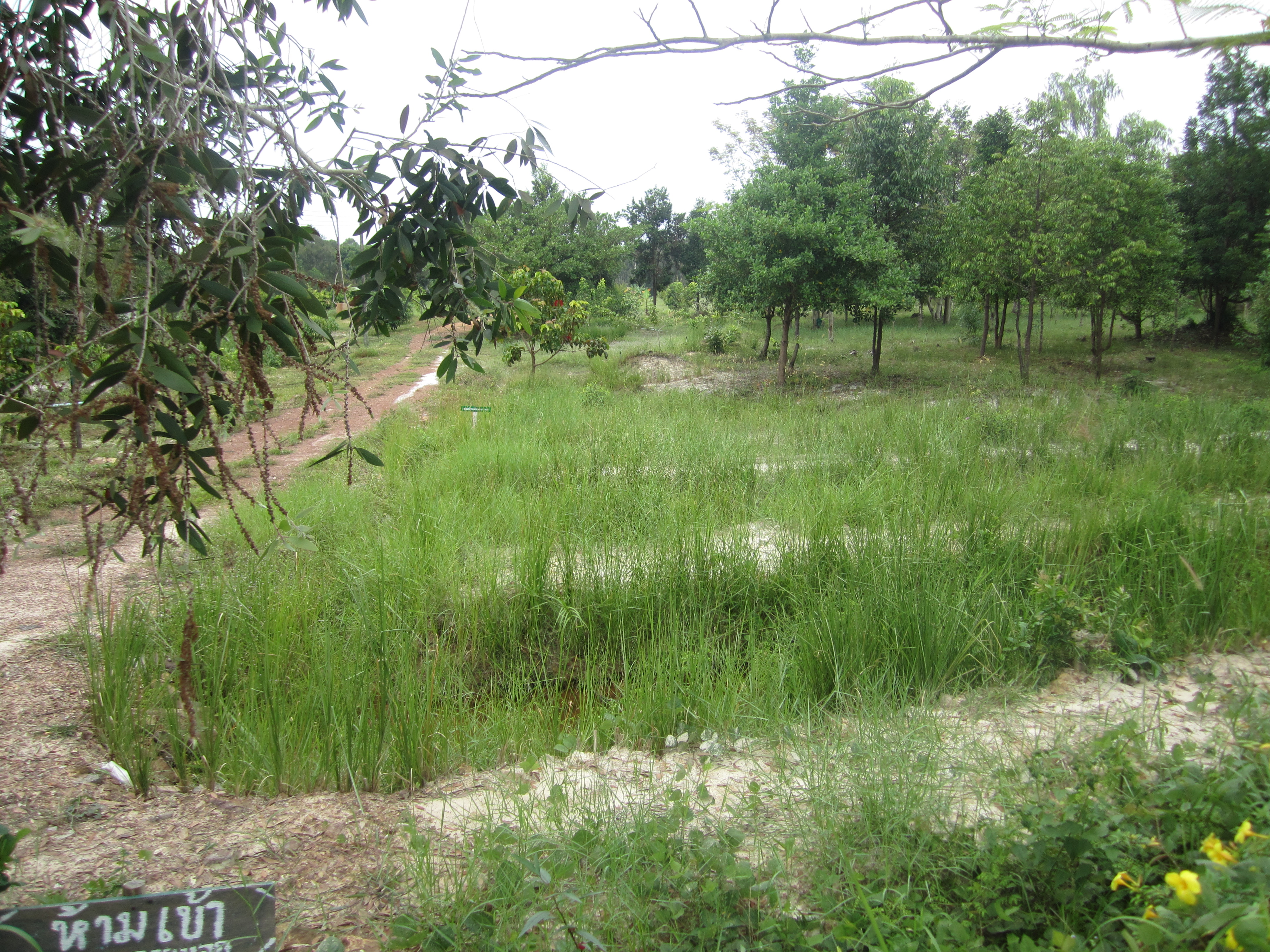
Rattana had taught us how to spot bomb ponds. Unlike natural ditches, they’re perfectly circular. Because of the linear bomb-dropping pattern, they usually occur in a row, in certain intervals; you can count them out: “one, two, three…” The big ones are along the Vietnam border; the smaller ones, like these, were dropped from fighter jets and can be found all over the country. During the rainy season, they fill with water that even still, after 30+ years, has a lingering toxicity that makes it undrinkable. As it’s the end of the dry season, the bomb ponds now are just craters, sunken and waiting. They reminded me of pockmarks, the skin of a hard life—I thought back to Thailand, to its green, its rich-kid skin.

A local man lingered around us, like the little girls but with less exuberance. He began chatting with Rattana in Khmer, and wound up being our guide. He was knowledgeable, walked slowly, chiseled cheeks and a lean smile, salt-and-pepper hair swept into a comb-over, though he wasn’t balding. The lines around his eyes and mouth were thin, precise, deep and uncountable; they framed his mouth when he smiled, so that they seemed like smile lines.

He was missing an arm. There was a nub somewhere inside his worn shirt, and he tucked things under it: his cap, his cigarettes. Sometimes when he walked, a slow and pensive walk, he held onto the empty sleeve as though he were clasping his hands. There was a tenderness to the gesture so palpable you wondered if it was his phantom limb he was holding—a dead hand, ghost hand, from another life that he was still clinging to, intertwined with, in the moments when no one was looking.

He pointed out carvings and statues and explained their meaning, which then went through rounds of French and English translations. At one point, as we walked between temples, he pointed to a crater in the earth with his one arm. “American,” he said. “B-52.”

How do you be American in this? “I wasn’t born yet” doesn’t seem good enough. “My parents were against the war” doesn’t either. Because these may be ruins, but it’s still happening, in other places; it’s still happening in this place too, the echo of it. You know, intellectually, that this echo lasts a long time, but knowing it and seeing it are two different things: You can hear something a thousand times and not know it, yet if you see it with your eyes just once, you know. It’s a Khmer proverb, and it seems to be written for this place, the experience of being in this place.

I thought, briefly, of bombs falling from the sky like small black parcels; I tried to imagine the blast and the sound, the rumble and heat. I couldn’t, not really—just project what I’d seen on old newsreels, aerial footage of impersonal explosions, reverse fireworks against dense green. I thought of how much was lost—lives and limbs and ancient temples, vacant of their gods—and how much remained, that any of it remained, even as scars, on the earth and in the bodies. I thought of what still stood, what still walked, and wondered how to be American amidst all this.

On The Road to Nowhere: Finding an Anti-Place, Part 3

Mai Rut. Mai Rood. You couldn’t even be sure of the name, and you sure as hell couldn’t be sure of the history. But it existed, that was the important part, and I was going to find it.

I sat on the back of a motorbike and scanned the landscape. The town of Mai Rut was 5km from the main highway, and there’d actually been a motorbike driver, waiting on the platform in the shade for someone like me to set off a blue pick-up truck. Thailand was otherwise devoid of motorbike drivers; although a break from the constant barrage of “La-dee, moto-bike!” was refreshing, I kept finding myself needing a motorbike and finding none. But one appeared just when I needed it, and I suppose that’s how Thailand worked for me, how I’ll come to think of those three days spent along the border.

I’d seen footage of Mai Rut, at the Bophana Audiovisual Center, from an old French newsreel. I could piece together bits and pieces, stray words, but mostly it was a study in the visual, squinting at the screen and trying to memorize every little bit of earth. I knew I’d later try and find the place, what was left of the place, and this was the best clue I was going to get. (It was silly, but I kept scanning the faces too, as though I’d happen to see the two people I knew in the crowd, as though that would be a clue too.)

And now I was there, or whizzing through there, and there was nothing but trees and grass and the odd clearing. We moved too fast; I didn’t know how to tell the motorbike driver what I was looking for, or even to slow down, so I just let him drive, let us move through the landscape of lost stories.

He left me off at the end of the road, where earth gave way to water and boats bobbed and nets hung, flies buzzing over sheets of fish and the smell of fish, fish, drying in the sun. Houses stood on stilts and streets of cement had been made. This was the town, not the remains of the camp, which must have been somewhere outside of the town, fenced off by barbed wire the camera kept focusing on and off of, a beat-you-over-the-head kind of metaphor but a metaphor nonetheless, in a newsreel, which I could appreciate. This was not it, but it was the closest I was going to get.

Mai Rood was a quiet little fishing town with not a lot going on. People sat in doorways. Children ran naked, grinned and disappeared. Women sat cutting fish, and men reeled in the nets from painted wooden boats. Dogs sniffed at the sand, littered and muddy; a man picked at the wounds that covered his body, little scabs that spoke of disease and something else, a language I didn’t understand.

I looked at the faces—many of them were Khmer, obviously Khmer. There’s a brown to pure Khmer skin, while Thai has more of a yellow glow. I thought of what the man at the guesthouse in Trat had told me, how a lot of the Cambodian refugees had stayed once their camps had closed, resettled in Thailand.

Like him, there were stories trapped in these people—or rather, trapped in the incommunicable space between me and them. They held answers, and if I could have sat with them, listened to them, I could have pieced together an approximation of another story, trapped in a different incommunicable space, the one between live and death—the story I had come to understand.

In the picture my friends have from Mai Rut, there’s my friend, a newborn in his mother’s arms. His mother looks like the woman I knew, strong and sturdy and alive, and his father like the man I knew, small and frail and dark. Beside them were two little girls who looked nothing like my friends’ parents—different features, much too dark-skinned.

“Who are these girls?”

“Some girls that came over with us. They were orphans. Or their parents said they were orphans. so they could come to the US. Or maybe my parents said they were their kids too.”

“But they look nothing like you guys.”

He shrugged. “So what happened to them?” I ask.

Shrugged again. “They probably had family here already, and met up with them once we got here.”

“Have you ever tried to find them?”

“No,” he answered kind of far-away, as though the thought had never occurred to him.

And I thought of that picture and wondered if I had it, if I could show it to these people, even without a common language, and if anyone would have known or remembered. I wondered what the hell that would accomplish anyway, other than confirming that it had all actually happened. I wondered what the hell I was even doing there, what I was looking for, what any of it was, let alone what it meant.

I wandered.

Closest thing to a remnant I found: Red Cross symbol on a lamppost back along the main highway

On The Road to Nowhere: Finding an Anti-Place, Part 2

Our pick-up truck bounded down the smooth pavement, creating a muggy breeze. We moved down a strip of the coast, a highway and a shade of green I think I’ll forever associate with Thailand, and that’s the place the people came through. It was 30 years ago and there’s not a lot left—unless you know where to look.

I didn’t. I kept craning my neck through the grating of the covered truck bed, trying to catch a sign for Khao Lan. I was lucky, I discovered, in that a giggly group of five teenage girls with straw mats and beach towels were getting off at Khao Lan as well. They’d spend the entire 40-minute ride squealing and chatting and texting. When we glided to an easy stop, they pointed and exclaimed to me, “Khao Lan!”

We trundled off, stood on the swampy roadside of a military checkpoint. “Beach?” one of the girls asked me shyly.

“Museum,” I replied.

“Museum,” she repeated softly. The word caused a buzz among her friends. “Museum!” one of them exclaimed assuredly, and pointed to a white structure obscured by the green.

I thanked them with a small bow of my head—I hadn’t learned “thank you” in Thai—and watched them disappear down the road.

The museum was modern, diagonal columns and a glass skylight structure that didn’t at all seem to fit the landscape. The adjoining parking lot was empty and the museum gates locked.

The guard at the military checkpoint back on the road made an eating motion. He pointed to his watch, held up one finger. I nodded and wandered back down towards the museum grounds, thinking how strangely simple it was, how much you could communicate without words, without a common language, just signs and gestures and hints, a smile and a bow.

Green signs were stuck amid the grasses, and those communicated a lot less. Were they marking something related to the camp that had once stood there? I couldn’t be sure, but photographed them just in case.

I walked deeper into the grounds. A buzz grew from the trees like a living thing, like it weren’t the product of a living thing, a million unseen insects, but an animal in and of itself. It whined and hissed and followed me down the road.

There were beaten bits of earth, what had once been a road. Chunks of cement remained, with earth growing back up around it, like a scab before it peels. There were clearings in the grass, and I tried to figure out if they were remains or something used for farming, the stray huts I could spot off between the trees.

But I walked further and found translated markers—something, not in a common language, but my language, a scribble I could understand. I held my breath and tried to imagine tents and roads and some 90,000 people.

I couldn’t. It was just wind and rubble, stairs to nowhere and the earth growing back up around.

The museum was open by the time I got back, and I slid off my shoes and stepped inside. A lone female attendant smiled at me and went back to sweeping the floor.

The museum was strange. It was mostly a tribute to the Queen, a tribute to her goodwill as evidenced by her selfless saving of Cambodian refugees. Everything was framed in that context—photographs of a glamorous white-skinned woman walking through a city of tents in a white suit, a floppy sun hat and Jackie-O sunglasses. She crouched beside the thin and sick, bellies swollen and eyes dulled, a look of practiced concern. She sat before a group of children, an opened book in her hands: The children listened rapt, the words of the Queen forever imprinted in their minds.

Subtext: Thailand is the only country in SE Asia to have never officially fallen under imperalist control.

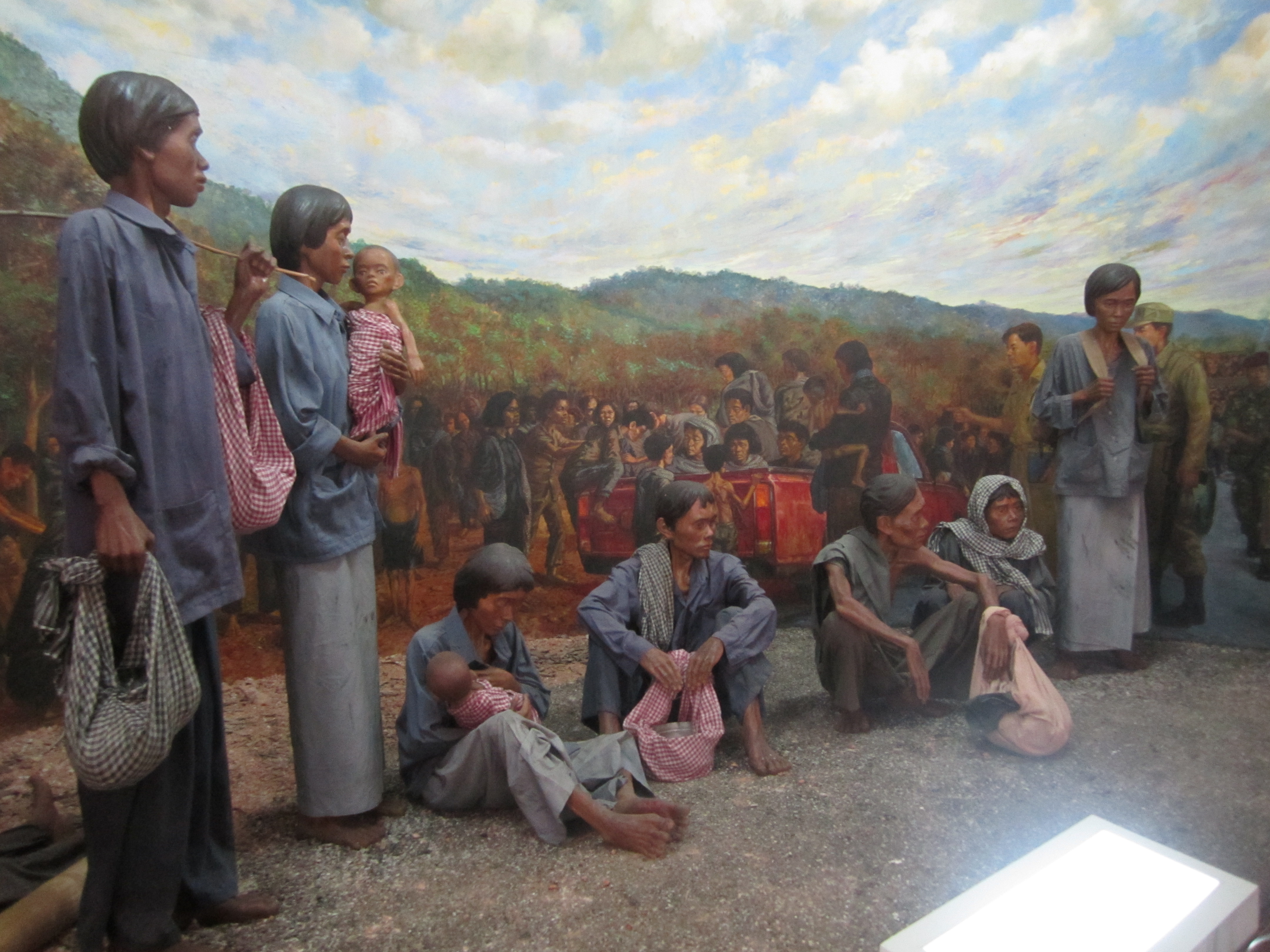
But still, she’d done a good thing, a damn good thing. The museum included three life-size scenes that reminded me of wildlife dioramas, the kind my best friend meticulously restores, repainting eyes and gluing on fake fur.

Wax Cambodian figures, their bodies worn and their faces contorted by grief, stood in varying poses of despair, before a painting of thick jungle, more faces and bodies coming through the trees. Other scenes depicted varying elements of camp life: cooking pots of rice, a white woman holding a stethoscope to the chest of a small wax infant. The dark Cambodian bodies grew plumper, more solid.

I wondered if that’s what it’d looked like—the emergence from the woods and the camp life. I thought of the newsreel footage of camps I’d seen, the faces in the camps, and decided it was worse.

(“You’ve seen The Killing Fields?” Lisa asked my mom once. My mom said yes. Lisa nodded. “It was much worse.”)

For its oddity and drama, I wondered, if there were any other museums like this, that documented this particular snippet, this part of journey, this freeze-frame from the film reel of a movie you’ve never managed to see all of, keep catching out of sequence or coming in half-way through.

I stood barefoot in an empty museum of transience, while the earth outside slowly swallowed the remains of what was left, which wasn’t much at all. I tucked some crumbled bills into the donation box, slid my shoes back on, and stepped out into the heat.

On The Road to Nowhere: Finding an Anti-Place,Part 1

"We're on the road to nowhere..."

I rode, blue pick-up truck bouncing, through the lush green and muggy grey of a Thai highway. I was squeezed between a bucket of paint, a woman’s groceries and the soft squirming limbs of two small children. Men stood on rice stacks on the back of the trailer, clutching the grating as the breeze moved through their hair.

I was on the local “taxi,” domed trucks with wooden benches in the back, and I was on something of a mission—an anti-mission to find an anti-place, a futile mission to find the What’s Left of a transient moment, blue tents and barbed wire, where babies were born and fates were written in the dusty earth.

So it was more than a visa run. I’d come to the Trat province to find the remains of Mai Rut, a Cambodian refugee camp where my friends’ parents had escaped to, where one of my friends was born. I knew it was a somewhat fruitless endeavor; refugee camps are purposefully made from temporal materials. Still, I wanted to see it, or as close as it I could come to. It was an inbetween point, a turning point, where lives were changed. There’d be little left to find, and that was, I supposed, part of the point.

I’d gotten into the town of Trat the night before, still startled by the disparity between Thailand and Cambodia. I found the backpacker area, got a cheap room in a cute guesthouse. I’d proceeded to wander around, asking every guesthouse keeper and travel agent about where I could hire a tour guide. They looked at me like I was crazy. It was the one time I was ready to throw down some money to hire someone who knew the area, and I was getting nowhere.

“Why you want to go there?” the man at Pop Guesthouse asked, eying me carefully.

“I’m working on a project. My friend was born there.”

He shook his head. “There’s nothing there. Nothing to see.” It was the same answer I’d gotten from everyone else, but it felt like he was holding back. I paused a moment, then shrugged, said thanks anyway, and continued on.

I rounded a corner, to the block behind. After walking a bit, the same man poked his head out of a doorway. “Oh, hello again,” I smiled, confused as to how he’d gotten there.

He waved me over. He spread a map out on a table, pointed. “This Mai Rood,” he pointed. It was spelled differently, but sounded the same. “But nothing to see there.” He paused. “But here, Khao Lan,” his finger moved up the green spindle of coast, “there is a museum for the refugee.”

“A museum?” I asked, amazed.

He nodded. “For the Queen. She make the refugee camp for Cambodians.” He explained how to get there, wrote the name in Thai for me in my notebook.

I sensed my moment of opportunity.

“Did you live here then?”

He nodded.

“You were a little boy?” I asked.

“No, I was 18!”

“No!” I exclaimed, smiling. (Flattery gets you everywhere.) I paused. “Do you remember it?”

He nodded again. “Yes, I work on the border then. In my uncle’s orchard.” He pointed to a place right along the black line.

“There? Did you see a lot of people coming in?”

“Yes. A lot of people come through the orchard.” He stopped there. I tried to imagine it, to hold some kind of image of what that must have looked, been like—the first foreign eyes to see these people straggle out of four years of unthinkable misery.

We stood there in silence. “Most of the camps were up here, right?” I pointed to the Northern border.

He nodded again. “Yes, but here, not so many landmines. So it’s better.” He paused again, another muggy silence. “The people here, they come from Battambang, this way,” he drags his finger across the dim yellow of Cambodia’s eastern edge along the map. I nodded.

“Mai Rood, it’s a fishing town. Big town.” I nodded, waiting. “Many Cambodians live there,” he added briefly.

“Really?”

“Yes. Here too,” he pointed at the ground. “Trat too.”

“People from the camps? They stayed?”

He nodded again. We stood another moment. “Maybe I have picture somewhere. Maybe you want to see it.”

My eyes widened. “Definitely!”

“I have map too. I go look and bring it to your guesthouse. You stay—” and he named my guesthouse.

“Yeah,” I responded, amazed. What was this guy, the hospitality ninja?

“I see you earlier.” He paused. “Okay,” he folded up his map and smiled. That was it; we were done talking.

Of course I wanted to know more. Of course he knew more, more he wasn’t saying. But who was I to ask, to push? I’d already gotten far more than I otherwise would have.

I thought about the time it would take to coax the whole story out. I wondered for a moment if he’d ever even told it. Why should he, now, there, with me, a Western girl wandered in from the street? It would take months, I decided—at least that, and I don’t have that now. But if I really want to do this project, and really want to do it right, that’s what it’s going to take.

But for now I had all I was going to get. And it was a helluva lot more than I’d come with.

Border Crossing: Searching the Landscape for Clues

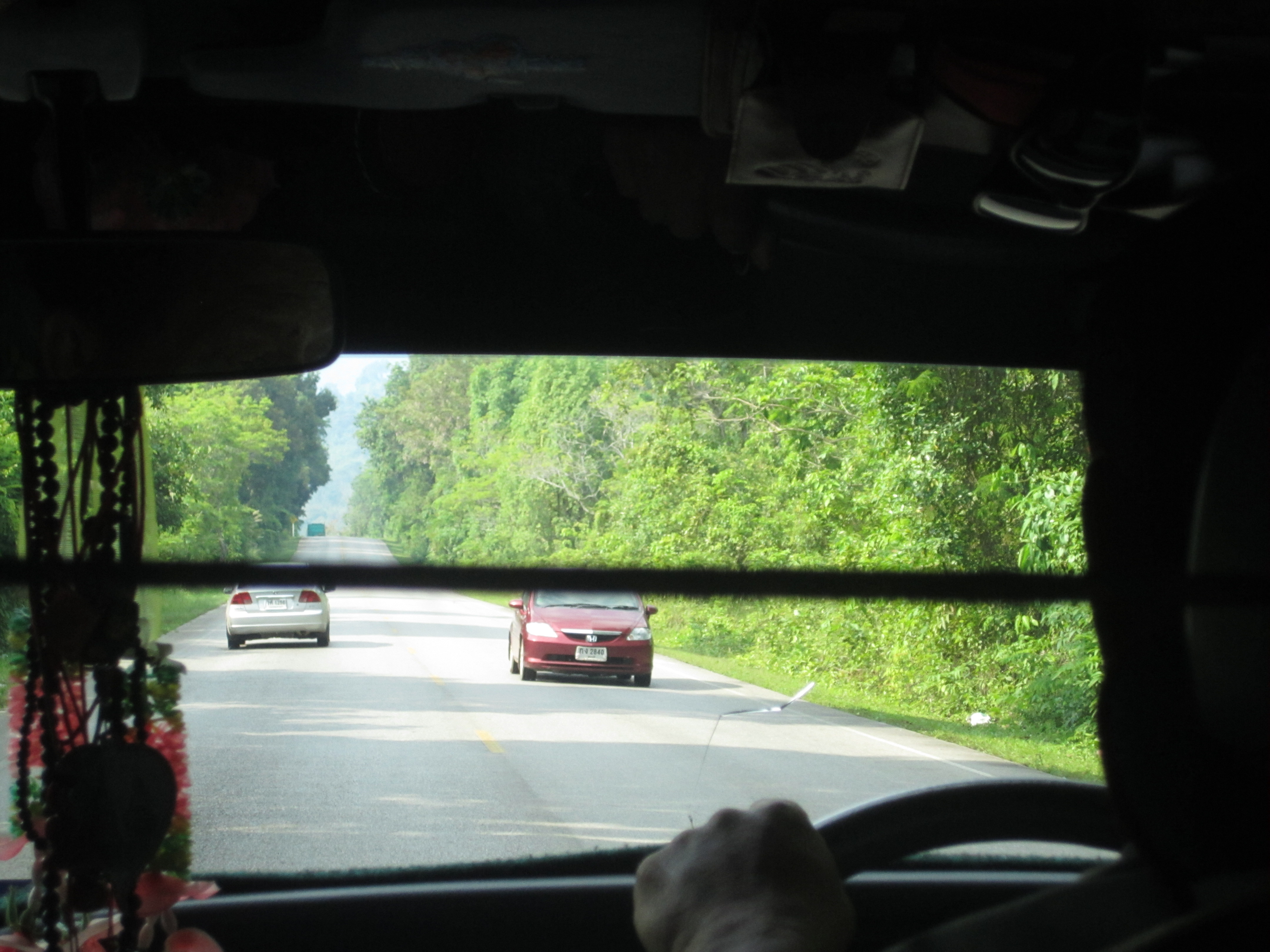
I’m staring through a bus window, scanning for clues.

A month in Phnom Penh and I’m finally leaving the city. I need a new visa, and I was planning to come to the Thai border anyway, to search for the remains of a refugee camp—as though the land could hold stories, or bits of stories; as though it could tell them and I’d be able to hear it.

I look out at the rumbly pavement, the lumbering trucks, the dusty shoulder and the green, green beyond. I don’t see any traces. I see thatched roofs and hammocks between the trees; I see bone-white cows laying in the dirt and houses perched on stilts like skinny legs. I see roadside petrol stands and carts of rubble with young boys sitting atop the heap, staring back through the window at me. I see palms reflected in still water.

Where did the people walk? Somewhere, once, there were paths, and this land saw it, was it. I’m along the Southeast of Cambodia, heading into the Thailand’s Trat Province. It wasn’t one of the main avenues for escape to Thailand—those were in the north—but enough people came this way for there to have been two refugee camps, from what I’ve been able to learn. And I see no traces of their journey.

How quickly, I think, the land swallows human traces. I think of the images of saw I Phnom Penh after the fall of the Khmer Rouge, a little less than four years after having been evacuated: it was rubble, crumble, weeds growing tall and stoplights swinging silent. It was surprising how quickly the earth could undo things.

I think of the accounts of refugees I’ve read. The danger was immense, especially for people already physically weakened by years of starvation and overwork. I think of Vietnamese soldiers, fake Khmer Rouge soldiers, Thai bandits, sleeping landmines—all that people risked to walk through this place that I’m gliding through, plexiglass and air-conditioning. And isn’t that the truth of it?—all I can know of it the warp in the window, the transparent reflection of my own face obscuring the landscape that once held answers, that maybe still does, maybe has its own recurrent dreams, of footsteps marching.

I think this as we climb through the Cardamom Mountains, bus heavy and wheezing. We arrive at the Thai border, our gaggle of Westerners clucking at the Immigration window. (Isn’t this the truth of it?) I buy a coffee; we pile into a different mini-bus and move away from Cambodia and deeper into Thailand.

And it’s different, very different, in a way that surprises me. Borders are usually blurry to me, cultures overlapping like a Venn Diagram. But this one, the contrasts seems stark.

It’s not just that everyone’s driving on the British side of the road, not just that the cars are all newer and shinier. The green is greener in Thailand, I think. There’s no trash on the sides of the road. The electrical wires extend in an orderly fashion, don’t tangle like dreadlocks. There’s more road signs, and they’re crisper, brighter, perkier.

After a month in Cambodia’s capital and five hours chugging through its countryside, Thailand strikes me as wealthy, lavishly wealthy—but something else too. Calm? Peaceful? Something emanates through the lushness, which seems unexplainably lusher than Cambodia. It reminds me of rich kid’s skin, how it seems to glow—how when I was young I learned to spot rich kids by their skin, and I remembering asking my Dad once, “Why do rich kids’ skin glow like that?” and he said, “Access to good health care.” And that made sense, logically, but still didn’t explain all of the glow, or why me and my friends didn’t have it.

And to me, Thailand glows in that way—gleams, even. I stare out at it, the ease and grace it permeates. I want to call it an innocence, but I don’t think it’s that. It’s a stability, I think, perhaps the result of having not been at war, wars. Is this the landscape of peace, of a place that’s managed to never be under the hold of imperialism, that’s maintained a precious degree (or illusion, depending on who you ask) of neutrality?

In comparison to Thailand, I begin to wonder if Cambodia’s landscape does bear wounds, bear a kind of witness—dulled and muted and hard to notice once your eyes have become adjusted to it, like a silhouette of mountains against the night’s sky. Will I be able to see it better when I cross back, the other direction?—what I have easily, automatically normalized.

I stare out the window, searching.

Good Lord, That’s A Lotta Money: A Trip to the US Embassy

The culprit

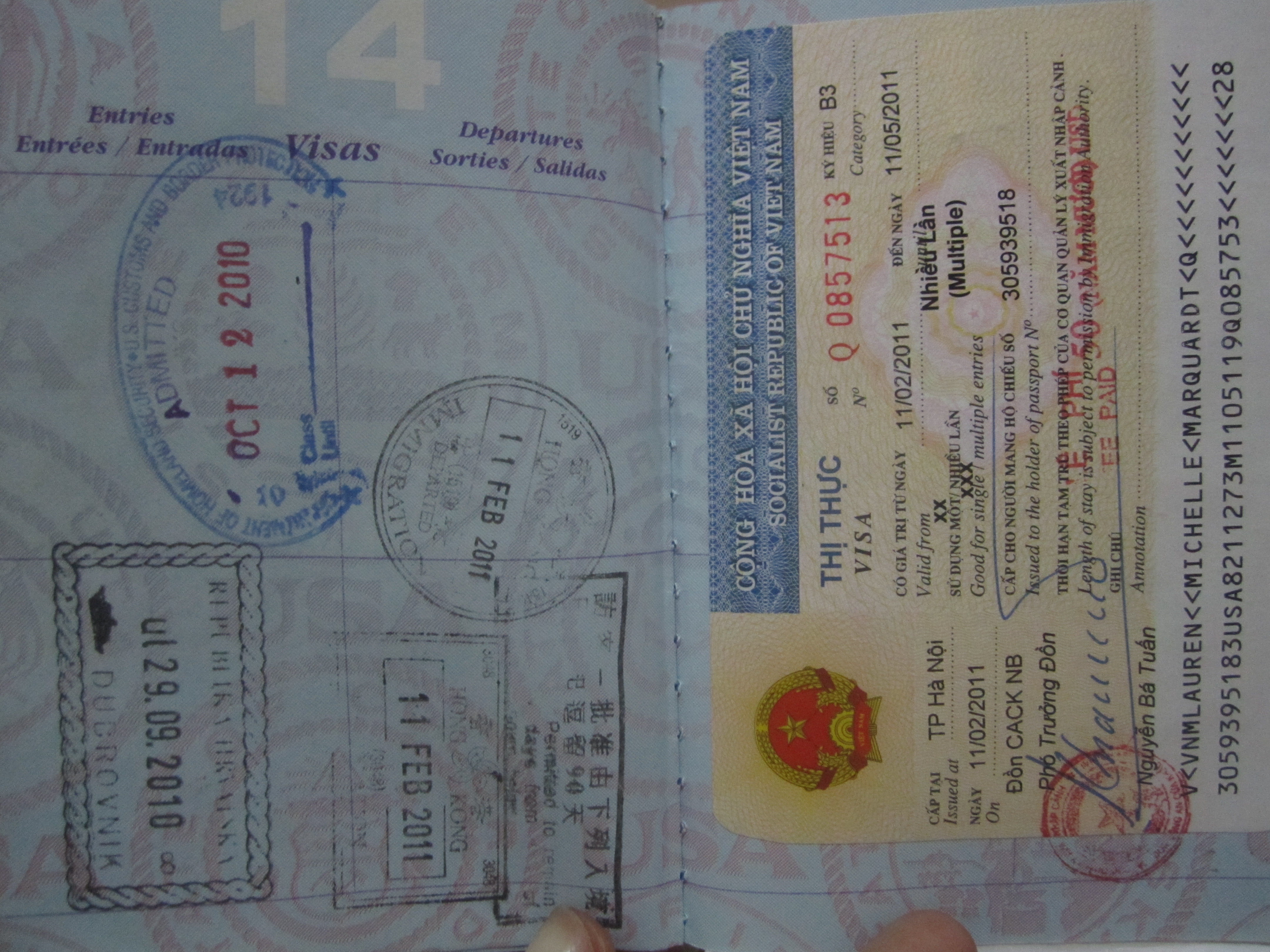
Damn these full-page visas.

When I started traveling, I loved getting passport stamps. They were like tattoos—when you first starting getting tattooed, all you want is more, more, and you stare at the ones you have, and you look at the remaining blankness and fantasize about the ones you’ll get. Western Europe, I thought, was a real bummer—you got only one (extremely boring) stamp for entry into any of the Schengen Zone countries. Lame.

Enter SE Asia—the land of senseless beauracracy and full-page visas. They hungrily consume your passport, taking up space that could easily fit five to six entry stamps to more modest, reasonable countries. Two of these, and I realized I was quickly running out of room in my passport.

It was time for a trip to my Embassy.

Here I should interject—for the non-Americans and the non-traveling Americans, which is most Americans—that filling up my passport does not make me a world traveler of epic proportions. It simply means that the US issues the skimpiest passports you’ve ever seen.

“Look at this thing!” I exclaimed, holding my passport up sideways, showing Anna its anorexic profile.

“Aw, that’s the cutest little passport I’ve ever seen.”

“And guess how long it’s good for?” I paused, preparing her for the indignity. “Ten years! Ten fucking years! What am I supposed to do with this—go to Canada once a year?” And I flung it on the cafe table like the mildly offensive thing it is.

American passports have improved; they now come with 24 pages. But when mine was issued, they still came with a measly 14 pages. Which is annoying, but serves as yet more evidence that Americans don’t travel like the rest of their Western counterparts.

But we recently hit a record high: a whopping 30% of Americans hold passports. (Tell this to a person of any other Western nationality and they laugh heartily.) And, I’d soon find out, there’s evidence of that too.

So it was off to the US Embassy. I’ve never had a reason to visit an Embassy before, and it felt a little like a field trip. I was mildly excited. I queued up under a shady awning at 1pm, eager to be one of the first in line for the two daily hours allotted for walk-in services.

The door opened at 1pm exactly (ah, American punctuality) and a grim-faced guard waved me in. I passed through a metal detector, was told I need to check my bag. I left that room, walking through a manicured courtyard (ah, the American affection for well-groomed lawns) and into another room, where another man examined my passport, wrote down my info, handed me a visitors badge and waved to enter the next room.

It was like a little air-conditioned slice of America. Posters on the wall: “From Sea to Shining Sea,” portraying different landscape shots; pictures of smiling, racially diverse faces; a sign suggesting that I like the US Embassy on Facebook (now, why on earth…). There was a drinking fountain—not a water cooler, but a drinking fountain—and I took a sip just for the novelty of it. A picture of Uncle Sam pointed down at me, and I smiled.

I lined up at a service window, fenced off with red partitions. I’d heard that they’d recently started charging for additional passport pages. I’d assumed that, now flooded with an influx of traveling Americans, this would be some sort of modest administrative fee; I had $30 in my wallet. I got to the window and told the clerk I needed more passport pages, and asked how much it would be.

She handed me a form. “It’s $82.”

I blinked. “$82?” I repeated. Maybe I heard her wrong.

She nodded. “$82.”

I briefly considered quoting the old Chris Rock skit from I’m Gonna Get You Sucka: “$82? Good lord, that’s a lotta money. How much for one page? How bout I photocopy a page and staple it in myself?”


Apparently the original skit doesn’t have the tag line. But you know what I mean…

Something told me this would not be an effective bargaining technique. Besides, this was the little slice of America, and in America, we don’t bargain.

“Um, okay,” I said slowly. “Well, I didn’t think it would be that much. Do you take credit cards?”

“No,” she smiled. “Cash only.” So it wasn’t totally a slice of America.

I asked the clerk’s opinion on whether I’d actually need more pages. I showed what I had left—two unstamped pages, plus the back amendment pages. I told her the countries I’d be going to. Did she think the customs agents will be able to squeeze the stamps in? (If it were Mexico or Italy, it’d be no problem; those fools will stamp right over of other stamps.)

“I think it’ll be okay for this trip. But it’s the same price here as in the States. So if you think you’ll need more pages anyway, you may as well get them while you’re here.”

Ah, American customer service: she was right. I don’t even know where the Consulate is in San Francisco. Right now I’m living a 5 minute walk from the US Embassy; in Phnom Penh, the task would only chew up an hour or so, as opposed to a whole day.

I nodded. “Okay, thank you. I’ll be back.”

And so I went back yesterday, went through the whole process again. And I must say that there’s something vaguely comforting about the whole thing—even though I don’t feel myself missing the States at all, there’s something sweet and reassuring about being surrounded by the Americana images, the American accents.

The funny thing about the Embassy here—and I’ve been told this is particular to this Embassy—is that services for Americans and services for Cambodians are done in one room. You sit in little chairs and wait for your number to be called, which sounds boring (and it is) but you’re provided with some pretty keen people-watching. Conversations between clerks and customers are done through a glass window, over a small speaker, and that provides for some pretty keen eaves-dropping.

A Cambodian man was trying to secure visas for his family to come to the States. He’d failed to follow the correct procedures and was stumbling to answer questions. He didn’t seem to understand the concept of needing to provide DNA-test results for his kids. I felt embarrassed for him.

I also saw the most Mexican Khmer man in, well, perhaps anywhere: cowboy boots, cowboy hat, big belt buckle and blue jeans, one of those air-brushed Cholo shirts with a picture of a foxy lady on the back, saying something “Por Vida.” I was ravenously curious to find out his story, but he left before I had a chance to sit down next to him and get nosy. Sometimes Khmer people with especially round faces look vaguely Mayan, and in my mind I imagined him having resettled in Texas or California and one day deciding: “Fuck it, if everyone thinks I’m Mexican, I’m rolling with it—por vida.”

A man next to me struck up conversation. He was Cambodian; having lived in the US for 10 years, he’d recently returned and was hoping to get a job at the Embassy. He asked why I was there, and we shared a laugh about how ghastly expensive my simple task was.

“I think it’s because more Americans have passports now—they’re milking it.” I leaned in, lowered my voice, “They found a new way to rip us off, you know?”

He nodded. “Maybe the pages be made of gold.”

I chuckled. “We can only hope.”

I got my passport back and the new pages were not, in fact, made of gold. They were made of paper. Very smartly decorated paper, with fanciful American images—totem poles and majestic eagles and buffalo so darkly colored I don’t know how a stamp is supposed to be readable over it. There are quotes from famous Americans about democracy and freedom and something from Ronald Reagan about living in a world “lit by lightning” that I’ve been unable to make sense of.

The new pages are insultingly over-priced, audaciously gaudy and not entirely practical—in short, very very American. And what can I do but shake my head, both annoyed and amused, with the vague affection one feels for their native land, their home country, their home.

My new plump passport

The Anti-Irony of Cambodian Fashion: The English-Language T-Shirt Edition

“I like how cheesy it is, you know?” Mathilde said this morning, ashing her anorexic cigarette and looking across the street, at the teenagers hanging out at the Best Friend Cafe. Fake acid-wash skinny jeans, emo sideswiped hair-dos, bedazzled trucker hats positioned atop boys’ heads in a perch reminiscent of Abe Lincoln—the styles donned so earnestly by Cambodian youth would be only be seen on the most ironic of Western hipsters. And even then…

“It’s not so serious as in Europe,” she continued. “We would think this was so cheesy, but why not? If they like it, if they think it looks good, why not?”

One of the things I love most about Cambodian fashion—and it isn’t the stripper shoes or cutesy pajama prints or polka-dot pants—is the utter sincerity with which ridiculous clothing is worn. Ridiculous to Western eyes, I should say. And tonight this was exemplified by the t-shirts for sale at Phnom Penh’s Night Market.

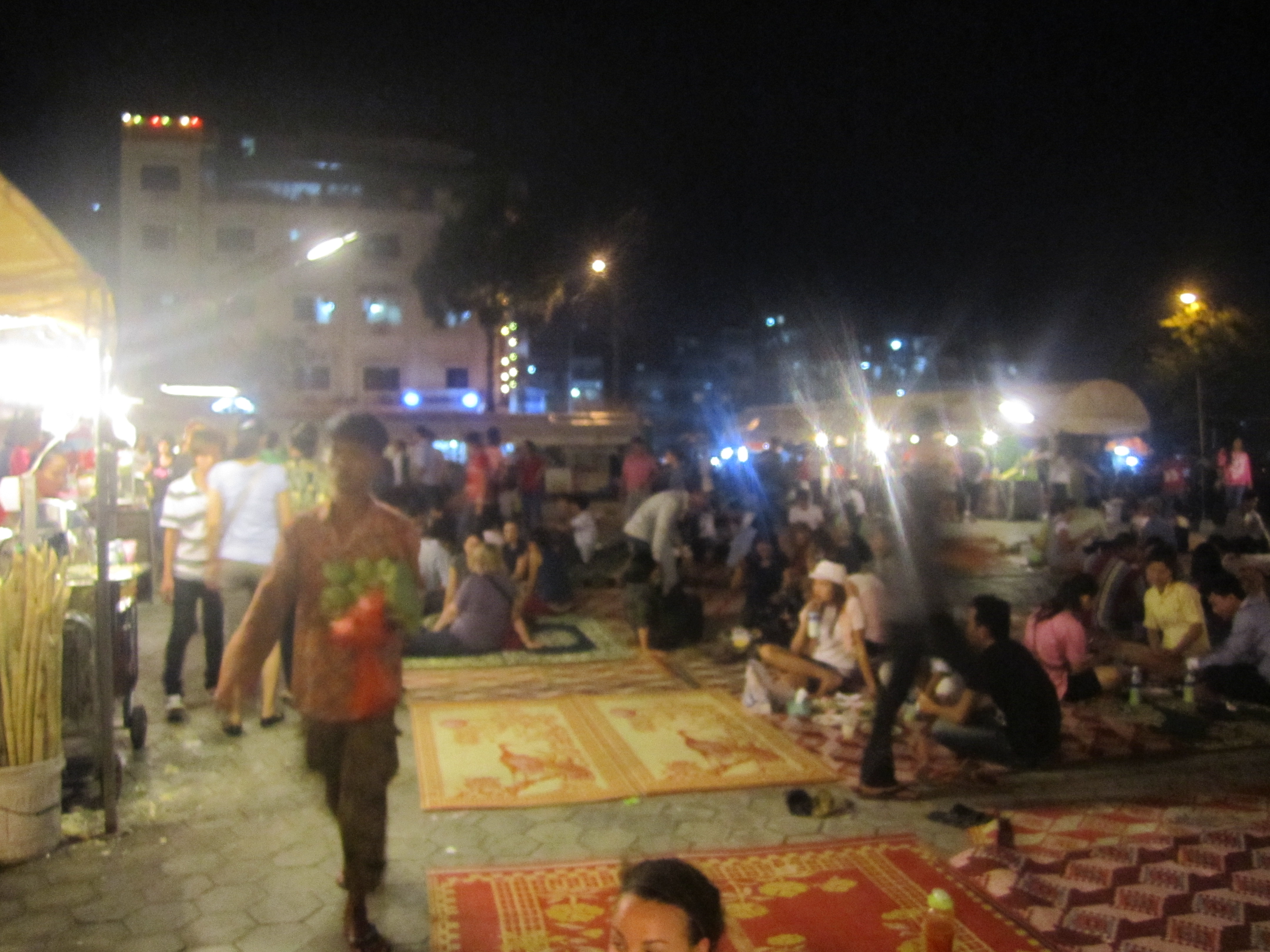
On Friday, Saturday and Sunday nights, along the riverside, tents are erected and a fair-style stage put up; vendors set up booths, teenagers with mediocre voices and sleep-walk-y dance moves perform on stage, mobile phone companies set up opposing stands with megaphones blasting promotions at one another, food stalls sell skewers of myserious deep-fried meat products, and diners take off their shoes and sit on straw mats, eating off thin wooden sticks. It’s nice. It’s a good mix of foreigners and Khmers, the riverside breeze is sweet, and until the mosquitoes drive you away, it’s pretty fucking luxurious to sit out and enjoy the night.

So we’ve been making a habit of grabbing some food and sitting out under the stars—or what would be the stars, might be the stars, behind the haze of city lights and smog. You can’t really be sure anymore. You don’t really go there to buy things—some tourist trinkets, fake floral arrangements (okay, I bought one of those for my apartment), and clothing. Clothing for local teenagers, I should say.

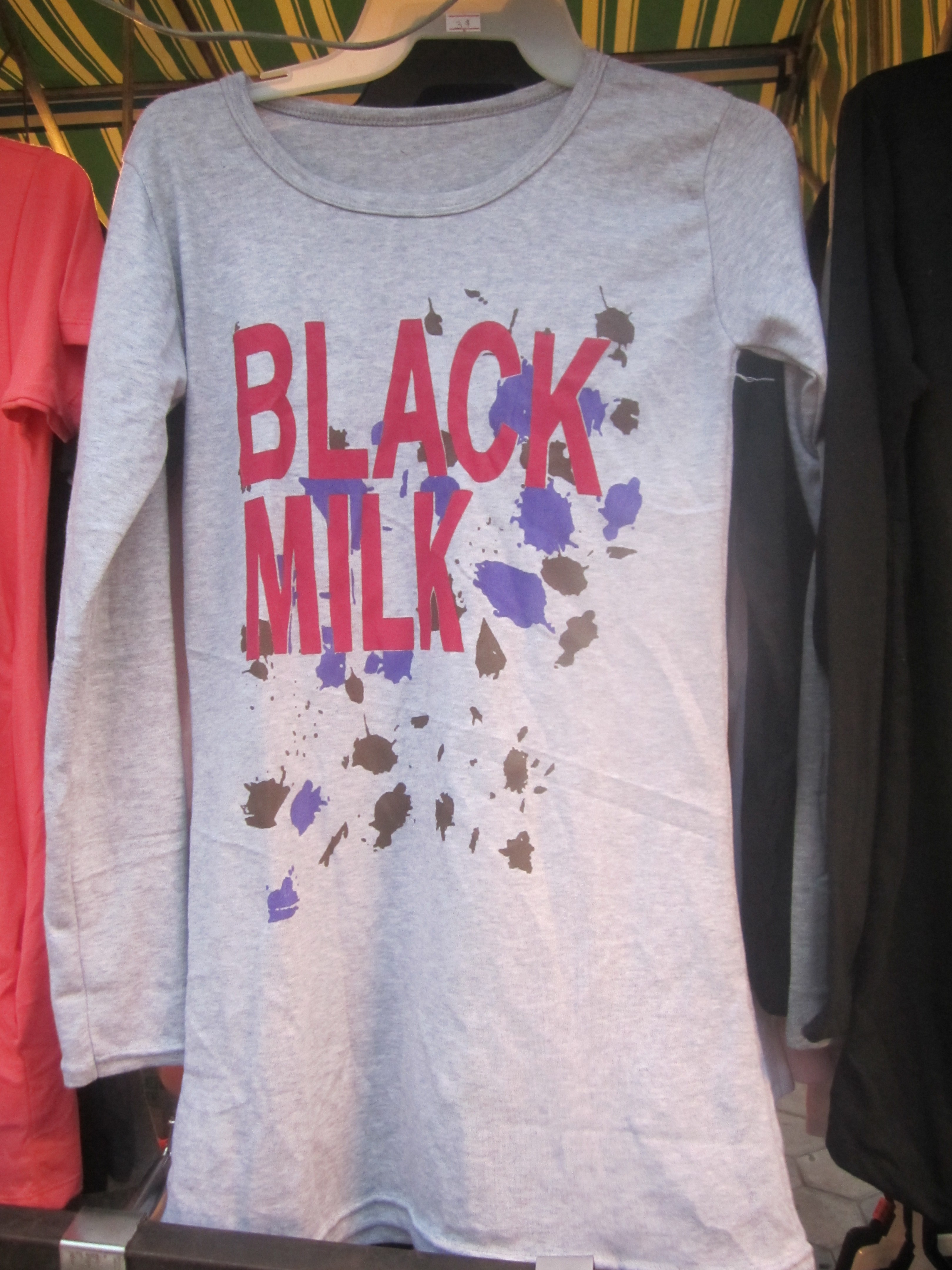
Tonight I took to photographing some of the t-shirts I felt best exemplified the Cambodian fashion spirit within the particular sub-category of Putting English Words On A Shirt Immediately Makes It Cool.

Rule #1: It doesn’t really matter if what’s on a shirt makes sense or not—as long as there are English letters, you’re half-way there.

Rule #2: It really doesn’t matter.

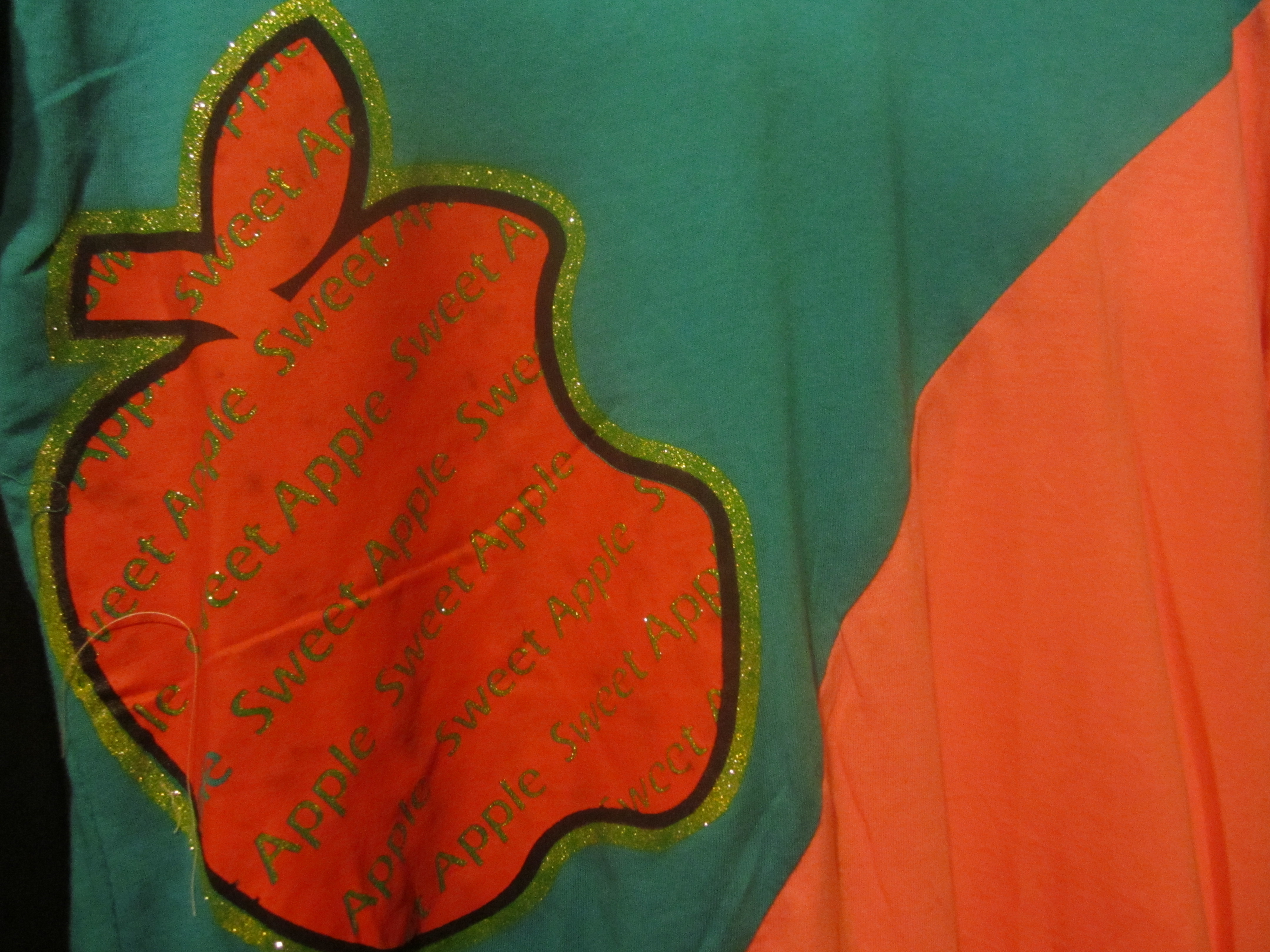
Rule #3: Product placement is a key component of English-language t-shirt fashion. It doesn’t matter if it’s the actual logo of a product, as long as it refers a Western, and preferably American, product.

Hey Apple marketing masterminds: you should really think about doing a Cambodian edition of those PC vs Apple guys ads. Do you see any PC t-shirts out here? I don’t think so…

Rule (?) #4: It also doesn’t seem to matter if the senseless phrases evoke repulsive imagery of, say, spoiled food products.

“Punk Rock Tonight Love Me”: I almost bought this one. It was too small.

“Power Over Pimples”: Fuck yeah! As someone who endured 12 years of acne, I wanted to high-five this t-shirt and jump joyously in the air like… the people on this t-shirt. The text was also English, singing the praises of an acne-fighting cleansing solution.

So, um, in a country where a shitton of kids get strung out on glue sniffing and paint huffing, I didn’t know what to make of this. Was it supposed to be funny? One thing’s for sure: I don’t think the affected demographic is perusing for new shirts at the Night Market though…

Rule #5: Content Over Accuracy

“Joy, Look For It Evert Day”: This shirt says it all. There’s a certain sweetness to it all, what would be convenient to call an innocence, but I think it’s something other than that, less simple or more simple or in any case different.

“Cambodia’s not a post-modern culture,” someone was explaining to me. “So there’s not a lot of irony. There’s a playfulness for sure—but more of a sincerity to the work.”

She was talking about contemporary art, but I thought about her comment looking at the shirts tonight. And I think it’s true for the fashion as well. And I agree with Mathilde—I like it. Coming from a world of ironic everything—ironic moustaches, ironic wolf-howling-at-the-moon shirts, ironic gangsta rap listening and ghetto blasting, ironic malt liquor drinking and crack smoking (yes, really)—it’s pretty fucking refreshing to enter a world of sweetness and anti-irony. It’s not any less self-conscious, it’s just self-conscious in a different way. It makes you feel like we’ve missed something in the Western world, that we’ve lost something, gotten away from something, something I can’t quite name but that makes me horribly sad, in the smallest way, heavy like a pebble.

But I’m Western. And I can’t switch worlds, switch roles, ease myself into a different way of thinking. The t-shirts are, to me, ironic.

Yawning teenager working the teddy bear stand

A Silence Created By A Mighty Sound Is Still A Sound

Bomb Ponds, Sa Sa Bassac

This is it, I thought. I’ve hit the wall of my own silence.

When I started my trip, on through when I first got to Phnom Penh, I was on fire. I couldn’t stop writing. It came like a flood, from some damp corner of my brain, out my fingers; it came menstrually, ravenously. I couldn’t turn it off. I felt like, for every hour spent outside, I needed three hours to write everything I saw. I was exhausted, and I was in the zone.

And then, and then… Something in me closed the door.

Other doors have closed too. Or haven’t opened to begin with. I had a crap morning. I’d made an appointment to meet with the Acting Director of PADV, a leading domestic violence NGO. Domestic violence is central to the story I have to tell, though I haven’t wanted to look at it. Or rather, I’ve only been able to look at it sideways, head cocked askew, the way my brother watches TV. I’ve stolen a glance at its countenance, its cruel shadow, and I’ve quickly glanced away.

But I wrote the organization, and someone actually wrote me back and was willing to meet. And that’s pretty much what I’ve been doing here in Phnom Penh—standing in a hallway (a skinny dim hallway with a full-length mirror at the end, where I see myself and also something else, a shadow moving perhaps, though I don’t know of what), knocking on doors and waiting to see which ones open.

I woke up with a knot in my stomach and full of nervous energy. I was uptight about the meeting, self-conscious and stressed. I was dreading talking about what we were going to be talking about, something I haven’t been able to find much qualitative information on—the reality of domestic violence in Cambodia.

I never made it to the meeting.

In classic Phnom Penh fashion, I got lost. I tried to look up the address the night before, but Google Maps has proven useless for this city. I got a motobike 40 minutes before the appointment, a confused old man with deep wrinkles and busted plastic sandals.

We eventually found Street 271, but the building numbers didn’t make sense. They stuttered, jumped from 5 to 36 to 300, back to 60. Evens and odds hop-scotched across the sides of the road. Up and down the hot, dusty road, sweating in my tattoo-covering cardigan, scanning the storefronts for addresses, searching for some kind of sense, a logic, a meaning and order, finding none. Sometimes there isn’t one.

We finally found #269, but it was not an NGO. It was a dress shop. I showed the woman, sitting in her pajamas amidst the sequin-studded manequins, the name of the organization. She frowned, waved her hands in the air. I felt forlorn, a kind of panic rising up in me—but why? What for? I felt like I was going to cry.

I handed the motobike driver $2.5, far more than the ride was worth, and thanked him. I tried to call PADV; my phone died. I wove through the traffic to a call center; I got through to PADV, but then the line cut out. I used the internet, wrote them an email, idled while I waited for a reply.

I never heard back from them. I missed my appointment. I felt like I’d hit a wall, alone in the hall with only the echo of my knocking. It was an awful sound, a rhythm like a feeble heartbeat. There was a curious feeling welling up in me, a kind of black hysteria. What was this? I didn’t know; all I was sure of was that I needed to go back to my apartment.

Maybe this is it, I thought. Maybe I’ve gone as far as I can go with this project. Maybe I’m not ready, maybe it’s too much, maybe the doors are locked too tightly, maybe the silence too deafening, maybe it’s that way for a reason.

I went out later for food. I ended up wandering further than I’d meant to. I was close to the Royal Palace, decided to stop in an art gallery I’d been meaning to check out, the only independent art gallery in Cambodia, started up last year by a collective of “new generation” photographers.

The slim doorway led to a dusty stairwell. I squeezed up the narrow passage into Sa Sa Bassac‘s gallery space. The nine photographs on the wall constituted Vandy Rattana‘s The Bomb Ponds, photographic documentation of the craters left behind from American B-52 bombings.

(“In my province,” the downstairs neighbor, who translates conversations between my landlady and I, said, “many people still hate the Americans for the bombings.” He smiled sheepishly, boyishly and looked away.

“You know,” I told him, “most Americans didn’t know about the bombings then. It was kept a secret.” I paused. “And most Americans still don’t know about them.”)

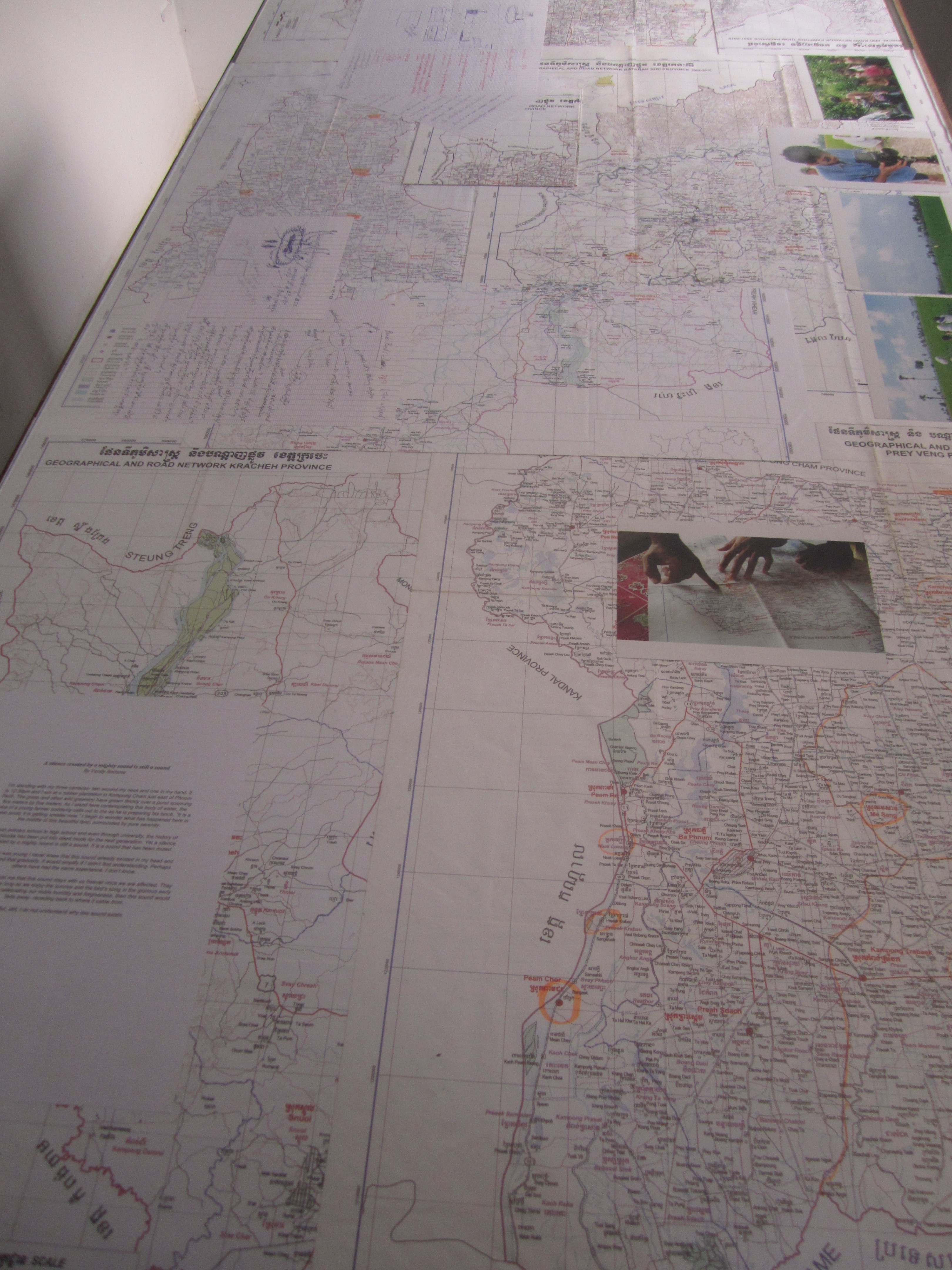
In a back room, sweaty and lit by sunlight, was a table laid out with maps from Rattana’s expeditions to the bomb ponds—black-and-white line drawings circled with highlighters, neon halos and Khmer scribblings. A single typed half-sheet of paper told a story, held a key, a small sound of knocking, knocking…

From primary school to high school and even through university, the history of Cambodia has been put into silent mode for the next generation. Yet a silence created by a mighty sound is still a sound. It is a sound that has been muted.

When I was young I never knew that this sound already existed in my head and body, that gradually it would amplify if I didn’t find understanding. Perhaps others have had the same experience. I don’t know.

My parents told me that this sound stays with us forever once we are affected. They told me as long as we enjoy the sunrise and the bird’s song in the glorious early morning whilst celebrating our noble humility and forgiveness, then this sound would fade away, receeding back to where it came from.

But still I do not understand why this sound exists.

I stood in the heat, in the echoes of street, and nodded. Thank you Vandy, I thought. Thank you.


Fuck you, I love this song. And orange turtlenecks.

Old Films, New Stories and Sifting For Clues

I got another clue the other day.

That’s what I feel like I’m doing: sifting around this city for clues. I’m working on my Glimpse project, which is really a personal project, a mammoth undertaking of which the writing is only the very end result, a small part of the process.

What I’m trying to do is reconstruct a story—a story of the past, that was only ever told in fragments, and now those scraps are all that’s left. I’m trying to string them together, make some sort of linear, coherent narrative, though I’m not sure why or what it’ll accomplish or change or relieve.

Because there’s not a linear, coherent narrative. There was once, perhaps, but it’s gone now; the chance to know it is gone too. And the silence and the blank spots, the unknowing—they tell a story too. They tell a story I know much better than the scraps themselves. It’s a story I’ve locked away, in my own kind of silence—a story as foreign to me as the dust and traffic of this city, the microbes in the water, floating in an unseeable dance.

And here’s the other thing I’ve been thinking: what the fuck for? Aside from the huge, glaring fact that it isn’t my story, or is only tangentially my story—my own story is still too dim to know, to touch or hold or let alone tell—aside from that, there’s the Why. Why do we seek out the past, feel a need to understand it, or at least know it—a past we didn’t even live? What does it accomplish or change or relieve?

I went to Bophana yesterday, sat on a straw mat in a corner of a dim room with no fan, and watched New Year Baby. It’s a documentary by a Khmer-American woman about her search to learn about her family’s history and war experience, what was always kept a secret from her. There seem to be more and more foreign-born Khmers doing this—traveling back to Cambodia, seeking out answers, trying to find the full story, the reel from which they’ve only ever seen clipped stills.

It was an excellent film. But the question that kept ringing through my head was Why? What’s this need in us, drive in us, all of us, to know where we come from? And what does it mean for the generations growing up in silence?

In any event, 500 words later, here’s the clue I got. I met with Sithen Sum, director of Kon Khmer Koun Khmer. It’s a collective of young Cambodian filmmakers—the “next generation,” as they’re called here. I’d met him at the opening of the Vintage shop, where repaintings of Cambodian Golden Era film posters intrigued me.

We met at a Western cafe. I was dry-mouthed and bleary-eyed from an all-night bout of traveler’s stomach, but I refused to miss our appointment. We sat in the air-conditioning and talked about the organization’s work: the short films they’d made, the way they’re all volunteer-run, doing all the projects in their off time from other jobs, full-time, money-earning jobs.

The organization grew out of a 2009 exhibition curated by French-Khmer film maker Davy Chou focused on reviving 60s and 70s Cambodian films and bringing them to the public.


Trailer for Chou’s upcoming documentary about Cambodian film revival

Chou led workshops and classes in film making, and inspired the formation of Kon Khmer Koun Khmer. The group has gone on to make a few of their own films, with another to be released in May.

“It started as a revival,” Sithen told me. “We see the old cinema as a bridge to make something new, to create something of our own.”


Trailer of Kon Khmer Koun Khmer’s first film, Twin Diamonds

It was so simple, so succinct: to make something new, they have to know what came before them. To know who you are, you have to know where you come from. Artistically, I’ve always known this is true—where would I be without the works of all those writers I’ve adored that came before me? You need to lineage to build on, whether its a family tree or a film reel.

This was the clue, staring me in the face, living inside me—that took someone else’s words to realize.

“We love the old films like realitives,” he said. “But we’re also critical of them.” They especially don’t like the universal practice of voice dubbing used in the old films. The group is more influenced by foreign methods, Sithen admits; they want to apply foregin knowledge to make new films. “We don’t want to go back to the past,” he told me. “We want to learn from both the successes and mistakes of the old films.”

They want to know where they come from.


Lauren Quinn is a writer and traveler currently living in Hanoi. Lonely Girl Travels was a blog of her sola travels and expat living from 2009 to 2012. She resides elsewhere on the internet now.

Join 490 other subscribers

Buy This Sh#t

Categories