Archive Page 16

No Hue: Hue Riders Knock-Off

Um, is this supposed to be something important?

Mr. Loc is over it.

He slows the motorbike, pulling over to the skinny shoulder of the highway that wraps seductively around the lush green mountain. He points. “Photo.” It’s more of a command than a suggestion. I snap of shot of the vista—pretty, with rice paddies and a cloak of fog. But I couldn’t tell you any more about it.

That’s because Mr. Loc isn’t having it. He’s shown us the goddamn vista, his posture seems to say, what more do we want?

Even the most skilled and adept of independent travelers (and I’m certainly far from one of them) falls for an imitator sometimes. It happens: we’re tired, we’re rushed, our guard is down, it seems like a good idea. We wind up paying top dollar for a half-assed adventure.

I’d heard about the Hue Riders one night in Hanoi. Instead of a boring old tour bus, they take you on motorbikes from Hue to Hoi An, an historic trail that stops at waterfalls and pagodas and old American bunkers. “It’s supposed to be brillant,” one of Jacob’s friends told me, hunched on our plastic stools over the billow of BBQ smoke.

Killer. Sign me up.

I asked my hotel in Hue if they’d heard of the Hue Riders and they nodded enthusiastically, leading me over to the dude posted at the cafe next door. He thumbed through his photo album—him with smiling white girls, him with white dudes giving the thumbs up sign. He showed me an entry in his customer comment notebook from a girl who was “from your country!”

I couldn’t tell if it was cause to be suspicious, or if he was just that certain kind of proud that third-world tourism workers sometimes are. He showed me his business card: “FIFTEEN YEARS Experienced, All’s for your satisfaction.” But hey, it said “Hue Riders” under his name.

It was only later, after I’d paid and signed up, that the real suspicion began to mount. I googled Hue Riders. And holy shit, there was an actual, legit website. For the real Hue Riders. Of which Mr. Loc was not one.

Oh well, I told myself. Chalk another up to experience. Sometimes the DIY, hustling tour guides can be just as good as the bona fide ones your LP recommends.

Which is true. But Mr. Loc, I’m discovering, isn’t one of them.

He isn’t terrible; he’s just monumentally not into it. Fifteen years of experience has translated to boredom.

Our first stop was a fishing village off the highway: a dirt road strewn with debris; a couple of kids playing soccer; a clutter of wooden boats, docked and sleeping; nets laid out like the vacated skins of snakes.

“Fishing village,” was the extent of explaination given.

Joe, the upbeat and friendly male half of an American couple who’d also gotten roped into the tour, attempted to ask some questions. “Do they go out in the morning?” We got a sort of unintelligble, one-word answer.

Now at a mountain pass—but was it the first or the second pass?—I attempt to eavesdrop on the tour guide next to us. Something important about these cables, this view, something about Americans? I try to ask Mr. Loc. “Was this something important during the war?”

“Yes, I think so.”
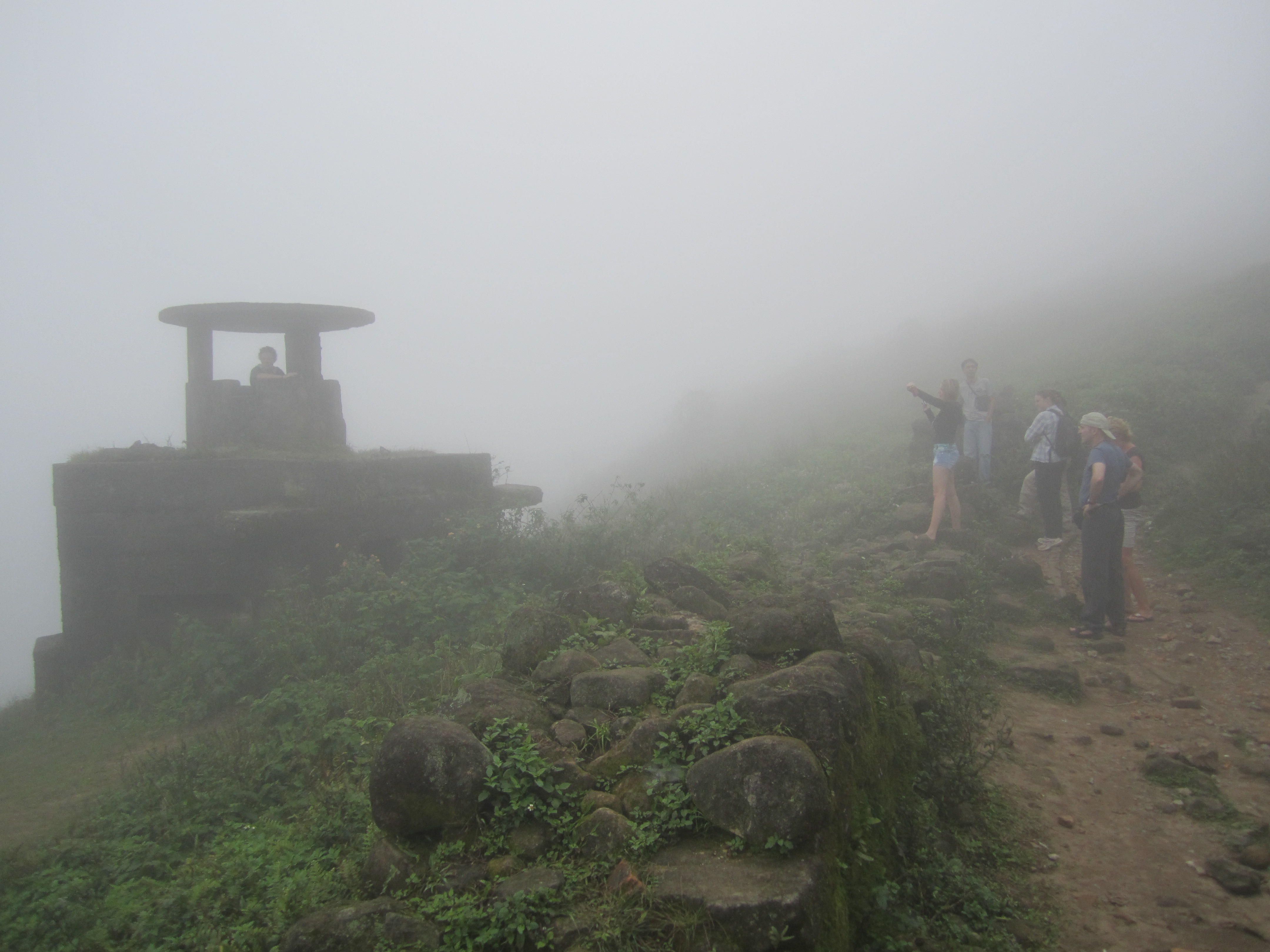
Tourists at a former bunker

We move along. It’s a foggy, white-wrapped day, and all the sights we stop at are equally shrouded in hazy incomprehension. We stop by bunkers used during “the American War” (now a tourist trap—more on that in a later post). We stop off for overpriced coffee at a cheesy resort. We pull over at the roadside operation for a kind of cosmetic oil made from a local leaf. We stand around awkwardly as Mr. Loc tells us the prices of the different sized oils.

“Not much of an oil type myself,” Joe declares good-naturedly. He’s pathologically cheerful, in that particular American way, with his buzz cut and beaming cheeks. “When do we get to the waterfall?”

“No waterfall today,” Mr. Loc declares. “The weather,” he gestures around us, “road too slippery.” He makes a skid-and-crash motion with his hands. We nod solemnly, disappointed.

We stop at Marble Mountains, thrust from the flat earth near China Beach like a glittering rock of crystal. Pagodas and temples abound. Joe maintains his positivity, reading aloud from his Lonely Planet to make up for our lack of tour guide. I’m grateful for his unrelenting optimism.

Holy light

We wander into a cave that feels like a cathedral—a carved Buddha in the stone, incense like breath, sunlight filtering through the ceiling like the fingers of gods. There’s the hush of a holy place there; Joe reads that during the War, it was used as a VC hospital.

In a corner, a bat with a broken wing arches and flops. He squeaks intermittenly, and it sounds like a very small prayer, echoing against the rock.

We descend the mountain and find Mr. Loc waiting for us, leaned against the motorbike. “Okay, we go.”

I realize the thing about Mr. Loc isn’t that he’s rude or unknowledgable or even a shitty tour guide. It’s that he’s supremely Vietnamese. It’s this certain way, this certain attitude, that I’ve begun to understand, the same as in the nail shops at home—matter-of-fact, blunt, nothing sugar-coated or said sweetly. Here’s your tour. There’s a sight. Good? Okay.

“Vietnamese people aren’t very nice,” other travelers have told me. I understand where they’re coming from, but I don’t think it’s a simple matter of not being nice; I think it’s a profound cultural difference. (“You want pedicure? Okay, you pick a color.”) Brusk and brash—jarring as the chorus of honks from the motorbikes.

We arrive in Hoi An wind-blown and dirt-covered. My eyes well from the thousand particles of crap swimming around my contacts; my hair’s matted to my head from too many hours wearing a helmet.

Mr. Loc drops me at my hotel. “Happy?” It’s a business-like question.

I nod. Why not?

Hanoi’s Secret Cafe

I love rooftops, and I love rooftops in cities—sitting up on your bird’s perch and watching the strange dance of it all.

There’s no pigeons in Hanoi (except the ones you see plucked and pink at the food stalls), and there’s virtually no places to take respite.

Jacob told me about the secret cafe—not so much a secret, but a nameless, signless place you could never find without looking for it. On a road behind Turtle Lake, beside an especially terrifying roundabout, at the heart of the chaos—a nondescript storefront shop selling all the usual lanterns and bags and lacquered art. You walk past it, through it, down and back, what looks like the dim hallway to some squalid toilet.

It actually leads to a cafe, opening up into a courtyard that evokes the same “ah” sensation as stepping into a riad from the din of a Moroccan medina. A girl thrust a menu at me and told me I needed to order there, right there, before going any further. I pointed to the coffee with milk and egg white, as recommended, and the girl moved aside and let me pass.

I climbed up a flight of stairs, past a set of carved doors left ajar, revealing a glowing, smoldering altar within. Up another skinny staircase, and I was at a quiet little terrace that overlooked the lake, the skyline, the swarming street, the madness of the city.

It was my fourth day in Hanoi, and I was only then beginning to make sense of it. Its roads were a tangle of incomprehension, like lines in a palm whose fortune you couldn’t quite decipher—electrical wires and branches the gentle hatch marks that lay like a webbing, even less decipherable in what was certainly a story, certainly trying to say something.

But on the terrace it almost made sense, or at least begin to take shape. The other tables were sparsely inhabited by couples, leaning in and speaking low, by a few other foreigners smoking and reading. My egg white coffee came and it was goddamn delicious, thick and like a milkshake. I spooned it to myself like I were my own infant and sat there, just sat, thinking my nothing thoughts and watching.

It was refreshing, to be up there like a bird, in a city that doesn’t have any—to enjoy a moment of peace amid the frenzy. Which is a metaphor for life, in the way it’s all a metaphor for life—one great metaphor beneath the surface of everyday, at the center of everyday, everything just an arrow, pointing, leading, hinting us towards some soft secret (down a passageway, behind a trinket shop)—nudging us towards something we can’t possibly ever know or say, can only sense sometimes, in the still moments—can only approximate, speak about in abstractions, relationally. Which is why it’s a metaphor in the first place, and not The Real Thing—why we need metaphors and egg white foam in thick coffee and pretty little terraces to take a breather on.

Hanoi Secret Cafe: 11 Hang Gai

Suicide-Proof

I dreamed your apartment was suicide-proof:
those little half-windows
that only open in slits,
like doped-up eyes,
how we blew the smoke
sideways and down
and it couldn’t really make it out,
just blew right back to us.

I asked if there were earthquakes here
and you said there weren’t,
but I didn’t believe it—
not that I didn’t believe you,
but I didn’t believe the earth—
that somewhere down
under all this something
was shaking,
ready to shake:
the smell of a seizure
before it erupts.

I got up and paddled
my bare feet across the floor,
my bad ankle snapping.
I realized I’d forgotten the kitchen window,
that slides open wide—
a ledge and a little metal railing
that wouldn’t be enough
to keep a body from crouching,
crawling out
to the 16 stories
of honking beneath.

Learning to Ride On a Motorbike in Hanoi

Hanoi is a bipolar child with a strict bedtime.

Clinging hands behind me to the metal rack, I try to suppress the involuntary flinching—a circumstantial case of Tourette’s. It’s Saturday morning, and my first ride aback a motorbike through the frenetic traffic of Hanoi.

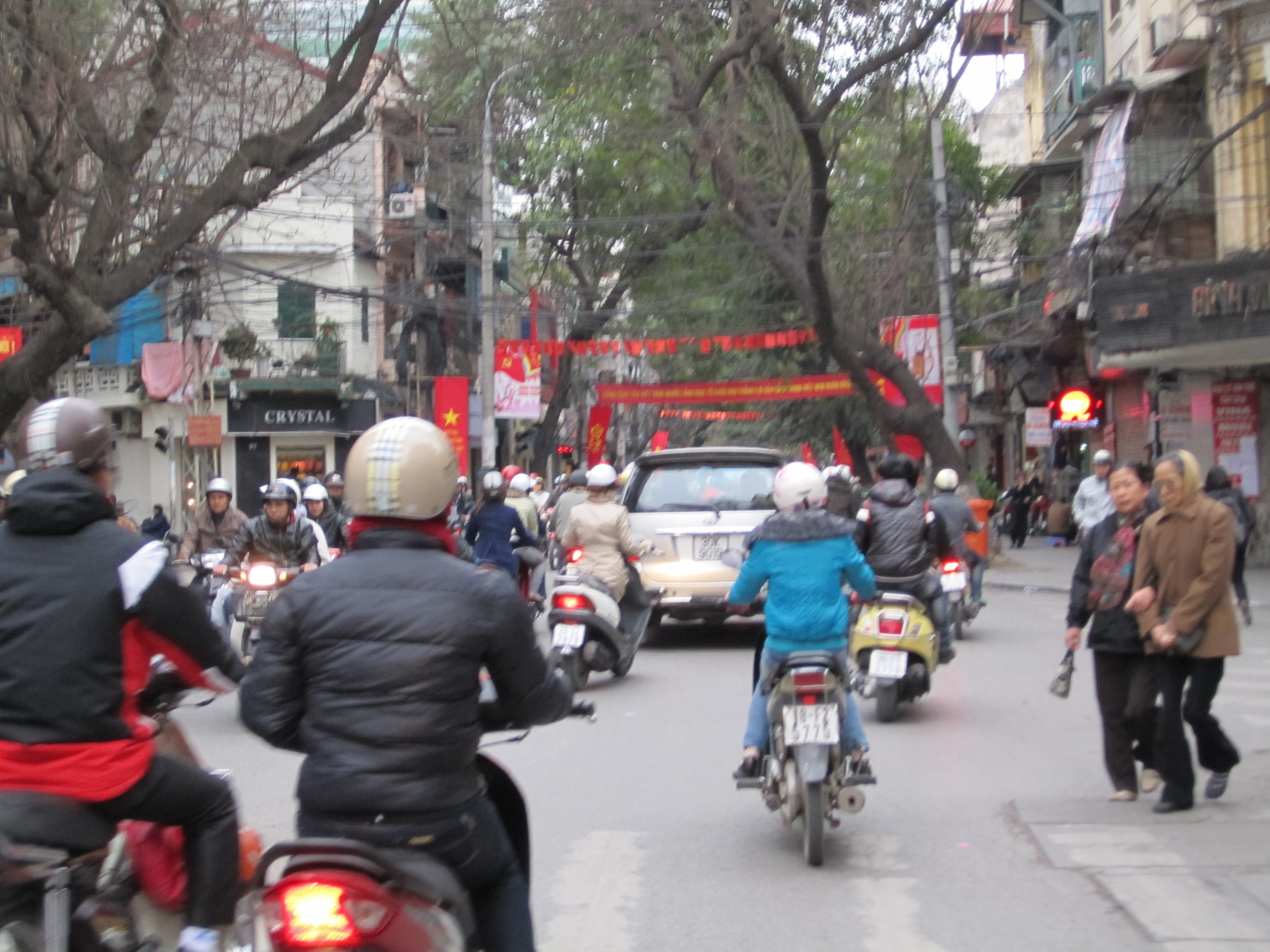
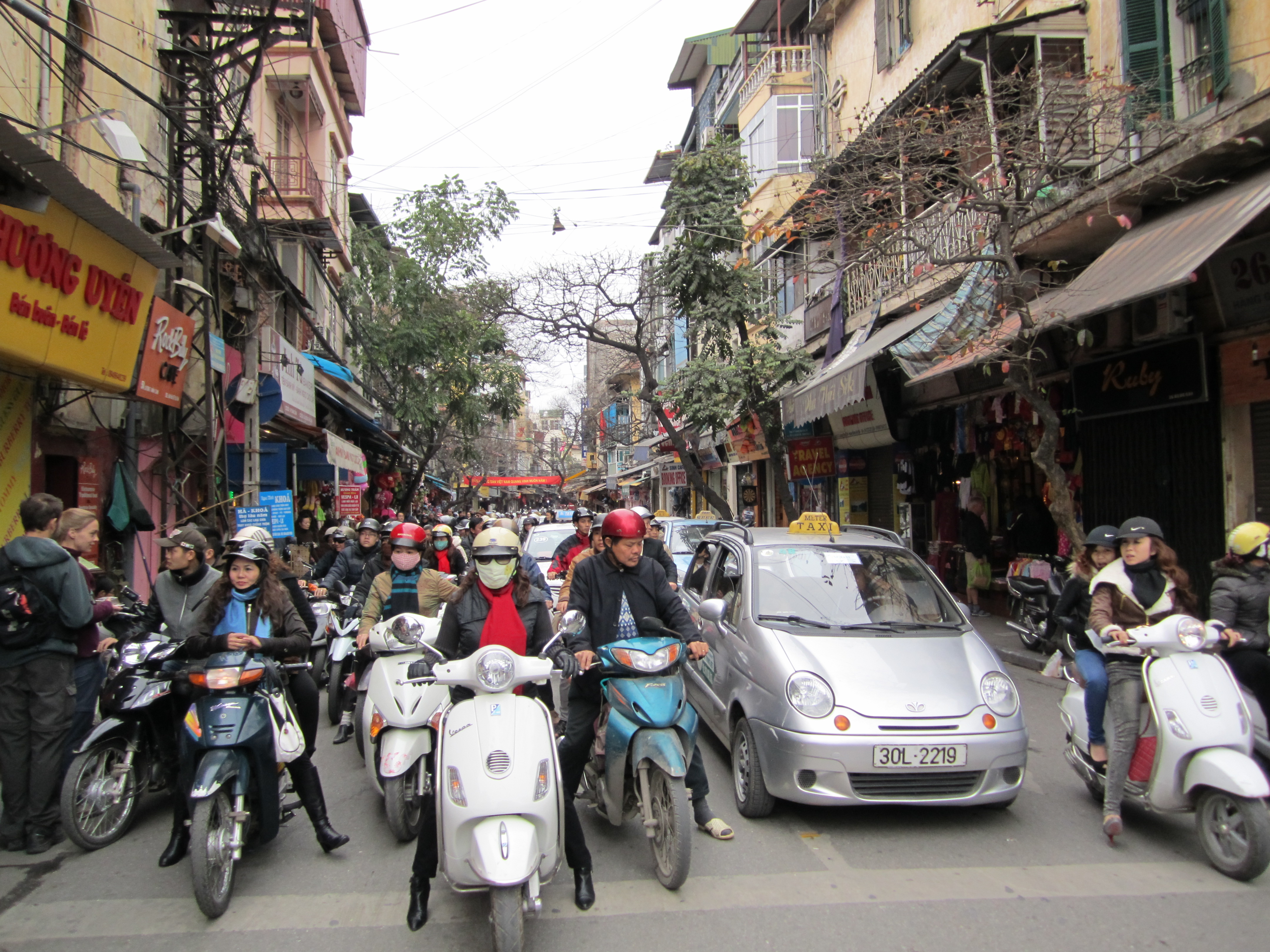
If you want to see the word “clusterfuck” defined, acted out in an exquisite charade, snap on a spare helmet, straddle the seat of your friend’s motorbike and take a ride through the streets of Hanoi. Feel the blanket of exhaust haze whip up around you; feel your legs naked to the risk of a thousand near collisions; feel the breeze of your own mortality and the queasy cocktail of sweetened coffee, cigarettes and exhaust churn in your stomach.

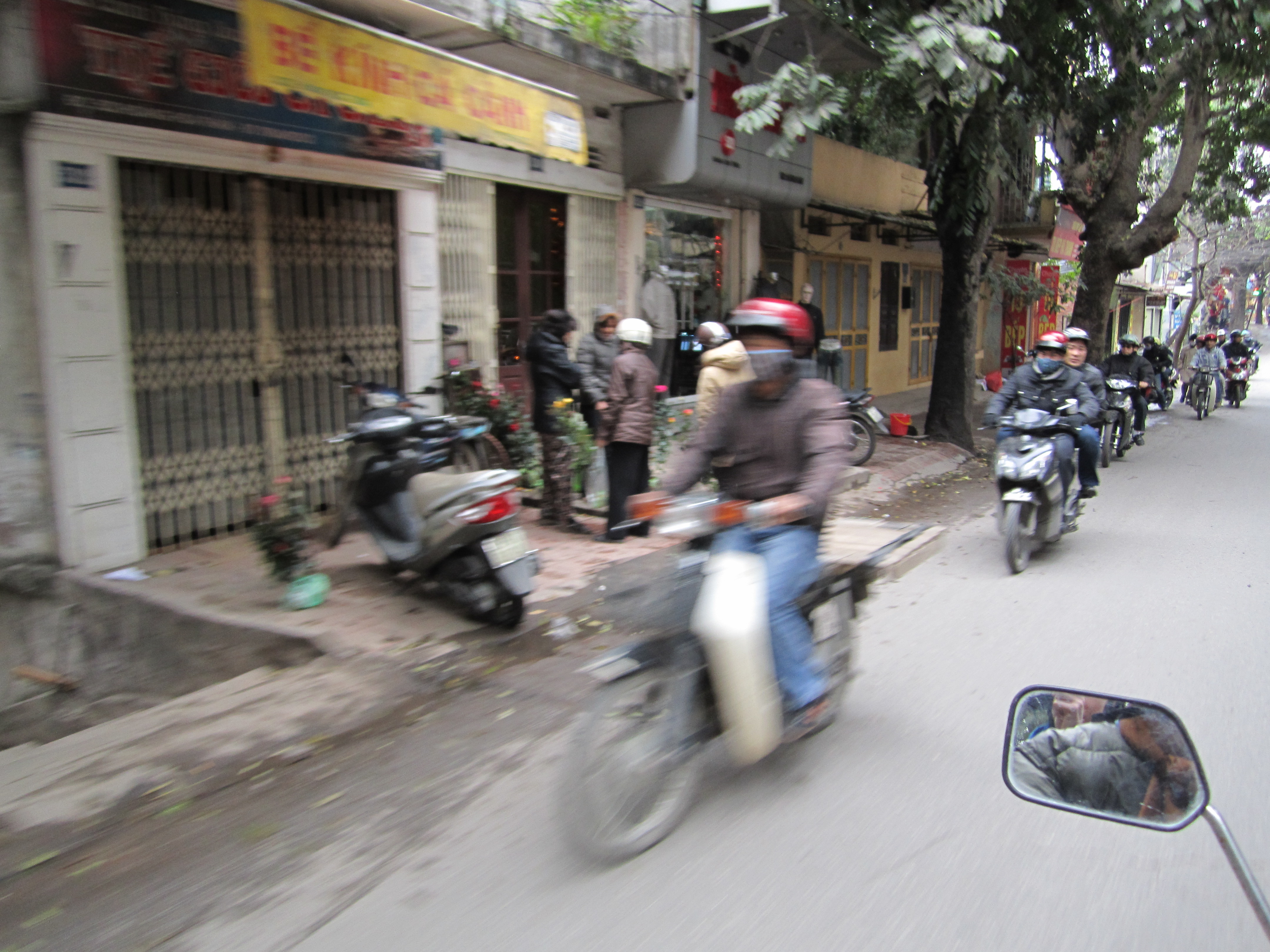
See towers of Tet trees and blossom branches balanced aback bikes; see jugs of water and housewares, bundles of mysterious somethings tied on in impossible precariousness. See families of four smooshed onto a single bike; see the eyes of children placidly blinking in the madness. See drivers texting, pulling out without looking, barely slowly, pedestrians stepping out into the chaos of it all—women walking with baskets balanced on a piece of wood across their shoulders, liked Lady Justice, except it’s their mouths that are masked; their eyes remain wide open.

Hear the horns beep and squawk like a million hungry birds—seven million, to be exact, and every damn one of em has a motorbike and is riding their motorbike, lanes just vague suggestions, right-of-way a nonexistent notion.

See this all this because you’re in this, suddenly a part of this: a passenger in the strange dance that feels more like a riot or a mosh pit—but no, no, must be a dance because you keep skirting disaster, skirting death, and you keep wanting to clamp your eyes shut but can’t, can’t.

Riding aback a motorbike through Hanoi isn’t exactly a near-death experience. It feels more like being on an airplane with really bad turbulence: you trust the pilot but not the skies. You know you’re not actually going to die, but you really can’t wait for the whole damn thing to be over. You get off feeling like you’ve just stepped off a rickety old rollercoaster that’s safety permits are supremely suspect.

“The sidewalks in Hanoi aren’t really for walking,” Jacob throws over his shoulder. “They’re more for commerce. If you want to walk, you’ve pretty much gotta do it in the street.”

It’s not a walking town, he says, and it’s true—at times I don’t see a single pedestrian, just a weaving, wheezing sea of traffic. How do you get to know a place without walking it? How do you get a feel for feel for a place without your feet on its streets?

It gets easier. I tell myself to trust, to put faith in the fact no one seems to be crashing. It begins to feel like we’re moving along this barely perceptible tightrope that weaves in and out of other people’s tightropes, maybe like telephone wires—like our own personal orbit, the miracle of chance that we don’t collide, such a miracle that it can’t be chance at all, but driven by some other force I can only suspect, can feel at times in the smoggy breeze, but can’t come close to naming.

Nighttime is different. It’s as though someone flips a giant switch. By 11, the streets have cleared, suddenly swept of everything but a faint whisper, the asthmatic glow of the headlight. The streets seem smaller in the dark, emptied of their madness—they don’t seem like the same streets at all, but an entirely different place, a different city. An incredible stillness settles over the buildings, the pavement, the wires stretching and branches drooping and the shapes of shadows in the dim drizzle—as if none of it were real, all the daylight mania just a waking dream, a reverse nightmare.

By Sunday I’m able to hang on with only one hand and snap photos with the other. I’m comfortable enough to carry on a conversation as we drive. Jacob points out landmarks and tell little stories; I tell him how my parents were revolutionaries when they were young, how the met in a Communist meeting. He quizzes me Vietnamese numbers, phrases; we laugh about the universal asshole-ness of SUV drivers. We weave through the manic chaos of daytime, and I tell him Hanoi feels like a bipolar city.

Rain comes that night, along with a cold wind; we move more slowly through the vacant streets. I blink against the lashings of wet and my hands turn frigid. Slowly, I loosen my grip on the metal grating, and place both my hands in my pockets.

I’ve learned how to trust the gods of traffic and chaos. I’ve learned how to ride a motorbike in Hanoi.

11 Dazed Hours in Hong Kong

If ever there was a place to wander around in a jet-lagged, head-cold haze with nothing more than a tourist bureau map, Hong Kong is it.

The 11-hour lay-over is actually what made me choose this flight to Hanoi (aside from the fact that it was the cheapest). I love long layovers; it’s like a two-for, a bonus. You get to extend the half-here-ness of transit onto a place—walk through its streets like it were a video game, or bumpy camcorder images from someone else’s vacation, or someone else’s dream, exuding a kind of impermenance that makes you impervious, imperceptible, a kind of illusion, a walking ghost in a half-here city.

Or it could just be the jet-lag talking.

Either way, Hong Kong is a trippy city to spend 11 hours sleepwalking through. Everything is clean, clear and predetermined: signs telling you where to go, signs reminding you to hold the handrailings, signs designating exactly where you should walk and where you should stand and which direction you should look for traffic and when you should be mindful of bicyclists.

It’s a subdued city, a city on Vicodin. Everyone talks in a low, pleasant voice; they smile slightly when they exchange words with you. Skyscrapers rise up to be swallowed in a white fog. Municipal workers sweep sidewalks, trim hedges, wear blue face masks and walk with their hands clasped behind their backs, or piously under their bellies. People walk with the self-possessed composure of business people on their lunch breaks. Shoes click, crosswalk signs hum, the gentle clatter of endless construction (what more could they be building?) echoes. Nothing is loud or jarring or overwhelming. Yes, it’s crowded, but there’s an order to everything—an organized insanity, a colonized chaos.

You could almost begin to suspect that you were in some George-Orwell-esque alternate reality, where everything seems real, resembles real, but really isn’t—just some placated approximation of a real place. Rolex, Prada, Couch, Ralph Lauren, Espirit, Starbucks, 711, Pret A Manger, Citibank, Geox—buildings that stack as neatly as Leggos and fish markets that don’t reek of fish, don’t reek of anything. The thinnest layer of soot covers the awnings, as if to remind you that it’s real—the slightest twinge of exhaust tickles your nose.

It doesn’t feel theme-parky or like a tourist charade, but rather like the city has in fact become this—a large, outdoor office park.

None of which is to say I didn’t enjoy my time wandering around Hong Kong—just that it felt more like one of the alternative realities from Inception than a real place. Which could have been the cocktail of jet lag and DayQuil and caffiene and bad airplane food swimming around inside me. It could have been the pork dumplings and Ramen noodles that tasted like childhood.

Getting Ready

So I leave tomorrow. People keep asking me, “Oh, are you excited?”

And for the first time, I answer, “No.” I shake my head and exhale a kind of half-laugh, the well-isn’t-that-some-crazy-shit half-laugh we do when we don’t know what else to do, how else to respond than to shake our heads at the mystery of things.

I’m not excited. But what is the emotion I feel? I’ve been trying to describe it, name it, say it. It feels big, like a bubble being blown up in me. It’s not panic, but it’s black like panic—panic minus the lightning streaks? “Sadness,” I answered to one person, but then I realized that that wasn’t right either. It’s another emotion, a nameless emotion, that’s twinged with sadness—only on the very edges, but those edges are all I know, all I can feel. And even that I can’t be sure of.

Yet the pain of withdrawal is unique and special, even precious (although you probably don’t think so now). In a sense, the experience is you, a part of you which has been trying to surface for a long time. You have been avoiding or postponing this pain for a long time now, but you have never been able to lastingly outrun it. You need to go through withdrawal in order to become a whole person. You need to meet yourself. Behind the terror of what you fear, withdrawal contains the seeds of your personal wholeness. It must be experienced for you to realize, or make real, the potential for you and your life which has been stored there for so long.

This is a trip I’ve been wanting to take for a long time. This is a story I’ve been carrying in me, mostly without knowing I was carrying it, except in moments when I would see it suddenly: a flash of lightning on a black night, when the landscape of it laid out before me, terrifyingly bare—what was always around me, surrounding me, but that I couldn’t see, wouldn’t let myself see. And it would scare me and I wouldn’t have words for it, because I haven’t ever had words for it.

Only it wasn’t the lightning, the sudden moments of seeing, that were scary; it was the black.

But I’m not feeling scared, not anymore at least. I suppose it’s a stillness I’m feeling, a monumental stillness, burned on the edges with a sadness. For what? For leaving my life. Not that I don’t want to go, but that I suspect some piece of me won’t be coming back. And while it’s been painful—so painful I didn’t really know it, until I let the lightning reveal how painful it really was—that black has been with me a long time.

With all the pain and ache of the early going, with all the difficult and dangerous challenges to our new sobriety which we had faced, and throughout all the gut-wrenching we had undergone over our crisis of personal identity and meaning, we somehow knew that we would miss this period once it was behind us. Amidst all the difficulties and uncertainties, a simple intimacy had come into being for us: we had met ourselves and found ourselves worthy.

We’d been talking about childhood, how Lynda doesn’t much remember hers. She was struggling to get some lost detail right; she turned to me and asked, “I dunno, do you believe in hypnotism?”

I paused. Without knowing quite where it was coming from, I answered, “I believe we look at things when we’re ready to look at them.”

So, I guess I must be ready.

Saying Goodbye

People are trying to say goodbye, and I’m trying to let them.

I’m no good at goodbyes. Not other people’s, but my own. I’m uncomfortable with leavings, and, with my trip only four days away, I’m getting plenty of opportunities for unease.

Three months is just long enough to feel like A Long Time, just long enough to be not just a trip, but an absence, a leave of absence—not just from a job, but from my life. I keep noticing myself wanting to hide, to disappear, to tiptoe off into the darkness—which isn’t really darkness or even blankness, but a big unknown, unimagined and undrawn, the painter’s dream of the painting before he paints it.

I’m uncomfortable with attention. I don’t have birthday parties. I’ve never had an official last day at a job, have always chosen to just dwindle off, fade away, sneak out of the backdoor of a particular life, saying things like, “I’ll be back,” or “I’ll be filling in shifts,” or “I don’t know exactly when I’ll be leaving.” Which is never true, and I know it isn’t true, but I half-believe myself—which becomes full-believing, a believing I distract myself with so that I don’t have to feel sad or wistful or guilty or anything at all. I can push away people’s expression of attachment, their love and care, keep it all at a distance. By the time I’m gone, even I haven’t noticed.

People are trying to say goodbye, and I’m trying to let them.

It’s a different kind of leaving this time. It’s a temporary leaving, like all trips for me, but a more bittersweet one. Why? Because my life is good, and I’m sad to leave it, even if it is for a something positive, a project I believe in, a story I’ve wanted to tell. Because I’ve been working on building true relationships, on truly letting people in, on being vulnerable in a way I never have been. Because I’m letting myself acknowledge that I’m going to miss it all—my muay thai and my yoga, my bed and my backporch, the smell of my favorite coffee and of my roommate’s hair products. And most of all the people.

I’ve been feeling these strange urges to tell people things: “It’s been really rad getting to know you”; “I’m gonna miss our Saturday mornings”; “I really appreciate all your support the last few months.” As though I’m not coming back, as though some piece of me won’t be coming back, the precious little heavy thing I’ve carried and carried.

Is this what they mean by intimacy? Is this what they mean by being truly intimate with another person, by letting it in instead of keeping it all at arms’ length, all of it, always, withdrawing and sneaking off and disappearing into some blank place inside myself?

People are trying to say goodbye, and I’m trying to let them.

“Aw, I’m gonna miss you,” Benji said in the middle of the shift.

“Oh, I’ll be back,” I started in. “Three months isn’t that long.”

I paused, wiping the rim of the plate. I took a deep breath, and looked at him. “Thank you. Goodbyes are hard for me. But I’m gonna miss you too.”

Yes, I Travel; No, I Don’t Have a Trust Fund: Budgetary Breakdown of a Working-Class Frequent Traveler

It’s happening again. I’m busily getting my life in order—writing post-dated rent checks and filing my taxes (before Feb 1!) and generally preparing my life at home to cruise on autopilot while I go travel—someone will eye me narrowly, a half-slit of suspicion, and ask, “So, how do you get to travel so much?”

Which is actually a question within a question—an implicit way of asking, “Where the hell do you get the money?” Which, given that I work as a waitress, is also to ask, “Who’s giving you the money to travel?”

They initially don’t believe me when I answer, “I save a lot.” Which is to say, “I budget like crazy.” Which is to say, “No one’s giving me money; every penny I have I earn.”

I’ve found myself breaking it down, taking it further, explaining my budgeting technique and demonstrating iPhone apps as Exhibit A in the No, I’m Not Secretly Rich defense trial. Which isn’t so much an effort to prove myself to other people (okay, maybe it’s a little that), but really to answer the question for myself. Because honestly, I don’t know how I afford it all either.

Through this recent round of explaining, I’ve begun to see more clearly that I’m a bit peculiar when it comes to money. I’m not sure where that comes from either. My family was pretty poor when I was growing up, and money was always a stressful issue, so it might grow out of that. Or it might just be who I am.

Either way, I’ve always been a budgeter. I’ve always kept meticulous track of my finances, my expenditures and income. I’ve never paid a bill late. I can always tell you exactly how much I have in my checking account. This is not normal. There weren’t any other 19-year-old punk kids who drew charts in their organizers with savings schedules and projected income based on the averaged income from the previous months. (Where there any other punk kids with organizers to begin with?)

So it’s not a new development, not solely a product of having a goal, something I love, to work towards and save for. Nor is this meticulous budgeting necessarily a product of not having anything but my own ability to work to fall back on. My background is purely working-class; there’s no trust funds, no investments or money market accounts, no heirlooms, no looming inheritances, nothing to pass along the generations but a propensity towards denial and socialism. My parents have done everything they can for me, given me everything they could give me, so it’s not like I’ve never had help. But I work for everything I have. Here’s how I do it.

Exhibit A: Realistic Budgeting

I live comfortably on $2,000 a month. This includes everything from necessities like rent and health insurance to indulgences like lattes and dinners out. It’s really important for me to work in modest indulgences, and to hold myself to them, to not try to “work harder, push more, save more.” Because it’s important for me to not feel like I’m constantly scrimping and saving for some future goal (and thus living in the future), but also allowing myself to enjoy today (and thus live in the present).

I long ago figured out how much I need to live comfortably and happily, to not feel like I’m depriving myself—a budgetary form of crash dieting. The number has slowly crept up the older I’ve gotten, because adult life is expensive; but my income has also crept up. Which brings us to…

Exhibit B: Knowing How Much I Earn

This sounds pretty basic, but when you work in a cash-based industry, it’s really easy to lose track—to wind up with a drawer full of twenties and no real idea how much you’re actually earning. A lot of people I’ve worked with over the years have no clue how much they make, and no idea where the hell the money all goes.

I currently take home between $2,500 and $3,000 a month. Which means I’m earning $500-1,000 more than my expenses. There’s a fuck of a lot you can do with that kind of money. Such as travel. And get tattooed.

Exhibit C: Treating Saving Like a Bill

I deposit money into my savings account on the 15th of every month. I treat it like another bill, instead of a if-I-have-money-leftover kind of thing. It’s pretty simple, and that’s all I have to say about it.

Exhibit D: Keeping Track of Everything I Spend

And I mean everything. I like to think of this more as “thorough” than “neurotic” (you say “potato”…). iPhone apps have made this infinitely easier, but I used to do it by hand, in my organizers, with crooked-line charts and bleeding ink.

Exhibit E: Maintaining a “Prudent Reserve”

In addition, or underneath, all my regular saving for travel, there’s a baseline I never dip beneath. I maintain a $2,000 “prudent reserve” for total emergencies—my car explodes, I break my leg and can’t work, etc. So even when I’m coming back from a trip, I’m never completely at zero. If disaster strikes, I’ll have enough to live on for at least a month.

The end result of all this is that I know where all my money is going, and exactly how much is coming in. There’s no murky intransparencies. I don’t have to stress out; I can be comfortable in the fact that there’ll be enough.

I realize this sounds like a lot—when I’m done explaining it all to someone, their eyes have invariable glazed over and they no longer doubt me when I say that I don’t have secret trust fund. They’ll shake their heads and say something to the effect of, “I could never…”

And I realize that this all sounds terribly tedious and like a lot of time and work. But for me, the energy I put into budgeting is far less than the emotional energy of worrying that there won’t be enough, that I won’t be okay. Budgeting for me allows for a kind of freedom—and not just the freedom to travel and do what I love. But that’s nice too.

Vietnam, Look For Me Cause Here I Come: How to Get A Visa

Yes, travel is exotic and life-altering and profoundly moving. Yes, you encounter new environments, new people, new customs, and in that way, also encounter some new piece of yourself. Yes, you become more cultured, more able to pepper cocktail conversations with ledes like, “Well, when I was learning tango in Buenos Aires…,” and “There’s really no comparison to actual Italian gelato…”

But there’s also the nitty-gritty, the laborious and unglamorous, the tedium of trip planning. It’s not fun, there’s no scene cred, and no one likes to talk about it.

So, with twelve days left until my departure to Southeast Asia, I’m taking a pause in the string of earth-shattering lyrical narratives to discuss the oh-so boring details necessary to Vietnam travel: visas.

The first step to any obligatory activity, whether it’s commuting or house cleaning, is to get yourself a killer soundtrack to lessen the annoyance. For this, I suggest listening to Abner Jay on repeat.

Having to obtain a visa before visiting a country is a strange and confusing process to those of us native to countries of privilege. As an American, you’re more or less used to waltzing up to a customs window, flashing a smile that gleams of tourist dollars, and getting your stamp. Some countries, like Chile and Brazil, charge you of reciprocal entry fee, a kind of fuck-you I can appreciate. But needing to arrange a visa prior to arrival? What kind of criminal do you think I am?

Once you get over the indignity that the majority of the world’s other citizens are subjected to, you’ll need to actually procure the said visa. Here’s what I learned, thanks to research and Thorn Tree, one of my all-time favorite travel resources.

There are no “visas on arrival” for Vietnam.

Other countries in Southeast Asia, yes. Vietnam, no. It’s pretty simple.

There are different types of visas.

For your basic Vietnam tourist visa, there’s a few options. You can go for a one- or three-month visa; you can also opt for single- or multiple-entry. There are no longer six-month tourist or business visas. This means that, if like me, you’re planning on cruising in and out of Vietnam for a period longer than three months, you’ll need to get a visa extension while you’re there. That’s a beast I’ll tackle when the time comes…

Visa costs aren’t fixed.

Figuring out exactly how much a Vietnam visa will cost is an adventure in obscurity. The Embassy and Consulate websites conveniently don’t tell you how much visas cost. Through poking around, I discovered that if you go directly through official channels—that is, the Embassy or Consulate—you can expect to pay anything from $70 for a one-month single-entry, to $150 for a three-month multiple-entry.

There are several companies (like this one) that facilitate visas, and their prices are far from fixed. Discounts apply for groups; the larger the group, the deeper the discount. Prices for these service range from a $20-$50 discount from official prices.

Going through the Embassy or Consulate is expensive, time-consuming and worrisome.

In most situations like this, I’m skeptical of companies with cheesy websites that offer deeply discounted prices on official services. So I’d decided to stick with getting a visa from the Consulate. But this meant handing over my passport. I’d either have to mail my passport to the Embassy and wait for it to be returned (hello anxiety), or get up early one morning and head out to the Vietnam Consulate in San Francisco. Here, I was told I’d need to give them my passport for processing, which would take around 5 days, and then come pick it up again. It sounded like a pain, but preferable to mailing my most sacred of travel possessions.

The night before I was to roust myself and cram onto the train with all the suit-and-ties, I discovered that…

There’s a way around all this. Kind of.

So, you can actually negate the visa process, in a way. You can get what’s called a Visa Approval Letter, an official document that allows you to get what is essentially a visa on arrival. The pluses are that it’s much cheaper, your passport doesn’t have to leave your possession, and you can do it from your computer. The two big catches are that you need to be arriving into one of the international airports (Hanoi, Da Nang, and Ho Chi Minh), and you need to be ready to pay a $25-$50 “stamping” fee.

I used Vietnam Visa Pro, and while the actual entry into Vietnam remains to be experienced, I’m so far super happy with them. I paid $30 for an approval letter for a three-month multiple-entry. I paid via Paypal, which I liked since I’ve heard horror stories about stolen credit card numbers from shady foreign websites (incidentally, just had my credit card number stolen, but that’s another story). I heard back from the company promptly, and had my approval letter emailed to me in 2 business days. Printed it out, made copies of my passport photo, and am ready to roll!

Now all I’ve got to focus on is amassing some more exotic-sounding stories.

Tirana Took Some Piece of Me, Under Seige And Too Far Away

The Pyramid, where protests took place

Sometimes when you travel, a place will steal a piece of you. And sometimes you’ll leave a little piece of yourself in a place—which might be the same thing—some piece of you you hadn’t really known was there, that took the foreign air (smoking chestnuts and car exhaust) to be awakened or realized. And you’re sure you can only ever know that piece or be that piece there—which probably isn’t true but is nonetheless how it feels. Because all it can do is feel, not quite be articulated or explained or rationalized. Which is part of the magic of traveling.

Tirana is one of these places for me—not perfect, far from paradise, but a place I just slid into, like a peg in one of them little holes. I think about my Albanian homies often, and we keep in touch (like everyone else) via Facebook. So I knew when it was snowing there last month, saw pictures of familiar rooftops hazed in a dingy white. I saw pictures from New Year’s, from parties that looked like the ghosts of parties I’d gone to—or rather, parties that had never stopped, kept going, where some piece of me might still be dancing amid the smoke.

And so I knew this morning that shit had gone down. Before I looked at the New York Times or Reuters or listened to NPR, I saw via Facebook. Which made it impossible to detach from, which made it all the more real.

Vincent had been a fellow traveler when I’d been in Tirana, but the lure of the city had inspired him to move there (and helped me to acknowledge that it wasn’t just me being crazy, that the city really does have a kind of special something). He’s been the most vocal of my Tirana friends, though I did get word that everyone I know is okay.

Vincent posted this first-hand account, far more compelling than any news story I read:

I was surprised how well cars can burn, they make hissing and exploding sounds as they slowly die, and usually after two or three minutes, their horns and lights switch on until the circuits are burned through, its like their dying lament.

It’s a funny feeling, I can’t explain it, but I want to be there. For what? To protest? It’s not my fight. To watch shit burn, to run the streets and raise my fist and feel the sting of tear gas? No, that’s not it. To be curled up in someone’s apartment, watching newscasts and hearing the echoes of sirens and shouts and maybe gunfire? Perhaps. To feel that that piece of me I left there, that was so so alive there, is safe?—and that all those people that saw that piece, that shared that piece and maybe even a small piece of themselves, that they’re all safe too?

Because nothing is really safe, and no one is really safe, least of all the parts of you you don’t know, that you’ve littered all over this planet like loose change, like strands of hair, like earring backs and lines from old forgotten poems someone else remembered and reminded you of, when you least expected it, on Twitter of all fucking places—and it sounded like an echo of an ancient sadness and you don’t know what the fuck all this is or means, but just that it doesn’t feel safe, or doesn’t feel like you can save it—which is not at all the same thing, but is all too easy to confuse. And you’ve been confusing it your whole damn life without knowing it.

All of which is to say that you can never predict how this shit will make you feel, what it will bring up. Which is my own way of saying I hope all my Albanian friends—that I love without really knowing, the way I love a part of myself without really knowing it—are safe.


Lauren Quinn is a writer and traveler currently living in Hanoi. Lonely Girl Travels was a blog of her sola travels and expat living from 2009 to 2012. She resides elsewhere on the internet now.

Join 458 other subscribers

Buy This Sh#t

Categories