Archive Page 18

If No Man Is An Island…

Alcatraz Night Tour—wandering around the haunted empty of an old institution, relighted and relabeled, black signs with white letters. All hard lines and sparse materials—cement and steel—littered with the footsteps of tourists, the little echoes we carry in our shoes and our voices and, in some of us, our hearts.

Because you live here, you’d never done it—because there was always some other chance, some other day, any day, it turned into no day, never. So when Nick said he was going to Alcatraz, fuck it, you said you were going too.

So you roved, like everyone else roved, wearing your headset and listening to the gravely voiced narrator of the audio tour, a well-cast choice by any measure. Former prison guards and inmates read their recollections, giving the tour more weight, more significance than it would have otherwise had.

You stopped in front of the steel doors to the solitary confinement cell, and listened to the weathered voices recall what they’d done to wait out the time in the blackness:

But if you would close your eyes—like right now, close your eyes, seal your eyes off with your hand—with a little concentration, you can see a light. And pretty soon that light will get brighter. And you’ve gotta concentrate on it—not a short while; it takes time and practice—but pretty soon you can almost put your own TV there, and you can see things and you can go on trips—and that’s what I did.

And it was an echo, the sound of a memory reverberating from some place inside. It was a night you’d stored away: summer, warm, the window open, the leaves cutting the streetlight into a thousand broken, dancing pieces. He laid on his side, held you under his arm, and you said you couldn’t sleep.

“Let me show you a trick.” And he said it softly—strangely soft, you’d thought, the way we’d whispered as kids in our hiding places, the places only children can fit.

“I used to do this when I was little, when I couldn’t sleep.” He rolled onto his back. “You put your thumbs against your eyes—you’ve got them there?—and you push. Not hard, but not light either. And keep pushing; don’t stop.”

You didn’t. You didn’t stop pushing.

“And eventually you see it.”

“See what?”

“Lights. Shapes. Anything. You go on a trip.”

And he got real quiet, and you listened—listened to the horrible silence and waited for your own show, your own little light parade. You saw only faint traces, dim colors, a couple gray buzzing lights.

He rolled back on his side, towards you. “Where did you go?”

You looked down, ashamed, though you weren’t sure why. “I don’t know. I don’t think I went anywhere.”

And he didn’t say anything, just traced your belly with the tips of his fingers—the fullest part of your belly, the part you hate and pinch and suck in in front of the mirror—and you felt so fucking lonely you thought you might die, that some part of you might die.

And it was the same feeling, standing there, alone with your headset in a silent group of wanderers. Like being a tourist in someone else’s loneliness—or rather, the ruins of someone else’s loneliness, what was left after the guards had gone and the light—now strange and harsh—had returned. Listening to their tricks, the little games they played (Your dad telling you, “Sometimes I’d bite the inside of my cheek, slowly, until it’d start bleeding and I’d play with it.”)—the ways they’d learn to escape, if only for a moment, into some place so deep inside that some piece, it seemed, never came back.

You blinked. You pushed the rewind button and the voice stuttered, restarted, and you listened again. And it was his voice, inside this other voice, and you remembered how you’d put it in a poem—or, you’d tried to put it in a poem, but it’d never amounted to anything, never quite fit, a parenthetical metaphor you weren’t quite sure related, or how it related, until right now, here, under the institutional glare of a tourist attraction, Alcatraz.

You half-smiled—what else was there to do?—and continued on with the tour, walked through the door in the steel bars into another emptied room.
Where Glen E Friedman and Travel Blogging Intersect

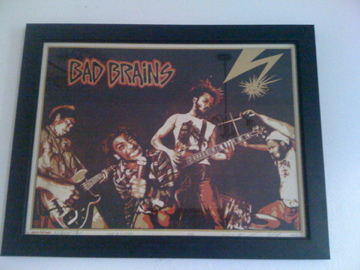
Friedman/Fairey collab that happens to hang in my living room

I didn’t expect to get so sucked in. I didn’t expect to get so inspired, and I certainly didn’t expect my interview with photographer Glen E Friedman to have anything to do with travel writing or blogging.

Which it didn’t, not explicitly. But in talking to Glen, crosslegged on my bedroom floor for over an hour one Monday morning, in asking him about his drives and motivations, about what inspires him and what doesn’t, I saw so many parallels to my own experience in the travel blogging world that I couldn’t help but write something up about it. Our chat served as a kind of check, about what really matters to me and what I really want to do with my writing.

Glen is old-school. Some would say “an idealist from a bygone era,” and I suppose I can appreciate where they’re coming from. But that wasn’t my experience with Glen. My experience was that he didn’t want to fuck around, that he didn’t want his time wasted by people who didn’t actually care or didn’t want to work hard, and that he truly truly believed in what he was doing and had done. And fuck if you can say that about a lot of people.

But in fact, the most personally inspiring part of my interview with Glen didn’t make it into the actual published interview (up in two parts, one and two, on Hi-Fructose). Because, well, an hour-long interview is really fucking long transcribed.

I was intrigued by Glen’s frustrations with the contemporary art scene, and asked him about it. He went on a kind of rant (homeboy can talk) and some of the lines he used I’d actually read in other interviews. But as he described the scene of it all, what is really the inherent bullshit in any artistic scene, I couldn’t help but think of what one writer dubbed “the circle jerk of travel blogging” (don’t worry, I won’t dog you out):

There’s definitely some people out there that are doing some good stuff—Shepard’s name goes to mind—but there’s a ton of shit out there too. And it makes it boring and frustrating to go to a museum or an art gallery and see the stuff that gets the credibility, because the people hobnob with the right people, you know, or they get high with the right people or had sex with the right people, or they’re just in the scene. I have a strange feeling that if you’re in the scene, then you’re probably not very good. It’s all about the emperor’s new clothes in art. I’d say maybe 5% of people actually have a real talent for what they’re doing and aren’t just getting over. And that’s in most of the fields, whether it’s in music or painting or any kind of craftsmanship that’s considered an art.

It’s a pretty bold position, but as he spoke, I replaced “art” with “blogging,” and well, the same held true.

“I don’t know what suddenly makes so many people artists these days,” Glen wondered aloud. He talked about a laziness, a getting-over attitude, enabled by the ease of having one’s voice heard these days; when he was young, you had to be really driven—you had to really want it. Everything was DIY, because there was no other choice. No one was making any money off their bands or their skating; you did it because you loved it.

It reminded me of my own beginnings in writing—the little callous on my thumb from the pencil ridge, fingertips covered in glue from making zines, waking up from a long night with bits of poetry scribbled across my arm because I hadn’t had any paper on me. I didn’t do it for page ranking, I didn’t do it to “travel the world and get paid”—I did it simply because I couldn’t imagine not doing it. Because there was a voice in me that would not be still.

And I wouldn’t say I’ve sold out or even sold myself short. But it’s easy to get caught up in the scene of it all. It’s easy to see all the recognition other people get and to want it too—to want something measurable, to drive traffic, something to point to: “See, it actually matters; what I have to say matters.” And if you’re a decent writer, it’s easy to write the kind of stuff people want to hear, that garners retweets and comments and link outs. And it’s even easier to get lost inside all that.

Glen’s always followed a higher call that went beyond this scene or that scene, the cool kid club. He’s done his work in order to inspire other people, and he’s really held himself to it. To be fair, he’s had the luxury to hold himself to it: he begun being successful at age 14, and has supported himself through his art his whole adult life. But despite that, there’s always always the opportunity to get lazy, to ride the gravy train, to put your images on a tshirt and make a fuckton of money cause who can’t use more money?

It’s also easy to get frustrated with the scene, to point the finger and scream (internally, of course), “For fuck’s sake, write something real, not just what’s easy or convenient! Write about what’s inconvenient, about what’s difficult and painful and scares the shit out of you.”

In my best of moments, I’d like to be able to take a more loving, tolerant approach. I’d like to not roll my eyes and shittalk (which I’m of course guilty of), but to somehow say to all those writers: “You’re fucking better than what’s easy, than what drives traffic, and you deserve to let that voice be heard.”

But I’ve got a big enough job just trying to hold myself to that standard. Cause, you know, I still have to pay the rent too. And I’m sure as hell not gonna do it transcribing Glen Friedman interviews. But what I will get from it is a reminder, like a small stone you can carry in your pocket and rub when you’re bored or lonely or nervous—of what it really is I want to do with my writing.

Americanness on the Road, Part II: It Ain’t All Bad

Yes, really: George W Bush Street, in Tirana

“America is the best country for a person with a disability to visit.”

This was Rob, sitting cross-legged on the roof terrace of the Tirana hostel. He continued, “For deaf people, it’s like a dream. It’s like going to Disneyland. Actually,” he ashed his cigarette, “Disneyland is great for people with disabilities too. Wheelchair accessibility and all.”

Chad looked confused. You could see the information smacking up against the wall of prejudice, his brow wincing from the pressure.

Chad didn’t like the US, and Chad was American.

Rob continued on, citing the revolutionary wonders of Civil Rights legislation and the Americans with Disabilities Act (ADA) in his English accent. Rob was in Tirana doing NGO work in the deaf community; Zhujeta, Rob’s girlfriend who helped run the hostel, also did work with the same NGO. Rob rattled off the comprehensive services available to deaf people in the US—from resources in public schools to telephone interpreters—vastly different from any other country in the world, including his native England.

Chad nodded, soaking it all in. “Wow,” he said thoughtfully. “I guess that’s one thing we didn’t fuck up.”

It’s easy for Americans to be jaded about our own country. There’s a lot of fucked-up shit going on in it, and we’ve caused a lot of suffering, both abroad and at home. It’s easy to fall into a sort of naive cynicism: our country is completely fucked. As young travelers, little ambassadors on hostel terraces, we feel it our duty to decry our country and lament its shortcomings, its sins, its unforgivable and deplorable acts. And there’s a lot to decry.

But it’s something like the Guilty White Person syndrome, the Bleeding Heart Liberal. This perspective—and God knows I fell prey to it for several years in my early traveling—lacks complexity, nuance. The US isn’t the evil empire, as easy and convenient as it’d be to think that. Just when you want to write it off, there’s something like the ADA to remind you of the revolutionary notion of equality written into the fabric, the very law of the land, that you can’t get away from—that, no matter how far we sway into the other side, keeps showing up and shaking things down.

It was funny to watch that information try to sort itself in the mind of someone who thought they’d neatly washed their hands of the issue: US = bad. Because the fact is, we only have ADA legislation as a product of Civil Rights legislation, and we only have that because of that little blip written into our constitution that declared all the men equal. Sure, it’s not what a bunch of rich white dudes in powdered wigs meant at the time, but too bad. And this is what, in my mind, makes our country such a complex, contradictory and ultimately fascinating place: this space for change, this tension built into it. That, and the incredible cultural cocktail that keep colliding, exploding, bubbling over and making something new.

It was even funnier to watch Chad struggle with the information that Bush Senior was the man who signed the ADA into effect.

Because things as big as people or countries are never that simple, never all one thing (“Do I contradict myself? Very well then, I contradict myself. I am large, I contain multitudes”—when in doubt, always quote Walt Whitman). It reminded me of a Middle Eastern friend of mine, an ethnic minority from Iraq, who told me her mother still thinks of Saddam Hussein as a great man, because he didn’t persecute Assyrians.

And there’s more than the ADA on the list of “things we didn’t fuck up.” But it wasn’t my job to teach or explain that to Chad; he’d have to figure it out for himself. I just sat back and watched the lightbulb turn on, a small flicker of awareness.

Later on, we sat playing music from someone’s iPod. “Welcome to the Jungle” came on, and I indulged in a moment of cheesiness. “To me,” I said, absently, not really thinking about it, “this is the epitome of America. This is what the US sounds like.”

Chad looked slightly taken aback. “What do you mean?”

“Well, it’s rock, good ole’ 80s hard rock. Which came out of rock n roll, which came out of the blues, which is about as fucking American as it gets. It comes from the core, you know, the soul of the country. And I fucking love it,” I added. “American music is my favorite music. In all its permutations—folk, country, soul, hip hop, grunge…”

“I guess I never thought of it that way,” Chad said. “I think of American music as, you know, the corporate Britney Spears shit.”

“Well, yeah, it’s that too. But that’s only a small bit of it.” I lowered my voice and leaned in. “No one can deny it: our music is pretty bad-ass.”

Americanness on the Road, Part I: Letting His Issues Be His Issues

“I hate your country’s politics.”

This was K, and this was the first thing he said to me.

We sat on the dark patio of a Tirana bar, table of ashtrays and beer bottles, the headlights and footsteps of surrounding streets obscured by a criss-cross fence. I’d arrived in the city only hours earlier, and had already found myself chasing fun with the group of people I’d hang with for the next five days.

K had just come in from Kosovo, in town for a gig where important record executives would be. He sang, or he played the guitar, or did both—it wasn’t clear. He had a red Adidas track jacket and the straw Fedora of male insecurity: a little too self-consciously cool.

He sat down at the table, said his hellos to old friends, was introduced to me. He asked where I was from, then crossed his arms, leaned back, eyes narrowed to a challenge, as if to say, “Come on, step to this, I dare you.” He announced his personal aversion to my country’s politics with smug satisfaction.

It was like K was trying to hand me a big bag of his bullshit. And I, in turn, got to firmly but without malice reply, “Actually, this is yours. And I’m just gonna let you hang on it.”

There was a time when I would have had to jump up and down to prove to K that I wasn’t one of those Americans. I would have cited my city of residence, my family’s long history in activism, personal lifestyle choices that reflect my commitment to anti-corporate, anti-imperialist values. I would have lamented the pervasive culture of ignorance and fear that paved the way for predatory politics, and when the bitch/blame-session reached its crescendo of discontent, I’d have thrown my hands up and announced my ultimate goal to marry someone with an EU passport and flee the whole mess.

I would have, in short, run laps to prove who I was to K, to win his validation and approval, this person I had just met, in some sort of attempt to resolve my own insecurity about my nationality.

Instead I shrugged, sighed, “Yeah, join the club, buddy.”

The rest of the tabled groaned at K. “What is that?” Robo asked, shoulders hunched and flicking ash, seeming a little uncomfortable at K’s underhanded assault on me. “That’s the first thing you say to someone?”

“Well, I do hate the US’s politics,” K defended himself.

“Yeah, but as the first thing to say?” Zhujeta cooed in her gentle, loving way. “Not even, ‘Nice to meet you.'” She titled her head in the same way as when she spoke to the begging gypsy kids that cruised past the table, “It’s rude, K.”

“Okay, okay,” K waved his hands as though they were little white flags. “Sorry, nice to meet you.”

I shrugged again. Whatever issue it was—whatever insecurity in K made him want to challenge someone, get them to prove themselves to him—I wasn’t going to get involved. That was between K and himself, not me. Or my Americanness.

God on the Walls: Abandoned Monastery Outside Grottaglie

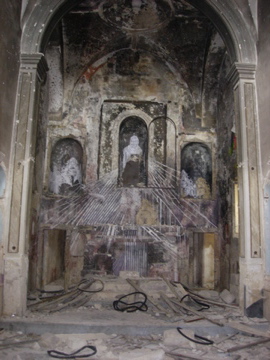
If you walk far enough down a dirt road outside of town; if you stalk through the weeds and sweatshirt-snagging thistles; if you scramble and heave and hoist yourself over a crumbly stone wall and follow the dent in the foliage that has become a path, you will find it: an abandoned monastery covered in art.

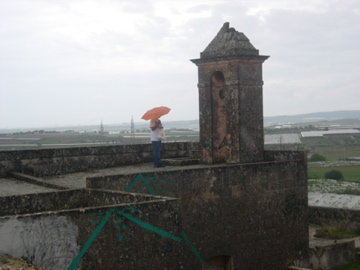
You will be on the roof. You won’t be sure how you got there. The storm will be moving in, and the countryside, the heel of the boot that is Puglia, will stretch out beneath the gray: plastic tarps over vineyards, farms, the coughing plumes of the factories of Taranto.

You’ll circle the perimeter of the roof with your new friends. You found them all—you found each other—like a rag-tag team of adventurers in some cartoon: Rebecca at a cafe, Pedro as you walked through the Old Town, then Greg as he feverishly rode a bicycle away from a herd of grazing animals (“Were they rabid?” “No.” “What were they doing?” “I dunno, they were just in the road. It was some weird country shit.”). You’ve all come alone, all flown from your various big cities to Grottaglie, for nothing more than the love of street art. And adventure.

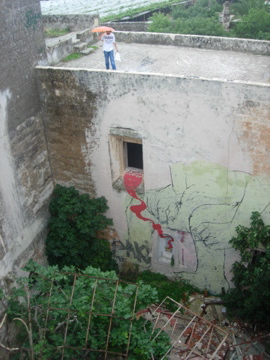
And you will have gotten there. You’ll have gotten to the moldy, peely, crumbling core of What It Is You Came For. Over the last three years of Fame Festival, the abandoned Convento dei Cappuccini has amassed works by visiting artists on its decrepit old walls. It’s become something of a museum of anarchic awesome—where you crunch through the broken glass, through rooms and rooms with bleeding walls; down dank stairways where the mosquitoes buzz and the light don’t shine; down into the guts and internal organs of an abandoned holiness left to rot, left to reborn in the last gasps of its decomposition, its swallowing-back-up by the earth, by the weeds, by the green; left to the artists and the vandals and the punk little kids with bruises on their knees, to the foreigners that don’t speak the language but know that urgent lonesome in the howling of the wind, the coming of the storm, as it blows through the broken windows and walks alongside you.

Pedro on the roof

Courtyard

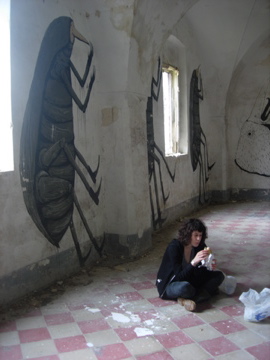
Panini break in the cockroach room

Cockroach close-up

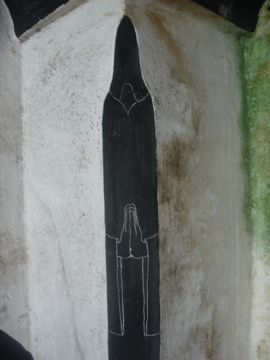
Where two walls meet

It’s not so much about the art, not the monastery or Fame or the streets of Grottaglie. It’s about the spirit, the breathing of new life into the forgotten, the love of the forgotten, saying, “Yes, yes, you can still be something beautiful to me.”

It’s exceedingly tender; it’s exceedingly unexpected that you would find this here: this vision of yourself in the walls of an abandoned monastery outside a small Italian town. As though every painting and stencil and shitty little tag were a message of love, saying, “Even in your wreckage, your falling-apart, your scars and wounds and ragged flesh—something can still love you enough to take the time, to do something beautiful.”

It’s what you like to think of God as. It’s how you’d like to treat yourself, as if you could love yourself as much as an abandoned monastery.

And it’s even more unexpected that you would find three friends to tromp around with you, to be as stoked as you, to love this place and this town and this art as much as you do.

You pause; you take a moment to take it all in, to file it away in the card catalog of your heart, to be able to call upon in those certain difficult times ahead, when you need something, just a little something, to remind you What It Is You Came For. You look around, smile, tuck it under the slot labeled “Best Travel Moments.”

And then you walk into the chapel.

For a far better visual representation, check out Bablegum’s video of their trip to the monastery. The music doesn’t really fit the experience to me—but in those moments when you hear the wind howl, that’s closer to what I felt in there.

Tower of Rubble, Kotor

The crumbled bones of a building rose up, tower some six stories, broken glass and exposed beams, cement like dead flesh. Covered in faded graffiti scribbles, a little bombed-out passage gave a dim glimpse: rubbish piles, sleeping stray cats, green growing from the tumble of rubble, left there as though bombed not some 20 years ago, but just a few months ago.

And laundry lines. Satellite dishes. People were living there.

Kotor was kind of a let-down. The guidebook gushed, but the city was boring to me. Sure, it was beautiful, but it was a manicured beautiful, a theme-park quaint—ancient wall uplit, facades restored, stones scrubbed clean—all in an effort, it appeared, to lure Western tourists an hour south. A new Dubrovnik.

And it appeared to be working. October, and the streets of Kotor’s Old Town were filled with busloads of snapshot takers. It was beautiful, beautiful, but there was nothing for me to hold on to, dig in to, grab ahold of. It felt slippery, like swimming.

So I walked to the bus station to see when the next bus out was. I saw the building—or rather, what was dirty and ragged and left of the building—and thought, Now this, this is something interesting.

Poking my head in didn’t suffice. I needed to see more.

I went around the building’s backside, a dirt road, squat brick structure covered in green foliage and gray tarps, huddling up alongside the tower of crumble. Run-down cars and makeshift workshops, the buzz of machinery and the yap of roped dogs, the slowness of people living their everyday lives.

Two people stood in a doorway, staring out at me. Not hostile, but observing, in that way we observe outsiders that are observing us—suddenly aware, self-conscious of our own reality. This is my life, the arms crossed over the woman’s apron seemed to say.

I smiled and shrugged sort of, pointed to the tower rising up behind their roof, a shadow or a ghost or a dingy kind of demon, a relic. The man, seemingly more amused, walked up to me.

He pointed to the tower, then around him, then right down to the ground he stood on, we stood on. “Bosnia, Serbia, no Montenegro.” He made the shape of an explosion with his hands, big, calloused, oil-stained hands, fingers arched wide, as if trying to contain a growing cloud. “NATO,” he explained, then pointed back to the blown-out tower.

I nodded.

He looked at me, and nodded slowly. We stood there like that, in the silence, having gone as far as our linguistic capabilities would allow.

I pointed to my camera. “Okay?” I asked.

The man nodded. The woman in the doorway laughed, shook her head, turned and went back inside.

I wandered further. I passed a man chopping wood. He stood between two massive piles, one cut, the other uncut. He paused to observe me, nodded slightly, went back to work.

I didn’t want to photograph them. I didn’t want to photograph these people I saw, living beside and inside this huge crumbled building, a relic of destruction, going about their tasks, looking out from their doorways at me. I didn’t want them to feel like they were on exhibit, like they were amusing or exotic to me. I just wanted to see them, to see what was really there, how people really lived in this town, what their lives really looked like.

A small face peeked out, blazing eyes around the pillar its body hid behind. I smiled at the boy. He turned away, as though he’d been caught, watching me observe his world.

I poked up a small ladder, peered in through the broken window—a makeshift carpenter’s studio, desk and a pile of wood, two stories. I gazed up through the gaping wound in the center of the building. Dim light came through ceiling, so many stories up.

I climbed back down the ladder. The little eyes were still watching me; I smiled and turned to walk away.

He came out behind the pillar. He glanced over at me, as if to say “watch me,” and I did. He ran up to the ladder. His small feet scampered up; he crouched down to crawl the fangs of glass.

He stopped, paused, only for a moment, to look back over at me. His eyes seemed to say, “Look. See. This is my life. This is my world. See me.”

I did. Or I tried to. I really just stood there and watched.

The boy ducked down through the window and was gone—him into his world, and me into mine.

Transit Fragments: Views from the Window

I. Bar to Ulcinj

Gypsy children at the intersection
bang on the windows
of stopped cars, pleading
/
until the windows roll up
and they see their reflections,
/
dirt-faced
and pleading back.

II. Ulcinj to Shkoder

Carry that girl
through the rubbish
and field of dead,
the rusted carcasses
of cars,
engineless
and humming wind.
/
Take her,
hold her
under your arm
(bare feet and unbroken skin)
/
Carry her
down that road,
carry her,
take her home.

III. Shkoder to Tirana

Mosques and minarets,
half-constructed buildings
(stairways
and skeletons
exposed)
stripped-down cars
left to rust
in lots of dying
/
A boy with the cheekbones
of an ex-boyfriend
huddles, mutters
into the mouthpiece
of his cellphone
and you can only see
half is face
(turn around
and show me the whole thing, honey)
/
Corrugated tin and tires,
teepee piles of hay
that look like the insides of scarecrows
with nothing left to scare
/
Yell your stop
to the driver, and rumble
that big door open
(wrench the metal
from the metal)—
pay him your fare
and be left there
on the roadside
of somewhere
/
a gas station
and a cheap umbrella

Boys, Boys, Boys: A Solo Female Traveler’s Experience With the Men of Southern Italy, Montenegro and Albania

You know the picture...

“Southern Italy, eh?” He gave me the raised eyebrow of caution. “Watch out for the men.”

This was Alex, his voice lifting above the roar of hair dryers and hip music at the salon, two days before I left on my trip.

A lady friend of his, he continued, had recently spent several weeks in the Mediterranean land of machismo. “Apparently, they all use the same line: ‘I have a girlfriend. But tonight, for you, no girlfriend.’ She said it got really old.”

I laughed. To be honest, it hadn’t crossed my mind yet. Dealing with the men of a country as a solo female traveler is usually one of the first things people ask me about when they hear I travel alone—right after the “is it safe” question. But the truth is, I’ve been doing this sola thing for awhile now, and whether or not the men somewhere will hound me to death doesn’t really factor into my travel considerations. Plus, I’ve done the majority of my traveling in Latin America, where sidewalks can at times feel like catwalks of degradation. As long as the men aren’t physically attacking me, I pretty much feel like I can handle it.

But Alex’s comment did give me pause. When it comes to safety (and drinking tap water), I throw caution to the wind in Europe. It’s the civilized, more highly evolved land of social safety nets and low crime. Hell, the vast majority of Europe is safer than my hometown. My hairdresser’s comment reminded me that, oh yeah, right, I’d be venturing off sola in a scant 48 hours and that maybe I’d ought to mentally prepare.

You stand out as a female solo traveler, and in a way, get to experience a culture more deeply, if no other reason than the fact that its men are talking to you more. My last trip took me to Southern Italy, Montenegro and the capital of Albania (and Croatia, but I only stayed for a day, so I’m not counting it). The men in each these countries treated me totally differently—and, I think, reveal a little something about the culture.

Italy

Oh, Italian men. They have quite the reputation. American women swoon for their accents, their sense of style, their motorinos and chest hair. And they’re known for hitting on pretty much anything that moves, serenading you with sweet odes of professed passion.

I don’t get it. And Italian men, apparently, don’t get me.

During my venture Rome-and-southwards, I was largely ignored by Italian men. Which suited me just fine. Again, having traveled heftily through Latin America and once through Morocco, I’m stoked on anything that isn’t street harassment. I’ll take being ignored over obscene insults any day.

But it did cause me wonder… Who the hell are all these American women who are getting hit on Italian men all the time? I’m a cute enough girl, but do you want to know why I wasn’t getting any attention from the dudes? Because they’re surrounded by Italian women—who are impossibly gorgeous and stylish, with their cascade of curly hair and their moody black eyeliner. I wouldn’t hit on me either.

Traveling through Southern Italy was like an adventure in mutual disinterest—as though every guy I passed on the street exchanged a brief little dialog with me: “Thanks but no thanks.” Italy is a pretty culturally conservative place, and I’m a pretty not culturally conservation person, in appearance or attitude. So it makes sense to me that the Italian men and I didn’t vibe. In person, that is.

While I was in Naples my Couchsurfing inbox got flooded with messages from shirtless dudes in sunglasses asking me if I needed a place to stay. (“Um, no.”) But this was the extent of the Italian sleaze I experienced—an indirect, easily ignored, half-assed attempt.

Maybe that was the secret to the purported flirtations of Italian men: that it’s largely impersonal, having less to do with you and whether or not there’s any real potential for something to happen, and more to do with, I dunno, not having anything else better to do? Hitting on someone just for the sake of hitting on someone?…

Montenegro

If ever a girl was thinking of a place to take advantage of men, Montenegro would be the place to do it. I had more offers for rides, tour guides, free drinks, places to stay, etc than anywhere else I’ve been.

But the curious thing was a) all the attention was from middle-aged men, no guys my own age, and b) they somehow managed to stay just on the right side of appropriate and respectful. I never felt violated or threatened by any of the Montenegrin men; it all just came across as really, really nice.

I was of course only getting the attention because I’m a pretty young(ish) American girl traveling alone. Montenegro is really trying to woo Western tourists, and I think I was something of an anomaly; there weren’t many Americans, weren’t many backpackers, weren’t many women alone. I think I was on the one hand intriguing for this reason; I think Montenegrins in general also really want tourists to feel welcome, want to take care of them. I must have sparked all the paternal instincts of the middle-aged men there. But somehow not in a demeaning way. Most curious.

Albania

At a certain point one night, it got ridiculous. I had to put on my sweater and get the hell off the dance floor.

It was like moths to a lightbulb. I have never received more male attention from males I actually wanted attention from than in Tirana. It was dangerous.

Albanians my age, it seems, really want to be Western. They’ve lived most of their lives in post-Communist Albania, but still relatively isolated from the rest of Europe. They’re ready, it seems, to be a part of the rest of the world.

For most kids, this striving seems to take the form of mainstream culture, the Top-40 kind. Stylistically, Tirana is filled with tons of extremely beautiful nouveau riche girls, who could, at first glance, blend in on Parisian sidewalks. You look a little closer and you realize that they don’t quite have it right yet; they wear a little too much make-up, their clothes not quite expensive enough.

But the point is, they’re trying really really hard. They have the posture, the poise, the carefully cultivated look of class in the arch of their fingers as they lean back and drag their cigarettes. They also don’t seem like a whole lot of fun—a little snobby, to be honest.

So I stood out, and not just for being foreign. There weren’t any other girls in Tirana like me, in sneakers and a band shirt, with short hair and tattoos. I’m a dime-a-dozen in the Bay Area, but in Tirana, I was the only act in town. And every single rock n roll dude, it seemed, was eying me. Or talking to me. Or offering me drinks or asking me out or wanting to dance with me.

Big-fish-in-a-little-pond syndrome. I’d never experienced it. After the initial rush of validation, though, it felt funny. It didn’t seem real and, in a way, it wasn’t.

It was like Genti’s indie rock band. An Albanian turned Brighton boy, Genti was just another dude in a band in England. But in Albania, he was becoming a big deal, selling a ton of albums and appearing on Albanian TV. It would have been easy, he told me, to really make it there. “But, I dunno,” he yelled over the barroom clatter, “do I really want to be the guy who was ‘really big in Albania’?”

I paused, and asked myself the same question. I was pretty damn sure that if all these rocker dudes were suddenly delivered into the Bay Area, they wouldn’t be tripping off me so much. I wanted to tell them, to put my hand gently on their shoulders and let them know, “Honey, there’s a big world out there, and it’s filled with a fuckton of cuter girls with more tattoos than me.”

But they’d have had to take my word for it. Cause it’s so damn hard for an Albanian to get a tourist visa, or to afford to travel anywhere where rock n roll girls live, places steeped in privilege.

So I did all I could do, which was to shake my head and laugh.

Thank God for San Lorenzo Street Art

The last full day of my trip: drizzly grey and a mounting head cold, city still shuddering from the previous night’s storm. I would not be stopped by the weather or my health (I really should have been stopped by that) or my impending departure or my own crappy attitude. I was going to go out and find something cool. Goddamnit.

It was more than my intuition that told me that Something Cool would be in San Lorenzo. It was Jessica from Rome Photo Blog. Specifically, she told me: “Go to San Lorenzo. Take the number 14 street car. There’s lots of cool street art.” It seemed a good enough activity for my final day in Europe. Because Lord knows I hadn’t tromped around in the rain hunting down street art enough on the trip.

I like Rome’s neighborhoods. I supposed every city has its distinct neighborhoods with their distinct vibes, but for some reason the differences feel more marked in Rome, where perhaps the centuries have dug those differences down deep, deeper than in other places. The center, while magnificent, bums me out and exhausts me, with its gaggles of people and trinket shops. There’s not a lot of contemporary culture to dig into. And contemporary culture is kind of what I’m all about.

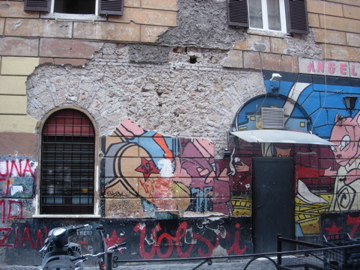
Typical crumbling building

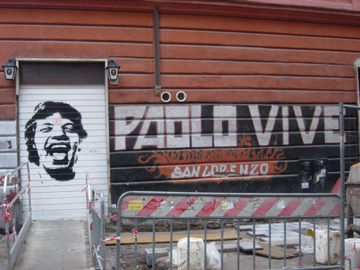
San Lorenzo is one of Rome’s hippest neighborhoods. It’s the bombed-out, more gentrified version of Pigneto—or rather, it’s formerly bombed-out and further along the gentrification scale from Pigneto. The working-class 19th-century neighborhood received the heaviest bombing during WWII, and I don’t know if all that crumble I saw was a remnant of that or just a result of the usual Italian building decay. Either way, it was fucking cool. There’s a lot less immigrants than in nearby Pigneto, and the neighborhood seems to have moved deeply into the third stage of gentrification: when the local business begin catering to the new residents. San Lorenzo’s proximity to the enormous La Sapienza university means there’s tons of students and tons of artists, with a proportionate ton of trendy stores and cool record shops and cafes with wifi.

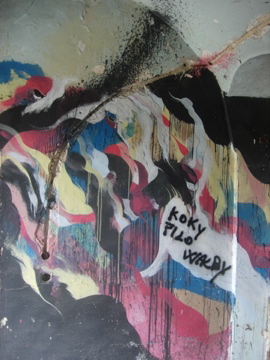
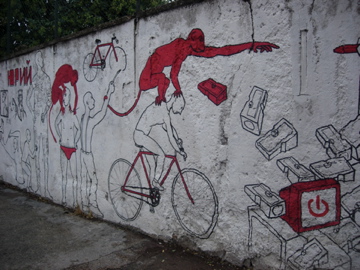
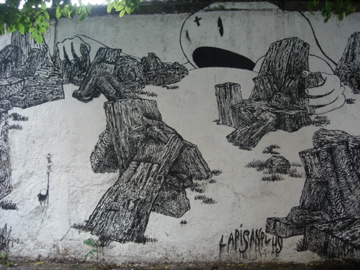
And a whole mess of graffiti and street art.

I hopped off the tram when the walls began to resemble a two year old’s furious crayon scribbling.

I was delighted to see some good ol’ Space Invader the moment I got off the 14. He’d recently come to Rome, and has an upcoming solo exhibition in the city. Word has it (ok, Jessica told me) that Roman street artists are pretty stoked about Invader’s, um, invasion (I hate myself for using that pun)—hoping it’ll lend a little more attention and validity to their own work.

I wandered about a bit, until I found what I was looking for: Something Extremely Cool. Along Via Delgi Ausoni, on a wall surrounding the block-long Fondazione Cavalieri di Colombo, was the best street art I found in the city. It was like the Clarion Alley of Rome.


Hey, Ekua, check it out: a whole wall of Hopnn!


Okay, so the picture doesn’t give you the full effect, but a shadow/inverse of the stencil was actually put on the sidewalk in front of the wall as well—so it felt like you were walking through some weird mirror of the piece. Cool ass effect.


Too cool for just one picture…

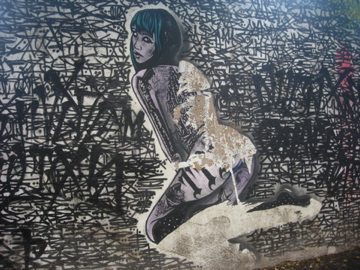
This reminds me of Retna:


I’m not totally sure what’s going on here, whether the figures were wheatpastes that got taken down, or if that was an effect was created intentionally—but a pretty fresh, haunting effect, especially given the message written:

But to be fair, most of the stuff on the walls in San Lorenzo looks like this:

Okay, so I’m gonna be the asshole and say it: this is not aesthetically pleasing. But it reminded me of this conversation I had with Pedro at Fame Festival, about the need to create urban spaces designated for street art, like they have in Melbourne or in that tunnel in London. I can totally feel people when they complain about piss-poor chicken-scratch tagging all over their neighborhoods; it’s ugly. But cities need to have some kinda strategy towards graffiti that goes beyond just prevention.

When I was growing up, the Oakland Public Schools had a full-time employee whose sole job was to go around and paint over graffiti on all the school campuses. Which seems like a damn waste of resources. The sad thing, to me, is that these kids obviously have something to say, something they wanted to communicate, and no other way to do it. I think it’s important to create those spaces, walls and zones where they can throw up pieces—to give kids the space to say what they need to say. (I’m assuming this is what’s being discussed in this news coverage of Pedro’s Crono Lisboa project…)

Because you never know which one of them just might grow up to be a dope street artist. And because it limits the amount of tagging elsewhere. And because it looks cool as shit.

I’m not sure what all that has to do explicitly with San Lorenzo, except that I was thinking about that as I wandered around the neighborhood. Here’s some more stuff I spotted:

This C215 piece was actually on the wall of a church. It blended so well I wasn’t sure if it was street art or the church’s actual art work until I saw the signature logo:


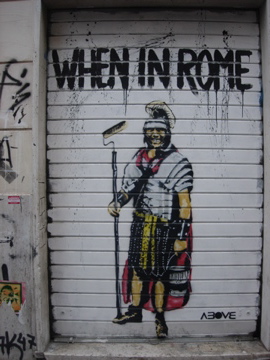
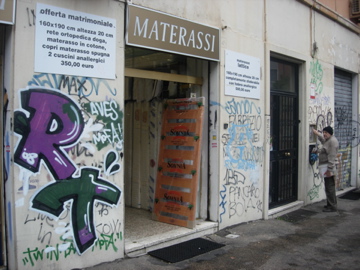
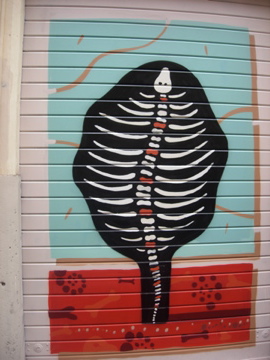
Lots of stores had pieces on their shutters…


But I think my favorite might have been pieces that worked with the crumbling facades of San Lorenzo. I get pretty stoked on well-done site-specific street art, when the environment and the art interact with and inform each other…


Walking around there, damp-footed and achy-throated, I had to say a little thank you to San Lorenzo, for giving me one last cool adventure on my trip. And for reminding me that Rome is more than history and monuments—that it’s a damn big city, and a damn great city, and that there is contemporary culture—just beneath the surface, below the rubble, just a short tram ride from the center.

Albanian Death Flu, and The End to a Charmed Trip

Dog is my co-pilot?

It had been the best trip I’d ever been on. And, you know, I’ve been on a few trips.

But at last it happened: the perfect constellation that had hung above my trip cracked, shattered, rained down in a million filaments on to my cigarette-stained clothes until the smell writhed back out of rank layers. Not that I could smell it.

On my best trips—well, no, even on my worst trips—I don’t really feel in charge. That’s one of the things I love about traveling: it shatters any illusions of being in control, of running the show, so to speak. Serendipity drives the car; you just ride shotgun.

And I’d been really quite pleased with Serendipity’s navigational prowess on my latest trip, taking me to random small towns, big crazy cities, introducing me to rad people, giving endless writing material, keeping me in good spirits. I approved. “Job well done.”

But on my way back to Rome, something snagged, tripped, pulled the plug. It was my attitude. And my health. Things were no longer going my way. And so I ended my trip slumped over in a plastic airport chair, achy-boned, runny-nosed, sleep-deprived and pissed as fuck.

I didn’t want to leave Tirana. The only date I locked myself into on my itinerary-less travel was my flight from Tirana back to Rome, mostly to avoid another sleepless, freezing cold ferry ride. It was a cheap ticket, the kind you can’t change—so when I had to pass on the opportunity to drive up to Shkoder to get tattooed in an abandoned bunker and instead fly back to expensive-ass, whacked-ass Rome, I was slightly bummed. To say the least.

On the flight, I began to feel a tickle in my throat. I coughed. I assumed it was the result of the pack of cigarettes I’d smoked in the previous 48 hours, or the succession of late nights, or the guzzling of tap water that I wasn’t really supposed to be drinking. And it probably was those things. It was also the beginnings of what I’ve dubbed Albanian Death Flu (incidentally, also the name of my new metal band).

It started slow and steady as a rumbling drum beat—the amplified echo of my own heartbeat in congested ears. It’s okay, I could power through. I had a few different friends that also happened to be in Rome at the time that I wanted to meet up with, some events I wanted to check out; I’d fill the time.

It was like a see-saw: the more things unraveled, the shittier I felt. Or the other way around. Whatever. I never got in touch with any of my friends. The events either fell through or were kinda lame. After blissfully cheap, tourist-free Tirana, Rome was an expensive, American-swarmed jolt to my sick system. And I wasn’t helping myself any. I was cranky, torturing myself with the shoulda’s and why-didn’t-I’s. Serendipity may have been driving the car, but I was being a pretty big backseat driver.

It all came to a fevered pitch at the airport. I didn’t sleep at all the night before, six hours of tossing and turning and coughing and groaning. The overpriced train ride to the airport had robbed me of my last few Euros, so, with no cash for breakfast, the post-nasal drip stirred in my stomach in an unsettling stew. And I had no patience for my fellow travelers.

Rome is a most beloved destination of Americans, right up there with Paris and Disneyland. But it’s a pretty culturally conservative place—not a lot of contemporary arts or music going on—so it doesn’t tend to attract our most dynamic demographic, what I call our A-Team. It’s most popular with the Joe-and-Marge-from-Iowa demographic. Not that I have anything wrong with Joe and Marge; it can be, actually, just as culturally fascinating and foreign to observe them as Romans.

It’s just that Joe and Marge don’t travel much. They get stressed out easily, and they bicker with each other. They aren’t as adept to rolling with cultural differences, and feel it necessary to (loudly) point out contrasts and the discomfort those contrasts provide. They get lost easily. They aren’t urban people, and they get confused by public transportation, crowded spaces, the Italian irreverence for lines at espresso counters.

All this I’m more or less willing to take in stride. Except when I’m sick, nauseous, sleep-deprived, and generally fighting the gods of circumstance. Then I sit in a plastic airport chair with steam seeping out of my ears and one eyeball slowly twitching.

I gave up. I couldn’t fight it anymore. My body—and Serendipity—were trying to tell me something: the party was over. It was time to slow down, sit still and accept what came my way.

I went to a pharmacy and bought some mystery Italian cold medicine on my credit card. I changed a little cash back into Euros and bought a stale, overpriced panini. I moved over to an empty gate and slowly munched my bread in relative peace. Then I boarded my plane and promptly passed out in puddle of drool and sneezes (yeah, I was that person).

Even great trips have bad moments, and every trip, even the best, has to end. I suppose the trick is letting that happen gracefully. Still working on that one.


Lauren Quinn is a writer and traveler currently living in Hanoi. Lonely Girl Travels was a blog of her sola travels and expat living from 2009 to 2012. She resides elsewhere on the internet now.

Join 458 other subscribers

Buy This Sh#t

Categories