Archive Page 27

Street Art Pictures: London, Spain, Morocco and Portugal

First, a disclaimer: I don’t profess to be any kind of expert in street art. Or even a novice, really. I just know that, when I spot a fresh stencil or spy some sick piece, it makes me smile—and, if I happen to have a camera with me, snap some photos.

I guess the thing about street art is the sense of place it evokes—which one naturally notices more when one is traveling, seeing a city with fresh eyes. As the world gets smaller, regionalism can be hard to find; this is especially true in the Westernized world. Traveling in Western Europe, you constantly see the same chainstores, the same brands, the same fashions—girls are wearing whatever’s hip at H&M everywhere from Malmo to Madison (and I’d like to say myself excluded, but that would be a lie). Street art, whether it’s good or not, shatters through that; its viscerality marks a place, claims it, and if you’re traveling, can often reveal a lot more about where you are than reconstructed period buildings and restaurants with picture menus (really, paella all kinda looks the same).

I hung around some East Bay graf kids for a time, and still smile when I see their tags around town. A repeated stencil, a tag, a distinctive style—they’re like recurring images from a dream, someone else’s dream, and you catch little glimpses, train your eyes to look down alleys and up at overpasses, and you feel like you’re in on something. It grounds you in a very tangible way, connects you with the phantoms that sneak around at 3am with backpacks full of clanging illegality, with their finger-staining passions and illicit dreams. Of course, I was never one of them; a certain romance remains when it’s not you getting arrested or jumped in some strange turf battle. But I will say you interact with a city—its architecture and landscape, its thingness—differently when you’re even vaguely in tune with its street art. And when you’re traveling, it can often be your only contact with the night-crawling kids that in large part create the pulse of a place.

My first stop on my trip was London, where I of course went on an all-day goose chase for Banksy (chronicled here). The hunt also took me past several of these digitized little fellows by Invader..
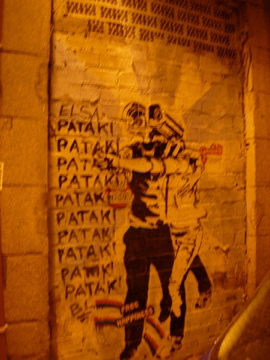
Super poor picture quality, but what can you expect from a 2am street lamp and a mediocre camera? This I spotted in Madrid, near Plaza Sol. If you can't tell, it's two tangoing figures with security cameras for heads.

Granada generally had some piss-poor graffiti and stencils, but this one made me laugh. Totally fitting for a college town.

I spotted this one several times around the beach breakers in Tarifa. The sentiment jived well with the surf-town vibe, and the fact that it was in English spoke to the internationalism of the unassuming little place-between-places.

As you might guess, there wasn't a whole lot of street art going on in Morocco, or at least in the places I went. What one does see a lot of is stenciled Muslim calendars, on the side of buildings, with icons depicting certain holidays and dates. My favorite was the rose. I of course have no idea what it denoted or what the Arabic says, and retained none of the heavily accented, half-French explanations.

But of course, the best stencil piece I saw was in one of my favorite dirt-road beach towns, Mirleft. Popular with vacationing Marrakeshis, artists, dreadlocked travelers and, well, me, Mirleft seemed a perfect place to find this, peeling away on a side street.

Back in Europe, much of Lisbon's street art had a distinctive Brazilian flavor, which makes sense considering the city's large Afro-Brazilian population, and the fact that São Paulo and Rio are some of the biggest and baddest producers of street art in the world. I saw this stencil around the center, around uber-hip Barrio Alto.

And this was a simply incredible wheatpasted portrait over near the Alfama district.

Another college town, Coimbra had a fair amount of politicized stencils. This one was especially interesting given the prevalence of domestic violence in Portugal, and the pervading stigma against seeking help: "Every 2 weeks, a Portuguese victim of domestic violence dies." The number is a little more somber when you consider the small country's population of 10 million.

On the flip side, this was just awesome.

And I quite liked this one as well.
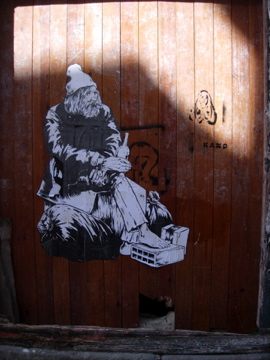
But the place that really took the cake was Porto. Good ole unsuspecting Porto, forever in the shiny, smiley shadow of Lisbon. These were all taken near hip-slick-and-cool Rue Miguel Bombara.

The paper cranes were part of the 1000 Tsuri Project. They acted like punctuation, all over the walls of the street, serving as both a kind of visual break and space filler between the other pieces.

Part of a larger project by artist Costah; check more out here: http://www.costah.net/the-icons.html

This little girl is up a few places; each time, she's touching something different. From what I could tell, this was the logo of a nearby art gallery/collective.

One my favorites. Simple but expressive, and totally took me aback when I spotted it down an alley.

I don’t know if these reveal any more about the places I was in, but to me they do. And if nothing else, they’re better than cell phone ads.

Reaching Out My Tentacles

The inky arms of this blog have stretched out, past the confines of this page and onto other travel sites.

Voureen Taylor over at The Travel Nerd asked me a couple weeks ago if I’d like to be the first interviewee in her new weekly series profiling budding travel writers. Seeing as though I was the girl who, at 12, was convinced she’d be interviewed on Oprah by 16 for writing the great American novel—um, yes, I’d love to be interviewed.

The questions really made me realize how far I’ve come in a short period of time, and just how much I love both writing and traveling. Plus, I got called a prodigy—who doesn’t like that? You can check out the full interview here.

Matador Abroad editor and kick-ass writer Sarah Menkedick asked if I’d be into having an edited-down version of my recent post “The French Won’t Save You” published on Matador. I was especially stoked because Sarah and her man Jorge’s blog is one of my favorites. The slimmed-down version went up today, and I was happily surprised to see so much of the original post remained: my Oakland references, my back-handed throw-down to Futurism, even some profanity survived the editorial process. I’m super interested to see what kind of discussion the post generates.

And finally, Girl’s Getaway republished the post I did on my emotionally brutalizing day in Marrakesh. “Marrakesh, You Broke Me Down” appears in full, even with some of my own photos (though the girl pictured in the header is most definitely not me). It’s been rather life-affirming to read the other ladies’ comments. And you know how they say that writing is the ultimate revenge? Well, sometimes it is.

I was surprised when the editor at Girl’s Getaway approached me about the Marrakesh post, since it seems like a bit of a deviation from the other articles on the site. But it was encouraging to see, in both republished articles, that there’s a place for some of my less servicey pieces.

My next narrative piece for Girl’s Getaway will be a lighter, more cheerful one: when Melissa, Georgina, Alicia and I, sick of the incessant street harassment of Puerto Vallarta, snuck into a cheesy package resort and spent the day amid the overweight middle-management dudes and their budget trophy wives at the swim-up bar. Just in case you need a sneak preview…

This should be a good one… one more written appendage reaching out, grasping at the invisible sparks of web pages and wireless signals, submission guidelines and editors’ emails—and finding something to grab on to.

Notebook Digging

DSCN3935

Yep. Traveled with all 3 of these guys.

Recrafting prose or polishing turds?—you make the call.

I’ve put it off long enough. I’ve finally embarked on the task of digging through my last trip’s notebooks. I’ve set out on a spelunking mission through the email addresses, phone numbers and crudely drawn street maps that fill the stained pages, excavating hieroglyphic scrawling and jagged phrases in search of literary gems I just know are in there, buried amid the recesses of black ink/bat feces.

As per usual, these disembodied stanzas and half-poems don’t seem quite as brilliant as they did in the moment, but some aren’t so bad. I plan on bugging some writing friends of mine for feedback (that means you, Jacob), then packaging up what survives in a nice electronic bow and sending it to Literary Bohemian, a site I have a crush on. What’s left will be put on here.

Don’t think of it as a literary scrap heap, but rather that first post-Thanksgiving plate of leftovers—before you’ve gotten sick of turkey. At least that’s the spin I’m putting on it.

One of the great things about my last trip was how much I wrote. I was on fire. It’d been a long time since I’d felt that way, completely consumed, possessed. It’d been a lost couple of years, basically not writing at all; I could feel it all swimming around in there, very far beneath the conscious surface, but nothing would come out. Literary constipation. As uncomfortable as it sounds.

To my delight, I actually wrote a fair amount of poetry on my trip. Which feels more like writing to me than first-person narrative—I don’t know why. I love narrative, but it sometimes feels too easy. Just me mouthing off, you know. Of course, I find my witty insights endlessly amusing and fascinating, but I still love the rawness of writing poetry, the way an image will overpower you, how the best poems feel like they write themselves. It’s a tough place for me to tap into these days, and it sometimes feels like traveling is the only way to give my poetic prowess the necessary kick in the ass. Shock therapy via passport stamps.

In any event, here’s a fragment I wrote in Tangier about, well, writing and feeling like you’re in the pocket. And there’s plenty more where it came from…

I’m writing again

all the time

even when there’s not a pen in my hand,

always, in some back basement

of my brain, a hunched figure

banging typewriter keys,

smoke-shrouded

with only a street level window

silhouetting it

against the endless passing of feet.

I can’t keep up

with the furious clatter,

the singing of the keys,

their persistent tapping,

not for permission

but to be unleashed.

The French Won’t Save You: Recklessness, Fear and Safety Abroad

Military chillin in central Bogota

Military, chillin in central Bogota

We’d taken refuge from the soggy Bogota afternoon in the hostel’s dank kitchen, sat drinking coffee and swapping tales. Only my third trip out of the country, I sat quietly, listening to the boys one-up each other. No one could beat the Swede in zip-off pants.

He sat smugly, like a guru, doling out morsels of his tales in titillating tidbits. He’d dyed his hair brown, donned dark contacts, and backpacked through Iran, Iraq, Pakistan. He’d ridden buses rarely, walked mostly, and had almost been killed (purportedly) by an anti-American lynch mob. Sparks of awe and admiration flew from the enthralled eyes of other travelers.

One of the boys in his rapt audience turned to me, suddenly aware of my presence. He quizzed me on my basics: where was I from, how long was I traveling, did I speak Spanish. “What’s your itinerary?” was his final question. I bit my lip as he looked me over, sizing me up for what I was: an early-twenties American girl, not terribly well-traveled, with a mediocre accent and a minimal vocabulary. I recited my basic plan: Bogota, Medellin, Cartegena, Santa Marta and La Ciudad Perdida.

“Hmph,” he snorted. “Typical.” And with that, he turned his attention back to the blond god before him.

Fast forward several years and a couple thousand miles to this afternoon, as I rattled down the uneven pavement of Interstate 880, windows down and blasting NPR (yo, turn it up so it bumps). I’d just caught the beginning of a story on France’s proposal to charge tourists for rescues from risky spots while abroad. The hotly debated bill came about several months ago, prompted by a much-publicized rescue of French citizens who were captured by Somali pirates while pleasure-yachting around the Indian Ocean. Reportedly, public outrage at the travelers’ perceived irresponsibility was intense enough to inspire a bill that would require tourists rescued from dangerous situations abroad to repay rescue costs (aid workers and journalists excluded). A coordinating author from Lonely Planet was on hand to discuss the proposal and its implications, a discussion that centered around issues of travel safety, and real versus perceived dangers abroad.

Here’s something most independent travelers, including myself, rarely check before going abroad: the Department of State’s Current Travel Warnings. When you grow up amid a culture of fear mongering, it’s easy to get desensitized. Yeah, yeah, yeah, you think, the world’s sooo dangerous and I’ll get kidnapped and killed the moment I leave the US. Fear is one of three reasons discussed in Nomadic Matt’s article, Why American Don’t Travel Overseas. Once certain travelers step outside the country and see the rest of the world isn’t the depraved war zone it’s often portrayed to be, they get cocky. And brazen. And sometimes stupid.

Take that to the extreme: extreme tourism. I haven’t heard this term in awhile, but it was tossed around the hostel table in Bogota that afternoon. It refers to a type of off-the-beaten-path thrill-seeking travel that prides itself in brushes with danger. Real danger. As in, I’m-gonna-walk-through-Baghdad-just-to-prove-I-can danger. Implicit in this type of travel, I would argue, are entitlement and bragging rights.

Fresh stencil in Bogota

Fresh stencil in Bogota

Which begs the question: should risk-taking travelers enjoy the luxury of being rescued, at the expense of their countrymen? The French don’t seem to think so. Nor do the Germans. The United States—well, we don’t really need to worry about it, since so few of us travel to begin with. Reportedly vague and insufficient, the French bill also opens the door to a lot of loaded issues—namely, who decides what countries and regions are dangerous, and whether travelers are behaving recklessly?

I’ve been to three gasp-evoking places often deemed too dangerous for travelers (let alone a solo white girl): Caracas, Mexico City, the entire country of Colombia. I didn’t go to any of these places because they were considered dangerous, but despite them being considered dangerous. One I ended up in circumstantially, but the other two I sought out—I’d heard too many good things from other travelers. I did my research. Street sense and good luck got me through unscathed. But there’s certainly people who would have regarded my traveling in these places as reckless, stupid and asking for trouble.

I remember thinking Colombia was a lot like Oakland. Which isn’t true: armed military don’t roll through city streets, and you can’t smoke cigarettes inside shopping malls (not even Eastmont). But both places have a sort of infamy to them, a danger that either lures or deters. As in Oakland, many parts of Colombia feel totally safe; as in Oakland, other parts of Colombia continue to feed the unsafe reputation. To stay safe in Colombia, I did everything I already do in Oakland: don’t go out at night alone, stick to main streets in safe neighborhoods, don’t ride buses at night, check my back like a motherfuck.

The Swedish guy in the Colombian hostel reminded of suburban kids that move into Oakland warehouses (snark alert). They proudly tell you they live in the Lower Bottoms, Murder Dubs, Dirty 30s, Ghost Town. “The thugs aren’t that bad, really,” they tell you. Then, knowingly, as though they’re imparting some great gem of karmic street ethics upon you—“If you don’t bother them, they don’t bother you.” Then they mugged/assaulted/held at gunpoint, and they leave, go back to their suburbs bruised and bitter and hating the town they so recklessly glamorized.

There’s a certain romance with violence and danger that people who have no real experience with violence and danger have. It’s exciting, enlivening, visceral and real. It’s the wild-eyed rapture of Futurists (which for all of their sexism, fascism and idiocy still created some good art). It’s as easy to write off as the uninformed fear that keeps some folks away from Oakland, away from traveling, and comfortably cocooned in familiarity.

But neither side is right, neither view complete. They’re just two sides of the same coin—exoticizing someone else’s world, treating it as the Other, instead of attempting (however falteringly) to meet it, understand it and experience it as it is. Can I claim to have traveled so honorably? Not really. But I can claim to have tried.

DSCN1202_2_2

Good times with the Colombian military

Which could all be an elaborate rationalization for why the rules don’t apply to me—why I haven’t gotten into any real trouble while traveling, and why I would surely be rescued in the event of any dire incidents. And not expected to pay for it. (Because, after all, I’m not French.) But I suspect the truth lays somewhere muddled between all this, between embassies and travelers, the frightened and the intrepid, the streets of East Oakland, the seas of Somalia and hostel kitchen tables around the world.

Trudging the Road to Travel Writer-dom: Struggles, Successes and a Couple Happy Dances

DSCN3924

The ole ball and chain

It’s been an exciting, exhausting week in my journey (bad pun alert) to become a travel writer.

It’s pretty counterintuitive when you think about it—trying to become a travel writer. As Tim Cahill said, travel writing is a forgiving genre, “because as soon as you step out the front door it’s travel writing.” By the same token, the moment your fingers start scribbling or typing, you’re writing. So, bingo-bango—I’m a travel writer.

But when it comes to the more pressing business of business, of embarking upon building a profession around overlapping passions, in an industry so tumultuous seasoned experts are scrabbling to make due—well, that’s another story. I’d like to say I’m writing that story, but I suspect that this is a story that’s writing me.

First with the successes. They say bad things come in threes, but I’m convinced good things do too. The travel-writing stork delivered three little bundles of joy to my laptop this week.

My run of good luck started on Tuesday, when a StumbleUpon link to my blog generated 346 pages views, making the day’s total 494. My previous record had been 97, so, yeah, I was a little stoked. I knew it would only be downhill after that (indeed, the downward slope in the line graph is a little sad), and the busted link-back kept the original Stumbler a shadow-shrouded enigma. But I was tickled nonetheless. There may or may not have been a happy dance involved.

Wednesday I discovered that a local TV station’s website had published an excerpt from my Dia de los Muertos post, along with a link to my blog. This is the closest I’ve come to being on TV. (Happy dance #2)

Thursday, the editor from the new female-oriented travel site Girl’s Getaway contacted me to see if I’d be interested in writing for them. Um, yes. While I brainstorm ideas of girlie stuff to do around the Bay, my post on getting hassled and humiliated in Marrakesh will be appear on their site (guess my grand entrance will be on the bummer-ish side). I’m now listed on their writers page, which evoked more of a happy giggle than a dance. My feet hurt—it’d been a long night at work.

Which brings me to the “struggles” side of things. I don’t mind the long hours at the computer, and taking my laptop over to the cafe and eating cake while I work may or may not be the highlight of my day. But that’s also indicative of the adventure level of my life right now. Which, even if you don’t want to be a travel writer, is pretty lame.

Here’s the scenario: this week, I wrote the post on Dia de los Muertos; worked on a sizable, ongoing freelance project from NileGuide (fun with regional descriptions); continued reading the Pico Iyer book I’m deep into; spent hours online reading and commenting other people’s blogs; wrote an article on Caracas—and worked full-time. This means that pretty much every minute I wasn’t at my actual job (the one where I make enough to support myself), I was at the computer, doing what I love. Now, I love writing, but this scenario doesn’t leave a lot of time for friends, for going out, for doing the kinds of things that generate compelling writing in the first place. If great writing is the end product of great living, this ain’t cutting it.

Something’s gotta give, and I don’t think it’s gonna be the writing. I’ve been grappling with financial insecurity this week, on working up the nerve to release my grip and leap into the unknown.

I face, of course, the American Dilemma. No, not Gunnar Myrdal’s—I mean health insurance. If I cut my hours at work, I lose my health insurance. I can stay on the company’s plan and pay out of pocket for up to 18 months, but the last time I did that, it cost me nearly as much as my rent. But wait—if I cut my hours at work, how will I afford another monthly bill? Ah well, who needs thyroid medication anyway? Oh wait—me.

So I’m working (in addition to working) on letting go of my comforts, and getting comfortable with the idea of less security. Or no security. Careers that offer security don’t appeal to me—thus the debauched grant writing stint. Sometimes, a lot of times, I wish they did. But we don’t get to pick what we love, now do we?

I read an excellent interview with writer and fresh lady (and perhaps role model) Daisann McLane, in which she talks about how scary a life without security can be, the life of a travel writer. But, she says, “when you travel to so many different places, and you see how people live outside of your little bubble, you realize how ridiculous the very idea of security is, from a global perspective” (Lonely Planet’s Guide to Travel Writing, p. 140).

Well, amen, sister. But now I’ve got some margaritas to sell… do you take salt?

Dos Dias de los Muertos: Oakland Vs. SF Celebrations

DSCN3892It’s not Mexican Halloween. Or Northern Californian Halloween. It’s Dia de los Muertos, and it’s everyone’s holiday now.
You can’t escape Dia de los Muertos in the Bay Area. That’s a good thing. It’s a pretty bad-ass holiday, based in the Aztec belief of death not as a definitive end, but merely a continuation in a parallel form. Aided by elaborate graveside altars, souls of the departed return for one night (traditionally two) to kick it with the living. The celebratory approach towards death comes complete with a comically macabre aesthetic derived largely from a good ole’ revolutionary, Jose Guadalupe Posada (see: my first tattoo).

What makes the holiday fascinating to me is its endurance and evolution. Dia de los Muertos is the little holiday that could: millennia-old, it’s survived colonialism, Catholicism, and more recently, the United States. But while all these outside elements have altered the holiday, the fundamental spirit has managed to survive. Observances vary wildly, both within and outside Mexico, and serve to say a lot about their respective communities (see: my latest Matador article). Case in point? Oakland versus San Francisco celebrations.

The Bay Area’s enormous Hispanic population has two established homebases: East Oakland’s increasingly cleaned-up Fruitvale district, and San Francisco’s contentiously gentrified Mission District (claimed to be birthplace of the burrito). Both host huge Dia de los Muertos celebrations that shut down city blocks and draw thousands with marigold-adorned, incense-laced festivities. Neither celebration is traditional, in the Patzcuaro sense of the term, but neither are the same. They contrast as starkly as an SF hipster’s ironic mullet and an Oakland hyphy  kid’s synthetic dreads.

DSCN3846

International Blvd during the Dia de los Muertos

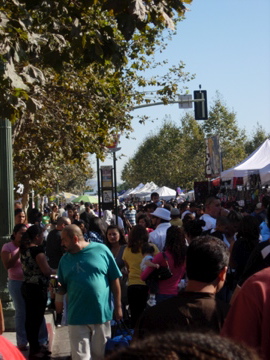
Oakland celebrates with a family-oriented daytime street fair on the Sunday preceding the holiday, this year November 1. While drawing a healthy cross-section of the city’s ever-diverse population, the event is mostly representative of contemporary Mexican and Latin culture in the Bay Area. Powerhouse Spanish radio stations, La Raza and La Preciosa, set up stages on opposite ends of the festival and vie for on-lookers. Local taquerias set up stands that pump out carne asada smoke, while DIY vendors push helado carts and set up raspado stands. Women hawkers cry, “Churros, Churros, Churros!” while others wrap still-steaming elotes in foil. Local businesses abut booths with corporate superpowers like Safeway, while non-profits erect altars next to those of neighborhood school kids. Dancers decked out in Aztec garb (the feather- and skull-adorned headdresses are bad-ass) break into spontaneous drum-infused performances, and there’s more men in cowboy hats and little girls in mini-skirts than you can count.

DSC_0381On November 2, San Francisco holds an evening procession that a jaded friend of mine has dubbed “Gringos Gone Wild.” True, the participants are largely not of Hispanic decent and, boy, do they get down. People dress up in calavera face paint and elaborate Tim-Burton-esque costumes that I suspect derive from Victorian Catrina dolls. A modest group of Aztec dancers leads the procession, which then follows with revelers of the purely San Franciscan variety: costumed people with politicized signs, curious interpretive dancers, bicycle-powered floats, and a whole lotta candle-clutching white folks. The procession ends at a public park filled with some seriously artistic altars—this year, an anatomical heart suspended by red nerves, a papier-mache carniceria, a parlor scene that looked like the inside of Edward Gorey’s head.
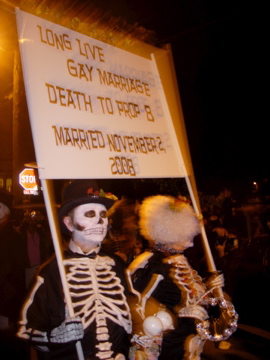
I can see how people get down on San Francisco’s Dia de Los Muertos celebration for not being authentico; I understand why others deem Oakland’s as boring and not creative enough. But isn’t that just an extension of the Oakland-SF rivalry, the cities’ differences demonstrated through the observance of another culture’s holiday?

I’m an Oakland girl, so I’m partial to an event where I run into about a dozen people I know. And if nothing else, the Fruitvale festival is thrilling for the mere fact that Oakland manages to hold a peaceful public festival (I remember seeing stray post-Festival-At-The-Lake rioters pass by the bottom of my block as a kid—that was the end of that neighborhood event). Events like the Dia de los Muertos celebration remind me why I love my hometown—though I never really forget.

DSCN3907At the same time, the Mission procession captures so much of San Francisco’s cultural landscape. Just when you get disheartened, want to write the whole place off as over-priced and gentrified, the city comes through with something insanely creative or beautiful. Despite the changing demographics, beneath the paling population and depressing socioeconomics, San Francisco’s still a city with soul.



And at the center of both of these celebrations is the fact that they don’t derive from, well, here. They aren’t American, have been brought over by immigrants and subsequently Americanized. Some shout cultural appropriation, and, sure, these festivities are a far cry from the all-night graveside vigils I attended last year in Tzintzuntzan. But, at the core of these modern interpretations, both stay true to the fundamentally celebratory Aztec approach of the holiday. And if that’s not survival, I don’t know what is.

Top 5 Things That Make Me American

3622369311_8989a991b2_m

That is totally mine.

“The more I travel, the more I realize how American I really am.”

This was Matt, leaning on a pole in a Madrid metro car, observing the raucous teenagers and stylishly dressed adults of an average Spanish evening. I nodded in sad agreement.

I’d like to say that traveling has made me more cultured, sophisticated and worldly. Maybe it has. But it’s also made me acutely aware of my incurable Americanness.

I didn’t really know what it meant to be an American before I started traveling; it’s hard to know if you have nothing to compare it to. I’ve now caught on to plenty of red-flag characteristics that will immediately identify one as hopelessly American. I’m guilty of many of them: holding my fork like a shovel, having obscenely straight teeth, living on my own before marriage, maintaining a staunch belief in the importance of a hearty breakfast. There’s also some attributes I don’t share with my countrymen: I don’t own a TV, I’m not overweight, and I can find Australia on a map. And I travel.

Being as though I travel, and have had the luxury to mingle with other cultures, I’ve been made aware of my grosser American offenses. Here’s the top 5 off my American rap sheet:

2639402501_5924ef8801_m

From the human race, I'd like to extend my apologies, little fellow.

5. I walk fast.

I didn’t know this was an American characteristic until someone pointed it out to me. It makes perfect sense. We don’t stroll in America. Walking is not a leisure activity; it’s the lowliest form of transportation. We do it briskly to conceal our shame. Or else we construe it as exercise (as in, office workers powerwalking their lunch breaks away).

Our avoidance of walking manifests in everything from drive-thrus to elevators to Segways. Remember when MacDonald’s had step counters as a meal prize? Exactly.

4. I shake hands.

Now, this isn’t exclusively American; many cultures shake hands. But Americans place special importance on the handshake, measure relative grip and firmness to construct deep insights into another’s character and psyche. “I like that young man; he’s got a good handshake.” And I was just in Europe, where nothing announces your Americanness like jabbing someone in the chest with your outstretched hand as they lean in for a check kiss. (Sorry, Pierre, hope that doesn’t bruise.)

3. I call myself American.

America isn’t a country, it’s a continent. Two continents, actually. Filled with many, many countries. In our utterly naive narcissism, we seem to forget this (read: title of this post). Numerous travels through Latin America have taught me to say that I’m from “Estados Unidos,” not “America.” But I still have trouble pronouncing “Estadounidense,” which basically means United-States-ian. Doesn’t flow off the tongue as easily, but it is more correct.

2. I don’t speak another language.

I mean, really. It’s just ridiculous at this point.

441228274_30567e38cb_m

And the rockets red glare...

1. I have a deep and abiding love of peanut butter.

Protein, healthy fat, delicious taste: the American love affair with the peanut culminates when we grind it, jar it and spread it on stuff. Or eat it by the spoonful.

Trying to find peanut butter outside of the United States is a depressing, frustrating and often futile effort. If you can find a jar, on a lonesome dusty shelf hidden behind the Nutella and marmalades, it’s bound to be sugared to hell, rife with hydrogenated oils and staggeringly expensive. I’m not sure why the rest of the world is sleeping on the PB tip; with great taste, nutritional value and versatility, they’re really missing out.

There’s plenty of things I could change about myself to become more international, a “citizen of the world” as the obnoxious call it. Sure, I could learn 7 languages, use military time and metrics, and school myself in the finer points of kissing cheeks. I could disregard my reverence for the orderliness of lines, become a football fan (not American football, silly), even slow my roll to a smooth swagger. But I will never give up my passionate fervor for peanut butter.

Flyin’ with Ryan: What to Expect and How to Survive

DSCN3843I have seen the future of air travel. And it’s covered in Telecom ads.

If you haven’t been broke and in Europe in recent years, you may not be familiar with Ryanair. Among the no-frills airlines specializing in short distances and absurdly low prices, Ryanair is the most vile, audacious and offensive. And usually the cheapest.

The idea of an under-$50 flight gets most Americans all hot and bothered. It’s just another way those Europeans have it better than us—universal health care, social welfare systems that work, less violent crime, tougher environmental laws. And cheap flights. I’m talking 5 Euros cheap. I’m not sure why Europe gets to add this to their ever-expanding repertoire of ass-kicking, but my guess would be that the airlines have to compete with competent, efficient train service. Take Amtrak, or God forbid, Greyhound across the country? Down to LA? I think I’ll pay the $125.

When I was figuring out the general itinerary for my last trip, I checked out flight costs for my longest distances on FlyCheapo. I came across Ryanair, and thought there was something wrong. A one-hour flight from Marrakesh to Seville for 5 Euros? Porto to Madrid also for 5? Are you kidding me?

Well, yes and no. The thing with Ryanair is that there’s catches. Enough to warrant a mitt—or the ability to read fine print, follow rules to a tee, and tune out advertising assaults. And you’ll need a pinch of luck. I took 2 flights with Ryanair; here’s some survival tips on what to expect from Europe’s most infamous airline:

The first trick to surviving a Ryanair flight is to read every rule and instruction, and treat it like the gospel. It is. Any attempts to bend the rules promptly results in a hailstorm of fees. Size and weight requirements for both checked and carry-on luggage, for instance, aren’t approximations. Carry-on baggage over 10kg? That’ll be 20 Euros. Forget to print your boarding pass at home? That’ll be 40 Euros. Traveling with an infant, surf board or guitar? Another 20-40 Euros. You’ve gotta pay to check a bag, but if it exceeds 15 kg, there’s an additional per kilo charge. If you’re a non-EU citizen, you have to have your passport checked by immigration control; forget that, and, yes, it’s another 20 Euros.

In preparation for your Ryanair flight, don’t even think about fudging on the details. Check-in closes exactly 40 minutes before the flight departs; arrive even 3 minutes late and you’re SOL. Have your printed boarding pass in hand, and get your passport checked.

Get to the gate early. Don’t sit in the hard plastic chairs—stand as close to the gate as possible. Ryanair doesn’t assign seating, which at first seems counterintuitive—it takes longer for people to board when they’re elbowing and jostling and trying to find their own seats. But, as always, there’s a catch: you can pay 4 Euros for priority boarding. Most of the folks doing this are traveling with small children, or those infants they paid an extra 20 Euros to hold on their laps.

As boarding time approaches, expect to see a steely-faced attendant walking up and down the line of anxious passengers, examining each carry-on item. It must be under 10 kg, and it must be only one bag. That means purses, laptops, water bottles, plastic bags carrying your wilted sandwich from earlier that day—it all counts. This is where they really rake in the extra fees. I only saw one man successfully evade the attendant, putting a jacket on over his fanny pack and untucking his shirt so you couldn’t see the waist strap. Smooth.

When it comes time to board, don’t expect anything fancy like gates or protected corridors. You’ll be scurrying across the tarmac and scampering up stairs (front or back, they open both up for maximized efficiency). Hustle on to the plane while perky young attendants bark at you like PE teachers: keep moving! find a seat! don’t block the isle! move quickly! go!

You’ll discover a couple of unusual things about your Ryanair aircraft. One, there are no tray tables. That safety card with a creepy characters acting out worst-case scenarios will not be a folded card in a pocket, but pasted onto the seat back in front of you. The overhead bins will be covered in Telecom ads, like a bus or metro car.

Once you’ve buckled your seatbelt, you’ve successfully completed the first stage in surviving a Ryanair flight: you’ve negotiated the rules and fees. Now it’s time to sit back and… be marketed at.

It’s ingenious, really, and I’m not sure why other airlines haven’t thought of it yet. Maybe they have, and Ryanair’s just the only one ballsy enough to go through with it. They’ve got a captive audience on an airplane, and Ryanair makes use of this ideal situation. In a 55 minute flight, I counted 4 opportunities to buy things. Jonesing for a cigarette? Buy our Smokeless Cigarettes for only 6 Euros. Make use of Ryanair’s exclusive inflight mobile phone service, and text and chat your heart away for only 2 Euros a minute. Buy Nescafe coffee for only 3 Euros. Get your gambling fix by buying a scratch card for only 3 Euros—and don’t feel guilty because some undisclosed amount of the proceeds goes to charity (here the flight attendant actually walked the aisle saying, “Win 10,000 Euros, save the children”). And let’s not forget duty-free shopping.

All this means that the attendants are basically talking at you the entire flight. Part of the reason is that announcements and sales pitches need to be made in multiple languages, but still. I recommend headphones. A smiley “no thank you” is as effective as a mean scowl, so pick whichever one fits your mood. No charge.

Now, when you’re descending into your destination, you may think the battle’s almost over, but here’s where the luck comes into play. I was fortunate on my 2 flights, because I landed in the airports and cities I thought I’d be landing in. Not so for all Ryanair passengers. I’ve heard horror stories about people landing on some lonesome runway 20 kms from the city they’d booked for. Notice that on your Ryanair itinerary, specific airport names aren’t given, just the names of cities. This allows them to land in the regional area of whatever destination, but not necessarily the main (and more expensive) airport. So, if you’re among the unfortunate, how do you get to where you thought you were going? Ryanair is nice enough to arrange for a bus. Which you can ride for 20 Euros.

Seeing as though I landed where I was supposed to, only had one flight time changed and neurotically followed every rule, my Ryanair travel experience wasn’t so bad. I actually don’t mind being inundated with ads and paying checked bag fees if it means I’m flying for a total of 25 Euros. And judging from the number of filled seats, I’m guessing I’m not alone.

Ryanair certainly hasn’t won any friends with its wily antics (this guy is pissed), and there’s an art to surviving their flights. But until they start charging to use the bathroom (they lost on that one), I’ll still grab a cheap flight with them whenever I’m in Europe. And my guess is that US-based airlines will begin moving more in this direction—hey, they’re already charging for checked bags. Only their flights ain’t no 5 Euros. (Oh, Europe, there you go again…)

There’s No Place like Oakland

3318186624_396e94a2c4_mI’m falling in love with my hometown. Again.
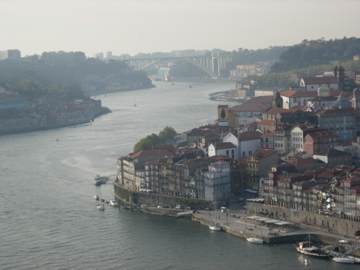
I’ve just come home from six weeks in Iberocco (Spain, Portugal, Morocco). And more than any other homecoming from any other trip, I’ve been struck with a swooning sense of smittendom—for Oakland.

Coming home is always bittersweet. I love so much the headspace of traveling and who I am when I’m on the road—more open and willing to roll with punches, the literal potholes and uneven pavement of shoulderless highways. I love the feeling of constantly learning, constantly adjusting, figuring out buses and city streets and how to say “thank you” in whatever language (“gracias,” “obrigada” and “shokran,” in case you’re wondering). It’s always a serious bummer to board a plane and know that that will soon slip away as I settle back into the familiar, a chrysalis of complacency.

But as the jumbo jet tilted and spun and made its descent into SFO on Wednesday, I had another usual feeling encountered when coming home: awe. Even in my dehydrated, swollen-legged state of sleep deprivation, I was floored by the raw beauty of the Bay Area, its bridges and mountains and tumble of cities. You’d think I’d have gotten used to it by now, desensitized to the rugged coast and smooth blanket of ocean. But no. It still gets me. And, surrounded by eager British tourists, I had a sense of pride—yeah, this is where I’m from.

My dad picked me up, and we chatted about exciting family developments on the drive across the bridge. My brother’s gotten engaged, wedding preparations are in full effect, baby’s on the way. It was one of those perfect Indian summer days in the Bay, and the skyscrapers and billboards of Downtown San Francisco sparkled in the lazy afternoon sun. If you’ve gotta come home to anyway in the US, I’ve always thought, this is about the best place.

And then came Oakland.

We pulled off the freeway, stopped at a light next to a woman singing along to the bass-rattling radio, hyphy dancing in her gleaming-rims car. My dad looked over at me. “Good to be home?”

“You have no idea.”

I love my hometown in a fierce, unexplainable way that transcends the normal no-place-like-home adage. There’s really no where quite like Oakland—at once diverse and vibrant, crime-ridden and corrupt, filled with the tension of violence and drugs, and with a kind of kick-back coolness that gets under people’s skin, infects them with this cursed passion for the place that won’t let them leave.

There’s a reason San Francisco is called The City, and Oakland’s called The Town: it’s a city of neighborhoods, where people say hello and chat with each other. I can’t blame the encroaching tide of gentrifiers for snatching up bungalows, sipping coffee on their porches and talking about how much they love their neighborhoods, their new city, their adopted hometown. Even for the newly arrived, Oakland just feels like home.

And seeing as though I’ve never lived anywhere but Oakland, it’s truly the only place where I feel comfortable, feel like I don’t stand out like the 5’10, tattooed, throbbing sore thumb I am everywhere else. (Even in New York City, I’m constantly being stopped on the subway, the streets, in Jewish delis, and asked where I get my work done—so much for New Yorkers being unfriendly.) Somewhere amid the dreadlocks and full sleeves, the mulleted vaqueros and the clashing-prints Asian immigrants, between the Crod-clad yuppies and the Southern-accented old men, somewhere in the seams of all that, I find this funny feeling of home.

Oakland’s not an easy city to love. My first Matador article was about that, and, judging from the comments, I’m not alone in either my love for Oakland or heartbreaking frustration with it. And, while I really can’t get enough of traveling, of seeing the world and experiencing different cultures, I’m fairly certain that, fuck, Oakland’s got a grip on my heart. I’m a lifer.

Hanging On: Porto and My Final Days

Porto, being hella beautiful

Porto, being hella beautiful

I´m nearing the end of my trip, fighting the blues and impending sense of finality not at all discouraged by the dark and brooding city of Porto.

Every place I go in Portugal seems to the up the ante. College-town Coimbra was a steep jumble of old streets and sudden squares with startlingly beautiful sights tucked inside every twist and fold. It was as pretty as a girl without make-up on, a girl who doesn´t know how pretty she is—clutching her parks and praças (plazas) and fountains to her chest like a Valentine. I wandered around the small city, sighing and thinking, This might be my favorite place in Portugal.

Then came Porto, sharply cleaved by the Douro River in a precipitous dive of rock and stone, bridges and dancing light. It´s the dark-haired, fiery-eyed counterpart forever in the Northern shadow of its shiny, more popular younger sibling, Lisbon. The two cities have a huge rivalry (most overtly expressed via football); I feel like an aunt that loves them both, for their different personalities, but that can vibe a little more with the darker side. At least, right now I can.

I spent the bus ride in yesterday not reading or writing or listening to my ipod, but staring out the window and wishing I would never arrive. Just keep riding, keep traveling, keep going. It was the last bus ride of my trip and I was savoring those precious moments of just sitting, thinking, living in that inbetween state—like when I used to ride the bus as a teenager. Having the time just to sit and stare is a huge luxury for me these days, and I´m going to miss it.

But more than even that, I wanted to hang on to the feeling of traveling, the mindset. When I´m on the road, everything seems possible; I´m more open to chance, more aware, more able to live life on life´s terms. When I´m at home, nothing seems possible; everything seems difficult and riddled with tedious and insurmountable obstacles. Of course, neither view is entirely accurate, but I enjoy the former much more than the nose-to-the-grindstone latter.

Two days ago, on the bus ride from Peniche to Coimbra, I began plotting and planning—sketching out timetables and earning versus saving projections (yes, really), trying to figure out when my next trip would be. I was seized by panic, stressed by the dismal prospect of not being able to travel anytime soon. Basically, I was future-tripping, trying to manage and arrange life before I even got home.

But I´m not alone in that. During my trip, I´ve slowly been reading Peter Matthiessen´s The Snow Leopard, a classic travelouge and meditation on the state of living. As timing would have it, Peter´s about to head back down the mountain, towards home, just as I´m about to hop on a flight and sleep in an airport and hop another two flights. In the passage I read today, he´s also losing the Zen of travel and stressing about home, “forever getting-ready-for-life instead of living it each day” (p. 244). He suggests that perhaps the greatest spiritual challenge is to live in the present, to “pay attention even at unextraordinary times, to be of the present, nothing-but-the-present, to bear this mindfulness of now into each event of ordinary life” (p. 245).

So I rambled around the shuttered shops and lonesome graffiti of Porto this afternoon, the uneven stones in the street like a repeating mantra against my worn soles: be present, be present, be present. I wandered past baroque building facades adorned with trumpet-blazing statues, up gasping stairways, into gold-dripping cathedrals, past the darkly oxidized rock (“the awful and irrefutable rock-ness”) that jutted from the earth, bold and undeniable. I felt the murmur of Roman ruins beneath the surface, beneath my sneakers, and tried to hang on to this fleeting feeling of present.


Lauren Quinn is a writer and traveler currently living in Hanoi. Lonely Girl Travels was a blog of her sola travels and expat living from 2009 to 2012. She resides elsewhere on the internet now.

Join 458 other subscribers

Buy This Sh#t

Categories