Posts Tagged 'blogsherpa'


Livin on a CUC: Independent, Budget Travel in Cuba

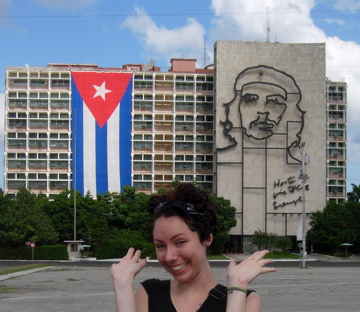
Cheesin it up

Backpackers, lefties and dirty hippies beware: Cuba is not cheap. And despite any romantic revolutionary visions, it’s got tourist traps, just like everywhere else. They’re just filled with Che shirts instead of fanny packs.

Several factors might lead one to logically assume Cuba to be a budget-friendly, independent travelers’ paradise: it’s a dirt-poor Latin American country, enamored in the hearts of liberals, intellectuals and military-cap-wearing undergrads. So when you hear that your low-to-mid-range daily budget for Cuba should be around $100/day, it comes as a bit of a shock.

Here’s the deal: after the sugar industry collapsed in Cuba, there wasn’t much left to keep the island afloat. Keen eyes turned towards tourism. Not only does Cuba’s larger-than-life lore hold particular allure for the left-leaning, it’s got an undeniable romanticism—old cars, crumbling buildings, rum and Rumba. Couple that white people’s insatiable lust for balmy Caribbean getaways, and they had the perfect cocktail on their hands—muddled with Euros instead of mint sprigs. Tourism today is “the most dynamic sector of the Cuban economy.”

If you’ve traveled to other places where tourism is a mainstay of the economy, you’ll know what this means: high prices and potential hassle. From Moroccan medina touts to San Francisco’s 14% hotel tax, economies that rely on tourism milk it. In San Francisco, the hotel tax goes to fund all sorts of cool arts endeavors and social programming that other US cities don’t have; you could argue (depending on your politics) that Cuba’s dual currencies are an extension of that. And in Cuba you don’t really have to worry about hustlers and pick-pockets (though they do still exist); tour companies take care of that.

Let's play "Spot the Tourists"

You wouldn’t initially think it, but Cuba’s got a resort, package tourism industry up to snuff with any Caribbean destination. A Hungarian friend won a Cuban vacation as an incentive prize at work; all he saw of Cuba outside of his resort was through a tour bus window. Combine the package factor with the absence of youth hostels and backpacking networks, and the prospects can seem pretty dismal for DIY cheapstakes like me.

But independent, budget travel in Cuba can and does happen. There’s just some special tricks you have to be hip to. My travel companion and I managed to squeak by on $75/day, well under the Lonely Planet budget (but then again, we were both surviving at home on less than $2000/month, so cheap living wasn’t anything new). Here’s what we learned and how we did it.

Resources

My two biggest resources for independent, budget travel to Cuba were Lonely Planet’s Thorn Tree Forum, and Cuba Junky, a comprehensive, Cuban/Dutch-run website for travelers (with endearingly odd translations and misspellings). At these two sites, you can find info all sorts of great information, and on the forum you can trouble-shoot and get advice (and suffer through the occasional political debate).

Money

Cuba operates on two currencies: the Cuban peso (CUP), the money of the people, and the Cuban Convertible Peso (CUC), the money of tourists.

Why? As tourism grew, American dollars began to wiggle their way into the country—hotels and tourist restaurants charged foreigners in dollars, while charging locals in pesos. (Considering the average monthly salary for a Cuban doctor is about what I make in thirty minutes, it’s more fair than it seems.) In addition, “dollar-only” shops emerged, where scarce and coveted items like dental floss could be had for a a high price. The influx of money was good, but the presence of American dollars was kind of slap-in-the-face to the government, wouldn’t you say? The government thus created the CUC to keep US dollars out; they did, though, base the exchange rate on the US dollar. Tourists pay for things in CUCs, while locals pay in pesos.

Whenever you exchange money, you’ll be given CUCs, and the majority of places you spend money will accept only CUCs. Invariably, however, you’ll get your hands on some pesos. It’ll probably happen like this: you get seduced by the wafting smell of cooking meats, and buy some street food. You hand the guy your CUC note. He digs around his pockets, shouts over at some other vendors; no one has the proper CUC change. He shrugs and gives your change in pesos. You’ve now got a pocket full of notes and coins, and can pay for small items like coffee and ice-cream with pesos—dropping the price from a couple bucks to a couple cents (literally).

There are of course more nefarious ways to get your hands on pesos, but you wouldn’t do that, now would you? Tourists aren’t really supposed to use pesos, and I have to say, I felt pretty guilty paying the equivalent of 5 cents to someone who makes $10/month—even if I am just a waitress living in a run-down North Oakland Victorian. I don’t recommend trying to use pesos as a way of cutting corners and stretching your budget, but it’s something that will happen at some point.

Casa Particulares

The single biggest way to save money in Cuba is by staying in casa particulares. State-licensed rooms for rent in private homes, casa particulares will also be one of your best glimpses into Cuban life.

Huge-ass main course served at a casa particular

Here’s how it works: individuals apply for a license, which is expensive; they must pay a monthly tax whether or not they have guests. The government approves them, and they can rent rooms to foreigners.

Expect to pay 15-30 CUCs per night (as opposed to 50-100 Euros and upwards on a hotel). Plus, as everyone knows, homestays are a great way to experience the everyday life and culture of a country; we stayed with hosts in Vinales whose teenage son showed us plenty of hip Cuban dance moves (which we were incapable of replicating). Hosts will usually offer to cook you meals, for an additional 5-15 CUCs. This may not be cheaper than eating at a budget restaurant or food stall, but they’ll stuff you silly.

The Cuba Junky site has gotten much more spiffy since I went to Cuba, and you can now book a casa particular room via the website. I did it a semi-old-fashioned way: I got ahold of Potato’s email address on the Thorn Tree forum, sent him an email, and he booked a room for us. He gave us his address; once we landed in Havana, we went to his apartment, enjoyed a cup of tea and chatted (he’s a really cool dude), and he walked us a couple blocks over to a lovely elderly couple who we stayed with for four days (and whose toilet we later busted—more on that later).

I like to have my accommodation arranged for my first couple nights when I arrive somewhere new, but the rest of the casa particulares we stayed in on our trip we booked ourselves. Most people will display their license logo prominently, so you can just knock on their door and ask if they have room (really, Cubans are insanely friendly and won’t turn you away). If the one you go to is full, they’ll for sure have a dozen friends with licensed rooms, and will help you find one. It sounds like a hassle, more for them than us, but I swear it works: a cab driver drove us all around Vinales while neighbors tracked down an empty room.

Bring Every Last Toiletry You May Possibly Need

Basic medical supplies are both costly and in short supply, or nonexistent, in Cuba. Pack all the sunscreen, aspirin, contact lens solution and insect repellent you might need—or risk shelling out painful amounts of money in a poorly stocked dollar-store. Even an extra roll of toilet paper isn’t a bad idea—unless you like wiping your ass with day-old news.

Tours and Entertainment

Cuba has a fairly well-beaten path, and if you stick to the neighborhoods and activities tourists are routinely funneled into, you’ll bleed CUCs faster than you can say “revolucion.” But get a little intrepid and a little chatty, and you’ll stretch your budget big-time.

Everyone knows that Cubans party, and party well, so you can be pretty sure that any club charging a hefty entrance fee is geared towards tourists. And as cool as a Hemingway tour or trip to the Tropicana might sound right now, you’ll quickly realize that they’re the Fisherman’s Wharf of Havana. Get friendly and ask your casa hosts (or random folks on the street) for tips on where to go and what to do. Less tacky companies like San Cristobal Agencia de Viajes are a good bet for more offbeat tours.

Food, Transport, and the Likes

There’s no real trick here: just do what you do in other countries.

Dinners at tourist-geared restaurants will set you back much further than paladares (mom-and-pops) and street food stands. Snack foods can actually be pretty hard to come by, so bringing along some biscuits, nuts or, for the homesick Yankee, peanut butter isn’t a bad idea. You can skimp on transit, but be prepared to pay the price: low-cost buses break down and hitch-hiking isn’t fun anywhere (in my opinion). Walk and take local buses within big cities, as opposed to cabs, and of course, the less you move, the less you spend on bus tickets, trains, etc. Cut down on souvenirs (really, how any Che hats do you need?), and do free stuff like strolling and lazing on the beach.


So, as with the last post, any seasoned Cuban travelers or recent returnees wanna share their experiences? We’re all ears…

Yankee in a Che Shirt: How To Travel to Cuba Independently and Illegally as an American

Americans you're likely to encounter in Cuba

Si, se puede!

Three years ago, I traveled to Cuba. I didn’t get a visa, didn’t book a tour, didn’t go with a dance troupe or salsa band (though that would have been killer). I did it the way I do everything, independently.

Fear mongers, nay sayers and foreign travel agencies would lead you to believe that independent travel to Cuba is dangerous and impossible. They’re the same people that make full and complete stops at every stop sign, and are too scared to ride the subway in NYC. Or else they’re trying to sell you something—the hustling taxi driver outside of the airport. They clamor cowardly behind the embargo.

Here’s the legality deal: as an American, you’re technically not banned from traveling to Cuba; you’re prohibited from spending money there. Whatever. If you didn’t obey your parents’ curfew as a teenager, are you really gonna start heeding authority now?

The fun thing about traveling to Cuba as an American is that it requires more effort, more digging. You can’t buy your plane tickets online; most worthwhile advice won’t come from guidebooks but fellow travelers, via forums like Thorn Tree. Basically, you have to work a little harder. But the reward is getting to go to one of the most un-Americanized countries in the world—remarkably only 90 miles from Florida.

I’m pretty sure it’s technically illegal to give Cuban travel advice to Americans. But eff that too. Here’s how I did it, how it worked and the gems of wisdom I smuggled back (along with the cigars):

Before You Go: Money and Packing

Your most important pre-travel preparation as an American is money. Your ATM and credit cards won’t work in Cuba, meaning you’ve pretty much got to bring everything you plan on spending with you. Travelers checks are a pain in the ass and have a hefty commission tacked on—which means you’ll be bringing cash. Lots and lots of cash.

If you’re like me, you’re not too thrilled at the idea of walking around with $1300 on your person. But keep in mind Cuba’s remarkably low crime rate, the absence of desperate drug addicts and your own street sense—you’re gonna be fine.

Another consideration is which type of currency to bring in. The greenback gets an extra 10% penalty fee on top of the standard 8% exchange commission, so most travelers opt to bring in Canadian dollars or Euros. It pays to do the math on conversions and figure out how much you’ll be hit by commissions and fees for dual exchange (changing from dollars into Euros into CUCs).

Another pre-trip consideration is what to bring, and what not to bring. This is for everyone, not just Americans. Charitable donations like medical supplies and clothes are greatly needed and appreciated, but check out regulations on what and how much to bring. Cuban Customs has some unusual regulations regarding the import of electronics and pornography, and is super strict about narcotics. Of particular concern to Americans is the prohibition of anti-revolutionary literature—make sure you don’t have any crazy right-wing, Miami ex-pat ramblings with you. Not that you would anyway.

Getting In: Booking a Flight

The easiest, most popular and often cheapest way for an American to get into Cuba is through Mexico, namely Cancun. Of course, Cancun is the #1 most suspicious transfer point, and word around the chat rooms is that you’re singled out by US Customs most often when arriving from Cancun. But it’s also an insanely popular destination, and I think the Mexican- to Cuban-vacationer ratio still works in your favor.

American travel agencies and airlines are prohibited from booking flights or giving any kind of assistance to Cuban travelers. But foreign airlines and agencies aren’t. So instead of shelling out big bucks to some Canadian company that’ll orchestrate the whole thing (for a mere 300% mark-up), do what I did: call a foreign airline at one of their international offices. I called Mexicana in Mexico City (52 55 2881 0000), requested to speak to an agent that spoke English (not a bad idea when purchasing something as expensive as plane tickets), and bought tickets from Mexico to Havana. Not as easy as Orbitz, but pretty damn close.

The way the flight times worked out, we ended up bookending our Cuban travels with overnight stays in Mexico. I thought I’d be smart and fly through Merida, whose Sunday night dance parties sounded infinitely preferable to Cancun’s binge-drinking co-eds. Turns out that you can’t fly directly from Merida to Havana, so we had to transfer in Cancun anyway. Ah well, better than a spending a night in Cancun.

Arriving: Surviving Customs

Passing through Cuban Customs is the most intimidating border crossing I’ve ever done. But, as I reminded my then-boyfriend and travel companion, Cuba wants to let you in. They need tourists’ money. They just wanna make sure you’re not there on an anti-revolution espionage mission. Fair enough.

Expect to stand in an impossibly long line. You’ll be instructed to approach the Customs booth by yourself. They’ll scowl at you, tell you to take off your glasses and look into the camera. They’ll photograph you, record you, enter every last bit of info on your passport into their computer. They’ll then stamp your tourist card, your golden ticket. Cuba doesn’t stamp passports, but $20 purchased tourist cards. Mexicana provided mine, but it’s a good idea to check your airline or prepurchase your card at a Cuban Embassy, as getting ahold of one at the airport sucks. And hang on to that baby—losing it is an expensive, bureaucratic hassle.

Once your passport is handed back to you, you’ll get directed through the floor-to-ceiling solid door that the travelers before you disappeared behind. It may seem like you’re being funneled into an interrogation room, but most likely, you’ll be headed off for a quick frisking and x-raying of your baggage. Drug sniffing dogs will accompany female agents in ridiculously short skin-tight mini-skirts—the most amusing part of your Customs experience.

While You’re There

Really? Couldn't have left the Confederate swim trunks at home?

Once you’re in Cuba, there’s not a lot in your day-to-day travels that’ll set you apart as American. You’ll have to deal with the money issue, but the good news is that everyone will guess you’re from somewhere other than the US. It’s a nice change of pace from the Frenchman breaking into sudden English with, “And where in the States are you from?”

Getting Out: Playing Dumb and Looking Innocent

The trickiest and most anxiety-inducing part of any American’s trip to Cuba is coming home. I’ve heard of Americans getting hassled by Cuban customs agents, but it’s pretty rare. The folks you have to worry about are the good ole’ boys (and girls) back home.

But first you have to worry about a double-entry stamp back in Mexico. This means that you’ll have a stamp for arriving in Mexico, no stamps for Cuba, but then another entry stamp for your return to Mexico; there’s a void in there, signaling nefarious activity.

You can handle this one of two ways: bribing the Mexican Customs agent to not stamp your passport (trickier at Cancun, where they’re more vigilant, but still possible), or by hoping for the best with a doubly stamped passport. We opted to bribe the Mexican Customs agent. We tucked a sizable peso note into our passports and softly asked not to be stamped. The agent grunted and handed us back our passports, unstamped. If you’ve got a heavily stamped passport to begin with, it might be worth saving the money and relying on the slim odds that the US Customs agent will bother to inspect your passport closely. I’ve never had an agent more than glance at my stamps.

Aside from the extensive, albeit poorly edited, advice by eco-hippies International Bike Fund (I mean that in a good way), any American who’s ever traveled to Cuba will be eager to give you plenty of tips and first-hand accounts on how to elude US Customs—whether you want to hear it or not. So here’s my two centavos:

Revolution anniversary poster I stole and smuggled back home

Reports vary, but up to 100,000 Americans are claimed to have visited Cuba last year. Most of them breeze through US Customs without a problem. There’s nothing that should single you out as particularly suspicious. Be respectful; don’t roll up to the counter smoking a cigar and wearing a Che hat. But don’t sweat it too much. Customs agents are doing their job, and you’re doing yours. They really don’t want to write out lengthy reports anyway. I truly regarded my traveling to Cuba as not too dissimilar from jay-walking—not supposed to really do it, but no big deal. Folks’ll tell you not to bring anything incriminating and obviously Cuban back with you, but eff that—I brought cigars and stolen street posters.

We arrived at SFO disheveled and tired with a horde of sunburnt vacationers. I of course did not write on my Immigration Card that I’d traveled to Cuba, nor did I list the goods I was smuggling back (why you gonna rat yourself out?). I smiled nicely at the agent, told her yes, I’d had a great time in Mexico, picked up my bags, passed em through the x-ray machine without incident, and headed home.

But enough out of me. Any Americans out there wanna share their Cuban travel experiences?

We Wish You a Merry Solstice, and a Non-Denominational New Year: A Muir Woods Solstice

Into the darkness...

Nature lover, pagan, hippie, cheapskate—call me what you will, but the Muir Woods Solstice Event ruled. And not just in a Wicker Man kind of way.

The free, annual event honoring the longest night of the year is uber North-Bay: wholesome, granola-y, non-denominational family fun, set amid old-growth redwoods and adorned with weedy handmade garlands. Luminaria-lit paths fill with white-breathed revelers, whose flashlights make the falling rain look like snow, or that scene from Edward Scissorheads. Puppet shows, antler-clashing Germanic dances and de-Christianized caroling ensue in an event that makes even a cynical 20-something (me) smile.

The promise of free entry and free hot cider lured me out on a moody Monday afternoon, to brave the bridges and highways of a Bay Area rush hour. On a slow Saturday, I’d gotten to chatting with some regulars at work, who gushed to me about the event. Traipsing around the damp dark of one of the Bay Area’s most impressive natural attractions had sounded like a damn good way to spend the longest night of the year. I grabbed a crappy flashlight and a hooded puff coat, roped a friend into riding shotgun and playing DJ, and we set out, sliding along the green curves of Marin, through afternoon sun that shone through the clouds like light into a church.

A ranger with plastic encasing her hat ushered us past the forever-full parking lot; we joined the assembly of cars lined up along the soft shoulder. We walked a muddy, pleasant 15 minutes to the park entrance. Slicker-clod kids tromped puddles as their parents juggled umbrellas and thermoses.

We arrived just as the crowd was thickening. A bearded ranger that looked like a nervous cross between a bluegrass singer and a surfer handed us a booklet of Solsticized/Muirized Christmas carols, complete with lines and titles such as “Deck the woods with luminaria,” “I’m Dreaming of a Green Solstice,” “O Redwood Tree,” and “Come All Ye People.” My personal favorite was “On the first day of Solstice / A Ranger showed to me / A spotted owl in a redwood tree.” The adapted songs captured the progressive eco-politics and non-religious spirituality of Marin better than an Anne Lamott novel. You know that stir a couple years back when right-wing Christians got their knickers in a twist over “Happy Holidays” replacing “Merry Christmas”? Well, these were the folks they were pissed at.

It was, as you might guess, a mellow crowd of nature-y families and local weirdos (a simplification that I suppose puts me into the latter category). We grabbed some cups of cider and strolled around in the intermittent rain, soggy sneakers and cold noses. The creek was full from the recent storm, the stumps mossy; everything felt wet and alive.

We joined the huddle of firepits and hunched shoulders encircling a small, makeshift stage. It was time for some wholesome, non-offensive entertainment. The crowd sang a couple carols, and was then held rapt by a story-telling performance featuring exuberantly portrayed animal characters that I’m sure have inspired several voice-over school rejections. We agreed that the confused shadow puppet show was most definitely the improved result of a flash of marijuana-fueled brilliance. We took it as our cue to stroll the now-dark trails.

Candles in white paper bags lined the trails, making it feel almost like we were walking through an altar. Raindrops held heavy on the tree branches as little kids ran past in a bobble of flashlight beams. Other than that, it was all sound. It reminded me of an interview I’d read with a travel writer (Don George?) who’d wanted to write about something other than the cathedral-ish quality of light in Muir Woods. He’d blindfolded himself and walked around, experiencing the famous woods with mostly just his sense of sound, and written the article from that perspective. It was true that it was a totally different Muir Woods without the light and the sight of redwoods—all rambling water and the solid, rooted presence of those trees, the way you feel a stranger in a dark room.

We got back to the caroling crowd just in time to catch the most bad-ass and spooky performance of the night, a Germanic Solstice dance by the Christmas Rebels (which sounds kind of punk rock). Composed of members of the German fraternal society California Rebels, the group did a slow, hypnotic folk dance that included antler-clashing and creepy flute playing. A bearded dude with a crazy eye hushedly explained the pre-Christian roots of the dance, which got back to the potent mix of fear and worship that fuels most religions, not just Paganism. Under the illuminated, snow-like mist, the clanks of the antlers and the wet clomp of the determined feet felt like a ritual not from long ago, but rather some deranged allegorical movie. Which is to say it was rad.

Toes numb and bellies hungry, we trekked back to the car under the dim halo of my flashlight. A half-grin of moon cut through the heavy clouds, and the earth rustled, sighed, pulled a blanket of darkness up to its chin and settled in for the longest sleep of the year. And Marin celebrated, the way Marin knows how: amid the trees.

Hipsters Vs. Homeys: Oakland YouTube Travel Guides

“Oh hell no,” the text read. “Hipster douches filming Oakland travel video outside the shop.”

This was my best friend, writing from her post behind the counter of Tattoo 13. For years, she and the fellas have maintained a comical running commentary on the goings on of the now-trendy Temescal neighborhood, knowing every event, incident and wily character within a 10-block radius. Of course, she’d be the first person I’d hear about such shenanigans from.

It actually turned out pretty good, with the bit filmed in front of the shop capturing hipster sentiment with striking accuracy. Amid the recent annoyance over the woefully narrow Cool Hunting’s Oakland Word-of-Mouth Guide, I was inspired to dig the “hipster douche” video back up, and discovered some other YouTube gems along the way. And I hate to say it, I think the douches did it best. Or at least the most forthrightly.

Cool Hunting promotes independent art and design, featuring video guides on artists, cultural events, how-tos and destinations. The most recent installment visits independent businesses and local artists in Oakland, interviewing “the people who call it home.” They hit some great, popular local spots, but there’s a problem—the video only visits a very narrow section of the population, and the city. Businesses featured are almost exclusively in the North Oakland/Temescal and Downtown/Uptown areas, and, um, all the people interviewed are white. There’s a lot more white people in Oakland these days, but not that many.

Perhaps in an attempt to be inclusive, the video includes a couple shots of non-white, non-artist folks. They exist as passing, silent figures, riding bikes and making sandwiches—almost as though on another plane. I think it’s rather telling; I’m sure there’s people who’ve moved to Oakland that interact solely with the arts/”yuppie” communities, who experience the rest of the city only in tangent, realities that intersect on sidewalks and in cheap cafes, but no where else. I’m stoked to see my city getting recognition, but sad to see the guide left out so much of the city, what makes Oakland Oakland.

On the complete other side of spectrum, I stumbled across Thizz Nation’s neighborhood guides during my YouTube quest for the “hipster douche” video. Amid Mac Dre’s ever-generous contributions to Bay Area culture (I’m not really being sarcastic here), his Thizz Nation & On Point Productions created Treal TV Series, video guides that feature notorious Bay Area neighborhoods that birthed prominent figures in the rap community. (If you’re wondering what “thizz” is, check out old high school buddy Rachel Swan’s East Bay Express article from a few years back.) Installments include North, West and East Oakland.

I’m convinced these will someday be used as important specimens in some cultural anthropological study of Oakland. These guides do a little more to reveal the history and culture of certain neighborhoods, as rugged as they may be. But of course, they are also terribly narrow, and could leave one with the impression that Oakland is filled with nothing but 20-something, hard-as-shit black guys. Murder Dubs was one of the better ones:

A stab at a more balanced portrayal is made in the endearing “Oakland B Mine” video. A trailer for a short film that will be showing on a 30-foot screen at the Oakland Airport’s baggage claim, “Oakland B Mine” is pretty damn sweet. I never thought of my city being the backdrop for an artsy dialogue-less love story, but hey, I can roll with that. The trailer features some shots of everyone’s favorite farmers market (okay, my favorite farmers market), and the bad-ass old folks that do Tai Chi by the Lake Merritt BART station in the morning. While definitely more balanced and definitely the most well-done, one could still walk away from this one with the idea that Oakland is filled with nothing but good-looking, casually well-dressed hiply ethnic types. Which is fairly accurate, but still incomplete.

Which leaves the douches. While still narrow and incomplete, their video does something the others all don’t: makes fun of itself. It doesn’t just make fun of hipsters and gentrifying yuppies, it makes fun of cheesy travel guides and the abhorrent “staycation” phenomenon. But most importantly, the video gets at some of the very real issues inherent to living in Oakland, the preposterous dysfunction that manifests in sideshows, prostitution and, yes, the smells emanating from the Lake. And while the underlying message is that Oakland is “crappy,” the video captures the kind of delusional exoticism so many fall spell to.

Leave it to the hipsters…

Dos Dias de los Muertos: Oakland Vs. SF Celebrations

DSCN3892It’s not Mexican Halloween. Or Northern Californian Halloween. It’s Dia de los Muertos, and it’s everyone’s holiday now.
You can’t escape Dia de los Muertos in the Bay Area. That’s a good thing. It’s a pretty bad-ass holiday, based in the Aztec belief of death not as a definitive end, but merely a continuation in a parallel form. Aided by elaborate graveside altars, souls of the departed return for one night (traditionally two) to kick it with the living. The celebratory approach towards death comes complete with a comically macabre aesthetic derived largely from a good ole’ revolutionary, Jose Guadalupe Posada (see: my first tattoo).

What makes the holiday fascinating to me is its endurance and evolution. Dia de los Muertos is the little holiday that could: millennia-old, it’s survived colonialism, Catholicism, and more recently, the United States. But while all these outside elements have altered the holiday, the fundamental spirit has managed to survive. Observances vary wildly, both within and outside Mexico, and serve to say a lot about their respective communities (see: my latest Matador article). Case in point? Oakland versus San Francisco celebrations.

The Bay Area’s enormous Hispanic population has two established homebases: East Oakland’s increasingly cleaned-up Fruitvale district, and San Francisco’s contentiously gentrified Mission District (claimed to be birthplace of the burrito). Both host huge Dia de los Muertos celebrations that shut down city blocks and draw thousands with marigold-adorned, incense-laced festivities. Neither celebration is traditional, in the Patzcuaro sense of the term, but neither are the same. They contrast as starkly as an SF hipster’s ironic mullet and an Oakland hyphy  kid’s synthetic dreads.

DSCN3846

International Blvd during the Dia de los Muertos

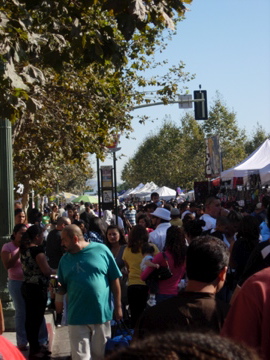
Oakland celebrates with a family-oriented daytime street fair on the Sunday preceding the holiday, this year November 1. While drawing a healthy cross-section of the city’s ever-diverse population, the event is mostly representative of contemporary Mexican and Latin culture in the Bay Area. Powerhouse Spanish radio stations, La Raza and La Preciosa, set up stages on opposite ends of the festival and vie for on-lookers. Local taquerias set up stands that pump out carne asada smoke, while DIY vendors push helado carts and set up raspado stands. Women hawkers cry, “Churros, Churros, Churros!” while others wrap still-steaming elotes in foil. Local businesses abut booths with corporate superpowers like Safeway, while non-profits erect altars next to those of neighborhood school kids. Dancers decked out in Aztec garb (the feather- and skull-adorned headdresses are bad-ass) break into spontaneous drum-infused performances, and there’s more men in cowboy hats and little girls in mini-skirts than you can count.

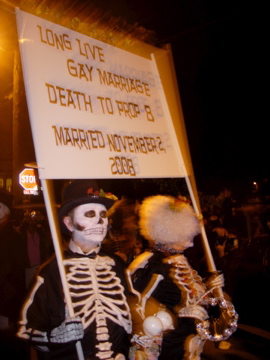
DSC_0381On November 2, San Francisco holds an evening procession that a jaded friend of mine has dubbed “Gringos Gone Wild.” True, the participants are largely not of Hispanic decent and, boy, do they get down. People dress up in calavera face paint and elaborate Tim-Burton-esque costumes that I suspect derive from Victorian Catrina dolls. A modest group of Aztec dancers leads the procession, which then follows with revelers of the purely San Franciscan variety: costumed people with politicized signs, curious interpretive dancers, bicycle-powered floats, and a whole lotta candle-clutching white folks. The procession ends at a public park filled with some seriously artistic altars—this year, an anatomical heart suspended by red nerves, a papier-mache carniceria, a parlor scene that looked like the inside of Edward Gorey’s head.
I can see how people get down on San Francisco’s Dia de Los Muertos celebration for not being authentico; I understand why others deem Oakland’s as boring and not creative enough. But isn’t that just an extension of the Oakland-SF rivalry, the cities’ differences demonstrated through the observance of another culture’s holiday?

I’m an Oakland girl, so I’m partial to an event where I run into about a dozen people I know. And if nothing else, the Fruitvale festival is thrilling for the mere fact that Oakland manages to hold a peaceful public festival (I remember seeing stray post-Festival-At-The-Lake rioters pass by the bottom of my block as a kid—that was the end of that neighborhood event). Events like the Dia de los Muertos celebration remind me why I love my hometown—though I never really forget.

DSCN3907At the same time, the Mission procession captures so much of San Francisco’s cultural landscape. Just when you get disheartened, want to write the whole place off as over-priced and gentrified, the city comes through with something insanely creative or beautiful. Despite the changing demographics, beneath the paling population and depressing socioeconomics, San Francisco’s still a city with soul.
And at the center of both of these celebrations is the fact that they don’t derive from, well, here. They aren’t American, have been brought over by immigrants and subsequently Americanized. Some shout cultural appropriation, and, sure, these festivities are a far cry from the all-night graveside vigils I attended last year in Tzintzuntzan. But, at the core of these modern interpretations, both stay true to the fundamentally celebratory Aztec approach of the holiday. And if that’s not survival, I don’t know what is.

Lisa, the Beautiful

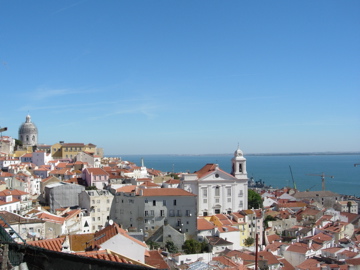
DSCN3627Tiles and terraces and tired-ass legs: it´s my third day in Lisbon/Lisboa/Lisa, and she´s working her charm on me.
Portugal´s an intriguing country: it feels overlooked, almost forgotten to me, hanging on to the edge of Iberia, of Europe, like fluttering laundry. I never hear much about it, tucked away down there, in the shadow of both Spain and its dominating former colony. (Prior to my arrival, my only two words of Portuguese were Brazilian: “caçhaca” and “caipirinha.”) A small country, it´s hemorrhaged emigrants for decades, leaving the country a little empty and a little lonely. It´s bittersweet, and so far, I love it.

I´ve spent my days in Lisbon rather lazily, sleeping late, hanging out with my Couchsurfing hosts, lunching and napping and strolling slowly. It feels like a city to be taken in slowly, to be savored, and I´m doing my best to oblige.

My hosts tell me that Lisbon is the most underrated city in Europe; they´ve seen more than I have, but I´m going to venture to agree. They live in a comfortable flat with smooth hardwood floors and modern appliances, in the heart of the city—“In no other city in Europe,” my host told me thoughtfully, “would this be possible.” Rents are cheap, and abandoned buildings with boarded-up windows and cracked tiles line streets that in Paris or Barcelona would be bustling, booming, and demanding rents at least twice as high.

Lisbon is a humble city. Though complete with all the usual big-city stuff—busy metro stations and graffiti and honking snares of traffic—there´s a certain quiet underneath it all, a kind of yearning in the gleaming stone streets, the zig-zag of rust-colored tiled roofs. She´s filled with a brave nostalgia, this Lisa, with the rattle of yellow street cars that young boys cling to the sides of, hooting and yelling, sharp limbs hanging in a bravado that feels old, a relic from another time. Her seven hills rise and fall sharply, like breath; steps are carved into the sidewalk. The hills don´t slope gradually but seem too reach, almost hungrily, for the water, too bright and sparkling for blue eyes to bear.

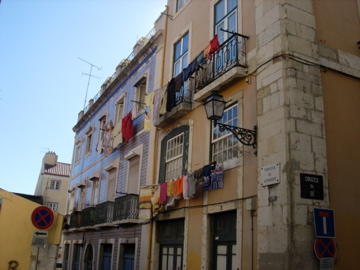
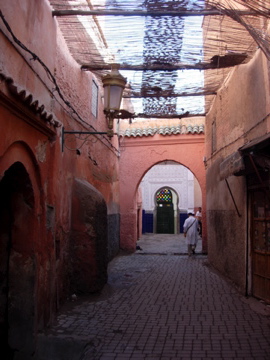
DSCN3639Today I wandered around Alfama, the old Moorish neighborhood, a European version of a medina—tight alleys that twist and angle and dead-end into the sides of terracotta buildings dripping with flowers and bushes and colorful plastic streamers. The streets are so narrow that old women can lean their full arms against the wrought-iron railings and gossip between the buildings, between the lines of laundry, laughing and shouting in their flower-patterned aprons. In little squares, trees jumble the black and tan stones that have been worn smooth—by Romans and Moors and Crusaders, by my thin-soled Toms that make me slip from time to time, lose myself amid it all.
It sounds sentimental, and it kind of is. It´s a city like that—with soul. And tonight, I´ll go to hear the sound of its melancholy mourning, its bittersweet longing, its Fado. I think Lisa´s prepared me well.

Marrakesh, You Broke Me Down

DSCN3558It was a long, hard, hot last day in Morocco, in Marrakesh, the pounding heart of the country´s tourism industry.
As I was venturing down the Atlantic Coast, south of Agadir and thoroughly ¨off the beaten path,¨ I was giving some serious thought to ditching out on my flight back into Europe, and spending the rest of my two weeks in Morocco. There was certainly enough to keep me occupied—I didn´t even make it to the Sahara!—and I felt like I´d hit my groove with Morocco. I was getting skilled at traversing the streets, haggling for taxis; I was in love with fresh-squeezed orange juice and mint tea; even my French was improving. We were vibing, Morocco and I, and it seemed a shame to cut out so soon.

But the prospect of Portugal, Western Europe´s ¨forgotten¨ country,  combined with a pre-purchased flight and a chance to wash my blue jeans and ditch that filthy blue scarf won out. I arrived in Marrakesh with just one day to soak in the crowning jewel of Morocco´s imperial cities, and its exotic lure.

I´d heard horror stories—travelers and Moroccans alike warned me that Marrakesh´s touts were the toughest, the street harassment the ugliest. I got off the bus from Tiznit suited up in my thickest armor, ready to do battle with a mean look and a linguistic sword of two words: la shokran, no thank you.

The problem with Marrakesh, or my problem with it, is that people like to touch. I don´t. As my grandma said, I´m ¨a real touch-me-not.¨ The men in Marrakesh really see no problem with poking you, grabbing your arm, pressing their bodies against yours, literally tugging you this way and that. I think it´s largely a cultural difference; Moroccans touch a lot, are extremely affectionate with one another, and I don´t think they view touching as the same kind of violation as Americans do. As in, get-your-fucking-hands-off-me, or touch-me-one-more-time-and-I-swear-to-God-I´ll-drop-your-ass-don´t-even-think-I´m-playing.

Not that I ever said either of those. But I thought it. And I suspect the wild-eyed, shocked look I gave the dudes who put their hands on me communicated well my very visceral reaction to unwanted contact. They, in turn, almost seemed offended that I was offended, got really defensive. It was one of those tough cultural clashes, and I refuse to admit I was in the wrong. Maybe just the different.

But there was, I have to admit, a kind of magic to the city. I always feel lame saying that about a place that´s really hyped up (as in, yes, Paris is all that). I was intermittently in awe of the city, and frustrated beyond belief.

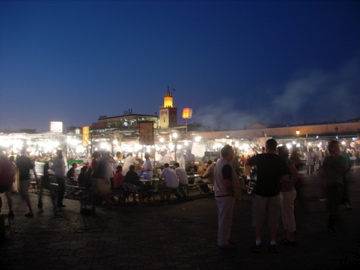
I stayed right near Djemaa el Fna, the open-air market of insanity that really was everything it was cracked up to be. Imagine a county fair. Now add throbbing drums and shrill pipes; snake charmers and witch doctors; wrapped women hunched on plastic stools, ready to ready fortunes and paint henna. Picture billows of meat smoke, the glare of a thousand gas lamps on a thousand white tarps;  see gleaming date stands and pyramided orange juice carts; beggars hands and child shoe-shiners. Hear the zoom and honk of motorbikes; feel the buzz of bodies weaving around one another. Wrap it all in a breeze that comes eastward and touches everything, envelops it in one big ball of electric humanity, shakes it up furiously, like a snow globe—and you´re somewhere close.

I meant to treat myself to a fancy last dinner, but when I got to the white-linen restaurant, it felt sterile. I headed down to Djemaa el Fna, stopping to slurp  snails at a food stall along the way. I dined on a wooden bench under the white tarps of one of the skewer stalls, watching the multi-lingual touts and hustlers do their business, sometimes rudely, but mostly with a charming penache that was hard to refuse. The breeze blew, and I felt in love with the night, the place, the country.

I thought I´d seal the deal with some chocolate ice-cream. I made my way across the square, nimbly traversing the crowds, not responding to the barrage of ¨bonjours,¨eyes on the prize.

I heard a loud voice rumble, ¨Hey sweetie!¨ Though the crowd was thick, I had that prickly back-of-the-neck feeling that the call was directed at me. I didn´t look up, kept walking. ¨Hey sweetcakes!¨ it yelled again. Still, I kept moving. ¨It´s okay,¨ the voice hollered, ¨I like small boobies.¨

I whipped my head around and saw a reddened face laughing, jowls shaking in a grotesque mask of amusement. Other faces were turned to look at me and my shawl-covered chest (I mean, come on, a B-cup is not that small). My cheeks flushed; I muttered ¨piece of shit¨and stormed away, trying to lose myself in the throngs.

The face hadn´t been a teenager´s, but a grown man´s, which angered me more. It had seemed quite pleased that it had humiliated me, that other people had noticed and looked. I felt the blood in my body burning with frustration.

A well-dressed man sidled up next to me, holding a clip-board and a perky straw hat. I looked forward, didn´t acknowledge him.

¨That man,¨ he said to me, ¨you can´t get angry. You have to just accept and—¨ out of the corner of my eye, I saw him make a brushing-off gesture.

I sighed, not entirely sure of this man´s intentions, and not in the mood to risk it. ¨I know,¨ I respond. ¨But sometimes I get tired of accepting, of always being the one to have to accept.¨ I could feel hot tears in the corners of my eyes.

¨Where are you from?¨ the man asked.

I eyed him cautiously, as the question was usually a prelude to some kind of hustle. ¨The US.¨

¨Ah, welcome,¨ he nodded thoughtfully. He leaned forward, said softly, ¨Of all the things you remember, of all the things you take home, don´t take that.¨ He nodded again. ¨I´m sorry.¨ He paused, let the words and the sentiment linger there in the charged air for a moment, turned and was gone, swallowed into the crowd.

It was all a little too much for me, the intensity of extremes—the degradation, the laughing face, the twisted soul-sickness that makes someone humiliate another person—and now, such thoughtful tenderness. All of it from strangers, all of it strange, somehow finding me in the immensity of the crowd. The whole day had felt like that, a tugging between two places, between two sentiments, of both loving and hating a place.

DSCN3551I was exhausted. I decided not to fight it, not to try to be tough anymore. I went back to my hotel room and sobbed, for the overwhelming kindness and cruelness of it all. For being a woman, for being a person, in a place, a world, that is simultaneously horrifying and beautiful.
Legzira Love

DSCN3456I think I may have just found the most beautiful beach in the world.
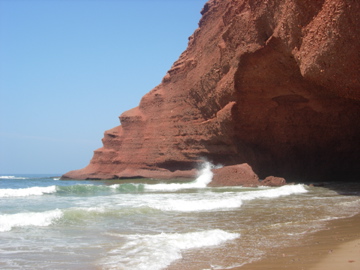
Yes, it’s a sweeping statement, and no, I’m not a beach afficionado. But if red cliffs diving into pebbled sand coves count for anything; if lazy waves crashing against sandstone arches score points; if a tourist to local fishman/swooping seagull/stray dog/donkey (hey, it’s still Morocco) ratio of 1:5 means much—if these are the elements that create that “paradise” thing all the guidebooks talk about, well then, I just spent the night there. And slept with the windows open to the ocean. Cause why not, you know?

Legzira Plage is pretty incognito—it warrants not more than a paragraph in my guidebook and a weathered-beaten, graffitied roadside sign along the pretty two-lane highway connecting Tiznit, Mirleft and Sidi Ifni. Down Morocco’s Atlantic coastline, just before the Western Sahara and a disputed border, the area as a whole doesn’t attract the hordes that the country’s other wonders do—which is why it attracted me. A near-deserted beach away from any big city or pushy tout? I’m in.

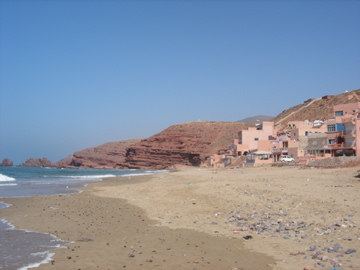
I took the local bus from Mirleft, got off at the faded cement block sign at the access road, and took the 20 minute walk down to the beach, a lazy slope washed in ocean breezes. The scenery revealed itself like a striptease: a sweeping hill view, a peak of ocean, the sound of waves, the pink edge of a pink building. I turned into a small dirt parking lot, and almost started laughing—it was so beautiful, it was almost obscene.

DSCN3464There were half-a-dozen pink buildings cascading down the cliff to the beach. Sweaty and shoulders aching, I set my backpack down in a cheap but cheerful hotel room with windows that flung open to the ocean. (Now thoroughly “off the beaten path,” the room costed only a little more than my smelly toilet- and shower-less hole in Essaouira.) I kicked off my shoes, grabbed my camera, and went for a walk.
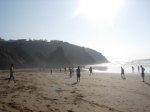
I’m not much of a shutterbug, but I exhausted both my camera battery and memory card. I walked for over an hour; each cove was more secluded and empty than the last. On the first few beaches, I passed a small group of teenagers playing soccer, a fisherman, and a handful of sun-bathing tourists, many of them Moroccan (tell-tale sign: the lady’s swimming fully clothed). We “bonjour”ed politely. I rounded a gently jutting set of red rocks, and was alone. I closed my eyes, and let out a long exhale.

I’ve really been liking Morocco, but I can’t tell you how good it felt to be alone, away from any non-human sound—just me and the seagulls, you know? Later, I stripped down to my swim suit, and wave-hopped and sun-bathed without concern for modesty. I soaked up much-needed sun, vitamin D sparking wildly through my body. I didn’t worry about, well, anything.

I had a simple dinner of grilled fish (yes, caught that afternoon) and pommes frites, washed down by that killer mint tea. The hotel’s patio was sparsely populated with about a dozen dining guests. If there were any less people, I realized, it would have felt creepy. Like The Shining or something.

The hotel only ran electricity for prime hours during the evening, so I read by candlelight for awhile before crashing out. It was warm enough, so I left the windows open and slept to sound of the waves, to the smell of salt.

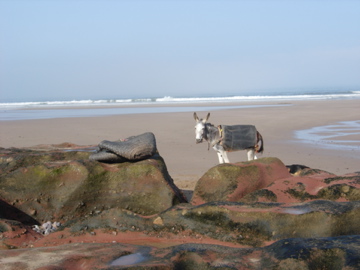
Donkey on the beach!

Donkey on the beach!

In the morning, the fog outside the window was thick. The tide was so far out that a previously offshore crag of rocks connected to the beach. I sipped my freshly squeezed orange juice and nibbled on my still-warm bread breakfast, and watched the fishmen trod out for the day, the sifters search out clams and mussels (I think) in the tide pools. A waiting donkey with two empty sacks on its side bickered with a yapping stray dog with a wobbly magazine of stretched-out nipples. The fog thinned, turned to a fine mist, and slowly, so faintly I could hardly notice, was gone.

I don’t know why Legzira Plage is so under-visited, under-promoted and unknown. But I’m not complaining. My camera battery may have konked out, but my personal battery is fully recharged. Just in time for Marrakech.

The Best Tour Guides in Mirleft

DSCN3389Yesterday I found the best 3 tour guides in town. No, they weren’t the touts that surrounded me shouting in 3 different languages and tugging me in 12 different directions the second I stepped out of the grand taxi from Tiznit. They were a rag-tag group of stray dogs that led me around the Berber beach town of Mirleft for over 2 hours.
We met outside my hotel, Hotel Atlas, the cleanest, cutest and most well equipped of my trip thus far (hot water, flushing toilets AND toilet paper—hot damn!). The leader, a German Sheppard looking female with a mangled hind leg and a black patch of furless scar tissue, greeted me as joyously as an old friend. I politely explained that I didn’t have any food, but she didn’t seem to mind. I’m not as worn out by the street dogs as everyone else in town is; I didn’t shoo them away, just kind of smiled and kept walking down the dirt main road toward the beach.

The dog immediately took the role of loyal and ardent defender, barking and growling at every scooter and donkey that passed, as well as a couple old men and frightened schoolgirls. I smiled and shrugged at them; we exchanged chuckles.

Along our pebbled-path way, we picked up a couple other boney-ribbed dogs who displayed proper supplication to the leader. I didn’t know where I was going other than coastward; Mirleft is too small to warrant a map in my guidebook. So the dogs would trot off ahead of me, sniffing through refuse and gnawing on plastic bottles. When we’d reach a crossroads, they’d pause and wait for me to catch up before continuing waggingily along whatever way they thought was best. Who was I not to follow? They knew the town better than me, and I was grateful for the speechless company.

DSCN3394They led me down a steep flight of cliffside stairs into a cove of jagged rocks and gleaming sand. Shirtless local boys were playing afternoon soccer and a couple tourists sat out on blankets. My guides dashed off to leap in the waves; I rolled up my jeans and waded behind them.
I wanted to tip them—I certainly would be expected to if they were people—but thought they’d be terribly uninterested in my pocket full of coins. I rustled some stale crackers out of my bag, and they chewed them gratefully. I sat in the sand and watched them trot off, skinny and mangled and more-or-less happy.

The Case for Casa

2501980441_83e5e9331eI didn’t plan on spending a night in Casablanca, but my bowels had other ideas.

Traveler’s diarrhoea—whatever, it happens; I’ll spare you the sordid details. Let’s just say that dehydration, gurgling cramps and lack of sleep, coupled with the stifling heat and constricted leg room of the 3-hour train ride from Meknes (this ain’t no Eurostar), were sufficient impetus to delay my connecting 7-hour bus ride in favor of a bed and flushing toilet. And so I ended up spending a night and morning in “the least Moroccan” city in Morocco, famous more for old Hollywood than medinas.

Most travelers and guidebooks will advise the eager tourist against anything more than lay-overs in what is arguably Morocco’s most well-known city. It’s too Westernized, they say, not exotic enough—full of all the traffic and shiny buildings and business men of home. It’s not the real Morocco, the cumin-scented crumbling alleyways of your fantasies.

During my lovely 2-day London lay-over, I read a Guardian travel article about Casablanca that my host had thoughtfully set aside for me. The author argued that Casablanca was just as much the real Morocco as anywhere else—and lacked the hassles and over-tourism of many of the country’s more popular destinations. I nibbled my morning toast and read with skepticism—sounded like a writer working a little too hard for an angle, to say something fresh and different.

Well, I’ll be god-damned if he wasn’t right.

Now, don’t get all excited. It’s true that Casablanca is not a beautiful or artistically cultured city; it doesn’t “boast” a lot of sights and its stray-cat- and donkey-less medina feels more like an outdoor strip mall than a relic of ancient urbanity. But Casablanca reveals a different side of Morocco, the struggles and tensions on the other end of the booming economy and rapidly growing tourism. I’m grateful for my extended stop-over in the city; without it, I don’t think I’d have gotten as full a view of the country.

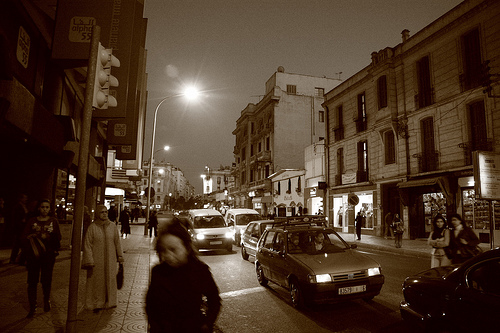
Casablanca’s streets are filled with a different kind of energy—people swarming rhythmically and cross-walk-less across vast boulevards of sleek new cars and gasping palm trees. French business men and snappily dressed black Africans drop coins into the gnarled cupped palms of beggars. Less fortunate immigrants walk slowly along the sidewalks, displaying goods: tissues, random electronics, watches; they have thin arms, impossibly high cheekbones and a kind of dignified desperation. Young girls wear jellabas like bathrobes, carelessly; just as often, they sport bare arms and skinny jeans. The air is thick with honking horns, the streets grimy and littered. Colonial building facades look as though they’ve grown tired of being elegant; beside them, mirrored-glass new construction shoots into the sky arrogantly.

Despite an thriving economy—it grew nearly 6 percent in 2007—around 19 percent of the Moroccan population lives under the poverty line; no where is this more evident than in Casablanca. On the train ride in, we passed through scores of squatter settlements, sagging structures whose tin roofs were anchored with old tires and heavy rocks, sometimes a satellite dish. In direct contrast is the oceanside Hassan II Mosque, a half-billion-dollar monument to opulence and Islam that would have been offensive if it weren’t so damn impressive.  Since the 80s, Casablanca has also been the site of political uprisings, brutal repressions and suicide bombings.

You get a sense of this all walking the alternatingly busted-up and newly paved streets of the city—or slowly sipping mint tea at the cafes, what my sore stomach called for. I sat and watched the city, its people, pass; it fascinated me past my exhaustation and illness. In exchange, the city largely ignored me; I was just another poorly dressed, sallowed foreigner, totally uninteresting.

Casablanca’s not the kind of place to top itineraries. It’s not for the tourist who gushes glowingly about the authenticity of the Fez medina, or the simple quiantness of mountain village folk. It’s not for those seeking out some preconceived vision of exotism, doesn’t even try to live up to any stereotypes. It’s not for people looking to “get away” from it all. But if you wanna get a glimpse of what’s going on behind the carpet shops and faux guides, if you’re interested in seeing all of a country poised forever at a  crossroads of cultures and continents, if you’re traveling and not vacationing, I’d give it a look. Just be sure to buy some tissue along the way; you’ll need it in the bathrooms.


Lauren Quinn is a writer and traveler currently living in Hanoi. Lonely Girl Travels was a blog of her sola travels and expat living from 2009 to 2012. She resides elsewhere on the internet now.

Join 490 other subscribers

Buy This Sh#t

Categories