
One of Aly's photos from the Burlington Hotel
It happened like this:
Making the rounds last Friday at the Art Murmur, I came across the photos of a friend of mine, Aly Su Borst. They were pretty bad-ass: a series of self-portraits set in some run-down opulence that got my spooky/awesome sensors spiked. I took some photos on my phone. At home the next day, I showed my roommate, “Hey, Luke, check out Aly’s photos.”
“Oh, rad, Port Costa.”
“Where’s that?”
That’s how I found out about the overnight destination all the local dirtbags have apparently been partying it up in for decades. And like most things, I’ve found out just in the nick of time: the reputedly haunted, ramshackle old bordello/hotel that serves as the heart of the 250-person town of Port Costa (that despite being 30 miles from my house, I’d never heard of) has plans to spiffy itself up, and recently received coverage by the San Francisco Chronicle. I knew no time could be wasted—I booked a room for this Saturday night. It’ll be a Valentine’s weekend overnight the way I like it: full of bats, bedbugs, dive bar denizens and rock n roll.
The Chronicle‘s article made the Burlington Hotel sound like the very definition of “hidden gem”—not in the Tuscan villa sense of the word, but in the gritty, visceral sense—which is to say, the sense I dig the most. Whether it was in fact an old whorehouse, and whether it is indeed haunted by the ghosts of prostitutes and shipyard workers, one thing seems for sure: the Burlington Hotel is a relic of the Old West California, the one Jack Black captured in the book You Can’t Win—the one that’s all but gone amid the Botox and SUVs of Southern California, and the Blue Priuses and Tibetan prayer flags of Northern California. Which is why I want in.
It won’t be a relaxing, rejuvenating or romantic getaway. Its Yelp reviews reveal as much: “dirty,” “bad-ass,” “like a horror movie,” “whore-tel.” One person laments that it’s no longer the all-night rager spot it had been in previous years (frequented by the likes of none other than the East Bay Rats—nuff said). A raucous bar next door constitutes much of the clientele, including “bikers, transients, nazi crack addicts, and drifters. maybe tourists are in there somewhere, too.” (Really, there’s some effing gems on the Yelp page, read through that shit.)
Already pretty convinced, I came home from work the next night and found Liz and Melissa on the couch. “You guys ever heard of the Burlington Hotel?” They turned their heads slowly towards me. “Oh. Dude.”
They swapped debaucherous stories from their hard-partying youth—Liz being haunted in Room K, Melissa’s heshen friends getting permanently 86-ed (which apparently is saying a whole lot). “Make sure,” Liz advised, “that you bring your own sheets. Bedbug city, yo.”
I called to make a reservation, which wasn’t quite as difficult as the Chronicle article made it out to be. After a long succession of rings, someone picked up; muffled and scratchy, he told me they weren’t quite open yet, but to call back in a half-hour, and they’d be ready to “rock n roll.” I did, and they were. Butt rock blared in the background. All the rooms I’d been advised were the best were, of course, full, but I did get in on the “special” (Valentine’s Day special? probably not): the room and 2 surf-and-turf dinners for $99 total. Now that’s my kind of overnight.
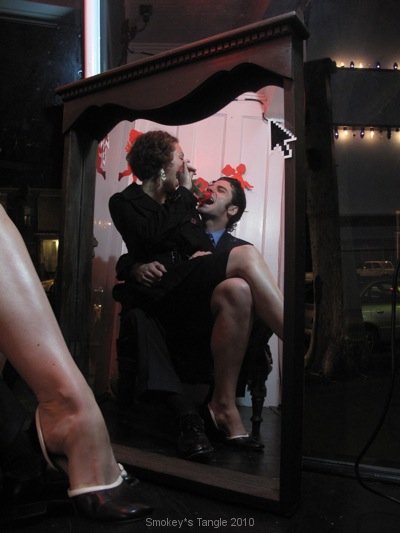
Ridiculous photo from the Smokey's Tangle V-Day Photo Booth, February's Art Murmur
So sadly, since the Chronicle recently did a piece on the hotel, I’m gonna have to dig a little deeper to a) out-do their article, and b) find the right publication for it. The good news is that my partner in crime is bringing along his fancy camera, so the photos, well, they’re going to kill. Hopefully not literally.

















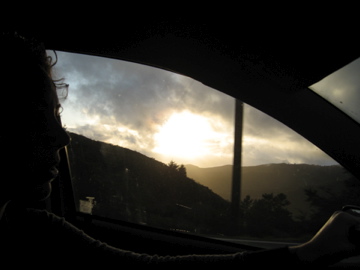
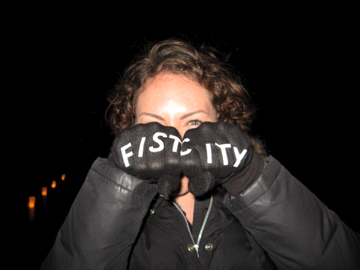


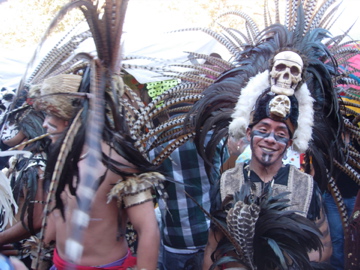 It’s not Mexican Halloween. Or Northern Californian Halloween. It’s Dia de los Muertos, and it’s everyone’s holiday now.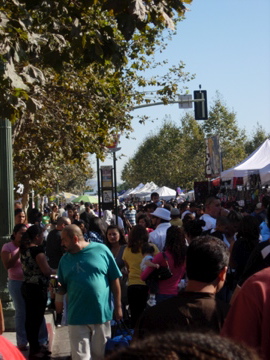
 On November 2, San Francisco holds an evening procession that a jaded friend of mine has dubbed “Gringos Gone Wild.” True, the participants are largely not of Hispanic decent and, boy, do they get down. People dress up in calavera face paint and elaborate Tim-Burton-esque costumes that I suspect derive from Victorian Catrina dolls. A modest group of Aztec dancers leads the procession, which then follows with revelers of the purely San Franciscan variety: costumed people with politicized signs, curious interpretive dancers, bicycle-powered floats, and a whole lotta candle-clutching white folks. The procession ends at a public park filled with some seriously artistic altars—this year, an anatomical heart suspended by red nerves, a papier-mache carniceria, a parlor scene that looked like the inside of Edward Gorey’s head.
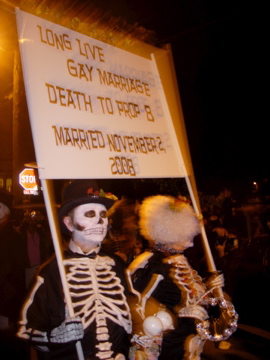 At the same time, the Mission procession captures so much of San Francisco’s cultural landscape. Just when you get disheartened, want to write the whole place off as over-priced and gentrified, the city comes through with something insanely creative or beautiful. Despite the changing demographics, beneath the paling population and depressing socioeconomics, San Francisco’s still a city with soul.

 Lonely Girl Travels
Recent Comments