Posts Tagged 'culture shock'


The Young Leading The Blind: Phnom Penh Image

This is the image I haven’t been able to get out of my head:

There’s an instrument called tro. It’s kind of like a violin. It’s a traditional Khmer instrument and you hold it low, down by its belly, and you work the strings with your other hand, across your chest or near your neck, like you’re sawing something.

There’s a whole history to it—it being destroyed during the Khmer Rouge time, famous musicians being killed, one surviving, unearthing the one he’d buried in the field before he’d been evacuated, it being one of the only tros to survive, the musician later founding a non-profit to teach the next generation, pass on what was nearly gone and almost died.

There’s a lot of stories like that in Cambodia; you hear so many you start to confuse them, get the facts mixed up and the characters wrong, until it becomes one big story that no one, it seems, can keep straight. But somehow blind men were involved in this one—were they blinded during the KR or later by landmines? Or were they born that way? I never figured that part out. But there were blind men that played the tro, that much I know, and you’d see them in the streets of Phnom Penh, and that’s the image I can’t get out of my head.

The tro players would always be older, battered-looking—the old generation, the 40+ers that had lived through the KR. They’d be walking as they played, being led around through the chaos of the motorbikes and tuk-tuks and vendors on the sidewalk and the busted-up places that were supposed to be sidewalks but were really just rubble—being led by a child, 10 or 11 or so, what was called “the new generation.” The kid would have their palm open, upturned, begging for the musician whose hands were occupied, seeing for eyes that were clouded by a perpetual mist.

But that wasn’t the weird part, the part that has lodged itself in my mind and keeps reappearing. The thing I keep thinking about is the string. There’d be a string tied around the tro player’s waist, and the kid would be holding the string, leading the blind old man like a pet through the streets—though you didn’t know who was whose pet, and how much of it was for show, for pity, for dollars.

The young leading the blind: it would have been a metaphor anywhere else. But this was Cambodia, Phnom Penh, so it was reality, just another scene on the street.

Gabriel Garcia Marquez hated the term “magical realism.” It was, to him, inaccurate, a term applied by outsiders, that dripped with misunderstanding and European paternalism. To him, what he wrote was realism, plain and simple—the so-called “magical” part was just a part of reality for Latin Americans, or Colombians at least.

Why do I think of this now? Why can’t I get the image of a lassoed blind man playing a near-extinct instrument out of my mind? Why did the image only begin recurring once I’d left, was in Laos, and why did I keep thinking of it and thinking of it, once I was back in the States?

Why didn’t it strike me as so bizarre in the moment?—not necessarily normal, in the sense of normal that I know, but as just another happening on the sidewalk, another sight to block out, filter out, shake my head to and keep my eyes straight and mutter “ot tey” to.

I’ve been trying to explain Cambodia and Phnom Penh to people. They ask me how my trip was, how my time there was, and my immediate answer—and the one that seems the truest—is, “Bizarre.” But I can’t really explain why it was bizarre, make any insightful statements or overarching cultural observations. All I can do is present a handful of images, anecdotes, the way they were presented to me—at random, shoved in my face so that all I could do was block them out, file them away to think about later and still not understand: children huffing from plastic bags, and monkeys running across the telephone wires, and the cross and uncross of the karaoke girls’ legs. The tro players and their milky eyes, the children and their upturned palms—but most of all the string.

Didn't take a picture of the tro players. Cause it seemed wrong. But here's another thing that didn't seem so weird at the time: typical sign outside a nightclub.

10 Thoughts on Being Back in the US

1. Riding in my dad’s truck, MLK:
“So what does it feel like to be back?”
Look out the window, lines of lanes and sidewalk. “Everything feels really sterile. And clean.”
“Sterile and clean? Not usually words associated with Oakland.”
Laugh. “Yeah, I guess not.”

Empty

2. Running around the lake, joggers in sweat clothes:
Everyone looks really healthy here—big and robust, cheeks flushed.

3. Whole Foods, walk around for an hour, confused—pick up food, put it back down:
How do you shop in a grocery store? Everything looks plastic.

4. Winter-like storm, long pants and a jacket:
Everyone else may be annoyed, but I’m tickled to death.

5. Waiting to make left turn, watching the cars:
The US feels like a video game, some kind of old-school Atari: little boxes moving through space. The object of the game is to stay between the lines, stay in the lanes, walk on the sidewalk, put trash in the bin…

6. Rapture billboards:
Why?

7. Waiting to meet Nhu and Jacobo outside Bette’s Cafe, watching family:
“But I’m huuuun-greee.”
“Well, we have to wait.”
“But I don’t wa-nnnna.”
American children are allowed to be really obnoxious.

8. Wine meeting for work, varietal characteristics and spit buckets:
This is my job. This is silly.

9. Drive to meeting, park; drive to yoga, park; drive to cafe, park:
My life feels like a video game. I’m not sure what the object is.

10. Waiting at stoplight. Car beside me: bass bumping, boy leaning out of the open window, shirt half-off, arms raised, dancing:
There is nothing, nothing in the world like African-American culture.

Adventures in Vietnamese Bureaucracy: Dong Hoi Visa Shenanigans

I didn't take many pictures amid all this. So here's a boat.

Blond and sun-crisp, with a Marlon Brandon mouth and board shorts, Ben was the first Westerner I’d seen in Dong Hoi.

He lit a cigarette and sighed as his driver secured my backpack to the roof of the SUV. “Where are you from in the States?”

“California.”

“Ah, well,” he exhaled an agitated puff, “this is like the Alabama of Vietnam.”

I’d only spent 20 hours in Dong Hoi, so I wasn’t exactly in the position to agree or disagree. But I could verify that during those hours, I hadn’t seen any other foreigners. I hadn’t been able to communicate with anyone, hadn’t seen any English or any Western food, and I certainly hadn’t seen the travel agency I so desperately needed.

My first clue that I was officially off the beaten path was when the minivan from Dong Ha had more or less slid the door open and pushed me out onto the main strip of Dong Hoi, the tout smiling and yelling back at me, “Dong Hoi.”

I’d been lured to this part of the country by the Phong Nha Farmstay, an independent, family-run homestay that was also one of the few outfitters to run tours to the newly opened Paradise Cave.

But what I needed first was a travel agency—the kind I’d see all over the other places I’d been in the country, English-language signs advertising tourism services. I needed a visa extension: my 3-month, multiple-entry one was due to expire just 4 days before I fly out. While in Laos, I’d spent a good hour researching extensions, grace periods, whether I should just apply for a new visa or try to extend the one I have. I’d come up with zero in the way of solid, conclusive information. You could, it was rumored, overstay by 48 hours with no penalty. After that? Both Google and the Vietnamese Immigration website were wholly unhelpful. My plan was: get to Vietnam, find a travel agency in Dong Hoi, drop my passport there while I went to the farmstay for four days, pick up my passport when I returned to Dong Hoi for my bus to Hanoi. It wasn’t air-tight, but it was the best I could devise.

But after circling a dusky Dong Hoi a few times, I determined that there were no travel agencies. Because there were no Western tourists. I picked up a SIM card and called Ben, from the Phong Nha Farmstay.

“Listen,” Ben told me after I explained my situation, “I’ve got a guy in Dong Hoi.” He gave me the info of a man named Hung. After an ensuing half-dozen phone calls triangulating between Ben, Hung and myself, I ended up at Hung’s office the next morning, 2km down the main highway, a small room crammed with computers and tourism posters—in Vietnamese.

“Why didn’t you just get another visa?” Hung drilled me.

“Because I didn’t know I needed to.”

“Why did you wait so long to apply for an extension?”

“Because I couldn’t find any information on whether I had to extend it or not.”

Hung sighed. “This will be a problem.” He lectured me on much easier it would have been to just get a new visa while I was in Laos. I nodded, not bothering to explain the obscurity of Vietnamese bureaucracy.

He made a phone call; I sipped a glass on tea. He wheeled back over to me, giving a grave-faced and round-about explanation for why I couldn’t apply for a normal extension, why I had to have a rush, one-day extension. Which cost $100.

At which point Ben called me. “How’s it going with the visa there?”

I explained the situation. He sighed. “Let me talk to Hung.” The phone passed back and forth a few times. “Okay, listen,” Ben told me, “what Hung’s telling me is that you can’t leave your passport in Dong Hoi, because if the extension gets denied, we could possibly get fined for having someone illegal at the farmstay.” I chuckled at the idea of myself being illegal. “So it looks like you’ve got to do the rush, sorry bout that.”

After the initial wave of nausea, I succumbed to the idea that I’d have to part with $100. Live and learn—and blog about it so that other poor saps can learn too. Hung told me he’d call when it was done, around 3 or 4 o’clock.

I commenced to wander around the sweltering town of Dong Hoi, the faded colonial streets, the floating restaurants and wooden fishing boats, waving at the boys on bicycles that called out “hello” at me. I’d retreated to the lobby of my hotel—where I’d been the only guest—when Hung called. “There’s a problem with your visa. You didn’t tell me you have a business visa.”

I let out a laugh. “Well, I didn’t know I had one. I applied for a tourist visa.”

“The Immigration office says they need a health check and a letter from your employer to extend your visa.”

“But I don’t have an employer. I don’t actually work in Vietnam. It’s a mistake.”

“Then you’ll have to go to Hanoi. Immigration here can’t do it.”

That was about the time Ben showed up, an SUV packed with family and supplies he’d picked up in Hue. “Well shit,” he said, “let’s drive over to Hung’s.”

There aren’t hardly any Westerners in this province, Ben explained, so they aren’t used to dealing with tourists. The Phong Nha Cave might be the biggest tourist attraction in Vietnam, but that was only for Vietnamese. Westerners are rare, and everything having to do with Westerners exceedingly difficult.

On the sidewalk in front of Hung’s office, Hung shook his head and handed my money back to me. We stood around and ate ice-cream from the corner store, brain-storming.

“I mean, fuck,” Ben said, “you could just overstay.”

His Vietnamese wife Vik shook her head. “No. Better to do it the legal way.”

We discussed options. I could take a bus to Hanoi that night, and get it sorted out there. I could take a bus to Hue, hoping I could sort it out there, then take a bus back to the farmstay. Or I could say fuck it.

“I mean, what’s the worst that’ll happen?” I asked. “Will they arrest me or detain me?”

“No, no. I think officially, they charge you $25 a day. But a mate of mine overstayed and they just waved him through. Worst, I say, is they put something in your passport saying you can’t come back for three years.”

I shrugged. “I can live with that.”

I had something less than a chuckle when I imagined myself actually being an illegal in Vietnam. But after all the day’s shenanigans, I really could live with it..

Blessing of String and Sticky Rice: Day One in Ban Natane

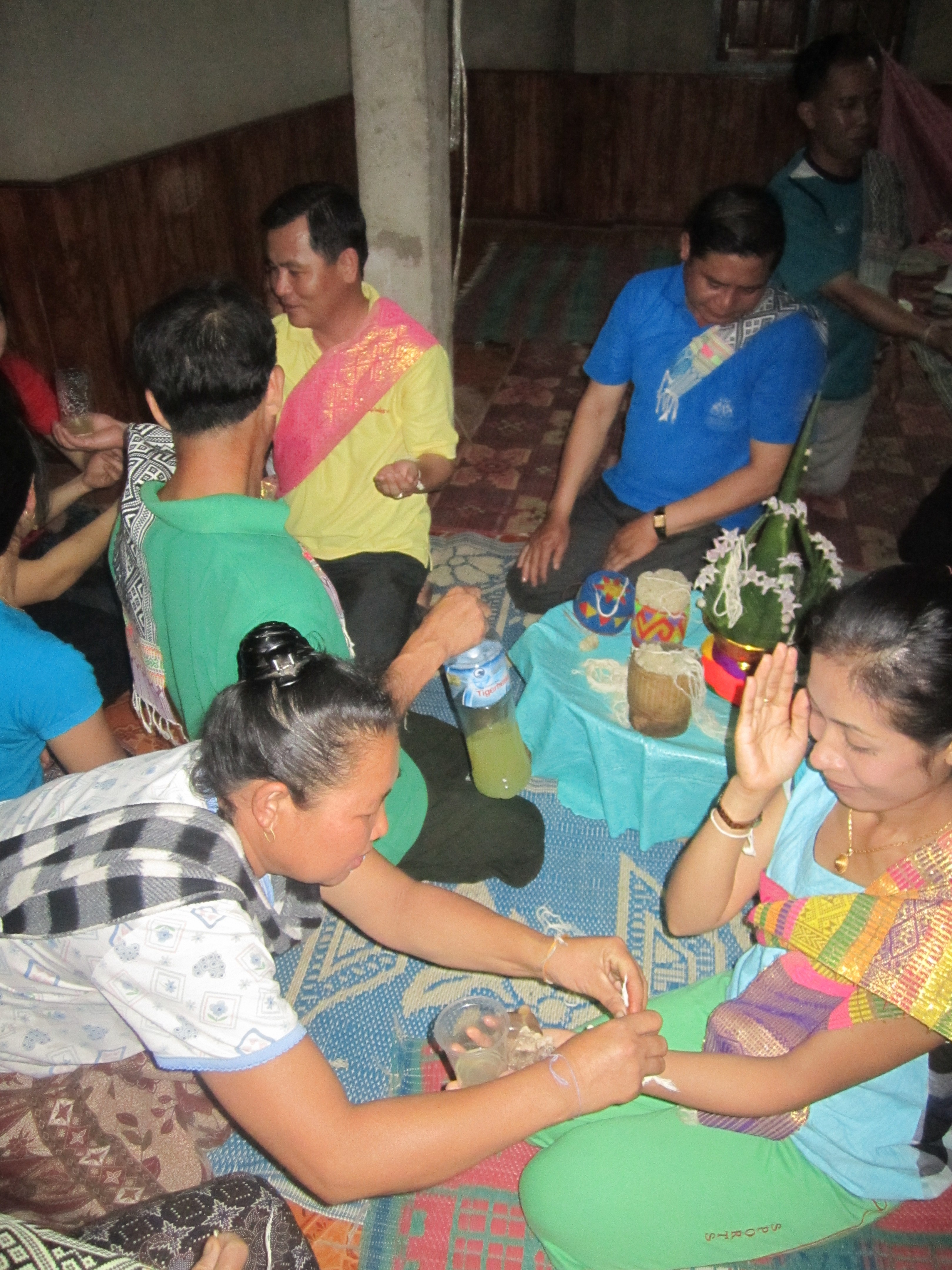
The man held my open palm in his. In it, he placed a small clump of sticky rice and pork. He raised his right hand to his face, murmured blessings in a language I didn’t understand. He waved a piece of string, then tied it around my wrist.

“He wishes you good health, good luck,” Pauline translated.

I smiled, bowed. Outside the open-air room, lightning stuttered the night sky white.

Sometimes you end up some weird-ass places traveling. Not that they’re weird, so much as it’s weird that you’re there, that you ended up there—that the gods of circumstance conspired, whispering in their thunderous perch above grey rock, to bring you there. And it was like that in Ban Natane.

To say Ban Natane is off the beaten path is an understatement. Cut off from the rest of world by impassable roads, the only way to reach it and its neighboring four villages is through the Kong Lo Cave. Which is how I got there.

I met Pauline trolling the town of Ban Na Hin for travel companions. The boat ride through the cave costs 100,000 kip, so I was on the lookout for people to split the ride with. Pauline sat on the computer in front of her guesthouse. As it turned out, she was a French anthropology student doing her Masters research on Ban Natane and its neighbors; she was meeting her local supervisor and translator the next day and headed back to the village for another 10-day stay. “If you’d like to come with us,” she made that characteristic French popping noise, “it’s no problem.”

On the sawng thaew ride to the cave’s entrance, she filled me in the details. A French NGO was sponsoring the development of eco-tourism in the Ban Natane area. To date, all homestays and eco-tourism in the area have focused on the Ban Kong Lo side of the cave—you take a boat ride through, come back and sleep on the more developed side of the cave.

“No one stays on this side,” she told me, “because tourists don’t know the villages are there.” Since the only viable way to reach the villages is through the cave, Ban Natane and its neighbors have remained quite isolated, not reaping the rewards/wealth of tourism. “In all of last year,” Pauline told me, “only 20 tourists came to Ban Natane.”

The eco-tourism project was focused on developing facilities for homestays and training locals to act as guides into the caves and waterfalls that surround the region. Pauline’s project focused on documenting the traditional agricultural way of life, interviewing locals about the history and their feelings about tourism, and then studying the impact.

Emerging

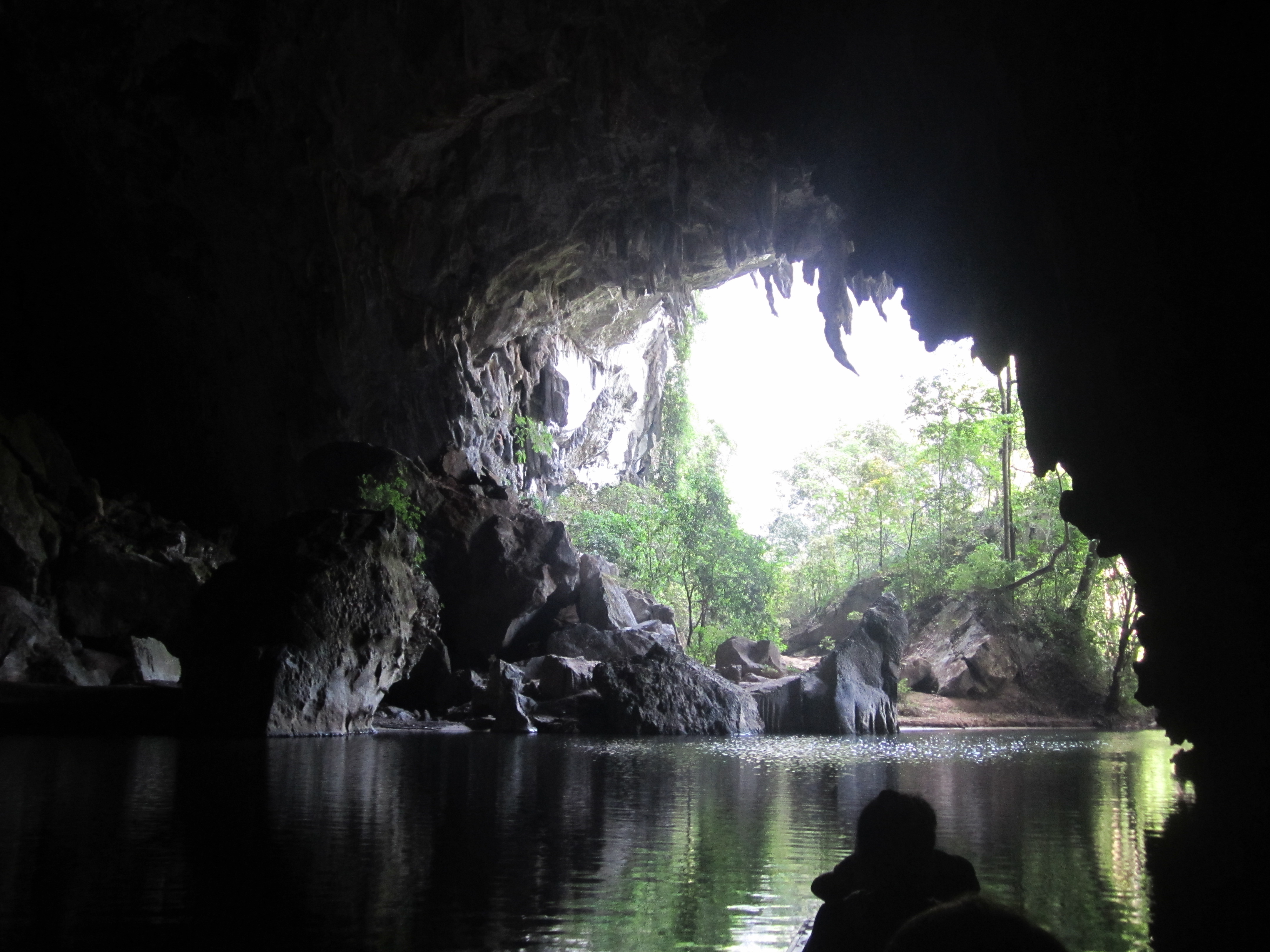
So the Kon Lo cave became, not my destination, but the passageway into another world. Which actually what it felt like—a limestone cavern like a mouth, dripping with stalagmites, the squeal and swoop of bats, where mist floated off the cool water like thin ghosts. It felt like moving through some deeply internal part of the earth, through its innards or petrified organs.

We emerged on the other side. Where most people turn around, we began walking down a dirt road. My cheap flip flops had finally busted, so I walked the 2km barefoot. In the distance, the sky grumbled. We arrived in Ban Natane just as the afternoon storm erupted.

My homestay was with one of the wealthier families in town. They owned the town’s only shop (and thus had packets of Nescafe in abundance), goods that had all been transported on skinny wooden boats through the cave, as they had been for generations. Even the TV. “TV only arrived here three months ago,” Pauline told me. “So the children,” she gestured towards the little ones gathered rapt around the glowing screen, “they are like this.”

The storm cleared and she showed me around the village. Everything enthralled me—I am, as previously admitted, a total city kid, so the presence alone of ducks, pigs, chickens and goats was thrilling, let alone the sarongs and hoes and looms beneath the stilted houses.

We shared dinner with the family that night, as we would for all our meals during my 2-day stay. As isolated as it is, the food was all local, not by trend as it is in the Bay Area, but by necessity—foraged snails, fish, frogs. “Frog season has just started,” Pauline translated from her Lao supervisor, “so we will eat a lot of frog.” (Sure enough, I had it 4 meals in a row.)

Walking that night, we three were called over to a large house. I could tell it was a wealthy person’s home because it had a ground floor, constructed of brick—like the TVs, this was new, Pauline told me, as traditional homes were all stilted and wooden. “It means you need more space, and have the money to build it.” She paused. “So modernity is already coming.”

Men sat on the floor around a type of altar, banana-leaf adorned in white flowers. It wasn’t a mystical vibe—they sat in polo shirts and slacks, chatting casually. A large silver bowl of pig parts, a leg and half a head, lay beside baskets of sticky rice.

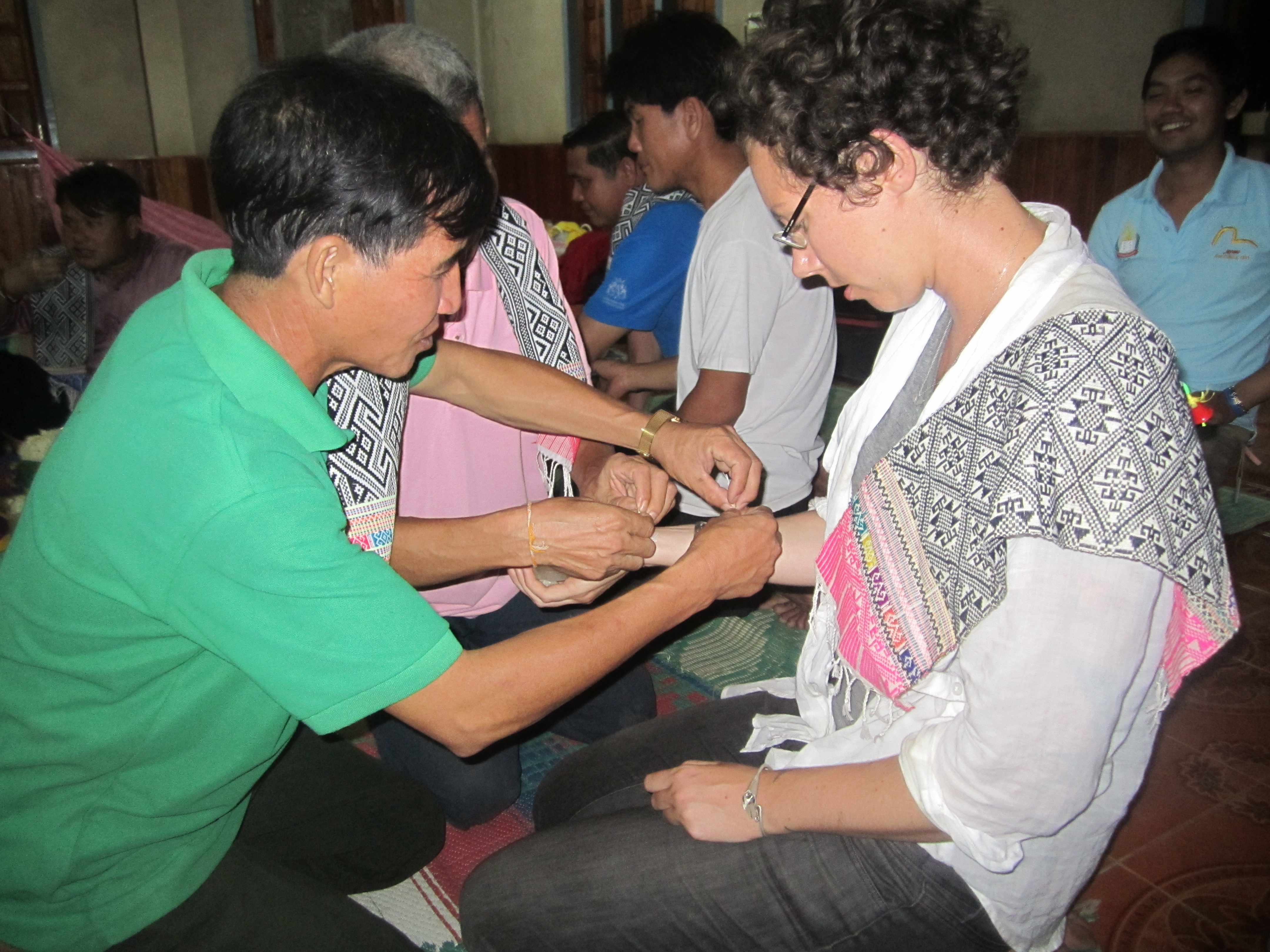
We were motioned to sit, a village-made scarf thrown over our left shoulders. The man in charge began talking—“a blessing,” Pauline whispered. He held another man’s open palm, put a clump of food and a plastic cup of lao lao in it, chanted, tied the string. Then everyone commenced to bless each other.

“It’s a ceremony called baci,” Pauline translated. “They’re having it for special visitors—the district chief came today.” People took photos with digital cameras; I assumed those to be the wealthy and important visitors.

We were soon called into the mix. I wound up with a bangle of string around my right wrist and an even fuller tummy. The storms continued in the sky outside. Old men smiled as they blessed me, as they blessed each other.

And I had one of those moments when your life feels like a dream, some foreign place you don’t quite understand how you ended up in. Yes, I rode an old wooden boat through a cave and walked down a dirt road—but how I really got to Ban Natane or that ceremony, I suspected, had little to do with that. It didn’t make sense, to my Western mind, why I’d be so welcomed, so embraced here.

And so blessed.

***

Travel Tips: Getting to Ban Natane

It’s actually pretty simple, even if you don’t have an anthropologist as your guide. Take your day bag, sturdy plastic sandals, a good flashlight and some snacks with you on your boat ride. It’ll still cost 100,000 kip, even if you only take it one way. So it goes.

Get off at the snack stands. Only buy the snacks if you’re desperate; since they have to be transported through the cave, they’re fuck-all expensive. Anyway, there’ll be a blue sign that haphazardly explains the homestays:

From the snack stands, there’s two dirt roads. Facing the sign, Ban Natane is down the road to your left. Straight ahead, across the bridge, is another closer village, though from what I understand, there’s less facilities for homestays. If you arrive in Ban Natane and say “homestay,” you’ll get hooked up. Or just show up and look like a Westerner, and they’ll know what to do with you.

Bringing a Lao phrasebook would be goddamn useful. There may be some people floating around who speak a few scraps of English; there’s rumored to be an English teacher at the school in the village, though she was out of town when I was there. If you can manage to communicate, there’s bikes you can rent or a couple good treks to go on, if it’s the dry season. Next month, an NGO will be holding a tour guide training course for locals, so I imagine there will be much more in the way of communication and tour options shortly.

The Lucky Ones at the War Museum

Instruments of death don’t die. They rust.

Fifteen minutes from the happy pizza restaurants and nibbling-fish pedicure tanks of Siem Reap’s Old Market area is the War Museum. It’s not much of a museum, per se—it’s a grassy field filled with mango trees and the skeletal carcasses of tanks, missiles and planes used during the Cambodian civil war (the 1960s Lon Nol era through the fighting of the mid-90s). The “exhibits” sit exhausted and silent in the heat of the field. They’ve been striped for parts, all that’s left of them slowly turning brown, the same brown as the the earth.

“The memorials in Cambodia are so raw,” Anna’d remarked. “At Auschwitz, everything is behind glass or protected. You felt more separated. But in Cambodia, at the Killing Fields or S-21, there’s less between you and the stuff you’re seeing.”

I thought of Anna’s comment as I walked into the War Museum, past the massive helicopters that slept like corpses in the entrance. I’ve never been to Auschwitz or any similar genocide memorials, so I don’t have anything to compare the ones in Cambodia to. But there’s definitely a rawness. And it’s a rawness you feel in the whole country, not just at the memorials, but that the memorials seem to capture, to be the pure essence of, in a way that reminds me of whiskey distillation—too pure, the uncut soul of the thing, that if’s not diluted could kill you.

A guide approached us, a young man in a fake Lacoste shirt, frayed stitching and tell-tale grin on the alligator’s face. He was missing an arm; a nub extended beneath the sleeve, a little past his shoulder, and you could see it move around in there as he walked.

A sign announced that guides were free, so we went along with him, assuming a small tip would be expected. He spoke English well and was knowledgeable about the artifacts, mute metal that sat, refusing to decompose. Small wooden signs had explanations penned in a haphazard English.

“What is your nationality?”

“USA,” I replied. A pause. “We’re American.”

“Ah. America is rich country. Cambodia is poor. So if a pilot not fight well, if a soldier not hit target, he get killed—it a waste of ammunition. The pilot, they cannot eject from the plane, they trapped. The soldier get locked inside the tank, and if he don’t fight good, he stay in and die. We find still the bodies in many of these tanks.”

We stared at the machines; they reminded me of dinosaur bones or the great cranes at the Port of Oakland—metal with so much power, sitting still.

As we walked, he told us the story of how he lost his arm: when he was 14, his dad brought home a landmine. He was trying to dismantle it; we couldn’t make sense of why. The bomb exploded, killing his parents and two siblings, and leaving him with a belly full of shrapnel and one less arm.

“I’m lucky I’m okay,” he told us. “But I am very lonely, I have no family.” He went on to explain the difficulties of life as an amputee in Cambodia, with discrimination and lack of healthcare. He paused, looked at us. “You are very lucky, you have family.”

Types of landmines

We kept moving. He pointed out common types of landmines, explaining which countries they’d been made in: Russia, Bulgaria, the US. He told us 1-2 people a day in Cambodia are still injured by unexploded ordinances. “You are very lucky, your country no have landmines.”

As he stood talking, I slid a modest note into the “Donations for Landmine Victims” box. He watched me. When he finished explaining the table of empty shells, he pointed to the box. “This money go to the government first, then the people. The government take a lot.” I squinted my eyes, nodding slowly. It’s true—there’s a lot of corruption in Cambodia. But I could also sense where this was going. “It better you give to the people.”

I cocked my head as he lead us away. Everything I’ve read in every country I’ve been to—including the sign at the guesthouse I’d just left (that among other things encouraged me to not have sex with children)—tells you not to give directly to people but to worthy, legitimate organizations. It was unsubtle foreshadowing.

He kept us moving at a steady pace. I thought of my guide at the pre-Angkorian temples a week earlier—also missing an arm but older, darker, a man who only spoke Khmer. I thought of the way he’d clasped his phantom hands behind his back, and the way it made something in me pound, then sink.

This guide didn’t clasp his hands. He was wearing short sleeves.

We paused under the hot breath of the sun. “How many sibling you have?” he asked each of us and we each responded.

“That good. You lucky. I have no brother or sister now.”

We came to a row of wooden shacks, displays of exploded bombs. They looked like peeled fruit, like some modern-art interpretation of peeled fruit that you’d see in some chic lounge, that was trying to make some sort of terribly deep and obvious statement. But this wasn’t art and it wasn’t a lounge—it was a shack and twisted metal.

They’d sawed the blown bits of his arm off with a wire. Because he was young and still growing, he had to go back every four years, to have the bone re-sawed. He couldn’t afford to get the shrapnel from his belly removed; at $100-200 a pop, he said he’d had to leave it to float around in there.

“In America I hear they make a machine arm.” He looked around at all the dead, rusted machines. “Maybe soon they make it in China. It will be cheaper there, and if I work enough, one day I can get. This is my dream: you come back and I can give you a hug with my robot arms.”

We got to the end of the tour. “It is good if you give a tip,” he told us flatly, “so I can pay for my surgery. Many people give $20-30 each person.”

Suki and Alicia looked at me. They’d each been in the country less than 24 hours. I considered the fact that a construction worker makes $3 a day, your average tuk-tuk driver $5. I considered the fact that my daily budget was $30.

He stood a few steps back, staring at us, waiting. “Can you give us just two minutes?” Suki asked.

We whispered, gathered bills. We gave him a fair tip, said thank you.

Then he walked back to our tuk-tuk, heavy with sweat, our ankles covered in dirt the color of rust.

The Anti-Irony of Cambodian Fashion: The English-Language T-Shirt Edition

“I like how cheesy it is, you know?” Mathilde said this morning, ashing her anorexic cigarette and looking across the street, at the teenagers hanging out at the Best Friend Cafe. Fake acid-wash skinny jeans, emo sideswiped hair-dos, bedazzled trucker hats positioned atop boys’ heads in a perch reminiscent of Abe Lincoln—the styles donned so earnestly by Cambodian youth would be only be seen on the most ironic of Western hipsters. And even then…

“It’s not so serious as in Europe,” she continued. “We would think this was so cheesy, but why not? If they like it, if they think it looks good, why not?”

One of the things I love most about Cambodian fashion—and it isn’t the stripper shoes or cutesy pajama prints or polka-dot pants—is the utter sincerity with which ridiculous clothing is worn. Ridiculous to Western eyes, I should say. And tonight this was exemplified by the t-shirts for sale at Phnom Penh’s Night Market.

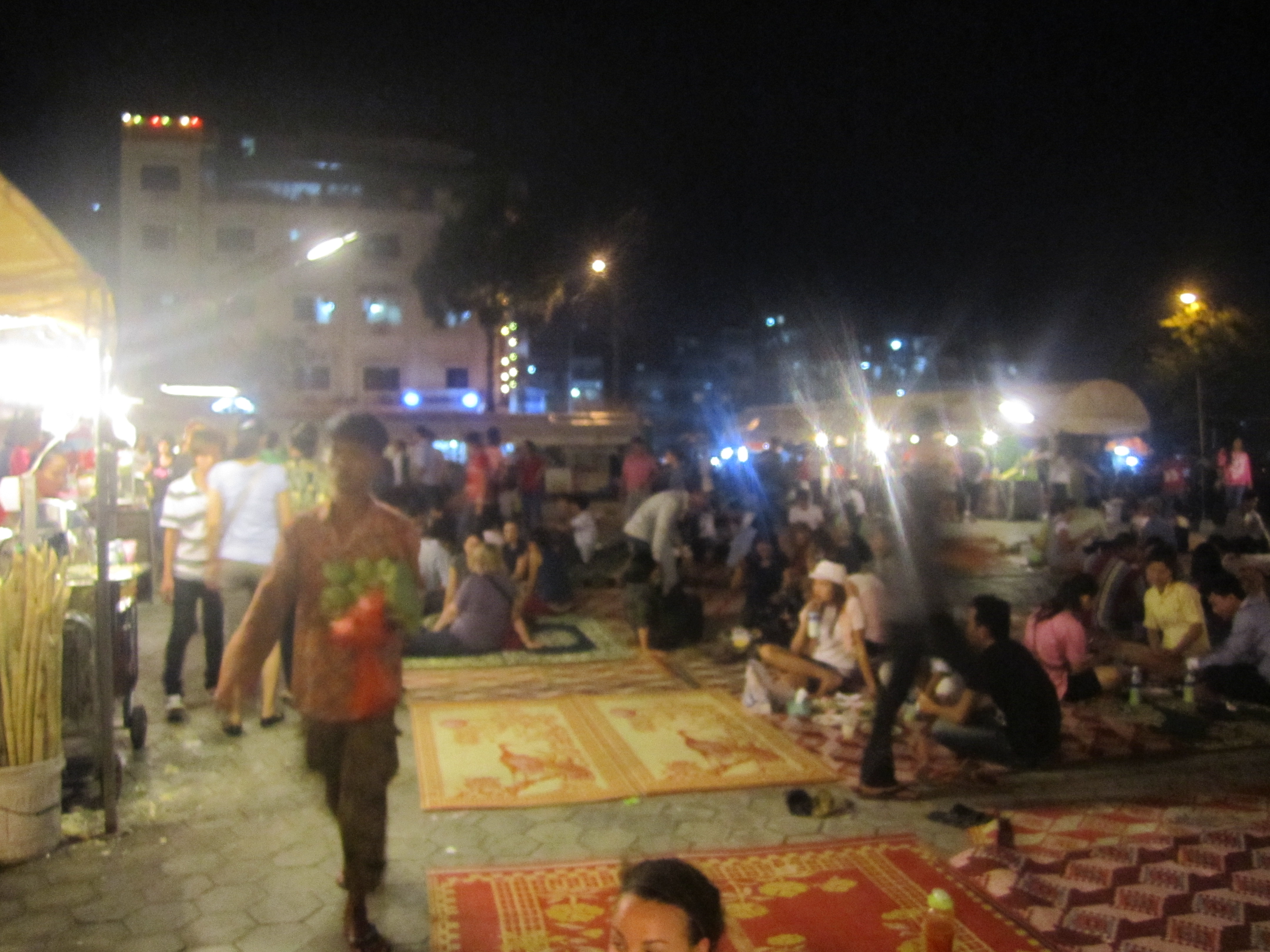
On Friday, Saturday and Sunday nights, along the riverside, tents are erected and a fair-style stage put up; vendors set up booths, teenagers with mediocre voices and sleep-walk-y dance moves perform on stage, mobile phone companies set up opposing stands with megaphones blasting promotions at one another, food stalls sell skewers of myserious deep-fried meat products, and diners take off their shoes and sit on straw mats, eating off thin wooden sticks. It’s nice. It’s a good mix of foreigners and Khmers, the riverside breeze is sweet, and until the mosquitoes drive you away, it’s pretty fucking luxurious to sit out and enjoy the night.

So we’ve been making a habit of grabbing some food and sitting out under the stars—or what would be the stars, might be the stars, behind the haze of city lights and smog. You can’t really be sure anymore. You don’t really go there to buy things—some tourist trinkets, fake floral arrangements (okay, I bought one of those for my apartment), and clothing. Clothing for local teenagers, I should say.

Tonight I took to photographing some of the t-shirts I felt best exemplified the Cambodian fashion spirit within the particular sub-category of Putting English Words On A Shirt Immediately Makes It Cool.

Rule #1: It doesn’t really matter if what’s on a shirt makes sense or not—as long as there are English letters, you’re half-way there.

Rule #2: It really doesn’t matter.

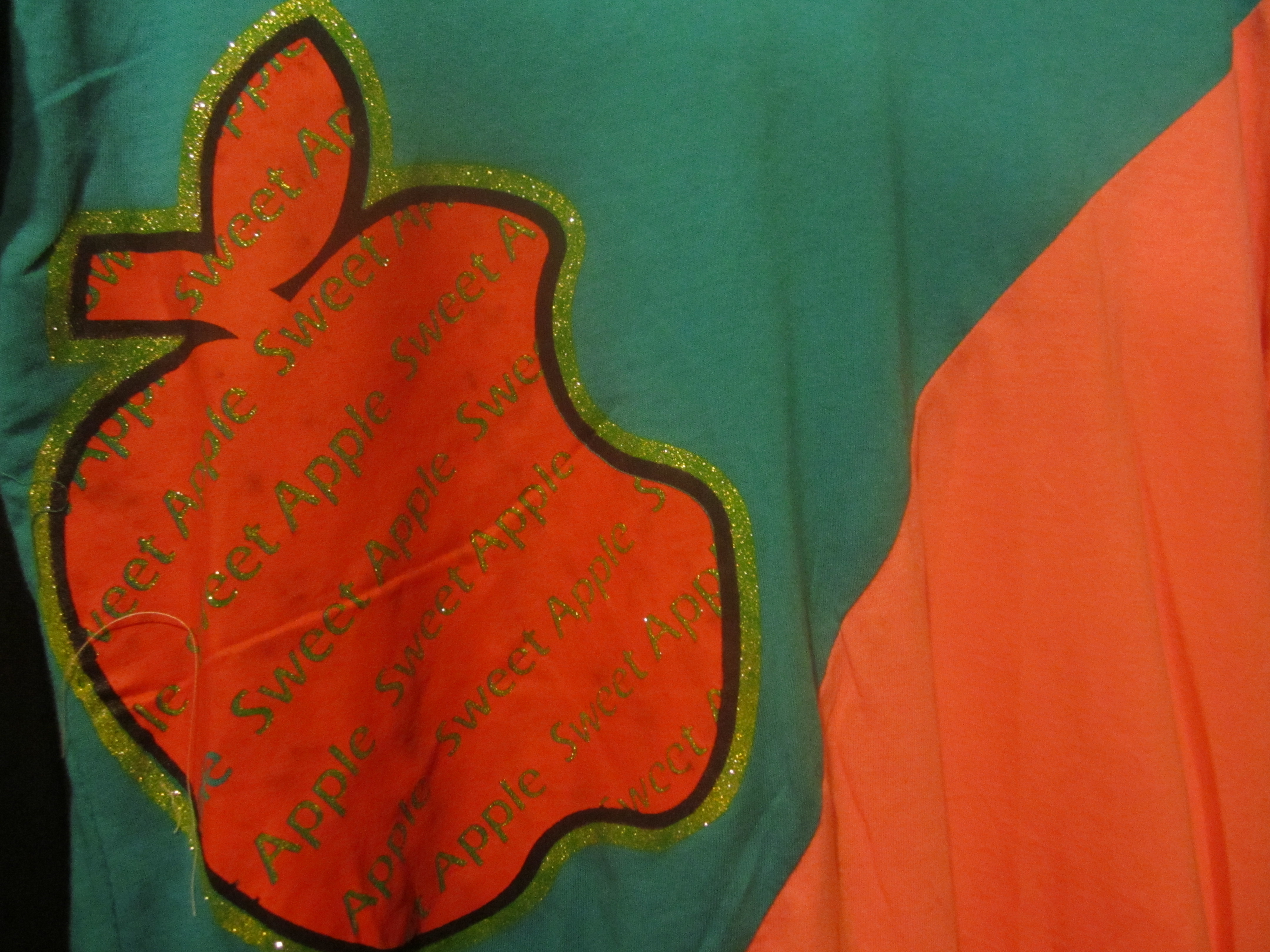
Rule #3: Product placement is a key component of English-language t-shirt fashion. It doesn’t matter if it’s the actual logo of a product, as long as it refers a Western, and preferably American, product.

Hey Apple marketing masterminds: you should really think about doing a Cambodian edition of those PC vs Apple guys ads. Do you see any PC t-shirts out here? I don’t think so…

Rule (?) #4: It also doesn’t seem to matter if the senseless phrases evoke repulsive imagery of, say, spoiled food products.

“Punk Rock Tonight Love Me”: I almost bought this one. It was too small.

“Power Over Pimples”: Fuck yeah! As someone who endured 12 years of acne, I wanted to high-five this t-shirt and jump joyously in the air like… the people on this t-shirt. The text was also English, singing the praises of an acne-fighting cleansing solution.

So, um, in a country where a shitton of kids get strung out on glue sniffing and paint huffing, I didn’t know what to make of this. Was it supposed to be funny? One thing’s for sure: I don’t think the affected demographic is perusing for new shirts at the Night Market though…

Rule #5: Content Over Accuracy

“Joy, Look For It Evert Day”: This shirt says it all. There’s a certain sweetness to it all, what would be convenient to call an innocence, but I think it’s something other than that, less simple or more simple or in any case different.

“Cambodia’s not a post-modern culture,” someone was explaining to me. “So there’s not a lot of irony. There’s a playfulness for sure—but more of a sincerity to the work.”

She was talking about contemporary art, but I thought about her comment looking at the shirts tonight. And I think it’s true for the fashion as well. And I agree with Mathilde—I like it. Coming from a world of ironic everything—ironic moustaches, ironic wolf-howling-at-the-moon shirts, ironic gangsta rap listening and ghetto blasting, ironic malt liquor drinking and crack smoking (yes, really)—it’s pretty fucking refreshing to enter a world of sweetness and anti-irony. It’s not any less self-conscious, it’s just self-conscious in a different way. It makes you feel like we’ve missed something in the Western world, that we’ve lost something, gotten away from something, something I can’t quite name but that makes me horribly sad, in the smallest way, heavy like a pebble.

But I’m Western. And I can’t switch worlds, switch roles, ease myself into a different way of thinking. The t-shirts are, to me, ironic.

Yawning teenager working the teddy bear stand

WTF Moment of the Day: Street Monkey

So about once a day here in Phnom Penh I have a massive WTF moment. I’ve been catalouging them: a boy stabbing birds, Western beggars, my guesthouse posting a sign about not offering “the sex services,” and pretty much any occasion I open the Phnom Penh Post. Strange things, bizarre things that my Western brain can’t compartmentalize—where all there is to do is shrug, shake your head and say “What the fuck…”

Today’s WTF moment came as I was walking home. It was a mellow day, filled with writing and street food, and I was retiring early, walking down a dusty road lined with corrugated metal fences, behind which the humming of machinery had ceased for the day. Men still wearing their hardhats bicycled past; teenagers in school uniforms clustered at the street corners, eating grilled meats from street stalls.

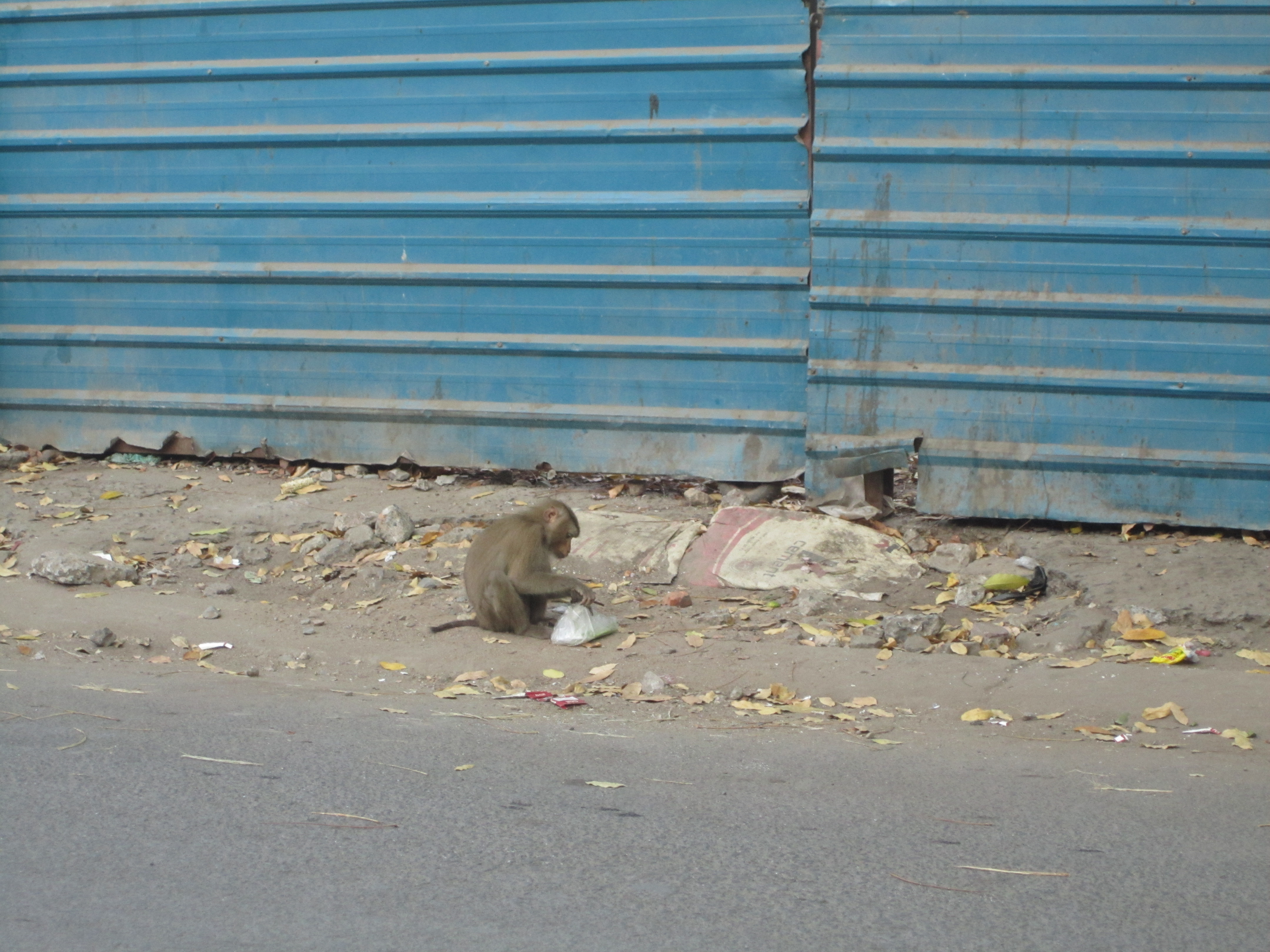
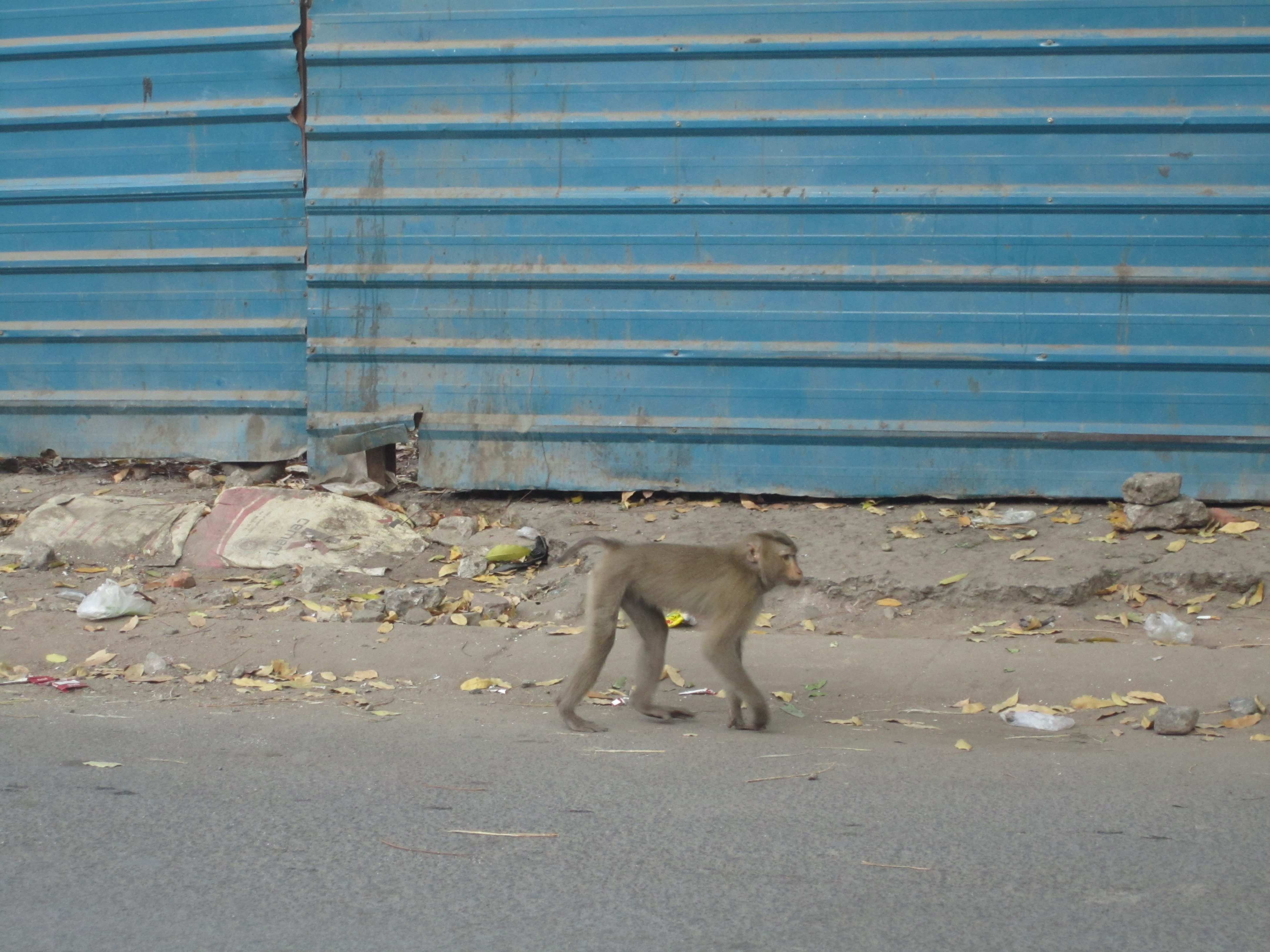
Then I saw this fellow:

Now, I’m familiar with street dogs and street cats and rats and mice and raccoons and squirrels—but WTF?! A street monkey? Phnom Penh isn’t the fucking jungle; it’s a city.

Where did the little guy comes from? Why wasn’t he in a zoo? Why was he just chilling there, riffling through a bag, trying to fish out a little food, sticking his red ass in the air as he repositioned? Why was no one doing anything? Why were they all going about their business like it was no big deal, perfectly normal for a hairy primate cousin to be out and about on a humid late afternoon?

I stood and watched him. I took a picture. A security guard down the road looked at me curiously—What’s this crazy white girl taking a picture of a monkey for?

The monkey tired of the plastic bag, threw it aside. He stretched his limbs and turned, looking into the traffic. He began to cross the street slowly, the same way I do, sensing out the rhythm of the road. He knew what he was doing. He was better at crossing the street than most tourists. The motobikes and tuk-tuks and cars slowed and swerved seamlessly around him—just another monkey cruising across the street.

Then he spotted me.

I still had my camera in my hands; maybe he was offended that I was taking pictures, objectifying him like an animal in a zoo. He gave me a real menacing look, bared his teeth slightly. He walked towards me.

Here I should clarify that I am 100% a city kid. I used to be afraid to swim in water I couldn’t see the bottom of. I’m easily impressed by the appearance of any stars whatsoever. Wildlife freaks me out about as much as uber urbanity freaks other people out. And everything is wildlife: from the geckos on the wall to the squeaks of bats. If it’s not a cat or dog, it’s probably got rabies and wants to eat you.

I thought of Greg, who I met bicycling breathlessly down a dirt road in Southern Italy. Greg was straight outta Queens, his speech peppered with more “yo”s than my own “hella”s. He’d just run into a herd of sheep in the road. He’d freaked—what were they doing? (“Probably grazing,” I offered.) Wildlife, fuck that. He hadn’t wasted any time in pedaling the other direction, and I immediately understood his panic.

And so the gangsta street monkey swaggered towards me. I moved slowly (“keep it cool, don’t ask scared, he can smell your fear”), stepping carefully, one foot at a time, in the opposite direction. When he disappeared between two parked cars, I walked briskly away, shaking my head and thinking, “What the fuck, what the fuck, what the fuck.”

Two Cambodias

“The Cambodian people are just so lovely.”

You’re apt to hear this from other Westerners as you travel throughout Southeast Asia; you arrive in Phnom Penh and you’re apt to agree. A friendly, welcoming, almost shy demeanor, so vastly different from the brashness of their Vietnamese neighbors—it’s entracing, in a way, and a part of you falls in love with it, with the endlessly smiling faces, the hands pressed together and the small bow, say, when you pay your tab at a restaurant.

“How could they have possibly killed each other?” you hear people ask. “It’s amazing to think the Khmer Rouge could have occurred in a place like this, where the people are just so nice.” And as you graze the surface—stroll along the riverside, say, or stop for a coffee at a shady little street stall—it’s easy to wonder the same thing.

But you stay here a little while and you begin to see things—shadows that move like stray dogs, so that you think they’re stray dogs, until you look closer and realize: no, no, that’s something else. And it’s like there’s two Cambodias—the one you see on the surface, during daylight hours, and the other, some strange Other, of darkness and violence and short skirts sitting outside neon nightclubs, and weird, weird shit you couldn’t possibly ever understand.

“It’s out there,” Rachel said, nodding. “And all you need to do is scratch the surface—” she flicked her finger in the air “—and you see it.”

Flipping through the two English-language newspapers, you catch glimpses, between the black newsprint that smudges onto your fingertips in the heat. Western pedafiles, human traffikers, drug busts. You read a story about a local military captain being punished for using his gun “anarchically”, shooting it recklessly into a crowd of people. Because no one died, he doesn’t face any criminal charges. Instead, his head is shaved and he’s forced to go a military detention center, what sounds like a work camp, where he scrubs toilets and collects rubbish. He’ll be forced to work until “his attitude changes, then he’ll be set free.”

You read another article, about the murder/rape of a 25-year-old girl in a village in the Cham province. She’d been scratched, maimed, her vagina set ablaze. And yet it’s what the article mentions in passing, without further explaination, as though it were a given, that you find most disturbing. “Even in a time when every week brings fresh news of a horrific assault on a woman or child, the brutality of Lim Kim’s death stands out.” It’s determined that the attacker must be married, because otherwise he would have just married the victim after raping her and wouldn’t have had to kill her. “Something made him unable to be responsible for his actions,” the local police had determined. The reporter had gone on to interview villagers; they reported being “scared of the ghost of the body, but most of all the attacker”—as though it were perfectly normal to be scared of the murderer girl’s ghost, but not of an attacker.

Tim’s telling you the lead-in to some story, some hapless night. It took place at the first Western nightclub in Phnom Penh, where prostitution isn’t the worst of the city’s nightclubs, but certainly still present. “It’s called Heart of Darkness—”

“Wait,” you stop him. “Are you fucking serious? The first Western nightclub in the city is called ‘Heart of Darkness’?”

He nods and you laugh, because what is there else to do in the face of such a blatant metaphor—if you wrote in a book, you say, it’d be over-the-top symbolism. But here it is, in real life, staring you in the face, and there’s nothing to do but shake your head and laugh.

“You should always take a taxi at night,” Patricia tells you at the club, giving you the number of a taxi service. “The police clock off at 9. So sometimes, the moto or tuk-tuk driver will call a friend, and there’ll be someone waiting at your apartment with a gun to rob you. The taxi costs more, but it’s better.”

You program the taxi number into your phone.

You’re having dinner with Susan and she mentions in passing that the number of mob killings are down. “Mob killings?” you ask. “Oh, yes,” and she tells you about the phenomenon of mobs of people spontaneously beating and stoning accused theives to death. “It was really bad seven or so years ago, several a month. They came under pressure from the UN to get a handle on it. It’s pretty rare in Phnom Penh now, but it still happens in the provinces.”

“A girl was double raped earlier this week,” Tom tells you, “and her attackers only had to pay a $125 restitution. The case didn’t even go to court.”

“We’ve secured scholarships for several kids to go back to school,” Romi tells you when you visit Tiny Toones.

“Are the school fees very high?” you ask.

“No,” she sighs, “it’s the bribes that really add up.”

“Bribes?”

“Yes, the teacher bribes. They don’t always call it that, but it’s like this: the teacher photocopies a lesson. They say, ‘I paid for this photocopy, so you must pay me.’ If you don’t, you don’t get the lesson, you can’t take the test, you can’t pass the class. So it’s like this. But,” she shurgs and looks out at the shaded lot of squealing children, “this is Cambodia, and this is how it is.”

You nod. You’ve given up trying to wrap your head around it, trying to fit it into some compartment of Western understanding.

But it doesn’t feel bipolar; it doesn’t feel like a contradiction, or like it’s at odds with itself. You feel, on an intuitive, unnameable level, that it’s two sides of the same coin—that it’s born from the same place, the beauty and grace and warmth, and the violence and corruption and darkness—born from the same mystery down there at the center, and not so far from the surface.

You think of Elliott Smith. Which is embarrassing and ridiculous, but you think of him anyway—of the beautiful ballads, the immense tenderness, the way you cried across the Atlantic when his song came on your iPod and the news of the death was fresh, an another lifetime that’s not so long ago sometimes, not as far as you’d like to think. And you think of people asking, “Man, how could he write such beautiful songs and fucking stab himself in the chest?”

And you’d always thought, “That’s how.” And you think of it now, though you’re not sure why, though it’s not at all the same thing—though you laugh at your silly, silly gut for telling you it is.

Lost in Navigational Translation: The Tuk-Tuk and Motorbike Drivers of Phnom Penh

“Tuk-tuk la-dee?” “La-dee, moto-bike!” “Where you go?” “La-dee, la-dee—you need moto-bike!”

This is the chorus you hear, endlessly, walking through central Phnom Penh. It’s like birds chattering, only more jarring, less song-like. It comes accompanied with a raised arm, two fingers extended—more of a summons than an offering of service.

By the touristy riverside, the touts can be pushy, but for the most part they’re just guys trying to make an honest(ish) buck. At first I tried to respond to all of them—Lisa ran a tuk-tuk company in Phnom Penh, given as part of her dowry, before the Khmer Rouge—so I feel a special responsibility to be respectful. I smiled politely and said “no” or “ot te.”

Eventually it got to be too much to respond to each other them, perched on their bikes at every street corner, crying out to you when you’re half-way down the block. I began to just shake my head, and soon stopped making eye contact. I started feeling like a bobble-head toy, my neck hurting from the constant swinging. Now I barely respond at all.

But I suppose that’s not so unusual, the constant barrage—being a Westerner in a city like Phnom Penh, where you stand out, gleaming of privilege and sweat and thin layer of sun screen. You take it in stride, a small price to pay for the relative welcoming warmness of the Cambodian people.

But here’s what is so unusual: most of these tuk-tuk and motorbike drivers have no idea how to navigate the city. A city, I should add, that’s laid out in a neat grid. And not just a grid, a numbered grid, where even numbered streets intersect the odd.

It is perhaps the easiest city I’ve ever learned. And I don’t make my living by driving its streets. So what, what, what is going on here?

It took me a few days to clue into it. I did a lot of walking at first, and when I did finally take a motorbike, chalked the confusion up to language barriers and my hotel’s offbeat location.

On Friday night, I was headed from a party back to my hotel. “Street 141 at 232,” I told the driver. The glassy gleam of incomprehension stared back at me, followed by a vague nod. This did not produce a feeling of confidence in me.

Must not know his English numbers yet, I thought and whipped out a piece of paper. I wrote the street numbers as largely and legibily as I could. I showed him. He nodded a little more vigoriously; we negotiated the price and I hopped on.

We slid down the wide Norodom Boulevard, nearly empty of its honking, and I felt the breeze of the night on my arms, my legs. I closed my eyes and let it kiss me.

I’d been in the city four days by that point—so I knew when we were making a wrong turn.

“Um, no,” I said and pointed back to Norodom. He shot me a confused glance. I pointed to the street sign. “This is only 156. We go to 232.” I waved my hand down the road.

A series of slow circlings and U-Turns ensued, me growing ever crankier on the back of the bike. It devolved to me leading the motorbike driver street-by-street back to the hotel.

He must be new at this, I thought as I finally hopped off.

But the phenomenon repeated itself: the glassy look, the vague nods, the wrong turns and aimless meandering. Another characteristic element to the typical un-joy-ride, I soon discovered, comes when you stop every couple blocks for the driver to discuss with other drivers the intended destination of the passenger, locked in some sort of secret code no one is able to decipher. Lots of pointing and shrugging ensues. This is apt to repeat two-to-four times before one finally arrives.

At first, I blamed it on my own inability to say Khmer numbers, and took to only writing locations, following it up with a big, you-get-it? grin.

The answer you always get is “okay, okay.” The ride you get is not always “okay, okay.”

I was utterly confused and out of ideas. Maybe they were guys from the countryside, who’d only just come to Phnom Penh. Maybe they didn’t know the city that well yet—but come on, how long does it take to learn a city? A numbered grid of a city at that?

No, no, there was something more going on here—some kind of deeper divide than just language or location familiarity. There was so kind of vast cultural chasm, a disconnect.

“Oh no, no, no,” Mathilde told me. “They don’t know street names, only landmarks. It’s better to say ‘near to Independence Monument,’ or ‘Royal Palace.’ These they know. But sometimes even then…”

I’ve worked that into my repertoire, a long, drawn-out process in which I use every means I can fathom to communicate my destination. “Sihanouk, near Independence Monument,” I told the driver yesterday.

We got closer this time, but just before the up-lit monument—positioned handsomely at the crossroads of two main thoroughfares and surrounded by the massive honking roundabout—we took a turn down a random sidestreet. I sighed. We U-Turned.

I reported my failure back to Mathilde. “They will always say ‘okay,’ even if they don’t know.”

“So, how do they work? How do they live and get around a city they don’t know at all?”

She shrugged, and I guess that’s all you can do. Because they must know it—there must be some way they know it, some entirely different way of interacting with a city and a landscape that doesn’t even occur to me, that I can’t even fathom—as foreign as another language, as mysterious as an alien scribble, written all over this city in a way I can’t read, can’t decipher—in a way that I can’t even see.

Perhaps I’ll figure out the mystery. But for now I’ll keep circling, keep ambling, keep pointing to a destination I can’t communicate, hidden somewhere in the gap between cultures—foreign, mystified and helmetless on the back of a Phnom Penh motorbike.

Saturday Night Fevered

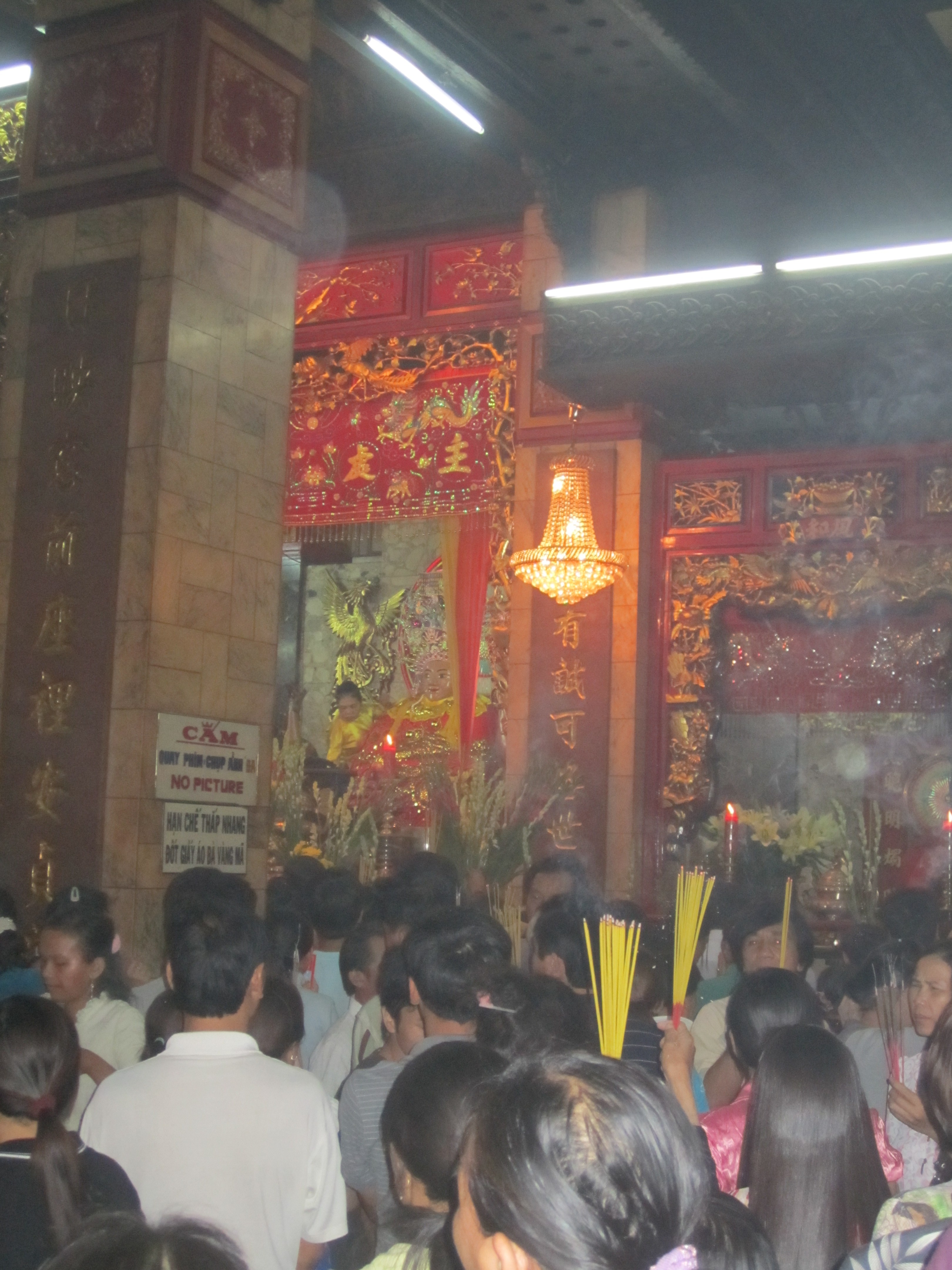
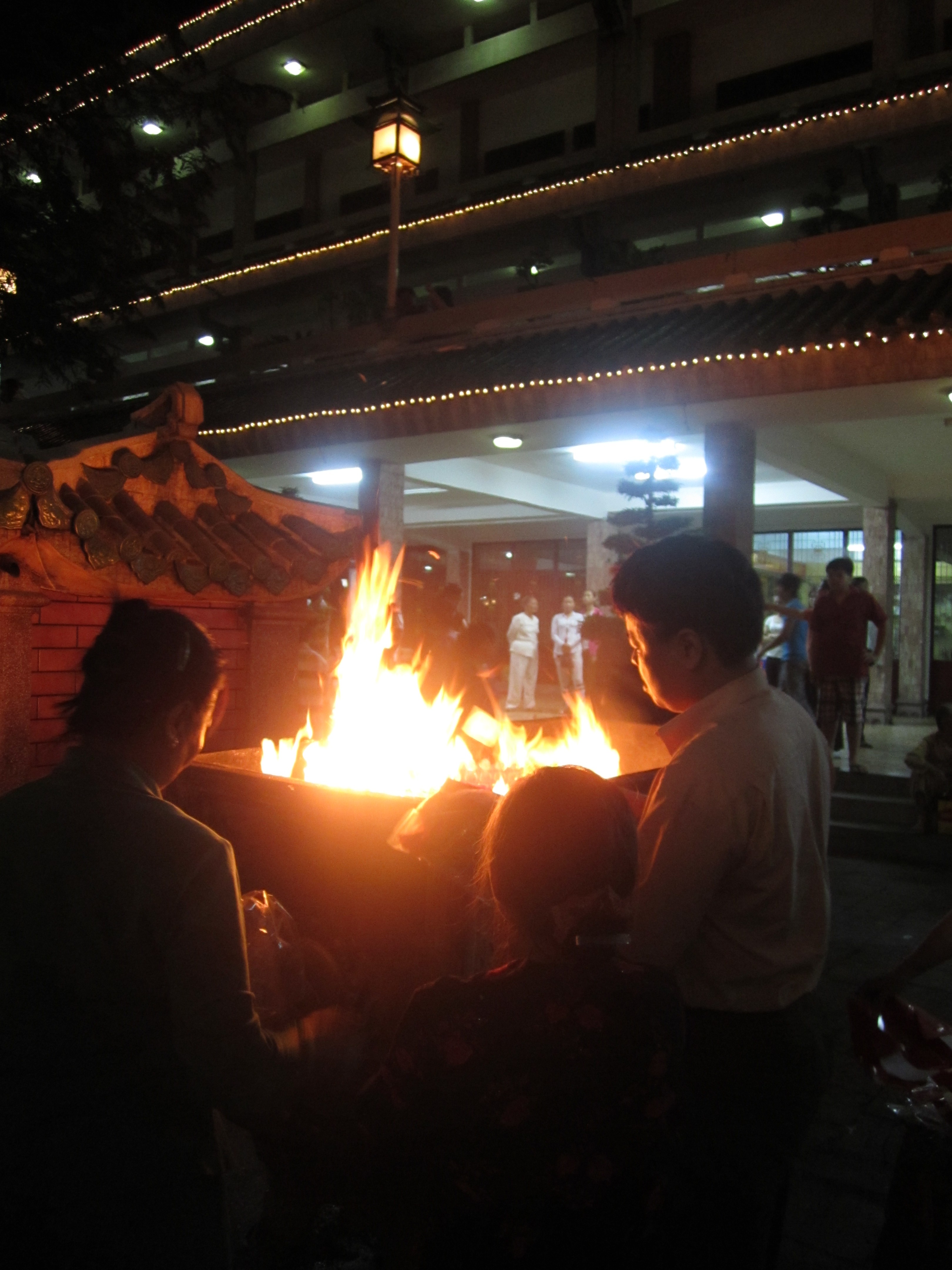
Long stalks of flowers and twisted plumes of incense burning. Nodding, bowing, chanting with their eyes closed. Trays of food—peeled fruit, shrink-wrapped cookie packages, an entire plucked chicken—held atop people’s heads as they murmur. Candles and coconuts, red glowing altars (to what, to what?).

Children and hunched-up old people, a constant bumping, bustling, brushing against—the Asian conception of personal space, or lack thereof, exemplified. Announcements on a loudspeaker (what, what?).

Smoking a cigarette while he prays. Sweeping rubbish out from under the feet of the worshippers—playing cards with footprints on the floor.

Photocopied money in buckets being carried, to be burned—tossed into a pit outside that shoots scraps of burnt paper all over, raining ash in the night wind. Smoke rising (to where, to where?). Calling to children—“Em oi! Em oi!” Some kind of urgency, some kind of plead—nothing Christian about this piety. Nothing solemn; everything sacred.

Security guard siddles up to me, glances at the furious scribbling in my notebook (for what, for what?).

A Buddha-looking diety looking down on it all—a halo of neon, flashing in technicolor.

——–

This was perhaps one of the biggest What The Fuck moments of my travels. I had no idea where I was, what was going on, what any of it was for—just that I was suddenly immersed in it, plunged into a cloud of incense smoke and chanting and riotous fervor. These were the notes I made in the middle of the madness.

The motorbike driver didn’t speak any English. We were coming back from another site outside of Chau Doc, a town along the Cambodian border in the Mekong Delta. The roads became cluttered, lined with food stalls and carts and bodies, bodies. They filled like a clogged pipe until they choked and he had to pedal the bike through the crowd.

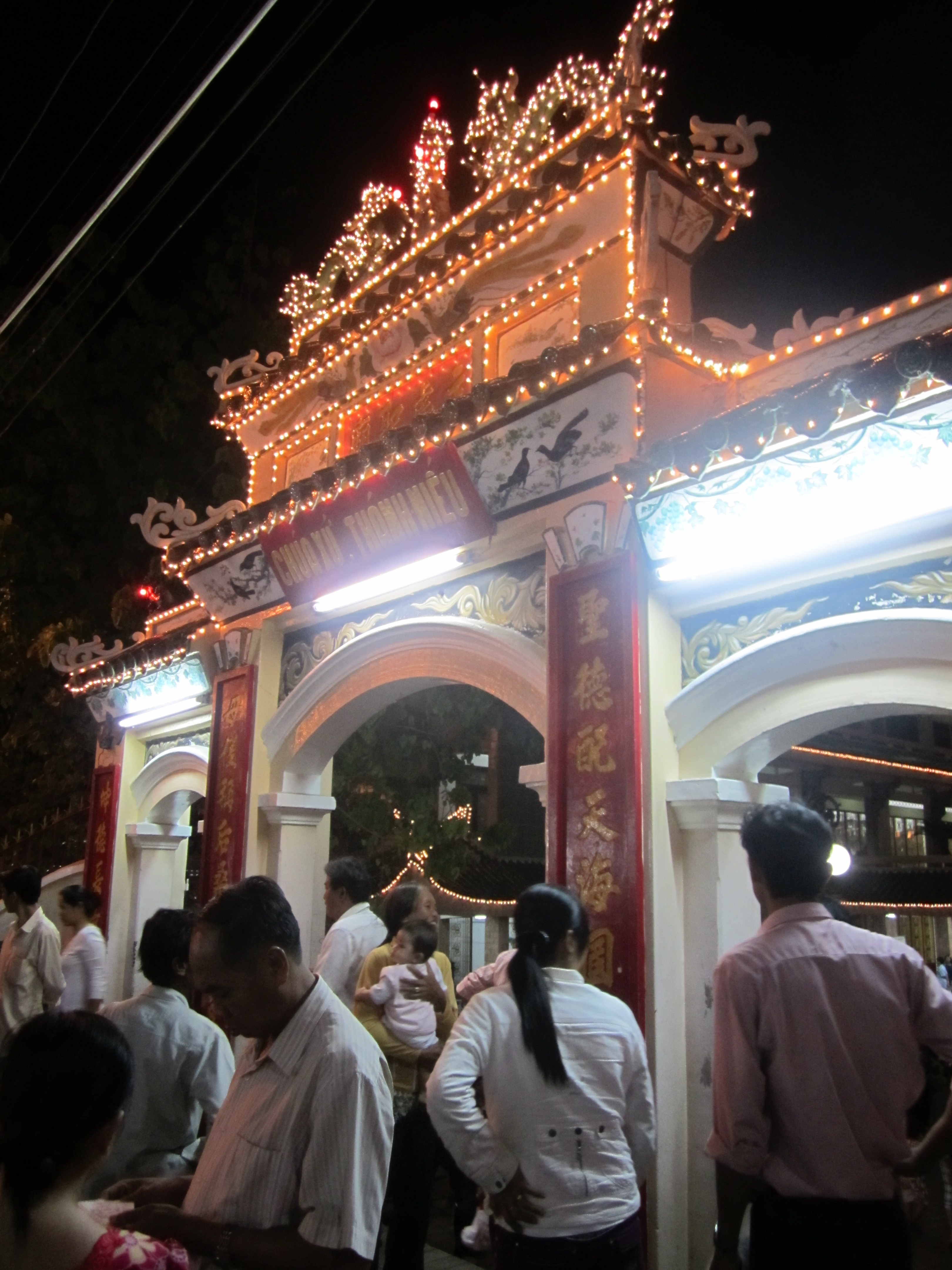
He stopped in front of a temple adorned with blinking Christmas lights. He pointed. I went in.

It was a funny thing, to be wrapped up in the zeal and fervor of it all without having the slightest clue what any of it was—an entirely sensory experience, a ritual out of context, a girl out of context, cultured-shocked.

When I got back to the hotel, I asked the English-speaking desk clerk, “I just went to some temple, up the road and—”

“You saw thousands of people,” she finished me, nodding.

“Yeah! What was that?”

She told me that they’re city-folk; they come to Lady Temple after the new year to ask for good luck. On weekends in February, March, even up through April, the otherwise sleepy town of Chau Doc swells with these Vietnamese travelers.

“Pilgrims, pilgrims,” the other clerk told me the next day. He’s younger than the girl, I thought, but he only seems it—he later told me that he’s almost 40. I wondered where the years went, behind his boyish smile.

“Other times, not so many people in Chau Doc. It very good for the business.” He looked out the glass lobby windows onto the town’s main market, overflowing into the street with tourists—not so many of them Western.

Snapped a couple of jostled photos before I saw the "No Camera" signs...


Lauren Quinn is a writer and traveler currently living in Hanoi. Lonely Girl Travels was a blog of her sola travels and expat living from 2009 to 2012. She resides elsewhere on the internet now.

Join 490 other subscribers

Buy This Sh#t

Categories