 I never heard the term “Khmer Rouge” growing up. We didn’t learn about Cambodia in school, didn’t hear about it in TV or the movies. I must have been a teenager when I first heard those specific words, and I remember it sounding terribly exotic and glamorous: “Khmer,” smooth, black, still as glass; “Rouge,” like lipstick, like burlesque, Paris in the 20s. (Cambodia, Cambodia—where even the genocides have beautiful names.)
I did hear about Pol Pot. Not all the time—quite rarely, actually, and only in passing, but in a way that made in stand out in your mind, that made it tuck into some cramped little corner of your brain where nothing much else goes. How did you learn to make fire from two sticks? “I learn during Pol Pot.” Why were you running, pregnant, through waist-deep water in the middle of a monsoon? “To escape Pol Pot.” Who hung you upside down for days when you were caught stealing food? “Pol Pot.”
It was never the Khmer Rouge, but instead always this person, this invisible man, a dark silhouette that you could perhaps see passing, passing, passing through the house at night—like a ghost or a phantom or something even realer than that: Pol Pot.
So it was a type of linguistic division—responsibility placed not on a mass of people, a movement (ie: Nazis), but on a single person. Not a war, a genocide, but a man.
I kept thinking about that last night. I chanced upon—as I’ve been “chancing” upon everything in this project, so that you can’t really call it chance at all—the exhibition “Voices of the Khmer Rouge.” A massive audiovideo installation, “Voices of the Khmer Rouge” features 30 interviews with former low-ranking Khmer Rouge soliders, displayed with multi-lingual subtitles on some dozen computer monitors/headsets. It’s being shown at the Bophana Audiovisual Resource Center, an historical archive center with free, open access to the public. The exhibition opening happened to be last night. So I went.
It was sweltering hot in Bophana’s main floor, a space that was meant to have air-conditioning but didn’t. There were well-dressed Westerners and well-dressed Cambodians—lots of younger Cambodians, too: teens and twenties, what’s referred to as “the next generation,” all wearing the same type of short-leeve button-up top and slacks, conservative skirts. At a certain point, a herd of younger children filtered through, chattering softly; they were thin and dark and put on the headphones and stared.
The opening speeches were being translated into 3 languages—Khmer, English and French—and proceeded at a painstaking pace. I stood in the breeze of a fan and read the subtitles flashing on the screen.
All of the interviewees were poor villagers from a Northern province. Many of them had been young when they joined the Khmer Rouge—teenagers or even children. I’d read about that, accounts of that: the Khmer Rouge’s use of child soliders. Some had been arrested and forced to join, others felt they’d had no choice, and still others joined voluntarily, zealously.
So they’d mostly all been extremely vulnerable. They all spoke of experiencing hardship during Lon Nol’s regime and the American B-52 bombings: hunger, death, loss. They were angry, young, uneducated and desperate. These are dangerous conditions.
Their thoughts about the Khmer Rouge now ran the gamut. One man lauded Pol Pot as a hero who’d fought imperalism. He thought of him as a teacher and kept repeating that he couldn’t say Pol Pot is bad because, “If the student says the teacher is bad, then the student is bad too”—a logic steeped in the Cambodian brand of Buddhism.
There was a marked clarity when it came to the US’s involvement in the development of the war. One woman summed up: “Americans paid Khmers to fight other Khmer, and that’s what we were fighting: Khmer puppets.” Another man, with piercing eyes and deep wrinkles, spoke of how the power of the Khmer Rouge was set up by the “greater powers” of the world. He cited the US, China, Vietnam, Cuba, the Soviet Union—how they supplied money, guns, mines. “It was the greater powers that incited war. How could they have afforded it otherwise?”
He said that he was for the trying for former Khmer Rouge leaders, but that it wouldn’t be a proper trial if it was only trying them. “America must pay compensation too,” he said.
When I was at Tuol Sleng, my tour guide had said something about the Khmer Rouge that stood out to me. He said that they had “the trauma” just like the victims. Some of them killed, but they had to; if they didn’t, they’d be killed. “So they are victims too,” he said. “Indirect victims, but victims too.” That sense of division echoed in me: Pol Pot vs. the Khmer Rouge.
One woman, old and thin now, spoke of how she’d felt sorry for the people in the camps, but how there was nothing she could do. “That is war.” Mostly, she felt sorry for her Khmer Rouge comrades. She said how, when one would die, they would mourn them like a sibling. And I imagined an army of children in black pajamas, in the jungle with their semi-automatic weapons, stripped of their families, with nothing but each other.
Another man had been sent to be a solider as a child. During the fighting, he said, he’d lost his thumb, an eye, had a leg cut off; he didn’t even mention his missing front teeth. “I became a disabled person,” and he said it with a smile, a well-what’re-you-gonna-do smile—a battered little shell of a man.
Another man had a broad smile and smooth dark skin. He spoke of being afraid. “Maybe they will see this and come arrest me and execute me.” I thought of what my tour guide had said, how he’s still easily frightened, all these years later. “This would be very unfortunate for me,” said the man on the screen, and he smiled still, laughed. “It may sound like I’m joking, but I’m not.”
The project’s producers were on hand to discuss the work—two Danish dudes. They insisted that this was an art installation, because it wasn’t attempting to answer questions, only raise them. They refused to tell viewers what to think of the interviews; they wanted you to look at them and make your own conclusions.
“There are no conclusions,” I thought.
I waited around to speak with one of them. I was curious about a point he’d made—that he felt there were different levels of Khmer Rouge, the “really bad guys,” as it was convenient to phrase, and the other people, who existed in shades of grey—so many shades of grey, I’d thought, that you hadn’t knew existed before, like looking at one of those charts of the light spectrum in science class and realizing that all you’d ever seen was this small sliver of what was out there.
Another American girl had him cornered; I eavesdropped and they seemed to be talking about the same thing. She was debating that point fiercely, the kind guilty-by-compliance logic that had always made sense to me, before this. She was young, unwrinkled skin and braces, and kept shaking her head.
I finally got my chance to ask him. I told him my linguistic childhood ancedote. He spoke about the shades of grey, how he didn’t think it was as simple as just Pol Pot or all the Khmer Rouge. He again urged me to find my own answers.
“I think maybe there aren’t answers,” I said.
Which I think didn’t sound the way I’d intended. It wasn’t to say that the search was futile—because, after all, what the hell am I doing? (What the hell am I doing?)
No, I think the search is one of the most worthwhile things we can do. But I keep feeling like every layer I peel back, the further I look into it, the more complex it gets; it only opens the door to new questions. So we can look at it and we can tease it apart and try to know it, but I feel that at the center of it all is a great mystery, an un-understandability—the same mystery that’s at the center of everything, only maybe a little darker.
It’s a fact I feel I keep coming back to and keep coming back to, that all of seems to orbit around: the impenetrable mystery—smooth, black, still as glass.
 Late afternoon sun through the trees, dusty lot and birds singing, the stillness of a temple. I slide off my shoes and the tiles are hot on my feet as I walk slowly around the pagoda, a tower of skulls.
  But the skulls aren’t what gets me, because the skulls don’t seem real. It’s the piles of clothes on the bottom shelf. Shirts and shorts, dusty and tattered and vacant now, a limp pile—this is what is left.
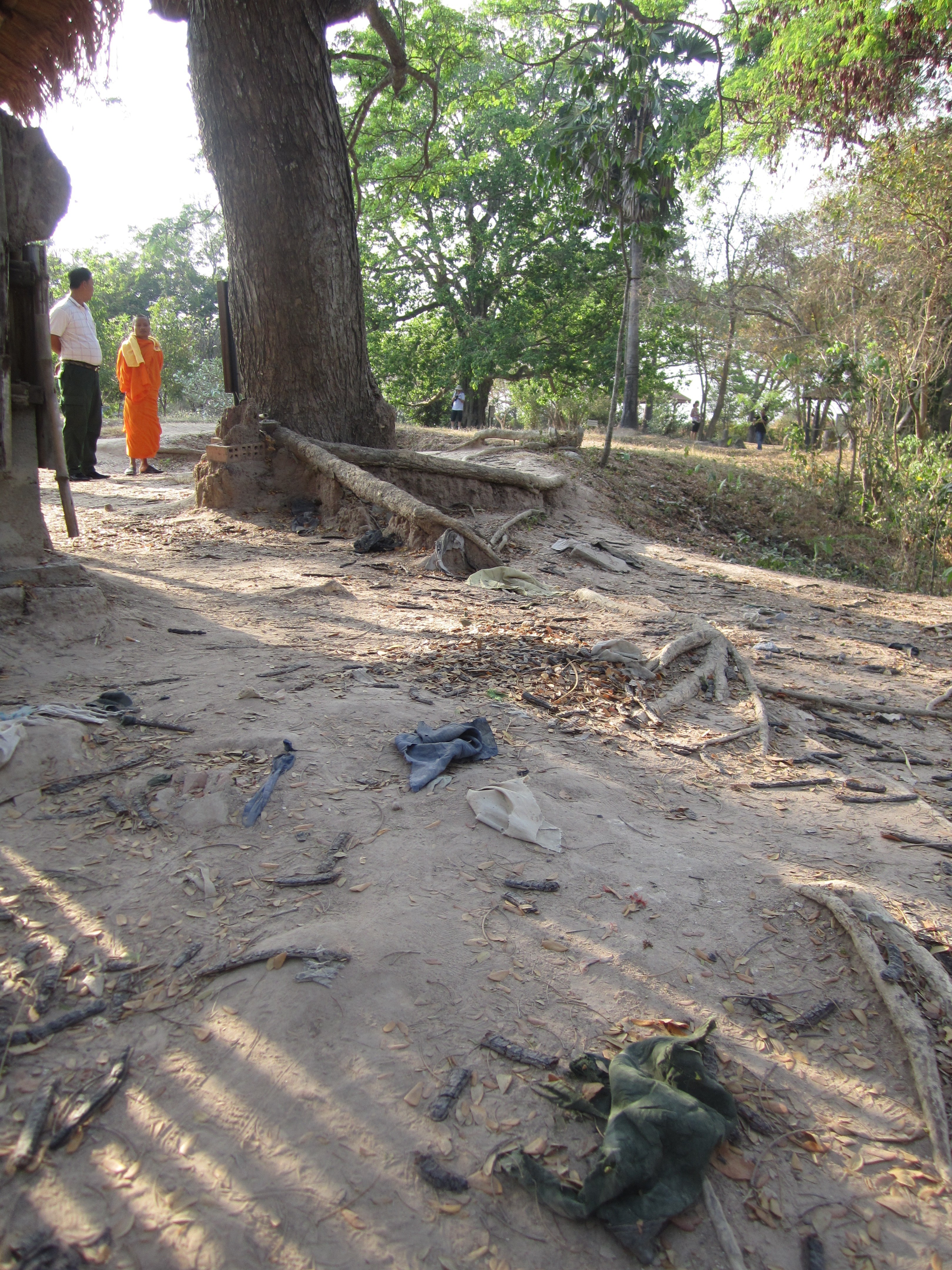 Sometimes the earth write the metaphors for you, I think. Sometimes the ground itself is a poem—this place a poem you couldn’t possibly ever write, no one could write, just walk through—the stillness; the birds; the smell of incense and smoke; someone burning off wild grasses somewhere, behind the fence; schoolkids singing somewhere in the wind. Two monks walking, orange robes, reading the signs with impassive faces, round faces, young young faces.
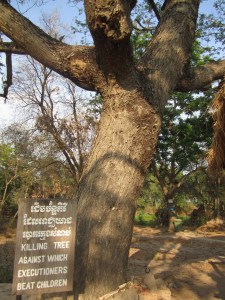 The trees all saw this, I think. These same trees, noble and twisted and standing here still. Some were forced to take part, and I imagine something in them weeping, their trunks dulled and bloodied. These same trees, bearing witness, the same way they bear witness now—silent, petrified in their places, the way parts of our brains are, the way parts of our brains bear witness (secret stitching, secret from ourselves)—roots tangling and rising out of the earth, with the teeth and bones and scraps of clothing and all the things there aren’t metaphors for: a dusty field in the afternoon sun.










 Lonely Girl Travels
Recent Comments