Posts Tagged 'southeast asia'


Hand Tractors and Impending Tourism: Day Two in Ban Natane

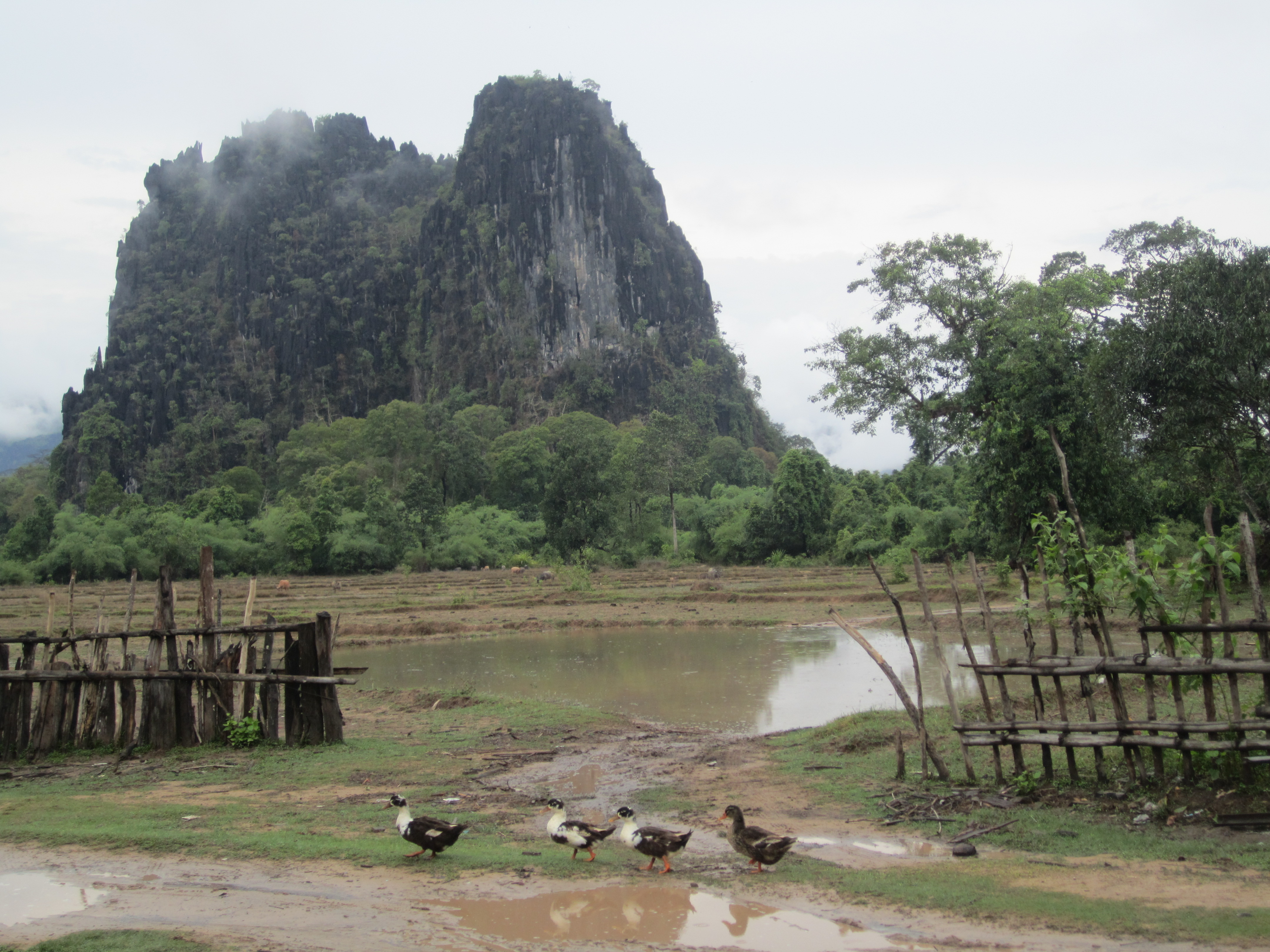
My first morning in Ban Natane, I woke up with the sun and the roosters. It isn’t saying much—it could have happened somewhere in the States—but it was still a first for me.

The morning was misty and, as I sat up and peered through my mosquito net, I could see out the open-air common room into the dirt paths of the village, the common room of the next house over, where the TV already blared and the family sat on the floor around a metal table of steaming bowls. The day had begun.

I’d had to sleep with ear plugs. I’d become accustomed in SE Asia to geckos bellowing and incests buzzing, but I wasn’t used to the noise of the village: animals snorting, grunting, squawking, chirping, thunder booming and rain drumming. The houses are all open in the village—no windows or glass to enclose things—so you could also hear the neighbors talking. There were less filters, less divisions, more of a meshing of life, I thought as I crawled off my cot. I poured a cloudy glass of water that had been boiled and purified with local herbs, and swallowed my malaria pills.

I’d had plans to ride a hand tractor, then hike an hour out to a river, possibly visit some caves. “Too much rain,” Pauline’s supervisor—whose name I could never get straight—told me over our breakfast of sticky rice and more frog. It was determined, as we dipped clumps of rice into red chili paste, that I would instead ride a hand tractor around to the check out the neighboring villages.

This is romantic in theory. And it is pretty cool—the hand-crank wrench, the rumble, the foot pedals and gear shift, all the machinery exposed, retching and rumbling through brown puddles, water whooshing into waves beside you. Standing on a vehicle like that without falling over is another matter. I tried squatting, clutching the wooden railing, but the lurching started to make me nauseous. For some reason, I determined that sitting was my best option. (Three days later, I’m still paying for this decision with a bruised tailbone…)

Two guys from the Ban Natane took me around to three other villages. Which gave me more of a feel for life out there. It looks like this:
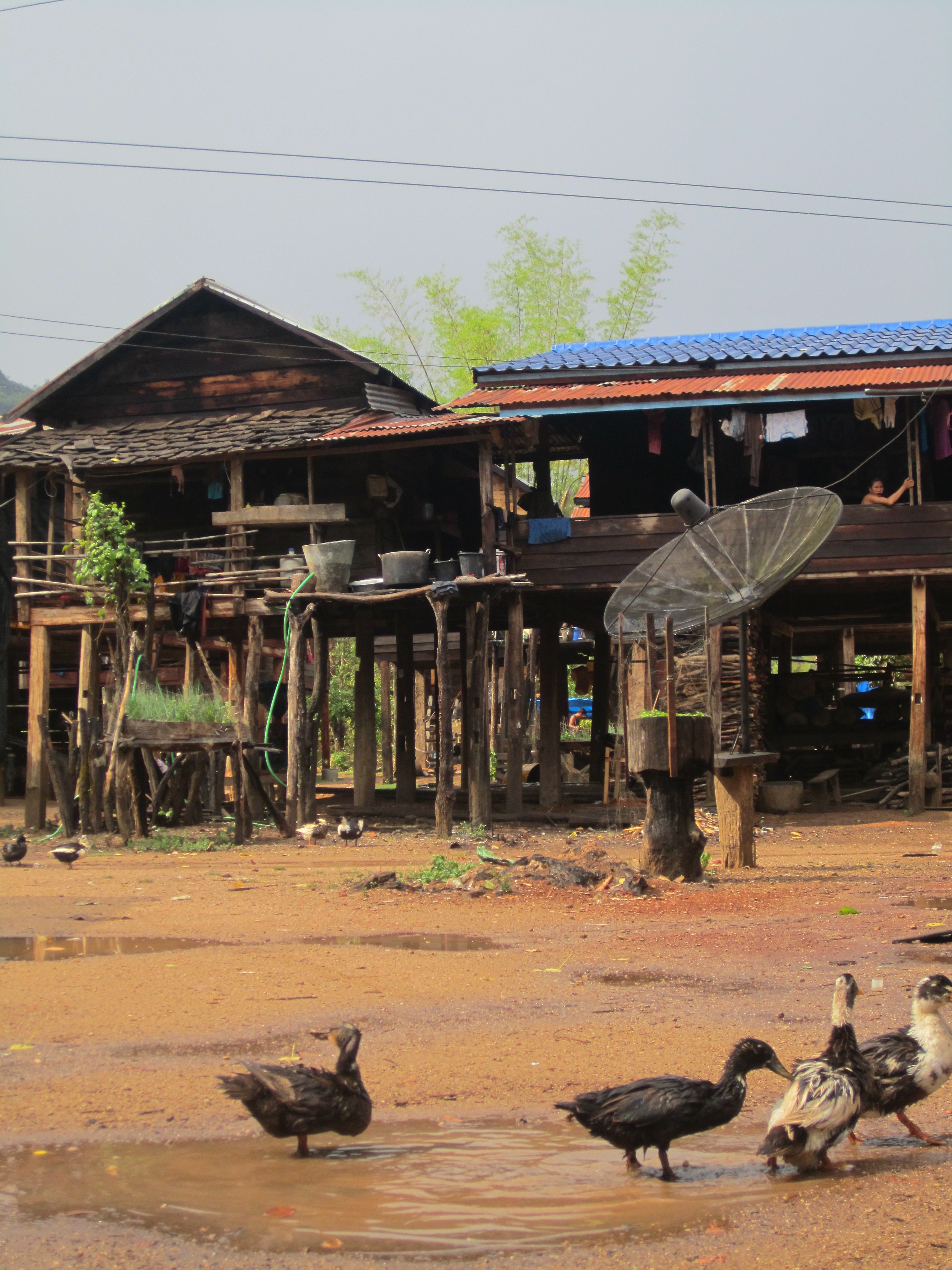
I suppose what struck me most was how much life there was, how much constant movement. It wasn’t exciting like a city, but there was this constant bustle, animals and people, babies of different species. It was intoxicating—I felt like I could sit for hours and just watch it pass.

Again, there seemed to be less divisions: the pig that snorted around today, for instance, could just as easily be dinner tomorrow. Even the land see more involved, more implicated, more imminently a part of life. We talk a lot about sustainable living in the West, but this was the real deal. It wasn’t ideal—there was plenty of trash strewn about, mostly wrappers for the products transported through the cave, and other trash, people still burned. But it was the closest I’d ever seen.

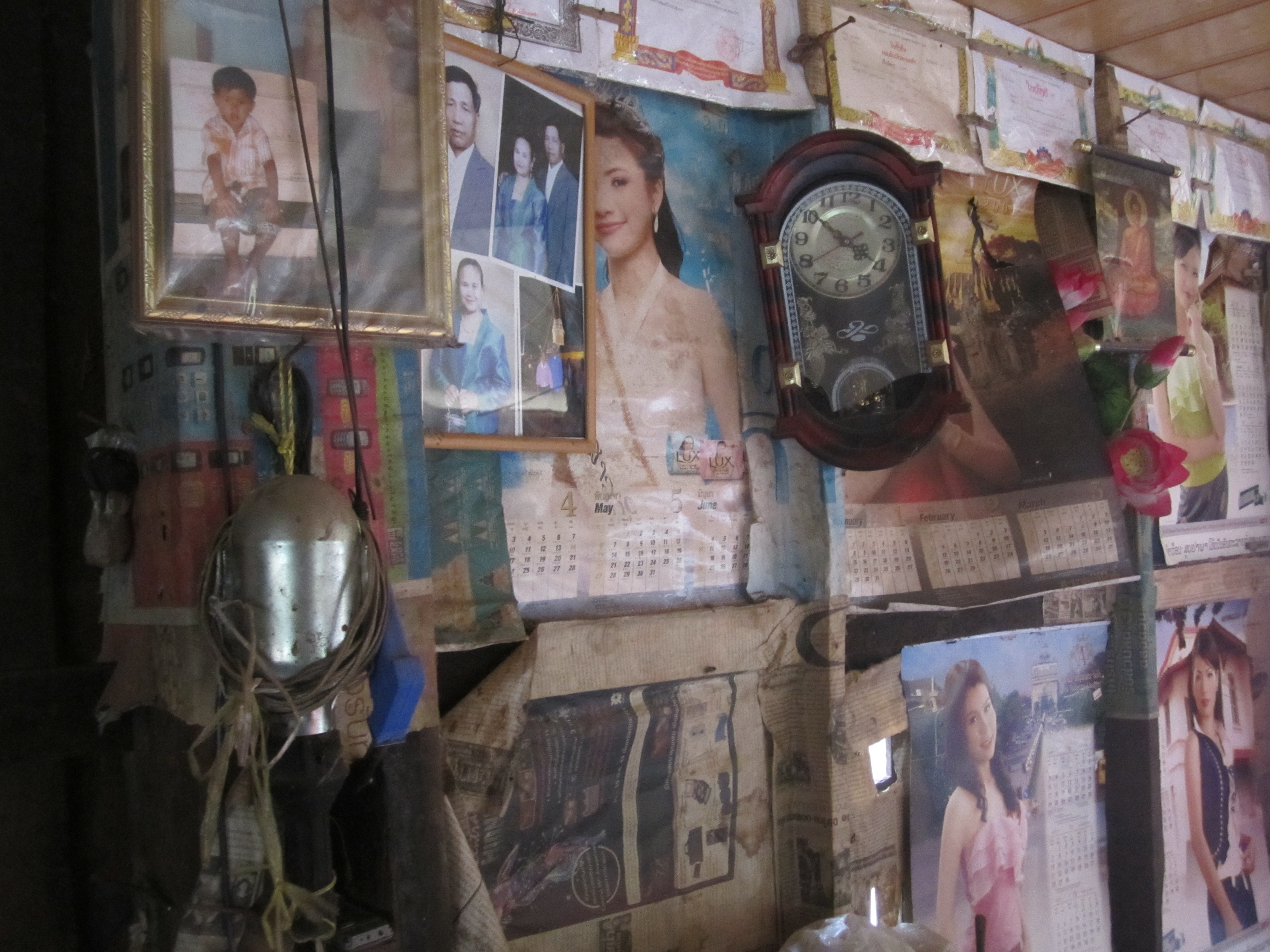
I met Pauline and her supervisor in one of the villages for lunch—another family’s house, another bare wooden room with modest Lao girly posters on the wall, an exposed shoulder, perhaps. On a cot on the floor lay an impossibly thin woman, skin loose on a coat hanger of an arm she raised to readjust her blanket. “She is sick,” Pauline told me, “with cancer.”

I tried not to watch as her family members brought a glass of the murky, purified water to her lips, as they rolled her over, readjusted her pillows. I stared at my frog lunch. These villages were traditional, isolated—and this was part of that too. It wasn’t just the agrarian ideal, the simple life; people here were also poor, didn’t have access to the arguably good aspects of modern life, like health care. It was all fascinating, intoxicating for me, glimpsing in for a few days—but this was these people’s lives. And this, too, was what it looked like.

Later that afternoon, I walked down to the stream by Ban Natane with Pauline. It was where locals bathe, wash clothes, where boys clutch bows and arrows shoot them into the water, actually managing to catch some fish. Pauline laid down on the shallow rocks—clothed, as they do in Laos—and let the water run over her.

“All the people I interview,” she told me, “they all want the tourism. They think it will be a good thing.” She looked over at the boys fishing. “But I’m not so sure. I think they will lose their way of life.” It had already happened, already begun, with the introduction of TV a few months earlier.

I thought of the sallow skin and boney elbow of the woman at lunch. “But who are we to say how their lives should be? If they support the tourism project—” I shrugged, made that French popping noise I’ve picked up— “maybe it will bring positive changes too.”

We talked for a long time about it—about the preservation and loss of culture, about isolation and poverty, about the role of outsiders and tourism, whether it ever does any good or not. I thought of a story I’d heard once, about some now-famous Greek statue that was discovered by Englishmen or Frenchmen, the locals unaware of how valuable and precious it was. They were going to smash it, until the explorers stopped them. I couldn’t remember the name of the statue, or where I heard the story or if it was even true or not. But I thought of broken-off noses and missing limbs in European museums, and wondered if the sanctity of some things might be seen better by outsiders, who have more of world to compare it to.

But again, I thought of the woman on the cot, barely moving. I thought of the earthy taste of the purified water, imagined that taste in her mouth as well as mine.

“There is not an easy answer, I think,” Pauline said, as the water ran over her clothed limbs.

I nodded.

Blessing of String and Sticky Rice: Day One in Ban Natane

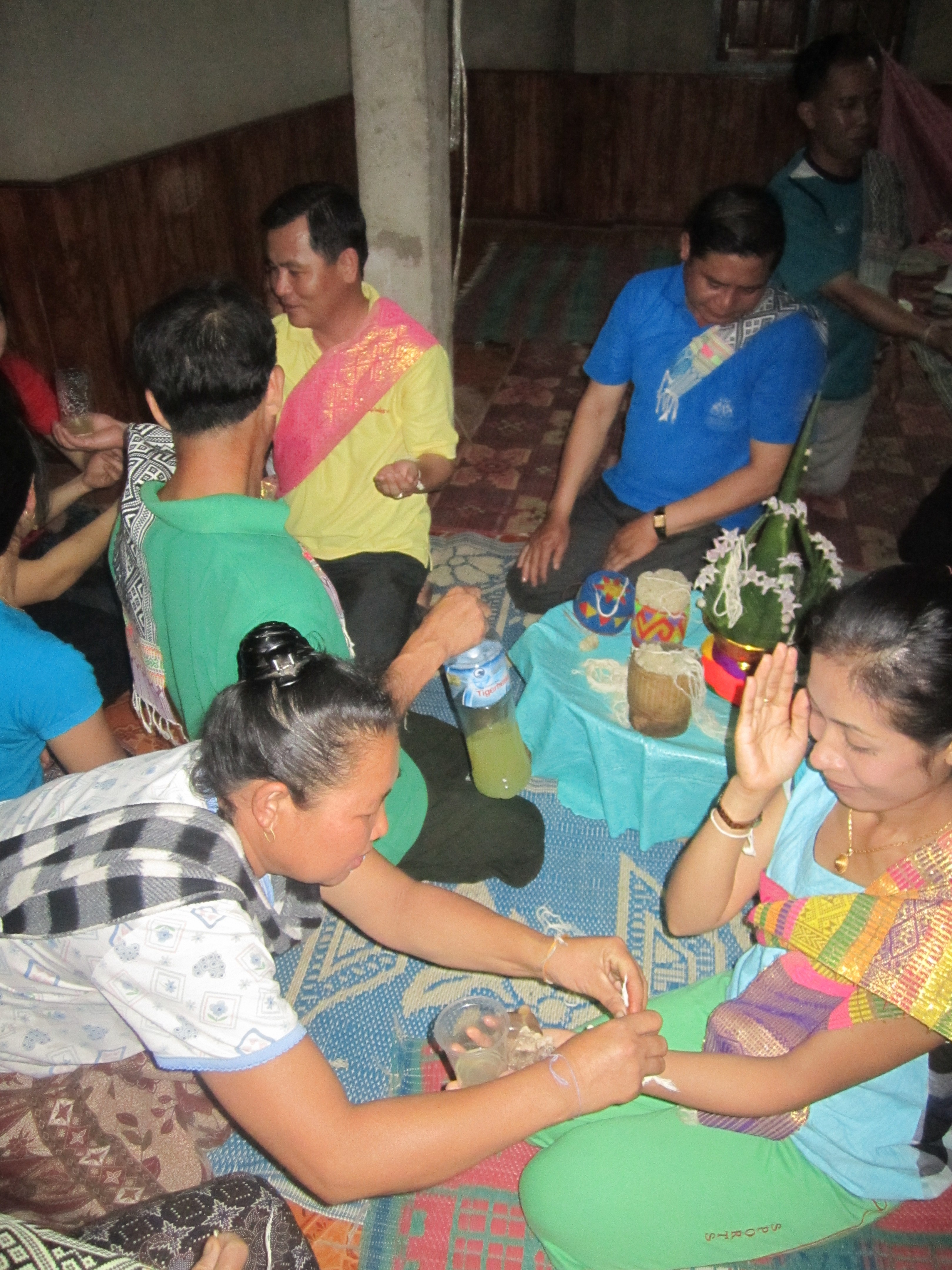
The man held my open palm in his. In it, he placed a small clump of sticky rice and pork. He raised his right hand to his face, murmured blessings in a language I didn’t understand. He waved a piece of string, then tied it around my wrist.

“He wishes you good health, good luck,” Pauline translated.

I smiled, bowed. Outside the open-air room, lightning stuttered the night sky white.

Sometimes you end up some weird-ass places traveling. Not that they’re weird, so much as it’s weird that you’re there, that you ended up there—that the gods of circumstance conspired, whispering in their thunderous perch above grey rock, to bring you there. And it was like that in Ban Natane.

To say Ban Natane is off the beaten path is an understatement. Cut off from the rest of world by impassable roads, the only way to reach it and its neighboring four villages is through the Kong Lo Cave. Which is how I got there.

I met Pauline trolling the town of Ban Na Hin for travel companions. The boat ride through the cave costs 100,000 kip, so I was on the lookout for people to split the ride with. Pauline sat on the computer in front of her guesthouse. As it turned out, she was a French anthropology student doing her Masters research on Ban Natane and its neighbors; she was meeting her local supervisor and translator the next day and headed back to the village for another 10-day stay. “If you’d like to come with us,” she made that characteristic French popping noise, “it’s no problem.”

On the sawng thaew ride to the cave’s entrance, she filled me in the details. A French NGO was sponsoring the development of eco-tourism in the Ban Natane area. To date, all homestays and eco-tourism in the area have focused on the Ban Kong Lo side of the cave—you take a boat ride through, come back and sleep on the more developed side of the cave.

“No one stays on this side,” she told me, “because tourists don’t know the villages are there.” Since the only viable way to reach the villages is through the cave, Ban Natane and its neighbors have remained quite isolated, not reaping the rewards/wealth of tourism. “In all of last year,” Pauline told me, “only 20 tourists came to Ban Natane.”

The eco-tourism project was focused on developing facilities for homestays and training locals to act as guides into the caves and waterfalls that surround the region. Pauline’s project focused on documenting the traditional agricultural way of life, interviewing locals about the history and their feelings about tourism, and then studying the impact.

Emerging

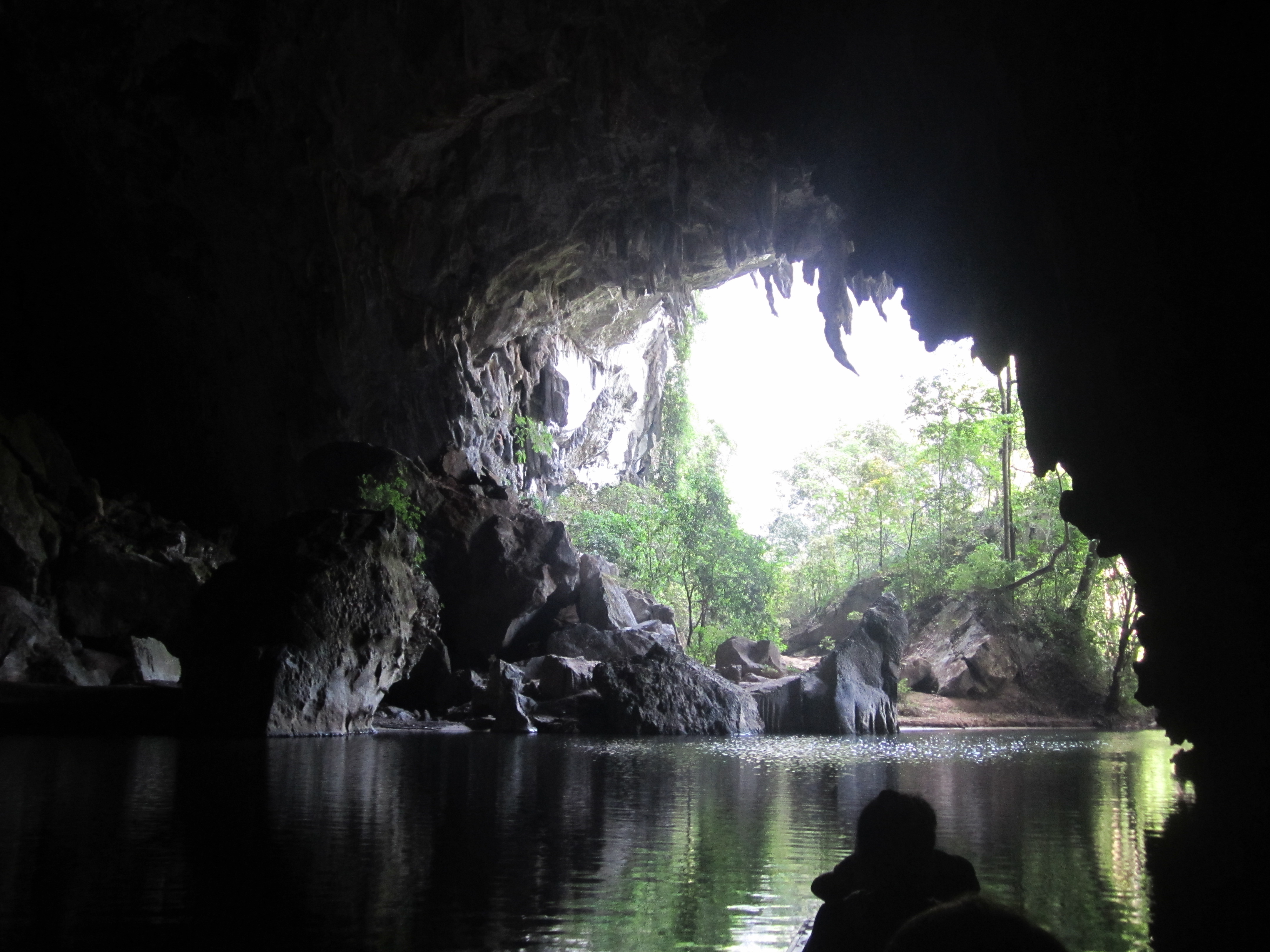
So the Kon Lo cave became, not my destination, but the passageway into another world. Which actually what it felt like—a limestone cavern like a mouth, dripping with stalagmites, the squeal and swoop of bats, where mist floated off the cool water like thin ghosts. It felt like moving through some deeply internal part of the earth, through its innards or petrified organs.

We emerged on the other side. Where most people turn around, we began walking down a dirt road. My cheap flip flops had finally busted, so I walked the 2km barefoot. In the distance, the sky grumbled. We arrived in Ban Natane just as the afternoon storm erupted.

My homestay was with one of the wealthier families in town. They owned the town’s only shop (and thus had packets of Nescafe in abundance), goods that had all been transported on skinny wooden boats through the cave, as they had been for generations. Even the TV. “TV only arrived here three months ago,” Pauline told me. “So the children,” she gestured towards the little ones gathered rapt around the glowing screen, “they are like this.”

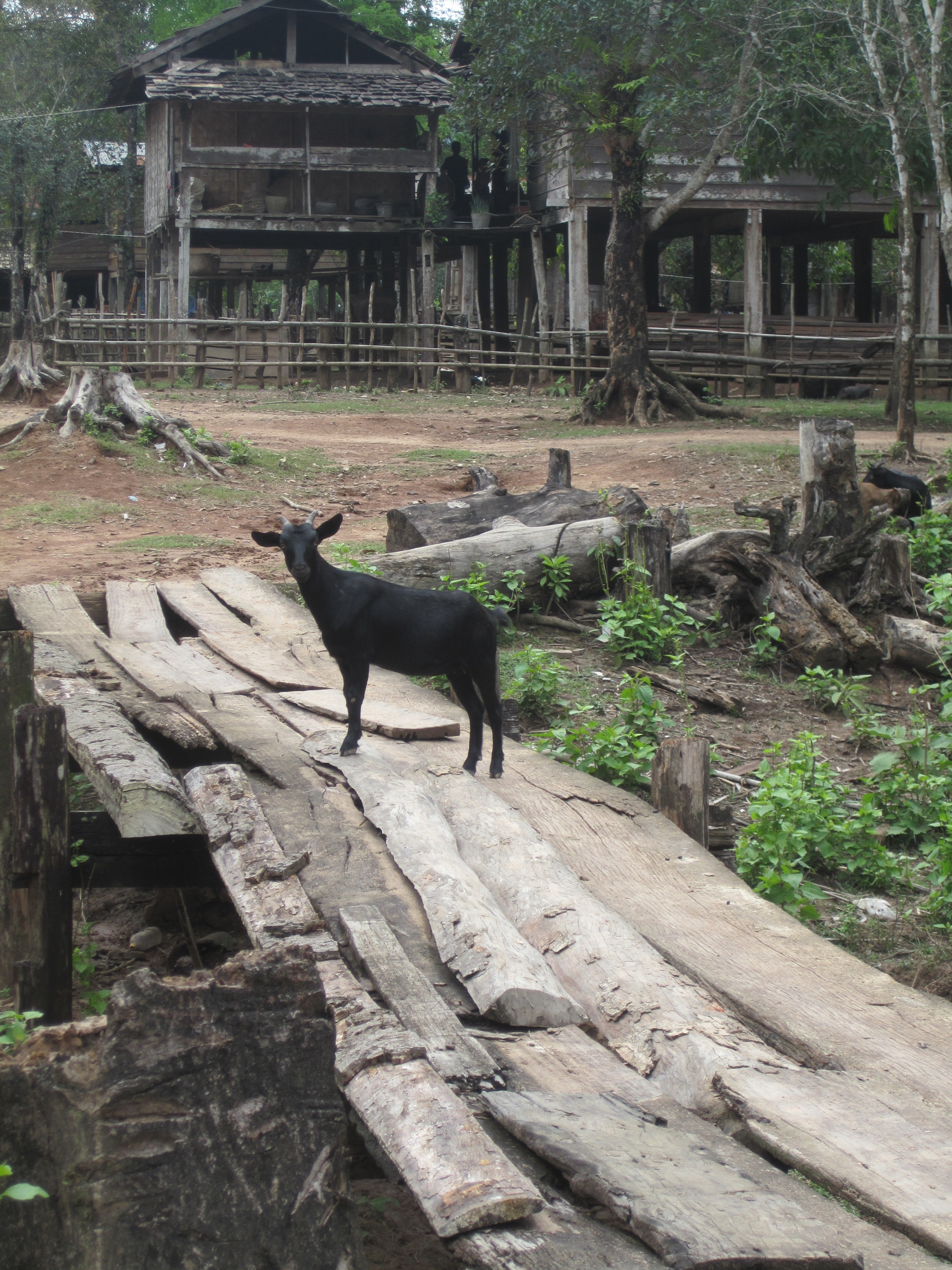
The storm cleared and she showed me around the village. Everything enthralled me—I am, as previously admitted, a total city kid, so the presence alone of ducks, pigs, chickens and goats was thrilling, let alone the sarongs and hoes and looms beneath the stilted houses.

We shared dinner with the family that night, as we would for all our meals during my 2-day stay. As isolated as it is, the food was all local, not by trend as it is in the Bay Area, but by necessity—foraged snails, fish, frogs. “Frog season has just started,” Pauline translated from her Lao supervisor, “so we will eat a lot of frog.” (Sure enough, I had it 4 meals in a row.)

Walking that night, we three were called over to a large house. I could tell it was a wealthy person’s home because it had a ground floor, constructed of brick—like the TVs, this was new, Pauline told me, as traditional homes were all stilted and wooden. “It means you need more space, and have the money to build it.” She paused. “So modernity is already coming.”

Men sat on the floor around a type of altar, banana-leaf adorned in white flowers. It wasn’t a mystical vibe—they sat in polo shirts and slacks, chatting casually. A large silver bowl of pig parts, a leg and half a head, lay beside baskets of sticky rice.

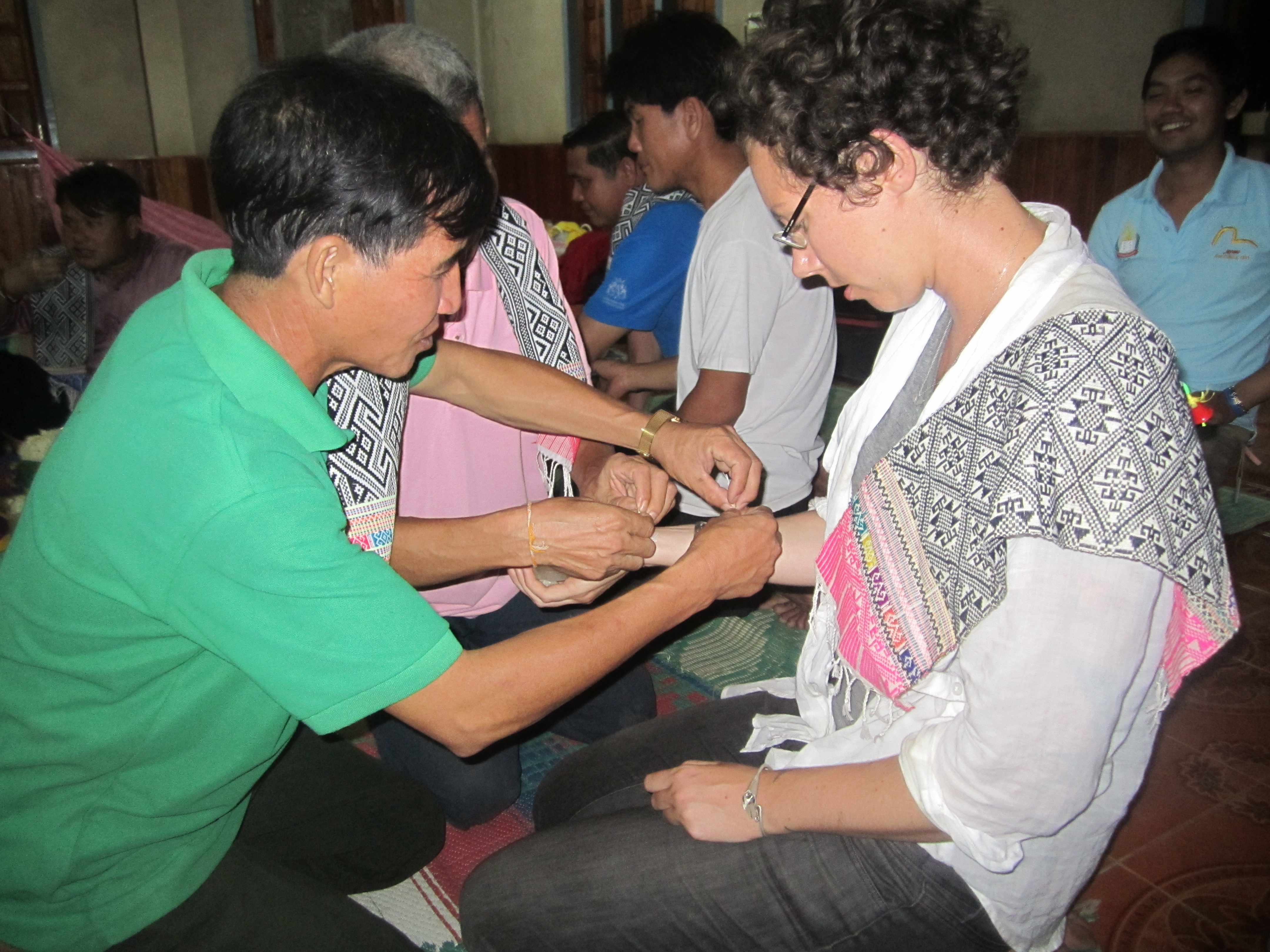
We were motioned to sit, a village-made scarf thrown over our left shoulders. The man in charge began talking—“a blessing,” Pauline whispered. He held another man’s open palm, put a clump of food and a plastic cup of lao lao in it, chanted, tied the string. Then everyone commenced to bless each other.

“It’s a ceremony called baci,” Pauline translated. “They’re having it for special visitors—the district chief came today.” People took photos with digital cameras; I assumed those to be the wealthy and important visitors.

We were soon called into the mix. I wound up with a bangle of string around my right wrist and an even fuller tummy. The storms continued in the sky outside. Old men smiled as they blessed me, as they blessed each other.

And I had one of those moments when your life feels like a dream, some foreign place you don’t quite understand how you ended up in. Yes, I rode an old wooden boat through a cave and walked down a dirt road—but how I really got to Ban Natane or that ceremony, I suspected, had little to do with that. It didn’t make sense, to my Western mind, why I’d be so welcomed, so embraced here.

And so blessed.

***

Travel Tips: Getting to Ban Natane

It’s actually pretty simple, even if you don’t have an anthropologist as your guide. Take your day bag, sturdy plastic sandals, a good flashlight and some snacks with you on your boat ride. It’ll still cost 100,000 kip, even if you only take it one way. So it goes.

Get off at the snack stands. Only buy the snacks if you’re desperate; since they have to be transported through the cave, they’re fuck-all expensive. Anyway, there’ll be a blue sign that haphazardly explains the homestays:

From the snack stands, there’s two dirt roads. Facing the sign, Ban Natane is down the road to your left. Straight ahead, across the bridge, is another closer village, though from what I understand, there’s less facilities for homestays. If you arrive in Ban Natane and say “homestay,” you’ll get hooked up. Or just show up and look like a Westerner, and they’ll know what to do with you.

Bringing a Lao phrasebook would be goddamn useful. There may be some people floating around who speak a few scraps of English; there’s rumored to be an English teacher at the school in the village, though she was out of town when I was there. If you can manage to communicate, there’s bikes you can rent or a couple good treks to go on, if it’s the dry season. Next month, an NGO will be holding a tour guide training course for locals, so I imagine there will be much more in the way of communication and tour options shortly.

Bananas and Plastic Bows: Sawng Thaew to Kong Lo Cave

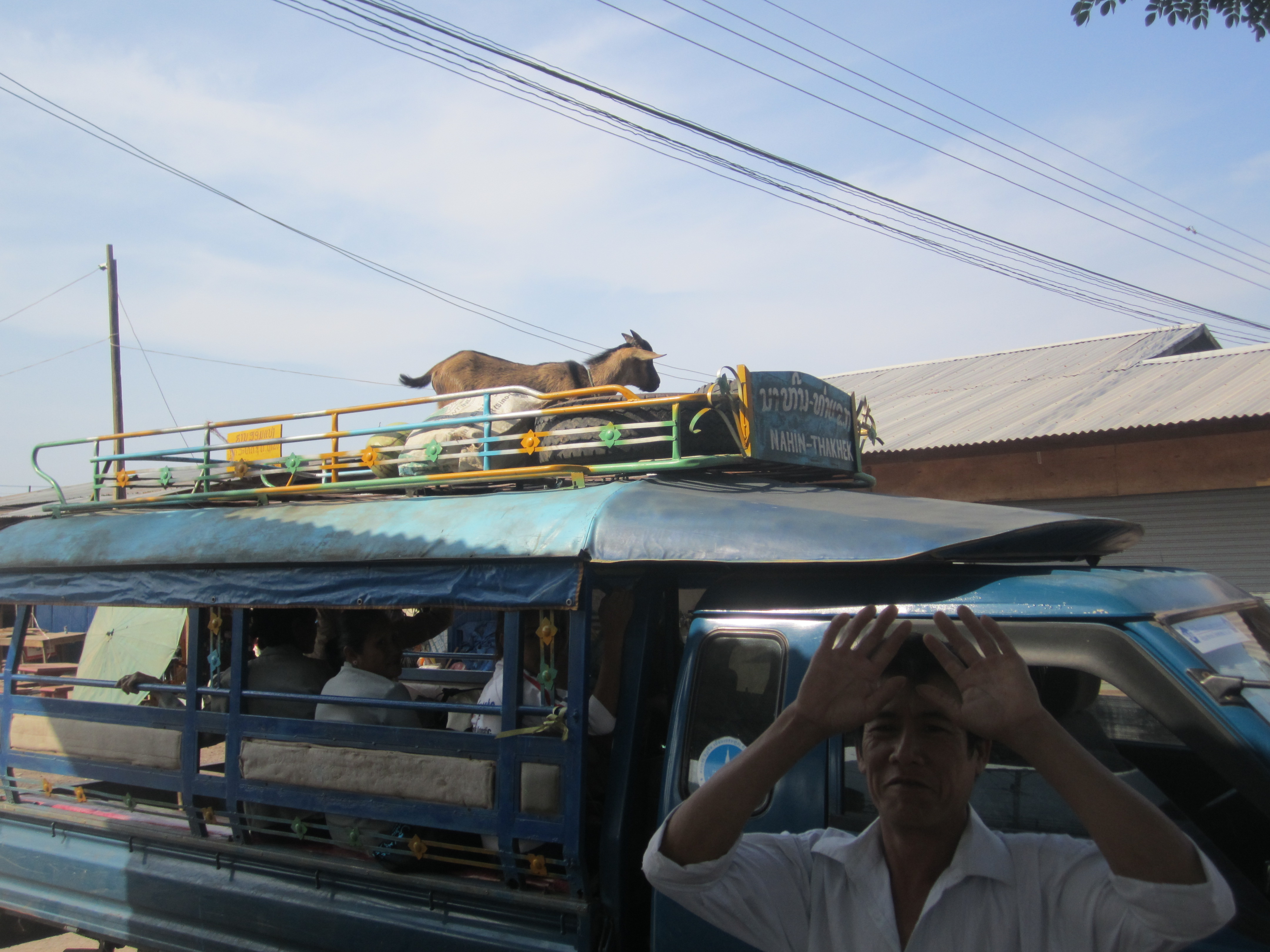
Goat on the roof. Friendly driver.

Salt-and-pepper hair beneath a worn military cap, high cheekbones and pursed lips. He squeezes the bananas I’m clutching through their plastic bag, says something in Lao.

I smile, shake my head. He repeats; I repeat. He nods.

I can’t tell if he approves of the bananas or not.

When I climbed on the sawng thaew in Ban Na Hin, the old man slid over, made room for me between the empty gasoline barrels and bags of cabbage. We rumbled around the market. Old women climbed on with pink bags, still-alive fish flopping inside, while the driver kept climbing on the roof, adding to the goods secured atop: sacks of rice, a goat and my dusty red backpack.

The old man nudged me. “Kong Lo?” I nodded. He nodded. But where else would I have been going?

We headed out down the two-lane highway, lined with construction lots and signs for a Ford Motors Center. The main industry in Ban Na Hin isn’t tourism—as evidenced by the single-room tourism office surrounded by grass-chewing cows—but the nearby hydro-electric plant. The handful of guesthouses that run the length of the town’s main road are an afterthought, and the English spoken is minimal.

Despite this, Ban Na Hin is still the closest town to the Kon Lo Cave, a 7.5km limestone tunnel that’s purported to be creepy as shit and mildly reminiscent of the Greek underworld. But, 40-some winding kilometers from a main highway and serviced only by local buses and sawng thaew (pick-up trucks with two benches in the truckbed), what would be a top tourist attraction in any other country remains fairly off-the-beaten-path in Laos. Which, as much as the cave itself, is what lured me out here—after Vientiane and Luang Prabang, I was tourism-weary and in the mood for adventure.

So I don’t mind as it takes two hours to go the 45km to Kon Lo. Past rock that jutted from the earth like jagged teeth, past slash-and-burn fields were the land looked as though it were gasping—we stop at every village, delivering groceries, dropping off canisters of gasoline. I watch the landscape, the farms, the clouds that ito the rock like scraps of cloth that had been ripped off. And I people-watch.

And now, slyly, I study the old man beside me. He has soft yellow skin the texture of crushed silk. I notice on his sleeve, he has small plastic bows haphazardly safety-pinned on. Beside his army-green cap, I imagine them as military decorations, badges from a make-believe army. I imagine them as gifts from grandchildren, secured to his shirt and forgotten about.

I pull out my notebook, to jot down the image between the bumps that stutter my handwriting across the page. He leans over, looks at the notebook, watches me write. He nods as though he understands.

I can’t tell if he approves or not.

I smile, point to the plastic bow on his sleeve. He laughs. I give a thumbs-up.

He tugs his sleeve, begins to unfasten one of the pins. He takes my sleeve, pins the bow. I touch it, smile. He laughs. I laugh.

(A little later on the ride, I discover what the bows are: a bunch of teenagers lining the road come up to the sawng thaew and, through the poles, pin bows to our shirts. They smile and sing, holding out a collection for something.)

The sawng thaew thins of its passengers and produce as we rumble along. A tank of a woman with a soft, laughing face pushes her way out, waves at me. We stretch our legs in the luxurious space.

The old man waves his arm at the driver, stands to a hunch beneath the truck bed’s dome. I tap him as he begins to shuffle off.

I open my plastic bag and hand him a banana.

He smiles. I laugh, he laughs.

I think he approves.

He steps off the back of the truck, place his hands together and bows his head. I repeat.

***

Travel Tips: Getting to Kong Lo Cave

While researching Kong Lo Cave, the number one concern I encountered was over transport. The LP doesn’t have much info and it seems as though the lack of direct buses deters a lot of people from visiting.

Here’s the deal: Kong Lo and the nearby Ban Na Hin (nearest town, with guesthouses and an ATM) lie along Highway 8, which moves east from Highway 13. All buses between Vientiane/Paksan and Tha Khaek/Savanaket run down Highway 13, so the route you will often read recommended is to take one of these buses running along the 13, ask to get off at the junction, then take a sawng thaew to Ban Na Hin, where you can then take another sawng thaew to Kon Lo Cave or the nearby town, Ban Kong Lo, where it’s possible to homestay.

Another friendly fellow

I think it’s the transfers that deter people. It;s actually a lot less dodgy than it sounds. There’s enough of a trickle of backpackers that the bus drivers know where you’re headed—there’s not much else out here for tourists. Sawng thaew run from the junction to Ban Na Hin every 30-or-so minutes during the daytime, and there are supposedly a few direct sawng thaew to Ban Kong Lo every day, though it probably wouldn’t be worth waiting for those.

From Vientiane, there’s only one VIP bus to Tha Khaek a day at an inconvenient 1pm—journey takes about 6-7 hours, so you’d potentially be looking at doing the transfer after dark. Local buses, though, run every half hour beginning at 6am. They cost 60,000 kip, regardless of whether you get off at the junction or the final destination.

There’s also local buses to Lak Soa, the biggest town along Highway 8. The advantage of this bus is that you negate the feared transfer at the junction. These buses leave Vientiane every 2 hours, beginning also at 6am, and cost 75,000. This is the bus I took, and I recommend it: it was early enough in the day that the lack of AC was bearable, and even with a break-down, I still arrive in Ban Na Hin at 1pm.

I’ve also been told that there’s one daily bus directly from Vientiane to Ban Kong Lo that leaves between 9-10am. However, if there’s not enough people, the bus will be canceled, so it’s probably best not to risk it.

From Ban Na Hin, though, there’s only three official sawng thaew per day to Kong Lo—more evidence of the undeveloped tourist facilities. The first leaves the town bus station at 10-ish, the others at 1 and 3-ish. But in reality, they seem to leave more often than that. Otherwise, you’re looking at arranging private transport, about 100,000 kip versus the 25,000 for the bus.

Coming from the South, it appears as though your best bets would be to take a sawng thaew from Tha Khaek, which is well-connected to Savannakhet and Pakse, or one of the buses coming up the 13 and doing the transfer. I did meet some grumpy Brits who had gotten on the wrong bus and had the journey take a day and a half—”All this for a bloody cave.”

Which brings me to my biggest recommendation: treat the whole thing as journey-is-the-destination adventure. Don’t focus on just Getting To The Cave—everyone I met who did this seemed fairly annoyed, or at least had to qualify it with “worth the trek.” I was armed with snacks and in the mindset of “well, let’s see where this leads,” and I had a grand ole’ time.

Born Into This: Inheriting War in SE Asia

It was really not the time to be thinking of Charles Bukowski.

I stood staring at a display of UXO casings at a Phonsavan tour company. I was thinking of the documentary I’d seen the night before (see previous post), which followed a group of impoverished Lao children as they harvested UXOs for scrap metal.

Something panged in me, and I thought of the poem.

It was the same something I’d felt at the War Remnants Museum in Saigon. I stood before pictures of children born with mutations from Agent Orange—small and crippled and bubble-skinned—children who’d been born after the war, hadn’t lived through the war, but who had it in them, possessed it in their DNA. If the images hadn’t been so brutal, I’d thought, they’d have been a metaphor for the intergenerational transmission of trauma.

I’d been surprised in Vietnam, to discover how much of the war I’d carried in me, without knowing it. I hadn’t realized how much a part of American culture the Vietnam War is—in our books, our films, our movies and our freeway exits, cardboard signs and thousand-yard stares. I’d remembered, suddenly, visiting the Vietnam War Memorial in Washington DC as a teenager—muggy-skied and sweating, watching the grown-ups trace hands along the reflective stone, place flowers and cry—not understanding it. I’d turned; my mom had been one of them, the name of her cousin under her fingers.

And I’d suddenly remembered the poem.

It’s more muddled in Cambodia and Laos, places were the American activity was “secret”—it’s less a part of your consciousness, more a part of something else that you can’t quite name.

“People from my province,” the Cambodian boy looked sheepish as he told me, “they still hate Americans. For the bombings.”

I nodded one, two, three times. “And you know what? America bombed Cambodia in secret. And most Americans still don’t know about those bombings.”

We sat beside each other waiting for our numbers to be called at the cell phone shop. Neither of us had been alive during the 70s.

I’d wondered, as I looked at bomb ponds beside pre-Angkorian temples in Cambodia, how one goes about being American in all this. “‘I wasn’t born yet,'” I wrote, “doesn’t seem good enough.”

And looking at the pile of UXOs in Phonsavan, I had the same thought rise. Because the kids out there harvesting these bombs, they weren’t born yet either. Neither of us asked for this, did this, witnessed this, lived through this. We were born into this, are left to figure out what to do with this, dig through the dirt of this.

And that’s when I thought of the poem again.

I’ve been composing some kind of essay in the back of my head about all this. I don’t know exactly what I have to say about it yet, or if there is anything to say about it. But in the meantime, I’m thinking of a poem that seems fitting. And, in the light of the recent string of natural and political disasters, doesn’t seem so dramatic or fanciful as it once did. It doesn’t feel so hopeless either—it just feels accurate.

Scrap Metal and Tourist Scars in Phonsavan

On a small stand in the Phonsavan tourism office, bracelets are for sale.

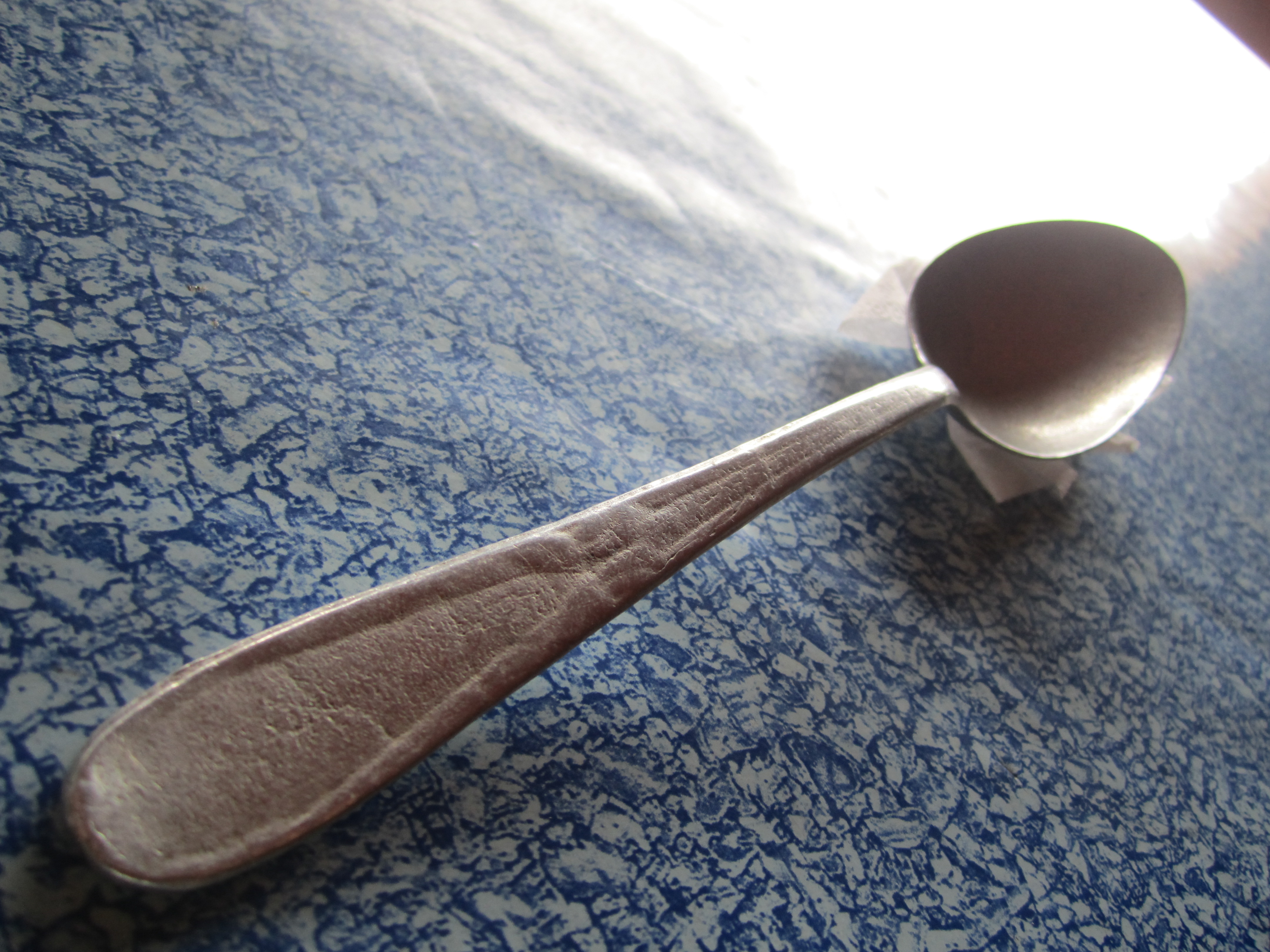
So is flatware. They sit beside a postcard that reads “Make Spoons Not War.” Beside cartoon posters depicting the Dos and Don’ts of respectable Lao tourism, posted leaflets encourage you to purchase items made by villages out of metal scraped from the UXOs (unexploded ordinances) that continue to claim lives and limbs. From tragedy to hope, a brighter future for impoverished locals—your tourist dollars can make a difference.

Or something like that.

Phonsavan is an emerging tourist destination in Northern Laos. Its only draw is the scars of enigmatic history: a landscape scattered of mysterious, 2000-year-old stone jars (think Stonehenge in circular formation), and bomb craters and UXOs. The juxtaposition has, in the last few years, landed the grizzlied town on the independent traveler route, with broader tourism looming ahead like the black storm clouds of an early rainy season.

For now, the town remains rough-and-tumble and charm-challenged. A series of squalid guesthouses line its one sidewalked road. A handful of tour offices litter the same road. It’s the kind of place where you arrive, in a mid-afternoon downpour that muddies your shoes and seeps through your backpack, and think—Get In, Get Out, Get Gone.

I spent the rest of the afternoon wandering around the town. I cruised the local market, bought some rice-paper rolls and steamed greens; the hunched old woman smiled at me and refused money for the greens.

I passed Craters Restaurant; decidedly Western, it had a makeshift fence of UXO shells. It felt cheeky, performative, self-conscious—something about it didn’t sit right. But I hadn’t had my requisite three fruit shakes that day, so I sat down and watched the traffic pass.

Across the street, the sign for MAG peeked through the bomb-shell fence. The most prominent UXO-clearing agency in Laos, MAG works both to defuse and remove UXOs, and educate local communities about their dangers. They screen a few documentaries on a small TV set every evening; I left Craters and went to watch that night’s showing of Bomb Harvest.

The documentary traces the work of MAG. It’s somewhat sensationalist and self-congratulatory (“In bomb disposal, you only make one mistake”), but overall the film achieves a really good end: educating people on the realities of UXOs in Laos today.

I’d known they existed; I had more than a passing familiarity with the devastation of US secret bombing in the country. And I knew that UXOs continued to kill and maim people throughout Laos. What I didn’t know was that scrap metal had become the new cash crop. And tourism, I’d discover the next day, was fueling it.

The basic story is this: in a country as poor as Laos, a lot of subsistence farmers struggle to feed themselves. The scrap metal peeled from UXOs fetches a fair dollar—some $100 for large casings. It may not sound like a lot to risk your life for, but when you don’t have enough to eat, your life is risked already. Despite public education campaigns, people continue to harvest and sell UXOs—many of them children.

In addition to selling scrap metal, locals began to use casings for planter boxes and building supports. As tourism trickled in to the Plain of Jars sites, Westerners were charmed with the aesthetic and ingenuity of this repurposing. Tourist-geared establishments are now getting on the bandwagon.

With this backdrop, I eyed the scrap metal bracelets carefully. I liked the idea of them, liked the feel of the dented metal and the notion that I could both accessorize and ease my American guilt. “It helps the local people make money,” our tour guide explained.

“Do they make the bracelets from harvested UXOs?” I asked.

He nodded.

“But isn’t that very dangerous? Don’t people die that way?”

He nodded again, this time more reluctantly.

I slid the bracelet off and placed it back down.

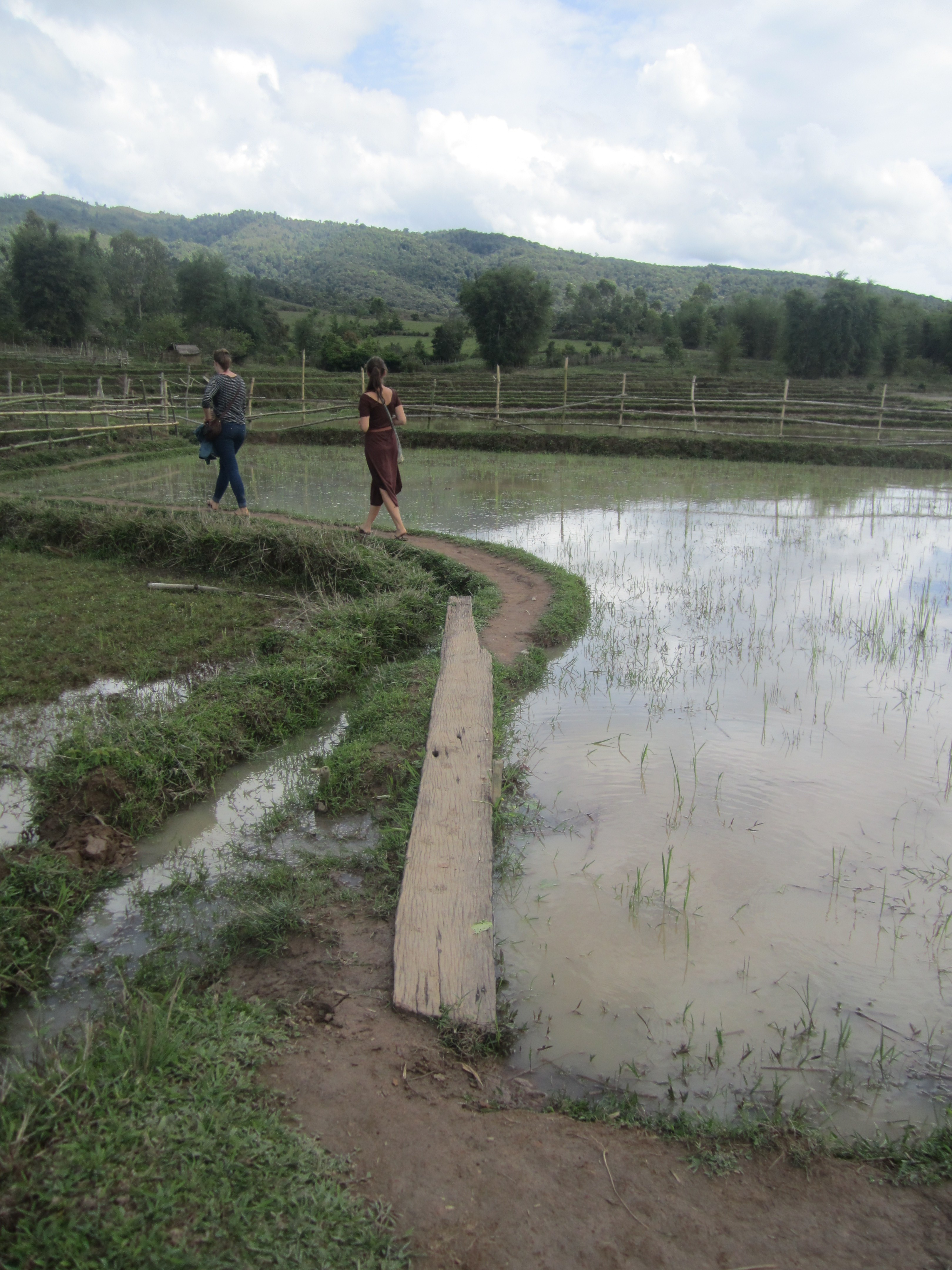
Our tour continued on bumpy muddy roads. We trailed one other 6-person group, but largely had the sites to ourselves. To get to one of the sites, we tromped through rain-soaked rice fields, down wooden slats and past families bathing in brown water.

Tourists, our guide told us, had only been coming to the sites in the last few years. There were plans to pave the roads, our guide told us; an international airport would soon open near the town. Only 15 sites of jar sites were currently open; several more were being de-mined. You got the feeling that mass tourism was just around the corner.

We stopped at a modest farm house. Standing behind the bamboo fence, our guide pointed our the bomb casings used as supports for the barn. We snapped photos. “Not many houses still like this,” our guide said. “Now, the casings are mostly sold to guesthouses and hotels, for decoration.”

I thought of Craters Restaurant and cringed.

Tourism can bring a lot of good to a community. Phonsavan is poised to become more wealthy because of it. But I thought of the children I’d seen in Bomb Harvest, carefully digging through the earth, crude metal detectors and frightened eyes, and wondered at what cost.

It’s hard to always be informed about where your tourist dollars go. Over lunch, I had a long discussion with a British couple about their experience volunteering at a “real” elephant sanctuary in Thailand. They told me about the farcical nature of most eco-parks, how the Thai government worked to block the release of information about the real conditions of the animals, information that would surely hinder the precious money brought in by Westerns who unwittingly wanted to ride elephants.

“And the sad thing,” I remarked, “is that all those people think they’re helping, that their money is going towards some kind of solution.”

They nodded. I leaned slightly and slurped another mouthful of rice noodles.
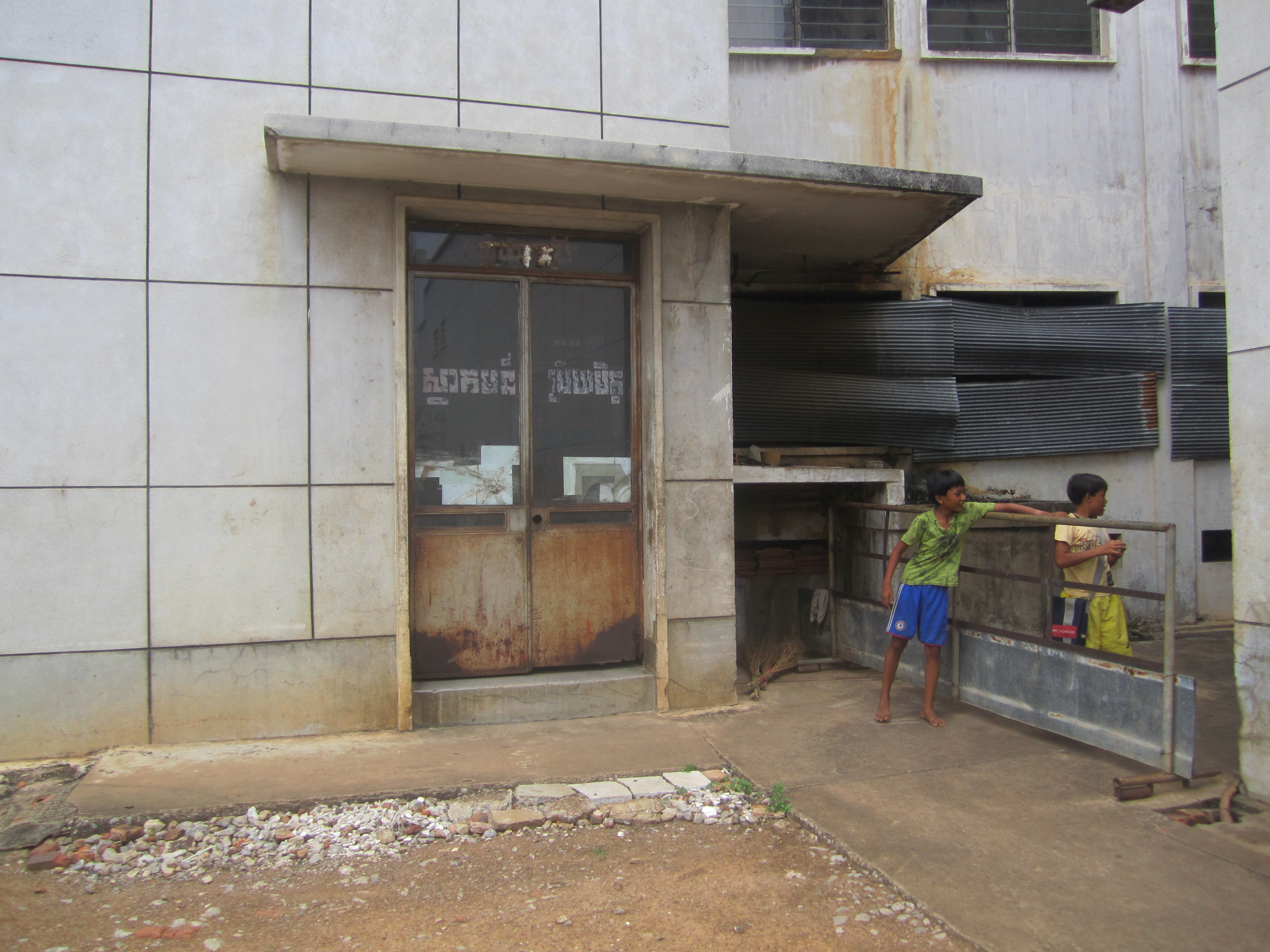
My spoon, I realized, thumbing its texture, was made of scrap metal.

***

Travel Tips: Phonsavan

Phonsavan is well-connected to provincial capitals and tourist destinations. I took a minivan from Luang Prabang, a bumpy and cramped 7-hour affairs; a bus would have been 9 hours. I took the overnight VIP bus back to Vientiane, getting about 2 hours total of sleep.

Guesthouses are in a sad state in Phonsavan, especially in the budget range. I ended up at the LP-recommended Kong Keo Guesthouse. It wasn’t great by any means and I’d read some sketchy things about the owner, but after checking out three other guesthouses, it was still the least squalid.

A tour of the Plain of Jars sites seems to be the best option, especially if you can buddy up with some people. The sites are pretty far apart, so you’ll need some transport anyway. We paid 150,000 kip (little under $20) each for a group of six, which included lunch. The guide was knowledgeable, and there’s plenty of outfitters to chose from.

Fellow travelers tend to be pretty friendly and less Spring-Break-ish than the backpackers I’d encountered in Vientiane and Luang Prabang, so teaming up should be easy. Definitely visit in the dry season, until the roads are paved and facilities modernized; it was super muddy, and Site 3 becomes impassable during the rainy season.

The only Wifi I found in the town was at the Western and fairly decent Vanaloun Cafe, along the main drag. Wifi is free, espresso drinks passable, and the breakfast was actually pretty good and not too expensive. They also have a small guesthouse. Might be worth checking out, though a girl I met in the cafe told me she couldn’t ever find the shower.

Travel Tip: Accessories Will Save You

Now really, there is just no need for this.

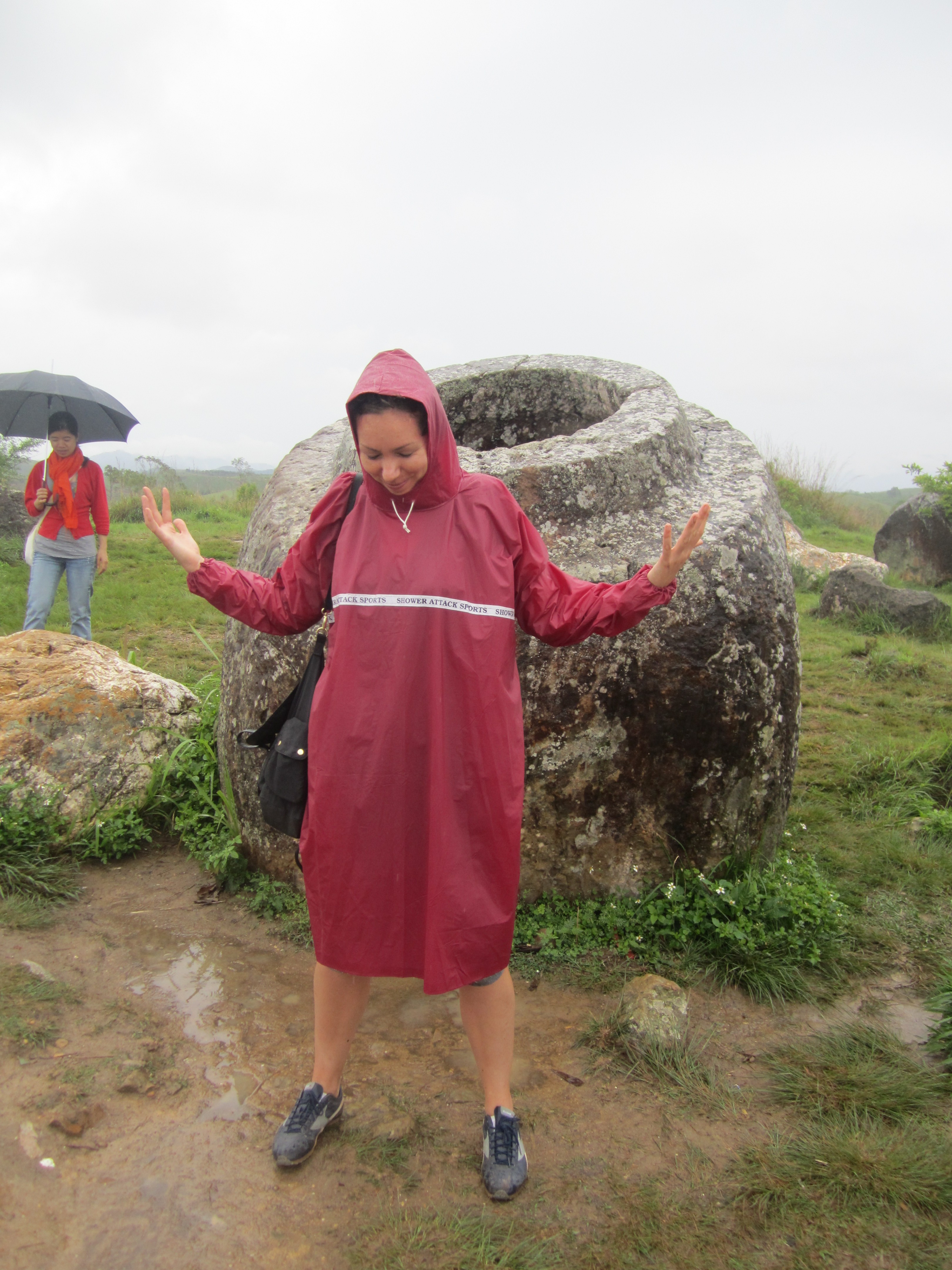
The rainy season may have arrived early in Laos this year. But think that means you’ve got to tromp around in ugly boots and plastic tarps?

I say nay. I say accessorize.

I once heard on Oprah that the difference between people and animals is our ability to accessorize. I couldn’t agree more. Enough of these chimpanzees in zip-off pants and Tevas. A proper display of one’s humanity obviously includes a few well-chosen statement pieces that take you from Backpacker Bum to Hobo Chic.

Take the belt. It is perhaps the most crucial travel fashion accessory—it is both practical and stylish. Kate Middleton recently made heads turn when she left the Buckingham Palace for a post-wedding getaway in a belted blue dress. There’s no reason one can’t have the same effect at tourist attractions in Laos.

The $2 plastic poncho purchased at the town market may not scream “Style Icon.” It may not be the most form-flattering and may make you feel like you’re wearing a sweaty trash bag with a too-small head hole. But don’t let that get you down.

Throw on that handy belt you’ve packed, and you suddenly have both a waistline and a powerful statement to make: “I will not be held back by weather conditions, budgetary restrictions nor poor local fashion standards.”

Yes, you can hold your head high, your pants up and your waistline in, all with one well-chosen and easily packable accessory. Oprah would be proud.

April 25: Sobreity and Getting Stolen From

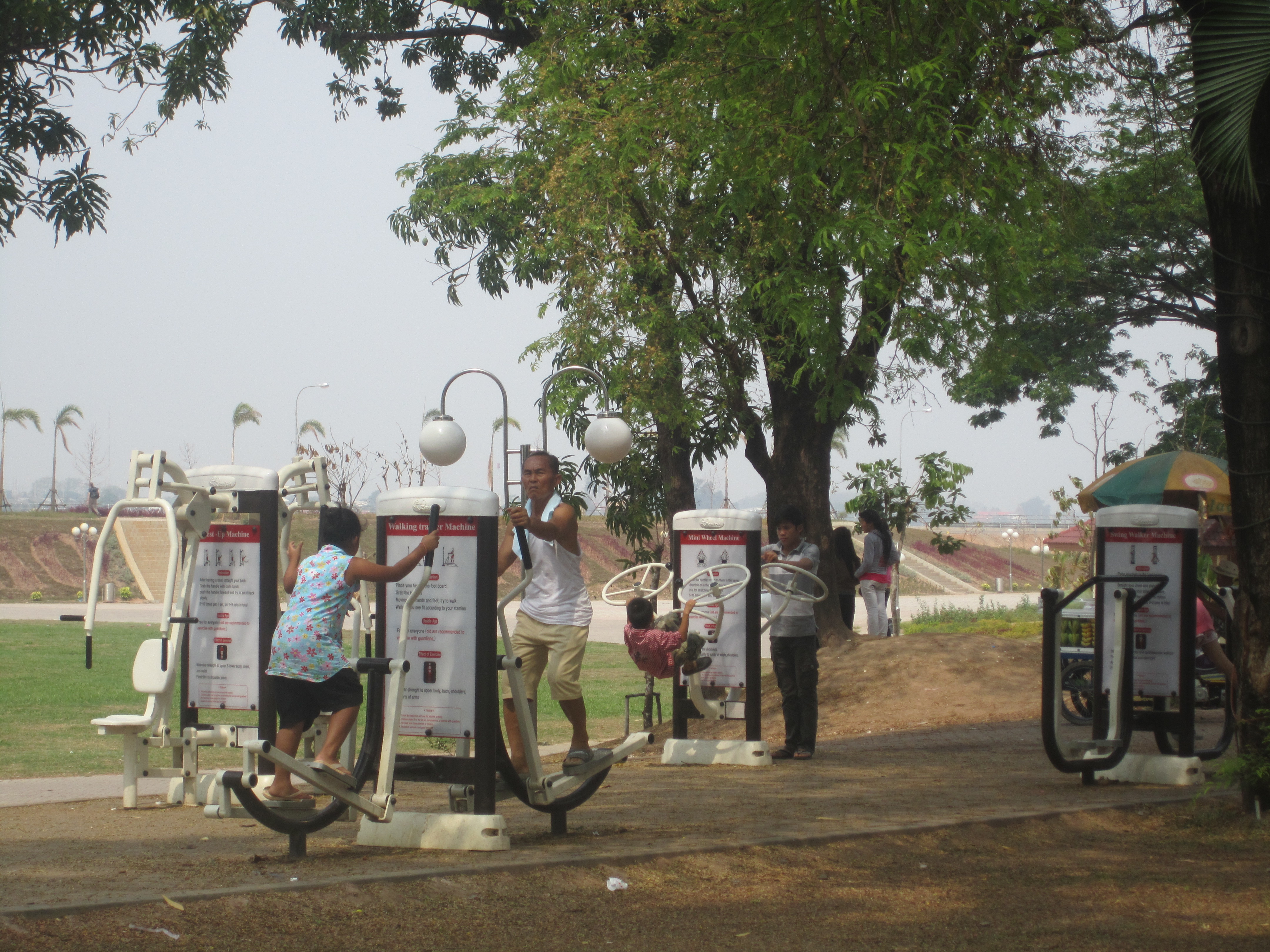
Didn't take many picture in Vientiane. So here's one of people on the exercise equipment along the riverside.

Vientiane, April 25th: it was one of those perfect days. Until I found the money missing.

April 25th is my sobriety birthday, the day I get to think to myself—“This is the number of years my life has been getting better.” This year was eleven. Eleven years of slowly, sometimes painfully, learning to live in the world and in my own body without killing myself. It’s a pretty good thing to celebrate, not in a balloons-and-cake kind of way, but in a way that’s stiller, sweeter.

The theme of the day, I’d decided, was self-cafe. Which didn’t seem like it would be hard to achieve in Vientiane. We’d arrived the previous morning, slept off our 24-hour-bus-ride aches and spent the afternoon strolling around the town, eating at the local night market, reveling in all the differences from Cambodia (“Sidewalks!”).

The air was lighter, softer in Vientiane. We were farther north, and it was cooler, an oppressive edge eased. The streets were free of rubbish, and the traffic was mellow, orderly even—girls in sarongs riding side-saddle, holding frilly sun umbrellas. With its shady streets and fountain square, its cafes and riverside promenade, the city felt—I hate to say it—European.

Everyone had talked about how insanely mellow Laos is, how when you cross the border you exhale this breath you hadn’t know you’d been holding. And it was like that for me. So I decided to mellow out with it. April 25, there’d be no hard-core traveler shit, just doing things that felt good for me.

So I spent a couple hours writing in the morning, then went for fruit shakes and Western salads. We took a tuk-tuk out to a fitness center recommended by the guidebook; I ran sprints on the treadmill, swam in the pool, read in the sun, drank fancy coffee, got an hour-long massage. We went back into town and my friends treated me to Indian food. Cool air blew off the river, and I felt healthy, serene, filled with a simple kind of gratitude you don’t need words for.

“This has been a fucking great day,” I told my friends as we walked back to the guesthouse. “Really, guys—thanks for sharing it with me.”

I needed to stop off at our room to grab some more cash. I’d changed a bunch of US dollars the day before, and I never like to walk around with too much money on me—a lesson learned, I suppose, growing up in Oakland. I know you’re not supposed to leave anything of value in hotel rooms, but it always seemed a toss up to me. And in six years of traveling, I’d never had a problem.

Housekeeping had come, we noticed: fresh towels and soap packets. I reached into my bag, a pocket that I’d left, admittedly, half-zipped. I pulled out the book I’d tucked my cash into—as it happened, my favorite recovery daily reader (yeah, that’s right). I flipped to the page I’d stuck my money in—as it happened, that day, April 25.

And it wasn’t there.

“God. Damn. It.” I closed my eyes, dropped my arms to my side. “My money is gone.”

I commenced what I knew was a fruitless effort, digging through all my shit. Alicia and Suki joined in. “Did you put it here maybe?” opening another pocket, lifting up another pile of dirty laundry.

It was gone. $150, about 5 days worth of travel. And I knew there was nothing I could do. Every hotel room I’d ever stayed in, this one included, has had signs telling you they weren’t responsible for missing property. I had travel insurance, but how do you prove you had cash stolen?

And it was partially my fault. I hadn’t been careless, per se, but I hadn’t been as vigilant as I should have. I’d broken one of the cardinal rules of traveling, right along with leaving your bags unattended or keeping money in your back pocket.

I went down to reception, even though I knew, just like searching through the room, that talking to the manager would be fruitless.

I told him about the missing money. “I know there’s nothing you can do, but I just thought you should know.” He went through the motions of calling staff (“They said no one cleaned your room today.”), searching through the video recorder of the hallway (“I didn’t see anyone enter the room.”).

He told me they’d never had a problem before; a couple minutes later, he suggested I’d lost the money. “Maybe because you are three,” he offered. “Once we had three people staying, and they also lost something. They called the police; it was a big problem for us.”

I sighed a long, pained sigh. “I thought you said you’d never had a problem before.”

He shook his head, dismissing my observation. “I trust my staff.”

“Well, that’s good. But someone stole money from me, so I don’t.”

I sat down in the gaudily carved bench in the foyer, defeated. My brain ran through a list of should-have’s, why-didn’t-I’s. I pictured all the end-of-trip indulgences I wouldn’t be able to allow myself. I felt nauseous. I got, I’ll admit it, teary.

I went back upstairs, flopped down on the crisply folded sheets. I smirked at the irony of getting money stolen from a recovery text, on my sobriety birthday, a day that had been so healthful and serene.

What do you have control of in this situation? I asked myself. I couldn’t get the money back, couldn’t file a claim with my travel insurance, couldn’t prove that it was stolen in the first place. All I could come up with was my attitude.

I sighed again. Not a pained sigh, but a long exhale, the kind they say you do in Laos. So someone took my money. Was I going to let them take my serenity too?

It’s been a few days. And while I still feel the sting, while I have to be extra careful about what I spend money on, the main thing I remember from April 25, 2011 isn’t getting ripped off. It’s of taking care of myself, giving myself what I needed—a day of fitness and relaxing and good food—and sharing it with friends.

[For what it’s worth, the hotel I stayed at was the Riverside Hotel. And they’re breakfast was pretty awful to boot.]

Battambang, Abandoned City

Battambang is a dingy balcony over a deserted street. Battambang is a tangle of electrical wires sagging in the heat, is a patch of sand between busted-up sidewalk, is discarded amusement-park bumper cars fading in the sun.

Cambodia’s fourth largest tourist attraction felt post-apocalyptic when we arrived, mid-afternoon during the biggest day of Khmer New Year. We wandered through nameless, signless streets, past shutters and padlocks and beach umbrellas with no one under them, looking for a guesthouse. We ventured out for coffee, through the wilted market, strewn stalks of sugar cane and vegetables rotting in the heat. The open lot across from the evening carnival, sleeping in the mid-day sun, reminded me of an old Freddy Kueger movie, dogs sniffing around the menacing clown smiles on the front of bumper cars.

While this impression isn’t entirely accurate—it would be like coming into any US city on Christmas Day—it did prove an apt opening to two days of wandering around the city and its surroundings. Battambang was, I’d learned, a major hub for people making the journey to Thailand in the post-Khmer-Rouge days, where they’d trade gold and hire shady guides to lead them through forests and mountains, landmines and bandits, that only some would survive. It’s probable that my friends’ parents passed through Battambang, and my friend, in a sense—in utero, sleeping inside the warmth of his mother.

It was hard with the holiday to get a sense for the city as it is today. And the coolest stuff we found wasn’t the temples, where monks chanted into megaphones, and it wasn’t the bamboo norry trains that have now turned into a shameless tourist trap—a police man with a crooked smile and a limp handshake, “$5 per person.” The coolest places in Battambang were the abandoned ones.

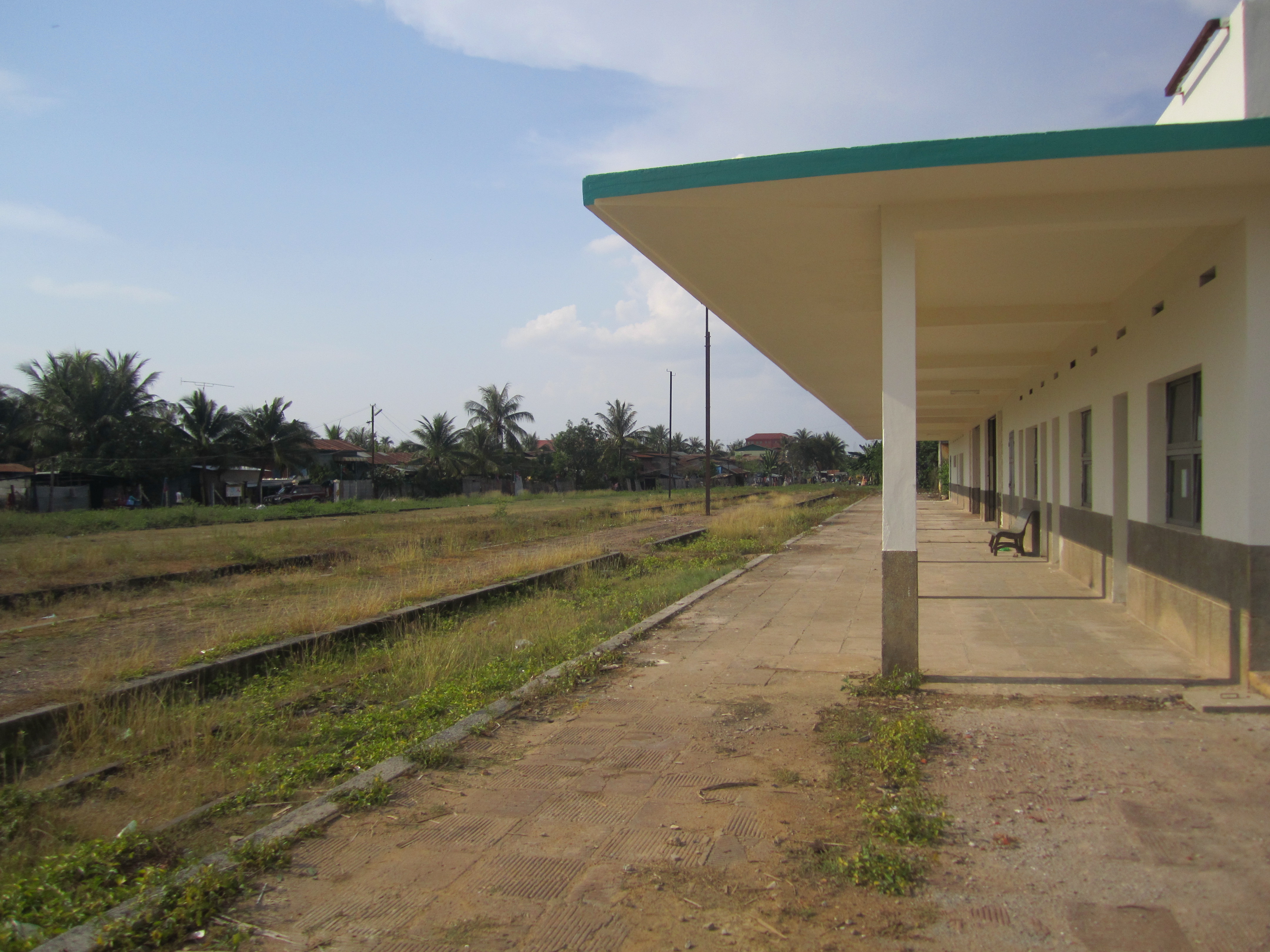
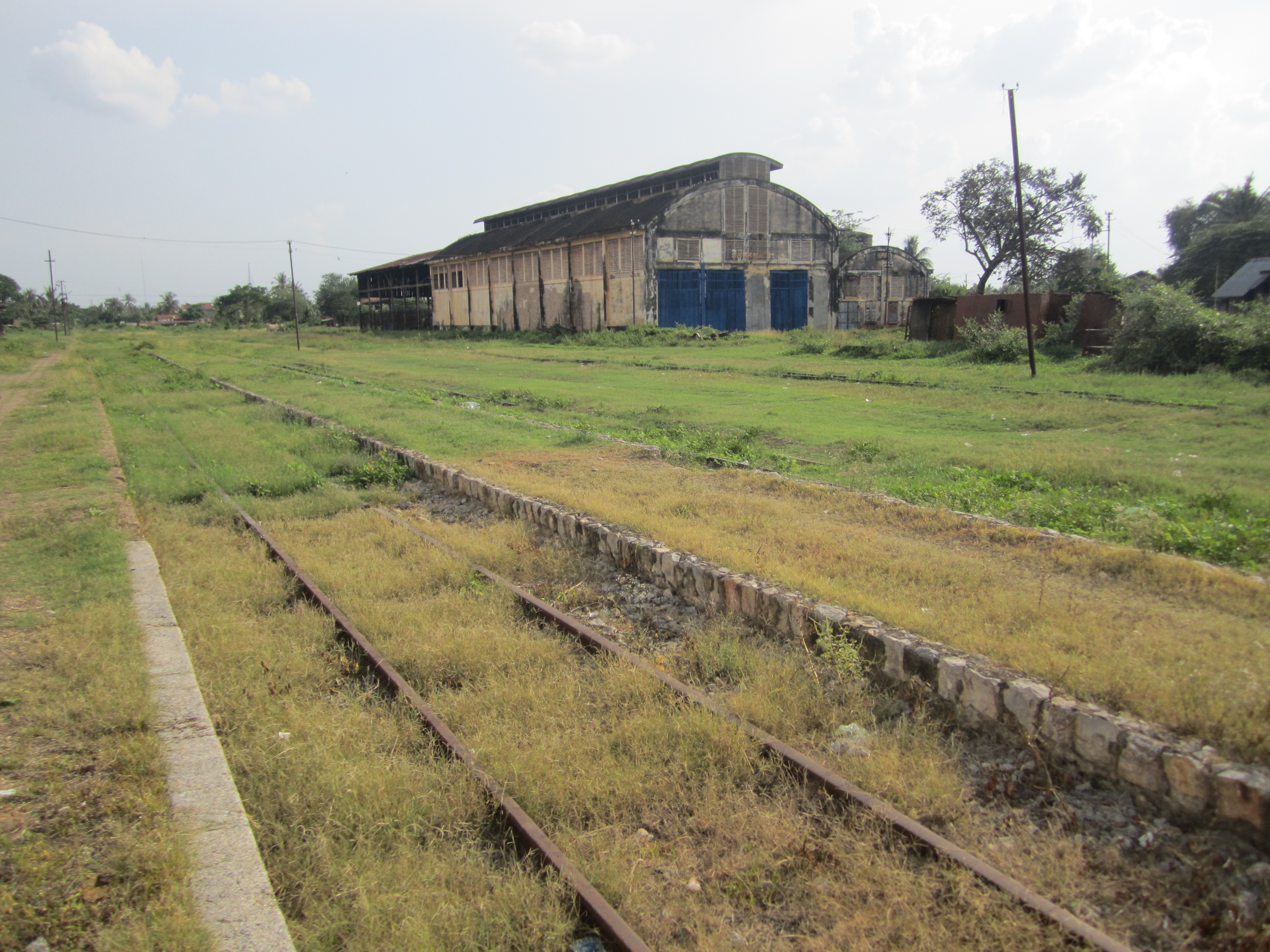
We walked down to the abandoned train station, a sweltering sidewalk lined with New Years decorations that look like tinsel pentagrams. During colonialism, the French built a train system in Cambodia, and it was still used through the 70s. I’ve read accounts of people who, early on in the Khmer Rouge reign, were transported to various work sites by train. At some point the system disintegrated, and the Battambang train station is proof of it, the clock out front permanently frozen at 8:02—a time that comes twice a day, like a train passing, but a year and date that remain silent, that will never pass by again.

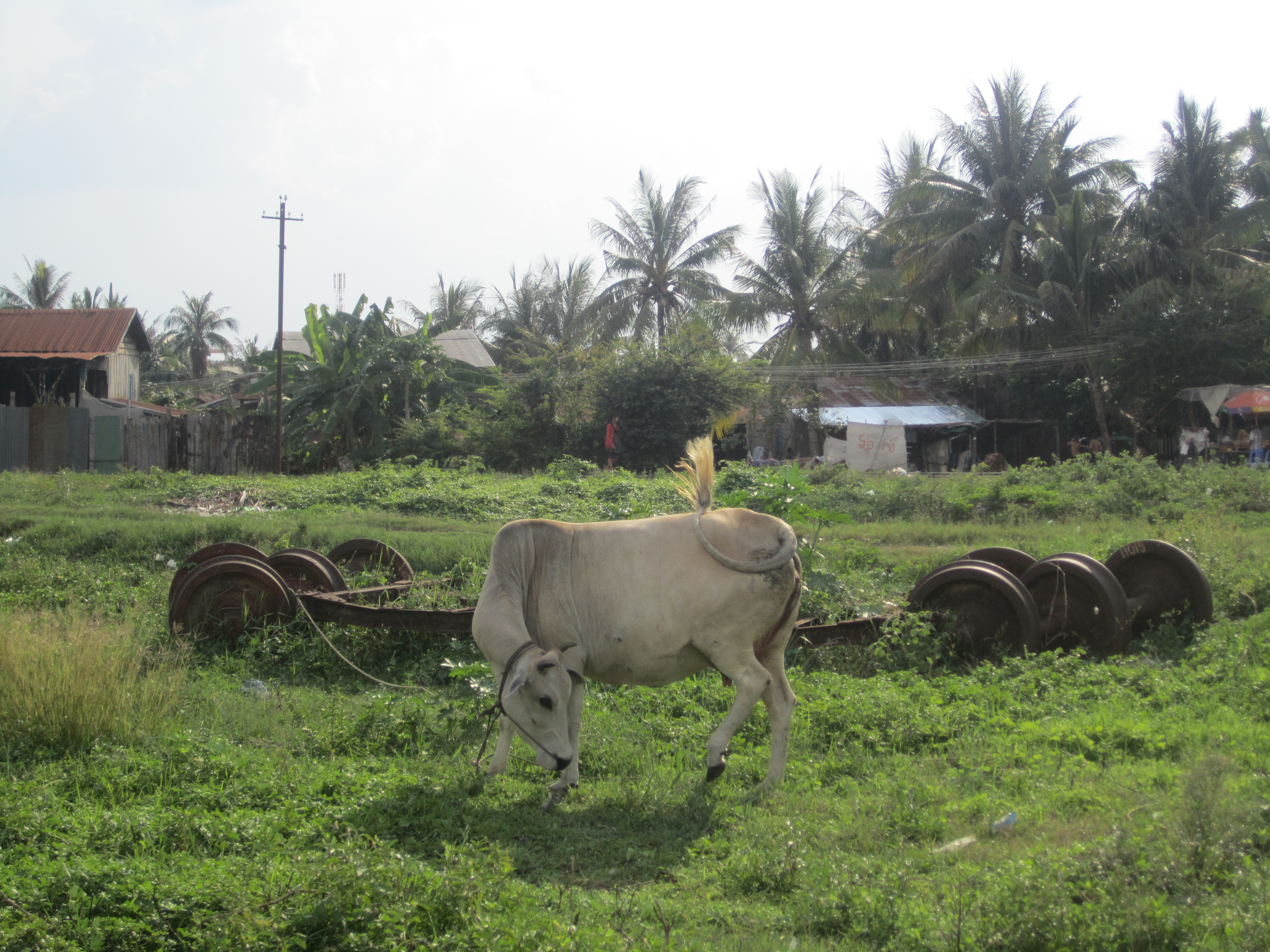
Like everything old in Cambodia, there’s nothing to stop you from poking around the lot of rusted engines, boxcar carcasses, tracks obscured by long grass and cow dung. People live there now, poor folks in thatched huts, where once the wind of the train might have blown them down, but now they only have to worry about the ghost trains passing—the wind, I suppose, doesn’t blow so hard from those. One man had set up a home in an old warehouse; I glimpsed him, through a crumble in the wall, bathing in his sarong.

You’d feel funny walking through a place like that in any other country. In the US, it’d be dripping with graffiti and crackheads. But in Cambodia it was people just living their lives, sitting on bamboo platforms with their families, small children exclaiming, “Hello!” and giggling joyiously when we responded. You couldn’t help but feel welcome, though you weren’t sure why you were welcome, why they all greeted you so goddamn graciously. Something in me felt I didn’t deserve it. I smiled anyway.

The next day I went out solo to explore the abandoned Pepsi factory. It’d been shut down, I read, when the Khmer Rouge came to power in 1975—frozen like that, like the clock at the train station. I grabbed a tuk-tuk, a man who insisted I pity him for having to work on New Years. We rattled out there, dirt roads lined with kids throwing small plastic bags of water, a New Year tradition. They smiled at me, waved, but none of them threw a bag at me. I wondered why.

The Pepsi factory was a faded concrete building with a well-tended garden. It struck me as a curious juxtaposition—the crates of bottles I could spy through the windows, waiting for a delivery that never came; the burned-out remains of a warehouse further back, where a fire had once raged, fixtures hanging from holes in the ceiling; the barefoot children that wandered around, peeling back strips of corrugated tin and disappearing inside the blackness. All that, next to trimmed grass and perky flowers, a yard free of rubbish, where a couple of families picnicked in the shade of a tree.

My tuk-tuk driver wandered over to me, as I balanced up on a ledge, beside shorn hedges, trying to get a photo of the inside of the factory. “All the machines are gone,” he told me in surprisingly fluent English. “They went to Vietnam.”

The factory, he said, had sat empty during the Khmer Rouge regime. When the Vietnamese came in 79, they’d dismantled all the machines and took the parts back to Vietnam. Now it was just crates of empty bottles, a silent loudspeaker with its wires disconnected, exposed.

“Why is the garden so nice?” I asked him.

“Oh, it’s a man who lives here. He’s very old, 80, I think. He used to work at the factory before the war. After, he had no family, nowhere to go, so he came back. The government let him keep the grounds. He lives back there.” He waved his hand back towards the burned-out warehouse, where I’d seen laundry lines and pieces of cooked rice sitting in the sun.

“That’s him,” the tuk-tuk driver said casually, gesturing towards an old man who walked slowly with his hands clasped behind his back. He wore an Angkor Wat t-shirt and a krama scarf loosely over his shoulders. You could tell by the way he sucked his mouth that there weren’t hardly any teeth left. The lines in his face were a fine webbing, like wrinkled laundry.

I smiled and bowed for our awkward introduction. What do you say to a man like that?—a man who’d seen all those abandoned places alive, who’d lived it himself, who’d set up a home amid the ruin and spent his days tidying what was left, memories green as grass?

“The garden is beautiful.” The tuk-tuk driver translated and the old man smiled a sunken smile, no teeth to stretch it taut. I bowed again.

Battambang is a dirt road and a child waving, an old man nodding to himself as he walks away.

On Not Riding A Bike In Siem Reap

I have a deep dark secret: I don’t know how to ride a bicycle.

It’s what I like to think is the last relic of the child I was: hysterical, terrified, subject to daily sobbing break-downs until the age of 8, my parents called in for concerned conferences with teachers. I was afraid of everything, and that included learning to ride a bicycle. My parents couldn’t come up with a good enough reason to force me—or themselves to teach me.

So I never learned. The older I got, the more ridiculous it became. Every once in a while I’d try, boyfriends valiantly declaring they’d teach me. It always ended in me flush-faced, ashamed, the jack-o-lantern cackle of crackheads at the park we’d hang out it, laughing as I fearfully raised one foot, then the other, then wobbled and swerved. It always ended in tears, and I’d be embarrassed about that too.

So when my two friends wanted to rent bikes to cruise around Siem Reap, when they smiled so sweetly and suggested, “There’ll probably never be a better place to learn. Flat roads, old cruiser bikes—a lot better than a roadbike in Oakland.” I nodded at the logic. Yes, I thought, the time has come to finally learn.

I’d actually thought about it the day before, as we rattled in our tuk-tuk through the temple sites. We were trapped on a painful tour, which actually felt more like a school field trip—our guide a well-meaning fellow who insisted we take photos at all the popular spots (“Stand sideways here, so it looks like your nose is touching the statue’s”). A girl had passed us on a rented bicycle, sundress and a basket, steering with one hand as she ate a pineapple wedge with the other. She looked so leisurely, so relaxed, in her own world of solitude with the trees, the stones, the road.

I’d wanted to be on that bike more than anything.

“But I have to warn you guys,” I told my friends as we walked to the rental shop. “I turn into a five-year-old when I try to ride a bike.”

“It’s gonna be fine,” they reassured me. “You’ll pick it up no problem.”

I had a knot in my stomach as they tested the different bikes, adjusting seats and cruising slowly down the dirt road and back. I distracted myself with plans for a blog post, a tender and life-affirming meditation on overcoming fear, letting go of old identities, on the role of place—on how, I imagined, being in a different environment could help you to find yourself or lose yourself, parts of yourself you don’t like—or maybe discover a new version of yourself. Yes, something like that, I thought as my friends paid the rental fee.

We walked down to a shady street with only occasional traffic, bicycles and motorbikes passing every few minutes. I felt nervous but confident as my friends gave me pointers, suggestions, but most of all encouragement. “You’re totally gonna get this,” Suki assured me with her sunlight smile, as Alicia held on to the back of the seat like a father, explaining the science of forward momentum to reassure me.

I wobbled around, lifting feet to the pedals one at a time, then both for quick moments of breath-held balance. “Oh, your so close!” Suki exclaimed behind me. “Any minute you’re gonna take right off!”

A frustration started to mount. It came, it seemed, from some very deep place. As I went back and forth down the country road, the feeling grew. It began to turn into anger, a seething self-hatred I haven’t felt in years but know too well to mistake. A burning began behind my eyes.

“Goddamnit,” I kept muttering under my breath. I knew logically that I could get this—I’m an able-bodied person with full control of my limbs. But my forearms tightened as I gripped the handlebars, staring down at the dirt before me—I couldn’t bear to look up at the world. You’re defective, a voice said.

I know this voice. It’s a tape I like to think I’ve outgrown, that I like to think I’ve smashed the casing of, pulled out the shiny reel, spun it like a fat black spiderweb, like I’d do as a kid—then crumbled and thrown away. I like to think I don’t even own a cassette player anymore.

But it’s there, always there (“What we really have is a daily reprieve…”)—perhaps collecting dust but still waiting for something, feet on pedals, to push play. The more I tried to ride that goddamn bicycle, the louder and clearer the voice became.

The good news is that today, I know it’s just a tape. And I told myself that, sweating in the morning heat: These are just old beliefs. They aren’t true, and you can choose not to believe them.

A motorbike and a bicycle passed concurrently, raising a plume of dust. I glanced up. I saw five faces, turned back over their shoulders to look at me. The expression wasn’t of pity or amusement or superiority—it was of concern. They’d seen me, these strangers, glimpsed a very private and shame-filled and ultimately very true part of me, on a roadside in their city.

I put my feet down, stood up. “I can’t do anymore guys,” I said in a shaky voice. I grabbed my purse, not wanting to look my friends in the eye. “I’m going for a walk; have a good day.” I rushed away.

The tears came freely as I kept my head down, walking through the roads of outer Siem Reap. Tinsel New Years decorations hung from doorways as amplified voices of chanting monks filtered through the trees, along with the lethargic sunlight.

“Fuck, fuck fuck,” I chanted to myself. There I was, 28 years old in Cambodia, and still feeling like a little kid, like that girl I used to be and hated.

Can travel really change us? Can discovering new external landscapes help us to discover new landscapes inside ourselves? Does anyone really ever “find themselves” traveling? Is it all one massive distraction from the pain of it, the pain we’ve nestled away, the way they say we store memories in our knotted muscles? Can travel be a kind of accupressure? What are we hoping to find, and what are we hoping to get rid of?

I walked. I passed a group of half-clothed children playing with a ball. They smiled and waved, “Hello!” and giggled when I said hello back. I passed a cemetery, where a shirtless young monk hung his orange robe on a clothesline, then lit a cigarette and stared. A skinny-ribbed dog sniffed through a pile of rubble, a magazine of tired black nipples. She looked up at me with startled eyes, flinched at the sight of me, lowered her head and stepped backwards.

I wanted to take that dog, to sit down and let her lie her head in my lap. I wanted to sit like that, the two of us in the trash and smashed cement, a random road outside Siem Reap.

But I just kept walking.

The Lucky Ones at the War Museum

Instruments of death don’t die. They rust.

Fifteen minutes from the happy pizza restaurants and nibbling-fish pedicure tanks of Siem Reap’s Old Market area is the War Museum. It’s not much of a museum, per se—it’s a grassy field filled with mango trees and the skeletal carcasses of tanks, missiles and planes used during the Cambodian civil war (the 1960s Lon Nol era through the fighting of the mid-90s). The “exhibits” sit exhausted and silent in the heat of the field. They’ve been striped for parts, all that’s left of them slowly turning brown, the same brown as the the earth.

“The memorials in Cambodia are so raw,” Anna’d remarked. “At Auschwitz, everything is behind glass or protected. You felt more separated. But in Cambodia, at the Killing Fields or S-21, there’s less between you and the stuff you’re seeing.”

I thought of Anna’s comment as I walked into the War Museum, past the massive helicopters that slept like corpses in the entrance. I’ve never been to Auschwitz or any similar genocide memorials, so I don’t have anything to compare the ones in Cambodia to. But there’s definitely a rawness. And it’s a rawness you feel in the whole country, not just at the memorials, but that the memorials seem to capture, to be the pure essence of, in a way that reminds me of whiskey distillation—too pure, the uncut soul of the thing, that if’s not diluted could kill you.

A guide approached us, a young man in a fake Lacoste shirt, frayed stitching and tell-tale grin on the alligator’s face. He was missing an arm; a nub extended beneath the sleeve, a little past his shoulder, and you could see it move around in there as he walked.

A sign announced that guides were free, so we went along with him, assuming a small tip would be expected. He spoke English well and was knowledgeable about the artifacts, mute metal that sat, refusing to decompose. Small wooden signs had explanations penned in a haphazard English.

“What is your nationality?”

“USA,” I replied. A pause. “We’re American.”

“Ah. America is rich country. Cambodia is poor. So if a pilot not fight well, if a soldier not hit target, he get killed—it a waste of ammunition. The pilot, they cannot eject from the plane, they trapped. The soldier get locked inside the tank, and if he don’t fight good, he stay in and die. We find still the bodies in many of these tanks.”

We stared at the machines; they reminded me of dinosaur bones or the great cranes at the Port of Oakland—metal with so much power, sitting still.

As we walked, he told us the story of how he lost his arm: when he was 14, his dad brought home a landmine. He was trying to dismantle it; we couldn’t make sense of why. The bomb exploded, killing his parents and two siblings, and leaving him with a belly full of shrapnel and one less arm.

“I’m lucky I’m okay,” he told us. “But I am very lonely, I have no family.” He went on to explain the difficulties of life as an amputee in Cambodia, with discrimination and lack of healthcare. He paused, looked at us. “You are very lucky, you have family.”

Types of landmines

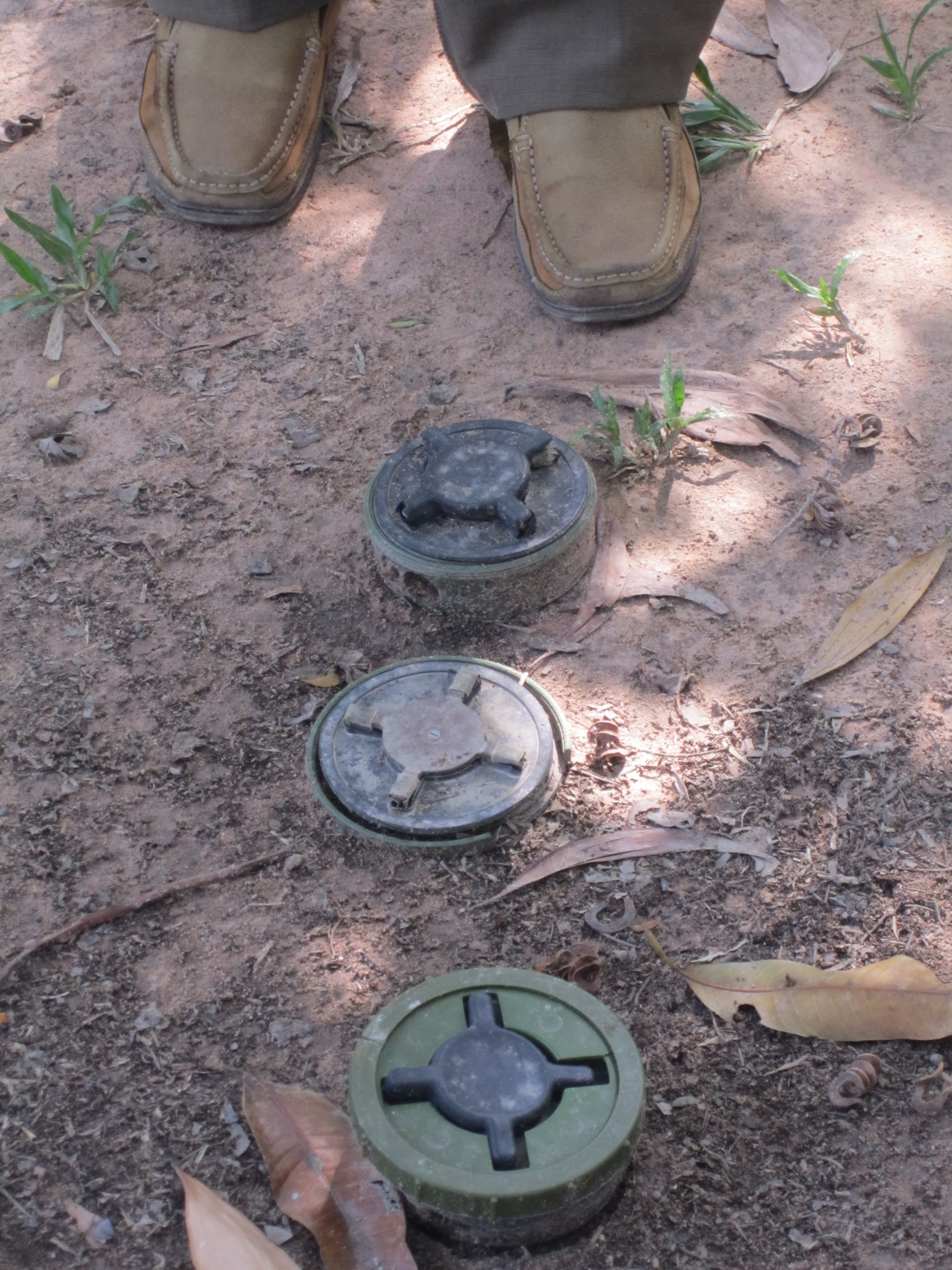
We kept moving. He pointed out common types of landmines, explaining which countries they’d been made in: Russia, Bulgaria, the US. He told us 1-2 people a day in Cambodia are still injured by unexploded ordinances. “You are very lucky, your country no have landmines.”

As he stood talking, I slid a modest note into the “Donations for Landmine Victims” box. He watched me. When he finished explaining the table of empty shells, he pointed to the box. “This money go to the government first, then the people. The government take a lot.” I squinted my eyes, nodding slowly. It’s true—there’s a lot of corruption in Cambodia. But I could also sense where this was going. “It better you give to the people.”

I cocked my head as he lead us away. Everything I’ve read in every country I’ve been to—including the sign at the guesthouse I’d just left (that among other things encouraged me to not have sex with children)—tells you not to give directly to people but to worthy, legitimate organizations. It was unsubtle foreshadowing.

He kept us moving at a steady pace. I thought of my guide at the pre-Angkorian temples a week earlier—also missing an arm but older, darker, a man who only spoke Khmer. I thought of the way he’d clasped his phantom hands behind his back, and the way it made something in me pound, then sink.

This guide didn’t clasp his hands. He was wearing short sleeves.

We paused under the hot breath of the sun. “How many sibling you have?” he asked each of us and we each responded.

“That good. You lucky. I have no brother or sister now.”

We came to a row of wooden shacks, displays of exploded bombs. They looked like peeled fruit, like some modern-art interpretation of peeled fruit that you’d see in some chic lounge, that was trying to make some sort of terribly deep and obvious statement. But this wasn’t art and it wasn’t a lounge—it was a shack and twisted metal.

They’d sawed the blown bits of his arm off with a wire. Because he was young and still growing, he had to go back every four years, to have the bone re-sawed. He couldn’t afford to get the shrapnel from his belly removed; at $100-200 a pop, he said he’d had to leave it to float around in there.

“In America I hear they make a machine arm.” He looked around at all the dead, rusted machines. “Maybe soon they make it in China. It will be cheaper there, and if I work enough, one day I can get. This is my dream: you come back and I can give you a hug with my robot arms.”

We got to the end of the tour. “It is good if you give a tip,” he told us flatly, “so I can pay for my surgery. Many people give $20-30 each person.”

Suki and Alicia looked at me. They’d each been in the country less than 24 hours. I considered the fact that a construction worker makes $3 a day, your average tuk-tuk driver $5. I considered the fact that my daily budget was $30.

He stood a few steps back, staring at us, waiting. “Can you give us just two minutes?” Suki asked.

We whispered, gathered bills. We gave him a fair tip, said thank you.

Then he walked back to our tuk-tuk, heavy with sweat, our ankles covered in dirt the color of rust.


Lauren Quinn is a writer and traveler currently living in Hanoi. Lonely Girl Travels was a blog of her sola travels and expat living from 2009 to 2012. She resides elsewhere on the internet now.

Join 490 other subscribers

Buy This Sh#t

Categories