Archive for the 'Lonely Girl Loves' Category


Marrakesh, You Broke Me Down

DSCN3558It was a long, hard, hot last day in Morocco, in Marrakesh, the pounding heart of the country´s tourism industry.

As I was venturing down the Atlantic Coast, south of Agadir and thoroughly ¨off the beaten path,¨ I was giving some serious thought to ditching out on my flight back into Europe, and spending the rest of my two weeks in Morocco. There was certainly enough to keep me occupied—I didn´t even make it to the Sahara!—and I felt like I´d hit my groove with Morocco. I was getting skilled at traversing the streets, haggling for taxis; I was in love with fresh-squeezed orange juice and mint tea; even my French was improving. We were vibing, Morocco and I, and it seemed a shame to cut out so soon.

But the prospect of Portugal, Western Europe´s ¨forgotten¨ country,  combined with a pre-purchased flight and a chance to wash my blue jeans and ditch that filthy blue scarf won out. I arrived in Marrakesh with just one day to soak in the crowning jewel of Morocco´s imperial cities, and its exotic lure.

I´d heard horror stories—travelers and Moroccans alike warned me that Marrakesh´s touts were the toughest, the street harassment the ugliest. I got off the bus from Tiznit suited up in my thickest armor, ready to do battle with a mean look and a linguistic sword of two words: la shokran, no thank you.

The problem with Marrakesh, or my problem with it, is that people like to touch. I don´t. As my grandma said, I´m ¨a real touch-me-not.¨ The men in Marrakesh really see no problem with poking you, grabbing your arm, pressing their bodies against yours, literally tugging you this way and that. I think it´s largely a cultural difference; Moroccans touch a lot, are extremely affectionate with one another, and I don´t think they view touching as the same kind of violation as Americans do. As in, get-your-fucking-hands-off-me, or touch-me-one-more-time-and-I-swear-to-God-I´ll-drop-your-ass-don´t-even-think-I´m-playing.

Not that I ever said either of those. But I thought it. And I suspect the wild-eyed, shocked look I gave the dudes who put their hands on me communicated well my very visceral reaction to unwanted contact. They, in turn, almost seemed offended that I was offended, got really defensive. It was one of those tough cultural clashes, and I refuse to admit I was in the wrong. Maybe just the different.

But there was, I have to admit, a kind of magic to the city. I always feel lame saying that about a place that´s really hyped up (as in, yes, Paris is all that). I was intermittently in awe of the city, and frustrated beyond belief.

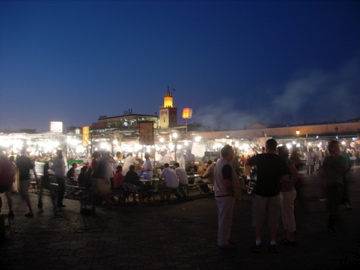
I stayed right near Djemaa el Fna, the open-air market of insanity that really was everything it was cracked up to be. Imagine a county fair. Now add throbbing drums and shrill pipes; snake charmers and witch doctors; wrapped women hunched on plastic stools, ready to ready fortunes and paint henna. Picture billows of meat smoke, the glare of a thousand gas lamps on a thousand white tarps;  see gleaming date stands and pyramided orange juice carts; beggars hands and child shoe-shiners. Hear the zoom and honk of motorbikes; feel the buzz of bodies weaving around one another. Wrap it all in a breeze that comes eastward and touches everything, envelops it in one big ball of electric humanity, shakes it up furiously, like a snow globe—and you´re somewhere close.

I meant to treat myself to a fancy last dinner, but when I got to the white-linen restaurant, it felt sterile. I headed down to Djemaa el Fna, stopping to slurp  snails at a food stall along the way. I dined on a wooden bench under the white tarps of one of the skewer stalls, watching the multi-lingual touts and hustlers do their business, sometimes rudely, but mostly with a charming penache that was hard to refuse. The breeze blew, and I felt in love with the night, the place, the country.

I thought I´d seal the deal with some chocolate ice-cream. I made my way across the square, nimbly traversing the crowds, not responding to the barrage of ¨bonjours,¨eyes on the prize.

I heard a loud voice rumble, ¨Hey sweetie!¨ Though the crowd was thick, I had that prickly back-of-the-neck feeling that the call was directed at me. I didn´t look up, kept walking. ¨Hey sweetcakes!¨ it yelled again. Still, I kept moving. ¨It´s okay,¨ the voice hollered, ¨I like small boobies.¨

I whipped my head around and saw a reddened face laughing, jowls shaking in a grotesque mask of amusement. Other faces were turned to look at me and my shawl-covered chest (I mean, come on, a B-cup is not that small). My cheeks flushed; I muttered ¨piece of shit¨and stormed away, trying to lose myself in the throngs.

The face hadn´t been a teenager´s, but a grown man´s, which angered me more. It had seemed quite pleased that it had humiliated me, that other people had noticed and looked. I felt the blood in my body burning with frustration.

A well-dressed man sidled up next to me, holding a clip-board and a perky straw hat. I looked forward, didn´t acknowledge him.

¨That man,¨ he said to me, ¨you can´t get angry. You have to just accept and—¨ out of the corner of my eye, I saw him make a brushing-off gesture.

I sighed, not entirely sure of this man´s intentions, and not in the mood to risk it. ¨I know,¨ I respond. ¨But sometimes I get tired of accepting, of always being the one to have to accept.¨ I could feel hot tears in the corners of my eyes.

¨Where are you from?¨ the man asked.

I eyed him cautiously, as the question was usually a prelude to some kind of hustle. ¨The US.¨

¨Ah, welcome,¨ he nodded thoughtfully. He leaned forward, said softly, ¨Of all the things you remember, of all the things you take home, don´t take that.¨ He nodded again. ¨I´m sorry.¨ He paused, let the words and the sentiment linger there in the charged air for a moment, turned and was gone, swallowed into the crowd.

It was all a little too much for me, the intensity of extremes—the degradation, the laughing face, the twisted soul-sickness that makes someone humiliate another person—and now, such thoughtful tenderness. All of it from strangers, all of it strange, somehow finding me in the immensity of the crowd. The whole day had felt like that, a tugging between two places, between two sentiments, of both loving and hating a place.
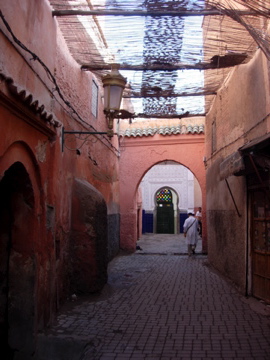
DSCN3551I was exhausted. I decided not to fight it, not to try to be tough anymore. I went back to my hotel room and sobbed, for the overwhelming kindness and cruelness of it all. For being a woman, for being a person, in a place, a world, that is simultaneously horrifying and beautiful.
Legzira Love

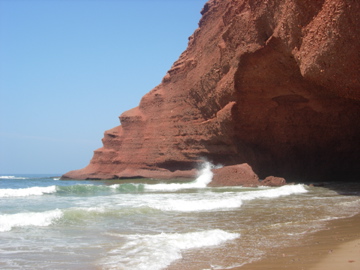
DSCN3456I think I may have just found the most beautiful beach in the world.
Yes, it’s a sweeping statement, and no, I’m not a beach afficionado. But if red cliffs diving into pebbled sand coves count for anything; if lazy waves crashing against sandstone arches score points; if a tourist to local fishman/swooping seagull/stray dog/donkey (hey, it’s still Morocco) ratio of 1:5 means much—if these are the elements that create that “paradise” thing all the guidebooks talk about, well then, I just spent the night there. And slept with the windows open to the ocean. Cause why not, you know?

Legzira Plage is pretty incognito—it warrants not more than a paragraph in my guidebook and a weathered-beaten, graffitied roadside sign along the pretty two-lane highway connecting Tiznit, Mirleft and Sidi Ifni. Down Morocco’s Atlantic coastline, just before the Western Sahara and a disputed border, the area as a whole doesn’t attract the hordes that the country’s other wonders do—which is why it attracted me. A near-deserted beach away from any big city or pushy tout? I’m in.

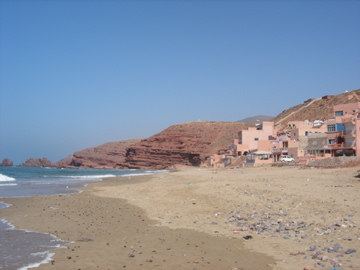
I took the local bus from Mirleft, got off at the faded cement block sign at the access road, and took the 20 minute walk down to the beach, a lazy slope washed in ocean breezes. The scenery revealed itself like a striptease: a sweeping hill view, a peak of ocean, the sound of waves, the pink edge of a pink building. I turned into a small dirt parking lot, and almost started laughing—it was so beautiful, it was almost obscene.

DSCN3464There were half-a-dozen pink buildings cascading down the cliff to the beach. Sweaty and shoulders aching, I set my backpack down in a cheap but cheerful hotel room with windows that flung open to the ocean. (Now thoroughly “off the beaten path,” the room costed only a little more than my smelly toilet- and shower-less hole in Essaouira.) I kicked off my shoes, grabbed my camera, and went for a walk.
I’m not much of a shutterbug, but I exhausted both my camera battery and memory card. I walked for over an hour; each cove was more secluded and empty than the last. On the first few beaches, I passed a small group of teenagers playing soccer, a fisherman, and a handful of sun-bathing tourists, many of them Moroccan (tell-tale sign: the lady’s swimming fully clothed). We “bonjour”ed politely. I rounded a gently jutting set of red rocks, and was alone. I closed my eyes, and let out a long exhale.

I’ve really been liking Morocco, but I can’t tell you how good it felt to be alone, away from any non-human sound—just me and the seagulls, you know? Later, I stripped down to my swim suit, and wave-hopped and sun-bathed without concern for modesty. I soaked up much-needed sun, vitamin D sparking wildly through my body. I didn’t worry about, well, anything.

I had a simple dinner of grilled fish (yes, caught that afternoon) and pommes frites, washed down by that killer mint tea. The hotel’s patio was sparsely populated with about a dozen dining guests. If there were any less people, I realized, it would have felt creepy. Like The Shining or something.

The hotel only ran electricity for prime hours during the evening, so I read by candlelight for awhile before crashing out. It was warm enough, so I left the windows open and slept to sound of the waves, to the smell of salt.

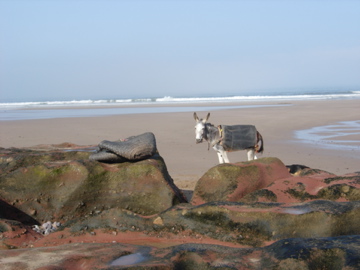
Donkey on the beach!

Donkey on the beach!

In the morning, the fog outside the window was thick. The tide was so far out that a previously offshore crag of rocks connected to the beach. I sipped my freshly squeezed orange juice and nibbled on my still-warm bread breakfast, and watched the fishmen trod out for the day, the sifters search out clams and mussels (I think) in the tide pools. A waiting donkey with two empty sacks on its side bickered with a yapping stray dog with a wobbly magazine of stretched-out nipples. The fog thinned, turned to a fine mist, and slowly, so faintly I could hardly notice, was gone.

I don’t know why Legzira Plage is so under-visited, under-promoted and unknown. But I’m not complaining. My camera battery may have konked out, but my personal battery is fully recharged. Just in time for Marrakech.

The Best Tour Guides in Mirleft

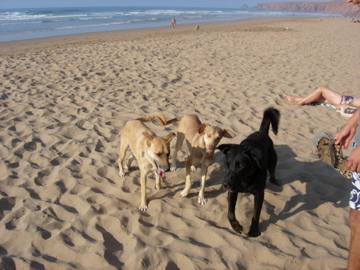
DSCN3389Yesterday I found the best 3 tour guides in town. No, they weren’t the touts that surrounded me shouting in 3 different languages and tugging me in 12 different directions the second I stepped out of the grand taxi from Tiznit. They were a rag-tag group of stray dogs that led me around the Berber beach town of Mirleft for over 2 hours.
We met outside my hotel, Hotel Atlas, the cleanest, cutest and most well equipped of my trip thus far (hot water, flushing toilets AND toilet paper—hot damn!). The leader, a German Sheppard looking female with a mangled hind leg and a black patch of furless scar tissue, greeted me as joyously as an old friend. I politely explained that I didn’t have any food, but she didn’t seem to mind. I’m not as worn out by the street dogs as everyone else in town is; I didn’t shoo them away, just kind of smiled and kept walking down the dirt main road toward the beach.

The dog immediately took the role of loyal and ardent defender, barking and growling at every scooter and donkey that passed, as well as a couple old men and frightened schoolgirls. I smiled and shrugged at them; we exchanged chuckles.

Along our pebbled-path way, we picked up a couple other boney-ribbed dogs who displayed proper supplication to the leader. I didn’t know where I was going other than coastward; Mirleft is too small to warrant a map in my guidebook. So the dogs would trot off ahead of me, sniffing through refuse and gnawing on plastic bottles. When we’d reach a crossroads, they’d pause and wait for me to catch up before continuing waggingily along whatever way they thought was best. Who was I not to follow? They knew the town better than me, and I was grateful for the speechless company.

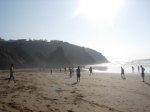
DSCN3394They led me down a steep flight of cliffside stairs into a cove of jagged rocks and gleaming sand. Shirtless local boys were playing afternoon soccer and a couple tourists sat out on blankets. My guides dashed off to leap in the waves; I rolled up my jeans and waded behind them.
I wanted to tip them—I certainly would be expected to if they were people—but thought they’d be terribly uninterested in my pocket full of coins. I rustled some stale crackers out of my bag, and they chewed them gratefully. I sat in the sand and watched them trot off, skinny and mangled and more-or-less happy.

Bonjour guapa, you want sex?

No way did I flatter those boys with a photo. Here's a busy street in Meknes instead.

No way did I flatter those boys with a photo. Here's a busy street in Meknes instead.

In Fez and Meknes, I finally got a taste of the street harassment all the guidebooks warn of. It was still a lot tamer than anticipated, a multilingual assault of adolescent bravado more than an actual threat. Though the intention spans the confines of language, it’s easiest to brush off these comments when they’re in French or Spanish. It’s a little like having monkeys hurl feces at you; it sticks less when you don’t know the actual words being said.

But those boys are a cunning lot, and have managed to master a few key phrases in English: “massage”, “sex”, “fuck”, and most telling of all, “you like me?” Just to be safe, they like to mix it up, covering all linguistic bases, just to make sure their intention is entirely communicated.

The harassment comes nearly exclusively from one group, teenagers in Western clothing. Adult men are by-and-large very respectful; if anything, they want to sell you something, but I’ve had far more pleasant exchanges with adult Moroccan men than not. The young guys dressed in traditional jellabas tend to just ignore me, which is A-OK; same with the poorer young men, who just want to shine my dirty sneakers or sell me some tissue. It’s the 12-18 year olds in faux Western clothing you’ve gotta watch out for.

They hang in packs, pushing and nudging and teasing one another. They’re a kind of pathetic lot: thin and self-conscious, somehow lost in their t-shirts and blue jeans, short hair over-gelled and haphazardly spiked. They are consumed by this proposterous posturing, seeming at once to resent and idolize Western culture. They desperately strive to emulate it, can’t quite get it right; their cat-calls and gross comments feel like a plea for acknowledgment, validation. They want so much to be taken seriously, to be something other than what they are—and in that way, I suppose they’re not unlike any other ill-at-ease teenager. I can relate to the insecurity, know so well where it springs from, and I almost feel sorry for them when I see them all there, so sadly absurd in their metallic G Star Raw shirts and bedazzled-pockets denim.

And then they say some dumb shit, and I don’t feel so sorry for them anymore.

It’s a pain in the ass, for sure, but it seems to be something that comes with the territory, part of what it means to be born female in this world. It can wear you down—I may or may not have snapped and thrown a banana peel at a man in Venezuela once—but I’m sure as hell not gonna let it stop me from seeing the world, from being in it as fully as I can. I’m just gonna cover myself in thick-ass skin, maybe a tarp or something. You know, so the feces doesn’t stick.

The Glamorous Life of a Budding Travel Writer

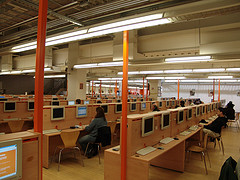
Internet cafes usually lack the "cafe" ambiance

Internet cafes usually lack the "cafe" ambiance

Sure, I wandered the cobbled streets of Tarifa’s old city, took a walk along the deserted pebbled beach, sipped cafe con leche and watched the comings and goings from a streetside cafe. I also holed up in an internet cafe for over two hours and wrote. Some of it was catching up on my blog, some of it was checking bank accounts and responding to emails, and some of it was writing an article on credit card rewards programs.

I know, I know—you’re jealous, and it’s wrong of me to rub in your faces the glamour of the profession I’ve so haphazardry embarked upon. But this is the truth of it, from what I’ve acertained and thus far experienced: the majority of writing a travel writer gets published, at least on the on-set, is service-oriented and, well, kind of unexciting.

But it’s extremely useful—I’ve advised friends on how to make the most of rewards programs, and I’m certain other travelers will find value in this nuts-and-bolts type of article. I get to plug my own blog, make connections with editors and readers, and add one more piece to my portfolio. Is it earth-shattering, thought-provoking or emotionally stirring? No. But is it a start; is it still my name in print and a little more experience? For sure.

With that long-winded intro, you can check out the article, published on StartBackpacking, here.

I’ve been puttering through Lonely Planet’s Guide to Travel Writing, written and edited by Don George, co-founder of the Book Passage Travel Writers & Photographers Conference I attended, a heavy-weight in the industry and all-around nice guy. The book includes a lot of great information; I’ve especially been enjoying the author interviews. All of the the folks interviewed, well-established and successful travel writers, say the same thing: there’s no glamour or money in travel writing (I’d extend that to most types of writing). You’ve gotta do it for the love of it, cause you can’t think of any other way to live your life.

If that’s the case, I suspect I might be on the right track.

Fez Through the Window

DSCN3272I arrived last night in the swarming, honking, neon-lit mess of life that is Fez.

The excruciatingly haggled taxi I shared with a mother-daughter duo from the bus station to the medina (we were accused of being “cheap like Berbers”—is racism usually an effective bartering technique?) deposited us at the gates to the 1200-year-old medina, what the guidebooks call the entryway back in time, into another world. After eight hours on a rattling first-class bus through plastic-littered landscapes and vast expanses of mountains, forests and fields, it felt like I had been belched into a place where millennia collided. I was swarmed in the frenzied, electric chaos of humanity—and, as always, I loved it.

I grabbed a room in the first cheap hotel I spotted, a simple space not much bigger than the double bed that occupied it. The wooden shutters were thrown open, revealing the light and noise, the smell of strange spices and the hum of motorbikes, the grit and life and incessant sea of people on the throughfare below. It didn’t matter that the threadbare room was only 80 dirhams (about $10) a night; I wanted it for those windows.

I knew it would be noisy (why one should always travel with earplugs), and I’m sure the novelty of the hustle-bustle will wear off, but so far, I’ve loved sitting hunched over my notebook on the lumpy mattress, staring out through the wrought-iron bars at the street—my own private perch, where I can spy like a secret, and take it all in.

I closed the shutters around 11pm last night, with stereos still bumping, engines groaning, dogs barking and cats crying and men shouting intermittenly. The glass of the shutters had been crudely painted over, so some of the street still got in, a thin illumination reminding me where I was. My earplugs only slightly muffled the medina din.

When I woke, I took out the earplugs and just laid, listening to the street as it arose, stretched, came alive. Birds shrieked in a high-pitched panic; a voice boomed from a loud speaker, wailed in prayer. Metal shutters rattled awake and voices called to one another; somewhere, a rooster crowed. I wiggled the warped wood apart; the smells of cooking meat and mint burst through. I sat and stared from my bed at the ancient city, its beaten streets and ashy rooftops, its sand-colored crumble of stone on stone, its endless passing of colored robes.

I had arrived in the heart of it, and was ready to join in.

Red-Door Flamenco

DSCN3201The drama and thunder of it—

trance-like

when the notes sing sadly,

seem to pluck themselves

from weeping fingers,

when the wails of passion

get inside the hips,

become the bend of wrists,

the fistful of ruffles—

how unapologetic

the stomps are,

the throbs

of a furious pulse,

the exactitude of hands

that don´t stop clapping

until the blood reaches

its final fevered pitch:

a pose of breathlessness,

a sculpture gasping

with life.

BYOB Debauchery: Spanish Botellónes

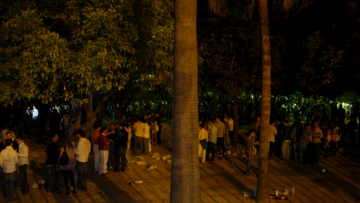
DSCN3177The roar of voices rose from between the trees, out of the darkness and dirt. Scooters swarmed, freshly broken glass glittered in the dim park lights. Young girls teetered in impossibly high heels and boys stumbled, leaned their faces against the sides of walls as they pissed. And every person clutched a plastic cup.

When Spanairds sigh in disapproving despondency about ¨kids today,¨ they´re talking about botellónes. In a culture of late-night fiestas,  these youth-ridden BYOB binges stand out as particularly debaucherous.

Bottelónes take place in public, on the streets and in the parks; teeangers and early 20-somethings gather to drink, flirt, cause trouble, and leave a mountain of trash in their wake. Increasingly the subject of public controversy, Seville´s bottelónes are known to be especially raucous.

We passed one as we trod through Parque Maria Luisa on Friday during a once-a-year festival of museum open houses and cultural performances. (How Spanish is this?: museums are free to the public from 10pm-3am, and completely full the whole time.) September is festival month in Seville, when residents have returned from August vacations and the oppression of the heat has subsided; it´s also the beginning of botellón season. My couchsurfing hosts and I were walking over to Museo Artes y Costumbres Populares, where we saw a killer flamenco show, and the adjacent Museo Arqueológico, where a classical guitarist´s exaggerated facial expressions were more dramatic than an old guitar-playing friend with Tourettes (RIP, friend).

We passed what I was told was a typically trashy Friday night bottelón. It was like a rave minus the pulsing lights and techno music, like a sideshow minus the cars and firearms. Hundreds of kids filled the open space at the park´s entrance. Teenage girls were dressed to the nines to attire revealing even by Spanish standards, while boys puffed their chests and tried to impress each other, even in curiously effeminate clothing. My hosts spoke of the trash, piss and vomit the parties left in their wake, the shards of glass and tell-tale crushed plastic cups that city workers scurry to clean up the mornings after. (The next day, I passed through the carnage of another botellón, down by the river, and had to say, it was pretty gnarly.)

I smiled to myself as we passed by. I couldn´t help but feel that, if you swapped the heels for combat boots, and blush and blow-drying for heavy eyeliner and multi-colored dreads, it wouldn´t have been too unlike the Rocky Horror Picture Show or Gilman Street of my adolescence. Instead of being out in the open, though, we were relegated to the sketchy corners of the city, to alleyways, public restrooms, the stairwells of parking garages. I wondered if having to hide it—the violent pursuit of oblivion—somehow served to make ours worse, more seedy and powder-laced, more self-destructive and apt to end in institutions and death.

From between the park gates, I spotted a girl hoisted up by two friends, her arms drapped over their shoulders. Her head hung at a sharp angel; her heeled feet scuttled, dragged in the dirt lifelessly. Whether it´s a plague to Spanish culture or kids just being kids, I felt mighty glad not to be a teenager anymore.

Granada Fragments

DSCN3127Granada got me all literary…

Bus ride: Sheets of rock like shoulder blades, knobby fingers  pointing skyward in an arthritic ache.

Granada: A town that still rolls its clattering shutters down for siesta, where people lean on bars at lunchtime, where crayon-colored graffiti makes the edifices seem all the older, and more opulent.

Outskirts: Tatiana lived on the outskirts, the broad chest of the Sierra, where  grey blocks of buildings stood stoicly, white-washed walls and flat stone streets filled with people coughing, crossing their arms as they walked to bus stops beneath rain-streaked towers, windows crying mascara tears.

Thursday: It was a moody day, a voluptuous pout of wind and clouds.

Balcony like a prayer: The rain thins, the clouds ascend, and the city sharpens like a reflection in an unfogging mirror—tiled roofs that arch along the spine of the mountain, the grey domes of grey cathedrals, the red crane of steel-boned construction. The birds chatter invisibly from the inside of trees, like children at recess, high voices rising above the thunder of the drainpipes.

Boy at the party: It was the way his shoulder moved beneath his tshirt, how his sneakered feet would pigeon inward, the way his veins vined around his forearms like twine, down, down, to the thick fingers that, unlike yours, were uncalloused and clean.

Kimmo´s Culinary Quest in Madrid

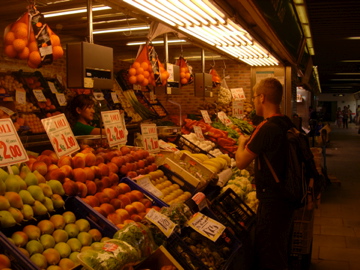
Shopping for produce

Shopping for produce

Kimmo sighs a cloud of smoke and looks into his half-full pint glass. ¨I told her one and a half months, I´ll try it. Then,¨ he shrugs and manages a smile ringed with worry lines.

It´s one am, and we´re washing down the 4th night of Doña Antonia´s grand reopening at an endearingly tacky Irish bar in the cobbled heart of Madrid. The red plaid wallpaper and grime-covered Guiness mirrors seem to agree with Kimmo, who looks 10 years younger out of his white-starched chef´s jacket.

Kimmo, Matt and I at one time all worked for the same 5-restaurant company that encompassed, at varying times, 3 SF-Chronicle Top 100 restaurants. That is to say, we´ve all been well-indoctorinated with the Alice-Waters-inspired culinary philospohy of organic, locally sourced ingredients. Ours paths have crossed for one heavy-skied Sunday in Madrid, where Matt, some friends and I feasted on the kick-ass creations of Kimmo´s new menu. It was one of the best meals I´d had in awhile.

But, apparently, Madridanos don´t share our American enthusiasm.

¨Madridanos,¨Matt tells me, ¨aren´t very discerning diners. It´s more about atmosphere than the actual food.¨ Kimmo nods in semi-forlorned agreement.

A recent transplant from the Bay Area culinary scene, Kimmo´s been trying to reconcile his California-cuisine sensibility with Madrid´s affection for over-salted sameness. It´s been 6 months, 3 restaurants, and so far, it hasn´t gone splendidly.

Listening to Kimmo´s qualms and Matt´s frustrations, I begin to realize that culinary values and expectations in California are wildly different than those in Spain.

Matt, an ex-bar-manager turned handle-bar-moustached vagabonder, has been frustrated with Spanish service and quality for the past 7 months. Kimmo, a sweet-faced Scandinavian socialist who´s vowed not to die in either the US or Finland, has been struggling against the low standards and unadventurous expectations of Madrid´s diners and restauranteurs. A chef by trade, he´s been hired as the head chef and sole cook of the newly reopened Doña Antonio near Plaza Santa Ana.

Kimmo´s creative menu includes untraditional dishes like mussels with chorizo and garbanzo beans, a sort of inventiveness valued in the Bay Area. Put the same old things on the menu there, and you can bet on your clintele steadily plummeting. In Madrid, it´s the opposite. For the 4th consecutive night, Kimmos´s watched nervously as potential diners sip on coktails (he insisted on expanding the beer and wine bar to include mojitos and caipirinhas), peruse the menu, look confused, and leave without ordering.

¨When it comes to tapas restaurants, the kind younger Madridanos go to,¨ Matt says, ¨I usually don´t even have to look at the menu. They´re pretty much all the same.¨

The increasingly anxious owner of Doña Antonia wants a more typical menu; in the previous day´s blow-out, Kimmo conceeded to including bravas and croquetas on the menu. ¨She tells me,¨Kimmo says of the owner, ¨ ´You can do them your way.´ But no one in Madrid wants to try lemon aioli. And they haven´t even heard to romesco!¨

Another problem Kimmo´s encountered is that modern Madridanos seem to have no familiarity with the Spanish cuisine he learned in the States. Filet of fish with romesco? No go. Paella without seafood? Won´t fly. Additionally, the organic craze has far from set in. An almost nauseatingly hip trend in the US, the inherent taste superioirty and sustainable sensibility means nothing in Spain. ¨There´s no idea that you might want to spend more for better ingredients. I can´t say, ´The meat is expensive because it´s organic.´ They won´t care; they say, ´Find it for cheaper.´ So I have to try to cook with rubbery arugula, carrots that don´t taste like carrots.¨

Kimmo´s decided to give it 6 weeks. He´ll do what the owner wants: put the typical dishes on the menu and try to make the best of less-than-optimum ingredients. Will he eventually conceede and adapt to the Madrid way of dining, or will he maintain his high standards and continue the seemingly impossible struggle to raise diners´expectations, lower their inhibitions and up the ante of the Madrid tapas scene?

There´s no way to know, not now. But tonight we can kick back in the thickening smoke creeping through the psuedo-pub as the crowd thins and the evening grows damp and heavy, and let it all go. Afterall, tomorrow´s Monday, Kimmo´s one day off.


Lauren Quinn is a writer and traveler currently living in Hanoi. Lonely Girl Travels was a blog of her sola travels and expat living from 2009 to 2012. She resides elsewhere on the internet now.

Join 490 other subscribers

Buy This Sh#t

Categories