Archive for the 'Places' Category


Wind and Dust and Real Wild West

Two days in the desert—driving, hot wind roaring, through the pebbles and boulders, palm groves and dusty towns, the strange angles of the Joshua trees, arching up towards something, a sky as pale as eyes. It’s not hard to imagine infinity in the desert, that’s it’s all still at the bottom of some great prehistoric sea, that the sky were the lid of the sea and we were all swimming through it, rattling highway through it—the wind, waves; the dust, sand; the crunch under your sneakers some kind of ancient asking.

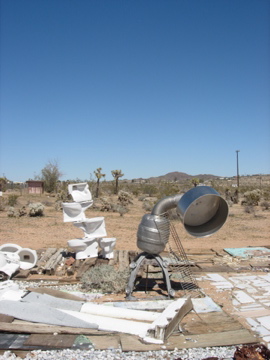
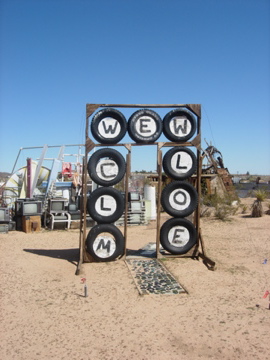
I arched over the hills, my tired car chugging, and arrived in Joshua Tree, went teeth-chattering down an unpaved road that dead-ended at open lot of strange, scavenged art. I’d read about the Noah Purifoy Foundation on Trazzler, and it immediately rose to the top on my list of things to do .

An LA artist that moved to the desert for more space and peace, Noah Purifoy erected whimsical sculptures out of found and salvaged materials—toilets, old vacuum cleaners, scrapped tin. During the 60s he’d directed the Watts Towers Art Center, and you can definitely see the influence of Simon Rodia—though Purifoy’s creations are more folksy, more political, less abstract. In fact, one of the most powerful pieces in the wind-swept lot was a piece made from materials found after the Watts Riots. To take a tragic, violent event, to sift through its remains and piece them together to create something new, something beautiful—this seems to be what Noah Purifoy was all about.

Admission to the Noah Purifoy Foundation is free; there’s a couple pamphlets at the entrance that guide you through your wanderings. There were only a couple other people there, and I hadn’t read about the place anywhere else. Except that, the next day, I saw on Twitter that it’d been featured in the New York Times. So much for having the edge.
Then it was off into the park itself. You hear a lot about the strange spiritual power of Joshua Tree, and I gotta say, they aren’t exaggerating. The terrain was other-worldly, to say the least. The tumble of boulders looked as though they’d been piled up by a toddler’s hand. The arms of the Joshua trees twisted and reached, fists full of beige spring flowers.  The shrubs had a slight purplish haze, like an old woman’s hair, and the air was full with a charged silence, the sound of wind.

I of course made a beeline to the site of Gram Parson’s impromptu cremation, something of a pilgrimage site for fans and aficionados of the bizarre. I drove out to Cap Rock and walked slowly around the massive formation, searching for the tributes and messages written on the rock that would signal the spot. And you know, I have to say, sitting there, the whole thing seemed much less odd. Well, the bit about stealing the body and having it actually burned on the spot is still a bit far-fetched, but being there—listening to the wind and watching the lizards dart—it seemed less like some kind of opiate-inspired fit of fancifulness, and more like an honest yearning to become a part of the place. It felt like somewhere, very far beneath the surface of it all, those plutonic intrusions that caused the rock formations were still boiling, still shooting up through the crust of the earth, and it didn’t seem so strange to want to become a part of it—to become smoke, twisting; dust, dancing; and at last the wind.

Across the desolation lay a supreme indifference, the casualness of night and another day, and yet the secret intimacy of those hills, their silent consoling wonder, made death a thing of no great importance. You could die, but the desert would hide the secret of your death, it would remain after you, to cover your memory with ageless wind and heat and cold.

John Fante, “Ask the Dust”

The next day it was off find the Wild West. I’d been stoked about Pioneertown, for nothing more than the kitsch factor. An old movie and TV set from the 40s, my trip to Pioneertown seemed ill-fated from the beginning. The Pionnertown Motel suddenly “closed indefinitely” the week before I left, and Harriet and Pappy’s Palace, billed as the best honky tonk west of the Mississippi, was closed the night I wanted to go boogie down. So I headed out in the morning and I have to say, if it would have been monumentally disappointing if Ice Cube hadn’t been there, in a poncho and a sombrero hat, filming a new video.

I headed back on the highway, through squat, peopleless towns of gas stations and boarded-up buildings. Did you know they grow dates in the California desert? I didn’t. Or that a date milkshake is god-damn delicious?

I made it to Niland, a windy little town with a couple shops, a no-name gas station and a stretch of trailers. There were two big sights there that inspired me to go 2 1/2 hours out of my way: Salvation Mountain and Slab City—the real, modern-day Wild West. It’s fitting that most people know about these places, if at all, from the movie and book Into The Wild, because they capture the kind of not-for-profit weirdness that can only take place in California.

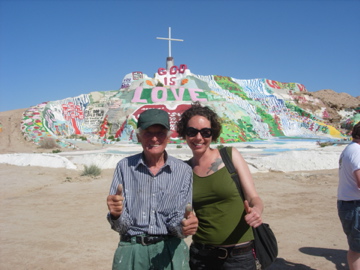
Salvation Mountain is Leonard Knight’s neon, latex-paint monument to God. Really. Radioactively bright, the art installation is covered in biblical passages, odes to God, and topped with a cross. The old dude came out to the desert in 1985, shortly after he was saved by Jesus, and began building the tribute, fueled by some kind of insane passion and other-realm vision.

Leonard was there that day, as he is most. Weathered, red-skinned and still mostly coherent, Leonard showed a small group of us around, spouting his message of God’s love and keeping it simple. He had a 10th grade education, he told us, and was one of the dumbest creatures on Earth, but because he’d repented, God had enabled him to build Salvation Mountain. He didn’t do it for money, he didn’t do it for fame—he did it spread the message.

His paint-stained pants were hitched up high, one of the legs tucked into his sock. The Velcro straps of his stained sneakers flapped, and he’d missed a button on his shirt. Three long hairs grew out of the top of his nose; he had a cold sore and one long thumb nail. He looked like a man that had become the desert, was the desert. He gave us each a handful of postcards and asked us to distribute them. He wanted nothing in return, just for us to spread the word. He repeated “keep it simple” like a mantra.
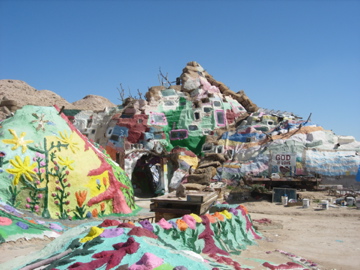
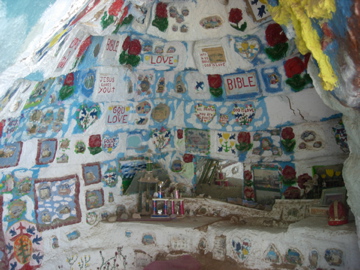
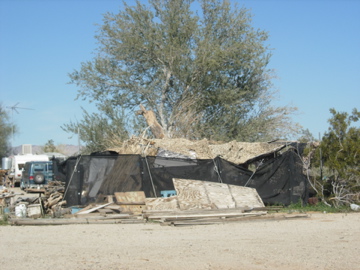
A quarter-mile down the road was the legendary RV squatter encampment of Slab City—“the last free place,” the sign read. Pebbly and stark and covered with trailers, Slab City is a piece of land no one wants. The government bulldozed a military base that was there in the mid-40s, leaving nothing but concrete slabs, covering the ground like graves. Word got out in the squatter community, and it became a wintering place for “snow birds.” There’s no water, no bathrooms—nothing, again, but wind and dust.

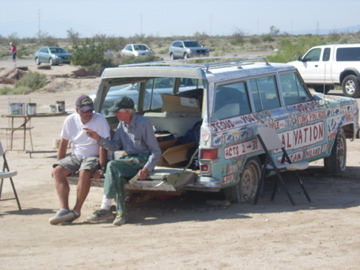
There were a number of “yard sales”—tables and blankets were random stuff was displayed, on sale for passer-throughs like myself. I pulled over to one and chatted with the people there, a desert-skinned man with a scabby elbow on a bicycle, and a sun-visored woman with obese ankles and a gap where a tooth once was. I asked them about life in Slab City, about the community and why they were there.

“There’s no rules here,” they told me. “No one bothers you, and you can do whatever you want.” They let the statement linger, and I didn’t ask what “whatever” was. As long as you were sociable with your neighbors and didn’t steal, anything went.

They told me how they easily lived on $200 a month in government assistance and food stamps, how people helped each other without payment or reward, how there were weekly live music shows and how the cops wouldn’t come out there (since Slabbers provide all the income for the nearby town Niland, they claimed). They talked about local goings-on, about drunk neighbors who’d stabbed each other and a dog that had recently died, a new church that had opened and was going to start giving out food on Sundays. Last year a trailer had burned; there was nothing to do but watch it blaze in the night.

“By April 1,” the guy told me, “everyone will be gone.”

“Where do they go?”

He shrugged. “Oregon. Canada. There’s not many free places left, places like this.”

He looked around the shrubs and dirt, squinted under the heavy sun—a place that had etched itself onto his skin, his sharp blue eyes. This was no OK Corral; this was the realeast Wild West I’d ever seen.
Through the Green and Into the Dust

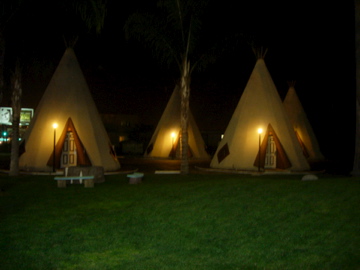
Blogging to you LIVE from the Wigwam Motel in Rialto—my own yellow, cigarette-stenched circle of heaven in the epicenter of strip malls, tract housing and Morrissey fans, the San Bernardino Valley. It’s the perfect place to end the drive down to SoCal, and to begin the journey into the dusty heart of whatever weirdness remains.

I started out on my roadtrip yesterday, sniffling and sore and in a DayQuil daze. I decided to press on with my plans, despite succumbing to a nasty cold that’s been going around, and if it hadn’t been so goddamn beautiful, it might have been painful. Spring arrived a couple days ago, with that certain lightness that makes everything seem young and hopeful and achingly pure. The coast was lit green by months of El Nino storms, a verdancy that’s rare in California. I twisted and turned on the skinny roads, blasting my stereo over the roar of wind through the rattlingly cracked windows.

I stopped in Big Sur, where I hadn’t been since I was a kid. I’d remembered it being so far away from home, which I suppose it is, but only if you measure in culture, not in miles. It was just as massively impressive as I’d remembered, with broad trees and heartbreaking cliffs and not too many tourists, being early in the year. I’d been too groggy to stop for a sandwich on the way out of town, so I pulled into Nepenthe, purported to be one of the better of Big Sur’s overpriced coastal cafes. Glorified Wonderbread, browned and soggy lettuce, and $20 later, I decided that eating a $7 sandwich from home of the hood of my car at some pretty vista point would have been a far preferable experience. Whatever—it’s Big Sur. You can’t stay disappointed that long.

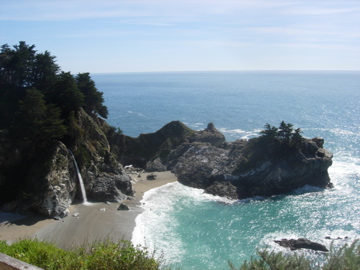
Feeling a little pepped up, I tried to do a quick hike, but discovered that a lot of the trails are currently closed due to the pummeling storms this year. So I tromped down a little coastal path, with bickering families and friendly Germans, aptly named Overlook Trail. It overlooks this:

and I felt pretty satisfied.

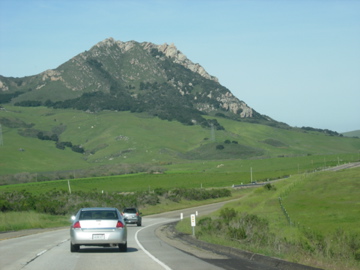
Back on the road, the coast got twistier, the pavement rougher, as I made my way down to San Luis Obispo. It’s a pretty typical California college town, with one major draw—one of the region’s few youth hostels. I grabbed a cheap bunk at Hostel Obispo, a cute old Victorian house, and took a leisurely stroll down to “Downtown,” which is really more of a high-end outdoor mall.

meeeeeat!

Traveling within the US is a novelty for me, and it comes with a couple major benefits, one of which is the use of my iPhone (far too expensive to use abroad). While the Cheap Gas and Public Restroom Finder apps have proven utterly disappointing, my old favorites are definitely coming through: Google maps and Yelp. I wanted to eat somewhere popular, that would give me a good feel for the town, and ended up at the Firestone Grill. It’s a BBQ joint heavy on portions and easy on the pocketbook, which makes sense in a college town. It was alright, about twice as good and half as much as my lunch—but 419 reviews? Then I passed the newly opened Chipotle, with a line literally out the door, and realized maybe, you know, I had had some of the best food in town.

I strolled around the town some more, filled with dudes in flip flops and girls in work-out clothes and pony-tails. It felt wholesome and relaxed—even the local riffraff felt quaint, in their barefoot belligerence. Everything felt cheerful and hopeful, like springtime and college students. I topped off the night with a much-needed soak in a hot tub at Sycamore Mineral Springs, a 12 minute drive from San Luis Obispo. My achy bones and sinus congestion thanked me.

This morning I backtracked to Montana de Oro State Park, for a little fresh air and strolling. Curving down a two-lane road, I went past coastal hills covered in purple and yellow wildflowers, orange explosions of poppies against the green green of the hills. The road took me into a tangle of eucalyptus trees; I pulled over where a bunch of cars were parked and scurried down a dirt path into a grove of trees.

The light cut through the leaves and branches and ocean mist in this dream-like haze, and all I could hear where birds and surf crashing. Over a hill and through a miniature valley (where a pelican glided past just as I rounded the corner), and I found myself at a surfer spot. I hung around a bit, sitting on the rocks and watching the waves and wet suits.

I headed back, this time inland on the 101, where flowers and green continued to line my journey. At home, I’m an impatient and cranky driver—I hate traffic, parking, street sweeping. Always an impediment to where I’m trying to go, what I’m trying to do. But driving down the coast, with my music playing and my broken skeleton doll dangling from the rearview mirror, I could let go and just go with the rhythms of the road. There was little traffic, just fresh air and beauty and my own wordless thoughts. The road was the place I was trying to go.

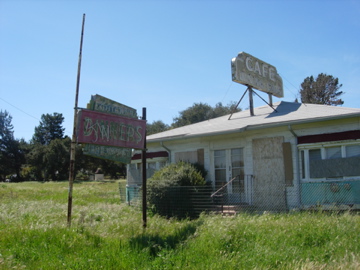
The roadside kitsch of Pea Soup Anderson’s was too much to pass up, so I made another stop—plus the soup felt good on my sore throat. Then I went to do a little un-urban exploring, swishing through thigh-high grass to poke around an abandoned diner I’d spotted from the highway. I peered through the windows at the stacked chairs, the silent booths, feeling a strange kind of nostalgia for a place I’d never been.

Things were starting to get cool.

As luck (or unluck) would have it, my iPod died just as I was cruising past Santa Barbara, so I pulled off to find a cafe. It’s hard not to feel alienated in a town like Santa Barbara, wealthy and white and homogenized and nice. Very very  nice. It’s the kind of place that feeds all your Southern California stereotypes, both the good ones—sun and long, tan legs—and the bad ones—everything else.

I got back on the highway just in time for rush hour. The green gave way to brown and billboards, the ocean mist to heat and just a thin layer of smog, the free flowing to break lights and miles of congestion. My 2 hour drive took 3 1/2. I climbed over the spine of LA, snuck around the backside, through one valley and into another. And finally pulled into the Wigwam Motel. It’s not as run-down as they say, the area not as “rough” as some reviews claimed. It’s a working class “ethnic” suburb and, hey, I’ll take that over a wealthy brofest any day. Even if it is damn hard to find a salad.

Blurry, but it does say "Get Your Kicks on Route 66." A better photo by daylight tomorrow.

So I’ve made it, my little car and me, crawling down the lip of the continent, down through the legendary beauty of coastal California, made more ridiculous by the green and tender spring. I’ve gotten reminded of what I already know of Southern California—bros and traffic—and am poised to head into the desert tomorrow. Found art, a rock n roll pilgrimage (and human cremation) site, and a honky tonk await. And that’s just tomorrow.

Los Angeles, Give Me Some of You!

“Los Angeles, give me some of you! Los Angeles come to me the way I came to you, my feet over your streets, you pretty town I loved you so much, you sad flower in the sand, you pretty town.”

John Fante, “Ask the Dust”

Us Northern Californians are prejudiced.

That’s right: prejudiced. We look down our noses, down the long craggy coastline, at Los Angeles as though it were the traffic-clogged  layer of Hell Dante forgot to mention. Tanned and Botoxed and full of silicone, Southern California steals our water, votes Republican, gave us the Governator. In its smog-laden haze of red carpets and reality shows, it skews our state’s reputation, bogs down our ethereal quest for Prius-driving utopia of gay marriage and legalized marijuana. It’s Sparta and we’re Athens, the “LA face and Oakland booty” that never quite make it onto the same person, never combine to create the ultimate bad-ass state, but instead go careening on their own individual, bickering paths of disapproval (NorCal) and complete unawareness/indifference (SoCal).

I once read an essay that whittled the whole Northern-Southern divide down to the difference between internal and external—Southern California was the glossy, teeth-whitened facade, Northern California the soulful, spiritually searching inside (you can guess which side of the debate the author fell on). It’s Bikram and we’re Hatha. And while Southern California remains too self-absorbed to even notice our despising of them, people write whole books on the cultural clashes of the US’s most populous state.

But I’ve long suspected that there’s more to Southern California than SUV-driving anorexics and flip-flop-wearing bros. It may have given us Kardashians and Speidi, but what about Charles Bukowski and John Fante, Camille Rose Garcia and The Date Farmers, The Germs and NWA? There must be, I’ve thought, a whole nuther Los Angeles, down beneath the glittering grotesque surface, that most people never see—hidden and raw, like an open wound or a small, beating heart.

I’m going to find it. I’m going, filling my beat-up car with gas and kicking the tires to check the air, going down the writhing road of Highway 1, past old Missions and crumbling cliffs, sleepy mansions and under-funded state parks. I’m headed into the desert, to psuedo-Old-West honky tonks and lawless squatter encampments. I’m watching swallows return from their long flight, to build strange nests and swoop their shadows through the dusk. And then I’m headed into the city itself, the city of Angeles and dreamers and dirtbags I’ve adored. I’ve got no traditional guidebook, no road map—just my phone and a smattering of tips divulged by friends and dug up on random websites.

Oh, and I’m taking you along for the ride.

Temporal Permanence: Ruins, Street Art and the Narrative Beneath

The speechless candlelight made the images more powerful. The way the sage billowed, the music groaned, the little light flickered—it made the images seem less like a mural and more like the hallucinogenic remnants of a dream, bloody and hand-smeared on the walls of a very dark cave, or on the inside of your skull—which may be the same thing. Dancing on the under side of your eyelids, before swollen and searching pupils, this was the stuff of mushrooms and all-nighters, of contemporary graffiti and ancient cities, of Latin American travels and my Friday night in Oakland.

The showing of Obi Kaufmann‘s mural The Feathered Serpent at The Oakbook was less like an art show than a ceremonious seance. Painted in the fever and fury of a single day and night (and mushroom trip), the mural was inspired by the artist’s recent travels through Latin America. The distinctive flavor of Santiago’s street art scene and the whispering ruins of Oaxaca’s ancient city Monte Alban swirled around in the artist’s subconscious until a dream pushed images out, from one side of the brain to the other, through his fingers and onto the wall of the gallery.

I am not an art critic, journalist, collector or student, so I won’t try to review or surmise. Instead, I’ll let the artist speak for himself. Here’s his photo essay of Santiago street art on Artopic, and his written essay about the genesis and symbolism of the piece on The Oakbook’s website.

After checking out the essays, I got pretty stoked to see the mural. The work being travel-inspired got my antennas twitching. I’d been to both Santiago and Monte Alban, I love crumbly old ruins, and I really love street art (as you’ve seen before)—often for the aesthetics but more because, as a traveler, I find it reveals so much about the beating heart of a place. I was curious to see how it all connected.

Indeed, what I found most compelling about the work (aside from the spooky images and skeletal figures) was the way it blended seemingly disparate influences. There doesn’t seem to be a lot of similarity between the streets of Santiago and the ruins of the Zapotec city Monte Alban: vibrant color versus crumbled stone; modern versus ancient; temporality versus remains—a continent, culture and two millennia apart, what commonality did these two places hold? For the artist, it was some kind of communalism, each place informing part of a narrative that was at once universal and personal, regionally distinct and part of a bigger story. Obi saw the world, human history, in the cavernous, torch-lit intersection of two places that don’t seem to intersect. And if that’s not some damn good traveling, than I don’t know what is.

The artist

Travel often brings up puzzling paradoxes (thus the tired line, “land of contrasts”). How does one hold, in the same hand, the transience of graffiti and the permanence of hard stone foundations? Or, to extend the metaphor, how does a traveler simultaneously love the spontaneity of the open road and the rootedness of home? I think the answer, if there is one, must lie somewhere down beneath all that, in the narrative thread that ties this big world together—in the collective unconscious, if you wanna get real heady. Or at least, you know, in the images and scrawlings and paint smears that have now been painted over—a wall blazing white and sealed-lipped about the stories it holds.

Ass Whoopin on the AC Transit: Epic Beard Man, and Why I Don’t Ride the Bus Anymore

Celebrity sighting on the 53

The voice was barely discernible, muffled by whizzing traffic and excitement. “I just rode the bus with Epic Beard Man! He was giving out candy bars and autographs, and I got a photo with him!”

My friend’s Friday evening commute home had been spiced up by a sighting of Oakland’s latest internet phenomenon. As the number 53 heaved down Fruitvale Avenue, passengers posed for pictures and chanted “Epic Beard Man,” as the grizzlied old dude distributed candy from his backpack and basked in the adoration of the bus riders.

Regardless of your take on Oakland’s latest internet sensation—racist, vigilante or mentally ill bad-ass—one thing is for sure: Epic Beard Man has reached celebrity status. And while a heated, racialized debate rages in chat rooms and on blogs, the actual riders of AC Transit appear to have risen Epic Beard Man to the revered status of folk hero.

Quick low-down, in case you’re out of the loop: earlier this week, a YouTube video of an AC Transit (Alameda County Transit) altercation between a middle-aged black man and an elderly white man (now dubbed Epic Beard Man) made quite a stir—over a million page views in its first day, and countless comments and ensuing discussions over issues of race and safety in Oakland. The story was picked up by local blogs, news outlets, even the Huffington Post. Know Your Meme offers the most complete run-down of the controversy, featuring video responses that capture some telling Oakland sentiments.

You can go to YouTube and dig through all the remixes, follow-ups and tributes, but here’s the original video. Yes, it’s graphic:

It’s no surprise that the video is so popular. It’s another opportunity for people to glimpse into the dysfunctional “urban” reality of Oakland, and people outside of Oakland never seem to tire of that. Several years ago, the city’s other big internet phenomenon fascinated outsiders with its oh-so Oakland cultural collisions and colorful characters (I was living in East Oakland at the time, and the screeching sound of whistle tips really did echo through the streets at all hours).

While responses to the latest video vary, they largely fall into two camps: Epic Beard Man is a racist, or a hero. He’s either an old redneck who asks a black man to shine his shoes, then beats him, or he’s a tough dude who stands up to a punk-ass thug who’s instigating and harassing him. In general, the first camp seems to be populated by guilty white people and advocates of all things ghetto, while the second camp is composed of kids, bus riders and enthusiasts of drama and smack-downs.

My own response lies somewhere between the two. Both men are unstable, not the kind of people you want to sit next to and exactly the kind of people you meet on East Bay buses. Epic Beard Man is obviously not well, further evidenced by follow-up interviews; turns out he was also the star of another YouTube phenomenon, a video where he gets tased at an A’s game for unruly behavior. He’s a deranged old Vet with a tenuous grasp on reality, prone to violent outbursts. Not someone who should be milling around the streets, trying to take care of themselves, but hey, that’s America (thank you, Ronald Reagan). The other dude should have left it alone, realized Epic Beard Man was not all there and not worth the trouble—but in his bravado, he got pumped full of ego and shit-talking and, well, he got served.

What’s most interesting to me is how the people most closely related to the issues raised in the video reacted—that is, AC Transit riders and people with exhaustive experience dealing with both the tiringly whacked-out and tediously ghetto. Most of the folks I’ve talked to feel that while, yeah, Epic Beard Man is totally deranged, dude got what he deserved.

It reminds me of an issue several years ago when an Oakland resident was both vilified and exalted for standing up to the thug kids that plagued his block, in what became a violent incident. While both parties in this instance were African-American, so the race issue wasn’t raised, responses were similar: he was either a vigilante hero, or a villainous attacker of innocent youth. Throughout the controversy, the man insisted that all he wanted was a safe neighborhood in which to raise his kids—what I’d argue the majority of people in Oakland are looking for. In the end, he did what most of the families I grew up with did—unable to afford a nicer neighborhood in Oakland, he moved to one of the outlying working-class suburbs.

Responses to that issue, as well as this one, tap into some very central Oakland issues. While the man from a few years back was a much more sympathetic (and sane) character, and didn’t want to be a hero, many people regarded him as such. I think it speaks to the extent to which people are sick of all the bullshit. People are tired of dealing with puffed up a-holes who think they can say/do whatever to whoever and get away with it, tired of shit-talkers, instigators and intimidators. So much so that they’re willing to revere violent behavior.

The riders on the 53 last night, majority non-white, were literally cheering for Epic Beard Man. Yes, some of it was surely star-struckedness and a glorification of school-yard theatrics, but I think there was something deeper going on there, something almost beyond race. Most of the video responses I’ve encountered are, in fact, from people of color. Epic Beard Man may be nuts, but the other guy was an ass. There’s no video glorifying him—and I don’t think it’s just cause he was the loser in the altercation. It’s a strange thing: an incident so racialized, that at its core, to the people who deal with this stuff day in and day out, has more to do with harassment and basic respect than race.

That the incident took place on a bus is no coincidence. A San Francisco Chronicle blogger (and fellow gym goer) centered his coverage of the issue on the ridiculousness of AC Transit—for him, it was all evidence for why he doesn’t ride the buses in Oakland.

Word. I grew up riding AC Transit, and it served as a serious education in the world. The first post on this blog was a reflection of how riding the East Bay buses prepared me for world travel, while the very first piece I published, as a teenager in The East Bay Express, was a narrative about my fucked-up experiences on AC Transit (I used a line from the piece as the title for this post). While shit like this doesn’t go down on the vast majority of bus rides, it’s not some sort of exceptional incident—it just happened to be captured on tape. I’m grateful for the schooling AC Transit administered; as a result of vital life skills learned on those blue plastic seats, people generally don’t fuck with me. But I’m even more grateful to have a car now.

The Epic Beard Man hype will surely die down—like everything these days, it’ll be discussed and linked to and tweeted wildly, then fade into the buzzing gray, the next craze taking its place (in the digital age, it seems everyone’s 15 minutes of fame are whittled down to 15 seconds). But for the rest of us, the issues the video captures will continue on: race, safety, the crazies that fill AC Transit. They’ll continue to roam around, screaming and bleeding all over our commutes, and I will carry on with my self-centered, polluting aversion to East Bay mass transit.

But I will say—being on that 53 with my friend last night would have been an experience. If for nothing else than the photo ops.

I Heard That Lonesome Whistle Blow: Port Costa and the Past

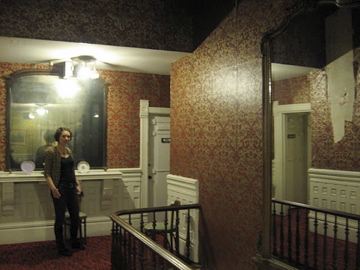
In the hallway

It wasn’t the squeaking of the bats that kept me up all night. It wasn’t the way my shoulders dug in to the thin mattress that kept me rolling over, not the low-voiced howl of the passing freight trains that rattled me out of my half-dreams.

It was that I had to pee. And I was too scared of ghosts get up.

Not that I’m 7, and not that I actually saw or heard any ghosts. Just that, you know, I’m a wuss. The bathroom was only a couple doors down the hall. But I’d heard stories, of ghostly laughs and the clicking of century-old high heels, and I figured—why risk it? I waited until the gray light of dawn sank its fingers through the curtains, brushed the walls and illuminated the shadows. I relieved myself with incident.

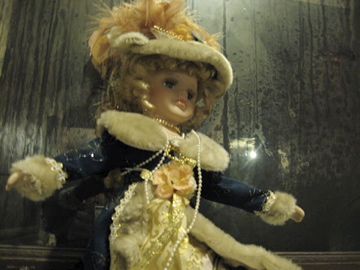
The whole overnight to Port Costa, actually, went without incident, the kind that had been hyped and fore-warned: red necks, ghosts, bed bugs, cocaine-fueled partiers—I didn’t see any. What I did see: peeling velvet wallpaper, a spooky porcelain doll, fishermen tromping over gravel and train tracks, a stuffed polar bear, a dude playing a banjo and a whole lot of motorcycles.

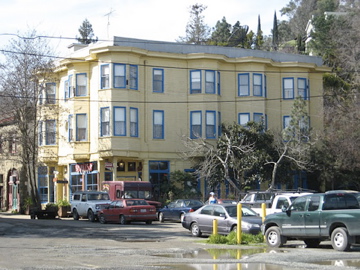
We arrived after dark, weaving our way through the shadowed coastal hills of a regional park. The pavement gave way to gravel as we delved into a little valley, dim houses and an old chapel lining the one road of Port Costa. The road dead-ended into a wide parking lot, gravel, train tracks, the misty water of the Carquinez Strait. On one side of us was a three-story, dirt-colored old warehouse, on the other, the bay windows of the Burlington Hotel. That was it.

Inside The Warehouse

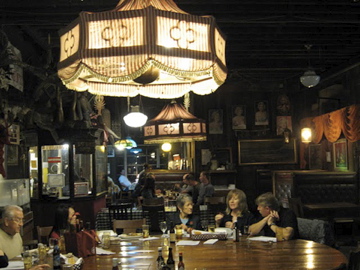
We turned the locked knob to the hotel’s door a couple times, until the banjo-playing dude on the corner told us we had to go across the street to the bar to check in. We entered The Warehouse, the main occupant of the 19th-century grain storage-house.  We stared stupidly for a couple moments, taking in the mish-mash of burlesque lampshades, checkered plastic tablecloths, mounted animal heads and vintage signs. We must have stood out—a man in the corner waved at us.

Turned out he was Howie, accompanied by Barbie, proprietors of the Burlington Hotel. They greeted us in what we’d discover was a typical Port Costa way: genuinely friendly and down-to-earth. It wasn’t the affected over-sweetness of a typical tourist town, nor the you-ain’t-from-round-here skepticism of an isolated small town. The vibe was unpretentious and warm, but not overly warm. It was the Goldilocks of small towns—just right.

Everything was just right about Port Costa: just enough overnighters that I didn’t feel too out of place, just enough decrepitude to make the hotel really really cool, just enough vestiges of history to make the town special—not undiscovered, but not blown up or theme-parky.

On the mantel in front of our room.

We wandered around the Burlington Hotel with our jaws dropped—it was the antique/vintage/ creaky dollhouse of cool we’d hoped for. But it wasn’t the stinky filth-pot Yelp reviewers and the Chronicle had made it out to be. Sure, it was faded and had the musty smell of an attic, but I had to wonder—had the people who’d called it dirty ever stayed in a cheap third-world hotel? Or a flea-bag American one, for that matter? It was no Courtyard Inn, but definitely one of the nicer hotels I’ve stayed in the US (not saying much, granted).

Maybe they’ve already started to spiffy up and straighten out, as the Chronicle article claimed. Aside from the lack of bed bugs and grime, there wasn’t a lot of raucous activity either. The other guests definitely looked like they were there for a good time, but the most debauchery we experienced at the Burlington Hotel was some middle-aged folks having a Hank Williams sing-along (I wanted in), followed by some late-night bed creaking (I did not want in). Pretty mild, really.

Ate all that!

As part of the Valentine’s Special, a $99 dinner-room combo, we headed back to The Warehouse for some good ole American eating. I’m usually a free-range, organic kinda girl, but I figured, meh, when in Port Costa. We grubbed on a whole lobster, one pound of prime rib, and unlimited salad/chili/chowder bar, washed down with soda served in a glass jar. My pants felt quite a bit snugger. A post-dinner stroll was definitely in order.

We tip-toed across the puddle-ridden parking lot, through an opening in the chain-link fence, and across the dark of gravel and train tracks. The nighttime mist made everything feel dream-like and removed, like we were somewhere much further away, like those weren’t the lights of a suburb blinking and sighing across the water. The way the Amtrack and freight trains’ horns would wail, the way their lights gleamed like animal eyes, how the heaved and rattled past—it made it feel like we were in some little pocket of the world, not quite forgotten by time, but where time just kind of rumbled past, without really stopping, leaving only a puff of exhaust and the echo of its cry.

Sitting on the rocks, I looked out across the water, and had a strange, back-of-the-head tingle. The lights of a far-off refinery winked in the billows of steam pouring out its towers, glittering like some kind of industrial Oz. Jagged fragments of memory came cutting back. “Fuck,” I said. “I’ve been here.”

High school. Malt liquor and weed and pills. We’d piled into B’s truck, drove around El Sob and Crockett looking for drugs and trouble, finding none of one and only a little of the other. We’d pulled into a parking lot, staggered across gravel. Refineries twinkling. Feet numb, and sides closing in, black. Cigarette smoke in my hair. Wanting to sleep.

My little kaleidoscope of fucked-up broken memories came out of some forgotten fold of my brain, stinging and still alcohol-damp. So I’d partied in Port Costa after all. Who knew.

The next morning, the town was mist-shrouded and dewey-eyed. I was dazed; all night I’d listened to the trains, thinking of all the other people who’d laid in that room before me, in the gray and shadows, listening to that same rumble and sigh. We drank teeth-burning from styrofoam cups and took another tromp around town, then further down the train tracks. Lots of killer photos ensued (currently, only the digital ones are ready; pro film shots will take plenty longer). Coolest find: on some rusty old rails, someone with a similar nerdy affinity for trains and travel left their mark:

The mild afternoon melted past, time a far away thing. The trains continued to pass, rumbling and horn blowing at a couple of kids poking around the rocks and rails of a once-great railway hub, filled with miners and shipyard workers and whores and ferry horns—and now, just the ghostly groan of the trains, passing, passing, but never stopping, no, not anymore.

Photos by Theo Konrad Auer. More on the way…

Where Do Dirtbags Go for Valentine’s?

One of Aly's photos from the Burlington Hotel

It happened like this:

Making the rounds last Friday at the Art Murmur, I came across the photos of a friend of mine, Aly Su Borst. They were pretty bad-ass: a series of self-portraits set in some run-down opulence that got my spooky/awesome sensors spiked. I took some photos on my phone. At home the next day, I showed my roommate, “Hey, Luke, check out Aly’s photos.”

“Oh, rad, Port Costa.”

“Where’s that?”

That’s how I found out about the overnight destination all the local dirtbags have apparently been partying it up in for decades. And like most things, I’ve found out just in the nick of time: the reputedly haunted, ramshackle old bordello/hotel that serves as the heart of the 250-person town of Port Costa (that despite being 30 miles from my house, I’d never heard of) has plans to spiffy itself up, and recently received coverage by the San Francisco Chronicle. I knew no time could be wasted—I booked a room for this Saturday night. It’ll be a Valentine’s weekend overnight the way I like it: full of bats, bedbugs, dive bar denizens and rock n roll.

The Chronicle‘s article made the Burlington Hotel sound like the very definition of “hidden gem”—not in the Tuscan villa sense of the word, but in the gritty, visceral sense—which is to say, the sense I dig the most. Whether it was in fact an old whorehouse, and whether it is indeed haunted by the ghosts of prostitutes and shipyard workers, one thing seems for sure: the Burlington Hotel is a relic of the Old West California, the one Jack Black captured in the book You Can’t Win—the one that’s all but gone amid the Botox and SUVs of Southern California, and the Blue Priuses and Tibetan prayer flags of Northern California. Which is why I want in.

It won’t be a relaxing, rejuvenating or romantic getaway. Its Yelp reviews reveal as much: “dirty,” “bad-ass,” “like a horror movie,” “whore-tel.” One person laments that it’s no longer the all-night rager spot it had been in previous years (frequented by the likes of none other than the East Bay Rats—nuff said). A raucous bar next door constitutes much of the clientele, including “bikers, transients, nazi crack addicts, and drifters. maybe tourists are in there somewhere, too.” (Really, there’s some effing gems on the Yelp page, read through that shit.)

Already pretty convinced, I came home from work the next night and found Liz and Melissa on the couch. “You guys ever heard of the Burlington Hotel?” They turned their heads slowly towards me. “Oh. Dude.”

They swapped debaucherous stories from their hard-partying youth—Liz being haunted in Room K, Melissa’s heshen friends getting permanently 86-ed (which apparently is saying a whole lot). “Make sure,” Liz advised, “that you bring your own sheets. Bedbug city, yo.”

I called to make a reservation, which wasn’t quite as difficult as the Chronicle article made it out to be. After a long succession of rings, someone picked up; muffled and scratchy, he told me they weren’t quite open yet, but to call back in a half-hour, and they’d be ready to “rock n roll.” I did, and they were. Butt rock blared in the background. All the rooms I’d been advised were the best were, of course, full, but I did get in on the “special” (Valentine’s Day special? probably not): the room and 2 surf-and-turf dinners for $99 total. Now that’s my kind of overnight.

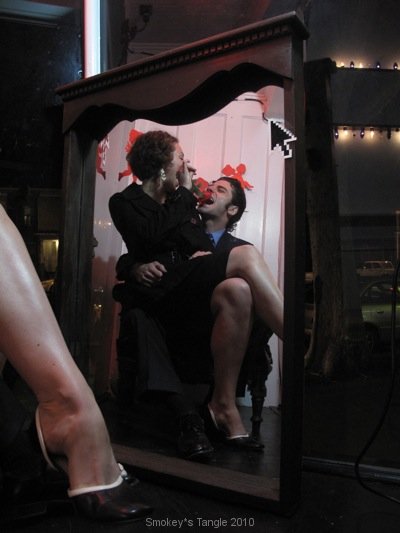
Ridiculous photo from the Smokey's Tangle V-Day Photo Booth, February's Art Murmur

So sadly, since the Chronicle recently did a piece on the hotel, I’m gonna have to dig a little deeper to a) out-do their article, and b) find the right publication for it. The good news is that my partner in crime is bringing along his fancy camera, so the photos, well, they’re going to kill. Hopefully not literally.

Flowers and Hair Dye: Getting Ready for the New Year in Oakland’s Chinatown

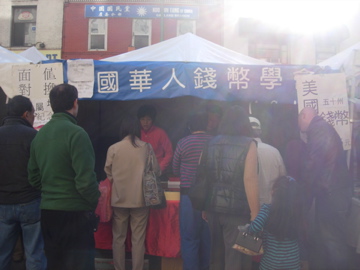
Short women elbowed through stacks of neon flowers. Banners boasted the rejuvenating wonders of herbs, tea, hair dye: “No. 1 Selling Brand in U.S.A.”, “Prince of Peace, The Name You Can Trust!” Distorted pop vocals crackled and hummed from a far-off stereo. Children gazed up at their toy windmills, decorated with carton tigers or Dora the Explorer, black eyes shinning and mesmerized by the spinning, spinning.

This last weekend was Oakland Chinatown’s annual Lunar New Year “Bazaar.” Not quite a street festival, not quite a farmers market, and anything but the well-known San Francisco Chinese New Year Parade (ahem, the “Southwest Airlines Chinese New Year Parade”), the event captured Oakland’s Chinatown: non-glitzy, utilitarian, and not particularly concerned with outsiders.

I’ve been meaning to do a post about Oakland’s Chinatown for awhile. As its Chamber of Commerce website declares: “Oakland’s Chinatown is one of the most fun and authentic of the American Chinatowns. It is quite safe. It is not a line of t-shirt and postcard shops like much of other Chinatowns.” I recently tromped through San Francisco’s Chinatown with out-of-town relatives, which actually gave me a renewed appreciation for its lanterns, pagodas, skinny alleys and countless trinket stores. Growing up here, it’s easy to get blase about what remains alien and alluring for a lot of people. My cousins loved SF’s Chinatown, and I wouldn’t think of bringing them to Oakland’s—it would be totally uninteresting to tourists.

Diagonal crosswalk

Oakland’s Chinatown isn’t glamorous; there’s no self-conscious gestures towards exoticism. It’s not even really a “Chinatown” as much as it is an “Asiantown,” filled with a good number of Southeast Asians (and thus, one of the best Vietnamese sandwich shops around). Still, the history of the neighborhood is Chinese—as evidenced by the bilingual street signs—and the attitude, well, that’s Chinese too. It’s not hostile by any means, it just doesn’t go out of its way to include outsiders. It reminds me of the sentiment Pico Iyer captured in his 1980s essay “The Door Swings both Ways.” A lot of the stores and markets don’t bother to translate signs. Despite one of its main thoroughfares being four lanes wide, double-parking is so rampant it still takes ten minutes to drive two blocks. People ignored crosswalks and traffic signals so much that the city eventually gave up and installed Oakland’s only diagonal crosswalks.

Dingy awnings, block construction and an eerily empty mall are part of the unexotic offerings of Oakland’s Chinatown. And, this last weekend, two of its main streets were closed off for what’s marketed as a Lunar New Year Bazaar, but what’s really a stock-up opportunity for locals. I ran into an old friend who was working the event, and her aunt helped illuminate my hazy understanding of New Years traditions, informed mostly by the annual dragon dance on the playground of my grade school, when we got to throw cabbage and eat those chewy candies covered in rice paper.

Aunt Kathy told me about the purpose of the market, which is to stock up on bright flowers to decorate the home with. Yellow mums and reedy stalks (whose English name we couldn’t figure out) are most popular for their bright color and longevity. People also bought up red envelopes, for money giving; what I didn’t know was that only single people receive envelopes (hint, hint). As opposed to Chinese celebrations, when people have a week off work to visit relatives and feast, American celebrations are more condensed—people usually gather at a relative’s house for a night, eat a ton, and exchange envelopes, candy and sugar-coated fruit. “Like Thanksgiving”—but with a lot more red.

Like most things in Chinese culture, the traditions of the New Year seem to all go back to “good luck.” “Why the colorful flowers?” “For happiness and good luck.” “What’s the significance of the long stalky flowers?” “They live long, don’t die. Bring good luck to the house.” “Why all the candy?” “It’s sweet, bring good luck.”

Oakland’s Chinatown doesn’t hold a New Year parade or celebration, just one big market for all your flower, herb, sunglasses, socks, DVD and good luck buying needs. A couple of other non-Asians milled through the crowd, not quite sure what to do with themselves or why they were there. Where were the food stalls? The ethnic trinkets and radio stations? Meh, it was Chinatown. This was their affair, and they weren’t gonna dress it up for anyone.

Photos by Theo Auer

Aw, crap, forget my pocket phrasebook

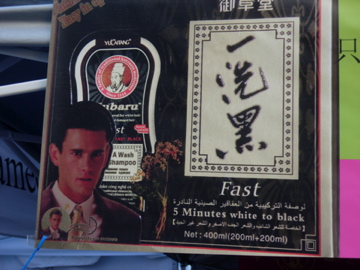
Booth selling hair dye

What language is that under "Fast"?

Celebrity endorsement

Digging for goods

Flowers and sunshine

Another mystery booth

Dora the Explorer Windmill

Peeking in to a random shop

Ummm...

"Alright, alright, we'll give you a pagoda."

A jay-walker no more

Exotic...

Even Citibank is in the Year of the Tiger spirit

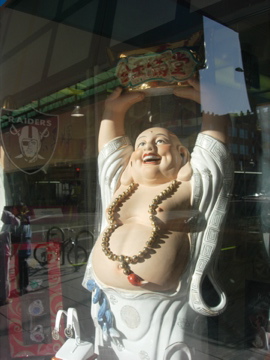
Buddha and a Raiders Logo

Honolulu, Black and White and Back in Time

Faces stare out from a two-dimensional black and white. They are laughing, posing, cast in shadows and cut-and-pasted beside lush palm trees, neon hummingbirds, tan thatching and pinkened skies. Sometimes they smile; other times they gaze off, someplace beyond the camera, looking out from thin layer of time and plastic. And I am completely obsessed.

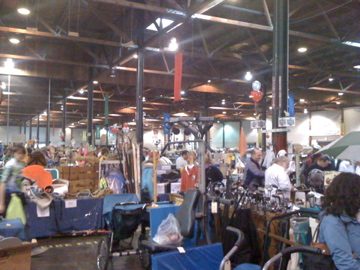
It’s my weirdest and raddest score from the Bay Area’s rummage event of year. The annual Oakland Museum’s White Elephant Sale is a cult event local collectors, scavengers, cheapskates and lovers of vintage live for. The Oakland Museum benefit is held out in a Jingletown warehouse, and hosted by the spunky white-haired ladies of the Women’s Board. Donations are collected throughout the year, culminating in the kitschy bonanza of bargains. The event takes over the neighborhood, complete with taco trucks and a free shuttle to the BART station.

While the main event is a two-day affair held on the first weekend in March, this last Sunday was the special preview—when the die-hards shell out $10-15 months in advance to get first pickings. A friend finagled us onto the guest list; we traipsed down across the train tracks, through the sour estuary smell and into the warehouse bustling with bodies digging for treasure.

Inside the warehouse

There was a little of everything: antique furniture, vintage suits, old Polaroid cameras, $1 LPs, 80s action figures that brought me back to my childhood—even a box of expired condoms. The prices put any flea market to shame, and everyone was in a good mood. The staff was sweet and grandparently. An old dude with a vest full of buttons from previous years’ sales stood by a Thomas Edison record player, explaining to whoever passed how it worked and the history behind it. Some staff dressed up—I saw a Napoleon look-alike—which added to the festive atmosphere and reconfirmed my aspiration to be a cool old volunteer/docent person when I retire (like I’ll ever be able to…). A truly awesome moment came when, rifling through old records, a tween boy with shoulder-length blond hair picked up a Van Halen LP and let out a long, “Yessssss.”

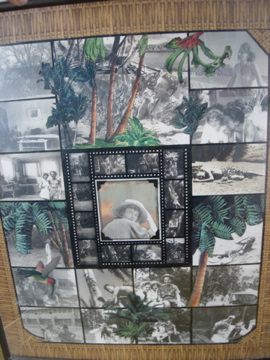
I scored a couple cool vintage-y household items, but by far the coolest thing I came across was a 20″ x 16″ photo collage. It’s cheaply framed, cost $1 and is full of the kind of mystery that gets my wheels turning, my imagination shooting sparks.

The artfully executed collage of photos is from a group of young people’s vacation to Honolulu. The handwritten note on the cardboard back guesses the year to either be 1939, or 1940-43, World War II. Beneath that, four names appear: Virginia Matthiesen, Cole McFarland, Bud Matthiesen and “Sailor Friend.” Those are the only tangibles I have to cling to, the only ones I want. In the grey photos of shorelines and hotel rooms, a garden and a roadside, I have all the fodder for fantasy I need.

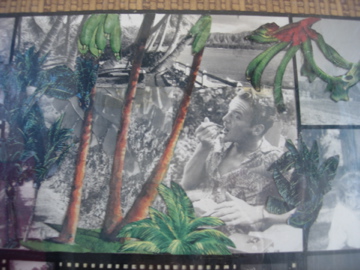
The group is young, mid-20s I’d guess. They have the eyes and expressions of old-school rebels, a kind of pre-Beatnik vibe, something carefree and a little wild in their smiles and poses. One has a Neal Cassady look; a girl has sharp cheekbones and piercing eyes; another stares off from above bare shoulders and a shell necklace. In a different photo, Neal Cassady is wearing the shell necklace, leaning in towards the girl as she looks away. The light has caught her blouse, making it blaze with a whiteness that obscures her face.

There’s an impossible number of stories inside the collage, silent and lost like a dream you can’t remember. Whoever made it set it in a border of tiki-style thatch print, then pasted a couple cut-outs of palm trees, to add color and a tropical vibe. It’s visually cool and kitschy enough to be hip. But really, it’s the faces that make me love the collage.

Of course, I’m projecting all of this—maybe they’re not artsy rebels at all. But that’s the fun of it, imagining a trip like that, then: how long it must have taken to get to Hawaii, how rustic and undeveloped it looked, how more pointed and romantic everything looks in black and white. And the timelessness of getting into adventures on the road. I haven’t found the perfect place for it yet; one of my roommates loves it, the other thinks it’s creepy. For now, it’s leaning against my bedroom wall, where I can stare and dream.

At the center of the collage, pasted on a pastel sunset, is a solo shot of the sharp-cheeked woman. She’s looking back, over her shoulder, holding a straw hat down against what might be wind, what might be the passage of time. I like to think she’s looking back at me, out from a moment that’s long passed, a place that isn’t the same, a youth that is gone. Probably, she was looking back at one of the boys in the collage. But a girl can dream, can’t she?

Relatives and Revelations: What My Brother’s Wedding Taught Me about Travel

Photo booth fun

“What can I say? When you’re children get married, it’s one of the happiest days of your life.”

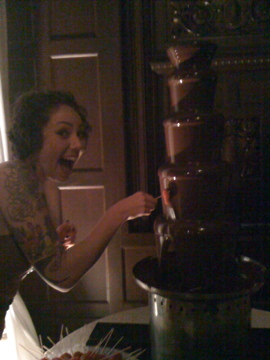
That was my dad, toasting at my brother’s wedding two weeks ago. Simple, but true: celebrating my brother’s marriage to a rad lady will definitely go down as one of my happiest days. Aside from the awesomeness of why we were all there, it was a gorgeous event at the Julia Morgan Ballroom in Downtown San Francisco, complete with caviar and a five-tier chocolate fondue fountain (that’s right, you heard me). I was surrounded with life-long friends and far-away family, flown in from the Midwest and East Coast.

Of course, as a travel person, my antennaes were perked by all the out-of-towners. Watching them all come in—arrive at the hotel, rent cars, hang wrapped dress clothes in closets—I realized I only travel a very specific way, and it’s lent a very limited perspective.

I’d argue that most Americans travel the way my family did two weeks ago: domestically, in hotels, either shelling out for a rental car or attempting to traverse poorly funded mass transit systems. It’s pretty far-off from the international ramblings I do on second-class buses and cheap pensions/hostels/couchsurfing. The weekend resulted a series of travel revelations—“light bulb moments,” as I’d once heard them described on Oprah.

Before the guests arrived

What shocked me most was the sheer expense of it all. Even at an off-season rate, further discounted for the wedding party, staying in Downtown San Francisco is not cheap. Renting a car is not cheap. Eating at the restaurants and cafes Downtown is also not cheap. No wonder people ask me “But how can you afford to travel so much?” I used to feel that travel within the US was kinda a rip-off. I don’t take it that far now, but I will say you get a lot more bang for your buck elsewhere. (That being said, I have done New York City on $40 a day, so maybe I’m just a cheapskate.)

The night of the wedding, my parents decided to not add battling the Bay Bridge to the day’s ledger, and booked a room, which I piggy-backed on. Which brings me to the next travel revelation I had: looking good on the road is a major hassle.

As far as hassles go, mine were pretty minimal: the morning of the wedding, I dropped my shoes, dress and fancy jacket off at my parents’ house in Oakland before taking BART out to the city to get my hair and make-up done. I toted with me my overnight bag, in which I carried more make-up and hair products, as well as jewelry, nail polish, etc. My parents brought my dress clothes; I met them at the hotel and changed. The next day they took my dress clothes back to the East Bay while I hung out with my cousins. Not bad at all, considering I didn’t even have to negotiate riding the train with a hanger of dress clothes.

Classy as shit

But considering the way I normally travel, this jaunt across the Bay was complicated exponentially by the need to wear something other than jeans and sneakers. When I travel, all bets are off: I bring my most utilitarian clothes, no makeup, a dabble of hair gel and loads of sunscreen. I look like a total ragamuffin—handy, since it tends to decrease the amount I’m hit on. Wanting to look not just presentable, but my drop-dead best, is tricky enough; doing it out of a bag was even harder. I garnered a new appreciation for business travelers, beauty pageant contestants and all other non-backpacker/dirtbags travelers.
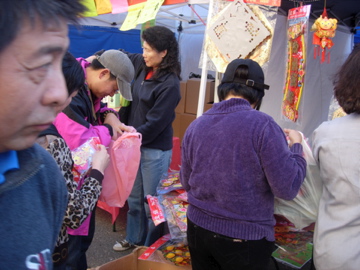
Here’s another thing I learned: logistics are tough. Organizing big groups of people, getting them here and there when they don’t know where they are, is really hard. No wonder tour companies charter buses. And no wonder people trundle on them happily.

I’m the kind of traveler that loves transit. I grew up riding buses and trains, and I get a kick out of figuring out new metro systems: where train lines connect, what lines run where, the fastest and easiest way to get from Point A to Point B. There’s a skill to transit, and I’ve honed a kind of sixth sense for the rhythm and order of it. So when my dad started to fret over how we’d get everyone from the Downtown hotel to a Sunday night pizza dinner at my brother’s house on 27th and Dolores, I responded, “We’ll have them take the J-Church.” Easy, right?

Well, it was easier than shuttling loads of people back and forth in the couple of rental cars, but not as easy as you’d suspect. I played transit tour guide, leading everyone to the Montgomery Station, through the turnstiles, down to the platform, on to the train (luckily, we all got seats). I alerted everyone to our stop, got us all out of the back doors (although almost lost my grandfather in the process), and down the two blocks to my brother’s house.

There’s not a lot of hand-holding or coddling on MUNI, and I like it that way. MUNI’s not most intuitive system—you can only pay station turnstiles in coins, have to retain a transfer ticket, and all lines eventually come aboveground, where stops are unmarked. But it’s still cheaper and more comprehensive than BART, long-distance commuter trains that double as mass transit for the Greater Bay Area, with a pathetic number of inner-city stations and a whopping $7 round trip fare from my neighborhood in Oakland to Downtown SF. In my mind, this makes BART infinitely inferior to MUNI. Who needs plush seats and timetables anyway? I’ll take hard plastic and a vague urine smell over a $7 fare any day.

iPhones have no flash, but you can still kinda make out five tiers of fondue.

But riding the train with my relatives, I realized that transit can be damn stressful. If you’re not already in the groove of it, or don’t share my nerdy obsession with maps and routes, it’s really just a pain in the ass. The potential to get lost is huge: you could get on the wrong train, get off at the wrong stop, end up god-only-knows-where. It’s confusing, station agents are exasperated, locals impatient. My relatives that rented cars were hit with overnight parking fees and having to traverse a maze of one-way streets, but when they got lost, they were warm and dry, and could easily turn back around. I realized why, despite the costs, so many travelers opt to rent cars over riding transit. Guiding everyone through the process, I also realized why tour guides carry those little colored umbrellas.

In the end, everyone got to and fro and everywhere inbetween safely. We gussied up, boogied down and had a killer time. And that’s what weddings are all about, right?


Lauren Quinn is a writer and traveler currently living in Hanoi. Lonely Girl Travels was a blog of her sola travels and expat living from 2009 to 2012. She resides elsewhere on the internet now.

Join 486 other subscribers

Buy This Sh#t

Categories