 Yesterday I had the most authentic Moroccan experience of my trip so far. It wasn’t in a medina, it wasn’t at any monument; it wasn’t outside of a mosque or inside of carpet shop. It wasn’t in some exotic spice souq, or even with a witch doctor.
It was knees-to-chest, sweating obscenely, holding my breath and trying not a vomit in a catastrophic cauldron that careened its way through the countryside. That is to say, it was on a bus.
There’s two kinds of buses in Morocco: the first-class and the “other.” My previous two bus rides had been on the plush, first-class CTM company. The guidebook doesn’t just recommend CTM; it virtually doesn’t list the times, prices or destinations of other companies. In most cities, CTM’s buses depart from their own seperate offices, far from the chaos and heat and exhaust-laced smell of rotting ass characteristic to most bus stations, not just in Morocco, but around the world.
CTM accepts credit cards and assigns seats; their desk workers speak English. These are not the buses of screaming children or those checkered mesh bags fraying at the plastic seams from the weight of all some old lady’s worldly possessions. These are the buses of laptops and exquisite scarves, polo shirts and heavy gold rings. And independent travelers with Western standards and a low tolerance for long-distance discomfort. Together, we bound competently down the highways, stretching our legs and basking beneath the gentle blow of air-conditioning vents.
Once on board a CTM bus, you usually make a stop at the big messy main bus station before departing a city. In Tangier, I parted my curtain and peered out at the shouting, scrambling insanity of the real bus station. Jam-packed buses, a jumble of children’s bodies and grim faces pressed against tinted glass, heaved and wheezed and lurched haphazardly through the lot, shouting touts hanging from still-open doors. I have to say, I felt kind of like a chump from my kooshy assigned seat in a half-empty bus. At least once on this trip, I told myself, I’ll ride a real bus.
I intended to fulfill this brazen commitment on some short-distance route—45 minutes, an hour tops. Just, you know, to feel like I’d done it, gotten a taste and promptly gotten out.
The problem is, CTM runs infrequent services to only a few destinations, especially towards the south of the country. In my great haste to flee dishearteningly over-touristed Essaouira, I weighed my options: languish at the bus station and continue to get hassled by hotel and taxi touts for two hours while I wait for the CTM bus, and then have to make a connection mid-way through my journey, or hop on a direct “other” bus leaving in 15 minutes. Comfort flew out the window as I climbed the sticky stairs of the second-class bus.
I found an empty seat towards the back, and observed. This was the bus of acne and deep wrinkles, missing teeth and stern expressions. Children didn’t get seats, were left to swim on the laps of their parents. Upholstery was browned; I could feel the springs through the thinned seat fabric. A tout with a scar on his chin and impossibly stained fingers came off and on the bus, taking money, scribbling crude tickets, counting seats. I was grateful for the wobbling vents that blew a little air down from above my seat.
As the seats filled and the horn honked, people continued to pile on. The tout appeared with a stack of plastic stools; he strained to tug them apart and, after some shouting and coordination, placed them in the narrow aisle. Women were given stool seats first, then men; an adolscent clutching a book and a plastic bag was left standing. As the bus began its lumbering, the tout yelled at him to get down. The boy curved himself into the back stairwell—we slid past the officials at the station gates and were on our way.
The tout continued collecting fares and writing tickets as we lurched through the taxi- and scooter-swarmed streets—not an easy task on an old bus with poor shocks and an aisle full of huddled bodies. To get the job done, he balanced his feet on the edges of seats and literally climbed over people, his crotch in this lady’s face, his elbow in that guy’s chest, his entire torso smashed against my already-sweating body. He clutched a fistfull of bills, carefully folded between each finger, and with each new fare, made an almost tenderly careful note on a worn piece of paper.
We left the city center and began up a steep hill. The bus struggled, slowed to a speed scantly faster than a donkey cart. The effort cut out the faint blow of air-conditioning, and arms raised to fiddle hopefully with vents. The boy next to me unscrewed the top to a pocket-sized perfume bottle, pressed it against his nostril and inhaled. The tout distributed black plastic bags—vomit bags, I suspected. Beside me, the boy tossed a jacket over his head, leaned against the window and was gone.
Less than 15 minutes after departing, the adolscent in the stairwell began politely hurling with a liquidus sound into his plastic bag. I could make out, displayed proudly on the top of the windshield, just the last words of the bus company’s name: “Fadl Allah.” I jokingly translated this to myself as “pray to f%^*ing God.” The boy in the stairwell caught his breath and discreetly tied the handles of his bag together.
We made our first stop, and much shouting and shuffling ensued. The tout had the disembarkers already climbing over the aisle-sitters before the bus was stopped. We paused only momentarily; those getting off were left on the dusty roadside, struggling with heavy bags. Stools were cleared for vacated seats, and a new slew of stern faces took their squatting place on the plastic as we bumbled back on the road.
We fell into a determined quiet, just the struggle of the bus, soft conversations and the gentle gagging of vomiters. The scenery was pebbled and stark, branches bent cryptically; with the vent back a’blowing, I was almost comfortable enough to fall into a ragged sleep.
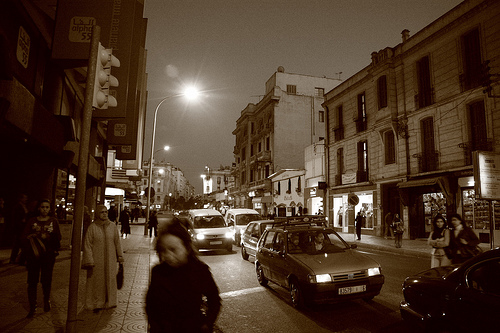 I didn’t plan on spending a night in Casablanca, but my bowels had other ideas.
 I arrived last night in the swarming, honking, neon-lit mess of life that is Fez.
 As I staggered off the Tarifa ferry, through the desserted port gates and into the quiet Tangier morning, I had a thought I’ve had before. It was the same thought I had as I first stared through a taxi window at the hazy Lima streets, when I first stepped out the Bogota airport, when I walked around big bad cities like Caracas and Mexico City. The thought is, “Oh. This is it?”
 What did happen: I left the port gates, took a moment getting my orientation, and found the left luggage office. The clerk and I fumbled with mutally poor Spanish, and I left my backpack secure. I headed uphill, largely ignored by every passerby, and parked it at a cafe along the Grand Socco. I lazed, and have been wandering the Medina and Ville Nouvelle ever since. I plan on getting a coffee at the Beat-beloved Cafe Paris before meeting up with my couchsurfing host (only slightly concerned we won’t actually connect).
 I’m also surprised by the dress of the women. I wasn’t expecting burkhas or even necesarily hijabs, but I’ve even seen some short sleeves—on the younger women, that is. I’m tromping around town in long sleeves, but I’ve seen many tourists in spaghetti straps and shorts. I have yet to see visible tattoos (does a knock-off Ed Hardy shirt count?), which I’ll take as a que to keep mine covered.
 I can´t think of anything better than to spend a chilled-out day wandering the streets, sitting at the beach, reading, catching up on writing (and sleep), and generally getting ready for tomorrow´s ferry embarkment. The 35-minute ride will deposit me at sister city Tangier, another meeting of worlds, where I´ll begin my Moroccan odyssey.
 The drama and thunder of it—
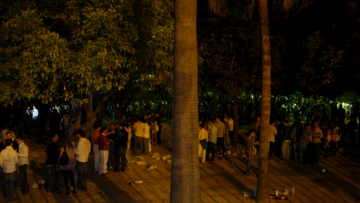 The roar of voices rose from between the trees, out of the darkness and dirt. Scooters swarmed, freshly broken glass glittered in the dim park lights. Young girls teetered in impossibly high heels and boys stumbled, leaned their faces against the sides of walls as they pissed. And every person clutched a plastic cup.
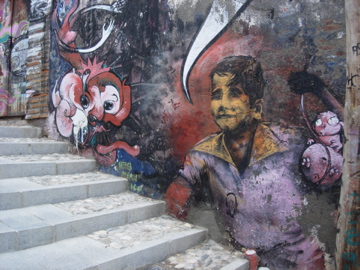 Down a
  The streets I wandered got starker, more litter-filled than people-filled. Abandoned buildings and dirt lots suggested that restoration efforts weren´t the trend in this forgotten corner, perched on a precipice between well-visible, touristed neighborhoods. A steep stone footpath lightning-bolted its way down the hillside; I followed it.
 Granada got me all literary…
 Lonely Girl Travels
Recent Comments