Archive for the 'Sola' Category


There’s No Crackheads in Cuba, and Other Things that Strike the American Traveler as Strange

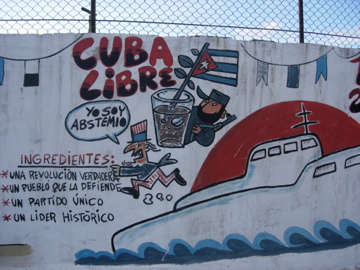
Havana Mural

Hands down, beyond a doubt, Cuba is the most different place I’ve ever traveled to.

Sure, I’ve been to non-Western countries; I’ve trekked through remote jungles studded with indigenous villages and spent a night in a water-world town-on-stilts where the night sky erupted with spontaneous flashes of thunderless lightning. But I’ve never been to another place where capitalism wasn’t a presence, and where the ensuing materialism and infiltration of American culture was so miniscule.

It’s impossible to talk about Cuba without getting into some kind of political discussion. Like everyone else, I’ve got my personal views—seeing as I was raised in a house that had 38 volumes of Lenin on the shelf, I’ll just let you guess what side of the spectrum I fall on.

But I’m not here to talk about that. Not really. What I want to talk about, and what’s of importance to the traveler to Cuba, are the ways in which Cuba is unlike any other country I’ve experienced. These reasons are inextricably linked to the country’s politics, to the revolution and the island’s legacy of struggle.

Yes, I realize I’m walking into a shitstorm. But we either dance delicately around these things, saying the same, tired, noncommittal niceties (Dante had a hell for that), or we get real—sit down, look it in the eye and say what we mean. (I’ll let you guess which option I think has more value.) Besides, I’m back home; I’ve got the toilet paper and functional plumbing to handle barrages of shit.

Oddity #1: Safety

One of the first things I read about Cuba was how safe it was. Touted in guidebooks to be paradise for solo female travelers, where any dark backalley can be delved into any time of day or night, I was willing to accept that Cuba was probably safer than Oakland. Most places are. I was still uneasy about rolling into the country with over a thousand dollars in cash on me, and neither my travel companion nor I could easily shed our well-grained habits of stone-facing strangers and checking our backs like motherfucks. But after a couple days, we loosened up. It was true: Cuba was mellow.

Break between innings

I suppose what strikes one as odd about the lack of violent crime in Cuba is that the country is so terribly poor. In the US, and most other countries in the world, poverty equals danger. From Rio’s famed favelas to Cairo’s ghettos of Sudanese refugees, to deep East Oakland, the relative safety of a neighborhood is most often directly proportionate to the level of wealth, or lack thereof. One look at the crumbling building facades and boys playing baseball with scrap pieces of plywood, and you start to understand just how poor Cuba is. And while, yes, there’s hustlers and pick-pockets, and yes, some laughing 12-year-olds tried to snatch my bag one night, the gravity of the threat of real violence isn’t there. (It would have sucked to have my bag stolen, but it sucks a lot worse to get a gun put under your chin.)

You can chalk Cuba’s safety up to a number of factors, depending on your politics and worldview: The police force is strong and no one wants to risk a lengthy stay in a Cuban prison. Protecting tourists is in the best interest of the island as a whole. Or you can think it’s got something to do with the fact that base needs like housing, education, medical care and some amount of food are all guaranteed by the Communist government, taking the edge of desperation out of the poverty equation.

Whatever the reason, walking around at night and realizing that you have no need to be weary is a strange feeling for an Oakland kid like me. Good thing we didn’t get used to it; less than 48 hours after getting home, my travel buddy was robbed at gunpoint. Welcome home.

Oddity #2: Lack of Homeless People and Drug Addicts

Cienfuegos

Beggars and bleary-eyed glue sniffers are par for the course in the cities of most poor countries. Even in one the wealthiest countries on earth (guess which one), pan-handlers, under-the-freeway encampments, and twitchy characters of all narcotic varieties are everyday fixtures on the streets, even in posh tourist attractions (San Francisco). After a couple of days wandering around Havana, I realized I hadn’t seen any cardboard alley homes and not a single crackhead. Weird.

During my time in Cuba, I got pan-handled maybe half a dozen times, and saw one toothless, staggering old lady that looked like the resident town wino. But when it came to hard-core addicts and homeless people, I didn’t see any.

The lack of homelessness is fairly obvious—the government provides housing. But Cuba is also really strict about the import of drugs. Not wanting to give the US any reason to invade, and perhaps still smarting from its soul-sucking era as a mafia paradise, the Cuban government put the ixnay on drugs, and today they’re really not a presence in Cuba. (Makes you wonder what would happen if the US made such a bold decision—oh wait, wasn’t that what the whole War on Drugs thing was about?)

The night we got home from Cuba, we went to see Neurosis play at the Great American Music Hall in San Francisco. The venue is smack in the middle of the Tenderloin, one of the highest concentrations of human misery on the West Coast. We walked through urine-soaked sidewalks, crunching windshield glass and dodging screaming, contorted derelicts, in a kind of dazed state of shock. After two weeks in Cuba, it seemed inhumane that suffering like that could be tolerated, allowed to exist in such a rich, rich nation. It was the worst culture shock I’ve ever experienced.

Oddity #3: Lack of Advertising and Lots of Government Propaganda

Okay, you’re gonna see a lot of government propaganda. Pro-revolutionary billboards, Vive Fidel banners, smiling pictures of Hugo Chavez: it’s all a little unnerving, I’m not gonna lie. But then you realize why it seems like there’s so damn much of it in Cuba (aside from the fact that there is): there’s no other advertising out there.

You forget how much energy you spend blocking out flashing signs, automated voices, beautifully anorexic, air-brushed girls selling perfume and cell phones and chewing gum. Until you don’t have to do it. I’ve heard really high-end resorts make you feel the same way, like you can let your mental filters down and just relax. Well, until I get a rich sponsor, Cuba’s gonna be the closest I come.

If it’s true that you can learn a lot about a culture through its advertising, then it’s also true you can learn a lot about a culture about its lack of advertising. Cubans are insanely open and friendly, and while there’s plenty of cultural factors contributing, couldn’t one of the reasons be that they’re not constantly fending off the barrage of catchy slogans and glossy images of psychologically invasive advertising? At the same time, the government is an inescapable presence on the island; one is constantly given visual reminders of the pro-government stance everyone’s supposed to take.

It’s a stretch, but maybe. All I know for sure is that my brain got a real vacation in Cuba.

Oddity #4: Havana Has a Chinatown (With Three Chinese People in It)

And it’s actually the oldest Chinatown in the Western Hemisphere.

A then-vegan, I had a mean hankering for some tofu when I was in Havana. I thought my best bet was Chinatown, the touristy relic of Cuba’s once-robust Chinese population, originally brought over in the mid 19th century to work in the sugar fields. I elbowed amid the throngs on foreigners and grabbed a seat under the red awning of a restaurant whose menu listed something I assumed was bean cakes. Ten minutes later, a steaming plate of bean sprouts, and nothing but bean sprouts, was placed before me. My then-boyfriend laughed.

Havana’s Chinatown stands as a reminder that the country has plenty of pre-Castro history, often overshadowed. Most of the Chinese laborers brought over intermarried, infusing the Cuban cocktail with Asian genes; thus, there aren’t a whole lot of fully Chinese looking people left in Chinatown. I saw a couple dudes smoking in the traditional squat, but it was honestly the most un-Chinese Chinatown I’ve ever been to. And the most devoid of tofu.


Oddity #5: The Resilience of Cuban People

It’s kind of a Cuban cliche: some cigar-smoking, deeply wrinkled dude fixing a 30-year-old bicycle with a piece of dental floss and an old Coke can (or something to that extent). Cuban people are renowned as the global experts in reusing everything, wasting nothing, helping each other out and not complaining (partially because of political repression, but still). Cubans are like the one friend you have that can fix anything, who relishes in helping you figure out why your car is making that funny noise and who repairs the holes in their sneakers instead of tossing them to hang over the telephone wires. Yes, part of it is a result of years of rationing and making do, but I think it gets down to a deeper cultural characteristic, one born of imperialism.

Another gem from the Havana mural

The best explanation I read of why Cubans are so resilient and continue to come together and make do is that, by and large, they want the Revolution to succeed. (I’m not talking Miami Cubans now. And this isn’t necessarily my perspective, but a well-informed argument that made a lot of sense.) However deeply flawed and difficult the Revolution is, it’s still the first time in 500 years that the island’s been run by Cubans. From Spanish colonialism to puppet governments to foreign-owned sugar plantations, outsiders had the ultimate power in pre-Castro Cuba. The country was endemically violent and deeply divided down lines of race, class and ethnic origin—divisions that don’t disappear in 50 years, but have improved. Castro’s Revolution is the longest enduring era of Cuban control since the Spanish arrived on the island. That’s a really powerful statement, one that can help you understand why Cubans endure so much and continue to struggle.

Of course, one could easily argue that all this is at risk. The impending end to the US embargo will mean an immediate influx of American culture and goods. And however much outsiders may want Cuba to remain a junkie-free, billboard-less Eden of free health care and high literacy, the end of the embargo will be a damn good thing for Cubans. But I’m glad I got to go pre-post-embargo, and experience some of the strangest things an Oakland girl can.
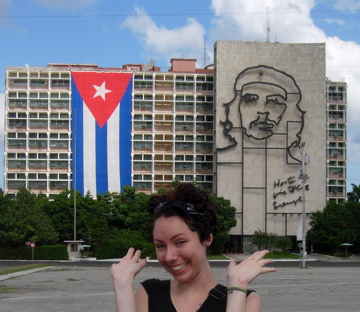
Livin on a CUC: Independent, Budget Travel in Cuba

Cheesin it up

Backpackers, lefties and dirty hippies beware: Cuba is not cheap. And despite any romantic revolutionary visions, it’s got tourist traps, just like everywhere else. They’re just filled with Che shirts instead of fanny packs.

Several factors might lead one to logically assume Cuba to be a budget-friendly, independent travelers’ paradise: it’s a dirt-poor Latin American country, enamored in the hearts of liberals, intellectuals and military-cap-wearing undergrads. So when you hear that your low-to-mid-range daily budget for Cuba should be around $100/day, it comes as a bit of a shock.

Here’s the deal: after the sugar industry collapsed in Cuba, there wasn’t much left to keep the island afloat. Keen eyes turned towards tourism. Not only does Cuba’s larger-than-life lore hold particular allure for the left-leaning, it’s got an undeniable romanticism—old cars, crumbling buildings, rum and Rumba. Couple that white people’s insatiable lust for balmy Caribbean getaways, and they had the perfect cocktail on their hands—muddled with Euros instead of mint sprigs. Tourism today is “the most dynamic sector of the Cuban economy.”

If you’ve traveled to other places where tourism is a mainstay of the economy, you’ll know what this means: high prices and potential hassle. From Moroccan medina touts to San Francisco’s 14% hotel tax, economies that rely on tourism milk it. In San Francisco, the hotel tax goes to fund all sorts of cool arts endeavors and social programming that other US cities don’t have; you could argue (depending on your politics) that Cuba’s dual currencies are an extension of that. And in Cuba you don’t really have to worry about hustlers and pick-pockets (though they do still exist); tour companies take care of that.

Let's play "Spot the Tourists"

You wouldn’t initially think it, but Cuba’s got a resort, package tourism industry up to snuff with any Caribbean destination. A Hungarian friend won a Cuban vacation as an incentive prize at work; all he saw of Cuba outside of his resort was through a tour bus window. Combine the package factor with the absence of youth hostels and backpacking networks, and the prospects can seem pretty dismal for DIY cheapstakes like me.

But independent, budget travel in Cuba can and does happen. There’s just some special tricks you have to be hip to. My travel companion and I managed to squeak by on $75/day, well under the Lonely Planet budget (but then again, we were both surviving at home on less than $2000/month, so cheap living wasn’t anything new). Here’s what we learned and how we did it.

Resources

My two biggest resources for independent, budget travel to Cuba were Lonely Planet’s Thorn Tree Forum, and Cuba Junky, a comprehensive, Cuban/Dutch-run website for travelers (with endearingly odd translations and misspellings). At these two sites, you can find info all sorts of great information, and on the forum you can trouble-shoot and get advice (and suffer through the occasional political debate).

Money

Cuba operates on two currencies: the Cuban peso (CUP), the money of the people, and the Cuban Convertible Peso (CUC), the money of tourists.

Why? As tourism grew, American dollars began to wiggle their way into the country—hotels and tourist restaurants charged foreigners in dollars, while charging locals in pesos. (Considering the average monthly salary for a Cuban doctor is about what I make in thirty minutes, it’s more fair than it seems.) In addition, “dollar-only” shops emerged, where scarce and coveted items like dental floss could be had for a a high price. The influx of money was good, but the presence of American dollars was kind of slap-in-the-face to the government, wouldn’t you say? The government thus created the CUC to keep US dollars out; they did, though, base the exchange rate on the US dollar. Tourists pay for things in CUCs, while locals pay in pesos.

Whenever you exchange money, you’ll be given CUCs, and the majority of places you spend money will accept only CUCs. Invariably, however, you’ll get your hands on some pesos. It’ll probably happen like this: you get seduced by the wafting smell of cooking meats, and buy some street food. You hand the guy your CUC note. He digs around his pockets, shouts over at some other vendors; no one has the proper CUC change. He shrugs and gives your change in pesos. You’ve now got a pocket full of notes and coins, and can pay for small items like coffee and ice-cream with pesos—dropping the price from a couple bucks to a couple cents (literally).

There are of course more nefarious ways to get your hands on pesos, but you wouldn’t do that, now would you? Tourists aren’t really supposed to use pesos, and I have to say, I felt pretty guilty paying the equivalent of 5 cents to someone who makes $10/month—even if I am just a waitress living in a run-down North Oakland Victorian. I don’t recommend trying to use pesos as a way of cutting corners and stretching your budget, but it’s something that will happen at some point.

Casa Particulares

The single biggest way to save money in Cuba is by staying in casa particulares. State-licensed rooms for rent in private homes, casa particulares will also be one of your best glimpses into Cuban life.

Huge-ass main course served at a casa particular

Here’s how it works: individuals apply for a license, which is expensive; they must pay a monthly tax whether or not they have guests. The government approves them, and they can rent rooms to foreigners.

Expect to pay 15-30 CUCs per night (as opposed to 50-100 Euros and upwards on a hotel). Plus, as everyone knows, homestays are a great way to experience the everyday life and culture of a country; we stayed with hosts in Vinales whose teenage son showed us plenty of hip Cuban dance moves (which we were incapable of replicating). Hosts will usually offer to cook you meals, for an additional 5-15 CUCs. This may not be cheaper than eating at a budget restaurant or food stall, but they’ll stuff you silly.

The Cuba Junky site has gotten much more spiffy since I went to Cuba, and you can now book a casa particular room via the website. I did it a semi-old-fashioned way: I got ahold of Potato’s email address on the Thorn Tree forum, sent him an email, and he booked a room for us. He gave us his address; once we landed in Havana, we went to his apartment, enjoyed a cup of tea and chatted (he’s a really cool dude), and he walked us a couple blocks over to a lovely elderly couple who we stayed with for four days (and whose toilet we later busted—more on that later).

I like to have my accommodation arranged for my first couple nights when I arrive somewhere new, but the rest of the casa particulares we stayed in on our trip we booked ourselves. Most people will display their license logo prominently, so you can just knock on their door and ask if they have room (really, Cubans are insanely friendly and won’t turn you away). If the one you go to is full, they’ll for sure have a dozen friends with licensed rooms, and will help you find one. It sounds like a hassle, more for them than us, but I swear it works: a cab driver drove us all around Vinales while neighbors tracked down an empty room.

Bring Every Last Toiletry You May Possibly Need

Basic medical supplies are both costly and in short supply, or nonexistent, in Cuba. Pack all the sunscreen, aspirin, contact lens solution and insect repellent you might need—or risk shelling out painful amounts of money in a poorly stocked dollar-store. Even an extra roll of toilet paper isn’t a bad idea—unless you like wiping your ass with day-old news.

Tours and Entertainment

Cuba has a fairly well-beaten path, and if you stick to the neighborhoods and activities tourists are routinely funneled into, you’ll bleed CUCs faster than you can say “revolucion.” But get a little intrepid and a little chatty, and you’ll stretch your budget big-time.

Everyone knows that Cubans party, and party well, so you can be pretty sure that any club charging a hefty entrance fee is geared towards tourists. And as cool as a Hemingway tour or trip to the Tropicana might sound right now, you’ll quickly realize that they’re the Fisherman’s Wharf of Havana. Get friendly and ask your casa hosts (or random folks on the street) for tips on where to go and what to do. Less tacky companies like San Cristobal Agencia de Viajes are a good bet for more offbeat tours.

Food, Transport, and the Likes

There’s no real trick here: just do what you do in other countries.

Dinners at tourist-geared restaurants will set you back much further than paladares (mom-and-pops) and street food stands. Snack foods can actually be pretty hard to come by, so bringing along some biscuits, nuts or, for the homesick Yankee, peanut butter isn’t a bad idea. You can skimp on transit, but be prepared to pay the price: low-cost buses break down and hitch-hiking isn’t fun anywhere (in my opinion). Walk and take local buses within big cities, as opposed to cabs, and of course, the less you move, the less you spend on bus tickets, trains, etc. Cut down on souvenirs (really, how any Che hats do you need?), and do free stuff like strolling and lazing on the beach.


So, as with the last post, any seasoned Cuban travelers or recent returnees wanna share their experiences? We’re all ears…

Yankee in a Che Shirt: How To Travel to Cuba Independently and Illegally as an American

Americans you're likely to encounter in Cuba

Si, se puede!

Three years ago, I traveled to Cuba. I didn’t get a visa, didn’t book a tour, didn’t go with a dance troupe or salsa band (though that would have been killer). I did it the way I do everything, independently.

Fear mongers, nay sayers and foreign travel agencies would lead you to believe that independent travel to Cuba is dangerous and impossible. They’re the same people that make full and complete stops at every stop sign, and are too scared to ride the subway in NYC. Or else they’re trying to sell you something—the hustling taxi driver outside of the airport. They clamor cowardly behind the embargo.

Here’s the legality deal: as an American, you’re technically not banned from traveling to Cuba; you’re prohibited from spending money there. Whatever. If you didn’t obey your parents’ curfew as a teenager, are you really gonna start heeding authority now?

The fun thing about traveling to Cuba as an American is that it requires more effort, more digging. You can’t buy your plane tickets online; most worthwhile advice won’t come from guidebooks but fellow travelers, via forums like Thorn Tree. Basically, you have to work a little harder. But the reward is getting to go to one of the most un-Americanized countries in the world—remarkably only 90 miles from Florida.

I’m pretty sure it’s technically illegal to give Cuban travel advice to Americans. But eff that too. Here’s how I did it, how it worked and the gems of wisdom I smuggled back (along with the cigars):

Before You Go: Money and Packing

Your most important pre-travel preparation as an American is money. Your ATM and credit cards won’t work in Cuba, meaning you’ve pretty much got to bring everything you plan on spending with you. Travelers checks are a pain in the ass and have a hefty commission tacked on—which means you’ll be bringing cash. Lots and lots of cash.

If you’re like me, you’re not too thrilled at the idea of walking around with $1300 on your person. But keep in mind Cuba’s remarkably low crime rate, the absence of desperate drug addicts and your own street sense—you’re gonna be fine.

Another consideration is which type of currency to bring in. The greenback gets an extra 10% penalty fee on top of the standard 8% exchange commission, so most travelers opt to bring in Canadian dollars or Euros. It pays to do the math on conversions and figure out how much you’ll be hit by commissions and fees for dual exchange (changing from dollars into Euros into CUCs).

Another pre-trip consideration is what to bring, and what not to bring. This is for everyone, not just Americans. Charitable donations like medical supplies and clothes are greatly needed and appreciated, but check out regulations on what and how much to bring. Cuban Customs has some unusual regulations regarding the import of electronics and pornography, and is super strict about narcotics. Of particular concern to Americans is the prohibition of anti-revolutionary literature—make sure you don’t have any crazy right-wing, Miami ex-pat ramblings with you. Not that you would anyway.

Getting In: Booking a Flight

The easiest, most popular and often cheapest way for an American to get into Cuba is through Mexico, namely Cancun. Of course, Cancun is the #1 most suspicious transfer point, and word around the chat rooms is that you’re singled out by US Customs most often when arriving from Cancun. But it’s also an insanely popular destination, and I think the Mexican- to Cuban-vacationer ratio still works in your favor.

American travel agencies and airlines are prohibited from booking flights or giving any kind of assistance to Cuban travelers. But foreign airlines and agencies aren’t. So instead of shelling out big bucks to some Canadian company that’ll orchestrate the whole thing (for a mere 300% mark-up), do what I did: call a foreign airline at one of their international offices. I called Mexicana in Mexico City (52 55 2881 0000), requested to speak to an agent that spoke English (not a bad idea when purchasing something as expensive as plane tickets), and bought tickets from Mexico to Havana. Not as easy as Orbitz, but pretty damn close.

The way the flight times worked out, we ended up bookending our Cuban travels with overnight stays in Mexico. I thought I’d be smart and fly through Merida, whose Sunday night dance parties sounded infinitely preferable to Cancun’s binge-drinking co-eds. Turns out that you can’t fly directly from Merida to Havana, so we had to transfer in Cancun anyway. Ah well, better than a spending a night in Cancun.

Arriving: Surviving Customs

Passing through Cuban Customs is the most intimidating border crossing I’ve ever done. But, as I reminded my then-boyfriend and travel companion, Cuba wants to let you in. They need tourists’ money. They just wanna make sure you’re not there on an anti-revolution espionage mission. Fair enough.

Expect to stand in an impossibly long line. You’ll be instructed to approach the Customs booth by yourself. They’ll scowl at you, tell you to take off your glasses and look into the camera. They’ll photograph you, record you, enter every last bit of info on your passport into their computer. They’ll then stamp your tourist card, your golden ticket. Cuba doesn’t stamp passports, but $20 purchased tourist cards. Mexicana provided mine, but it’s a good idea to check your airline or prepurchase your card at a Cuban Embassy, as getting ahold of one at the airport sucks. And hang on to that baby—losing it is an expensive, bureaucratic hassle.

Once your passport is handed back to you, you’ll get directed through the floor-to-ceiling solid door that the travelers before you disappeared behind. It may seem like you’re being funneled into an interrogation room, but most likely, you’ll be headed off for a quick frisking and x-raying of your baggage. Drug sniffing dogs will accompany female agents in ridiculously short skin-tight mini-skirts—the most amusing part of your Customs experience.

While You’re There

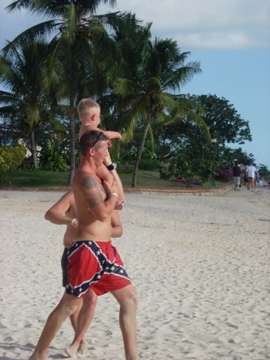
Really? Couldn't have left the Confederate swim trunks at home?

Once you’re in Cuba, there’s not a lot in your day-to-day travels that’ll set you apart as American. You’ll have to deal with the money issue, but the good news is that everyone will guess you’re from somewhere other than the US. It’s a nice change of pace from the Frenchman breaking into sudden English with, “And where in the States are you from?”

Getting Out: Playing Dumb and Looking Innocent

The trickiest and most anxiety-inducing part of any American’s trip to Cuba is coming home. I’ve heard of Americans getting hassled by Cuban customs agents, but it’s pretty rare. The folks you have to worry about are the good ole’ boys (and girls) back home.

But first you have to worry about a double-entry stamp back in Mexico. This means that you’ll have a stamp for arriving in Mexico, no stamps for Cuba, but then another entry stamp for your return to Mexico; there’s a void in there, signaling nefarious activity.

You can handle this one of two ways: bribing the Mexican Customs agent to not stamp your passport (trickier at Cancun, where they’re more vigilant, but still possible), or by hoping for the best with a doubly stamped passport. We opted to bribe the Mexican Customs agent. We tucked a sizable peso note into our passports and softly asked not to be stamped. The agent grunted and handed us back our passports, unstamped. If you’ve got a heavily stamped passport to begin with, it might be worth saving the money and relying on the slim odds that the US Customs agent will bother to inspect your passport closely. I’ve never had an agent more than glance at my stamps.

Aside from the extensive, albeit poorly edited, advice by eco-hippies International Bike Fund (I mean that in a good way), any American who’s ever traveled to Cuba will be eager to give you plenty of tips and first-hand accounts on how to elude US Customs—whether you want to hear it or not. So here’s my two centavos:

Revolution anniversary poster I stole and smuggled back home

Reports vary, but up to 100,000 Americans are claimed to have visited Cuba last year. Most of them breeze through US Customs without a problem. There’s nothing that should single you out as particularly suspicious. Be respectful; don’t roll up to the counter smoking a cigar and wearing a Che hat. But don’t sweat it too much. Customs agents are doing their job, and you’re doing yours. They really don’t want to write out lengthy reports anyway. I truly regarded my traveling to Cuba as not too dissimilar from jay-walking—not supposed to really do it, but no big deal. Folks’ll tell you not to bring anything incriminating and obviously Cuban back with you, but eff that—I brought cigars and stolen street posters.

We arrived at SFO disheveled and tired with a horde of sunburnt vacationers. I of course did not write on my Immigration Card that I’d traveled to Cuba, nor did I list the goods I was smuggling back (why you gonna rat yourself out?). I smiled nicely at the agent, told her yes, I’d had a great time in Mexico, picked up my bags, passed em through the x-ray machine without incident, and headed home.

But enough out of me. Any Americans out there wanna share their Cuban travel experiences?

We Wish You a Merry Solstice, and a Non-Denominational New Year: A Muir Woods Solstice

Into the darkness...

Nature lover, pagan, hippie, cheapskate—call me what you will, but the Muir Woods Solstice Event ruled. And not just in a Wicker Man kind of way.

The free, annual event honoring the longest night of the year is uber North-Bay: wholesome, granola-y, non-denominational family fun, set amid old-growth redwoods and adorned with weedy handmade garlands. Luminaria-lit paths fill with white-breathed revelers, whose flashlights make the falling rain look like snow, or that scene from Edward Scissorheads. Puppet shows, antler-clashing Germanic dances and de-Christianized caroling ensue in an event that makes even a cynical 20-something (me) smile.

The promise of free entry and free hot cider lured me out on a moody Monday afternoon, to brave the bridges and highways of a Bay Area rush hour. On a slow Saturday, I’d gotten to chatting with some regulars at work, who gushed to me about the event. Traipsing around the damp dark of one of the Bay Area’s most impressive natural attractions had sounded like a damn good way to spend the longest night of the year. I grabbed a crappy flashlight and a hooded puff coat, roped a friend into riding shotgun and playing DJ, and we set out, sliding along the green curves of Marin, through afternoon sun that shone through the clouds like light into a church.

A ranger with plastic encasing her hat ushered us past the forever-full parking lot; we joined the assembly of cars lined up along the soft shoulder. We walked a muddy, pleasant 15 minutes to the park entrance. Slicker-clod kids tromped puddles as their parents juggled umbrellas and thermoses.

We arrived just as the crowd was thickening. A bearded ranger that looked like a nervous cross between a bluegrass singer and a surfer handed us a booklet of Solsticized/Muirized Christmas carols, complete with lines and titles such as “Deck the woods with luminaria,” “I’m Dreaming of a Green Solstice,” “O Redwood Tree,” and “Come All Ye People.” My personal favorite was “On the first day of Solstice / A Ranger showed to me / A spotted owl in a redwood tree.” The adapted songs captured the progressive eco-politics and non-religious spirituality of Marin better than an Anne Lamott novel. You know that stir a couple years back when right-wing Christians got their knickers in a twist over “Happy Holidays” replacing “Merry Christmas”? Well, these were the folks they were pissed at.

It was, as you might guess, a mellow crowd of nature-y families and local weirdos (a simplification that I suppose puts me into the latter category). We grabbed some cups of cider and strolled around in the intermittent rain, soggy sneakers and cold noses. The creek was full from the recent storm, the stumps mossy; everything felt wet and alive.

We joined the huddle of firepits and hunched shoulders encircling a small, makeshift stage. It was time for some wholesome, non-offensive entertainment. The crowd sang a couple carols, and was then held rapt by a story-telling performance featuring exuberantly portrayed animal characters that I’m sure have inspired several voice-over school rejections. We agreed that the confused shadow puppet show was most definitely the improved result of a flash of marijuana-fueled brilliance. We took it as our cue to stroll the now-dark trails.

Candles in white paper bags lined the trails, making it feel almost like we were walking through an altar. Raindrops held heavy on the tree branches as little kids ran past in a bobble of flashlight beams. Other than that, it was all sound. It reminded me of an interview I’d read with a travel writer (Don George?) who’d wanted to write about something other than the cathedral-ish quality of light in Muir Woods. He’d blindfolded himself and walked around, experiencing the famous woods with mostly just his sense of sound, and written the article from that perspective. It was true that it was a totally different Muir Woods without the light and the sight of redwoods—all rambling water and the solid, rooted presence of those trees, the way you feel a stranger in a dark room.

We got back to the caroling crowd just in time to catch the most bad-ass and spooky performance of the night, a Germanic Solstice dance by the Christmas Rebels (which sounds kind of punk rock). Composed of members of the German fraternal society California Rebels, the group did a slow, hypnotic folk dance that included antler-clashing and creepy flute playing. A bearded dude with a crazy eye hushedly explained the pre-Christian roots of the dance, which got back to the potent mix of fear and worship that fuels most religions, not just Paganism. Under the illuminated, snow-like mist, the clanks of the antlers and the wet clomp of the determined feet felt like a ritual not from long ago, but rather some deranged allegorical movie. Which is to say it was rad.

Toes numb and bellies hungry, we trekked back to the car under the dim halo of my flashlight. A half-grin of moon cut through the heavy clouds, and the earth rustled, sighed, pulled a blanket of darkness up to its chin and settled in for the longest sleep of the year. And Marin celebrated, the way Marin knows how: amid the trees.

Sola: A Fetal Manifesto and Healing Tattoo

My swollen arm, looking more like my calf

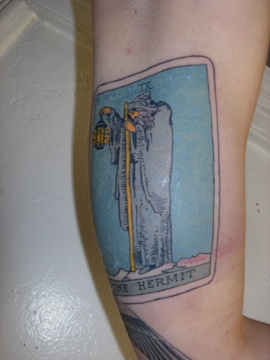
Swollen and bruised and freshly tattooed, I’ve decided that there’s more to this “lonely girl” thing than a catchy title and purchasable domain name. It’s got to do with an approach towards travel, and maybe even an approach towards life, that’s developing inside me, embryonically. And at the center, the tiny heart between the budding limbs, is solitude, going at it sola.

There’s plenty of articles and blogs out there lauding the benefits of solo travel. Solo Friendly and Solo Traveler are devoted entirely to solo travel, with service-oriented tips and how-tos, while Women on the Road focuses exclusively on encouraging women to backpack. Independent-traveler sites BootsnAll and Matador have featured articles discussing pros and cons, and urging readers to take the solo plunge. The benefits promoted are fairly obvious—the freedom to do what you want when you want—as are the chief drawbacks discussed: safety and loneliness. Nearly every article and site on solo travel I’ve encountered has urged all travelers to go at it alone at least once.

I could write something similar, talk about how traveling solo forces me to be more social, to interact more with my surroundings; how it teaches me self-reliance and thus self-confidence; how I relish in the freedom of it; how none of my friends that can afford to travel are able to take the time off to accompany me anyway. But underneath and inside all those benefits is something harder to explain but ultimately more appealing, a kind of central gravity that all the other pluses of solo traveling orbit around: solitude.

It’s both positive and negative, both the exalted glory of Rilke and the insanity-inducing agony of solitary confinement. It’s a gnarled old wizard dude with a staff and a lantern, setting out into the craggy blue of the Hermit tarot card, now etched into the tender flesh on the inside of my arm, swollen amid the lymph nodes and brachial veins that hold me together.

On my last trip, I met many incredulous, widened eyes that asked, “You’re alone?” Then, declaratively, both impressed and horrified, “I could never do that”—in the way I’d respond to someone who’d climbed Mount Everest: good-for-you, thanks-but-no-thanks. People told me I was brave, fool-hardy, a feminist.

The truth is, I never really considered the fact that I was traveling alone; it rarely factors into my trip-planning, doesn’t strike me as odd or especially intrepid. It is what it is. Of course I’ll be alone. Who else am I gonna drag off around the planet?

But things like that, core characteristics and fundamental truths, rarely strike us as odd. Or even occur to us at all. They’re so central to who we are and how we live in the world that we aren’t aware of them. They strike us suddenly, in strange moments of lucidity—the porcelain-clutching “moment of clarity” in which one finally realizes she’s an alcoholic, or my mom’s recent epiphany that “we were the crazy white family in the neighborhood.” Or when someone else points it out to us, in the dingy back of dingy taxi, when you tell them you’re traveling alone.

For me, it goes back to my travel roots, which aren’t travel roots at all. It’s where I first learned to be alone in the world—the raggedy-ass East Bay buses. During my hour-and-a-half commute home from a far-away high school, I learned all the things international solo travel would later confirm and deepen—self-reliance, self-confidence, how to handle dicey situations and dodgy characters. It was especially important as a female. Honing my street smarts and learning how to carry myself and not take shit have been invaluable. And not something not every girl learns. The lessons taught on the hard plastic of AC Transit buses equipped me to travel sola everywhere from Colombia to Morocco.

But there’s something more inside that, something deeper and more fundamental than knowing how to watch your back and tell someone off with your eyes. More than even the confidence of knowing I’ll be able to figure out and make it through whatever crazy-ass situation I end up in. What is comes down to is a kind of comfort and security in who I am, and the way in which I never feel more like myself, the who-I-am underneath whatever’s happening in my life at the time, than when I’m alone, out in the world. It’s not the same sitting here in my bedroom typing; it’s gotta be out there, walking the streets and riding the buses of this world.

I think everyone should travel solo once in the same way I think everyone should be forced to wait tables once: it’d be nice, but not gonna happen. I don’t think solo travel is for everyone, but it’s become a defining part of how I experience the world, how I exist in it. I simultaneously delve deeper into myself (“the teacher within,” as they say in yoga) and my surroundings. I experience the world from a more intuitive, back-of-the-brain place, where I’m okay with it not making sense, where I find a way to somehow swim through the chaos and insanity and all-too-often heartbreaking cruelty of it, and tap, however lightly, on the beautiful something at the center of it all. I’m more able to trust that I’ve got a place somewhere amid it all.

During my four-hour detainment by the Venezuelan police a few years back, the female officer kept looking at my passport, me and back again, and asking, “Y estas sola?” She couldn’t believe I’d venture off in some other country by myself. However much of an evil, child-abusing American I might have been (it’s a long story), my being sola amazed her. And may have had something to do with me weaseling out of the situation.

I suppose it would have been more accurate to get a feminized Hermit card tattooed, but the beard was too Zeppelin-y to forfeit. And I feel cheesy having an uber-symbolic tattoo, to finally have some kind of answer for the middle-aged customers that look up over their reading glasses at me and ask what my tattoos mean. Most likely, I shrug and continue to say, “I just thought they looked cool.” At least until this approach, this fetal manifesto, is a little more gestated.

Top Three Travel Secrets: A Chain Letter for Travel Bloggers

It reads as ominously as a middle school chain letter. Except, in the end, failure to perpetuate the chain isn’t sworn to result in untimely death or spinsterhood (which are more or less the same thing when you’re 12). Rather, in this chain, compliance results in access to a treasure trove of travelers’ secrets. And probably some new friends.

I was hit by two writers in the TripBase Blog Tag, spreading through the travel blogosphere like hot gossip around a lunch table. Or a dirty note during Math class, light-up sneakers in a mean game of duck-duck-goose. (The analogies could go on forever.) The idea is you write a post about your top three travel secrets: out-of-the-way towns, little-known restaurants, unheard-of hotels—“hidden gems” that lay glittering in the dimness of obscurity. Until now, that is.

Aside from amassing an ass-kicking list of previously unknown spots around the world, the other objective of the TripBase Blog Tag is to be build community and get folks involved. I can get down with that. In addition to the awesome ladies that tagged me—Stephanie from Twenty-Something Travel and Abbie from Miles of Abbie—I’ve already discovered some new writers on the TripBase list of bloggers tagged so far. (Best blog names? Dirtbag Writer and Snarky Tofu. Fuck yeah.) My hunch: the final list won’t just expose travel secrets, but also some bad-ass writers I hadn’t encountered yet.

They say you’re only as sick as your secrets. Here’s to travel health:

End of the hike: waterfall into the Pacific

#1 Palomarin Hike, Marin County, California

My work friend had been telling me about “the secret hike” for months. Huddled over our staff meals in the cramped bus station, she made rope-swinging into the clear lake, and the coastal waterfall at the trail’s end, sound like a dream. Or at least a damn good fantasy.

We finally coordinated a day off together in August and headed up to Marin to the Palomarin Hike. We grabbed sandwiches and drove up past Stinson Beach to tackle the 11-mile hike. And I gotta say, it was just as killer as she’d described.

The hike starts through rather typical dusty California coastal terrain, taking you past sweeping Pacific vistas us locals have grown accustomed to. After about 45 minutes, the foliage and trees thicken, and you eventually get to Bass Lake, a frigid-water lake that’s biggest draw is an old-school rope swing. You could while away hours here, but, seeing as though it was August in the Bay Area and foggy as hell, we were too cold to partake. We continued on, and ended up at the trail’s end, where a waterfall tumbles into an isolated coastal cove.

The good news: the hike, although long, is gentle and not too strenuous. Which means just about anyone could do it—including my smoke-a-pack-a-day friend and me, who was then recovering from swine flu (yes, really).

The bad news: the Palomarin Hike is a total word-of-mouth Bay Area secret. As is the way with Marinites, locals don’t want outsiders to know about their secrets or have access to them (see also: why BART doesn’t run to Marin). Locals take down street signs and signposts, meaning that you’ve pretty much gotta go with someone who’s been there. So if you’re headed to the Bay soon, just hit me up; I’ll take you.

Ahhh...

#2 Legzira Plage, Atlantic Coast, Morocco

Okay, if you’ve been following this blog for a bit, you’ve already heard me gush about the most deserted and beautiful beach I’ve ever been to: Legzira Plage, Morocco.

Talk about tucked-away: from Tiznit, take an hour bus ride, hop off at the faded roadside sign, and hike down 20 minutes. It’ll really just be you, a couple stray tourists, some fisherman and their donkeys—and the sandstone arches that dive red earth into blue water.

Among the handful of pink building that cascade down the cliff into the main beach, there’s two hotels that offer relatively cheap rooms. I went high-class and got one with my own shower, squat toilet (doin’ big things), and a window that opened onto the ocean view—for under $20.

Another bonus is the Moroccan street harassment factor, and the fact that Legzira Plage doesn’t have one. After a couple weeks of solo backpacking, sweating in long sleeves and fending off the barrage of “bonjour”s, it felt pretty damn sweet to strip down to my bikini and wave-hop in peace.

Kids on their way to school

#3 El Congo, Venezuela

The story goes that, when Europeans first arrived in what is now Venezuela, they came to the Lake Maracaibo villages, perched on stilts amid the marshes and water. Watching the village folks traverse the “streets” in handmade rafts reminded the Europeans of Venice—and they dubbed the place Venezuela.

El Congo, Venezuela is the most other-worldly places I’ve ever been. It’s only reachable by boat, a 30-minute ride through the hazy flat expanse of water, and you’ve gotta book a tour to get there. But surprisingly, the town isn’t the main draw of the tour. The Catatumbo Lightning phenomenon is what draws most people—mysterious, thunderless lightning that occurs almost nightly in the skies over Lake Maracaibo.

The road to Los Llanos was flooded when I was in Merida, so I opted to take the Catatumbo tour in its place. I hadn’t heard of El Congo, but it ended up being the highlight of the tour (the lightning didn’t really happen that night). The town had everything—a school, a fire station, a convenience store, even a Plaza Bolivar—all erected on stilts. Rumor had it there were a couple old folks still living in the town who’d only ever stepped foot for dry land to bury relatives.

It wasn’t an untouched Eden: El Congo was extremely isolated, making inbreeding a huge problem, and the town was quite poor. Sanitation was a major issue, with most refuse and human waste going directly into the water. Owning an actual boat was a sign of privilege. The less well-to-do had to construct their own floatation devices—this girl tied a piece of wood to some leftover styrofoam, dug a stick down into the mushy lakebed, and propelled herself along that way.

The thing that really bummed me out were the poor yapping dogs chained to the “front porch” of some of the houses. So much for getting a walk, little buddy. But hands down, El Congo was the most unusual place I’ve ever traveled to—and so far off the beaten path, there wasn’t a path at all.

So that’s my top three, scrawled not-so-jaggedly into the margins of a wrinkled note. Now to fold it up and shove it into another sweaty, unsuspecting palm. This could get good…

Hipsters Vs. Homeys: Oakland YouTube Travel Guides

“Oh hell no,” the text read. “Hipster douches filming Oakland travel video outside the shop.”

This was my best friend, writing from her post behind the counter of Tattoo 13. For years, she and the fellas have maintained a comical running commentary on the goings on of the now-trendy Temescal neighborhood, knowing every event, incident and wily character within a 10-block radius. Of course, she’d be the first person I’d hear about such shenanigans from.

It actually turned out pretty good, with the bit filmed in front of the shop capturing hipster sentiment with striking accuracy. Amid the recent annoyance over the woefully narrow Cool Hunting’s Oakland Word-of-Mouth Guide, I was inspired to dig the “hipster douche” video back up, and discovered some other YouTube gems along the way. And I hate to say it, I think the douches did it best. Or at least the most forthrightly.

Cool Hunting promotes independent art and design, featuring video guides on artists, cultural events, how-tos and destinations. The most recent installment visits independent businesses and local artists in Oakland, interviewing “the people who call it home.” They hit some great, popular local spots, but there’s a problem—the video only visits a very narrow section of the population, and the city. Businesses featured are almost exclusively in the North Oakland/Temescal and Downtown/Uptown areas, and, um, all the people interviewed are white. There’s a lot more white people in Oakland these days, but not that many.

Perhaps in an attempt to be inclusive, the video includes a couple shots of non-white, non-artist folks. They exist as passing, silent figures, riding bikes and making sandwiches—almost as though on another plane. I think it’s rather telling; I’m sure there’s people who’ve moved to Oakland that interact solely with the arts/”yuppie” communities, who experience the rest of the city only in tangent, realities that intersect on sidewalks and in cheap cafes, but no where else. I’m stoked to see my city getting recognition, but sad to see the guide left out so much of the city, what makes Oakland Oakland.

On the complete other side of spectrum, I stumbled across Thizz Nation’s neighborhood guides during my YouTube quest for the “hipster douche” video. Amid Mac Dre’s ever-generous contributions to Bay Area culture (I’m not really being sarcastic here), his Thizz Nation & On Point Productions created Treal TV Series, video guides that feature notorious Bay Area neighborhoods that birthed prominent figures in the rap community. (If you’re wondering what “thizz” is, check out old high school buddy Rachel Swan’s East Bay Express article from a few years back.) Installments include North, West and East Oakland.

I’m convinced these will someday be used as important specimens in some cultural anthropological study of Oakland. These guides do a little more to reveal the history and culture of certain neighborhoods, as rugged as they may be. But of course, they are also terribly narrow, and could leave one with the impression that Oakland is filled with nothing but 20-something, hard-as-shit black guys. Murder Dubs was one of the better ones:

A stab at a more balanced portrayal is made in the endearing “Oakland B Mine” video. A trailer for a short film that will be showing on a 30-foot screen at the Oakland Airport’s baggage claim, “Oakland B Mine” is pretty damn sweet. I never thought of my city being the backdrop for an artsy dialogue-less love story, but hey, I can roll with that. The trailer features some shots of everyone’s favorite farmers market (okay, my favorite farmers market), and the bad-ass old folks that do Tai Chi by the Lake Merritt BART station in the morning. While definitely more balanced and definitely the most well-done, one could still walk away from this one with the idea that Oakland is filled with nothing but good-looking, casually well-dressed hiply ethnic types. Which is fairly accurate, but still incomplete.

Which leaves the douches. While still narrow and incomplete, their video does something the others all don’t: makes fun of itself. It doesn’t just make fun of hipsters and gentrifying yuppies, it makes fun of cheesy travel guides and the abhorrent “staycation” phenomenon. But most importantly, the video gets at some of the very real issues inherent to living in Oakland, the preposterous dysfunction that manifests in sideshows, prostitution and, yes, the smells emanating from the Lake. And while the underlying message is that Oakland is “crappy,” the video captures the kind of delusional exoticism so many fall spell to.

Leave it to the hipsters…

Thanks for Nothing / Everything

I celebrated this Thanksgiving at two long-standing Oakland events: Thanks for Nothing, the legendary potluck of punk debauchery, and my family’s annual Day-After-Thanksgiving party, legendary in its own right. Both events were a little less epic this year, with an intimacy that reminded me of what’s good about Thanksgiving and about family—as untraditional as they may come.

Anyone in the East Bay who’s ever donned liberty spikes and a studded anything has gone to Thanks for Nothing. And possibly passed out at it. Now in its 18th year, the Thanksgiving potluck is an Oakland punk tradition, a place for all the family-less kids in black to come together, at picnic tables under jimmied lights, and create their own family.

Of course, by “kids” I mean “punks” and not kids at all, anymore. These are the die-hards, wearing smile wrinkles and old band shirts—the folks that, once the scene-ness melts away, once all the other folks have grown out of what was just a phase, are still there, purely for the love of it. Punk may be mostly dead, but it’s not all-the-way dead; it just lives in the hearts of a small handful. And, on Thanksgiving, in an East Oakland backyard.

Thanks for Nothing has taken on a larger-than-life status; the woman that puts in on is convinced that even if she were out of town one year, people would still show up. They didn’t pump it too much this year—no flyers or MySpace posts, just word-of-mouth—and the result was a smaller, friendlier crowd, that was also a bit tamer. The event historically gets increasingly raucous as the evening progresses; as the steam from the turkey table cools and the toddlers konk out, staggering, slurring sing-alongs ensue (among other things). This year, the pot food table was nearly empty and the jar of homemade Bailey’s went fast, but the Jell-O shots were plentiful, tossed around in a haphazard game of catch that somehow didn’t end in neon goo being splattered across someone’s head.

Despite the uber-punk name, this year’s Thanks for Nothing felt more about community than anything else. Family, as most travelers know, isn’t really about blood lines; it’s got little to do with genes or ethnicity or even, as we learn on the road, nationality. Family’s about people that share similar values and perspectives coming together and sharing, growing together. (And at Thanks for Nothing, singing along to Cock Sparrer together.) It sounds more one-love than punk, more Berkeley than Oakland, but sometimes it takes unexpected manifestations to drive a point home.

But most of my “family” growing up wasn’t about blood lines—a lot of Californians’ aren’t. My parents moved my toddler brother and my infant self to California with only one blood relative within 2,000 miles. Once my uncle passed away, it was really just the four of us for holidays. Plus an ever-growing band of fellow Bay Area orphans. It seemed that my dad’s first couple of years in the fire department, he kept having to work Thanksgiving (turkey at the fire house!). So we started having all our family friends over the day after, when we’d sit back and talk and laugh and eat for hours. We invited everyone, and it became a kind of neighborhood affair. A tradition was born, and yesterday, carried into its 22nd year.

Like Thanks for Nothing, we don’t really need to invite people anymore; everyone just knows to show up. Charles deep-fries two turkeys in the driveway, Karen and Jamal make the marshmellow sweet potatoes, Nhu and Jacobo bring the bread pudding, my brother makes the famous firehouse Caesar (I used to make the vegan entree, but those days are long gone…). My parents’ small bungalow overflows; there’s an incessant wait for the one bathroom and a warm glow from the fireplace. It’s consistently one of my favorite days of the year.

The event was smaller this year, just under 60 people, and I had a couple bittersweet moments, missing people who used to come—people who’ve moved, who we’ve lost touch with, but mostly people who’ve passed away. But at the same time, there were folks there that I’ve grown up with, that I’ve known my whole life, that are the aunts and uncles and cousins I otherwise wouldn’t have really had, so many miles and states away.

Family is one of the most important things to me, as traditional or untraditional as mine may be regarded. Of course, much has been written about the “demise” of the American family, and holidays like Thanksgiving hold a particular weight for those from untraditional or un-intact families. But I’d argue that the American family isn’t crumbling, just reshaping; seeing as though this guy got a book deal out of the concept, I don’t think I’m alone. And as travelers know, the traditions of a family are some of the best glimpses you’ll get into a culture—whether it’s making stuffing with your play-cousin, or pounding Jell-O shots with punks. It may not be a Norman Rockwell painting, but it’s as close as some of us get.

Street Art Pictures: London, Spain, Morocco and Portugal

First, a disclaimer: I don’t profess to be any kind of expert in street art. Or even a novice, really. I just know that, when I spot a fresh stencil or spy some sick piece, it makes me smile—and, if I happen to have a camera with me, snap some photos.

I guess the thing about street art is the sense of place it evokes—which one naturally notices more when one is traveling, seeing a city with fresh eyes. As the world gets smaller, regionalism can be hard to find; this is especially true in the Westernized world. Traveling in Western Europe, you constantly see the same chainstores, the same brands, the same fashions—girls are wearing whatever’s hip at H&M everywhere from Malmo to Madison (and I’d like to say myself excluded, but that would be a lie). Street art, whether it’s good or not, shatters through that; its viscerality marks a place, claims it, and if you’re traveling, can often reveal a lot more about where you are than reconstructed period buildings and restaurants with picture menus (really, paella all kinda looks the same).

I hung around some East Bay graf kids for a time, and still smile when I see their tags around town. A repeated stencil, a tag, a distinctive style—they’re like recurring images from a dream, someone else’s dream, and you catch little glimpses, train your eyes to look down alleys and up at overpasses, and you feel like you’re in on something. It grounds you in a very tangible way, connects you with the phantoms that sneak around at 3am with backpacks full of clanging illegality, with their finger-staining passions and illicit dreams. Of course, I was never one of them; a certain romance remains when it’s not you getting arrested or jumped in some strange turf battle. But I will say you interact with a city—its architecture and landscape, its thingness—differently when you’re even vaguely in tune with its street art. And when you’re traveling, it can often be your only contact with the night-crawling kids that in large part create the pulse of a place.

My first stop on my trip was London, where I of course went on an all-day goose chase for Banksy (chronicled here). The hunt also took me past several of these digitized little fellows by Invader..

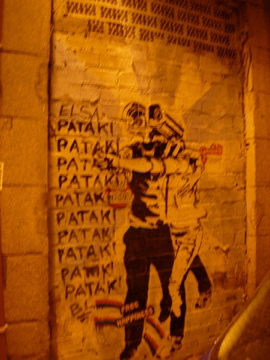
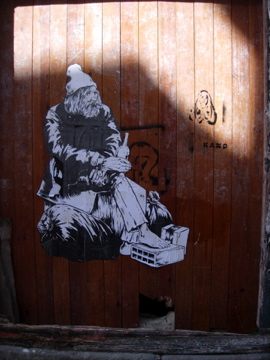
Super poor picture quality, but what can you expect from a 2am street lamp and a mediocre camera? This I spotted in Madrid, near Plaza Sol. If you can't tell, it's two tangoing figures with security cameras for heads.

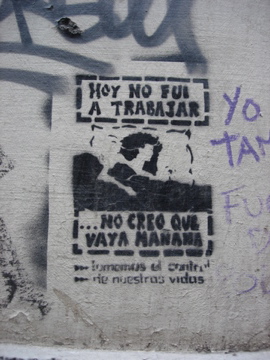
Granada generally had some piss-poor graffiti and stencils, but this one made me laugh. Totally fitting for a college town.

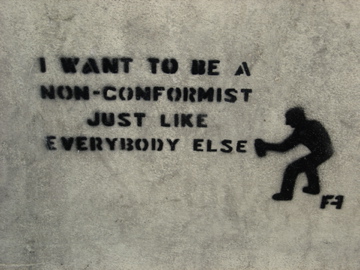
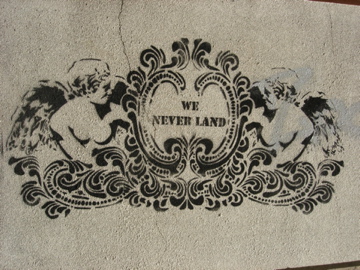
I spotted this one several times around the beach breakers in Tarifa. The sentiment jived well with the surf-town vibe, and the fact that it was in English spoke to the internationalism of the unassuming little place-between-places.

As you might guess, there wasn't a whole lot of street art going on in Morocco, or at least in the places I went. What one does see a lot of is stenciled Muslim calendars, on the side of buildings, with icons depicting certain holidays and dates. My favorite was the rose. I of course have no idea what it denoted or what the Arabic says, and retained none of the heavily accented, half-French explanations.

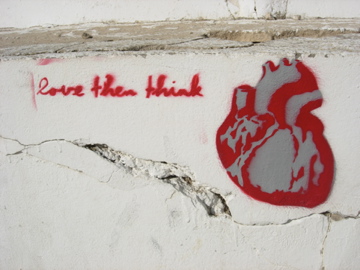
But of course, the best stencil piece I saw was in one of my favorite dirt-road beach towns, Mirleft. Popular with vacationing Marrakeshis, artists, dreadlocked travelers and, well, me, Mirleft seemed a perfect place to find this, peeling away on a side street.

Back in Europe, much of Lisbon's street art had a distinctive Brazilian flavor, which makes sense considering the city's large Afro-Brazilian population, and the fact that São Paulo and Rio are some of the biggest and baddest producers of street art in the world. I saw this stencil around the center, around uber-hip Barrio Alto.

And this was a simply incredible wheatpasted portrait over near the Alfama district.

Another college town, Coimbra had a fair amount of politicized stencils. This one was especially interesting given the prevalence of domestic violence in Portugal, and the pervading stigma against seeking help: "Every 2 weeks, a Portuguese victim of domestic violence dies." The number is a little more somber when you consider the small country's population of 10 million.

On the flip side, this was just awesome.

And I quite liked this one as well.

But the place that really took the cake was Porto. Good ole unsuspecting Porto, forever in the shiny, smiley shadow of Lisbon. These were all taken near hip-slick-and-cool Rue Miguel Bombara.

The paper cranes were part of the 1000 Tsuri Project. They acted like punctuation, all over the walls of the street, serving as both a kind of visual break and space filler between the other pieces.

Part of a larger project by artist Costah; check more out here: http://www.costah.net/the-icons.html

This little girl is up a few places; each time, she's touching something different. From what I could tell, this was the logo of a nearby art gallery/collective.

One my favorites. Simple but expressive, and totally took me aback when I spotted it down an alley.

I don’t know if these reveal any more about the places I was in, but to me they do. And if nothing else, they’re better than cell phone ads.

Dos Dias de los Muertos: Oakland Vs. SF Celebrations

DSCN3892It’s not Mexican Halloween. Or Northern Californian Halloween. It’s Dia de los Muertos, and it’s everyone’s holiday now.
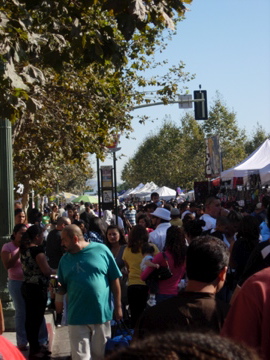
You can’t escape Dia de los Muertos in the Bay Area. That’s a good thing. It’s a pretty bad-ass holiday, based in the Aztec belief of death not as a definitive end, but merely a continuation in a parallel form. Aided by elaborate graveside altars, souls of the departed return for one night (traditionally two) to kick it with the living. The celebratory approach towards death comes complete with a comically macabre aesthetic derived largely from a good ole’ revolutionary, Jose Guadalupe Posada (see: my first tattoo).

What makes the holiday fascinating to me is its endurance and evolution. Dia de los Muertos is the little holiday that could: millennia-old, it’s survived colonialism, Catholicism, and more recently, the United States. But while all these outside elements have altered the holiday, the fundamental spirit has managed to survive. Observances vary wildly, both within and outside Mexico, and serve to say a lot about their respective communities (see: my latest Matador article). Case in point? Oakland versus San Francisco celebrations.

The Bay Area’s enormous Hispanic population has two established homebases: East Oakland’s increasingly cleaned-up Fruitvale district, and San Francisco’s contentiously gentrified Mission District (claimed to be birthplace of the burrito). Both host huge Dia de los Muertos celebrations that shut down city blocks and draw thousands with marigold-adorned, incense-laced festivities. Neither celebration is traditional, in the Patzcuaro sense of the term, but neither are the same. They contrast as starkly as an SF hipster’s ironic mullet and an Oakland hyphy  kid’s synthetic dreads.

DSCN3846

International Blvd during the Dia de los Muertos

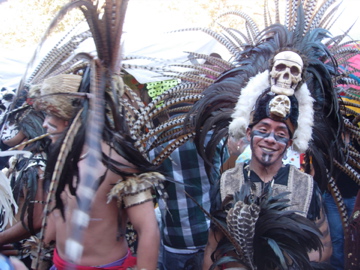
Oakland celebrates with a family-oriented daytime street fair on the Sunday preceding the holiday, this year November 1. While drawing a healthy cross-section of the city’s ever-diverse population, the event is mostly representative of contemporary Mexican and Latin culture in the Bay Area. Powerhouse Spanish radio stations, La Raza and La Preciosa, set up stages on opposite ends of the festival and vie for on-lookers. Local taquerias set up stands that pump out carne asada smoke, while DIY vendors push helado carts and set up raspado stands. Women hawkers cry, “Churros, Churros, Churros!” while others wrap still-steaming elotes in foil. Local businesses abut booths with corporate superpowers like Safeway, while non-profits erect altars next to those of neighborhood school kids. Dancers decked out in Aztec garb (the feather- and skull-adorned headdresses are bad-ass) break into spontaneous drum-infused performances, and there’s more men in cowboy hats and little girls in mini-skirts than you can count.

DSC_0381On November 2, San Francisco holds an evening procession that a jaded friend of mine has dubbed “Gringos Gone Wild.” True, the participants are largely not of Hispanic decent and, boy, do they get down. People dress up in calavera face paint and elaborate Tim-Burton-esque costumes that I suspect derive from Victorian Catrina dolls. A modest group of Aztec dancers leads the procession, which then follows with revelers of the purely San Franciscan variety: costumed people with politicized signs, curious interpretive dancers, bicycle-powered floats, and a whole lotta candle-clutching white folks. The procession ends at a public park filled with some seriously artistic altars—this year, an anatomical heart suspended by red nerves, a papier-mache carniceria, a parlor scene that looked like the inside of Edward Gorey’s head.
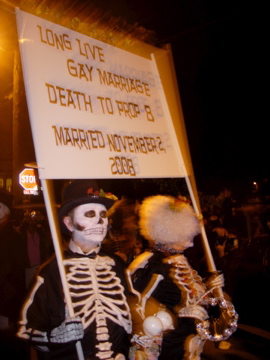
I can see how people get down on San Francisco’s Dia de Los Muertos celebration for not being authentico; I understand why others deem Oakland’s as boring and not creative enough. But isn’t that just an extension of the Oakland-SF rivalry, the cities’ differences demonstrated through the observance of another culture’s holiday?

I’m an Oakland girl, so I’m partial to an event where I run into about a dozen people I know. And if nothing else, the Fruitvale festival is thrilling for the mere fact that Oakland manages to hold a peaceful public festival (I remember seeing stray post-Festival-At-The-Lake rioters pass by the bottom of my block as a kid—that was the end of that neighborhood event). Events like the Dia de los Muertos celebration remind me why I love my hometown—though I never really forget.

DSCN3907At the same time, the Mission procession captures so much of San Francisco’s cultural landscape. Just when you get disheartened, want to write the whole place off as over-priced and gentrified, the city comes through with something insanely creative or beautiful. Despite the changing demographics, beneath the paling population and depressing socioeconomics, San Francisco’s still a city with soul.

And at the center of both of these celebrations is the fact that they don’t derive from, well, here. They aren’t American, have been brought over by immigrants and subsequently Americanized. Some shout cultural appropriation, and, sure, these festivities are a far cry from the all-night graveside vigils I attended last year in Tzintzuntzan. But, at the core of these modern interpretations, both stay true to the fundamentally celebratory Aztec approach of the holiday. And if that’s not survival, I don’t know what is.


Lauren Quinn is a writer and traveler currently living in Hanoi. Lonely Girl Travels was a blog of her sola travels and expat living from 2009 to 2012. She resides elsewhere on the internet now.

Join 490 other subscribers

Buy This Sh#t

Categories