Archive Page 16

Take Me To The Jungle, And Don’t Ever Take Me Back

Okay, so outdated pop culture references aside, hear me and hear me well: Jungle Beach is the stuff of backpacker folklore.

A rustic, simple homestay: a cluster of bamboo cabanas on a sandy lot, shaded by the whispering palms of trees; hammocks and hand-made lounge chairs; a communal dining room where guests gather twice a day for meals; thatched sun umbrellas stuck into the sand of a postcard beach.

Sometimes a place feels so special that you don’t really want to write about—as though writing about it would sully it, or giving it words—trying to give it words—would cheapen it, lessen it, and you want to keep it a private, precious thing.

I arrived at Jungle Beach a little heart-heavy (see previous post), a bit of melancholy sprung up, as though something tapped into a murmuring, gargling reserve of oil beneath the surface of me and wasn’t shooting out like a geyser, but rather seeping through, leaking out into the sunlight.

In any case, I crawled off the overnight bus a stop early, 40km outside Nha Trang—5:30 am on a dusty strip of highway that consituted the town Doc Let. I took a motorbike the next 20-some km, sleep-blurred and thirty-mouthed, to Jungle Beach. I arrived, and I didn’t ever want to leave.

It wasn’t the kind of place that immediately bowls you over. “This is nice,” I thought, as I curled up under a thin blanket, inside a soft blue mosquito net. But the place grew on me—or I grew into it.
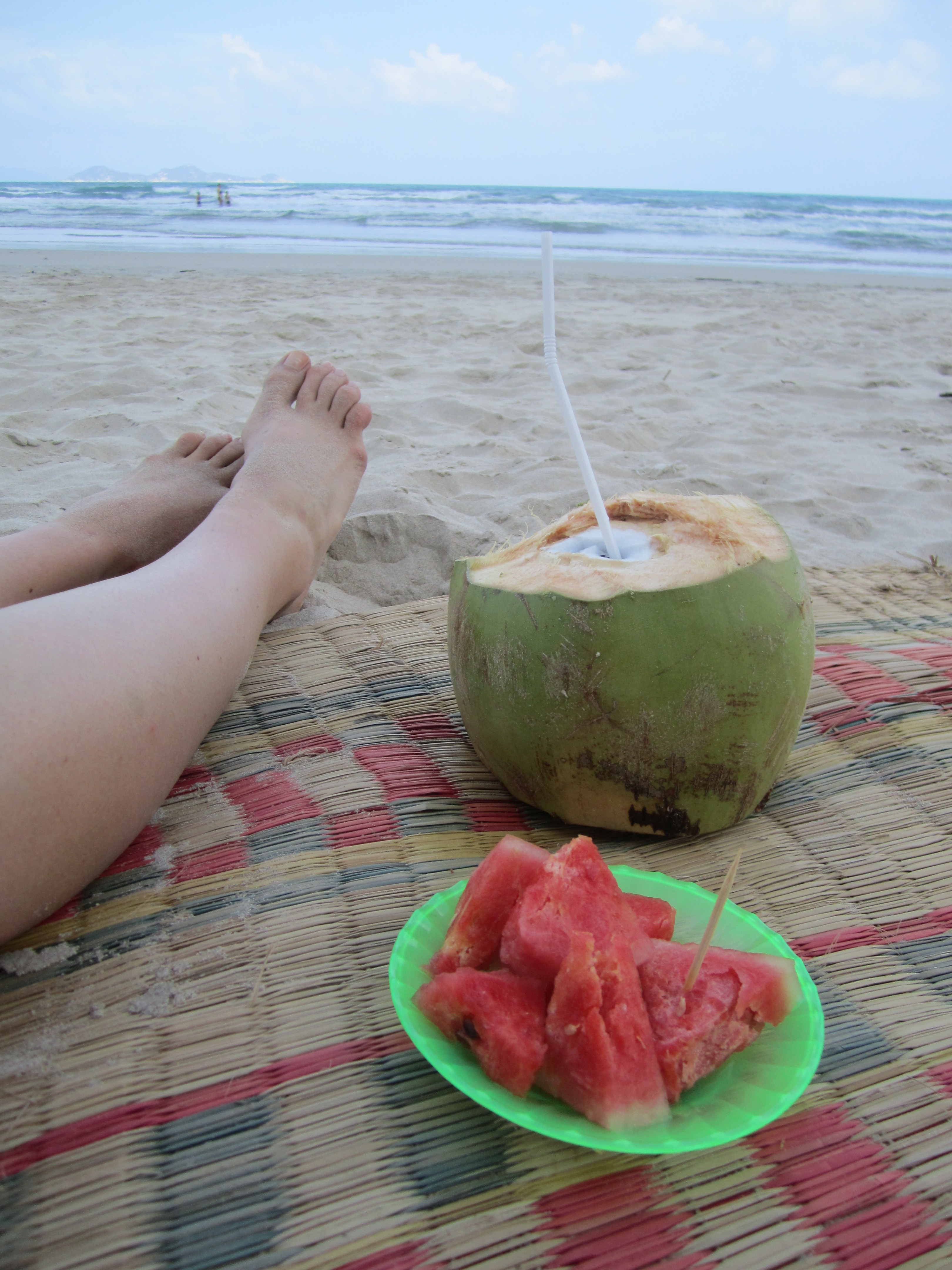
Hours and days passed in some sort of other time zone. Wake up with the sun. Jog on the beach or do yoga on a mat in the shade. Eat breakfast. Do some writing, some reading. Lay on the beach. One of the workers comes out and says it’s lunchtime. Rise off my feet, sit at the communal table, pass bowls of meat and veggies and rice and sweet chili sauce. Have another coffee. Go back to the beach. Not even read, really, just lay there—lay there thinking, or not thinking, just watching the waves and feeling my own kind of waves inside, welling up, rising and receeding, as though I were standing on the banks of a monumental sadness, whose bounds I didn’t know, just the pull of its gravity. Cry sometimes, about nothing in particular.

Three pm, and someone comes out with a little plastic plate of fruit, pineapple or pomello or watermelon. Eat it with a toothpick, get a coconut, drink it and scrape it clean with a spoon. Go wade in the water, hopping waves or letting them pummel me, or floating on my back and watching the great white clouds walk across the sky. Shower, check my email, write. Gather for dinner and spend hours afterwards chatting with the other travelers—mostly couples, mostly German for some reason, but really cool people, different ages but all open and friendly. Feel like it’s midnight when it’s only 9, say good night and curl up under a thin blanket, inside a soft blue mosquito net. Repeat as necessary.

The place was built by a dude named Sylvio, who walks around shirtless and smoking, a tough old guy (see character study in upcoming post). He bought the land nearly 10 years ago, and built the place slowly, each cabana by hand, and it’s become the stuff of backpacker folklore.
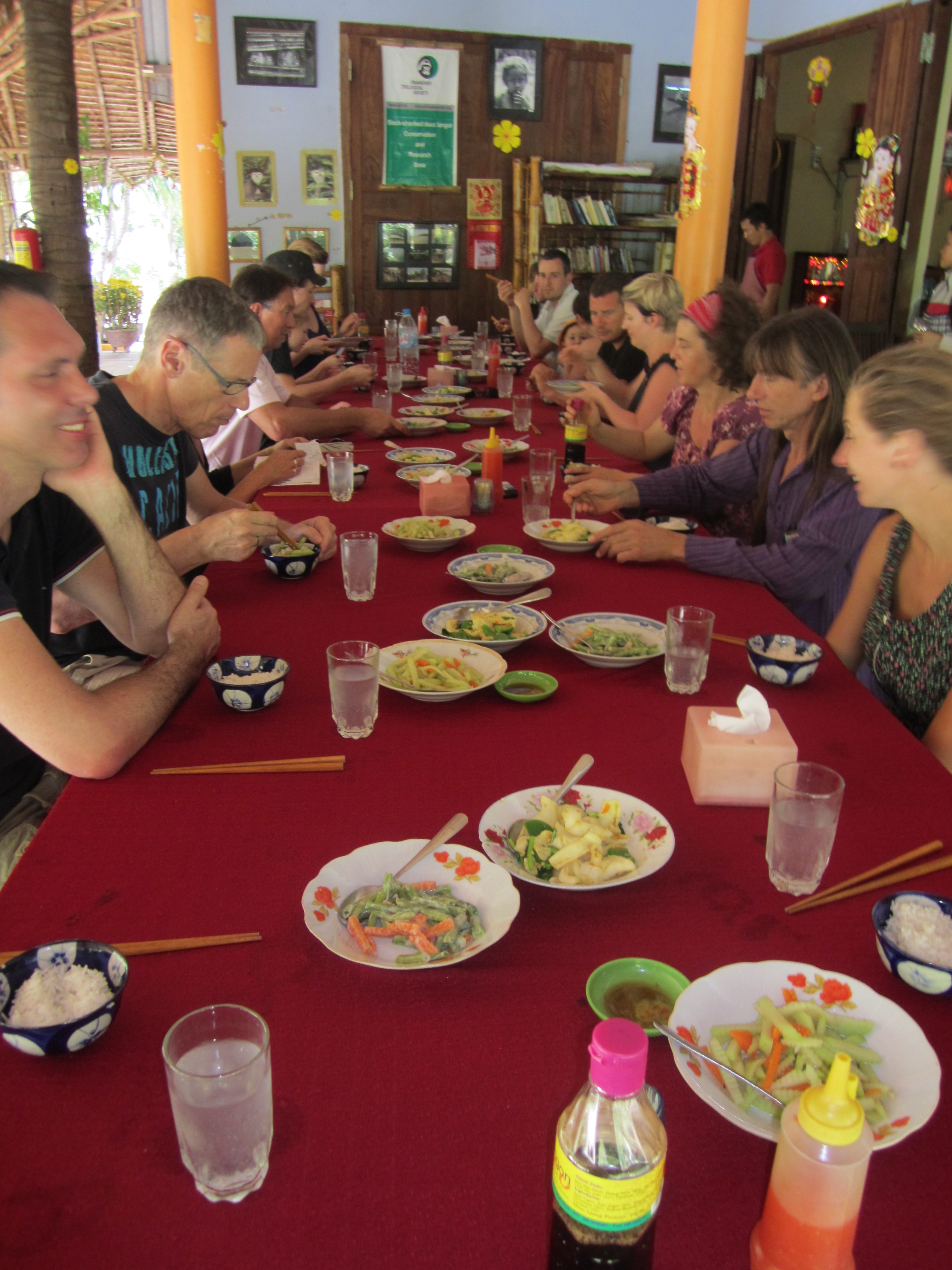
One of the most impressive parts of Jungle Beach is the staff. The staff to guest ratio was almost 1:1, a friendly, laid-back Vietnamese staff that didn’t pander to the guests and fawn over them, but was attentive—in short, that actually seemed to really care that we had a good time. Ten years of working in the service industry, and I’ve decided that that’s all people really want—to feel taken care of, to feel like you actually give a shit. It’s a rare thing, and it doesn’t necessarily come with heafy price tags and swanky surroundings. It comes, to be completely and utterly trite, from the heart.

I spent four days and three nights doing virtually nothing at Jungle Beach. And as my depature neared, I found myself desperately not wanting to leave. I discovered, without having known it, that I really needed that time—to decompress, to clear out some space, to get ready for the project I’m about to embark on. And yet I didn’t feel rejuvenated, in a sense; I felt simply like I didn’t want to leave.

But what would another day have done? What would another week or year done? Will I ever actually work through all this whatever-it-is I carry in me? Will I ever be done? No, no, it was time to go.

But I can’t ever remember feeling so sad to leave a place. I looked around—it all seemed so precious. I actually almost cried. What the hell is all this? Am I going crazy? Am I becoming soft in my old age?

I got in the taxi and we bumped off, leaving the buildings and the thatched roofs and the gate and the barking dogs in a billow of dust behind us.

A Memory Rises On An Overnight Bus

Nothing in this landscape should have reminded me of you.

Nothing in the bus seat, rock hard and shoes off; nothing in the moon or the night or the stale air, the rattle of the road. Nothing in the sound coming through my headphones—an ancient blues, tambourine kick pedal harmonica, one-man band wail, from before we were born, either one of us existed—and that died into a vinyl crackle before we ever met, a Here even less like this landscape of palms and rice patties, reflections of headlights and mountains in the still, black water.

But suddenly it was there, I was there or you were there—in any case, it came back. Somehow something in that bus and the night tapped into a wellspring of sorrow, an old sorrow that I still carry in me and carry in me, all over this rotten world—constantly decomposing and becoming something new, an exercise in impermanence—and this hard little rock in me that won’t ever melt away.

I started to cry for you. It’d been years since I’d cried for you, about you, about any of it or all of it. (But what was it?) I stared through the scratched glass and cried—but for what? For missing you? I never had you. No one ever had you, not even you.

For having ever even known you?—the shining star of you, burning cigarette embers on the highway, dancing and I watched you dance. For the little moment that our lives intersected: a train station, crosslegged and howling through the alleys of that town neither one of us belonged to? For what blazed through the madness and fury, the brown eyes pinned and the brown eyes glassy and the brown eyes blown out wide as bowling balls, bawling?

For having loved you in the broken way I knew how?—how to only love things that aren’t yours, that’ll leave you, that’s leave us all, that’ll sicken and die the only way they know how. For the fact that nothing could save you, not even God and least of all yourself.

For everything we ran from. For the immense pain we both lived in, that killed you and not me. What the fuck do you do with that? Where do you put that except a hard rock inside you? What Gods are there for this?

Can you build an altar inside yourself—glowing, plated metal and blinking lights, bowls of foregin fruit, a religion you don’t know, whose rituals you perform without understanding—incense smoldering and churning and coming out in little coughs, little moments like these, when I find myself moving through a dark world that doesn’t have you in it—except in a rock I carry, my heart, a temple of unforgetting.

Little Artist Girl, Hoi An

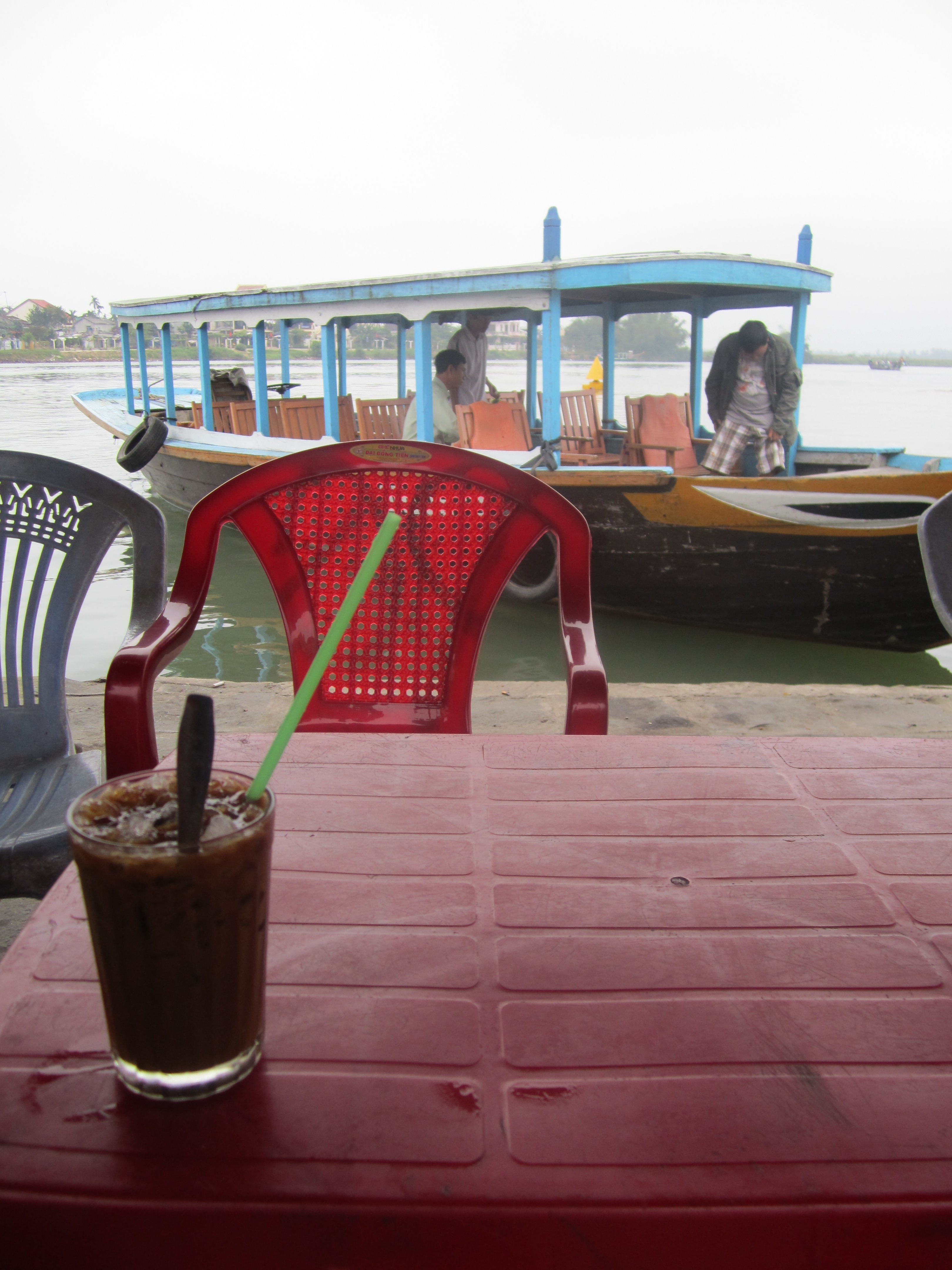
The best cup of coffee—or rather, glass of coffee, tinkling with ice cubes and a teeny spoon for stirring—I had in Hoi An wasn’t at one of the wicker-chair, wifi-ready terrace cafes with an English menu. Sure, those were nice too: to sit and look out on the lantern-lined pedestrian streets and tailor shops and footbridges and the grey strip of water on which paper-mache Tet floats and old wooden boats nodded “yes, yes.”

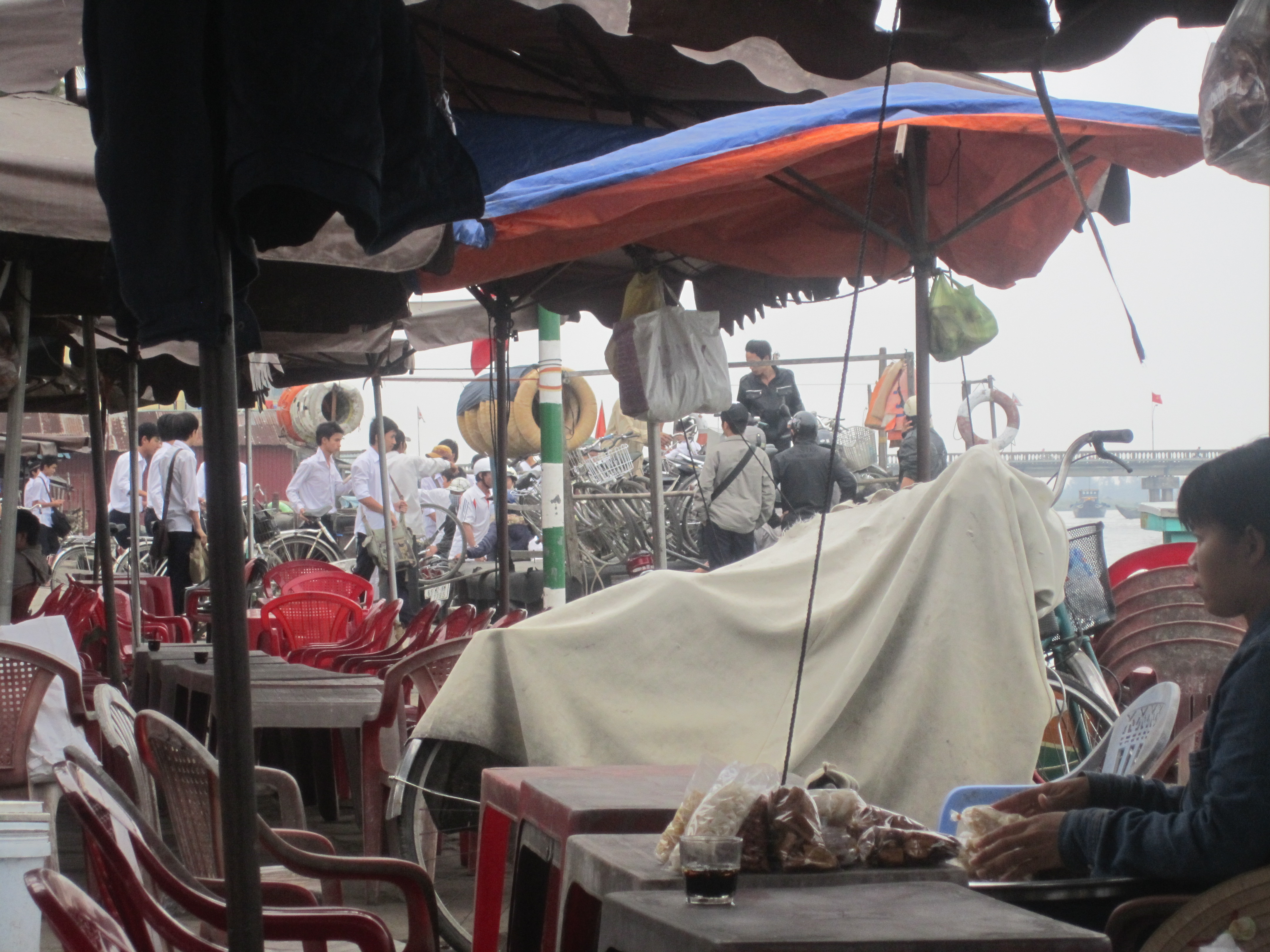
But those were more of the ambiance. The best actual coffee I had was at a plastic-chair, sooty-pavement stall near where locals loaded their motorbikes onto a dingy barge and set sail, to somewhere off into the reedy horizon.

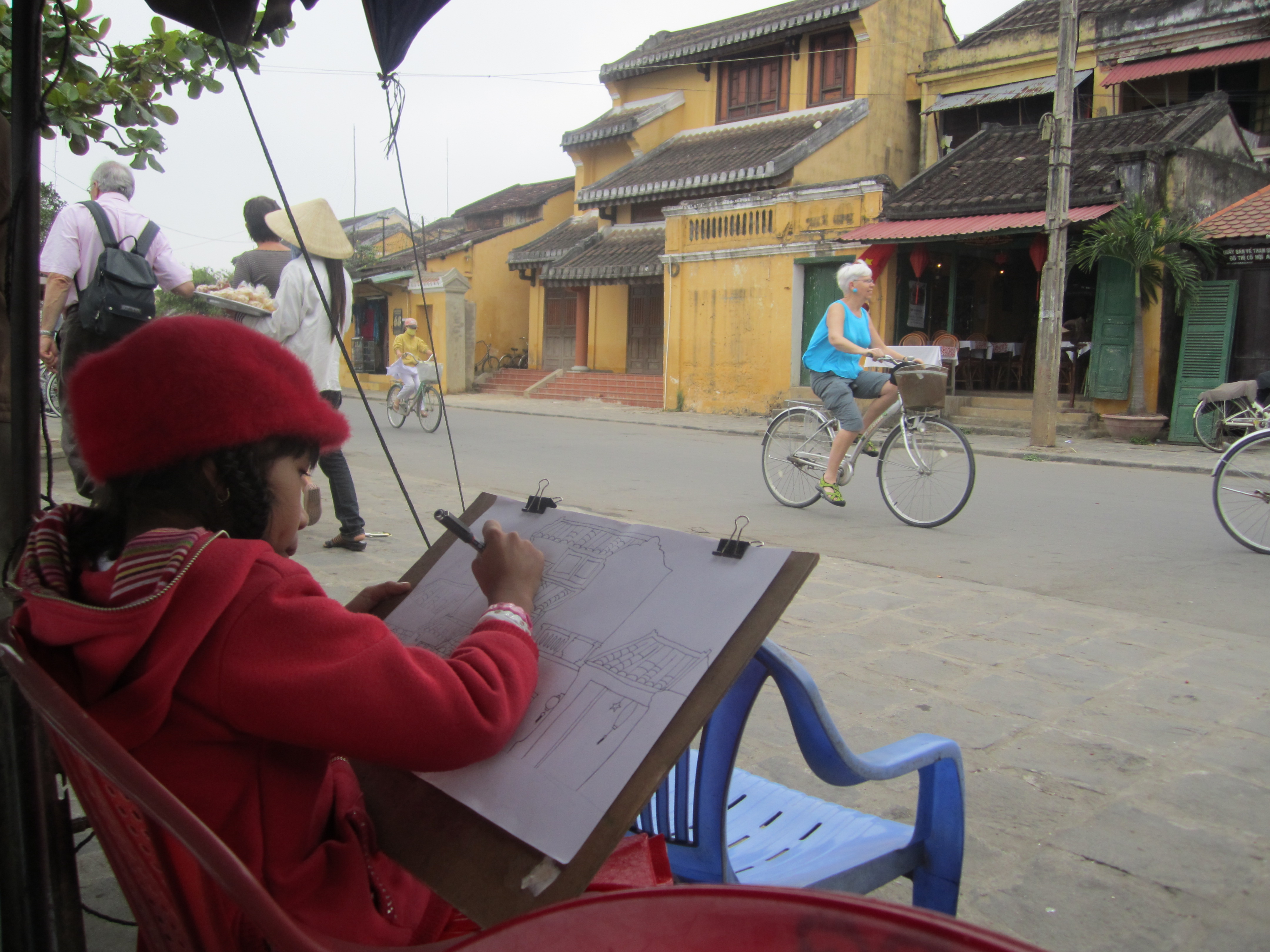
I sat sighing and stirring and soaking in what felt like a private nook amidst the “charmingly touristy” bustle of the city (it really is quite lovely, in spite, or because of, all the tourism). I observed the goings-on, and then I noticed her: a little artist girl, studiously perched over her clipboard.

She was fully absorbed in her work, a study of the colonial building across the street. The bicycles and motorbikes and swarm of people didn’t seem to exist to her—she sat focused, consumed by the work at hand.

Passerbys stopped to observe her; she didn’t seem to notice. Old men who sat smoking, drinking coffee, waiting alongside the docked boats for an indeterminate something, slowly got up to watch her. They stood around nodding; she didn’t look up once. Nothing else seemed to exist; none of it—the people, the street, its bustle, the whole honking world—mattered except the building, her drawing.

She was an artist at work. In her poofy red vinyl skirt, her frilly white socks, her fuzzy beret; her unwavering black eyes and posture of pure commitment —a perfect little artist.

She worked for the duration of my leisurely linger. Eventually she looked up, over at a man that might have been her father. He nodded, tenderly clipped another board atop her drawing to protect it from the flurry of the street. He took her hand and they walked off together.

I got up and paid for the best glass of coffee I had in Hoi An.

No Hue: Hue Riders Knock-Off

Um, is this supposed to be something important?

Mr. Loc is over it.

He slows the motorbike, pulling over to the skinny shoulder of the highway that wraps seductively around the lush green mountain. He points. “Photo.” It’s more of a command than a suggestion. I snap of shot of the vista—pretty, with rice paddies and a cloak of fog. But I couldn’t tell you any more about it.

That’s because Mr. Loc isn’t having it. He’s shown us the goddamn vista, his posture seems to say, what more do we want?

Even the most skilled and adept of independent travelers (and I’m certainly far from one of them) falls for an imitator sometimes. It happens: we’re tired, we’re rushed, our guard is down, it seems like a good idea. We wind up paying top dollar for a half-assed adventure.

I’d heard about the Hue Riders one night in Hanoi. Instead of a boring old tour bus, they take you on motorbikes from Hue to Hoi An, an historic trail that stops at waterfalls and pagodas and old American bunkers. “It’s supposed to be brillant,” one of Jacob’s friends told me, hunched on our plastic stools over the billow of BBQ smoke.

Killer. Sign me up.

I asked my hotel in Hue if they’d heard of the Hue Riders and they nodded enthusiastically, leading me over to the dude posted at the cafe next door. He thumbed through his photo album—him with smiling white girls, him with white dudes giving the thumbs up sign. He showed me an entry in his customer comment notebook from a girl who was “from your country!”

I couldn’t tell if it was cause to be suspicious, or if he was just that certain kind of proud that third-world tourism workers sometimes are. He showed me his business card: “FIFTEEN YEARS Experienced, All’s for your satisfaction.” But hey, it said “Hue Riders” under his name.

It was only later, after I’d paid and signed up, that the real suspicion began to mount. I googled Hue Riders. And holy shit, there was an actual, legit website. For the real Hue Riders. Of which Mr. Loc was not one.

Oh well, I told myself. Chalk another up to experience. Sometimes the DIY, hustling tour guides can be just as good as the bona fide ones your LP recommends.

Which is true. But Mr. Loc, I’m discovering, isn’t one of them.

He isn’t terrible; he’s just monumentally not into it. Fifteen years of experience has translated to boredom.

Our first stop was a fishing village off the highway: a dirt road strewn with debris; a couple of kids playing soccer; a clutter of wooden boats, docked and sleeping; nets laid out like the vacated skins of snakes.

“Fishing village,” was the extent of explaination given.

Joe, the upbeat and friendly male half of an American couple who’d also gotten roped into the tour, attempted to ask some questions. “Do they go out in the morning?” We got a sort of unintelligble, one-word answer.

Now at a mountain pass—but was it the first or the second pass?—I attempt to eavesdrop on the tour guide next to us. Something important about these cables, this view, something about Americans? I try to ask Mr. Loc. “Was this something important during the war?”

“Yes, I think so.”

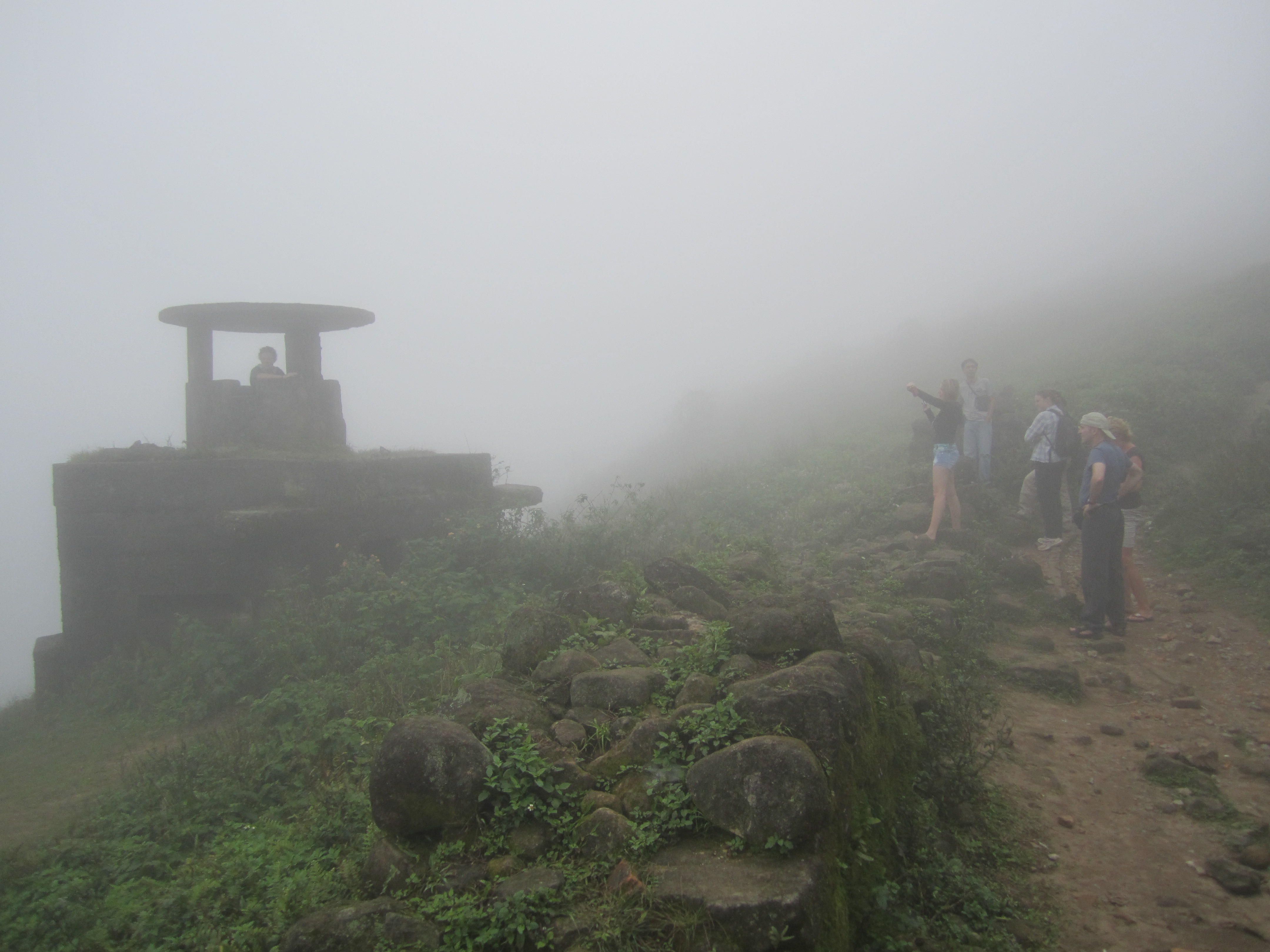
Tourists at a former bunker

We move along. It’s a foggy, white-wrapped day, and all the sights we stop at are equally shrouded in hazy incomprehension. We stop by bunkers used during “the American War” (now a tourist trap—more on that in a later post). We stop off for overpriced coffee at a cheesy resort. We pull over at the roadside operation for a kind of cosmetic oil made from a local leaf. We stand around awkwardly as Mr. Loc tells us the prices of the different sized oils.

“Not much of an oil type myself,” Joe declares good-naturedly. He’s pathologically cheerful, in that particular American way, with his buzz cut and beaming cheeks. “When do we get to the waterfall?”

“No waterfall today,” Mr. Loc declares. “The weather,” he gestures around us, “road too slippery.” He makes a skid-and-crash motion with his hands. We nod solemnly, disappointed.

We stop at Marble Mountains, thrust from the flat earth near China Beach like a glittering rock of crystal. Pagodas and temples abound. Joe maintains his positivity, reading aloud from his Lonely Planet to make up for our lack of tour guide. I’m grateful for his unrelenting optimism.

Holy light

We wander into a cave that feels like a cathedral—a carved Buddha in the stone, incense like breath, sunlight filtering through the ceiling like the fingers of gods. There’s the hush of a holy place there; Joe reads that during the War, it was used as a VC hospital.

In a corner, a bat with a broken wing arches and flops. He squeaks intermittenly, and it sounds like a very small prayer, echoing against the rock.

We descend the mountain and find Mr. Loc waiting for us, leaned against the motorbike. “Okay, we go.”

I realize the thing about Mr. Loc isn’t that he’s rude or unknowledgable or even a shitty tour guide. It’s that he’s supremely Vietnamese. It’s this certain way, this certain attitude, that I’ve begun to understand, the same as in the nail shops at home—matter-of-fact, blunt, nothing sugar-coated or said sweetly. Here’s your tour. There’s a sight. Good? Okay.

“Vietnamese people aren’t very nice,” other travelers have told me. I understand where they’re coming from, but I don’t think it’s a simple matter of not being nice; I think it’s a profound cultural difference. (“You want pedicure? Okay, you pick a color.”) Brusk and brash—jarring as the chorus of honks from the motorbikes.

We arrive in Hoi An wind-blown and dirt-covered. My eyes well from the thousand particles of crap swimming around my contacts; my hair’s matted to my head from too many hours wearing a helmet.

Mr. Loc drops me at my hotel. “Happy?” It’s a business-like question.

I nod. Why not?

Hanoi’s Secret Cafe

I love rooftops, and I love rooftops in cities—sitting up on your bird’s perch and watching the strange dance of it all.

There’s no pigeons in Hanoi (except the ones you see plucked and pink at the food stalls), and there’s virtually no places to take respite.

Jacob told me about the secret cafe—not so much a secret, but a nameless, signless place you could never find without looking for it. On a road behind Turtle Lake, beside an especially terrifying roundabout, at the heart of the chaos—a nondescript storefront shop selling all the usual lanterns and bags and lacquered art. You walk past it, through it, down and back, what looks like the dim hallway to some squalid toilet.

It actually leads to a cafe, opening up into a courtyard that evokes the same “ah” sensation as stepping into a riad from the din of a Moroccan medina. A girl thrust a menu at me and told me I needed to order there, right there, before going any further. I pointed to the coffee with milk and egg white, as recommended, and the girl moved aside and let me pass.

I climbed up a flight of stairs, past a set of carved doors left ajar, revealing a glowing, smoldering altar within. Up another skinny staircase, and I was at a quiet little terrace that overlooked the lake, the skyline, the swarming street, the madness of the city.

It was my fourth day in Hanoi, and I was only then beginning to make sense of it. Its roads were a tangle of incomprehension, like lines in a palm whose fortune you couldn’t quite decipher—electrical wires and branches the gentle hatch marks that lay like a webbing, even less decipherable in what was certainly a story, certainly trying to say something.

But on the terrace it almost made sense, or at least begin to take shape. The other tables were sparsely inhabited by couples, leaning in and speaking low, by a few other foreigners smoking and reading. My egg white coffee came and it was goddamn delicious, thick and like a milkshake. I spooned it to myself like I were my own infant and sat there, just sat, thinking my nothing thoughts and watching.

It was refreshing, to be up there like a bird, in a city that doesn’t have any—to enjoy a moment of peace amid the frenzy. Which is a metaphor for life, in the way it’s all a metaphor for life—one great metaphor beneath the surface of everyday, at the center of everyday, everything just an arrow, pointing, leading, hinting us towards some soft secret (down a passageway, behind a trinket shop)—nudging us towards something we can’t possibly ever know or say, can only sense sometimes, in the still moments—can only approximate, speak about in abstractions, relationally. Which is why it’s a metaphor in the first place, and not The Real Thing—why we need metaphors and egg white foam in thick coffee and pretty little terraces to take a breather on.

Hanoi Secret Cafe: 11 Hang Gai

Suicide-Proof

I dreamed your apartment was suicide-proof:
those little half-windows
that only open in slits,
like doped-up eyes,
how we blew the smoke
sideways and down
and it couldn’t really make it out,
just blew right back to us.

I asked if there were earthquakes here
and you said there weren’t,
but I didn’t believe it—
not that I didn’t believe you,
but I didn’t believe the earth—
that somewhere down
under all this something
was shaking,
ready to shake:
the smell of a seizure
before it erupts.

I got up and paddled
my bare feet across the floor,
my bad ankle snapping.
I realized I’d forgotten the kitchen window,
that slides open wide—
a ledge and a little metal railing
that wouldn’t be enough
to keep a body from crouching,
crawling out
to the 16 stories
of honking beneath.

Learning to Ride On a Motorbike in Hanoi

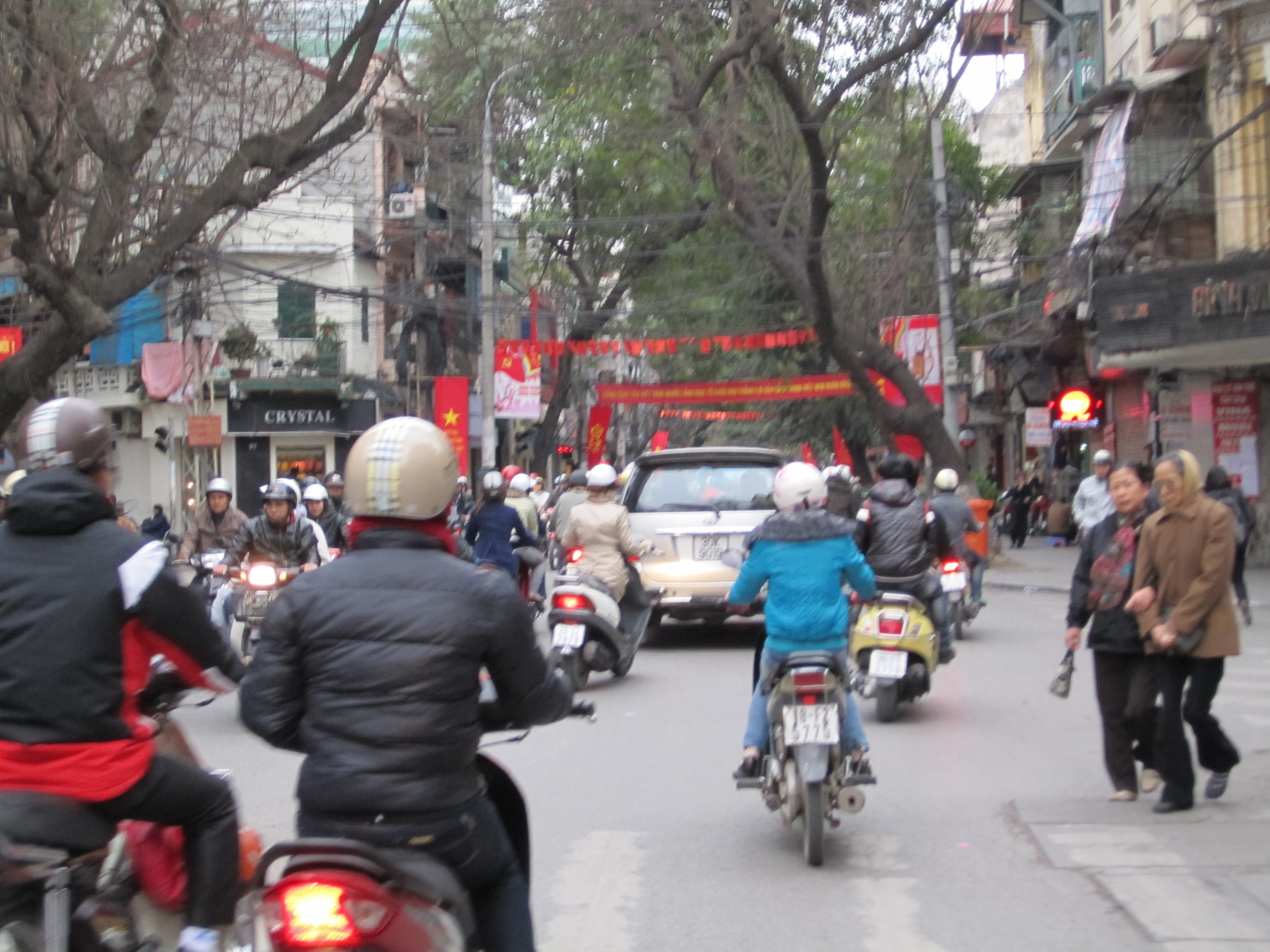
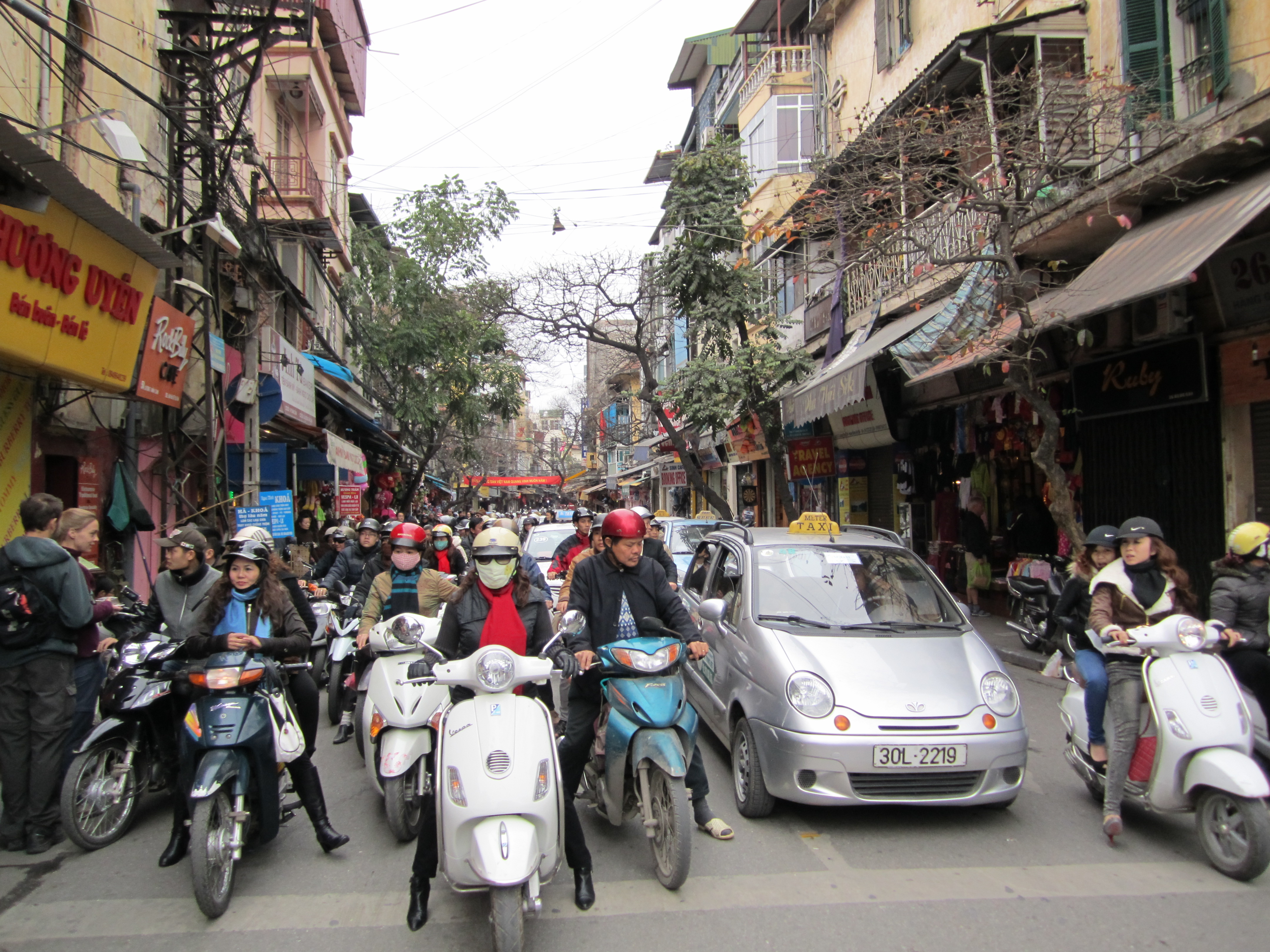
Hanoi is a bipolar child with a strict bedtime.

Clinging hands behind me to the metal rack, I try to suppress the involuntary flinching—a circumstantial case of Tourette’s. It’s Saturday morning, and my first ride aback a motorbike through the frenetic traffic of Hanoi.

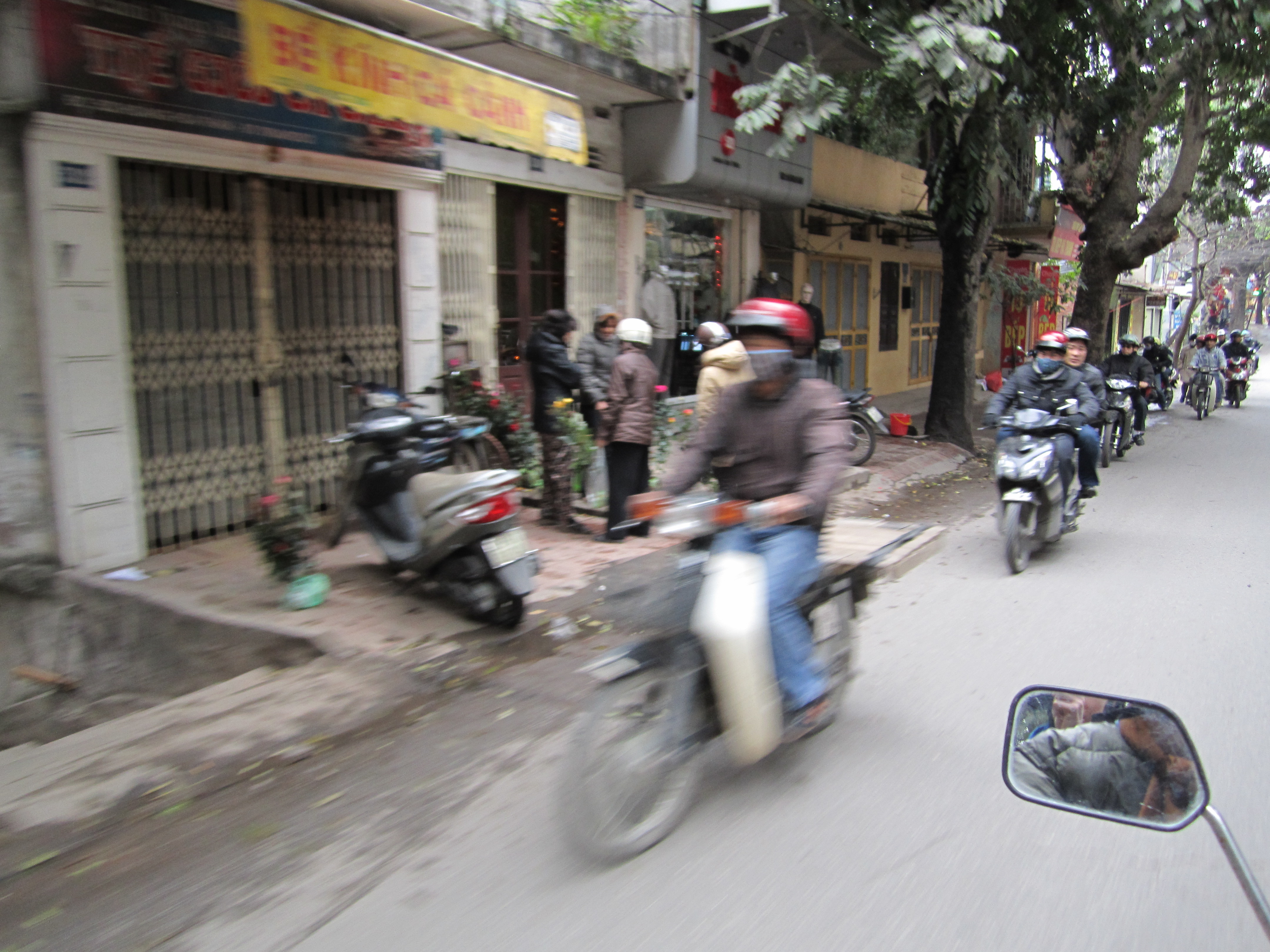
If you want to see the word “clusterfuck” defined, acted out in an exquisite charade, snap on a spare helmet, straddle the seat of your friend’s motorbike and take a ride through the streets of Hanoi. Feel the blanket of exhaust haze whip up around you; feel your legs naked to the risk of a thousand near collisions; feel the breeze of your own mortality and the queasy cocktail of sweetened coffee, cigarettes and exhaust churn in your stomach.

See towers of Tet trees and blossom branches balanced aback bikes; see jugs of water and housewares, bundles of mysterious somethings tied on in impossible precariousness. See families of four smooshed onto a single bike; see the eyes of children placidly blinking in the madness. See drivers texting, pulling out without looking, barely slowly, pedestrians stepping out into the chaos of it all—women walking with baskets balanced on a piece of wood across their shoulders, liked Lady Justice, except it’s their mouths that are masked; their eyes remain wide open.

Hear the horns beep and squawk like a million hungry birds—seven million, to be exact, and every damn one of em has a motorbike and is riding their motorbike, lanes just vague suggestions, right-of-way a nonexistent notion.

See this all this because you’re in this, suddenly a part of this: a passenger in the strange dance that feels more like a riot or a mosh pit—but no, no, must be a dance because you keep skirting disaster, skirting death, and you keep wanting to clamp your eyes shut but can’t, can’t.

Riding aback a motorbike through Hanoi isn’t exactly a near-death experience. It feels more like being on an airplane with really bad turbulence: you trust the pilot but not the skies. You know you’re not actually going to die, but you really can’t wait for the whole damn thing to be over. You get off feeling like you’ve just stepped off a rickety old rollercoaster that’s safety permits are supremely suspect.

“The sidewalks in Hanoi aren’t really for walking,” Jacob throws over his shoulder. “They’re more for commerce. If you want to walk, you’ve pretty much gotta do it in the street.”

It’s not a walking town, he says, and it’s true—at times I don’t see a single pedestrian, just a weaving, wheezing sea of traffic. How do you get to know a place without walking it? How do you get a feel for feel for a place without your feet on its streets?

It gets easier. I tell myself to trust, to put faith in the fact no one seems to be crashing. It begins to feel like we’re moving along this barely perceptible tightrope that weaves in and out of other people’s tightropes, maybe like telephone wires—like our own personal orbit, the miracle of chance that we don’t collide, such a miracle that it can’t be chance at all, but driven by some other force I can only suspect, can feel at times in the smoggy breeze, but can’t come close to naming.

Nighttime is different. It’s as though someone flips a giant switch. By 11, the streets have cleared, suddenly swept of everything but a faint whisper, the asthmatic glow of the headlight. The streets seem smaller in the dark, emptied of their madness—they don’t seem like the same streets at all, but an entirely different place, a different city. An incredible stillness settles over the buildings, the pavement, the wires stretching and branches drooping and the shapes of shadows in the dim drizzle—as if none of it were real, all the daylight mania just a waking dream, a reverse nightmare.

By Sunday I’m able to hang on with only one hand and snap photos with the other. I’m comfortable enough to carry on a conversation as we drive. Jacob points out landmarks and tell little stories; I tell him how my parents were revolutionaries when they were young, how the met in a Communist meeting. He quizzes me Vietnamese numbers, phrases; we laugh about the universal asshole-ness of SUV drivers. We weave through the manic chaos of daytime, and I tell him Hanoi feels like a bipolar city.

Rain comes that night, along with a cold wind; we move more slowly through the vacant streets. I blink against the lashings of wet and my hands turn frigid. Slowly, I loosen my grip on the metal grating, and place both my hands in my pockets.

I’ve learned how to trust the gods of traffic and chaos. I’ve learned how to ride a motorbike in Hanoi.

11 Dazed Hours in Hong Kong

If ever there was a place to wander around in a jet-lagged, head-cold haze with nothing more than a tourist bureau map, Hong Kong is it.

The 11-hour lay-over is actually what made me choose this flight to Hanoi (aside from the fact that it was the cheapest). I love long layovers; it’s like a two-for, a bonus. You get to extend the half-here-ness of transit onto a place—walk through its streets like it were a video game, or bumpy camcorder images from someone else’s vacation, or someone else’s dream, exuding a kind of impermenance that makes you impervious, imperceptible, a kind of illusion, a walking ghost in a half-here city.

Or it could just be the jet-lag talking.

Either way, Hong Kong is a trippy city to spend 11 hours sleepwalking through. Everything is clean, clear and predetermined: signs telling you where to go, signs reminding you to hold the handrailings, signs designating exactly where you should walk and where you should stand and which direction you should look for traffic and when you should be mindful of bicyclists.

It’s a subdued city, a city on Vicodin. Everyone talks in a low, pleasant voice; they smile slightly when they exchange words with you. Skyscrapers rise up to be swallowed in a white fog. Municipal workers sweep sidewalks, trim hedges, wear blue face masks and walk with their hands clasped behind their backs, or piously under their bellies. People walk with the self-possessed composure of business people on their lunch breaks. Shoes click, crosswalk signs hum, the gentle clatter of endless construction (what more could they be building?) echoes. Nothing is loud or jarring or overwhelming. Yes, it’s crowded, but there’s an order to everything—an organized insanity, a colonized chaos.

You could almost begin to suspect that you were in some George-Orwell-esque alternate reality, where everything seems real, resembles real, but really isn’t—just some placated approximation of a real place. Rolex, Prada, Couch, Ralph Lauren, Espirit, Starbucks, 711, Pret A Manger, Citibank, Geox—buildings that stack as neatly as Leggos and fish markets that don’t reek of fish, don’t reek of anything. The thinnest layer of soot covers the awnings, as if to remind you that it’s real—the slightest twinge of exhaust tickles your nose.

It doesn’t feel theme-parky or like a tourist charade, but rather like the city has in fact become this—a large, outdoor office park.

None of which is to say I didn’t enjoy my time wandering around Hong Kong—just that it felt more like one of the alternative realities from Inception than a real place. Which could have been the cocktail of jet lag and DayQuil and caffiene and bad airplane food swimming around inside me. It could have been the pork dumplings and Ramen noodles that tasted like childhood.

Getting Ready

So I leave tomorrow. People keep asking me, “Oh, are you excited?”

And for the first time, I answer, “No.” I shake my head and exhale a kind of half-laugh, the well-isn’t-that-some-crazy-shit half-laugh we do when we don’t know what else to do, how else to respond than to shake our heads at the mystery of things.

I’m not excited. But what is the emotion I feel? I’ve been trying to describe it, name it, say it. It feels big, like a bubble being blown up in me. It’s not panic, but it’s black like panic—panic minus the lightning streaks? “Sadness,” I answered to one person, but then I realized that that wasn’t right either. It’s another emotion, a nameless emotion, that’s twinged with sadness—only on the very edges, but those edges are all I know, all I can feel. And even that I can’t be sure of.

Yet the pain of withdrawal is unique and special, even precious (although you probably don’t think so now). In a sense, the experience is you, a part of you which has been trying to surface for a long time. You have been avoiding or postponing this pain for a long time now, but you have never been able to lastingly outrun it. You need to go through withdrawal in order to become a whole person. You need to meet yourself. Behind the terror of what you fear, withdrawal contains the seeds of your personal wholeness. It must be experienced for you to realize, or make real, the potential for you and your life which has been stored there for so long.

This is a trip I’ve been wanting to take for a long time. This is a story I’ve been carrying in me, mostly without knowing I was carrying it, except in moments when I would see it suddenly: a flash of lightning on a black night, when the landscape of it laid out before me, terrifyingly bare—what was always around me, surrounding me, but that I couldn’t see, wouldn’t let myself see. And it would scare me and I wouldn’t have words for it, because I haven’t ever had words for it.

Only it wasn’t the lightning, the sudden moments of seeing, that were scary; it was the black.

But I’m not feeling scared, not anymore at least. I suppose it’s a stillness I’m feeling, a monumental stillness, burned on the edges with a sadness. For what? For leaving my life. Not that I don’t want to go, but that I suspect some piece of me won’t be coming back. And while it’s been painful—so painful I didn’t really know it, until I let the lightning reveal how painful it really was—that black has been with me a long time.

With all the pain and ache of the early going, with all the difficult and dangerous challenges to our new sobriety which we had faced, and throughout all the gut-wrenching we had undergone over our crisis of personal identity and meaning, we somehow knew that we would miss this period once it was behind us. Amidst all the difficulties and uncertainties, a simple intimacy had come into being for us: we had met ourselves and found ourselves worthy.

We’d been talking about childhood, how Lynda doesn’t much remember hers. She was struggling to get some lost detail right; she turned to me and asked, “I dunno, do you believe in hypnotism?”

I paused. Without knowing quite where it was coming from, I answered, “I believe we look at things when we’re ready to look at them.”

So, I guess I must be ready.

Saying Goodbye

People are trying to say goodbye, and I’m trying to let them.

I’m no good at goodbyes. Not other people’s, but my own. I’m uncomfortable with leavings, and, with my trip only four days away, I’m getting plenty of opportunities for unease.

Three months is just long enough to feel like A Long Time, just long enough to be not just a trip, but an absence, a leave of absence—not just from a job, but from my life. I keep noticing myself wanting to hide, to disappear, to tiptoe off into the darkness—which isn’t really darkness or even blankness, but a big unknown, unimagined and undrawn, the painter’s dream of the painting before he paints it.

I’m uncomfortable with attention. I don’t have birthday parties. I’ve never had an official last day at a job, have always chosen to just dwindle off, fade away, sneak out of the backdoor of a particular life, saying things like, “I’ll be back,” or “I’ll be filling in shifts,” or “I don’t know exactly when I’ll be leaving.” Which is never true, and I know it isn’t true, but I half-believe myself—which becomes full-believing, a believing I distract myself with so that I don’t have to feel sad or wistful or guilty or anything at all. I can push away people’s expression of attachment, their love and care, keep it all at a distance. By the time I’m gone, even I haven’t noticed.

People are trying to say goodbye, and I’m trying to let them.

It’s a different kind of leaving this time. It’s a temporary leaving, like all trips for me, but a more bittersweet one. Why? Because my life is good, and I’m sad to leave it, even if it is for a something positive, a project I believe in, a story I’ve wanted to tell. Because I’ve been working on building true relationships, on truly letting people in, on being vulnerable in a way I never have been. Because I’m letting myself acknowledge that I’m going to miss it all—my muay thai and my yoga, my bed and my backporch, the smell of my favorite coffee and of my roommate’s hair products. And most of all the people.

I’ve been feeling these strange urges to tell people things: “It’s been really rad getting to know you”; “I’m gonna miss our Saturday mornings”; “I really appreciate all your support the last few months.” As though I’m not coming back, as though some piece of me won’t be coming back, the precious little heavy thing I’ve carried and carried.

Is this what they mean by intimacy? Is this what they mean by being truly intimate with another person, by letting it in instead of keeping it all at arms’ length, all of it, always, withdrawing and sneaking off and disappearing into some blank place inside myself?

People are trying to say goodbye, and I’m trying to let them.

“Aw, I’m gonna miss you,” Benji said in the middle of the shift.

“Oh, I’ll be back,” I started in. “Three months isn’t that long.”

I paused, wiping the rim of the plate. I took a deep breath, and looked at him. “Thank you. Goodbyes are hard for me. But I’m gonna miss you too.”


Lauren Quinn is a writer and traveler currently living in Hanoi. Lonely Girl Travels was a blog of her sola travels and expat living from 2009 to 2012. She resides elsewhere on the internet now.

Join 490 other subscribers

Buy This Sh#t

Categories