Archive Page 18

Into The Blank Space

So I bought plane tickets to Southeast Asia. With a knot in my stomach.

It was the first time I didn’t get that rush, that tingle at the tangibility of travel plans—didn’t jump up and do a hop-skip happy dance across my bedroom floor. This is because, I realized, I’m scared shitless.

I figured as much, as I’d been balking on buying the tickets for no discernible reason. I couldn’t really tell you what it was. Yes, it’s gonna be one of the longer trips I’ve been on, just over three months, and it’ll be on a continent I’ve never been to, where my chances of muddling through the local language are next to nil. It’ll be humid as hell and the buses will suck and the roads will be shitty and the mosquitoes will buzz and I won’t be able to drink the water and I’ll have to negotiate the fabled squat toilet again and most likely I’ll get one of the gnarly stomach flus that turns me into a gasping, pale, dehydrated, crusty-lipped caricature of myself.

But I can tell you right away that that wasn’t all that made my stomach clench like a white-knuckled fist.

It’s gonna be a different kind of trip for me, more of a personal journey, a pilgrimage, in the Phil Cousineau sense of the term. It’s a trip I’ve wanted to do for a long time; ever since I started traveling, I knew I wanted to go to Cambodia. My childhood best friend’s parents had escaped and I’d always heard about it—this place and this person, Pol Pot—a presence I felt but didn’t understand. We didn’t learn about Cambodia in school, I didn’t hear about it on TV or in books, and Pol Pot became just another person around her house, like a dead uncle no one dared talk about, except in passing.

I couldn’t tell you exactly why I wanted to go, though, just that I felt this draw, this pull—the difference between a trip you want to take and a trip you need to take. The closest I could come was to say that I wanted to actually see this place I’d felt, to experience it for what it was—a place that, to me, was kind of like Jacob in Jacob’s Room: this big howling empty in the middle of the everything, that everything circled around but no one ever got close to, in to, inside of—like flies around a lightbulb.

“Can I write about it?” I asked Lynda. I was scared then too.

“My life is an open book,” she told me. “You can write about anything.”

“Can we get together and talk sometime, about what you remember?”

She sighed. “Yeah, of course, but to be honest, there’s so much I don’t remember. There’s a lot of blank spaces, you know.”

And it was like a little click. Blank spaces: the things we darken and blur and don’t let ourselves look at—that we push down, down, so far down, but still carry with us, the stories murmuring in our blood. Because I do that too, in my own way, in the way I think we all do—black out the things we can’t bear. But goddamnit if it isn’t all still in there, always; goddamnit if we don’t spend our lives circling around it, crashing our heads into the glowing glass of it.

I never cried when Lynda’s parents died, ten years ago. I realized this just after I’d bought my plane tickets. I was tired and irritated and, like a two year old, had decided to put myself down for a nap. But I didn’t really sleep, just laid there floating in the numb in-between space, a vagrant twitch here and there.

And I thought about the reality of going there, being there, a place that had become tragically mythic in my own mind, but also blurry, unreal—the face of that dead uncle you never met, but reconstructed, from photographs and passing stories, in your own mind. And it wasn’t like I’d finally be looking at that face, seeing it in real life, because it was gone and buried—but, I don’t know, like digging up the bones of what was left? No, that isn’t quite right either.

I had this dim notion that, to me, traveling to Cambodia was akin to traveling into some place inside myself, a blank place where there was nothing but a thick silence, a deathly silence; where everything was white, or maybe black, but in any case obscure; a place that looked empty, but really was full, pregnant with some sort of strange energy I didn’t understand but was somehow scared of.

That place wasn’t necessarily Cambodia, or really Cambodia at all, but a place inside myself. And I was fucking terrified of what I’d find.

I didn’t cry then, not exactly, but I teared up. Which is the closest I’ve come to letting myself really feel any of it—to looking at it and letting it become real.

Sink, Alameda, Sink

December 9, 2003

“It’s a special kind of anesthetic. So we won’t be putting you completely under—you’ll still be lucid—but you won’t remember anything.”

Paper gown and stirrups, they injected the needle and you didn’t flinch.

You took it as a challenge: remembering.

You stared out of the window—out of the white walls made antiseptically cheerful, away from the faces and charts and the gleaming tray of tools—looked at a pond outside, gray water against gray sky, the geese sitting and splashing and silently honking—no noise, just their beaks moving in the shape of a scream.

The room went away, and the sides became black, tight, squeezing in, like the end of an old-timey cartoon—tunneling, until the whole world became that pond and those geese, trapped there in a December afternoon and a pinhole of consciousness.

And it’s like you weren’t there. You couldn’t see them working, couldn’t feel them working (working on you). You couldn’t hear them—or at least, you couldn’t remember hearing them, maybe a sound floated in here and there, but it didn’t stick to anything, memory like fly paper or that sticky tape the rats get stuck to and sometimes chew their own legs off trying to escape. So in that way, they were right.

You focused on the pond, out the window, struggled against the squeezing black. You fought for that pond, those geese (which now seemed like plastic geese) and you wondered if it was real or man-made—the pond, that is—whether the office park was built up around a marsh, filled in and cemented and paved clean, and the pond had been left there as a charming relic; or if it was added later, an empty lot dredged, a sliver of pastoral idyll amidst the row of generic 60s architecture.

It was man-made, you decided, because this was Alameda and everything was man-made, an entire island of fabrication: unearthly flat, because it wasn’t earth; flat like the Bay, because it was the Bay. Because the Bay moved under the flimsy layers of landfill, murmuring, like a waterbed.

And they’d always said that if a big enough earthquake hit, the whole goddamn island would sink—crack and crumble and get swallowed into the water, because there was nothing solid underneath, just landfill, which you’d always assumed meant trash, like a trash patty, a whole city built on garbage.

And you imagined a big enough earthquake making the water reach up, tear apart all the little everyday cracks—in sidewalks and in the walls of old buildings—reswallowing the place: the office, the pond, the whole island. And you imagined those plastic geese rising up, flying off in a V shaped like an arrowhead, their beaks moving (open, close) in silent honking, which might have been prayers, or might have been screaming.

Because they didn’t need anything solid to exist, or anything unsolid either, but you did, or at least you thought you did—though whether it was the solid earth or the murmuring black underneath, you weren’t sure.

It was pretty fun, you told your mom later—a pretty good drug, all in all. Not one you’d do recreationally, there wasn’t enough of a high, but not bad at blacking out what needed to be blacked out, and keeping in some strange sliver of what didn’t matter, what meant nothing to nothing: the geese and the gray light of the gray afternoon. Which was, after all, all it was meant for.

Living With Vampires

It’s vampire season in Oakland.

We sit at the bar, piles of cash and cigarettes and half-drunk bottles of wine—another end to another shift. It’s past midnight, and we’re all tired, itching to get home. “Just another ten minutes, I swear!” JL calls from the loft.

We sit there—all four of us—off the clock and waiting. Because we can’t leave someone to walk out alone.

I used to wonder as a little kid which would be worse: to live with werewolves or vampires? Werewolves could pulverize through anything, but you only had to deal with them one night a month. Vampires, on the other hand, were tricky, the color of shadows, and out there every single night. As soon as the sun went down, the streets would become a different thing, sinister, a free-for-all, an anything-goes zone where at any moment a pale, hungry creature could leap out and attack. And you could harbor illusions about fighting them off, but really, what were the chances you could actually drive a stake through their heart? You’d be defenseless, and all they’d see would be your virgin neck and throbbing vein and they’d want a drink—a drink of blood that was now theirs.

I imagined the constant stress, the constant level of awareness, the little ways that living with such creatures would reshape your life (“I left something in my car. Oh well, I’ll have to get it in the morning; not worth risking it.”), and in the end, I’d always decide that vampires were worse.

And it’s a similar feeling in Oakland right now—that when the sun goes down, the shadows come alive, and go on the hunt. There’s been a rash of robberies and violent assaults among the circles I frequent, enough that I can’t discount it as the usual fifth-most-dangerous-city-in-the-country shenanigans. No one can.

I forget how much it’s there, this constant consideration in the back of my head. I won’t take the train into the city if it means I’ll be coming home after dark; I don’t want to risk the walk back to my car from the station. I don’t go jogging at night—or at least, I drive up into Piedmont to do it. I suck it up and pay for parking in order to park right outside the restaurant I work at, so I again don’t have to risk walking farther than I have to.

But it’s gone a step further this year. After two guys I worked with got robbed at gunpoint leaving the restaurant, we stopped walking out even in pairs—we all leave work together now. After a girl from another restaurant got abducted, robbed and tortured, we won’t even let our manager stay late, even if her car is literally 50 feet from the door. She rearranges her schedule so that she comes in early, gets her office work done, and can leave with everyone else.

It’s like being a prisoner in a way. There’s no comfort in the fact that the fear applies equally to men and women, or that it’s not even fear that drive you all, but rather a statistical likelihood. When a third guy you work with got his nose broken last week, the reaction was largely anger—at him. “What the fuck was he doing thinking he could walk three blocks by himself?”

I keep thinking about Tirana, about my first late night at a bar, when everyone I’d come with had left.

“Where can I catch a cab?”

“A cab? You can walk, you know, it’s only 15 minutes.”

“Yeah, I know, but it’s late, and I’m alone…”

“Oh, but it’s totally safe.”

“I’d rather not risk it.”

A laugh. “Listen. In five years at the hostel, we’ve never heard of anyone ever having a problem.”

And it felt strange, walking through the two am streets, a foreign girl by herself. I couldn’t stop checking my back, walking briskly, staring down the few strangers I passed.

But eventually, I got used to it. And I almost felt giddy, elated by this strange sense of freedom—a sudden lightness and ease. Sometimes you don’t know what you’re missing until you get a taste of something better.

Just after one of the guys at work who got robbed, he posted a really telling Facebook status: “I knew it was bound to happen, living in Oakland caught up with me.” And it kind of broke my heart, because at times I feel the same way—like I’m just waiting for my number to be drawn. That I can be as careful and cautious as I’d like, but eventually, one day, I’ll let my guard down or take a risk, and it’ll be me, my turn, my time to get bitten.

When we finally walk out, it’s after one am. “That,” I sigh, “was not 10 minutes.”

“Nope.”

“But it’s not like we coulda left her there.”

“Nope.”

And we get in our cars and drive own separate homes, where we’ll circle to find the closest spot, walk briskly to the gate and slam it shut, tightly behind us.

If No Man Is An Island…

Alcatraz Night Tour—wandering around the haunted empty of an old institution, relighted and relabeled, black signs with white letters. All hard lines and sparse materials—cement and steel—littered with the footsteps of tourists, the little echoes we carry in our shoes and our voices and, in some of us, our hearts.

Because you live here, you’d never done it—because there was always some other chance, some other day, any day, it turned into no day, never. So when Nick said he was going to Alcatraz, fuck it, you said you were going too.

So you roved, like everyone else roved, wearing your headset and listening to the gravely voiced narrator of the audio tour, a well-cast choice by any measure. Former prison guards and inmates read their recollections, giving the tour more weight, more significance than it would have otherwise had.

You stopped in front of the steel doors to the solitary confinement cell, and listened to the weathered voices recall what they’d done to wait out the time in the blackness:

But if you would close your eyes—like right now, close your eyes, seal your eyes off with your hand—with a little concentration, you can see a light. And pretty soon that light will get brighter. And you’ve gotta concentrate on it—not a short while; it takes time and practice—but pretty soon you can almost put your own TV there, and you can see things and you can go on trips—and that’s what I did.

And it was an echo, the sound of a memory reverberating from some place inside. It was a night you’d stored away: summer, warm, the window open, the leaves cutting the streetlight into a thousand broken, dancing pieces. He laid on his side, held you under his arm, and you said you couldn’t sleep.

“Let me show you a trick.” And he said it softly—strangely soft, you’d thought, the way we’d whispered as kids in our hiding places, the places only children can fit.

“I used to do this when I was little, when I couldn’t sleep.” He rolled onto his back. “You put your thumbs against your eyes—you’ve got them there?—and you push. Not hard, but not light either. And keep pushing; don’t stop.”

You didn’t. You didn’t stop pushing.

“And eventually you see it.”

“See what?”

“Lights. Shapes. Anything. You go on a trip.”

And he got real quiet, and you listened—listened to the horrible silence and waited for your own show, your own little light parade. You saw only faint traces, dim colors, a couple gray buzzing lights.

He rolled back on his side, towards you. “Where did you go?”

You looked down, ashamed, though you weren’t sure why. “I don’t know. I don’t think I went anywhere.”

And he didn’t say anything, just traced your belly with the tips of his fingers—the fullest part of your belly, the part you hate and pinch and suck in in front of the mirror—and you felt so fucking lonely you thought you might die, that some part of you might die.

And it was the same feeling, standing there, alone with your headset in a silent group of wanderers. Like being a tourist in someone else’s loneliness—or rather, the ruins of someone else’s loneliness, what was left after the guards had gone and the light—now strange and harsh—had returned. Listening to their tricks, the little games they played (Your dad telling you, “Sometimes I’d bite the inside of my cheek, slowly, until it’d start bleeding and I’d play with it.”)—the ways they’d learn to escape, if only for a moment, into some place so deep inside that some piece, it seemed, never came back.

You blinked. You pushed the rewind button and the voice stuttered, restarted, and you listened again. And it was his voice, inside this other voice, and you remembered how you’d put it in a poem—or, you’d tried to put it in a poem, but it’d never amounted to anything, never quite fit, a parenthetical metaphor you weren’t quite sure related, or how it related, until right now, here, under the institutional glare of a tourist attraction, Alcatraz.

You half-smiled—what else was there to do?—and continued on with the tour, walked through the door in the steel bars into another emptied room.

Where Glen E Friedman and Travel Blogging Intersect

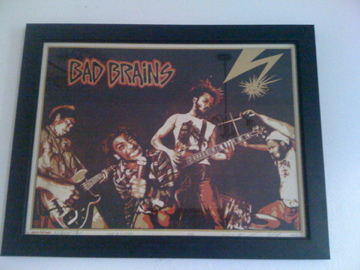
Friedman/Fairey collab that happens to hang in my living room

I didn’t expect to get so sucked in. I didn’t expect to get so inspired, and I certainly didn’t expect my interview with photographer Glen E Friedman to have anything to do with travel writing or blogging.

Which it didn’t, not explicitly. But in talking to Glen, crosslegged on my bedroom floor for over an hour one Monday morning, in asking him about his drives and motivations, about what inspires him and what doesn’t, I saw so many parallels to my own experience in the travel blogging world that I couldn’t help but write something up about it. Our chat served as a kind of check, about what really matters to me and what I really want to do with my writing.

Glen is old-school. Some would say “an idealist from a bygone era,” and I suppose I can appreciate where they’re coming from. But that wasn’t my experience with Glen. My experience was that he didn’t want to fuck around, that he didn’t want his time wasted by people who didn’t actually care or didn’t want to work hard, and that he truly truly believed in what he was doing and had done. And fuck if you can say that about a lot of people.

But in fact, the most personally inspiring part of my interview with Glen didn’t make it into the actual published interview (up in two parts, one and two, on Hi-Fructose). Because, well, an hour-long interview is really fucking long transcribed.

I was intrigued by Glen’s frustrations with the contemporary art scene, and asked him about it. He went on a kind of rant (homeboy can talk) and some of the lines he used I’d actually read in other interviews. But as he described the scene of it all, what is really the inherent bullshit in any artistic scene, I couldn’t help but think of what one writer dubbed “the circle jerk of travel blogging” (don’t worry, I won’t dog you out):

There’s definitely some people out there that are doing some good stuff—Shepard’s name goes to mind—but there’s a ton of shit out there too. And it makes it boring and frustrating to go to a museum or an art gallery and see the stuff that gets the credibility, because the people hobnob with the right people, you know, or they get high with the right people or had sex with the right people, or they’re just in the scene. I have a strange feeling that if you’re in the scene, then you’re probably not very good. It’s all about the emperor’s new clothes in art. I’d say maybe 5% of people actually have a real talent for what they’re doing and aren’t just getting over. And that’s in most of the fields, whether it’s in music or painting or any kind of craftsmanship that’s considered an art.

It’s a pretty bold position, but as he spoke, I replaced “art” with “blogging,” and well, the same held true.

“I don’t know what suddenly makes so many people artists these days,” Glen wondered aloud. He talked about a laziness, a getting-over attitude, enabled by the ease of having one’s voice heard these days; when he was young, you had to be really driven—you had to really want it. Everything was DIY, because there was no other choice. No one was making any money off their bands or their skating; you did it because you loved it.

It reminded me of my own beginnings in writing—the little callous on my thumb from the pencil ridge, fingertips covered in glue from making zines, waking up from a long night with bits of poetry scribbled across my arm because I hadn’t had any paper on me. I didn’t do it for page ranking, I didn’t do it to “travel the world and get paid”—I did it simply because I couldn’t imagine not doing it. Because there was a voice in me that would not be still.

And I wouldn’t say I’ve sold out or even sold myself short. But it’s easy to get caught up in the scene of it all. It’s easy to see all the recognition other people get and to want it too—to want something measurable, to drive traffic, something to point to: “See, it actually matters; what I have to say matters.” And if you’re a decent writer, it’s easy to write the kind of stuff people want to hear, that garners retweets and comments and link outs. And it’s even easier to get lost inside all that.

Glen’s always followed a higher call that went beyond this scene or that scene, the cool kid club. He’s done his work in order to inspire other people, and he’s really held himself to it. To be fair, he’s had the luxury to hold himself to it: he begun being successful at age 14, and has supported himself through his art his whole adult life. But despite that, there’s always always the opportunity to get lazy, to ride the gravy train, to put your images on a tshirt and make a fuckton of money cause who can’t use more money?

It’s also easy to get frustrated with the scene, to point the finger and scream (internally, of course), “For fuck’s sake, write something real, not just what’s easy or convenient! Write about what’s inconvenient, about what’s difficult and painful and scares the shit out of you.”

In my best of moments, I’d like to be able to take a more loving, tolerant approach. I’d like to not roll my eyes and shittalk (which I’m of course guilty of), but to somehow say to all those writers: “You’re fucking better than what’s easy, than what drives traffic, and you deserve to let that voice be heard.”

But I’ve got a big enough job just trying to hold myself to that standard. Cause, you know, I still have to pay the rent too. And I’m sure as hell not gonna do it transcribing Glen Friedman interviews. But what I will get from it is a reminder, like a small stone you can carry in your pocket and rub when you’re bored or lonely or nervous—of what it really is I want to do with my writing.

Americanness on the Road, Part II: It Ain’t All Bad

Yes, really: George W Bush Street, in Tirana

“America is the best country for a person with a disability to visit.”

This was Rob, sitting cross-legged on the roof terrace of the Tirana hostel. He continued, “For deaf people, it’s like a dream. It’s like going to Disneyland. Actually,” he ashed his cigarette, “Disneyland is great for people with disabilities too. Wheelchair accessibility and all.”

Chad looked confused. You could see the information smacking up against the wall of prejudice, his brow wincing from the pressure.

Chad didn’t like the US, and Chad was American.

Rob continued on, citing the revolutionary wonders of Civil Rights legislation and the Americans with Disabilities Act (ADA) in his English accent. Rob was in Tirana doing NGO work in the deaf community; Zhujeta, Rob’s girlfriend who helped run the hostel, also did work with the same NGO. Rob rattled off the comprehensive services available to deaf people in the US—from resources in public schools to telephone interpreters—vastly different from any other country in the world, including his native England.

Chad nodded, soaking it all in. “Wow,” he said thoughtfully. “I guess that’s one thing we didn’t fuck up.”

It’s easy for Americans to be jaded about our own country. There’s a lot of fucked-up shit going on in it, and we’ve caused a lot of suffering, both abroad and at home. It’s easy to fall into a sort of naive cynicism: our country is completely fucked. As young travelers, little ambassadors on hostel terraces, we feel it our duty to decry our country and lament its shortcomings, its sins, its unforgivable and deplorable acts. And there’s a lot to decry.

But it’s something like the Guilty White Person syndrome, the Bleeding Heart Liberal. This perspective—and God knows I fell prey to it for several years in my early traveling—lacks complexity, nuance. The US isn’t the evil empire, as easy and convenient as it’d be to think that. Just when you want to write it off, there’s something like the ADA to remind you of the revolutionary notion of equality written into the fabric, the very law of the land, that you can’t get away from—that, no matter how far we sway into the other side, keeps showing up and shaking things down.

It was funny to watch that information try to sort itself in the mind of someone who thought they’d neatly washed their hands of the issue: US = bad. Because the fact is, we only have ADA legislation as a product of Civil Rights legislation, and we only have that because of that little blip written into our constitution that declared all the men equal. Sure, it’s not what a bunch of rich white dudes in powdered wigs meant at the time, but too bad. And this is what, in my mind, makes our country such a complex, contradictory and ultimately fascinating place: this space for change, this tension built into it. That, and the incredible cultural cocktail that keep colliding, exploding, bubbling over and making something new.

It was even funnier to watch Chad struggle with the information that Bush Senior was the man who signed the ADA into effect.

Because things as big as people or countries are never that simple, never all one thing (“Do I contradict myself? Very well then, I contradict myself. I am large, I contain multitudes”—when in doubt, always quote Walt Whitman). It reminded me of a Middle Eastern friend of mine, an ethnic minority from Iraq, who told me her mother still thinks of Saddam Hussein as a great man, because he didn’t persecute Assyrians.

And there’s more than the ADA on the list of “things we didn’t fuck up.” But it wasn’t my job to teach or explain that to Chad; he’d have to figure it out for himself. I just sat back and watched the lightbulb turn on, a small flicker of awareness.

Later on, we sat playing music from someone’s iPod. “Welcome to the Jungle” came on, and I indulged in a moment of cheesiness. “To me,” I said, absently, not really thinking about it, “this is the epitome of America. This is what the US sounds like.”

Chad looked slightly taken aback. “What do you mean?”

“Well, it’s rock, good ole’ 80s hard rock. Which came out of rock n roll, which came out of the blues, which is about as fucking American as it gets. It comes from the core, you know, the soul of the country. And I fucking love it,” I added. “American music is my favorite music. In all its permutations—folk, country, soul, hip hop, grunge…”

“I guess I never thought of it that way,” Chad said. “I think of American music as, you know, the corporate Britney Spears shit.”

“Well, yeah, it’s that too. But that’s only a small bit of it.” I lowered my voice and leaned in. “No one can deny it: our music is pretty bad-ass.”

Americanness on the Road, Part I: Letting His Issues Be His Issues

“I hate your country’s politics.”

This was K, and this was the first thing he said to me.

We sat on the dark patio of a Tirana bar, table of ashtrays and beer bottles, the headlights and footsteps of surrounding streets obscured by a criss-cross fence. I’d arrived in the city only hours earlier, and had already found myself chasing fun with the group of people I’d hang with for the next five days.

K had just come in from Kosovo, in town for a gig where important record executives would be. He sang, or he played the guitar, or did both—it wasn’t clear. He had a red Adidas track jacket and the straw Fedora of male insecurity: a little too self-consciously cool.

He sat down at the table, said his hellos to old friends, was introduced to me. He asked where I was from, then crossed his arms, leaned back, eyes narrowed to a challenge, as if to say, “Come on, step to this, I dare you.” He announced his personal aversion to my country’s politics with smug satisfaction.

It was like K was trying to hand me a big bag of his bullshit. And I, in turn, got to firmly but without malice reply, “Actually, this is yours. And I’m just gonna let you hang on it.”

There was a time when I would have had to jump up and down to prove to K that I wasn’t one of those Americans. I would have cited my city of residence, my family’s long history in activism, personal lifestyle choices that reflect my commitment to anti-corporate, anti-imperialist values. I would have lamented the pervasive culture of ignorance and fear that paved the way for predatory politics, and when the bitch/blame-session reached its crescendo of discontent, I’d have thrown my hands up and announced my ultimate goal to marry someone with an EU passport and flee the whole mess.

I would have, in short, run laps to prove who I was to K, to win his validation and approval, this person I had just met, in some sort of attempt to resolve my own insecurity about my nationality.

Instead I shrugged, sighed, “Yeah, join the club, buddy.”

The rest of the tabled groaned at K. “What is that?” Robo asked, shoulders hunched and flicking ash, seeming a little uncomfortable at K’s underhanded assault on me. “That’s the first thing you say to someone?”

“Well, I do hate the US’s politics,” K defended himself.

“Yeah, but as the first thing to say?” Zhujeta cooed in her gentle, loving way. “Not even, ‘Nice to meet you.'” She titled her head in the same way as when she spoke to the begging gypsy kids that cruised past the table, “It’s rude, K.”

“Okay, okay,” K waved his hands as though they were little white flags. “Sorry, nice to meet you.”

I shrugged again. Whatever issue it was—whatever insecurity in K made him want to challenge someone, get them to prove themselves to him—I wasn’t going to get involved. That was between K and himself, not me. Or my Americanness.

God on the Walls: Abandoned Monastery Outside Grottaglie

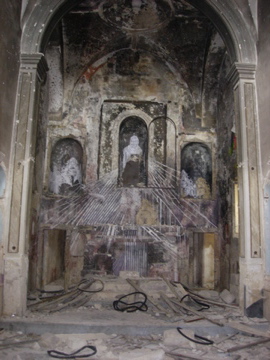
If you walk far enough down a dirt road outside of town; if you stalk through the weeds and sweatshirt-snagging thistles; if you scramble and heave and hoist yourself over a crumbly stone wall and follow the dent in the foliage that has become a path, you will find it: an abandoned monastery covered in art.

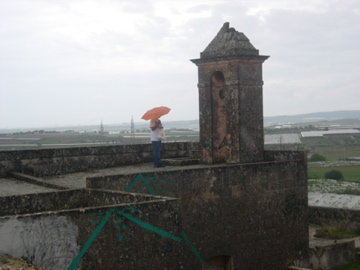
You will be on the roof. You won’t be sure how you got there. The storm will be moving in, and the countryside, the heel of the boot that is Puglia, will stretch out beneath the gray: plastic tarps over vineyards, farms, the coughing plumes of the factories of Taranto.

You’ll circle the perimeter of the roof with your new friends. You found them all—you found each other—like a rag-tag team of adventurers in some cartoon: Rebecca at a cafe, Pedro as you walked through the Old Town, then Greg as he feverishly rode a bicycle away from a herd of grazing animals (“Were they rabid?” “No.” “What were they doing?” “I dunno, they were just in the road. It was some weird country shit.”). You’ve all come alone, all flown from your various big cities to Grottaglie, for nothing more than the love of street art. And adventure.

And you will have gotten there. You’ll have gotten to the moldy, peely, crumbling core of What It Is You Came For. Over the last three years of Fame Festival, the abandoned Convento dei Cappuccini has amassed works by visiting artists on its decrepit old walls. It’s become something of a museum of anarchic awesome—where you crunch through the broken glass, through rooms and rooms with bleeding walls; down dank stairways where the mosquitoes buzz and the light don’t shine; down into the guts and internal organs of an abandoned holiness left to rot, left to reborn in the last gasps of its decomposition, its swallowing-back-up by the earth, by the weeds, by the green; left to the artists and the vandals and the punk little kids with bruises on their knees, to the foreigners that don’t speak the language but know that urgent lonesome in the howling of the wind, the coming of the storm, as it blows through the broken windows and walks alongside you.

Pedro on the roof

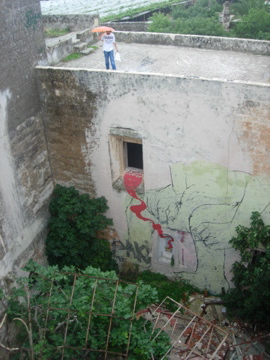
Courtyard

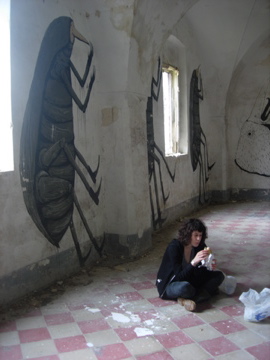
Panini break in the cockroach room

Cockroach close-up

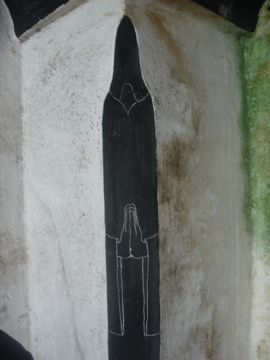
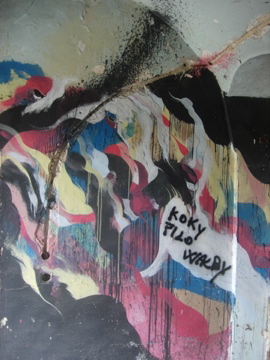
Where two walls meet

It’s not so much about the art, not the monastery or Fame or the streets of Grottaglie. It’s about the spirit, the breathing of new life into the forgotten, the love of the forgotten, saying, “Yes, yes, you can still be something beautiful to me.”

It’s exceedingly tender; it’s exceedingly unexpected that you would find this here: this vision of yourself in the walls of an abandoned monastery outside a small Italian town. As though every painting and stencil and shitty little tag were a message of love, saying, “Even in your wreckage, your falling-apart, your scars and wounds and ragged flesh—something can still love you enough to take the time, to do something beautiful.”

It’s what you like to think of God as. It’s how you’d like to treat yourself, as if you could love yourself as much as an abandoned monastery.

And it’s even more unexpected that you would find three friends to tromp around with you, to be as stoked as you, to love this place and this town and this art as much as you do.

You pause; you take a moment to take it all in, to file it away in the card catalog of your heart, to be able to call upon in those certain difficult times ahead, when you need something, just a little something, to remind you What It Is You Came For. You look around, smile, tuck it under the slot labeled “Best Travel Moments.”

And then you walk into the chapel.

For a far better visual representation, check out Bablegum’s video of their trip to the monastery. The music doesn’t really fit the experience to me—but in those moments when you hear the wind howl, that’s closer to what I felt in there.

Tower of Rubble, Kotor

The crumbled bones of a building rose up, tower some six stories, broken glass and exposed beams, cement like dead flesh. Covered in faded graffiti scribbles, a little bombed-out passage gave a dim glimpse: rubbish piles, sleeping stray cats, green growing from the tumble of rubble, left there as though bombed not some 20 years ago, but just a few months ago.

And laundry lines. Satellite dishes. People were living there.

Kotor was kind of a let-down. The guidebook gushed, but the city was boring to me. Sure, it was beautiful, but it was a manicured beautiful, a theme-park quaint—ancient wall uplit, facades restored, stones scrubbed clean—all in an effort, it appeared, to lure Western tourists an hour south. A new Dubrovnik.

And it appeared to be working. October, and the streets of Kotor’s Old Town were filled with busloads of snapshot takers. It was beautiful, beautiful, but there was nothing for me to hold on to, dig in to, grab ahold of. It felt slippery, like swimming.

So I walked to the bus station to see when the next bus out was. I saw the building—or rather, what was dirty and ragged and left of the building—and thought, Now this, this is something interesting.

Poking my head in didn’t suffice. I needed to see more.

I went around the building’s backside, a dirt road, squat brick structure covered in green foliage and gray tarps, huddling up alongside the tower of crumble. Run-down cars and makeshift workshops, the buzz of machinery and the yap of roped dogs, the slowness of people living their everyday lives.

Two people stood in a doorway, staring out at me. Not hostile, but observing, in that way we observe outsiders that are observing us—suddenly aware, self-conscious of our own reality. This is my life, the arms crossed over the woman’s apron seemed to say.

I smiled and shrugged sort of, pointed to the tower rising up behind their roof, a shadow or a ghost or a dingy kind of demon, a relic. The man, seemingly more amused, walked up to me.

He pointed to the tower, then around him, then right down to the ground he stood on, we stood on. “Bosnia, Serbia, no Montenegro.” He made the shape of an explosion with his hands, big, calloused, oil-stained hands, fingers arched wide, as if trying to contain a growing cloud. “NATO,” he explained, then pointed back to the blown-out tower.

I nodded.

He looked at me, and nodded slowly. We stood there like that, in the silence, having gone as far as our linguistic capabilities would allow.

I pointed to my camera. “Okay?” I asked.

The man nodded. The woman in the doorway laughed, shook her head, turned and went back inside.

I wandered further. I passed a man chopping wood. He stood between two massive piles, one cut, the other uncut. He paused to observe me, nodded slightly, went back to work.

I didn’t want to photograph them. I didn’t want to photograph these people I saw, living beside and inside this huge crumbled building, a relic of destruction, going about their tasks, looking out from their doorways at me. I didn’t want them to feel like they were on exhibit, like they were amusing or exotic to me. I just wanted to see them, to see what was really there, how people really lived in this town, what their lives really looked like.

A small face peeked out, blazing eyes around the pillar its body hid behind. I smiled at the boy. He turned away, as though he’d been caught, watching me observe his world.

I poked up a small ladder, peered in through the broken window—a makeshift carpenter’s studio, desk and a pile of wood, two stories. I gazed up through the gaping wound in the center of the building. Dim light came through ceiling, so many stories up.

I climbed back down the ladder. The little eyes were still watching me; I smiled and turned to walk away.

He came out behind the pillar. He glanced over at me, as if to say “watch me,” and I did. He ran up to the ladder. His small feet scampered up; he crouched down to crawl the fangs of glass.

He stopped, paused, only for a moment, to look back over at me. His eyes seemed to say, “Look. See. This is my life. This is my world. See me.”

I did. Or I tried to. I really just stood there and watched.

The boy ducked down through the window and was gone—him into his world, and me into mine.

Transit Fragments: Views from the Window

I. Bar to Ulcinj

Gypsy children at the intersection
bang on the windows
of stopped cars, pleading
/
until the windows roll up
and they see their reflections,
/
dirt-faced
and pleading back.

II. Ulcinj to Shkoder

Carry that girl
through the rubbish
and field of dead,
the rusted carcasses
of cars,
engineless
and humming wind.
/
Take her,
hold her
under your arm
(bare feet and unbroken skin)
/
Carry her
down that road,
carry her,
take her home.

III. Shkoder to Tirana

Mosques and minarets,
half-constructed buildings
(stairways
and skeletons
exposed)
stripped-down cars
left to rust
in lots of dying
/
A boy with the cheekbones
of an ex-boyfriend
huddles, mutters
into the mouthpiece
of his cellphone
and you can only see
half is face
(turn around
and show me the whole thing, honey)
/
Corrugated tin and tires,
teepee piles of hay
that look like the insides of scarecrows
with nothing left to scare
/
Yell your stop
to the driver, and rumble
that big door open
(wrench the metal
from the metal)—
pay him your fare
and be left there
on the roadside
of somewhere
/
a gas station
and a cheap umbrella


Lauren Quinn is a writer and traveler currently living in Hanoi. Lonely Girl Travels was a blog of her sola travels and expat living from 2009 to 2012. She resides elsewhere on the internet now.

Join 490 other subscribers

Buy This Sh#t

Categories