Archive Page 22

A Circle of Stones

“I believe that the land has memory—that the earth remembers the things it has seen.”

Lucille Clifton said that at a reading I went to as a teenager, in introduction to her poem “Auction Street,” about how it felt to stand at former slave auctioning blocks in Memphis. I hadn’t traveled yet, hadn’t experienced much outside of the Bay Area, but something in me knew she was right: that rocks and trees and dirt have memories, maybe even dreams—that they hold little pieces of their histories in them, stored emotions, tender and swollen as our own knotted muscles.

I kept thinking about that line, said in passing in some beaming wooden room years ago, on my last trip. Walking amid the wordless rocky ruins of an abandoned village with a heat in my chest and a trouble in my mind, nothing seemed truer. Because, after all, Hawaii is a tragic place.

I stayed along the Kona Coast, a barren, burned-out mound of volcanic rock where the resorts stand out like green sores: lush, overly landscaped swaths of palm and grass against the expansive silence of lunar black.

P. was supposed to be one of them. Not a resort, but a tract of vacation homes: 7 acres divided into 10 lots, like much else along the winding 3-mile road that led from the highway to the coast. The land had belonged to a Hawaiian family who, amid the 80s mad-dash of development, could no longer afford the property tax and was forced to sell the land to a shady enterprise. A wealthy philanthropist came into contact with the family, bought P. from the enterprise, and built a personal vacation home there. My brother married the daughter of a the philanthropist’s good friend—which is how I came to find myself vacationing in a private, ocean-side villa earlier this month.

Sure, there was a gym and a media room and a billiards room and WiFi and groundskeepers and a gated entrance. But it wasn’t like a private resort. Not really. Because something had been retained, kept, preserved—not bulldozed and landscaped over (just landscaped around). The place quivered with a peculiar spiritual energy that made me hippie-out on heavy vibage. (And feel like I was on Vicodin.)

P. had once been a small Hawaiian village, abandoned for unknown reasons around the time Westerns arrived. Through a kind of cheat-the-locals-out-of-their-land swindle, a family came into possession of the land in the 1930s when they swapped their more lucrative property on a lusher side of the island for the rocky tangle of coast. As they bush-whacked into the overgrowth, the family discovered the rock-mound remains of the old buildings, as well as a burial site for what was later determined by archeologists to be a chief. The family was old-school, and believed in respecting the ruins; they didn’t move a stone, but left it in homage to their ancestors.

When the philanthropist came into possession of P., he respected the original family’s wishes and built his home around the ruins. He hired the son of the family, T., to be the property manager, an effort to maintain the sacred integrity of the place and undo some of the bad mojo that had cheated the family from their land.

That was as much of the story I knew as I walked the property the first day. Barefoot, the thick grass felt like carpet, and the air was soft and heavy and feeling of paradise. The path of grass snaked between the ruins, dotted by dense tangles of native trees. Neon birds flitted past, and the weasels darted like small, hungry ghosts.

I approached a perfectly circular mound to the immediate right of the house. Shaded by trees and covered in the round shells of their nuts, it seemed like a particularly potent spot.

As I got closer, I felt a warmth in my chest, rising into the base of my throat—not entirely unlike how I remember that first sip of alcohol: the healing heat, how something from the outside got inside, and suddenly made me feel more whole, less empty and aching. It was a curious, jarring feeling, at once intensely comforting and, well, disturbing in its unapologetic power.

I steered clear of the spot for the next few days. Frankly, I was freaked out. There was plenty else to do: I floated around the pool in an inner tube, did yoga on the deck, lounged in a hammock and read my self-help book on love addicition and co-dependancy. I’d glance sideways at the mound, avoid it, like it were a person watching me with too-blue eyes: it had seen through me and sat waiting.

T. came over to attend to some maintenance issues one day, and we got to talking. He filled in more of the history of P.—how he’d spent his summers there as a kid, how his grandmother had always told him about the spiritual power of the place and how he’d always felt it, even during his wild party days. He talked about respecting the land, saying thanks and being in tune. He told a story about an owl that lived on the property, that may or may not have been the spirit of his deceased grandmother, that had once come out in the middle of the day to watch him repair some of the stones the archeologists had moved.

If it were a movie, T. would have been wearing a lion cloth and the lights would have dimmed when he spoke, the sound of far-off drumming accompanying his tales. As it was, he wore flip-flops and a t-shirt, wrap-around sunglasses and an American moustache.

“P. has always been a healing place,” he told me simply. “I’m just glad that G. bought it, and it was able to stay the place it had always been.” He looked around the stately furniture in the vaulted-ceilinged living room, the hint of a wistful smile in the lines around his eyes. It was a far cry from the rustic shacks of his childhood, but I knew what he meant: it turned out as best it could, for the situation.

“That mound over by the house,” I pointed. “What was that?”

“Heavy, huh?” T. smiled. “We don’t really know. The archeologists thought it might have been a women’s house. Either way, it’s got some of the most powerful energy here.”

Later, I went over to the mound. Thinking of what T. had said, I bowed my head a little and asked permission before I entered into the center. I sat down cross-legged and breathed.

I felt the heat come—not a burning, but a warmth. I tried not to fight it. (He left.) It reached down, to some very tiny place inside, a very old and glowing wound. (A black kitchen and a birthday cake.) I looked at the trees, imagined their roots reaching down, back, on in at something (purple sores, swallowed by black)—like the pulsing red roots of teeth, the throbbing behind the bones of things. (He was sick, I loved him, he left.) The wind was gentle but urgent, speaking in a language of leaves (if I could have loved them more), like a mournful ballad sung in a language you don’t understand. (And left me here: gone.) The stones scratched and the shells dug in.

I heard a hoot. My eyes shot open and my spine twitched.

I heard it again, a belly sound, a calling. I thought of T.’s story: his grandmother owl in the middle of the day, watching over him.

It could have been a dove, cooing at the wind. But in the center of that circle, the ancient black of rocks, it sounded like the voice of P., the voice of the past—whatever it was, still was, had been and was still being, despite the house and the sprinklers and walking of foreign feet: a place of healing. A place that could somehow get down, down into the tightly clutched hurt of things, and coo.

Does the earth remember what it was? Does it carry its past in special little pockets, like a wound we hardly remember, but keep reliving, searching to heal? Well, fucked if I know. All I know is that, with all its resorts and rental cars, Hawaii feels like a beautiful young girl who’s been forced to marry a man she doesn’t love—and P. feels like the place where she goes, not to weep, but to pretend, to dream, to whisper her fantasies to herself, in the voice of the wind.

Travel Tip: Wear a Fanny Pack

Much has been written about the fanny pack. Most of it is bad.

What began as a utilitarian fashion craze of the early 90s (shut up, you know you had one) has now been strictly relegated to the arena of unabashed tourist. Worse than Tevas, worse than zip-off pants, worse than wielding a guidebook or clutching a map or asking for directions loudly in English, the fanny pack is the ultimate signifier of clueless tourist. Just ask the people who write this blog.

But on my last trip in Austin, my good friend and travel buddy Liz presented a most compelling argument in favor of the fanny pack:

I guess it’s all in how you wear it.

Having trouble finding support in your fashion-forward revival of the fanny pack? Use your free hands to take solace at The Real Fanny Pack.

Beautiful: The Ridiculous Hair of Chaos in Tejas

Oh, kids these days…

Or actually, kids circa 1979. This year’s crowd at Chaos in Tejas was kind of like a time warp. I haven’t seen that many liberty spikes and back dreads since the hey day of the Telegraph Ave gutterpunk.

Now everyone loves a good Elmer’s glue mohawk with an anarchy symbol spray-painted on it. And who hasn’t shaved half their head before? It was like being a kid again…

By the end of it all, I wanted to wear a pink leotard and sparkly tights. To the dude who wore a tie-dyed t-shirt: rock on. You might have been the punkest of them all.

Confession: I Have Been a Bad Travel Writer

And it’s not just that my computer’s been stressing out and spinning that color pinwheel in endless stuttering frustration.

It wasn’t that I traveled with friends or that I didn’t leave the US. It wasn’t that I went to a crusty music festival, or that I lounged in a private Hawaiian villa, or even that I slept till noon and stayed out till 4am chasing boys in a leopard print miniskirt (successful method, btw).

It was that I never made the switch, flipped my brain over into traveler mode. I didn’t push myself to explore, to dig in, to muck around and get dirty in the soul of a destination (no, getting covered in other people’s beer and sweat didn’t count).

It wasn’t that I was a “tourist instead of a traveler”—I was worse. I was a vacationer.

If tourists are the people following around umbrella-wielding tour guides, clicking shutters and buying cheesy trinkets and (sin of all sins) wearing fanny packs, vacationers are their drooling, sedated counterparts. We could really care less about whether a tour is culturally authentic or not; we don’t have the energy to get off our asses and go in the first place. We go to the same cafe over and over, buy the same sandwich, because it’s good and why bother finding another spot? We spend an hour staring into space. It there were a Sitting and Staring Olympics instead of a half-Ironman while I was in Hawaii, I would have won. (I have photographs that document my decent, but I’m currently not even able to upload anything onto my computer.)

I haven’t vacationed in years, maybe not ever, really—guiltlessly wasting days away. No notes taken, no itineraries feverishly followed, no long rambles down alien streets. So it wasn’t just that I barely wrote any posts while I was gone—it was that I wasn’t even traveling.

I had fun, and I certainly still have stories to tell. And while I “got away from it all” (really, people are on to something with this whole vacationing thing), I didn’t get away from myself. I talked a couple months ago about how I like who I am better when I travel, how I become what feels like a better version of myself, freer and happier and more at peace, enthralled with my surroundings instead of the hamster wheel of self-will. And while I was certainly a more relaxed version of myself these last 11 days, I was still Home Me, not Traveler Me.

So that’s what my brain will be chewing on while my laptop’s in the shop—or rather, what my brain won’t be chewing on. Not articles or blog posts and pitches—just the image of what I stared at along the Kona coast, what’s burned into my retina, like the pink is onto my skin: a hammock, a horizon and a pile of black rocks. I’ll take my computer crashing as a sign, a circumstantial nudging that I need to take a step back and keep on being a bad travel writer.

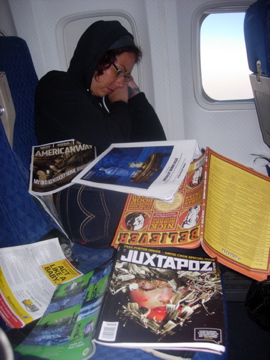
Travel Tip: Magazine Blanket (AKA: Stickin It to the Man)

Oh yeah, American Airlines? You wanna play dirty?

You’ve already taken away my peanuts and charged me for a checked bag—think you’re gonna bleed me a little more by cranking the air conditioning to Venezuelan-overnight-bus levels and charging $8 for one of those shitty blue blankets?

Well, I’m not skerd. I’ll make a hobo blanket out of magazines.

You’ve obviously underestimated my industrious frugality and lack of shame. Maybe next I’ll bring a can of beans and a hot plate, and make my own in-flight meal.

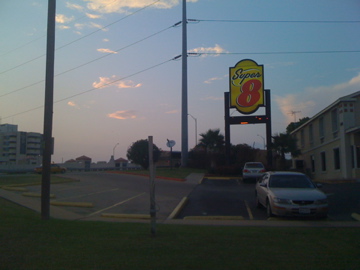
Sunset at the Super 8

Dusk and the birds come out.

Diving dark bodies against a fading pink—the kids are getting ready.

Ripples in the pool, empty cups and sagging neon intertubes, nodding “yes, yes.”

Drums and distortion and a screaming rage, rattling out of too-small speakers, a half-open door. Hanging over the rail of the balcony, smoking and slouching, bad postures and back patches.

A bird swoops, circles, disappears inside a nook under the drain pipe—small squabbling voices: hungry. Ready to be fed.

Skateboarding in the parking lot of the Super 8 as the light fades: pink and darkness stretching, chasing, reaching for the sun and consuming the city instead.

Night is coming, the shows are starting, the air exhales and a breeze from no particular direction blows across the pavement, the hot stretch of steel, winking windshields, “yes, yes.”

The birds keep circling, searching for something to take between their beaks. They are only aware of their wings, the wind—not of their dancing or the shape it makes against the sinking Austin sky.

Chaos to Kona: This Will Be Epic

SFO –> AUS –> SJC –> LAX –> KOA –> LAX –> SFO: This will be epic.

It happened like this: my brother’s family was going to Hawaii. It’s an annual thing. My sister-in-law has a good family friend who is famously, fabulously wealthy, and owns a private villa along the Kona coast (“It’s like your own personal Four Seasons,” my parents told me). They go down and stay at the house every year, usually with a big group of people in January (when you can watch the migrating whales from the pool deck). The imminent arrival of my new baby niece pushed the party back till the end of May this year, which gave me enough time to scrape together airfare and justify taking a proper vacation (travelers don’t vacation, see below…). I roped my hard-working best friend into getting some time off from her fancy scientist job and come along with me.

Aside from the not-paying-for-a-place-to-stay bit, it’s kind of the classic American vacation: a relaxing one-week Hawaiian beach vacation. We’re renting a car (which I’ve never done while traveling), traveling with family, have nothing on the agenda other than morning yoga, noontime naps and all-day sunbathing. Which means, of course, it was nearly impossible to justify. I don’t relax when I travel; that’s not the point. If I need to relax, I’ll sleep till noon and go eat ice-cream cones in Dolores Park. I travel to see the world, dig in, explore, run myself ragged on third-class busses. When I travel, virtually no sacrifice is too big: I’ll bankrupt myself, take as much time off work as I can without getting fired. But when it came to taking 5 days off work and spending $436 to fly to Hawaii, I balked. It seemed like a lot to do nothing, learn nothing, gain nothing but a couple pounds from my brother’s bad-ass cooking.

I took it on as a sort of spiritual challenge: a traveler vacationing. In a lot of ways, it’s going to be my first vacation in 5 years. Unwinding, unplugging. But of course, I’ll have to write about that. And bring my laptop along. And then a friend gave me some tips on non-touristy places to go on the Big Island. An independent traveler tackling the most touristy place in the US? Sounds like a killer article…

Already, I was chipping away at the “vacation” element of my vacation. And then came Chaos.

It’s the dirtbaggiest, DIY-est music festival of the year. Organized by one dude with a blog and Xeroxed flyers, Chaos is Tejas brings out some of the biggest names in punk/crust/sludge/metal for four days of sheer debauchery in Austin, Texas. Friends had been road-tripping out since its inception 6 years ago. I finally went 2 years ago, and partied like I was 15 (minus the malt liquor and methamphetamines). I stayed with a tattooer/artist friend of mine, and ran around the streets till 4 in the morning, lighting off fireworks at after parties and making out in the back of a truck with some dude while his friends careened us around the city. And that was stone-cold sober.

I remembered the festival as being in early May. A tight squeeze, but I could fit it before Hawaii, right?

Turns out Chaos in Tejas (which has entered the digital age this year with a Facebook page) is Memorial Day weekend. And I was leaving for Hawaii on that Sunday. Some friends were planning to drive out. A hair-brained scheme began to hatch.

The road-tripping part had to get chopped out, but here’s how it’s ended up working out:

Wednesday: Fly to Austin with Liz and Melissa.

Thursday – Saturday: Rock our effing brains out. Killer bands from all over the world playing nearly 20 different shows. 3 single girls in a sea of crusty boys: think “Girls Gone Wild,” but with more tattoos.

Sunday: Fly from Austin to San Jose. Meet Alicia at the airport. Fly from San Jose to LA, where we’ll connect and fly to Kona. Grab our rental car and traverse the dark turns of some deserted highway, arriving at the gate to the mile-long driveway.

Monday-Saturday: Chill-ax.

Saturday night: Red-eye back to LA.

Sunday morning: Fly back to San Jose. Get a ride back to Oakland. Be at work by 2:30.

It’ll be one end of the spectrum to another: ridiculous partying to ridiculous relaxing. Punk rock shows to private properties, dirtbags to nieces, stinky clubs to island paradise. 11 days, 2 destinations, 7 flights, 1 rental car, 3 girls in 1 cheap hotel room, 15 people in 1 oceanside villa, 99 bands and 1 me to live (and write) it all.

Monetization Madness: Horn Players, Slam Poets and Why I Turned Down an Opportunity to Make Money on My Blog

From Flickr, not my stats

Yesterday I turned down an opportunity to make money on my blog.

Ridiculous, right? Isn’t that what every travel blogger wants? Isn’t it the dream that keeps us clicking fingers over keyboards and battling faulty WiFi connections around the planet: to fund our travels through a well-trafficked and heavily monetized blog? Click-throughs, AdSense, commissions. SEO and analytics and Top 100 badges. “Travel Blog Success,” “Monetize Your Blog,” “8 Steps to Building a Profitable Blog that Funds Your Travels.” Purchase an eBook, book a hostel, buy a flight. “Get advertisers contacting YOU.”

Well, I did. Without trying. And I shot them down.

It all happened, as most things do, via Twitter. A travel service that I actually have used and like contacted me wondering if I’d like to be a part of their “exciting new campaign.” “I’m hoping that we can create a relationship in which I email over exciting news, offers and competitions that (nameless company) has over the year so that you have some new content for your blog.” So, um, do you want to place ads or have me write posts related to your promotions on my personal blog? “The latter.”

It would have been easy and relatively painless. And also goddamn boring, both to write and to read. And if I wouldn’t want to read it, why would I want to put it up on my own blog? To improve traffic and make a little cash? I do contract work writing what is essentially marketing content for a trip-planning site. I pour hours into crafting pitches for sellable articles. I fucking wait tables. Why am I gonna compromise on the one place, the one thing, that’s really mine?

It sounds snarky, but that’s really just a defense mechanism for feeling unsure of my direction and a little jealous. Why jealous? Because if your goal is a have a successful and profitable travel blog, the trajectory is much more clear, much more linear: write on these topics, have a couple give-aways and contests, become an expert in something, brand yourself—get in where you fit in and get paid. There’s nothing wrong with that; being self-supporting through a blog is actually pretty bad-ass. It’s just that, when I browse through the most trafficked travel blogs, I realize that they’re (for the most part) not doing what I want to be doing. Which, I’m beginning to suspect, is write first-person narrative inspired by travel.

Trip-planning has its place. When I’m getting ready to go on a trip, I want to know what to pack and what buses to take and Top 10 tips and Top 10 undiscovered gems and Top 10 Top 10s. But that’s not what I want to write, not where my heart is. The travel blogs that I love and read regularly aren’t the most popular ones; they’re narrative-driven, thought-provoking and literary.

My blog is still young, in utero, 9 months old and dreaming fetal dreams of personage. “What kind of readers do you want to attract?” a friend of mine who’s helping me redesign my site asked months ago. “What are people coming to your blog for?” I’m starting to figure it out. And ads and stats don’t have much to do with it.

When I was in high school, I spent a lot of time doing Poetry Slams. The spoken word scene was popping off, Bay Area underground hip-hop was at its height, and every kid who could string a rhyme was taking to the stage. I took after-school workshops with an excellent literary non-profit and performed what felt like once a week. But I wasn’t a Slam poet. I couldn’t beat box, couldn’t freestyle (unless I was seriously faded), wasn’t a performance artist. I read Sylvia Plath and Charles Bukowski; instead of quoting Mos Def in my pieces, I quoted William Burroughs.

I learned, early on in that, to be okay with what I was. And that the kids that got all the applause and won all the competitions weren’t producing work that was necessarily any better or worse than mine—just different. A lot of it was bullshit, and a lot of it was really good. I met kids that weren’t into the scene of it all, but loved writing—kids I still keep in touch with and whose work I still respect. I’m immensely grateful to have been a part of that community, even if my own addiction-drenched lyrical poetry didn’t ever fit in, prompted more raised eyebrows and dead silences than standing ovations.

I’m finding myself again in the same situation. There’s a lot of great travel blogs out there, and I’ve “met” a lot of great writers. There’s really this awesome, supportive community out there, and I’m glad to be a part of it, however tangentially. But again, as usual and as always, what I’m doing and my vision of where I want to go doesn’t align with the dominant trend—isn’t raking in perfects 10s and bringing down the house. And again, I’m learning to be okay with that, and to stay true to myself.

When I was a teenager, amidst all the Slam Poetry woo-hah, I saw a documentary about Wynton Marsalis. He was talking about being a childhood prodigy, how he’d learned some fancy trick that horn players are hip to but audience go nuts for. He did it at a show and the crowd lost their mind and he basked in the thunder of their adoration.

After the show, on his way home, his dad was real quiet. Finally, he said, “Son, if you play for applause, that’s all you’ll ever get.”

I’ve kept that one with me all these years. And I’m still not performing for applause—or writing for advertisers.

Travel Fantasies, Work Realities and Impulsive Plane Ticket Purchases

Last week I found myself entrenched in 8 straight days of work. So I did what any rational, well-adjusted person would do—I bought plane tickets to Italy.

I got a new job. (You know, those things us writers and artists do for rent money.) It’s a good job and I wanted it bad. It’s a major step up from the place I’d been for the last two years, one of the foodier (yes, I just made that a word) restaurants in the East Bay, full of good vibes and positive people and no ex-boyfriends. But it’s put a hitch in the go!-go!-go! giddy-up of my travel plans. So, instead of reconciling the home versus travel conundrum stretched taut beneath the surface of nose-to-the-grindstone work days, I went for the fast and easy fix: late-night impulse buying. On Orbitz.

Timing is a funny thing. Three days before I was called in to stage, I was about to buy my tickets to Southeast Asia. Like seriously about to hit the “purchase” button. I’d been saving, had tracked down a friend in Hanoi, had plotted out a vague itinerary. But something told me to wait. This is notable because nothing ever tells me to wait, especially when it comes to travel. It persisted, like the even but firm voice of an old school teacher. Well, shit, I thought, I guess I’d better listen.

I told myself that my consolation, if I didn’t get the job, was that I’d buy those tickets. But I did get the job. And contrary to what some people still seem to think, waiting tables isn’t a no-brainer gig for ditzy cute girls, especially in the Bay Area. I received 20 pages of wine and liquor notes to memorize (read: spending all my time not actually at the job pouring over my flash cards—go ahead, ask me about the dominant Sicilian varietals, I dare you). Training at one location while phasing out of my last job, then training at another location while working my first shifts at the new spot—it added up to more work than I’d busted out in a couple years. I felt immersed in work, distant from my writing, and even more distant from travel.

It’s not, I’ve told myself, that I’m canceling my Southeast Asia trip, just postponing it a few months. The weather, I’ve consoled myself, will actually be better in the winter anyway. And in the meantime, I’ll head out on shorter jaunt to an amazing sounding street art festival in Italy. I’ve given myself three weeks, which means I’ll have roughly two weeks after the festival to cruise (literally) over to Montenegro, Albania, maybe even trek all the way to Istanbul if I get the gusto. For most people, I’ve reassured myself amid sheet-tossing attempts at sleep, this would be one of the epic trips of their lives. For me, it’s a tide-me-over until my real trip. That’s not bad.

But something doesn’t sit right. It’s either all an elaborate cop out, or else I’m exercising some degree of acceptance that feels entirely too mature.

On my first trip out of the country, I went to Buenos Aires. I’ve been dreaming of going back ever since. It’s been my ultimate goal, in various imaginings, to move there, live there. But there’s always some trip to come first, one more thing I’ve got to do. It’s been “next year” and “next year” and finally, it’s been five years and I’m nowhere closer to packing up and moving than I was when my plane took off from the Argentina earth.

I recently read Revolutionary Road, which completely rocked my world. In it, the main characters have this plan to move to Paris. It’s going to solve all their problems, set them free of the confines of 1950s suburban America. But the guy in the story just can’t break loose. He doesn’t have the guts, is a little too comfortable in the familiar misery. He accepts a good job, assures himself and his wife that Paris is merely postponed. Then everything falls to shit.

It’s not that my life is going to become Revolutionary Road. (Mostly because of modern-day divorce and abortion rights.) But there are some striking parallels, no? Maybe I don’t have it in me. Maybe I’m too attached to the comforts and predictabilities of home to break loose and do some serious long-term traveling. Maybe I’d gotten a little too close the last few months, working part-time and focusing on my writing and having some successes. Maybe I wanted a reason, an excuse, something to anchor me in the familiar. Maybe Buenos Aires will just be a little fantasy I harbor, in the reddest part of my heart, until the fire of it dims and it becomes one of those youthful fancies we raise a half-smile to. Maybe it’ll become that dream deferred.

Or it could be that I’m accepting my life—my real life. (You know, that thing that happens while we’re making other plans.) Barring some unforeseen stroke of overnight success, I won’t be supporting myself writing anytime soon. Best case scenario, I’ll be waiting tables for a least another few years, and better to do it at a solid, legit place that I really like instead of being unhappy in a place that’s steadily sliding downhill. I love travel, but this is as much of my life as the galavanting-around-the-planet part. Maybe it’s more.

At the end of every yoga class I go to, they ring the Tibetan singing bowls and read an inspirational quotation. (You know, that hippy shit you like to scoff at but find yourself contemplating later.) It’s cheesy as hell, but the one they’ve been on lately seems to be speaking to me, in that bang-you-over-the-head-with-symbolism way we like to think only happens in novels:

For a long time it had seemed to me that life was about to begin—real life. But there was always some obstacle in the way. Something to be got through, some unfinished business, time still to be served, a debt to be paid. At last it dawned on me that these obstacles were my life.

Damn yoga, damn good jobs, damn my own ideas of what my life should look like and be like and feel like. Buenos Aires or not; Southeast Asia or not; having a successful travel blog or supporting myself writing or just being a goddamn waitress for the rest of life. Either way, I’m still pretty happy, and still lucky as hell. And going to Italy to boot.

Domestic Travel for the 25% Club

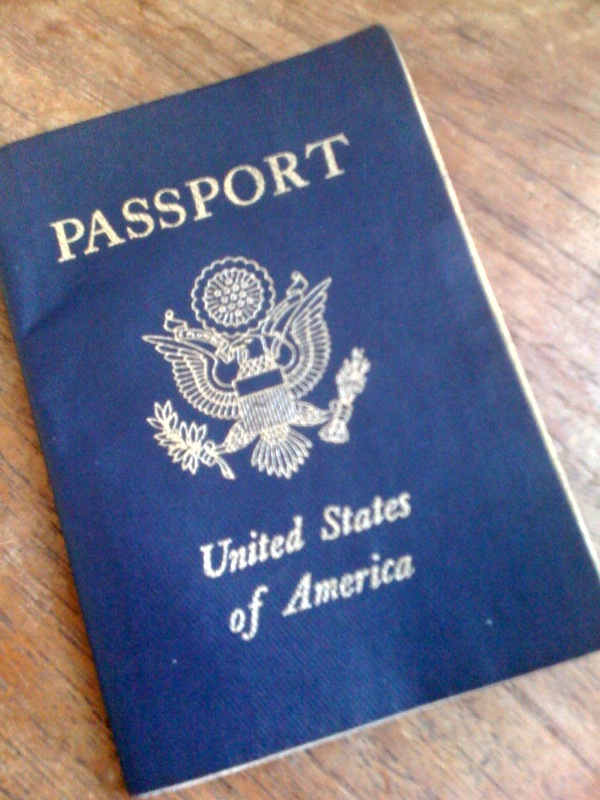
It’s a tired, tongue-worn statistic that staggers gasping into travel discussions across the internet: only 25% of Americans hold passports.

Usually meant as a sad accounting for the geographic and cultural ignorance of Americans, it has the opposite effect on those of us in that illustrious quarter percent. We are the daring, the open-minded, the shrewd and worldly elder all the glowing faces at the campfire are huddled around. We have seen the world, and we have stories to tell. (Whether you not you really want to listen.) The only real travel is international travel—all else (minus the notable exception of New York City) is a petty bourgeois venture in the money-sucking heart of homogeneity.

“Is domestic travel really travel?”—it’s the kind of inane question that you unwittingly discover yourself debating (with yourself) over a slice of open road and steaming cup of gas station coffee. Travel within one’s own country is never an exotic thing—a kind of half-traveling, going through the motions, faking the orgasm of discovery. But when you’re American, and that country is a sprawling continent composed mostly of people who never leave it, domestic travel can sometimes seem like the antithesis of travel: giving up, giving in and coping out. And paying entirely too much for hotel rooms.

I got to thinking a lot about domestic travel on my very unglamorous, utterly unworldly last trip: driving through Southern California. It was so different from the type of travel I’d been doing the last few years: I had my car, I spoke the language, could use my cell phone and credit cards. There was no hassle, no “other”—but it most definitely was still travel. And now, as I’m getting ready to dash off to one equally unexotic locale (Texas) and the ultimate “paradise without a passport” destination (Hawaii), I’m thinking even more about what domestic travel means as an American.

I didn’t grow up traveling. International travel was one of those unfathomable luxuries of the wealthy. So when I left the US for the first time, it was literally like the world opened up to me. This occurred during a very dark time—namely, Bush’s presidency. The prevailing image of America, and Americans, was pretty much everything I was against. I wouldn’t go so far as to say I was Canadian when abroad, but I didn’t want to be associated with anything American: capitalists, Christians, blond suburban girls. I was also broke, so traveling in places where rooms cost $7 a night was pretty much the only way to go. Thus, I left the country more than I left the immediate Bay Area and my ignorance went inverse: I knew the geography of Latin America better than the Midwest.

It’s true that the political tide has shifted, but it’s more than that. There’s so much to be against in the US—imperialism, corportatization, people who don’t believe in evolution—that it’s easy to forget all the good things. Our art is amazing; from hip-hop to punk rock to graffiti, pretty much everything I love was spawned out of the raging, pulsing cultural cocktail that is the United States.

And when I travel here, at home, I’m more able to dig in to those things that interest me—poke and scratch beneath the surface and get closer to what it means to be this, from this, born out of this. It goes beyond using the Yelp app in my phone to find a good coffee shop (which is goddamn useful). It goes beyond even just speaking the language, or doing so without an accent. Because I know the culture, am the culture, I know how to approach people, how get right in there and smile and make friends and discover cool shit I wouldn’t otherwise be able to.

The number one benefit of traveling within my own country is that I’m more able to dig in to what really fascinates me: people, how they live, the weird art/shit they make and the stories it tells. Domestic travel is a totally different beast from international, and I gotta admit that you don’t get the same knock-you-over-the-head rush. Rather than exploring the “other,” you’re exploring the known, and in that way, exploring yourself.

What does it really mean to be American? I used to think it had mostly to do with narrow-mindedness and consumerism. Maybe I’m just a cheeseball, maybe the Obama campaign really did give me some kind of hope, but I think it’s something much deeper than all that. I’m not sure what all it is, this being American, but I’m certain that somewhere down near the core of it is travel. There’s something very central about travel to the American psyche, a kind of open road that flows through the veins of the place, a Manifest Destiny born into us, to set wheels over earth. Stagecoaches, trains, automobiles, a country based upon more, upon Going West and Getting Yours. It’s not the jet-set , passport-stamping kind of travel. It’s visceral, grounded, rooted down into the earth, the dusty, craggy, bayoued and fertile earth.

Perhaps I’m settling into myself. Perhaps I’m just becoming accustomed to being a traveler and building a life around travel; being a member of that elite 25% isn’t so much a novelty anymore, it’s my life. I’m not the anxious teenager with a self-conscious mohawk; I’m the cranky old punk who doesn’t give a shit about dental-floss-sewn patches and would rather go to bed than party/do blow backstage (an actual anecdote from my weekend). And while my heart is in international travel, it doesn’t mean travel within the US is a waste of time and money (what I honestly used to think). It’s just a whole different experience, uses a whole different side of the brain.

Besides, what other country has Chaos in Tejas? (I’ll see you in the pit.)


Lauren Quinn is a writer and traveler currently living in Hanoi. Lonely Girl Travels was a blog of her sola travels and expat living from 2009 to 2012. She resides elsewhere on the internet now.

Join 490 other subscribers

Buy This Sh#t

Categories